Cloud Computing By  Ankita Mathur
What is cloud computing? Computing power ‘On demand’ to customers. History : 1960 John McCarthy predicted that someday computing will be organised as a public utility Grid computing -> Cloud computing Cloud computing: A set of technologies that allows computing applications and data to be exposed as a set of services from a pool of underlying resources.
 
Foundation of cloud computing Data centers (servers, storage, networking) Business applications and middleware Virtualization softwares Operating systems
‘ Pay as you go’ basis   Entire workload shifts to the cloud, so the local computers are not burdened with running hundreds of applications anymore All that a user needs is a system interface software, like a simple web browser to be run on their side MAJOR BENEFITS: Scalability Lower infrastructure cost Better utilization
Trends in cloud computing Accr. To IDC : By 2012 20% of the businesses will own no IT assets. During the coming 10 years, data stored in various storage systems will increase by 44 times, with the current rate of growth. But it won’t be possible for enterprises to scale up their IT budgets and infrastructures at the same speed. Saving in time : No planning and cost estimates for hardware required.
Cloud deployment models Public cloud (Resources provided by a service provider :Email etc.) Benefits:  Pay only for what you use and for the time you use No need to worry about the underlying IT infrastructure No security patches or updates to apply No software upgrades Best option for SMEs Hybrid cloud
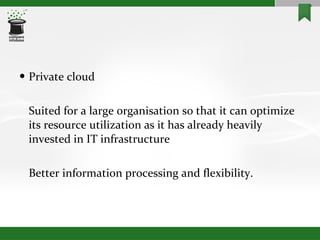
Private cloud Suited for a large organisation so that it can optimize its resource utilization as it has already heavily invested in IT infrastructure Better information processing and flexibility.
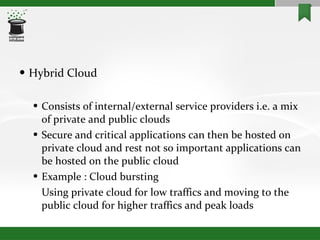
Hybrid Cloud Consists of internal/external service providers i.e. a mix of private and public clouds Secure and critical applications can then be hosted on private cloud and rest not so important applications can be hosted on the public cloud Example : Cloud bursting Using private cloud for low traffics and moving to the public cloud for higher traffics and peak loads
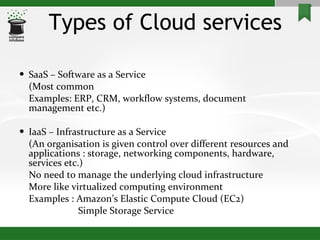
Types of Cloud services SaaS – Software as a Service (Most common Examples: ERP, CRM, workflow systems, document management etc.) IaaS – Infrastructure as a Service (An organisation is given control over different resources and applications : storage, networking components, hardware, services etc.) No need to manage the underlying cloud infrastructure More like virtualized computing environment Examples : Amazon’s Elastic Compute Cloud (EC2)   Simple Storage Service
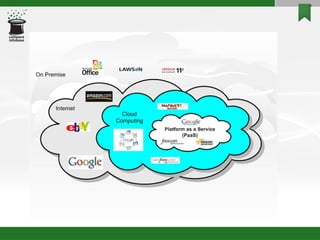
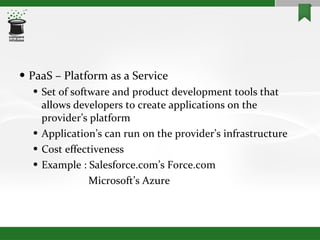
PaaS – Platform as a Service Set of software and product development tools that allows developers to create applications on the provider’s platform Application’s can run on the provider’s infrastructure Cost effectiveness Example : Salesforce.com’s Force.com   Microsoft’s Azure
Cloud computing : how it works? Cloud computing is creating a fundamental change in computer architecture, software and tools development, and of course, in the way we store, distribute and consume information. only a different way to deliver computer resources, rather than a new technology Internet-based computing Computers in the cloud are configured to work together and the various applications use the collective computing power as if they are running on a single system.
Online Desktops Before cloud computing, websites and server-based applications were executed on a specific system. Why the rush to the cloud? There are valid and significant business and IT reasons for the cloud computing paradigm shift. The fundamentals of outsourcing as a solution apply.  Reduced cost:  Cloud computing can reduce both capital expense (CapEx) and operating expense (OpEx) costs because resources are only acquired when needed and are only paid for when used. Refined usage of personnel:  Using cloud computing frees valuable personnel allowing them to focus on delivering value rather than maintaining hardware and software. Robust scalability:  Cloud computing allows for immediate scaling, either up or down, at any time without long-term commitment.
Comparing self-hosting and cloud hosting Almost 3 cents/hour for electricity alone  not taking into account: labor, server hardware amortization, data-storage costs (replacing a failed disk), cooling costs,  ISP  costs, security costs (routers, firewalls, etc.), power backup costs (a UPS) and so on. Mark notes that he could have probably bought a newer more energy efficient server – but the required investment would not justify the savings. The shocking part is that the recent price competition of cloud infrastructure (IaaS) and platform ( PaaS ) vendors took the current cloud servers costs to roughly the same order of costs. Here’s a quick survey of a few major cloud players:
Microsoft  is rolling out their  5 cent/hour  option (with additional  further discounts if you pre-pay for reserved use  – e.g. say you have a bunch of instances which you have running all the time and you are willing to pre-pay for the next few months). Same thing with  Amazon : minimal price (although for a slightly more limited version) is already in  2 cent for Linux / 3 cent for Windows  instance area, with reserved/pre-paid option getting as low as  0.7 cents/Linux & 1.3 cents/Windows . Rackspace  pricing  starts at  1.5 cents/hour for Linux , and  8 cents/hour for Windows .
Cloud Services Eyeos.com Beta.cloudo.com Jaycut.com Meebo.com Pixlr.com Aviary.com Google docs Amazon EC2 cloud
Creating your own private cloud Cloud server and cloud controller node needed Configuring virtual machines Ubuntu 10.04 OS Use either eucalyptus or make your own
 

Cloud Computing

  • 1.
    Cloud Computing By Ankita Mathur
  • 2.
    What is cloudcomputing? Computing power ‘On demand’ to customers. History : 1960 John McCarthy predicted that someday computing will be organised as a public utility Grid computing -> Cloud computing Cloud computing: A set of technologies that allows computing applications and data to be exposed as a set of services from a pool of underlying resources.
  • 3.
  • 4.
    Foundation of cloudcomputing Data centers (servers, storage, networking) Business applications and middleware Virtualization softwares Operating systems
  • 5.
    ‘ Pay asyou go’ basis Entire workload shifts to the cloud, so the local computers are not burdened with running hundreds of applications anymore All that a user needs is a system interface software, like a simple web browser to be run on their side MAJOR BENEFITS: Scalability Lower infrastructure cost Better utilization
  • 6.
    Trends in cloudcomputing Accr. To IDC : By 2012 20% of the businesses will own no IT assets. During the coming 10 years, data stored in various storage systems will increase by 44 times, with the current rate of growth. But it won’t be possible for enterprises to scale up their IT budgets and infrastructures at the same speed. Saving in time : No planning and cost estimates for hardware required.
  • 7.
    Cloud deployment modelsPublic cloud (Resources provided by a service provider :Email etc.) Benefits: Pay only for what you use and for the time you use No need to worry about the underlying IT infrastructure No security patches or updates to apply No software upgrades Best option for SMEs Hybrid cloud
  • 8.
    Private cloud Suitedfor a large organisation so that it can optimize its resource utilization as it has already heavily invested in IT infrastructure Better information processing and flexibility.
  • 9.
    Hybrid Cloud Consistsof internal/external service providers i.e. a mix of private and public clouds Secure and critical applications can then be hosted on private cloud and rest not so important applications can be hosted on the public cloud Example : Cloud bursting Using private cloud for low traffics and moving to the public cloud for higher traffics and peak loads
  • 10.
    Types of Cloudservices SaaS – Software as a Service (Most common Examples: ERP, CRM, workflow systems, document management etc.) IaaS – Infrastructure as a Service (An organisation is given control over different resources and applications : storage, networking components, hardware, services etc.) No need to manage the underlying cloud infrastructure More like virtualized computing environment Examples : Amazon’s Elastic Compute Cloud (EC2) Simple Storage Service
  • 11.
    PaaS – Platformas a Service Set of software and product development tools that allows developers to create applications on the provider’s platform Application’s can run on the provider’s infrastructure Cost effectiveness Example : Salesforce.com’s Force.com Microsoft’s Azure
  • 12.
    Cloud computing :how it works? Cloud computing is creating a fundamental change in computer architecture, software and tools development, and of course, in the way we store, distribute and consume information. only a different way to deliver computer resources, rather than a new technology Internet-based computing Computers in the cloud are configured to work together and the various applications use the collective computing power as if they are running on a single system.
  • 13.
    Online Desktops Beforecloud computing, websites and server-based applications were executed on a specific system. Why the rush to the cloud? There are valid and significant business and IT reasons for the cloud computing paradigm shift. The fundamentals of outsourcing as a solution apply. Reduced cost: Cloud computing can reduce both capital expense (CapEx) and operating expense (OpEx) costs because resources are only acquired when needed and are only paid for when used. Refined usage of personnel: Using cloud computing frees valuable personnel allowing them to focus on delivering value rather than maintaining hardware and software. Robust scalability: Cloud computing allows for immediate scaling, either up or down, at any time without long-term commitment.
  • 14.
    Comparing self-hosting andcloud hosting Almost 3 cents/hour for electricity alone  not taking into account: labor, server hardware amortization, data-storage costs (replacing a failed disk), cooling costs,  ISP  costs, security costs (routers, firewalls, etc.), power backup costs (a UPS) and so on. Mark notes that he could have probably bought a newer more energy efficient server – but the required investment would not justify the savings. The shocking part is that the recent price competition of cloud infrastructure (IaaS) and platform ( PaaS ) vendors took the current cloud servers costs to roughly the same order of costs. Here’s a quick survey of a few major cloud players:
  • 15.
    Microsoft  is rollingout their  5 cent/hour  option (with additional  further discounts if you pre-pay for reserved use  – e.g. say you have a bunch of instances which you have running all the time and you are willing to pre-pay for the next few months). Same thing with  Amazon : minimal price (although for a slightly more limited version) is already in  2 cent for Linux / 3 cent for Windows instance area, with reserved/pre-paid option getting as low as  0.7 cents/Linux & 1.3 cents/Windows . Rackspace pricing  starts at  1.5 cents/hour for Linux , and  8 cents/hour for Windows .
  • 16.
    Cloud Services Eyeos.comBeta.cloudo.com Jaycut.com Meebo.com Pixlr.com Aviary.com Google docs Amazon EC2 cloud
  • 17.
    Creating your ownprivate cloud Cloud server and cloud controller node needed Configuring virtual machines Ubuntu 10.04 OS Use either eucalyptus or make your own
  • 18.