All information in this presentation is proprietary to CRGT.
Cloud Computing & Benefits
Madhu Vattipulusu
09/25/2015
Session Objectives
• Explore cloud computing and different models
• Look at Top Cloud Providers/companies in Cloud
Computing
• Top 2 Cloud Providers Products/Offerings
• Cloud Use Cases
• Deep dive in one of the cloud providers offerings
• Demo
2 October 2015 | 2 | © 2015 CRGT Inc.
Cloud Computing
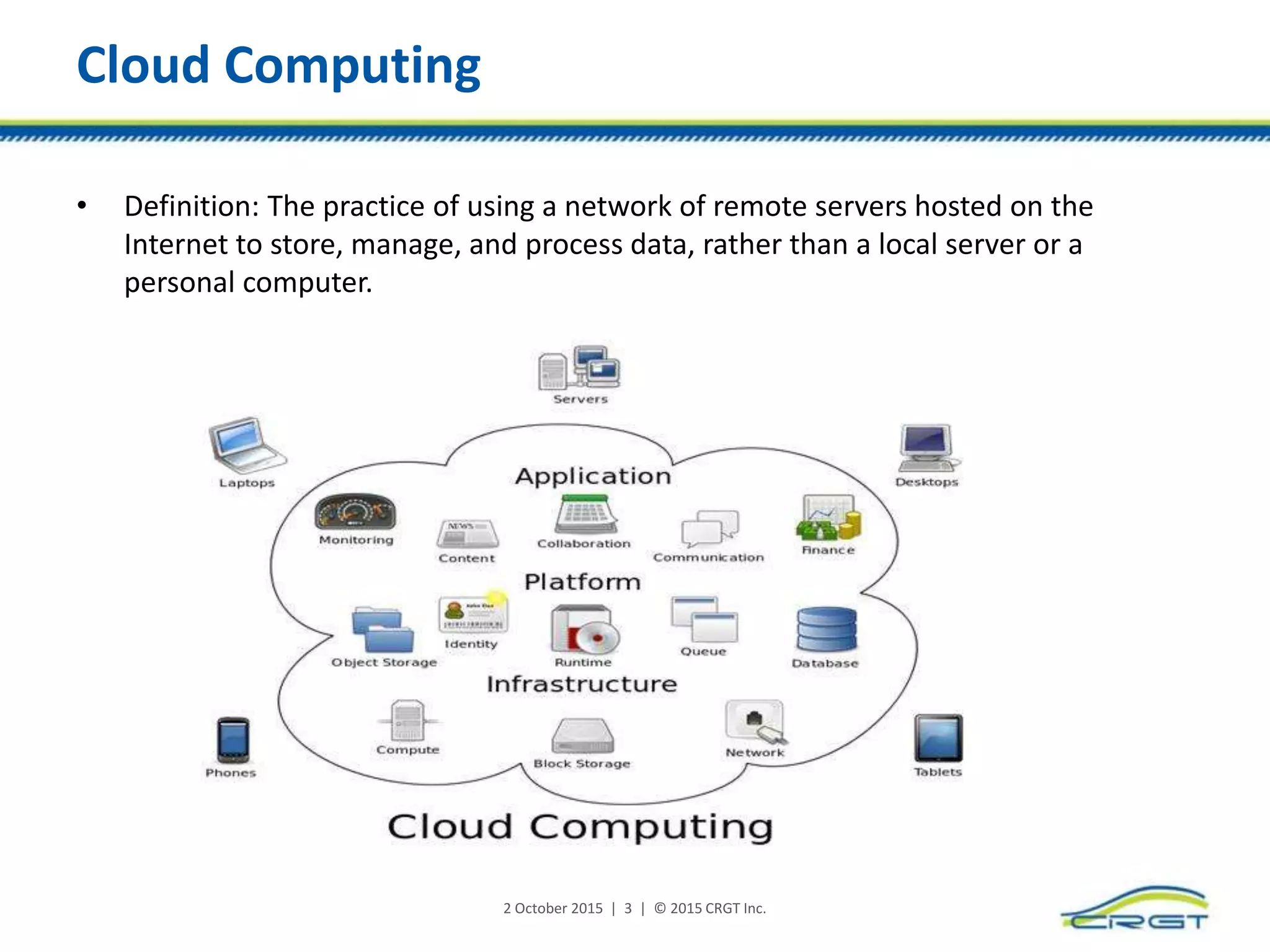
• Definition: The practice of using a network of remote servers hosted on the
Internet to store, manage, and process data, rather than a local server or a
personal computer.
2 October 2015 | 3 | © 2015 CRGT Inc.
Cloud Computing
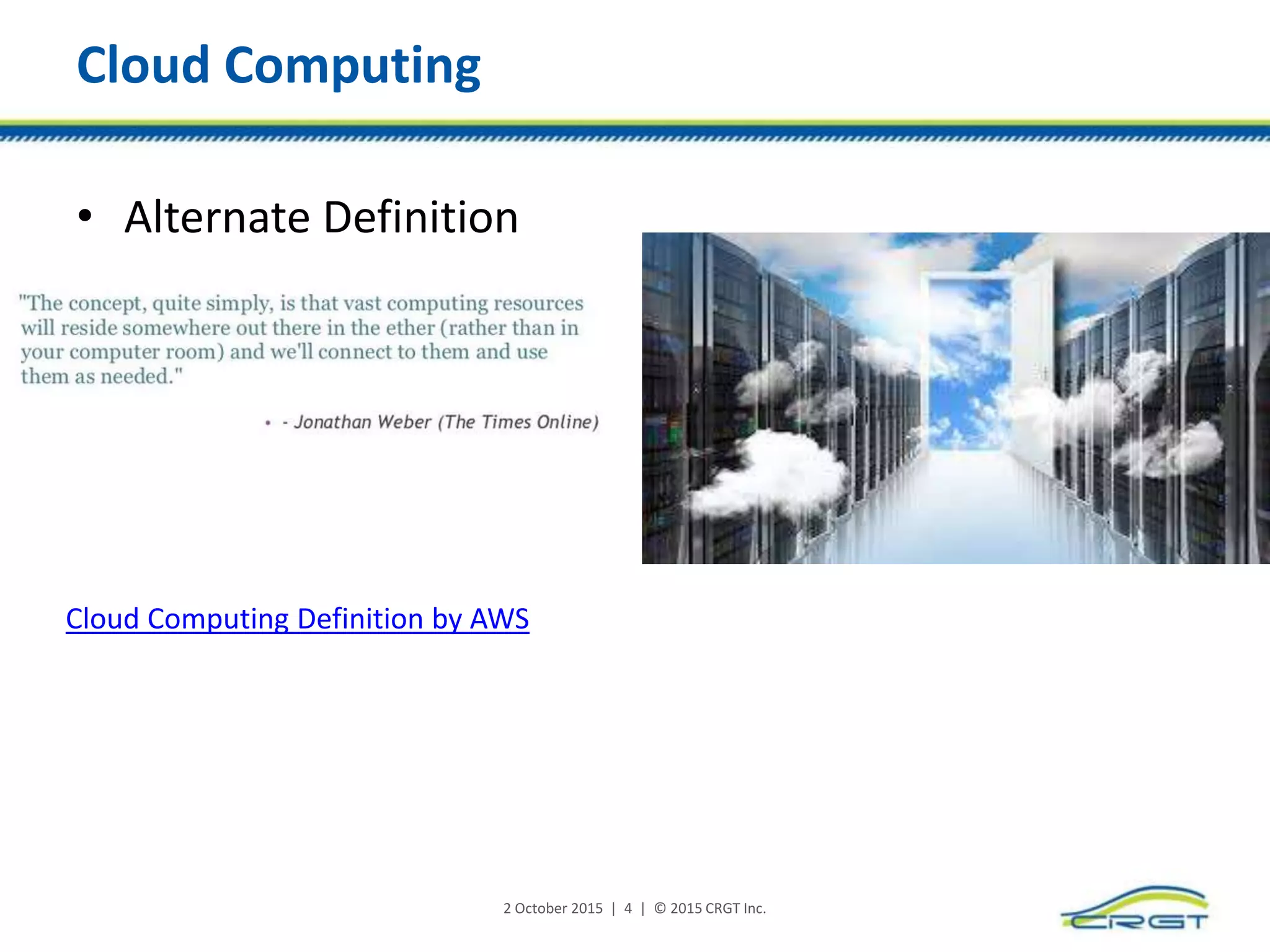
• Alternate Definition
2 October 2015 | 4 | © 2015 CRGT Inc.
Cloud Computing Definition by AWS
What can you do In Cloud?
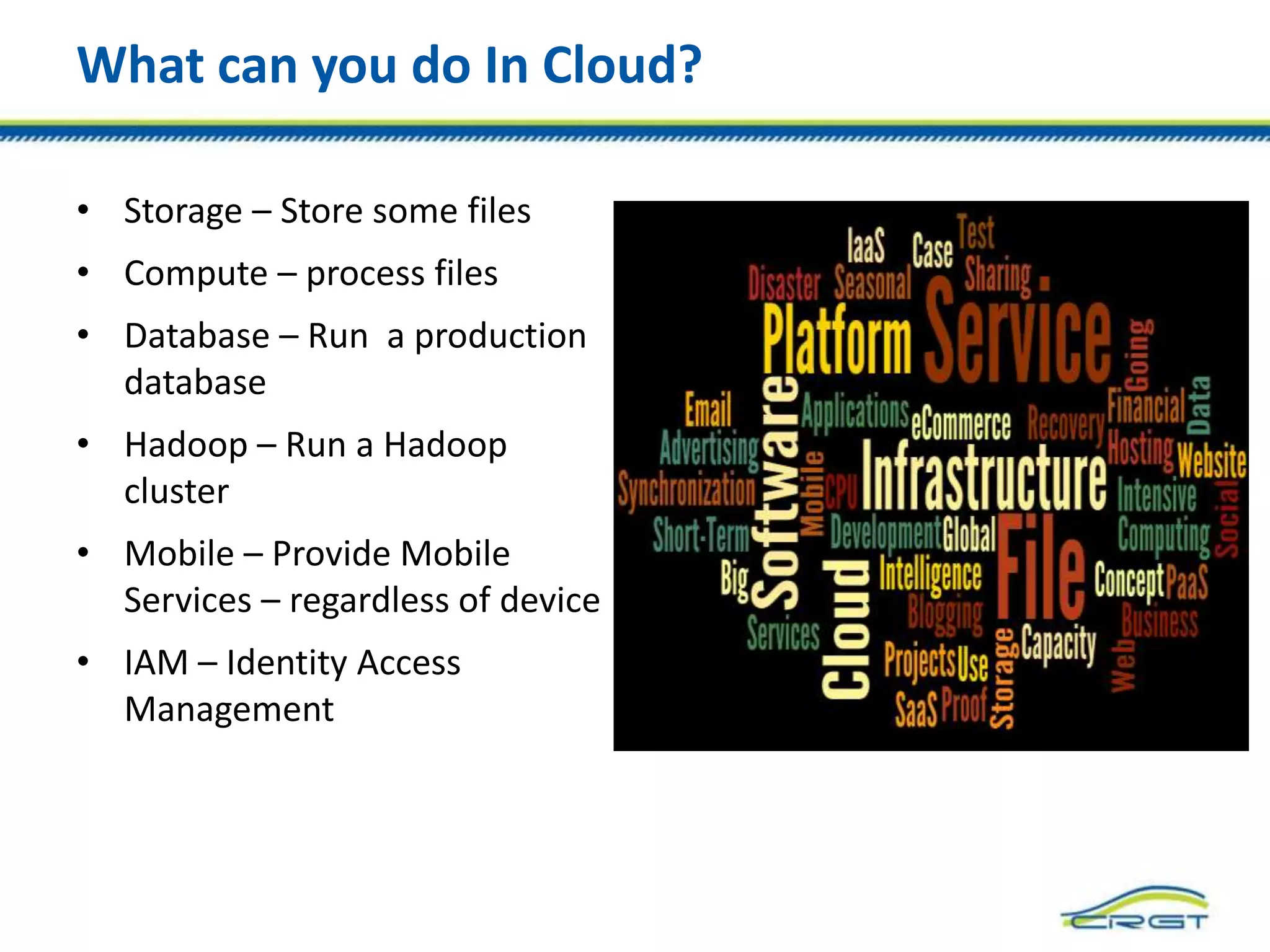
• Storage – Store some files
• Compute – process files
• Database – Run a production
database
• Hadoop – Run a Hadoop
cluster
• Mobile – Provide Mobile
Services – regardless of device
• IAM – Identity Access
Management
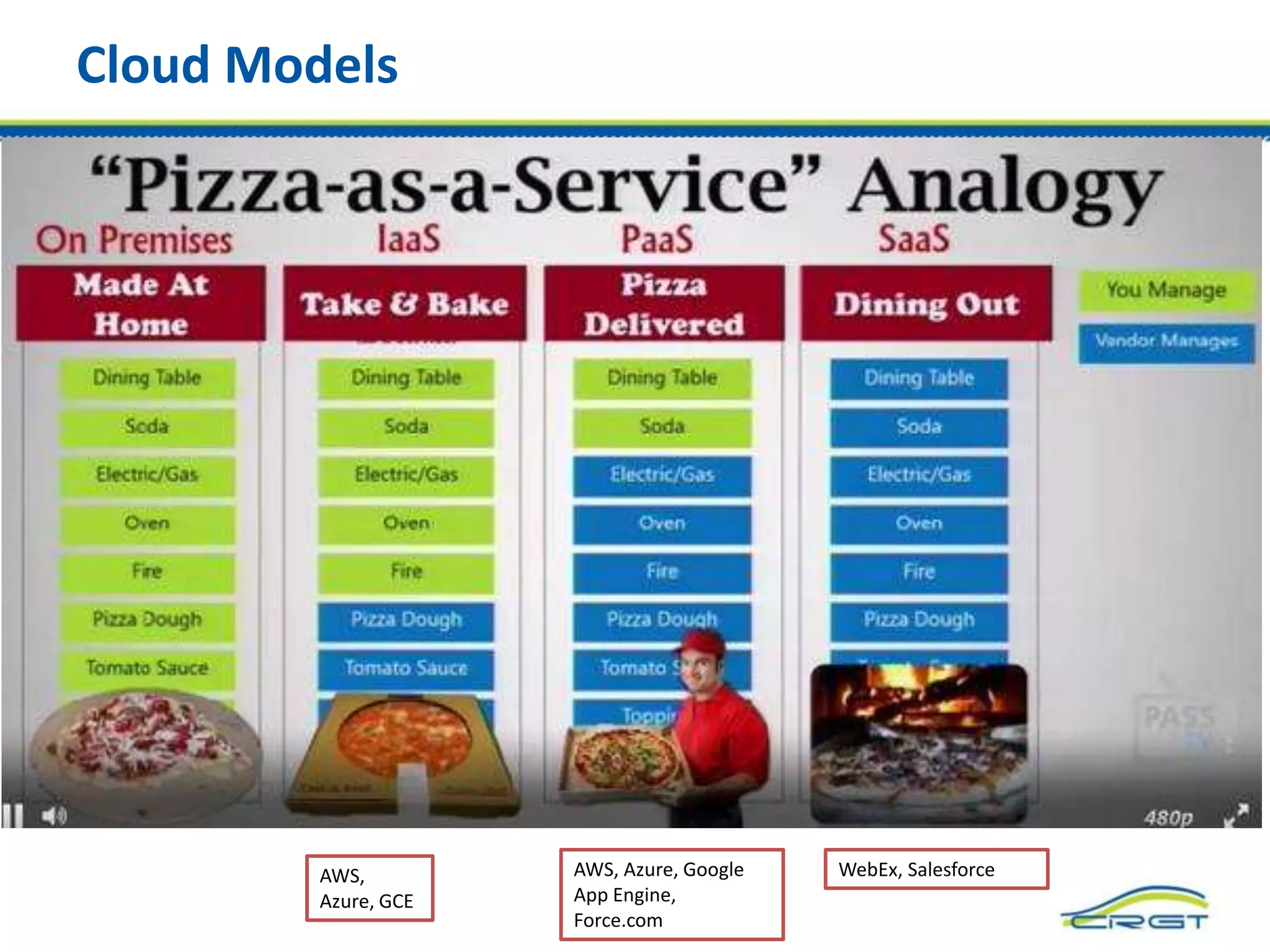
Cloud Models
AWS,
Azure, GCE
AWS, Azure, Google
App Engine,
Force.com
WebEx, Salesforce
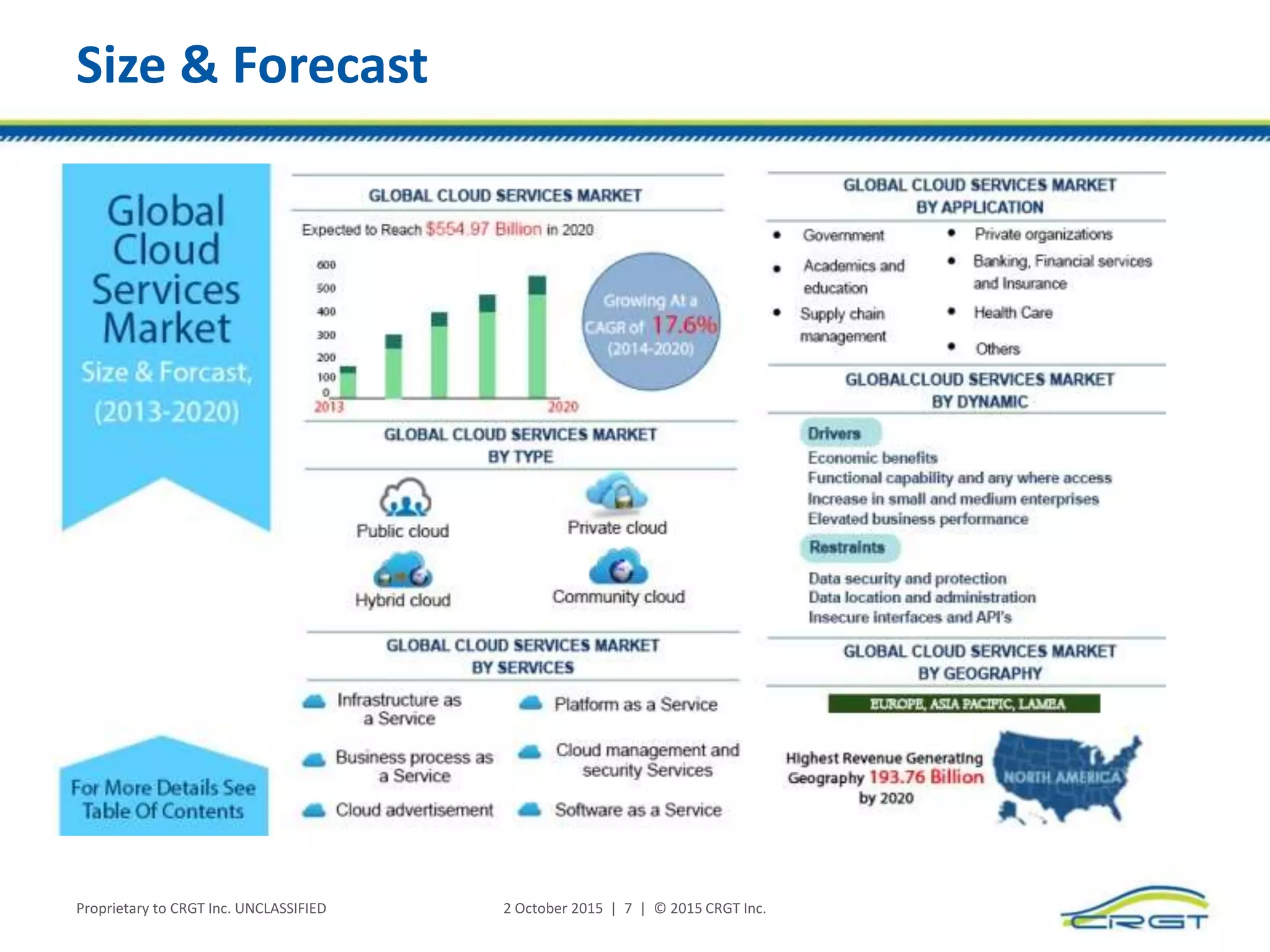
Size & Forecast
Proprietary to CRGT Inc. UNCLASSIFIED 2 October 2015 | 7 | © 2015 CRGT Inc.
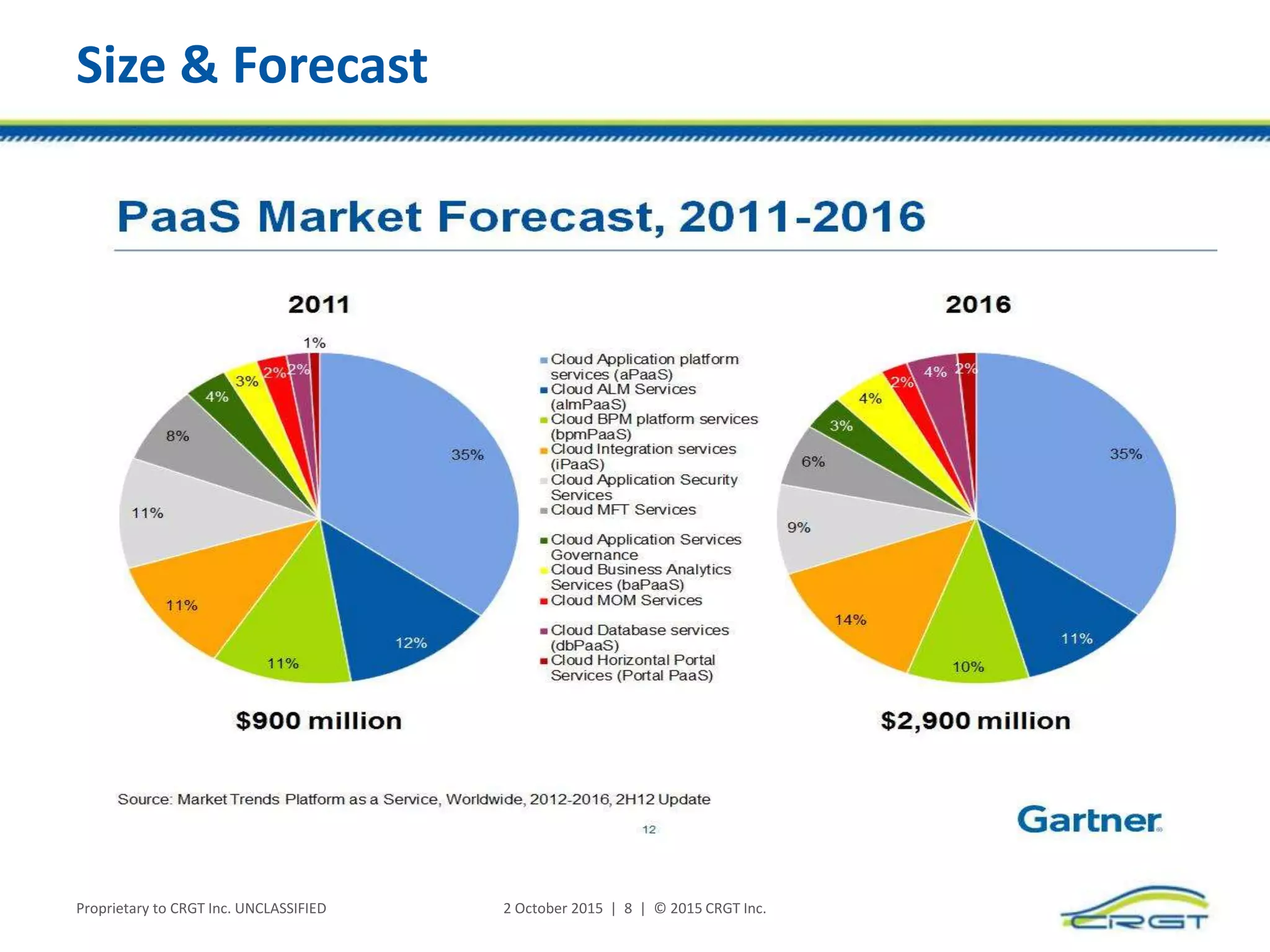
Size & Forecast
Proprietary to CRGT Inc. UNCLASSIFIED 2 October 2015 | 8 | © 2015 CRGT Inc.
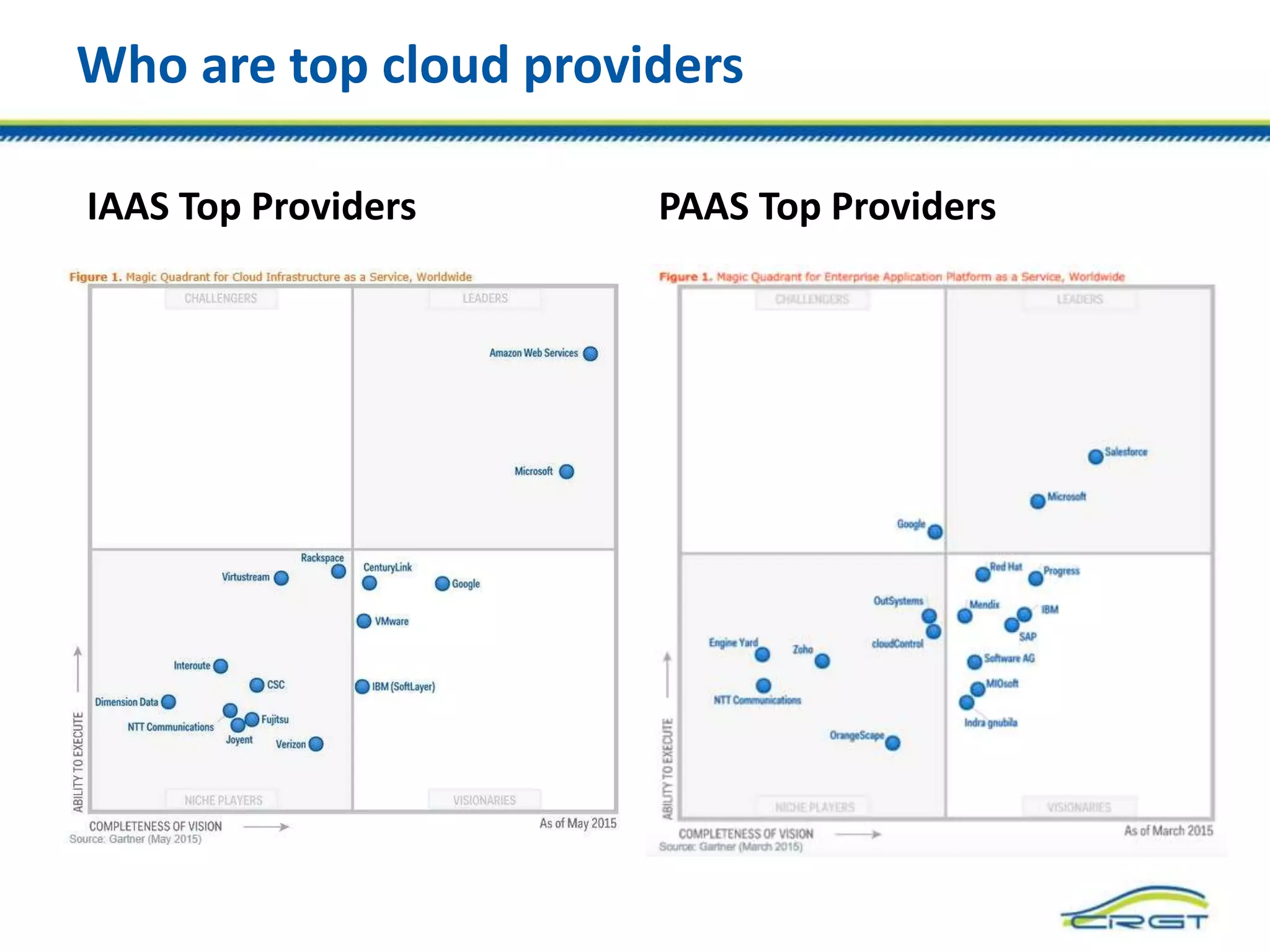
Who are top cloud providers
IAAS Top Providers PAAS Top Providers
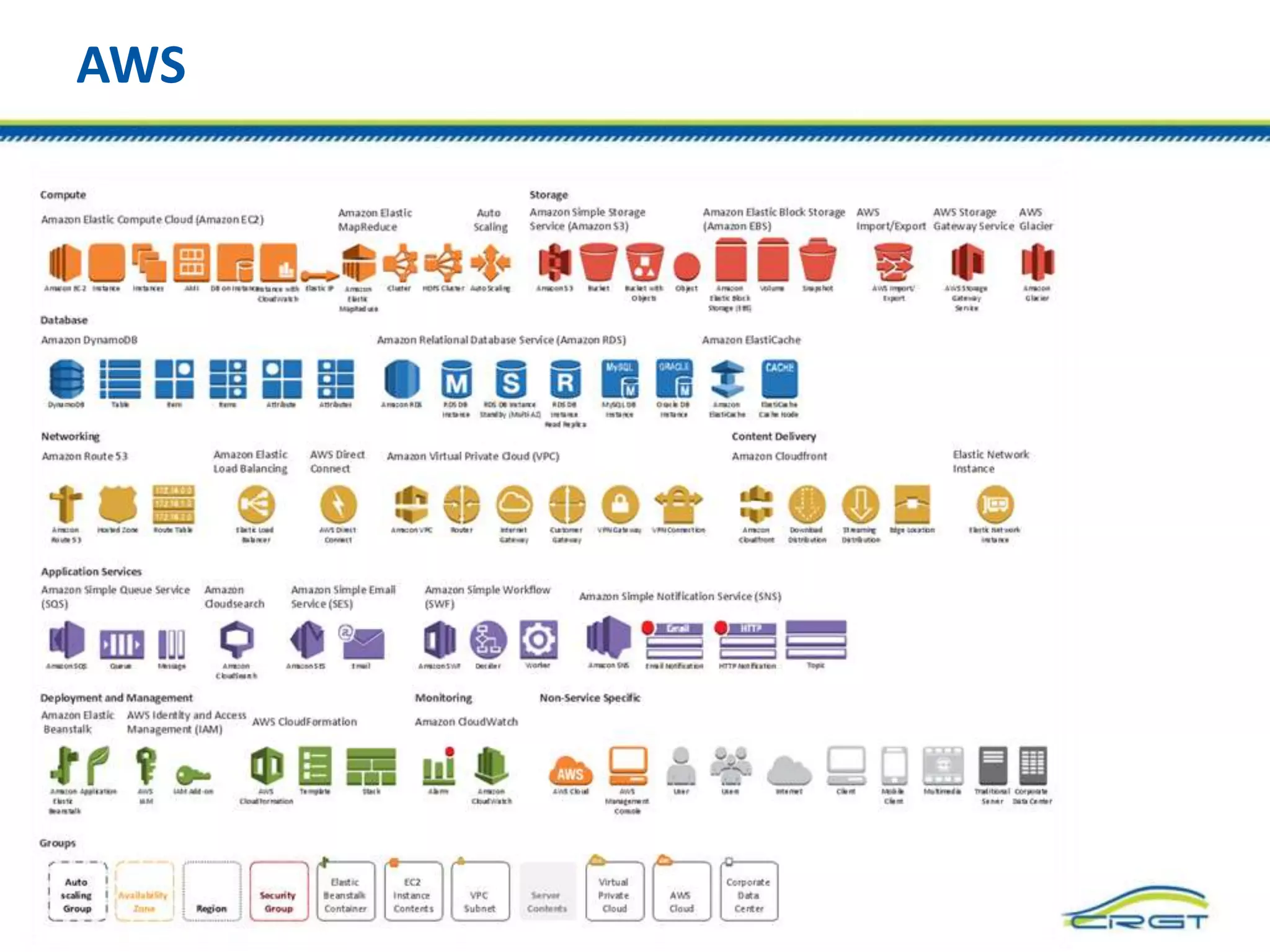
AWS
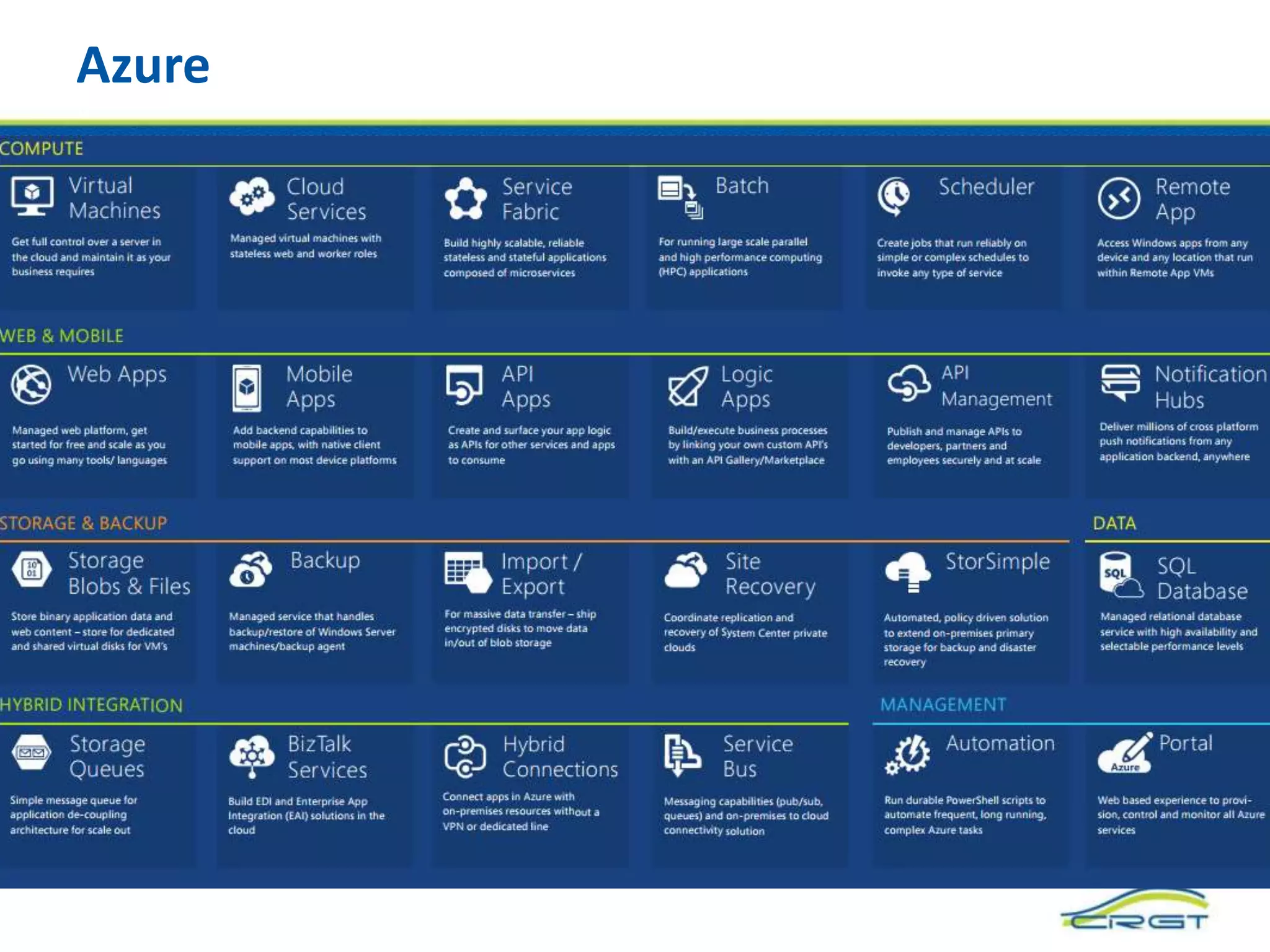
Azure
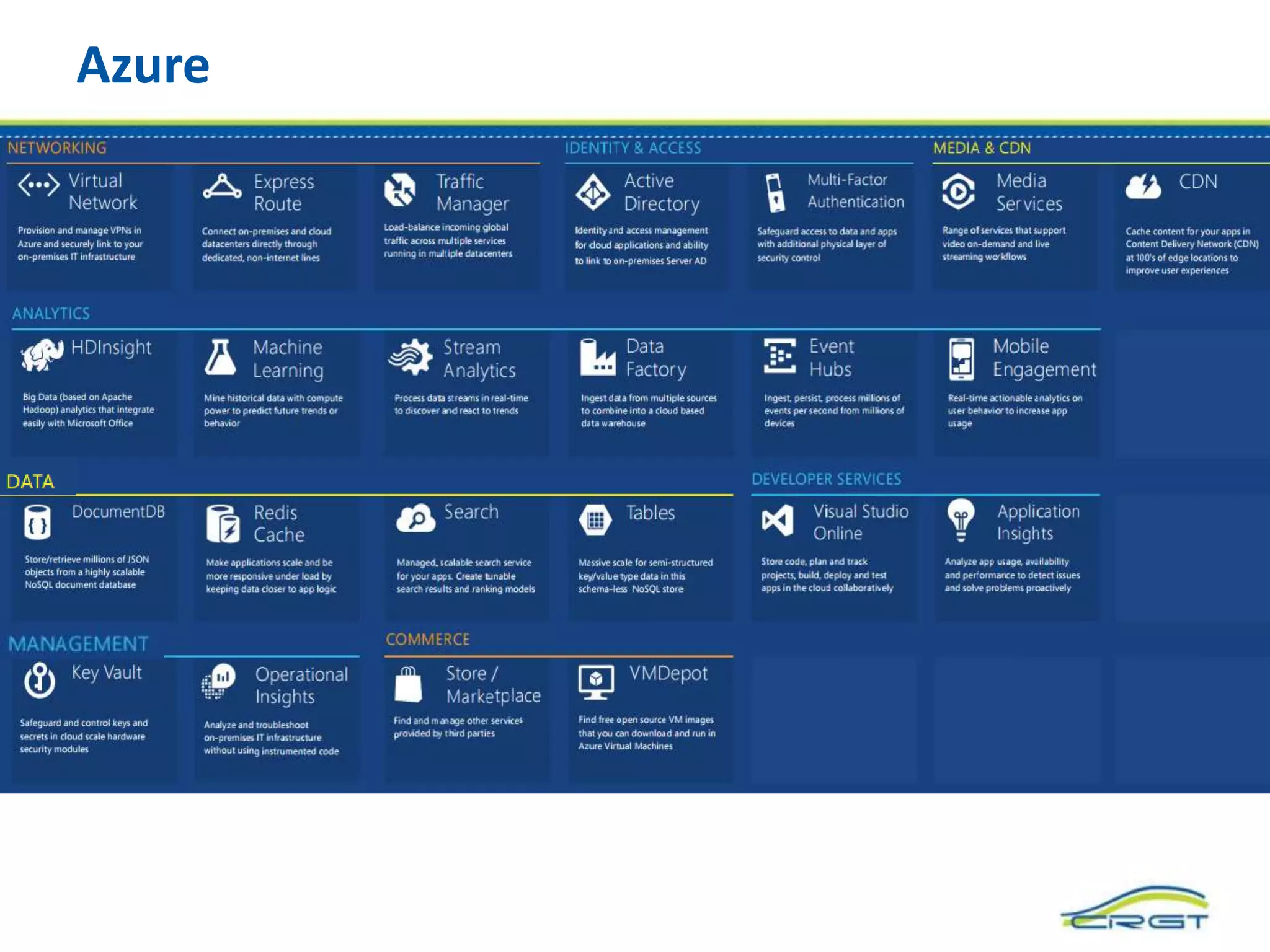
Azure
Some Use Cases
• Big Data -
https://aws.amazon.com/solut
ions/case-studies/netflix/
• Media Services – Azure
https://www.youtube.com/wa
tch?v=Hhskdxj4QIY
• https://aws.amazon.com/solut
ions/case-studies/zumba-
fitness/
Moving to cloud
• Application readiness – Does the application provide
similar SLA?
• Security – The data is sensitive and a data breach
would present a significant risk to the organization
• Cost/ROI – Is the cost more than on premise?
• Company Culture –Does the management support it?
Requires strong leadership, tenacity and vision for
cloud drive.
• Market Maturity – Is cloud mature to handle your
loads?
Simple Storage Service (S3)
• S3 is designed specifically
for data storage in the
cloud. Like folders in
windows, AWS has buckets
in S3 that contain files.
Sample Architecture – Log Analysis
Glacier
• Extremely low-cost storage
service that provides secure,
durable, and flexible storage
for data backup and archival.
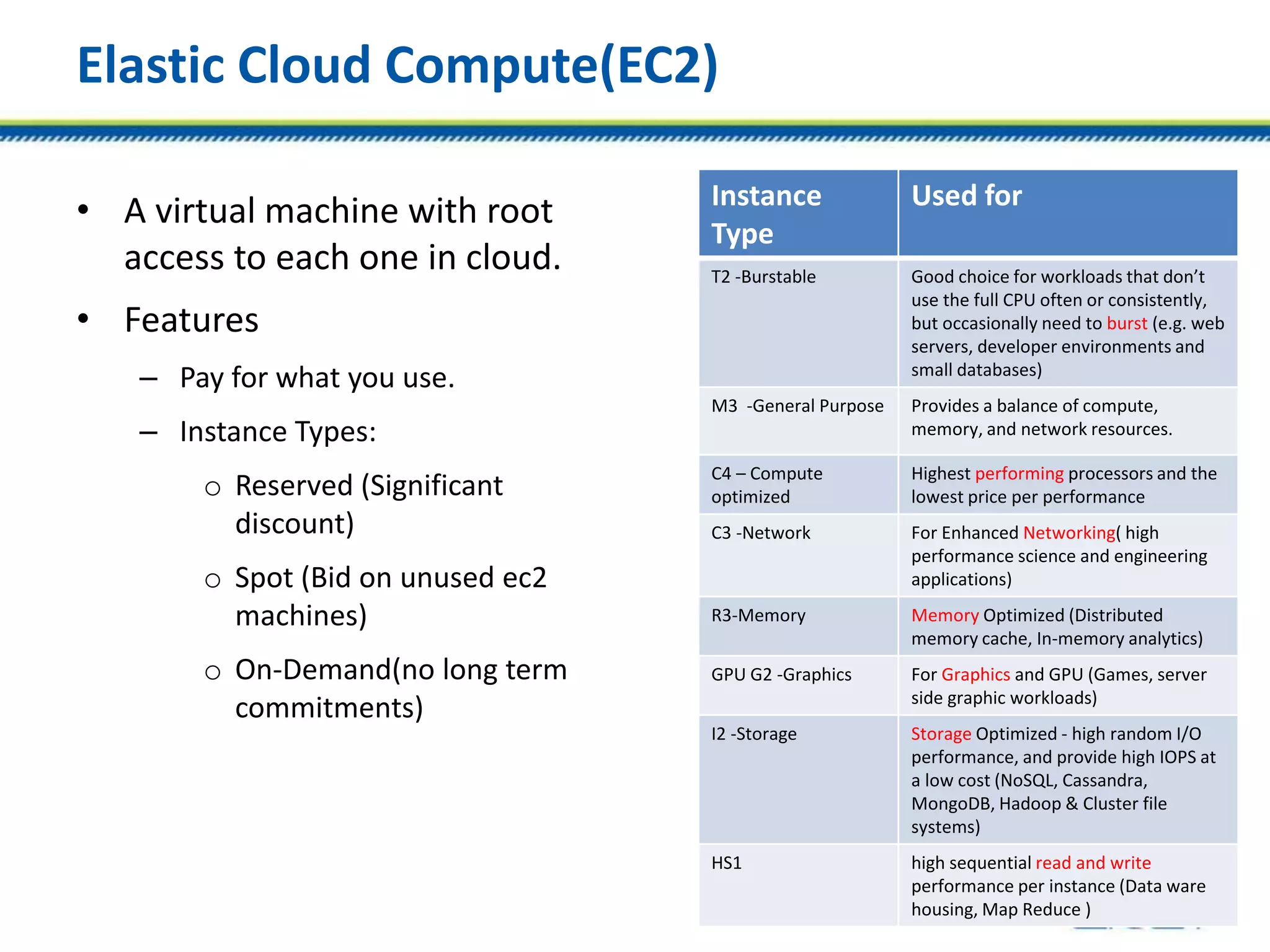
Elastic Cloud Compute(EC2)
• A virtual machine with root
access to each one in cloud.
• Features
– Pay for what you use.
– Instance Types:
o Reserved (Significant
discount)
o Spot (Bid on unused ec2
machines)
o On-Demand(no long term
commitments)
Instance
Type
Used for
T2 -Burstable Good choice for workloads that don’t
use the full CPU often or consistently,
but occasionally need to burst (e.g. web
servers, developer environments and
small databases)
M3 -General Purpose Provides a balance of compute,
memory, and network resources.
C4 – Compute
optimized
Highest performing processors and the
lowest price per performance
C3 -Network For Enhanced Networking( high
performance science and engineering
applications)
R3-Memory Memory Optimized (Distributed
memory cache, In-memory analytics)
GPU G2 -Graphics For Graphics and GPU (Games, server
side graphic workloads)
I2 -Storage Storage Optimized - high random I/O
performance, and provide high IOPS at
a low cost (NoSQL, Cassandra,
MongoDB, Hadoop & Cluster file
systems)
HS1 high sequential read and write
performance per instance (Data ware
housing, Map Reduce )
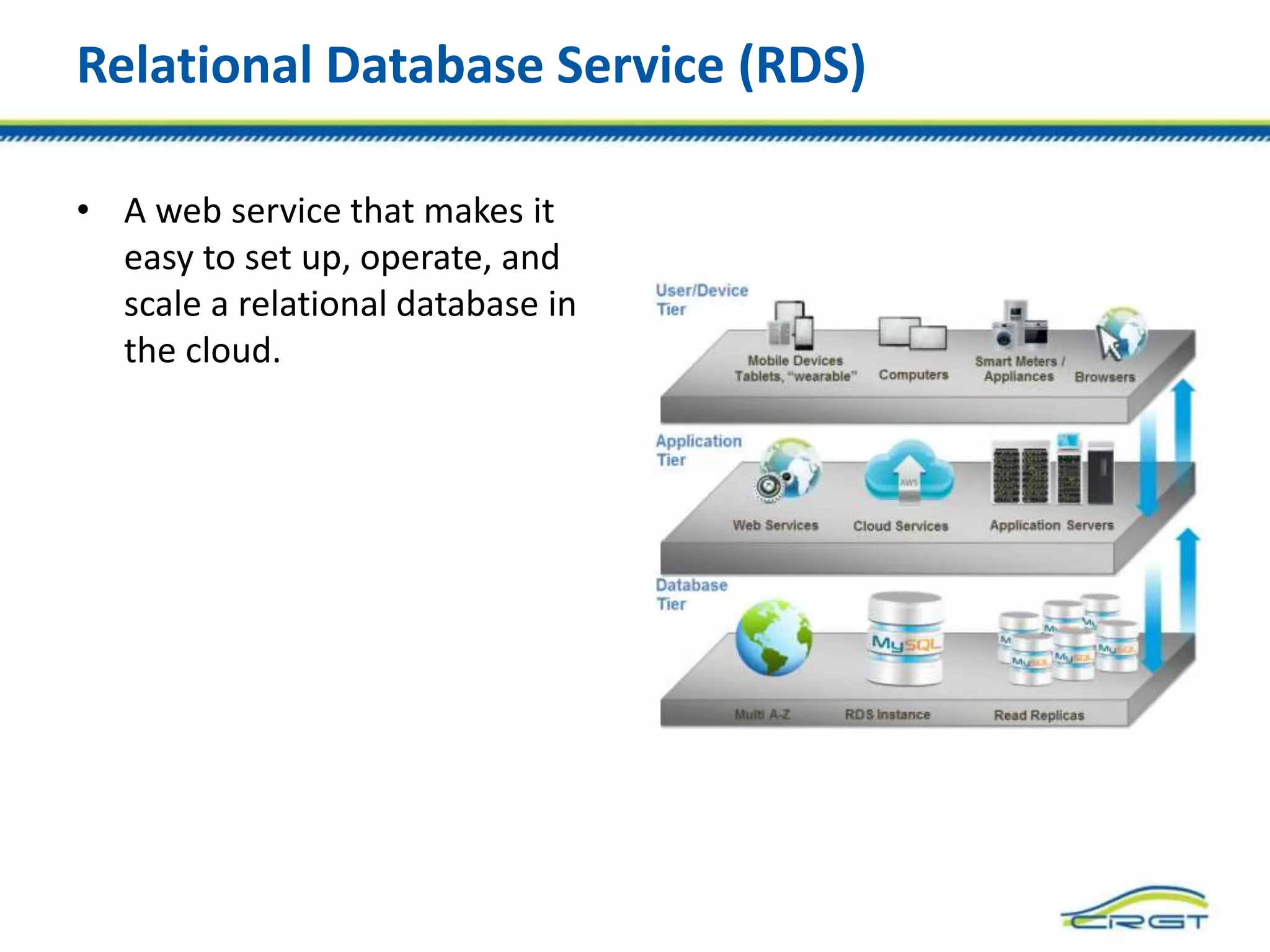
Relational Database Service (RDS)
• A web service that makes it
easy to set up, operate, and
scale a relational database in
the cloud.
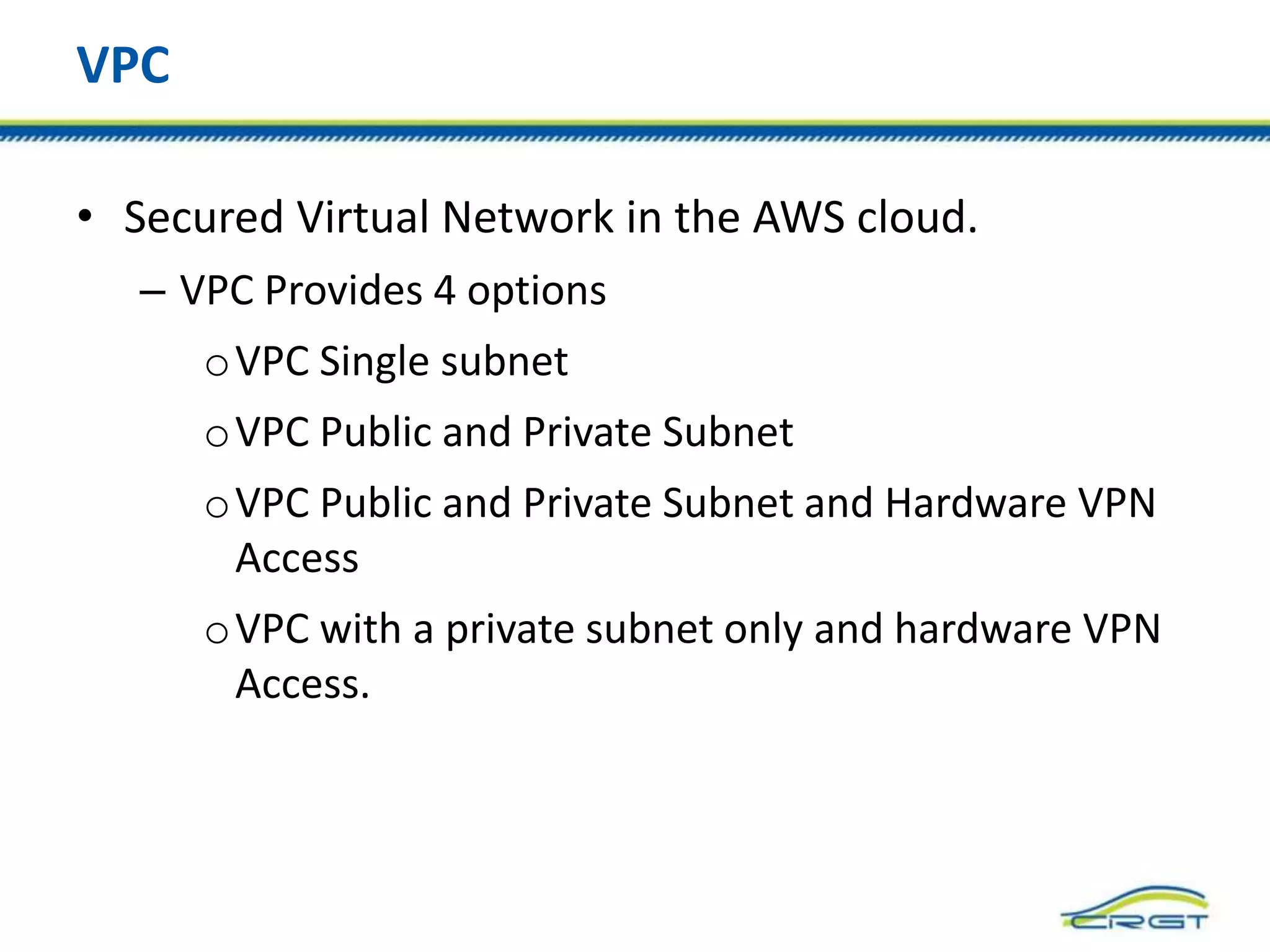
VPC
• Secured Virtual Network in the AWS cloud.
– VPC Provides 4 options
oVPC Single subnet
oVPC Public and Private Subnet
oVPC Public and Private Subnet and Hardware VPN
Access
oVPC with a private subnet only and hardware VPN
Access.
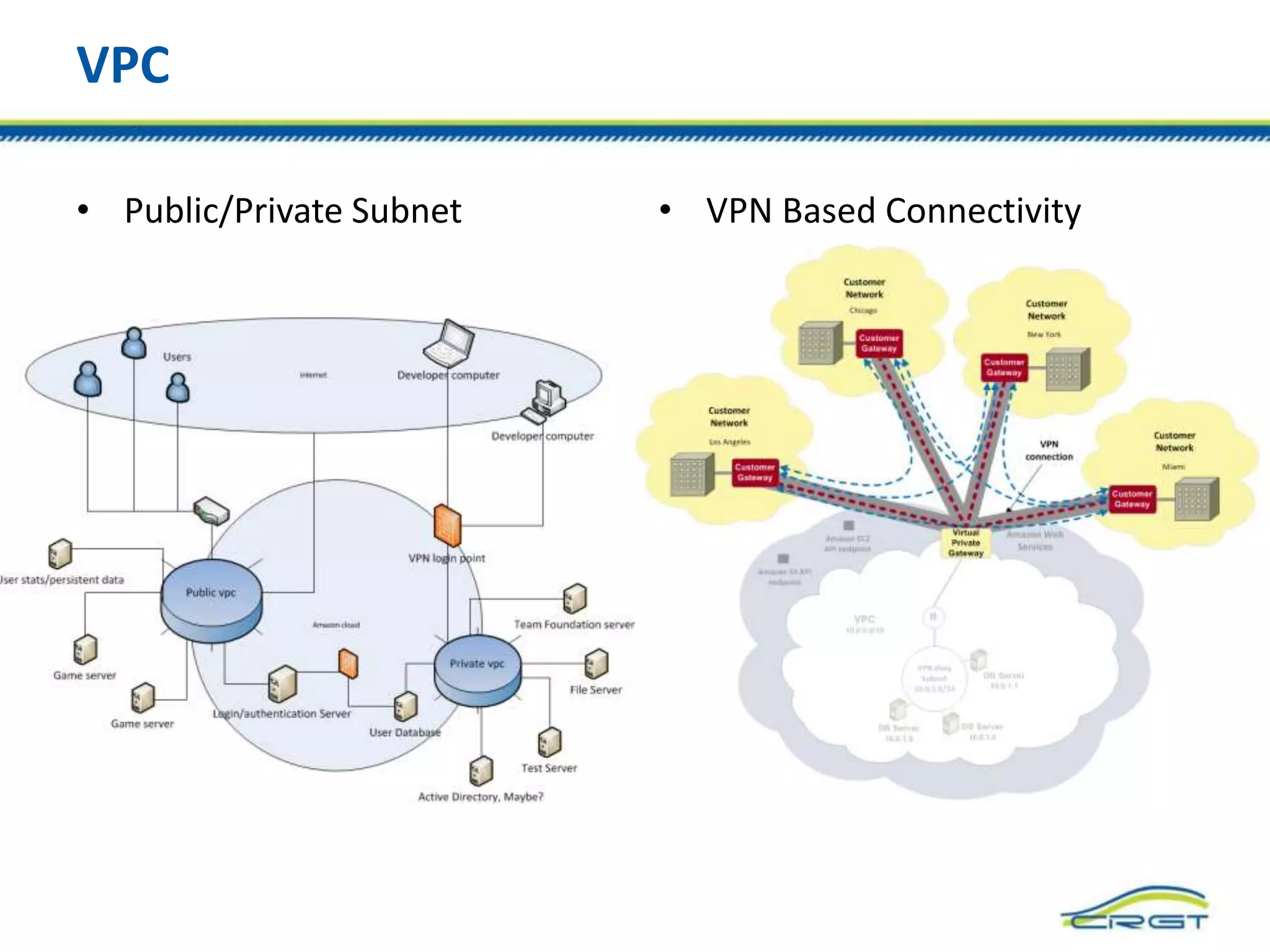
VPC
• Public/Private Subnet • VPN Based Connectivity
IAM
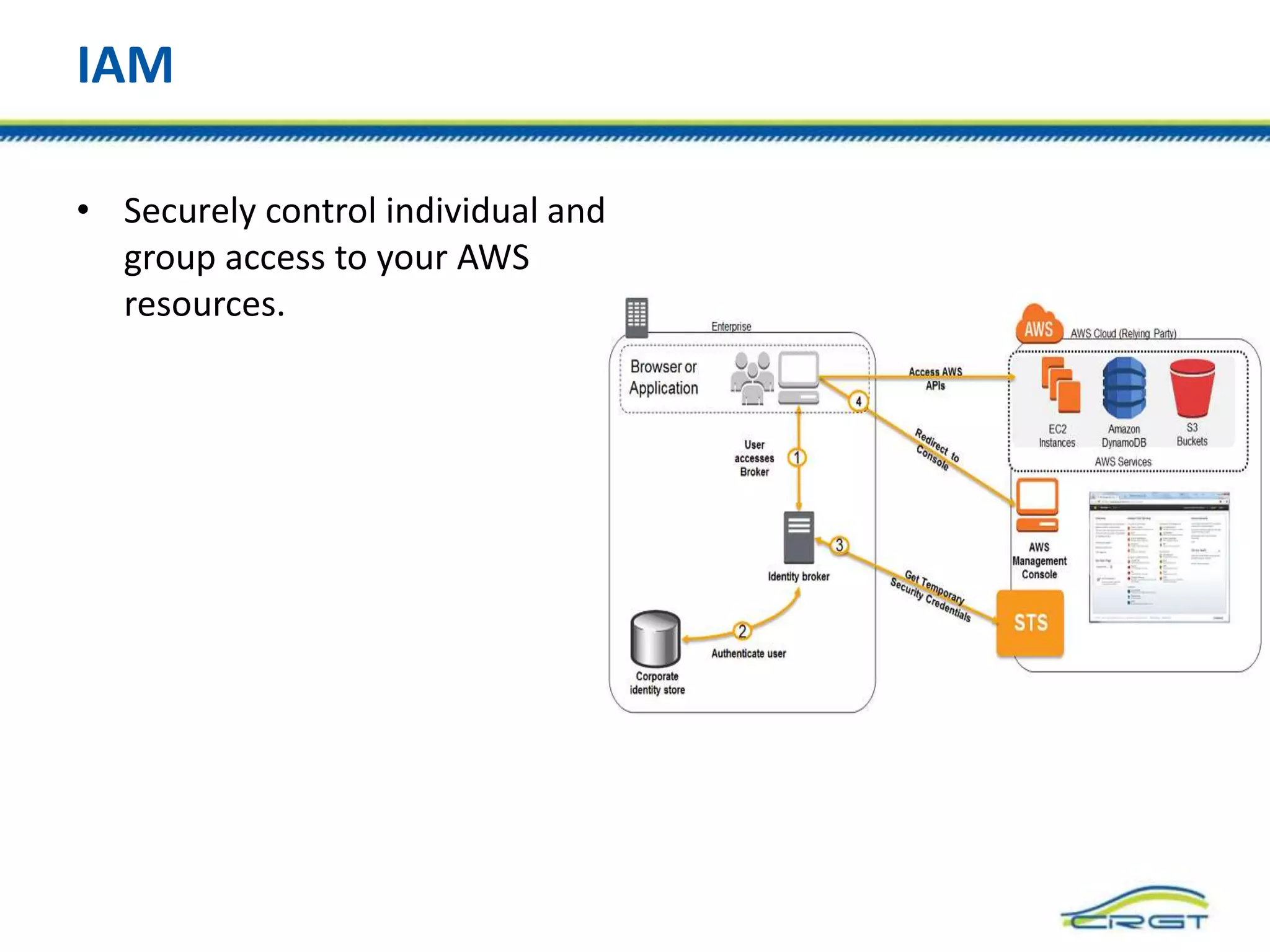
• Securely control individual and
group access to your AWS
resources.
CLOUD WATCH
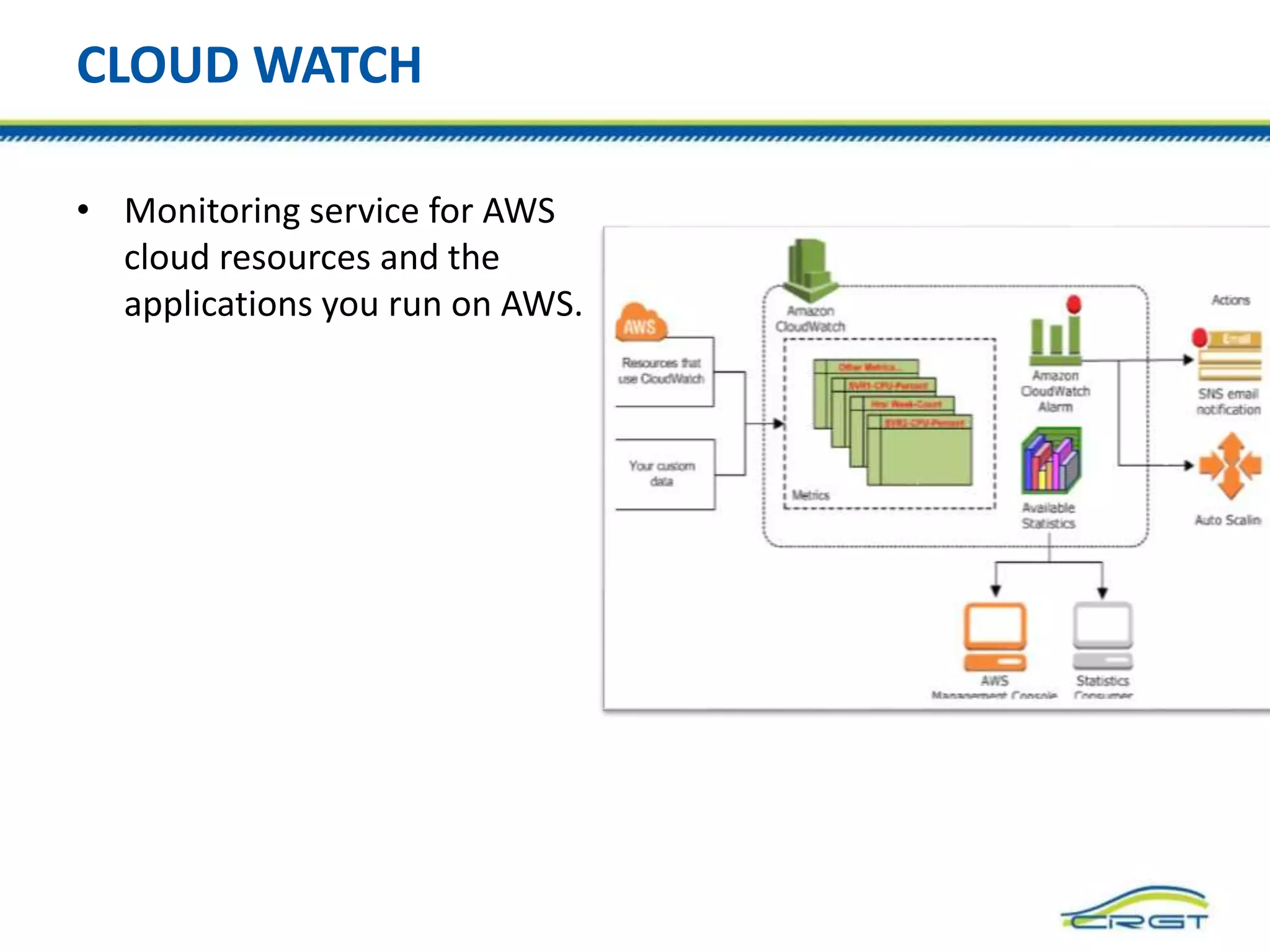
• Monitoring service for AWS
cloud resources and the
applications you run on AWS.
ELASTIC BEAN STALK
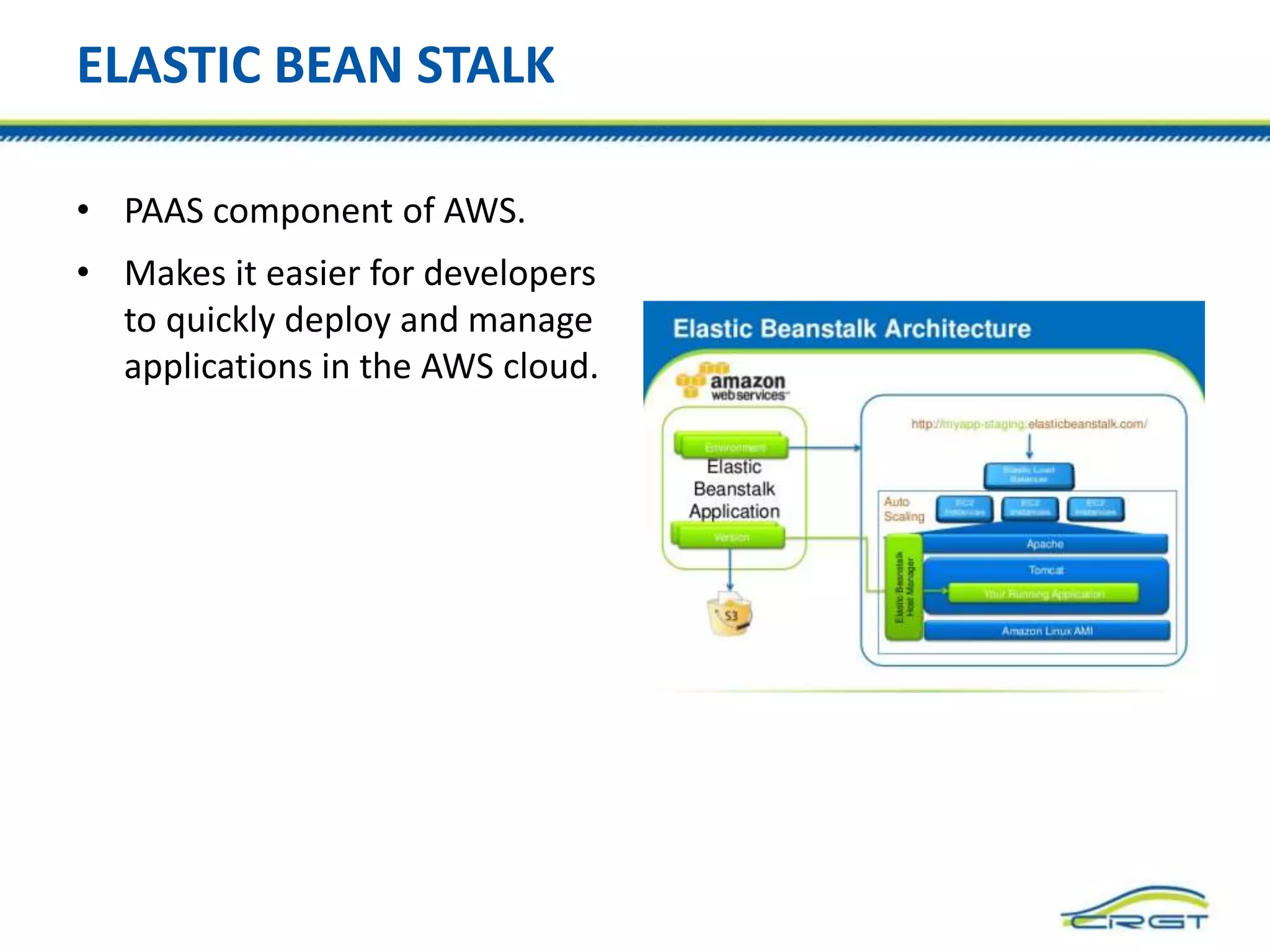
• PAAS component of AWS.
• Makes it easier for developers
to quickly deploy and manage
applications in the AWS cloud.
Cloud Formation
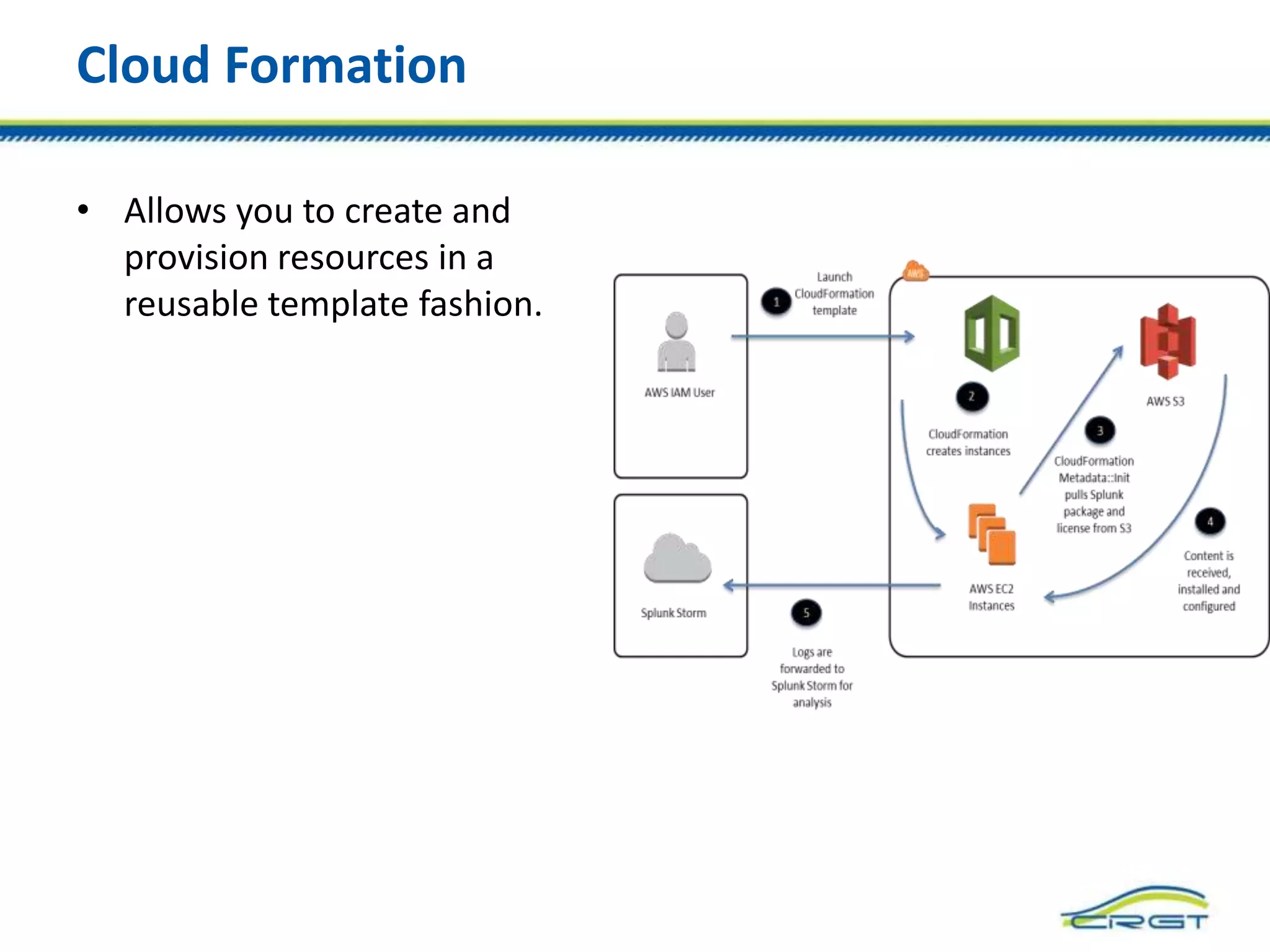
• Allows you to create and
provision resources in a
reusable template fashion.
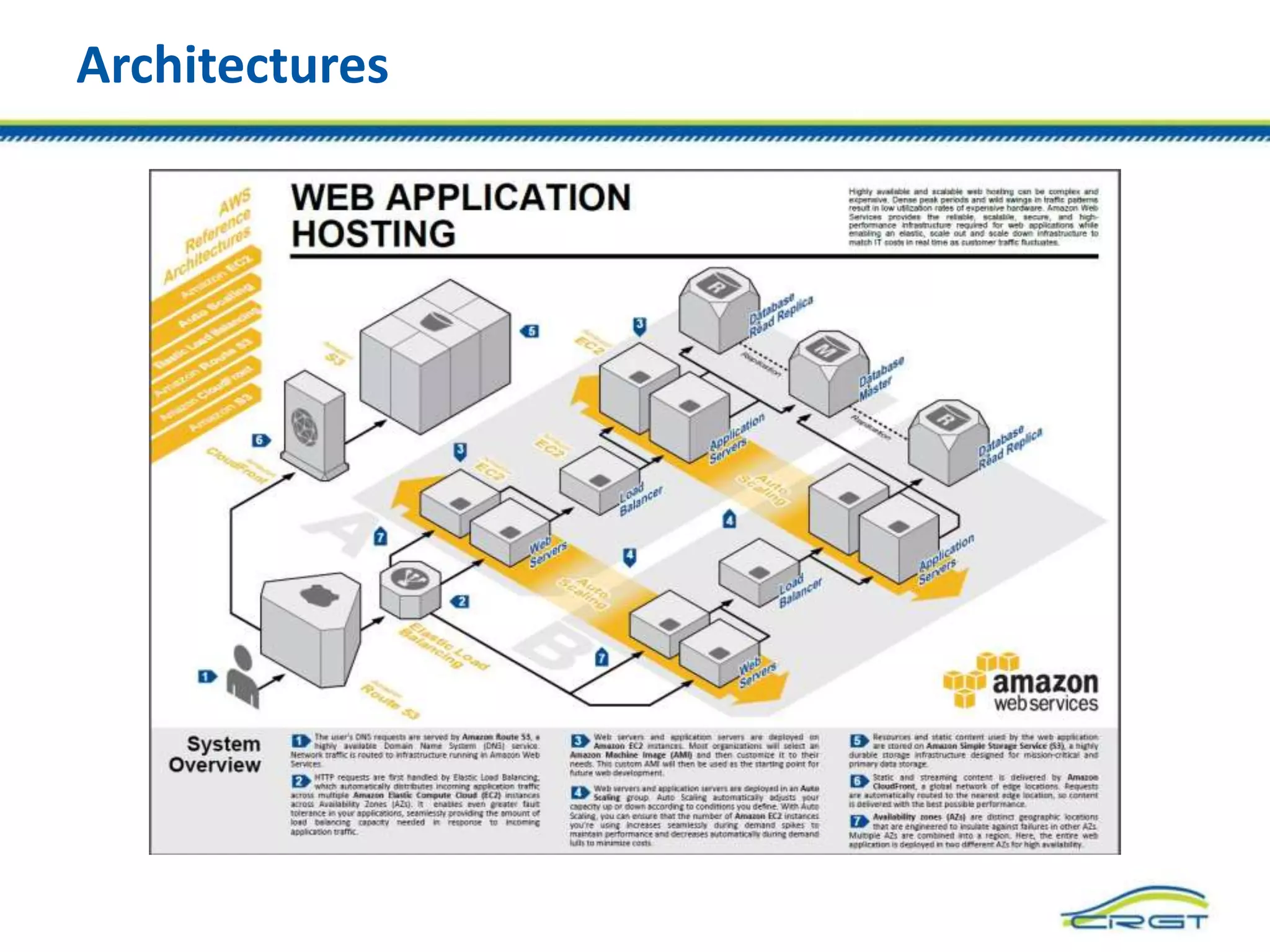
Architectures
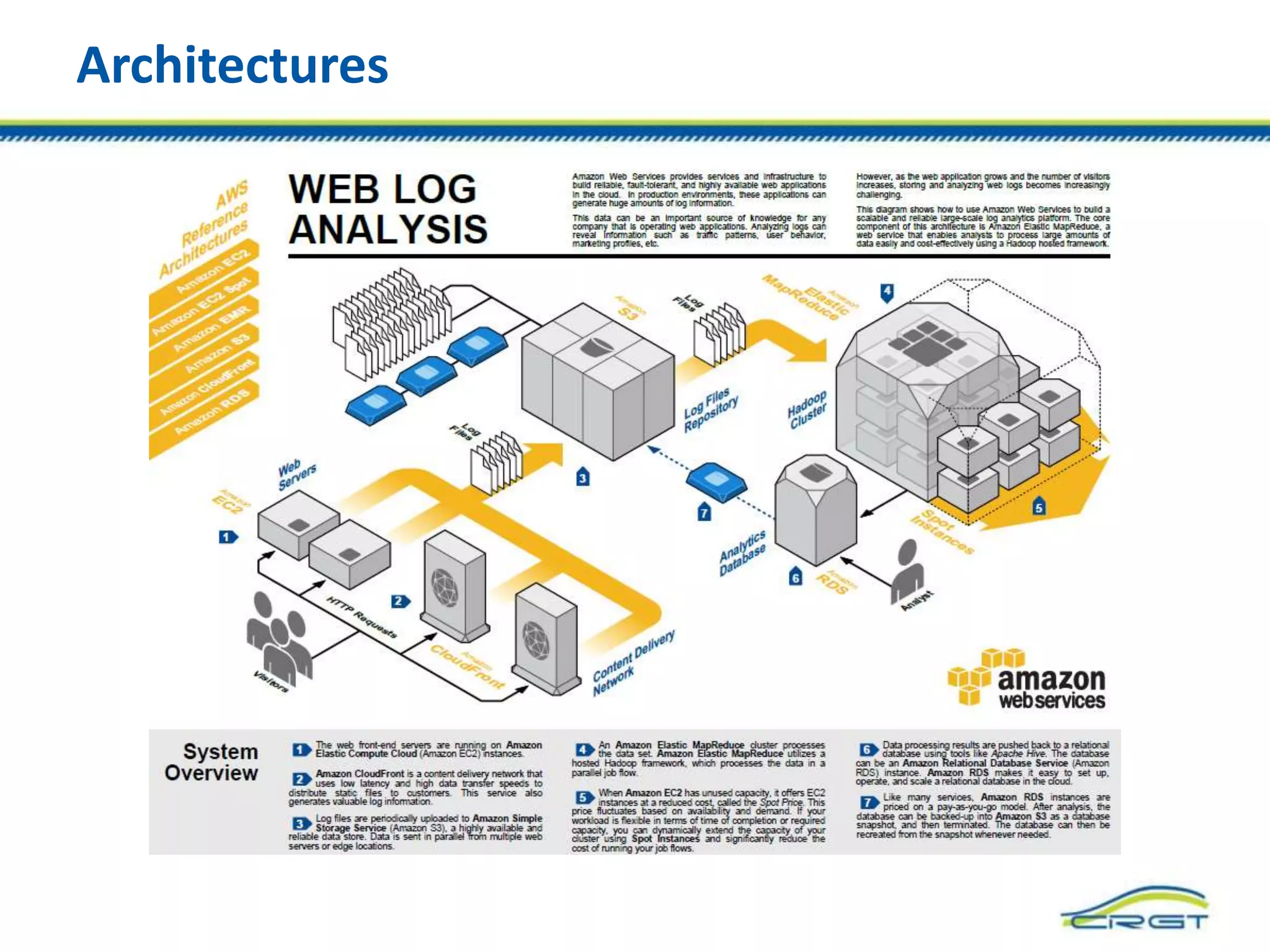
Architectures
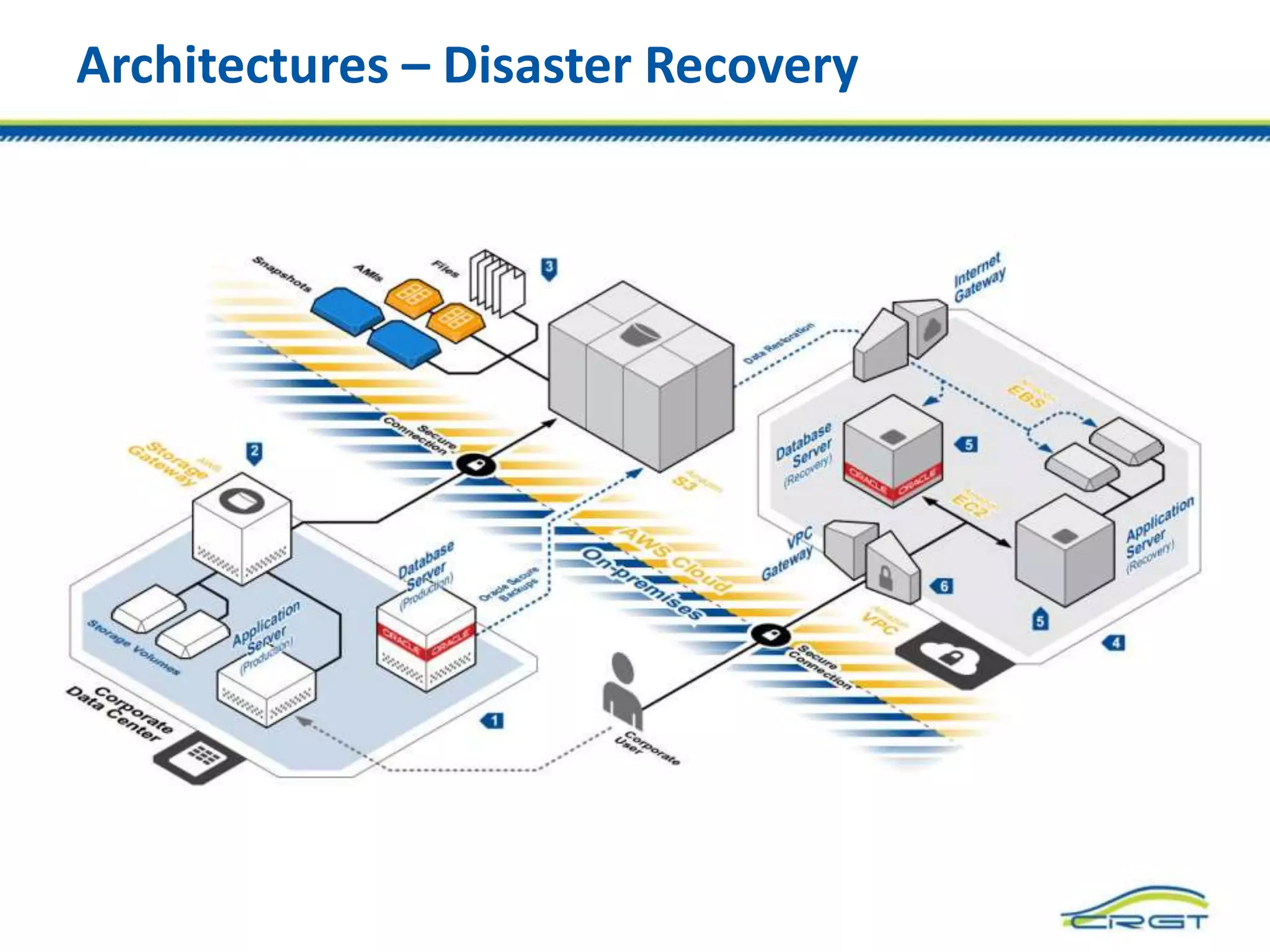
Architectures – Disaster Recovery
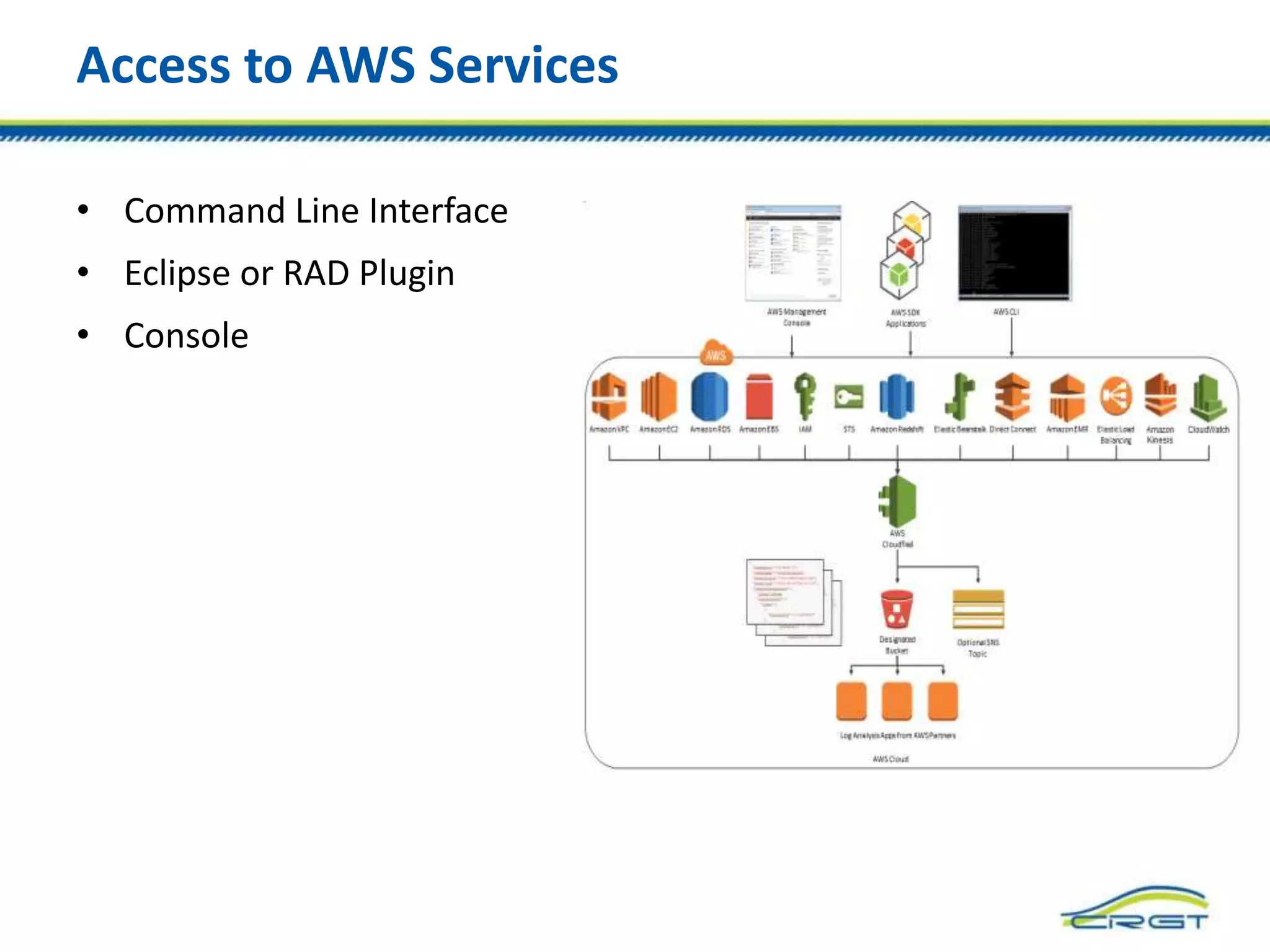
Access to AWS Services
• Command Line Interface
• Eclipse or RAD Plugin
• Console
Demo
• Features of AWS
– Deploy a web application
– Create a relational databas
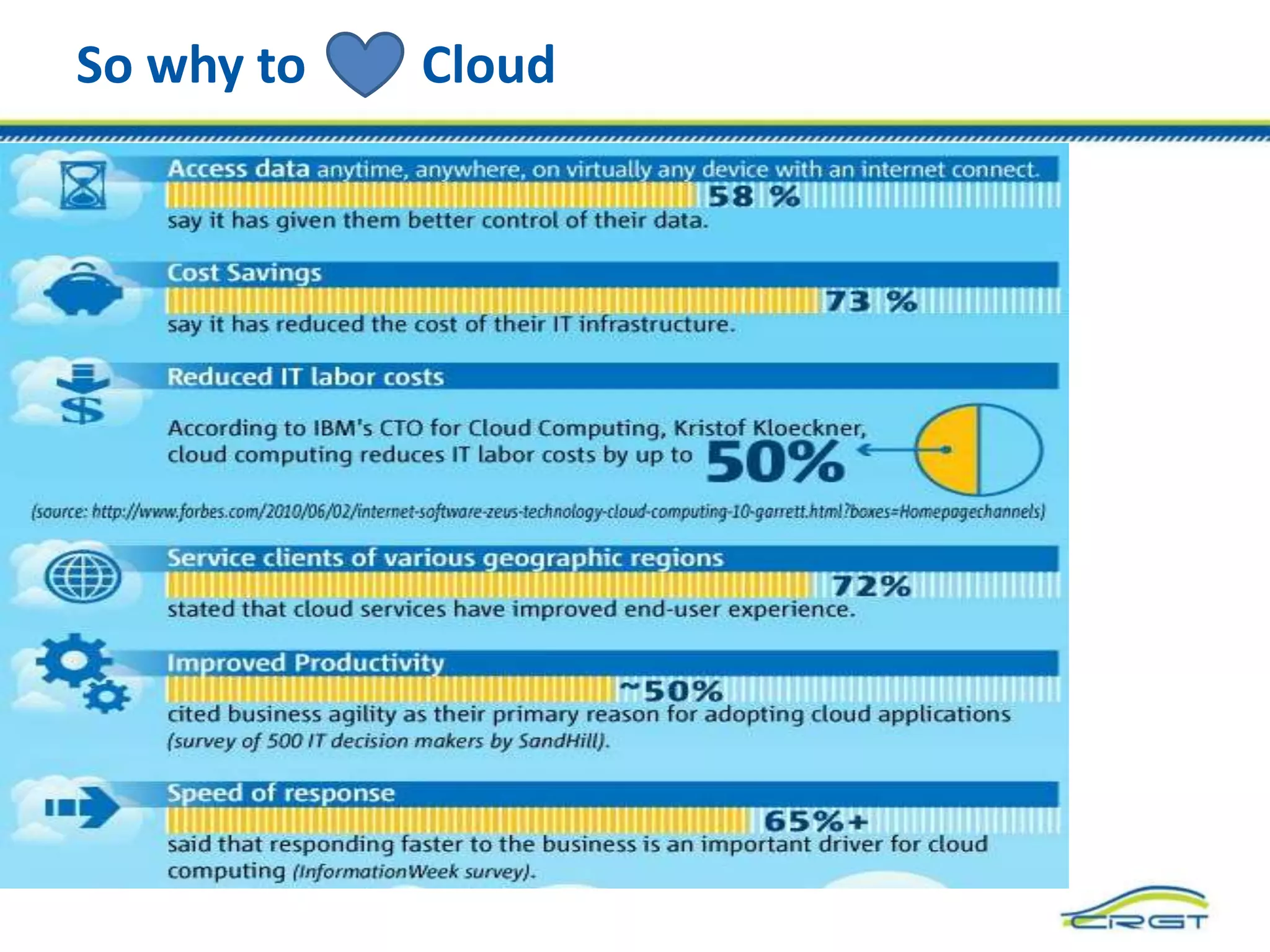
So why to Cloud
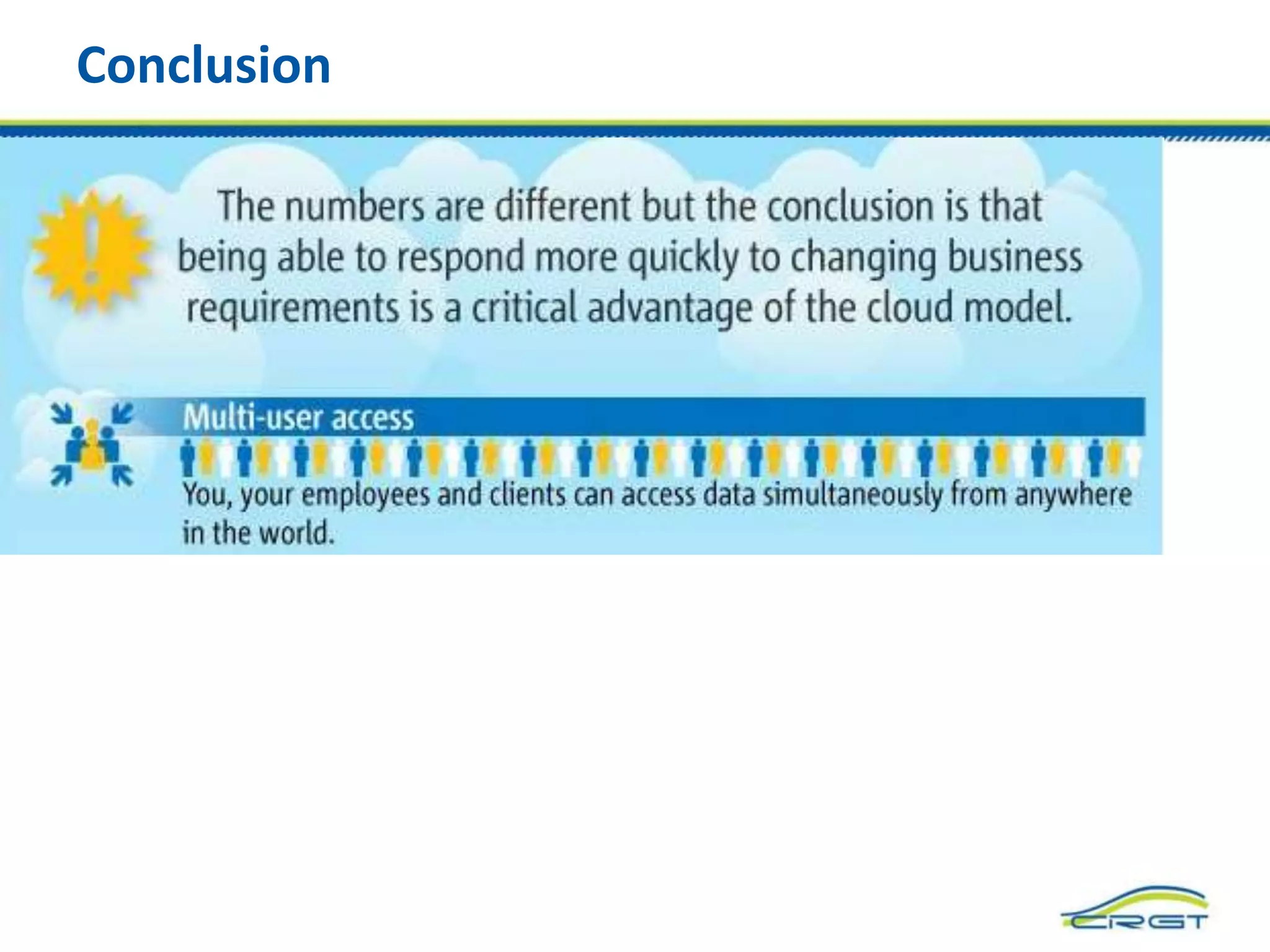
Conclusion
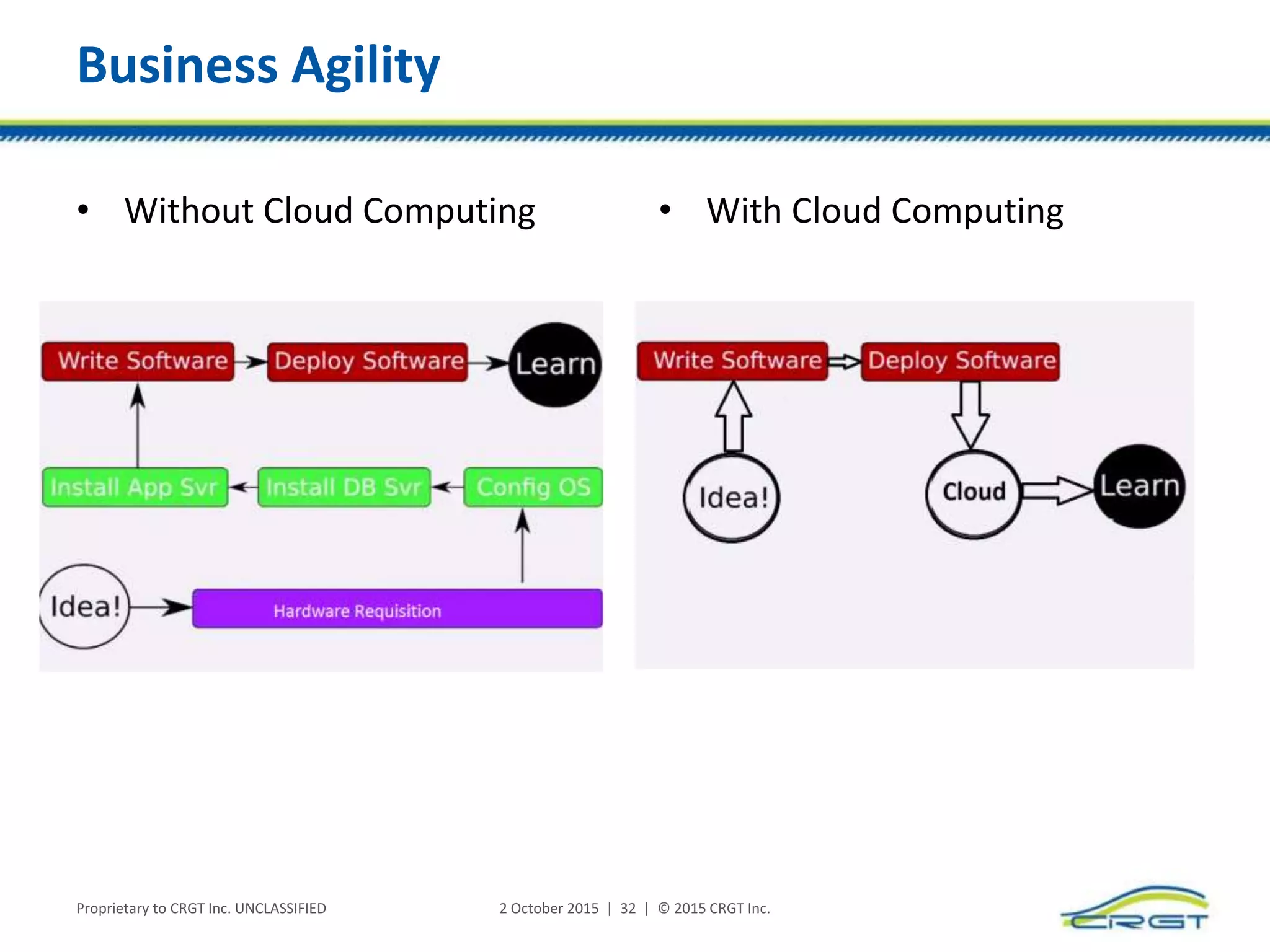
Business Agility
• Without Cloud Computing • With Cloud Computing
Proprietary to CRGT Inc. UNCLASSIFIED 2 October 2015 | 32 | © 2015 CRGT Inc.
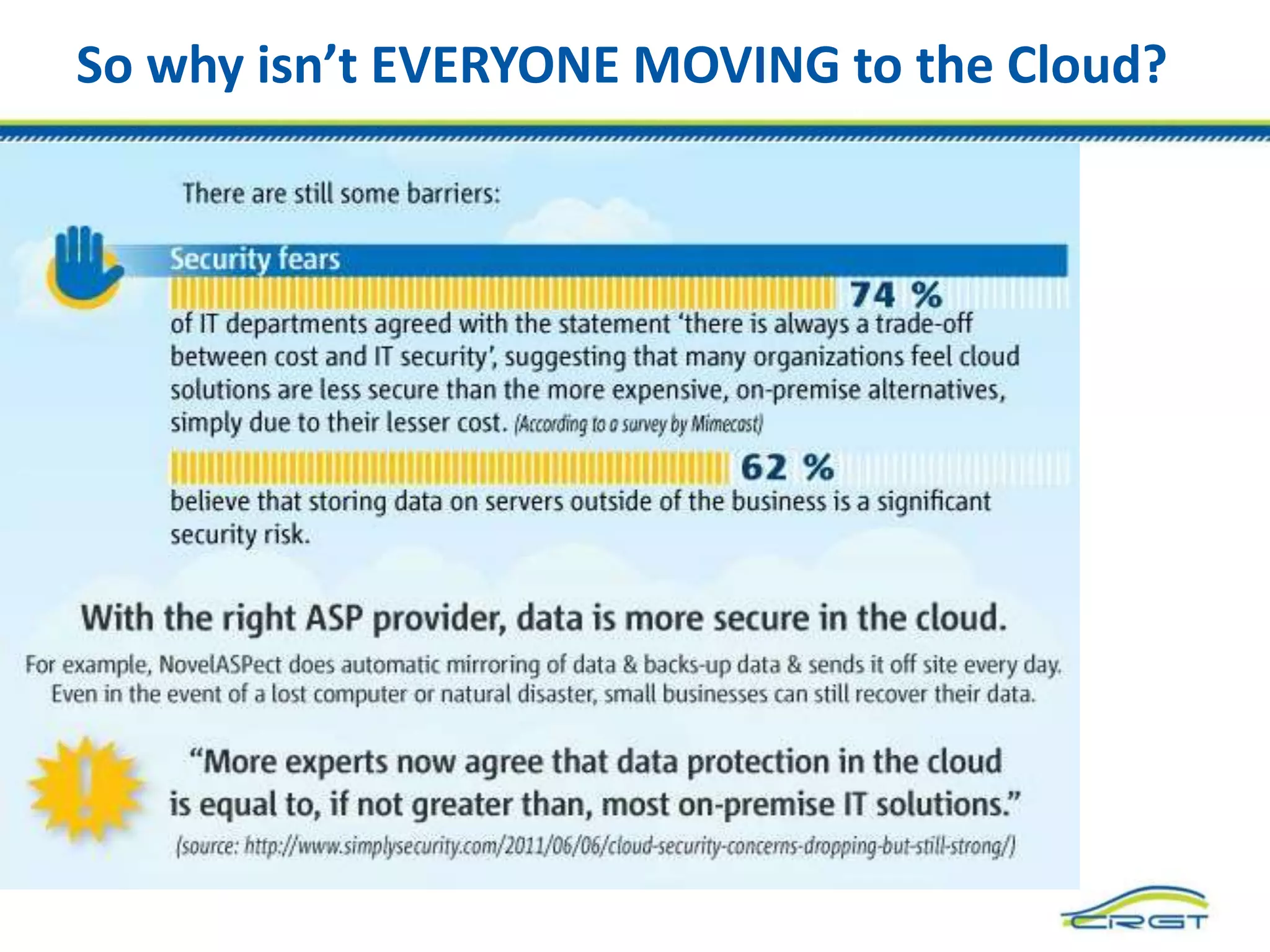
So why isn’t EVERYONE MOVING to the Cloud?
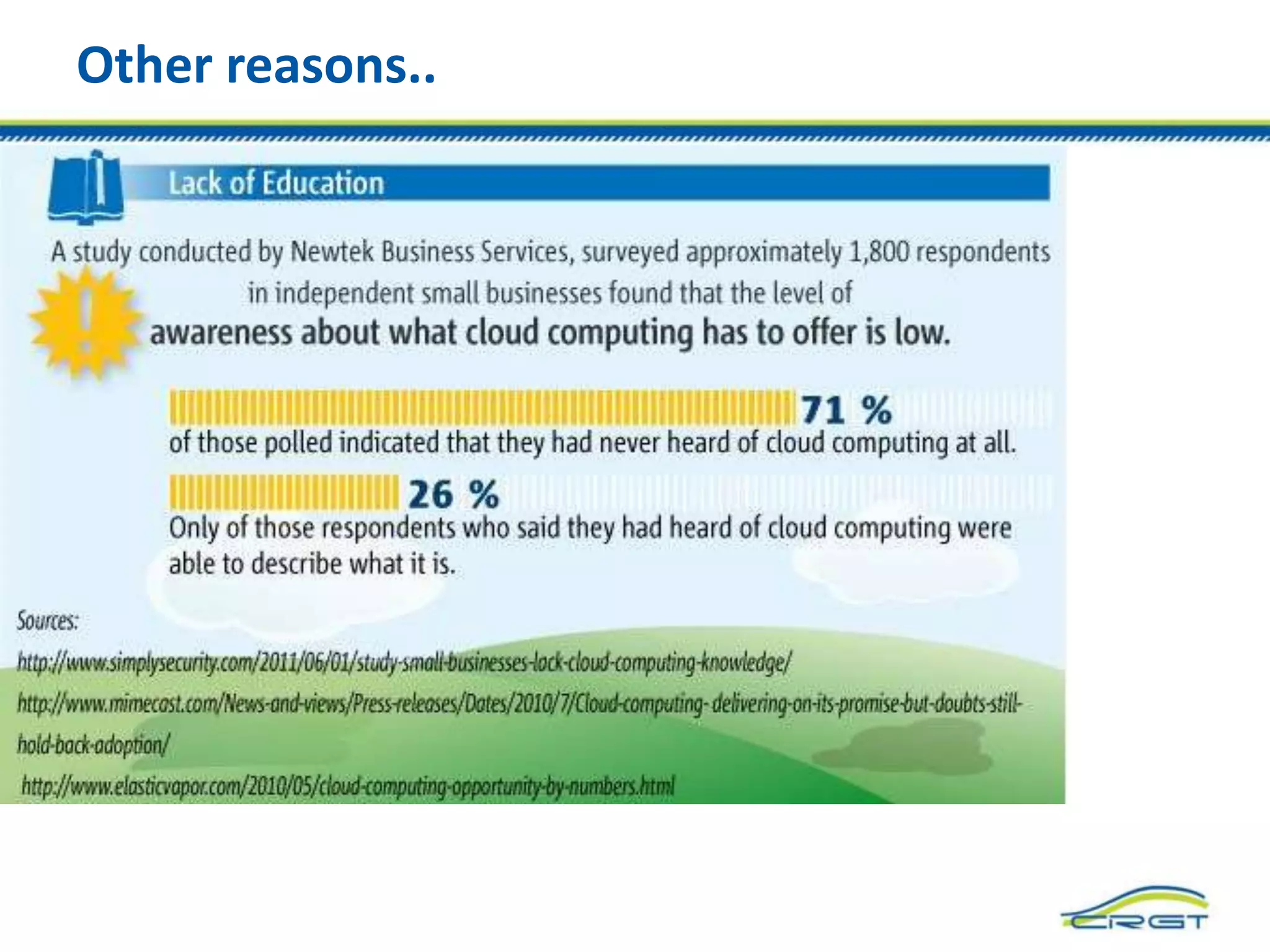
Other reasons..
Final Comments
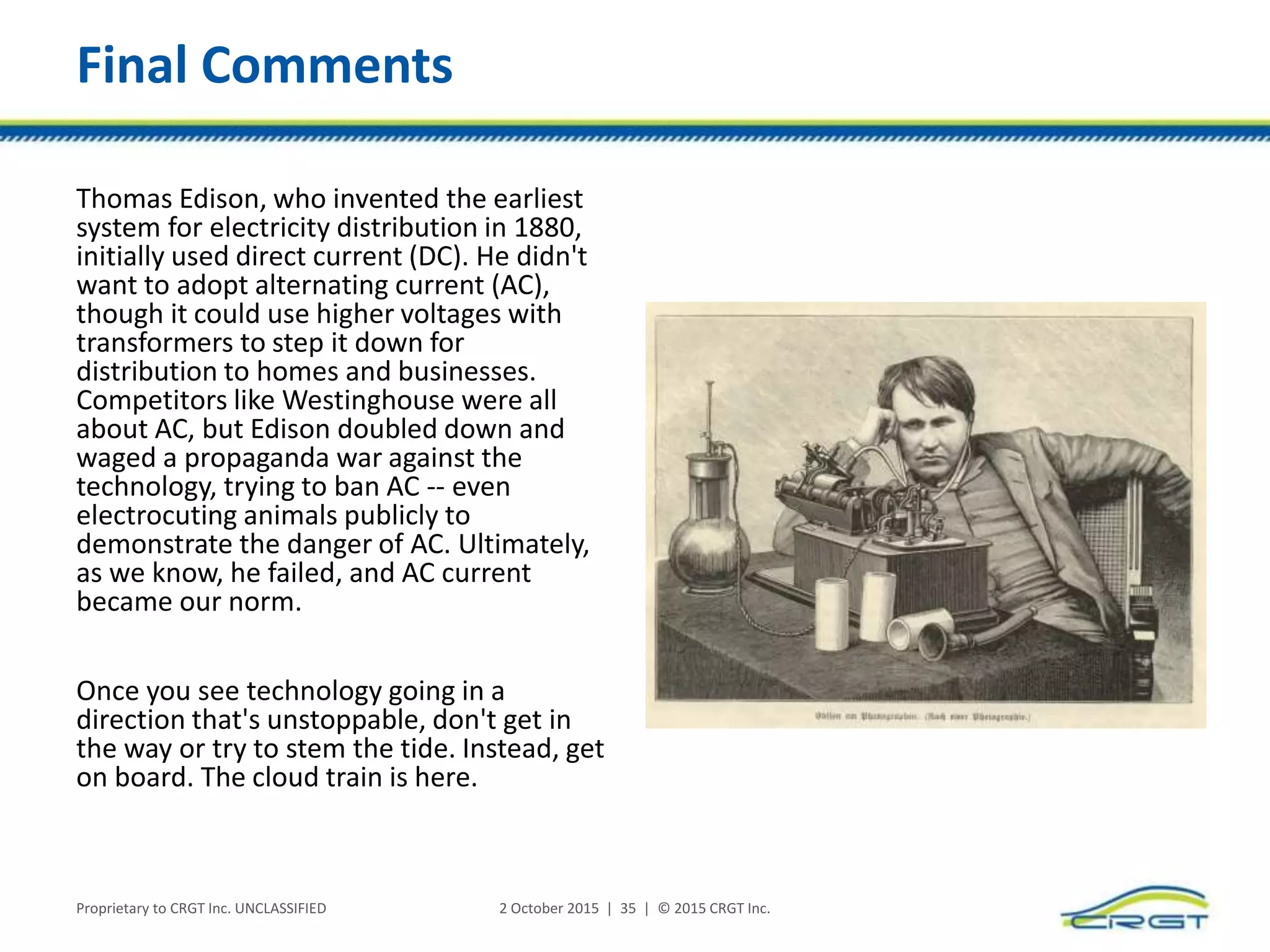
Thomas Edison, who invented the earliest
system for electricity distribution in 1880,
initially used direct current (DC). He didn't
want to adopt alternating current (AC),
though it could use higher voltages with
transformers to step it down for
distribution to homes and businesses.
Competitors like Westinghouse were all
about AC, but Edison doubled down and
waged a propaganda war against the
technology, trying to ban AC -- even
electrocuting animals publicly to
demonstrate the danger of AC. Ultimately,
as we know, he failed, and AC current
became our norm.
Once you see technology going in a
direction that's unstoppable, don't get in
the way or try to stem the tide. Instead, get
on board. The cloud train is here.
Proprietary to CRGT Inc. UNCLASSIFIED 2 October 2015 | 35 | © 2015 CRGT Inc.

Cloud computing benefits

  • 1.
    All information inthis presentation is proprietary to CRGT. Cloud Computing & Benefits Madhu Vattipulusu 09/25/2015
  • 2.
    Session Objectives • Explorecloud computing and different models • Look at Top Cloud Providers/companies in Cloud Computing • Top 2 Cloud Providers Products/Offerings • Cloud Use Cases • Deep dive in one of the cloud providers offerings • Demo 2 October 2015 | 2 | © 2015 CRGT Inc.
  • 3.
    Cloud Computing • Definition:The practice of using a network of remote servers hosted on the Internet to store, manage, and process data, rather than a local server or a personal computer. 2 October 2015 | 3 | © 2015 CRGT Inc.
  • 4.
    Cloud Computing • AlternateDefinition 2 October 2015 | 4 | © 2015 CRGT Inc. Cloud Computing Definition by AWS
  • 5.
    What can youdo In Cloud? • Storage – Store some files • Compute – process files • Database – Run a production database • Hadoop – Run a Hadoop cluster • Mobile – Provide Mobile Services – regardless of device • IAM – Identity Access Management
  • 6.
    Cloud Models AWS, Azure, GCE AWS,Azure, Google App Engine, Force.com WebEx, Salesforce
  • 7.
    Size & Forecast Proprietaryto CRGT Inc. UNCLASSIFIED 2 October 2015 | 7 | © 2015 CRGT Inc.
  • 8.
    Size & Forecast Proprietaryto CRGT Inc. UNCLASSIFIED 2 October 2015 | 8 | © 2015 CRGT Inc.
  • 9.
    Who are topcloud providers IAAS Top Providers PAAS Top Providers
  • 10.
  • 11.
  • 12.
  • 13.
    Some Use Cases •Big Data - https://aws.amazon.com/solut ions/case-studies/netflix/ • Media Services – Azure https://www.youtube.com/wa tch?v=Hhskdxj4QIY • https://aws.amazon.com/solut ions/case-studies/zumba- fitness/
  • 14.
    Moving to cloud •Application readiness – Does the application provide similar SLA? • Security – The data is sensitive and a data breach would present a significant risk to the organization • Cost/ROI – Is the cost more than on premise? • Company Culture –Does the management support it? Requires strong leadership, tenacity and vision for cloud drive. • Market Maturity – Is cloud mature to handle your loads?
  • 15.
    Simple Storage Service(S3) • S3 is designed specifically for data storage in the cloud. Like folders in windows, AWS has buckets in S3 that contain files. Sample Architecture – Log Analysis
  • 16.
    Glacier • Extremely low-coststorage service that provides secure, durable, and flexible storage for data backup and archival.
  • 17.
    Elastic Cloud Compute(EC2) •A virtual machine with root access to each one in cloud. • Features – Pay for what you use. – Instance Types: o Reserved (Significant discount) o Spot (Bid on unused ec2 machines) o On-Demand(no long term commitments) Instance Type Used for T2 -Burstable Good choice for workloads that don’t use the full CPU often or consistently, but occasionally need to burst (e.g. web servers, developer environments and small databases) M3 -General Purpose Provides a balance of compute, memory, and network resources. C4 – Compute optimized Highest performing processors and the lowest price per performance C3 -Network For Enhanced Networking( high performance science and engineering applications) R3-Memory Memory Optimized (Distributed memory cache, In-memory analytics) GPU G2 -Graphics For Graphics and GPU (Games, server side graphic workloads) I2 -Storage Storage Optimized - high random I/O performance, and provide high IOPS at a low cost (NoSQL, Cassandra, MongoDB, Hadoop & Cluster file systems) HS1 high sequential read and write performance per instance (Data ware housing, Map Reduce )
  • 18.
    Relational Database Service(RDS) • A web service that makes it easy to set up, operate, and scale a relational database in the cloud.
  • 19.
    VPC • Secured VirtualNetwork in the AWS cloud. – VPC Provides 4 options oVPC Single subnet oVPC Public and Private Subnet oVPC Public and Private Subnet and Hardware VPN Access oVPC with a private subnet only and hardware VPN Access.
  • 20.
    VPC • Public/Private Subnet• VPN Based Connectivity
  • 21.
    IAM • Securely controlindividual and group access to your AWS resources.
  • 22.
    CLOUD WATCH • Monitoringservice for AWS cloud resources and the applications you run on AWS.
  • 23.
    ELASTIC BEAN STALK •PAAS component of AWS. • Makes it easier for developers to quickly deploy and manage applications in the AWS cloud.
  • 24.
    Cloud Formation • Allowsyou to create and provision resources in a reusable template fashion.
  • 25.
  • 26.
  • 27.
  • 28.
    Access to AWSServices • Command Line Interface • Eclipse or RAD Plugin • Console
  • 29.
    Demo • Features ofAWS – Deploy a web application – Create a relational databas
  • 30.
    So why toCloud
  • 31.
  • 32.
    Business Agility • WithoutCloud Computing • With Cloud Computing Proprietary to CRGT Inc. UNCLASSIFIED 2 October 2015 | 32 | © 2015 CRGT Inc.
  • 33.
    So why isn’tEVERYONE MOVING to the Cloud?
  • 34.
  • 35.
    Final Comments Thomas Edison,who invented the earliest system for electricity distribution in 1880, initially used direct current (DC). He didn't want to adopt alternating current (AC), though it could use higher voltages with transformers to step it down for distribution to homes and businesses. Competitors like Westinghouse were all about AC, but Edison doubled down and waged a propaganda war against the technology, trying to ban AC -- even electrocuting animals publicly to demonstrate the danger of AC. Ultimately, as we know, he failed, and AC current became our norm. Once you see technology going in a direction that's unstoppable, don't get in the way or try to stem the tide. Instead, get on board. The cloud train is here. Proprietary to CRGT Inc. UNCLASSIFIED 2 October 2015 | 35 | © 2015 CRGT Inc.

Editor's Notes

  • #2 Title Deploy an application to aws
  • #4 Change the picture if you can.
  • #10 http://cloudcomputing.info/en/news/2015/05/gartner-releases-its-magic-quadrant-for-cloud-infrastructure-as-a-service-for-2015.html
  • #11 https://aws.amazon.com/products/ - products video.
  • #12 Replace this with PDF
  • #13 Replace this with PDF
  • #16 Simple, Reliable, Scalable, Fast and Simple Storage on Cloud. Store data that is 99.999999999% durable, with 99.99% available. Currently holds 2 Trillion Objects with 1Million Requests per second. Can hold infinite amount of data in a bucket, with ability to upload/download data and orchestrate permissions around data. Provides Standard interfaces (Java, REST, .NET, ) Data transfer from S3 to Elastic Cloud Compute (EC2) is free. Use it when you need low latency or frequent access to your data
  • #17 Costs as low as $0.01 per gigabyte per month. Use it when your data is rarely retrieved, and data retrieval times of several hours are acceptable. Frees companies of managing tape libraries.
  • #18 On-Demand Instances let you pay for compute capacity by the hour with no long-term commitments or upfront payments. Reserved Instances provide you with a significant discount (up to 75%) compared to On-Demand Instance pricing.  Spot Instances provide the ability for customers to purchase compute capacity with no upfront commitment and at hourly rates usually lower than the On-Demand rate. Spot Instances allow you to specify the maximum hourly price that you are willing to pay to run a particular instance type.
  • #19 Great link: EC2 MYSQL vs RDS MYSQL http://www.laurencegellert.com/2013/04/aws-benchmark-of-mysql-5-5-rds-vs-ec2/ Features Supports MySql, Oracle, PostgreSQL, SQL Server. Multi- Availability Zone(AZ) support. manages backups, software patching, automatic failure detection, read replicas and recovery.
  • #20 Amazon VPC provides advanced security features such as security groups and network access control lists to enable inbound and outbound filtering at the instance level and subnet level. In addition, you can store data in Amazon S3 and restrict access so that it’s only accessible from instances in your VPC. Optionally, you can also choose to launch Dedicated Instances which run on hardware dedicated to a single customer for additional isolation. Features Provides advanced security features (ACL, Security Groups) Multiple Connectivity Options Can create a Hardware Virtual Private Network (VPN) connection between your corporate datacenter and your VPC and leverage the AWS cloud as an extension of your corporate datacenter.
  • #22 Features Can create and manage user identities and grant permissions for those IAM users to access your resources. Can also grant access for users outside of aws- Temporary Credentials. Security Credentials include: Access Keys, passwords, Multi-Factor Authentication
  • #23 Features Use CW, to  gain system-wide visibility into resource utilization, application performance, and operational health Monitor Resources on EC2, DynamoDb, RDS instances.
  • #24 Languages Supported: JAVA, PHP, Python, Node.js, Ruby, .NET
  • #25 Features Cloud formation is defined as a template, a json based format, that describes all the resources you need to deploy to run your application. Automates creation of resources your application needs. Simplifies the task of repeatedly and predictably creating groups of related resources that power your applications.
  • #26 Add sample architectures from AWS Architecture http://aws.amazon.com/solutions/case-studies/parse/