
Cloud computing is location-independent computing,
whereby shared servers provide resources, software,
and data to computers and other devices on demand.
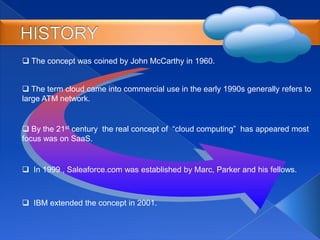
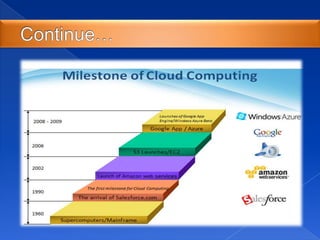
 The concept was coined by John McCarthy in 1960.
 The term cloud came into commercial use in the early 1990s generally refers to
large ATM network.
 By the 21st century the real concept of “cloud computing” has appeared most
focus was on SaaS.
 In 1999 , Saleaforce.com was established by Marc, Parker and his fellows.
 IBM extended the concept in 2001.
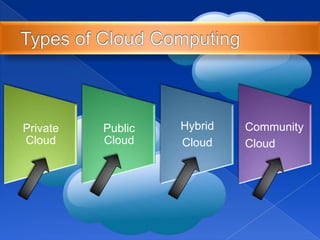
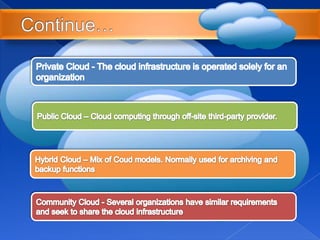
Private
Cloud
Public
Cloud
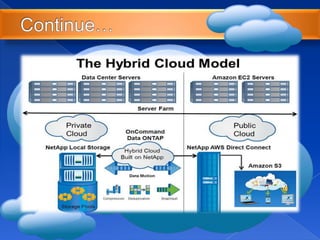
Hybrid
Cloud
Community
Cloud
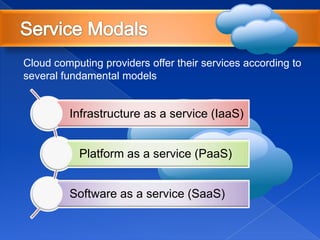
Cloud computing providers offer their services according to
several fundamental models
Infrastructure as a service (IaaS)
Platform as a service (PaaS)
Software as a service (SaaS)
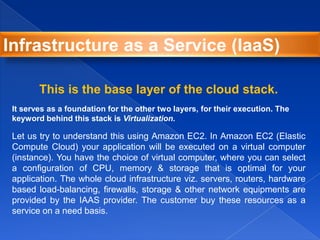
This is the base layer of the cloud stack.
It serves as a foundation for the other two layers, for their execution. The
keyword behind this stack is Virtualization.
Let us try to understand this using Amazon EC2. In Amazon EC2 (Elastic
Compute Cloud) your application will be executed on a virtual computer
(instance). You have the choice of virtual computer, where you can select
a configuration of CPU, memory & storage that is optimal for your
application. The whole cloud infrastructure viz. servers, routers, hardware
based load-balancing, firewalls, storage & other network equipments are
provided by the IAAS provider. The customer buy these resources as a
service on a need basis.
Infrastructure as a Service (IaaS)
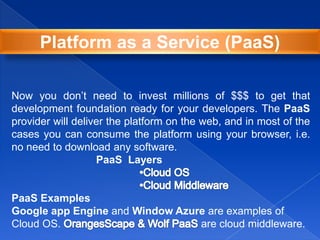
Now you don’t need to invest millions of $$$ to get that
development foundation ready for your developers. The PaaS
provider will deliver the platform on the web, and in most of the
cases you can consume the platform using your browser, i.e.
no need to download any software.
PaaS Layers
PaaS Examples
Google app Engine and Window Azure are examples of
Cloud OS. are cloud middleware.
Platform as a Service (PaaS)
• Next generation SaaS promises everything as a
service over the internet.
• Cloud computing started with a similar premise.
• A computing paradigm where there exists a
flexible set of computing resources across the
internet.
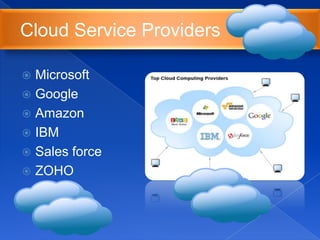
Cloud Service Providers
 Microsoft
 Google
 Amazon
 IBM
 Sales force
 ZOHO
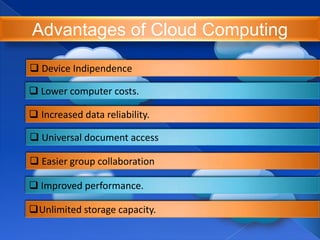
Advantages of Cloud Computing
 Lower computer costs.
 Device Indipendence
 Improved performance.
Unlimited storage capacity.
 Increased data reliability.
 Universal document access
 Easier group collaboration
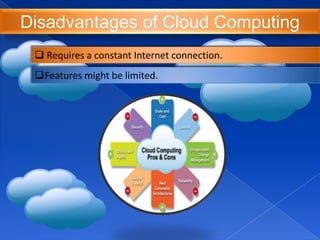
Disadvantages of Cloud Computing
 Requires a constant Internet connection.
Features might be limited.
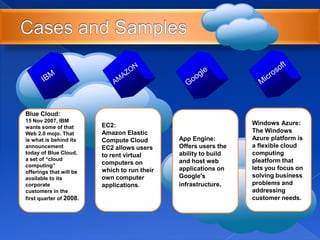
Blue Cloud:
15 Nov 2007, IBM
wants some of that
Web 2.0 mojo. That
is what is behind its
announcement
today of Blue Cloud,
a set of “cloud
computing”
offerings that will be
available to its
corporate
customers in the
first quarter of 2008.
Windows Azure:
The Windows
Azure platform is
a flexible cloud
computing
pleatform that
lets you focus on
solving business
problems and
addressing
customer needs.
EC2:
Amazon Elastic
Compute Cloud
EC2 allows users
to rent virtual
computers on
which to run their
own computer
applications.
App Engine:
Offers users the
ability to build
and host web
applications on
Google's
infrastructure.
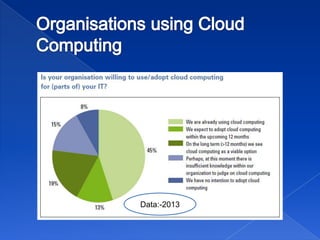
Data:-2013
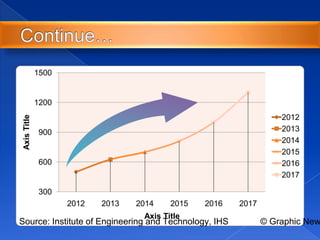
300
600
900
1200
1500
2012 2013 2014 2015 2016 2017
AxisTitle
Axis Title
2012
2013
2014
2015
2016
2017
Source: Institute of Engineering and Technology, IHS © Graphic New
 It Provides Tremendous benefits to Companies.
 You Pay only for Services that you use.
 Cloud computing is now evolving like never
before.
 Cloud Computing is the fastest growing part of
IT but still has security issues and somewhat it
is immature.
 But definitely, over a period of time, Cloud
Computing will become the most promising
technology in next few years.
 Google
 Wikipedia
 Amazon.com
 Salesforce.com
Cloud Computing

Cloud Computing

  • 2.
    Cloud computing islocation-independent computing, whereby shared servers provide resources, software, and data to computers and other devices on demand.
  • 4.
     The conceptwas coined by John McCarthy in 1960.  The term cloud came into commercial use in the early 1990s generally refers to large ATM network.  By the 21st century the real concept of “cloud computing” has appeared most focus was on SaaS.  In 1999 , Saleaforce.com was established by Marc, Parker and his fellows.  IBM extended the concept in 2001.
  • 7.
  • 10.
    Cloud computing providersoffer their services according to several fundamental models Infrastructure as a service (IaaS) Platform as a service (PaaS) Software as a service (SaaS)
  • 11.
    This is thebase layer of the cloud stack. It serves as a foundation for the other two layers, for their execution. The keyword behind this stack is Virtualization. Let us try to understand this using Amazon EC2. In Amazon EC2 (Elastic Compute Cloud) your application will be executed on a virtual computer (instance). You have the choice of virtual computer, where you can select a configuration of CPU, memory & storage that is optimal for your application. The whole cloud infrastructure viz. servers, routers, hardware based load-balancing, firewalls, storage & other network equipments are provided by the IAAS provider. The customer buy these resources as a service on a need basis. Infrastructure as a Service (IaaS)
  • 12.
    Now you don’tneed to invest millions of $$$ to get that development foundation ready for your developers. The PaaS provider will deliver the platform on the web, and in most of the cases you can consume the platform using your browser, i.e. no need to download any software. PaaS Layers PaaS Examples Google app Engine and Window Azure are examples of Cloud OS. are cloud middleware. Platform as a Service (PaaS)
  • 13.
    • Next generationSaaS promises everything as a service over the internet. • Cloud computing started with a similar premise. • A computing paradigm where there exists a flexible set of computing resources across the internet.
  • 14.
    Cloud Service Providers Microsoft  Google  Amazon  IBM  Sales force  ZOHO
  • 15.
    Advantages of CloudComputing  Lower computer costs.  Device Indipendence  Improved performance. Unlimited storage capacity.  Increased data reliability.  Universal document access  Easier group collaboration
  • 16.
    Disadvantages of CloudComputing  Requires a constant Internet connection. Features might be limited.
  • 17.
    Blue Cloud: 15 Nov2007, IBM wants some of that Web 2.0 mojo. That is what is behind its announcement today of Blue Cloud, a set of “cloud computing” offerings that will be available to its corporate customers in the first quarter of 2008. Windows Azure: The Windows Azure platform is a flexible cloud computing pleatform that lets you focus on solving business problems and addressing customer needs. EC2: Amazon Elastic Compute Cloud EC2 allows users to rent virtual computers on which to run their own computer applications. App Engine: Offers users the ability to build and host web applications on Google's infrastructure.
  • 18.
  • 19.
    300 600 900 1200 1500 2012 2013 20142015 2016 2017 AxisTitle Axis Title 2012 2013 2014 2015 2016 2017 Source: Institute of Engineering and Technology, IHS © Graphic New
  • 20.
     It ProvidesTremendous benefits to Companies.  You Pay only for Services that you use.  Cloud computing is now evolving like never before.  Cloud Computing is the fastest growing part of IT but still has security issues and somewhat it is immature.  But definitely, over a period of time, Cloud Computing will become the most promising technology in next few years.
  • 22.
     Google  Wikipedia Amazon.com  Salesforce.com