Introduction to Openstack
Ranjith Kumar N
Principle Software Engineer
EMC
1
2
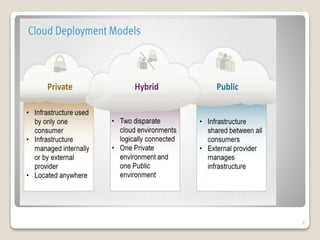
 Private clouds are built on infrastructure
components that are dedicated to only one
consumer. This provides the ability to offer
specific service levels and guarantee resource
availability for specific uses.
 Public cloud model, an external provider
manages the (shared)infrastructure. The
consumer is only responsible for deploying
services within the environment.
 Hybrid cloud is a combination of the Private
and Public models. In a Hybrid environment,
one or more Private clouds is logically
connected with one or more Public clouds.
This provides flexibility to have critical
systems operating on dedicated hardware,
while other services can run on shared
infrastructure
3
4
Service delivery models
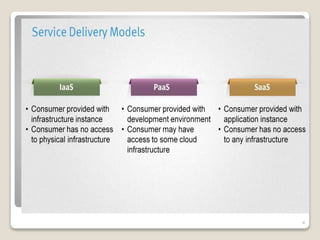
 Infrastructure as a Service (IaaS):
Here consumer is able to provision
compute, storage, network, and other
fundamental computing resources on which
they can run software, including an
operating system and applications. The
consumer does not manage the physical
infrastructure but is able to allocate
portions of it for their use.
Example: OpenStack framework
5
 Platform as a Service (PaaS):
Consumer is provided with a preconfigured
development environment used to create, test,
and deploy supported applications on a cloud
infrastructure. The development environment
may have certain applications or tools installed
that provide a consistent repeatable
environment to perform tasks.
Example : Pivotal Cloud Foundry, Windows
Azure, Google App Engine, and Red Hat
OpenShift.
6
 Software as a Service (SaaS):
Here consumer is provided with an application
instance on a cloud infrastructure. The
consumer has no access to any underlying
infrastructure. Once the application is
established, users access it and the associated
data using a thin client, such as a web
browser.
Example : Customer Relationship Management
(CRM), Enterprise Resource Planning (ERP),
Management Information Systems (MIS),
human resource management, and content
management.
7
8
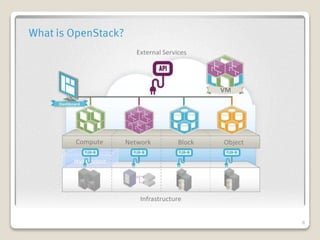
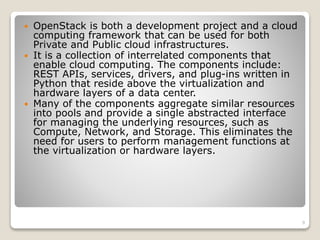
 OpenStack is both a development project and a cloud
computing framework that can be used for both
Private and Public cloud infrastructures.
 It is a collection of interrelated components that
enable cloud computing. The components include:
REST APIs, services, drivers, and plug-ins written in
Python that reside above the virtualization and
hardware layers of a data center.
 Many of the components aggregate similar resources
into pools and provide a single abstracted interface
for managing the underlying resources, such as
Compute, Network, and Storage. This eliminates the
need for users to perform management functions at
the virtualization or hardware layers.
9
10
11
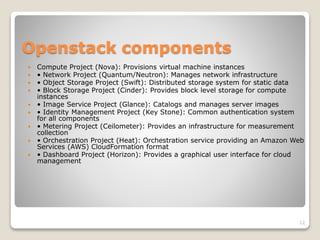
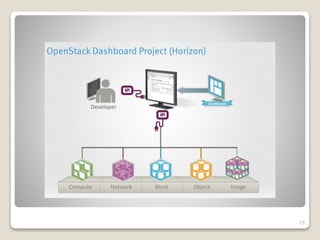
Openstack components
 Compute Project (Nova): Provisions virtual machine instances
 • Network Project (Quantum/Neutron): Manages network infrastructure
 • Object Storage Project (Swift): Distributed storage system for static data
 • Block Storage Project (Cinder): Provides block level storage for compute
instances
 • Image Service Project (Glance): Catalogs and manages server images
 • Identity Management Project (Key Stone): Common authentication system
for all components
 • Metering Project (Ceilometer): Provides an infrastructure for measurement
collection
 • Orchestration Project (Heat): Orchestration service providing an Amazon Web
Services (AWS) CloudFormation format
 • Dashboard Project (Horizon): Provides a graphical user interface for cloud
management
12
13
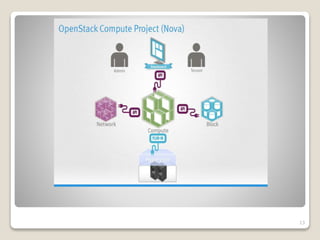
 The OpenStack Compute Project is a collection of APIs,
operating system layer services, and plug-ins that
provision and manage virtual machine instances and
control the underlying compute resources.
 The operating system layer services are distributed
throughout the cloud environment and perform various
functions, such as determining virtual machine instance
placement, tracking instance state, and enforcing quotas.
 OpenStack Compute is not a virtualization application.
Through plug-ins, it supports deploying virtual machine
instances on multiple hypervisors, such as XenServer, KVM,
ESXI, and directly on bare-metal hardware.
 OpenStack Compute provides APIs to both users and
administrators for management functions.
 Compute uses API calls to other OpenStack services for
network connectivity, storage, authentication, and other
requirements
14
15
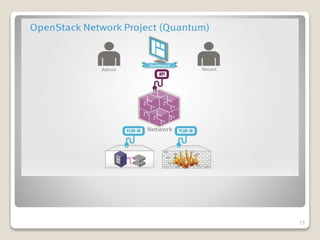
 The OpenStack Network Project is a framework of
distributed operating system layer services that provide a
pluggable, scalable, and API-driven architecture.
 Network provides a common set of APIs for both tenants
and administrators that can be used to create networks
and manage IP addresses.
 Network provides an architecture for various plug-ins and
agents that can be used to interface with different network
provider components, such as Open vSwitch, Cisco
UCS/Nexus, VMware NVP, and others. Plug-ins can also
introduce advanced features, such as Software Defined
Networking (SDN) technology like OpenFlow, Quality of
Service, load balancing, and others.
 The goal of OpenStack Network is to provide a standard
interface to consume virtual network service, regardless of
the underlying network technology.
16
17
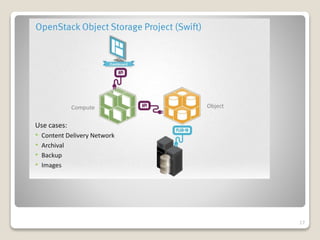
 The OpenStack Object Storage Project was initially
conceived for the purpose of storing virtual machine
images for deployment.
 Files and objects are accessed through the REST API
interface. The end-user’s operating system is unaware of
the remote storage system.
 Applications are typically built using object storage in order
to provide a higher level of abstraction.
 For example, object storage solutions are commonly used
as Content Delivery Networks (CDNs) for hosting static
web media, since object storage provides an HTTP
interface. Because of its highly available and reliable
nature, object storage is also used for archival and backup
purposes.
 Provides vendor neutral storage
18
19
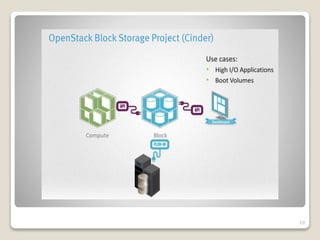
 The OpenStack Block Storage Project provides
persistent block-level storage devices for use
within virtual machine instances.
 The project was created to support high I/O
requirements, such as boot devices and mission
critical databases.
 Tenants in an OpenStack environment access
data through block storage by mounting the
remote volume in a similar manner to how they
would mount a local physical disk.
 The goal of the OpenStack Block Storage Project
is to provide storage devices from heterogeneous
back-end storage.
20
21
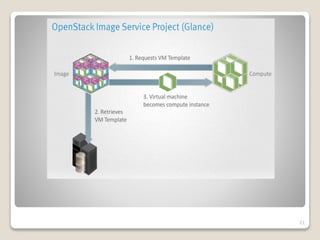
 The OpenStack Image Service provides the
ability to discover, register, and deliver services
for virtual disk and server images. This supports
the use of images created in Hyper-V, vSphere,
or other platforms.
 Image provides an interface for discovering
information about virtual disk images stored in a
variety of back-end storage, including OpenStack
object storage.
 The goal of the OpenStack Image Service Project
is to provide a central repository for virtual
machine images to be used by Compute.
22
23
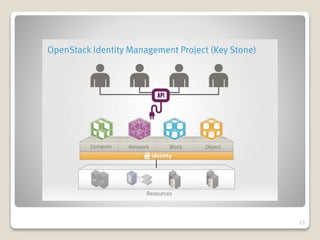
 The OpenStack Identity Management Project is
responsible for authenticating and authorization.
 It is queried by other OpenStack components to
ensure that users have appropriate access to
resources, such as volumes, virtual machines,
and IP addresses.
 It supports external authorization mechanisms,
such as LDAP, oAuth, and SAML.
 The goal of the OpenStack Identity Management
Project is to provide a standard centralized
mechanism for authentication in an OpenStack
environment.
24
25
26
27
28
29
30
31
 Openstack releases:
 Juno –April 2015
 Kilo – end of this month
 Liberty – next release
32
Q&A
33
 Adaptation
 More than one-third of cloud users use
private clouds, and more than half of
those are OpenStack clouds.
 Walmart, Toyota and others
34
 Advantage
 no vendor lock in
 Customise the software
35

Introduction Openstack

  • 1.
    Introduction to Openstack RanjithKumar N Principle Software Engineer EMC 1
  • 2.
  • 3.
     Private cloudsare built on infrastructure components that are dedicated to only one consumer. This provides the ability to offer specific service levels and guarantee resource availability for specific uses.  Public cloud model, an external provider manages the (shared)infrastructure. The consumer is only responsible for deploying services within the environment.  Hybrid cloud is a combination of the Private and Public models. In a Hybrid environment, one or more Private clouds is logically connected with one or more Public clouds. This provides flexibility to have critical systems operating on dedicated hardware, while other services can run on shared infrastructure 3
  • 4.
  • 5.
    Service delivery models Infrastructure as a Service (IaaS): Here consumer is able to provision compute, storage, network, and other fundamental computing resources on which they can run software, including an operating system and applications. The consumer does not manage the physical infrastructure but is able to allocate portions of it for their use. Example: OpenStack framework 5
  • 6.
     Platform asa Service (PaaS): Consumer is provided with a preconfigured development environment used to create, test, and deploy supported applications on a cloud infrastructure. The development environment may have certain applications or tools installed that provide a consistent repeatable environment to perform tasks. Example : Pivotal Cloud Foundry, Windows Azure, Google App Engine, and Red Hat OpenShift. 6
  • 7.
     Software asa Service (SaaS): Here consumer is provided with an application instance on a cloud infrastructure. The consumer has no access to any underlying infrastructure. Once the application is established, users access it and the associated data using a thin client, such as a web browser. Example : Customer Relationship Management (CRM), Enterprise Resource Planning (ERP), Management Information Systems (MIS), human resource management, and content management. 7
  • 8.
  • 9.
     OpenStack isboth a development project and a cloud computing framework that can be used for both Private and Public cloud infrastructures.  It is a collection of interrelated components that enable cloud computing. The components include: REST APIs, services, drivers, and plug-ins written in Python that reside above the virtualization and hardware layers of a data center.  Many of the components aggregate similar resources into pools and provide a single abstracted interface for managing the underlying resources, such as Compute, Network, and Storage. This eliminates the need for users to perform management functions at the virtualization or hardware layers. 9
  • 10.
  • 11.
  • 12.
    Openstack components  ComputeProject (Nova): Provisions virtual machine instances  • Network Project (Quantum/Neutron): Manages network infrastructure  • Object Storage Project (Swift): Distributed storage system for static data  • Block Storage Project (Cinder): Provides block level storage for compute instances  • Image Service Project (Glance): Catalogs and manages server images  • Identity Management Project (Key Stone): Common authentication system for all components  • Metering Project (Ceilometer): Provides an infrastructure for measurement collection  • Orchestration Project (Heat): Orchestration service providing an Amazon Web Services (AWS) CloudFormation format  • Dashboard Project (Horizon): Provides a graphical user interface for cloud management 12
  • 13.
  • 14.
     The OpenStackCompute Project is a collection of APIs, operating system layer services, and plug-ins that provision and manage virtual machine instances and control the underlying compute resources.  The operating system layer services are distributed throughout the cloud environment and perform various functions, such as determining virtual machine instance placement, tracking instance state, and enforcing quotas.  OpenStack Compute is not a virtualization application. Through plug-ins, it supports deploying virtual machine instances on multiple hypervisors, such as XenServer, KVM, ESXI, and directly on bare-metal hardware.  OpenStack Compute provides APIs to both users and administrators for management functions.  Compute uses API calls to other OpenStack services for network connectivity, storage, authentication, and other requirements 14
  • 15.
  • 16.
     The OpenStackNetwork Project is a framework of distributed operating system layer services that provide a pluggable, scalable, and API-driven architecture.  Network provides a common set of APIs for both tenants and administrators that can be used to create networks and manage IP addresses.  Network provides an architecture for various plug-ins and agents that can be used to interface with different network provider components, such as Open vSwitch, Cisco UCS/Nexus, VMware NVP, and others. Plug-ins can also introduce advanced features, such as Software Defined Networking (SDN) technology like OpenFlow, Quality of Service, load balancing, and others.  The goal of OpenStack Network is to provide a standard interface to consume virtual network service, regardless of the underlying network technology. 16
  • 17.
  • 18.
     The OpenStackObject Storage Project was initially conceived for the purpose of storing virtual machine images for deployment.  Files and objects are accessed through the REST API interface. The end-user’s operating system is unaware of the remote storage system.  Applications are typically built using object storage in order to provide a higher level of abstraction.  For example, object storage solutions are commonly used as Content Delivery Networks (CDNs) for hosting static web media, since object storage provides an HTTP interface. Because of its highly available and reliable nature, object storage is also used for archival and backup purposes.  Provides vendor neutral storage 18
  • 19.
  • 20.
     The OpenStackBlock Storage Project provides persistent block-level storage devices for use within virtual machine instances.  The project was created to support high I/O requirements, such as boot devices and mission critical databases.  Tenants in an OpenStack environment access data through block storage by mounting the remote volume in a similar manner to how they would mount a local physical disk.  The goal of the OpenStack Block Storage Project is to provide storage devices from heterogeneous back-end storage. 20
  • 21.
  • 22.
     The OpenStackImage Service provides the ability to discover, register, and deliver services for virtual disk and server images. This supports the use of images created in Hyper-V, vSphere, or other platforms.  Image provides an interface for discovering information about virtual disk images stored in a variety of back-end storage, including OpenStack object storage.  The goal of the OpenStack Image Service Project is to provide a central repository for virtual machine images to be used by Compute. 22
  • 23.
  • 24.
     The OpenStackIdentity Management Project is responsible for authenticating and authorization.  It is queried by other OpenStack components to ensure that users have appropriate access to resources, such as volumes, virtual machines, and IP addresses.  It supports external authorization mechanisms, such as LDAP, oAuth, and SAML.  The goal of the OpenStack Identity Management Project is to provide a standard centralized mechanism for authentication in an OpenStack environment. 24
  • 25.
  • 26.
  • 27.
  • 28.
  • 29.
  • 30.
  • 31.
  • 32.
     Openstack releases: Juno –April 2015  Kilo – end of this month  Liberty – next release 32
  • 33.
  • 34.
     Adaptation  Morethan one-third of cloud users use private clouds, and more than half of those are OpenStack clouds.  Walmart, Toyota and others 34
  • 35.
     Advantage  novendor lock in  Customise the software 35