eiVia
Energy Consumption Management – Forecasting,
Planning, Financial Modeling - CAPEx Planning /
  Execution, Optimization, & Carbon Footprint
         Performance Impact Analysis


                                Presented by
                                John C. Kesseg
                                VP of Sales
                                eiVia, Inc.
                                703-408-1534
                                Confidential Proprietary Information
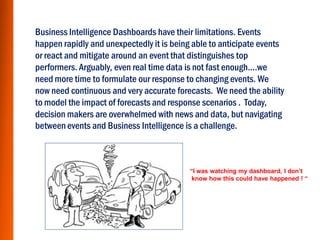
Business Intelligence Dashboards have their limitations. Events
happen rapidly and unexpectedly it is being able to anticipate events
or react and mitigate around an event that distinguishes top
performers. Arguably, even real time data is not fast enough….we
need more time to formulate our response to changing events. We
now need continuous and very accurate forecasts. We need the ability
to model the impact of forecasts and response scenarios . Today,
decision makers are overwhelmed with news and data, but navigating
between events and Business Intelligence is a challenge.


                                          “I was watching my dashboard, I don’t
                                           know how this could have happened ! “
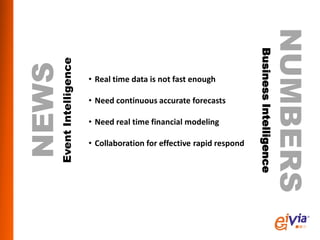
NUMBERS
                                                                      Business Intelligence
   Event Intelligence
NEWS
                        • Real time data is not fast enough

                        • Need continuous accurate forecasts

                        • Need real time financial modeling

                        • Collaboration for effective rapid respond
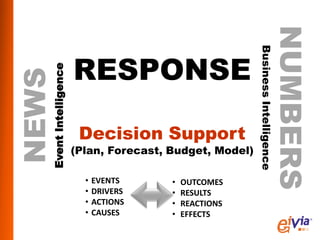
NUMBERS
                                                          Business Intelligence
                        RESPONSE
   Event Intelligence
NEWS


                         Decision Support
                        (Plan, Forecast, Budget, Model)

                          •   EVENTS     •   OUTCOMES
                          •   DRIVERS    •   RESULTS
                          •   ACTIONS    •   REACTIONS
                          •   CAUSES     •   EFFECTS
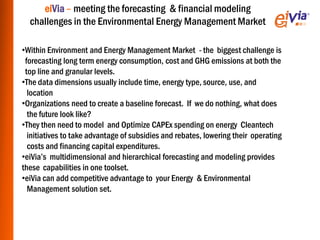
eiVia – meeting the forecasting & financial modeling
  challenges in the Environmental Energy Management Market

•Within Environment and Energy Management Market - the biggest challenge is
 forecasting long term energy consumption, cost and GHG emissions at both the
 top line and granular levels.
•The data dimensions usually include time, energy type, source, use, and
  location
•Organizations need to create a baseline forecast. If we do nothing, what does
  the future look like?
•They then need to model and Optimize CAPEx spending on energy Cleantech
  initiatives to take advantage of subsidies and rebates, lowering their operating
  costs and financing capital expenditures.
•eiVia’s multidimensional and hierarchical forecasting and modeling provides
these capabilities in one toolset.
•eiVia can add competitive advantage to your Energy & Environmental
  Management solution set.
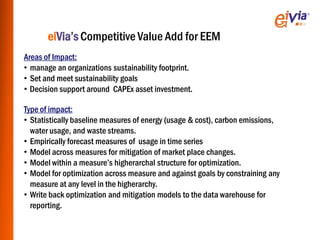
eiVia’s Competitive Value Add for EEM
Areas of Impact:
• manage an organizations sustainability footprint.
• Set and meet sustainability goals
• Decision support around CAPEx asset investment.

Type of impact:
• Statistically baseline measures of energy (usage & cost), carbon emissions,
  water usage, and waste streams.
• Empirically forecast measures of usage in time series
• Model across measures for mitigation of market place changes.
• Model within a measure’s higherarchal structure for optimization.
• Model for optimization across measure and against goals by constraining any
  measure at any level in the higherarchy.
• Write back optimization and mitigation models to the data warehouse for
  reporting.
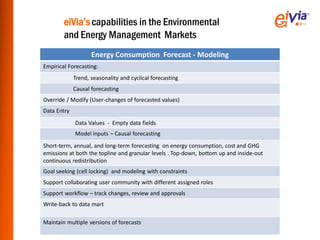
eiVia’s capabilities in the Environmental
        and Energy Management Markets
                    Energy Consumption Forecast - Modeling
Empirical Forecasting:
             Trend, seasonality and cyclical forecasting
             Causal forecasting
Override / Modify (User-changes of forecasted values)
Data Entry
             Data Values - Empty data fields
             Model inputs – Causal forecasting
Short-term, annual, and long-term forecasting on energy consumption, cost and GHG
emissions at both the topline and granular levels . Top-down, bottom up and inside-out
continuous redistribution
Goal seeking (cell locking) and modeling with constraints
Support collaborating user community with different assigned roles
Support workflow – track changes, review and approvals
Write-back to data mart

Maintain multiple versions of forecasts
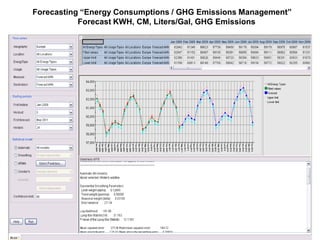
Forecasting “Energy Consumptions / GHG Emissions Management”
           Forecast KWH, CM, Liters/Gal, GHG Emissions
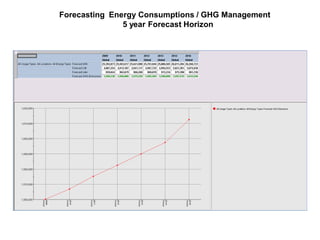
Forecasting Energy Consumptions / GHG Management
               5 year Forecast Horizon
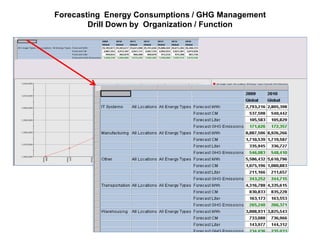
Forecasting Energy Consumptions / GHG Management
        Drill Down by Organization / Function
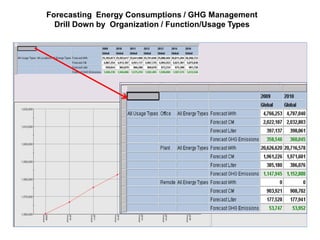
Forecasting Energy Consumptions / GHG Management
  Drill Down by Organization / Function/Usage Types
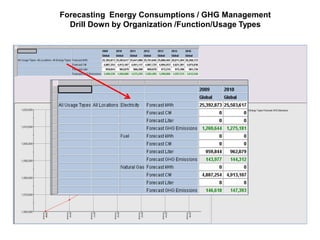
Forecasting Energy Consumptions / GHG Management
  Drill Down by Organization /Function/Usage Types
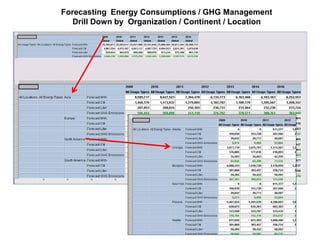
Forecasting Energy Consumptions / GHG Management
   Drill Down by Organization / Continent / Location
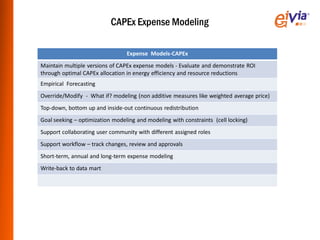
CAPEx Expense Modeling

                                 Expense Models-CAPEx
Maintain multiple versions of CAPEx expense models - Evaluate and demonstrate ROI
through optimal CAPEx allocation in energy efficiency and resource reductions
Empirical Forecasting
Override/Modify - What if? modeling (non additive measures like weighted average price)
Top-down, bottom up and inside-out continuous redistribution
Goal seeking – optimization modeling and modeling with constraints (cell locking)
Support collaborating user community with different assigned roles
Support workflow – track changes, review and approvals
Short-term, annual and long-term expense modeling
Write-back to data mart
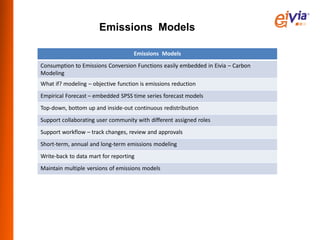
Emissions Models

                                    Emissions Models
Consumption to Emissions Conversion Functions easily embedded in Eivia – Carbon
Modeling
What if? modeling – objective function is emissions reduction
Empirical Forecast – embedded SPSS time series forecast models
Top-down, bottom up and inside-out continuous redistribution
Support collaborating user community with different assigned roles
Support workflow – track changes, review and approvals
Short-term, annual and long-term emissions modeling
Write-back to data mart for reporting
Maintain multiple versions of emissions models
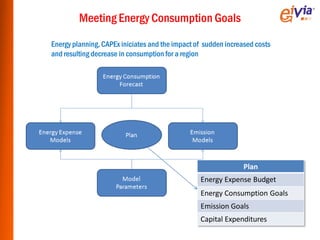
Meeting Energy Consumption Goals
Energy planning, CAPEx iniciates and the impact of sudden increased costs
and resulting decrease in consumption for a region


                                                                Plan
                                                 Energy Expense Budget
                                                 Energy Consumption Goals
                                                 Emission Goals
                                                 Capital Expenditures
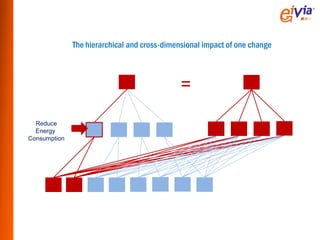
The hierarchical and cross-dimensional impact of one change


                                              =
  Reduce
  Energy
Consumption
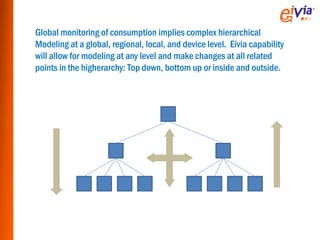
Global monitoring of consumption implies complex hierarchical
Modeling at a global, regional, local, and device level. Eivia capability
will allow for modeling at any level and make changes at all related
points in the higherarchy: Top down, bottom up or inside and outside.
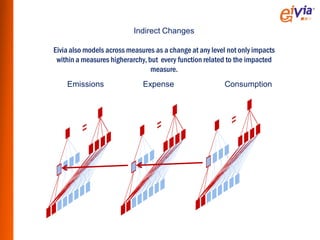
Indirect Changes

Eivia also models across measures as a change at any level not only impacts
 within a measures higherarchy, but every function related to the impacted
                                 measure.
    Emissions                 Expense                    Consumption
About Eivia
• Deep roots in Business Intelligence & Data Warehousing as Eivia represents
  the 2nd generation tool from the management and development team of
  Information Advantage

• Over $20 million invested in development of technology, to-date.

• Large commercial users: Pepsi, Cargill, and Johnson & Johnson.

• Go to market strategy is to provide the Eivia engine to SAAS Providers to
  deliver decision support for their user community.
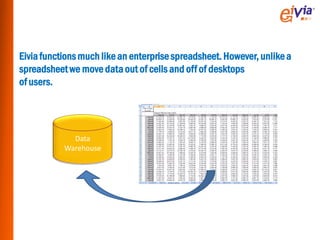
Eivia functions much like an enterprise spreadsheet. However, unlike a
spreadsheet we move data out of cells and off of desktops
of users.


             Data
           Warehouse
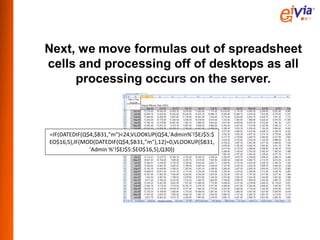
Next, we move formulas out of spreadsheet
cells and processing off of desktops as all
     processing occurs on the server.


=IF(DATEDIF(Q$4,$B31,"m")<24,VLOOKUP(Q$4,'Admin%'!$EJ$5:$
EO$16,5),IF(MOD(DATEDIF(Q$4,$B31,"m"),12)=0,VLOOKUP($B31,
              'Admin %'!$EJ$5:$EO$16,5),Q30))
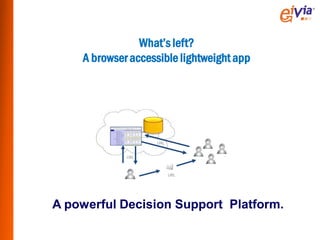
What’s left?
    A browser accessible lightweight app


                   URL


             URL


                         URL


A powerful Decision Support Platform.
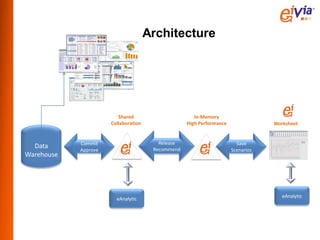
Architecture


                         Shared                       In-Memory
                      Collaboration                High Performance               Worksheet


            Commit                       Release                        Save
  Data      Approve                    Recommend                      Scenarios
Warehouse


                                                                                     eAnalytic
                        eAnalytic
Eivia Benefits Summary
•   Familiar User Interface - Facilitates Rapid Adoption
•   Web based application
     Ready for the sweeping business changes associated
      with tablet computing
     Zero Footprint
     Information Assurance & security - Conforms to
      Enterprise Data Governance Best Practices
•   Empirical Forecasting
•   Complex Data Modeling Planning, and Forecasting
     Multidimensional Database Navigation – model
      impact what if analysis on CAPEx initiatives
•   E-Analytic allows for easy integration with complex
    business rules and functions

Carbon Management Market EiVia Overview

  • 1.
    eiVia Energy Consumption Management– Forecasting, Planning, Financial Modeling - CAPEx Planning / Execution, Optimization, & Carbon Footprint Performance Impact Analysis Presented by John C. Kesseg VP of Sales eiVia, Inc. 703-408-1534 Confidential Proprietary Information
  • 2.
    Business Intelligence Dashboardshave their limitations. Events happen rapidly and unexpectedly it is being able to anticipate events or react and mitigate around an event that distinguishes top performers. Arguably, even real time data is not fast enough….we need more time to formulate our response to changing events. We now need continuous and very accurate forecasts. We need the ability to model the impact of forecasts and response scenarios . Today, decision makers are overwhelmed with news and data, but navigating between events and Business Intelligence is a challenge. “I was watching my dashboard, I don’t know how this could have happened ! “
  • 3.
    NUMBERS Business Intelligence Event Intelligence NEWS • Real time data is not fast enough • Need continuous accurate forecasts • Need real time financial modeling • Collaboration for effective rapid respond
  • 4.
    NUMBERS Business Intelligence RESPONSE Event Intelligence NEWS Decision Support (Plan, Forecast, Budget, Model) • EVENTS • OUTCOMES • DRIVERS • RESULTS • ACTIONS • REACTIONS • CAUSES • EFFECTS
  • 5.
    eiVia – meetingthe forecasting & financial modeling challenges in the Environmental Energy Management Market •Within Environment and Energy Management Market - the biggest challenge is forecasting long term energy consumption, cost and GHG emissions at both the top line and granular levels. •The data dimensions usually include time, energy type, source, use, and location •Organizations need to create a baseline forecast. If we do nothing, what does the future look like? •They then need to model and Optimize CAPEx spending on energy Cleantech initiatives to take advantage of subsidies and rebates, lowering their operating costs and financing capital expenditures. •eiVia’s multidimensional and hierarchical forecasting and modeling provides these capabilities in one toolset. •eiVia can add competitive advantage to your Energy & Environmental Management solution set.
  • 6.
    eiVia’s Competitive ValueAdd for EEM Areas of Impact: • manage an organizations sustainability footprint. • Set and meet sustainability goals • Decision support around CAPEx asset investment. Type of impact: • Statistically baseline measures of energy (usage & cost), carbon emissions, water usage, and waste streams. • Empirically forecast measures of usage in time series • Model across measures for mitigation of market place changes. • Model within a measure’s higherarchal structure for optimization. • Model for optimization across measure and against goals by constraining any measure at any level in the higherarchy. • Write back optimization and mitigation models to the data warehouse for reporting.
  • 7.
    eiVia’s capabilities inthe Environmental and Energy Management Markets Energy Consumption Forecast - Modeling Empirical Forecasting: Trend, seasonality and cyclical forecasting Causal forecasting Override / Modify (User-changes of forecasted values) Data Entry Data Values - Empty data fields Model inputs – Causal forecasting Short-term, annual, and long-term forecasting on energy consumption, cost and GHG emissions at both the topline and granular levels . Top-down, bottom up and inside-out continuous redistribution Goal seeking (cell locking) and modeling with constraints Support collaborating user community with different assigned roles Support workflow – track changes, review and approvals Write-back to data mart Maintain multiple versions of forecasts
  • 8.
    Forecasting “Energy Consumptions/ GHG Emissions Management” Forecast KWH, CM, Liters/Gal, GHG Emissions
  • 9.
    Forecasting Energy Consumptions/ GHG Management 5 year Forecast Horizon
  • 10.
    Forecasting Energy Consumptions/ GHG Management Drill Down by Organization / Function
  • 11.
    Forecasting Energy Consumptions/ GHG Management Drill Down by Organization / Function/Usage Types
  • 12.
    Forecasting Energy Consumptions/ GHG Management Drill Down by Organization /Function/Usage Types
  • 13.
    Forecasting Energy Consumptions/ GHG Management Drill Down by Organization / Continent / Location
  • 14.
    CAPEx Expense Modeling Expense Models-CAPEx Maintain multiple versions of CAPEx expense models - Evaluate and demonstrate ROI through optimal CAPEx allocation in energy efficiency and resource reductions Empirical Forecasting Override/Modify - What if? modeling (non additive measures like weighted average price) Top-down, bottom up and inside-out continuous redistribution Goal seeking – optimization modeling and modeling with constraints (cell locking) Support collaborating user community with different assigned roles Support workflow – track changes, review and approvals Short-term, annual and long-term expense modeling Write-back to data mart
  • 15.
    Emissions Models Emissions Models Consumption to Emissions Conversion Functions easily embedded in Eivia – Carbon Modeling What if? modeling – objective function is emissions reduction Empirical Forecast – embedded SPSS time series forecast models Top-down, bottom up and inside-out continuous redistribution Support collaborating user community with different assigned roles Support workflow – track changes, review and approvals Short-term, annual and long-term emissions modeling Write-back to data mart for reporting Maintain multiple versions of emissions models
  • 16.
    Meeting Energy ConsumptionGoals Energy planning, CAPEx iniciates and the impact of sudden increased costs and resulting decrease in consumption for a region Plan Energy Expense Budget Energy Consumption Goals Emission Goals Capital Expenditures
  • 17.
    The hierarchical andcross-dimensional impact of one change = Reduce Energy Consumption
  • 18.
    Global monitoring ofconsumption implies complex hierarchical Modeling at a global, regional, local, and device level. Eivia capability will allow for modeling at any level and make changes at all related points in the higherarchy: Top down, bottom up or inside and outside.
  • 19.
    Indirect Changes Eivia alsomodels across measures as a change at any level not only impacts within a measures higherarchy, but every function related to the impacted measure. Emissions Expense Consumption
  • 20.
    About Eivia • Deeproots in Business Intelligence & Data Warehousing as Eivia represents the 2nd generation tool from the management and development team of Information Advantage • Over $20 million invested in development of technology, to-date. • Large commercial users: Pepsi, Cargill, and Johnson & Johnson. • Go to market strategy is to provide the Eivia engine to SAAS Providers to deliver decision support for their user community.
  • 21.
    Eivia functions muchlike an enterprise spreadsheet. However, unlike a spreadsheet we move data out of cells and off of desktops of users. Data Warehouse
  • 22.
    Next, we moveformulas out of spreadsheet cells and processing off of desktops as all processing occurs on the server. =IF(DATEDIF(Q$4,$B31,"m")<24,VLOOKUP(Q$4,'Admin%'!$EJ$5:$ EO$16,5),IF(MOD(DATEDIF(Q$4,$B31,"m"),12)=0,VLOOKUP($B31, 'Admin %'!$EJ$5:$EO$16,5),Q30))
  • 23.
    What’s left? A browser accessible lightweight app URL URL URL A powerful Decision Support Platform.
  • 24.
    Architecture Shared In-Memory Collaboration High Performance Worksheet Commit Release Save Data Approve Recommend Scenarios Warehouse eAnalytic eAnalytic
  • 25.
    Eivia Benefits Summary • Familiar User Interface - Facilitates Rapid Adoption • Web based application  Ready for the sweeping business changes associated with tablet computing  Zero Footprint  Information Assurance & security - Conforms to Enterprise Data Governance Best Practices • Empirical Forecasting • Complex Data Modeling Planning, and Forecasting  Multidimensional Database Navigation – model impact what if analysis on CAPEx initiatives • E-Analytic allows for easy integration with complex business rules and functions