Exhibitmag.co.in

Nine tips that will set you apart from the boys when it comes to shooting great close-up
photographs.

What is macro photography after all?
An art of taking close up pictures that reveal details which can't be seen with naked eye.

Here then are nine simple tips...

                                                             1. Selecting the Macro mode

                                                             Quite obvious, you may think! But
                                                             I'm always surprised by how many
                                                             digicam owners do actually explore
                                                             the shooting modes of their cameras.

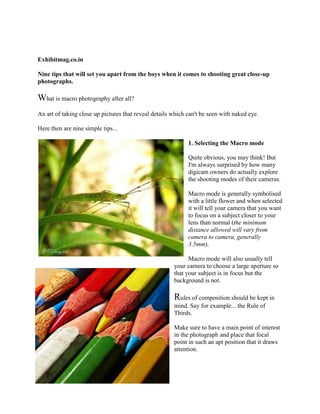
                                                             Macro mode is generally symbolised
                                                             with a little flower and when selected
                                                             it will tell your camera that you want
                                                             to focus on a subject closer to your
                                                             lens than normal (the minimum
                                                             distance allowed will vary from
                                                             camera to camera, generally
                                                             3.5mm).

                                                             Macro mode will also usually tell
                                                       your camera to choose a large aperture so
                                                       that your subject is in focus but the
                                                       background is not.

                                                       Rules of composition should be kept in
                                                       mind. Say for example... the Rule of
                                                       Thirds.

                                                       Make sure to have a main point of interest
                                                       in the photograph and place that focal
                                                       point in such an apt position that it draws
                                                       attention.
Better to go for a non-cluttered or simple background so that the background and the main
subject don't clash visually.

Don't try for professional macro photography unless you have the best control over focusing.
It is especially when you have shallow depth of fields where it is all the more important to make
sure the right part of the shot image is in focus.

This is a tricky one.
While flash can be a strict no-no for a particular macro photography, using a piece of tracing
paper and draping it over the flash of your camera to diffuse the strong flash light can be a better
option in another case.

Remember... shadows are macro photographers' enemy!

Instead choose a location where the light is enough. Or else carry a reflector to fill the shadow.

If you know to adjust the aperture settings, learn the depth of fields of the shots.
Choose a small aperture for a large depth of field with everything in focus or a large one if the
main subject is to be in focus.

In macro, select the largest aperture available for the shallow depth of field.

Using a tripod for obvious reasons actually helps. You avoid the shakes, you go closer to subjects
without disturbing the mood and more so...just a tripod!


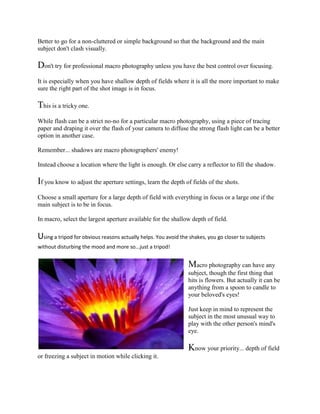
                                                                Macro photography can have any
                                                                subject, though the first thing that
                                                                hits is flowers. But actually it can be
                                                                anything from a spoon to candle to
                                                                your beloved's eyes!

                                                                Just keep in mind to represent the
                                                                subject in the most unusual way to
                                                                play with the other person's mind's
                                                                eye.

                                                                Know your priority... depth of field
or freezing a subject in motion while clicking it.
Personally on a windy day, I would use shutter priority to stop motion blur. Clicking a bug or
butterfly in flight also requires the same setting.

Same goes for a falling water droplet. Aperture priority is used when the subject in motionless
and the background is preferred blurred.

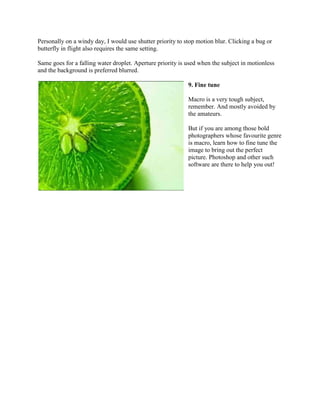
                                                            9. Fine tune

                                                            Macro is a very tough subject,
                                                            remember. And mostly avoided by
                                                            the amateurs.

                                                            But if you are among those bold
                                                            photographers whose favourite genre
                                                            is macro, learn how to fine tune the
                                                            image to bring out the perfect
                                                            picture. Photoshop and other such
                                                            software are there to help you out!

Macro photography tips

  • 1.
    Exhibitmag.co.in Nine tips thatwill set you apart from the boys when it comes to shooting great close-up photographs. What is macro photography after all? An art of taking close up pictures that reveal details which can't be seen with naked eye. Here then are nine simple tips... 1. Selecting the Macro mode Quite obvious, you may think! But I'm always surprised by how many digicam owners do actually explore the shooting modes of their cameras. Macro mode is generally symbolised with a little flower and when selected it will tell your camera that you want to focus on a subject closer to your lens than normal (the minimum distance allowed will vary from camera to camera, generally 3.5mm). Macro mode will also usually tell your camera to choose a large aperture so that your subject is in focus but the background is not. Rules of composition should be kept in mind. Say for example... the Rule of Thirds. Make sure to have a main point of interest in the photograph and place that focal point in such an apt position that it draws attention.
  • 2.
    Better to gofor a non-cluttered or simple background so that the background and the main subject don't clash visually. Don't try for professional macro photography unless you have the best control over focusing. It is especially when you have shallow depth of fields where it is all the more important to make sure the right part of the shot image is in focus. This is a tricky one. While flash can be a strict no-no for a particular macro photography, using a piece of tracing paper and draping it over the flash of your camera to diffuse the strong flash light can be a better option in another case. Remember... shadows are macro photographers' enemy! Instead choose a location where the light is enough. Or else carry a reflector to fill the shadow. If you know to adjust the aperture settings, learn the depth of fields of the shots. Choose a small aperture for a large depth of field with everything in focus or a large one if the main subject is to be in focus. In macro, select the largest aperture available for the shallow depth of field. Using a tripod for obvious reasons actually helps. You avoid the shakes, you go closer to subjects without disturbing the mood and more so...just a tripod! Macro photography can have any subject, though the first thing that hits is flowers. But actually it can be anything from a spoon to candle to your beloved's eyes! Just keep in mind to represent the subject in the most unusual way to play with the other person's mind's eye. Know your priority... depth of field or freezing a subject in motion while clicking it.
  • 3.
    Personally on awindy day, I would use shutter priority to stop motion blur. Clicking a bug or butterfly in flight also requires the same setting. Same goes for a falling water droplet. Aperture priority is used when the subject in motionless and the background is preferred blurred. 9. Fine tune Macro is a very tough subject, remember. And mostly avoided by the amateurs. But if you are among those bold photographers whose favourite genre is macro, learn how to fine tune the image to bring out the perfect picture. Photoshop and other such software are there to help you out!