Cloning By Calvin Koder, Henry Hauser, and Max Hoffmann
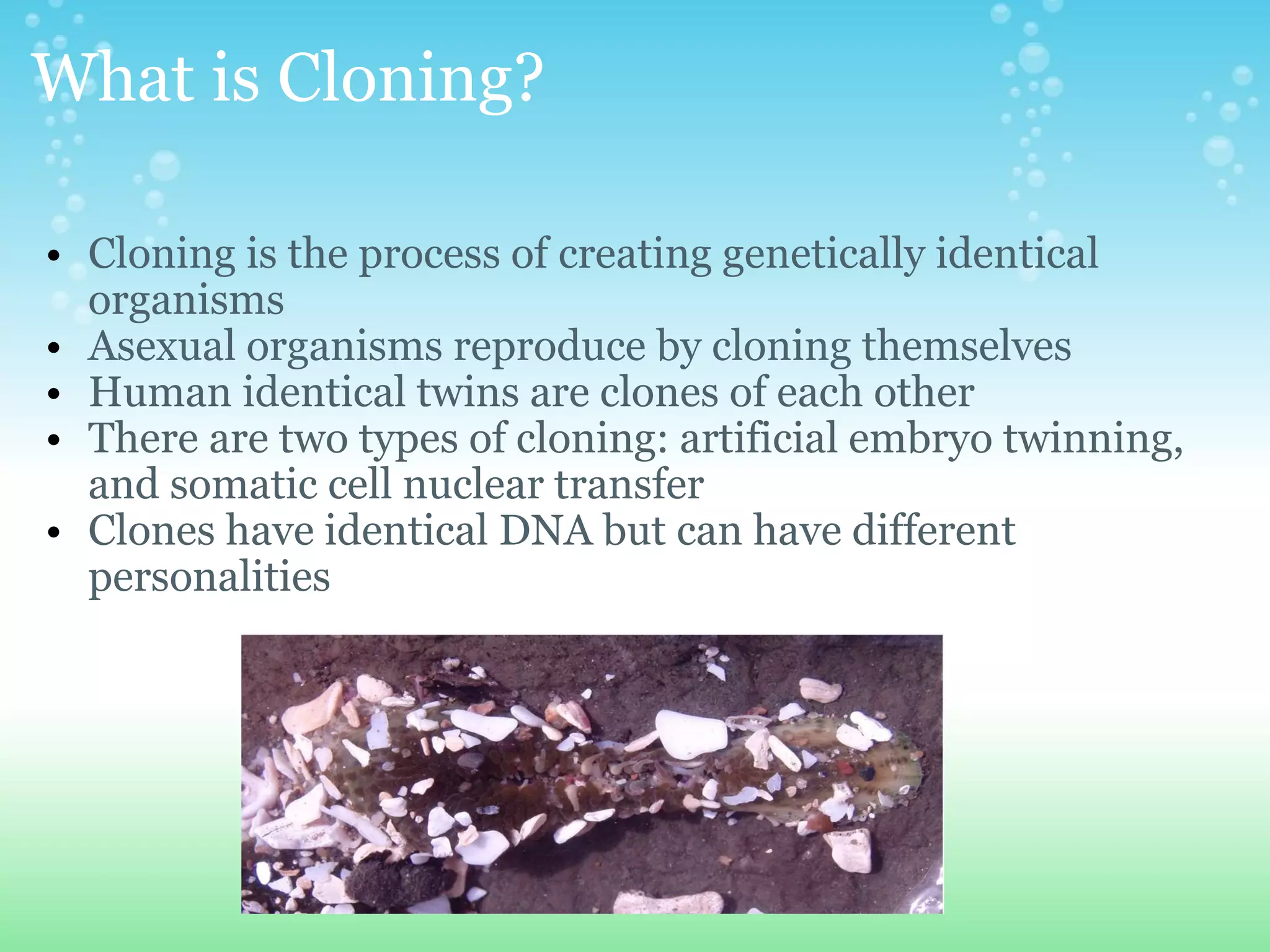
What is Cloning? Cloning is the process of creating genetically identical organisms Asexual organisms reproduce by cloning themselves Human identical twins are clones of each other There are two types of cloning: artificial embryo twinning, and somatic cell nuclear transfer Clones have identical DNA but can have different personalities
Artificial Embryo Twinning Artificial embryo twinning is done by imitating the process that creates identical twins.  An embryo is split up and each part is put in a petri dish to develop.  They are then placed in a surrogate mother.  The resulting clones are exact genetic copies of each other.
Somatic Cell Nuclear Transfer Somatic Cell Nuclear Transfer is a laboratory technique for creating a clonial embryo, using an egg cell, that has had it's nucleus removed, and a nucleus from a cell of a different animal. It can be used in embryonic stem cell research, or potentially, in regenerative medicine where it is sometimes referred to as "therapeutic cloning." It can also be used as the first step in the process of reproductive cloning. 
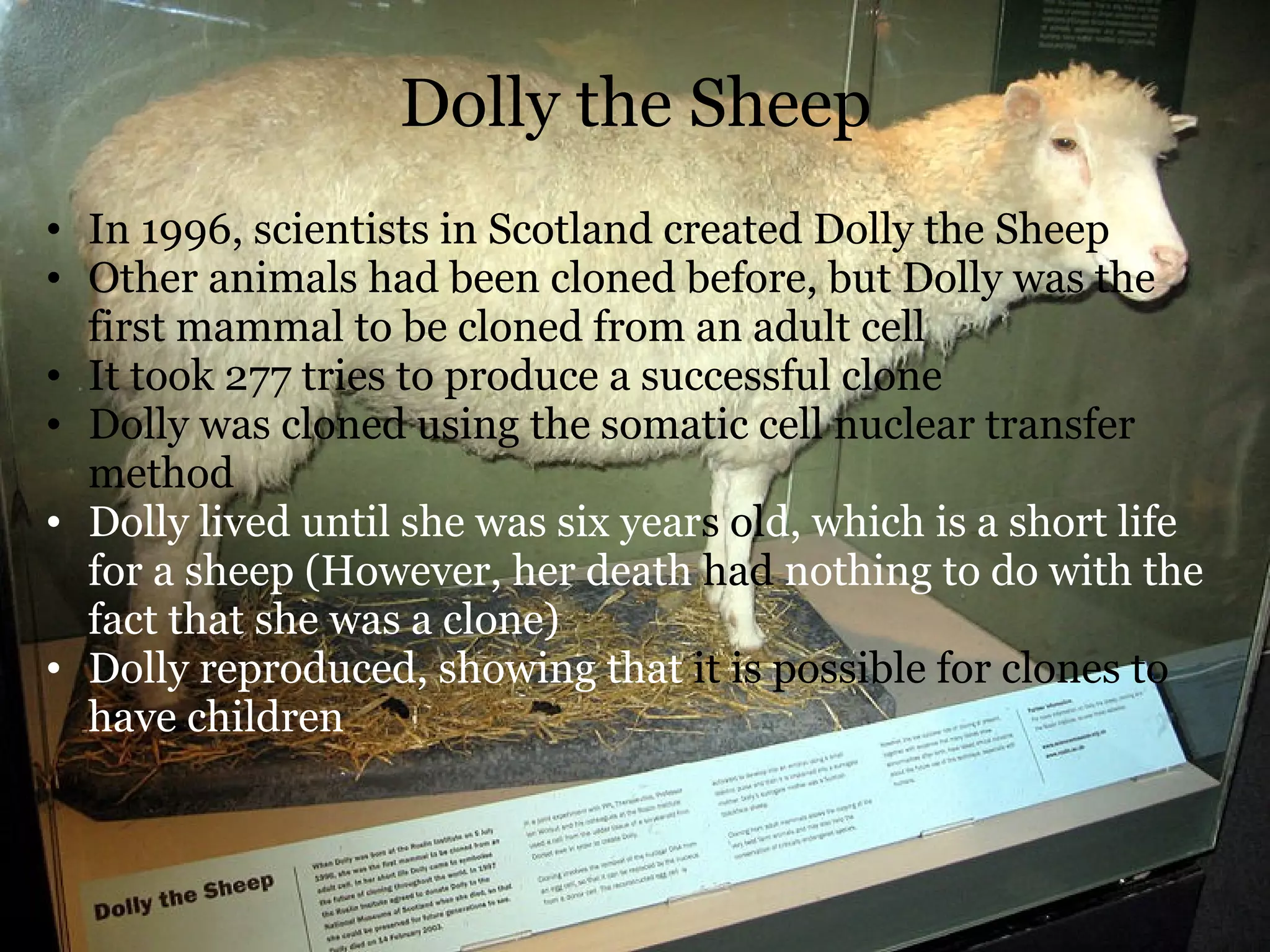
Dolly the Sheep In 1996, scientists in Scotland created Dolly the Sheep Other animals had been cloned before, but Dolly was the first mammal to be cloned from an adult cell It took 277 tries to produce a successful clone Dolly was cloned using the somatic cell nuclear transfer method Dolly lived until she was six year s ol d, which is a short life for a sheep (However, her death  had  nothing to do with the fact that she was a clone) Dolly reproduced,   showing that  it is   possible for clones to  have children
Human Cloning: The Good and The Bad Good: Can use certain organs and tissue of the clone for transplants Could help with getting DNA from two infertile parents into an offspring Bad:   There will most likely be several failures resulting in the death of the clone There has not yet been a successful clone of a primate Can possibly rob the clone of individuality when they realize they are a clone
Questions to consider: Do you approve of human cloning? Do you approve of cloning other animals? Do you think it's right to harvest organs and tissue from clones? If you had the option, would you want to clone yourself? Why? Do you think the benefits outweigh the risks with cloning humans?
http://en.wikipedia.org/wiki/File:Dollyscotland_%28crop%29.jpg http://en.wikipedia.org/wiki/Cloning http://www.animalresearch.info/en/medical/timeline/Dolly http://learn.genetics.utah.edu/content/tech/cloning/whatiscloning/ http://www.animalresearch.info/en/medical/timeline/Dolly http://en.wikipedia.org/wiki/Ethics_of_Cloning http://upload.wikimedia.org/wikipedia/commons/4/46/Longitudinal_fission_of_Anthopleura_elegantissima_in_California_tidepools.jpg Acknowledgments

Cloning

  • 1.
    Cloning By CalvinKoder, Henry Hauser, and Max Hoffmann
  • 2.
    What is Cloning?Cloning is the process of creating genetically identical organisms Asexual organisms reproduce by cloning themselves Human identical twins are clones of each other There are two types of cloning: artificial embryo twinning, and somatic cell nuclear transfer Clones have identical DNA but can have different personalities
  • 3.
    Artificial Embryo TwinningArtificial embryo twinning is done by imitating the process that creates identical twins.  An embryo is split up and each part is put in a petri dish to develop.  They are then placed in a surrogate mother.  The resulting clones are exact genetic copies of each other.
  • 4.
    Somatic Cell NuclearTransfer Somatic Cell Nuclear Transfer is a laboratory technique for creating a clonial embryo, using an egg cell, that has had it's nucleus removed, and a nucleus from a cell of a different animal. It can be used in embryonic stem cell research, or potentially, in regenerative medicine where it is sometimes referred to as "therapeutic cloning." It can also be used as the first step in the process of reproductive cloning. 
  • 5.
    Dolly the SheepIn 1996, scientists in Scotland created Dolly the Sheep Other animals had been cloned before, but Dolly was the first mammal to be cloned from an adult cell It took 277 tries to produce a successful clone Dolly was cloned using the somatic cell nuclear transfer method Dolly lived until she was six year s ol d, which is a short life for a sheep (However, her death had nothing to do with the fact that she was a clone) Dolly reproduced, showing that it is possible for clones to have children
  • 6.
    Human Cloning: TheGood and The Bad Good: Can use certain organs and tissue of the clone for transplants Could help with getting DNA from two infertile parents into an offspring Bad:   There will most likely be several failures resulting in the death of the clone There has not yet been a successful clone of a primate Can possibly rob the clone of individuality when they realize they are a clone
  • 7.
    Questions to consider:Do you approve of human cloning? Do you approve of cloning other animals? Do you think it's right to harvest organs and tissue from clones? If you had the option, would you want to clone yourself? Why? Do you think the benefits outweigh the risks with cloning humans?
  • 8.
    http://en.wikipedia.org/wiki/File:Dollyscotland_%28crop%29.jpg http://en.wikipedia.org/wiki/Cloning http://www.animalresearch.info/en/medical/timeline/Dollyhttp://learn.genetics.utah.edu/content/tech/cloning/whatiscloning/ http://www.animalresearch.info/en/medical/timeline/Dolly http://en.wikipedia.org/wiki/Ethics_of_Cloning http://upload.wikimedia.org/wikipedia/commons/4/46/Longitudinal_fission_of_Anthopleura_elegantissima_in_California_tidepools.jpg Acknowledgments