
Clinical Models
        What are they?
     What are they good for?


Dr Hugh Leslie MD
CMO Ocean Informatics
data                                       phenomena


001101010
010101001
011110101
011010010
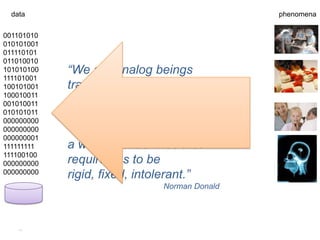
101010100   “We are analog beings
111101001
100101001   trapped in a digital world…
100010011
001010011   We are
010101011
000000000
            compliant, flexible, tolerant.
000000000          Yet we have constructed
000000001
111111111   a world of machines that
111100100
000000000   requires us to be
000000000
            rigid, fixed, intolerant.”
                             Norman Donald


    4.2
CDA
ClinicalDA
ClinicaDA
 ClinicDA
 CliniDA
  ClinDA
   CliDA
   ClDA
   CDA
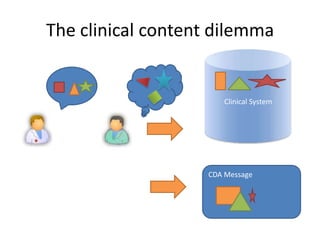
The clinical content dilemma


                      Clinical System


                   CDA Message
Who needs standardised
       content?

• Sophisticated solutions
• Vendors
• National Programs
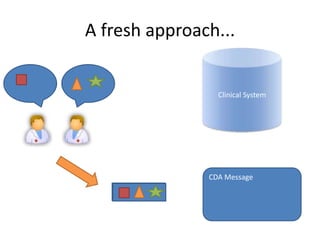
A fresh approach...


                 Clinical System


               CDA Message
Consistency
Quality/Safety
 Governance
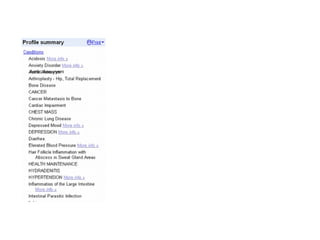
What about terminology?
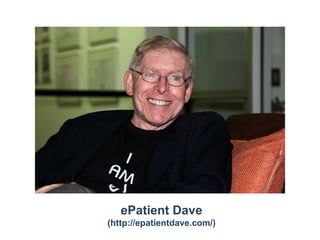
ePatient Dave
(http://epatientdave.com/)
Aortic Aneurysm
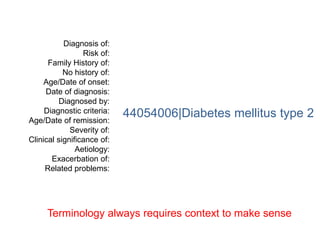
Diagnosis of:
                 Risk of:
      Family History of:
           No history of:
     Age/Date of onset:
     Date of diagnosis:
         Diagnosed by:
     Diagnostic criteria:   44054006|Diabetes mellitus type 2
Age/Date of remission:
             Severity of:
Clinical significance of:
               Aetiology:
       Exacerbation of:
     Related problems:


     Terminology always requires context to make sense
Another thing about context…
Data elements
• 11179
• HL7 DAMs
• Minimum data sets
COLD
Its quite

     COLD
in Auckland today
I have a really bad

           COLD
with a runny nose and fever.
The diagnosis is:

             COLD
(Chronic obstructive lung disease)
The patient had a very

        COLD
 emotional response
Definitions of single data elements
rarely survive outside a particular
              context
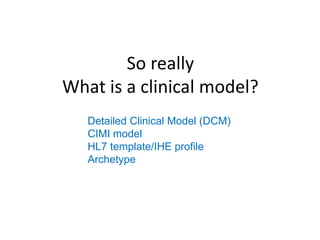
So really
What is a clinical model?
   Detailed Clinical Model (DCM)
   CIMI model
   HL7 template/IHE profile
   Archetype
To a clinician, an archetype is:
A definition of an atomic health concept that
as much as possible completely expresses
everything that you would ever want to
record about that particular thing in any
situation.
To a clinician, an archetype is:
A definition of an atomic health concept that
as much as possible completely expresses
everything that you would ever want to
record about that particular thing in any
situation.
To a clinician, an archetype is:
A definition of an atomic health concept that
as much as possible completely expresses
everything that you would ever want to
record about that particular thing in any
situation.
To a clinician, an archetype is:
A definition of an atomic health concept that
as much as possible completely expresses
everything that you would ever want to
record about that particular thing in any
situation.
To a clinician, an archetype is:
A definition of an atomic health concept that
as much as possible completely expresses
everything that you would ever want to
record about that particular thing in any
situation.
To a technician, an archetype is:
A computable expression of a domain content
model in the form of structured constraint
statements, based on the openEHR reference
model.
A logical information model
Reuseable
To a technician, an archetype is:
A computable expression of a domain content
model in the form of structured constraint
statements, based on the openEHR reference
model.
A logical information model
Reuseable
To a technician, an archetype is:
A computable expression of a domain content
model in the form of structured constraint
statements, based on the openEHR reference
model.
A logical information model
Reuseable
To a technician, an archetype is:
A computable expression of a domain content
model in the form of structured constraint
statements, based on the openEHR reference
model.
A logical information model
Reuseable
To a technician, an archetype is:
A computable expression of a domain content
model in the form of structured constraint
statements, based on the openEHR reference
model.
A logical information model
Reuseable
CKM – introduction


Dr Heather Leslie MD
Director Modelling - Ocean Informatics
So we have some archetypes…
 where do we go from here?
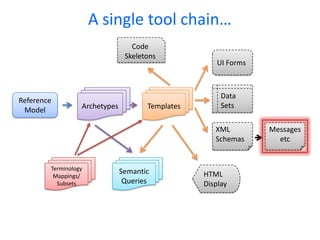
A single tool chain…
                                  Code
                                Skeletons
                                                      UI Forms


                                                       Data
Reference
                  Archetypes          Templates        Sets
 Model

                                                     XML         Messages
                                                     Schemas       etc


        Terminology
                               Semantic           HTML
         Mappings/
          Subsets               Queries           Display
openEHR Templates
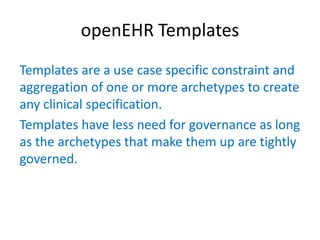
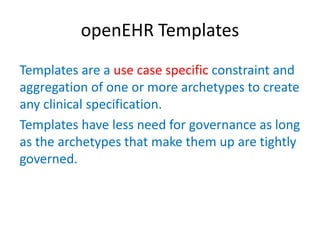
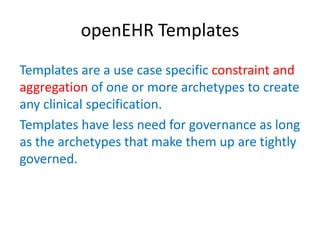
Templates are a use case specific constraint and
aggregation of one or more archetypes to create
any clinical specification.
Templates have less need for governance as long
as the archetypes that make them up are tightly
governed.
openEHR Templates
Templates are a use case specific constraint and
aggregation of one or more archetypes to create
any clinical specification.
Templates have less need for governance as long
as the archetypes that make them up are tightly
governed.
openEHR Templates
Templates are a use case specific constraint and
aggregation of one or more archetypes to create
any clinical specification.
Templates have less need for governance as long
as the archetypes that make them up are tightly
governed.
openEHR Templates
Templates are a use case specific constraint and
aggregation of one or more archetypes to create
any clinical specification.
Templates have less need for governance as long
as the archetypes that make them up are tightly
governed.
openEHR Templates
Templates are a use case specific constraint and
aggregation of one or more archetypes to create
any clinical specification.
Templates have less need for governance as long
as the archetypes that make them up are tightly
governed.
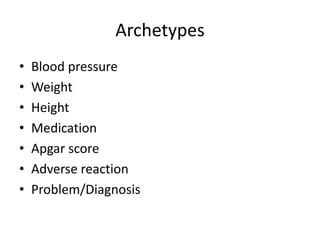
Archetypes
•   Blood pressure
•   Weight
•   Height
•   Medication
•   Apgar score
•   Adverse reaction
•   Problem/Diagnosis
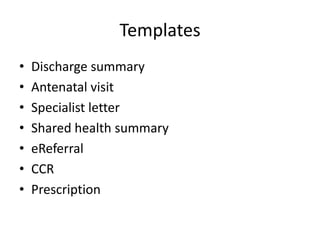
Templates
•   Discharge summary
•   Antenatal visit
•   Specialist letter
•   Shared health summary
•   eReferral
•   CCR
•   Prescription
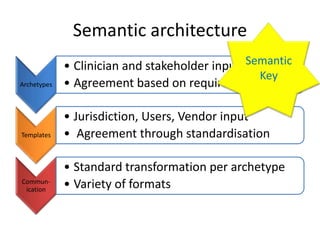
Semantic architecture
             • Clinician and stakeholder input Semantic
                                                 Key
Archetypes   • Agreement based on requirements

             • Jurisdiction, Users, Vendor input
Templates    • Agreement through standardisation

             • Standard transformation per archetype
Commun-
 ication
             • Variety of formats
Demo

Clinical Models - What Are They Good For?

  • 1.
    Clinical Models What are they? What are they good for? Dr Hugh Leslie MD CMO Ocean Informatics
  • 2.
    data phenomena 001101010 010101001 011110101 011010010 101010100 “We are analog beings 111101001 100101001 trapped in a digital world… 100010011 001010011 We are 010101011 000000000 compliant, flexible, tolerant. 000000000 Yet we have constructed 000000001 111111111 a world of machines that 111100100 000000000 requires us to be 000000000 rigid, fixed, intolerant.” Norman Donald 4.2
  • 3.
  • 4.
  • 5.
    The clinical contentdilemma Clinical System CDA Message
  • 6.
    Who needs standardised content? • Sophisticated solutions • Vendors • National Programs
  • 7.
    A fresh approach... Clinical System CDA Message
  • 8.
  • 9.
  • 10.
  • 11.
  • 12.
    Diagnosis of: Risk of: Family History of: No history of: Age/Date of onset: Date of diagnosis: Diagnosed by: Diagnostic criteria: 44054006|Diabetes mellitus type 2 Age/Date of remission: Severity of: Clinical significance of: Aetiology: Exacerbation of: Related problems: Terminology always requires context to make sense
  • 13.
  • 14.
    Data elements • 11179 •HL7 DAMs • Minimum data sets
  • 15.
  • 16.
    Its quite COLD in Auckland today
  • 17.
    I have areally bad COLD with a runny nose and fever.
  • 18.
    The diagnosis is: COLD (Chronic obstructive lung disease)
  • 19.
    The patient hada very COLD emotional response
  • 20.
    Definitions of singledata elements rarely survive outside a particular context
  • 21.
    So really What isa clinical model? Detailed Clinical Model (DCM) CIMI model HL7 template/IHE profile Archetype
  • 22.
    To a clinician,an archetype is: A definition of an atomic health concept that as much as possible completely expresses everything that you would ever want to record about that particular thing in any situation.
  • 23.
    To a clinician,an archetype is: A definition of an atomic health concept that as much as possible completely expresses everything that you would ever want to record about that particular thing in any situation.
  • 24.
    To a clinician,an archetype is: A definition of an atomic health concept that as much as possible completely expresses everything that you would ever want to record about that particular thing in any situation.
  • 25.
    To a clinician,an archetype is: A definition of an atomic health concept that as much as possible completely expresses everything that you would ever want to record about that particular thing in any situation.
  • 26.
    To a clinician,an archetype is: A definition of an atomic health concept that as much as possible completely expresses everything that you would ever want to record about that particular thing in any situation.
  • 27.
    To a technician,an archetype is: A computable expression of a domain content model in the form of structured constraint statements, based on the openEHR reference model. A logical information model Reuseable
  • 28.
    To a technician,an archetype is: A computable expression of a domain content model in the form of structured constraint statements, based on the openEHR reference model. A logical information model Reuseable
  • 29.
    To a technician,an archetype is: A computable expression of a domain content model in the form of structured constraint statements, based on the openEHR reference model. A logical information model Reuseable
  • 30.
    To a technician,an archetype is: A computable expression of a domain content model in the form of structured constraint statements, based on the openEHR reference model. A logical information model Reuseable
  • 31.
    To a technician,an archetype is: A computable expression of a domain content model in the form of structured constraint statements, based on the openEHR reference model. A logical information model Reuseable
  • 32.
    CKM – introduction DrHeather Leslie MD Director Modelling - Ocean Informatics
  • 33.
    So we havesome archetypes… where do we go from here?
  • 34.
    A single toolchain… Code Skeletons UI Forms Data Reference Archetypes Templates Sets Model XML Messages Schemas etc Terminology Semantic HTML Mappings/ Subsets Queries Display
  • 35.
    openEHR Templates Templates area use case specific constraint and aggregation of one or more archetypes to create any clinical specification. Templates have less need for governance as long as the archetypes that make them up are tightly governed.
  • 36.
    openEHR Templates Templates area use case specific constraint and aggregation of one or more archetypes to create any clinical specification. Templates have less need for governance as long as the archetypes that make them up are tightly governed.
  • 37.
    openEHR Templates Templates area use case specific constraint and aggregation of one or more archetypes to create any clinical specification. Templates have less need for governance as long as the archetypes that make them up are tightly governed.
  • 38.
    openEHR Templates Templates area use case specific constraint and aggregation of one or more archetypes to create any clinical specification. Templates have less need for governance as long as the archetypes that make them up are tightly governed.
  • 39.
    openEHR Templates Templates area use case specific constraint and aggregation of one or more archetypes to create any clinical specification. Templates have less need for governance as long as the archetypes that make them up are tightly governed.
  • 40.
    Archetypes • Blood pressure • Weight • Height • Medication • Apgar score • Adverse reaction • Problem/Diagnosis
  • 41.
    Templates • Discharge summary • Antenatal visit • Specialist letter • Shared health summary • eReferral • CCR • Prescription
  • 42.
    Semantic architecture • Clinician and stakeholder input Semantic Key Archetypes • Agreement based on requirements • Jurisdiction, Users, Vendor input Templates • Agreement through standardisation • Standard transformation per archetype Commun- ication • Variety of formats
  • 43.

Editor's Notes

  • #3 I want to take you on a journey – moving from the left of the screen to the right.
  • #4 I am a clinician – interested in the C in CDA
  • #5 Increasing complexity & richness of clinical information exchange.Look to the future to make sure what we do now can support what we want to do in the futureIndividual CDA specs are developed for use cases – models end up being different even though they are modelling the same thing.
  • #6 Estimated 7500 clinical systems in the USA alone developed with clinical input to cliniciansComplex technical artifacts are difficult for most clinicians to review and understand without additional training. Getting clinicians in a room is expensive, difficult (time poor)
  • #7 More sophisticated systems need more sophisticated content - fractalVendors – rapidly increasing cost of businessNational Programs – coming to grips with need for models and terminology for national EHR programs
  • #8 To build this clinical content, there is a need for an approach that allows a large number of clinicians and domain experts to collaborate in a cost and time effective way to create content. This content should be approachable for clinicians who have little technical expertise and should not be limited to health informaticians. The outputs from this process should be technical artifacts that can be directly used in information systems without any need for translation of paper specifications.
  • #9 How do we get there? Step back from CDA.To get interoperability we need clinical information that is Consistent ie modelled in the same way everywhere, of high quality –validated by clinicians and using metrics to measure quality and strongly governed – versioned, released like software artefacts.
  • #10 Doesn’t terminology solve the issues of clinical content? Can’t we just code something and get on with it?
  • #13 Clinical models give context to terminology (and semantics generally)You can’t do it with terminology alone (and you can’t do it with clinical models alone…)
  • #14 Doesn’t terminology solve the issues of clinical content? Can’t we just code something and get on with it?
  • #15 There has been and still is, an enormous effort going on in terms of defining data elements as single reuseable entities. Example of VIC Health – minimum datasets.
  • #21 National data collections are seriously importantDefining datasets is importantLets find a way to define them so that the context is clear.
  • #23 So its about recording clinical information faithfullyIts about maximal data set and universal use caseIncludes needed terminology bindings and terminology valuesets
  • #24 Ideal set of archetypes is a venn diagram with no overlap. Almost never a single data element.
  • #25 Its about maximal data set - includes needed terminology bindings and terminology valuesetsMuch easier to get agreement than minimum datasets.
  • #26 So its about recording clinical information faithfullyNot about creating an esoteric and academic model of something that represents that thing.
  • #27 The universal use case.
  • #28 Can be used directly in systems to create and persist data as well as other artefacts – top of an information tool chain.
  • #29 Can be used to do real stuff.Can be used directly in systems to create and persist data as well as other artefacts – top of an information tool chain.
  • #30 Can be used directly in systems to create and persist data as well as other artefacts – top of an information tool chain.
  • #31 Can be used directly in systems to create and persist data as well as other artefacts – top of an information tool chain.
  • #32 Can be used directly in systems to create and persist data as well as other artefacts – top of an information tool chain.
  • #33 CKM demo to show:A couple of models and viewsGovernance aspectsCrowd sourced information
  • #34 We have a set of clinical models that are vetted, governed and fit for purpose – how do we take these and use them everywhere? What is the link to CDA for instance?
  • #44 Template designerQueryingFinish with MeHR