Terminology in 
   openEHR
     Jussara Rötzsch
    Adapted from Thomas Beale
Drivers for Integrated EHRs and Semantic
                Interoperability
• Manage increasingly complex
  clinical (multi professional) care
• Support collaboration
  between multiple locations of care delivery
• Deliver evidence based health care
• Need for intelligent decision support in medicine
• Better exploit biomedical research
• Improve safety
  and cost effectiveness of health care
• Enrich population health management and preve
  ntion
• Empower and involve citizens
Coding  in the context of integrated 
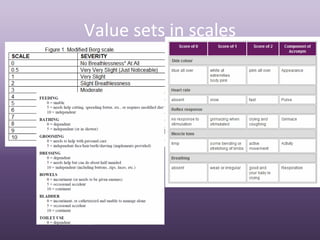
                    EHRs
•   Codes   in the context of electronic health records are  identifiers of concepts and 
    used  primarily for assisting computer processing of those concepts. They are the 
    key to semantic interoperability 
•   The coding of data  in  itself, offers very little though. Systems need to be able to 
    make use of the codes. Today's clinical systems aren´t prepared to use codes ina 
    way they can supply the benefits that coded data offers. This is very expensive.
•   So, there is a  proliferation of  many small, ad hoc  codesets subverting 
    interoperability achievement. 
•   Variations… overlapping and conflicting meaning, and  management and versioning 
    issues attendant with the codesets ‐ all are barriers to EHR systems that acquire 
    their data from many sources.
•   For searching of EHRs and for decision support, a single comprehensive 
    terminology and terminology architecture is highly desirable ‐ something offering 
    the potential power of an improved SNOMED CT. Clinical systems based on such a 
    complex terminology require the use of codes.
•   The use of closed, proprietary coded terminologies and the notion of semantic 
    interoperability are mutually incompatible. Ubiquitous semantic interoperability 
    requires ubiquitous access to the codes and the terminology by all participating 
    systems.

                              Adapted from Erik Browne;
                              http://www.openehr.org/wiki/display/healthmod/Codes%2C+EHRs+and+Sema
                              ntic+Interoperability
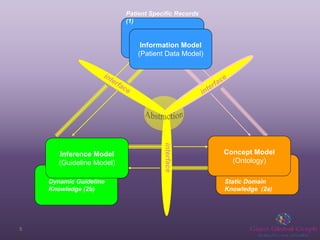
Three models in the  design of 
    interoperable EHRs (most systems)
• Information / Structure
• Terminology / ontology / reference facts
    – inference about what is always true
       • “All pneumonia is an infection of the lungs”
       • “Pneumonia causes shortness of breath”
• Decision support / inference / rules
    – inference about what is true in an individual case 
       • John’s pneumonia is caused by pneumococcus
       • If pneumonia is causing shortness of breath in an 
         elderly patient, then the patient should be hospitalized

4
Patient Specific Records
                             (1)


                                   Information Model
                                  (Patient Data Model)

                    int                                           e
                       er
                          fac                               r f ac
                                                           e
                              e                         int


                                         interface
       Inference Model                                           Concept Model
       (Guideline Model)                                           (Ontology)

    Dynamic Guideline                                            Static Domain
    Knowledge (2b)                                               Knowledge (2a)


5
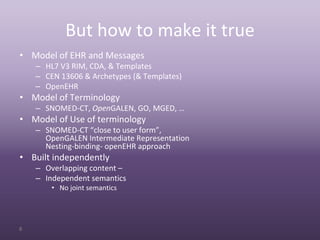
But how to make it true
• Model of EHR and Messages
    – HL7 V3 RIM, CDA, & Templates
    – CEN 13606 & Archetypes (& Templates)
    – OpenEHR
• Model of Terminology
    – SNOMED‐CT, OpenGALEN, GO, MGED, …
• Model of Use of terminology
    – SNOMED‐CT “close to user form”,
      OpenGALEN Intermediate Representation
      Nesting‐binding‐ openEHR approach
• Built independently
    – Overlapping content –
    – Independent semantics
        • No joint semantics


6
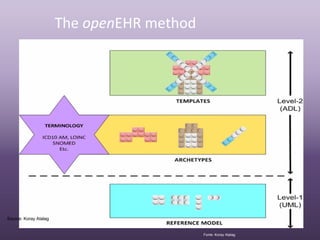
The openEHR method


Source: Koray Atalag


                                            Fonte :Koray Atalag
Technical
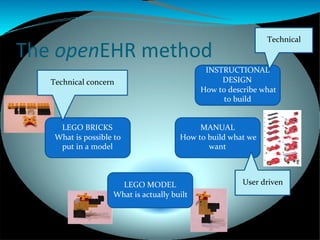
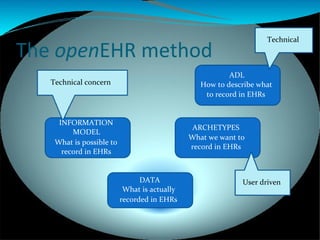
The openEHR method
                                              INSTRUCTIONAL
   Technical concern                              DESIGN
                                             How to describe what
                                                   to build


     LEGO BRICKS                            MANUAL
    What is possible to                How to build what we
     put in a model                           want


                      LEGO MODEL                        User driven
                    What is actually built
Technical

The openEHR method
                                                         ADL
   Technical concern                             How to describe what
                                                  to record in EHRs


     INFORMATION
                                               ARCHETYPES
         MODEL
                                              What we want to
    What is possible to
                                              record in EHRs
      record in EHRs


                                DATA                        User driven
                           What is actually
                          recorded in EHRs
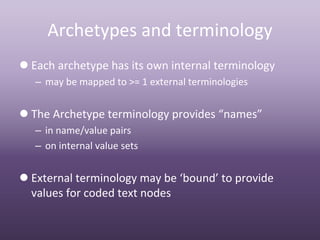
Archetypes and terminology
 Each archetype has its own internal terminology
   – may be mapped to >= 1 external terminologies


 The Archetype terminology provides “names”
   – in name/value pairs 
   – on internal value sets


 External terminology may be ‘bound’ to provide 
  values for coded text nodes
What is ‘terminology binding’?

• A formally expressible connection between 
  information model representation and 
  terminology representation of clinical 
  statements recorded in the EHR
To do the binding 
• We need to know how to control the use of 
  terminology within structured data so that it 
  achieves what we want:
  • Provides basis for querying
  • Economically feasible
• First, we need to know how to structure data so 
  it:
  • Doesn’t violate ontological truths; 
  • Is mappable to ontological concepts;
  • Supports data entry, storage, querying, reuse
Which ‘structured’ data?
• Two kinds:
  • Legacy proprietary: structures are all different
  • Shared, standardized: agreed structures and 
    information model, within a community of users 
    (can be more than one such community).
• The second kind we can standardize on.
• Shared clinical data generally include 
  structure and many data types.
Data are structured
• Clinical statements are naturally structured, e.g.
   • lab results: list / tree structure; normal ranges;
      • Microbiology is usually a large tree structure
   • vital signs: timing and multiple data points;
      • BP: (2 data points + patient state) x time‐series
   • physical examination: structured by anatomy
      • E.g. Endoscopy of colon
   • assessments: structured according to e.g. temporal 
     model of disease course;
   • orders: timing info, structured medication info;
   • actions: timing, medication structured info
Data have many types
• Clinical statement data includes instances of:
  •   Text
  •   Coded terms
  •   Quantity, including units, proportions, counts, etc.
  •   URIs
  •   Booleans
  •   Date, time, date/time, duration
  •   Parseable text, e.g. Units, medication timing
  •   Other more complex types
Other sources of structure
• Data capture: at the user interface, the 
  elements of a clinical statement are naturally 
  distinct, e.g. procedure, site, protocol, time...
• Document structures: reports, referrals etc. 
  are also structured, including audit info, 
  sections.
• For querying: data items that are queried for 
  separately are usually separated, e.g. 
  procedure type and body site.
What should be coded?
• Answers which are:
  • textually expressible
  • whose value range is
     • Best modelled by as ontological description (i.e. 
       discrete categorization),
  • likely to be independently queried later on.
  • E.g. types of disease; blood types; but not general 
    patient story (not expressible as just concepts)
• I.e. a subset of textual data, which are a 
  subset of all data
What could be coded?
• Questions which:
  • Need to be queried on using an agreed reference 
    coding standard.
• Example: ‘serum sodium’ (in context of blood 
  film result of patient) does not need any 
  coding to be 100% reliably queryable in 
  openEHR environment. However, for the data 
  to be re‐usable by ANYONE later on, SNOMED 
  or LOINC ‐coding makes sense.
Understanding the binding problem

• One thing complicates the task...SITUATION
• Examples:
  • list of body positions is not the same as list of body 
    positions pertinent to measuring BP;
  • valid Rh blood types differs depending on whether for 
    blood collection or transfusion;
  • almost all scales, e.g. Apgar, GCS, Borg, Barthel etc. 
    define their own value sets for common phenomena, 
    which differ from context less value sets of the same / 
    similar phenomena in naming and number of 
    divisions.
Value sets in scales
Binding and openEHR
Where is binding relevant in openEHR?

• openEHR Archetypes ‐ essentially, maximum data 
  sets, i.e. all data points for a given domain 
  ‘recording’ concept (not its ontological 
  ‘description’).
  • Examples:
     •   Vitals signs: BP, Heart‐rate etc.
     •   Labs – very structured, well understood
     •   Physical exam – e.g. Pain, symptom....numerous!
     •   Scales, e.g. GCS, Apgar, Barthel – ordinal data
  • Terminology need: globally invariant mappings; broad 
    value sets e.g. ‘infectious agent’
Where is binding needed?
• openEHR Templates ‐ essentially, use‐case 
  specific content specifications; consist of data 
  points from archetypes
  • Examples:
     • Discharge summary
     • Lab report
     • Encounter note
  • Terminology need: define local / region‐specific or 
    specialty‐specific value sets and constraints, e.g. 
    ‘lung infection’
Kinds of binding ‐ today
• Compositional expressions already used
• Direct binding to concept points
• Archetype local value sets  direct binding –
  value set specific to archetype
• Ref set binding for data points that 
  correspond to reusable value sets
• Templates can have direct binding to SCT 
  terms, with static value set defined in 
  archetype or ref set reference
Kinds of binding ‐ future
• Context‐dependent bindings
• SCT Compositional constraints
• SCT Composition pattern mapping?

Terminology in openEHR

  • 1.
    Terminology in  openEHR Jussara Rötzsch Adapted from Thomas Beale
  • 2.
    Drivers for IntegratedEHRs and Semantic Interoperability • Manage increasingly complex clinical (multi professional) care • Support collaboration between multiple locations of care delivery • Deliver evidence based health care • Need for intelligent decision support in medicine • Better exploit biomedical research • Improve safety and cost effectiveness of health care • Enrich population health management and preve ntion • Empower and involve citizens
  • 3.
    Coding  in the context of integrated  EHRs • Codes   in the context of electronic health records are  identifiers of concepts and  used  primarily for assisting computer processing of those concepts. They are the  key to semantic interoperability  • The coding of data  in  itself, offers very little though. Systems need to be able to  make use of the codes. Today's clinical systems aren´t prepared to use codes ina  way they can supply the benefits that coded data offers. This is very expensive. • So, there is a  proliferation of  many small, ad hoc  codesets subverting  interoperability achievement.  • Variations… overlapping and conflicting meaning, and  management and versioning  issues attendant with the codesets ‐ all are barriers to EHR systems that acquire  their data from many sources. • For searching of EHRs and for decision support, a single comprehensive  terminology and terminology architecture is highly desirable ‐ something offering  the potential power of an improved SNOMED CT. Clinical systems based on such a  complex terminology require the use of codes. • The use of closed, proprietary coded terminologies and the notion of semantic  interoperability are mutually incompatible. Ubiquitous semantic interoperability  requires ubiquitous access to the codes and the terminology by all participating  systems. Adapted from Erik Browne; http://www.openehr.org/wiki/display/healthmod/Codes%2C+EHRs+and+Sema ntic+Interoperability
  • 4.
    Three models in the  design of  interoperable EHRs (most systems) • Information / Structure • Terminology / ontology / reference facts – inference about what is always true • “All pneumonia is an infection of the lungs” • “Pneumonia causes shortness of breath” • Decision support / inference / rules – inference about what is true in an individual case  • John’s pneumonia is caused by pneumococcus • If pneumonia is causing shortness of breath in an  elderly patient, then the patient should be hospitalized 4
  • 5.
    Patient Specific Records (1) Information Model (Patient Data Model) int e er fac r f ac e e int interface Inference Model Concept Model (Guideline Model) (Ontology) Dynamic Guideline Static Domain Knowledge (2b) Knowledge (2a) 5
  • 6.
    But how to make it true • Model of EHR and Messages – HL7 V3 RIM, CDA, & Templates – CEN 13606 & Archetypes (& Templates) – OpenEHR • Model of Terminology – SNOMED‐CT, OpenGALEN, GO, MGED, … • Model of Use of terminology – SNOMED‐CT “close to user form”, OpenGALEN Intermediate Representation Nesting‐binding‐ openEHR approach • Built independently – Overlapping content – – Independent semantics • No joint semantics 6
  • 7.
  • 8.
    Technical The openEHR method INSTRUCTIONAL Technical concern DESIGN How to describe what to build LEGO BRICKS MANUAL What is possible to How to build what we put in a model want LEGO MODEL User driven What is actually built
  • 9.
    Technical The openEHR method ADL Technical concern How to describe what to record in EHRs INFORMATION ARCHETYPES MODEL What we want to What is possible to record in EHRs record in EHRs DATA User driven What is actually recorded in EHRs
  • 10.
    Archetypes and terminology  Each archetype has its own internal terminology – may be mapped to >= 1 external terminologies  The Archetype terminology provides “names” – in name/value pairs  – on internal value sets  External terminology may be ‘bound’ to provide  values for coded text nodes
  • 11.
    What is ‘terminology binding’? • A formally expressible connection between  information model representation and  terminology representation of clinical  statements recorded in the EHR
  • 12.
    To do the binding  • We need to know how to control the use of  terminology within structured data so that it  achieves what we want: • Provides basis for querying • Economically feasible • First, we need to know how to structure data so  it: • Doesn’t violate ontological truths;  • Is mappable to ontological concepts; • Supports data entry, storage, querying, reuse
  • 13.
    Which ‘structured’ data? • Two kinds: • Legacy proprietary: structures are all different • Shared, standardized: agreed structures and  information model, within a community of users  (can be more than one such community). • The second kind we can standardize on. • Shared clinical data generally include  structure and many data types.
  • 14.
    Data are structured • Clinical statements are naturally structured, e.g. • lab results: list / tree structure; normal ranges; • Microbiology is usually a large tree structure • vital signs: timing and multiple data points; • BP: (2 data points + patient state) x time‐series • physical examination: structured by anatomy • E.g. Endoscopy of colon • assessments: structured according to e.g. temporal  model of disease course; • orders: timing info, structured medication info; • actions: timing, medication structured info
  • 15.
    Data have many types • Clinical statement data includes instances of: • Text • Coded terms • Quantity, including units, proportions, counts, etc. • URIs • Booleans • Date, time, date/time, duration • Parseable text, e.g. Units, medication timing • Other more complex types
  • 16.
    Other sources of structure • Data capture: at the user interface, the  elements of a clinical statement are naturally  distinct, e.g. procedure, site, protocol, time... • Document structures: reports, referrals etc.  are also structured, including audit info,  sections. • For querying: data items that are queried for  separately are usually separated, e.g.  procedure type and body site.
  • 17.
    What should be coded? • Answerswhich are: • textually expressible • whose value range is • Best modelled by as ontological description (i.e.  discrete categorization), • likely to be independently queried later on. • E.g. types of disease; blood types; but not general  patient story (not expressible as just concepts) • I.e. a subset of textual data, which are a  subset of all data
  • 18.
    What could be coded? • Questions which: • Need to be queried on using an agreed reference  coding standard. • Example: ‘serum sodium’ (in context of blood  film result of patient) does not need any  coding to be 100% reliably queryable in  openEHR environment. However, for the data  to be re‐usable by ANYONE later on, SNOMED  or LOINC ‐coding makes sense.
  • 19.
    Understanding the binding problem • One thing complicates the task...SITUATION • Examples: • list of body positions is not the same as list of body  positions pertinent to measuring BP; • valid Rh blood types differs depending on whether for  blood collection or transfusion; • almost all scales, e.g. Apgar, GCS, Borg, Barthel etc.  define their own value sets for common phenomena,  which differ from context less value sets of the same /  similar phenomena in naming and number of  divisions.
  • 20.
  • 21.
  • 22.
    Where is binding relevant in openEHR? • openEHR Archetypes ‐essentially, maximum data  sets, i.e. all data points for a given domain  ‘recording’ concept (not its ontological  ‘description’). • Examples: • Vitals signs: BP, Heart‐rate etc. • Labs – very structured, well understood • Physical exam – e.g. Pain, symptom....numerous! • Scales, e.g. GCS, Apgar, Barthel – ordinal data • Terminology need: globally invariant mappings; broad  value sets e.g. ‘infectious agent’
  • 23.
    Where is binding needed? • openEHR Templates ‐essentially, use‐case  specific content specifications; consist of data  points from archetypes • Examples: • Discharge summary • Lab report • Encounter note • Terminology need: define local / region‐specific or  specialty‐specific value sets and constraints, e.g.  ‘lung infection’
  • 24.
    Kinds of binding ‐ today • Compositional expressions already used •Direct binding to concept points • Archetype local value sets  direct binding – value set specific to archetype • Ref set binding for data points that  correspond to reusable value sets • Templates can have direct binding to SCT  terms, with static value set defined in  archetype or ref set reference
  • 25.
    Kinds of binding ‐ future • Context‐dependent bindings •SCT Compositional constraints • SCT Composition pattern mapping?