Clinical Audit
- made simple
Dr Mamta Rath Datta
Source : RCOG Press
What is the difference between audit and
research ?
 Research is the systematic and rigorous process of enquiry that
aims to describe processes and develop explanatory concepts and
theories to contribute to scientific body of knowledge.
 Research aims to discover something new or find out whether an
untested technique actually works.
 Audit is about maintaining and achieving quality , through review ,
monitoring and evaluation against agreed standards.
Aims of Audit
 To improve patient outcome
 To promote the cost effective use of resources
 To provide education
 To empower health care staff
 To encourage reflection on one’s own practice.
THE AUDIT CYCLE
NABH
STEPS SUGGESTED IN BOTH THE FIGURES ARE THE SAME
Classification of criterion – based clinical
audit
 CRITERION BASED AUDIT
 Audit of structure – examining the organisation or resources (what is available)
 Audit of process - examining the activities themselves(what you do)
 Audit of outcome – examining the effectiveness of activities on individual and
communities (what are the results)
 Common types : Case notes review/critical incident or adverse event
audit/criterion based audit
Step 1: problem Identification:
 Identify possible auditable problems
 Consider whether the problem is imp. enough to audit
 Consider whether further investigation of the problem is
warranted.
 Consider whether it is practical to audit the problem.
 Consider whether auditing can improve the problem.
Identifying problems
 Problems identified by health professionals, hand over meetings, complaints,
highlighted by media, issues raised by government etc., feedbacks from clients
 Common problems :
 People
 Machines/equipments
 Materials /supplies
 Methods/techniques
 Investigations
 environment
Step 2: setting standards and establishing
criteria:
Criteria must be based on:
 Evidence
 Best practice
 Related to imp. aspects of care
 Capable of being measured
 Acceptable to all participating staff
 Realistic for the capacity of your
facility
Key points:
 Find guidelines on how the condition
is managed
 From the guidelines produce criteria –
key points on which to focus the audit
 Decide upon appropriate numerical
standards for each criterion
Step 3 : Measuring current practice
Work out what you need to know
Basic data
Audit criteria
Other relevant points
Work out how many cases you need
Create an audit pro forma and collect data
Step 4 :Analysing the data and comparing
practice with agreed criteria
 Gather and organise the data
 Work out some simple calculation, then summarise the key data
points in either tables or graph
 Compare the results with the audit standards and identify
performance gaps
Step 5,6 : Implement change and re-audit
 Do a root cause analysis
 Select appropriate intervention
 Make an action plan
 Carry out action plan.
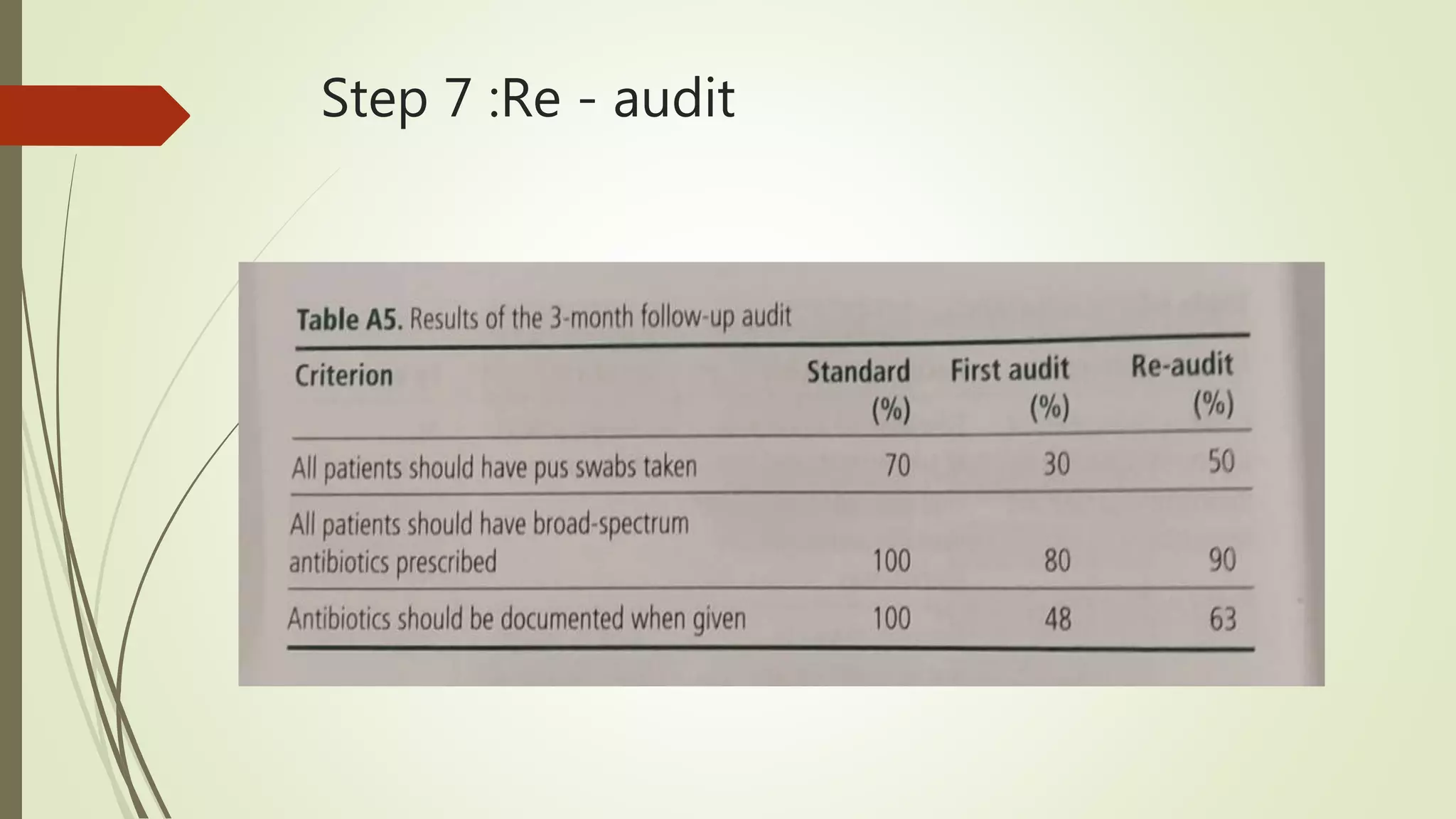
 Re-audit – this is done so that you can see what impact your audit
has had and what changes have been made.
Come Lets do Audit
Sample Audit - An example of a simple straightforward
audit
 AUDIT OF POSTOP CS WOUND INFECTION –audit carried out in National Hospital,Uganda
 Identifying problem : need for doing something for wound infection identified in morning
meeting
 Is it important? – common issue with high rates of morbidity/mortality
 Is further investigation warranted? – Yes. There were many questions.Why is it common? Which
organisms cause it? How common is it?
 Is it practical to audit the problem?- As it was a common problem it would be easy to find enough
cases
 Can auditing improve the problem? Postop infection is a preventable problem , so an audit could
find areas for improvement
Step 1 : Identifying the problem
Step 2 : Setting standards and establishing
criteria
 Finding guidelines & evidence : National and WHO guidelines studied
 Puerperal sepsis was defined
 Management criteria was set
 Swab any pus and take blood cultures in severe cases
 Give broad spectrum antibiotics
 Use wound irrigation and debridement if necessary
 Develop valid criteria :
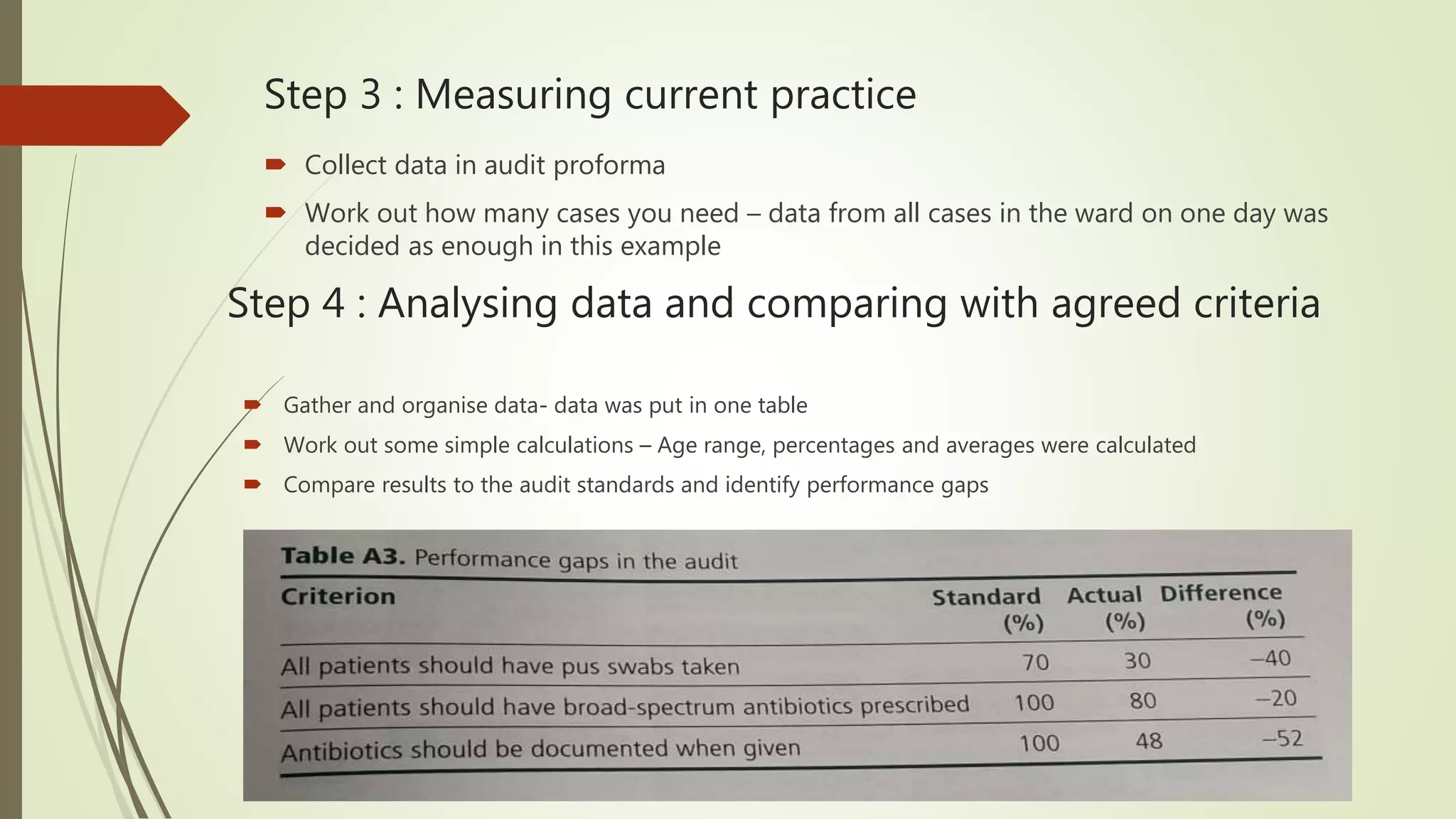
 70% patients with wound infections should have pus swabs taken
 100% patients should have broad spectrum antibiotics
 100% antibiotic collection should be documented correctly
Step 3 : Measuring current practice
 Collect data in audit proforma
 Work out how many cases you need – data from all cases in the ward on one day was
decided as enough in this example
Step 4 : Analysing data and comparing with agreed criteria
 Gather and organise data- data was put in one table
 Work out some simple calculations – Age range, percentages and averages were calculated
 Compare results to the audit standards and identify performance gaps
Step 5 : Root cause analysis using a why – why format
Step 6: Action plan created
Step 7 :Re - audit
Thank you

Clinical audit made easy

  • 1.
    Clinical Audit - madesimple Dr Mamta Rath Datta Source : RCOG Press
  • 2.
    What is thedifference between audit and research ?  Research is the systematic and rigorous process of enquiry that aims to describe processes and develop explanatory concepts and theories to contribute to scientific body of knowledge.  Research aims to discover something new or find out whether an untested technique actually works.  Audit is about maintaining and achieving quality , through review , monitoring and evaluation against agreed standards.
  • 3.
    Aims of Audit To improve patient outcome  To promote the cost effective use of resources  To provide education  To empower health care staff  To encourage reflection on one’s own practice.
  • 4.
    THE AUDIT CYCLE NABH STEPSSUGGESTED IN BOTH THE FIGURES ARE THE SAME
  • 5.
    Classification of criterion– based clinical audit  CRITERION BASED AUDIT  Audit of structure – examining the organisation or resources (what is available)  Audit of process - examining the activities themselves(what you do)  Audit of outcome – examining the effectiveness of activities on individual and communities (what are the results)  Common types : Case notes review/critical incident or adverse event audit/criterion based audit
  • 6.
    Step 1: problemIdentification:  Identify possible auditable problems  Consider whether the problem is imp. enough to audit  Consider whether further investigation of the problem is warranted.  Consider whether it is practical to audit the problem.  Consider whether auditing can improve the problem.
  • 7.
    Identifying problems  Problemsidentified by health professionals, hand over meetings, complaints, highlighted by media, issues raised by government etc., feedbacks from clients  Common problems :  People  Machines/equipments  Materials /supplies  Methods/techniques  Investigations  environment
  • 8.
    Step 2: settingstandards and establishing criteria: Criteria must be based on:  Evidence  Best practice  Related to imp. aspects of care  Capable of being measured  Acceptable to all participating staff  Realistic for the capacity of your facility Key points:  Find guidelines on how the condition is managed  From the guidelines produce criteria – key points on which to focus the audit  Decide upon appropriate numerical standards for each criterion
  • 9.
    Step 3 :Measuring current practice Work out what you need to know Basic data Audit criteria Other relevant points Work out how many cases you need Create an audit pro forma and collect data
  • 10.
    Step 4 :Analysingthe data and comparing practice with agreed criteria  Gather and organise the data  Work out some simple calculation, then summarise the key data points in either tables or graph  Compare the results with the audit standards and identify performance gaps
  • 11.
    Step 5,6 :Implement change and re-audit  Do a root cause analysis  Select appropriate intervention  Make an action plan  Carry out action plan.  Re-audit – this is done so that you can see what impact your audit has had and what changes have been made.
  • 12.
  • 13.
    Sample Audit -An example of a simple straightforward audit  AUDIT OF POSTOP CS WOUND INFECTION –audit carried out in National Hospital,Uganda  Identifying problem : need for doing something for wound infection identified in morning meeting  Is it important? – common issue with high rates of morbidity/mortality  Is further investigation warranted? – Yes. There were many questions.Why is it common? Which organisms cause it? How common is it?  Is it practical to audit the problem?- As it was a common problem it would be easy to find enough cases  Can auditing improve the problem? Postop infection is a preventable problem , so an audit could find areas for improvement Step 1 : Identifying the problem
  • 14.
    Step 2 :Setting standards and establishing criteria  Finding guidelines & evidence : National and WHO guidelines studied  Puerperal sepsis was defined  Management criteria was set  Swab any pus and take blood cultures in severe cases  Give broad spectrum antibiotics  Use wound irrigation and debridement if necessary  Develop valid criteria :  70% patients with wound infections should have pus swabs taken  100% patients should have broad spectrum antibiotics  100% antibiotic collection should be documented correctly
  • 15.
    Step 3 :Measuring current practice  Collect data in audit proforma  Work out how many cases you need – data from all cases in the ward on one day was decided as enough in this example Step 4 : Analysing data and comparing with agreed criteria  Gather and organise data- data was put in one table  Work out some simple calculations – Age range, percentages and averages were calculated  Compare results to the audit standards and identify performance gaps
  • 16.
    Step 5 :Root cause analysis using a why – why format
  • 17.
    Step 6: Actionplan created
  • 18.
    Step 7 :Re- audit
  • 19.