1
Clinical Audit Made Easy
Ayman Ewies
Consultant Gynaecologist
The Ipswich Hospital
August - 2007
2
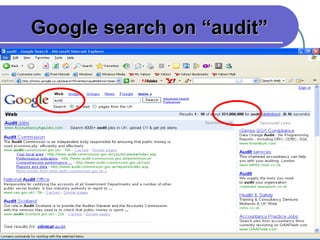
Google search on “audit”
3
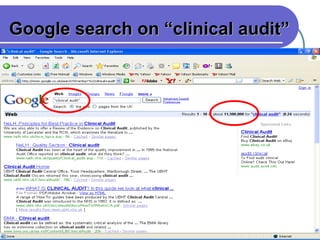
Google search on “clinical audit”
4
Scope Of This Talk
 Definition of Clinical Audit
 Why should I do an audit?
 What does audit achieve?
 Types of audit
 Components of audit
 How would you do it?
 Some do’s and don’ts
 Conclusion
5
Definition Of Clinical Audit
6
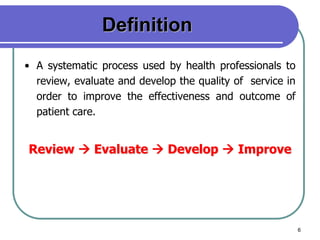
Definition
• A systematic process used by health professionals to
review, evaluate and develop the quality of service in
order to improve the effectiveness and outcome of
patient care.
Review  Evaluate  Develop  Improve
7
NICE - 2000
quality improvement process that seeks to improve
patient care and outcomes through systematic
review of care against explicit criteria and the
implementation of change.
8
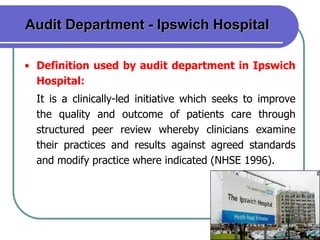
Audit Department - Ipswich Hospital
• Definition used by audit department in Ipswich
Hospital:
It is a clinically-led initiative which seeks to improve
the quality and outcome of patients care through
structured peer review whereby clinicians examine
their practices and results against agreed standards
and modify practice where indicated (NHSE 1996).
9
My Choice
• In simple words:
It is the process that compare the actual practices
with the standards practices aiming to implement
changes in the quality of care of individual patients.
10
Audit V Research
 Research
 The process that produces knowledge or confirm
the validity of existing knowledge.
 It tells us what is the right thing to do.
 Audit
 The process that reviews current practices to
stimulate change.
 It tells us whether we are doing the right thing in
the right way.
11
Why Should I Bother doing A
Clinical Audit?
12
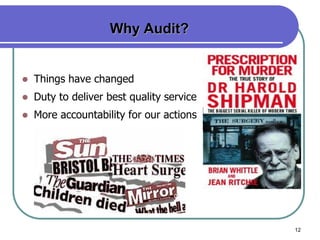
Why Audit?
 Things have changed
 Duty to deliver best quality service
 More accountability for our actions
13
Why Audit?
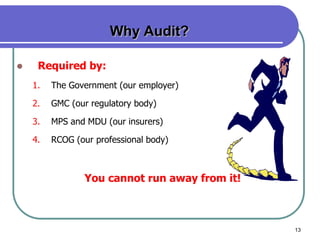
 Required by:
1. The Government (our employer)
2. GMC (our regulatory body)
3. MPS and MDU (our insurers)
4. RCOG (our professional body)
You cannot run away from it!
14
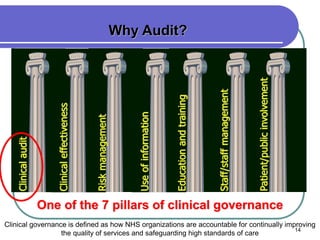
One of the 7 pillars of clinical governance
Clinicalaudit
Useofinformation
Riskmanagement
Patient/publicinvolvement
Clinicaleffectiveness
Educationandtraining
Staff/staffmanagement
Why Audit?
Clinical governance is defined as how NHS organizations are accountable for continually improving
the quality of services and safeguarding high standards of care
15
Why Audit?
1. Critical analysis of your own skills and ways of working (i.e. self
improvement)
2. Critical look at the system that delivers care to patients (i.e.
environmental improvement)
 Best practice
 Best outcome
 Best that we can deliver individually or collectively
16
What Does Clinical Audit Achieve?
17
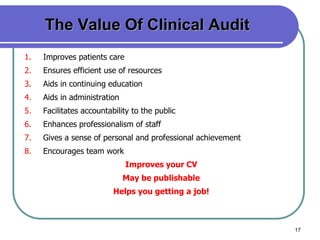
The Value Of Clinical Audit
1. Improves patients care
2. Ensures efficient use of resources
3. Aids in continuing education
4. Aids in administration
5. Facilitates accountability to the public
6. Enhances professionalism of staff
7. Gives a sense of personal and professional achievement
8. Encourages team work
Improves your CV
May be publishable
Helps you getting a job!
18
Types Of Clinical Audit
19
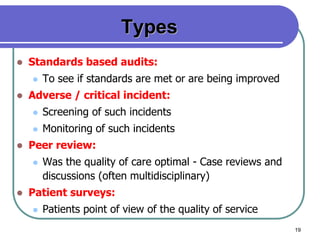
Types
 Standards based audits:
 To see if standards are met or are being improved
 Adverse / critical incident:
 Screening of such incidents
 Monitoring of such incidents
 Peer review:
 Was the quality of care optimal - Case reviews and
discussions (often multidisciplinary)
 Patient surveys:
 Patients point of view of the quality of service
20
20
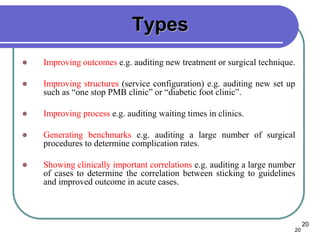
Types
 Improving outcomes e.g. auditing new treatment or surgical technique.
 Improving structures (service configuration) e.g. auditing new set up
such as “one stop PMB clinic” or “diabetic foot clinic”.
 Improving process e.g. auditing waiting times in clinics.
 Generating benchmarks e.g. auditing a large number of surgical
procedures to determine complication rates.
 Showing clinically important correlations e.g. auditing a large number
of cases to determine the correlation between sticking to guidelines
and improved outcome in acute cases.
21
Components Of Clinical Audit
22
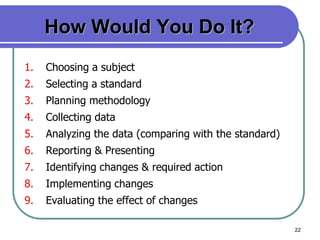
How Would You Do It?
1. Choosing a subject
2. Selecting a standard
3. Planning methodology
4. Collecting data
5. Analyzing the data (comparing with the standard)
6. Reporting & Presenting
7. Identifying changes & required action
8. Implementing changes
9. Evaluating the effect of changes
23
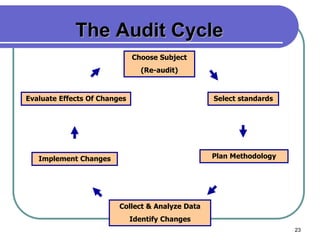
The Audit Cycle
Choose Subject
(Re-audit)
Select standards
Plan Methodology
Collect & Analyze Data
Identify Changes
Implement Changes
Evaluate Effects Of Changes
24
1- Choosing a Subject
 Generating an idea for audit is exciting since there is a direct
correlation between motivation and working on your own
ideas.
 However, every trust will have a list of audits that are of
particular importance.
25
1- Choosing a Subject
 When thinking about an audit, consider the
following:
1. Does your idea tap into clinicians’ anxiety? (this is the best
driver of ultimate change).
2. Is it a local priority? Will it help the directorate meet its
clinical governance requirements?
3. Is it a national priority? – NICE, DoH, etc.
4. Is it an area of high volume, high risk or high cost?
5. Is there variations in care, local concern, or known
problems?
26
1- Choosing a Subject
 The subject could be about:
1. Structure: This refers to the input of care such as manpower,
premises and facilities e.g. ‘Is the number of emergency
appointments enough to cope with demand?
2. Process: This refers to the provision of care (looking at what is
done and how it is done) e.g. 'Are all women with preterm labour
having the right steroid dose in the right time?
3. Outcome: This refers to the result of clinical intervention e.g. 'Are
women using Mirena for menorrhagia satisfied with their bleeding
pattern?
27
1- Choosing a Subject
• Generally speaking, no ethics committee
approval is needed, however:
 There is a fine line between the two: make sure your audit
does not alter patients' care in any way
 Follow Trust policy
 Contact audit department and audit lead
28
1- Choosing a Subject
• Supervisor: enthusiastic amateur or jaded expert?
 If you have a choice, decide who is the best person to
supervise you.
 Experienced supervisors are usually busy, which makes it
difficult to enthuse them with your ideas.
 Inexperienced supervisors are usually enthusiastic but
less effective.
It is better to spend 30 minutes with an expert than a
week with an amateur!!
29
1- Choosing a Subject
• Clear aims and objectives are mandatory:
 This helps clarifying the scope and approach of the
project.
 Keep the task focused on the audit project.
 Make unambiguous statements.
 Otherwise, you will get data at the end of no use!
30
2- Selecting a standard
 All audits require standards to measure against.
 This can be be defined from recent medical literature,
or
1. NICE guidelines www.nice.org.uk
2. RCOG www.rcog.org.uk
3. National Service frameworks
www.nhs.uk/england/aboutTheNHS/nsf/default.cmsx
4. Local policies
31
2- Selecting a standard
 Select standards in line with current practice.
 Be aware that the level of standard can often be
controversial.
32
2- Selecting a standard
 There are basically 3 options:
 A minimum standard: is often used to
distinguish between acceptable and unacceptable
practice.
 An ideal standard: describes the care that
should be possible to give under ideal conditions,
with no constraints. Such a standard by definition
cannot usually be attained.
 An optimum standard: lies between the 2. It
represent the standard of care most likely to be
achieved under normal conditions of practice.
33
3- Planning Methodology
 Source of information (case notes or electronically)
 Retrospective or prospective
 Number of patients
 Exclusion criteria
 Is pilot study required?
34
3- Planning Methodology
 Set deadlines for data collection, analysis and presentation.
 Include and liaise with all the relevant staff groups and/or
departments who the results may indicate change in their practice.
 Complete a clinical audit proposal form and submit it for approval
to the Clinical Audit department.
 Discuss your project and need for support.
35
3- Planning Methodology
• Does sample size matter?
 Ideally, you should include all relevant patients. If this is impossible
you need to consider sample size and selection criteria.
 The sample size needs to be big enough to ensure your findings are
not due to chance.
 If it is not necessary to include all patients within the area of
practice being audited; a sample group can be used  This reduces
the amount of data collected and make the analysis more
manageable.
 An excellent source of data is an electronic database.
36
3- Planning Methodology
• Looking backward or looking forward?
 If your data are recorded routinely  do retrospective data
collection:
 Quicker
 Big sample is possible
 However, the data could be biased
 Prospective data could be:
 Of better quality
 More suitable to answer the question directly
 However, it takes more time to do
37
3- Planning Methodology
How to identify patients?
 Each hospital has a “patient administration system”.
 You can request lists from those systems through the audit
department.
 These systems can trace patients by:
 Diagnosis,
 Operation, or
 Administrative data such as inpatients or day case episodes,
elective or emergency, etc.
38
4- Collecting data
 Manual / electronic - Use Excel.
 Make data collection as easy as possible – It is usually tedious
and time consuming.
 Do not collect unnecessary data – Be brief.
 Get help from the audit department – Not all of them!
 Do not rely on someone else to collect data for you as a
favour.
39
4- Collecting Data
 Good design of data collection form  easy analysis
later on.
 Ensure you are not omitting patients or creating a
bias.
 Are you collecting the right data?
 Does the data answer your audit question?
40
4- Collecting data
Confidentiality
 Any patient related data used within an audit should
meet the requirements of the Data Protection Act
and Caldicott Report (a DoH Report aiming to
ensure patients’ data is used correctly).
 As a minimum, when collecting patients
information, the patients names should not be
recorded with their personal/clinical details.
41
5- Analyzing Data
42
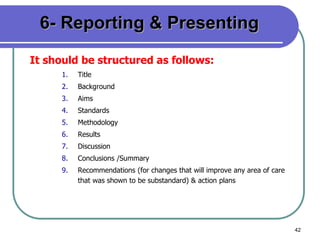
6- Reporting & Presenting
It should be structured as follows:
1. Title
2. Background
3. Aims
4. Standards
5. Methodology
6. Results
7. Discussion
8. Conclusions /Summary
9. Recommendations (for changes that will improve any area of care
that was shown to be substandard) & action plans
43
7- Identifying changes & required action
 Be clear
 Set realistic deadlines
 Never propose an action without discussing it with
the staff who will be carrying it out
 Take into account cost and training needs
44
7- Identifying changes & required action
• The success in achieving consensus on recommendations or
actions required will depend on:
1. Securing senior staff support and approval of
recommendations in advance.
2. Good structure and delivery of presentation.
• Clear ending summarising the findings, discussion points and
actions required.
3. Appropriate audience.
45
7- Identifying changes & required action
• Once the recommendations have been agreed by
the directorate, an action plan must be written
stating clearly:
1. What should be done?
2. Who will do it?
3. When will it be done?
46
8- Implementing changes
 Implementation is undoubtedly the most difficult part.
Change is never easy
Many audits never reach this stage
 However a robust audit with good quality data helps in implementing
change.
 These points might help:
1. Identify key leaders and make sure they support your audit
2. Invite people who can effect change to your audit committee
3. Never impose your changes from the outside  Withhold final
recommendations and ask for other people's opinions on how the service could
be improved  As soon as you hear the option you agree with make sure to
support and develop it.
47
9- Evaluating the effect of changes
(Completing the audit cycle)
 A re-audit may be planned in 6-12 months after implementing changes to ensure
that the desired improvement to patients care is achieved.
 This is difficult to achieve within junior doctors' time limits.
 Can you come back to re-audit even once you've moved?
 If not, could you find someone to do it for you?
Remember that big journals won't publish audits if no change of practice has been
demonstrated
 You need to ensure permanent staff take on the required action e.g.
1. Revise directorate guidelines
2. Circulate reports to all the staff
3. Set up a working group
4. Include topic in future induction programme
5. Arrange a study day on the topic, etc.
48
Some Do’s and Don’ts
49
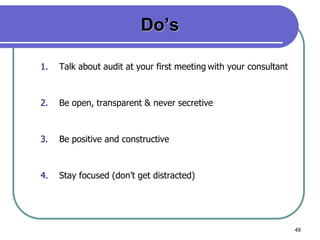
Do’s
1. Talk about audit at your first meeting with your consultant
2. Be open, transparent & never secretive
3. Be positive and constructive
4. Stay focused (don’t get distracted)
50
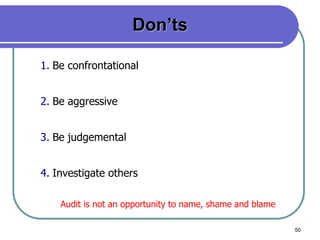
Don’ts
1. Be confrontational
2. Be aggressive
3. Be judgemental
4. Investigate others
Audit is not an opportunity to name, shame and blame
51
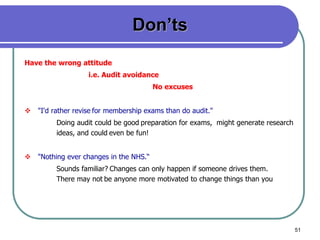
Don’ts
Have the wrong attitude
i.e. Audit avoidance
No excuses
 "I'd rather revise for membership exams than do audit."
Doing audit could be good preparation for exams, might generate research
ideas, and could even be fun!
 "Nothing ever changes in the NHS.“
Sounds familiar? Changes can only happen if someone drives them.
There may not be anyone more motivated to change things than you
52
Conclusion
53
Conclusion
Clinical audit is:
o Desirable
o Self satisfying
o Encourages teamwork
o Can be of benefit to:
1. The individual undertaking the audit
2. The department
3. The institution
4. The patients
54
Further Information
 NHS Clinical Governance Support Group. A Practical Handbook
for Clinical Audit. 2005—
www.cgsupport.nhs.uk/downloads/Practical_Clinical_Audit_Ha
ndbook_v1_1.pdf
 United Bristol Healthcare NHS Trust. Clinical Audit: Driving up
Quality at UBHT. 2006—www.ubht.nhs.uk/ClinicalAudit
 National Institute for Health and Clinical Excellence. Principles
for Best Practice in Clinical Audit. 2002—
www.nice.org.uk/page.aspx?o=233910
Dr Ayman Ewies - Clinical audit made easy

Dr Ayman Ewies - Clinical audit made easy

  • 1.
    1 Clinical Audit MadeEasy Ayman Ewies Consultant Gynaecologist The Ipswich Hospital August - 2007
  • 2.
    2 Google search on“audit”
  • 3.
    3 Google search on“clinical audit”
  • 4.
    4 Scope Of ThisTalk  Definition of Clinical Audit  Why should I do an audit?  What does audit achieve?  Types of audit  Components of audit  How would you do it?  Some do’s and don’ts  Conclusion
  • 5.
  • 6.
    6 Definition • A systematicprocess used by health professionals to review, evaluate and develop the quality of service in order to improve the effectiveness and outcome of patient care. Review  Evaluate  Develop  Improve
  • 7.
    7 NICE - 2000 qualityimprovement process that seeks to improve patient care and outcomes through systematic review of care against explicit criteria and the implementation of change.
  • 8.
    8 Audit Department -Ipswich Hospital • Definition used by audit department in Ipswich Hospital: It is a clinically-led initiative which seeks to improve the quality and outcome of patients care through structured peer review whereby clinicians examine their practices and results against agreed standards and modify practice where indicated (NHSE 1996).
  • 9.
    9 My Choice • Insimple words: It is the process that compare the actual practices with the standards practices aiming to implement changes in the quality of care of individual patients.
  • 10.
    10 Audit V Research Research  The process that produces knowledge or confirm the validity of existing knowledge.  It tells us what is the right thing to do.  Audit  The process that reviews current practices to stimulate change.  It tells us whether we are doing the right thing in the right way.
  • 11.
    11 Why Should IBother doing A Clinical Audit?
  • 12.
    12 Why Audit?  Thingshave changed  Duty to deliver best quality service  More accountability for our actions
  • 13.
    13 Why Audit?  Requiredby: 1. The Government (our employer) 2. GMC (our regulatory body) 3. MPS and MDU (our insurers) 4. RCOG (our professional body) You cannot run away from it!
  • 14.
    14 One of the7 pillars of clinical governance Clinicalaudit Useofinformation Riskmanagement Patient/publicinvolvement Clinicaleffectiveness Educationandtraining Staff/staffmanagement Why Audit? Clinical governance is defined as how NHS organizations are accountable for continually improving the quality of services and safeguarding high standards of care
  • 15.
    15 Why Audit? 1. Criticalanalysis of your own skills and ways of working (i.e. self improvement) 2. Critical look at the system that delivers care to patients (i.e. environmental improvement)  Best practice  Best outcome  Best that we can deliver individually or collectively
  • 16.
    16 What Does ClinicalAudit Achieve?
  • 17.
    17 The Value OfClinical Audit 1. Improves patients care 2. Ensures efficient use of resources 3. Aids in continuing education 4. Aids in administration 5. Facilitates accountability to the public 6. Enhances professionalism of staff 7. Gives a sense of personal and professional achievement 8. Encourages team work Improves your CV May be publishable Helps you getting a job!
  • 18.
  • 19.
    19 Types  Standards basedaudits:  To see if standards are met or are being improved  Adverse / critical incident:  Screening of such incidents  Monitoring of such incidents  Peer review:  Was the quality of care optimal - Case reviews and discussions (often multidisciplinary)  Patient surveys:  Patients point of view of the quality of service
  • 20.
    20 20 Types  Improving outcomese.g. auditing new treatment or surgical technique.  Improving structures (service configuration) e.g. auditing new set up such as “one stop PMB clinic” or “diabetic foot clinic”.  Improving process e.g. auditing waiting times in clinics.  Generating benchmarks e.g. auditing a large number of surgical procedures to determine complication rates.  Showing clinically important correlations e.g. auditing a large number of cases to determine the correlation between sticking to guidelines and improved outcome in acute cases.
  • 21.
  • 22.
    22 How Would YouDo It? 1. Choosing a subject 2. Selecting a standard 3. Planning methodology 4. Collecting data 5. Analyzing the data (comparing with the standard) 6. Reporting & Presenting 7. Identifying changes & required action 8. Implementing changes 9. Evaluating the effect of changes
  • 23.
    23 The Audit Cycle ChooseSubject (Re-audit) Select standards Plan Methodology Collect & Analyze Data Identify Changes Implement Changes Evaluate Effects Of Changes
  • 24.
    24 1- Choosing aSubject  Generating an idea for audit is exciting since there is a direct correlation between motivation and working on your own ideas.  However, every trust will have a list of audits that are of particular importance.
  • 25.
    25 1- Choosing aSubject  When thinking about an audit, consider the following: 1. Does your idea tap into clinicians’ anxiety? (this is the best driver of ultimate change). 2. Is it a local priority? Will it help the directorate meet its clinical governance requirements? 3. Is it a national priority? – NICE, DoH, etc. 4. Is it an area of high volume, high risk or high cost? 5. Is there variations in care, local concern, or known problems?
  • 26.
    26 1- Choosing aSubject  The subject could be about: 1. Structure: This refers to the input of care such as manpower, premises and facilities e.g. ‘Is the number of emergency appointments enough to cope with demand? 2. Process: This refers to the provision of care (looking at what is done and how it is done) e.g. 'Are all women with preterm labour having the right steroid dose in the right time? 3. Outcome: This refers to the result of clinical intervention e.g. 'Are women using Mirena for menorrhagia satisfied with their bleeding pattern?
  • 27.
    27 1- Choosing aSubject • Generally speaking, no ethics committee approval is needed, however:  There is a fine line between the two: make sure your audit does not alter patients' care in any way  Follow Trust policy  Contact audit department and audit lead
  • 28.
    28 1- Choosing aSubject • Supervisor: enthusiastic amateur or jaded expert?  If you have a choice, decide who is the best person to supervise you.  Experienced supervisors are usually busy, which makes it difficult to enthuse them with your ideas.  Inexperienced supervisors are usually enthusiastic but less effective. It is better to spend 30 minutes with an expert than a week with an amateur!!
  • 29.
    29 1- Choosing aSubject • Clear aims and objectives are mandatory:  This helps clarifying the scope and approach of the project.  Keep the task focused on the audit project.  Make unambiguous statements.  Otherwise, you will get data at the end of no use!
  • 30.
    30 2- Selecting astandard  All audits require standards to measure against.  This can be be defined from recent medical literature, or 1. NICE guidelines www.nice.org.uk 2. RCOG www.rcog.org.uk 3. National Service frameworks www.nhs.uk/england/aboutTheNHS/nsf/default.cmsx 4. Local policies
  • 31.
    31 2- Selecting astandard  Select standards in line with current practice.  Be aware that the level of standard can often be controversial.
  • 32.
    32 2- Selecting astandard  There are basically 3 options:  A minimum standard: is often used to distinguish between acceptable and unacceptable practice.  An ideal standard: describes the care that should be possible to give under ideal conditions, with no constraints. Such a standard by definition cannot usually be attained.  An optimum standard: lies between the 2. It represent the standard of care most likely to be achieved under normal conditions of practice.
  • 33.
    33 3- Planning Methodology Source of information (case notes or electronically)  Retrospective or prospective  Number of patients  Exclusion criteria  Is pilot study required?
  • 34.
    34 3- Planning Methodology Set deadlines for data collection, analysis and presentation.  Include and liaise with all the relevant staff groups and/or departments who the results may indicate change in their practice.  Complete a clinical audit proposal form and submit it for approval to the Clinical Audit department.  Discuss your project and need for support.
  • 35.
    35 3- Planning Methodology •Does sample size matter?  Ideally, you should include all relevant patients. If this is impossible you need to consider sample size and selection criteria.  The sample size needs to be big enough to ensure your findings are not due to chance.  If it is not necessary to include all patients within the area of practice being audited; a sample group can be used  This reduces the amount of data collected and make the analysis more manageable.  An excellent source of data is an electronic database.
  • 36.
    36 3- Planning Methodology •Looking backward or looking forward?  If your data are recorded routinely  do retrospective data collection:  Quicker  Big sample is possible  However, the data could be biased  Prospective data could be:  Of better quality  More suitable to answer the question directly  However, it takes more time to do
  • 37.
    37 3- Planning Methodology Howto identify patients?  Each hospital has a “patient administration system”.  You can request lists from those systems through the audit department.  These systems can trace patients by:  Diagnosis,  Operation, or  Administrative data such as inpatients or day case episodes, elective or emergency, etc.
  • 38.
    38 4- Collecting data Manual / electronic - Use Excel.  Make data collection as easy as possible – It is usually tedious and time consuming.  Do not collect unnecessary data – Be brief.  Get help from the audit department – Not all of them!  Do not rely on someone else to collect data for you as a favour.
  • 39.
    39 4- Collecting Data Good design of data collection form  easy analysis later on.  Ensure you are not omitting patients or creating a bias.  Are you collecting the right data?  Does the data answer your audit question?
  • 40.
    40 4- Collecting data Confidentiality Any patient related data used within an audit should meet the requirements of the Data Protection Act and Caldicott Report (a DoH Report aiming to ensure patients’ data is used correctly).  As a minimum, when collecting patients information, the patients names should not be recorded with their personal/clinical details.
  • 41.
  • 42.
    42 6- Reporting &Presenting It should be structured as follows: 1. Title 2. Background 3. Aims 4. Standards 5. Methodology 6. Results 7. Discussion 8. Conclusions /Summary 9. Recommendations (for changes that will improve any area of care that was shown to be substandard) & action plans
  • 43.
    43 7- Identifying changes& required action  Be clear  Set realistic deadlines  Never propose an action without discussing it with the staff who will be carrying it out  Take into account cost and training needs
  • 44.
    44 7- Identifying changes& required action • The success in achieving consensus on recommendations or actions required will depend on: 1. Securing senior staff support and approval of recommendations in advance. 2. Good structure and delivery of presentation. • Clear ending summarising the findings, discussion points and actions required. 3. Appropriate audience.
  • 45.
    45 7- Identifying changes& required action • Once the recommendations have been agreed by the directorate, an action plan must be written stating clearly: 1. What should be done? 2. Who will do it? 3. When will it be done?
  • 46.
    46 8- Implementing changes Implementation is undoubtedly the most difficult part. Change is never easy Many audits never reach this stage  However a robust audit with good quality data helps in implementing change.  These points might help: 1. Identify key leaders and make sure they support your audit 2. Invite people who can effect change to your audit committee 3. Never impose your changes from the outside  Withhold final recommendations and ask for other people's opinions on how the service could be improved  As soon as you hear the option you agree with make sure to support and develop it.
  • 47.
    47 9- Evaluating theeffect of changes (Completing the audit cycle)  A re-audit may be planned in 6-12 months after implementing changes to ensure that the desired improvement to patients care is achieved.  This is difficult to achieve within junior doctors' time limits.  Can you come back to re-audit even once you've moved?  If not, could you find someone to do it for you? Remember that big journals won't publish audits if no change of practice has been demonstrated  You need to ensure permanent staff take on the required action e.g. 1. Revise directorate guidelines 2. Circulate reports to all the staff 3. Set up a working group 4. Include topic in future induction programme 5. Arrange a study day on the topic, etc.
  • 48.
  • 49.
    49 Do’s 1. Talk aboutaudit at your first meeting with your consultant 2. Be open, transparent & never secretive 3. Be positive and constructive 4. Stay focused (don’t get distracted)
  • 50.
    50 Don’ts 1. Be confrontational 2.Be aggressive 3. Be judgemental 4. Investigate others Audit is not an opportunity to name, shame and blame
  • 51.
    51 Don’ts Have the wrongattitude i.e. Audit avoidance No excuses  "I'd rather revise for membership exams than do audit." Doing audit could be good preparation for exams, might generate research ideas, and could even be fun!  "Nothing ever changes in the NHS.“ Sounds familiar? Changes can only happen if someone drives them. There may not be anyone more motivated to change things than you
  • 52.
  • 53.
    53 Conclusion Clinical audit is: oDesirable o Self satisfying o Encourages teamwork o Can be of benefit to: 1. The individual undertaking the audit 2. The department 3. The institution 4. The patients
  • 54.
    54 Further Information  NHSClinical Governance Support Group. A Practical Handbook for Clinical Audit. 2005— www.cgsupport.nhs.uk/downloads/Practical_Clinical_Audit_Ha ndbook_v1_1.pdf  United Bristol Healthcare NHS Trust. Clinical Audit: Driving up Quality at UBHT. 2006—www.ubht.nhs.uk/ClinicalAudit  National Institute for Health and Clinical Excellence. Principles for Best Practice in Clinical Audit. 2002— www.nice.org.uk/page.aspx?o=233910