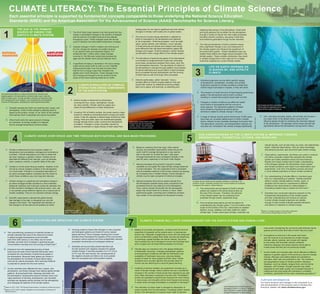
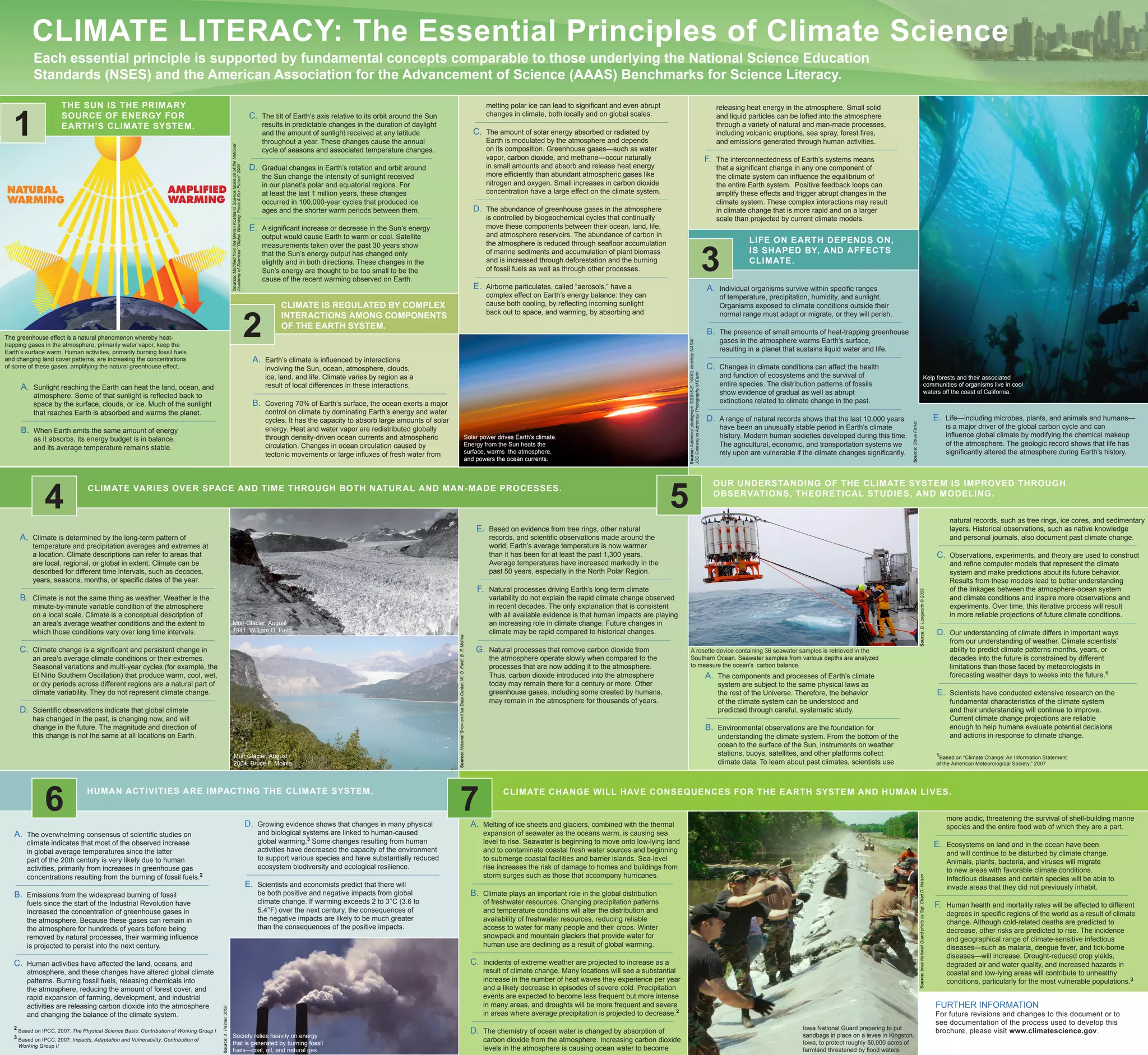
CLIMATE LITERACY: The Essential Principles of Climate Science
           Each essential principle is supported by fundamental concepts comparable to those underlying the National Science Education 
           Standards (NSES) and the American Association for the Advancement of Science (AAAS) Benchmarks for Science Literacy.

                         THE SUN IS THE PRIMARY                                                                                                                                                                                                                                                                                                melting polar ice can lead to significant and even abrupt                                                                            releasing heat energy in the atmosphere. Small solid 


   1                     SOURCE OF ENERGY FOR                                                                                                                                                 C.  The tilt of Earth’s axis relative to its orbit around the Sun                                                                                changes in climate, both locally and on global scales.                                                                               and liquid particles can be lofted into the atmosphere 
                         EARTH’S CLIMATE SYSTEM.                                                                                                                                                  results in predictable changes in the duration of daylight                                                                                                                                                                                                                        through a variety of natural and man­made processes, 
                                                                                                                                                                                                  and the amount of sunlight received at any latitude                                                                                     C.  The amount of solar energy absorbed or radiated by                                                                                    including volcanic eruptions, sea spray, forest fires, 
                                                                                                                                                                                                  throughout a year. These changes cause the annual                                                                                            Earth is modulated by the atmosphere and depends                                                                                     and emissions generated through human activities.


                                                                                                                  Source:!"#$%&'$!()#*!+,'!"-)%-.!/#0,1-.$!23%'.3'!"40'4*!#(!+,'!5-+%#.-1!
                                                                                                                                                                                                  cycle of seasons and associated temperature changes.                                                                                         on its composition. Greenhouse gases—such as water 
                                                                                                                                                                                                                                                                                                                                               vapor, carbon dioxide, and methane—occur naturally                                                                                F.  The interconnectedness of Earth’s systems means 
                                                                                                                                                                                              D.  Gradual changes in Earth’s rotation and orbit around                                                                                         in small amounts and absorb and release heat energy                                                                                  that a significant change in any one component of 


                                                                                                                  Academy of Sciences’ “Global Warming: Facts & Our Future” 2004
                                                                                                                                                                                                  the Sun change the intensity of sunlight received                                                                                            more efficiently than abundant atmospheric gases like                                                                                the climate system can influence the equilibrium of 
                                                                                                                                                                                                  in our planet’s polar and equatorial regions. For                                                                                            nitrogen and oxygen. Small increases in carbon dioxide                                                                               the entire Earth system.  Positive feedback loops can 
                                                                                                                                                                                                  at least the last 1 million years, these changes                                                                                             concentration have a large effect on the climate system.                                                                             amplify these effects and trigger abrupt changes in the 
                                                                                                                                                                                                  occurred in 100,000­year cycles that produced ice                                                                                                                                                                                                                                 climate system. These complex interactions may result 
                                                                                                                                                                                                  ages and the shorter warm periods between them.                                                                                         D.  The abundance of greenhouse gases in the atmosphere                                                                                   in climate change that is more rapid and on a larger 
                                                                                                                                                                                                                                                                                                                                               is controlled by biogeochemical cycles that continually                                                                              scale than projected by current climate models. 
                                                                                                                                                                                              E.  A significant increase or decrease in the Sun’s energy                                                                                       move these components between their ocean, land, life, 
                                                                                                                                                                                                  output would cause Earth to warm or cool. Satellite                                                                                          and atmosphere reservoirs. The abundance of carbon in 
                                                                                                                                                                                                                                                                                                                                               the atmosphere is reduced through seafloor accumulation                                                                                         LIFE ON EARTH DEPENDS ON, 


                                                                                                                                                                                                                                                                                                                                                                                                                                                                                 3
                                                                                                                                                                                                  measurements taken over the past 30 years show 
                                                                                                                                                                                                  that the Sun’s energy output has changed only                                                                                                of marine sediments and accumulation of plant biomass                                                                                           IS SHAPED BY, AND AFFECTS 
                                                                                                                                                                                                  slightly and in both directions. These changes in the                                                                                        and is increased through deforestation and the burning                                                                                          CLIMATE.
                                                                                                                                                                                                  Sun’s energy are thought to be too small to be the                                                                                           of fossil fuels as well as through other processes.
                                                                                                                                                                                                  cause of the recent warming observed on Earth.
                                                                                                                                                                                                                                                                                                                                          E.  Airborne particulates, called “aerosols,” have a                                                                                   A.  Individual organisms survive within specific ranges 
                                                                                                                                                                                                                                                                                                                                               complex effect on Earth’s energy balance: they can                                                                                    of temperature, precipitation, humidity, and sunlight. 
                                                                                                                                                                                                         CLIMATE IS REGULATED BY COMPLEX                                                                                                       cause both cooling, by reflecting incoming sunlight                                                                                   Organisms exposed to climate conditions outside their 


                                                                                                                                                                                             2
                                                                                                                                                                                                                                                                                                                                               back out to space, and warming, by absorbing and                                                                                      normal range must adapt or migrate, or they will perish. 
                                                                                                                                                                                                         INTERACTIONS AMONG COMPONENTS 
                                                                                                                                                                                                         OF THE EARTH SYSTEM.
                                                                                                                                                                                                                                                                                                                                                                                                                                                                                 B.  The presence of small amounts of heat­trapping greenhouse 
The greenhouse effect is a natural phenomenon whereby heat­
                                                                                                                                                                                                                                                                                                                                                                                                                                                                                     gases in the atmosphere warms Earth’s surface, 


                                                                                                                                                                                                                                                                                                                                                                                                                  Source: Astronaut photograph ISS015­E­ 10469, courtesy NASA/
trapping gases in the atmosphere, primarily water vapor, keep the 
Earth’s surface warm. Human activities, primarily burning fossil fuels                                                                                                                                                                                                                                                                                                                                                                                                               resulting in a planet that sustains liquid water and life.
and changing land cover patterns, are increasing the concentrations                                                                                                                            A.  Earth’s climate is influenced by interactions 
of some of these gases, amplifying the natural greenhouse effect.                                                                                                                                  involving the Sun, ocean, atmosphere, clouds,                                                                                                                                                                                                                                 C.  Changes in climate conditions can affect the health 
                                                                                                                                                                                                                                                                                                                                                                                                                                                                                     and function of ecosystems and the survival of 


                                                                                                                                                                                                                                                                                                                                                                                                                  JSC Gateway to Astronaut Photography of Earth
                                                                                                                                                                                                   ice, land, and life. Climate varies by region as a                                                                                                                                                                                                                                                                                                                                                                    Kelp forests and their associated 
      A.  Sunlight reaching the Earth can heat the land, ocean, and                                                                                                                                result of local differences in these interactions.                                                                                                                                                                                                                                entire species. The distribution patterns of fossils                                                                                communities of organisms live in cool 
           atmosphere. Some of that sunlight is reflected back to                                                                                                                                                                                                                                                                                                                                                                                                                    show evidence of gradual as well as abrupt                                                                                          waters off the coast of California.

           space by the surface, clouds, or ice. Much of the sunlight                                                                                                                          B.  Covering 70% of Earth’s surface, the ocean exerts a major                                                                                                                                                                                                                         extinctions related to climate change in the past.
           that reaches Earth is absorbed and warms the planet.                                                                                                                                    control on climate by dominating Earth’s energy and water 
                                                                                                                                                                                                   cycles. It has the capacity to absorb large amounts of solar                                                                                                                                                                                                                  D.  A range of natural records shows that the last 10,000 years                                                                                           E.  Life—including microbes, plants, and animals and humans—


                                                                                                                                                                                                                                                                                                                                                                                                                                                                                                                                                         Source: Steve Fisher
                                                                                                                                                                                                   energy. Heat and water vapor are redistributed globally                                                                                                                                                                                                                           have been an unusually stable period in Earth’s climate                                                                                                   is a major driver of the global carbon cycle and can 
      B.  When Earth emits the same amount of energy 
                                                                                                                                                                                                   through density­driven ocean currents and atmospheric                                                                        Solar power drives Earth’s climate.                                                                                                                  history. Modern human societies developed during this time.                                                                                               influence global climate by modifying the chemical makeup 
           as it absorbs, its energy budget is in balance, 
                                                                                                                                                                                                   circulation. Changes in ocean circulation caused by                                                                          Energy from the Sun heats the                                                                                                                        The agricultural, economic, and transportation systems we                                                                                                 of the atmosphere. The geologic record shows that life has 
           and its average temperature remains stable.
                                                                                                                                                                                                   tectonic movements or large influxes of fresh water from                                                                     surface, warms  the atmosphere,                                                                                                                      rely upon are vulnerable if the climate changes significantly.                                                                                            significantly altered the atmosphere during Earth’s history.
                                                                                                                                                                                                                                                                                                                                and powers the ocean currents. 


                4                                                                                                                                                                                                                                                                                                                                                                                           5
                                                                                                                                                                                                                                                                                                                                                                                                                                                                                   OUR UNDERSTANDING OF THE CLIMATE SYSTEM IS IMPROVED THROUGH 
                                 CLIMATE VARIES OVER SPACE AND TIME THROUGH BOTH NATUR AL AND MAN­ MADE PROCESSES.
                                                                                                                                                                                                                                                                                                                                                                                                                                                                                   OBSERVATIONS, THEORETICAL STUDIES, AND MODELING.


                                                                                                                                                                                                                                                                                                                                                                                                                                                                                                                                                                                                                                                 natural records, such as tree rings, ice cores, and sedimentary 
                                                                                                                                                                                                                                                                                                                                           E.  Based on evidence from tree rings, other natural                                                                                                                                                                                                                                                  layers. Historical observations, such as native knowledge 
     A.  Climate is determined by the long­term pattern of                                                                                                                                                                                                                                                                                      records, and scientific observations made around the                                                                                                                                                                                                                                             and personal journals, also document past climate change.
          temperature and precipitation averages and extremes at                                                                                                                                                                                                                                                                                world, Earth’s average temperature is now warmer 
          a location. Climate descriptions can refer to areas that                                                                                                                                                                                                                                                                              than it has been for at least the past 1,300 years.                                                                                                                                                                                                                                         C.  Observations, experiments, and theory are used to construct 
          are local, regional, or global in extent. Climate can be                                                                                                                                                                                                                                                                              Average temperatures have increased markedly in the                                                                                                                                                                                                                                              and refine computer models that represent the climate 
          described for different time intervals, such as decades,                                                                                                                                                                                                                                                                              past 50 years, especially in the North Polar Region.                                                                                                                                                                                                                                             system and make predictions about its future behavior. 
          years, seasons, months, or specific dates of the year.                                                                                                                                                                                                                                                                                                                                                                                                                                                                                                                                                                                 Results from these models lead to better understanding 
                                                                                                                                                                                                                                                                                                                                            F.  Natural processes driving Earth’s long­term climate                                                                                                                                                                                                                                              of the linkages between the atmosphere­ocean system 


                                                                                                                                                                                                                                                                                                                                                                                                                                                                                                                                                                                 Source: B. Longworth © 2008 
     B.  Climate is not the same thing as weather. Weather is the                                                                                                                                                                                                                                                                               variability do not explain the rapid climate change observed                                                                                                                                                                                                                                     and climate conditions and inspire more observations and 
          minute­by­minute variable condition of the atmosphere                                                                                                                                                                                                                                                                                 in recent decades. The only explanation that is consistent                                                                                                                                                                                                                                       experiments. Over time, this iterative process will result 
          on a local scale. Climate is a conceptual description of                                                                                                                                                                                                                                                                              with all available evidence is that human impacts are playing                                                                                                                                                                                                                                    in more reliable projections of future climate conditions.
          an area’s average weather conditions and the extent to                                                        Muir Glacier, August                                                                                                                                                                                                    an increasing role in climate change. Future changes in 
          which those conditions vary over long time intervals.                                                         1941, William O. Field                                                                                                                                                                                                  climate may be rapid compared to historical changes.                                                                                                                                                                                                                                        D.  Our understanding of climate differs in important ways 
                                                                                                                                                                                                                                                                   Source: National Snow and Ice Data Center, W. O. Field, B. F. Molnia


                                                                                                                                                                                                                                                                                                                                                                                                                                                                                                                                                                                                                                                 from our understanding of weather. Climate scientists’ 
     C.  Climate change is a significant and persistent change in                                                                                                                                                                                                                                                                          G.  Natural processes that remove carbon dioxide from                          A rosette device containing 36 seawater samples is retrieved in the                                                                                                                                                    ability to predict climate patterns months, years, or 
          an area’s average climate conditions or their extremes.                                                                                                                                                                                                                                                                               the atmosphere operate slowly when compared to the                        Southern Ocean. Seawater samples from various depths are analyzed                                                                                                                                                      decades into the future is constrained by different 
          Seasonal variations and multi­year cycles (for example, the                                                                                                                                                                                                                                                                           processes that are now adding it to the atmosphere.                       to measure the ocean’s  carbon balance.                                                                                                                                                                                limitations than those faced by meteorologists in 
          El Niño Southern Oscillation) that produce warm, cool, wet,                                                                                                                                                                                                                                                                           Thus, carbon dioxide introduced into the atmosphere                                                                              A.  The components and processes of Earth’s climate                                                                                                             forecasting weather days to weeks into the future.1
          or dry periods across different regions are a natural part of                                                                                                                                                                                                                                                                         today may remain there for a century or more. Other                                                                                  system are subject to the same physical laws as 
          climate variability. They do not represent climate change.                                                                                                                                                                                                                                                                            greenhouse gases, including some created by humans,                                                                                  the rest of the Universe. Therefore, the behavior                                                                                                      E.  Scientists have conducted extensive research on the 
                                                                                                                                                                                                                                                                                                                                                may remain in the atmosphere for thousands of years.                                                                                 of the climate system can be understood and                                                                                                                 fundamental characteristics of the climate system 
     D.  Scientific observations indicate that global climate                                                                                                                                                                                                                                                                                                                                                                                                                        predicted through careful, systematic study.                                                                                                                and their understanding will continue to improve. 
          has changed in the past, is changing now, and will                                                                                                                                                                                                                                                                                                                                                                                                                                                                                                                                                                                     Current climate change projections are reliable 
          change in the future. The magnitude and direction of                                                                                                                                                                                                                                                                                                                                                                                                                   B.  Environmental observations are the foundation for                                                                                                           enough to help humans evaluate potential decisions 
          this change is not the same at all locations on Earth.                                                                                                                                                                                                                                                                                                                                                                                                                     understanding the climate system. From the bottom of the                                                                                                    and actions in response to climate change.
                                                                                                                                                                                                                                                                                                                                                                                                                                                                                     ocean to the surface of the Sun, instruments on weather 
                                                                                                                               Muir Glacier, August                                                                                                                                                                                                                                                                                                                                  stations, buoys, satellites, and other platforms collect                                                                                               1Based on “Climate Change: An Information Statement 
                                                                                                                               2004, Bruce F. Molnia                                                                                                                                                                                                                                                                                                                                 climate data. To learn about past climates, scientists use                                                                                             of the American Meteorological Society,” 2007 


                6                HUMAN ACTIVITIES ARE IMPACTING THE CLIMATE SYSTEM.


                                                                                                                                                                                             D.  Growing evidence shows that changes in many physical 
                                                                                                                                                                                                                                                                           7                                                                        CLIMATE CHANGE WILL HAVE CONSEQUENCES FOR THE EARTH SYSTEM AND HUMAN LIVES.


                                                                                                                                                                                                                                                                                                                                          A.  Melting of ice sheets and glaciers, combined with the thermal 
                                                                                                                                                                                                                                                                                                                                                                                                                                                                                                                                                                                                                                                more acidic, threatening the survival of shell­building marine 
                                                                                                                                                                                                                                                                                                                                                                                                                                                                                                                                                                                                                                                species and the entire food web of which they are a part.
   A.  The overwhelming consensus of scientific studies on                                                                                                                                       and biological systems are linked to human­caused                                                                                            expansion of seawater as the oceans warm, is causing sea 
        climate indicates that most of the observed increase                                                                                                                                     global warming.3 Some changes resulting from human                                                                                           level to rise. Seawater is beginning to move onto low­lying land                                                                                                                                                                                                                             E.  Ecosystems on land and in the ocean have been 
        in global average temperatures since the latter                                                                                                                                          activities have decreased the capacity of the environment                                                                                    and to contaminate coastal fresh water sources and beginning                                                                                                                                                                                                                                      and will continue to be disturbed by climate change. 
        part of the 20th century is very likely due to human                                                                                                                                     to support various species and have substantially reduced                                                                                    to submerge coastal facilities and barrier islands. Sea­level                                                                                                                                                                                                                                     Animals, plants, bacteria, and viruses will migrate 
        activities, primarily from increases in greenhouse gas                                                                                                                                   ecosystem biodiversity and ecological resilience.                                                                                            rise increases the risk of damage to homes and buildings from                                                                                                                                                                                                                                     to new areas with favorable climate conditions. 
        concentrations resulting from the burning of fossil fuels.2                                                                                                                                                                                                                                                                           storm surges such as those that accompany hurricanes.


                                                                                                                                                                                                                                                                                                                                                                                                                                                                                                                                                                                Source: Iowa National Guard photo by Sgt. Chad D. Nelson
                                                                                                                                                                                                                                                                                                                                                                                                                                                                                                                                                                                                                                                Infectious diseases and certain species will be able to 
                                                                                                                                                                                             E.  Scientists and economists predict that there will                                                                                                                                                                                                                                                                                                                                                                                              invade areas that they did not previously inhabit.
   B.  Emissions from the widespread burning of fossil                                                                                                                                           be both positive and negative impacts from global                                                                                        B.  Climate plays an important role in the global distribution 
        fuels since the start of the Industrial Revolution have                                                                                                                                  climate change. If warming exceeds 2 to 3°C (3.6 to                                                                                          of freshwater resources. Changing precipitation patterns                                                                                                                                                                                                                                     F.  Human health and mortality rates will be affected to different 
        increased the concentration of greenhouse gases in                                                                                                                                       5.4°F) over the next century, the consequences of                                                                                            and temperature conditions will alter the distribution and                                                                                                                                                                                                                                        degrees in specific regions of the world as a result of climate 
        the atmosphere. Because these gases can remain in                                                                                                                                        the negative impacts are likely to be much greater                                                                                           availability of freshwater resources, reducing reliable                                                                                                                                                                                                                                           change. Although cold­related deaths are predicted to 
        the atmosphere for hundreds of years before being                                                                                                                                        than the consequences of the positive impacts.                                                                                               access to water for many people and their crops. Winter                                                                                                                                                                                                                                           decrease, other risks are predicted to rise. The incidence 
        removed by natural processes, their warming influence                                                                                                                                                                                                                                                                                 snowpack and mountain glaciers that provide water for                                                                                                                                                                                                                                             and geographical range of climate­sensitive infectious 
        is projected to persist into the next century.                                                                                                                                                                                                                                                                                        human use are declining as a result of global warming.                                                                                                                                                                                                                                            diseases—such as malaria, dengue fever, and tick­borne 
                                                                                                                                                                                                                                                                                                                                                                                                                                                                                                                                                                                                                                                diseases—will increase. Drought­reduced crop yields, 
   C.  Human activities have affected the land, oceans, and                                                                                                                                                                                                                                                                               C.  Incidents of extreme weather are projected to increase as a                                                                                                                                                                                                                                       degraded air and water quality, and increased hazards in 
        atmosphere, and these changes have altered global climate                                                                                                                                                                                                                                                                             result of climate change. Many locations will see a substantial                                                                                                                                                                                                                                   coastal and low­lying areas will contribute to unhealthy 
        patterns. Burning fossil fuels, releasing chemicals into                                                                                                                                                                                                                                                                              increase in the number of heat waves they experience per year                                                                                                                                                                                                                                     conditions, particularly for the most vulnerable populations.3 
        the atmosphere, reducing the amount of forest cover, and                                                                                                                                                                                                                                                                              and a likely decrease in episodes of severe cold. Precipitation 
        rapid expansion of farming, development, and industrial                                                                                                                                                                                                                                                                               events are expected to become less frequent but more intense 
        activities are releasing carbon dioxide into the atmosphere                                                                                                                                                                                                                                                                           in many areas, and droughts will be more frequent and severe                                                                                                                                                                                                                                 FURTHER INFORMATION
                                                                                        Source: A. Palmer, 2008


        and changing the balance of the climate system.                                                                                                                                                                                                                                                                                       in areas where average precipitation is projected to decrease.2                                                                                                                                                                                                                              For future revisions and changes to this document or to
                                                                                                                                                                                                                                                                                                                                                                                                                                                                                                                                                                                                                                           see documentation of the process used to develop this 
   2 Based on IPCC, 2007: The Physical Science Basis: Contribution of Working Group I                                                                                                                                                                                                                                                                                                                                                                                                                            Iowa National Guard preparing to put 
                                                                                                                        Society relies heavily on energy 
                                                                                                                                                                                                                                                                                                                                          D.  The chemistry of ocean water is changed by absorption of                                                                                                           sandbags in place on a levee in Kingston, 
                                                                                                                                                                                                                                                                                                                                                                                                                                                                                                                                                                                                                                           brochure, please visit www.climatescience.gov.
   3 Based on IPCC, 2007: Impacts, Adaptation and Vulnerability. Contribution of 
                                                                                                                        that is generated by burning fossil 
                                                                                                                                                                                                                                                                                                                                              carbon dioxide from the atmosphere. Increasing carbon dioxide                                                                                                      Iowa, to protect roughly 50,000 acres of 
      Working Group II
                                                                                                                        fuels—coal, oil, and natural gas.                                                                                                                                                                                     levels in the atmosphere is causing ocean water to become                                                                                                          !"#$%"&'()*#+")+&+'(,-(.//'(0")+#12(
&+7+11"#4%-(#+.+7)()*+(=4+01(/!()*+(D")4/&"%(B74+&7+(G/<&'")4/&2
                                                                                            conclusions or recommendations expressed in this material are those of the author(s) and do not 
                                                                                            F*41('/7<$+&)(*"1(,++&(#+=4+0+'(,-()*+(!/%%/04&5(G+'+#"%("5+&74+12((3&-(/84&4/&19(6&'4&519("&'(                                                                                                                                                                                                                                                                                                                  conditions for a region in the long­term future (seasons to decades).
                    Second Version: March 2009                                                                                                   Printed with Soy Ink                                                                                                                                                                                                                                                                                                                                        Climate Forecast A prediction about average or extreme climate 
                                                                                          Recycled Content Paper                                 Second Version: March  2009                                                                                                                                                                                         3. Based on IPCC, 2007: Mitigation of Climate Change. Contribution of Working Group III
                                                                                                                                                                                                                                                                                                                                                            2 . Based on IPCC, 2007: Impacts, Adaptation and Vulnerability. Contribution of Working Group II                                     sheets and sea ice described by statistics, such as means and extremes.
                                                                                          Program at http://www.climatescience.gov.                                                                                                                                                                                                                                                                                                                                                              Climate The long­term average of conditions in the atmosphere, ocean, and ice 
                                                                                                                                                                                                                                                                                                                                                                               Program and the Subcommittee on Global Change Research, Washington, DC.
                                                                                          For an up to date list of partners please refer to U.S Climate Change Science 
                                                                                                                                                                                                                                                                                                                                                                               and William L. Murray, editors, 2006. A Report by the Climate Change Science 
                                                                                                                                                                                                                                                                                                                                                                               Reconciling Differences. Thomas R. Karl, Susan J. Hassol, Christopher D. Miller,                                        expected for a location in the short­term future (hours to days).
                                                                                                                                                                                                                                                                                                                                                                              1. Temperature Trends in the Lower Atmosphere: Steps for Understanding and                                               Weather Forecast(3(8#+'47)4/&(",/<)()*+(18+7467(")$/18*+#47(7/&'4)4/&1(
                                                                                                                                     National Environmental Education Foundation
                                                                                                          U.S. Forest Service
                                                                                                                                                                                                                                                                                                                                                                                                                                                                                                        precipitation, cloudiness, humidity, air pressure, and wind. 
                                                                                                                                             California, Berkeley                                                                                                                                                                                                   of respiration, decay of organisms, and combustion of fossil fuels.
                                                                                                      U.S. Geological Survey                                                                                                                                                                                                                                                                                                                                                                            and time, measured in terms of variables that include temperature, 
                                                                                                                                             Lawrence Hall of Science, University of                                                                                                                                                                                and return of the carbon to the atmosphere as carbon dioxide as a result 
                                                                                                                                                                                                                                                                                                                                                                                                                                                                                                        Weather(F*+(18+7467(7/&'4)4/&1(/!()*+(")$/18*+#+(")("(8"#)47<%"#(8%"7+(
                                                                                                                                                                                                                                                                                                                                                                    organic compounds by plants, which are consumed by other organisms, 
                                                                                                   Atmospheric Research                                   Information Partners                                                                                                                                                                                      as a result of photosynthetic conversion of carbon dioxide into complex 
                                                                                                   University Corporation for                             Federation of Earth Science                                                                                                                                                                               Carbon Cycle Circulation of carbon atoms through the Earth systems                                                                                                          KEY DEFINITIONS
                                                                                                     Atmospheric Research                       Environmental Sciences
                                                                                                     The National Center for                                                                                                                                                                                                                            of the system output; negative feedback reduces the output of a system.
                                                                                                                                                Cooperative Institute for Research in 
                                                                                                                                                                                                                                                                                                                                                        modulated in response to its own output. Positive feedback results in amplification 
                                                                                                        The GLOBE Program                                                                                                                                                                                                                               Feedback The process through which a system is controlled, changed, or 
                                                                                                                                                                                                                                                                                                                                                                                                                                                                                               reduce those vulnerabilities.
                                                                                                                                                                 College of Exploration
                                                                                                                                                                                                                                                                                                                                                                                                                                                                                               precautionary steps in our lives and livelihoods that would 
                                                                                                                     TERC Inc.                                Climate Literacy Network                                                                                                                                                                          derived from living matter that existed during a previous geologic time period.                                                vulnerability to the impacts of climate change and to take 
                                                                                                         Sally Ride Science™                                                                                                                                                                                                                                    Fossil fuels Energy sources such as petroleum, coal, or natural gas, which are                                                 our ability to make decisions about activities that increase 
                                                                                                                                                         Science Education
                                                                                                                                                         Challenger Center for Space                                                                                                                                                                                                                                                                                                           Earth’s climate system. Such understanding improves 
                                                                                             Environmental Education                                                                                                                                                                                                                                             human systems against actual or expected climate change effects.3
                                                                                             North American Association For                Centers for Disease Control & Prevention                                                                                                                                                                              Adaptation Initiatives and measures to reduce the vulnerability of natural and                                                that individuals and communities should understand about 
                                                                                                                                                                                                                                                                                                                                                                                                                                                                                               identifies the essential principles and fundamental concepts 
                                                                                      National Science Teachers Association                                    Bowman Global Change                                                                                                                                                                     are susceptible to and unable to cope with adverse impacts of climate change.2                                                         citizenry is essential.  This climate science literacy guide 
                                                                                                 Atmospheric Administration                                                                                                                                                                                                                             Vulnerability The degree to which physical, biological, and socio­economic systems 
                                                                                                                                        Association of Science­Technology Centers                                                                                                                                                                                                                                                                                                              extreme weather and climate events—a climate­literate 
                                                                                                 National Oceanic and 
                                                                                                                                                     American Meteorological Society                                                                                                                                                                                     gases or enhance the sinks that remove them from the atmosphere.
                                                                                                                                                                                                                                                                                                                                                                                                                                                                                               communities that are resilient to climate change—including 
                                                                                 National Institute of Standards & Technology                                                                                                                                                                                                                                            Mitigation Human interventions to reduce the sources of greenhouse                                                    To protect fragile ecosystems and to build sustainable 
                                                                                                                                     Science Project 2061
                                                                                   National Geographic Education Programs            American Association for the Advancement of 
                                                                                                                                                                                                                                                                                                                                                                                                                                                                                                
                                                                                                                                                                                                                                                                                                                                                      than 95% probability, and “virtually certain” means greater than 99% probability.                                                        stratospheric ozone).”1
                                                                                                                                                                                                                                                                                                                                                      “very likely” result has a greater than 90% probability. “Extremely likely” means greater 
                                                                                                                                       Current Science and Educational Partners:                                                                                                                                                                      result that is deemed “likely” to occur has a greater than 66% probability of occurring. A 
                                                                                                                                                                                                                                                                                                                                                                                                                                                                                               system (due to changes in greenhouse gases, aerosols, and 
                                                                                                                                                                                                                                                                                                                                                      a predicted outcome will occur in the climate system, according to expert judgment. A                                                    time show clear evidence of human influences on the climate 
                                                                                                climate.literacy@climatescience.gov                                                                                                                                                                                                                   Intergovernmental Panel on Climate Change (IPCC) to indicate how probable it is that                                                     using patterns of observed temperature change in space and 
                                                                                                                                                                                                                                                                                                                                                      Likely, Very Likely, Extremely Likely, Virtually Certain These terms are used by the 
                                                                                                    http://www.climatescience.gov                                                                                                                                                                                                                                                                                                                                                              that “studies to detect climate change and attribute its causes 
                        and Communities                                                   +1.202.223.6262 (Voice) + 1.202.223.3065 (Fax)                                                                                                                                                                                                                                     lithosphere, biosphere, and Earth­Sun interactions.
                                                                                                                                                                                                                                                                                                                                                                                                                                                                                               published findings in agreement with the IPCC report, stating 
                                                                                 1717 Pennsylvania Avenue, NW Suire 250 Washington DC 20006 USA                                                                                                                                                                                                                              interactions among Earth’s atmosphere, hydrosphere, cryosphere,                                                   nitrous oxide. The U.S. Climate Change Science Program 
                      A Guide for Individuals                                                    Climate Change Science Program                                                                                                                                                                                                                                              Climate System The matter, energy, and processes involved in                                                      gases in the atmosphere: carbon dioxide, methane, and 
                                                                                              U.S. Global Change Research Program /                                                                                                                                                                                                                                                                                                                                                            influence primarily to the increase in three key heat­trapping 
                                                                                                                                                                                                                                                                                                                                                   lead to other changes in climate conditions, such as changes in precipitation patterns.
                                                                                                                                                                                                                                                                                                                                                   gases from human activities. Global warming is a type of climate change; it can also                                                        warming.” The IPCC attributes humanity’s global warming 
                                                                                                                                                                                                                                                                                                                                                   refers to the warming that has occurred as a result of increased emissions of greenhouse 
                  of Climate Science                                                                                                                                                                                                                                                                                                                                                                                                                                                           net effect of human activities since 1750 has been one of 
                                                                                                                                                                                                                                                                                                                                                   and in the lowest layer of the atmosphere. In common usage, “global warming” often                                                          that it had “very high confidence that the global average 
                                                                                                                                                                                                                                                                                                                                                   Global Warming The observed increase in average temperature near the Earth’s surface 
                The Essential Principles
                                                                                                                                                                                                                                                                                                                                                                                                                                                                                               Intergovernmental Panel on Climate Change (IPCC) stated 
                                                                                                                                                                                                                                                                                                                                                                    )+7)/&47($/)4/&19(/#("&)*#/8/5+&47($/'467")4/&(/!()*+(")$/18*+#+2                                                          on Earth’s climate. In its 2007 Fourth Assessment, the 
                                                                                                                                                                                                                                                                                                                                                                    Earth’s orbit about the sun, re­arrangement of continents through plate                                                    areas of land, for instance—have had a profound influence 
                                                                                                                                                                                                                                                                                                                                                                    in some aspect of Earth’s environment: these include regular changes in                                                    human activities—burning fossil fuels and deforesting large 
                                                                                                                                                                                                                                                                                                                                                                    the climate or its variability. Climate change occurs in response to changes 
                                                                                                                                                                                                                                                                                           ON CLIMATE                                                               Climate Change(3(145&467"&)("&'(8+#141)+&)(7*"&5+(4&()*+($+"&(1)")+(/!(                                                    thrived or failed. We now know that the opposite is also true: 
                                                                                                                                                                                                                                                                                                                                                                                                                                                                                               in profound ways, playing an integral role in whether societies 
                                                                                                                                                                                                                                                                                                                                                                      include the El Niño Southern Oscillation and other phenomena.                                                            variations in climate patterns have influenced human history 
                                                                                                                                                                                                                                                                                                                                                                      precipitation, and frequency of events. Drivers of climate variability 
                                                                                                                                                                                                                                                                              AND YOUR INFLUENCE                                                                                                                                                                                               10,000 years—the span of human civilization—regional 
                                                                                                                                                                                                                                                                                                                                                                      range of extremes for a particular region, as measured by temperature, 
                                                                                                                                                                                                                                                                                                                                                                      Climate Variability Natural changes in climate that fall within the normal                                               While global climate has been relatively stable over the last 


           Literacy
                                                                                                                                                                                                                                                                               ON YOU AND SOCIETY 
                                                                                                                                                                                                                                                                                                                                                    eruptions. Species and ecosystems have either adapted to these past climate variations or perished.
                                                                                                                                                                                                                                                                         THE CLIMATE’S INFLUENCE                                                    of slower natural processes such as shifts in ocean circulation, sometimes due to sudden events such as massive volcanic 


            Climate
                                                                                                                                                                                                                                                                                                                                                    circulation that result from plate tectonic movements. Earth’s climate has changed abruptly at times, sometimes as a result 
                                                                                                                                                                                                                                                                            AN UNDERSTANDING OF                                                     of solar energy the planet receives. Earth’s climate has also been influenced on very long timescales by changes in ocean 
                                                                                                                                                                                                                                                                                                                                                    ice age and then warming it again. This cycle is believed associated with regular changes in Earth’s orbit that alter the intensity 
                                                                                                                                                                                                                                                                     CLIMATE SCIENCE LITERACY IS                                                    each cycle, global average temperatures have fallen and then risen again by about 9°F (5°C), each time taking Earth into an 
                                                                                                                                                                                                                                                                                                                                                    world has experienced cycles of warming and cooling that take approximately 100,000 years to complete. Over the course of 
                                                                                                                                                                                                                                                                                                                                                    terrestrial, atmospheric, and living components that make up planet Earth’s systems. For at least the last million years, our 
                                                                                                                                                                                                                                                                                                                                                    Throughout its history, Earth’s climate has varied, reflecting the complex interactions and dependencies of the solar, oceanic, 
             FOR LEARNERS OF ALL AGES
           A CLIMATE­ORIENTED APPROACH 
                                                                                                                                                                                                                                                                                                                                                                                                                                                                                                                                           CLIMATE CHANGES 
     WHAT IS CLIMATE SCIENCE LITERACY?                                                                                                                                                                                                                                                                                                                INFORMED CLIMATE DECISIONS REQUIRE AN                                                                                                           GUIDING PRINCIPLE FOR INFORMED 
                                                                                                                                                                                                                                                                 HOW DO WE KNOW WHAT IS 
                                                                                                                                                                                                                                                                                                                                                      INTEGRATED APPROACH.                                                                                                                            CLIMATE DECISION:
                                                                                                                                                                                                                                                                 SCIENTIFICALLY CORRECT?
Climate Science Literacy is an understanding of your influence on                 People who are climate science literate know that climate science                                                                                                                                                                                                                                                                                                                                                   Humans can take actions to reduce 
                                                                                                                                                                                                                                                                                                                                                Agricultural 
climate and climate’s influence on you and society.                               can inform our decisions that improve quality of life. They have a                                                                                                             The Peer Review Process                                                        engineers 
A climate­literate person                                                         basic understanding of the climate system, including the natural                                                                                                                                                                                              inspect a 
                                                                                                                                                                                                                                                                                                                                                                                                                                                                                                      climate change and its impacts.
                                                                                  and human­caused factors that affect it. Climate science literate                                                                                                              Science is an on­going process of making observations and using                dry stream.
:(   understands the essential principles of Earth’s climate system,              individuals understand how climate observations and records as                                                                                                                 evidence to test hypotheses. As new ideas are developed and                                                                                                                                                                   A.    Climate information can be used to reduce vulnerabilities 
:(   knows how to assess scientifically credible information                      well as computer modeling contribute to scientific knowledge about                                                                                                             new data are obtained, oftentimes enabled by new technologies, 
                                                                                  climate. They are aware of the fundamental relationship between                                                                                                                                                                                                                                                                                                                                                    or enhance the resilience of communities and ecosystems 
     about climate,                                                                                                                                                                                                                                              our understanding evolves. The scientific community uses a highly 
                                                                                  climate and human life and the many ways in which climate has                                                                                                                                                                                                                                                                                                                                                      "!!+7)+'(,-(7%4$")+(7*"&5+2(;/&)4&<4&5()/(4$8#/=+(174+&)467(
:(   communicates about climate and climate change in a                                                                                                                                                                                                          formalized version of peer review to validate research results and 
                                                                                  always played a role in human health. They have the ability to                                                                                                                                                                                                                                                                                                                                                     understanding of the climate system and the quality of 
     meaningful way, and                                                                                                                                                                                                                                         our understanding of their significance. Researchers describe their 
                                                                                  assess the validity of scientific arguments about climate and to use                                                                                                                                                                                                                                                                                                                                               reports to policy and decision­makers is crucial.
                                                                                                                                                                                                                                                                 experiments, results, and interpretations in scientific manuscripts 
:(   is able to make informed and responsible decisions                           that information to support their decisions.                                                                                                                                   and submit them to a scientific journal that specializes in their field of 
     with regard to actions that may affect climate.                                                                                                                                                                                                             science. Scientists who are experts in that field serve as “referees” for                                                                                                                                                     B.  Reducing human vulnerability to the impacts of climate change 
                                                                                  CLIMATE SCIENCE LITERACY IS AN ONGOING                                                                                                                                         the journal: they read the manuscript carefully to judge the reliability of                                                                                                                                                       depends not only upon our ability to understand climate 
WHY DOES CLIMATE SCIENCE LITERACY                                                 PROCESS.                                                                                                                                                                       the research design and check that the interpretations are supported                                                                                                                                                              science, but also upon our ability to integrate that knowledge 
MATTER?                                                                                                                                                                                                                                                          by the data. Based on the reviews, journal editors may accept or reject                                                                                                                                                           into human society. Decisions that involve Earth’s climate 
                                                                                  No single person is expected to understand every detail about                                                                                                                  manuscripts or ask the authors to make revisions if the study has                                                                                                                                                                 must be made with an understanding of the complex inter­
:(   During the 20th century, Earth’s globally averaged surface                   all of the fundamental climate science literacy concepts. Full                                                                                                                 insufficient data or unsound interpretations. Through this process, only                                                                                                                                                          connections among the physical and biological components 
     temperature rose by approximately 1.08°F (0.6°C). Additional                 comprehension of these interconnected concepts will require a                                                                                                                  those concepts that have been described through well­documented                                                                                                                                                                   of the Earth system as well as the consequences of such 
     warming of more than 0.25°F (0.14°C) has been measured                       systems­thinking approach, meaning the ability to understand                                                                                                                   research and subjected to the scrutiny of other experts in the field                                                                                                                                                              decisions on social, economic, and cultural systems. 
     since 2000. Though the total increase may seem small, it likely              complex interconnections among all of the components of the                                                                                                                    become published papers in science journals and accepted as 
     represents an extraordinarily rapid rate of change compared to               climate system. Moreover, as climate science progresses and as                                                                                                                 current science knowledge. Although peer review does not guarantee                                                                                                                                                            C.  The impacts of climate change may affect the security 
                                                                                                                                                                                                                                                                                                                                                                                                                                                                  Source: Scott Bauer, USDA 


     changes in the previous 10,000 years.                                        efforts to educate the people about climate’s influence on them and                                                                                                            that any particular published result is valid, it does provide a high                                                                                                                                                             of nations. Reduced availability of water, food, and land 
                                                                                  their influence on the climate system mature, public understanding                                                                                                             assurance that the work has been carefully vetted for accuracy by                                                                                                                                                                 7"&(%+"'()/(7/$8+)4)4/&("&'(7/&.47)("$/&5(*<$"&19(
:(   Over the 21st century, climate scientists expect Earth’s                                                                                                                                                                                                                                                                                        In the coming decades, scientists expect climate change to have 
                                                                                  will continue to grow.                                                                                                                                                         informed experts prior to publication. The overwhelming majority of                                                                                                                                                               potentially resulting in large groups of climate refugees.
     temperature to continue increasing, very likely more than it did                                                                                                                                                                                                                                                                                an increasing impact on human and natural systems. In a warmer 
                                                                                                                                                                                                                                                                 peer­reviewed papers about global climate change acknowledge that 
     during the 20th century. Two anticipated results are rising global                                                                                                                                                                                                                                                                              world, accessibility to food, water, raw materials, and energy are 
                                                                                  Climate is an ideal interdisciplinary theme for lifelong learning about                                                                                                        human activities are substantially contributing factors.
     sea level and increasing frequency and intensity of heat waves,                                                                                                                                                                                                                                                                                 likely to change. Human health, biodiversity, economic stability,                                                                         D.   Humans may be able to mitigate climate change or lessen 
     droughts, and floods. These changes will affect almost every                 the scientific process and the ways in which humans affect and are                                                                                                                                                                                                                                                                                                                                               its severity by reducing greenhouse gas concentrations 
                                                                                                                                                                                                                                                                                                                                                     and national security are also expected to be affected by climate 
     aspect of human society, including economic prosperity, human                affected by the Earth’s systems. This rich topic can be approached                                                                                                                                                                                                                                                                                                                                               through processes that move carbon out of the 
                                                                                                                                                                                                                                                                                                                                                     change. Climate model projections suggest that negative effects 
     and environmental health, and national security.                             at many levels, from comparing the daily weather with long­term 
                                                                                                                                                                                                                                                                                                                                                     of climate change will significantly outweigh positive ones. The                                                                              atmosphere or reduce greenhouse gas emissions.
                                                                                  records to exploring abstract representations of climate in computer 
:(   Scientific observations and climate model results indicate                                                                                                                                                                                                                                                                                      nation’s ability to prepare for and adapt to new conditions may be 
                                                                                  models to examining how climate change impacts human and 
     that human activities are now the primary cause of most                                                                                                                                                                                                                                                                                         exceeded as the rate of climate change increases.                                                                                         E.    A combination of strategies is needed to reduce greenhouse 
                                                                                  ecosystem health. Learners of all ages can use data from their own 
     of the ongoing increase in Earth’s globally averaged                         experiments, data collected by satellites and other observation                                                                                                                                                                                                                                                                                                                                                    gas emissions. The most immediate strategy is conservation 
     surface temperature.                                                                                                                                                                                                                                                                                                                            Reducing our vulnerability to these impacts depends not                                                                                         of oil, gas, and coal, which we rely on as fuels for most 
                                                                                  systems, or records from a range of physical, chemical, biological, 
                                                                                                                                                                                                                                                                                                                                                     only upon our ability to understand climate science and the                                                                                     of our transportation, heating, cooling, agriculture, and 
:(   Climate change will bring economic and environmental                         geographical, social, economic, and historical sources to explore the 
                                                                                                                                                                                                                                                                                                                                                     implications of climate change, but also upon our ability to                                                                                    electricity. Short­term strategies involve switching from 
     challenges as well as opportunities, and citizens who have                   impacts of climate and potential adaptation and mitigation strategies. 
                                                                                                                                                                                                                                                                                                                                                     integrate and use that knowledge effectively. Changes in our                                                                                    carbon­intensive to renewable energy sources, which also 
     an understanding of climate science will be better prepared to                                                                                                                                                                                                                                                                                  economy and infrastructure as well as individual attitudes, 
     respond to both.                                                                                                                                                                                                                                                                                                                                                                                                                                                                                requires building new infrastructure for alternative energy 
                                                                                  ABOUT THIS GUIDE                                                                                                                                                                                                                                                   societal values, and government policies will be required to alter                                                                              sources. Long­term strategies involve innovative research 
:(   Society needs citizens who understand the climate system and                 Climate Literacy: The Essential Principles of Climate Science presents                                                                                                                                                                                             the current trajectory of climate’s impact on human lives. The                                                                                  and a fundamental change in the way humans use energy.
     know how to apply that knowledge in their careers and in their               information that is deemed important for individuals and communities to                                                                                                                                                                                            resolve of individuals, communities, and countries to identify and 
     engagement as active members of their communities.                           know and understand about Earth’s climate, impacts of climate change, and                                                                                                                                                                                          implement effective management strategies for critical institutional 
                                                                                  approaches to adaptation or mitigation.  Principles in the guide can serve as                                                                                                                                                                                      and natural resources will be necessary to ensure the stability of                                                                        F.    Humans can adapt to climate change by reducing their 
:(   Climate change will continue to be a significant element of                  discussion starters or launching points for scientific inquiry. The guide aims                                                                                                                                                                                                                                                                                                                                     vulnerability to its impacts. Actions such as moving to 
                                                                                                                                                                                                                                                                                                                                                     both human and natural systems as temperatures rise.
     public discourse. Understanding the essential principles of                  to promote greater climate science literacy by providing this educational                                                                                                                                                                                                                                                                                                                                          higher ground to avoid rising sea levels, planting new crops 
     climate science will enable all people to assess news stories and            framework of principles and concepts. The guide can also serve educators                                                                                                                                                                                                                                                                                                                                           that will thrive under new climate conditions, or using new 
                                                                                  who teach climate science as a way to meet content standards in their 
                                                                                                                                                                                                                                                                                                                                                     This climate science literacy document focuses primarily on the 
     contribute to their everyday conversations as informed citizens.                                                                                                                                                                                                                                                                                                                                                                                                                                building technologies represent adaptation strategies. 
                                                                                  science curricula.                                                                                                                                                                                                                                                 physical and biological science aspects of climate and climate 
                                                                                                                                                                                                                                                                                                                                                     change. Yet as nations and the international community seek                                                                                     3'"8)")4/&(/!)+&(#+><4#+1(6&"&74"%(4&=+1)$+&)(4&(&+0(/#(
CLIMATE SCIENCE LITERACY IS A PART OF                                             Development of the guide began at a workshop sponsored by the National                                                                                                                                                                                             solutions to global climate change over the coming decades,                                                                                     enhanced research, technology, and infrastructure.
SCIENCE LITERACY.                                                                 Oceanic and Atmospheric Administration (NOAA) and the American                                                                                                                                                                                                     a more comprehensive, interdisciplinary approach to climate 
                                                                                  Association for the Advancement of Science (AAAS). Multiple science                                                                                                                                                                                                literacy—one that includes economic and social considerations—                                                                            G.  Actions taken by individuals, communities, states, and 
““Science, mathematics, and technology have a profound impact                     agencies, non­governmental organizations, and numerous individuals also 
                                                                                                                                                                                                                                                                                                                                                     will play a vital role in knowledgeable planning, decision making,                                                                            7/<&)#4+1("%%(4&.<+&7+(7%4$")+2(?#"7)47+1("&'(8/%474+1(!/%%/0+'(
                                                                                  contributed through extensive review and comment periods. Discussion at the 
on our individual lives and our culture. They play a role in almost all                                                                                                                                                                                                                                                                              and governance. A new effort is in development within the                                                                                     in homes, schools, businesses, and governments can affect 
                                                                                  National Science Foundation­ and NOAA­sponsored Atmospheric Sciences 
human endeavors, and they affect how we relate to one another and                 and Climate Literacy workshop contributed substantially to the refinement of                                                                                                  3($+%)0")+#(1)#+"$(/&()*+(@#++&%"&'(A7+(B*++)(./01(4&)/()*+(                         social sciences community to produce a companion document                                                                                     climate.  Climate­related decisions made by one generation 
the world around us. . . . Science Literacy enables us to make sense              the document.                                                                                                                                                                 ice through a tunnel called a moulin. About half of the loss                         that will address these aspects of climate literacy. Together,                                                                                can provide opportunities as well as limit the range of 
of real­world phenomena, informs our personal and social decisions,                                                                                                                                                                                             /!(@#++&%"&'C1(47+($"11(./01(4&)/()*+(D/#)*(3)%"&)47(E7+"&(                          these documents will promote informed decision­making and                                                                                     possibilities open to the next generation. Steps toward reducing 
and serves as a foundation for a lifetime of learning.”                           To download this guide and related documents, visit www.climatescience.gov                                                                                                    as melt water. Liquid water, which is denser than ice, can                           effective systems­level responses to climate change that reflect 
                                                                                                                                                                                                                                                                penetrate through the ice sheet, lubricating the underside, and 
                                                                                                                                                                                                                                                                                                                                                                                                                                                                                                   )*+(4$8"7)(/!(7%4$")+(7*"&5+($"-(4&.<+&7+()*+(8#+1+&)(
                                                                                                                                                                                                                                                                                                                                                     a fundamental understanding of climate science. It is imperative                                                                              5+&+#")4/&(,-(8#/=4'4&5(/)*+#(,+&+6)1(1<7*("1(4$8#/=+'(8<,%47(
                                                                                                                                                                                                                                                                also accelerate ice loss. Warmer temperatures cause melting 
From the American Association for the Advancement of Science,                                                                                                                                                                                                                                                                                        that these responses to climate change embrace the following 
                                                                                                                                                                                                                                                                4&()*+(1<$$+#($/&)*19(0*47*(%+"'1()/(!"1)+#(./09('#"04&5(                                                                                                                                                                          health infrastructure and sustainable built environments.
Atlas of Science Literacy, Volume 2, Project 2061.                                                                                                                                                                                                              more of the ice sheet down to warmer, lower altitudes.                               guiding principle 


                                                                                                                                                                                               Source:!6#7')!89!:)-%+,;-%+'<!=,'!>.%?')0%+@!#(!"-.3,'0+')<!>/

Climate Science Literacy Brochure Final V4 1

  • 1.
    CLIMATE LITERACY: The Essential Principles of Climate Science Each essential principle is supported by fundamental concepts comparable to those underlying the National Science Education  Standards (NSES) and the American Association for the Advancement of Science (AAAS) Benchmarks for Science Literacy. THE SUN IS THE PRIMARY  melting polar ice can lead to significant and even abrupt  releasing heat energy in the atmosphere. Small solid  1 SOURCE OF ENERGY FOR  C.  The tilt of Earth’s axis relative to its orbit around the Sun  changes in climate, both locally and on global scales. and liquid particles can be lofted into the atmosphere  EARTH’S CLIMATE SYSTEM. results in predictable changes in the duration of daylight  through a variety of natural and man­made processes,  and the amount of sunlight received at any latitude  C.  The amount of solar energy absorbed or radiated by  including volcanic eruptions, sea spray, forest fires,  throughout a year. These changes cause the annual  Earth is modulated by the atmosphere and depends  and emissions generated through human activities. Source:!"#$%&'$!()#*!+,'!"-)%-.!/#0,1-.$!23%'.3'!"40'4*!#(!+,'!5-+%#.-1! cycle of seasons and associated temperature changes. on its composition. Greenhouse gases—such as water  vapor, carbon dioxide, and methane—occur naturally  F.  The interconnectedness of Earth’s systems means  D.  Gradual changes in Earth’s rotation and orbit around  in small amounts and absorb and release heat energy  that a significant change in any one component of  Academy of Sciences’ “Global Warming: Facts & Our Future” 2004 the Sun change the intensity of sunlight received  more efficiently than abundant atmospheric gases like  the climate system can influence the equilibrium of  in our planet’s polar and equatorial regions. For  nitrogen and oxygen. Small increases in carbon dioxide  the entire Earth system.  Positive feedback loops can  at least the last 1 million years, these changes  concentration have a large effect on the climate system.  amplify these effects and trigger abrupt changes in the  occurred in 100,000­year cycles that produced ice  climate system. These complex interactions may result  ages and the shorter warm periods between them. D.  The abundance of greenhouse gases in the atmosphere  in climate change that is more rapid and on a larger  is controlled by biogeochemical cycles that continually  scale than projected by current climate models.  E.  A significant increase or decrease in the Sun’s energy  move these components between their ocean, land, life,  output would cause Earth to warm or cool. Satellite  and atmosphere reservoirs. The abundance of carbon in  the atmosphere is reduced through seafloor accumulation  LIFE ON EARTH DEPENDS ON,  3 measurements taken over the past 30 years show  that the Sun’s energy output has changed only  of marine sediments and accumulation of plant biomass  IS SHAPED BY, AND AFFECTS  slightly and in both directions. These changes in the  and is increased through deforestation and the burning  CLIMATE. Sun’s energy are thought to be too small to be the  of fossil fuels as well as through other processes. cause of the recent warming observed on Earth. E.  Airborne particulates, called “aerosols,” have a  A.  Individual organisms survive within specific ranges  complex effect on Earth’s energy balance: they can  of temperature, precipitation, humidity, and sunlight.  CLIMATE IS REGULATED BY COMPLEX  cause both cooling, by reflecting incoming sunlight  Organisms exposed to climate conditions outside their  2 back out to space, and warming, by absorbing and  normal range must adapt or migrate, or they will perish.  INTERACTIONS AMONG COMPONENTS  OF THE EARTH SYSTEM. B.  The presence of small amounts of heat­trapping greenhouse  The greenhouse effect is a natural phenomenon whereby heat­ gases in the atmosphere warms Earth’s surface,  Source: Astronaut photograph ISS015­E­ 10469, courtesy NASA/ trapping gases in the atmosphere, primarily water vapor, keep the  Earth’s surface warm. Human activities, primarily burning fossil fuels  resulting in a planet that sustains liquid water and life. and changing land cover patterns, are increasing the concentrations  A.  Earth’s climate is influenced by interactions  of some of these gases, amplifying the natural greenhouse effect.  involving the Sun, ocean, atmosphere, clouds,  C.  Changes in climate conditions can affect the health  and function of ecosystems and the survival of  JSC Gateway to Astronaut Photography of Earth ice, land, and life. Climate varies by region as a  Kelp forests and their associated  A.  Sunlight reaching the Earth can heat the land, ocean, and  result of local differences in these interactions.  entire species. The distribution patterns of fossils  communities of organisms live in cool  atmosphere. Some of that sunlight is reflected back to  show evidence of gradual as well as abrupt  waters off the coast of California. space by the surface, clouds, or ice. Much of the sunlight  B.  Covering 70% of Earth’s surface, the ocean exerts a major  extinctions related to climate change in the past. that reaches Earth is absorbed and warms the planet. control on climate by dominating Earth’s energy and water  cycles. It has the capacity to absorb large amounts of solar  D.  A range of natural records shows that the last 10,000 years  E.  Life—including microbes, plants, and animals and humans— Source: Steve Fisher energy. Heat and water vapor are redistributed globally  have been an unusually stable period in Earth’s climate  is a major driver of the global carbon cycle and can  B.  When Earth emits the same amount of energy  through density­driven ocean currents and atmospheric  Solar power drives Earth’s climate.  history. Modern human societies developed during this time.  influence global climate by modifying the chemical makeup  as it absorbs, its energy budget is in balance,  circulation. Changes in ocean circulation caused by  Energy from the Sun heats the  The agricultural, economic, and transportation systems we  of the atmosphere. The geologic record shows that life has  and its average temperature remains stable. tectonic movements or large influxes of fresh water from  surface, warms  the atmosphere,  rely upon are vulnerable if the climate changes significantly. significantly altered the atmosphere during Earth’s history. and powers the ocean currents.  4 5 OUR UNDERSTANDING OF THE CLIMATE SYSTEM IS IMPROVED THROUGH  CLIMATE VARIES OVER SPACE AND TIME THROUGH BOTH NATUR AL AND MAN­ MADE PROCESSES. OBSERVATIONS, THEORETICAL STUDIES, AND MODELING. natural records, such as tree rings, ice cores, and sedimentary  E.  Based on evidence from tree rings, other natural  layers. Historical observations, such as native knowledge  A.  Climate is determined by the long­term pattern of  records, and scientific observations made around the  and personal journals, also document past climate change. temperature and precipitation averages and extremes at  world, Earth’s average temperature is now warmer  a location. Climate descriptions can refer to areas that  than it has been for at least the past 1,300 years.  C.  Observations, experiments, and theory are used to construct  are local, regional, or global in extent. Climate can be  Average temperatures have increased markedly in the  and refine computer models that represent the climate  described for different time intervals, such as decades,  past 50 years, especially in the North Polar Region. system and make predictions about its future behavior.  years, seasons, months, or specific dates of the year. Results from these models lead to better understanding  F.  Natural processes driving Earth’s long­term climate  of the linkages between the atmosphere­ocean system  Source: B. Longworth © 2008  B.  Climate is not the same thing as weather. Weather is the  variability do not explain the rapid climate change observed  and climate conditions and inspire more observations and  minute­by­minute variable condition of the atmosphere  in recent decades. The only explanation that is consistent  experiments. Over time, this iterative process will result  on a local scale. Climate is a conceptual description of  with all available evidence is that human impacts are playing  in more reliable projections of future climate conditions. an area’s average weather conditions and the extent to  Muir Glacier, August  an increasing role in climate change. Future changes in  which those conditions vary over long time intervals. 1941, William O. Field climate may be rapid compared to historical changes. D.  Our understanding of climate differs in important ways  Source: National Snow and Ice Data Center, W. O. Field, B. F. Molnia from our understanding of weather. Climate scientists’  C.  Climate change is a significant and persistent change in  G.  Natural processes that remove carbon dioxide from  A rosette device containing 36 seawater samples is retrieved in the  ability to predict climate patterns months, years, or  an area’s average climate conditions or their extremes.  the atmosphere operate slowly when compared to the  Southern Ocean. Seawater samples from various depths are analyzed  decades into the future is constrained by different  Seasonal variations and multi­year cycles (for example, the  processes that are now adding it to the atmosphere.  to measure the ocean’s  carbon balance. limitations than those faced by meteorologists in  El Niño Southern Oscillation) that produce warm, cool, wet,  Thus, carbon dioxide introduced into the atmosphere  A.  The components and processes of Earth’s climate  forecasting weather days to weeks into the future.1 or dry periods across different regions are a natural part of  today may remain there for a century or more. Other  system are subject to the same physical laws as  climate variability. They do not represent climate change. greenhouse gases, including some created by humans,  the rest of the Universe. Therefore, the behavior  E.  Scientists have conducted extensive research on the  may remain in the atmosphere for thousands of years. of the climate system can be understood and  fundamental characteristics of the climate system  D.  Scientific observations indicate that global climate  predicted through careful, systematic study.  and their understanding will continue to improve.  has changed in the past, is changing now, and will  Current climate change projections are reliable  change in the future. The magnitude and direction of  B.  Environmental observations are the foundation for  enough to help humans evaluate potential decisions  this change is not the same at all locations on Earth. understanding the climate system. From the bottom of the  and actions in response to climate change. ocean to the surface of the Sun, instruments on weather  Muir Glacier, August  stations, buoys, satellites, and other platforms collect  1Based on “Climate Change: An Information Statement  2004, Bruce F. Molnia climate data. To learn about past climates, scientists use  of the American Meteorological Society,” 2007  6 HUMAN ACTIVITIES ARE IMPACTING THE CLIMATE SYSTEM. D.  Growing evidence shows that changes in many physical  7 CLIMATE CHANGE WILL HAVE CONSEQUENCES FOR THE EARTH SYSTEM AND HUMAN LIVES. A.  Melting of ice sheets and glaciers, combined with the thermal  more acidic, threatening the survival of shell­building marine  species and the entire food web of which they are a part. A.  The overwhelming consensus of scientific studies on  and biological systems are linked to human­caused  expansion of seawater as the oceans warm, is causing sea  climate indicates that most of the observed increase  global warming.3 Some changes resulting from human  level to rise. Seawater is beginning to move onto low­lying land  E.  Ecosystems on land and in the ocean have been  in global average temperatures since the latter  activities have decreased the capacity of the environment  and to contaminate coastal fresh water sources and beginning  and will continue to be disturbed by climate change.  part of the 20th century is very likely due to human  to support various species and have substantially reduced  to submerge coastal facilities and barrier islands. Sea­level  Animals, plants, bacteria, and viruses will migrate  activities, primarily from increases in greenhouse gas  ecosystem biodiversity and ecological resilience. rise increases the risk of damage to homes and buildings from  to new areas with favorable climate conditions.  concentrations resulting from the burning of fossil fuels.2  storm surges such as those that accompany hurricanes. Source: Iowa National Guard photo by Sgt. Chad D. Nelson Infectious diseases and certain species will be able to  E.  Scientists and economists predict that there will  invade areas that they did not previously inhabit. B.  Emissions from the widespread burning of fossil  be both positive and negative impacts from global  B.  Climate plays an important role in the global distribution  fuels since the start of the Industrial Revolution have  climate change. If warming exceeds 2 to 3°C (3.6 to  of freshwater resources. Changing precipitation patterns  F.  Human health and mortality rates will be affected to different  increased the concentration of greenhouse gases in  5.4°F) over the next century, the consequences of  and temperature conditions will alter the distribution and  degrees in specific regions of the world as a result of climate  the atmosphere. Because these gases can remain in  the negative impacts are likely to be much greater  availability of freshwater resources, reducing reliable  change. Although cold­related deaths are predicted to  the atmosphere for hundreds of years before being  than the consequences of the positive impacts. access to water for many people and their crops. Winter  decrease, other risks are predicted to rise. The incidence  removed by natural processes, their warming influence  snowpack and mountain glaciers that provide water for  and geographical range of climate­sensitive infectious  is projected to persist into the next century. human use are declining as a result of global warming. diseases—such as malaria, dengue fever, and tick­borne  diseases—will increase. Drought­reduced crop yields,  C.  Human activities have affected the land, oceans, and  C.  Incidents of extreme weather are projected to increase as a  degraded air and water quality, and increased hazards in  atmosphere, and these changes have altered global climate  result of climate change. Many locations will see a substantial  coastal and low­lying areas will contribute to unhealthy  patterns. Burning fossil fuels, releasing chemicals into  increase in the number of heat waves they experience per year  conditions, particularly for the most vulnerable populations.3  the atmosphere, reducing the amount of forest cover, and  and a likely decrease in episodes of severe cold. Precipitation  rapid expansion of farming, development, and industrial  events are expected to become less frequent but more intense  activities are releasing carbon dioxide into the atmosphere  in many areas, and droughts will be more frequent and severe  FURTHER INFORMATION Source: A. Palmer, 2008 and changing the balance of the climate system. in areas where average precipitation is projected to decrease.2  For future revisions and changes to this document or to see documentation of the process used to develop this  2 Based on IPCC, 2007: The Physical Science Basis: Contribution of Working Group I Iowa National Guard preparing to put  Society relies heavily on energy  D.  The chemistry of ocean water is changed by absorption of  sandbags in place on a levee in Kingston,  brochure, please visit www.climatescience.gov. 3 Based on IPCC, 2007: Impacts, Adaptation and Vulnerability. Contribution of  that is generated by burning fossil  carbon dioxide from the atmosphere. Increasing carbon dioxide  Iowa, to protect roughly 50,000 acres of     Working Group II fuels—coal, oil, and natural gas. levels in the atmosphere is causing ocean water to become  !"#$%"&'()*#+")+&+'(,-(.//'(0")+#12(
  • 2.
    &+7+11"#4%-(#+.+7)()*+(=4+01(/!()*+(D")4/&"%(B74+&7+(G/<&'")4/&2 conclusions or recommendations expressed in this material are those of the author(s) and do not  F*41('/7<$+&)(*"1(,++&(#+=4+0+'(,-()*+(!/%%/04&5(G+'+#"%("5+&74+12((3&-(/84&4/&19(6&'4&519("&'( conditions for a region in the long­term future (seasons to decades). Second Version: March 2009 Printed with Soy Ink Climate Forecast A prediction about average or extreme climate  Recycled Content Paper Second Version: March  2009 3. Based on IPCC, 2007: Mitigation of Climate Change. Contribution of Working Group III 2 . Based on IPCC, 2007: Impacts, Adaptation and Vulnerability. Contribution of Working Group II sheets and sea ice described by statistics, such as means and extremes. Program at http://www.climatescience.gov. Climate The long­term average of conditions in the atmosphere, ocean, and ice       Program and the Subcommittee on Global Change Research, Washington, DC. For an up to date list of partners please refer to U.S Climate Change Science       and William L. Murray, editors, 2006. A Report by the Climate Change Science       Reconciling Differences. Thomas R. Karl, Susan J. Hassol, Christopher D. Miller, expected for a location in the short­term future (hours to days). 1. Temperature Trends in the Lower Atmosphere: Steps for Understanding and  Weather Forecast(3(8#+'47)4/&(",/<)()*+(18+7467(")$/18*+#47(7/&'4)4/&1( National Environmental Education Foundation U.S. Forest Service precipitation, cloudiness, humidity, air pressure, and wind.  California, Berkeley of respiration, decay of organisms, and combustion of fossil fuels. U.S. Geological Survey and time, measured in terms of variables that include temperature,  Lawrence Hall of Science, University of  and return of the carbon to the atmosphere as carbon dioxide as a result  Weather(F*+(18+7467(7/&'4)4/&1(/!()*+(")$/18*+#+(")("(8"#)47<%"#(8%"7+( organic compounds by plants, which are consumed by other organisms,  Atmospheric Research Information Partners as a result of photosynthetic conversion of carbon dioxide into complex  University Corporation for  Federation of Earth Science  Carbon Cycle Circulation of carbon atoms through the Earth systems  KEY DEFINITIONS Atmospheric Research Environmental Sciences The National Center for  of the system output; negative feedback reduces the output of a system. Cooperative Institute for Research in  modulated in response to its own output. Positive feedback results in amplification  The GLOBE Program Feedback The process through which a system is controlled, changed, or  reduce those vulnerabilities. College of Exploration precautionary steps in our lives and livelihoods that would  TERC Inc. Climate Literacy Network derived from living matter that existed during a previous geologic time period. vulnerability to the impacts of climate change and to take  Sally Ride Science™ Fossil fuels Energy sources such as petroleum, coal, or natural gas, which are  our ability to make decisions about activities that increase  Science Education Challenger Center for Space  Earth’s climate system. Such understanding improves  Environmental Education human systems against actual or expected climate change effects.3 North American Association For  Centers for Disease Control & Prevention Adaptation Initiatives and measures to reduce the vulnerability of natural and  that individuals and communities should understand about  identifies the essential principles and fundamental concepts  National Science Teachers Association Bowman Global Change are susceptible to and unable to cope with adverse impacts of climate change.2 citizenry is essential.  This climate science literacy guide  Atmospheric Administration Vulnerability The degree to which physical, biological, and socio­economic systems  Association of Science­Technology Centers extreme weather and climate events—a climate­literate  National Oceanic and  American Meteorological Society gases or enhance the sinks that remove them from the atmosphere. communities that are resilient to climate change—including  National Institute of Standards & Technology Mitigation Human interventions to reduce the sources of greenhouse  To protect fragile ecosystems and to build sustainable  Science Project 2061 National Geographic Education Programs American Association for the Advancement of    than 95% probability, and “virtually certain” means greater than 99% probability. stratospheric ozone).”1 “very likely” result has a greater than 90% probability. “Extremely likely” means greater  Current Science and Educational Partners: result that is deemed “likely” to occur has a greater than 66% probability of occurring. A  system (due to changes in greenhouse gases, aerosols, and  a predicted outcome will occur in the climate system, according to expert judgment. A  time show clear evidence of human influences on the climate  climate.literacy@climatescience.gov Intergovernmental Panel on Climate Change (IPCC) to indicate how probable it is that  using patterns of observed temperature change in space and  Likely, Very Likely, Extremely Likely, Virtually Certain These terms are used by the  http://www.climatescience.gov that “studies to detect climate change and attribute its causes  and Communities +1.202.223.6262 (Voice) + 1.202.223.3065 (Fax) lithosphere, biosphere, and Earth­Sun interactions. published findings in agreement with the IPCC report, stating  1717 Pennsylvania Avenue, NW Suire 250 Washington DC 20006 USA interactions among Earth’s atmosphere, hydrosphere, cryosphere,  nitrous oxide. The U.S. Climate Change Science Program  A Guide for Individuals  Climate Change Science Program Climate System The matter, energy, and processes involved in  gases in the atmosphere: carbon dioxide, methane, and  U.S. Global Change Research Program /  influence primarily to the increase in three key heat­trapping  lead to other changes in climate conditions, such as changes in precipitation patterns. gases from human activities. Global warming is a type of climate change; it can also  warming.” The IPCC attributes humanity’s global warming  refers to the warming that has occurred as a result of increased emissions of greenhouse  of Climate Science net effect of human activities since 1750 has been one of  and in the lowest layer of the atmosphere. In common usage, “global warming” often  that it had “very high confidence that the global average  Global Warming The observed increase in average temperature near the Earth’s surface  The Essential Principles Intergovernmental Panel on Climate Change (IPCC) stated  )+7)/&47($/)4/&19(/#("&)*#/8/5+&47($/'467")4/&(/!()*+(")$/18*+#+2 on Earth’s climate. In its 2007 Fourth Assessment, the  Earth’s orbit about the sun, re­arrangement of continents through plate  areas of land, for instance—have had a profound influence  in some aspect of Earth’s environment: these include regular changes in  human activities—burning fossil fuels and deforesting large  the climate or its variability. Climate change occurs in response to changes  ON CLIMATE Climate Change(3(145&467"&)("&'(8+#141)+&)(7*"&5+(4&()*+($+"&(1)")+(/!( thrived or failed. We now know that the opposite is also true:  in profound ways, playing an integral role in whether societies  include the El Niño Southern Oscillation and other phenomena. variations in climate patterns have influenced human history  precipitation, and frequency of events. Drivers of climate variability  AND YOUR INFLUENCE  10,000 years—the span of human civilization—regional  range of extremes for a particular region, as measured by temperature,  Climate Variability Natural changes in climate that fall within the normal  While global climate has been relatively stable over the last  Literacy ON YOU AND SOCIETY  eruptions. Species and ecosystems have either adapted to these past climate variations or perished. THE CLIMATE’S INFLUENCE  of slower natural processes such as shifts in ocean circulation, sometimes due to sudden events such as massive volcanic  Climate circulation that result from plate tectonic movements. Earth’s climate has changed abruptly at times, sometimes as a result  AN UNDERSTANDING OF  of solar energy the planet receives. Earth’s climate has also been influenced on very long timescales by changes in ocean  ice age and then warming it again. This cycle is believed associated with regular changes in Earth’s orbit that alter the intensity  CLIMATE SCIENCE LITERACY IS  each cycle, global average temperatures have fallen and then risen again by about 9°F (5°C), each time taking Earth into an  world has experienced cycles of warming and cooling that take approximately 100,000 years to complete. Over the course of  terrestrial, atmospheric, and living components that make up planet Earth’s systems. For at least the last million years, our  Throughout its history, Earth’s climate has varied, reflecting the complex interactions and dependencies of the solar, oceanic,  FOR LEARNERS OF ALL AGES A CLIMATE­ORIENTED APPROACH  CLIMATE CHANGES  WHAT IS CLIMATE SCIENCE LITERACY? INFORMED CLIMATE DECISIONS REQUIRE AN  GUIDING PRINCIPLE FOR INFORMED  HOW DO WE KNOW WHAT IS  INTEGRATED APPROACH. CLIMATE DECISION: SCIENTIFICALLY CORRECT? Climate Science Literacy is an understanding of your influence on  People who are climate science literate know that climate science  Humans can take actions to reduce  Agricultural  climate and climate’s influence on you and society.  can inform our decisions that improve quality of life. They have a  The Peer Review Process engineers  A climate­literate person basic understanding of the climate system, including the natural  inspect a  climate change and its impacts. and human­caused factors that affect it. Climate science literate  Science is an on­going process of making observations and using  dry stream. :( understands the essential principles of Earth’s climate system, individuals understand how climate observations and records as  evidence to test hypotheses. As new ideas are developed and  A.  Climate information can be used to reduce vulnerabilities  :( knows how to assess scientifically credible information           well as computer modeling contribute to scientific knowledge about  new data are obtained, oftentimes enabled by new technologies,  climate. They are aware of the fundamental relationship between  or enhance the resilience of communities and ecosystems  about climate, our understanding evolves. The scientific community uses a highly  climate and human life and the many ways in which climate has  "!!+7)+'(,-(7%4$")+(7*"&5+2(;/&)4&<4&5()/(4$8#/=+(174+&)467( :( communicates about climate and climate change in a        formalized version of peer review to validate research results and  always played a role in human health. They have the ability to  understanding of the climate system and the quality of  meaningful way, and our understanding of their significance. Researchers describe their  assess the validity of scientific arguments about climate and to use  reports to policy and decision­makers is crucial. experiments, results, and interpretations in scientific manuscripts  :( is able to make informed and responsible decisions                  that information to support their decisions. and submit them to a scientific journal that specializes in their field of  with regard to actions that may affect climate. science. Scientists who are experts in that field serve as “referees” for  B.  Reducing human vulnerability to the impacts of climate change  CLIMATE SCIENCE LITERACY IS AN ONGOING  the journal: they read the manuscript carefully to judge the reliability of  depends not only upon our ability to understand climate  WHY DOES CLIMATE SCIENCE LITERACY  PROCESS. the research design and check that the interpretations are supported  science, but also upon our ability to integrate that knowledge  MATTER? by the data. Based on the reviews, journal editors may accept or reject  into human society. Decisions that involve Earth’s climate  No single person is expected to understand every detail about  manuscripts or ask the authors to make revisions if the study has  must be made with an understanding of the complex inter­ :( During the 20th century, Earth’s globally averaged surface  all of the fundamental climate science literacy concepts. Full  insufficient data or unsound interpretations. Through this process, only  connections among the physical and biological components  temperature rose by approximately 1.08°F (0.6°C). Additional  comprehension of these interconnected concepts will require a  those concepts that have been described through well­documented  of the Earth system as well as the consequences of such  warming of more than 0.25°F (0.14°C) has been measured  systems­thinking approach, meaning the ability to understand  research and subjected to the scrutiny of other experts in the field  decisions on social, economic, and cultural systems.  since 2000. Though the total increase may seem small, it likely  complex interconnections among all of the components of the  become published papers in science journals and accepted as  represents an extraordinarily rapid rate of change compared to  climate system. Moreover, as climate science progresses and as  current science knowledge. Although peer review does not guarantee  C.  The impacts of climate change may affect the security  Source: Scott Bauer, USDA  changes in the previous 10,000 years. efforts to educate the people about climate’s influence on them and  that any particular published result is valid, it does provide a high  of nations. Reduced availability of water, food, and land  their influence on the climate system mature, public understanding  assurance that the work has been carefully vetted for accuracy by  7"&(%+"'()/(7/$8+)4)4/&("&'(7/&.47)("$/&5(*<$"&19( :( Over the 21st century, climate scientists expect Earth’s  In the coming decades, scientists expect climate change to have  will continue to grow. informed experts prior to publication. The overwhelming majority of  potentially resulting in large groups of climate refugees. temperature to continue increasing, very likely more than it did  an increasing impact on human and natural systems. In a warmer  peer­reviewed papers about global climate change acknowledge that  during the 20th century. Two anticipated results are rising global  world, accessibility to food, water, raw materials, and energy are  Climate is an ideal interdisciplinary theme for lifelong learning about  human activities are substantially contributing factors. sea level and increasing frequency and intensity of heat waves,  likely to change. Human health, biodiversity, economic stability,  D.   Humans may be able to mitigate climate change or lessen  droughts, and floods. These changes will affect almost every  the scientific process and the ways in which humans affect and are  its severity by reducing greenhouse gas concentrations  and national security are also expected to be affected by climate  aspect of human society, including economic prosperity, human  affected by the Earth’s systems. This rich topic can be approached  through processes that move carbon out of the  change. Climate model projections suggest that negative effects  and environmental health, and national security. at many levels, from comparing the daily weather with long­term  of climate change will significantly outweigh positive ones. The  atmosphere or reduce greenhouse gas emissions. records to exploring abstract representations of climate in computer  :( Scientific observations and climate model results indicate  nation’s ability to prepare for and adapt to new conditions may be  models to examining how climate change impacts human and  that human activities are now the primary cause of most  exceeded as the rate of climate change increases. E.  A combination of strategies is needed to reduce greenhouse  ecosystem health. Learners of all ages can use data from their own  of the ongoing increase in Earth’s globally averaged                      experiments, data collected by satellites and other observation  gas emissions. The most immediate strategy is conservation  surface temperature. Reducing our vulnerability to these impacts depends not  of oil, gas, and coal, which we rely on as fuels for most  systems, or records from a range of physical, chemical, biological,  only upon our ability to understand climate science and the  of our transportation, heating, cooling, agriculture, and  :( Climate change will bring economic and environmental  geographical, social, economic, and historical sources to explore the  implications of climate change, but also upon our ability to  electricity. Short­term strategies involve switching from  challenges as well as opportunities, and citizens who have  impacts of climate and potential adaptation and mitigation strategies.  integrate and use that knowledge effectively. Changes in our  carbon­intensive to renewable energy sources, which also  an understanding of climate science will be better prepared to  economy and infrastructure as well as individual attitudes,  respond to both. requires building new infrastructure for alternative energy  ABOUT THIS GUIDE societal values, and government policies will be required to alter  sources. Long­term strategies involve innovative research  :( Society needs citizens who understand the climate system and  Climate Literacy: The Essential Principles of Climate Science presents  the current trajectory of climate’s impact on human lives. The  and a fundamental change in the way humans use energy. know how to apply that knowledge in their careers and in their  information that is deemed important for individuals and communities to  resolve of individuals, communities, and countries to identify and  engagement as active members of their communities. know and understand about Earth’s climate, impacts of climate change, and  implement effective management strategies for critical institutional  approaches to adaptation or mitigation.  Principles in the guide can serve as  and natural resources will be necessary to ensure the stability of  F.  Humans can adapt to climate change by reducing their  :( Climate change will continue to be a significant element of  discussion starters or launching points for scientific inquiry. The guide aims  vulnerability to its impacts. Actions such as moving to  both human and natural systems as temperatures rise. public discourse. Understanding the essential principles of  to promote greater climate science literacy by providing this educational  higher ground to avoid rising sea levels, planting new crops  climate science will enable all people to assess news stories and  framework of principles and concepts. The guide can also serve educators  that will thrive under new climate conditions, or using new  who teach climate science as a way to meet content standards in their  This climate science literacy document focuses primarily on the  contribute to their everyday conversations as informed citizens. building technologies represent adaptation strategies.  science curricula. physical and biological science aspects of climate and climate  change. Yet as nations and the international community seek  3'"8)")4/&(/!)+&(#+><4#+1(6&"&74"%(4&=+1)$+&)(4&(&+0(/#( CLIMATE SCIENCE LITERACY IS A PART OF  Development of the guide began at a workshop sponsored by the National  solutions to global climate change over the coming decades,  enhanced research, technology, and infrastructure. SCIENCE LITERACY. Oceanic and Atmospheric Administration (NOAA) and the American  a more comprehensive, interdisciplinary approach to climate  Association for the Advancement of Science (AAAS). Multiple science  literacy—one that includes economic and social considerations— G.  Actions taken by individuals, communities, states, and  ““Science, mathematics, and technology have a profound impact  agencies, non­governmental organizations, and numerous individuals also  will play a vital role in knowledgeable planning, decision making,  7/<&)#4+1("%%(4&.<+&7+(7%4$")+2(?#"7)47+1("&'(8/%474+1(!/%%/0+'( contributed through extensive review and comment periods. Discussion at the  on our individual lives and our culture. They play a role in almost all  and governance. A new effort is in development within the  in homes, schools, businesses, and governments can affect  National Science Foundation­ and NOAA­sponsored Atmospheric Sciences  human endeavors, and they affect how we relate to one another and  and Climate Literacy workshop contributed substantially to the refinement of  3($+%)0")+#(1)#+"$(/&()*+(@#++&%"&'(A7+(B*++)(./01(4&)/()*+( social sciences community to produce a companion document  climate.  Climate­related decisions made by one generation  the world around us. . . . Science Literacy enables us to make sense  the document. ice through a tunnel called a moulin. About half of the loss  that will address these aspects of climate literacy. Together,  can provide opportunities as well as limit the range of  of real­world phenomena, informs our personal and social decisions,  /!(@#++&%"&'C1(47+($"11(./01(4&)/()*+(D/#)*(3)%"&)47(E7+"&( these documents will promote informed decision­making and  possibilities open to the next generation. Steps toward reducing  and serves as a foundation for a lifetime of learning.”  To download this guide and related documents, visit www.climatescience.gov as melt water. Liquid water, which is denser than ice, can  effective systems­level responses to climate change that reflect  penetrate through the ice sheet, lubricating the underside, and  )*+(4$8"7)(/!(7%4$")+(7*"&5+($"-(4&.<+&7+()*+(8#+1+&)( a fundamental understanding of climate science. It is imperative  5+&+#")4/&(,-(8#/=4'4&5(/)*+#(,+&+6)1(1<7*("1(4$8#/=+'(8<,%47( also accelerate ice loss. Warmer temperatures cause melting  From the American Association for the Advancement of Science,  that these responses to climate change embrace the following  4&()*+(1<$$+#($/&)*19(0*47*(%+"'1()/(!"1)+#(./09('#"04&5( health infrastructure and sustainable built environments. Atlas of Science Literacy, Volume 2, Project 2061.  more of the ice sheet down to warmer, lower altitudes. guiding principle  Source:!6#7')!89!:)-%+,;-%+'<!=,'!>.%?')0%+@!#(!"-.3,'0+')<!>/