© Yann Arthus-Bertrand / Altitude
Climate Change:
The physical science basis
Jan Fuglestvedt
AR5 Lead Author
WGI Vice Chair
2
Observations
Understanding
Future
www.climatechange2013.org
Warming in the climate system
is unequivocal, […]
Human influence on the
climate system is clear.
Limiting climate change will require
substantial and sustained reductions of
greenhouse gas emissions.
Observations
What has changed?
Each of the last three decades has been successively warmer
at the Earth’s surface than any preceding decade since 1850.
In the Northern Hemisphere, 1983–2012 was likely the warmest
30-year period of the last 1400 years (medium confidence).
Fig. SPM.1a
Anomaly(°C)relativeto1961-1990
©IPCC2013
Fig.SPM.1b
Temperature Difference 1901 to 2012 based on trend (°C)
Fig.SPM.2
Precipitation Trend (mm/yr per decade)
© IPCC 2013© IPCC 2013
Warming of the climate system
is unequivocal, […]
Fig. SPM.3
Warming of the climate system
is unequivocal, […]
©IPCC2013
EnergyContent(1021Joule)
1980 1990 2000 2010
300
200
0
100
-100
1970
70 Mill.
TWh
Ocean warming dominates the increase
in energy stored in the climate system.
Box 3.1, Fig. 1
©IPCC2013
Understanding
Why has it changed?
IPCC AR5 Synthesis Report
AR5 SYR SPM
IPCC AR5 Synthesis Report
AR5 SYR SPM
More recent data (1970-2010) and other gases than CO2
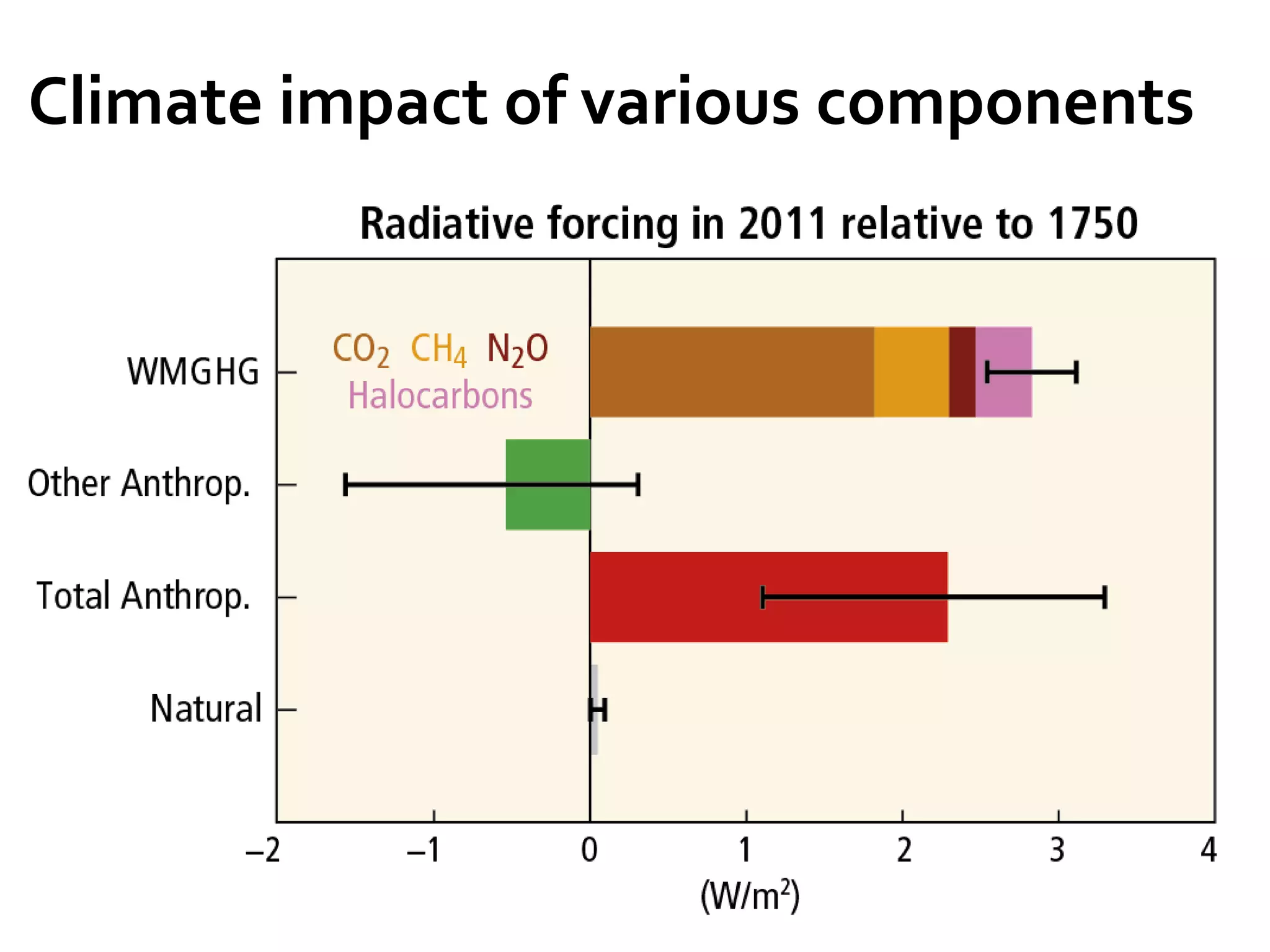
Climate impact of various components
atmosphere, land, ocean
extreme events
water cycle
global mean sea level
Human influence on the climate
system is clear.
sea ice, glaciers, ice sheets
Cause
Worldwide Effects
Human influence on the climate
system is clear.
©IPCC2013
Fig. SPM.6
© IPCC 2013
Human influence on the climate
system is clear.
Future
How will it change?
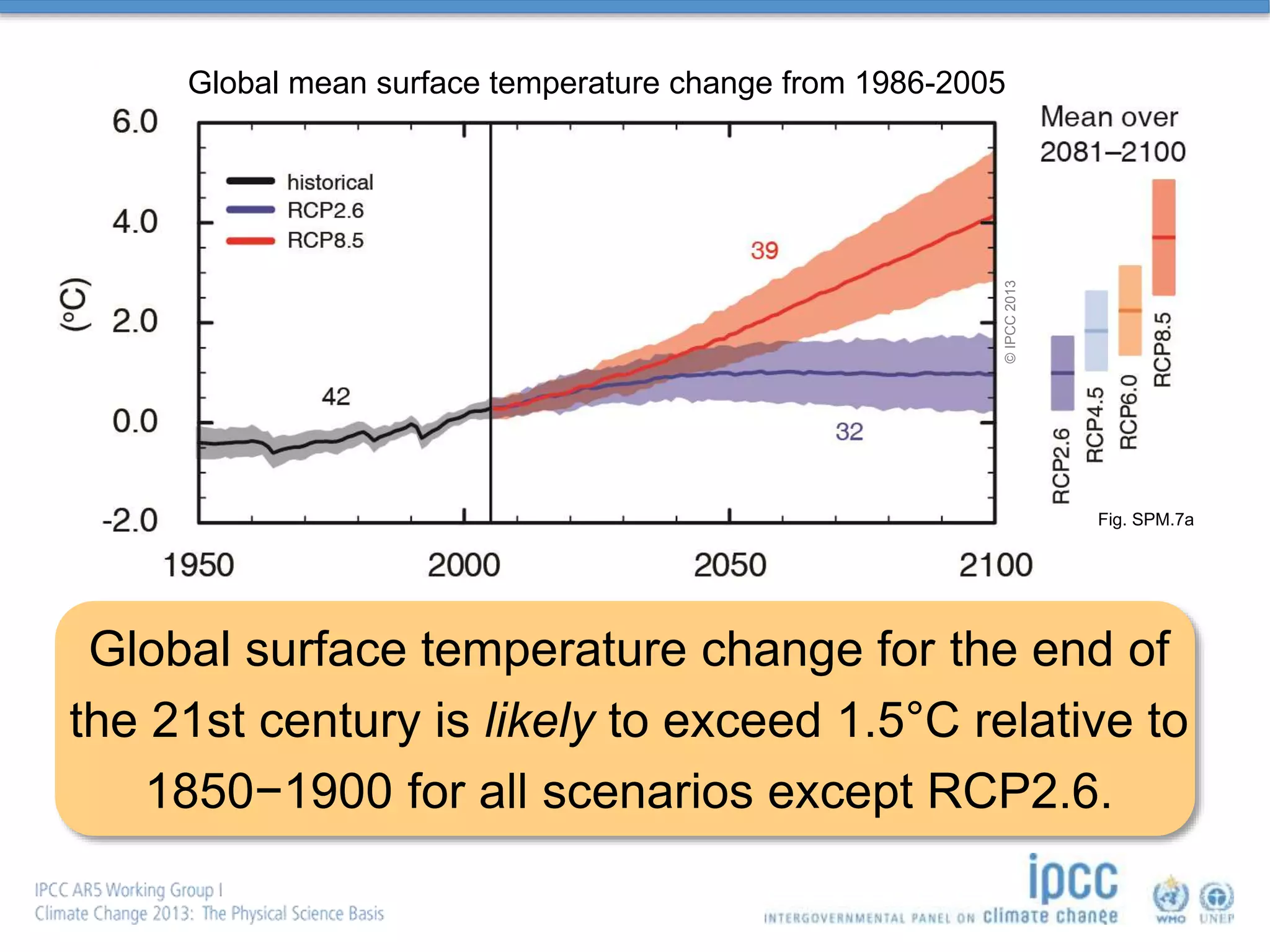
Fig. SPM.7a
Global surface temperature change for the end of
the 21st century is likely to exceed 1.5°C relative to
1850−1900 for all scenarios except RCP2.6.
Global mean surface temperature change from 1986-2005
©IPCC2013
RCP 2.6 (annual) RCP 8.5 (annual)
IPCC 2013: Atlas of Global and Regional Climate Projections
Regional Changes in East Africa (2081-2100)
All RCPs (annual)
Global mean sea level will continue to
rise over the 21st century.
Fig. SPM.9
©IPCC2013
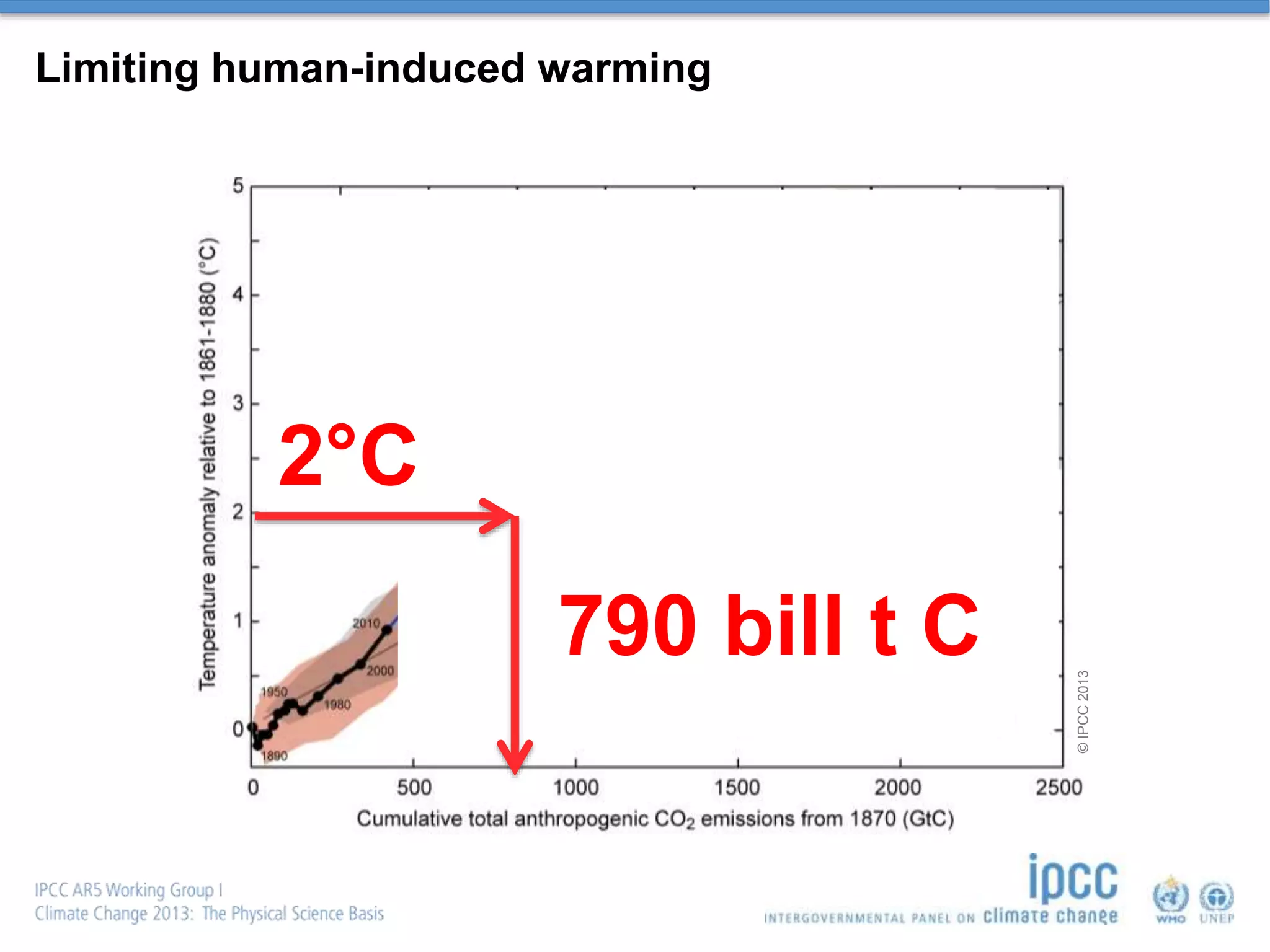
Cumulative emissions of CO2 largely
determine global mean surface warming
by the late 21st century and beyond.
2°C
790 bill t C
©IPCC2013
Limiting human-induced warming
Budget for 2°C target: 790 bill t C
CO2 emissions until 2016*: −565 bill t C
CO2 emissions in 2016 *: 9.9 bill t C
Remaining CO2 emissions: 225 bill t C
Limiting climate change will require
substantial and sustained reductions of
greenhouse gas emissions.
*updatedfromIPCC2013,WGISPM
Fig. SPM.8
2°C world
©IPCC2013
The Choices We Make Will Create
Different Outcomes
4.5°C world2°C world
©IPCC2013
Fig. SPM.8
© Yann Arthus-Bertrand / Altitude
www.climatechange2013.org
Further Information
1990
Gave a broad overview of
climate change science,
discussion of uncertainties
and evidence of warming
1995
“The balance of evidence
suggests a discernible
human influence on
global climate”
2001
“There is new and stronger
evidence that most of the
warming observed over the
last 50 years is attributable
to human activities”
2007
"Warming of the
climate system is
unequivocal…"
2013
“Human influence
on the climate
system is clear.”
Improvements:
Assessing «known unknowns»
“…. only the collapse of marine-
based sectors of the Antarctic ice
sheet, if initiated, could cause
global mean sea level to rise
substantially above the likely
range during the 21st century.
Example: Sea level and contribution from Antarctic marine ice sheet instability

Climate Change: The physical science basis

  • 1.
    © Yann Arthus-Bertrand/ Altitude Climate Change: The physical science basis Jan Fuglestvedt AR5 Lead Author WGI Vice Chair
  • 2.
  • 3.
    Warming in theclimate system is unequivocal, […] Human influence on the climate system is clear. Limiting climate change will require substantial and sustained reductions of greenhouse gas emissions.
  • 4.
  • 5.
    Each of thelast three decades has been successively warmer at the Earth’s surface than any preceding decade since 1850. In the Northern Hemisphere, 1983–2012 was likely the warmest 30-year period of the last 1400 years (medium confidence). Fig. SPM.1a Anomaly(°C)relativeto1961-1990 ©IPCC2013
  • 6.
    Fig.SPM.1b Temperature Difference 1901to 2012 based on trend (°C) Fig.SPM.2 Precipitation Trend (mm/yr per decade) © IPCC 2013© IPCC 2013 Warming of the climate system is unequivocal, […]
  • 7.
    Fig. SPM.3 Warming ofthe climate system is unequivocal, […] ©IPCC2013
  • 8.
    EnergyContent(1021Joule) 1980 1990 20002010 300 200 0 100 -100 1970 70 Mill. TWh Ocean warming dominates the increase in energy stored in the climate system. Box 3.1, Fig. 1 ©IPCC2013
  • 9.
  • 10.
    IPCC AR5 SynthesisReport AR5 SYR SPM
  • 11.
    IPCC AR5 SynthesisReport AR5 SYR SPM
  • 12.
    More recent data(1970-2010) and other gases than CO2
  • 13.
    Climate impact ofvarious components
  • 14.
    atmosphere, land, ocean extremeevents water cycle global mean sea level Human influence on the climate system is clear. sea ice, glaciers, ice sheets Cause Worldwide Effects
  • 15.
    Human influence onthe climate system is clear. ©IPCC2013
  • 16.
    Fig. SPM.6 © IPCC2013 Human influence on the climate system is clear.
  • 17.
  • 19.
    Fig. SPM.7a Global surfacetemperature change for the end of the 21st century is likely to exceed 1.5°C relative to 1850−1900 for all scenarios except RCP2.6. Global mean surface temperature change from 1986-2005 ©IPCC2013
  • 20.
    RCP 2.6 (annual)RCP 8.5 (annual) IPCC 2013: Atlas of Global and Regional Climate Projections Regional Changes in East Africa (2081-2100) All RCPs (annual)
  • 21.
    Global mean sealevel will continue to rise over the 21st century. Fig. SPM.9 ©IPCC2013
  • 22.
    Cumulative emissions ofCO2 largely determine global mean surface warming by the late 21st century and beyond.
  • 23.
    2°C 790 bill tC ©IPCC2013 Limiting human-induced warming
  • 24.
    Budget for 2°Ctarget: 790 bill t C CO2 emissions until 2016*: −565 bill t C CO2 emissions in 2016 *: 9.9 bill t C Remaining CO2 emissions: 225 bill t C Limiting climate change will require substantial and sustained reductions of greenhouse gas emissions. *updatedfromIPCC2013,WGISPM
  • 25.
  • 26.
    The Choices WeMake Will Create Different Outcomes 4.5°C world2°C world ©IPCC2013 Fig. SPM.8
  • 27.
    © Yann Arthus-Bertrand/ Altitude www.climatechange2013.org Further Information
  • 28.
    1990 Gave a broadoverview of climate change science, discussion of uncertainties and evidence of warming 1995 “The balance of evidence suggests a discernible human influence on global climate” 2001 “There is new and stronger evidence that most of the warming observed over the last 50 years is attributable to human activities” 2007 "Warming of the climate system is unequivocal…" 2013 “Human influence on the climate system is clear.” Improvements:
  • 29.
    Assessing «known unknowns» “….only the collapse of marine- based sectors of the Antarctic ice sheet, if initiated, could cause global mean sea level to rise substantially above the likely range during the 21st century. Example: Sea level and contribution from Antarctic marine ice sheet instability

Editor's Notes

  • #9 Erwärmung oberste 75m von 1971-2010: 0.11 [0.09 to 0.13] °C per decade KW (zB Leibstadt): 7 TWh in einem Jahr. 500x current world energy consumption every year or 10 Mill modern nuclear power plant (1 KKW ca. 7 TWh in 1 year) Ocean warming dominates the increase in energy stored in the climate system, accounting for more than 90% of the energy accumulated between 1971 and 2010 (high confidence).
  • #12 0.85 over perioden 1880-2012. Each of the last three decades has ben successivelt warmer than the precedeeing. 1983-2012 was likeliy the warmest 30 yr periode during last 1400 yrs.
  • #13 19 cm over perioden 1901 til 2010. > 90% of the accumulated heat is stored in teh ocen. 1% in atm. Upp 75 m wamred 0.11 per dec. pH decreased by 0.1 Arctic sea oce extent decreased by 3.5-4.1 over 1979-2012. Raten for havnivå stigning siden midten av prhundet > mean rate during teh previos two millenia
  • #14 This has led to atmospheric concentrations of carbon dioxide, methane and nitrous oxide that are unprecedented in at least the last 800,000 years.
  • #15 Halvparten av CO2 utslipp mellom 1750 og 2011 skjedde siste 40 år.
  • #23 It is extremely likely that more than half of the observed increase in global average surface temperature from 1951 to 2010 was caused by the anthropogenic increase in greenhouse gas concentrations and other anthropogenic forcings together.
  • #30 It is very likely that heat waves will occur with higher frequency and duration. Over 6 times more frequent in RCP8.5
  • #31 SPM: Page 7, lines 1 – 9 Figure SPM 3B Full report: 3.3.2, page 30-31 Figure 3.7 Adapted by Kharin et al, 2007
  • #32 SPM: Page 7, lines 1 – 9 Figure SPM 3B Full report: 3.3.2, page 30-31 Figure 3.7 Adapted by Kharin et al, 2007
  • #33 RCP2.6 (2081-2100), likely range: 26 to 55 cm RCP8.5 (2081-2100), likely range: 45 to 82 cm
  • #34 AR5: TCR = 1.0 to 2.5 °C (likely range; high confidence); extremely unlikely larger than 3°C AR5: ECS = 1.5 to 4.5 °C (likely range; high confidence); extremely unlikely less than 1°C (high confidence); very unlikely greater than 6°C (medium confidence)
  • #35 AR5: TCR = 1.0 to 2.5 °C (likely range; high confidence); extremely unlikely larger than 3°C AR5: ECS = 1.5 to 4.5 °C (likely range; high confidence); extremely unlikely less than 1°C (high confidence); very unlikely greater than 6°C (medium confidence) Cumulative emissions of CO2 largely determine global mean surface warming by the late 21st century and beyond
  • #37 bis 2011: 515 GtC (IPCC AR5) 2012: 9.6 GtC 2013: 9.9 GtC 2014: 10.1 GtC 2015: 9.9 GtC 2016*: 9.9 GtC (GCP, FF only, constant cum LUC) Total 564.2 GtC *The extension to year 2016 uses the emissions projections for fossil fuels and industry for 2016 (Sect. 3.2) and assumes a constant ELUC flux
  • #42 However, there is medium confidence that this additional contribution would not exceed several tenths of a meter of sea level rise during the 21st century. SyR: Abrupt and irreversible ice loss from a potential instability of marine-based sectors of the Antarctic ice sheet in response to climate forcing is possible, but current evidence and understanding is insufficient to make a quantitative assessment. {WGI SPM E.8, 5.6.2, 5.8.1, 13.4.3, 13.5.4}. The potential additional contribution to GMSL rise also cannot be precisely quantified, but there is medium confidence that, if a collapse were initiated, it would not exceed several tenths of a metre during the 21st century (Section 13.4.4.2). Abrupt and irreversible ice loss from a potential instability of marine-based sectors of the Antarctic ice sheet in response to climate forcing is possible, but current evidence and understanding is insufficient to make a quantitative assessment. {5.8, 13.3, 13.4 }