Professor Jayashree Sadri
And
Dr Sorab Sadri
Climate Change Issues
in India
Global WarmingGlobal Warming
Global warming is the increase in the average
measured temperature of the Earth's near-
surface air and oceans since the mid-20th
century, and its projected continuation.
The average global air temperature near the
Earth's surface increased 0.74 ± 0.18 °C (1.33 ±
0.32 °F) during the 100 years ending in 2005.
Source: Intergovernmental Panel on Climate Change
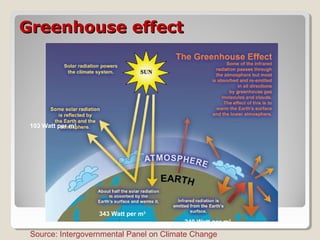
Greenhouse effectGreenhouse effect
Source: Intergovernmental Panel on Climate Change
240 Watt per m3
343 Watt per m3
103 Watt per m3
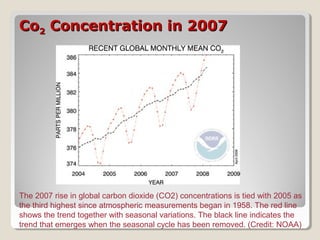
CoCo22 Concentration in 2007Concentration in 2007
The 2007 rise in global carbon dioxide (CO2) concentrations is tied with 2005 as
the third highest since atmospheric measurements began in 1958. The red line
shows the trend together with seasonal variations. The black line indicates the
trend that emerges when the seasonal cycle has been removed. (Credit: NOAA)
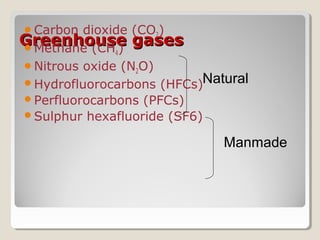
Greenhouse gasesGreenhouse gases
Carbon dioxide (CO2)
Methane (CH4)
Nitrous oxide (N2O)
Hydrofluorocarbons (HFCs)
Perfluorocarbons (PFCs)
Sulphur hexafluoride (SF6)
Natural
Manmade
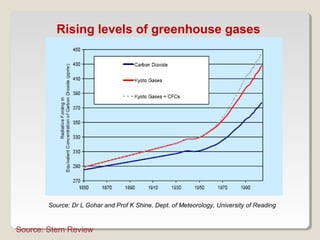
Source: Dr L Gohar and Prof K Shine, Dept. of Meteorology, University of Reading
Rising levels of greenhouse gases
Source: Stern Review
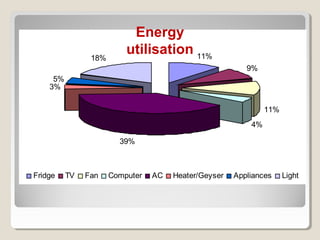
11%
9%
11%
4%
39%
3%
5%
18%
Fridge TV Fan Computer AC Heater/Geyser Appliances Light
Energy
utilisation
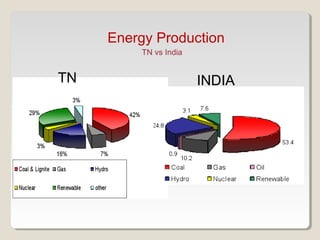
INDIATN
Energy Production
TN vs India
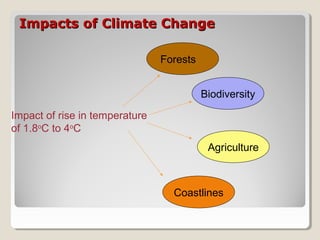
Impacts of Climate ChangeImpacts of Climate Change
Forests
Biodiversity
Agriculture
Coastlines
Impact of rise in temperature
of 1.8o
C to 4o
C
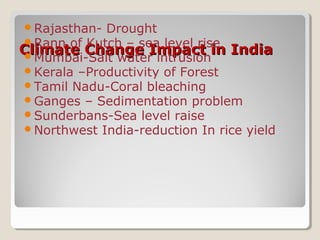
Climate Change Impact in IndiaClimate Change Impact in India
Rajasthan- Drought
Rann of Kutch – sea level rise
Mumbai-Salt water intrusion
Kerala –Productivity of Forest
Tamil Nadu-Coral bleaching
Ganges – Sedimentation problem
Sunderbans-Sea level raise
Northwest India-reduction In rice yield
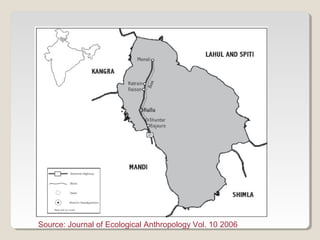
EffectEffect on apple cultivationon apple cultivation
Kullu Valley, Himachal Pradesh
Experienced a number of crop failures in the
last 15 years
Apple belt has moved 30 kilometers
[northwards] over the last 50 years
Apple growers, says attributed poor
production to reduced snowfall and its
changed timing.
Case study:1 Impact on Agriculture
Source: Journal of Ecological Anthropology Vol. 10 2006
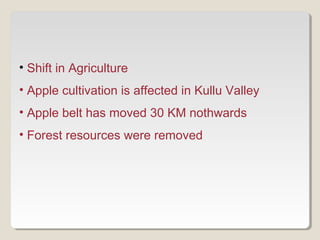
• Shift in Agriculture
• Apple cultivation is affected in Kullu Valley
• Apple belt has moved 30 KM nothwards
• Forest resources were removed
2. Ganga under threat from warming2. Ganga under threat from warming
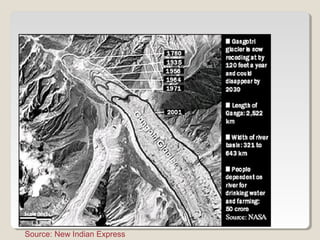
Himalayan source of the Ganga is drying up
at a rate of 40 yards a year, nearly twice as
fast as two decades ago, and that some of
these glaciers might disappear by 2030.
In the dry summer months, the Gangotri
glacier provides up to 70 percent of the
water of the Ganga.
According to a UN climate report, the
shrinking glaciers also threaten Asia’s supply
of fresh water.
Source: New Indian Express
3. Impact on Coastal Orissa3. Impact on Coastal Orissa
•The Satavaya region, once a cluster of seven
villages.
•Only two out of the seven villages exists the other
five villages have been submerged.
•The Coastal villages have been affected by cyclone
and floods killing more than 30,000 people.
•The sea has ingressed to about 1.5 km into
Satavaya and 2.5 km into Kanakpur. Satavaya has
also lost 56% of its mangrove vegetation.
Global ImpactsGlobal Impacts
The largest glacier on Mount Kenya has
lost 92% of its mass
Sea levels have risen by 10 - 25 cm
The thickness of sea ice in the arctic has
decreased by 40%.
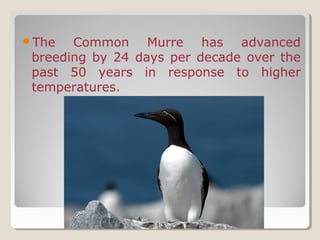
The Common Murre has advanced
breeding by 24 days per decade over the
past 50 years in response to higher
temperatures.
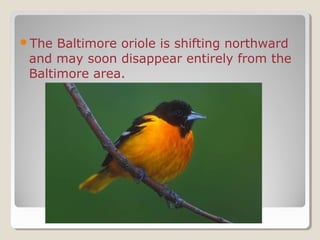
The Baltimore oriole is shifting northward
and may soon disappear entirely from the
Baltimore area.
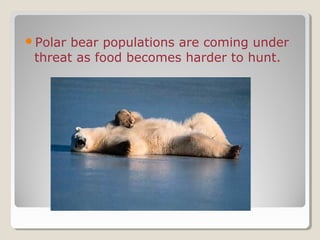
Polar bear populations are coming under
threat as food becomes harder to hunt.
India’s InitiativesIndia’s Initiatives
Signed UNFCC on 10th
June 1992
India ratified the Kyoto protocol
India has a National Action Plan on Climate
Change
◦ National Solar Mission
◦ National Mission for Enhanced Energy Efficiency
◦ National Mission on Sustainable Habitat
◦ National Water Mission
◦ National Mission for Sustaining the Himalayan Ecosystem
◦ National Mission for a “ Green India”
◦ National Mission for Sustainable Agriculture
◦ National Mission on Strategic Mission on Climate Change
India’s InitiativesIndia’s Initiatives
India has a well developed policy, legislative
regulatory & programmatic regime
For promotion of Energy efficiency,
renewable energy, nuclear power, fuel
switching, energy pricing reform addressing
GHG emission
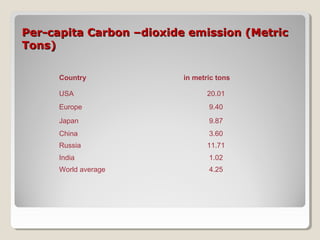
Per-capita Carbon –dioxide emission (MetricPer-capita Carbon –dioxide emission (Metric
Tons)Tons)
Country in metric tons
USA 20.01
Europe 9.40
Japan 9.87
China 3.60
Russia 11.71
India 1.02
World average 4.25
The impacts of climate change are not evenly distributed – the
poorest countries and people will suffer earliest and most. And if
and when the damages appear it will be too late to reverse the
process. Thus we are forced to look a long way ahead.
SOURCESOURCE
Culled from PPT for UNESCO ByCulled from PPT for UNESCO By
Dr.C.Thomson Jacob,Dr.C.Thomson Jacob,
Senior Programme Officer,Senior Programme Officer,
ENVIS Centre, Department ofENVIS Centre, Department of
EnvironmentEnvironment.
THANK YOU

Climate change issues

  • 1.
    Professor Jayashree Sadri And DrSorab Sadri Climate Change Issues in India
  • 2.
    Global WarmingGlobal Warming Globalwarming is the increase in the average measured temperature of the Earth's near- surface air and oceans since the mid-20th century, and its projected continuation. The average global air temperature near the Earth's surface increased 0.74 ± 0.18 °C (1.33 ± 0.32 °F) during the 100 years ending in 2005. Source: Intergovernmental Panel on Climate Change
  • 3.
    Greenhouse effectGreenhouse effect Source:Intergovernmental Panel on Climate Change 240 Watt per m3 343 Watt per m3 103 Watt per m3
  • 4.
    CoCo22 Concentration in2007Concentration in 2007 The 2007 rise in global carbon dioxide (CO2) concentrations is tied with 2005 as the third highest since atmospheric measurements began in 1958. The red line shows the trend together with seasonal variations. The black line indicates the trend that emerges when the seasonal cycle has been removed. (Credit: NOAA)
  • 5.
    Greenhouse gasesGreenhouse gases Carbondioxide (CO2) Methane (CH4) Nitrous oxide (N2O) Hydrofluorocarbons (HFCs) Perfluorocarbons (PFCs) Sulphur hexafluoride (SF6) Natural Manmade
  • 6.
    Source: Dr LGohar and Prof K Shine, Dept. of Meteorology, University of Reading Rising levels of greenhouse gases Source: Stern Review
  • 7.
    11% 9% 11% 4% 39% 3% 5% 18% Fridge TV FanComputer AC Heater/Geyser Appliances Light Energy utilisation
  • 8.
  • 9.
    Impacts of ClimateChangeImpacts of Climate Change Forests Biodiversity Agriculture Coastlines Impact of rise in temperature of 1.8o C to 4o C
  • 10.
    Climate Change Impactin IndiaClimate Change Impact in India Rajasthan- Drought Rann of Kutch – sea level rise Mumbai-Salt water intrusion Kerala –Productivity of Forest Tamil Nadu-Coral bleaching Ganges – Sedimentation problem Sunderbans-Sea level raise Northwest India-reduction In rice yield
  • 11.
    EffectEffect on applecultivationon apple cultivation Kullu Valley, Himachal Pradesh Experienced a number of crop failures in the last 15 years Apple belt has moved 30 kilometers [northwards] over the last 50 years Apple growers, says attributed poor production to reduced snowfall and its changed timing. Case study:1 Impact on Agriculture
  • 12.
    Source: Journal ofEcological Anthropology Vol. 10 2006
  • 13.
    • Shift inAgriculture • Apple cultivation is affected in Kullu Valley • Apple belt has moved 30 KM nothwards • Forest resources were removed
  • 14.
    2. Ganga underthreat from warming2. Ganga under threat from warming Himalayan source of the Ganga is drying up at a rate of 40 yards a year, nearly twice as fast as two decades ago, and that some of these glaciers might disappear by 2030. In the dry summer months, the Gangotri glacier provides up to 70 percent of the water of the Ganga. According to a UN climate report, the shrinking glaciers also threaten Asia’s supply of fresh water. Source: New Indian Express
  • 15.
  • 16.
    3. Impact onCoastal Orissa3. Impact on Coastal Orissa •The Satavaya region, once a cluster of seven villages. •Only two out of the seven villages exists the other five villages have been submerged. •The Coastal villages have been affected by cyclone and floods killing more than 30,000 people. •The sea has ingressed to about 1.5 km into Satavaya and 2.5 km into Kanakpur. Satavaya has also lost 56% of its mangrove vegetation.
  • 17.
    Global ImpactsGlobal Impacts Thelargest glacier on Mount Kenya has lost 92% of its mass Sea levels have risen by 10 - 25 cm The thickness of sea ice in the arctic has decreased by 40%.
  • 18.
    The Common Murrehas advanced breeding by 24 days per decade over the past 50 years in response to higher temperatures.
  • 19.
    The Baltimore orioleis shifting northward and may soon disappear entirely from the Baltimore area.
  • 20.
    Polar bear populationsare coming under threat as food becomes harder to hunt.
  • 21.
    India’s InitiativesIndia’s Initiatives SignedUNFCC on 10th June 1992 India ratified the Kyoto protocol India has a National Action Plan on Climate Change ◦ National Solar Mission ◦ National Mission for Enhanced Energy Efficiency ◦ National Mission on Sustainable Habitat ◦ National Water Mission ◦ National Mission for Sustaining the Himalayan Ecosystem ◦ National Mission for a “ Green India” ◦ National Mission for Sustainable Agriculture ◦ National Mission on Strategic Mission on Climate Change
  • 22.
    India’s InitiativesIndia’s Initiatives Indiahas a well developed policy, legislative regulatory & programmatic regime For promotion of Energy efficiency, renewable energy, nuclear power, fuel switching, energy pricing reform addressing GHG emission
  • 23.
    Per-capita Carbon –dioxideemission (MetricPer-capita Carbon –dioxide emission (Metric Tons)Tons) Country in metric tons USA 20.01 Europe 9.40 Japan 9.87 China 3.60 Russia 11.71 India 1.02 World average 4.25
  • 24.
    The impacts ofclimate change are not evenly distributed – the poorest countries and people will suffer earliest and most. And if and when the damages appear it will be too late to reverse the process. Thus we are forced to look a long way ahead.
  • 25.
    SOURCESOURCE Culled from PPTfor UNESCO ByCulled from PPT for UNESCO By Dr.C.Thomson Jacob,Dr.C.Thomson Jacob, Senior Programme Officer,Senior Programme Officer, ENVIS Centre, Department ofENVIS Centre, Department of EnvironmentEnvironment.
  • 26.