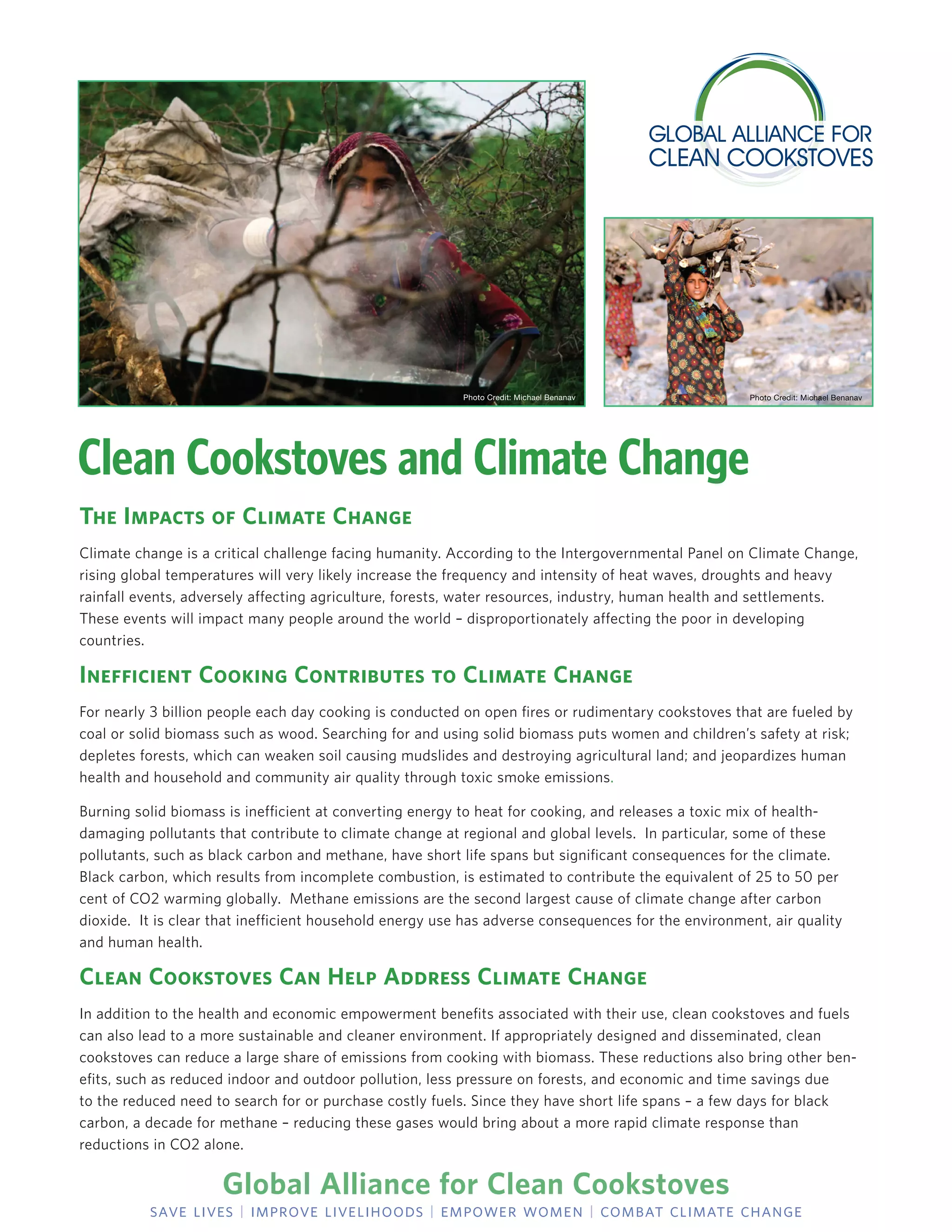
Photo Credit: Michael Benanav               Photo Credit: Michael Benanav


Clean Cookstoves and Climate Change
The Impacts of Climate Change
Climate change is a critical challenge facing humanity. According to the Intergovernmental Panel on Climate Change,
rising global temperatures will very likely increase the frequency and intensity of heat waves, droughts and heavy
rainfall events, adversely affecting agriculture, forests, water resources, industry, human health and settlements.
These events will impact many people around the world – disproportionately affecting the poor in developing
countries.

Inefficient Cooking Contributes to Climate Change
For nearly 3 billion people each day cooking is conducted on open fires or rudimentary cookstoves that are fueled by
coal or solid biomass such as wood. Searching for and using solid biomass puts women and children’s safety at risk;
depletes forests, which can weaken soil causing mudslides and destroying agricultural land; and jeopardizes human
health and household and community air quality through toxic smoke emissions.

Burning solid biomass is inefficient at converting energy to heat for cooking, and releases a toxic mix of health-
damaging pollutants that contribute to climate change at regional and global levels. In particular, some of these
pollutants, such as black carbon and methane, have short life spans but significant consequences for the climate.
Black carbon, which results from incomplete combustion, is estimated to contribute the equivalent of 25 to 50 per
cent of CO2 warming globally. Methane emissions are the second largest cause of climate change after carbon
dioxide. It is clear that inefficient household energy use has adverse consequences for the environment, air quality
and human health.

Clean Cookstoves Can Help Address Climate Change
In addition to the health and economic empowerment benefits associated with their use, clean cookstoves and fuels
can also lead to a more sustainable and cleaner environment. If appropriately designed and disseminated, clean
cookstoves can reduce a large share of emissions from cooking with biomass. These reductions also bring other ben-
efits, such as reduced indoor and outdoor pollution, less pressure on forests, and economic and time savings due
to the reduced need to search for or purchase costly fuels. Since they have short life spans – a few days for black
carbon, a decade for methane – reducing these gases would bring about a more rapid climate response than
reductions in CO2 alone.


                      Global Alliance for Clean Cookstoves
             save lives | improve livelihoods | empower women | combat climate change
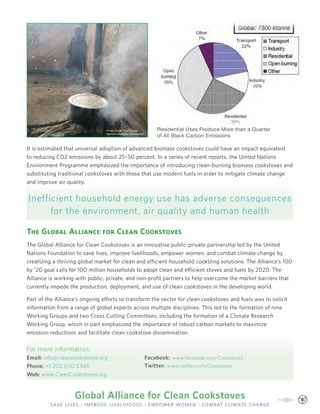
Photo Credit: Erin Patrick,        Residential Uses Produce More than a Quarter
                                 Women’s Refugee Commission
                                                                    of All Black Carbon Emissions

It is estimated that universal adoption of advanced biomass cookstoves could have an impact equivalent
to reducing CO2 emissions by about 25–50 percent. In a series of recent reports, the United Nations
Environment Programme emphasized the importance of introducing clean-burning biomass cookstoves and
substituting traditional cookstoves with those that use modern fuels in order to mitigate climate change
and improve air quality.


Inefficient household energy use has adverse consequences
      for the environment, air quality and human health

The Global Alliance for Clean Cookstoves
The Global Alliance for Clean Cookstoves is an innovative public-private partnership led by the United
Nations Foundation to save lives, improve livelihoods, empower women, and combat climate change by
creat¬ing a thriving global market for clean and efficient household cook¬ing solutions. The Alliance’s 100
by ’20 goal calls for 100 million households to adopt clean and efficient stoves and fuels by 2020. The
Alliance is working with public, private, and non-profit partners to help overcome the market barriers that
currently impede the production, deployment, and use of clean cookstoves in the developing world.

Part of the Alliance’s ongoing efforts to transform the sector for clean cookstoves and fuels was to solicit
information from a range of global experts across multiple disciplines. This led to the formation of nine
Working Groups and two Cross Cutting Committees, including the formation of a Climate Research
Working Group, which in part emphasized the importance of robust carbon markets to maximize
emission reductions and facilitate clean cookstove dissemination.


For more information:
Email: info@cleancookstoves.org                                Facebook: www.facebook.com/Cookstoves
Phone: +1 202 650 5345                                         Twitter: www.twitter.com/Cookstoves
Web: www.CleanCookstoves.org


                   Global Alliance for Clean Cookstoves
         save lives | improve livelihoods | empower women | combat climate change

Cookstoves and climate change

  • 1.
    Photo Credit: MichaelBenanav Photo Credit: Michael Benanav Clean Cookstoves and Climate Change The Impacts of Climate Change Climate change is a critical challenge facing humanity. According to the Intergovernmental Panel on Climate Change, rising global temperatures will very likely increase the frequency and intensity of heat waves, droughts and heavy rainfall events, adversely affecting agriculture, forests, water resources, industry, human health and settlements. These events will impact many people around the world – disproportionately affecting the poor in developing countries. Inefficient Cooking Contributes to Climate Change For nearly 3 billion people each day cooking is conducted on open fires or rudimentary cookstoves that are fueled by coal or solid biomass such as wood. Searching for and using solid biomass puts women and children’s safety at risk; depletes forests, which can weaken soil causing mudslides and destroying agricultural land; and jeopardizes human health and household and community air quality through toxic smoke emissions. Burning solid biomass is inefficient at converting energy to heat for cooking, and releases a toxic mix of health- damaging pollutants that contribute to climate change at regional and global levels. In particular, some of these pollutants, such as black carbon and methane, have short life spans but significant consequences for the climate. Black carbon, which results from incomplete combustion, is estimated to contribute the equivalent of 25 to 50 per cent of CO2 warming globally. Methane emissions are the second largest cause of climate change after carbon dioxide. It is clear that inefficient household energy use has adverse consequences for the environment, air quality and human health. Clean Cookstoves Can Help Address Climate Change In addition to the health and economic empowerment benefits associated with their use, clean cookstoves and fuels can also lead to a more sustainable and cleaner environment. If appropriately designed and disseminated, clean cookstoves can reduce a large share of emissions from cooking with biomass. These reductions also bring other ben- efits, such as reduced indoor and outdoor pollution, less pressure on forests, and economic and time savings due to the reduced need to search for or purchase costly fuels. Since they have short life spans – a few days for black carbon, a decade for methane – reducing these gases would bring about a more rapid climate response than reductions in CO2 alone. Global Alliance for Clean Cookstoves save lives | improve livelihoods | empower women | combat climate change
  • 2.
    Photo Credit: ErinPatrick, Residential Uses Produce More than a Quarter Women’s Refugee Commission of All Black Carbon Emissions It is estimated that universal adoption of advanced biomass cookstoves could have an impact equivalent to reducing CO2 emissions by about 25–50 percent. In a series of recent reports, the United Nations Environment Programme emphasized the importance of introducing clean-burning biomass cookstoves and substituting traditional cookstoves with those that use modern fuels in order to mitigate climate change and improve air quality. Inefficient household energy use has adverse consequences for the environment, air quality and human health The Global Alliance for Clean Cookstoves The Global Alliance for Clean Cookstoves is an innovative public-private partnership led by the United Nations Foundation to save lives, improve livelihoods, empower women, and combat climate change by creat¬ing a thriving global market for clean and efficient household cook¬ing solutions. The Alliance’s 100 by ’20 goal calls for 100 million households to adopt clean and efficient stoves and fuels by 2020. The Alliance is working with public, private, and non-profit partners to help overcome the market barriers that currently impede the production, deployment, and use of clean cookstoves in the developing world. Part of the Alliance’s ongoing efforts to transform the sector for clean cookstoves and fuels was to solicit information from a range of global experts across multiple disciplines. This led to the formation of nine Working Groups and two Cross Cutting Committees, including the formation of a Climate Research Working Group, which in part emphasized the importance of robust carbon markets to maximize emission reductions and facilitate clean cookstove dissemination. For more information: Email: info@cleancookstoves.org Facebook: www.facebook.com/Cookstoves Phone: +1 202 650 5345 Twitter: www.twitter.com/Cookstoves Web: www.CleanCookstoves.org Global Alliance for Clean Cookstoves save lives | improve livelihoods | empower women | combat climate change