HAY’S APPROACH TOHAY’S APPROACH TO
ASSESSMENT CENTRESASSESSMENT CENTRES
Professor Jayashree Sadri andProfessor Jayashree Sadri and
Dr. Sorab SadriDr. Sorab Sadri
Surviving AssessmentSurviving Assessment
CentresCentres
OROR
It is not what you do its how you do it….It is not what you do its how you do it….
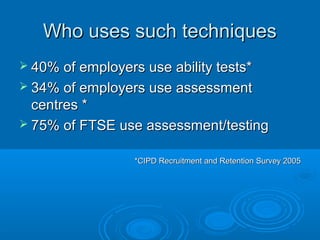
Who uses such techniquesWho uses such techniques
 40% of employers use ability tests*40% of employers use ability tests*
 34% of employers use assessment34% of employers use assessment
centres *centres *
 75% of FTSE use assessment/testing75% of FTSE use assessment/testing
*CIPD Recruitment and Retention Survey 2005*CIPD Recruitment and Retention Survey 2005
What are competencies ?What are competencies ?
Competencies are behaviours thatCompetencies are behaviours that
individuals demonstrate when undertakingindividuals demonstrate when undertaking
job-relevant tasks effectivelyjob-relevant tasks effectively
Common competenciesCommon competencies
 CommunicationCommunication
 Customer FocusCustomer Focus
 TeamworkTeamwork
 LeadershipLeadership
 Problem SolvingProblem Solving
 Developing OthersDeveloping Others
 Planning and OrganisingPlanning and Organising
Typical competency definitionsTypical competency definitions
CommunicationCommunication
The ability to send clear and convincing messages.The ability to send clear and convincing messages.
The use of an engaging style fine tuned to theThe use of an engaging style fine tuned to the
particular audience and which invites a dialogue.particular audience and which invites a dialogue.
Planning and organisingPlanning and organising
The ability to realistically schedule work and organiseThe ability to realistically schedule work and organise
resources so that a project or goal is achieved withinresources so that a project or goal is achieved within
agreed time and cost parameters.agreed time and cost parameters.
Hays HR Consultancy and Assessment Services 2004Hays HR Consultancy and Assessment Services 2004
Assessment Centre approachAssessment Centre approach
 Assess competencies determined by jobAssess competencies determined by job
analysisanalysis
 Uses multiple assessment techniquesUses multiple assessment techniques
 Uses multiple trained assessorsUses multiple trained assessors
 Assessors pool information to arrive at aAssessors pool information to arrive at a
consensus decisionconsensus decision
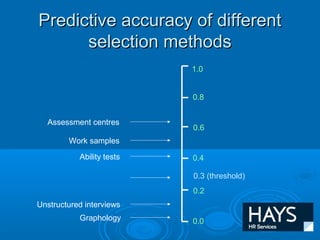
0.8
0.6
0.4
0.2
0.0Graphology
Unstructured interviews
Ability tests
Work samples
0.3 (threshold)
1.0
Assessment centres
Predictive accuracy of differentPredictive accuracy of different
selection methodsselection methods
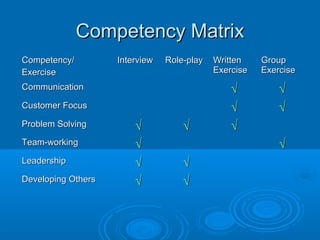
Competency MatrixCompetency Matrix
Competency/Competency/
ExerciseExercise
InterviewInterview Role-playRole-play WrittenWritten
ExerciseExercise
GroupGroup
ExerciseExercise
CommunicationCommunication √√ √√
Customer FocusCustomer Focus √√ √√
Problem SolvingProblem Solving √√ √√ √√
Team-workingTeam-working √√ √√
LeadershipLeadership √√ √√
Developing OthersDeveloping Others √√ √√
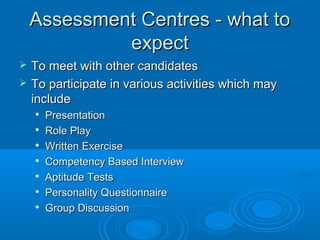
Assessment Centres - what toAssessment Centres - what to
expectexpect
 To meet with other candidatesTo meet with other candidates
 To participate in various activities which mayTo participate in various activities which may
includeinclude

PresentationPresentation

Role PlayRole Play

Written ExerciseWritten Exercise

Competency Based InterviewCompetency Based Interview

Aptitude TestsAptitude Tests

Personality QuestionnairePersonality Questionnaire

Group DiscussionGroup Discussion
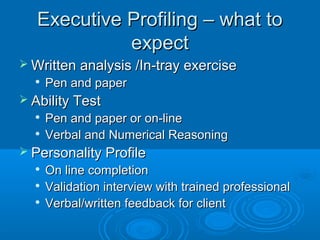
Executive Profiling – what toExecutive Profiling – what to
expectexpect
 Written analysis /In-tray exerciseWritten analysis /In-tray exercise

Pen and paperPen and paper
 Ability TestAbility Test

Pen and paper or on-linePen and paper or on-line

Verbal and Numerical ReasoningVerbal and Numerical Reasoning
 Personality ProfilePersonality Profile

On line completionOn line completion

Validation interview with trained professionalValidation interview with trained professional

Verbal/written feedback for clientVerbal/written feedback for client
Personality QuestionnairesPersonality Questionnaires
 Self report, not timedSelf report, not timed
 Preferences NOT abilitiesPreferences NOT abilities
 Best practice recommends thatBest practice recommends that
candidates should not be short-listed outcandidates should not be short-listed out
on basis of their personalityon basis of their personality
 StatementsStatements

““I am comfortable in social situations”I am comfortable in social situations”

““I am determined to beat the opposition”I am determined to beat the opposition”
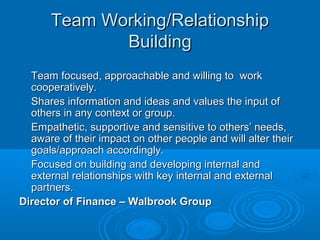
Team Working/RelationshipTeam Working/Relationship
BuildingBuilding
Team focused, approachable and willing to workTeam focused, approachable and willing to work
cooperatively.cooperatively.
Shares information and ideas and values the input ofShares information and ideas and values the input of
others in any context or group.others in any context or group.
Empathetic, supportive and sensitive to others’ needs,Empathetic, supportive and sensitive to others’ needs,
aware of their impact on other people and will alter theiraware of their impact on other people and will alter their
goals/approach accordingly.goals/approach accordingly.
Focused on building and developing internal andFocused on building and developing internal and
external relationships with key internal and externalexternal relationships with key internal and external
partners.partners.
Director of Finance – Walbrook GroupDirector of Finance – Walbrook Group
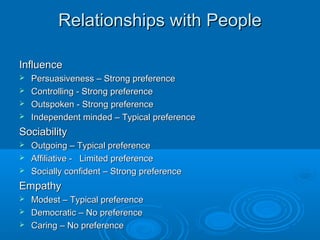
Relationships with PeopleRelationships with People
InfluenceInfluence
 Persuasiveness – Strong preferencePersuasiveness – Strong preference
 Controlling - Strong preferenceControlling - Strong preference
 Outspoken - Strong preferenceOutspoken - Strong preference
 Independent minded – Typical preferenceIndependent minded – Typical preference
SociabilitySociability
 Outgoing – Typical preferenceOutgoing – Typical preference
 Affiliative - Limited preferenceAffiliative - Limited preference
 Socially confident – Strong preferenceSocially confident – Strong preference
EmpathyEmpathy
 Modest – Typical preferenceModest – Typical preference
 Democratic – No preferenceDemocratic – No preference
 Caring – No preferenceCaring – No preference
Areas to ProbeAreas to Probe
 Specific examples of when they have proactivelySpecific examples of when they have proactively
and positively built relationships with othersand positively built relationships with others
 What tactics and techniques do they use to winWhat tactics and techniques do they use to win
people round?people round?
 How do they ensure they take people with them?How do they ensure they take people with them?
 Specific examples of when they used a softerSpecific examples of when they used a softer
approach to reach their end objectiveapproach to reach their end objective
 What teams are they members of and what doWhat teams are they members of and what do
they believe they contribute?they believe they contribute?
 What impact do they believe they have on thoseWhat impact do they believe they have on those
around them?around them?
Why companies useWhy companies use
assessmentassessment
 Can be cost effective and time efficientCan be cost effective and time efficient
 Provides a realistic job preview forProvides a realistic job preview for
candidatescandidates
 Involve line managers in decisionsInvolve line managers in decisions
 Positive candidate experience – good PRPositive candidate experience – good PR
exerciseexercise
 Strategic valueStrategic value
 Good predictive validityGood predictive validity
How to prepare to succeedHow to prepare to succeed
 AttitudeAttitude
 ResearchResearch
 Participate !Participate !
 Capitalise for feedback for next timeCapitalise for feedback for next time

Hay's assessment centres

  • 1.
    HAY’S APPROACH TOHAY’SAPPROACH TO ASSESSMENT CENTRESASSESSMENT CENTRES Professor Jayashree Sadri andProfessor Jayashree Sadri and Dr. Sorab SadriDr. Sorab Sadri
  • 2.
    Surviving AssessmentSurviving Assessment CentresCentres OROR Itis not what you do its how you do it….It is not what you do its how you do it….
  • 3.
    Who uses suchtechniquesWho uses such techniques  40% of employers use ability tests*40% of employers use ability tests*  34% of employers use assessment34% of employers use assessment centres *centres *  75% of FTSE use assessment/testing75% of FTSE use assessment/testing *CIPD Recruitment and Retention Survey 2005*CIPD Recruitment and Retention Survey 2005
  • 4.
    What are competencies?What are competencies ? Competencies are behaviours thatCompetencies are behaviours that individuals demonstrate when undertakingindividuals demonstrate when undertaking job-relevant tasks effectivelyjob-relevant tasks effectively
  • 5.
    Common competenciesCommon competencies CommunicationCommunication  Customer FocusCustomer Focus  TeamworkTeamwork  LeadershipLeadership  Problem SolvingProblem Solving  Developing OthersDeveloping Others  Planning and OrganisingPlanning and Organising
  • 6.
    Typical competency definitionsTypicalcompetency definitions CommunicationCommunication The ability to send clear and convincing messages.The ability to send clear and convincing messages. The use of an engaging style fine tuned to theThe use of an engaging style fine tuned to the particular audience and which invites a dialogue.particular audience and which invites a dialogue. Planning and organisingPlanning and organising The ability to realistically schedule work and organiseThe ability to realistically schedule work and organise resources so that a project or goal is achieved withinresources so that a project or goal is achieved within agreed time and cost parameters.agreed time and cost parameters. Hays HR Consultancy and Assessment Services 2004Hays HR Consultancy and Assessment Services 2004
  • 7.
    Assessment Centre approachAssessmentCentre approach  Assess competencies determined by jobAssess competencies determined by job analysisanalysis  Uses multiple assessment techniquesUses multiple assessment techniques  Uses multiple trained assessorsUses multiple trained assessors  Assessors pool information to arrive at aAssessors pool information to arrive at a consensus decisionconsensus decision
  • 8.
    0.8 0.6 0.4 0.2 0.0Graphology Unstructured interviews Ability tests Worksamples 0.3 (threshold) 1.0 Assessment centres Predictive accuracy of differentPredictive accuracy of different selection methodsselection methods
  • 9.
    Competency MatrixCompetency Matrix Competency/Competency/ ExerciseExercise InterviewInterviewRole-playRole-play WrittenWritten ExerciseExercise GroupGroup ExerciseExercise CommunicationCommunication √√ √√ Customer FocusCustomer Focus √√ √√ Problem SolvingProblem Solving √√ √√ √√ Team-workingTeam-working √√ √√ LeadershipLeadership √√ √√ Developing OthersDeveloping Others √√ √√
  • 10.
    Assessment Centres -what toAssessment Centres - what to expectexpect  To meet with other candidatesTo meet with other candidates  To participate in various activities which mayTo participate in various activities which may includeinclude  PresentationPresentation  Role PlayRole Play  Written ExerciseWritten Exercise  Competency Based InterviewCompetency Based Interview  Aptitude TestsAptitude Tests  Personality QuestionnairePersonality Questionnaire  Group DiscussionGroup Discussion
  • 11.
    Executive Profiling –what toExecutive Profiling – what to expectexpect  Written analysis /In-tray exerciseWritten analysis /In-tray exercise  Pen and paperPen and paper  Ability TestAbility Test  Pen and paper or on-linePen and paper or on-line  Verbal and Numerical ReasoningVerbal and Numerical Reasoning  Personality ProfilePersonality Profile  On line completionOn line completion  Validation interview with trained professionalValidation interview with trained professional  Verbal/written feedback for clientVerbal/written feedback for client
  • 12.
    Personality QuestionnairesPersonality Questionnaires Self report, not timedSelf report, not timed  Preferences NOT abilitiesPreferences NOT abilities  Best practice recommends thatBest practice recommends that candidates should not be short-listed outcandidates should not be short-listed out on basis of their personalityon basis of their personality  StatementsStatements  ““I am comfortable in social situations”I am comfortable in social situations”  ““I am determined to beat the opposition”I am determined to beat the opposition”
  • 13.
    Team Working/RelationshipTeam Working/Relationship BuildingBuilding Teamfocused, approachable and willing to workTeam focused, approachable and willing to work cooperatively.cooperatively. Shares information and ideas and values the input ofShares information and ideas and values the input of others in any context or group.others in any context or group. Empathetic, supportive and sensitive to others’ needs,Empathetic, supportive and sensitive to others’ needs, aware of their impact on other people and will alter theiraware of their impact on other people and will alter their goals/approach accordingly.goals/approach accordingly. Focused on building and developing internal andFocused on building and developing internal and external relationships with key internal and externalexternal relationships with key internal and external partners.partners. Director of Finance – Walbrook GroupDirector of Finance – Walbrook Group
  • 14.
    Relationships with PeopleRelationshipswith People InfluenceInfluence  Persuasiveness – Strong preferencePersuasiveness – Strong preference  Controlling - Strong preferenceControlling - Strong preference  Outspoken - Strong preferenceOutspoken - Strong preference  Independent minded – Typical preferenceIndependent minded – Typical preference SociabilitySociability  Outgoing – Typical preferenceOutgoing – Typical preference  Affiliative - Limited preferenceAffiliative - Limited preference  Socially confident – Strong preferenceSocially confident – Strong preference EmpathyEmpathy  Modest – Typical preferenceModest – Typical preference  Democratic – No preferenceDemocratic – No preference  Caring – No preferenceCaring – No preference
  • 15.
    Areas to ProbeAreasto Probe  Specific examples of when they have proactivelySpecific examples of when they have proactively and positively built relationships with othersand positively built relationships with others  What tactics and techniques do they use to winWhat tactics and techniques do they use to win people round?people round?  How do they ensure they take people with them?How do they ensure they take people with them?  Specific examples of when they used a softerSpecific examples of when they used a softer approach to reach their end objectiveapproach to reach their end objective  What teams are they members of and what doWhat teams are they members of and what do they believe they contribute?they believe they contribute?  What impact do they believe they have on thoseWhat impact do they believe they have on those around them?around them?
  • 16.
    Why companies useWhycompanies use assessmentassessment  Can be cost effective and time efficientCan be cost effective and time efficient  Provides a realistic job preview forProvides a realistic job preview for candidatescandidates  Involve line managers in decisionsInvolve line managers in decisions  Positive candidate experience – good PRPositive candidate experience – good PR exerciseexercise  Strategic valueStrategic value  Good predictive validityGood predictive validity
  • 17.
    How to prepareto succeedHow to prepare to succeed  AttitudeAttitude  ResearchResearch  Participate !Participate !  Capitalise for feedback for next timeCapitalise for feedback for next time

Editor's Notes

  • #6 Thinking/feeling/acting – balance cognitive/interactive
  • #8 Rating scales – not in detail Use examples of the exercises detailed in previous slides Recent CIPD study 40% of employers had used assessment centres – Rect, retention and turnover 2004 – surveys on website