Climate Feedbacks


                   Brian Soden
Rosenstiel School of Marine and Atmospheric Science
                University of Miami
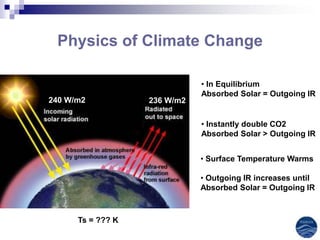
Physics of Climate Change

                              • In Equilibrium
                              Absorbed Solar = Outgoing IR
240 W/m2           240 W/m2
                   236

                              • Instantly double CO2
                              Absorbed Solar > Outgoing IR


                              • Surface Temperature Warms

                              • Outgoing IR increases until
                              Absorbed Solar = Outgoing IR


      Ts = 287 K
           ??? K
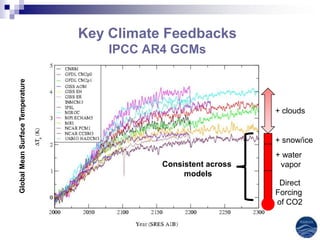
Key Climate Feedbacks
                                      IPCC AR4 GCMs
Global Mean Surface Temperature


                                                                 + clouds


                                                                 + snow/ice
                                                                 + water
                                             Consistent across    vapor
                                                  models
                                                                  Direct
                                                                 Forcing
                                                                 of CO2
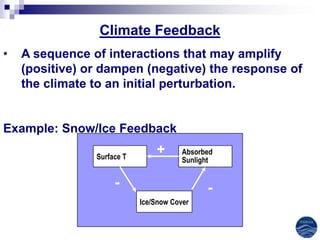
Climate Feedback
•   A sequence of interactions that may amplify
    (positive) or dampen (negative) the response of
    the climate to an initial perturbation.


Example: Snow/Ice Feedback

                Surface T
                                +       Absorbed
                                        Sunlight


                     -                        -
                            Ice/Snow Cover
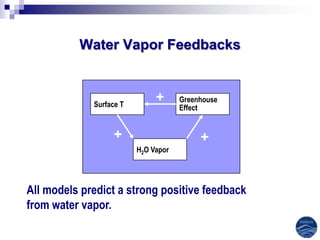
Water Vapor Feedbacks


             Surface T
                              +      Greenhouse
                                     Effect


                  +                       +
                         H2O Vapor


All models predict a strong positive feedback
from water vapor.
IPCC Assessments: Water Vapor Feedback

 1990:   “The best understood feedback mechanism is water vapor feedback,
         and this is intuitively easy to understand”
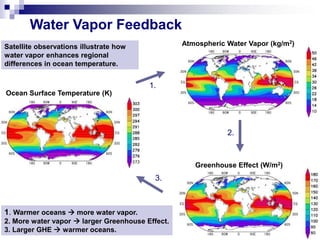
Water Vapor Feedback
Satellite observations illustrate how             Atmospheric Water Vapor (kg/m2)
water vapor enhances regional
differences in ocean temperature.


                                         1.
Ocean Surface Temperature (K)


                                                              2.


                                                     Greenhouse Effect (W/m2)
                                           3.


1. Warmer oceans  more water vapor.
2. More water vapor  larger Greenhouse Effect.
3. Larger GHE  warmer oceans.
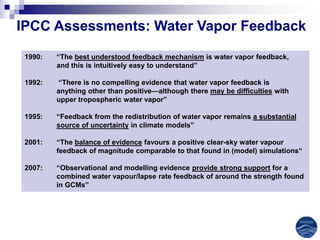
IPCC Assessments: Water Vapor Feedback

 1990:   “The best understood feedback mechanism is water vapor feedback,
         and this is intuitively easy to understand”

 1992:   “There is no compelling evidence that water vapor feedback is
         anything other than positive—although there may be difficulties with
         upper tropospheric water vapor”

 1995:   “Feedback from the redistribution of water vapor remains a substantial
         source of uncertainty in climate models”

 2001:   “The balance of evidence favours a positive clear-sky water vapour
         feedback of magnitude comparable to that found in (model) simulations“

 2007:   “Observational and modelling evidence provide strong support for a
         combined water vapour/lapse rate feedback of around the strength found
         in GCMs”
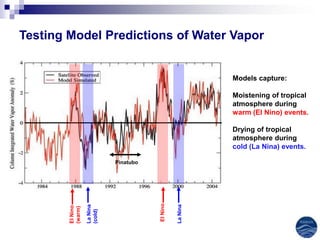
Testing Model Predictions of Water Vapor


                                                           Models capture:

                                                           Moistening of tropical
                                                           atmosphere during
                                                           warm (El Nino) events.

                                                           Drying of tropical
                                                           atmosphere during
                                                           cold (La Nina) events.

                            Pinatubo   El Nino


                                                 La Nina
                  La Nina
        El Nino
        (warm)


                  (cold)
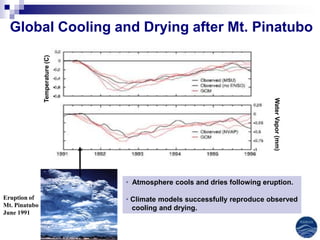
Global Cooling and Drying after Mt. Pinatubo
               Temperature (C)


                                                                           Water Vapor (mm)
                                 • Atmosphere cools and dries following eruption.

Eruption of                      • Climate models successfully reproduce observed
Mt. Pinatubo                       cooling and drying.
June 1991
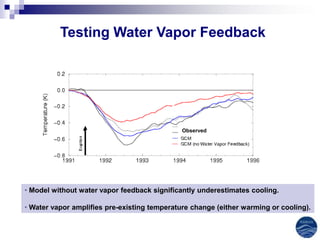
Testing Water Vapor Feedback


                                              Observed


• Model without water vapor feedback significantly underestimates cooling.

• Water vapor amplifies pre-existing temperature change (either warming or cooling).
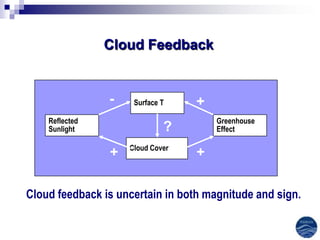
Cloud Feedback


                -    Surface T    +
    Reflected                         Greenhouse
    Sunlight                 ?        Effect

                    Cloud Cover
                +                 +

Cloud feedback is uncertain in both magnitude and sign.
The Problem Clouds
Regional contribution to intermodel spread in cloud feedback


Subtropical marine stratocumulus clouds are responsible for most
(~2/3) of the uncertainty in cloud feedback in current models.
Thank You!


Questions?
EXTRA SLIDES

Water Vapor Feedback and Global Warming

  • 1.
    Climate Feedbacks Brian Soden Rosenstiel School of Marine and Atmospheric Science University of Miami
  • 2.
    Physics of ClimateChange • In Equilibrium Absorbed Solar = Outgoing IR 240 W/m2 240 W/m2 236 • Instantly double CO2 Absorbed Solar > Outgoing IR • Surface Temperature Warms • Outgoing IR increases until Absorbed Solar = Outgoing IR Ts = 287 K ??? K
  • 3.
    Key Climate Feedbacks IPCC AR4 GCMs Global Mean Surface Temperature + clouds + snow/ice + water Consistent across vapor models Direct Forcing of CO2
  • 4.
    Climate Feedback • A sequence of interactions that may amplify (positive) or dampen (negative) the response of the climate to an initial perturbation. Example: Snow/Ice Feedback Surface T + Absorbed Sunlight - - Ice/Snow Cover
  • 5.
    Water Vapor Feedbacks Surface T + Greenhouse Effect + + H2O Vapor All models predict a strong positive feedback from water vapor.
  • 6.
    IPCC Assessments: WaterVapor Feedback 1990: “The best understood feedback mechanism is water vapor feedback, and this is intuitively easy to understand”
  • 7.
    Water Vapor Feedback Satelliteobservations illustrate how Atmospheric Water Vapor (kg/m2) water vapor enhances regional differences in ocean temperature. 1. Ocean Surface Temperature (K) 2. Greenhouse Effect (W/m2) 3. 1. Warmer oceans  more water vapor. 2. More water vapor  larger Greenhouse Effect. 3. Larger GHE  warmer oceans.
  • 8.
    IPCC Assessments: WaterVapor Feedback 1990: “The best understood feedback mechanism is water vapor feedback, and this is intuitively easy to understand” 1992: “There is no compelling evidence that water vapor feedback is anything other than positive—although there may be difficulties with upper tropospheric water vapor” 1995: “Feedback from the redistribution of water vapor remains a substantial source of uncertainty in climate models” 2001: “The balance of evidence favours a positive clear-sky water vapour feedback of magnitude comparable to that found in (model) simulations“ 2007: “Observational and modelling evidence provide strong support for a combined water vapour/lapse rate feedback of around the strength found in GCMs”
  • 9.
    Testing Model Predictionsof Water Vapor Models capture: Moistening of tropical atmosphere during warm (El Nino) events. Drying of tropical atmosphere during cold (La Nina) events. Pinatubo El Nino La Nina La Nina El Nino (warm) (cold)
  • 10.
    Global Cooling andDrying after Mt. Pinatubo Temperature (C) Water Vapor (mm) • Atmosphere cools and dries following eruption. Eruption of • Climate models successfully reproduce observed Mt. Pinatubo cooling and drying. June 1991
  • 11.
    Testing Water VaporFeedback Observed • Model without water vapor feedback significantly underestimates cooling. • Water vapor amplifies pre-existing temperature change (either warming or cooling).
  • 12.
    Cloud Feedback - Surface T + Reflected Greenhouse Sunlight ? Effect Cloud Cover + + Cloud feedback is uncertain in both magnitude and sign.
  • 13.
    The Problem Clouds Regionalcontribution to intermodel spread in cloud feedback Subtropical marine stratocumulus clouds are responsible for most (~2/3) of the uncertainty in cloud feedback in current models.
  • 14.
  • 15.