CLEFT LIP AND PALATE
CONTENTS
 Introduction
 Incidence
 Embryology
 Formation of clefts
 Etiology
 Diagnostic considerations
 Evolution of cleft classification
 Classification
 Problems associated with clefts
 Syndromes associated with clefts
 The team approach
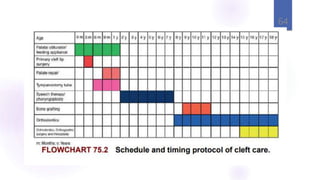
 Sequencing of treatment
 Nasoalveolar Moulding (NAM)
 Cleft lip repair
 Presurgical Orthopeadic Treatment
(PSOT)
 Millard-Latham procedure
 Distraction Osteogenesis
 Bone grafting for alveolar cleft
defects
 Role of an Orthodontist
 Conclusion
 References
2
Introduction
 Cleft of the lip and/or the palate (CL ± P) is a congenital birth
defect.
 Can be complete or partial clefting of the lip and/or the
palate.
 The severity of clefting may vary from the trace of notching of
the upper lip to complete non-fusion of the lip, primary palate
and secondary palate
4
Epidemiology
 Cl and p constitutes nearly one-third of all congenital malformations.
 Incidence as 1.6 per 1000 live births excluding those associated with
syndromes.
 Robert, Kallen and Harris (1996) pooled the data from five birth registries
from California, Sweden and France to study the prevalence of CLP anomaly.
From their pooled data, they calculated the incidence of CLP as 1.57/1000.
5
 Highest in Afghans 4.9
 lowest in Negroid population, 0.4 per 1000 live births.
 30,000 children afflicted with CLP anomaly are born every year
in India.
6
Sex ratio :
CL + CP : Males > Females
CP alone : Females > Males
Laterality of lesions :
Unilateral clefts > Bilateral clefts
Left side > Right side.
Increase in frequency :
- With increase in parents age
- Normal parents- affected one child- 4 % second baby
- If two siblings affected-10 % next baby
7
INCIDENCE
Thronton JB, Nimer S and Howrd P.The incidence, classification, etiology and embryology of oral clefts. Semin Orthod 1996;2:162-168
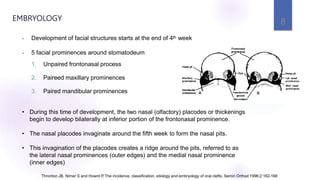
• Development of facial structures starts at the end of 4th week
• 5 facial prominences around stomatodeum
1. Unpaired frontonasal process
2. Paireed maxillary prominences
3. Paired mandibular prominences
• During this time of development, the two nasal (olfactory) placodes or thickenings
begin to develop bilaterally at inferior portion of the frontonasal prominence.
• The nasal placodes invaginate around the fifth week to form the nasal pits.
• This invagination of the placodes creates a ridge around the pits, referred to as
the lateral nasal prominences (outer edges) and the medial nasal prominence
(inner edges)
Thronton JB, Nimer S and Howrd P.The incidence, classification, etiology and embryology of oral clefts. Semin Orthod 1996;2:162-168
EMBRYOLOGY 8
9
M
L
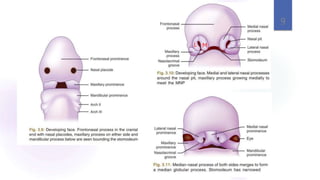
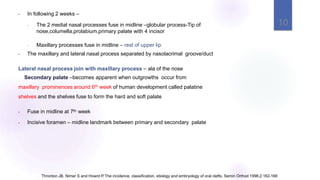
• In following 2 weeks –
• The 2 medial nasal processes fuse in midline –globular process-Tip of
nose,columella,prolabium,primary palate with 4 incisor
• Maxillary processes fuse in midline – rest of upper lip
• The maxillary and lateral nasal process separated by nasolacrimal groove/duct
Lateral nasal process join with maxillary process – ala of the nose
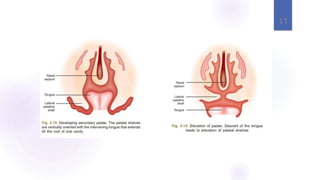
Secondary palate –becomes apparent when outgrowths occur from
maxillary prominences around 6th week of human development called palatine
shelves and the shelves fuse to form the hard and soft palate
• Fuse in midline at 7th week
• Incisive foramen – midline landmark between primary and secondary palate
10
Thronton JB, Nimer S and Howrd P.The incidence, classification, etiology and embryology of oral clefts. Semin Orthod 1996;2:162-168
11
Development of cleft
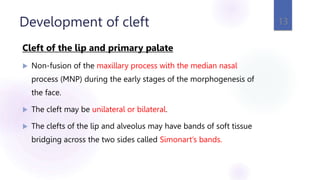
Cleft of the lip and primary palate
 Non-fusion of the maxillary process with the median nasal
process (MNP) during the early stages of the morphogenesis of
the face.
 The cleft may be unilateral or bilateral.
 The clefts of the lip and alveolus may have bands of soft tissue
bridging across the two sides called Simonart’s bands.
13
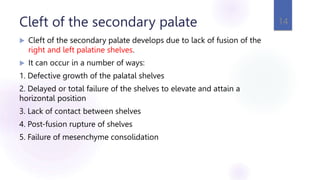
Cleft of the secondary palate
 Cleft of the secondary palate develops due to lack of fusion of the
right and left palatine shelves.
 It can occur in a number of ways:
1. Defective growth of the palatal shelves
2. Delayed or total failure of the shelves to elevate and attain a
horizontal position
3. Lack of contact between shelves
4. Post-fusion rupture of shelves
5. Failure of mesenchyme consolidation
14
Cleft soft palate only (CPO)
 Considered as a separate entity and appears to be under the high genetic
influence.
 The cleft of the palate alone is more common in females.
 which have been hypothesised to be linked with a week’s delay of hard palate
closure and therefore a prolonged sensitive embryonic period.
 usually associated with Pierre Robin malformation and has a distinct U shape
while most of the clefts in the palate make a V-shaped notch
15
Submucous cleft palate (SMCP)
 Clinically invisible.
 present on the palate as bony defects but are covered with
oral mucosa.
 Submucous cleft palate (SMCP) is a subgroup of cleft palate
that presents as
(1) bifid uvula
(2) translucent zone in the soft palate
(3) bony notch in the posterior edge of the hard palate.
16
Syndromic and non-syndromic clefts
 Non-syndromic cleft affected individuals have no other physical or
developmental anomalies
 70% of cases of CL/P and 50% of CPO are non-syndromic
 syndromic cleft may appear as a part of multiple congenital anomalies
(MCA).
 More than 350 syndromes are known to have associated cleft lip and
palate
17
ETIOLOGY
 Exact Etiology of CL/P is obscure because of its heterogeneous
presentation,
Familial affiliation
 The familial association is greater for cleft of the soft palate alone.
 Cephalometric studies on normal parents of the cleft lip and palate
patients have suggested that a distinct craniofacial pattern exists in
which include short facial heights and wider nasal widths.
20
 Environmental causes
 Anti-abortifacient drugs
 anti-emetics
 Phenytoin
 excessive alcohol and smoking have been linked to congenital
defects including cleft lip and palate.
 Nutrition
 Viral infections
 Mercaptopurine,Methotrexate, Valium, Dilantin
21
 Epigenetic factors/gene environment interactions
 The current research is more focused on gene-environment interaction.
 Studies of twins have shown a lack of 100% concordance in monozygotic
twins, which is an indication that genetic events alone are not responsible for
the clefting phenotype.
 Concordance in monozygotic (MZ) twins ranges between 40 and 60% and is
5% in dizygotic twins.
 Greatly increased MZ concordance does strongly support a major genetic
component.
22
23
Sommerland BC. Management of cleft lip and palate. Current Paediatrics 1994
 Chromosomal anomalies
• Trisomy 13 (Patau)
• Trisomy 18 (Edward)
• Trisomy 21 (Down’s)
• Velocardiofacial syndrome (22q11 deletion)
SYNDROMES ASSOCIATED WITH CLEFTS
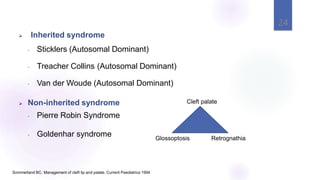
 Inherited syndrome
• Sticklers (Autosomal Dominant)
• Treacher Collins (Autosomal Dominant)
• Van der Woude (Autosomal Dominant)
 Non-inherited syndrome
• Pierre Robin Syndrome
• Goldenhar syndrome
24
Sommerland BC. Management of cleft lip and palate. Current Paediatrics 1994
Cleft palate
Glossoptosis Retrognathia
 Teratogenic
• Fetal alcohol syndrome
• Fetal phenytoin syndrome
• Fetal valproate syndrome
25
Sommerland BC. Management of cleft lip and palate. Current Paediatrics 1994
GENETICS
SYNDROMIC CLEFTING
• Interferon regulatory factor-6 (IRF6) in van der Woude syndrome
• Poliovirus receptor related-1 (PVRL1) gene in Ectodermal dysplasia
syndrome
• TCS gene (TCOF1) to human chromosome 5q32-q33.1- Treacher
Collins Syndrome
• 22q11 deletion – di George syndrome
26
The complex genetics of cleft lip and palate Martyn T. Cobourne European Journal of Orthodontics 26 (2004) 7–16
NON-SYNDROMIC CLEFTING
• 6p chromosome. endothelin-1
• TGFα
• F13A
• RARA on chromosome 17
• BCL3 on chromosome 19
27
30
• Prenatal ultrasound
• Prenatal counselling
• 22% to 33% rates for detecting facial clefts
• 73% - fetal cleft lip
• 1.4% - isolated cleft palate
• Color Doppler ultrasonography can also be used
Graber Vanarsdall Orthodontics: Current Principles and Techniques. 6th ed pg.no.368
DIAGNOSTIC CONSIDERATIONS
ADVANTAGES OF PRENATAL CLEFT DIAGNOSIS
33
Graber Vanarsdall Orthodontics: Current Principles and Techniques. Pg.368-369
- Psychological preparation for parents to have realistic expectations
- Parent education for cleft management
- Preparation for neonatal care and feeding
- Opportunity to investigate other abnormalities
- Possibility of fetal surgery
DISADVANTAGES OF PRENATAL CLEFT DIAGNOSIS
- Emotional disturbance
- High maternal anxiety and dysfunction
- Termination of pregnancy
EVOLUTION OF CLEFT CLASSIFICATIONS
─ FORSTER 1861 (First person to classify
malformations of the face )
─ DAVIS AND RITCHIE 1922
─ BROPHY 1923
─ VEAU AND RECAMIER 1931
─ FOGH-ANDERSEN 1943
─ KERNAHAN AND STARK 1958
─ SANDHAM 1958
─ HARKINS et al., 1962
─ VILAR-SANCHO 1962
─ PFEIFFER 1964
─ BROADBENT et al 1968
─ DAHL 1970
─ ELSAHY 1973
─ SPINA 1973
─ BALAKRISHNAN 1975
─ MILLARD 1976
─ TESSIER 1976
─ BERLIN 1979
─ KERNAHAN 1971
─ WHITAKER et al.,1981
─ KRIENS O LAHSHAL 1987
─ FRIEDMAN 1991
─ KOCH AND KOCH , LAHSN SYSTEM 1995
─ DAVISON et al., 1998
─ SMITH 1998
─ M.R.OTRIZ 2001
─ QIANG LIU ET AL LAPAL SYSTEM 2007
─ PERCY ROSSELL-PERRY 2009
34
35
Allori AC et al. Classification of Cleft Lip/Palate: Then and Now. Cleft Palate–Craniofacial Journal 2016;53(1)
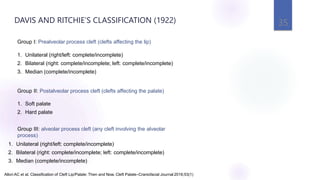
Group I: Prealveolar process cleft (clefts affecting the lip)
1. Unilateral (right/left: complete/incomplete)
2. Bilateral (right: complete/incomplete; left: complete/incomplete)
3. Median (complete/incomplete)
Group II: Postalveolar process cleft (clefts affecting the palate)
1. Soft palate
2. Hard palate
Group III: alveolar process cleft (any cleft involving the alveolar
process)
1. Unilateral (right/left: complete/incomplete)
2. Bilateral (right: complete/incomplete; left: complete/incomplete)
3. Median (complete/incomplete)
DAVIS AND RITCHIE’S CLASSIFICATION (1922)
36
A] Cleft lip
Class I : U/L notching of vermillion border, not extending into the lip.
Class II : cleft extending into the lip, but not including the floor of the nose.
Class III : extending into the floor of the nose.
Class IV : any b/l cleft of the lip, whether incomplete or complete.
B] Cleft palate
Class I : soft palate
Class II : soft/hard palate extending no further than incisive foramen.
Class III : complete unilateral cleft, extending from uvula to incisive foramen, then
deviating to one side
Class IV : two clefts extending forward from the incisive foramen into the alveolus.
Allori AC et al. Classification of Cleft Lip/Palate: Then and Now. Cleft Palate–Craniofacial Journal 2016;53(1)
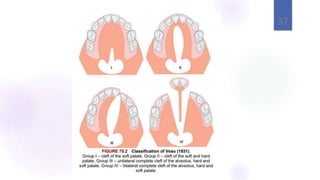
VICTOR VEAU’S CLASSIFICATION (1931)
37
39
Allori AC et al. Classification of Cleft Lip/Palate: Then and Now. Cleft Palate–Craniofacial Journal 2016;53(1)
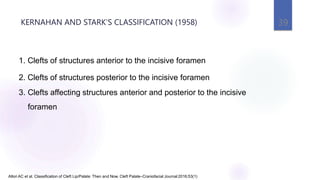
1. Clefts of structures anterior to the incisive foramen
2. Clefts of structures posterior to the incisive foramen
3. Clefts affecting structures anterior and posterior to the incisive
foramen
KERNAHAN AND STARK’S CLASSIFICATION (1958)
40
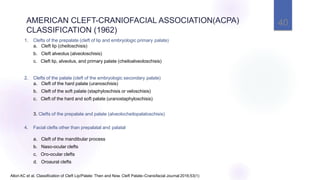
1. Clefts of the prepalate (cleft of lip and embryologic primary palate)
a. Cleft lip (cheiloschisis)
b. Cleft alveolus (alveoloschisis)
c. Cleft lip, alveolus, and primary palate (cheiloalveoloschisis)
2. Clefts of the palate (cleft of the embryologic secondary palate)
a. Cleft of the hard palate (uranoschisis)
b. Cleft of the soft palate (staphyloschisis or veloschisis)
c. Cleft of the hard and soft palate (uranostaphyloschisis)
3. Clefts of the prepalate and palate (alveolocheilopalatoschisis)
4. Facial clefts other than prepalatal and palatal
a. Cleft of the mandibular process
b. Naso-ocular clefts
c. Oro-ocular clefts
d. Oroaural clefts
Allori AC et al. Classification of Cleft Lip/Palate: Then and Now. Cleft Palate–Craniofacial Journal 2016;53(1)
AMERICAN CLEFT-CRANIOFACIAL ASSOCIATION(ACPA)
CLASSIFICATION (1962)
42
Allori AC et al. Classification of Cleft Lip/Palate: Then and Now. Cleft Palate–Craniofacial Journal 2016;53(1)
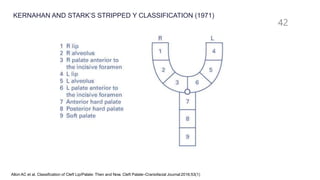
KERNAHAN AND STARK’S STRIPPED Y CLASSIFICATION (1971)
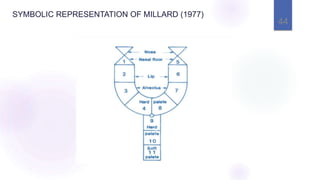
SYMBOLIC REPRESENTATION OF MILLARD (1977)
44
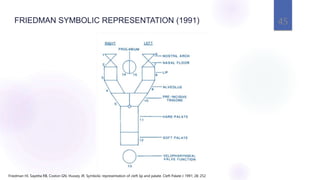
FRIEDMAN SYMBOLIC REPRESENTATION (1991) 45
Friedman HI, Sayetta RB, Coston GN, Hussey JR. Symbolic representation of cleft lip and palate. Cleft Palate J 1991; 28: 252
46
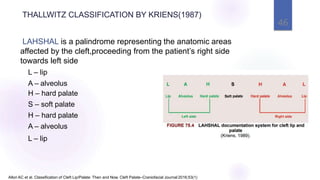
Allori AC et al. Classification of Cleft Lip/Palate: Then and Now. Cleft Palate–Craniofacial Journal 2016;53(1)
LAHSHAL is a palindrome representing the anatomic areas
affected by the cleft,proceeding from the patient’s right side
towards left side
L – lip
A – alveolus
H – hard palate
S – soft palate
H – hard palate
A – alveolus
L – lip
THALLWITZ CLASSIFICATION BY KRIENS(1987)
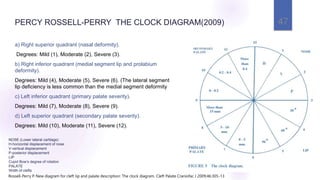
NOSE (Lower lateral cartilage)
H-horizontal displacement of nose
V-vertical displacement
P-posterior displacement
LIP
Cupid Bow’s degree of rotation
PALATE
Width of clefts
a) Right superior quadrant (nasal deformity).
Degrees: Mild (1), Moderate (2), Severe (3).
b) Right inferior quadrant (medial segment lip and prolabium
deformity).
Degrees: Mild (4), Moderate (5), Severe (6). (The lateral segment
lip deficiency is less common than the medial segment deformity
c) Left inferior quadrant (primary palate severity).
Degrees: Mild (7), Moderate (8), Severe (9).
d) Left superior quadrant (secondary palate severity).
Degrees: Mild (10), Moderate (11), Severe (12).
47
Rossell-Perry P. New diagram for cleft lip and palate description: The clock diagram. Cleft Palate Craniofac J 2009;46:305-13
PERCY ROSSELL-PERRY THE CLOCK DIAGRAM(2009)
49
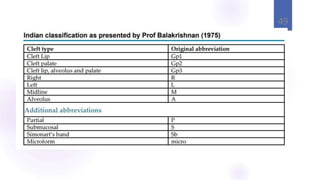
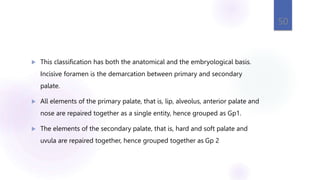
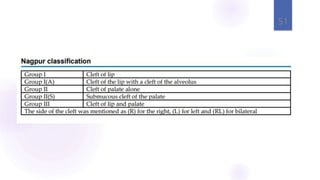
 This classification has both the anatomical and the embryological basis.
Incisive foramen is the demarcation between primary and secondary
palate.
 All elements of the primary palate, that is, lip, alveolus, anterior palate and
nose are repaired together as a single entity, hence grouped as Gp1.
 The elements of the secondary palate, that is, hard and soft palate and
uvula are repaired together, hence grouped together as Gp 2
50
51
52
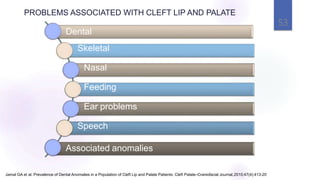
Dental
Skeletal
Nasal
Feeding
Ear problems
Speech
Associated anomalies
53
Jamal GA et al. Prevalence of Dental Anomalies in a Population of Cleft Lip and Palate Patients. Cleft Palate–Craniofacial Journal,2010;47(4):413-20
PROBLEMS ASSOCIATED WITH CLEFT LIP AND PALATE
54
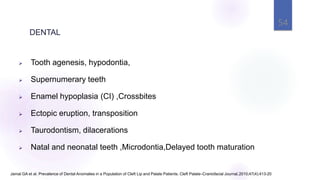
 Tooth agenesis, hypodontia,
 Supernumerary teeth
 Enamel hypoplasia (CI) ,Crossbites
 Ectopic eruption, transposition
 Taurodontism, dilacerations
 Natal and neonatal teeth ,Microdontia,Delayed tooth maturation
Jamal GA et al. Prevalence of Dental Anomalies in a Population of Cleft Lip and Palate Patients. Cleft Palate–Craniofacial Journal,2010;47(4):413-20
DENTAL
 Maxillary deficiency
 Mandibular prognathism
 Class III malocclusion
 Concave profile
Ana Paula et al, Dental Anomalies of Number in The Permanent Dentition ofPatientsWith Bilateral Cleft Lip: Radiographic Study, The Cleft Palate-Craniofacial Journal.2008;45(5):473-476.
SKELETAL
55
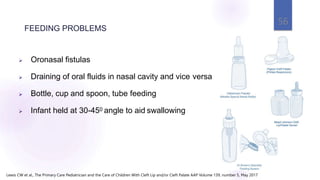
 Oronasal fistulas
 Draining of oral fluids in nasal cavity and vice versa
 Bottle, cup and spoon, tube feeding
 Infant held at 30-450 angle to aid swallowing
FEEDING PROBLEMS
56
Lewis CW et al., The Primary Care Pediatrician and the Care of Children With Cleft Lip and/or Cleft Palate AAP Volume 139, number 5, May 2017
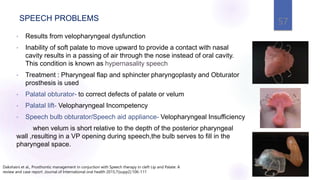
SPEECH PROBLEMS
• Results from velopharyngeal dysfunction
• Inability of soft palate to move upward to provide a contact with nasal
cavity results in a passing of air through the nose instead of oral cavity.
This condition is known as hypernasality speech
• Treatment : Pharyngeal flap and sphincter pharyngoplasty and Obturator
prosthesis is used
• Palatal obturator- to correct defects of palate or velum
• Palatal lift- Velopharyngeal Incompetency
• Speech bulb obturator/Speech aid appliance- Velopharyngeal Insufficiency
when velum is short relative to the depth of the posterior pharyngeal
wall ,resulting in a VP opening during speech,the bulb serves to fill in the
pharyngeal space.
57
Dakshaini et al., Prosthontic management in conjuction with Speech therapy in cleft Lip and Palate: A
review and case report .Journal of International oral health 2015;7(supp2):106-111
HEARING PROBLEMS AND EAR INFECTIONS
• Otitis media is a condition where a fluid is accumulated in the middle ear
and results in ear infection.
• This is due to the abnormal action of Eustachian tube opening by two
muscles which are tensor veli palatine and levator veli palatine.
• This leads to the lack of ventilation to the middle ear cavity and
accumulation of fluid inside the middle ear.
• This condition is presented in the child with cleft palate in the first six
months of life
58
THE TEAM APPROACH 60
Primary team or core team
 The cleft surgeon/plastic surgeon undertakes the primary and secondary repair.
 The speech therapist monitors speech from 9 months onwards and institutes
measures for normal development of the speech.
 The audiologist quantifies and locates the cause of hearing problems.
 The orthodontist monitors dental development, occlusion, skeletal problems and
institutes interceptive therapy, dentofacial orthopaedics and prepares for
secondary alveolar bone graft.
62
 Orthodontist’s expertise in cephalometry and craniofacial growth
uniquely qualifies him or her to monitor craniofacial growth,
dental development and treatment results.
 Oral surgeon. Secondary alveolar bone graft and orthognathic
surgery if required.
 Plastic surgeon. Correction of nose deformity, secondary
deformities of lip and scar revision.
63
64
Feeding appliance
Feeding in a normal child involves two mechanisms:
 Sucking
 Swallowing
 The sucking mechanism is disturbed while the swallowing is normal.
 The feeding appliance or feeding obturator is intended to block the
continuity of the oral cavity with the nasal cavity.
67
• 1920s -1930s – repair the defect by establishing an anatomical
continuity
• Priority of treatment
- Improve speech ability
- Dental function
- Facial aesthetics
68
Berkowitz S. A Comparison of Treatment Results in Complete Bilateral Cleft Lip and Palate Using a Conservative Approach Versus Millard-Latham PSOT Procedure. Semin Orthod 1996;2:169-184
PRESURGICAL ORTHOPEDIC TREATMENT (PSOT)
 1950s – Two schools of thoughts
• McNeil and Burston
• Align palatal segments
• Delay palatal closure till 5-9 years
of age
Presurgical
Orthopedics
• Led by Pruzansky
• Did not favour PSOT
• Palatal closure at 2-4 years of age
Immediate
surgery
Berkowitz S. A Comparison of Treatment Results in Complete Bilateral Cleft Lip and Palate Using a Conservative Approach Versus Millard-Latham PSOT Procedure. Semin Orthod 1996;2:169-184
69
Presurgical orthopaedics
 Presurgical orthopaedics was pioneered and introduced by
McNeil in the 1950s
 To control and modify the postnatal development of the
maxilla by stimulating the growth of the soft tissues overlying
the hard palate.
 The idea was to create a normal arch form by actively
moulding the alveolar segments using a series of plates.
70
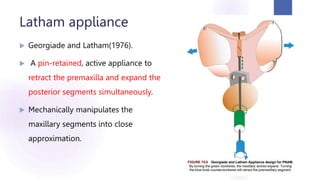
Latham appliance
 Georgiade and Latham(1976).
 A pin-retained, active appliance to
retract the premaxilla and expand the
posterior segments simultaneously.
 Mechanically manipulates the
maxillary segments into close
approximation.
71
 Along with lip adhesion, the gingivoperiosteoplasty (GPP)
provides stabilisation of the maxillary segments and
reconstruction of the nasal floor.
 The appliance is inserted 4 weeks before lip surgery.
 Advantages -a fixed appliance which provides quick results in
2.5–3 weeks.
 Disadvantage- Need of additional surgery for its placement under
general anaesthesia
72
Hotz plate(1987)
A passive orthopaedic to slowly align the cleft segments by grinding
away the acrylic in specific areas.
AIM
Take advantage of natural development potential.
Not to facilitate surgery or to stimulate growth.
Therefore, after a lip operation at the age of 6 months, palate repair
was postponed until 5 years of age to allow growth through intrinsic
growth potential
74
PNAM
 The concept is based on the findings by Matsuo who recognised alar
cartilage exhibits the same elasticity as auricular cartilage in the early
neonate.
 High levels of hyaluronic acid in the newborn , maternal oestrogen
during the first days of life, giving neonate tissues elastic properties
at the time of delivery.
 Grayson adapted nasal stent, from Matsuo method, to extend from
the anterior flange of an intraoral moulding plate to skilfully apply
force to shape the nasal cartilage.
76
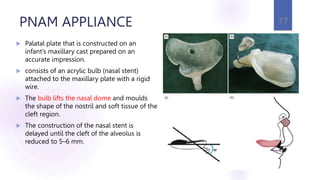
PNAM APPLIANCE
 Palatal plate that is constructed on an
infant’s maxillary cast prepared on an
accurate impression.
 consists of an acrylic bulb (nasal stent)
attached to the maxillary plate with a rigid
wire.
 The bulb lifts the nasal dome and moulds
the shape of the nostril and soft tissue of the
cleft region.
 The construction of the nasal stent is
delayed until the cleft of the alveolus is
reduced to 5–6 mm.
77
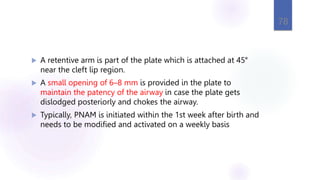
 A retentive arm is part of the plate which is attached at 45°
near the cleft lip region.
 A small opening of 6–8 mm is provided in the plate to
maintain the patency of the airway in case the plate gets
dislodged posteriorly and chokes the airway.
 Typically, PNAM is initiated within the 1st week after birth and
needs to be modified and activated on a weekly basis
78
Dynamic presurgical nasoalveolar
remodelling (DPNR)
 Bennun and Figueroa
Principle
 The redirection and transmission of the forces generated during
suction and swallowing through a nasal dynamic component.
 Produce remodelling effects on the nasal structures, and by
stimulating labial muscle contraction thereby enhancing lip function.
88
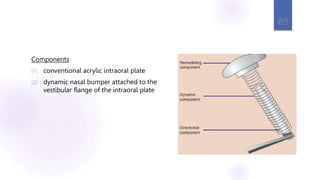
Components
(1) conventional acrylic intraoral plate
(2) dynamic nasal bumper attached to the
vestibular flange of the intraoral plate
89
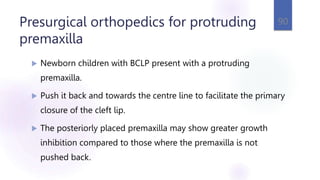
Presurgical orthopedics for protruding
premaxilla
 Newborn children with BCLP present with a protruding
premaxilla.
 Push it back and towards the centre line to facilitate the primary
closure of the cleft lip.
 The posteriorly placed premaxilla may show greater growth
inhibition compared to those where the premaxilla is not
pushed back.
90
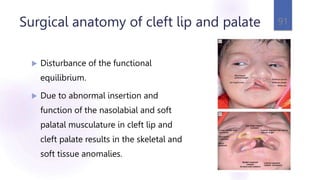
Surgical anatomy of cleft lip and palate
 Disturbance of the functional
equilibrium.
 Due to abnormal insertion and
function of the nasolabial and soft
palatal musculature in cleft lip and
cleft palate results in the skeletal and
soft tissue anomalies.
91
92
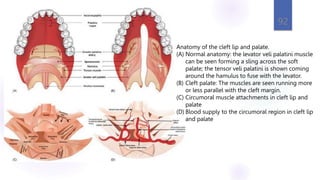
Anatomy of the cleft lip and palate.
(A) Normal anatomy: the levator veli palatini muscle
can be seen forming a sling across the soft
palate; the tensor veli palatini is shown coming
around the hamulus to fuse with the levator.
(B) Cleft palate: The muscles are seen running more
or less parallel with the cleft margin.
(C) Circumoral muscle attachments in cleft lip and
palate
(D) Blood supply to the circumoral region in cleft lip
and palate
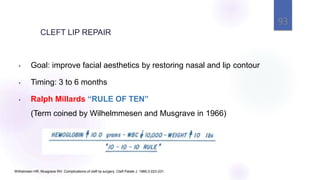
• Goal: improve facial aesthetics by restoring nasal and lip contour
• Timing: 3 to 6 months
• Ralph Millards “RULE OF TEN”
(Term coined by Wilhelmmesen and Musgrave in 1966)
CLEFT LIP REPAIR
Wilhelmsen HR, Musgrave RH. Complications of cleft lip surgery. Cleft Palate J. 1966;3:223-231.
93
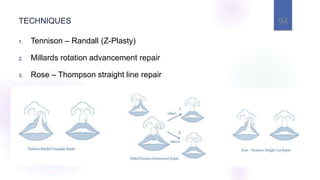
TECHNIQUES 94
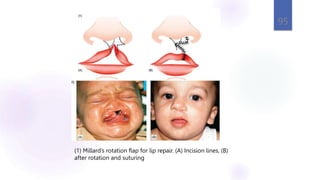
1. Tennison – Randall (Z-Plasty)
2. Millards rotation advancement repair
3. Rose – Thompson straight line repair
95
(1) Millard’s rotation flap for lip repair. (A) Incision lines, (B)
after rotation and suturing
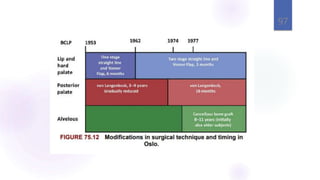
Oslo protocol
 A protocol for the management of cleft patients in 1948 was established with
the following key elements.
 No presurgical orthopaedics.
 Closure of cleft lip in infancy combined with a one-layer vomer flap for the
closure of the nasal floor in the region of the alveolus and hard palate at the
same operation
 Closure of the remaining posterior palatal cleft in early childhood by a von
Langenbeck palatoplasty.
96
97
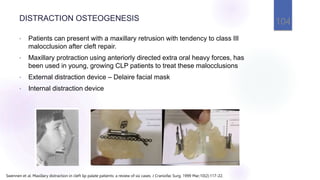
DISTRACTION OSTEOGENESIS
• Patients can present with a maxillary retrusion with tendency to class III
malocclusion after cleft repair.
• Maxillary protraction using anteriorly directed extra oral heavy forces, has
been used in young, growing CLP patients to treat these malocclusions
• External distraction device – Delaire facial mask
• Internal distraction device
104
Swennen et al. Maxillary distraction in cleft lip palate patients: a review of six cases. J Craniofac Surg. 1999 Mar;10(2):117-22.
Indices for cleft
 To categorise the complexity of malocclusion
 in purpose of choosing a treatment option
105
 GOSLON yardstick
 5-yr-old’s index
 Huddart Bodenham system
 Modified Huddart Bodenham system
 EUROCRAN.
106
GOSLON YARDSTICK INDEX
107
GOSLON (Great Ormond Street, London and Oslo) Yardstick index
was developed by Mars et al. and Olav Bergland 1987
A standardized method for categorizing treatment outcomes based on
the analysis of dental relationships (anteroposterior arch, vertical labial
segment and transverse relationships) using study models of children
born with UCLP in late mixed dentition (10 years of age).
This measurement system classifies patients as five groups (from
excellent to poor).
The Goslon Yardstick:A New system of assessing Dental Arch Relationships in children with Unilateral Clefts of the Lip & Palate (Mars et al Cleft Pal J 1987)
 GOSLON 1 – Excellent
 GOSLON 2 – Good
 GOSLON 3 – Fair
 GOSLON 4 – Poor
 GOSLON 5 – Very poor
108
I Anteroposterior Arch Relationships:
1. Severe Class III incisor relationships were least satisfactory[group 5]
2. class II division 1 relationship in the early permanent dentition , most
favorable for subsequent orthodontic correction.[ group 1]
3. Edge-to-edge bite is classified as group 3[fair] and negative overjet of 1–
2 mm as group 4 and negative overjet of 3–4 mm is classified as either
group 5 depending on dento alveolar inclination.
4. Pre-existing dentoalveolar compensation in the presence of a reverse
overjet was not favourable, since it limits the possible orthodontic
correction of the incisor relationship
109
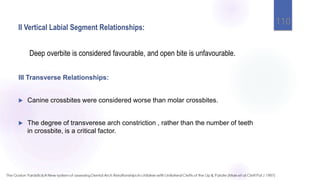
II Vertical Labial Segment Relationships:
Deep overbite is considered favourable, and open bite is unfavourable.
110
III Transverse Relationships:
 Canine crossbites were considered worse than molar crossbites.
 The degree of transverese arch constriction , rather than the number of teeth
in crossbite, is a critical factor.
 Advantage
 it is simple to use as an outcome measure of primary UCLP surgery.
 Diasadvantage
 This index is limited to be used in UCLP children with late mixed and early
permanent dentition only.
111
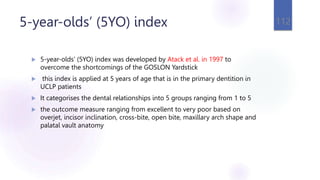
5-year-olds’ (5YO) index
 5-year-olds’ (5YO) index was developed by Atack et al. in 1997 to
overcome the shortcomings of the GOSLON Yardstick
 this index is applied at 5 years of age that is in the primary dentition in
UCLP patients
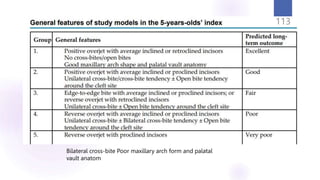
 It categorises the dental relationships into 5 groups ranging from 1 to 5
 the outcome measure ranging from excellent to very poor based on
overjet, incisor inclination, cross-bite, open bite, maxillary arch shape and
palatal vault anatomy
112
113
Bilateral cross-bite Poor maxillary arch form and palatal
vault anatom
 Huddart Bodenham system –
 The original Huddart Bodenham scoring system was developed in 1972
 This index scores each maxillary tooth and its opposing tooth based on
the presence and degree of cross-bite.
 These scores are then summed to deduce one overall score.
 It has five categories for scoring incisors ranging from + 1 to −3 and three
categories for scoring canines and molars ranging from 0 to −2.
114
 The modified Huddart/Bodenham index – The Huddart/Bodenham system
was designed for use in the primary dentition, and it was, therefore,
necessary to modify it for use in the mixed dentition.
 This was undertaken by scoring premolars in the same way as primary
molars.
 At the age of 6 years and after that, the first permanent molars if present,
or the midpoint of the maxillary alveolar ridge were scored similarly as in
original Huddart/Bodenham index ensuing maximum range of score from
−22 to +2.
115
 EUROCRAN index developed by the participants of the EUROCRAN project
(2000–2004) –
 This scores palatal morphology, as well as the dental arch relationship and
a score, is assigned for each component from a 3-point and 4-point scale,
respectively.
 Variants of this index have been developed for application on either the 5-
or 9- year age group.
 Thus the EUROCRAN yardstick is a modification of the GOSLON yardstick
and 5-year-old index, and it is again designed to assess surgical outcomes
in patients with UCLP
116
GOSLON index
 Groups 1 and 2: Require simple orthodontic treatment or no treatment at
all.
 Group 3: Malocclusion requires complex orthodontic treatment but good
result can be anticipated.
 Group 4: Malocclusion being at the limits of orthodontic treatment without
orthognathic surgery to correct skeletal malrelations and if facial growth is
unfavourable, orthognathic surgery is required.
 Group 5: Requires orthognathic surgery.
117
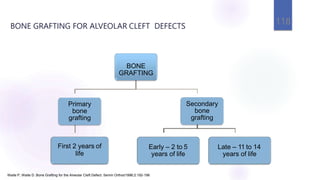
BONE GRAFTING FOR ALVEOLAR CLEFT DEFECTS
118
BONE
GRAFTING
Primary
bone
grafting
First 2 years of
life
Secondary
bone
grafting
Early – 2 to 5
years of life
Late – 11 to 14
years of life
Waite P, Waite D. Bone Grafting for the Alveolar Cleft Defect. Semin Orthod1996;2:192-196
SURGICAL MANAGEMNT OF ALVEOLAR CLEFT 121
Waite P, Waite D. Bone Grafting for the Alveolar Cleft Defect. Semin Orthod1996;2:192-196
• Ideal timing:
- 9 to 11 years of age
- Before canine eruption, canine root is 1/3rd formed (Bergland et al)
• Best source of bone graft: (autologous cancellous bone)
- Anterior portion of iliac crest
- The rib, tibia
- The cranium
- The mandible
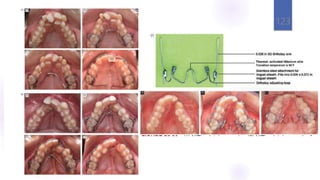
Pre-bone graft orthodontics
 The pre-graft orthodontic treatment contributes to better
access of site for the surgeon at the time of the grafting
procedure and helps to expand the cleft to the normal size of
the maxilla
 The quad helix appliance is the appliance of choice for
expansion
 Trihelix appliance is useful in V-shaped arches.
122
123
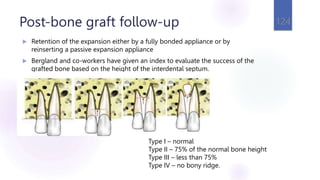
Post-bone graft follow-up
 Retention of the expansion either by a fully bonded appliance or by
reinserting a passive expansion appliance
 Bergland and co-workers have given an index to evaluate the success of the
grafted bone based on the height of the interdental septum.
124
Type I – normal
Type II – 75% of the normal bone height
Type III – less than 75%
Type IV – no bony ridge.
Machos C. Orthodontic Treatment for the Cleft Palate Patient. Semin Orthod 1996;2:197-204.
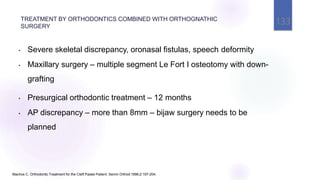
• Severe skeletal discrepancy, oronasal fistulas, speech deformity
• Maxillary surgery – multiple segment Le Fort I osteotomy with down-
grafting
• Presurgical orthodontic treatment – 12 months
• AP discrepancy – more than 8mm – bijaw surgery needs to be
planned
TREATMENT BY ORTHODONTICS COMBINED WITH ORTHOGNATHIC
SURGERY
133
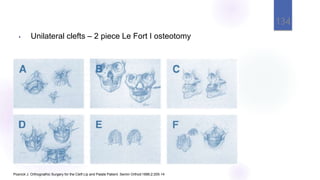
• Unilateral clefts – 2 piece Le Fort I osteotomy
Posnick J. Orthognathic Surgery for the Cleft Lip and Palate Patient. Semin Orthod1996;2:205-14
134
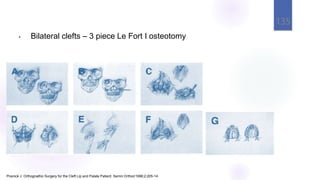
• Bilateral clefts – 3 piece Le Fort I osteotomy
Posnick J. Orthognathic Surgery for the Cleft Lip and Palate Patient. Semin Orthod1996;2:205-14
135
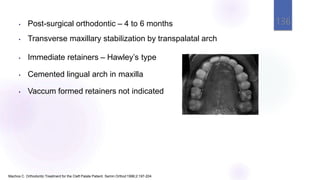
• Post-surgical orthodontic – 4 to 6 months
• Transverse maxillary stabilization by transpalatal arch
• Immediate retainers – Hawley’s type
• Cemented lingual arch in maxilla
• Vaccum formed retainers not indicated
Machos C. Orthodontic Treatment for the Cleft Palate Patient. Semin Orthod 1996;2:197-204.
136
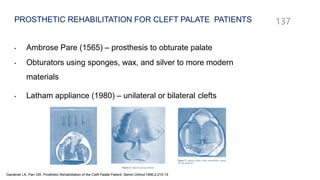
• Ambrose Pare (1565) – prosthesis to obturate palate
• Obturators using sponges, wax, and silver to more modern
materials
• Latham appliance (1980) – unilateral or bilateral clefts
PROSTHETIC REHABILITATION FOR CLEFT PALATE PATIENTS 137
Gardener LK, Parr GR. Prosthetic Rehabilitation of the Cleft Palate Patient. Semin Orthod1996;2:215-19
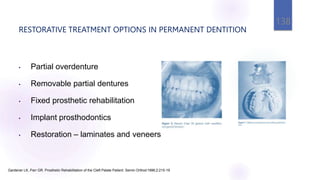
RESTORATIVE TREATMENT OPTIONS IN PERMANENT DENTITION
138
• Partial overdenture
• Removable partial dentures
• Fixed prosthetic rehabilitation
• Implant prosthodontics
• Restoration – laminates and veneers
Gardener LK, Parr GR. Prosthetic Rehabilitation of the Cleft Palate Patient. Semin Orthod1996;2:215-19
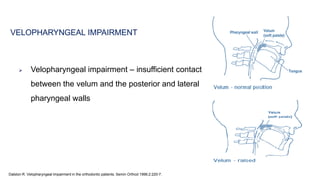
 Velopharyngeal impairment – insufficient contact
between the velum and the posterior and lateral
pharyngeal walls
VELOPHARYNGEAL IMPAIRMENT
139
Dalston R. Velopharyngeal Impairment in the orthodontic patients. Semin Orthod 1996;2:220-7.
TREATMENT
1. Speech therapy
2. Non-surgical or speech aid prosthesis
• Obturators
• Transitional appliance in growing patients
3. Surgical
• Palatoplasty, Sphincter pharyngeoplasty
Gardener LK, Parr GR. Prosthetic Rehabilitation of the Cleft Palate Patient. Semin Orthod1996;2:215-19
140
RECENT ADVANCES
 3D imaging
 3D printing technology
 The scientists have successfully evolved the use of
bone substitutes to fill in the bone defect
142
CONCLUSION
Patient with oro-facial cleft deformity needs to be treated
at right time and at right age to acheive functional and
esthetic well being.
Successful management of the child born with a cleft
requires coordinated care provided by cleft team and it
requires technical skill and in depth knowledge .
144
THANK YOU

2 CLEFT LIP AND PALATE.pptx

  • 1.
  • 2.
    CONTENTS  Introduction  Incidence Embryology  Formation of clefts  Etiology  Diagnostic considerations  Evolution of cleft classification  Classification  Problems associated with clefts  Syndromes associated with clefts  The team approach  Sequencing of treatment  Nasoalveolar Moulding (NAM)  Cleft lip repair  Presurgical Orthopeadic Treatment (PSOT)  Millard-Latham procedure  Distraction Osteogenesis  Bone grafting for alveolar cleft defects  Role of an Orthodontist  Conclusion  References 2
  • 3.
    Introduction  Cleft ofthe lip and/or the palate (CL ± P) is a congenital birth defect.  Can be complete or partial clefting of the lip and/or the palate.  The severity of clefting may vary from the trace of notching of the upper lip to complete non-fusion of the lip, primary palate and secondary palate 4
  • 4.
    Epidemiology  Cl andp constitutes nearly one-third of all congenital malformations.  Incidence as 1.6 per 1000 live births excluding those associated with syndromes.  Robert, Kallen and Harris (1996) pooled the data from five birth registries from California, Sweden and France to study the prevalence of CLP anomaly. From their pooled data, they calculated the incidence of CLP as 1.57/1000. 5
  • 5.
     Highest inAfghans 4.9  lowest in Negroid population, 0.4 per 1000 live births.  30,000 children afflicted with CLP anomaly are born every year in India. 6
  • 6.
    Sex ratio : CL+ CP : Males > Females CP alone : Females > Males Laterality of lesions : Unilateral clefts > Bilateral clefts Left side > Right side. Increase in frequency : - With increase in parents age - Normal parents- affected one child- 4 % second baby - If two siblings affected-10 % next baby 7 INCIDENCE Thronton JB, Nimer S and Howrd P.The incidence, classification, etiology and embryology of oral clefts. Semin Orthod 1996;2:162-168
  • 7.
    • Development offacial structures starts at the end of 4th week • 5 facial prominences around stomatodeum 1. Unpaired frontonasal process 2. Paireed maxillary prominences 3. Paired mandibular prominences • During this time of development, the two nasal (olfactory) placodes or thickenings begin to develop bilaterally at inferior portion of the frontonasal prominence. • The nasal placodes invaginate around the fifth week to form the nasal pits. • This invagination of the placodes creates a ridge around the pits, referred to as the lateral nasal prominences (outer edges) and the medial nasal prominence (inner edges) Thronton JB, Nimer S and Howrd P.The incidence, classification, etiology and embryology of oral clefts. Semin Orthod 1996;2:162-168 EMBRYOLOGY 8
  • 8.
  • 9.
    • In following2 weeks – • The 2 medial nasal processes fuse in midline –globular process-Tip of nose,columella,prolabium,primary palate with 4 incisor • Maxillary processes fuse in midline – rest of upper lip • The maxillary and lateral nasal process separated by nasolacrimal groove/duct Lateral nasal process join with maxillary process – ala of the nose Secondary palate –becomes apparent when outgrowths occur from maxillary prominences around 6th week of human development called palatine shelves and the shelves fuse to form the hard and soft palate • Fuse in midline at 7th week • Incisive foramen – midline landmark between primary and secondary palate 10 Thronton JB, Nimer S and Howrd P.The incidence, classification, etiology and embryology of oral clefts. Semin Orthod 1996;2:162-168
  • 10.
  • 11.
    Development of cleft Cleftof the lip and primary palate  Non-fusion of the maxillary process with the median nasal process (MNP) during the early stages of the morphogenesis of the face.  The cleft may be unilateral or bilateral.  The clefts of the lip and alveolus may have bands of soft tissue bridging across the two sides called Simonart’s bands. 13
  • 12.
    Cleft of thesecondary palate  Cleft of the secondary palate develops due to lack of fusion of the right and left palatine shelves.  It can occur in a number of ways: 1. Defective growth of the palatal shelves 2. Delayed or total failure of the shelves to elevate and attain a horizontal position 3. Lack of contact between shelves 4. Post-fusion rupture of shelves 5. Failure of mesenchyme consolidation 14
  • 13.
    Cleft soft palateonly (CPO)  Considered as a separate entity and appears to be under the high genetic influence.  The cleft of the palate alone is more common in females.  which have been hypothesised to be linked with a week’s delay of hard palate closure and therefore a prolonged sensitive embryonic period.  usually associated with Pierre Robin malformation and has a distinct U shape while most of the clefts in the palate make a V-shaped notch 15
  • 14.
    Submucous cleft palate(SMCP)  Clinically invisible.  present on the palate as bony defects but are covered with oral mucosa.  Submucous cleft palate (SMCP) is a subgroup of cleft palate that presents as (1) bifid uvula (2) translucent zone in the soft palate (3) bony notch in the posterior edge of the hard palate. 16
  • 15.
    Syndromic and non-syndromicclefts  Non-syndromic cleft affected individuals have no other physical or developmental anomalies  70% of cases of CL/P and 50% of CPO are non-syndromic  syndromic cleft may appear as a part of multiple congenital anomalies (MCA).  More than 350 syndromes are known to have associated cleft lip and palate 17
  • 16.
    ETIOLOGY  Exact Etiologyof CL/P is obscure because of its heterogeneous presentation, Familial affiliation  The familial association is greater for cleft of the soft palate alone.  Cephalometric studies on normal parents of the cleft lip and palate patients have suggested that a distinct craniofacial pattern exists in which include short facial heights and wider nasal widths. 20
  • 17.
     Environmental causes Anti-abortifacient drugs  anti-emetics  Phenytoin  excessive alcohol and smoking have been linked to congenital defects including cleft lip and palate.  Nutrition  Viral infections  Mercaptopurine,Methotrexate, Valium, Dilantin 21
  • 18.
     Epigenetic factors/geneenvironment interactions  The current research is more focused on gene-environment interaction.  Studies of twins have shown a lack of 100% concordance in monozygotic twins, which is an indication that genetic events alone are not responsible for the clefting phenotype.  Concordance in monozygotic (MZ) twins ranges between 40 and 60% and is 5% in dizygotic twins.  Greatly increased MZ concordance does strongly support a major genetic component. 22
  • 19.
    23 Sommerland BC. Managementof cleft lip and palate. Current Paediatrics 1994  Chromosomal anomalies • Trisomy 13 (Patau) • Trisomy 18 (Edward) • Trisomy 21 (Down’s) • Velocardiofacial syndrome (22q11 deletion) SYNDROMES ASSOCIATED WITH CLEFTS
  • 20.
     Inherited syndrome •Sticklers (Autosomal Dominant) • Treacher Collins (Autosomal Dominant) • Van der Woude (Autosomal Dominant)  Non-inherited syndrome • Pierre Robin Syndrome • Goldenhar syndrome 24 Sommerland BC. Management of cleft lip and palate. Current Paediatrics 1994 Cleft palate Glossoptosis Retrognathia
  • 21.
     Teratogenic • Fetalalcohol syndrome • Fetal phenytoin syndrome • Fetal valproate syndrome 25 Sommerland BC. Management of cleft lip and palate. Current Paediatrics 1994
  • 22.
    GENETICS SYNDROMIC CLEFTING • Interferonregulatory factor-6 (IRF6) in van der Woude syndrome • Poliovirus receptor related-1 (PVRL1) gene in Ectodermal dysplasia syndrome • TCS gene (TCOF1) to human chromosome 5q32-q33.1- Treacher Collins Syndrome • 22q11 deletion – di George syndrome 26 The complex genetics of cleft lip and palate Martyn T. Cobourne European Journal of Orthodontics 26 (2004) 7–16
  • 23.
    NON-SYNDROMIC CLEFTING • 6pchromosome. endothelin-1 • TGFα • F13A • RARA on chromosome 17 • BCL3 on chromosome 19 27
  • 24.
    30 • Prenatal ultrasound •Prenatal counselling • 22% to 33% rates for detecting facial clefts • 73% - fetal cleft lip • 1.4% - isolated cleft palate • Color Doppler ultrasonography can also be used Graber Vanarsdall Orthodontics: Current Principles and Techniques. 6th ed pg.no.368 DIAGNOSTIC CONSIDERATIONS
  • 25.
    ADVANTAGES OF PRENATALCLEFT DIAGNOSIS 33 Graber Vanarsdall Orthodontics: Current Principles and Techniques. Pg.368-369 - Psychological preparation for parents to have realistic expectations - Parent education for cleft management - Preparation for neonatal care and feeding - Opportunity to investigate other abnormalities - Possibility of fetal surgery DISADVANTAGES OF PRENATAL CLEFT DIAGNOSIS - Emotional disturbance - High maternal anxiety and dysfunction - Termination of pregnancy
  • 26.
    EVOLUTION OF CLEFTCLASSIFICATIONS ─ FORSTER 1861 (First person to classify malformations of the face ) ─ DAVIS AND RITCHIE 1922 ─ BROPHY 1923 ─ VEAU AND RECAMIER 1931 ─ FOGH-ANDERSEN 1943 ─ KERNAHAN AND STARK 1958 ─ SANDHAM 1958 ─ HARKINS et al., 1962 ─ VILAR-SANCHO 1962 ─ PFEIFFER 1964 ─ BROADBENT et al 1968 ─ DAHL 1970 ─ ELSAHY 1973 ─ SPINA 1973 ─ BALAKRISHNAN 1975 ─ MILLARD 1976 ─ TESSIER 1976 ─ BERLIN 1979 ─ KERNAHAN 1971 ─ WHITAKER et al.,1981 ─ KRIENS O LAHSHAL 1987 ─ FRIEDMAN 1991 ─ KOCH AND KOCH , LAHSN SYSTEM 1995 ─ DAVISON et al., 1998 ─ SMITH 1998 ─ M.R.OTRIZ 2001 ─ QIANG LIU ET AL LAPAL SYSTEM 2007 ─ PERCY ROSSELL-PERRY 2009 34
  • 27.
    35 Allori AC etal. Classification of Cleft Lip/Palate: Then and Now. Cleft Palate–Craniofacial Journal 2016;53(1) Group I: Prealveolar process cleft (clefts affecting the lip) 1. Unilateral (right/left: complete/incomplete) 2. Bilateral (right: complete/incomplete; left: complete/incomplete) 3. Median (complete/incomplete) Group II: Postalveolar process cleft (clefts affecting the palate) 1. Soft palate 2. Hard palate Group III: alveolar process cleft (any cleft involving the alveolar process) 1. Unilateral (right/left: complete/incomplete) 2. Bilateral (right: complete/incomplete; left: complete/incomplete) 3. Median (complete/incomplete) DAVIS AND RITCHIE’S CLASSIFICATION (1922)
  • 28.
    36 A] Cleft lip ClassI : U/L notching of vermillion border, not extending into the lip. Class II : cleft extending into the lip, but not including the floor of the nose. Class III : extending into the floor of the nose. Class IV : any b/l cleft of the lip, whether incomplete or complete. B] Cleft palate Class I : soft palate Class II : soft/hard palate extending no further than incisive foramen. Class III : complete unilateral cleft, extending from uvula to incisive foramen, then deviating to one side Class IV : two clefts extending forward from the incisive foramen into the alveolus. Allori AC et al. Classification of Cleft Lip/Palate: Then and Now. Cleft Palate–Craniofacial Journal 2016;53(1) VICTOR VEAU’S CLASSIFICATION (1931)
  • 29.
  • 30.
    39 Allori AC etal. Classification of Cleft Lip/Palate: Then and Now. Cleft Palate–Craniofacial Journal 2016;53(1) 1. Clefts of structures anterior to the incisive foramen 2. Clefts of structures posterior to the incisive foramen 3. Clefts affecting structures anterior and posterior to the incisive foramen KERNAHAN AND STARK’S CLASSIFICATION (1958)
  • 31.
    40 1. Clefts ofthe prepalate (cleft of lip and embryologic primary palate) a. Cleft lip (cheiloschisis) b. Cleft alveolus (alveoloschisis) c. Cleft lip, alveolus, and primary palate (cheiloalveoloschisis) 2. Clefts of the palate (cleft of the embryologic secondary palate) a. Cleft of the hard palate (uranoschisis) b. Cleft of the soft palate (staphyloschisis or veloschisis) c. Cleft of the hard and soft palate (uranostaphyloschisis) 3. Clefts of the prepalate and palate (alveolocheilopalatoschisis) 4. Facial clefts other than prepalatal and palatal a. Cleft of the mandibular process b. Naso-ocular clefts c. Oro-ocular clefts d. Oroaural clefts Allori AC et al. Classification of Cleft Lip/Palate: Then and Now. Cleft Palate–Craniofacial Journal 2016;53(1) AMERICAN CLEFT-CRANIOFACIAL ASSOCIATION(ACPA) CLASSIFICATION (1962)
  • 32.
    42 Allori AC etal. Classification of Cleft Lip/Palate: Then and Now. Cleft Palate–Craniofacial Journal 2016;53(1) KERNAHAN AND STARK’S STRIPPED Y CLASSIFICATION (1971)
  • 33.
    SYMBOLIC REPRESENTATION OFMILLARD (1977) 44
  • 34.
    FRIEDMAN SYMBOLIC REPRESENTATION(1991) 45 Friedman HI, Sayetta RB, Coston GN, Hussey JR. Symbolic representation of cleft lip and palate. Cleft Palate J 1991; 28: 252
  • 35.
    46 Allori AC etal. Classification of Cleft Lip/Palate: Then and Now. Cleft Palate–Craniofacial Journal 2016;53(1) LAHSHAL is a palindrome representing the anatomic areas affected by the cleft,proceeding from the patient’s right side towards left side L – lip A – alveolus H – hard palate S – soft palate H – hard palate A – alveolus L – lip THALLWITZ CLASSIFICATION BY KRIENS(1987)
  • 36.
    NOSE (Lower lateralcartilage) H-horizontal displacement of nose V-vertical displacement P-posterior displacement LIP Cupid Bow’s degree of rotation PALATE Width of clefts a) Right superior quadrant (nasal deformity). Degrees: Mild (1), Moderate (2), Severe (3). b) Right inferior quadrant (medial segment lip and prolabium deformity). Degrees: Mild (4), Moderate (5), Severe (6). (The lateral segment lip deficiency is less common than the medial segment deformity c) Left inferior quadrant (primary palate severity). Degrees: Mild (7), Moderate (8), Severe (9). d) Left superior quadrant (secondary palate severity). Degrees: Mild (10), Moderate (11), Severe (12). 47 Rossell-Perry P. New diagram for cleft lip and palate description: The clock diagram. Cleft Palate Craniofac J 2009;46:305-13 PERCY ROSSELL-PERRY THE CLOCK DIAGRAM(2009)
  • 37.
  • 38.
     This classificationhas both the anatomical and the embryological basis. Incisive foramen is the demarcation between primary and secondary palate.  All elements of the primary palate, that is, lip, alveolus, anterior palate and nose are repaired together as a single entity, hence grouped as Gp1.  The elements of the secondary palate, that is, hard and soft palate and uvula are repaired together, hence grouped together as Gp 2 50
  • 39.
  • 40.
  • 41.
    Dental Skeletal Nasal Feeding Ear problems Speech Associated anomalies 53 JamalGA et al. Prevalence of Dental Anomalies in a Population of Cleft Lip and Palate Patients. Cleft Palate–Craniofacial Journal,2010;47(4):413-20 PROBLEMS ASSOCIATED WITH CLEFT LIP AND PALATE
  • 42.
    54  Tooth agenesis,hypodontia,  Supernumerary teeth  Enamel hypoplasia (CI) ,Crossbites  Ectopic eruption, transposition  Taurodontism, dilacerations  Natal and neonatal teeth ,Microdontia,Delayed tooth maturation Jamal GA et al. Prevalence of Dental Anomalies in a Population of Cleft Lip and Palate Patients. Cleft Palate–Craniofacial Journal,2010;47(4):413-20 DENTAL
  • 43.
     Maxillary deficiency Mandibular prognathism  Class III malocclusion  Concave profile Ana Paula et al, Dental Anomalies of Number in The Permanent Dentition ofPatientsWith Bilateral Cleft Lip: Radiographic Study, The Cleft Palate-Craniofacial Journal.2008;45(5):473-476. SKELETAL 55
  • 44.
     Oronasal fistulas Draining of oral fluids in nasal cavity and vice versa  Bottle, cup and spoon, tube feeding  Infant held at 30-450 angle to aid swallowing FEEDING PROBLEMS 56 Lewis CW et al., The Primary Care Pediatrician and the Care of Children With Cleft Lip and/or Cleft Palate AAP Volume 139, number 5, May 2017
  • 45.
    SPEECH PROBLEMS • Resultsfrom velopharyngeal dysfunction • Inability of soft palate to move upward to provide a contact with nasal cavity results in a passing of air through the nose instead of oral cavity. This condition is known as hypernasality speech • Treatment : Pharyngeal flap and sphincter pharyngoplasty and Obturator prosthesis is used • Palatal obturator- to correct defects of palate or velum • Palatal lift- Velopharyngeal Incompetency • Speech bulb obturator/Speech aid appliance- Velopharyngeal Insufficiency when velum is short relative to the depth of the posterior pharyngeal wall ,resulting in a VP opening during speech,the bulb serves to fill in the pharyngeal space. 57 Dakshaini et al., Prosthontic management in conjuction with Speech therapy in cleft Lip and Palate: A review and case report .Journal of International oral health 2015;7(supp2):106-111
  • 46.
    HEARING PROBLEMS ANDEAR INFECTIONS • Otitis media is a condition where a fluid is accumulated in the middle ear and results in ear infection. • This is due to the abnormal action of Eustachian tube opening by two muscles which are tensor veli palatine and levator veli palatine. • This leads to the lack of ventilation to the middle ear cavity and accumulation of fluid inside the middle ear. • This condition is presented in the child with cleft palate in the first six months of life 58
  • 47.
  • 48.
    Primary team orcore team  The cleft surgeon/plastic surgeon undertakes the primary and secondary repair.  The speech therapist monitors speech from 9 months onwards and institutes measures for normal development of the speech.  The audiologist quantifies and locates the cause of hearing problems.  The orthodontist monitors dental development, occlusion, skeletal problems and institutes interceptive therapy, dentofacial orthopaedics and prepares for secondary alveolar bone graft. 62
  • 49.
     Orthodontist’s expertisein cephalometry and craniofacial growth uniquely qualifies him or her to monitor craniofacial growth, dental development and treatment results.  Oral surgeon. Secondary alveolar bone graft and orthognathic surgery if required.  Plastic surgeon. Correction of nose deformity, secondary deformities of lip and scar revision. 63
  • 50.
  • 51.
    Feeding appliance Feeding ina normal child involves two mechanisms:  Sucking  Swallowing  The sucking mechanism is disturbed while the swallowing is normal.  The feeding appliance or feeding obturator is intended to block the continuity of the oral cavity with the nasal cavity. 67
  • 52.
    • 1920s -1930s– repair the defect by establishing an anatomical continuity • Priority of treatment - Improve speech ability - Dental function - Facial aesthetics 68 Berkowitz S. A Comparison of Treatment Results in Complete Bilateral Cleft Lip and Palate Using a Conservative Approach Versus Millard-Latham PSOT Procedure. Semin Orthod 1996;2:169-184 PRESURGICAL ORTHOPEDIC TREATMENT (PSOT)
  • 53.
     1950s –Two schools of thoughts • McNeil and Burston • Align palatal segments • Delay palatal closure till 5-9 years of age Presurgical Orthopedics • Led by Pruzansky • Did not favour PSOT • Palatal closure at 2-4 years of age Immediate surgery Berkowitz S. A Comparison of Treatment Results in Complete Bilateral Cleft Lip and Palate Using a Conservative Approach Versus Millard-Latham PSOT Procedure. Semin Orthod 1996;2:169-184 69
  • 54.
    Presurgical orthopaedics  Presurgicalorthopaedics was pioneered and introduced by McNeil in the 1950s  To control and modify the postnatal development of the maxilla by stimulating the growth of the soft tissues overlying the hard palate.  The idea was to create a normal arch form by actively moulding the alveolar segments using a series of plates. 70
  • 55.
    Latham appliance  Georgiadeand Latham(1976).  A pin-retained, active appliance to retract the premaxilla and expand the posterior segments simultaneously.  Mechanically manipulates the maxillary segments into close approximation. 71
  • 56.
     Along withlip adhesion, the gingivoperiosteoplasty (GPP) provides stabilisation of the maxillary segments and reconstruction of the nasal floor.  The appliance is inserted 4 weeks before lip surgery.  Advantages -a fixed appliance which provides quick results in 2.5–3 weeks.  Disadvantage- Need of additional surgery for its placement under general anaesthesia 72
  • 57.
    Hotz plate(1987) A passiveorthopaedic to slowly align the cleft segments by grinding away the acrylic in specific areas. AIM Take advantage of natural development potential. Not to facilitate surgery or to stimulate growth. Therefore, after a lip operation at the age of 6 months, palate repair was postponed until 5 years of age to allow growth through intrinsic growth potential 74
  • 58.
    PNAM  The conceptis based on the findings by Matsuo who recognised alar cartilage exhibits the same elasticity as auricular cartilage in the early neonate.  High levels of hyaluronic acid in the newborn , maternal oestrogen during the first days of life, giving neonate tissues elastic properties at the time of delivery.  Grayson adapted nasal stent, from Matsuo method, to extend from the anterior flange of an intraoral moulding plate to skilfully apply force to shape the nasal cartilage. 76
  • 59.
    PNAM APPLIANCE  Palatalplate that is constructed on an infant’s maxillary cast prepared on an accurate impression.  consists of an acrylic bulb (nasal stent) attached to the maxillary plate with a rigid wire.  The bulb lifts the nasal dome and moulds the shape of the nostril and soft tissue of the cleft region.  The construction of the nasal stent is delayed until the cleft of the alveolus is reduced to 5–6 mm. 77
  • 60.
     A retentivearm is part of the plate which is attached at 45° near the cleft lip region.  A small opening of 6–8 mm is provided in the plate to maintain the patency of the airway in case the plate gets dislodged posteriorly and chokes the airway.  Typically, PNAM is initiated within the 1st week after birth and needs to be modified and activated on a weekly basis 78
  • 61.
    Dynamic presurgical nasoalveolar remodelling(DPNR)  Bennun and Figueroa Principle  The redirection and transmission of the forces generated during suction and swallowing through a nasal dynamic component.  Produce remodelling effects on the nasal structures, and by stimulating labial muscle contraction thereby enhancing lip function. 88
  • 62.
    Components (1) conventional acrylicintraoral plate (2) dynamic nasal bumper attached to the vestibular flange of the intraoral plate 89
  • 63.
    Presurgical orthopedics forprotruding premaxilla  Newborn children with BCLP present with a protruding premaxilla.  Push it back and towards the centre line to facilitate the primary closure of the cleft lip.  The posteriorly placed premaxilla may show greater growth inhibition compared to those where the premaxilla is not pushed back. 90
  • 64.
    Surgical anatomy ofcleft lip and palate  Disturbance of the functional equilibrium.  Due to abnormal insertion and function of the nasolabial and soft palatal musculature in cleft lip and cleft palate results in the skeletal and soft tissue anomalies. 91
  • 65.
    92 Anatomy of thecleft lip and palate. (A) Normal anatomy: the levator veli palatini muscle can be seen forming a sling across the soft palate; the tensor veli palatini is shown coming around the hamulus to fuse with the levator. (B) Cleft palate: The muscles are seen running more or less parallel with the cleft margin. (C) Circumoral muscle attachments in cleft lip and palate (D) Blood supply to the circumoral region in cleft lip and palate
  • 66.
    • Goal: improvefacial aesthetics by restoring nasal and lip contour • Timing: 3 to 6 months • Ralph Millards “RULE OF TEN” (Term coined by Wilhelmmesen and Musgrave in 1966) CLEFT LIP REPAIR Wilhelmsen HR, Musgrave RH. Complications of cleft lip surgery. Cleft Palate J. 1966;3:223-231. 93
  • 67.
    TECHNIQUES 94 1. Tennison– Randall (Z-Plasty) 2. Millards rotation advancement repair 3. Rose – Thompson straight line repair
  • 68.
    95 (1) Millard’s rotationflap for lip repair. (A) Incision lines, (B) after rotation and suturing
  • 69.
    Oslo protocol  Aprotocol for the management of cleft patients in 1948 was established with the following key elements.  No presurgical orthopaedics.  Closure of cleft lip in infancy combined with a one-layer vomer flap for the closure of the nasal floor in the region of the alveolus and hard palate at the same operation  Closure of the remaining posterior palatal cleft in early childhood by a von Langenbeck palatoplasty. 96
  • 70.
  • 71.
    DISTRACTION OSTEOGENESIS • Patientscan present with a maxillary retrusion with tendency to class III malocclusion after cleft repair. • Maxillary protraction using anteriorly directed extra oral heavy forces, has been used in young, growing CLP patients to treat these malocclusions • External distraction device – Delaire facial mask • Internal distraction device 104 Swennen et al. Maxillary distraction in cleft lip palate patients: a review of six cases. J Craniofac Surg. 1999 Mar;10(2):117-22.
  • 72.
    Indices for cleft To categorise the complexity of malocclusion  in purpose of choosing a treatment option 105
  • 73.
     GOSLON yardstick 5-yr-old’s index  Huddart Bodenham system  Modified Huddart Bodenham system  EUROCRAN. 106
  • 74.
    GOSLON YARDSTICK INDEX 107 GOSLON(Great Ormond Street, London and Oslo) Yardstick index was developed by Mars et al. and Olav Bergland 1987 A standardized method for categorizing treatment outcomes based on the analysis of dental relationships (anteroposterior arch, vertical labial segment and transverse relationships) using study models of children born with UCLP in late mixed dentition (10 years of age). This measurement system classifies patients as five groups (from excellent to poor). The Goslon Yardstick:A New system of assessing Dental Arch Relationships in children with Unilateral Clefts of the Lip & Palate (Mars et al Cleft Pal J 1987)
  • 75.
     GOSLON 1– Excellent  GOSLON 2 – Good  GOSLON 3 – Fair  GOSLON 4 – Poor  GOSLON 5 – Very poor 108
  • 76.
    I Anteroposterior ArchRelationships: 1. Severe Class III incisor relationships were least satisfactory[group 5] 2. class II division 1 relationship in the early permanent dentition , most favorable for subsequent orthodontic correction.[ group 1] 3. Edge-to-edge bite is classified as group 3[fair] and negative overjet of 1– 2 mm as group 4 and negative overjet of 3–4 mm is classified as either group 5 depending on dento alveolar inclination. 4. Pre-existing dentoalveolar compensation in the presence of a reverse overjet was not favourable, since it limits the possible orthodontic correction of the incisor relationship 109
  • 77.
    II Vertical LabialSegment Relationships: Deep overbite is considered favourable, and open bite is unfavourable. 110 III Transverse Relationships:  Canine crossbites were considered worse than molar crossbites.  The degree of transverese arch constriction , rather than the number of teeth in crossbite, is a critical factor.
  • 78.
     Advantage  itis simple to use as an outcome measure of primary UCLP surgery.  Diasadvantage  This index is limited to be used in UCLP children with late mixed and early permanent dentition only. 111
  • 79.
    5-year-olds’ (5YO) index 5-year-olds’ (5YO) index was developed by Atack et al. in 1997 to overcome the shortcomings of the GOSLON Yardstick  this index is applied at 5 years of age that is in the primary dentition in UCLP patients  It categorises the dental relationships into 5 groups ranging from 1 to 5  the outcome measure ranging from excellent to very poor based on overjet, incisor inclination, cross-bite, open bite, maxillary arch shape and palatal vault anatomy 112
  • 80.
    113 Bilateral cross-bite Poormaxillary arch form and palatal vault anatom
  • 81.
     Huddart Bodenhamsystem –  The original Huddart Bodenham scoring system was developed in 1972  This index scores each maxillary tooth and its opposing tooth based on the presence and degree of cross-bite.  These scores are then summed to deduce one overall score.  It has five categories for scoring incisors ranging from + 1 to −3 and three categories for scoring canines and molars ranging from 0 to −2. 114
  • 82.
     The modifiedHuddart/Bodenham index – The Huddart/Bodenham system was designed for use in the primary dentition, and it was, therefore, necessary to modify it for use in the mixed dentition.  This was undertaken by scoring premolars in the same way as primary molars.  At the age of 6 years and after that, the first permanent molars if present, or the midpoint of the maxillary alveolar ridge were scored similarly as in original Huddart/Bodenham index ensuing maximum range of score from −22 to +2. 115
  • 83.
     EUROCRAN indexdeveloped by the participants of the EUROCRAN project (2000–2004) –  This scores palatal morphology, as well as the dental arch relationship and a score, is assigned for each component from a 3-point and 4-point scale, respectively.  Variants of this index have been developed for application on either the 5- or 9- year age group.  Thus the EUROCRAN yardstick is a modification of the GOSLON yardstick and 5-year-old index, and it is again designed to assess surgical outcomes in patients with UCLP 116
  • 84.
    GOSLON index  Groups1 and 2: Require simple orthodontic treatment or no treatment at all.  Group 3: Malocclusion requires complex orthodontic treatment but good result can be anticipated.  Group 4: Malocclusion being at the limits of orthodontic treatment without orthognathic surgery to correct skeletal malrelations and if facial growth is unfavourable, orthognathic surgery is required.  Group 5: Requires orthognathic surgery. 117
  • 85.
    BONE GRAFTING FORALVEOLAR CLEFT DEFECTS 118 BONE GRAFTING Primary bone grafting First 2 years of life Secondary bone grafting Early – 2 to 5 years of life Late – 11 to 14 years of life Waite P, Waite D. Bone Grafting for the Alveolar Cleft Defect. Semin Orthod1996;2:192-196
  • 86.
    SURGICAL MANAGEMNT OFALVEOLAR CLEFT 121 Waite P, Waite D. Bone Grafting for the Alveolar Cleft Defect. Semin Orthod1996;2:192-196 • Ideal timing: - 9 to 11 years of age - Before canine eruption, canine root is 1/3rd formed (Bergland et al) • Best source of bone graft: (autologous cancellous bone) - Anterior portion of iliac crest - The rib, tibia - The cranium - The mandible
  • 87.
    Pre-bone graft orthodontics The pre-graft orthodontic treatment contributes to better access of site for the surgeon at the time of the grafting procedure and helps to expand the cleft to the normal size of the maxilla  The quad helix appliance is the appliance of choice for expansion  Trihelix appliance is useful in V-shaped arches. 122
  • 88.
  • 89.
    Post-bone graft follow-up Retention of the expansion either by a fully bonded appliance or by reinserting a passive expansion appliance  Bergland and co-workers have given an index to evaluate the success of the grafted bone based on the height of the interdental septum. 124 Type I – normal Type II – 75% of the normal bone height Type III – less than 75% Type IV – no bony ridge.
  • 90.
    Machos C. OrthodonticTreatment for the Cleft Palate Patient. Semin Orthod 1996;2:197-204. • Severe skeletal discrepancy, oronasal fistulas, speech deformity • Maxillary surgery – multiple segment Le Fort I osteotomy with down- grafting • Presurgical orthodontic treatment – 12 months • AP discrepancy – more than 8mm – bijaw surgery needs to be planned TREATMENT BY ORTHODONTICS COMBINED WITH ORTHOGNATHIC SURGERY 133
  • 91.
    • Unilateral clefts– 2 piece Le Fort I osteotomy Posnick J. Orthognathic Surgery for the Cleft Lip and Palate Patient. Semin Orthod1996;2:205-14 134
  • 92.
    • Bilateral clefts– 3 piece Le Fort I osteotomy Posnick J. Orthognathic Surgery for the Cleft Lip and Palate Patient. Semin Orthod1996;2:205-14 135
  • 93.
    • Post-surgical orthodontic– 4 to 6 months • Transverse maxillary stabilization by transpalatal arch • Immediate retainers – Hawley’s type • Cemented lingual arch in maxilla • Vaccum formed retainers not indicated Machos C. Orthodontic Treatment for the Cleft Palate Patient. Semin Orthod 1996;2:197-204. 136
  • 94.
    • Ambrose Pare(1565) – prosthesis to obturate palate • Obturators using sponges, wax, and silver to more modern materials • Latham appliance (1980) – unilateral or bilateral clefts PROSTHETIC REHABILITATION FOR CLEFT PALATE PATIENTS 137 Gardener LK, Parr GR. Prosthetic Rehabilitation of the Cleft Palate Patient. Semin Orthod1996;2:215-19
  • 95.
    RESTORATIVE TREATMENT OPTIONSIN PERMANENT DENTITION 138 • Partial overdenture • Removable partial dentures • Fixed prosthetic rehabilitation • Implant prosthodontics • Restoration – laminates and veneers Gardener LK, Parr GR. Prosthetic Rehabilitation of the Cleft Palate Patient. Semin Orthod1996;2:215-19
  • 96.
     Velopharyngeal impairment– insufficient contact between the velum and the posterior and lateral pharyngeal walls VELOPHARYNGEAL IMPAIRMENT 139 Dalston R. Velopharyngeal Impairment in the orthodontic patients. Semin Orthod 1996;2:220-7.
  • 97.
    TREATMENT 1. Speech therapy 2.Non-surgical or speech aid prosthesis • Obturators • Transitional appliance in growing patients 3. Surgical • Palatoplasty, Sphincter pharyngeoplasty Gardener LK, Parr GR. Prosthetic Rehabilitation of the Cleft Palate Patient. Semin Orthod1996;2:215-19 140
  • 98.
    RECENT ADVANCES  3Dimaging  3D printing technology  The scientists have successfully evolved the use of bone substitutes to fill in the bone defect 142
  • 99.
    CONCLUSION Patient with oro-facialcleft deformity needs to be treated at right time and at right age to acheive functional and esthetic well being. Successful management of the child born with a cleft requires coordinated care provided by cleft team and it requires technical skill and in depth knowledge . 144
  • 100.

Editor's Notes

  • #18 Monogenic syndrome Chromosomal aberrations part of a complex of multiple congenital anomalies of unknown aetiology Teratogenic syndromes
  • #45 Added 2 inverted triangles Cleft involving nasal arch or nose the cleft involving nasal arch Upright triangle cleft involving nasal floor
  • #46 Microform cleft as a congenital scar or subcutaneous cleft
  • #93 velopharyngeal insufficiency. nasality of speech. otopathology
  • #110 e the most important clinical feature for the rating in the GOSLON index and is examined first.
  • #119 Yertiary along with leffort. because of the burden and risks of additional surgery required to harvest the bone from the donor site at a relatively young age Boyne and Sands introduced secondary alveolar bone grafting (SABG) technique in 1972 iliac crest becoming indistinguishable in radiographic images after an average period of 3 months
  • #122 SABG is done at an age when the growth inhibition effects of the surgery on maxilla are minimised, and it can help the maxillary canine or lateral incisor to erupt normally through the cancellous bone After the age of 9 years, maxillary growth is minimal. s done during the mixed dentition stage after the eruption of permanent incisors but before the eruption of permanent canines. timing of bone graft is based on the root formation and eruption pattern of the maxillary lateral incisor and maxillary canine. In case insufficient bone is available in the cleft area for the lateral incisors to erupt, bone graft can be done around 7 years of age.
  • #125 a wait for the permanent canine to erupt through the grafted cancellous bone, which gets incorporated into the surrounding alveolar bone. Literature documents that 70% of the canines spontaneously erupt through the grafted bone. kindelen
  • #134 Goslon 4 5
  • #140 Velopharyngeal insufficiency – deficiency Velopharyngeal incompetence – neuromuscular
  • #143 Challenging, The cleft care involves multiple disciplines, time and cost. only way to eliminate the occurrence of CLP is to know its exact aetiology