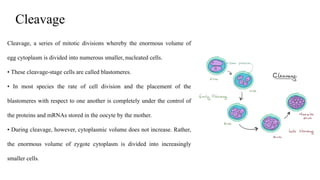
Cleavage, a series of mitotic divisions whereby the enormous volume of
egg cytoplasm is divided into numerous smaller, nucleated cells.
• These cleavage-stage cells are called blastomeres.
• In most species the rate of cell division and the placement of the
blastomeres with respect to one another is completely under the control of
the proteins and mRNAs stored in the oocyte by the mother.
• During cleavage, however, cytoplasmic volume does not increase. Rather,
the enormous volume of zygote cytoplasm is divided into increasingly
smaller cells.
Cleavage
Fertilization ………………………..…………..Cleavage
• The transition from fertilization to cleavage is caused by the activation of
mitosis promoting factor/Maturation-promoting factor (MPF).
One consequence of this rapid cell division is that the ratio of cytoplasmic to nuclear volume gets increasingly smaller as
cleavage progresses.
• This decrease in the cytoplasmic to nuclear volume ratio is crucial in timing the activation of certain genes.
• For example, in the frog Xenopus laevis, transcription of new messages is not activated until after 12 divisions. At that time, the
rate of cleavage decreases, the blastomeres become motile, and nuclear genes begin to be transcribed. This stage is called the mid-
blastula transition.
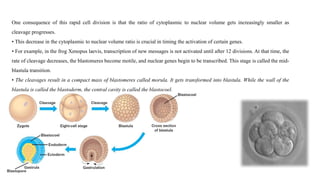
• The cleavages result in a compact mass of blastomeres called morula. It gets transformed into blastula. While the wall of the
blastula is called the blastoderm, the central cavity is called the blastocoel.
Influence of yolk on EMBRYONIC CLEAVAGE
Yolk is needed for embryonic development.
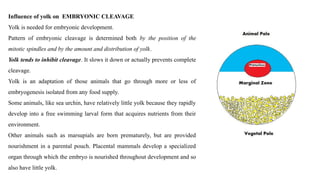
Pattern of embryonic cleavage is determined both by the position of the
mitotic spindles and by the amount and distribution of yolk.
Yolk tends to inhibit cleavage. It slows it down or actually prevents complete
cleavage.
Yolk is an adaptation of those animals that go through more or less of
embryogenesis isolated from any food supply.
Some animals, like sea urchin, have relatively little yolk because they rapidly
develop into a free swimming larval form that acquires nutrients from their
environment.
Other animals such as marsupials are born prematurely, but are provided
nourishment in a parental pouch. Placental mammals develop a specialized
organ through which the embryo is nourished throughout development and so
also have little yolk.
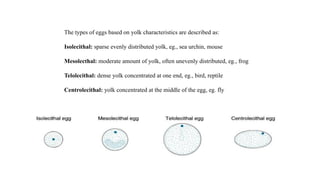
The types of eggs based on yolk characteristics are described as:
Isolecithal: sparse evenly distributed yolk, eg., sea urchin, mouse
Mesolecthal: moderate amount of yolk, often unevenly distributed, eg., frog
Telolecithal: dense yolk concentrated at one end, eg., bird, reptile
Centrolecithal: yolk concentrated at the middle of the egg, eg. fly
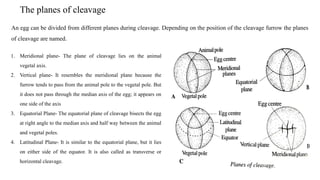
The planes of cleavage
An egg can be divided from different planes during cleavage. Depending on the position of the cleavage furrow the planes
of cleavage are named.
1. Meridional plane- The plane of cleavage lies on the animal
vegetal axis.
2. Vertical plane- It resembles the meridional plane because the
furrow tends to pass from the animal pole to the vegetal pole. But
it does not pass through the median axis of the egg; it appears on
one side of the axis
3. Equatorial Plane- The equatorial plane of cleavage bisects the egg
at right angle to the median axis and half way between the animal
and vegetal poles.
4. Latitudinal Plane- It is similar to the equatorial plane, but it lies
on either side of the equator. It is also called as transverse or
horizontal cleavage.
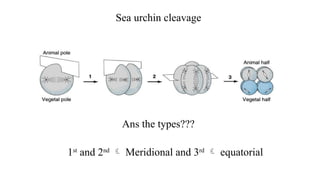
Sea urchin cleavage
Ans the types???
1st
and 2nd
 Meridional and 3rd
 equatorial
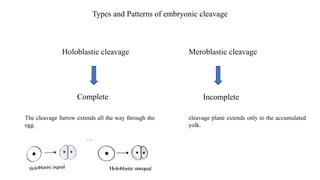
Types and Patterns of embryonic cleavage
Holoblastic cleavage Meroblastic cleavage
Complete Incomplete
The cleavage furrow extends all the way through the
egg.
cleavage plane extends only to the accumulated
yolk.
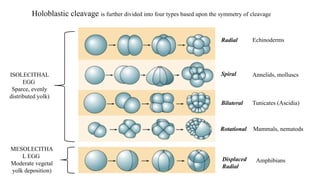
Holoblastic cleavage is further divided into four types based upon the symmetry of cleavage
Radial
Spiral
Bilateral
Rotational
Echinoderms
Annelids, molluscs
Tunicates (Ascidia)
Mammals, nematods
Displaced
Radial
Amphibians
ISOLECITHAL
EGG
Sparce, evenly
distributed yolk)
MESOLECITHA
L EGG
Moderate vegetal
yolk deposition)
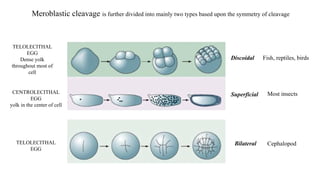
Meroblastic cleavage is further divided into mainly two types based upon the symmetry of cleavage
Discoidal Fish, reptiles, birds
Superficial Most insects
TELOLECITHAL
EGG
Dense yolk
throughout most of
cell
CENTROLECITHAL
EGG
yolk in the center of cell
TELOLECITHAL
EGG
Bilateral Cephalopod
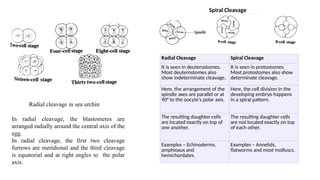
Radial cleavage in sea urchin
In radial cleavage, the blastomeres are
arranged radially around the central axis of the
egg.
In radial cleavage, the first two cleavage
furrows are meridional and the third cleavage
is equatorial and at right angles to the polar
axis.
Radial Cleavage Spiral Cleavage
It is seen in deuterostomes.
Most deuterostomes also
show indeterminate cleavage.
It is seen in protostomes.
Most protostomes also show
determinate cleavage.
Here, the arrangement of the
spindle axes are parallel or at
90° to the oocyte’s polar axis.
Here, the cell division in the
developing embryo happens
in a spiral pattern.
The resulting daughter cells
are located exactly on top of
one another.
The resulting daughter cells
are not located exactly on top
of each other.
Examples – Echinoderms,
amphioxus and
hemichordates.
Examples – Annelids,
flatworms and most molluscs.
Spiral Cleavage
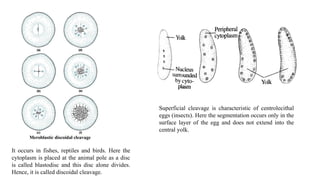
Superficial cleavage is characteristic of centrolecithal
eggs (insects). Here the segmentation occurs only in the
surface layer of the egg and does not extend into the
central yolk.
It occurs in fishes, reptiles and birds. Here the
cytoplasm is placed at the animal pole as a disc
is called blastodisc and this disc alone divides.
Hence, it is called discoidal cleavage.

cleavage and its types functions and pptx

  • 2.
    Cleavage, a seriesof mitotic divisions whereby the enormous volume of egg cytoplasm is divided into numerous smaller, nucleated cells. • These cleavage-stage cells are called blastomeres. • In most species the rate of cell division and the placement of the blastomeres with respect to one another is completely under the control of the proteins and mRNAs stored in the oocyte by the mother. • During cleavage, however, cytoplasmic volume does not increase. Rather, the enormous volume of zygote cytoplasm is divided into increasingly smaller cells. Cleavage
  • 3.
    Fertilization ………………………..…………..Cleavage • Thetransition from fertilization to cleavage is caused by the activation of mitosis promoting factor/Maturation-promoting factor (MPF).
  • 4.
    One consequence ofthis rapid cell division is that the ratio of cytoplasmic to nuclear volume gets increasingly smaller as cleavage progresses. • This decrease in the cytoplasmic to nuclear volume ratio is crucial in timing the activation of certain genes. • For example, in the frog Xenopus laevis, transcription of new messages is not activated until after 12 divisions. At that time, the rate of cleavage decreases, the blastomeres become motile, and nuclear genes begin to be transcribed. This stage is called the mid- blastula transition. • The cleavages result in a compact mass of blastomeres called morula. It gets transformed into blastula. While the wall of the blastula is called the blastoderm, the central cavity is called the blastocoel.
  • 5.
    Influence of yolkon EMBRYONIC CLEAVAGE Yolk is needed for embryonic development. Pattern of embryonic cleavage is determined both by the position of the mitotic spindles and by the amount and distribution of yolk. Yolk tends to inhibit cleavage. It slows it down or actually prevents complete cleavage. Yolk is an adaptation of those animals that go through more or less of embryogenesis isolated from any food supply. Some animals, like sea urchin, have relatively little yolk because they rapidly develop into a free swimming larval form that acquires nutrients from their environment. Other animals such as marsupials are born prematurely, but are provided nourishment in a parental pouch. Placental mammals develop a specialized organ through which the embryo is nourished throughout development and so also have little yolk.
  • 6.
    The types ofeggs based on yolk characteristics are described as: Isolecithal: sparse evenly distributed yolk, eg., sea urchin, mouse Mesolecthal: moderate amount of yolk, often unevenly distributed, eg., frog Telolecithal: dense yolk concentrated at one end, eg., bird, reptile Centrolecithal: yolk concentrated at the middle of the egg, eg. fly
  • 7.
    The planes ofcleavage An egg can be divided from different planes during cleavage. Depending on the position of the cleavage furrow the planes of cleavage are named. 1. Meridional plane- The plane of cleavage lies on the animal vegetal axis. 2. Vertical plane- It resembles the meridional plane because the furrow tends to pass from the animal pole to the vegetal pole. But it does not pass through the median axis of the egg; it appears on one side of the axis 3. Equatorial Plane- The equatorial plane of cleavage bisects the egg at right angle to the median axis and half way between the animal and vegetal poles. 4. Latitudinal Plane- It is similar to the equatorial plane, but it lies on either side of the equator. It is also called as transverse or horizontal cleavage.
  • 8.
    Sea urchin cleavage Ansthe types??? 1st and 2nd  Meridional and 3rd  equatorial
  • 9.
    Types and Patternsof embryonic cleavage Holoblastic cleavage Meroblastic cleavage Complete Incomplete The cleavage furrow extends all the way through the egg. cleavage plane extends only to the accumulated yolk.
  • 10.
    Holoblastic cleavage isfurther divided into four types based upon the symmetry of cleavage Radial Spiral Bilateral Rotational Echinoderms Annelids, molluscs Tunicates (Ascidia) Mammals, nematods Displaced Radial Amphibians ISOLECITHAL EGG Sparce, evenly distributed yolk) MESOLECITHA L EGG Moderate vegetal yolk deposition)
  • 11.
    Meroblastic cleavage isfurther divided into mainly two types based upon the symmetry of cleavage Discoidal Fish, reptiles, birds Superficial Most insects TELOLECITHAL EGG Dense yolk throughout most of cell CENTROLECITHAL EGG yolk in the center of cell TELOLECITHAL EGG Bilateral Cephalopod
  • 12.
    Radial cleavage insea urchin In radial cleavage, the blastomeres are arranged radially around the central axis of the egg. In radial cleavage, the first two cleavage furrows are meridional and the third cleavage is equatorial and at right angles to the polar axis. Radial Cleavage Spiral Cleavage It is seen in deuterostomes. Most deuterostomes also show indeterminate cleavage. It is seen in protostomes. Most protostomes also show determinate cleavage. Here, the arrangement of the spindle axes are parallel or at 90° to the oocyte’s polar axis. Here, the cell division in the developing embryo happens in a spiral pattern. The resulting daughter cells are located exactly on top of one another. The resulting daughter cells are not located exactly on top of each other. Examples – Echinoderms, amphioxus and hemichordates. Examples – Annelids, flatworms and most molluscs. Spiral Cleavage
  • 13.
    Superficial cleavage ischaracteristic of centrolecithal eggs (insects). Here the segmentation occurs only in the surface layer of the egg and does not extend into the central yolk. It occurs in fishes, reptiles and birds. Here the cytoplasm is placed at the animal pole as a disc is called blastodisc and this disc alone divides. Hence, it is called discoidal cleavage.

Editor's Notes

  • #12 The blastopore is the first opening in the embryo – the point of invagination during gastrulation. The blastopore will eventually become either the mouth or the anus. The blastopore in a protostome develops into a mouth, whereas the blastopore in deuterostomes develops into an anal opening.