Recycling
Why It Matters
By: Zachary Smith
What is Recycling?
• The act of collecting, sorting, and
remanufacturing or converting used or waste
products into new materials
• Series of steps involved
• Common recyclables: aluminum cans, glass
bottles, and plastic bottles
Process of Recycling
• Three steps: collecting and sorting,
manufacturing, and selling
– Collecting and sorting: gathering and categorizing
all recyclable materials respectively
– Manufacturing: Products are broken down and
used to create new materials
– Selling: Consumers buy recycled goods
• “Closes the loop”
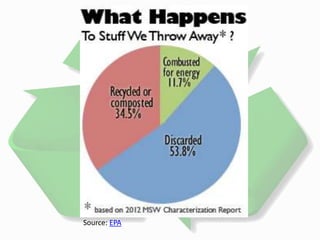
Recycling Statistics
• United States – average waste = 200 million tons
per year
• Recycling rate = 34%
– Aluminum = 58.1% rate
– Plastic = 28% rate
• 20 recycled cans for one new can
• Recycled plastic – 84% reduction in energy use
Source: EPA
Benefits of Recycling
• Reduces waste in landfills
• Conserves natural resources
• Prevents pollution
• Saves energy
• New jobs
• Sustainable future
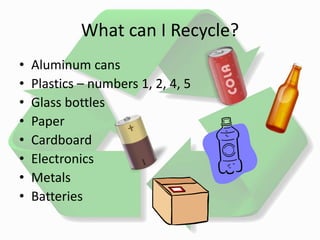
What can I Recycle?
• Aluminum cans
• Plastics – numbers 1, 2, 4, 5
• Glass bottles
• Paper
• Cardboard
• Electronics
• Metals
• Batteries
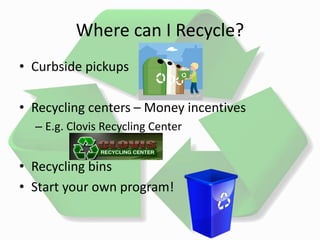
Where can I Recycle?
• Curbside pickups
• Recycling centers – Money incentives
– E.g. Clovis Recycling Center
• Recycling bins
• Start your own program!
Why does it matter?
• Save the Earth
• Save our resources
• Decrease emissions
• Less Waste
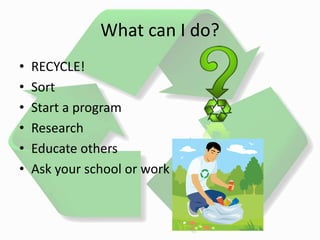
What can I do?
• RECYCLE!
• Sort
• Start a program
• Research
• Educate others
• Ask your school or work
Resources
• EPA Website
• Waste Management
• “Benefits of Recycling”
Works Cited
• 1. Environmental Protection Agency (EPA)
– (http://www2.epa.gov/recycle/recycling-basics)
• Waste Management
– (http://www.wm.com/thinkgreen/what-can-i-recycle.jsp)
• Benefits of Recycling
– (http://www.benefits-of-
recycling.com/whyisrecyclingimportant/)
• Keep America Beautiful
– (http://www.kab.org/site/PageServer?pagename=recycling_fact
s_and_stats)
• University of Oregon
– (http://pages.uoregon.edu/recycle/after_collection.html#when)

Recycling

  • 1.
  • 2.
    What is Recycling? •The act of collecting, sorting, and remanufacturing or converting used or waste products into new materials • Series of steps involved • Common recyclables: aluminum cans, glass bottles, and plastic bottles
  • 3.
    Process of Recycling •Three steps: collecting and sorting, manufacturing, and selling – Collecting and sorting: gathering and categorizing all recyclable materials respectively – Manufacturing: Products are broken down and used to create new materials – Selling: Consumers buy recycled goods • “Closes the loop”
  • 4.
    Recycling Statistics • UnitedStates – average waste = 200 million tons per year • Recycling rate = 34% – Aluminum = 58.1% rate – Plastic = 28% rate • 20 recycled cans for one new can • Recycled plastic – 84% reduction in energy use
  • 5.
  • 6.
    Benefits of Recycling •Reduces waste in landfills • Conserves natural resources • Prevents pollution • Saves energy • New jobs • Sustainable future
  • 7.
    What can IRecycle? • Aluminum cans • Plastics – numbers 1, 2, 4, 5 • Glass bottles • Paper • Cardboard • Electronics • Metals • Batteries
  • 8.
    Where can IRecycle? • Curbside pickups • Recycling centers – Money incentives – E.g. Clovis Recycling Center • Recycling bins • Start your own program!
  • 9.
    Why does itmatter? • Save the Earth • Save our resources • Decrease emissions • Less Waste
  • 10.
    What can Ido? • RECYCLE! • Sort • Start a program • Research • Educate others • Ask your school or work
  • 11.
    Resources • EPA Website •Waste Management • “Benefits of Recycling”
  • 12.
    Works Cited • 1.Environmental Protection Agency (EPA) – (http://www2.epa.gov/recycle/recycling-basics) • Waste Management – (http://www.wm.com/thinkgreen/what-can-i-recycle.jsp) • Benefits of Recycling – (http://www.benefits-of- recycling.com/whyisrecyclingimportant/) • Keep America Beautiful – (http://www.kab.org/site/PageServer?pagename=recycling_fact s_and_stats) • University of Oregon – (http://pages.uoregon.edu/recycle/after_collection.html#when)