Title of Lesson    Clay Milagros
Art, Grade Level   K12345
Objective(s)       Students will:
                        • demonstrate a recognition of the meaning of a milagro.
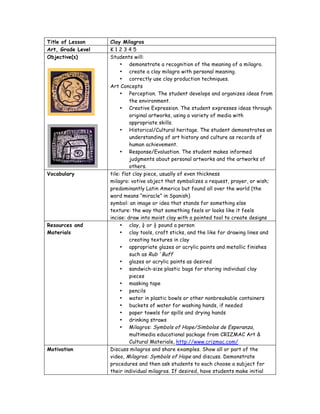
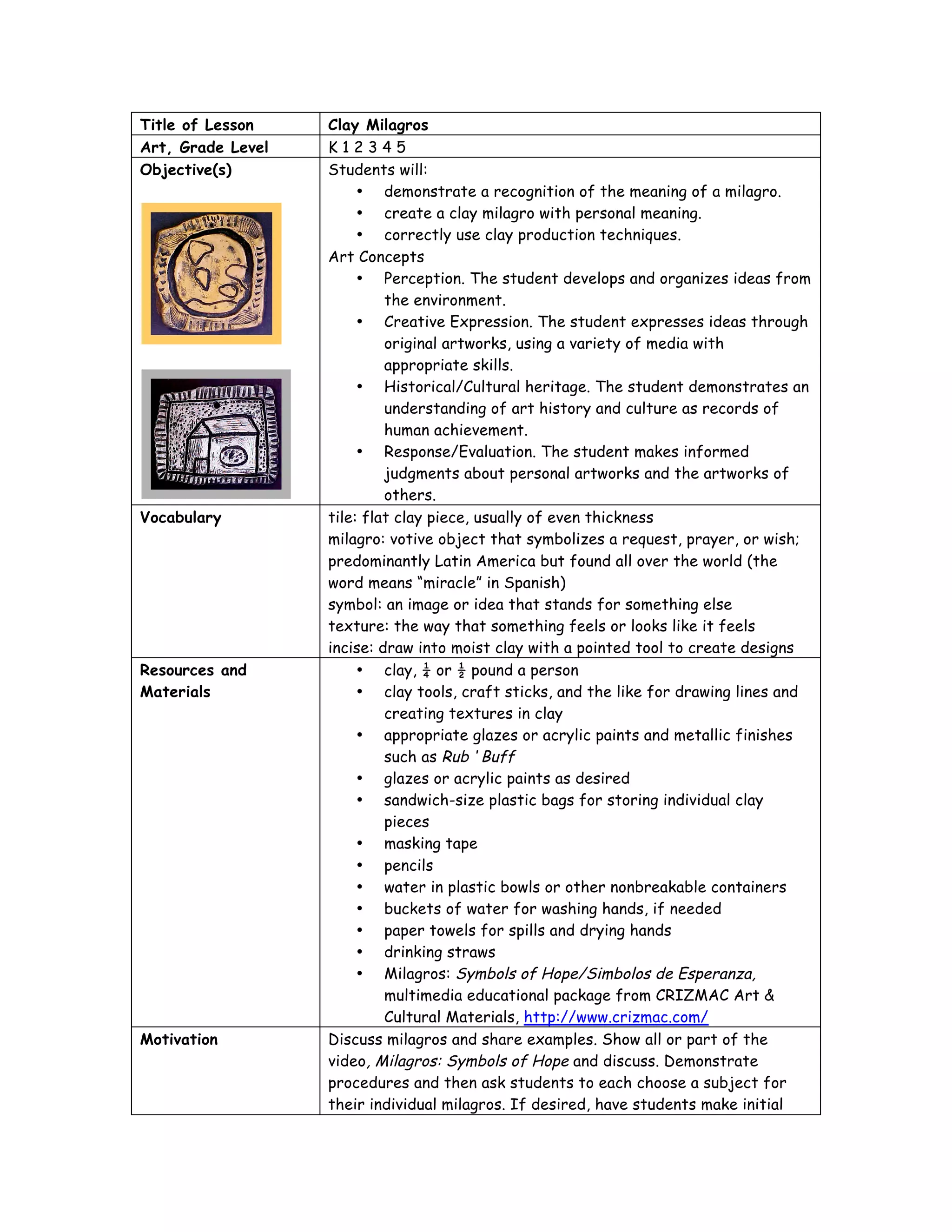
                        • create a clay milagro with personal meaning.
                        • correctly use clay production techniques.
                   Art Concepts
                        • Perception. The student develops and organizes ideas from
                            the environment.
                        • Creative Expression. The student expresses ideas through
                            original artworks, using a variety of media with
                            appropriate skills.
                        • Historical/Cultural heritage. The student demonstrates an
                            understanding of art history and culture as records of
                            human achievement.
                        • Response/Evaluation. The student makes informed
                            judgments about personal artworks and the artworks of
                            others.
Vocabulary         tile: flat clay piece, usually of even thickness
                   milagro: votive object that symbolizes a request, prayer, or wish;
                   predominantly Latin America but found all over the world (the
                   word means “miracle” in Spanish)
                   symbol: an image or idea that stands for something else
                   texture: the way that something feels or looks like it feels
                   incise: draw into moist clay with a pointed tool to create designs
Resources and           • clay, ¼ or ½ pound a person
Materials               • clay tools, craft sticks, and the like for drawing lines and
                            creating textures in clay
                        • appropriate glazes or acrylic paints and metallic finishes
                            such as Rub ‘ Buff
                        • glazes or acrylic paints as desired
                        • sandwich-size plastic bags for storing individual clay
                            pieces
                        • masking tape
                        • pencils
                        • water in plastic bowls or other nonbreakable containers
                        • buckets of water for washing hands, if needed
                        • paper towels for spills and drying hands
                        • drinking straws
                        • Milagros: Symbols of Hope/Simbolos de Esperanza,
                            multimedia educational package from CRIZMAC Art &
                            Cultural Materials, http://www.crizmac.com/
Motivation         Discuss milagros and share examples. Show all or part of the
                   video, Milagros: Symbols of Hope and discuss. Demonstrate
                   procedures and then ask students to each choose a subject for
                   their individual milagros. If desired, have students make initial
thumbnail sketches.
Procedures              Give each student a piece of clay and a plastic bag and direct
                        them to work with the clay on top of the bag. Have each student
                        use his/her palms to flatten a ball of clay into a thin, even
                        rectangular slab about the size and shape of a piece of bread.
                        Have students smooth the edges with water and then inscribe
                        their names on the back of each milagro. Tell students to draw
                        their chosen image on the clay, making designs very simple. Point
                        out that they can carve deeper lines and create textures on the
                        clay, especially on the background and on the edges of the tile. As
                        students work, circulate around the room and drill a hole in each
                        tile for hanging with a straw.

                        If students cannot finish the work in one class period, have them
                        wrap their tiles in their plastic bags and label them with their
                        names (write on masking tape and stick to the bag). Store the
                        bagged work until the next class.

                        When the tiles are finished, let them dry completely before
                        firing, glazing, or painting. Bisque-fired work can be painted with
                        acrylics and rubbed with Rub ‘n Buff or glazed and refired. Self-
                        hardening clay can be painted or sprayed with acrylics.
Assessment/Evaluation   To what extent did students:
                            • demonstrate recognition of the meaning of a milagro?
                            • create a clay milagro with personal meaning?
                            • correctly use clay production techniques?
Extensions                  • use papier mache or another modeling material instead of
                                 clay
                            • add low sides or borders to the tile to create a nicho
                                 (nicho) or retablo, other Latin American three-dimensional
                                 forms


Nancy Walkup
Editor, SchoolArts Magazine
www.schoolartsonline.com
nwalkup@netzero.net
Title of Lesson    Metal Milagros
Art, Grade Level   345
Objective(s)       Students will:
                       • demonstrate a recognition of the meaning of a milagro.
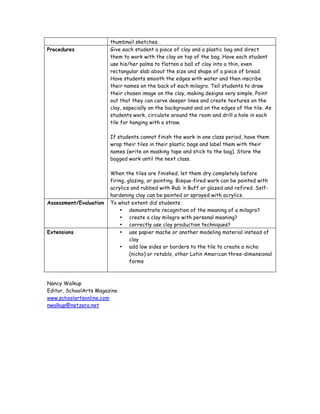
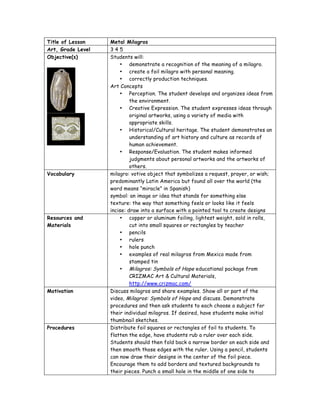
                       • create a foil milagro with personal meaning.
                       • correctly production techniques.
                   Art Concepts
                       • Perception. The student develops and organizes ideas from
                            the environment.
                       • Creative Expression. The student expresses ideas through
                            original artworks, using a variety of media with
                            appropriate skills.
                       • Historical/Cultural heritage. The student demonstrates an
                            understanding of art history and culture as records of
                            human achievement.
                       • Response/Evaluation. The student makes informed
                            judgments about personal artworks and the artworks of
                            others.
Vocabulary         milagro: votive object that symbolizes a request, prayer, or wish;
                   predominantly Latin America but found all over the world (the
                   word means “miracle” in Spanish)
                   symbol: an image or idea that stands for something else
                   texture: the way that something feels or looks like it feels
                   incise: draw into a surface with a pointed tool to create designs
Resources and          • copper or aluminum foiling, lightest weight, sold in rolls,
Materials                   cut into small squares or rectangles by teacher
                       • pencils
                       • rulers
                       • hole punch
                       • examples of real milagros from Mexico made from
                            stamped tin
                       • Milagros: Symbols of Hope educational package from
                            CRIZMAC Art & Cultural Materials,
                            http://www.crizmac.com/
Motivation         Discuss milagros and share examples. Show all or part of the
                   video, Milagros: Symbols of Hope and discuss. Demonstrate
                   procedures and then ask students to each choose a subject for
                   their individual milagros. If desired, have students make initial
                   thumbnail sketches.
Procedures         Distribute foil squares or rectangles of foil to students. To
                   flatten the edge, have students rub a ruler over each side.
                   Students should then fold back a narrow border on each side and
                   then smooth those edges with the ruler. Using a pencil, students
                   can now draw their designs in the center of the foil piece.
                   Encourage them to add borders and textured backgrounds to
                   their pieces. Punch a small hole in the middle of one side to
faciliate display.
Assessment/Evaluation   To what extent did students:
                            • demonstrate a recognition of the meaning of a milagro?
                            • create a foil milagro with personal meaning?
                            • correctly use production techniques?
Extensions                  • Make milagros from clay instead of foil.

Nancy Walkup
Editor, SchoolArts Magazine
www.schoolartsonline.com
nwalkup@netzero.net

Clay and metal milagros

  • 1.
    Title of Lesson Clay Milagros Art, Grade Level K12345 Objective(s) Students will: • demonstrate a recognition of the meaning of a milagro. • create a clay milagro with personal meaning. • correctly use clay production techniques. Art Concepts • Perception. The student develops and organizes ideas from the environment. • Creative Expression. The student expresses ideas through original artworks, using a variety of media with appropriate skills. • Historical/Cultural heritage. The student demonstrates an understanding of art history and culture as records of human achievement. • Response/Evaluation. The student makes informed judgments about personal artworks and the artworks of others. Vocabulary tile: flat clay piece, usually of even thickness milagro: votive object that symbolizes a request, prayer, or wish; predominantly Latin America but found all over the world (the word means “miracle” in Spanish) symbol: an image or idea that stands for something else texture: the way that something feels or looks like it feels incise: draw into moist clay with a pointed tool to create designs Resources and • clay, ¼ or ½ pound a person Materials • clay tools, craft sticks, and the like for drawing lines and creating textures in clay • appropriate glazes or acrylic paints and metallic finishes such as Rub ‘ Buff • glazes or acrylic paints as desired • sandwich-size plastic bags for storing individual clay pieces • masking tape • pencils • water in plastic bowls or other nonbreakable containers • buckets of water for washing hands, if needed • paper towels for spills and drying hands • drinking straws • Milagros: Symbols of Hope/Simbolos de Esperanza, multimedia educational package from CRIZMAC Art & Cultural Materials, http://www.crizmac.com/ Motivation Discuss milagros and share examples. Show all or part of the video, Milagros: Symbols of Hope and discuss. Demonstrate procedures and then ask students to each choose a subject for their individual milagros. If desired, have students make initial
  • 2.
    thumbnail sketches. Procedures Give each student a piece of clay and a plastic bag and direct them to work with the clay on top of the bag. Have each student use his/her palms to flatten a ball of clay into a thin, even rectangular slab about the size and shape of a piece of bread. Have students smooth the edges with water and then inscribe their names on the back of each milagro. Tell students to draw their chosen image on the clay, making designs very simple. Point out that they can carve deeper lines and create textures on the clay, especially on the background and on the edges of the tile. As students work, circulate around the room and drill a hole in each tile for hanging with a straw. If students cannot finish the work in one class period, have them wrap their tiles in their plastic bags and label them with their names (write on masking tape and stick to the bag). Store the bagged work until the next class. When the tiles are finished, let them dry completely before firing, glazing, or painting. Bisque-fired work can be painted with acrylics and rubbed with Rub ‘n Buff or glazed and refired. Self- hardening clay can be painted or sprayed with acrylics. Assessment/Evaluation To what extent did students: • demonstrate recognition of the meaning of a milagro? • create a clay milagro with personal meaning? • correctly use clay production techniques? Extensions • use papier mache or another modeling material instead of clay • add low sides or borders to the tile to create a nicho (nicho) or retablo, other Latin American three-dimensional forms Nancy Walkup Editor, SchoolArts Magazine www.schoolartsonline.com nwalkup@netzero.net
  • 3.
    Title of Lesson Metal Milagros Art, Grade Level 345 Objective(s) Students will: • demonstrate a recognition of the meaning of a milagro. • create a foil milagro with personal meaning. • correctly production techniques. Art Concepts • Perception. The student develops and organizes ideas from the environment. • Creative Expression. The student expresses ideas through original artworks, using a variety of media with appropriate skills. • Historical/Cultural heritage. The student demonstrates an understanding of art history and culture as records of human achievement. • Response/Evaluation. The student makes informed judgments about personal artworks and the artworks of others. Vocabulary milagro: votive object that symbolizes a request, prayer, or wish; predominantly Latin America but found all over the world (the word means “miracle” in Spanish) symbol: an image or idea that stands for something else texture: the way that something feels or looks like it feels incise: draw into a surface with a pointed tool to create designs Resources and • copper or aluminum foiling, lightest weight, sold in rolls, Materials cut into small squares or rectangles by teacher • pencils • rulers • hole punch • examples of real milagros from Mexico made from stamped tin • Milagros: Symbols of Hope educational package from CRIZMAC Art & Cultural Materials, http://www.crizmac.com/ Motivation Discuss milagros and share examples. Show all or part of the video, Milagros: Symbols of Hope and discuss. Demonstrate procedures and then ask students to each choose a subject for their individual milagros. If desired, have students make initial thumbnail sketches. Procedures Distribute foil squares or rectangles of foil to students. To flatten the edge, have students rub a ruler over each side. Students should then fold back a narrow border on each side and then smooth those edges with the ruler. Using a pencil, students can now draw their designs in the center of the foil piece. Encourage them to add borders and textured backgrounds to their pieces. Punch a small hole in the middle of one side to
  • 4.
    faciliate display. Assessment/Evaluation To what extent did students: • demonstrate a recognition of the meaning of a milagro? • create a foil milagro with personal meaning? • correctly use production techniques? Extensions • Make milagros from clay instead of foil. Nancy Walkup Editor, SchoolArts Magazine www.schoolartsonline.com nwalkup@netzero.net