




Kindergarten
TEKS: Kindergarten
(1) The fine arts incorporate the study of dance, music,
theatre, and the visual arts to offer unique experiences
and empower students to explore realities, relationships,
and ideas. These disciplines engage and motivate all
students through active learning, critical thinking, and
innovative problem solving. The fine arts develop
cognitive functioning and increase student academic
achievement, higher-order thinking, communication, and
collaboration skills, making the fine arts applicable to
college readiness, career opportunities, workplace
environments, social skills, and everyday life. Students
develop aesthetic and cultural awareness through
exploration, leading to creative expression. Creativity,
encouraged through the study of the fine arts, is
essential to nurture and develop the whole child.
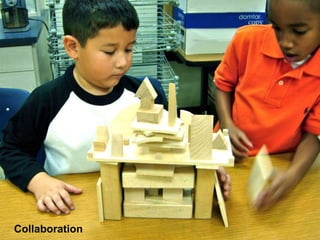
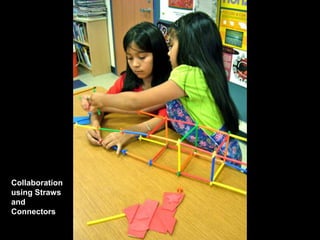
Collaboration
Collaboration
using Straws
and
Connectors
Four basic strands--Foundations: observation and
perception, creative expression, historical and cultural
relevance, and critical evaluation and response--provide
broad, unifying structures for organizing the knowledge and
skills students are expected to acquire. Each strand is of
equal value and may be presented in any order throughout
the year. Students rely on personal observations and
perceptions, which are developed through increasing visual
literacy and sensitivity to surroundings, communities,
memories, imaginings, and life experiences, as sources for
thinking about, planning, and creating original artworks.
Students communicate their thoughts and ideas with
innovation and creativity. Through art, students challenge
their imaginations, foster critical thinking, collaborate with
others, and build reflective skills. While exercising
meaningful problem-solving skills, students develop the
lifelong ability to make informed judgments.
Knowledge and Skills
(1)Foundations: observation and perception. The student
develops and expands visual literacy skills using critical
thinking, imagination, and the senses to observe and
explore the world by learning about, understanding, and
applying the elements of art, principles of design, and
expressive qualities. The student uses what the student
sees, knows, and has experienced as sources for
examining, understanding, and creating artworks. The
student is expected to:
(A)gather information from subjects in the environment
using the senses; and
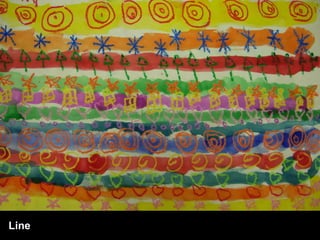
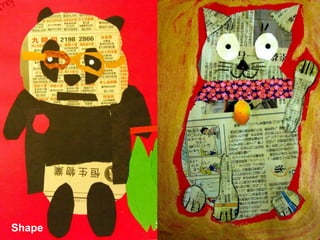
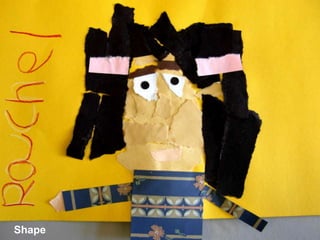
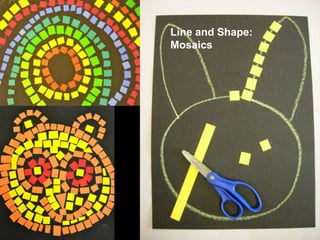
(B)identify the elements of art, including line, shape, color,
texture, and form, and the principles of design, including
repetition/pattern and balance, in the environment.
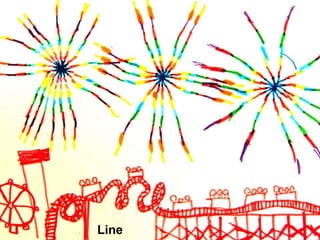
Line
Line
Line
ShapeShape
Shape
Line and Shape:
Mosaics
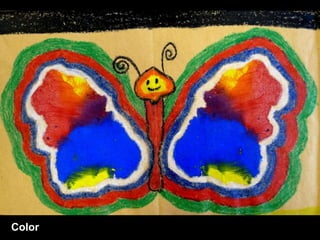
Color
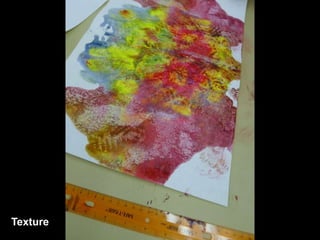
Texture
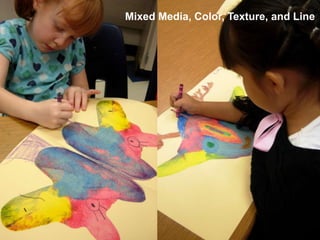
Mixed Media, Color, Texture, and Line
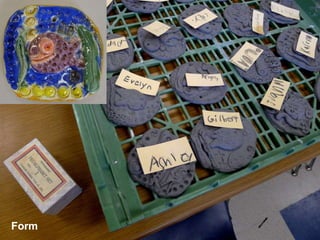
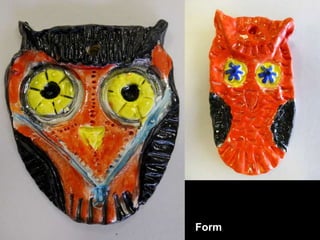
Form
Form
(2) Creative expression. The student communicates
ideas through original artworks using a variety of
media with appropriate skills. The student expresses
thoughts and ideas creatively while challenging the
imagination, fostering reflective thinking, and
developing disciplined effort and progressive
problem-solving skills. The student is expected to:
(A) create artworks using a variety of lines,
shapes, colors, textures, and forms;
(B) arrange components intuitively to create
artworks; and
(C) use a variety of materials to develop
manipulative skills while engaging in opportunities
for exploration through drawing, painting,
printmaking, constructing artworks, and sculpting,
including modeled forms.
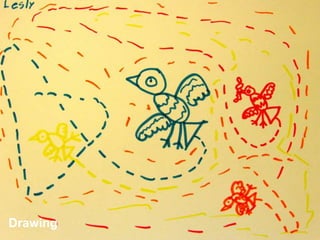
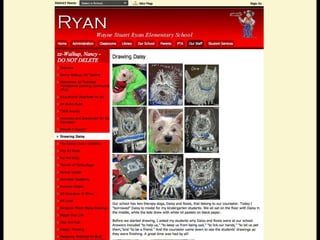
Drawing
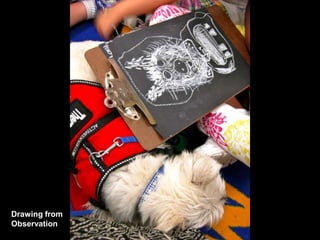
Drawing from
Observation
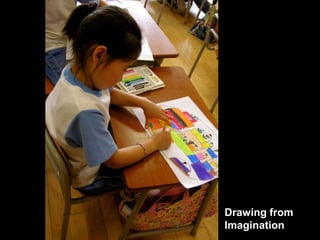
Drawing from
Imagination
Painting
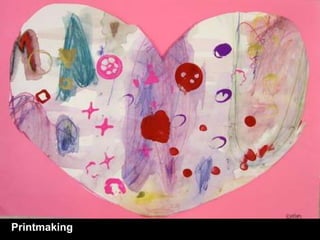
Printmaking
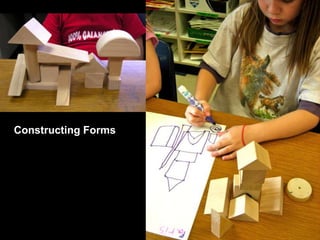
Constructing Forms
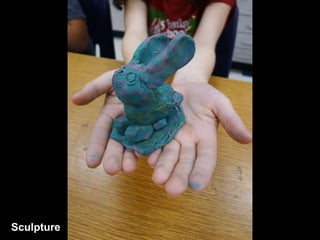
Sculpture
(3) Historical and cultural relevance. The student
demonstrates an understanding of art history and culture by
analyzing artistic styles, historical periods, and a variety of
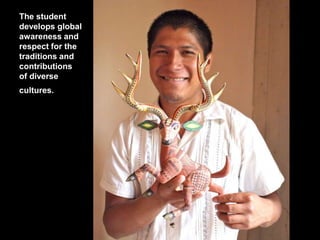
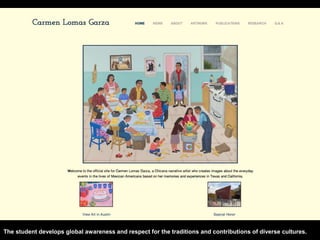
cultures. The student develops global awareness and respect
for the traditions and contributions of diverse cultures. The
student is expected to:
(A) identify simple subjects expressed in artworks;
(B) share ideas about personal experiences such as family
and friends and develop awareness and sensitivity to
differing experiences and opinions through artwork;
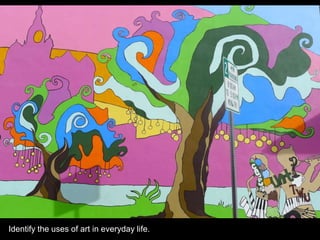
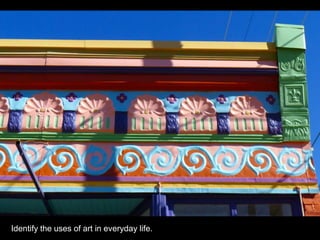
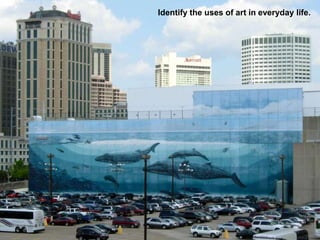
(C) identify the uses of art in everyday life; and
(D) relate visual art concepts to other disciplines.
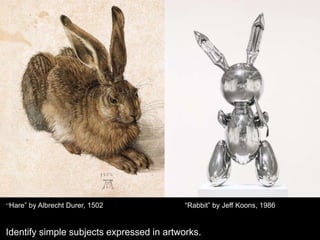
Identify simple subjects expressed in artworks.
“Hare” by Albrecht Durer, 1502 “Rabbit” by Jeff Koons, 1986
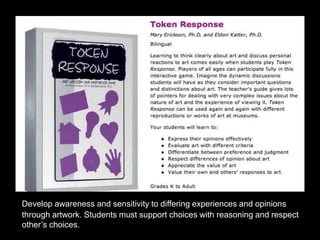
Develop awareness and sensitivity to differing experiences and opinions
through artwork. Students must support choices with reasoning and respect
other’s choices.
The student
develops global
awareness and
respect for the
traditions and
contributions
of diverse
cultures.
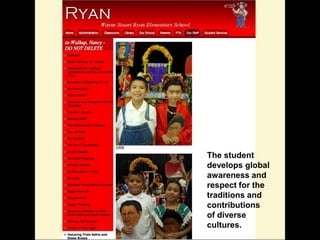
The student
develops global
awareness and
respect for the
traditions and
contributions
of diverse
cultures.
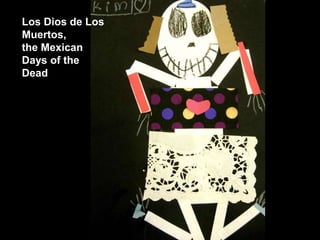
Los Dios de Los
Muertos,
the Mexican
Days of the
Dead
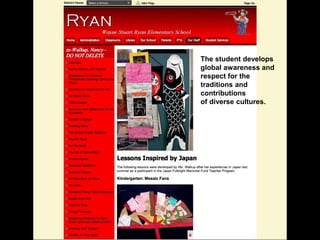
The student develops
global awareness and
respect for the
traditions and
contributions
of diverse cultures.
The student develops global awareness and respect for the traditions and contributions of diverse cultures.
Identify the uses of art in everyday life.
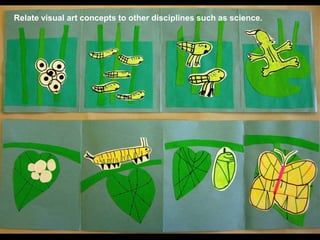
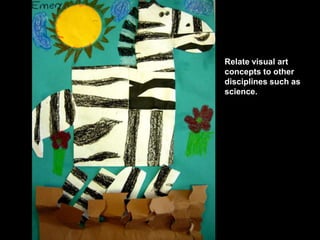
Relate visual art concepts to other disciplines such as science.
Relate visual art
concepts to other
disciplines such as
science.
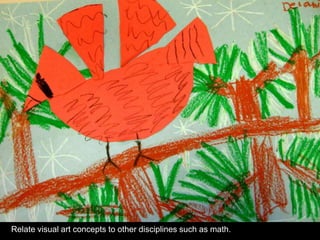
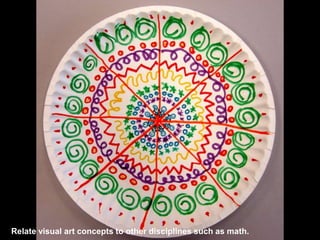
Relate visual art concepts to other disciplines such as math.
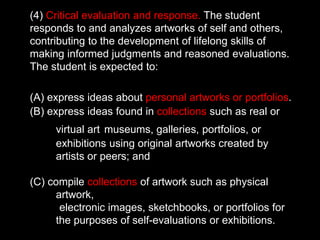
(4) Critical evaluation and response. The student
responds to and analyzes artworks of self and others,
contributing to the development of lifelong skills of
making informed judgments and reasoned evaluations.
The student is expected to:
(A) express ideas about personal artworks or portfolios.
(B) express ideas found in collections such as real or
virtual art museums, galleries, portfolios, or
exhibitions using original artworks created by
artists or peers; and
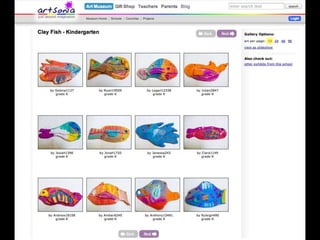
(C) compile collections of artwork such as physical
artwork,
electronic images, sketchbooks, or portfolios for
the purposes of self-evaluations or exhibitions.
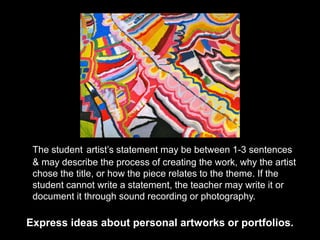
Express ideas about personal artworks or portfolios.
The student artist’s statement may be between 1-3 sentences
& may describe the process of creating the work, why the artist
chose the title, or how the piece relates to the theme. If the
student cannot write a statement, the teacher may write it or
document it through sound recording or photography.
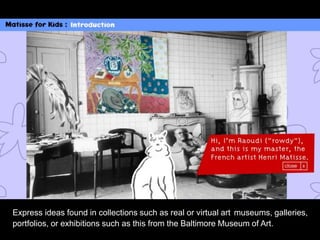
Express ideas found in collections such as real or virtual art museums, galleries,
portfolios, or exhibitions such as this from the Baltimore Museum of Art.
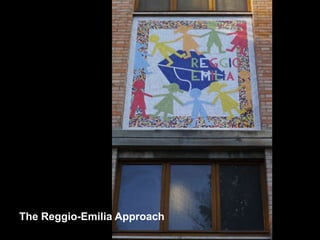
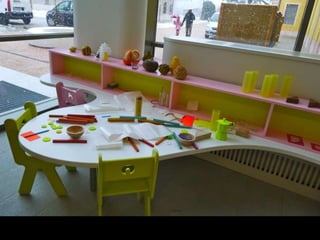
The Reggio-Emilia Approach
Explorations in Art, Kindergarten
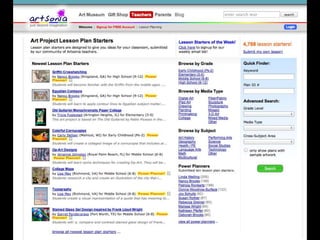
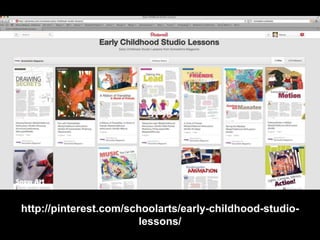
http://pinterest.com/schoolarts/early-childhood-studio-
lessons/
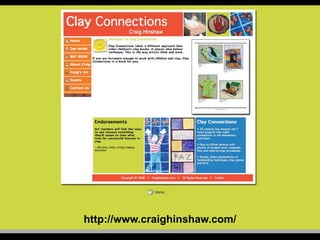
http://www.craighinshaw.com/
http://www.slideshare.net/nwalkup/

Art for Early Childhood

  • 1.
  • 2.
    TEKS: Kindergarten (1) Thefine arts incorporate the study of dance, music, theatre, and the visual arts to offer unique experiences and empower students to explore realities, relationships, and ideas. These disciplines engage and motivate all students through active learning, critical thinking, and innovative problem solving. The fine arts develop cognitive functioning and increase student academic achievement, higher-order thinking, communication, and collaboration skills, making the fine arts applicable to college readiness, career opportunities, workplace environments, social skills, and everyday life. Students develop aesthetic and cultural awareness through exploration, leading to creative expression. Creativity, encouraged through the study of the fine arts, is essential to nurture and develop the whole child.
  • 3.
  • 4.
  • 5.
    Four basic strands--Foundations:observation and perception, creative expression, historical and cultural relevance, and critical evaluation and response--provide broad, unifying structures for organizing the knowledge and skills students are expected to acquire. Each strand is of equal value and may be presented in any order throughout the year. Students rely on personal observations and perceptions, which are developed through increasing visual literacy and sensitivity to surroundings, communities, memories, imaginings, and life experiences, as sources for thinking about, planning, and creating original artworks. Students communicate their thoughts and ideas with innovation and creativity. Through art, students challenge their imaginations, foster critical thinking, collaborate with others, and build reflective skills. While exercising meaningful problem-solving skills, students develop the lifelong ability to make informed judgments.
  • 6.
    Knowledge and Skills (1)Foundations:observation and perception. The student develops and expands visual literacy skills using critical thinking, imagination, and the senses to observe and explore the world by learning about, understanding, and applying the elements of art, principles of design, and expressive qualities. The student uses what the student sees, knows, and has experienced as sources for examining, understanding, and creating artworks. The student is expected to: (A)gather information from subjects in the environment using the senses; and (B)identify the elements of art, including line, shape, color, texture, and form, and the principles of design, including repetition/pattern and balance, in the environment.
  • 7.
  • 8.
  • 9.
  • 10.
  • 11.
  • 12.
  • 13.
  • 14.
    Mixed Media, Color,Texture, and Line
  • 15.
  • 16.
  • 17.
    (2) Creative expression.The student communicates ideas through original artworks using a variety of media with appropriate skills. The student expresses thoughts and ideas creatively while challenging the imagination, fostering reflective thinking, and developing disciplined effort and progressive problem-solving skills. The student is expected to: (A) create artworks using a variety of lines, shapes, colors, textures, and forms; (B) arrange components intuitively to create artworks; and (C) use a variety of materials to develop manipulative skills while engaging in opportunities for exploration through drawing, painting, printmaking, constructing artworks, and sculpting, including modeled forms.
  • 18.
  • 19.
  • 21.
  • 22.
  • 23.
  • 24.
  • 25.
  • 26.
    (3) Historical andcultural relevance. The student demonstrates an understanding of art history and culture by analyzing artistic styles, historical periods, and a variety of cultures. The student develops global awareness and respect for the traditions and contributions of diverse cultures. The student is expected to: (A) identify simple subjects expressed in artworks; (B) share ideas about personal experiences such as family and friends and develop awareness and sensitivity to differing experiences and opinions through artwork; (C) identify the uses of art in everyday life; and (D) relate visual art concepts to other disciplines.
  • 27.
    Identify simple subjectsexpressed in artworks. “Hare” by Albrecht Durer, 1502 “Rabbit” by Jeff Koons, 1986
  • 28.
    Develop awareness andsensitivity to differing experiences and opinions through artwork. Students must support choices with reasoning and respect other’s choices.
  • 29.
    The student develops global awarenessand respect for the traditions and contributions of diverse cultures.
  • 30.
    The student develops global awarenessand respect for the traditions and contributions of diverse cultures.
  • 31.
    Los Dios deLos Muertos, the Mexican Days of the Dead
  • 32.
    The student develops globalawareness and respect for the traditions and contributions of diverse cultures.
  • 33.
    The student developsglobal awareness and respect for the traditions and contributions of diverse cultures.
  • 34.
    Identify the usesof art in everyday life.
  • 35.
    Identify the usesof art in everyday life.
  • 36.
    Identify the usesof art in everyday life.
  • 37.
    Identify the usesof art in everyday life.
  • 38.
    Relate visual artconcepts to other disciplines such as science.
  • 39.
    Relate visual art conceptsto other disciplines such as science.
  • 40.
    Relate visual artconcepts to other disciplines such as math.
  • 41.
    Relate visual artconcepts to other disciplines such as math.
  • 42.
    (4) Critical evaluationand response. The student responds to and analyzes artworks of self and others, contributing to the development of lifelong skills of making informed judgments and reasoned evaluations. The student is expected to: (A) express ideas about personal artworks or portfolios. (B) express ideas found in collections such as real or virtual art museums, galleries, portfolios, or exhibitions using original artworks created by artists or peers; and (C) compile collections of artwork such as physical artwork, electronic images, sketchbooks, or portfolios for the purposes of self-evaluations or exhibitions.
  • 43.
    Express ideas aboutpersonal artworks or portfolios. The student artist’s statement may be between 1-3 sentences & may describe the process of creating the work, why the artist chose the title, or how the piece relates to the theme. If the student cannot write a statement, the teacher may write it or document it through sound recording or photography.
  • 44.
    Express ideas foundin collections such as real or virtual art museums, galleries, portfolios, or exhibitions such as this from the Baltimore Museum of Art.
  • 48.
  • 51.
  • 52.
  • 53.
  • 54.