Arts & Knowledge
Art taught through Math, Science, History &
Literature.
Background
This curriculum is an Art curriculum that vicariously integrates
  academics into its lessons whether it be math, science, history, or
  Literature, while following an artist regimen that is
  natural, educational, and beneficial to the young mind.
This is a 31-32 week year-long curriculum for4thgrade students who attend a
  public school. This is is an elective course and will meet for 50 minutes one
  day a week.

-cost key: $= -$4    $$= -$10    $$$= +$10

*All Lessons Include PA standards- 9.1 A,B,C,D,E,F,H, and J. 9.2 A,B,C,D,E,F,G,J, and L. 9.3
   A,B,C,D,E, and F. and 9.4 B and C.
  * All lessons include Habits of Mind: Persisting, Thinking flexibly, Thinking about
   thinking, Striving for accuracy, Questioning and posing problems, Applying past
   knowledge, Thinking and communicating, Gathering data, Creating, Responding, Taking
   risks, Finding humor, Thinking interdependently, & Remaining open.
Introduction
      Week 1
The first week will be a general
 introduction to the class. We
 will introduce ourselves and
 explore the classroom and
 materials found in the
 classroom. We will also go over
 classroom rules and
 expectations of the students
 and the teacher. Furthermore,
 we will go over the outline of
 the curriculum; briefly
 explaining the overview of the
 class.
Play Dough Creation: The Color Wheel
      Week 2-4
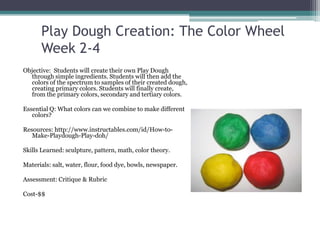
Objective: Students will create their own Play Dough
  through simple ingredients. Students will then add the
  colors of the spectrum to samples of their created dough,
  creating primary colors. Students will finally create,
  from the primary colors, secondary and tertiary colors.

Essential Q: What colors can we combine to make different
   colors?

Resources: http://www.instructables.com/id/How-to-
   Make-Playdough-Play-doh/

Skills Learned: sculpture, pattern, math, color theory.

Materials: salt, water, flour, food dye, bowls, newspaper.

Assessment: Critique & Rubric

Cost-$$
Play Dough Creation: Animal Sculpture
         Week5-6
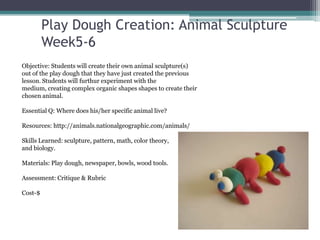
Objective: Students will create their own animal sculpture(s)
out of the play dough that they have just created the previous
lesson. Students will furthur experiment with the
medium, creating complex organic shapes shapes to create their
chosen animal.

Essential Q: Where does his/her specific animal live?

Resources: http://animals.nationalgeographic.com/animals/

Skills Learned: sculpture, pattern, math, color theory,
and biology.

Materials: Play dough, newspaper, bowls, wood tools.

Assessment: Critique & Rubric

Cost-$
3-D Abstract Art Inspired by Frank Stella
    Weeks 7-10
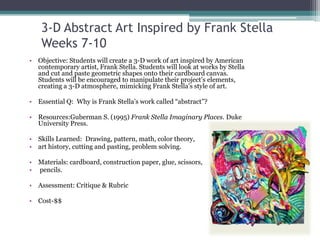
• Objective: Students will create a 3-D work of art inspired by American
  contemporary artist, Frank Stella. Students will look at works by Stella
  and cut and paste geometric shapes onto their cardboard canvas.
  Students will be encouraged to manipulate their project’s elements,
  creating a 3-D atmosphere, mimicking Frank Stella’s style of art.

• Essential Q: Why is Frank Stella’s work called “abstract”?

• Resources:Guberman S. (1995) Frank Stella Imaginary Places. Duke
  University Press.

• Skills Learned: Drawing, pattern, math, color theory,
• art history, cutting and pasting, problem solving.

• Materials: cardboard, construction paper, glue, scissors,
• pencils.

• Assessment: Critique & Rubric

• Cost-$$
Jackson Pollack Collaborative
      Weeks 11-14
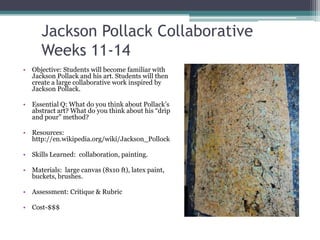
• Objective: Students will become familiar with
  Jackson Pollack and his art. Students will then
  create a large collaborative work inspired by
  Jackson Pollack.

• Essential Q: What do you think about Pollack’s
  abstract art? What do you think about his “drip
  and pour” method?

• Resources:
  http://en.wikipedia.org/wiki/Jackson_Pollock

• Skills Learned: collaboration, painting.

• Materials: large canvas (8x10 ft), latex paint,
  buckets, brushes.

• Assessment: Critique & Rubric

• Cost-$$$
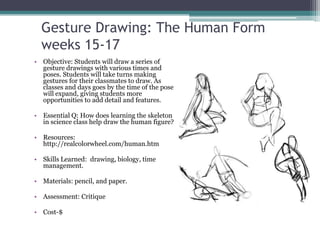
Gesture Drawing: The Human Form
  weeks 15-17
• Objective: Students will draw a series of
  gesture drawings with various times and
  poses. Students will take turns making
  gestures for their classmates to draw. As
  classes and days goes by the time of the pose
  will expand, giving students more
  opportunities to add detail and features.

• Essential Q: How does learning the skeleton
  in science class help draw the human figure?

• Resources:
  http://realcolorwheel.com/human.htm

• Skills Learned: drawing, biology, time
  management.

• Materials: pencil, and paper.

• Assessment: Critique

• Cost-$
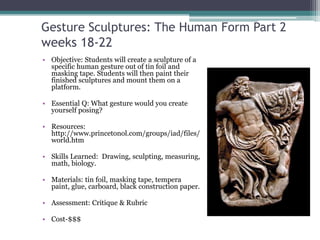
Gesture Sculptures: The Human Form Part 2
weeks 18-22
• Objective: Students will create a sculpture of a
  specific human gesture out of tin foil and
  masking tape. Students will then paint their
  finished sculptures and mount them on a
  platform.

• Essential Q: What gesture would you create
  yourself posing?

• Resources:
  http://www.princetonol.com/groups/iad/files/
  world.htm

• Skills Learned: Drawing, sculpting, measuring,
  math, biology.

• Materials: tin foil, masking tape, tempera
  paint, glue, carboard, black construction paper.

• Assessment: Critique & Rubric

• Cost-$$$
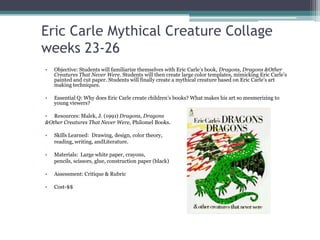
Eric Carle Mythical Creature Collage
weeks 23-26
•   Objective: Students will familiarize themselves with Eric Carle’s book, Dragons, Dragons &Other
    Creatures That Never Were. Students will then create large color templates, mimicking Eric Carle’s
    painted and cut paper. Students will finally create a mythical creature based on Eric Carle’s art
    making techniques.

•   Essential Q: Why does Eric Carle create children’s books? What makes his art so mesmerizing to
    young viewers?

• Resources: Malek, J. (1991) Dragons, Dragons
&Other Creatures That Never Were, Philomel Books.

•   Skills Learned: Drawing, design, color theory,
    reading, writing, andLiterature.

•   Materials: Large white paper, crayons,
    pencils, scissors, glue, construction paper (black)

•   Assessment: Critique & Rubric

•   Cost-$$
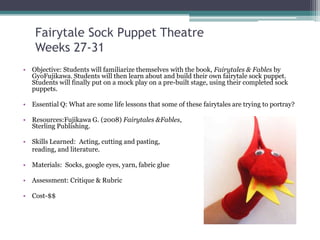
Fairytale Sock Puppet Theatre
    Weeks 27-31
• Objective: Students will familiarize themselves with the book, Fairytales & Fables by
  GyoFujikawa. Students will then learn about and build their own fairytale sock puppet.
  Students will finally put on a mock play on a pre-built stage, using their completed sock
  puppets.

• Essential Q: What are some life lessons that some of these fairytales are trying to portray?

• Resources:Fujikawa G. (2008) Fairytales &Fables,
  Sterling Publishing.

• Skills Learned: Acting, cutting and pasting,
  reading, and literature.

• Materials: Socks, google eyes, yarn, fabric glue

• Assessment: Critique & Rubric

• Cost-$$
Final Critique
    Week 32
• This week is dedicated to a one on one critique
  with each student and for last minute late work
  to be turned in.

Elementarycurriculum

  • 1.
    Arts & Knowledge Arttaught through Math, Science, History & Literature.
  • 2.
    Background This curriculum isan Art curriculum that vicariously integrates academics into its lessons whether it be math, science, history, or Literature, while following an artist regimen that is natural, educational, and beneficial to the young mind. This is a 31-32 week year-long curriculum for4thgrade students who attend a public school. This is is an elective course and will meet for 50 minutes one day a week. -cost key: $= -$4 $$= -$10 $$$= +$10 *All Lessons Include PA standards- 9.1 A,B,C,D,E,F,H, and J. 9.2 A,B,C,D,E,F,G,J, and L. 9.3 A,B,C,D,E, and F. and 9.4 B and C. * All lessons include Habits of Mind: Persisting, Thinking flexibly, Thinking about thinking, Striving for accuracy, Questioning and posing problems, Applying past knowledge, Thinking and communicating, Gathering data, Creating, Responding, Taking risks, Finding humor, Thinking interdependently, & Remaining open.
  • 3.
    Introduction Week 1 The first week will be a general introduction to the class. We will introduce ourselves and explore the classroom and materials found in the classroom. We will also go over classroom rules and expectations of the students and the teacher. Furthermore, we will go over the outline of the curriculum; briefly explaining the overview of the class.
  • 4.
    Play Dough Creation:The Color Wheel Week 2-4 Objective: Students will create their own Play Dough through simple ingredients. Students will then add the colors of the spectrum to samples of their created dough, creating primary colors. Students will finally create, from the primary colors, secondary and tertiary colors. Essential Q: What colors can we combine to make different colors? Resources: http://www.instructables.com/id/How-to- Make-Playdough-Play-doh/ Skills Learned: sculpture, pattern, math, color theory. Materials: salt, water, flour, food dye, bowls, newspaper. Assessment: Critique & Rubric Cost-$$
  • 5.
    Play Dough Creation:Animal Sculpture Week5-6 Objective: Students will create their own animal sculpture(s) out of the play dough that they have just created the previous lesson. Students will furthur experiment with the medium, creating complex organic shapes shapes to create their chosen animal. Essential Q: Where does his/her specific animal live? Resources: http://animals.nationalgeographic.com/animals/ Skills Learned: sculpture, pattern, math, color theory, and biology. Materials: Play dough, newspaper, bowls, wood tools. Assessment: Critique & Rubric Cost-$
  • 6.
    3-D Abstract ArtInspired by Frank Stella Weeks 7-10 • Objective: Students will create a 3-D work of art inspired by American contemporary artist, Frank Stella. Students will look at works by Stella and cut and paste geometric shapes onto their cardboard canvas. Students will be encouraged to manipulate their project’s elements, creating a 3-D atmosphere, mimicking Frank Stella’s style of art. • Essential Q: Why is Frank Stella’s work called “abstract”? • Resources:Guberman S. (1995) Frank Stella Imaginary Places. Duke University Press. • Skills Learned: Drawing, pattern, math, color theory, • art history, cutting and pasting, problem solving. • Materials: cardboard, construction paper, glue, scissors, • pencils. • Assessment: Critique & Rubric • Cost-$$
  • 7.
    Jackson Pollack Collaborative Weeks 11-14 • Objective: Students will become familiar with Jackson Pollack and his art. Students will then create a large collaborative work inspired by Jackson Pollack. • Essential Q: What do you think about Pollack’s abstract art? What do you think about his “drip and pour” method? • Resources: http://en.wikipedia.org/wiki/Jackson_Pollock • Skills Learned: collaboration, painting. • Materials: large canvas (8x10 ft), latex paint, buckets, brushes. • Assessment: Critique & Rubric • Cost-$$$
  • 8.
    Gesture Drawing: TheHuman Form weeks 15-17 • Objective: Students will draw a series of gesture drawings with various times and poses. Students will take turns making gestures for their classmates to draw. As classes and days goes by the time of the pose will expand, giving students more opportunities to add detail and features. • Essential Q: How does learning the skeleton in science class help draw the human figure? • Resources: http://realcolorwheel.com/human.htm • Skills Learned: drawing, biology, time management. • Materials: pencil, and paper. • Assessment: Critique • Cost-$
  • 9.
    Gesture Sculptures: TheHuman Form Part 2 weeks 18-22 • Objective: Students will create a sculpture of a specific human gesture out of tin foil and masking tape. Students will then paint their finished sculptures and mount them on a platform. • Essential Q: What gesture would you create yourself posing? • Resources: http://www.princetonol.com/groups/iad/files/ world.htm • Skills Learned: Drawing, sculpting, measuring, math, biology. • Materials: tin foil, masking tape, tempera paint, glue, carboard, black construction paper. • Assessment: Critique & Rubric • Cost-$$$
  • 10.
    Eric Carle MythicalCreature Collage weeks 23-26 • Objective: Students will familiarize themselves with Eric Carle’s book, Dragons, Dragons &Other Creatures That Never Were. Students will then create large color templates, mimicking Eric Carle’s painted and cut paper. Students will finally create a mythical creature based on Eric Carle’s art making techniques. • Essential Q: Why does Eric Carle create children’s books? What makes his art so mesmerizing to young viewers? • Resources: Malek, J. (1991) Dragons, Dragons &Other Creatures That Never Were, Philomel Books. • Skills Learned: Drawing, design, color theory, reading, writing, andLiterature. • Materials: Large white paper, crayons, pencils, scissors, glue, construction paper (black) • Assessment: Critique & Rubric • Cost-$$
  • 11.
    Fairytale Sock PuppetTheatre Weeks 27-31 • Objective: Students will familiarize themselves with the book, Fairytales & Fables by GyoFujikawa. Students will then learn about and build their own fairytale sock puppet. Students will finally put on a mock play on a pre-built stage, using their completed sock puppets. • Essential Q: What are some life lessons that some of these fairytales are trying to portray? • Resources:Fujikawa G. (2008) Fairytales &Fables, Sterling Publishing. • Skills Learned: Acting, cutting and pasting, reading, and literature. • Materials: Socks, google eyes, yarn, fabric glue • Assessment: Critique & Rubric • Cost-$$
  • 12.
    Final Critique Week 32 • This week is dedicated to a one on one critique with each student and for last minute late work to be turned in.