Specific learning outcomes
Upon successful completion of this Module,
you will be able to:
classroom English to teaching and
students‘ learning activities;
For verbal and non-verbal
instructions to classroom
activities;
set and sequence lesson activities
effectively;
3.
use a varietyof classroom questioning
techniques fluently and flexibly;
express your interest, surprise, appreciation,
anger, etc. using right phrases in class and
outside classroom;
maintain classroom discipline
(requests, commands, suggestions,)
etc.;
use every day phrases e.g. greetings,
introduction, leaving, apologizing for
relationship with your students;
4.
Unit 1: ClassroomEnglish
1.1. What is Classroom English?
Classroom English is the collection of
functional expressions and phrases
(communication among teachers and
students) (Louwerse, 2001).
Classroom English is the English language
that teachers need to use for class
management purposes (Hughes, 1990).
5.
Classroom English isimportant not only for
teachers but also for students. (English in
functional situations in class: e.g. asking the
teacher for help; saying that they don‘t
understand; asking for repetition; checking
for comprehension; working with a partner;
etc.)
6.
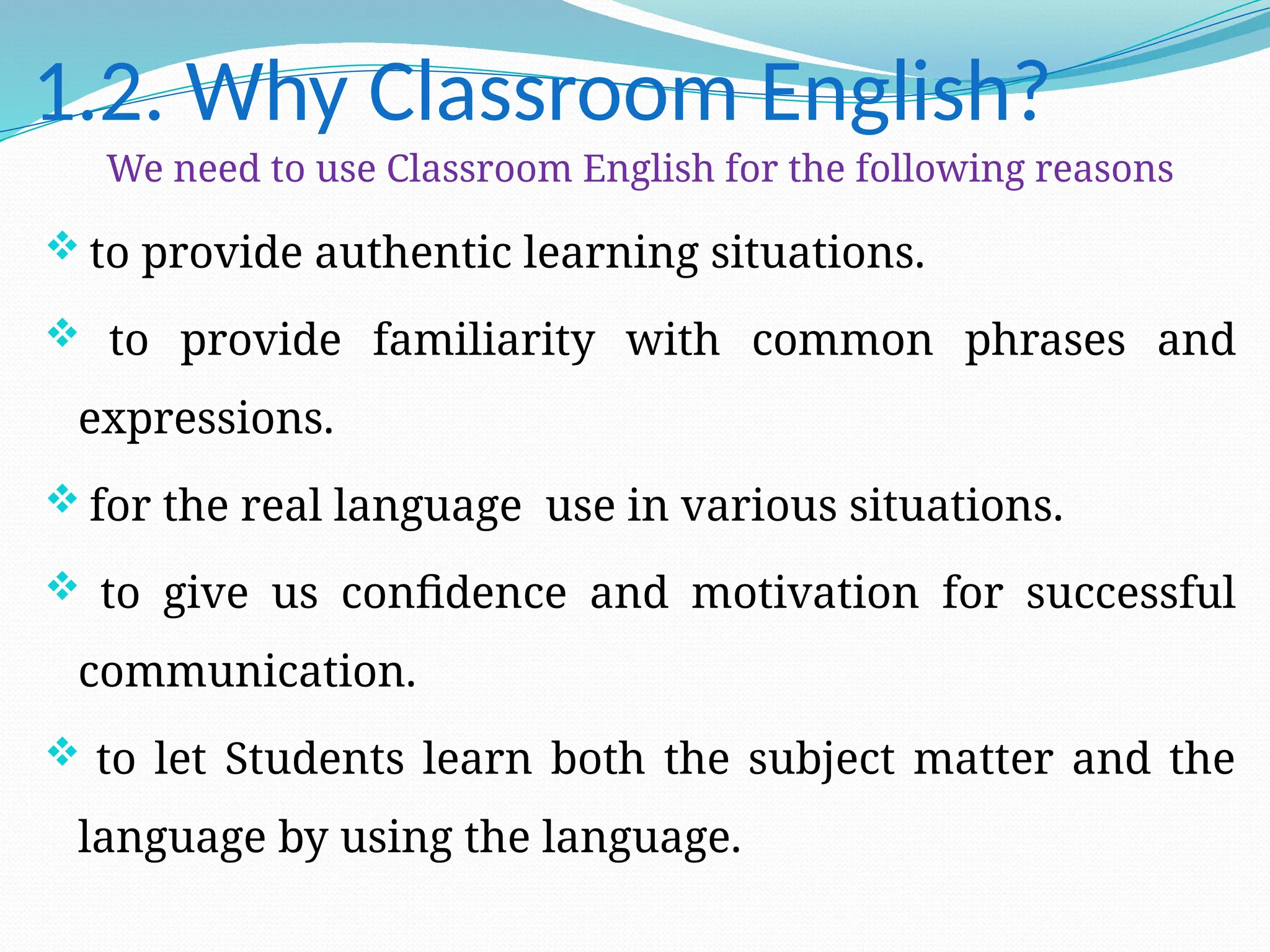
1.2. Why ClassroomEnglish?
We need to use Classroom English for the following reasons
to provide authentic learning situations.
to provide familiarity with common phrases and
expressions.
for the real language use in various situations.
to give us confidence and motivation for successful
communication.
to let Students learn both the subject matter and the
language by using the language.
7.
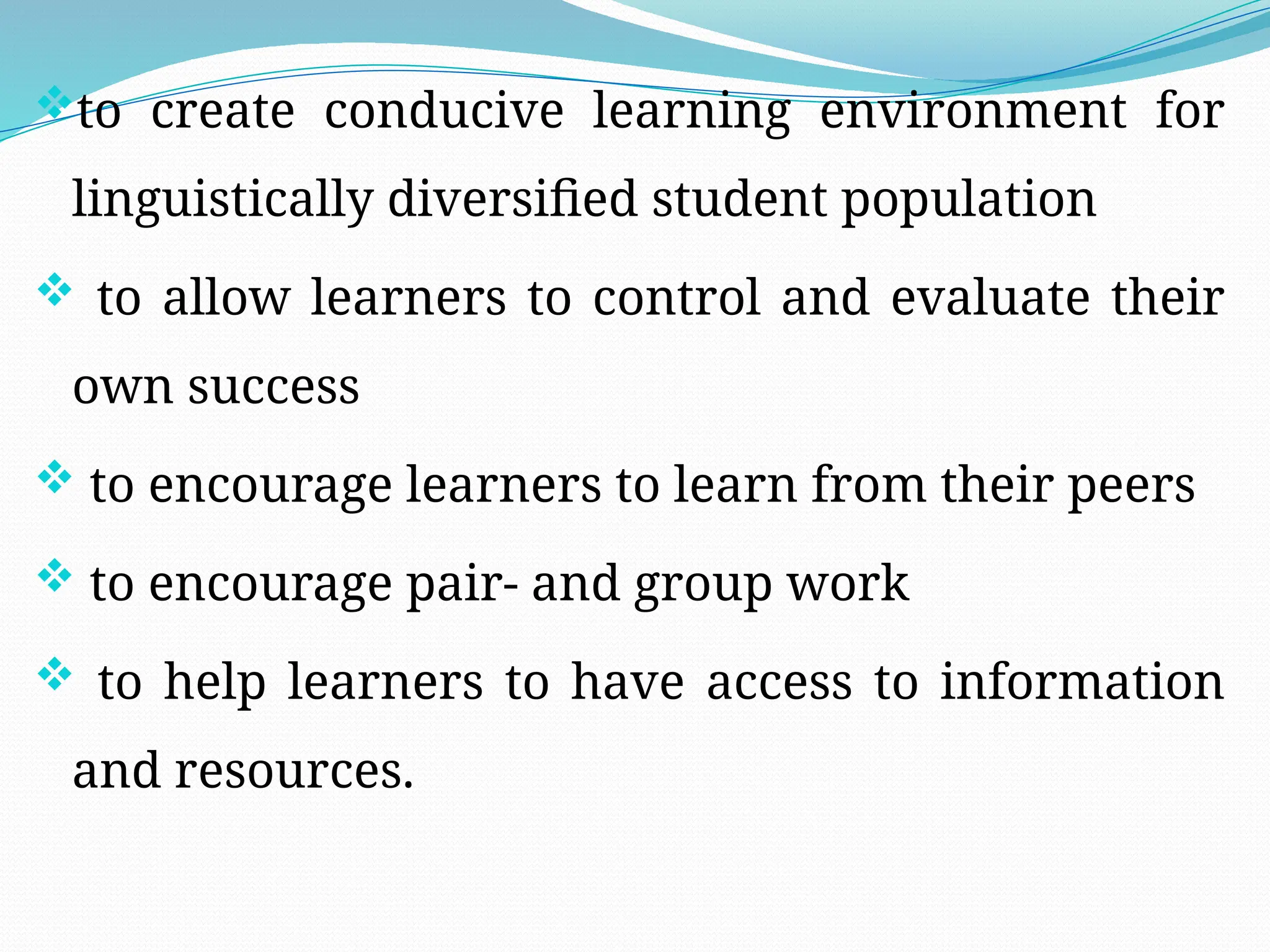
to create conducivelearning environment for
linguistically diversified student population
to allow learners to control and evaluate their
own success
to encourage learners to learn from their peers
to encourage pair- and group work
to help learners to have access to information
and resources.
8.
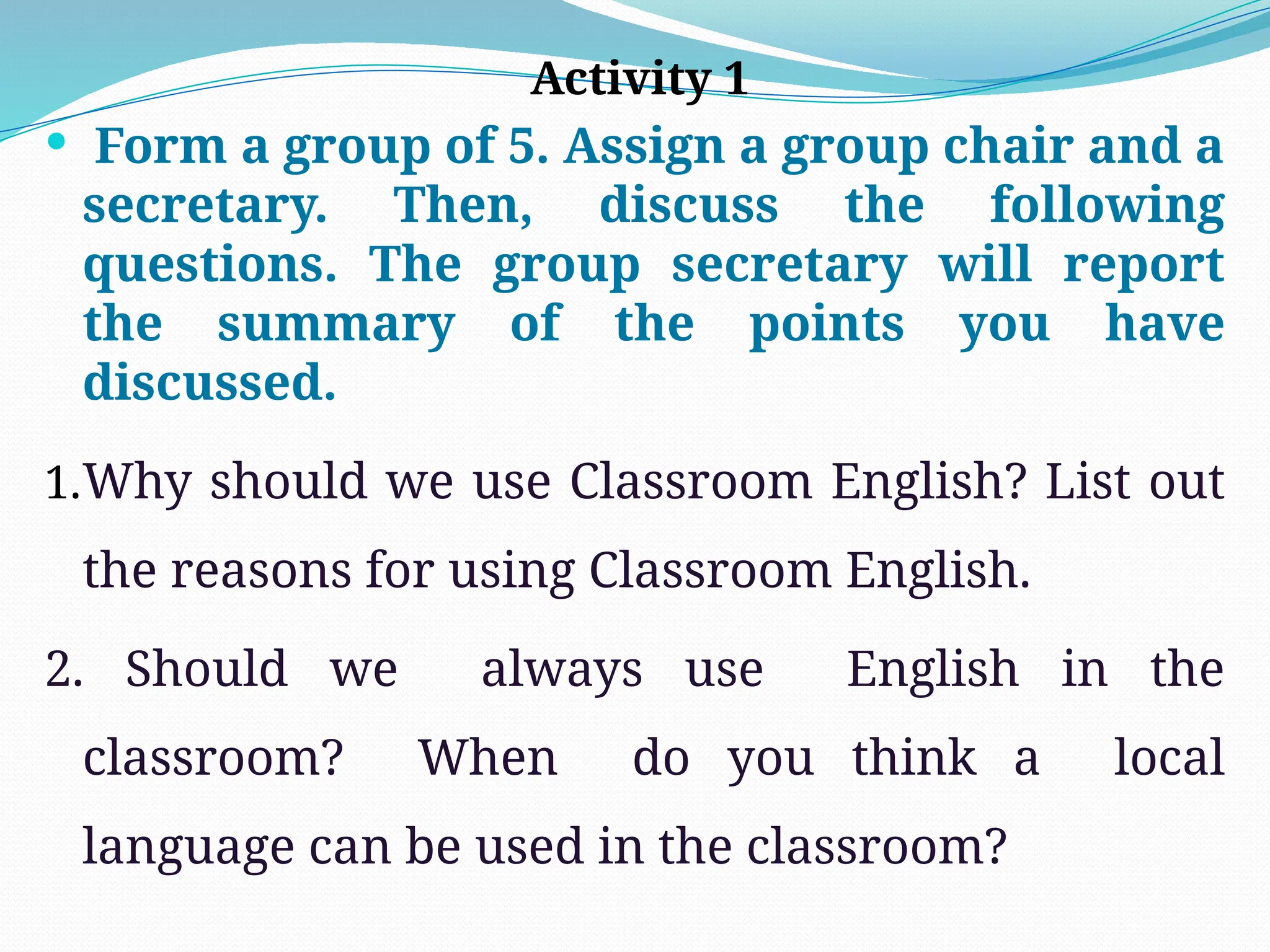
Activity 1
Forma group of 5. Assign a group chair and a
secretary. Then, discuss the following
questions. The group secretary will report
the summary of the points you have
discussed.
1.Why should we use Classroom English? List out
the reasons for using Classroom English.
2. Should we always use English in the
classroom? When do you think a local
language can be used in the classroom?
9.
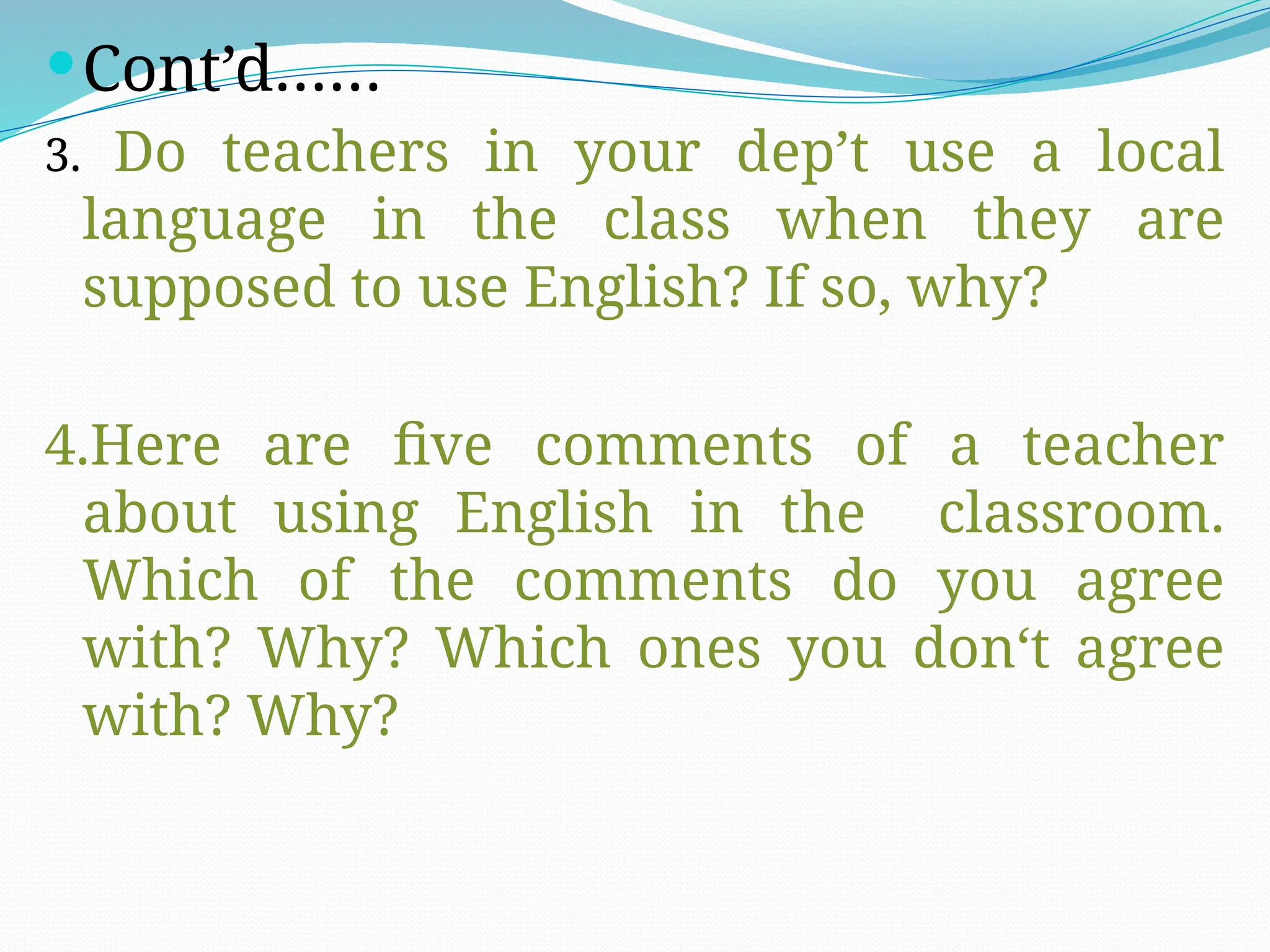
Cont’d……
3. Do teachersin your dep’t use a local
language in the class when they are
supposed to use English? If so, why?
4.Here are five comments of a teacher
about using English in the classroom.
Which of the comments do you agree
with? Why? Which ones you don‘t agree
with? Why?
10.
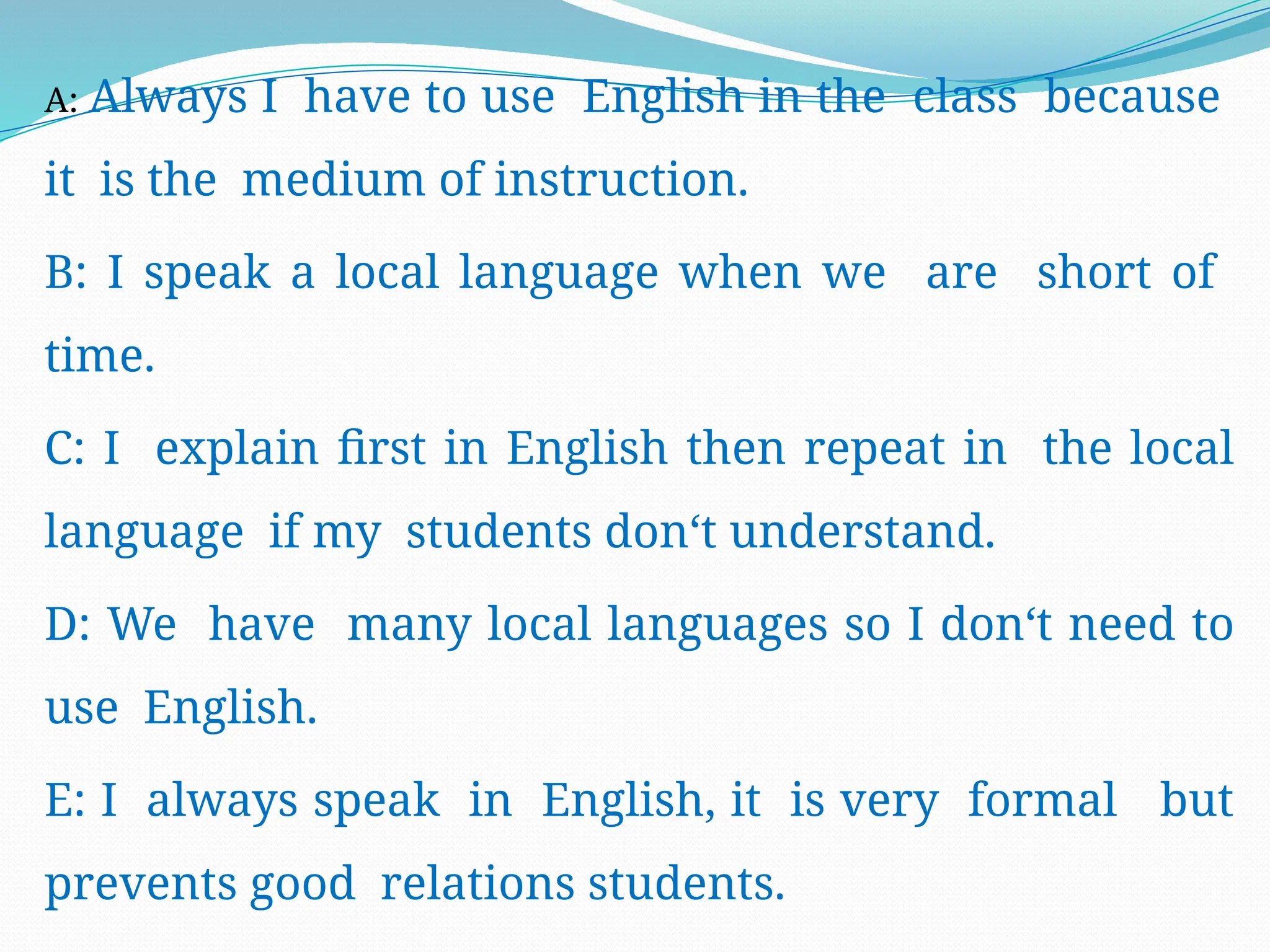
A: Always Ihave to use English in the class because
it is the medium of instruction.
B: I speak a local language when we are short of
time.
C: I explain first in English then repeat in the local
language if my students don‘t understand.
D: We have many local languages so I don‘t need to
use English.
E: I always speak in English, it is very formal but
prevents good relations students.
11.
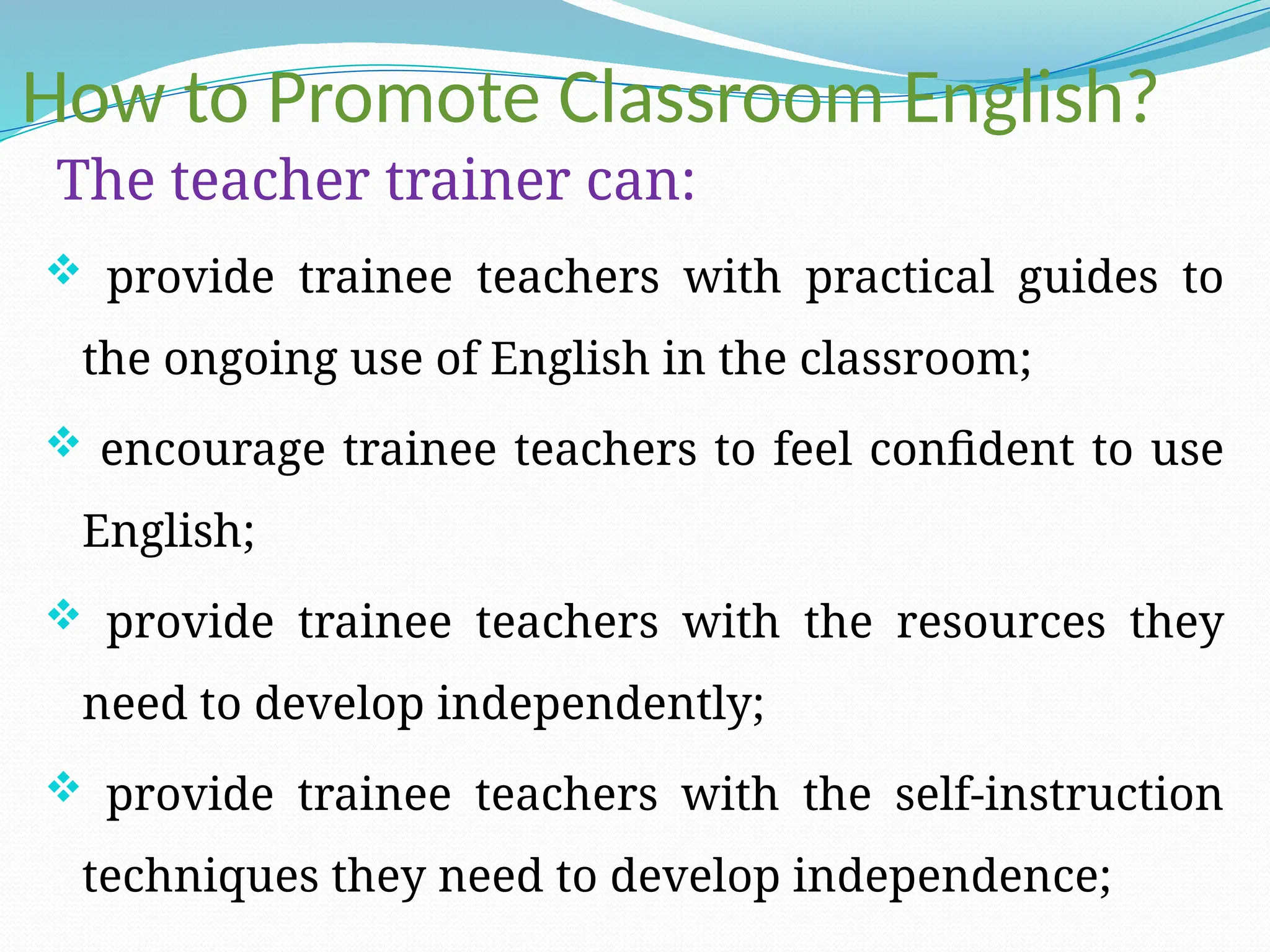
How to PromoteClassroom English?
The teacher trainer can:
provide trainee teachers with practical guides to
the ongoing use of English in the classroom;
encourage trainee teachers to feel confident to use
English;
provide trainee teachers with the resources they
need to develop independently;
provide trainee teachers with the self-instruction
techniques they need to develop independence;
12.
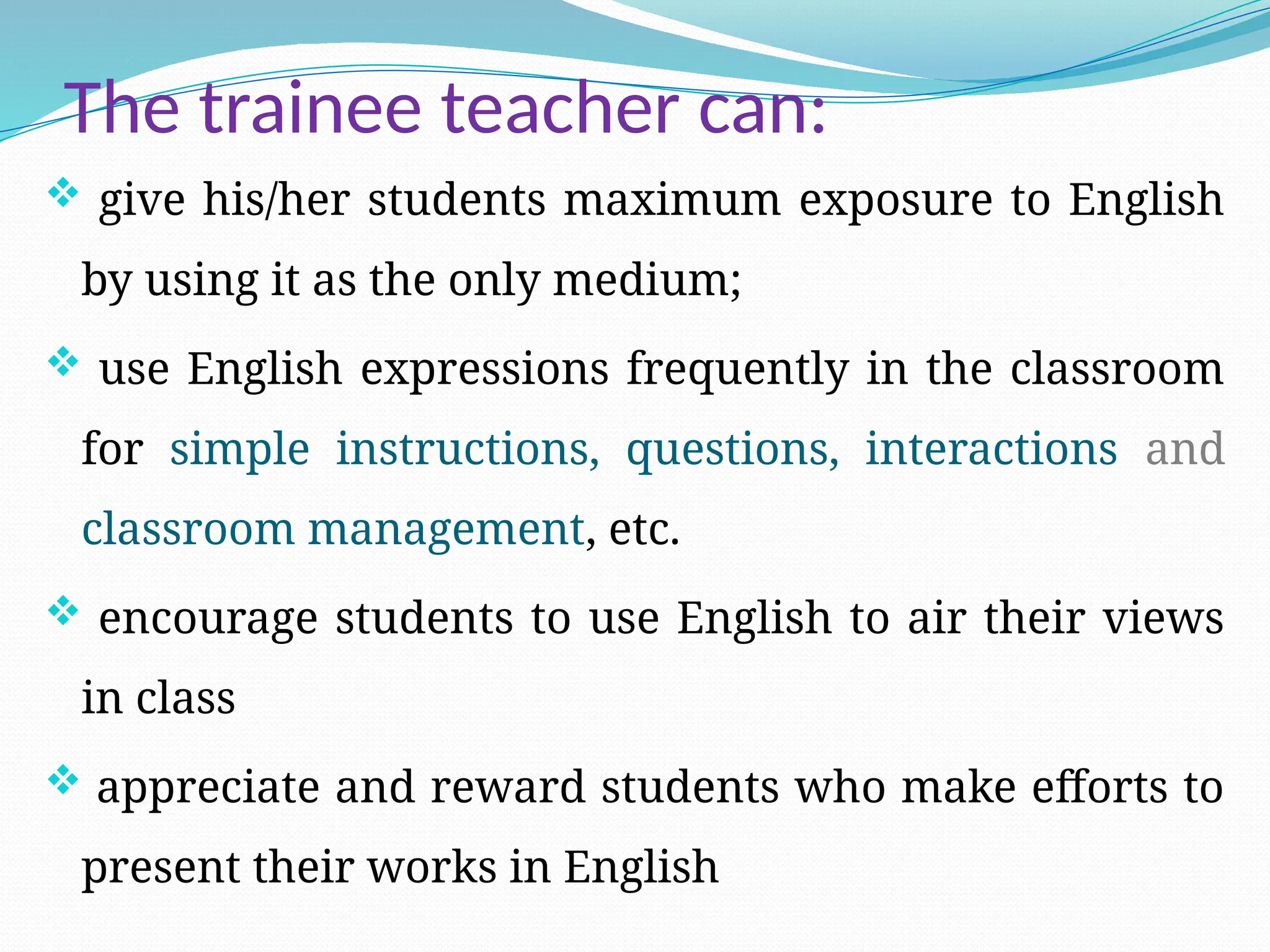
The trainee teachercan:
give his/her students maximum exposure to English
by using it as the only medium;
use English expressions frequently in the classroom
for simple instructions, questions, interactions and
classroom management, etc.
encourage students to use English to air their views
in class
appreciate and reward students who make efforts to
present their works in English
13.
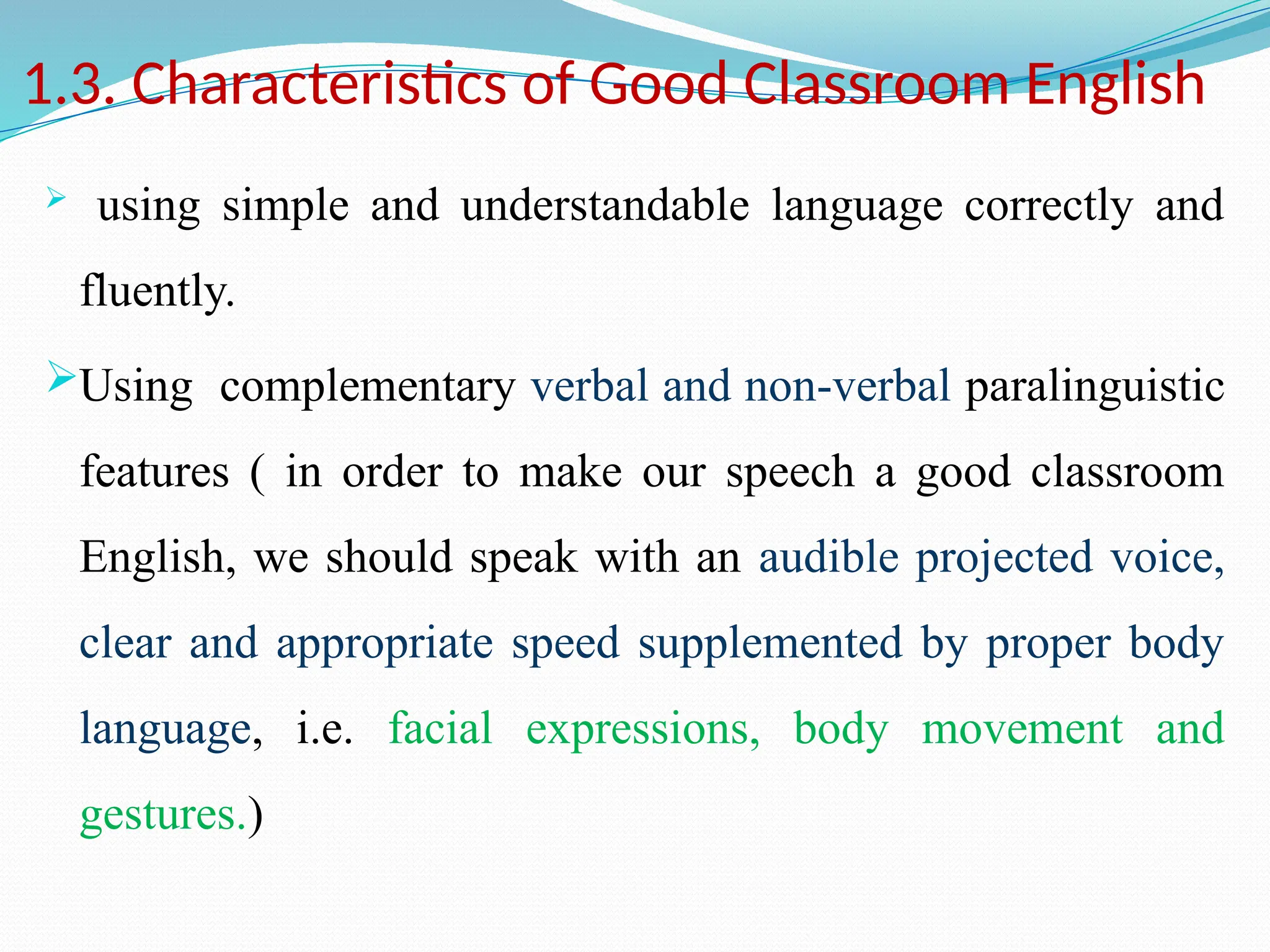
1.3. Characteristics ofGood Classroom English
using simple and understandable language correctly and
fluently.
Using complementary verbal and non-verbal paralinguistic
features ( in order to make our speech a good classroom
English, we should speak with an audible projected voice,
clear and appropriate speed supplemented by proper body
language, i.e. facial expressions, body movement and
gestures.)
14.
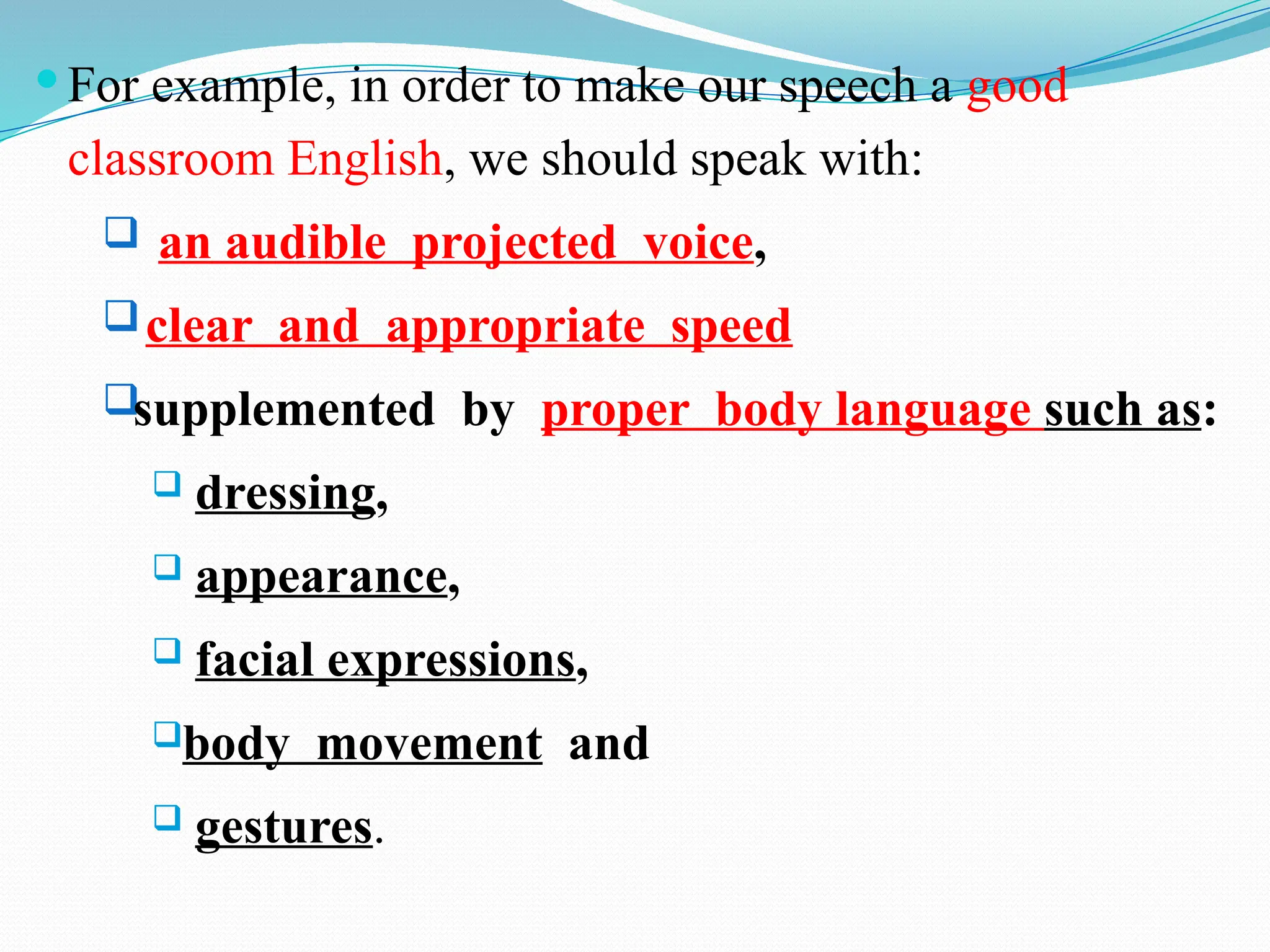
For example,in order to make our speech a good
classroom English, we should speak with:
an audible projected voice,
clear and appropriate speed
supplemented by proper body language such as:
dressing,
appearance,
facial expressions,
body movement and
gestures.
15.
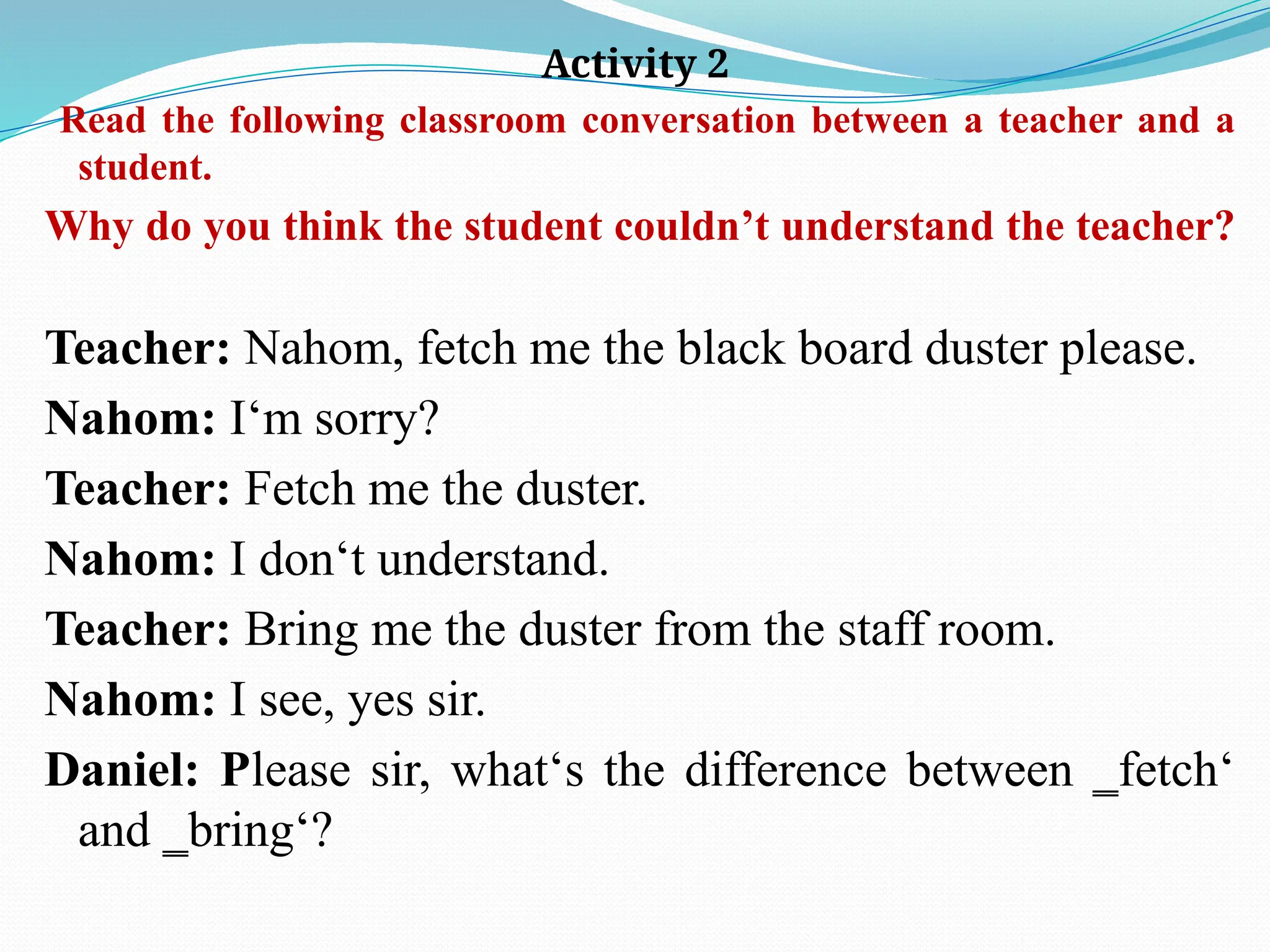
Activity 2
Read thefollowing classroom conversation between a teacher and a
student.
Why do you think the student couldn’t understand the teacher?
Teacher: Nahom, fetch me the black board duster please.
Nahom: I‘m sorry?
Teacher: Fetch me the duster.
Nahom: I don‘t understand.
Teacher: Bring me the duster from the staff room.
Nahom: I see, yes sir.
Daniel: Please sir, what‘s the difference between ‗fetch‘
and ‗bring‘?
16.
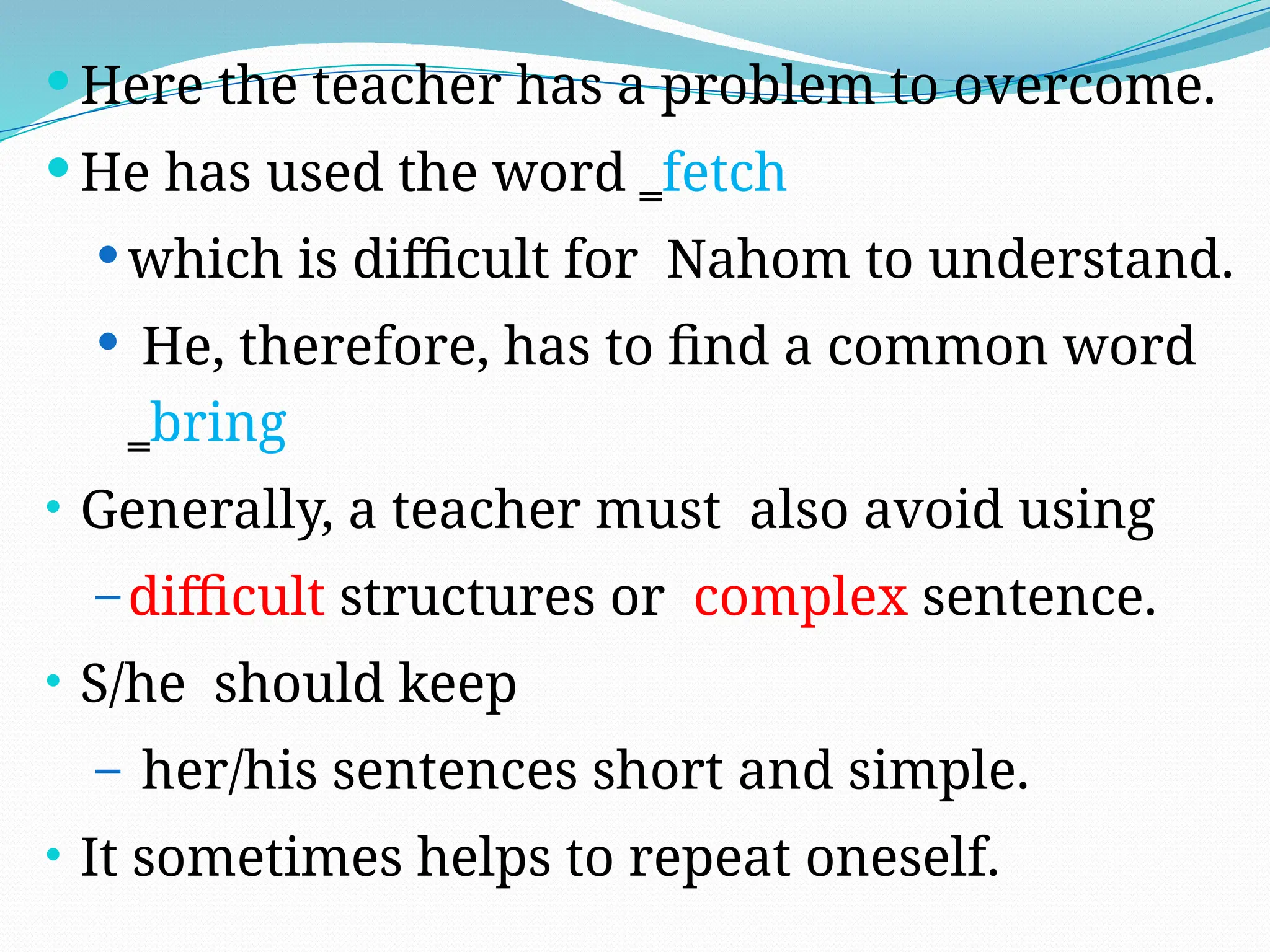
Here theteacher has a problem to overcome.
He has used the word ‗fetch
which is difficult for Nahom to understand.
He, therefore, has to find a common word
‗bring
• Generally, a teacher must also avoid using
– difficult structures or complex sentence.
• S/he should keep
– her/his sentences short and simple.
• It sometimes helps to repeat oneself.
17.
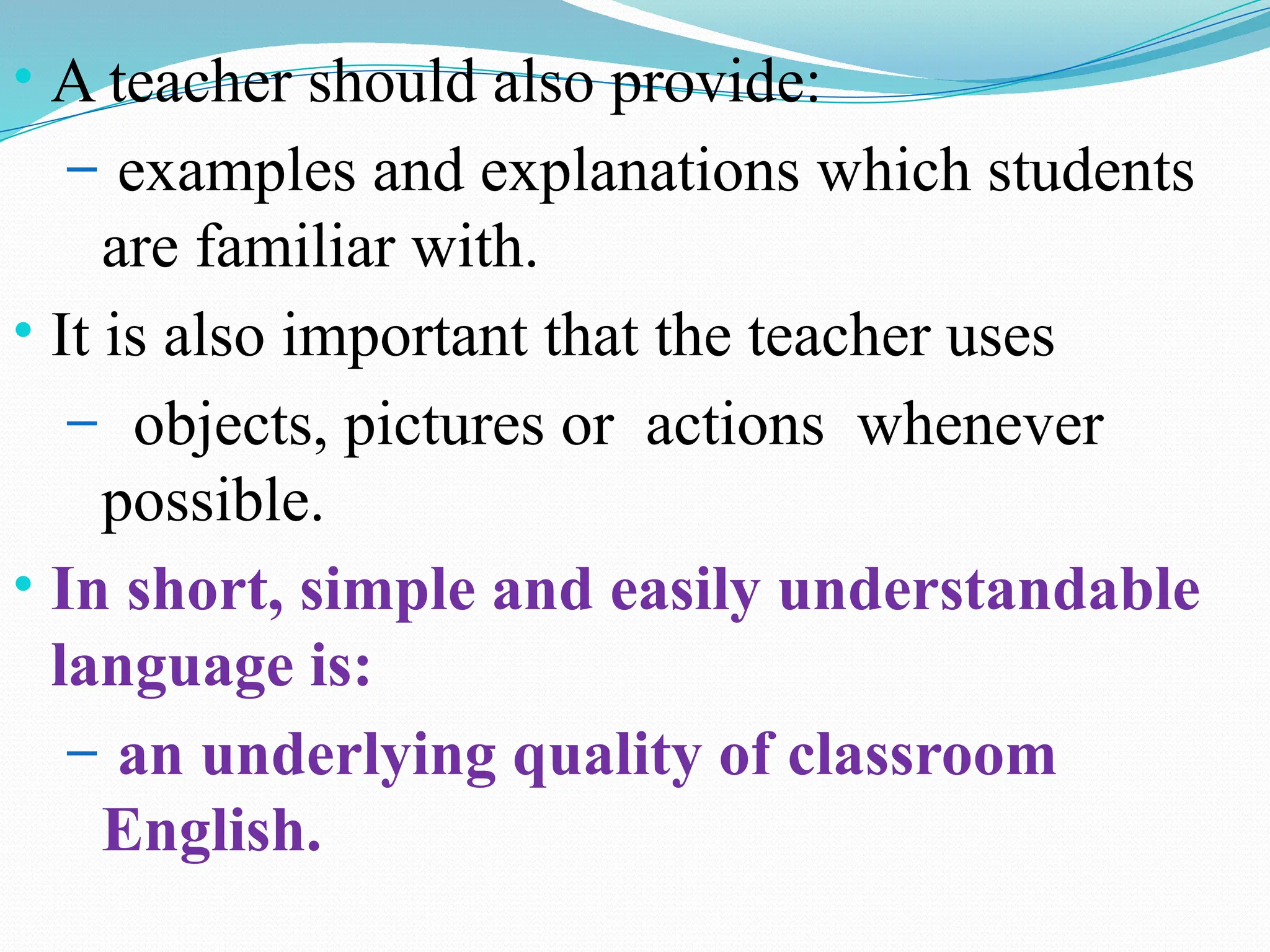
• A teachershould also provide:
– examples and explanations which students
are familiar with.
• It is also important that the teacher uses
– objects, pictures or actions whenever
possible.
• In short, simple and easily understandable
language is:
– an underlying quality of classroom
English.
18.
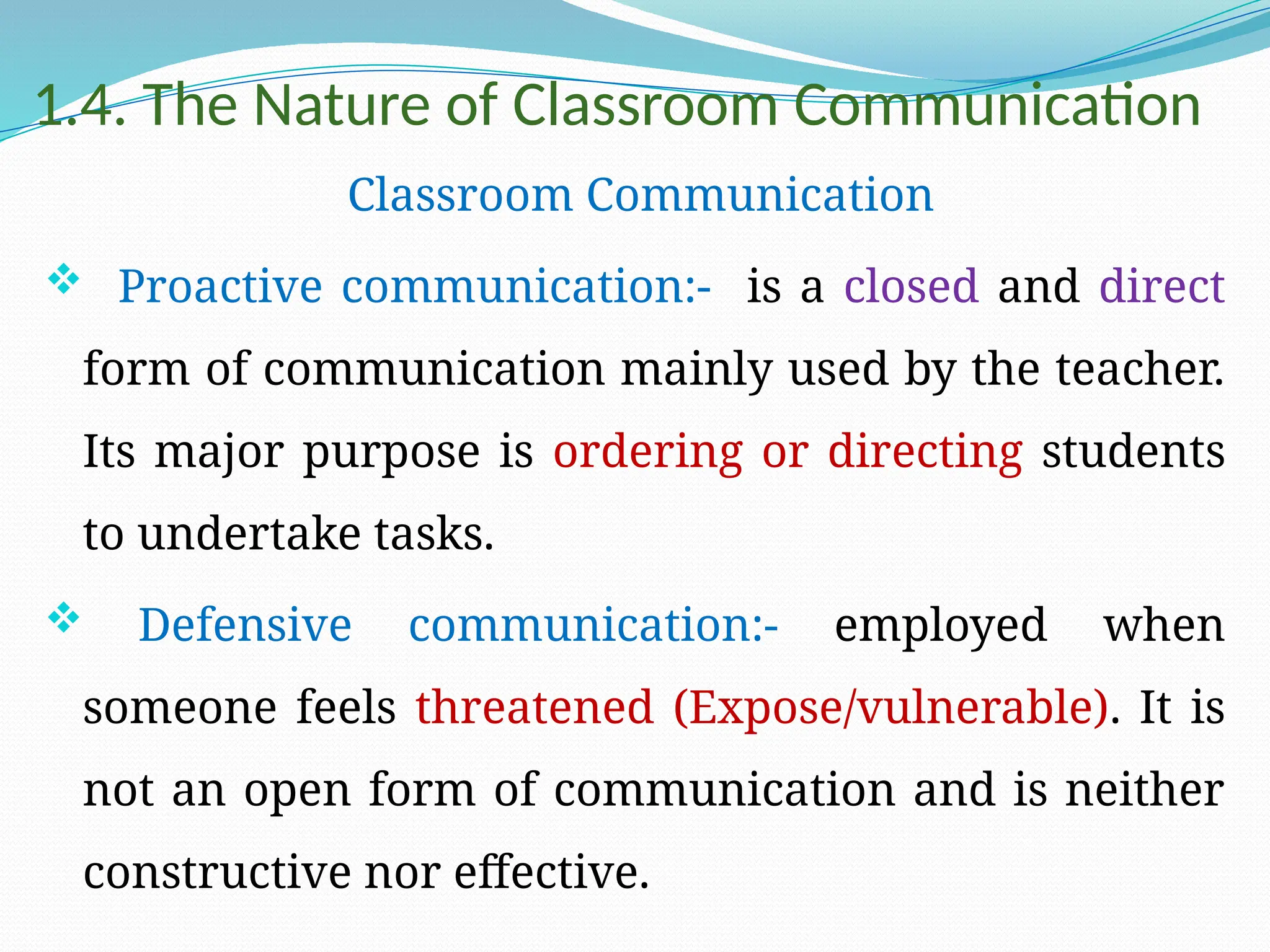
1.4. The Natureof Classroom Communication
Classroom Communication
Proactive communication:- is a closed and direct
form of communication mainly used by the teacher.
Its major purpose is ordering or directing students
to undertake tasks.
Defensive communication:- employed when
someone feels threatened (Expose/vulnerable). It is
not an open form of communication and is neither
constructive nor effective.
19.
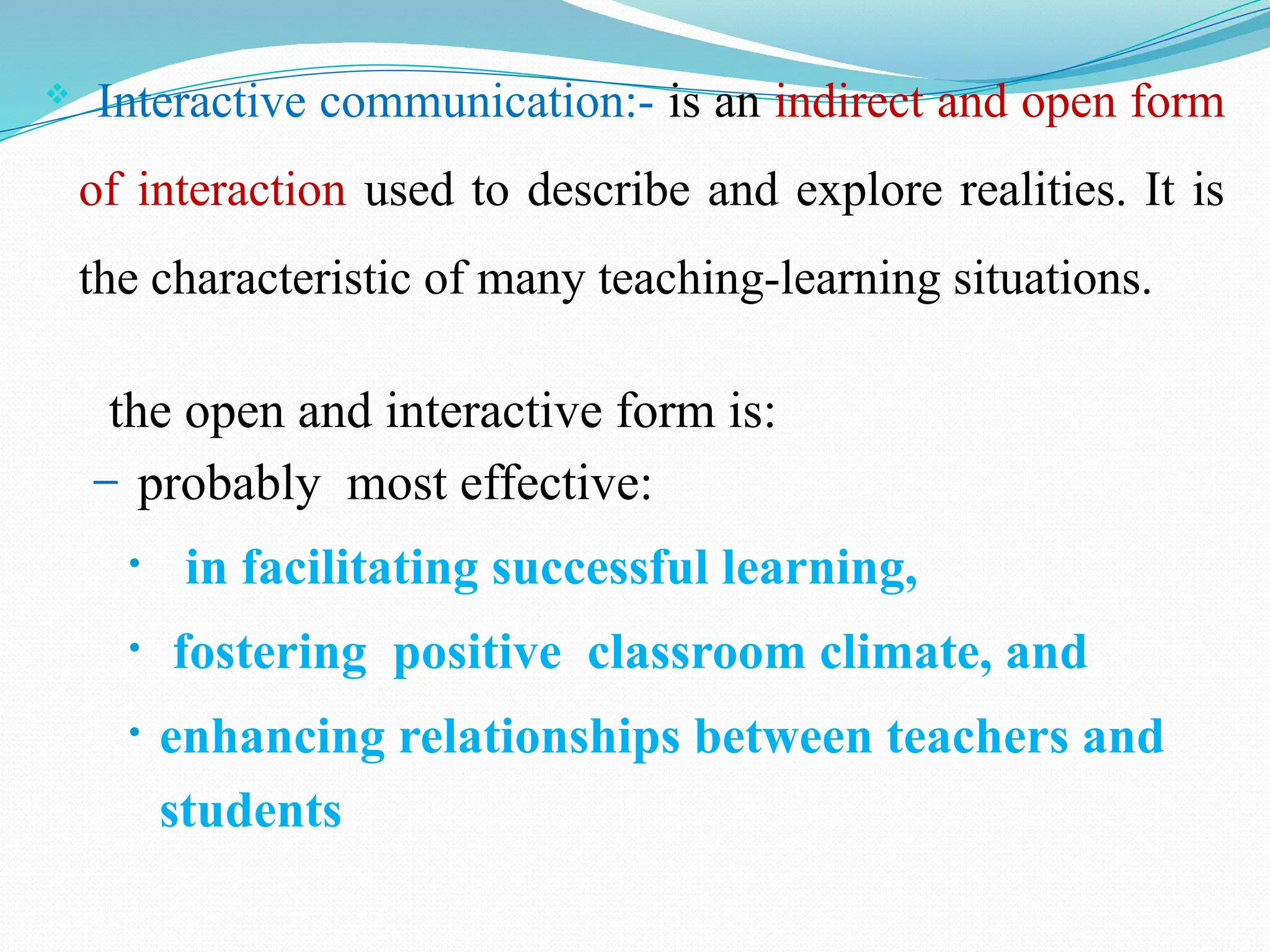
Interactive communication:-is an indirect and open form
of interaction used to describe and explore realities. It is
the characteristic of many teaching-learning situations.
the open and interactive form is:
– probably most effective:
• in facilitating successful learning,
• fostering positive classroom climate, and
• enhancing relationships between teachers and
students
20.
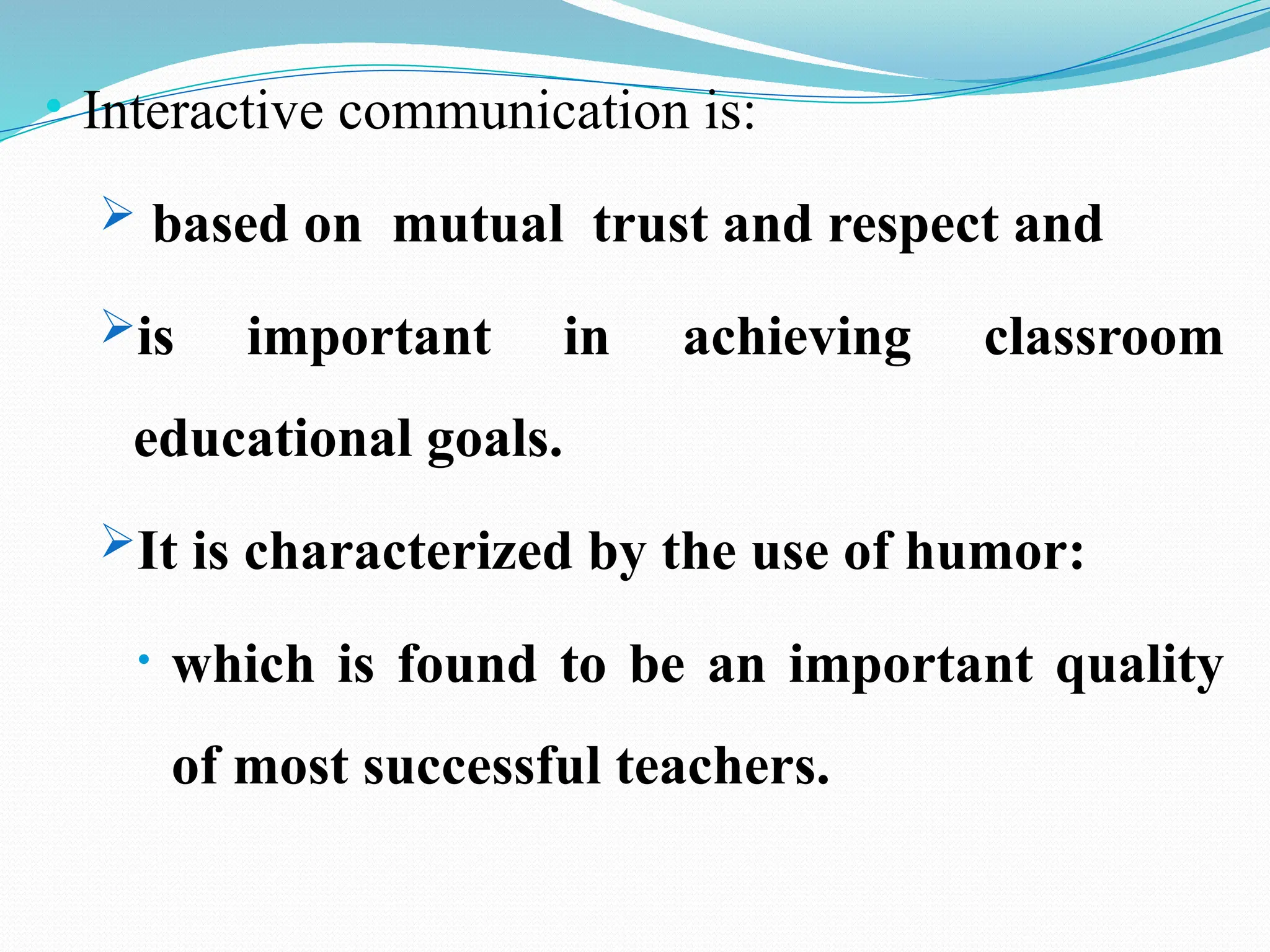
• Interactive communicationis:
based on mutual trust and respect and
is important in achieving classroom
educational goals.
It is characterized by the use of humor:
• which is found to be an important quality
of most successful teachers.
21.
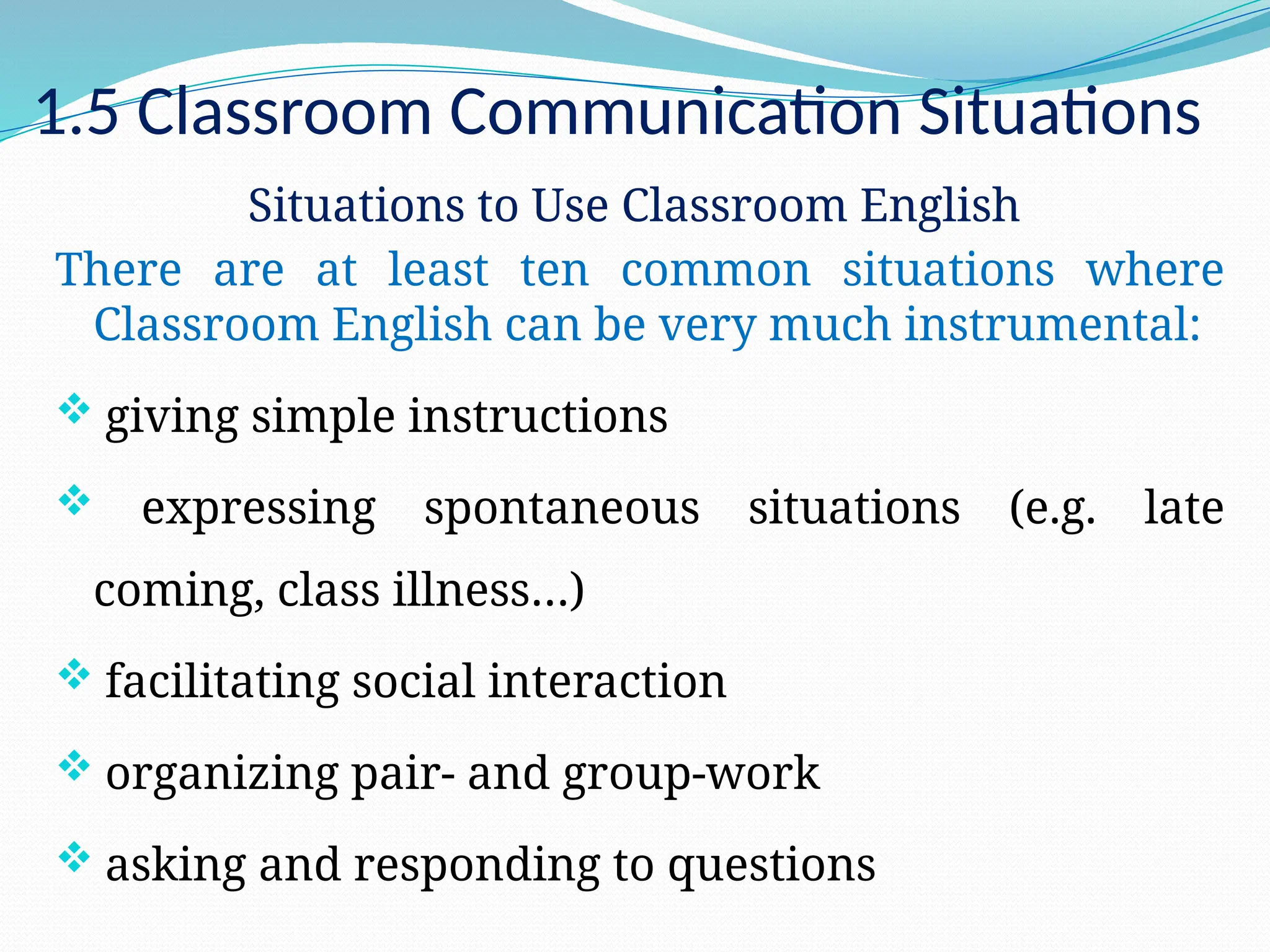
1.5 Classroom CommunicationSituations
Situations to Use Classroom English
There are at least ten common situations where
Classroom English can be very much instrumental:
giving simple instructions
expressing spontaneous situations (e.g. late
coming, class illness…)
facilitating social interaction
organizing pair- and group-work
asking and responding to questions
22.
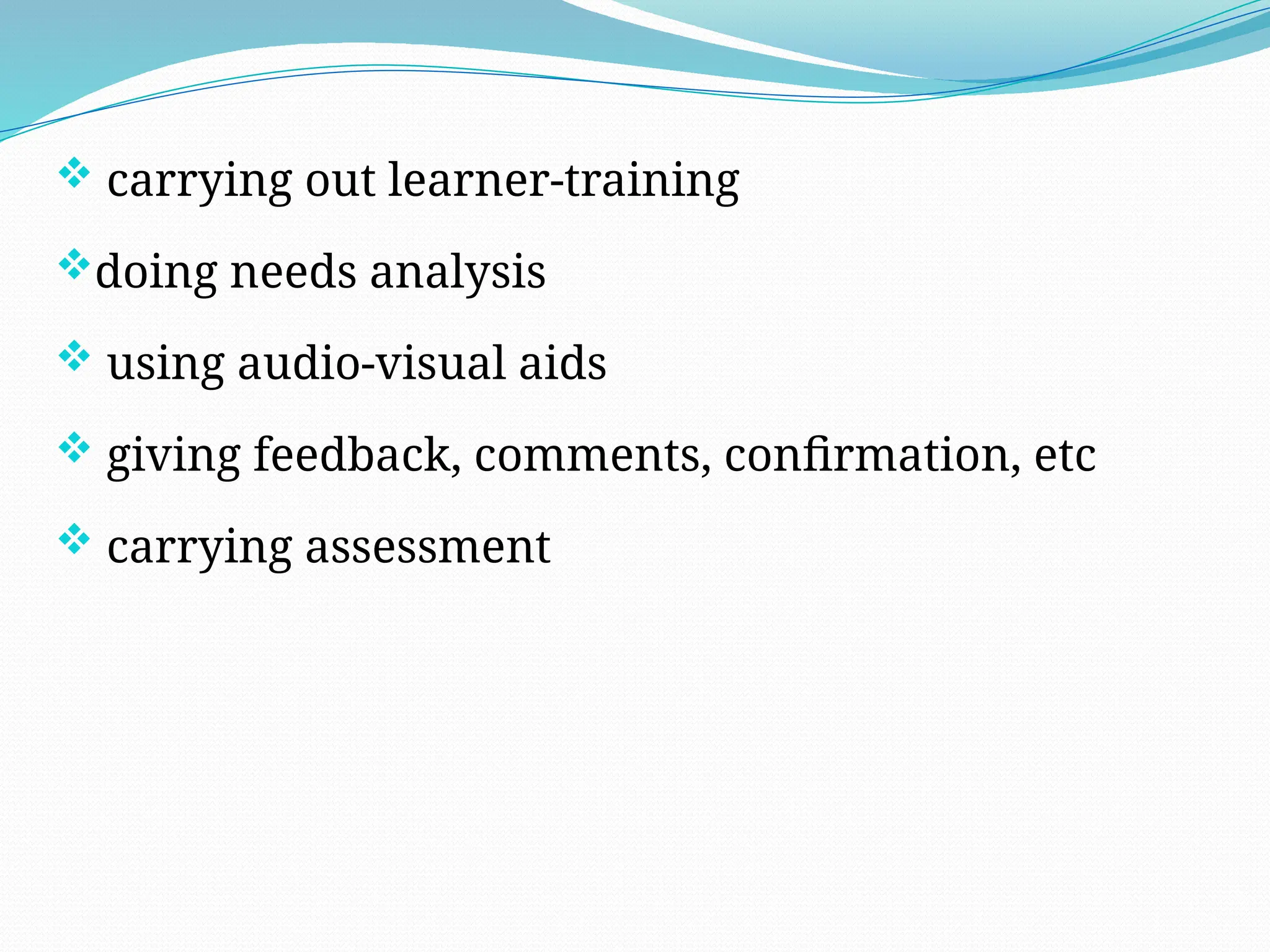
carrying outlearner-training
doing needs analysis
using audio-visual aids
giving feedback, comments, confirmation, etc
carrying assessment
23.
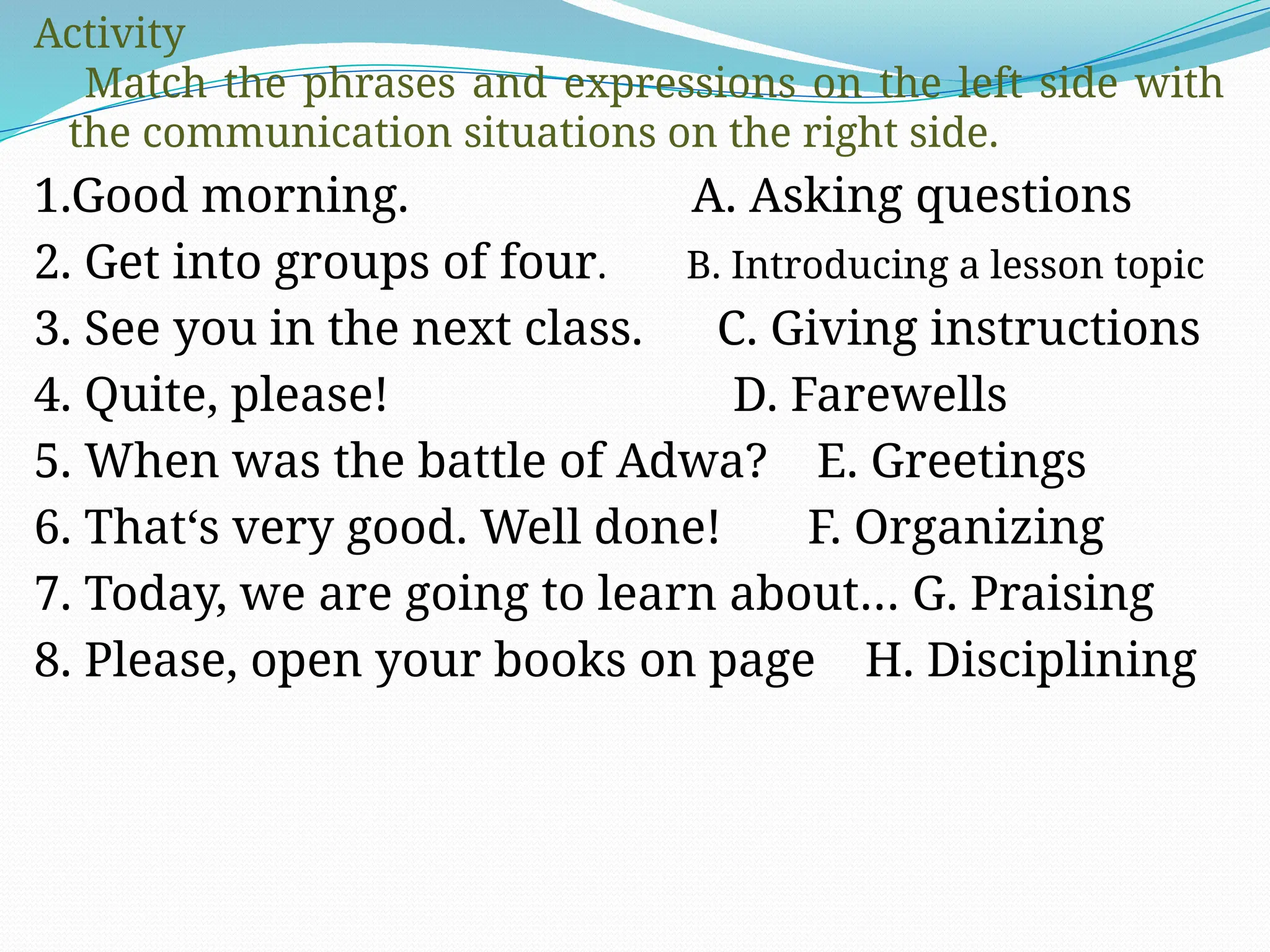
Activity
Match the phrasesand expressions on the left side with
the communication situations on the right side.
1.Good morning. A. Asking questions
2. Get into groups of four. B. Introducing a lesson topic
3. See you in the next class. C. Giving instructions
4. Quite, please! D. Farewells
5. When was the battle of Adwa? E. Greetings
6. That‘s very good. Well done! F. Organizing
7. Today, we are going to learn about… G. Praising
8. Please, open your books on page H. Disciplining
24.
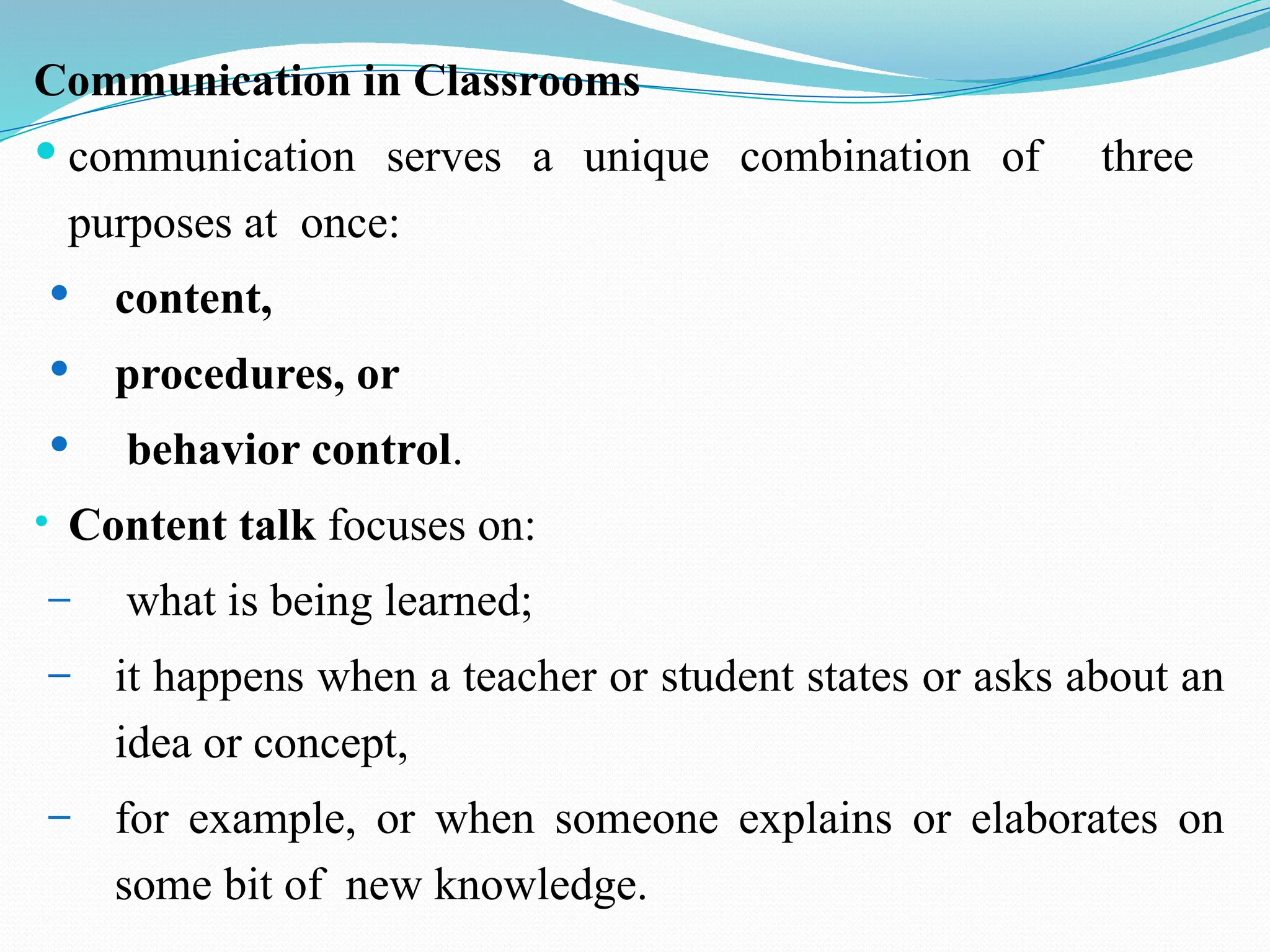
Communication in Classrooms
communication serves a unique combination of three
purposes at once:
content,
procedures, or
behavior control.
• Content talk focuses on:
– what is being learned;
– it happens when a teacher or student states or asks about an
idea or concept,
– for example, or when someone explains or elaborates on
some bit of new knowledge.
25.
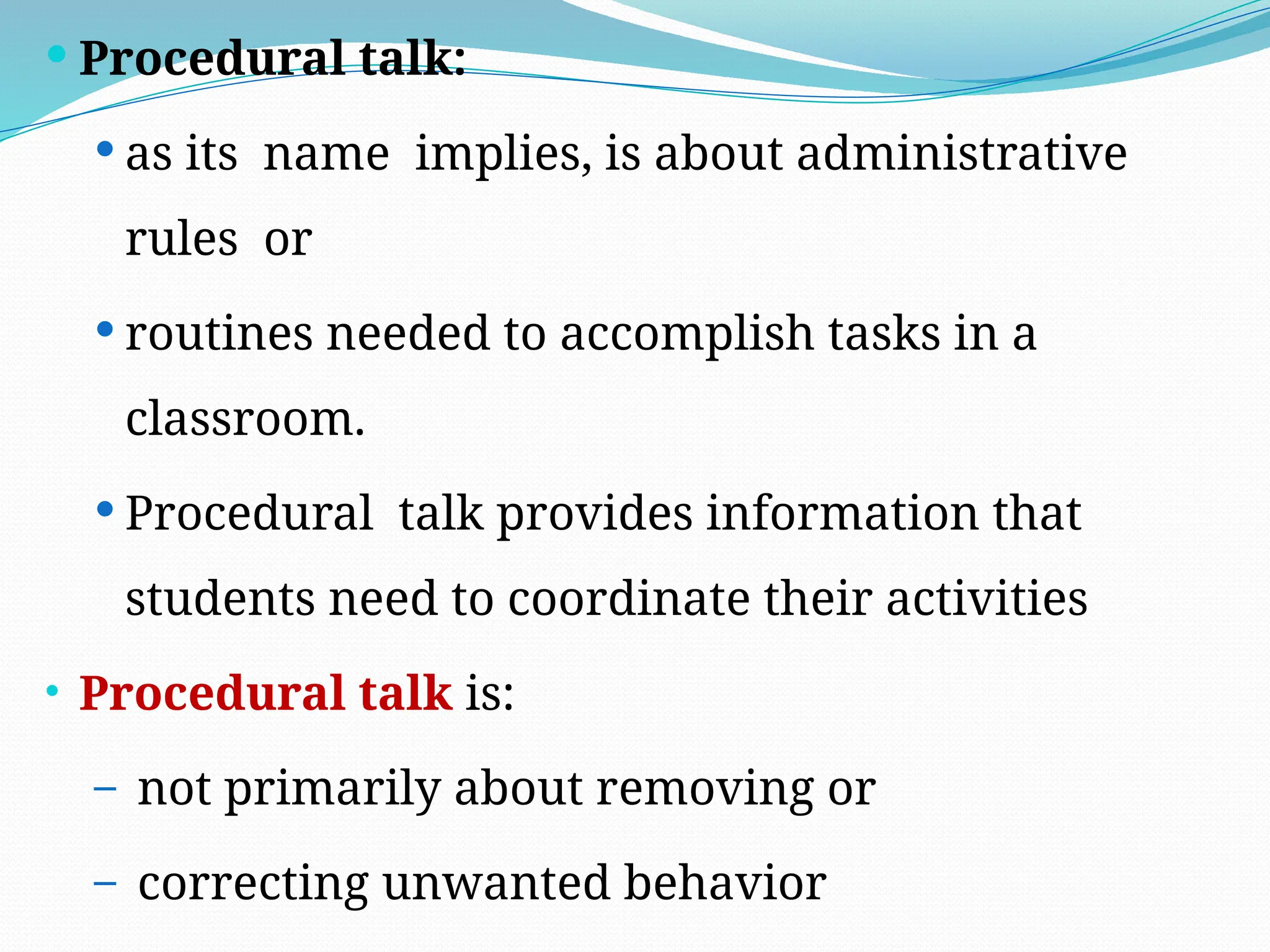
Procedural talk:
as its name implies, is about administrative
rules or
routines needed to accomplish tasks in a
classroom.
Procedural talk provides information that
students need to coordinate their activities
• Procedural talk is:
– not primarily about removing or
– correcting unwanted behavior
26.
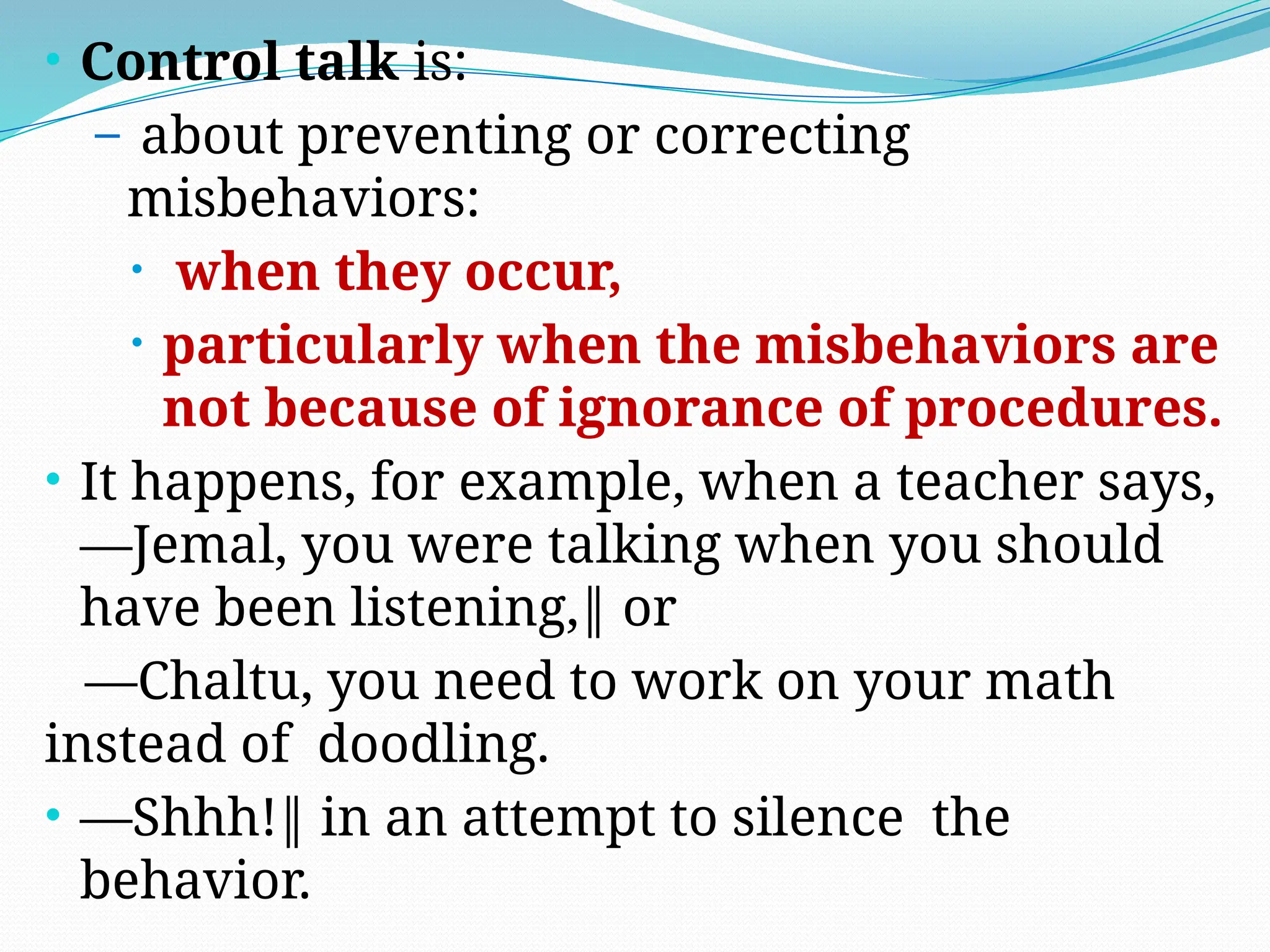
• Control talkis:
– about preventing or correcting
misbehaviors:
• when they occur,
• particularly when the misbehaviors are
not because of ignorance of procedures.
• It happens, for example, when a teacher says,
―Jemal, you were talking when you should
have been listening,‖ or
―Chaltu, you need to work on your math
instead of doodling.
• ―Shhh!‖ in an attempt to silence the
behavior.
27.
Unit Two: Beginninga Class
Getting the Classroom Ready
What should a teacher do to begin the year as an
effective teacher?
What classroom procedures did favorite university
instructor carryout at the beginning of a class?
What words, phrases or expressions did s/he use to
verbalize those procedures? Did s/he use English or
a local language?
28.
Beginning the Yearas an Effective Teacher :-
the ability to manage a classroom effectively
positive expectations for students‘ success
knowledge of lesson leads to students‘ mastery of
the lessons
the drive to continuously learn about(motivation)
grow within the teaching profession
29.
Classroom management
refersto all of the things that a teacher does to organize
students, space, time, and materials so that learning can take
place.
Effective CM fosters students’ involvement and cooperation in
all classroom activities and establishing a productive working
environment.
creating good classroom atmosphere and organizing students
for the class are key procedures to begin the year as an
effective teacher
30.
Therefore, well-CMis characterized by:-
the classroom is work-oriented but relaxed and
pleasant
relatively little wasted time, confusion or
disruption
Students involved with their work, especially
with academic, Learning led instruction
Students know what is expected of them and are
generally successful.
31.
CM on theFirst Day of School
Make sure your classroom is ready (maximize
student learning and minimize student misbehavior)
welcome the students and make sure that they know
where to go and how to get there on time.
Arrange students seating to maximize the
accomplishment of the tasks and to minimize behavior
problems.
32.
Classroom language toget the classroom
ready
Activity 1
1. What would you say students who are
wandering in the corridor to get them go into
classroom?
33.
some expressions toget
students go into the classroom
Come in, please
Come in and close the door
Hurry up! Come on (now)!
Hurry up so that we can start class
Don‘t slam/bang the door like that. Close it like
this instead
Let‘s go in
Get a move on!
Step on it!
34.
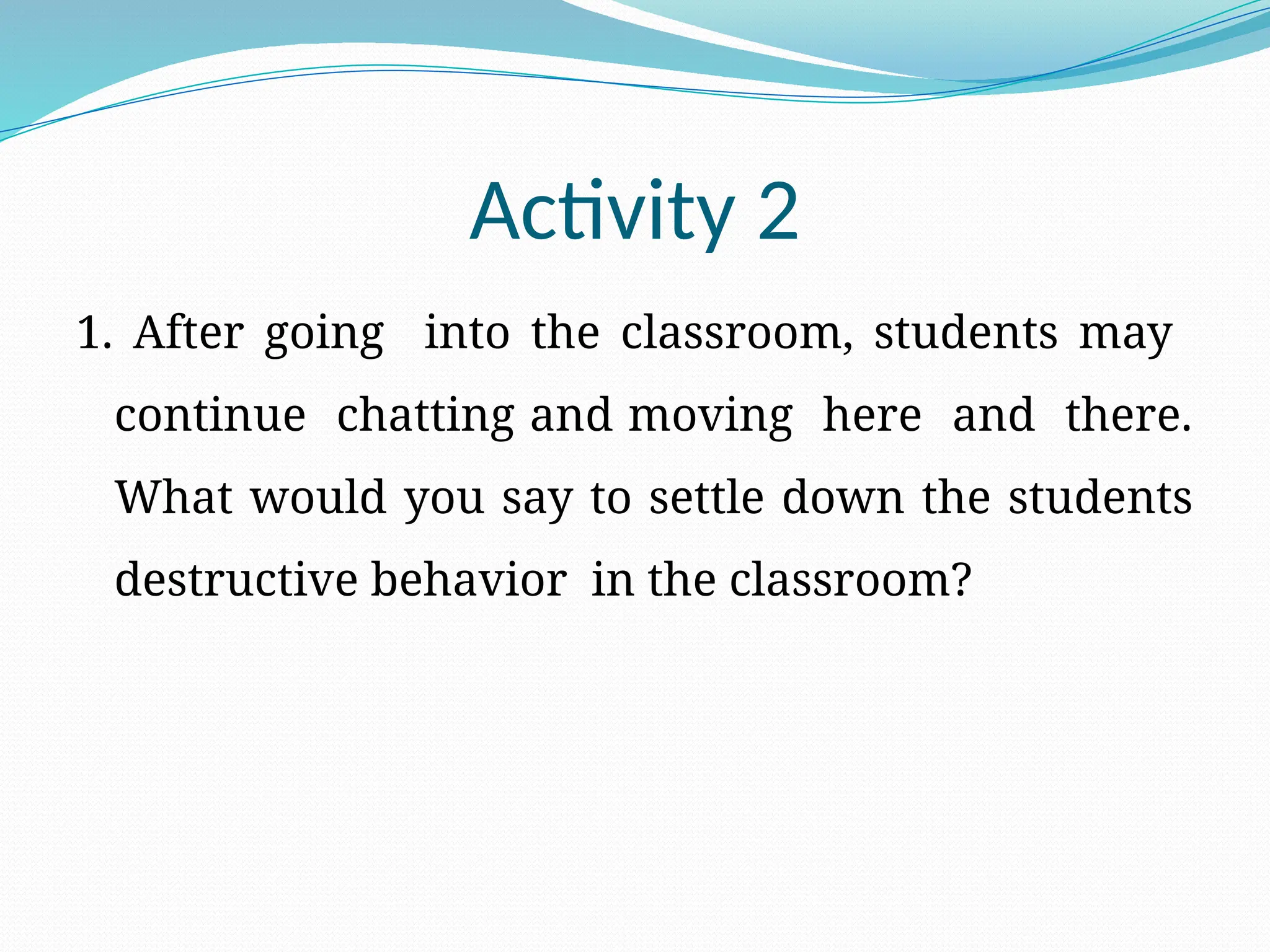
Activity 2
1. Aftergoing into the classroom, students may
continue chatting and moving here and there.
What would you say to settle down the students
destructive behavior in the classroom?
35.
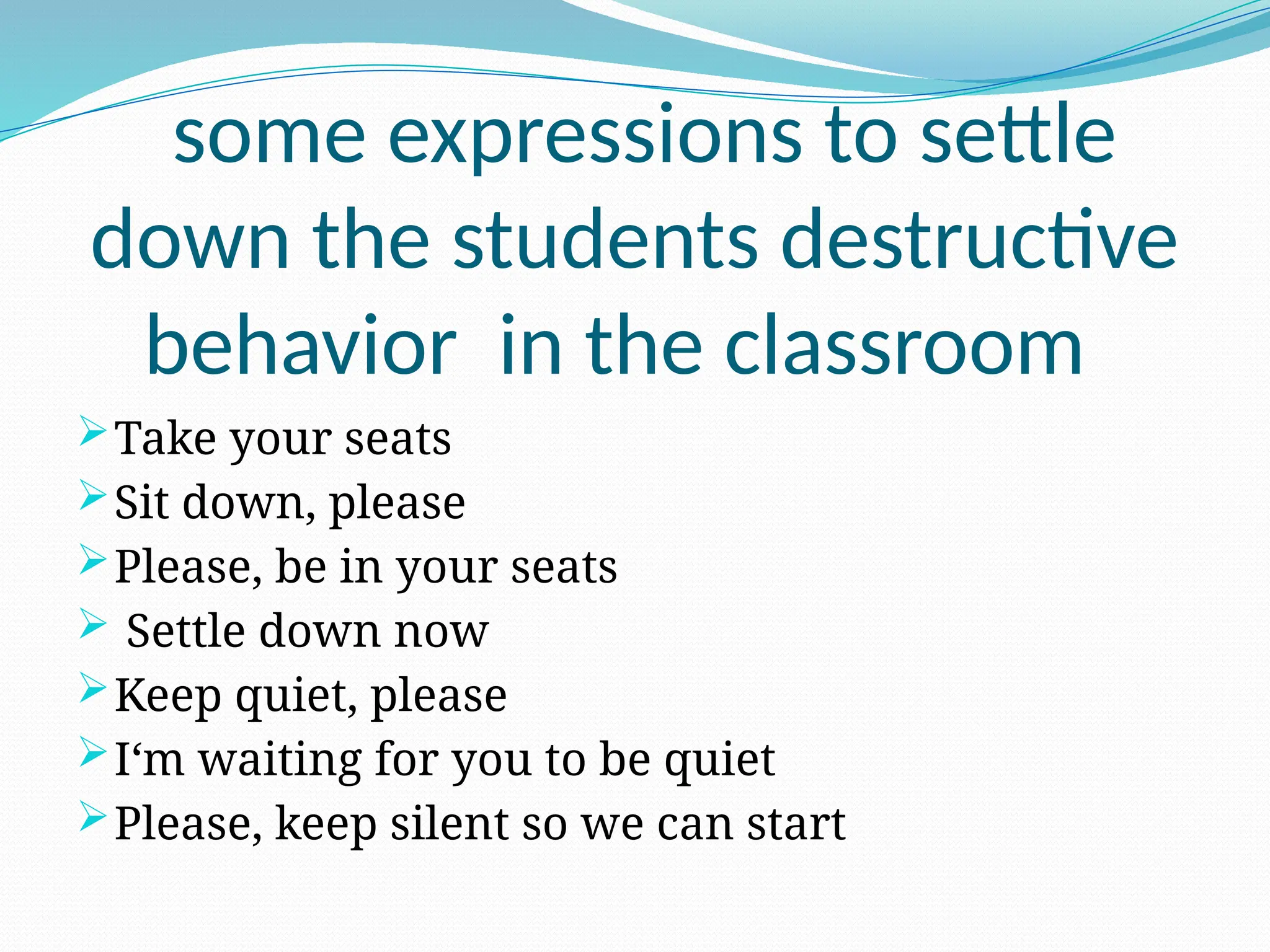
some expressions tosettle
down the students destructive
behavior in the classroom
Take your seats
Sit down, please
Please, be in your seats
Settle down now
Keep quiet, please
I‘m waiting for you to be quiet
Please, keep silent so we can start
36.
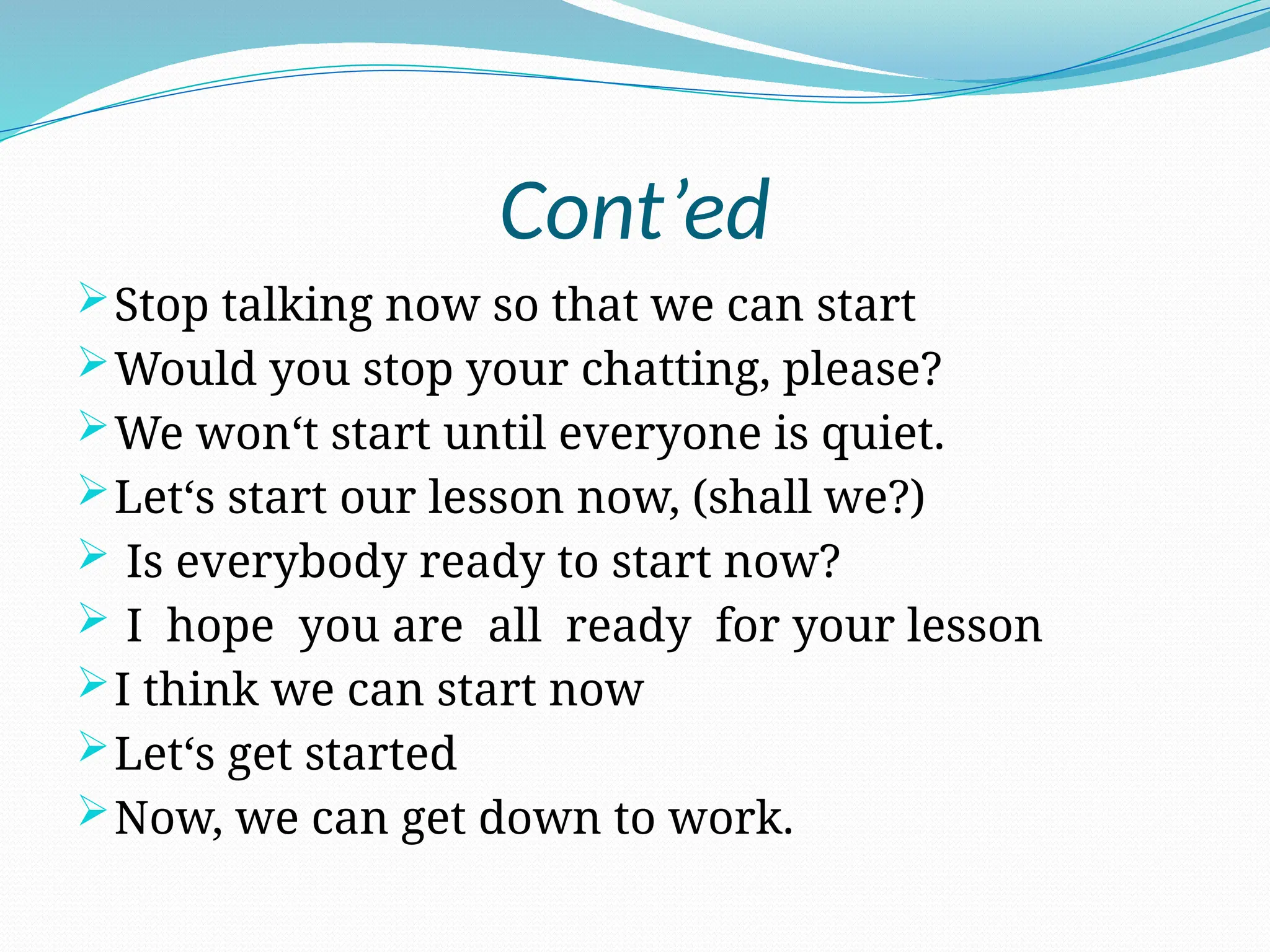
Cont’ed
Stop talking nowso that we can start
Would you stop your chatting, please?
We won‘t start until everyone is quiet.
Let‘s start our lesson now, (shall we?)
Is everybody ready to start now?
I hope you are all ready for your lesson
I think we can start now
Let‘s get started
Now, we can get down to work.
37.
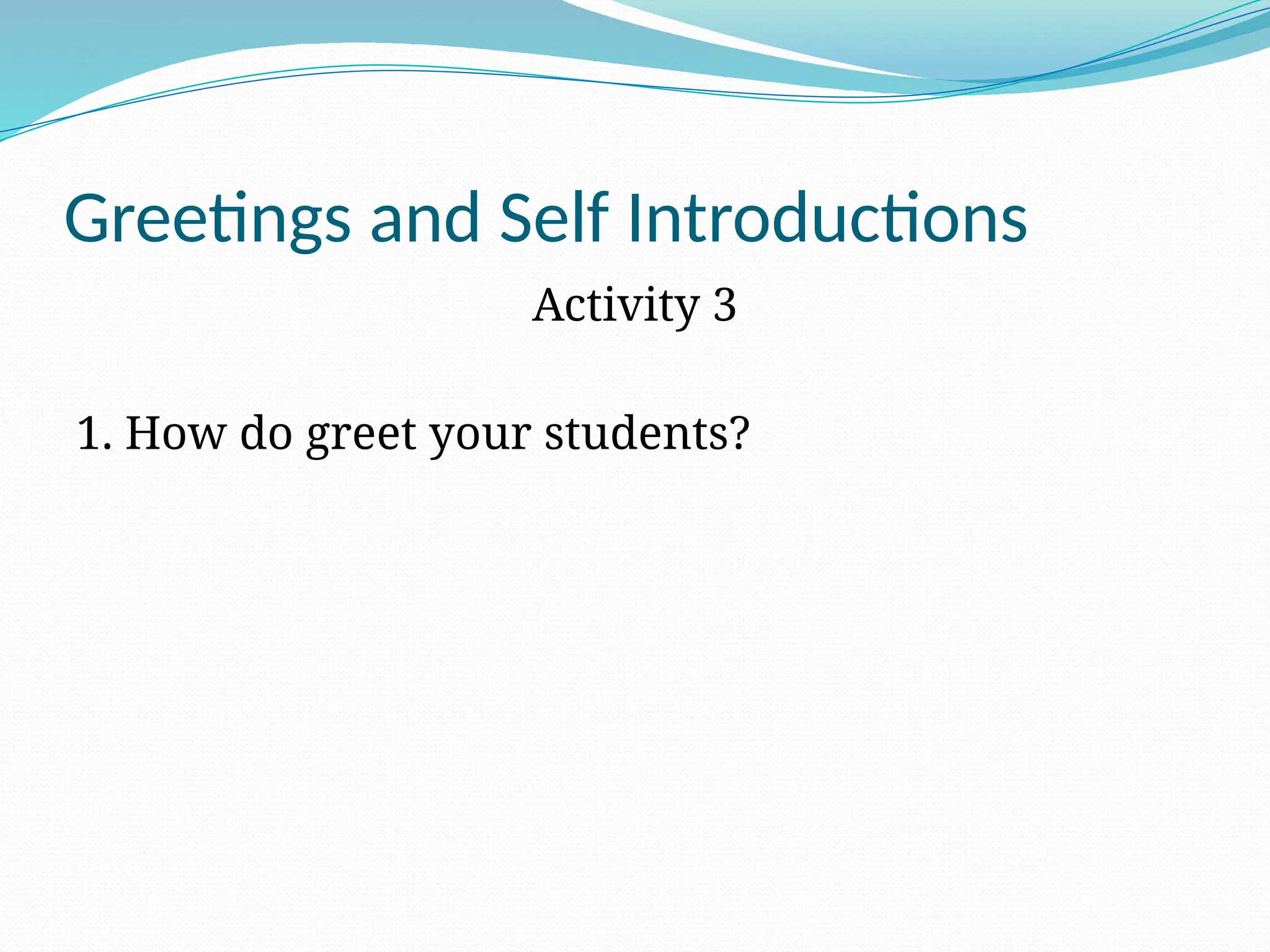
Greetings and SelfIntroductions
Activity 3
1. How do greet your students?
38.
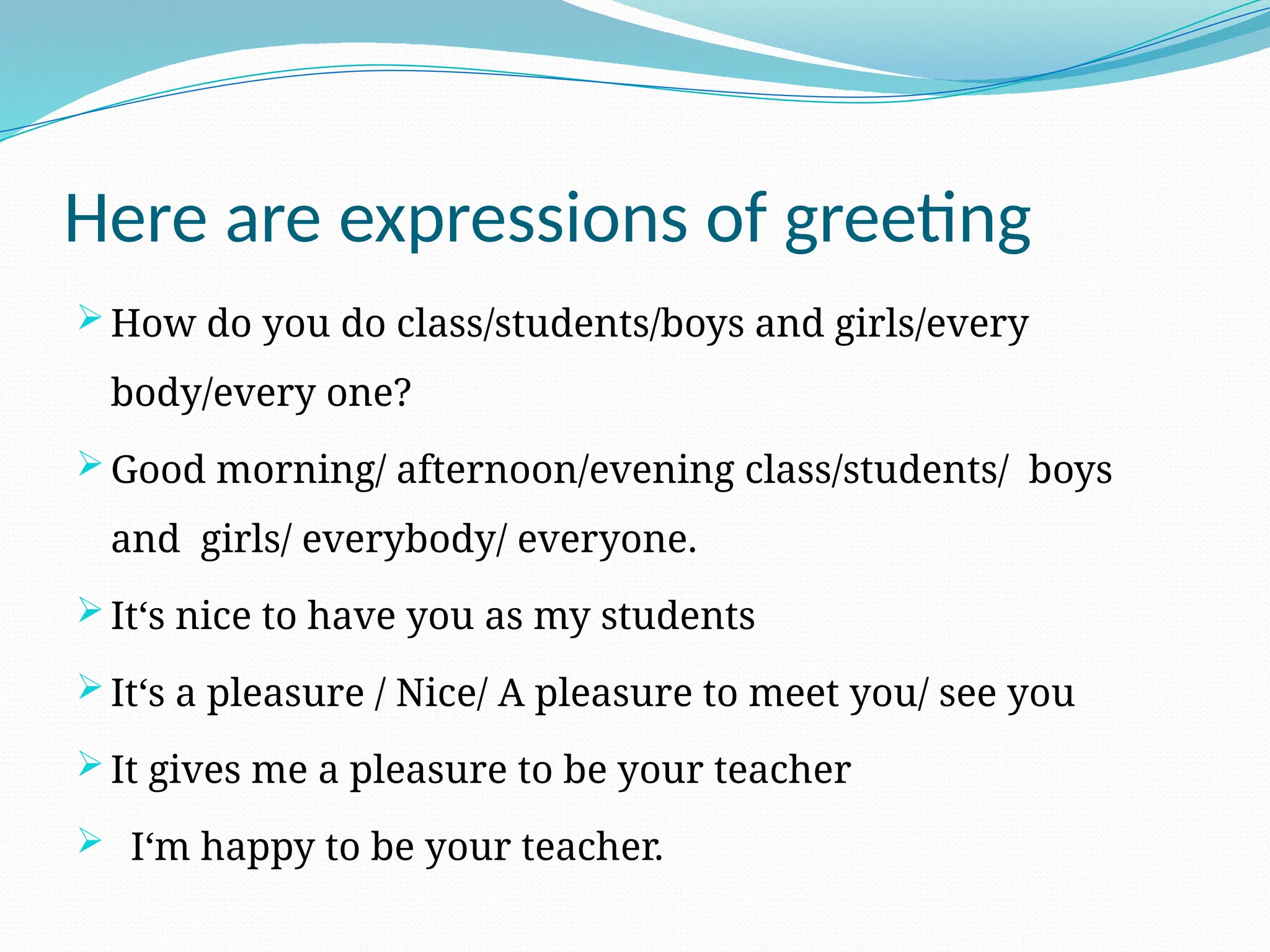
Here are expressionsof greeting
How do you do class/students/boys and girls/every
body/every one?
Good morning/ afternoon/evening class/students/ boys
and girls/ everybody/ everyone.
It‘s nice to have you as my students
It‘s a pleasure / Nice/ A pleasure to meet you/ see you
It gives me a pleasure to be your teacher
I‘m happy to be your teacher.
39.
Introduce yourself toyour class
Activity 4
In the first classroom encounter, greeting is
normally followed by self- introduction.
Therefore,
1. How would you introduce yourself to your
students?
2. Write down what you should tell your students
about yourself in your first class.
40.
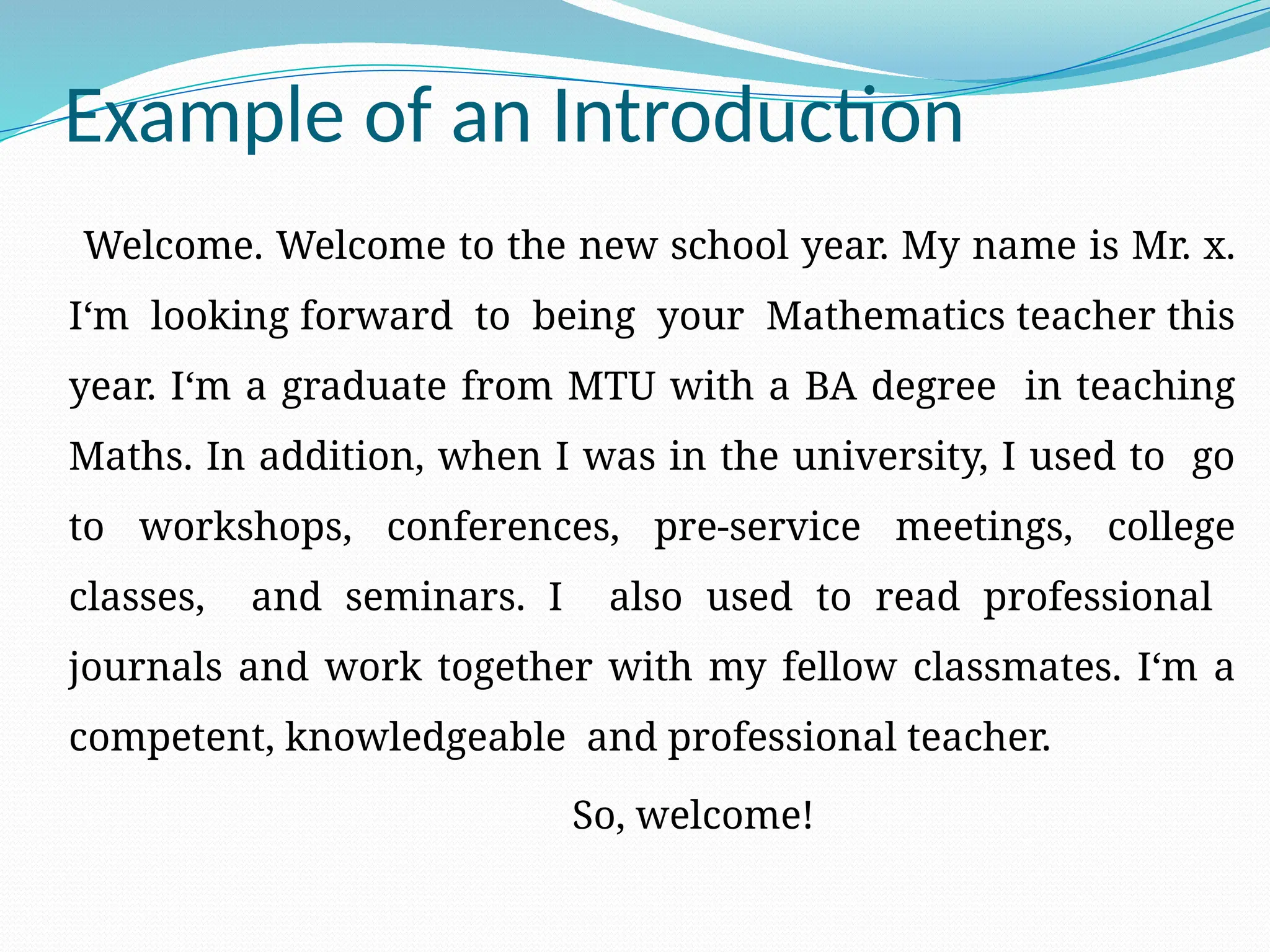
Example of anIntroduction
Welcome. Welcome to the new school year. My name is Mr. x.
I‘m looking forward to being your Mathematics teacher this
year. I‘m a graduate from MTU with a BA degree in teaching
Maths. In addition, when I was in the university, I used to go
to workshops, conferences, pre-service meetings, college
classes, and seminars. I also used to read professional
journals and work together with my fellow classmates. I‘m a
competent, knowledgeable and professional teacher.
So, welcome!
41.
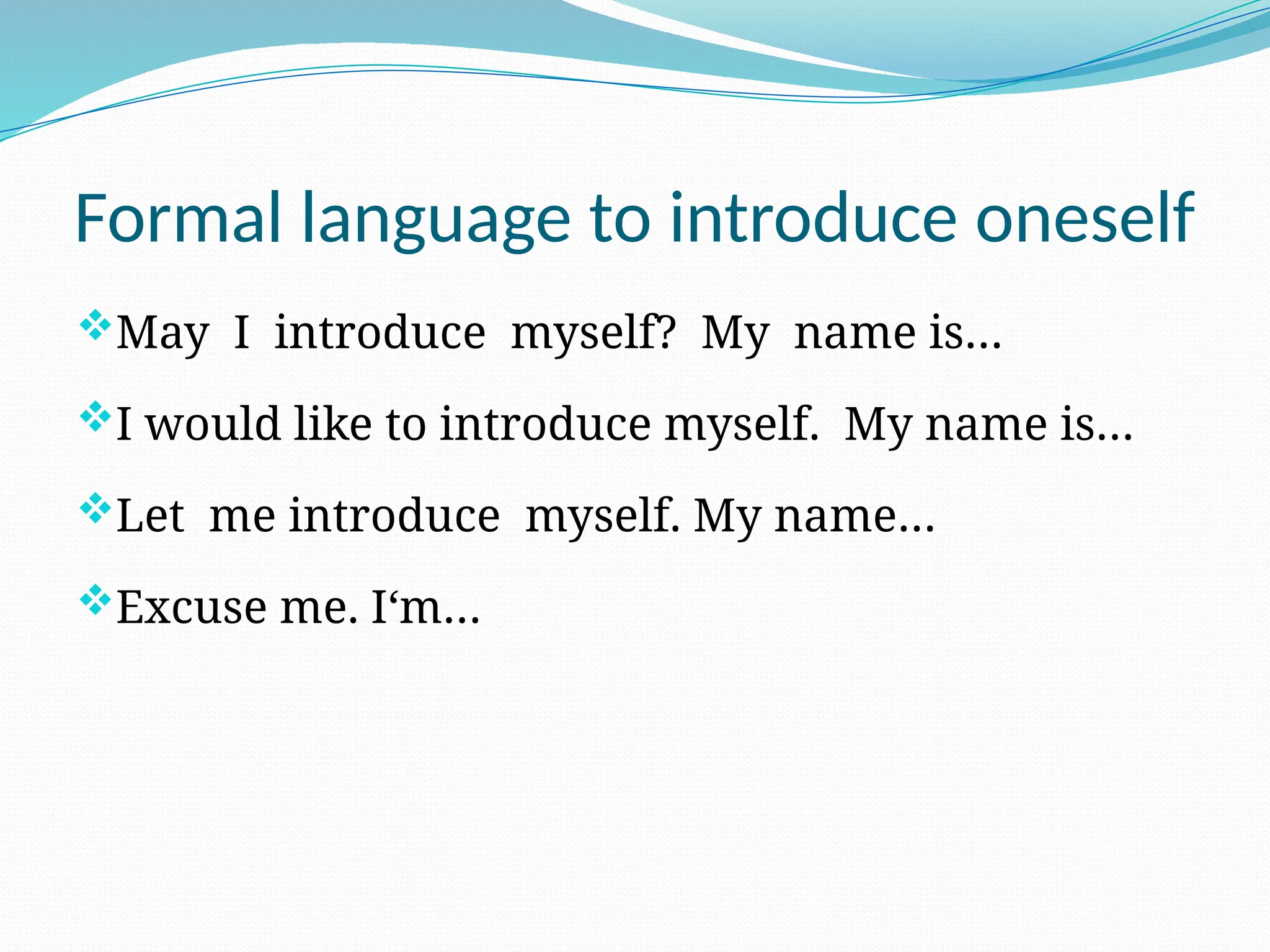
Formal language tointroduce oneself
May I introduce myself? My name is…
I would like to introduce myself. My name is…
Let me introduce myself. My name…
Excuse me. I‘m…
Greeting and smalltalk to get the class
relaxed
Activity 5
1. How would greet and make a small talk to get
yours students relaxed?
44.
Here are someexpressions to greet and get
students relax
Good morning/ afternoon/ evening class/students/ boys and girls/
everyone/ everybody/ Helen/ Ababa.
How are you (today), Tesfaye/ Hanna?
How are things with you Rosa/ Solomon?
How‘s life?
How are you getting on?
How are you feeling today, Ibrahim?
Are you feeling better today, Ayele?
Is it hot/ cold/ humid/ raining outside/ at the moment?
45.
Cont’d
I hope you‘verecovered from your cold, Merima.
You (all) look tired/ hot/ cold.
I hope you are all feeling well.
I hope you are all feeling fit today.
I hope you‘ve all had a nice/good Weekend /holiday.
How about you, Oliyad?
What did you do during the weekend/holiday?
Are you (all) feeling well today?
46.
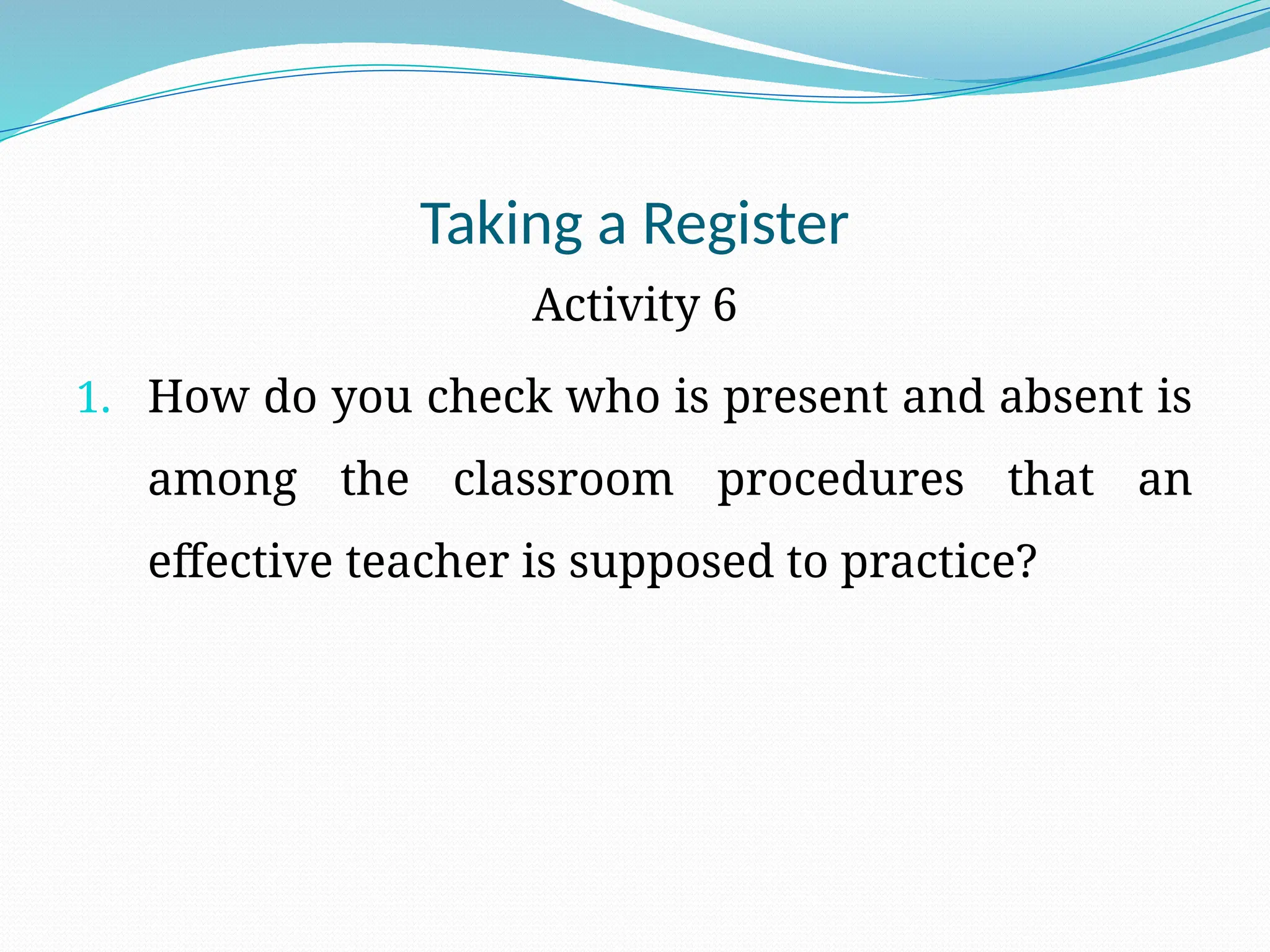
Taking a Register
Activity6
1. How do you check who is present and absent is
among the classroom procedures that an
effective teacher is supposed to practice?
47.
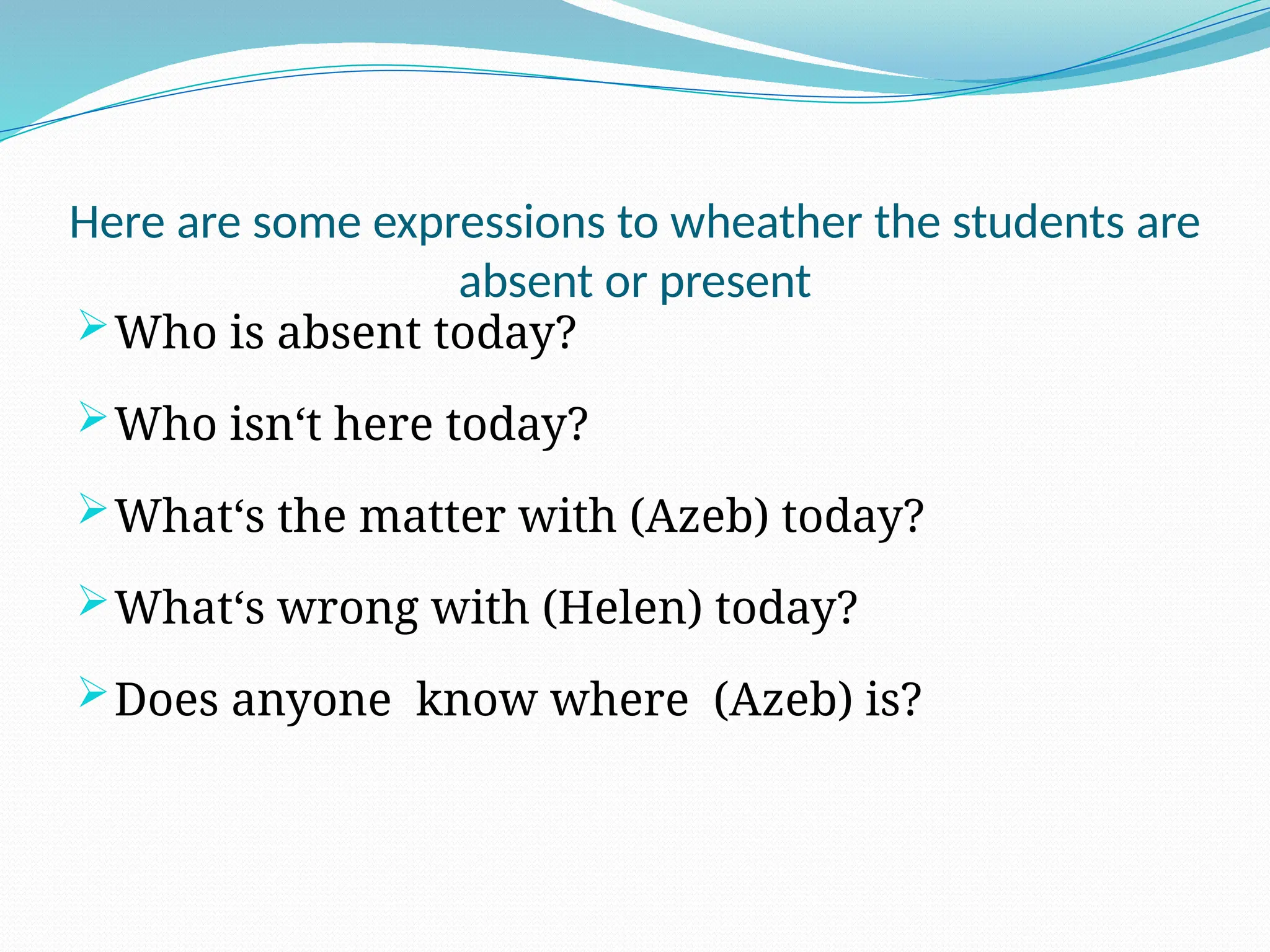
Here are someexpressions to wheather the students are
absent or present
Who is absent today?
Who isn‘t here today?
What‘s the matter with (Azeb) today?
What‘s wrong with (Helen) today?
Does anyone know where (Azeb) is?
48.
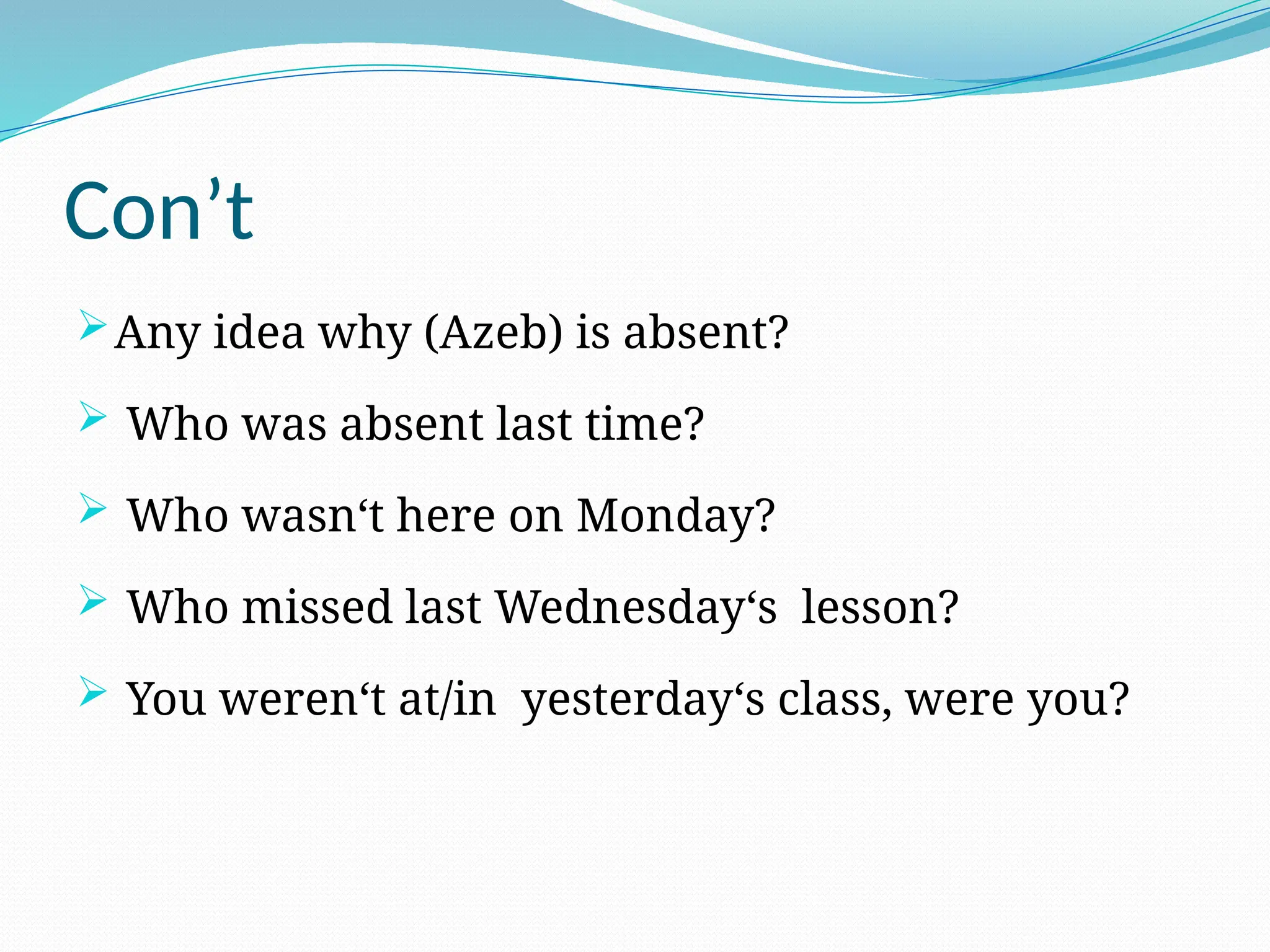
Con’t
Any idea why(Azeb) is absent?
Who was absent last time?
Who wasn‘t here on Monday?
Who missed last Wednesday‘s lesson?
You weren‘t at/in yesterday‘s class, were you?
49.
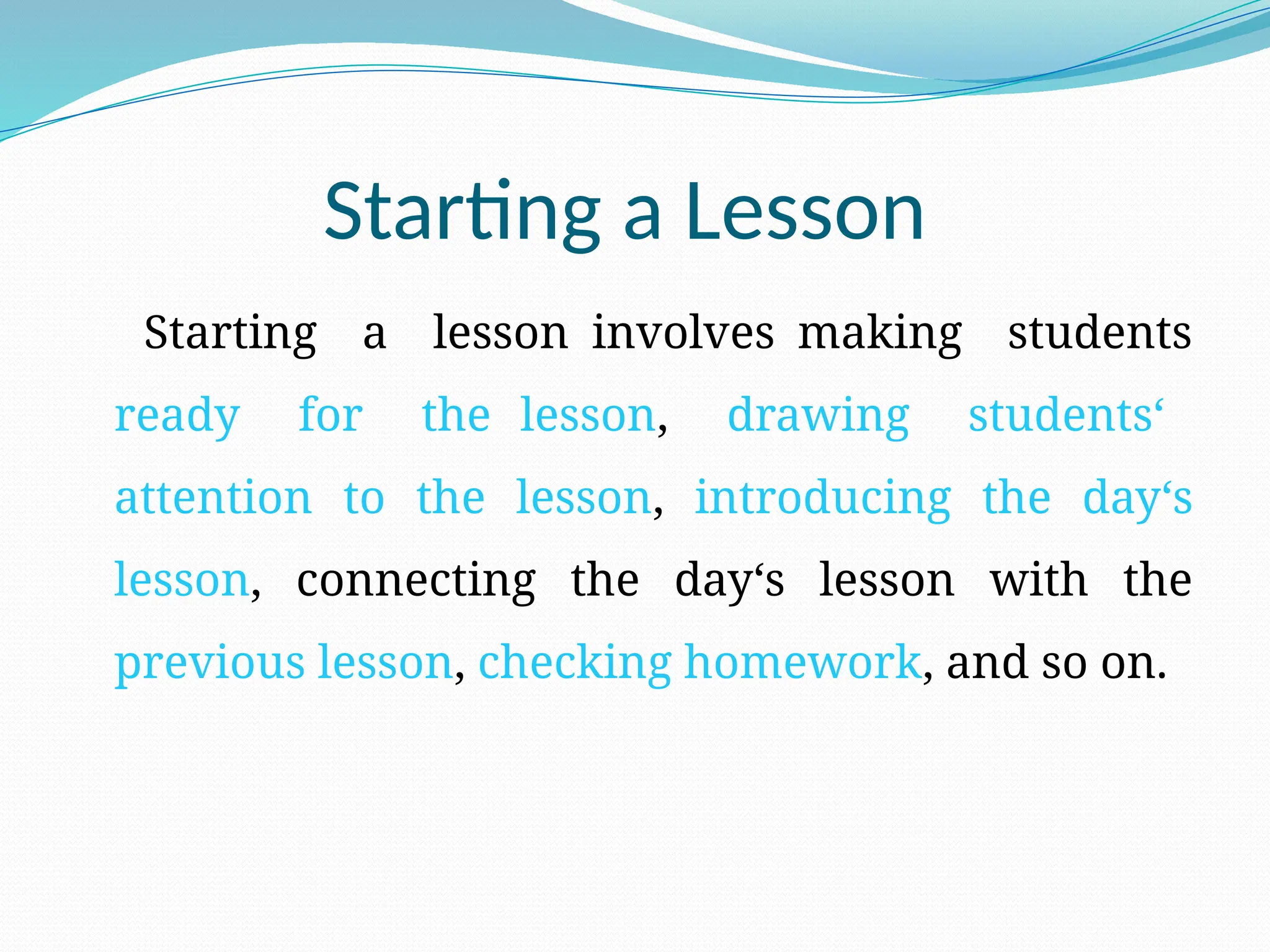
Starting a Lesson
Startinga lesson involves making students
ready for the lesson, drawing students‘
attention to the lesson, introducing the day‘s
lesson, connecting the day‘s lesson with the
previous lesson, checking homework, and so on.
50.
Getting students readyand drawing their attention to the lesson
Activity 7
1. What kind of language that you(teachers) use so
as to move students into the day's lesson?
51.
Look at thelanguage that you can
so as to move into the day's lesson
A. I hope you all are ready for your [English] lesson.
Let‘s begin/start the lesson!
Now, take out your book/exercise book and be ready for instruction.
B. Pay attention, please!
Be quiet and pay attention!
Attention, please!
[Name], pay attention and listen to me.
[Name], stop talking and listen to me.
Everybody, look at the board and pay attention.
52.
Introducing aims andstages of a
lesson
Activity 8
As a teacher, how can you introduce the aims and
stages of a lesson separately?
53.
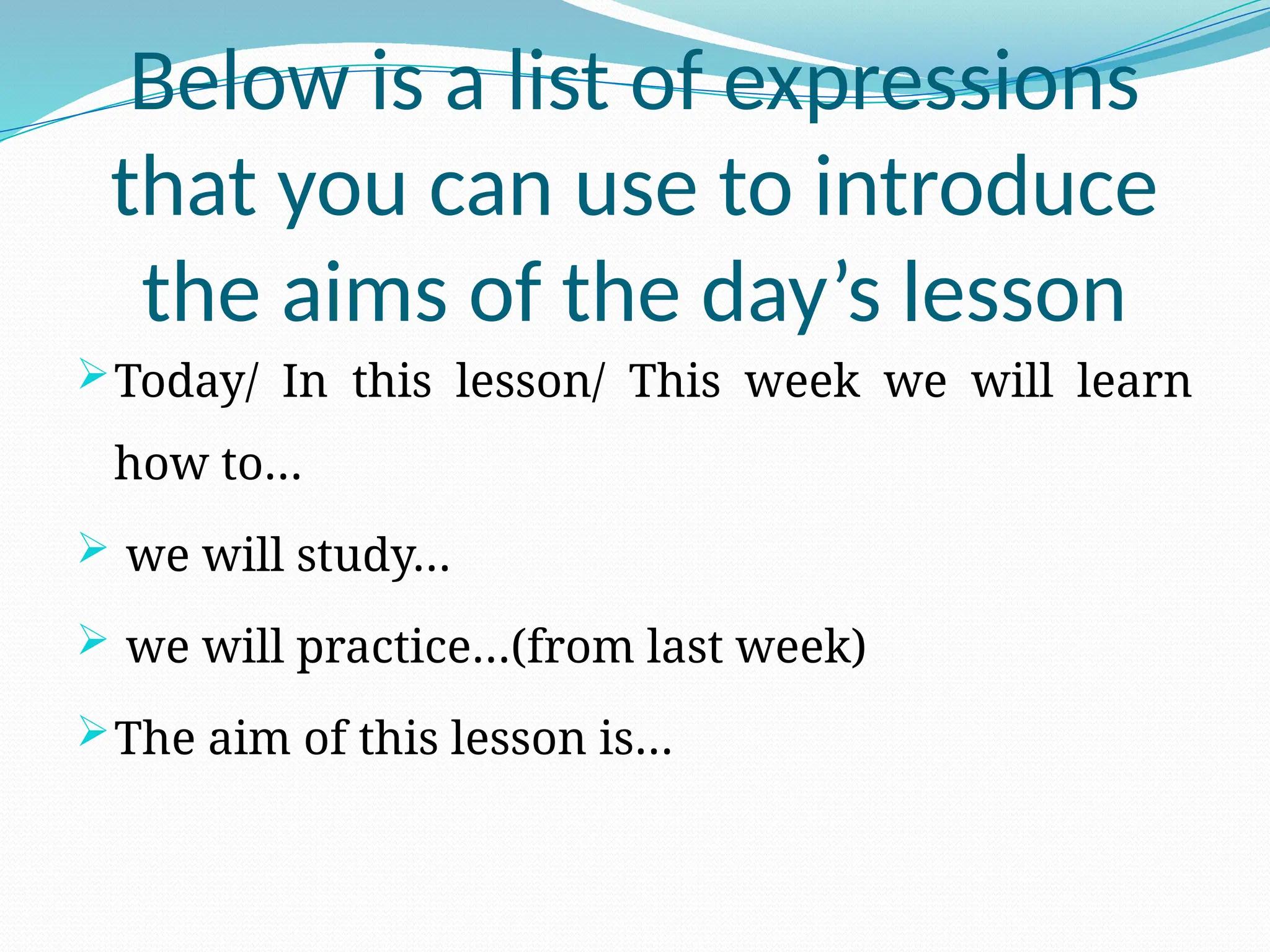
Below is alist of expressions
that you can use to introduce
the aims of the day’s lesson
Today/ In this lesson/ This week we will learn
how to…
we will study…
we will practice…(from last week)
The aim of this lesson is…
54.
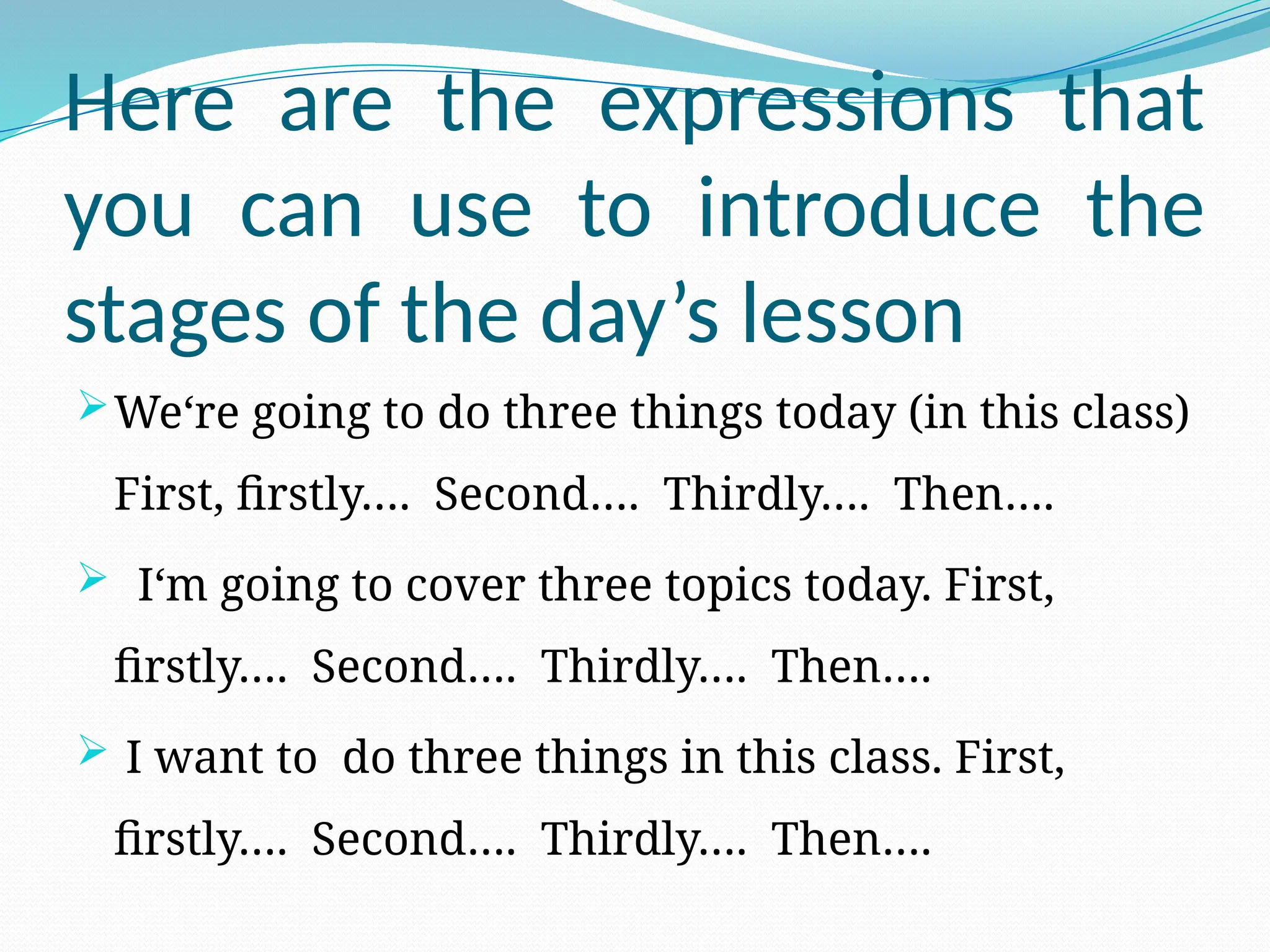
Here are theexpressions that
you can use to introduce the
stages of the day’s lesson
We‘re going to do three things today (in this class)
First, firstly…. Second…. Thirdly…. Then….
I‘m going to cover three topics today. First,
firstly…. Second…. Thirdly…. Then….
I want to do three things in this class. First,
firstly…. Second…. Thirdly…. Then….
55.
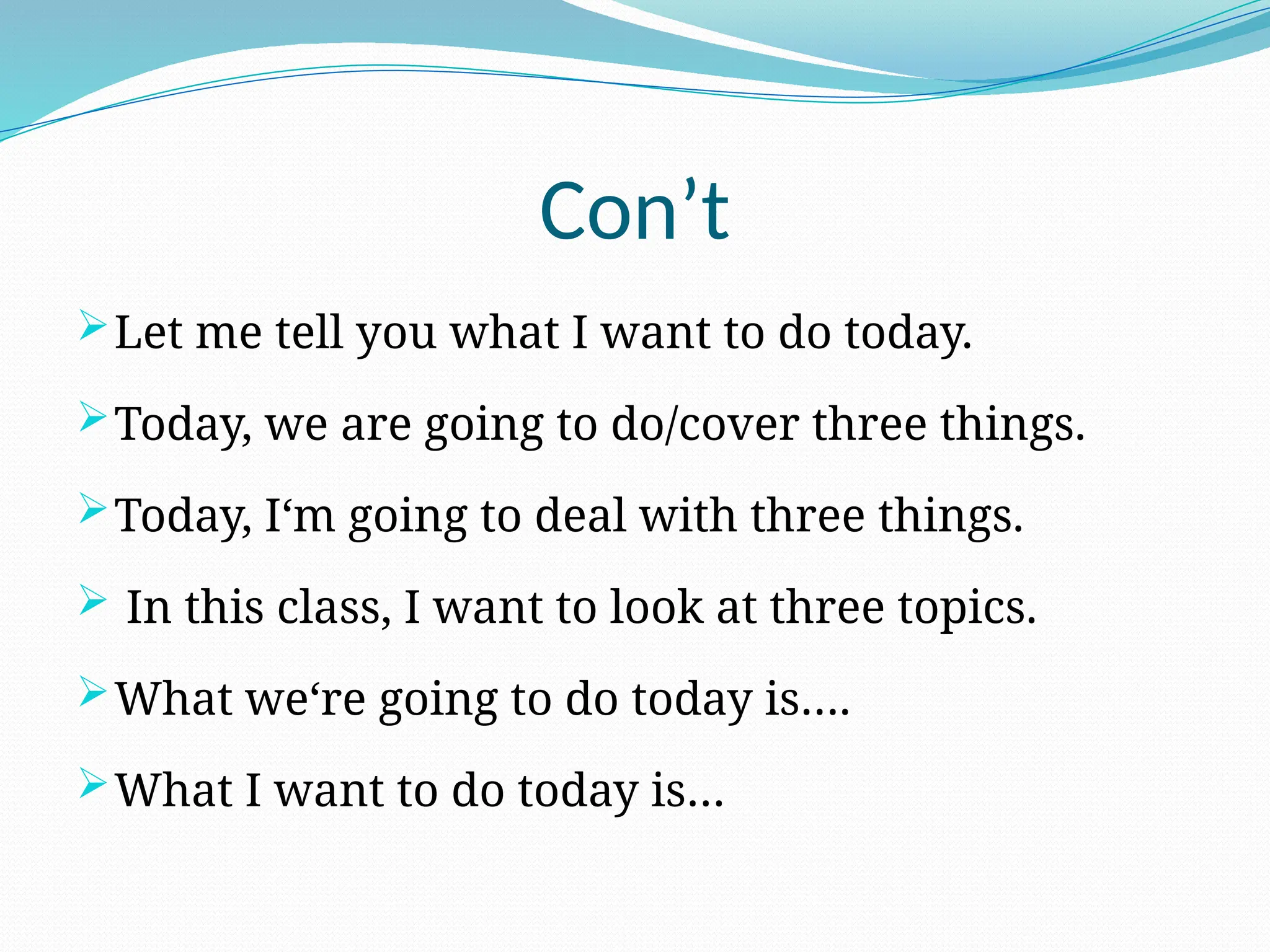
Con’t
Let me tellyou what I want to do today.
Today, we are going to do/cover three things.
Today, I‘m going to deal with three things.
In this class, I want to look at three topics.
What we‘re going to do today is….
What I want to do today is…
56.
Late coming students
Activity9
1. By the time you have been teaching, some
students might come late and then interrupted
your class. So how can you deal or communicate
with those late coming students?
57.
Below are thecommon expressions
to deal with late coming
A. Why are you late?
Where have you been?
What have you been doing? We started ten
minutes ago.
Did you oversleep/miss your bus?
What do you say when you are late?
58.
Con’t
B. I see.Well, come in and sit down.
Please, hurry up and sit down. We have already started.
That‘s all right. Sit down and we can continue.
C. Try not to be late next time.
Try to be here on time next time.
Don‘t let it happen again.
Let this be the last time.
That‘s the second time this week.
I‘ll have to report you if you‘re late again.
![Look at the language that you can
so as to move into the day's lesson
A. I hope you all are ready for your [English] lesson.
Let‘s begin/start the lesson!
Now, take out your book/exercise book and be ready for instruction.
B. Pay attention, please!
Be quiet and pay attention!
Attention, please!
[Name], pay attention and listen to me.
[Name], stop talking and listen to me.
Everybody, look at the board and pay attention.](https://image.slidesharecdn.com/shorttermtrainingformtustaff-250519181021-2ef63073/75/Training-material-for-instructors-on-classroom-English-51-2048.jpg)