Classifying IoT malware delivery patterns for attack detection
Master of Science in Engineering in Computer Science
Candidate:
Fabrizio Farinacci
Student ID: 1530961
Thesis advisor:
Prof. Leonardo Querzoni
Co-Advisor:
Dr. Giuseppe Laurenza
A. Y. 2016 - 2017
Introduction Related work and contributions Proposed approach Results evaluation Conclusions and future work
Background: The Internet of Things
• The Internet of Things (IoT) is that vision in which anything
from vehicles to home appliances are equipped with Internet
connectivity and digitally connected for exchanging data.
• Sadly, the IoT came recently under the spotlight more for its
widespread security issues rather than its enormous potential.
Classifying IoT malware delivery patterns for attack detection
Introduction Related work and contributions Proposed approach Results evaluation Conclusions and future work
Background: Threats affecting the IoT
• Being the IoT panorama formed by unsecure, misconfigured and
easily accessible devices, makes it the cybercriminals Holy Grail!
• This environment favored the proliferation of IoT malware and in
particular botnets, mainly devoted to perform DDoS attacks.
Classifying IoT malware delivery patterns for attack detection
Introduction Related work and contributions Proposed approach Results evaluation Conclusions and future work
Problem statement and thesis objective
Problem
The highly vulnerable IoT landscape favors the proliferation of threats
and in particular malware. Understanding and characterizing them is
a fundamental requirement for preventing IoT devices compromise.
Thesis objective
Design a platform, trained on top of knowledge extracted from real
attacks collected by the platform itself, capable of recognizing known
attacks and detecting variants or completely new attacks.
Classifying IoT malware delivery patterns for attack detection
Introduction Related work and contributions Proposed approach Results evaluation Conclusions and future work
Related work
Works in the IoT security field divides into:
• Studies providing basic security guidelines for preventing,
mitigating and recovery from attacks.
[Angrishi et al., 2017]
• Proposing honeypot systems designed for the IoT environment,
with the goal of assessing the current threats.
[SIPHON, Guarnizo et al., 2017]
• Designing detection strategies, employing either simple device
white-listing mechanism or unreliable signature-based approaches.
[Meidan et al., 2017]
• Proposing proof-of-concept mechanism for detecting infected
devices and automatize the recovery strategy.
[AntibIoTic, De Donno et al., 2017]
Classifying IoT malware delivery patterns for attack detection
Introduction Related work and contributions Proposed approach Results evaluation Conclusions and future work
Contributions
The contributions made by this work are the following:
1. Showing the honeypots capabilities of revealing IoT threats;
2. Identifying specific attack patterns for characterizing the attacks;
3. Introducing an approach for profiling the attacks;
4. Showing how profiles enable to group similar attacks;
5. Showing how profiles enable to classify and recognize attacks;
6. Showing how profiles enable to track the evolution of attacks.
Classifying IoT malware delivery patterns for attack detection
Introduction Related work and contributions Proposed approach Results evaluation Conclusions and future work
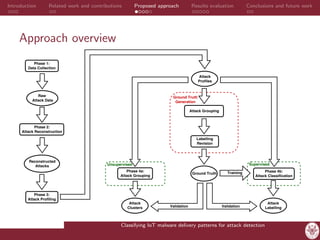
Approach overview
Classifying IoT malware delivery patterns for attack detection
Introduction Related work and contributions Proposed approach Results evaluation Conclusions and future work
Attack profile extraction
Classifying IoT malware delivery patterns for attack detection
Introduction Related work and contributions Proposed approach Results evaluation Conclusions and future work
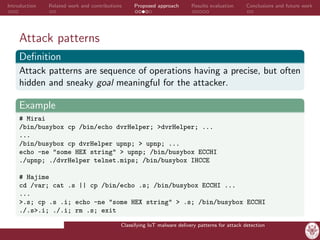
Attack patterns
Definition
Attack patterns are sequence of operations having a precise, but often
hidden and sneaky goal meaningful for the attacker.
Example
# Mirai
/bin/busybox cp /bin/echo dvrHelper; >dvrHelper; ...
...
/bin/busybox cp dvrHelper upnp; > upnp; ...
echo -ne "some HEX string" > upnp; /bin/busybox ECCHI
./upnp; ./dvrHelper telnet.mips; /bin/busybox IHCCE
# Hajime
cd /var; cat .s || cp /bin/echo .s; /bin/busybox ECCHI ...
...
>.s; cp .s .i; echo -ne "some HEX string" > .s; /bin/busybox ECCHI
./.s>.i; ./.i; rm .s; exit
Classifying IoT malware delivery patterns for attack detection
Introduction Related work and contributions Proposed approach Results evaluation Conclusions and future work
Pattern-based attack representation
Classifying IoT malware delivery patterns for attack detection
Introduction Related work and contributions Proposed approach Results evaluation Conclusions and future work
Phase 4: Attack aggregation and classification
• Once the attack profiles are extracted, they can be employed for:
◦ Grouping the attacks for devising attack classes and their evolution.
◦ Classifying the attacks and being so able to recognize them.
• For the grouping task, we employed the unsupervised learning
clustering algorithms BIRCH and DBSCAN.
• For the classification task, we trained and evaluated the supervised
learning classifiers Random Forest, Decision Tree, Bernoulli Naive
Bayes and Linear Kernel SVM.
Classifying IoT malware delivery patterns for attack detection
Introduction Related work and contributions Proposed approach Results evaluation Conclusions and future work
Dataset description and testing methodology
Dataset: 270.000 attacks collected by the platform and divided
in 17 classes, representing either variants or different attacks.
Used metrics:
• Attack grouping: Homogeneity and completeness scores,
Fowlkes–Mallows index and silhouette coefficient.
• Attack classification: F1 and accuracy scores, precision and recall.
Performed tests:
• Attack grouping:
◦ Clustering comparison on 50.000 samples ( 1/5 of dataset).
◦ Incremental time-based k-fold cross-validation (k = 10).
• Attack classification:
◦ Incremental time-based k-fold cross-validation (k = 10).
◦ Stratified k-fold cross-validation (k = 5).
Classifying IoT malware delivery patterns for attack detection
Introduction Related work and contributions Proposed approach Results evaluation Conclusions and future work
Test 1: BIRCH and DBSCAN comparison
0,8
0,85
0,9
0,95
1
FMI Homogeneity Completeness
Clustering	comparison	- Observed	metrics
DBSCAN BIRCH
(a) Observed metrics comparison
0
2
4
6
8
10
Avg.	Time	(sec.)
Clustering	comparison	- Time	performance
DBSCAN BIRCH
(b) Time performance comparison
Classifying IoT malware delivery patterns for attack detection
Introduction Related work and contributions Proposed approach Results evaluation Conclusions and future work
Test 2: Incremental time-based k-fold grouping
0
0,2
0,4
0,6
0,8
1
1 2 3 4 5 6 7 8 9 10
Folds	(Time)
BIRCH	Online	- Periodical	tuning
FMI Homogeneity	score Completeness	score Silhouette	coeff.
Classifying IoT malware delivery patterns for attack detection
Introduction Related work and contributions Proposed approach Results evaluation Conclusions and future work
Test 3: Incremental time-based k-fold classification
0
0,2
0,4
0,6
0,8
1
1 2 3 4 5 6 7 8 9
Folds	(Time)
Random	Forest	- Incremental	k-fold
F1	score Precision Recall Accuracy	score
Classifying IoT malware delivery patterns for attack detection
Introduction Related work and contributions Proposed approach Results evaluation Conclusions and future work
Test 4: Stratified k-fold classification
0,995
0,996
0,997
0,998
0,999
1
Random	
Forest
Decision	
Tree
Bernoulli	
Naive	
Bayes
Linear	
Kernel	
SVM
F1	score
(c) F1 score
0,995
0,996
0,997
0,998
0,999
1
Random	
Forest
Decision	
Tree
Bernoulli	
Naive	
Bayes
Linear	
Kernel	
SVM
Precision
(d) Precision
0,995
0,996
0,997
0,998
0,999
1
Random	
Forest
Decision	
Tree
Bernoulli	
Naive	
Bayes
Linear	
Kernel	
SVM
Recall
(e) Recall
0,995
0,996
0,997
0,998
0,999
1
Random	
Forest
Decision	
Tree
Bernoulli	
Naive	
Bayes
Linear	
Kernel	
SVM
Accuracy	score
(f) Accuracy score
Classifying IoT malware delivery patterns for attack detection
Introduction Related work and contributions Proposed approach Results evaluation Conclusions and future work
Conclusions and future work
Conclusions
Results shown that our approach delivers promising results in the field
of attack recognition, enabling to study the evolution of attacks,
for at least for the subset of attacks that we managed to collect.
Future work
• Extending the platform, by:
1. Improving the honeypot platform;
2. Building a platform for organizing the data;
3. Developing Visual Analytics tools.
• Improving the description of attacks, by:
1. Improving the attack pattern identification;
2. Integrating with signature-based information.
• Online monitoring for attack prevention, by designing an online
detection procedure capable of detecting ongoing attacks.
Classifying IoT malware delivery patterns for attack detection
Introduction Related work and contributions Proposed approach Results evaluation Conclusions and future work
That’s all!
Thanks for the attention!
Any questions?
Classifying IoT malware delivery patterns for attack detection

Classifying IoT malware delivery patterns for attack detection

  • 1.
    Classifying IoT malwaredelivery patterns for attack detection Master of Science in Engineering in Computer Science Candidate: Fabrizio Farinacci Student ID: 1530961 Thesis advisor: Prof. Leonardo Querzoni Co-Advisor: Dr. Giuseppe Laurenza A. Y. 2016 - 2017
  • 2.
    Introduction Related workand contributions Proposed approach Results evaluation Conclusions and future work Background: The Internet of Things • The Internet of Things (IoT) is that vision in which anything from vehicles to home appliances are equipped with Internet connectivity and digitally connected for exchanging data. • Sadly, the IoT came recently under the spotlight more for its widespread security issues rather than its enormous potential. Classifying IoT malware delivery patterns for attack detection
  • 3.
    Introduction Related workand contributions Proposed approach Results evaluation Conclusions and future work Background: Threats affecting the IoT • Being the IoT panorama formed by unsecure, misconfigured and easily accessible devices, makes it the cybercriminals Holy Grail! • This environment favored the proliferation of IoT malware and in particular botnets, mainly devoted to perform DDoS attacks. Classifying IoT malware delivery patterns for attack detection
  • 4.
    Introduction Related workand contributions Proposed approach Results evaluation Conclusions and future work Problem statement and thesis objective Problem The highly vulnerable IoT landscape favors the proliferation of threats and in particular malware. Understanding and characterizing them is a fundamental requirement for preventing IoT devices compromise. Thesis objective Design a platform, trained on top of knowledge extracted from real attacks collected by the platform itself, capable of recognizing known attacks and detecting variants or completely new attacks. Classifying IoT malware delivery patterns for attack detection
  • 5.
    Introduction Related workand contributions Proposed approach Results evaluation Conclusions and future work Related work Works in the IoT security field divides into: • Studies providing basic security guidelines for preventing, mitigating and recovery from attacks. [Angrishi et al., 2017] • Proposing honeypot systems designed for the IoT environment, with the goal of assessing the current threats. [SIPHON, Guarnizo et al., 2017] • Designing detection strategies, employing either simple device white-listing mechanism or unreliable signature-based approaches. [Meidan et al., 2017] • Proposing proof-of-concept mechanism for detecting infected devices and automatize the recovery strategy. [AntibIoTic, De Donno et al., 2017] Classifying IoT malware delivery patterns for attack detection
  • 6.
    Introduction Related workand contributions Proposed approach Results evaluation Conclusions and future work Contributions The contributions made by this work are the following: 1. Showing the honeypots capabilities of revealing IoT threats; 2. Identifying specific attack patterns for characterizing the attacks; 3. Introducing an approach for profiling the attacks; 4. Showing how profiles enable to group similar attacks; 5. Showing how profiles enable to classify and recognize attacks; 6. Showing how profiles enable to track the evolution of attacks. Classifying IoT malware delivery patterns for attack detection
  • 7.
    Introduction Related workand contributions Proposed approach Results evaluation Conclusions and future work Approach overview Classifying IoT malware delivery patterns for attack detection
  • 8.
    Introduction Related workand contributions Proposed approach Results evaluation Conclusions and future work Attack profile extraction Classifying IoT malware delivery patterns for attack detection
  • 9.
    Introduction Related workand contributions Proposed approach Results evaluation Conclusions and future work Attack patterns Definition Attack patterns are sequence of operations having a precise, but often hidden and sneaky goal meaningful for the attacker. Example # Mirai /bin/busybox cp /bin/echo dvrHelper; >dvrHelper; ... ... /bin/busybox cp dvrHelper upnp; > upnp; ... echo -ne "some HEX string" > upnp; /bin/busybox ECCHI ./upnp; ./dvrHelper telnet.mips; /bin/busybox IHCCE # Hajime cd /var; cat .s || cp /bin/echo .s; /bin/busybox ECCHI ... ... >.s; cp .s .i; echo -ne "some HEX string" > .s; /bin/busybox ECCHI ./.s>.i; ./.i; rm .s; exit Classifying IoT malware delivery patterns for attack detection
  • 10.
    Introduction Related workand contributions Proposed approach Results evaluation Conclusions and future work Pattern-based attack representation Classifying IoT malware delivery patterns for attack detection
  • 11.
    Introduction Related workand contributions Proposed approach Results evaluation Conclusions and future work Phase 4: Attack aggregation and classification • Once the attack profiles are extracted, they can be employed for: ◦ Grouping the attacks for devising attack classes and their evolution. ◦ Classifying the attacks and being so able to recognize them. • For the grouping task, we employed the unsupervised learning clustering algorithms BIRCH and DBSCAN. • For the classification task, we trained and evaluated the supervised learning classifiers Random Forest, Decision Tree, Bernoulli Naive Bayes and Linear Kernel SVM. Classifying IoT malware delivery patterns for attack detection
  • 12.
    Introduction Related workand contributions Proposed approach Results evaluation Conclusions and future work Dataset description and testing methodology Dataset: 270.000 attacks collected by the platform and divided in 17 classes, representing either variants or different attacks. Used metrics: • Attack grouping: Homogeneity and completeness scores, Fowlkes–Mallows index and silhouette coefficient. • Attack classification: F1 and accuracy scores, precision and recall. Performed tests: • Attack grouping: ◦ Clustering comparison on 50.000 samples ( 1/5 of dataset). ◦ Incremental time-based k-fold cross-validation (k = 10). • Attack classification: ◦ Incremental time-based k-fold cross-validation (k = 10). ◦ Stratified k-fold cross-validation (k = 5). Classifying IoT malware delivery patterns for attack detection
  • 13.
    Introduction Related workand contributions Proposed approach Results evaluation Conclusions and future work Test 1: BIRCH and DBSCAN comparison 0,8 0,85 0,9 0,95 1 FMI Homogeneity Completeness Clustering comparison - Observed metrics DBSCAN BIRCH (a) Observed metrics comparison 0 2 4 6 8 10 Avg. Time (sec.) Clustering comparison - Time performance DBSCAN BIRCH (b) Time performance comparison Classifying IoT malware delivery patterns for attack detection
  • 14.
    Introduction Related workand contributions Proposed approach Results evaluation Conclusions and future work Test 2: Incremental time-based k-fold grouping 0 0,2 0,4 0,6 0,8 1 1 2 3 4 5 6 7 8 9 10 Folds (Time) BIRCH Online - Periodical tuning FMI Homogeneity score Completeness score Silhouette coeff. Classifying IoT malware delivery patterns for attack detection
  • 15.
    Introduction Related workand contributions Proposed approach Results evaluation Conclusions and future work Test 3: Incremental time-based k-fold classification 0 0,2 0,4 0,6 0,8 1 1 2 3 4 5 6 7 8 9 Folds (Time) Random Forest - Incremental k-fold F1 score Precision Recall Accuracy score Classifying IoT malware delivery patterns for attack detection
  • 16.
    Introduction Related workand contributions Proposed approach Results evaluation Conclusions and future work Test 4: Stratified k-fold classification 0,995 0,996 0,997 0,998 0,999 1 Random Forest Decision Tree Bernoulli Naive Bayes Linear Kernel SVM F1 score (c) F1 score 0,995 0,996 0,997 0,998 0,999 1 Random Forest Decision Tree Bernoulli Naive Bayes Linear Kernel SVM Precision (d) Precision 0,995 0,996 0,997 0,998 0,999 1 Random Forest Decision Tree Bernoulli Naive Bayes Linear Kernel SVM Recall (e) Recall 0,995 0,996 0,997 0,998 0,999 1 Random Forest Decision Tree Bernoulli Naive Bayes Linear Kernel SVM Accuracy score (f) Accuracy score Classifying IoT malware delivery patterns for attack detection
  • 17.
    Introduction Related workand contributions Proposed approach Results evaluation Conclusions and future work Conclusions and future work Conclusions Results shown that our approach delivers promising results in the field of attack recognition, enabling to study the evolution of attacks, for at least for the subset of attacks that we managed to collect. Future work • Extending the platform, by: 1. Improving the honeypot platform; 2. Building a platform for organizing the data; 3. Developing Visual Analytics tools. • Improving the description of attacks, by: 1. Improving the attack pattern identification; 2. Integrating with signature-based information. • Online monitoring for attack prevention, by designing an online detection procedure capable of detecting ongoing attacks. Classifying IoT malware delivery patterns for attack detection
  • 18.
    Introduction Related workand contributions Proposed approach Results evaluation Conclusions and future work That’s all! Thanks for the attention! Any questions? Classifying IoT malware delivery patterns for attack detection