Introduction
Aquatic weeds Unwanted plants, which grow in water and complete
at least a part of their life cycle in water are called as aquatic weeds.
They are further grouped into four categories as:
1. Submersed
2. Emersed
3. Marginal
4. Floating weeds.
Submersed Weeds
These weeds are mostly vascular plants that produce all or most of
their vegetative growth beneath the water surface, having true roots,
stems and leave e.g. Utricularia stellaris, Ceratophyllum demersum.
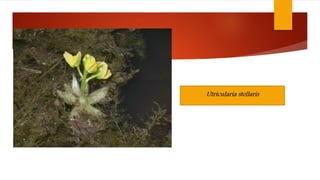
Utricularia stellaris
Immersed Weeds
These plants are rooted in the bottom mud, with aerial stems and
leaves at or above the water surface. The leaves are broad in many
plants and sometimes like grasses. These leaves do not rise and fall
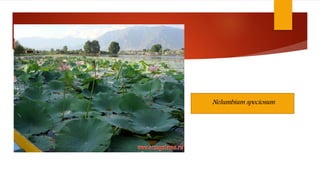
with water level as in the case of floating weeds e.g. Nelumbium
speciosum, Jussieua repens.
Nelumbium speciosum
Marginal Weeds
Most of these plants are immersed weeds that can grow in moist
shoreline areas with a depth of 60 to 90 cm water. These weeds vary
in size, shape and habitat. The important genera that comes under
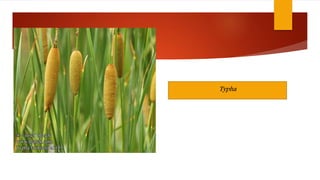
this group areTypha, Polygonum, Cephalanthus, Scirpus, etc.
Typha
Floating Weeds
These weeds have leaves that float on the water surface either singly
or in cluster. Some weeds are free floating and some rooted at the
mud bottom and the leaves rise and fall as the water level increases
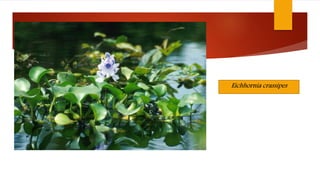
or decreases. e.g. Eichhornia crassipes, Pistia stratiotes, Salvinia sp.,
Nymphaea pubescens.
Eichhornia crassipes
Control Measures
These weeds can be controlled mechanically by dredging, cutting
cleaning, etc. chemicals like 2, 4-D ester formulations are effective
against both emerged and floating type of weeds like water hyacinth,
typha. Most submerged aquatic weeds will be killed by butachlor.
The use of liquid sodium arsenite and copper sulphate provides the
simple and cheap mean for destroying algae. Water hyacinth can be
controlled by paraquat @ 1 kg a.i/ha or Amitrole @ 3 to 5 kg a. i/ha.
Classification of rooted weeds

Classification of rooted weeds

  • 2.
    Introduction Aquatic weeds Unwantedplants, which grow in water and complete at least a part of their life cycle in water are called as aquatic weeds. They are further grouped into four categories as: 1. Submersed 2. Emersed 3. Marginal 4. Floating weeds.
  • 3.
    Submersed Weeds These weedsare mostly vascular plants that produce all or most of their vegetative growth beneath the water surface, having true roots, stems and leave e.g. Utricularia stellaris, Ceratophyllum demersum.
  • 4.
  • 5.
    Immersed Weeds These plantsare rooted in the bottom mud, with aerial stems and leaves at or above the water surface. The leaves are broad in many plants and sometimes like grasses. These leaves do not rise and fall with water level as in the case of floating weeds e.g. Nelumbium speciosum, Jussieua repens.
  • 6.
  • 7.
    Marginal Weeds Most ofthese plants are immersed weeds that can grow in moist shoreline areas with a depth of 60 to 90 cm water. These weeds vary in size, shape and habitat. The important genera that comes under this group areTypha, Polygonum, Cephalanthus, Scirpus, etc.
  • 8.
  • 9.
    Floating Weeds These weedshave leaves that float on the water surface either singly or in cluster. Some weeds are free floating and some rooted at the mud bottom and the leaves rise and fall as the water level increases or decreases. e.g. Eichhornia crassipes, Pistia stratiotes, Salvinia sp., Nymphaea pubescens.
  • 10.
  • 11.
    Control Measures These weedscan be controlled mechanically by dredging, cutting cleaning, etc. chemicals like 2, 4-D ester formulations are effective against both emerged and floating type of weeds like water hyacinth, typha. Most submerged aquatic weeds will be killed by butachlor. The use of liquid sodium arsenite and copper sulphate provides the simple and cheap mean for destroying algae. Water hyacinth can be controlled by paraquat @ 1 kg a.i/ha or Amitrole @ 3 to 5 kg a. i/ha.