Classification of computers
There are basically three
main ways to classify
computers. These are:
By Type
By Purpose
By Size/ Capacity
Dominic Boye Jnr.
By Type
There are three main
types of computers
under this class.
They include:
Digital computers
Analogue computers
Hybrid computers
bitsgh@gmail.com
Digital computers
These are computers that
represent data /information
in a binary form. That is they
represent signals in just two
states. 0s and 1s are used
during data communication.
bitsgh@gmail.com
bitsgh@gmail.com
Examples of digital computers
o Desktop computers
o Laptop computers
o Mobile phones
o iPads
o iPhones
o Scientific calculators
bitsgh@gmail.com
Analogue computers
These computers represent
data/information in a
continuous form. That is there
are no breaks during signal
transmission. They represent
information by processing
measurable physical
quantities.
bitsgh@gmail.com
bitsgh@gmail.com
Examples of analogue
computers
o Speedometer
o Thermometer
o Conventional watch
bitsgh@gmail.com
Hybrid computers
These computers exhibit features
of analogue computers and
digital computers. The digital
component normally serves as
the controller and provides
logical operations, while the
analogue component
normally serves as a solver of
different equations.
bitsgh@gmail.com
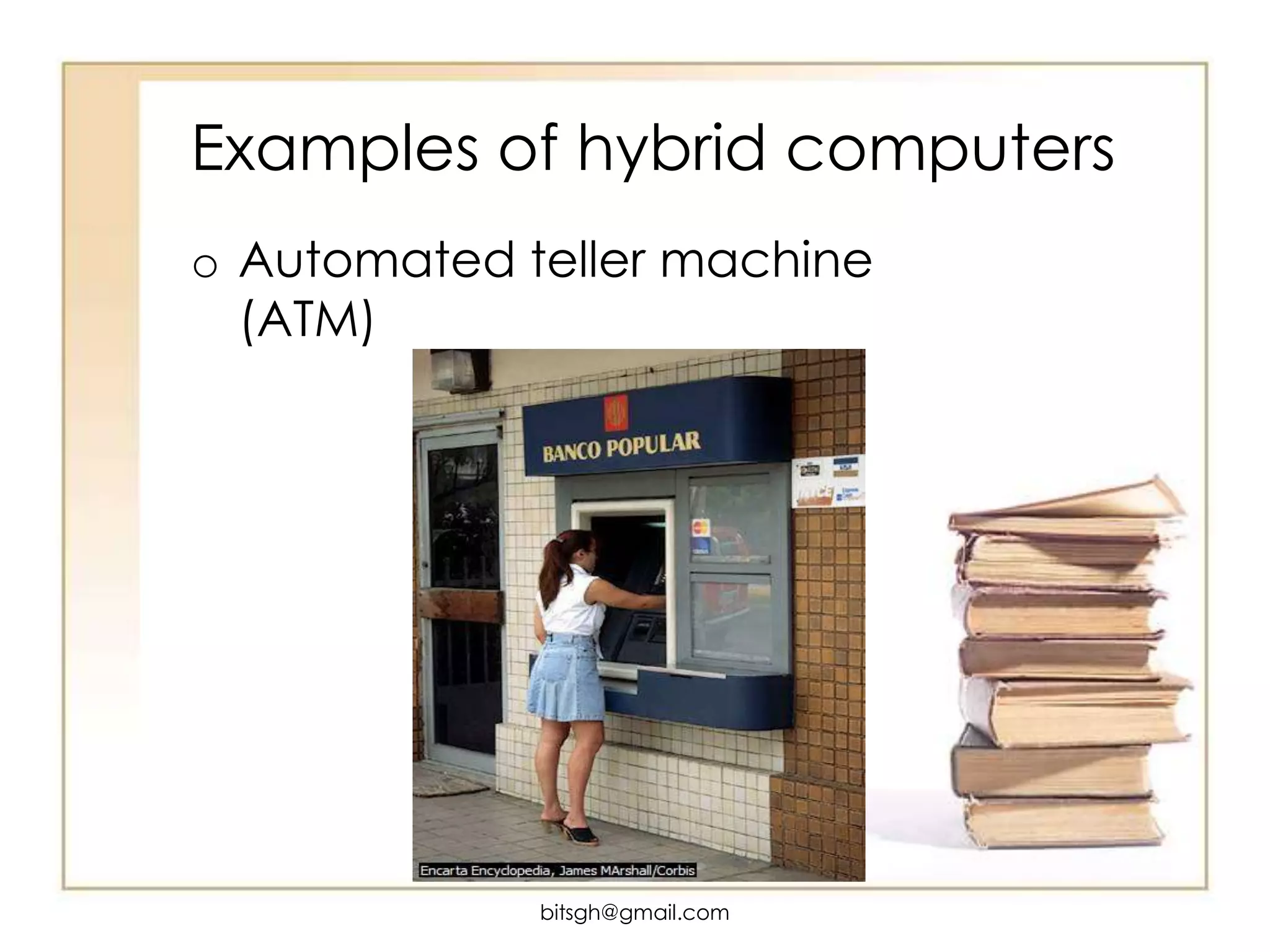
Examples of hybrid computers
o Automated teller machine
(ATM)
bitsgh@gmail.com
Examples of hybrid computers
o Electrocardiogram
bitsgh@gmail.com
By Purpose
Computers can also be
classified according to
the purpose or
application to which it
is put. There are two(2)
main groups under this
category, these are:
o Special purpose
o General purpose
bitsgh@gmail.com
Special Purpose Computers
A computer is said to be
special purpose if it is
designed to solve a
specific class of problem
for which it was made.
bitsgh@gmail.com
Examples of special purpose
computers
Computers for chemical
processes.
Computers in digital
watches.
bitsgh@gmail.com
General Purpose Computers
A general purpose computer
is not limited to the number
of applications it can be
used for.
bitsgh@gmail.com
By Size/Capacity
The capacity of a computer
refers to the volume of
data or information it can
process or store and the
speed at which it works.
The three main computers
under this group are:
Macro Computers
Mini Computers
Micro Computers
bitsgh@gmail.com
Macro Computers
They are the largest of all the
computers in terms of price,
memory size, power and
speed of processor.
Characteristics:
 Very expensive
 Generate a lot of heat
 Large memory size
 Wider variety of peripheral
support.
 Supports multiple users
bitsgh@gmail.com
Examples of Macro Computers
Mainframe
bitsgh@gmail.com
supercomputer
bitsgh@gmail.com
Micro computers
They are the smallest of all the
computers. They are also
called Personal Computers
because they are used by one
person at a time.
Characteristics:
 Small in size
 Used by one person
 Generate less heat
 Not expensive
bitsgh@gmail.com
Examples of Micro Computers
Desktop computers
Laptops
Workstations
IPads
Mobile phones
bitsgh@gmail.com
Mini Computers
A mini computer is one
whose size, speed and
capacity lies between
those of macro computers
and micro computers
bitsgh@gmail.com

Classification of computers

  • 1.
    Classification of computers Thereare basically three main ways to classify computers. These are: By Type By Purpose By Size/ Capacity Dominic Boye Jnr.
  • 2.
    By Type There arethree main types of computers under this class. They include: Digital computers Analogue computers Hybrid computers bitsgh@gmail.com
  • 3.
    Digital computers These arecomputers that represent data /information in a binary form. That is they represent signals in just two states. 0s and 1s are used during data communication. bitsgh@gmail.com
  • 4.
  • 5.
    Examples of digitalcomputers o Desktop computers o Laptop computers o Mobile phones o iPads o iPhones o Scientific calculators bitsgh@gmail.com
  • 6.
    Analogue computers These computersrepresent data/information in a continuous form. That is there are no breaks during signal transmission. They represent information by processing measurable physical quantities. bitsgh@gmail.com
  • 7.
  • 8.
    Examples of analogue computers oSpeedometer o Thermometer o Conventional watch bitsgh@gmail.com
  • 9.
    Hybrid computers These computersexhibit features of analogue computers and digital computers. The digital component normally serves as the controller and provides logical operations, while the analogue component normally serves as a solver of different equations. bitsgh@gmail.com
  • 10.
    Examples of hybridcomputers o Automated teller machine (ATM) bitsgh@gmail.com
  • 11.
    Examples of hybridcomputers o Electrocardiogram bitsgh@gmail.com
  • 12.
    By Purpose Computers canalso be classified according to the purpose or application to which it is put. There are two(2) main groups under this category, these are: o Special purpose o General purpose bitsgh@gmail.com
  • 13.
    Special Purpose Computers Acomputer is said to be special purpose if it is designed to solve a specific class of problem for which it was made. bitsgh@gmail.com
  • 14.
    Examples of specialpurpose computers Computers for chemical processes. Computers in digital watches. bitsgh@gmail.com
  • 15.
    General Purpose Computers Ageneral purpose computer is not limited to the number of applications it can be used for. bitsgh@gmail.com
  • 16.
    By Size/Capacity The capacityof a computer refers to the volume of data or information it can process or store and the speed at which it works. The three main computers under this group are: Macro Computers Mini Computers Micro Computers bitsgh@gmail.com
  • 17.
    Macro Computers They arethe largest of all the computers in terms of price, memory size, power and speed of processor. Characteristics:  Very expensive  Generate a lot of heat  Large memory size  Wider variety of peripheral support.  Supports multiple users bitsgh@gmail.com
  • 18.
    Examples of MacroComputers Mainframe bitsgh@gmail.com
  • 19.
  • 20.
    Micro computers They arethe smallest of all the computers. They are also called Personal Computers because they are used by one person at a time. Characteristics:  Small in size  Used by one person  Generate less heat  Not expensive bitsgh@gmail.com
  • 21.
    Examples of MicroComputers Desktop computers Laptops Workstations IPads Mobile phones bitsgh@gmail.com
  • 22.
    Mini Computers A minicomputer is one whose size, speed and capacity lies between those of macro computers and micro computers bitsgh@gmail.com