CLASSIFICATION AND TYPES OF
CRANIOFACIAL IMPLANTS
Presentation by:
Dr. Vanshree Sorathia
MDS Prosthodontist Total no. of slides: 88
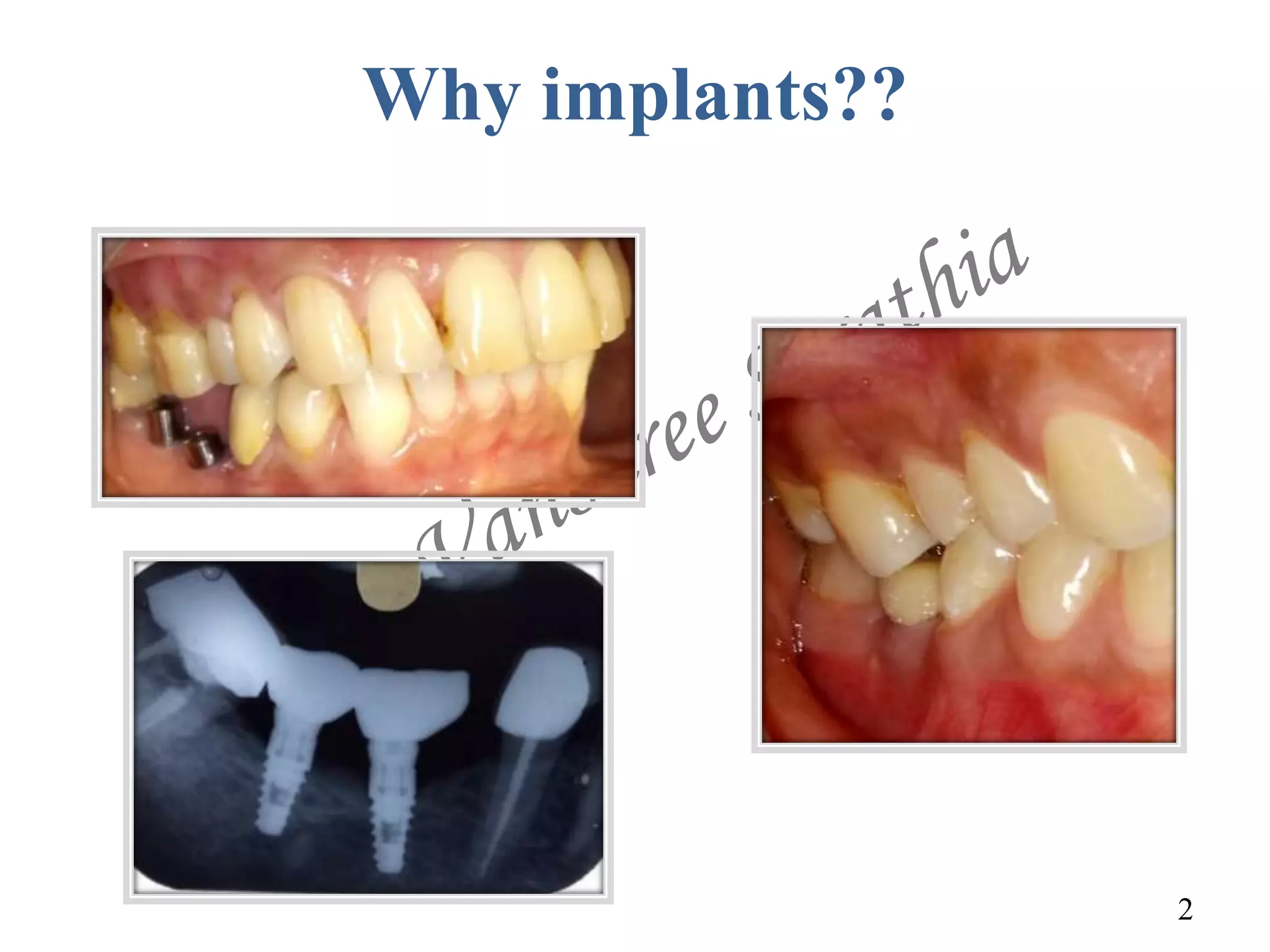
Why implants??
2
Objectives…
Definition
Classification
References
3
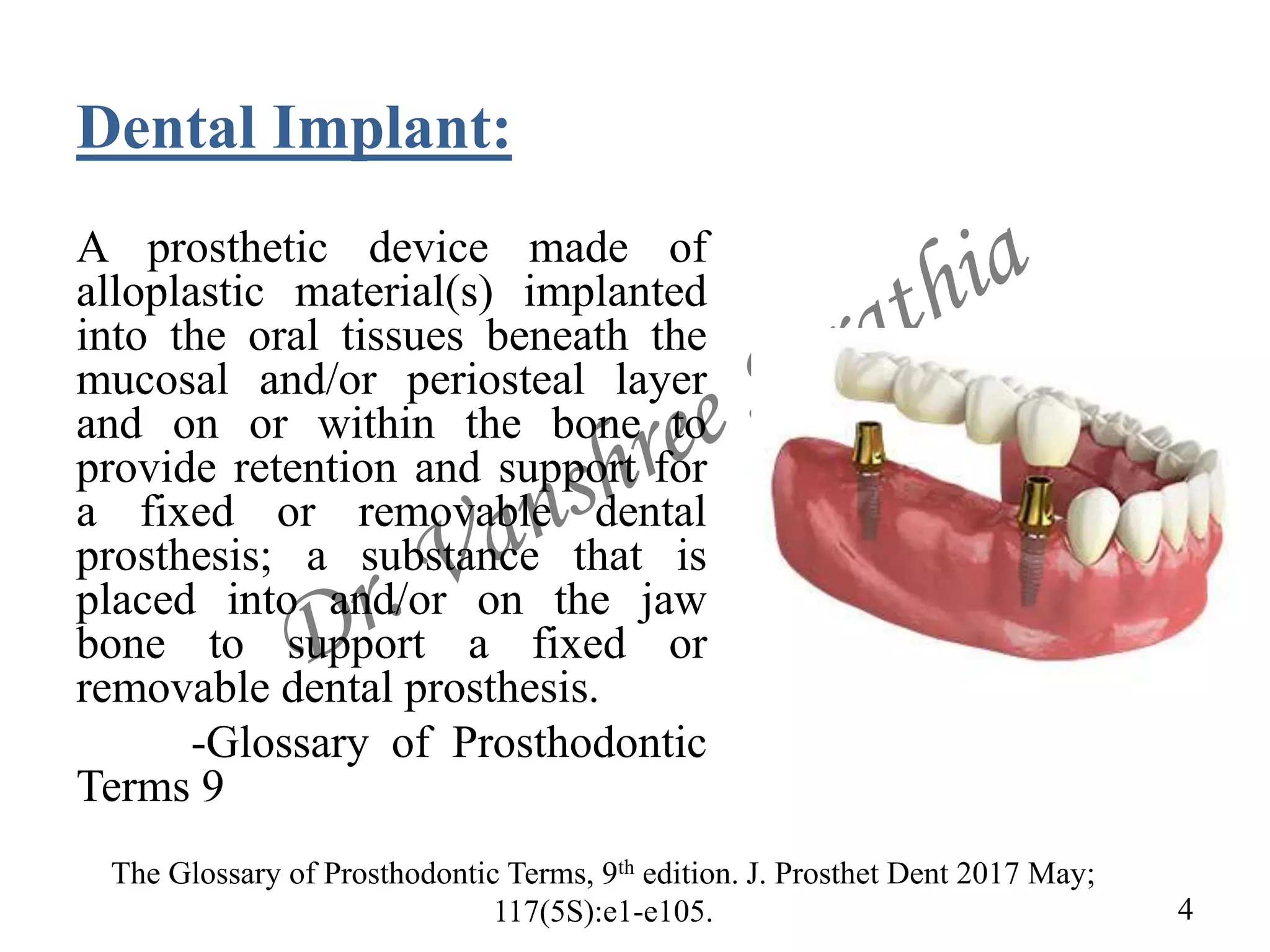
Dental Implant:
A prosthetic device made of
alloplastic material(s) implanted
into the oral tissues beneath the
mucosal and/or periosteal layer
and on or within the bone to
provide retention and support for
a fixed or removable dental
prosthesis; a substance that is
placed into and/or on the jaw
bone to support a fixed or
removable dental prosthesis.
-Glossary of Prosthodontic
Terms 9
The Glossary of Prosthodontic Terms, 9th edition. J. Prosthet Dent 2017 May;
117(5S):e1-e105. 4
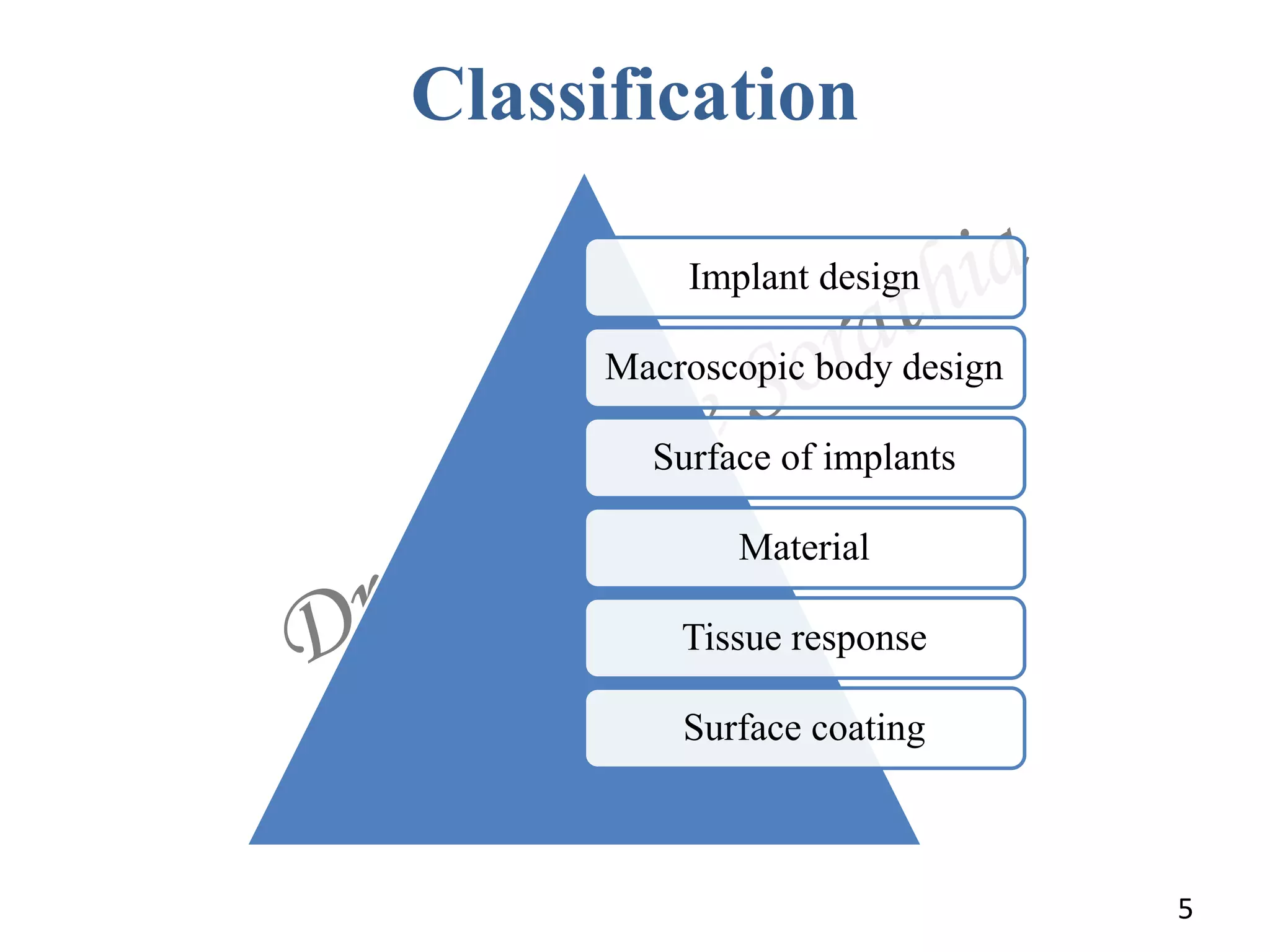
Classification
5
Implant design
Macroscopic body design
Surface of implants
Material
Tissue response
Surface coating
A. Implant Design
6
According to Charles A. Babbush
Charles A. Babbush, Dental implants-The art and science, 1st edition, Saunders
Elsevier, 2001.
7
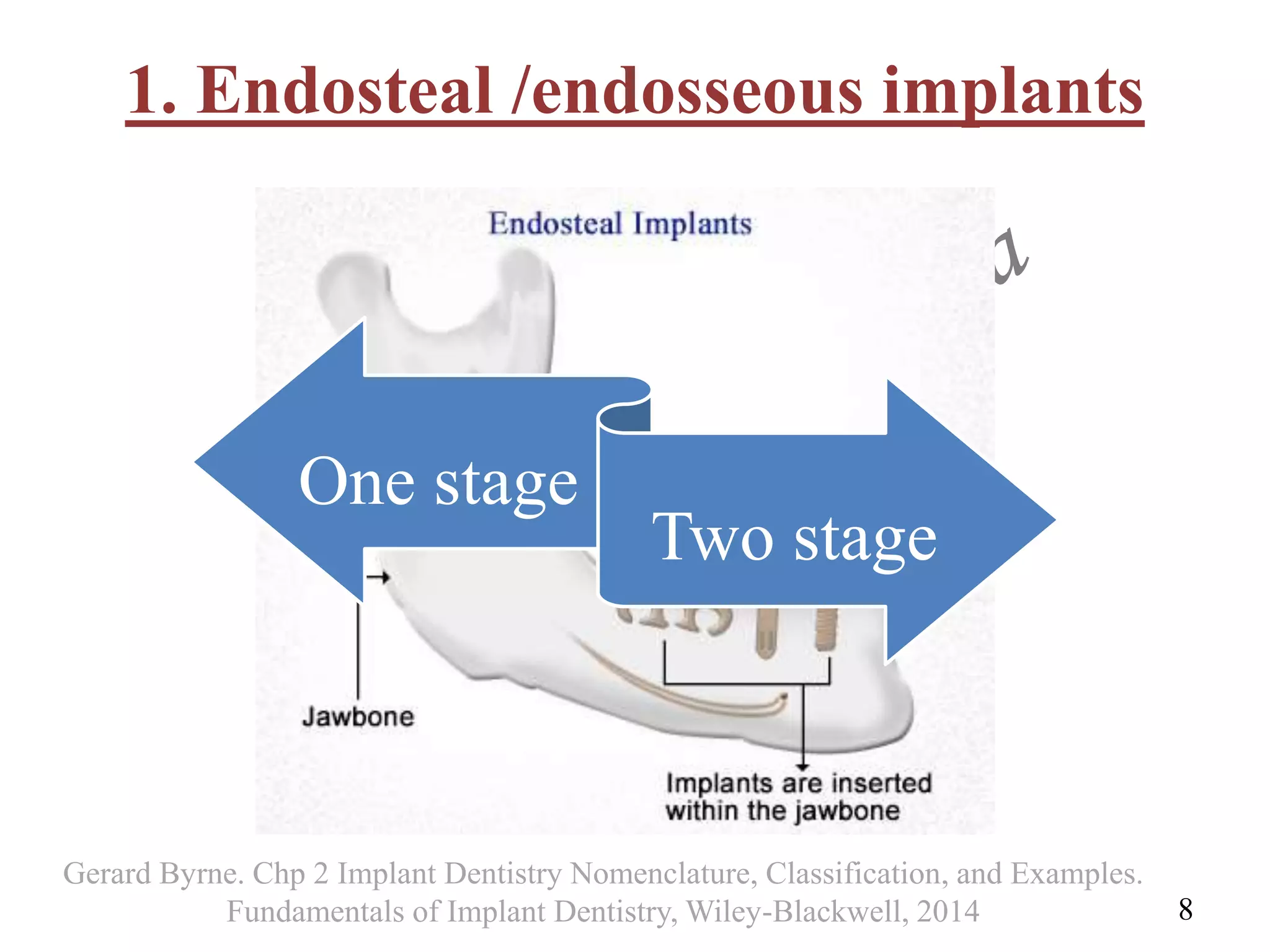
1. Endosteal /endosseous implants
Gerard Byrne. Chp 2 Implant Dentistry Nomenclature, Classification, and Examples.
Fundamentals of Implant Dentistry, Wiley-Blackwell, 2014 8
One stage
Two stage
(ii) Intraoral implants
9
(i) Intraoral → Conventional →(a)
Design
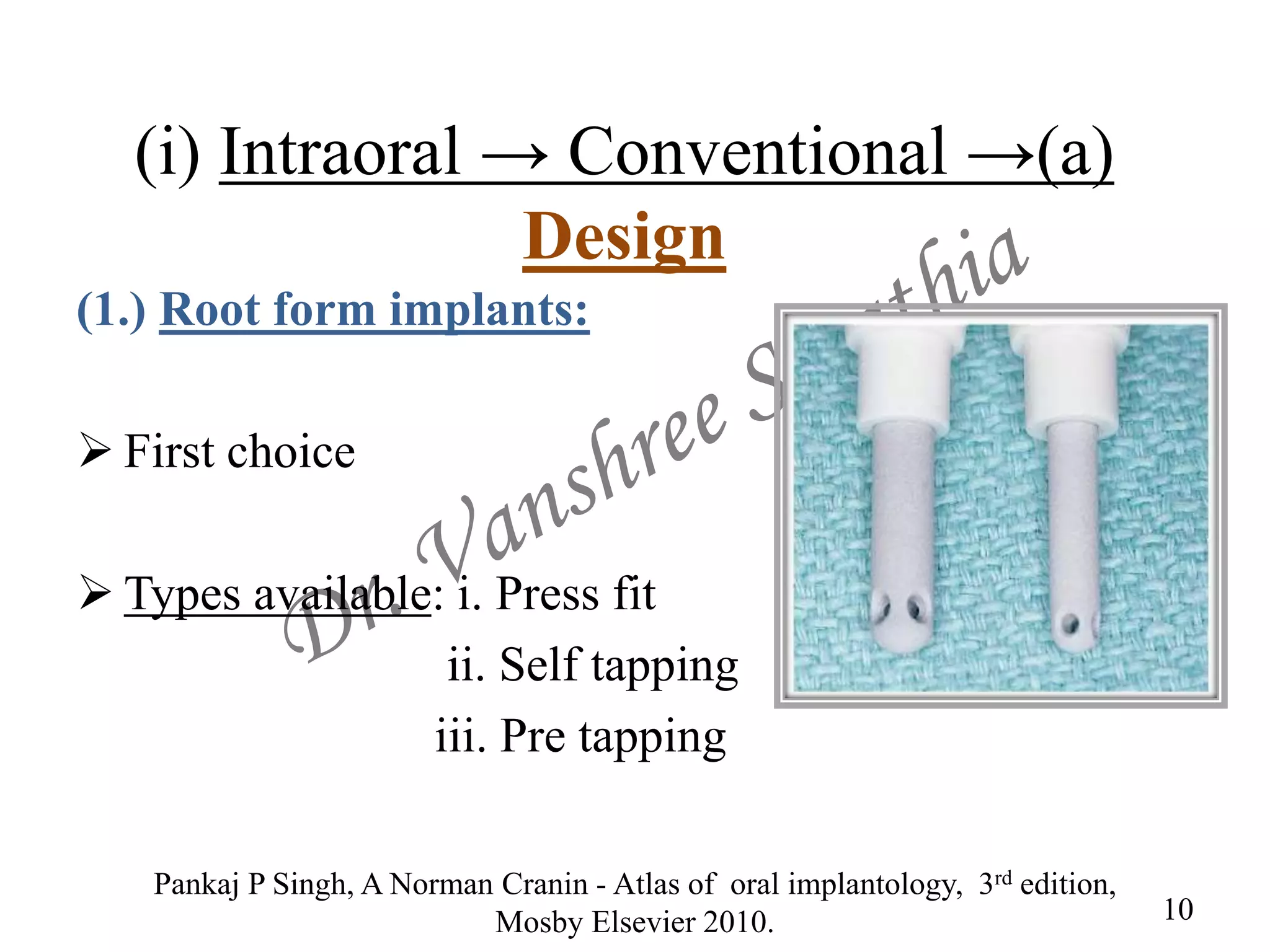
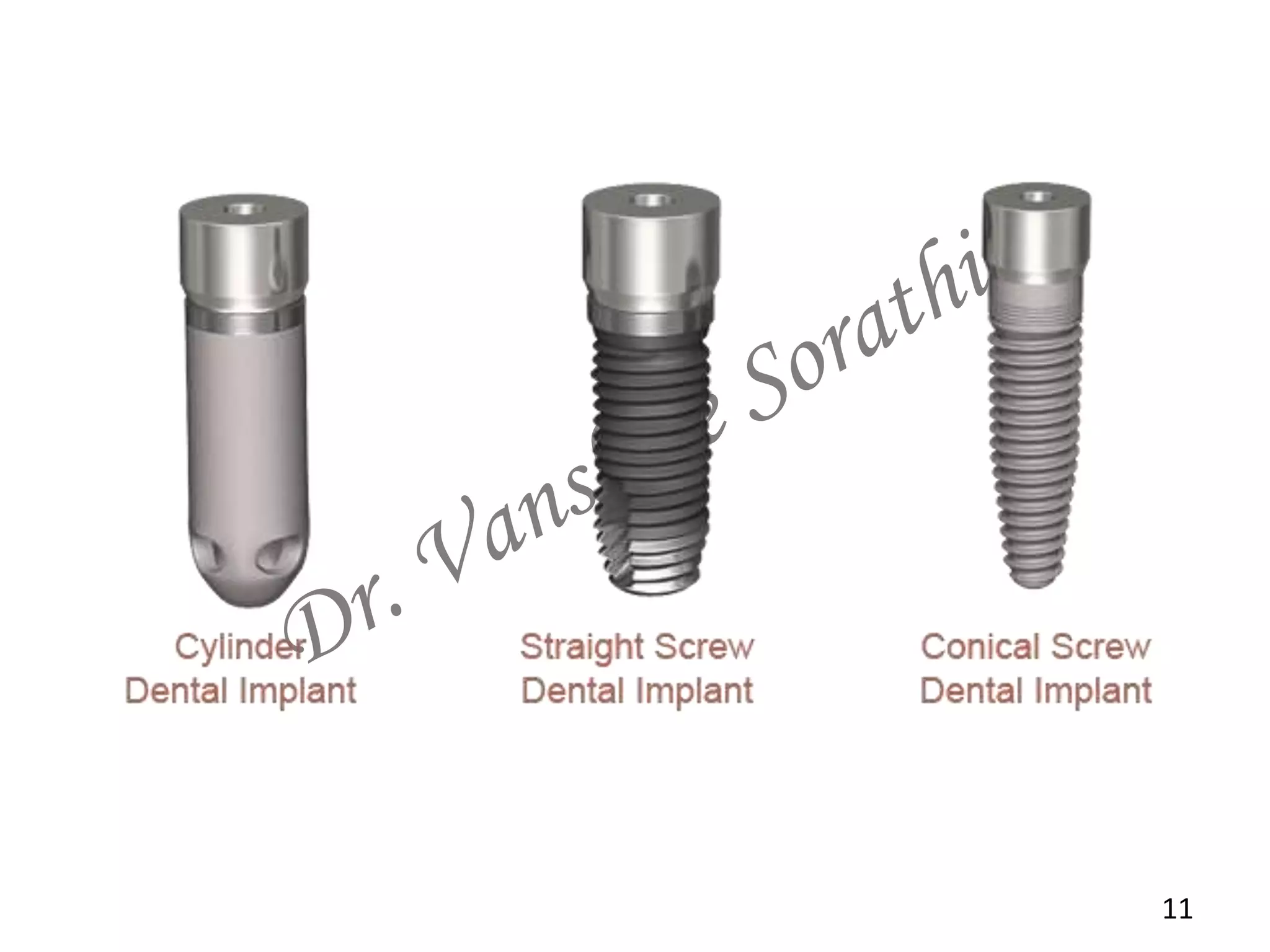
(1.) Root form implants:
 First choice
 Types available: i. Press fit
ii. Self tapping
iii. Pre tapping
Pankaj P Singh, A Norman Cranin - Atlas of oral implantology, 3rd edition,
Mosby Elsevier 2010. 10
11
12
 Prosthetic options: i. Fixed or fixed detachable
ii. Overdentures
iii. Single tooth devices
 Bone requirements:
Pankaj P Singh, A Norman Cranin - Atlas of oral implantology, 3rd edition,
Mosby Elsevier 2010.
13
Intraoral → Conventional →(a) Design
(2.) Crete Mince (Thin Ridge) implant:
 Threaded, self tapping, Ti spirals
 Prosthetic options: i. Fixed bridge prosthesis
ii. Superstructures
Pankaj P Singh, A Norman Cranin - Atlas of oral implantology, 3rd edition,
Mosby Elsevier 2010. 14
Intraoral → Conventional →(a) Design
(3.) Blade implants:
 Available as:
Submergible, single stage and two stage and one piece
devices in 3 forms:
i. Prefabricated
ii. Custom cast
iii. Alterable
Pankaj P Singh, A Norman Cranin - Atlas of oral implantology, 3rd edition,
Mosby Elsevier 2010.
15
Prosthetic options:
Pankaj P Singh, A Norman Cranin - Atlas of oral implantology, 3rd edition,
Mosby Elsevier 2010. 16
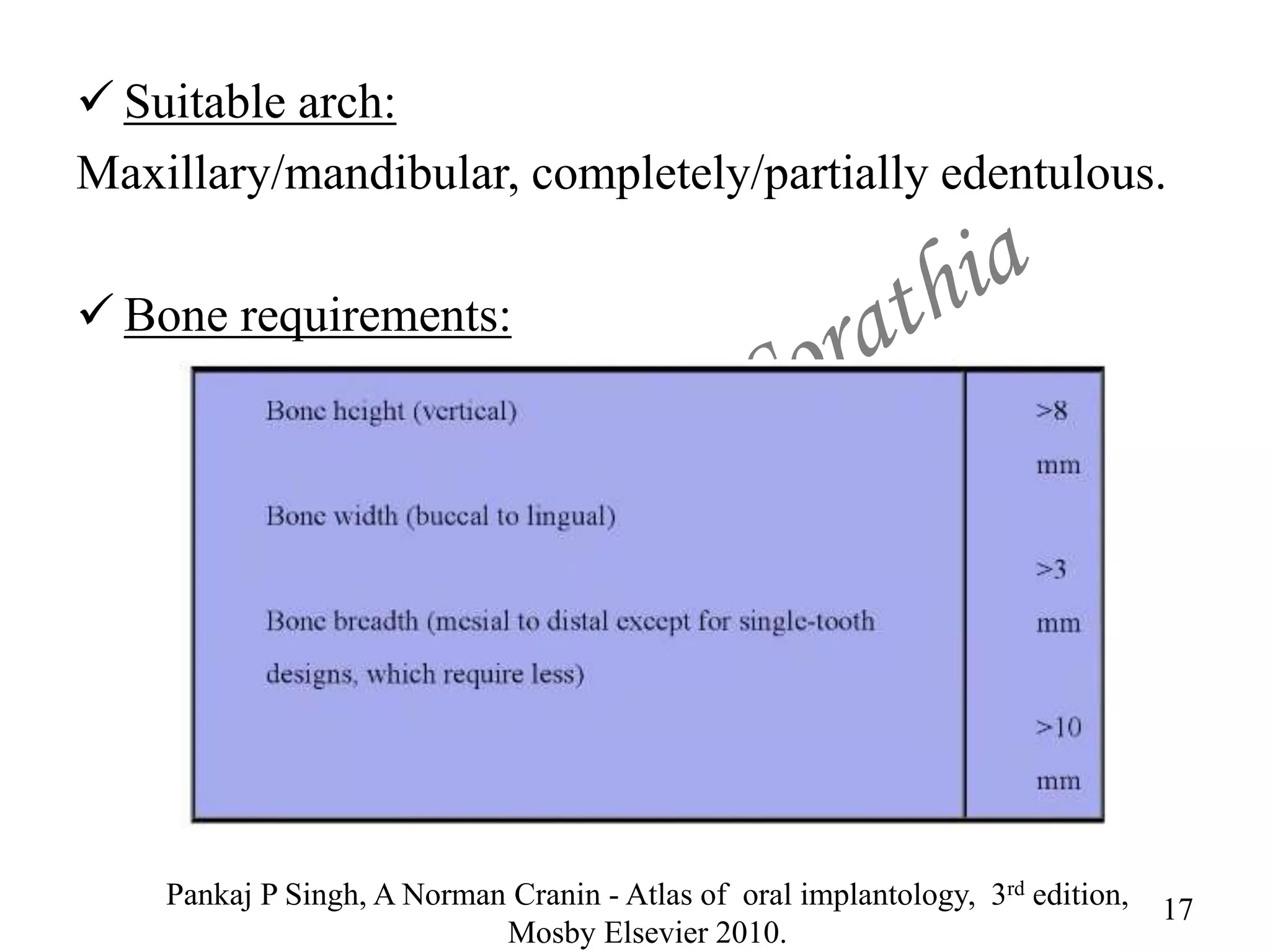
 Suitable arch:
Maxillary/mandibular, completely/partially edentulous.
 Bone requirements:
Pankaj P Singh, A Norman Cranin - Atlas of oral implantology, 3rd edition,
Mosby Elsevier 2010.
17
Ramus frame:
Pankaj P Singh, A Norman Cranin - Atlas of oral implantology, 3rd edition,
Mosby Elsevier 2010. 18
Ramus blade:
Prosthetic options: Overdentures
Suitable arch: Mandibular completely edentulous.
Pankaj P Singh, A Norman Cranin - Atlas of oral implantology, 3rd edition,
Mosby Elsevier 2010. 19
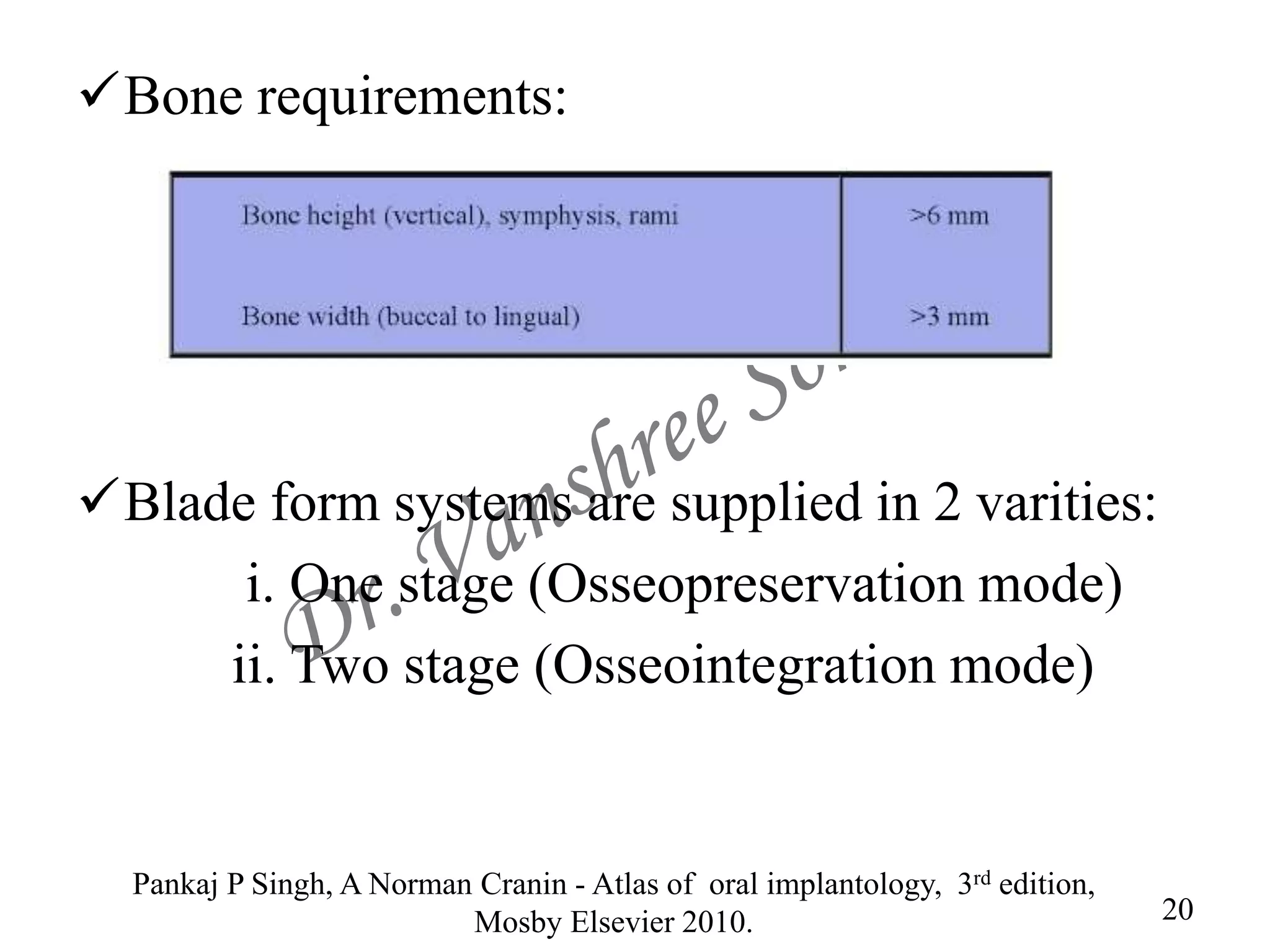
Bone requirements:
Blade form systems are supplied in 2 varities:
i. One stage (Osseopreservation mode)
ii. Two stage (Osseointegration mode)
Pankaj P Singh, A Norman Cranin - Atlas of oral implantology, 3rd edition,
Mosby Elsevier 2010. 20
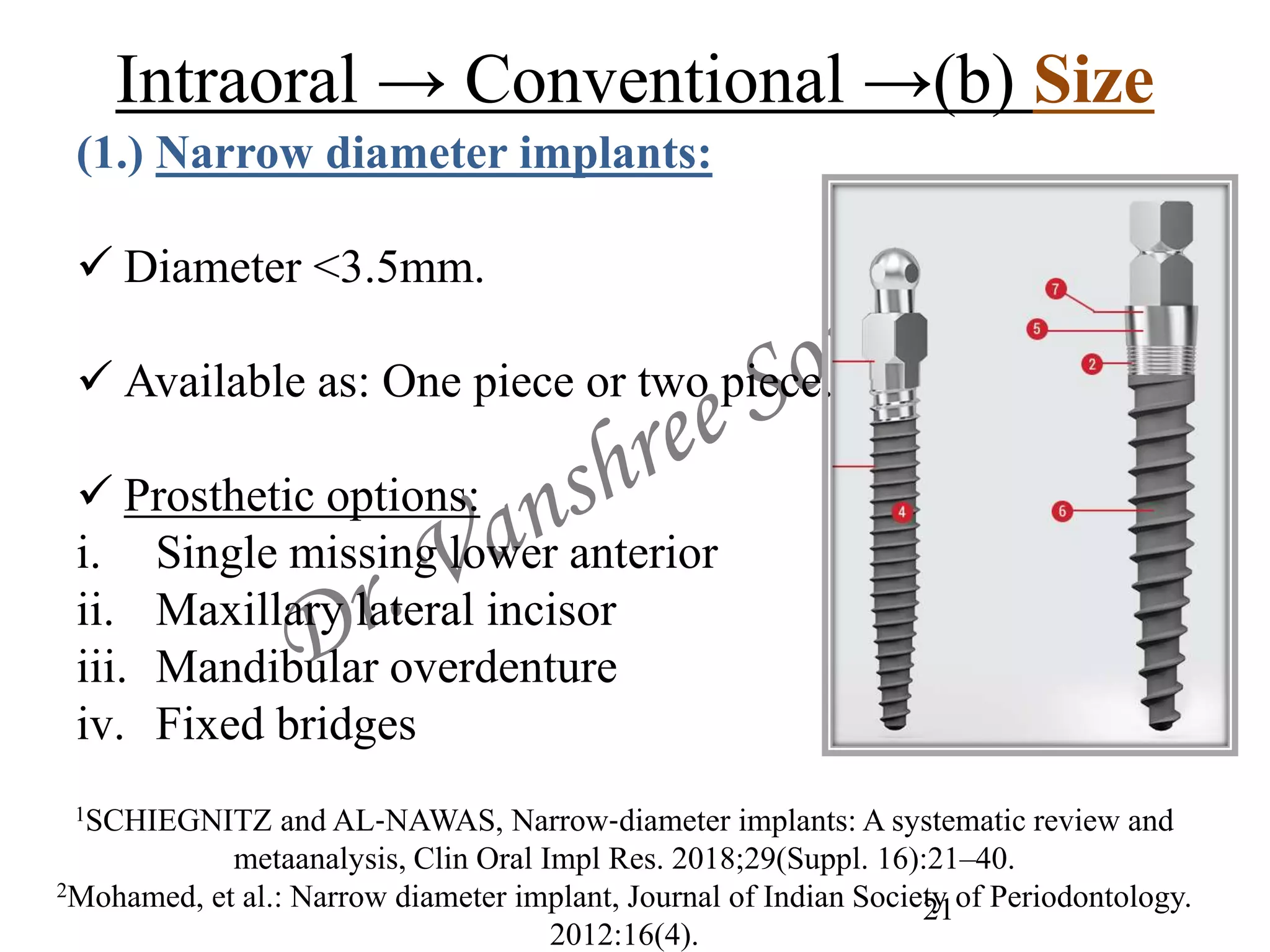
Intraoral → Conventional →(b) Size
(1.) Narrow diameter implants:
 Diameter <3.5mm.
 Available as: One piece or two piece.
 Prosthetic options:
i. Single missing lower anterior
ii. Maxillary lateral incisor
iii. Mandibular overdenture
iv. Fixed bridges
1SCHIEGNITZ and AL‐NAWAS, Narrow‐diameter implants: A systematic review and
metaanalysis, Clin Oral Impl Res. 2018;29(Suppl. 16):21–40.
2Mohamed, et al.: Narrow diameter implant, Journal of Indian Society of Periodontology.
2012:16(4).
21
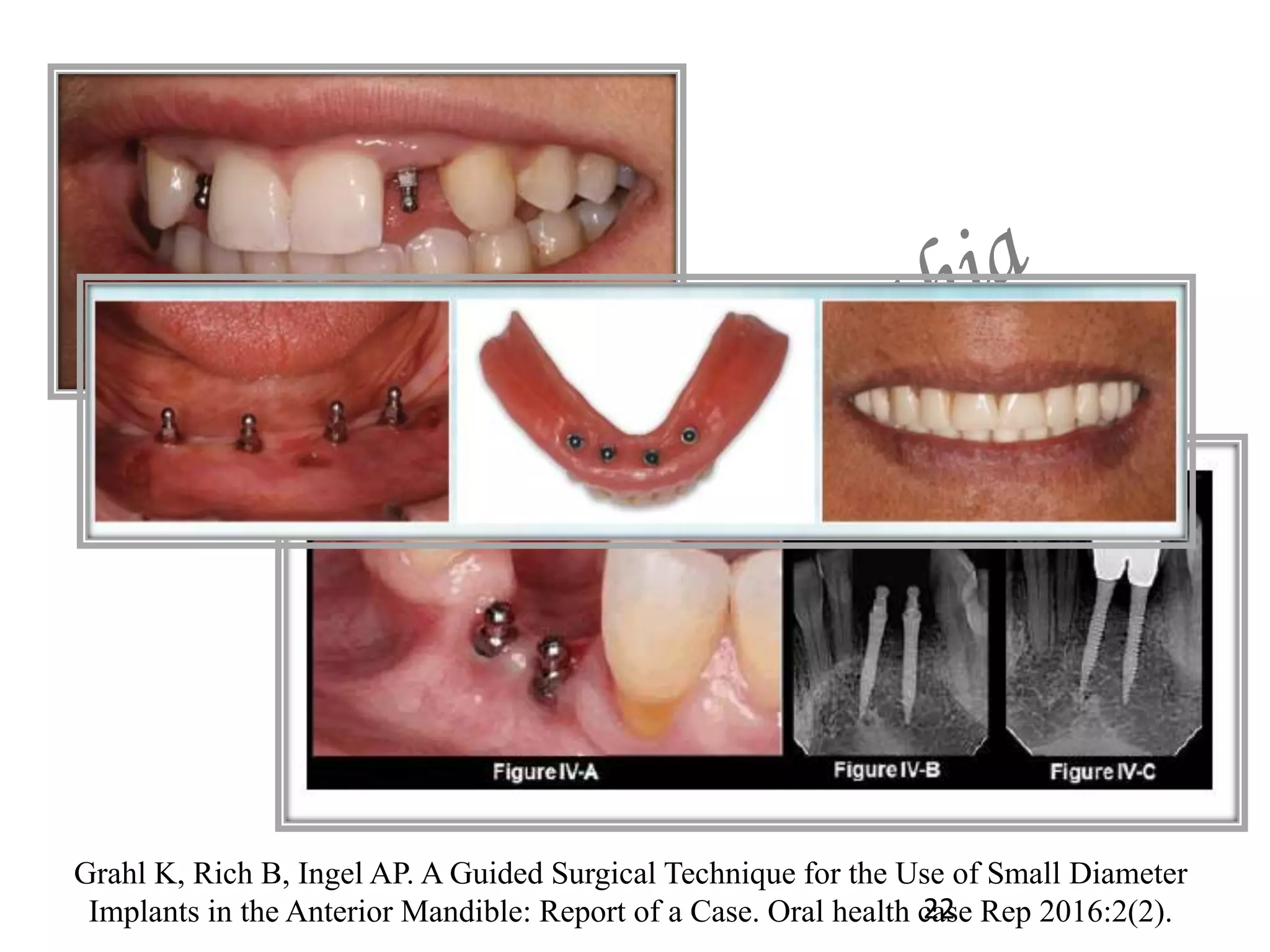
Grahl K, Rich B, Ingel AP. A Guided Surgical Technique for the Use of Small Diameter
Implants in the Anterior Mandible: Report of a Case. Oral health case Rep 2016:2(2).
22
Renouard and Nisand in 2006 - survival rates for NDI are
comparable with that of Standard diameter implants.
Renouard & Nisand, Impact of implant length and diameter on survival rate.
Clin. Oral Impl. Res. 17 (Suppl. 2), 2006 / 35–51 23
Intraoral → Conventional →(b) Size
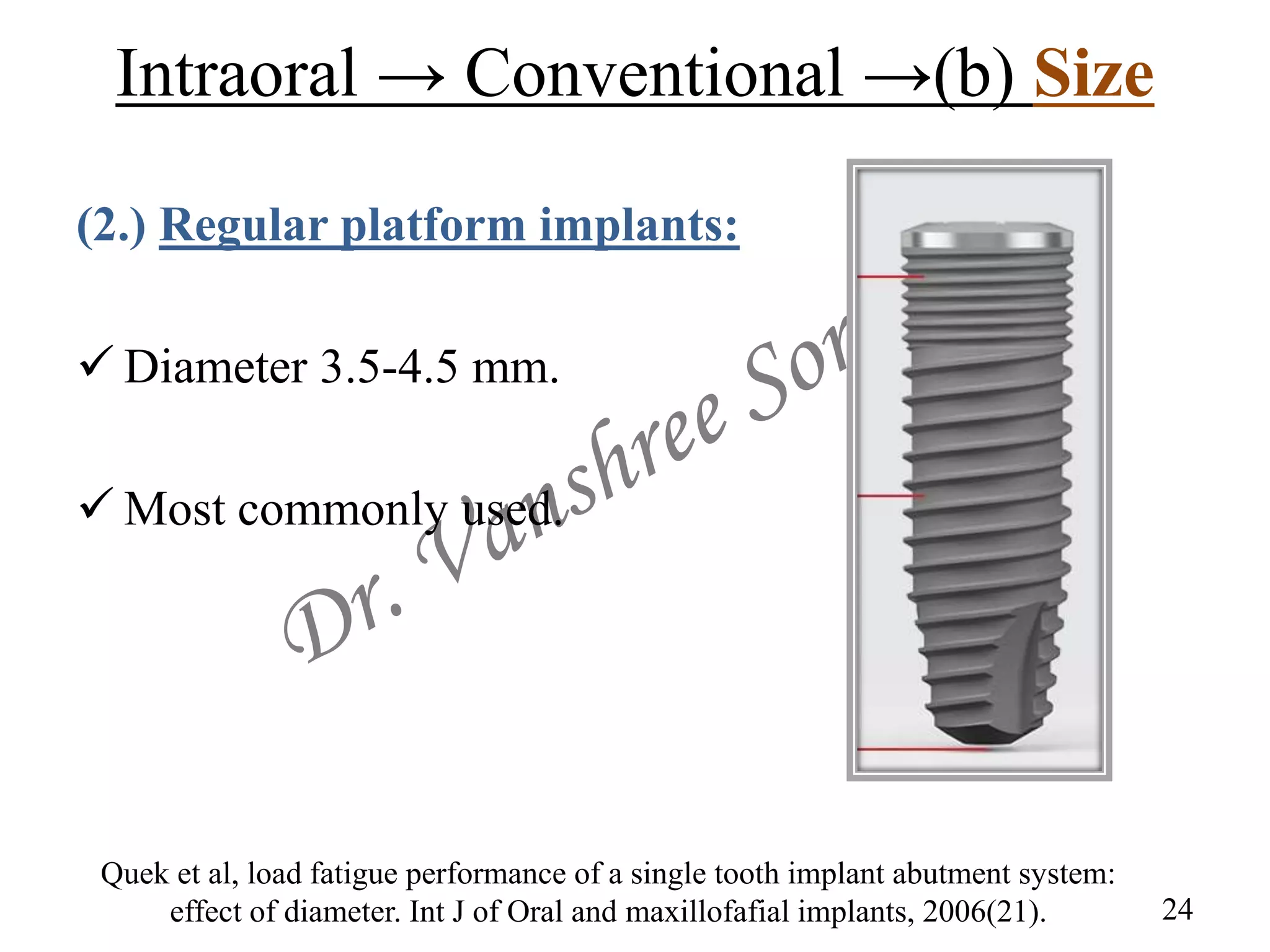
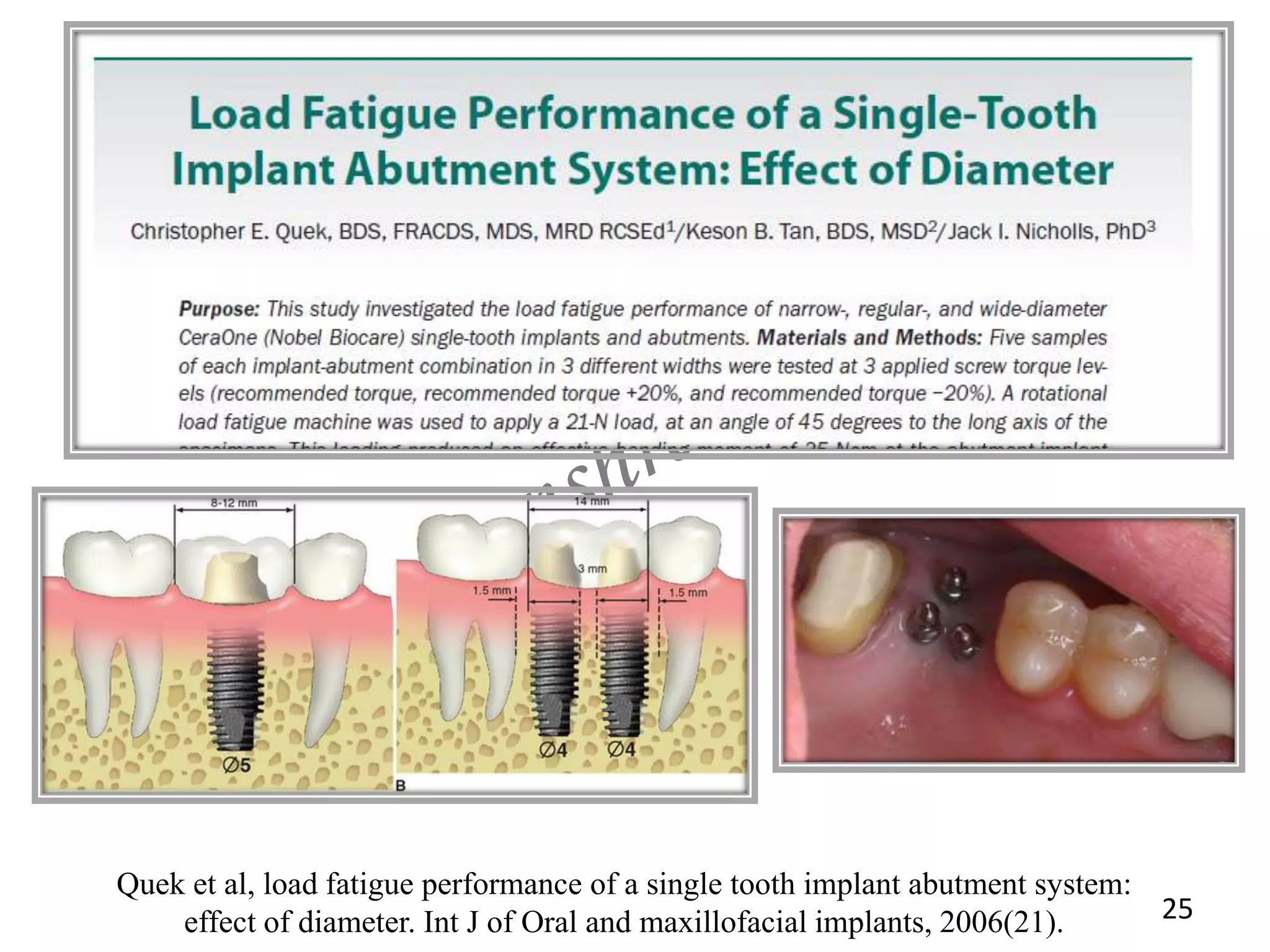
(2.) Regular platform implants:
 Diameter 3.5-4.5 mm.
 Most commonly used.
Quek et al, load fatigue performance of a single tooth implant abutment system:
effect of diameter. Int J of Oral and maxillofafial implants, 2006(21). 24
Quek et al, load fatigue performance of a single tooth implant abutment system:
effect of diameter. Int J of Oral and maxillofacial implants, 2006(21). 25
Intraoral → Conventional →(b) Size
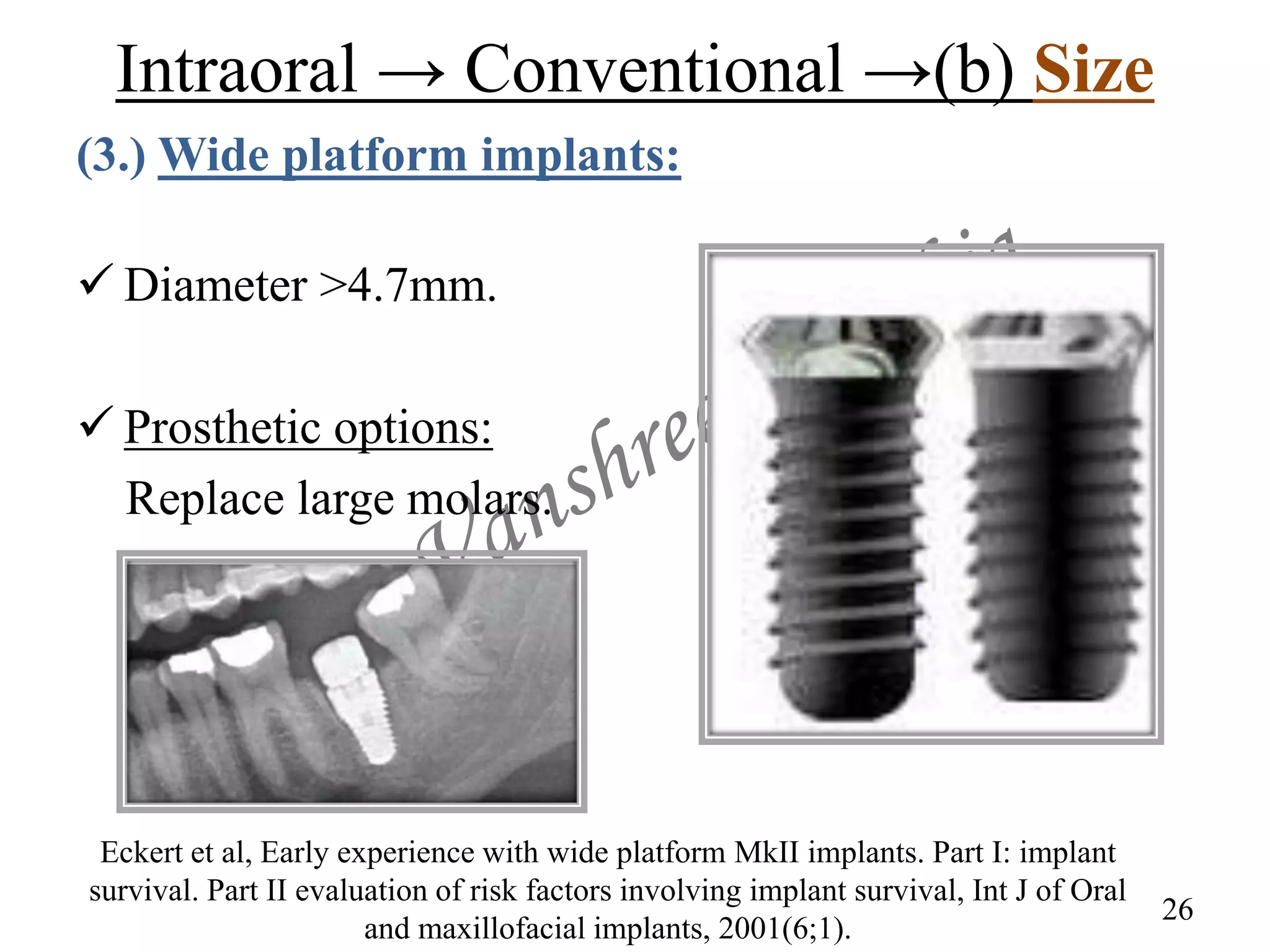
(3.) Wide platform implants:
 Diameter >4.7mm.
 Prosthetic options:
Replace large molars.
Eckert et al, Early experience with wide platform MkII implants. Part I: implant
survival. Part II evaluation of risk factors involving implant survival, Int J of Oral
and maxillofacial implants, 2001(6;1).
26
Eckert et al, Early experience with wide platform MkII implants. Part I: implant survival.
Part II evaluation of risk factors involving implant survival, Int J of Oral and
maxillofacial implants, 2001(6;1). 27
Intraoral → Conventional →(b) Size
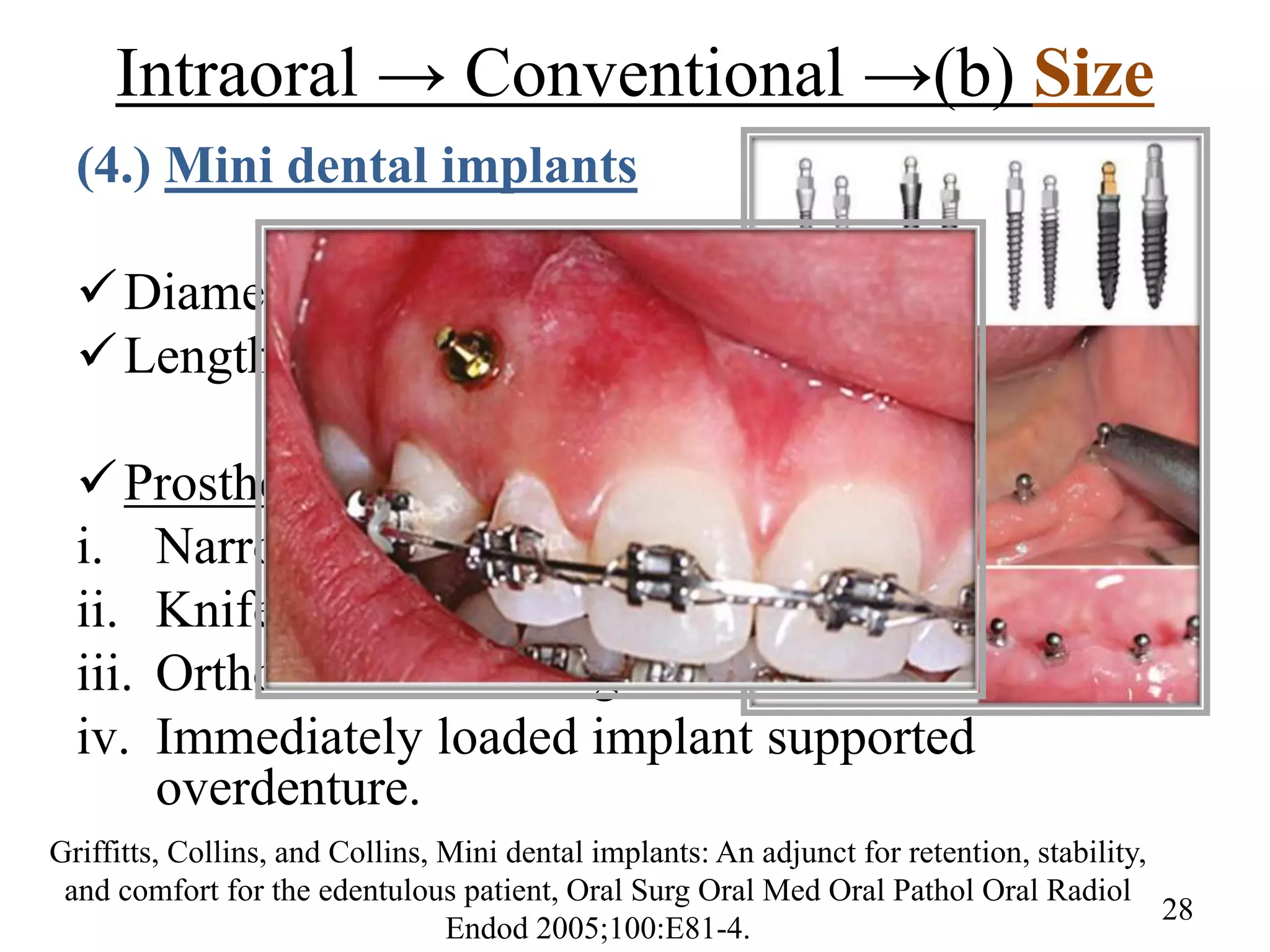
(4.) Mini dental implants
Diameter 1.8-2.4mm.
Length 10-18mm
Prosthetic option:
i. Narrow interdental space
ii. Knife edge ridge
iii. Orthodontic anchorage
iv. Immediately loaded implant supported
overdenture.
Griffitts, Collins, and Collins, Mini dental implants: An adjunct for retention, stability,
and comfort for the edentulous patient, Oral Surg Oral Med Oral Pathol Oral Radiol
Endod 2005;100:E81-4.
28
Intraoral → Conventional →(b) Size
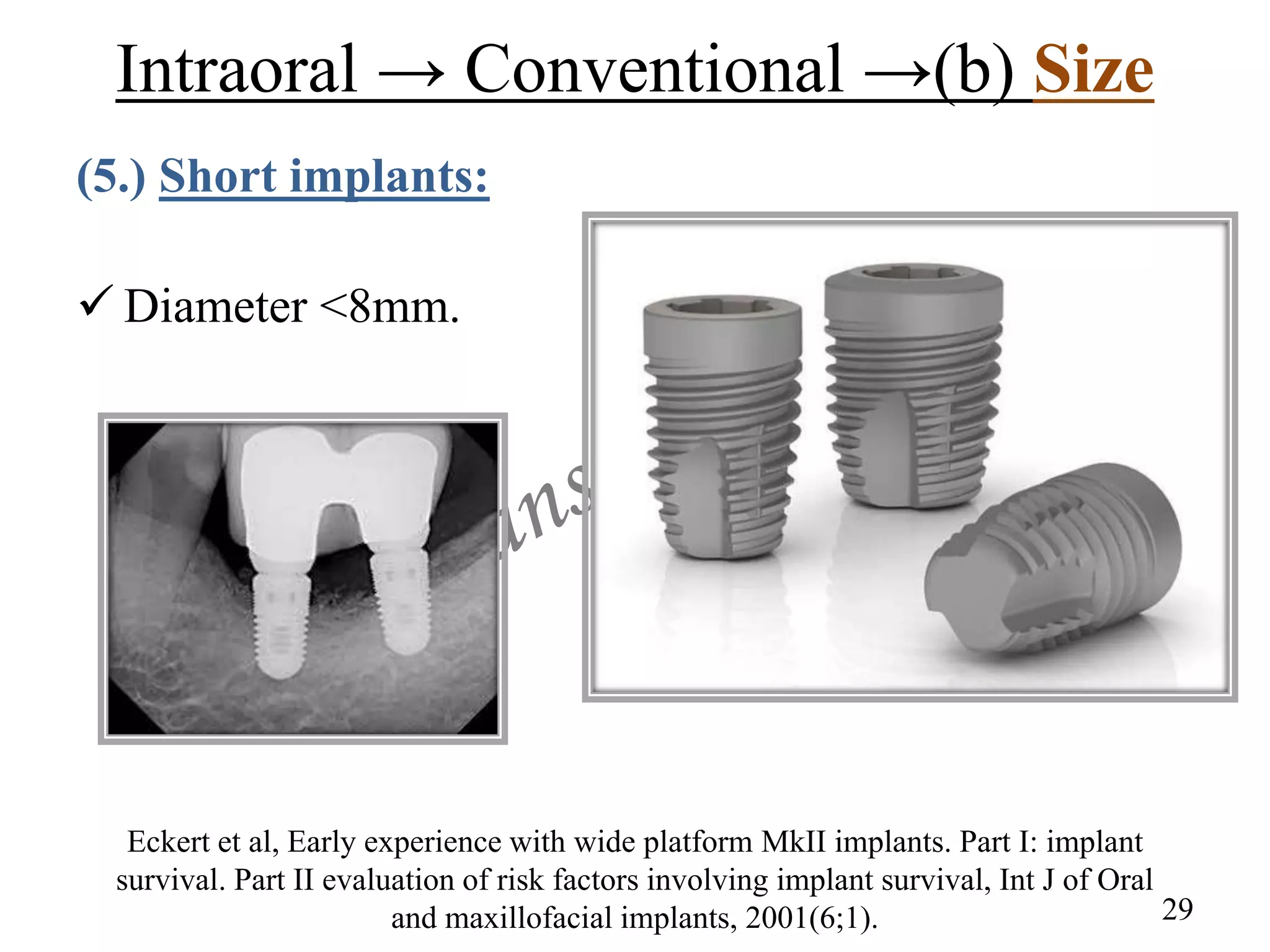
(5.) Short implants:
 Diameter <8mm.
Eckert et al, Early experience with wide platform MkII implants. Part I: implant
survival. Part II evaluation of risk factors involving implant survival, Int J of Oral
and maxillofacial implants, 2001(6;1). 29
 Prosthetic options:
30
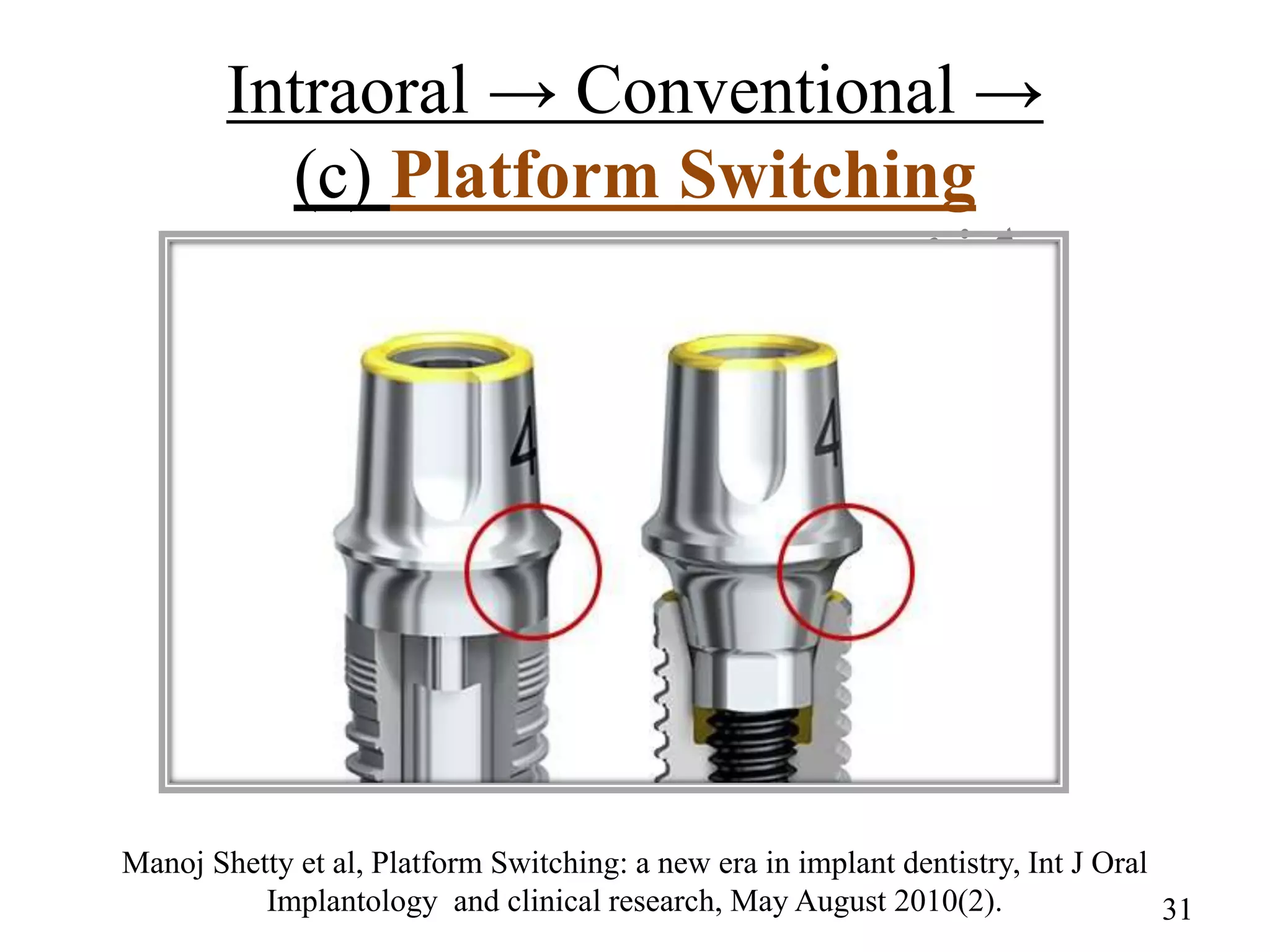
Intraoral → Conventional →
(c) Platform Switching
Manoj Shetty et al, Platform Switching: a new era in implant dentistry, Int J Oral
Implantology and clinical research, May August 2010(2). 31
Crespi R, Cappare P, Gherlone E. Radiographic evaluation of marginal bone levels
around platform switched and non switched implants used in an immediate loading
protocol. Int J Oral Maxillofac implants, 2009;24(5): 142-153. 32
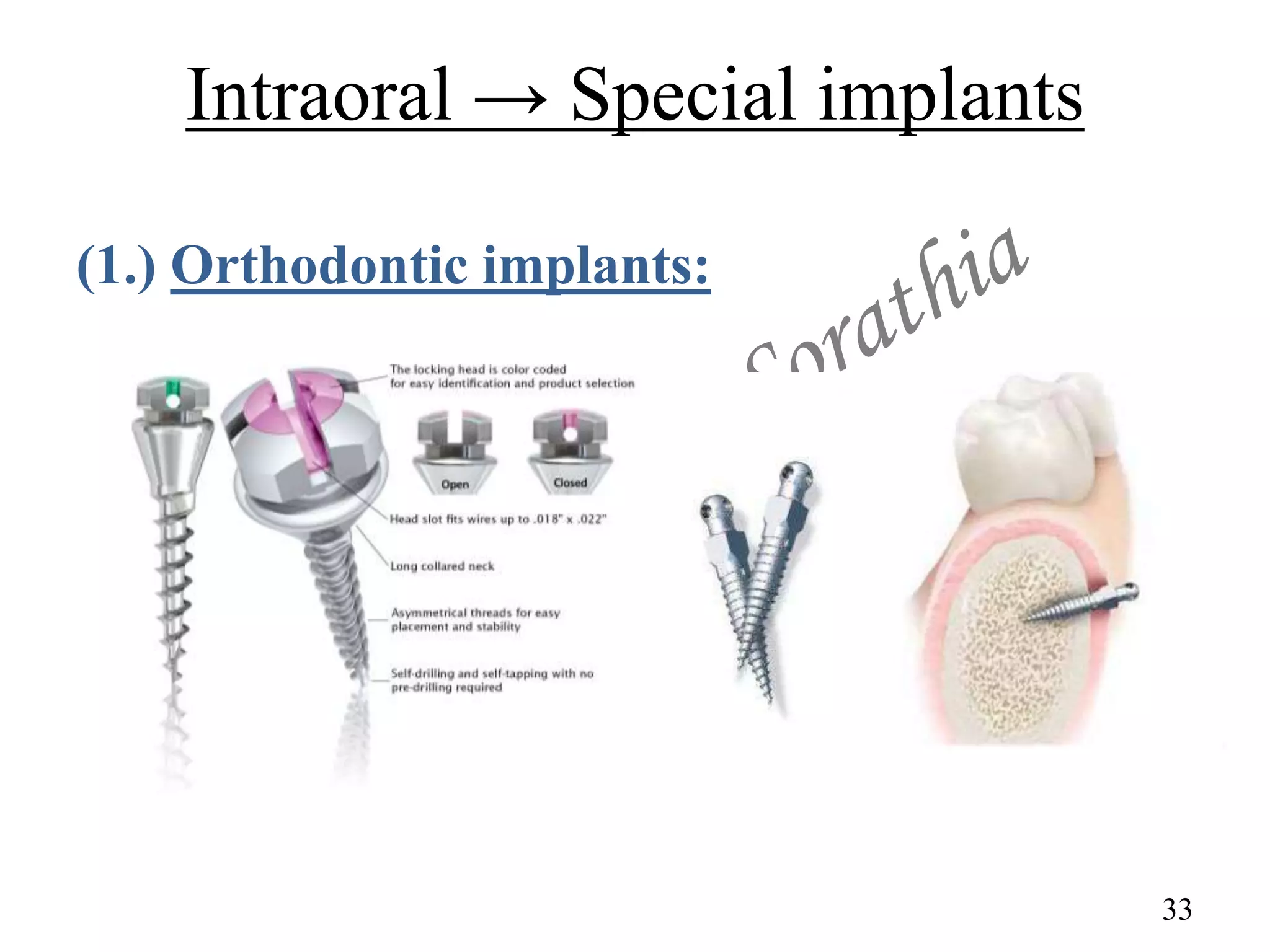
Intraoral → Special implants
(1.) Orthodontic implants:
33
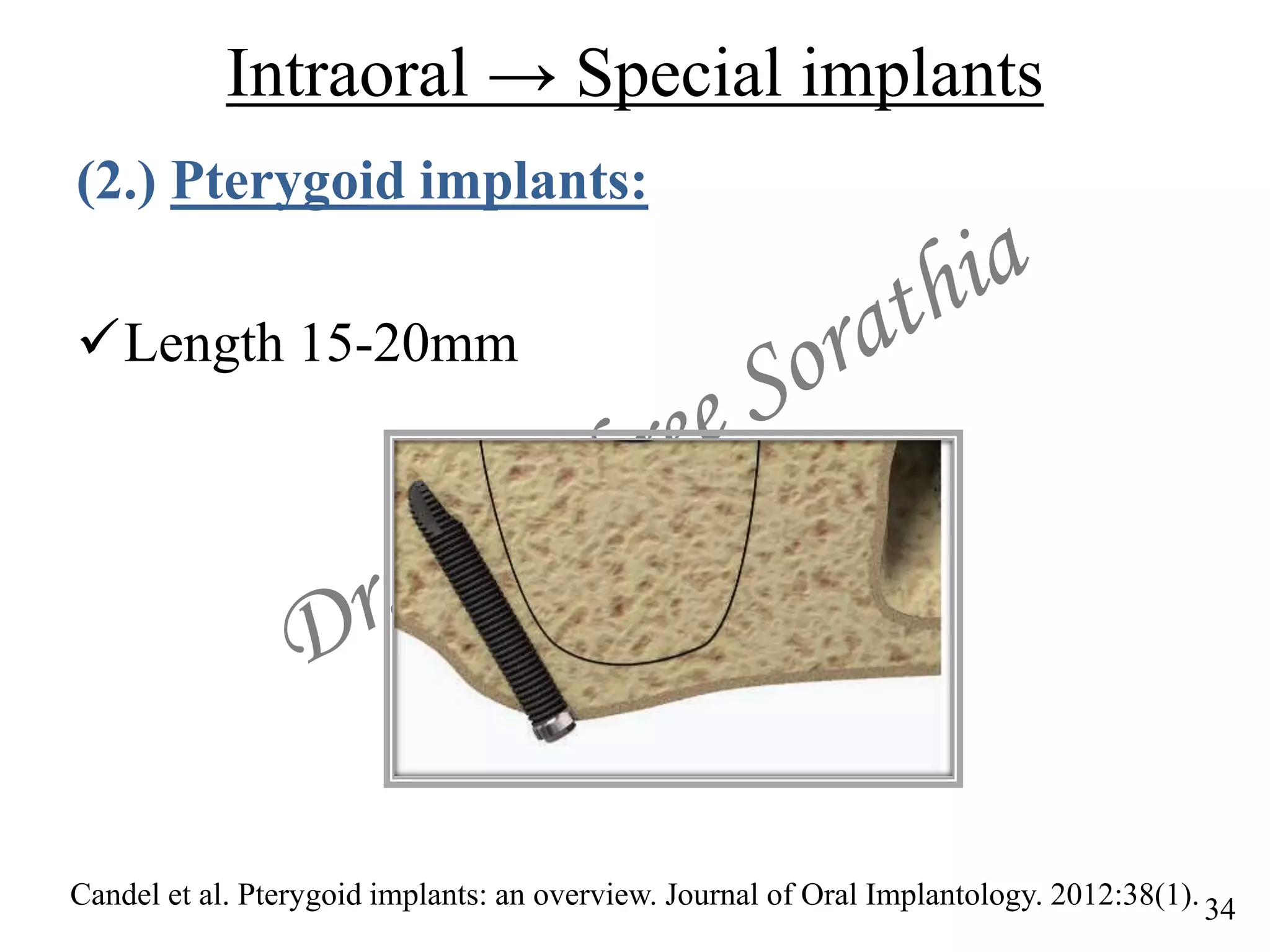
Intraoral → Special implants
(2.) Pterygoid implants:
Length 15-20mm
Candel et al. Pterygoid implants: an overview. Journal of Oral Implantology. 2012:38(1). 34
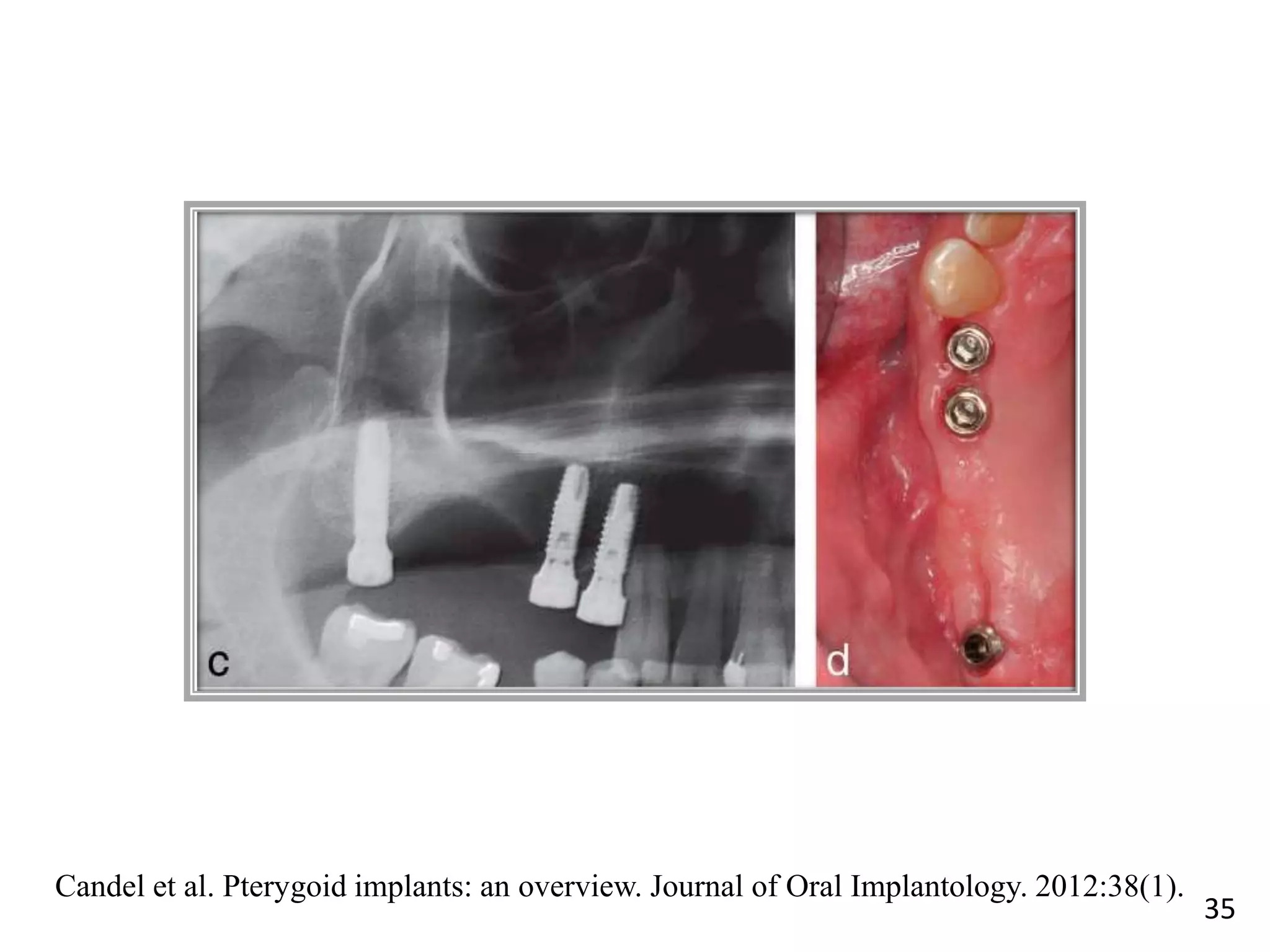
Candel et al. Pterygoid implants: an overview. Journal of Oral Implantology. 2012:38(1).
35
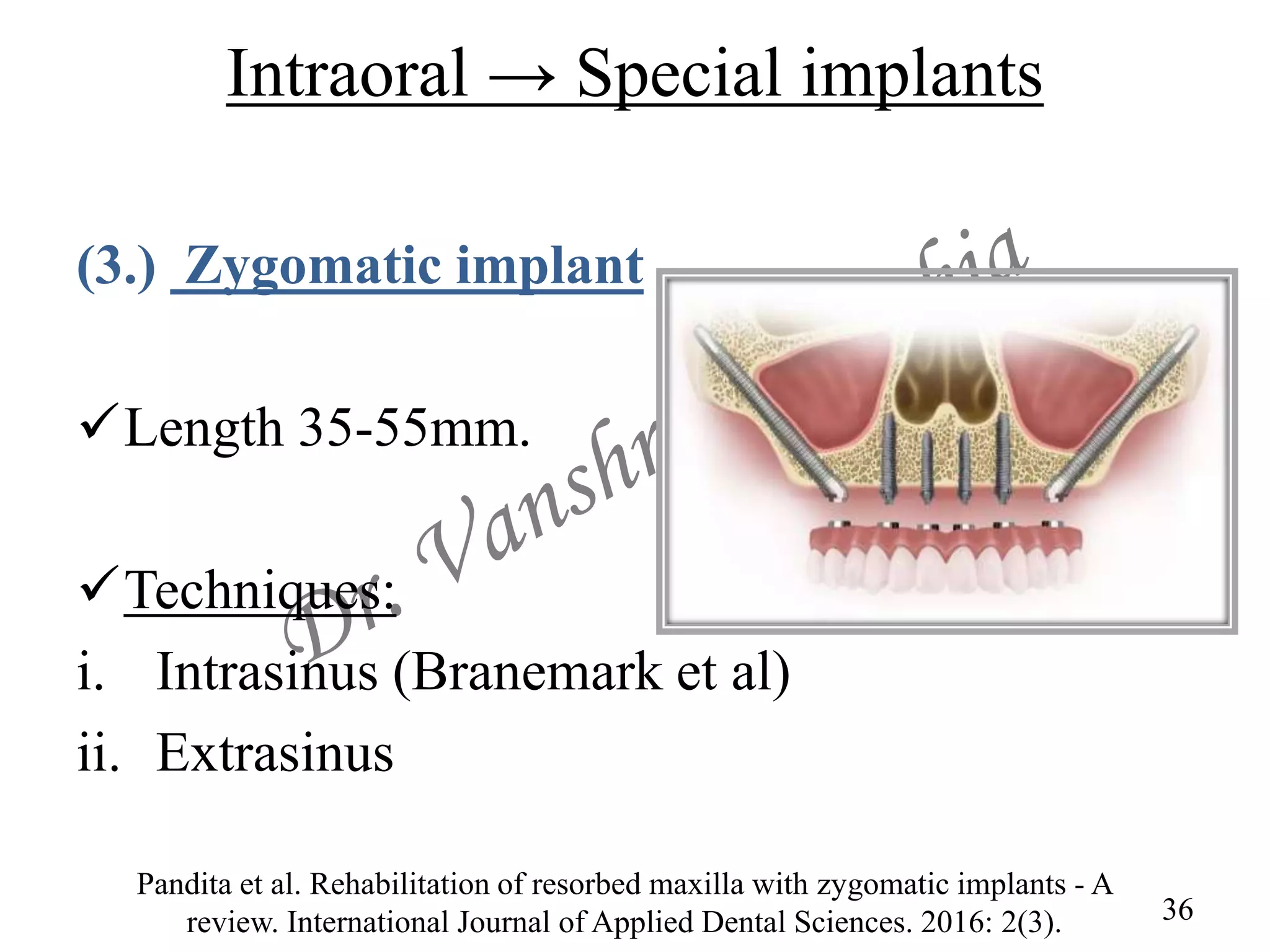
Intraoral → Special implants
(3.) Zygomatic implant
Length 35-55mm.
Techniques:
i. Intrasinus (Branemark et al)
ii. Extrasinus
Pandita et al. Rehabilitation of resorbed maxilla with zygomatic implants - A
review. International Journal of Applied Dental Sciences. 2016: 2(3). 36
Prosthetic option:
i. Partial or total maxillary edentulism with
extreme resorption in sinus area.
ii. Reconstruction of maxillary defects.
iii. Unilateral cleft palate and generalized
maxillary atrophy.
Contraindications
Associated risk
Pandita et al. Rehabilitation of resorbed maxilla with zygomatic implants- A review.
International Journal of Applied Dental Sciences. 2016:2(3). 37
Malo et al demonstrated 98.5% survival rate of
implants via extrasinus technique after 1 year follow
up.
Malo et al, A new approach to rehabilitate the severely atrophic maxilla using extramaxillary
anchored implants in immediate function: A pilot study. J Prosth Dent Nov 2008.
38
(ii) Extraoral implants
39
Federspil. Implant-retained craniofacial prostheses for facial defects. GMS
Current Topics in Otorhinolaryngology - Head and Neck Surgery 2009:8. 40
Anders Tjellstom 1977
1Federspil. Implant-retained craniofacial prostheses for facial defects. GMS Current
Topics in Otorhinolaryngology - Head and Neck Surgery 2009:8.
2Beumer. Maxillofacial rehabilitation. 3rd edition, Quintessence, 2011. 41
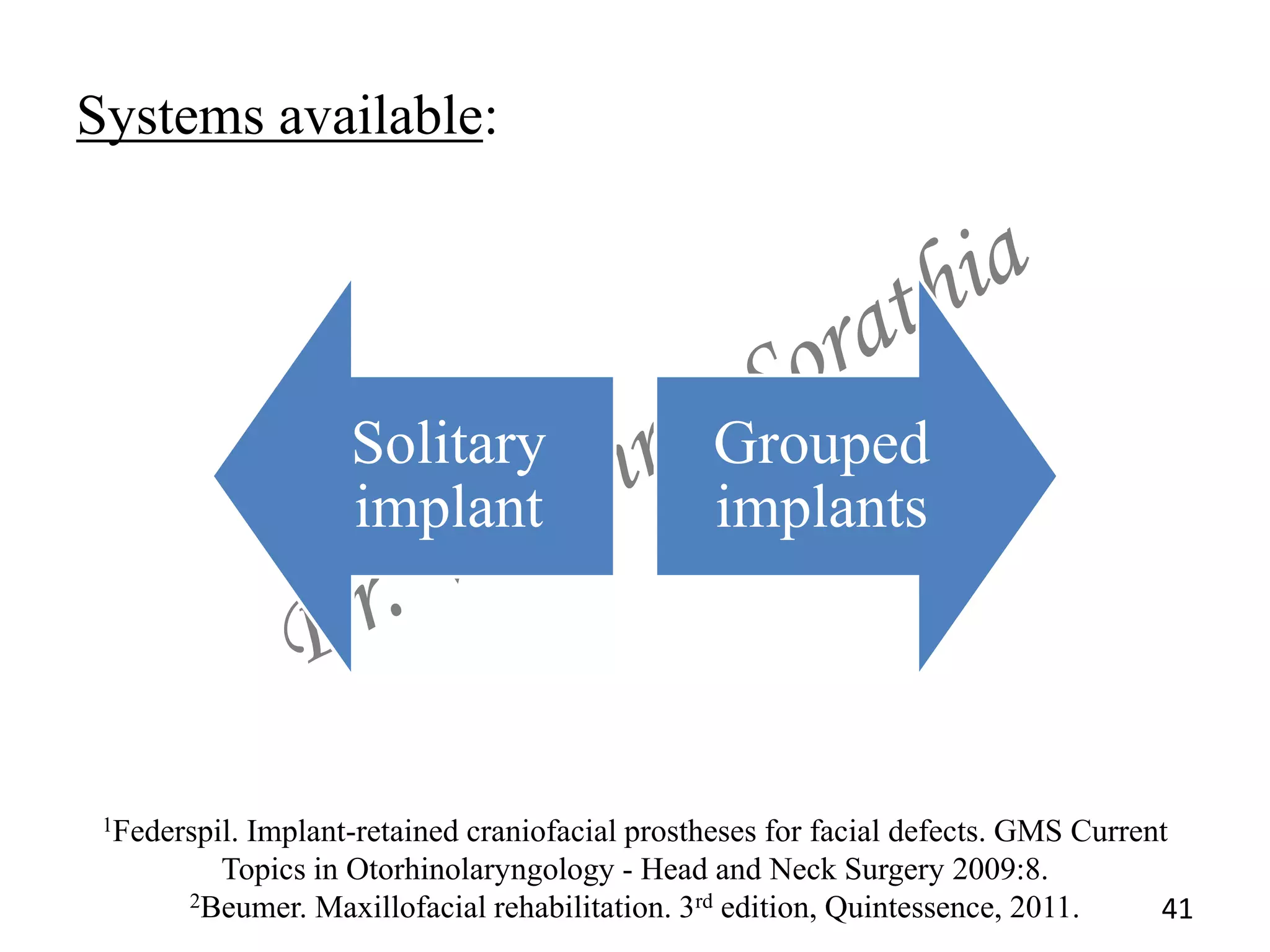
Systems available:
Solitary
implant
Grouped
implants
Federspil. Implant-retained craniofacial prostheses for facial defects. GMS Current
Topics in Otorhinolaryngology - Head and Neck Surgery 2009:8. 42
Solitary implants:
1. Branemark system
2. ITI system
3. IMZ system
4. Denstply Friedent system
5. Southern system
Federspil. Implant-retained craniofacial prostheses for facial defects. GMS
Current Topics in Otorhinolaryngology - Head and Neck Surgery 2009:8. 43
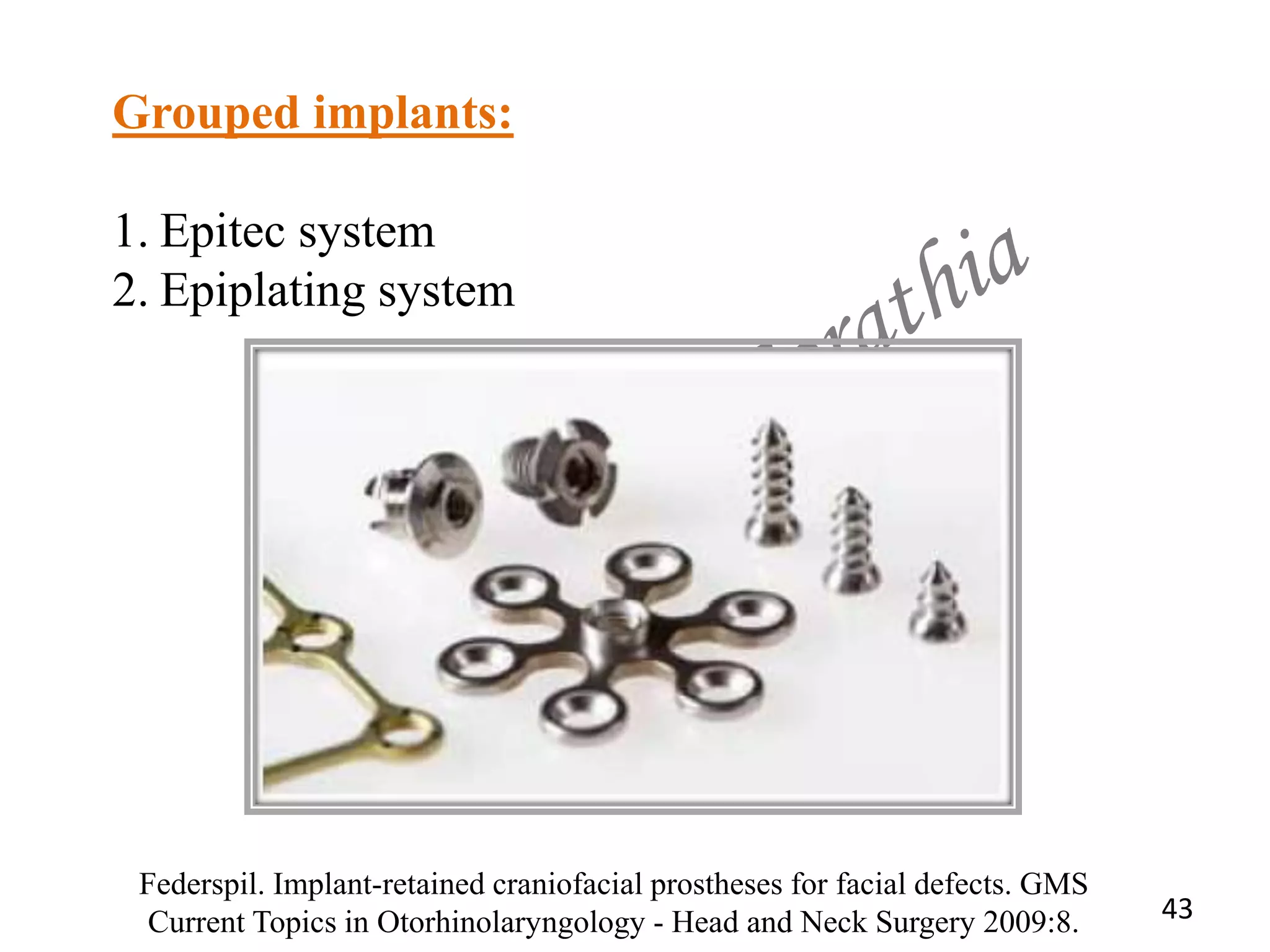
Grouped implants:
1. Epitec system
2. Epiplating system
Hatamleh MM, Jaradat E, Nawafleh N, Bibars A, Hourani Z, Watson J. Up-to-date
status of craniofacial implants - A literature review. The Journal of maxillofacial
prosthetics & technology, 2012.
44
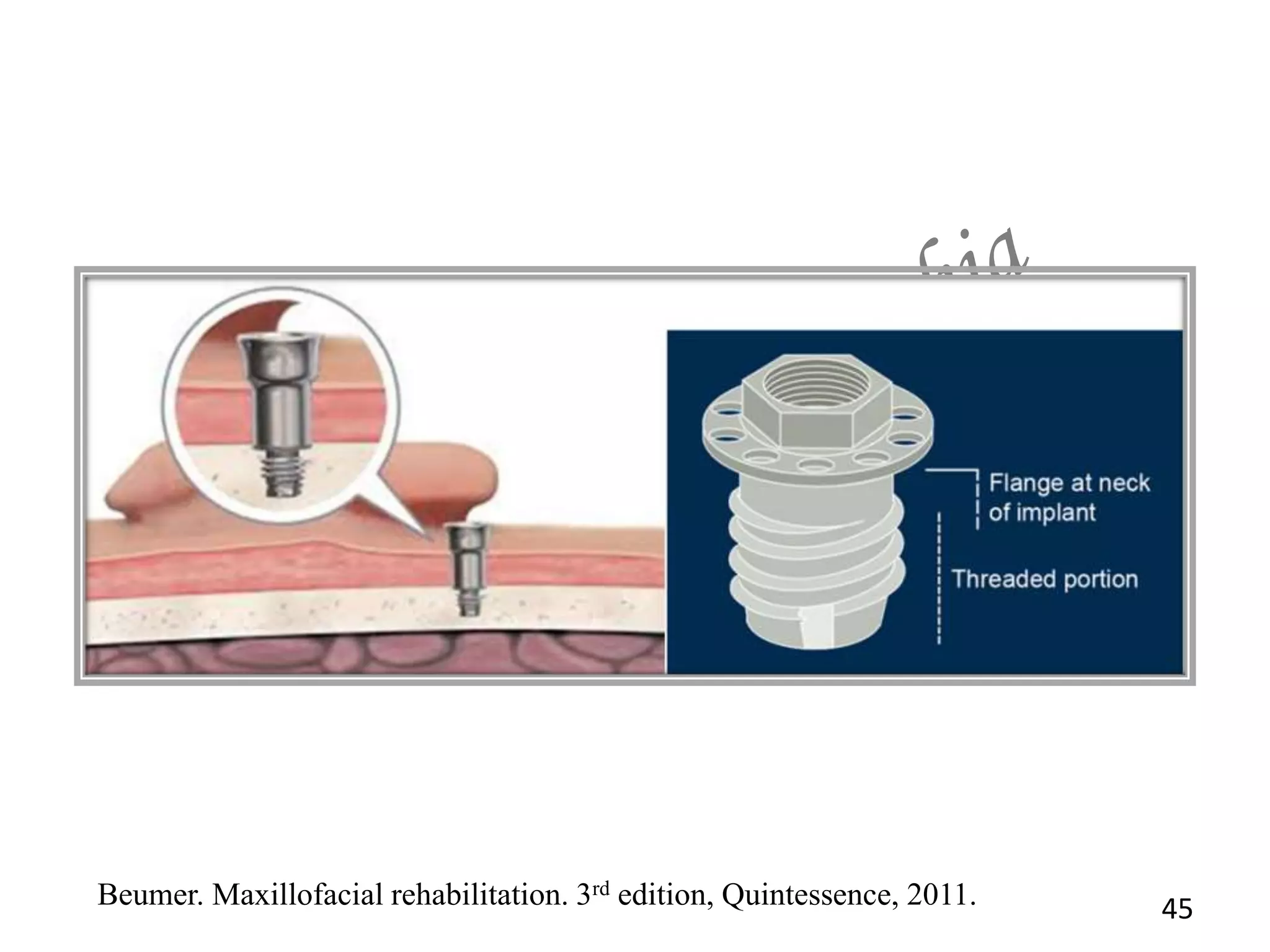
Beumer. Maxillofacial rehabilitation. 3rd edition, Quintessence, 2011. 45
Extraoral implants
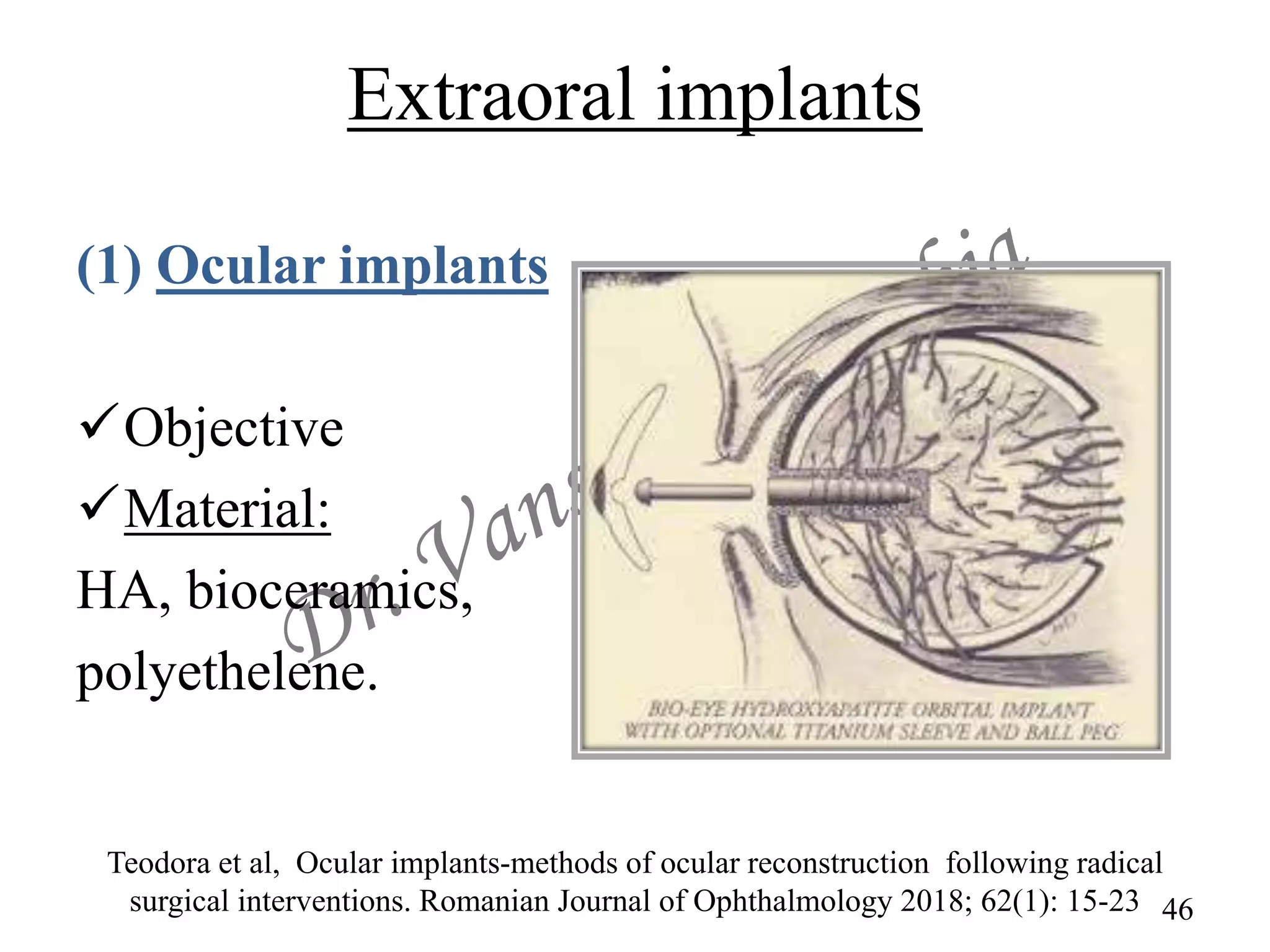
(1) Ocular implants
Objective
Material:
HA, bioceramics,
polyethelene.
Teodora et al, Ocular implants-methods of ocular reconstruction following radical
surgical interventions. Romanian Journal of Ophthalmology 2018; 62(1): 15-23 46
Zarb Bolender – Complete denture and implant supported prosthesis, Elsevier 2009 47
Extraoral implants
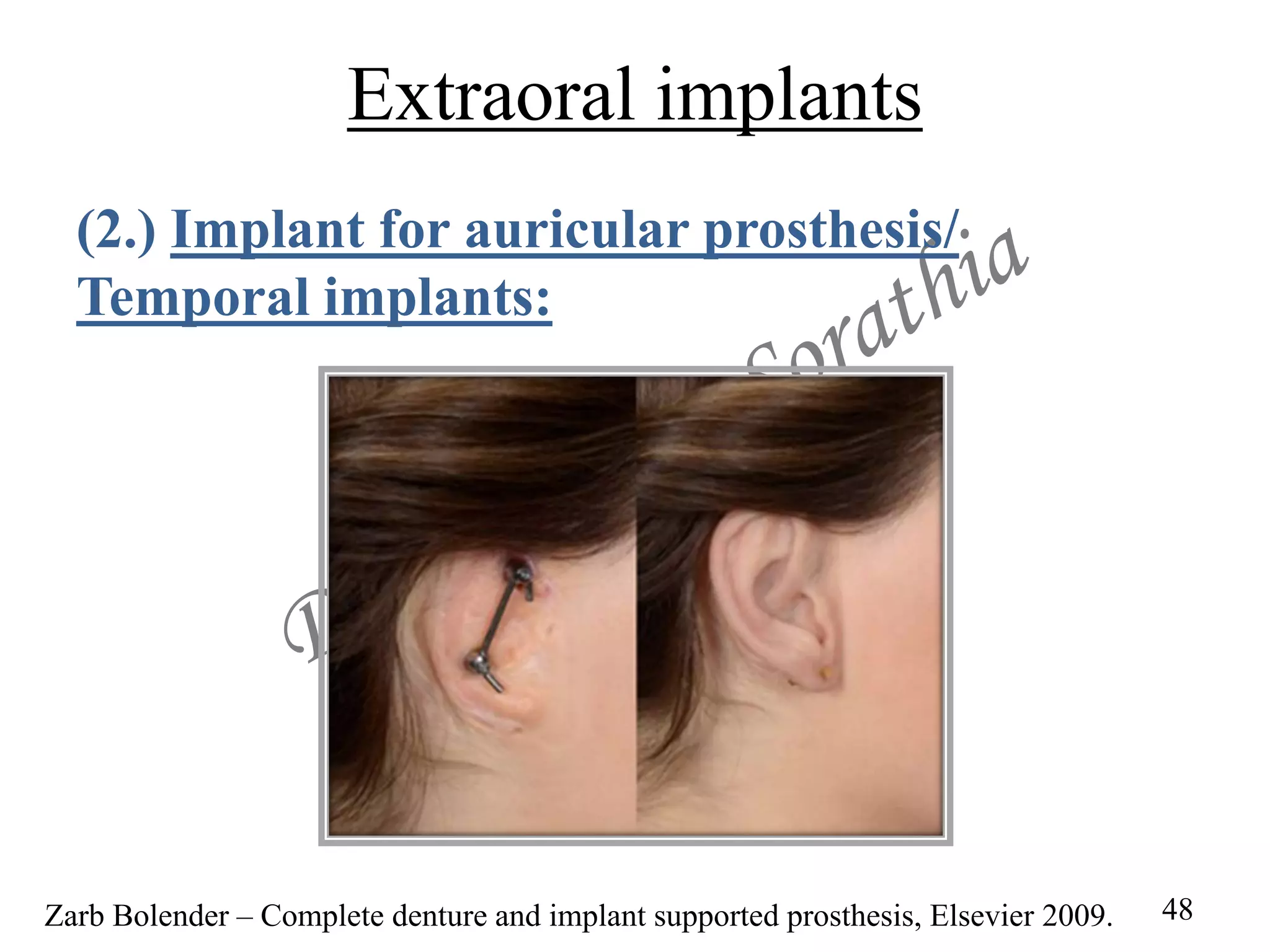
(2.) Implant for auricular prosthesis/
Temporal implants:
Zarb Bolender – Complete denture and implant supported prosthesis, Elsevier 2009. 48
Beumer. Maxillofacial rehabilitation. 3rd edition, Quintessence, 2011. 49
Extraoral implants
(3) Implant for nasal prosthesis:
Beumer, Maxillofacial rehabilitation, 3rd edition, Quintessence, 2011. 50
2. Transosteal implant
 One piece transmandibular complex implants.
 Advantage
 Designs
i. Single component device
ii. Multiple
iii. Staple device
Pankaj P Singh, A Norman Cranin - Atlas of oral implantology, 3rd edition,
Mosby Elsevier 2010. 51
Pankaj P Singh, A Norman Cranin - Atlas of oral implantology, 3rd edition,
Mosby Elsevier 2010. 52
Single component device
 Prosthetic option:
i. Overdentures
ii. Rarely fixed bridges
 Suitable arch: Mandibular anterior region, completely
or partially edentulous.
 Bone requirement:
Pankaj P Singh, A Norman Cranin - Atlas of oral implantology, 3rd edition,
Mosby Elsevier 2010.
Charles A. Babbush, Dental implants-The art and science, 1st edition,
Saunders Elsevier, 2001.
53
3. Subperiosteal implants
Pankaj P Singh, A Norman Cranin - Atlas of oral implantology, 3rd edition,
Mosby Elsevier 2010. 54
Pankaj P Singh, A Norman Cranin - Atlas of oral implantology, 3rd edition,
Mosby Elsevier 2010.
55
Prosthetic options:
Overdenture, fixed bridges
Suitable arch:
Maxillary or mandibular, completely or
partially.
Bone requirement: >5mm
Pankaj P Singh, A Norman Cranin - Atlas of oral implantology, 3rd edition,
Mosby Elsevier 2010. 56
4. Intramucosal inserts
Dahl in 1943.
Pankaj P Singh, A Norman Cranin - Atlas of oral implantology, 3rd
edition, Mosby Elsevier 2010. 57
Prosthetic option:
Removable denture, full or partial.
Suitable arch:
Maxillary completely or partially edentulous,
mandibular partial only.
Bone requirements:
None, mucosa (2.2mm)
Pankaj P Singh, A Norman Cranin - Atlas of oral implantology, 3rd edition,
Mosby Elsevier 2010. 58
5. Endodontic Stabilizer
Prosthetic option:
Crown and fixed bridge abutment
Suitable arch:
Any arch any tooth.
Bone requirement: >8mm lesion free.
Pankaj P Singh, A Norman Cranin - Atlas of oral implantology, 3rd edition,
Mosby Elsevier 2010. 59
B. Macroscopic body design
60
61
62
63
64
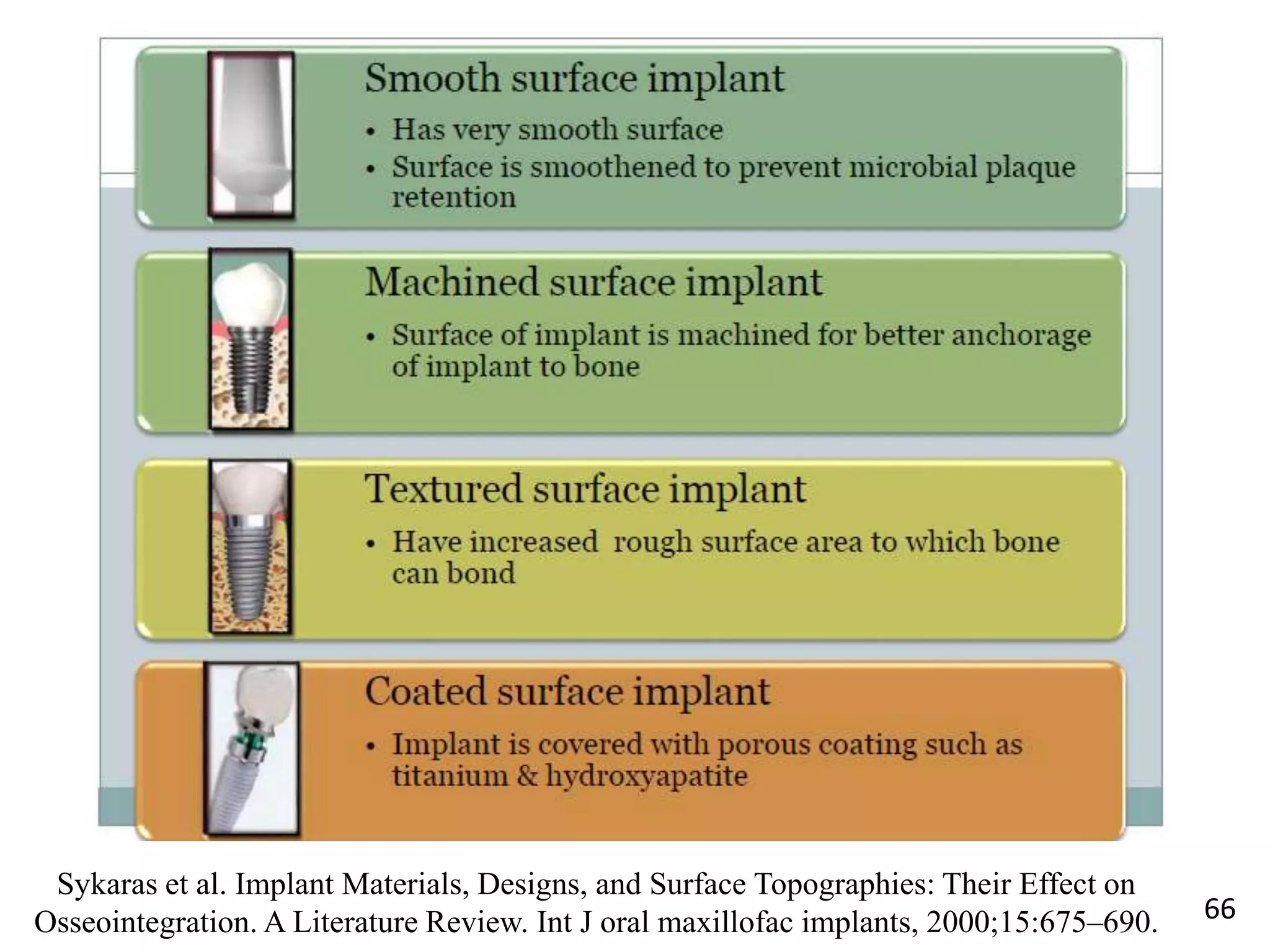
C. Surface of implant
Sykaras et al. Implant Materials, Designs, and Surface Topographies: Their Effect
on Osseointegration. A Literature Review. Int J oral maxillofac implants,
2000;15:675–690.
65
Sykaras et al. Implant Materials, Designs, and Surface Topographies: Their Effect on
Osseointegration. A Literature Review. Int J oral maxillofac implants, 2000;15:675–690. 66
D. Tissue response
67
Sykaras et al. Implant Materials, Designs, and Surface Topographies: Their Effect on
Osseointegration. A Literature Review. Int J oral maxillofac implants, 2000;15:675–690. 68
E. Material
69
Sykaras et al. Implant Materials, Designs, and Surface Topographies: Their Effect on
Osseointegration. A Literature Review. Int J oral maxillofac implants, 2000;15:675–690.
70
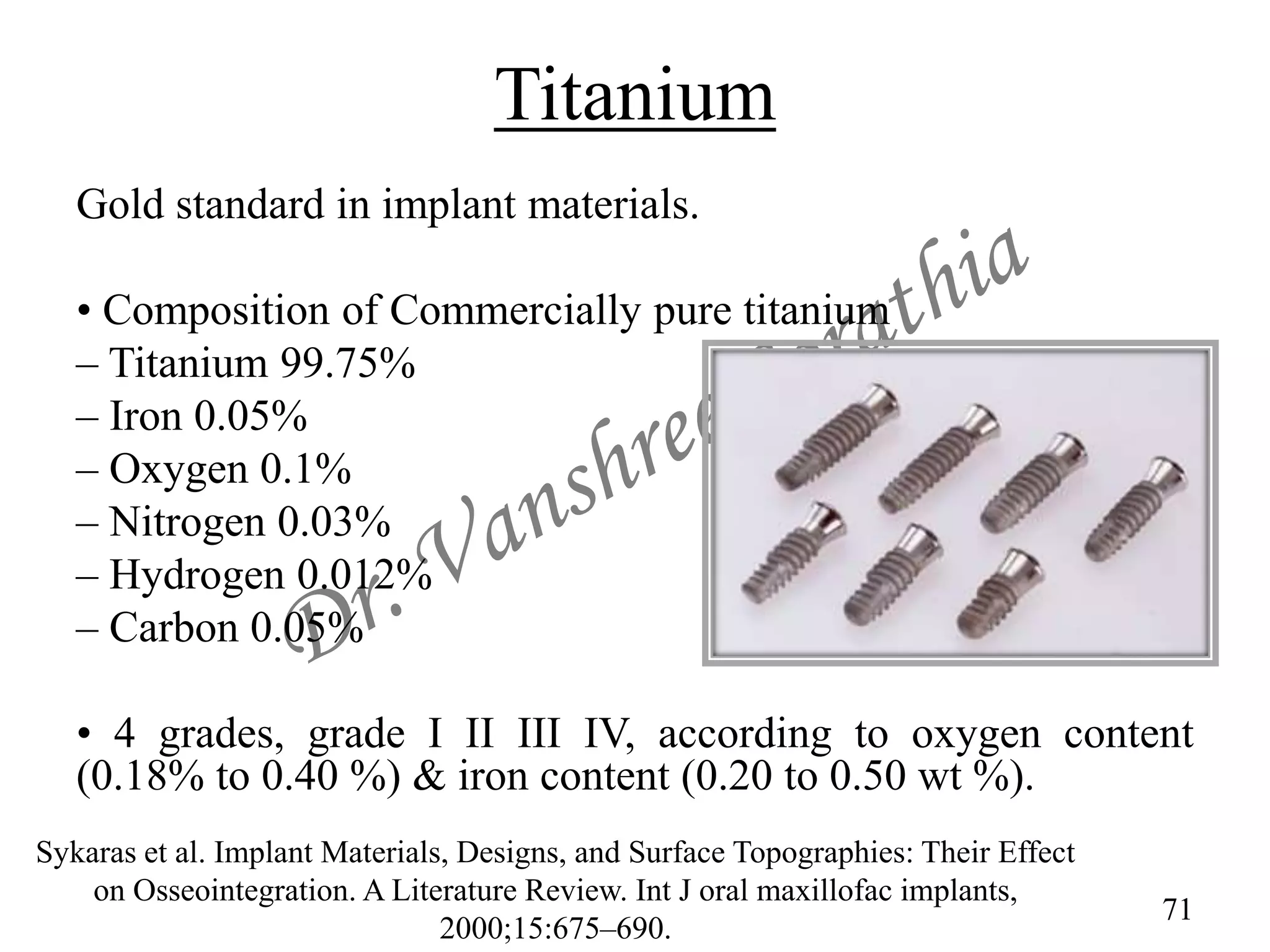
Titanium
Sykaras et al. Implant Materials, Designs, and Surface Topographies: Their Effect
on Osseointegration. A Literature Review. Int J oral maxillofac implants,
2000;15:675–690.
71
Gold standard in implant materials.
• Composition of Commercially pure titanium
– Titanium 99.75%
– Iron 0.05%
– Oxygen 0.1%
– Nitrogen 0.03%
– Hydrogen 0.012%
– Carbon 0.05%
• 4 grades, grade I II III IV, according to oxygen content
(0.18% to 0.40 %) & iron content (0.20 to 0.50 wt %).
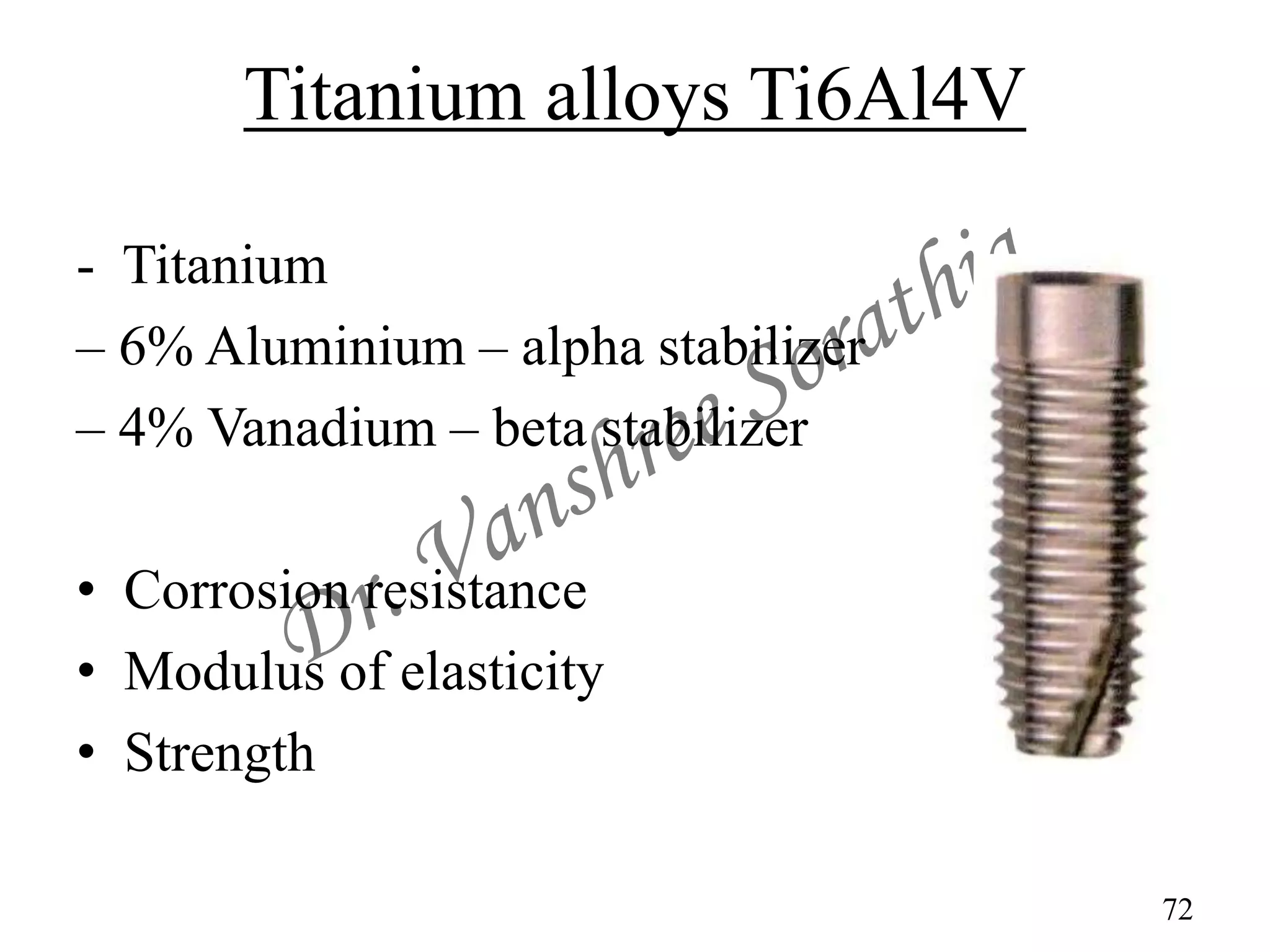
Titanium alloys Ti6Al4V
- Titanium
– 6% Aluminium – alpha stabilizer
– 4% Vanadium – beta stabilizer
• Corrosion resistance
• Modulus of elasticity
• Strength
72
Polymers - PEEK
• Stress shielding.
• Unmodified- contact angle 80-90degree-
bioinert.
• Modifications.
Najeeb S, et al. Applications of polyetheretherketone (PEEK) in oral
implantology and prosthodontics. J Prosthodont Res (2015) 73
74
F. Surface coating
1. Additive characterization
75
HA coating
TCP coating
Zr coating
Ti sintering
HA plasma spray
Anodization
2. Subtractive characterization
Acid etching
Alkaline etching
Sandblasting
Sandblast + acid etching
Grit blasting
Ti blasting
Laser Lithography
76
3. Combined
Acid Etching + Collagen coating
Acid Etching + Anodization
Acid Etching + Biomimetic coating
77
78
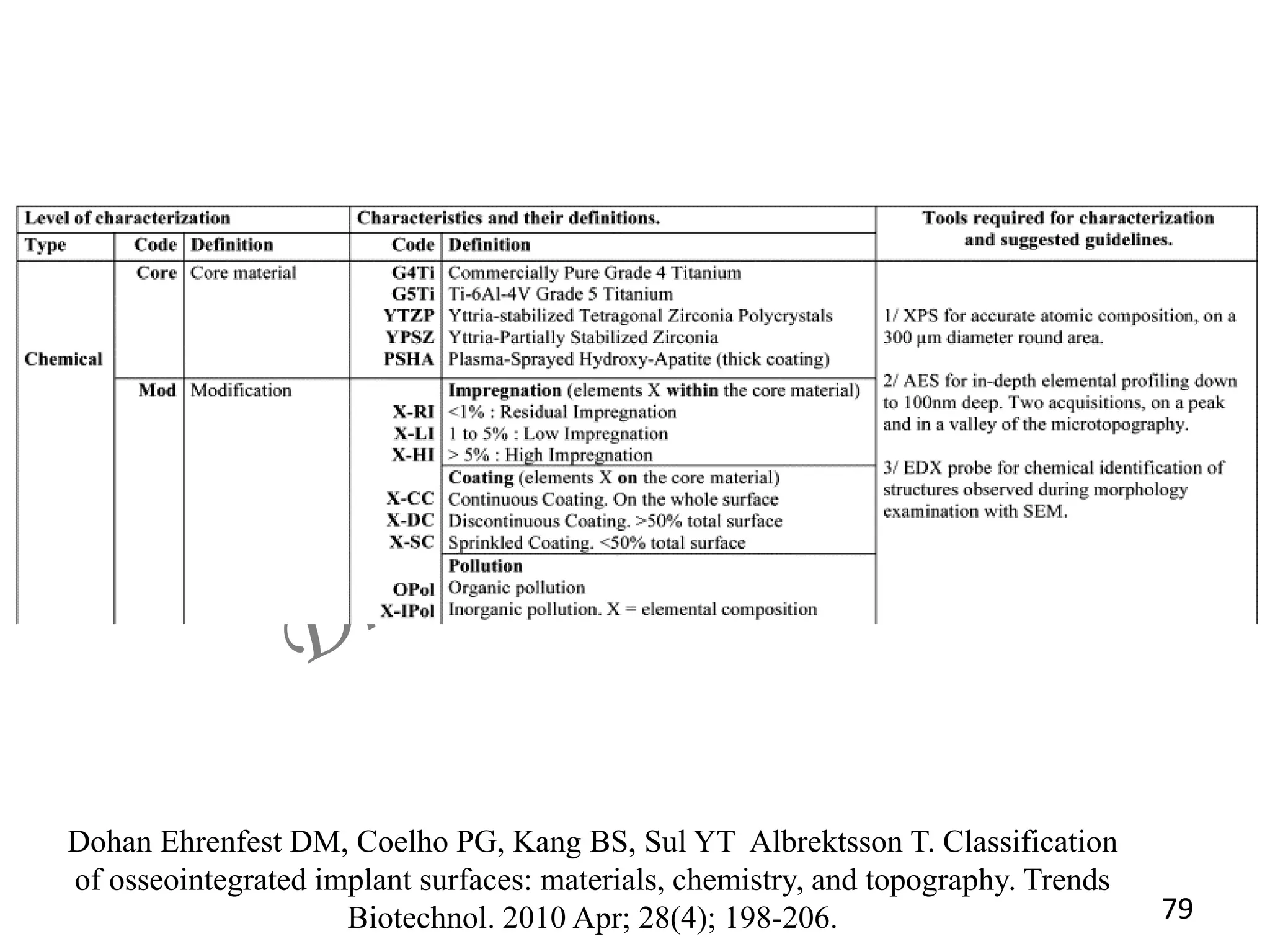
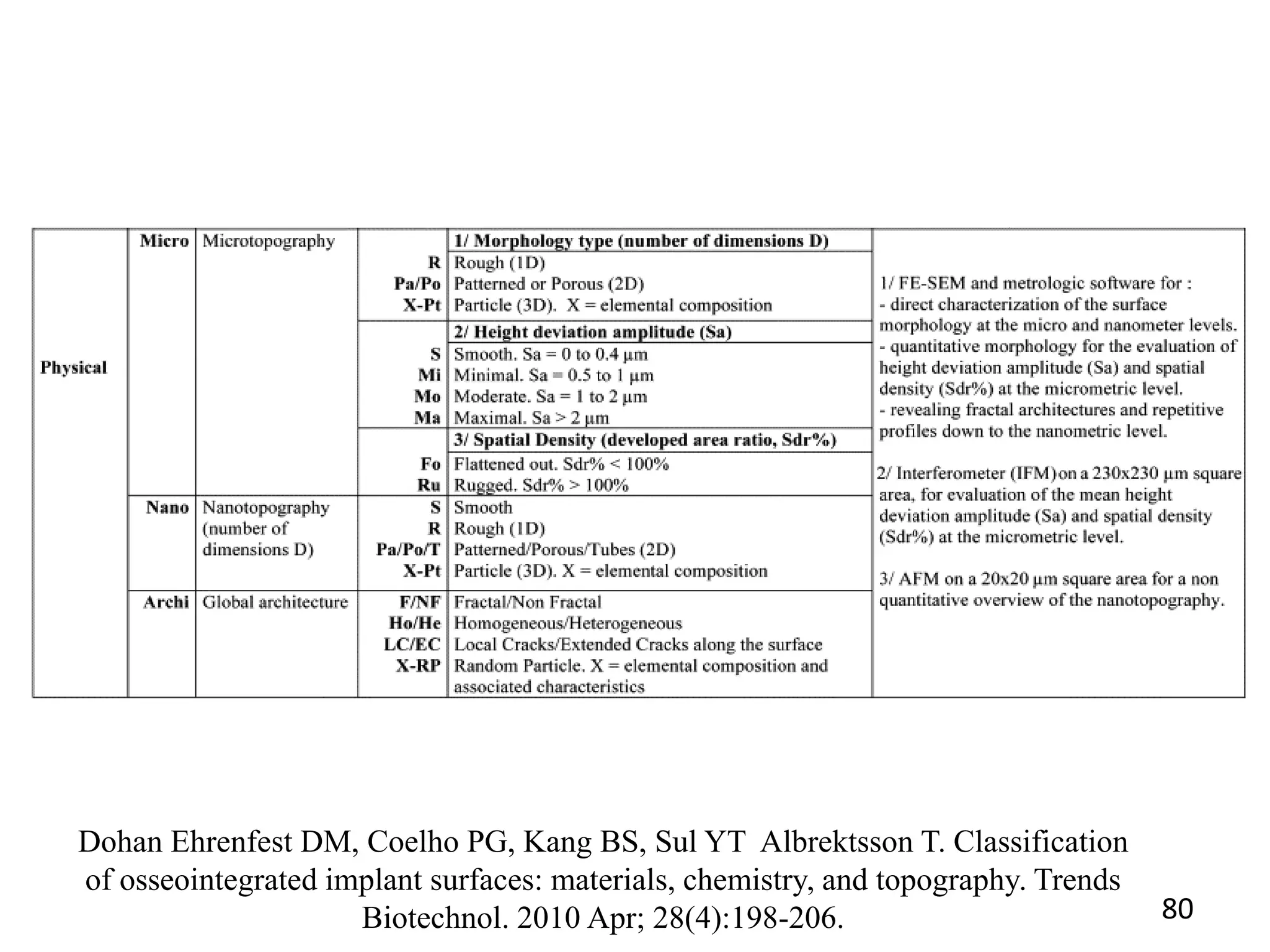
G. Implant surface
Dohan Ehrenfest DM, Coelho PG, Kang BS, Sul YT Albrektsson T. Classification
of osseointegrated implant surfaces: materials, chemistry, and topography. Trends
Biotechnol. 2010 Apr; 28(4); 198-206. 79
Dohan Ehrenfest DM, Coelho PG, Kang BS, Sul YT Albrektsson T. Classification
of osseointegrated implant surfaces: materials, chemistry, and topography. Trends
Biotechnol. 2010 Apr; 28(4):198-206. 80
References
1. The Glossary of Prosthodontic Terms, 9th edition. J. Prosthet
Dent. May 2017; 117(5S):e1-e105.
2. Yeshwante B. Dental Implants-Classification, Success and
Failure – An Overview. Journal of Dental and Medical
Sciences. 2015 May;14(5):01-08.
3. Sykaras et al. Implant Materials, Designs, and Surface
Topographies: Their Effect on Osseointegration. A Literature
Review. Int J oral maxillofac implants, 2000;15:675–690.
4. Krishna Kripal et al. Types of Implant. EC Dental Science
2017:249-254.
81
5. Pankaj P Singh. A Norman Cranin - Atlas of oral
implantology, 3rd edition, Mosby Elsevier 2010.
6. Charles A. Babbush. Dental implants-The art and science, 1st
edition, Saunders Elsevier, 2001.
7. Gerard Byrne. Chp 2 Implant Dentistry Nomenclature,
Classification, and Examples, Fundamentals of Implant
Dentistry, Wiley-Blackwell, 2014
8. Schiegnitz and Al‐nawas. Narrow‐diameter implants: A
systematic review and metaanalysis. Clin Oral Impl Res.
2018;29(16):21–40.
82
9. Mohamed, et al.: Narrow diameter implant, Journal of Indian
Society of Periodontology. 2012 Oct-Dec;16(4).
10. Renouard & Nisand. Impact of implant length and diameter
on survival rate. Clin. Oral Impl. Res. 2006;17(2):35–51.
11. Quek et al. Load fatigue performance of a single tooth
implant abutment system: effect of diameter. Int J of Oral and
maxillofafial implants. 2006;21.
12. Eckert et al. Early experience with wide platform MkII
implants. Part I: implant survival. Part II evaluation of risk
factors involving implant survival. Int J of Oral and
maxillofacial implants, 2001;6(1).
83
13. Griffitts, Collins, and Collins. Mini dental implants: An
adjunct for retention, stability, and comfort for the
edentulous patient. Oral Surg Oral Med Oral Pathol Oral
Radiol Endod. 2005;100:81-4.
14. Manoj Shetty et al. Platform Switching: a new era in
implant dentistry. Int J Oral Implantology and clinical
research, 2010 May-August;2.
15. Candel et al. Pterygoid implants: an overview. Journal of
Oral Implantology. 2012;38(1).
16. Pandita et al. Rehabilitation of resorbed maxilla with
zygomatic implants- A review. International Journal of
Applied Dental Sciences. 2016;2(3).
84
17. Malo et al. A new approach to rehabilitate the severely
atrophic maxilla using extra maxillary anchored implants in
immediate function: A pilot study. J Prosth Dent. 2008 Nov.
18. Teodora et al. Ocular implants-methods of ocular
reconstruction following radical surgical interventions.
Romanian Journal of Ophthalmology. 2018;62(1):15-23.
19. Federspil. Implant-retained craniofacial prostheses for facial
defects. GMS Current Topics in Otorhinolaryngology - Head
and Neck Surgery. 2009;8.
20. Beumer, Maxillofacial rehabilitation, 3rd edition,
Quintessence, 2011.
85
21. Zarb Bolender – Complete denture and implant supported
prosthesis, Elsevier 2009.
22. Dohan Ehrenfest DM, Coelho PG, Kang BS, Sul YT
Albrektsson T. Classification of osseointegrated implant
surfaces: materials, chemistry, and topography. Trends
Biotechnol. 2010 Apr; 28(4):198-206.
23. Najeeb S, et al. Applications of polyetheretherketone (PEEK)
in oral implantology and prosthodontics. J Prosthodont Res
(2015).
24. Grahl K, Rich B, Ingel AP. A Guided Surgical Technique for
the Use of Small Diameter Implants in the Anterior Mandible:
Report of a Case. Oral health case Rep 2016:2(2).
86
25. Hatamleh MM, Jaradat E, Nawafleh N, Bibars A,
Hourani Z, Watson J. Up-to-date status of
craniofacial implants - A literature review. The
Journal of maxillofacial prosthetics & technology,
2012.
87
Thank you

Classification and Types of Craniofacial Implants

  • 1.
    CLASSIFICATION AND TYPESOF CRANIOFACIAL IMPLANTS Presentation by: Dr. Vanshree Sorathia MDS Prosthodontist Total no. of slides: 88
  • 2.
  • 3.
  • 4.
    Dental Implant: A prostheticdevice made of alloplastic material(s) implanted into the oral tissues beneath the mucosal and/or periosteal layer and on or within the bone to provide retention and support for a fixed or removable dental prosthesis; a substance that is placed into and/or on the jaw bone to support a fixed or removable dental prosthesis. -Glossary of Prosthodontic Terms 9 The Glossary of Prosthodontic Terms, 9th edition. J. Prosthet Dent 2017 May; 117(5S):e1-e105. 4
  • 5.
    Classification 5 Implant design Macroscopic bodydesign Surface of implants Material Tissue response Surface coating
  • 6.
  • 7.
    According to CharlesA. Babbush Charles A. Babbush, Dental implants-The art and science, 1st edition, Saunders Elsevier, 2001. 7
  • 8.
    1. Endosteal /endosseousimplants Gerard Byrne. Chp 2 Implant Dentistry Nomenclature, Classification, and Examples. Fundamentals of Implant Dentistry, Wiley-Blackwell, 2014 8 One stage Two stage
  • 9.
  • 10.
    (i) Intraoral →Conventional →(a) Design (1.) Root form implants:  First choice  Types available: i. Press fit ii. Self tapping iii. Pre tapping Pankaj P Singh, A Norman Cranin - Atlas of oral implantology, 3rd edition, Mosby Elsevier 2010. 10
  • 11.
  • 12.
  • 13.
     Prosthetic options:i. Fixed or fixed detachable ii. Overdentures iii. Single tooth devices  Bone requirements: Pankaj P Singh, A Norman Cranin - Atlas of oral implantology, 3rd edition, Mosby Elsevier 2010. 13
  • 14.
    Intraoral → Conventional→(a) Design (2.) Crete Mince (Thin Ridge) implant:  Threaded, self tapping, Ti spirals  Prosthetic options: i. Fixed bridge prosthesis ii. Superstructures Pankaj P Singh, A Norman Cranin - Atlas of oral implantology, 3rd edition, Mosby Elsevier 2010. 14
  • 15.
    Intraoral → Conventional→(a) Design (3.) Blade implants:  Available as: Submergible, single stage and two stage and one piece devices in 3 forms: i. Prefabricated ii. Custom cast iii. Alterable Pankaj P Singh, A Norman Cranin - Atlas of oral implantology, 3rd edition, Mosby Elsevier 2010. 15
  • 16.
    Prosthetic options: Pankaj PSingh, A Norman Cranin - Atlas of oral implantology, 3rd edition, Mosby Elsevier 2010. 16
  • 17.
     Suitable arch: Maxillary/mandibular,completely/partially edentulous.  Bone requirements: Pankaj P Singh, A Norman Cranin - Atlas of oral implantology, 3rd edition, Mosby Elsevier 2010. 17
  • 18.
    Ramus frame: Pankaj PSingh, A Norman Cranin - Atlas of oral implantology, 3rd edition, Mosby Elsevier 2010. 18
  • 19.
    Ramus blade: Prosthetic options:Overdentures Suitable arch: Mandibular completely edentulous. Pankaj P Singh, A Norman Cranin - Atlas of oral implantology, 3rd edition, Mosby Elsevier 2010. 19
  • 20.
    Bone requirements: Blade formsystems are supplied in 2 varities: i. One stage (Osseopreservation mode) ii. Two stage (Osseointegration mode) Pankaj P Singh, A Norman Cranin - Atlas of oral implantology, 3rd edition, Mosby Elsevier 2010. 20
  • 21.
    Intraoral → Conventional→(b) Size (1.) Narrow diameter implants:  Diameter <3.5mm.  Available as: One piece or two piece.  Prosthetic options: i. Single missing lower anterior ii. Maxillary lateral incisor iii. Mandibular overdenture iv. Fixed bridges 1SCHIEGNITZ and AL‐NAWAS, Narrow‐diameter implants: A systematic review and metaanalysis, Clin Oral Impl Res. 2018;29(Suppl. 16):21–40. 2Mohamed, et al.: Narrow diameter implant, Journal of Indian Society of Periodontology. 2012:16(4). 21
  • 22.
    Grahl K, RichB, Ingel AP. A Guided Surgical Technique for the Use of Small Diameter Implants in the Anterior Mandible: Report of a Case. Oral health case Rep 2016:2(2). 22
  • 23.
    Renouard and Nisandin 2006 - survival rates for NDI are comparable with that of Standard diameter implants. Renouard & Nisand, Impact of implant length and diameter on survival rate. Clin. Oral Impl. Res. 17 (Suppl. 2), 2006 / 35–51 23
  • 24.
    Intraoral → Conventional→(b) Size (2.) Regular platform implants:  Diameter 3.5-4.5 mm.  Most commonly used. Quek et al, load fatigue performance of a single tooth implant abutment system: effect of diameter. Int J of Oral and maxillofafial implants, 2006(21). 24
  • 25.
    Quek et al,load fatigue performance of a single tooth implant abutment system: effect of diameter. Int J of Oral and maxillofacial implants, 2006(21). 25
  • 26.
    Intraoral → Conventional→(b) Size (3.) Wide platform implants:  Diameter >4.7mm.  Prosthetic options: Replace large molars. Eckert et al, Early experience with wide platform MkII implants. Part I: implant survival. Part II evaluation of risk factors involving implant survival, Int J of Oral and maxillofacial implants, 2001(6;1). 26
  • 27.
    Eckert et al,Early experience with wide platform MkII implants. Part I: implant survival. Part II evaluation of risk factors involving implant survival, Int J of Oral and maxillofacial implants, 2001(6;1). 27
  • 28.
    Intraoral → Conventional→(b) Size (4.) Mini dental implants Diameter 1.8-2.4mm. Length 10-18mm Prosthetic option: i. Narrow interdental space ii. Knife edge ridge iii. Orthodontic anchorage iv. Immediately loaded implant supported overdenture. Griffitts, Collins, and Collins, Mini dental implants: An adjunct for retention, stability, and comfort for the edentulous patient, Oral Surg Oral Med Oral Pathol Oral Radiol Endod 2005;100:E81-4. 28
  • 29.
    Intraoral → Conventional→(b) Size (5.) Short implants:  Diameter <8mm. Eckert et al, Early experience with wide platform MkII implants. Part I: implant survival. Part II evaluation of risk factors involving implant survival, Int J of Oral and maxillofacial implants, 2001(6;1). 29
  • 30.
  • 31.
    Intraoral → Conventional→ (c) Platform Switching Manoj Shetty et al, Platform Switching: a new era in implant dentistry, Int J Oral Implantology and clinical research, May August 2010(2). 31
  • 32.
    Crespi R, CappareP, Gherlone E. Radiographic evaluation of marginal bone levels around platform switched and non switched implants used in an immediate loading protocol. Int J Oral Maxillofac implants, 2009;24(5): 142-153. 32
  • 33.
    Intraoral → Specialimplants (1.) Orthodontic implants: 33
  • 34.
    Intraoral → Specialimplants (2.) Pterygoid implants: Length 15-20mm Candel et al. Pterygoid implants: an overview. Journal of Oral Implantology. 2012:38(1). 34
  • 35.
    Candel et al.Pterygoid implants: an overview. Journal of Oral Implantology. 2012:38(1). 35
  • 36.
    Intraoral → Specialimplants (3.) Zygomatic implant Length 35-55mm. Techniques: i. Intrasinus (Branemark et al) ii. Extrasinus Pandita et al. Rehabilitation of resorbed maxilla with zygomatic implants - A review. International Journal of Applied Dental Sciences. 2016: 2(3). 36
  • 37.
    Prosthetic option: i. Partialor total maxillary edentulism with extreme resorption in sinus area. ii. Reconstruction of maxillary defects. iii. Unilateral cleft palate and generalized maxillary atrophy. Contraindications Associated risk Pandita et al. Rehabilitation of resorbed maxilla with zygomatic implants- A review. International Journal of Applied Dental Sciences. 2016:2(3). 37
  • 38.
    Malo et aldemonstrated 98.5% survival rate of implants via extrasinus technique after 1 year follow up. Malo et al, A new approach to rehabilitate the severely atrophic maxilla using extramaxillary anchored implants in immediate function: A pilot study. J Prosth Dent Nov 2008. 38
  • 39.
  • 40.
    Federspil. Implant-retained craniofacialprostheses for facial defects. GMS Current Topics in Otorhinolaryngology - Head and Neck Surgery 2009:8. 40 Anders Tjellstom 1977
  • 41.
    1Federspil. Implant-retained craniofacialprostheses for facial defects. GMS Current Topics in Otorhinolaryngology - Head and Neck Surgery 2009:8. 2Beumer. Maxillofacial rehabilitation. 3rd edition, Quintessence, 2011. 41 Systems available: Solitary implant Grouped implants
  • 42.
    Federspil. Implant-retained craniofacialprostheses for facial defects. GMS Current Topics in Otorhinolaryngology - Head and Neck Surgery 2009:8. 42 Solitary implants: 1. Branemark system 2. ITI system 3. IMZ system 4. Denstply Friedent system 5. Southern system
  • 43.
    Federspil. Implant-retained craniofacialprostheses for facial defects. GMS Current Topics in Otorhinolaryngology - Head and Neck Surgery 2009:8. 43 Grouped implants: 1. Epitec system 2. Epiplating system
  • 44.
    Hatamleh MM, JaradatE, Nawafleh N, Bibars A, Hourani Z, Watson J. Up-to-date status of craniofacial implants - A literature review. The Journal of maxillofacial prosthetics & technology, 2012. 44
  • 45.
    Beumer. Maxillofacial rehabilitation.3rd edition, Quintessence, 2011. 45
  • 46.
    Extraoral implants (1) Ocularimplants Objective Material: HA, bioceramics, polyethelene. Teodora et al, Ocular implants-methods of ocular reconstruction following radical surgical interventions. Romanian Journal of Ophthalmology 2018; 62(1): 15-23 46
  • 47.
    Zarb Bolender –Complete denture and implant supported prosthesis, Elsevier 2009 47
  • 48.
    Extraoral implants (2.) Implantfor auricular prosthesis/ Temporal implants: Zarb Bolender – Complete denture and implant supported prosthesis, Elsevier 2009. 48
  • 49.
    Beumer. Maxillofacial rehabilitation.3rd edition, Quintessence, 2011. 49
  • 50.
    Extraoral implants (3) Implantfor nasal prosthesis: Beumer, Maxillofacial rehabilitation, 3rd edition, Quintessence, 2011. 50
  • 51.
    2. Transosteal implant One piece transmandibular complex implants.  Advantage  Designs i. Single component device ii. Multiple iii. Staple device Pankaj P Singh, A Norman Cranin - Atlas of oral implantology, 3rd edition, Mosby Elsevier 2010. 51
  • 52.
    Pankaj P Singh,A Norman Cranin - Atlas of oral implantology, 3rd edition, Mosby Elsevier 2010. 52 Single component device
  • 53.
     Prosthetic option: i.Overdentures ii. Rarely fixed bridges  Suitable arch: Mandibular anterior region, completely or partially edentulous.  Bone requirement: Pankaj P Singh, A Norman Cranin - Atlas of oral implantology, 3rd edition, Mosby Elsevier 2010. Charles A. Babbush, Dental implants-The art and science, 1st edition, Saunders Elsevier, 2001. 53
  • 54.
    3. Subperiosteal implants PankajP Singh, A Norman Cranin - Atlas of oral implantology, 3rd edition, Mosby Elsevier 2010. 54
  • 55.
    Pankaj P Singh,A Norman Cranin - Atlas of oral implantology, 3rd edition, Mosby Elsevier 2010. 55
  • 56.
    Prosthetic options: Overdenture, fixedbridges Suitable arch: Maxillary or mandibular, completely or partially. Bone requirement: >5mm Pankaj P Singh, A Norman Cranin - Atlas of oral implantology, 3rd edition, Mosby Elsevier 2010. 56
  • 57.
    4. Intramucosal inserts Dahlin 1943. Pankaj P Singh, A Norman Cranin - Atlas of oral implantology, 3rd edition, Mosby Elsevier 2010. 57
  • 58.
    Prosthetic option: Removable denture,full or partial. Suitable arch: Maxillary completely or partially edentulous, mandibular partial only. Bone requirements: None, mucosa (2.2mm) Pankaj P Singh, A Norman Cranin - Atlas of oral implantology, 3rd edition, Mosby Elsevier 2010. 58
  • 59.
    5. Endodontic Stabilizer Prostheticoption: Crown and fixed bridge abutment Suitable arch: Any arch any tooth. Bone requirement: >8mm lesion free. Pankaj P Singh, A Norman Cranin - Atlas of oral implantology, 3rd edition, Mosby Elsevier 2010. 59
  • 60.
  • 61.
  • 62.
  • 63.
  • 64.
  • 65.
    Sykaras et al.Implant Materials, Designs, and Surface Topographies: Their Effect on Osseointegration. A Literature Review. Int J oral maxillofac implants, 2000;15:675–690. 65
  • 66.
    Sykaras et al.Implant Materials, Designs, and Surface Topographies: Their Effect on Osseointegration. A Literature Review. Int J oral maxillofac implants, 2000;15:675–690. 66
  • 67.
  • 68.
    Sykaras et al.Implant Materials, Designs, and Surface Topographies: Their Effect on Osseointegration. A Literature Review. Int J oral maxillofac implants, 2000;15:675–690. 68
  • 69.
  • 70.
    Sykaras et al.Implant Materials, Designs, and Surface Topographies: Their Effect on Osseointegration. A Literature Review. Int J oral maxillofac implants, 2000;15:675–690. 70
  • 71.
    Titanium Sykaras et al.Implant Materials, Designs, and Surface Topographies: Their Effect on Osseointegration. A Literature Review. Int J oral maxillofac implants, 2000;15:675–690. 71 Gold standard in implant materials. • Composition of Commercially pure titanium – Titanium 99.75% – Iron 0.05% – Oxygen 0.1% – Nitrogen 0.03% – Hydrogen 0.012% – Carbon 0.05% • 4 grades, grade I II III IV, according to oxygen content (0.18% to 0.40 %) & iron content (0.20 to 0.50 wt %).
  • 72.
    Titanium alloys Ti6Al4V -Titanium – 6% Aluminium – alpha stabilizer – 4% Vanadium – beta stabilizer • Corrosion resistance • Modulus of elasticity • Strength 72
  • 73.
    Polymers - PEEK •Stress shielding. • Unmodified- contact angle 80-90degree- bioinert. • Modifications. Najeeb S, et al. Applications of polyetheretherketone (PEEK) in oral implantology and prosthodontics. J Prosthodont Res (2015) 73
  • 74.
  • 75.
    1. Additive characterization 75 HAcoating TCP coating Zr coating Ti sintering HA plasma spray Anodization
  • 76.
    2. Subtractive characterization Acidetching Alkaline etching Sandblasting Sandblast + acid etching Grit blasting Ti blasting Laser Lithography 76
  • 77.
    3. Combined Acid Etching+ Collagen coating Acid Etching + Anodization Acid Etching + Biomimetic coating 77
  • 78.
  • 79.
    Dohan Ehrenfest DM,Coelho PG, Kang BS, Sul YT Albrektsson T. Classification of osseointegrated implant surfaces: materials, chemistry, and topography. Trends Biotechnol. 2010 Apr; 28(4); 198-206. 79
  • 80.
    Dohan Ehrenfest DM,Coelho PG, Kang BS, Sul YT Albrektsson T. Classification of osseointegrated implant surfaces: materials, chemistry, and topography. Trends Biotechnol. 2010 Apr; 28(4):198-206. 80
  • 81.
    References 1. The Glossaryof Prosthodontic Terms, 9th edition. J. Prosthet Dent. May 2017; 117(5S):e1-e105. 2. Yeshwante B. Dental Implants-Classification, Success and Failure – An Overview. Journal of Dental and Medical Sciences. 2015 May;14(5):01-08. 3. Sykaras et al. Implant Materials, Designs, and Surface Topographies: Their Effect on Osseointegration. A Literature Review. Int J oral maxillofac implants, 2000;15:675–690. 4. Krishna Kripal et al. Types of Implant. EC Dental Science 2017:249-254. 81
  • 82.
    5. Pankaj PSingh. A Norman Cranin - Atlas of oral implantology, 3rd edition, Mosby Elsevier 2010. 6. Charles A. Babbush. Dental implants-The art and science, 1st edition, Saunders Elsevier, 2001. 7. Gerard Byrne. Chp 2 Implant Dentistry Nomenclature, Classification, and Examples, Fundamentals of Implant Dentistry, Wiley-Blackwell, 2014 8. Schiegnitz and Al‐nawas. Narrow‐diameter implants: A systematic review and metaanalysis. Clin Oral Impl Res. 2018;29(16):21–40. 82
  • 83.
    9. Mohamed, etal.: Narrow diameter implant, Journal of Indian Society of Periodontology. 2012 Oct-Dec;16(4). 10. Renouard & Nisand. Impact of implant length and diameter on survival rate. Clin. Oral Impl. Res. 2006;17(2):35–51. 11. Quek et al. Load fatigue performance of a single tooth implant abutment system: effect of diameter. Int J of Oral and maxillofafial implants. 2006;21. 12. Eckert et al. Early experience with wide platform MkII implants. Part I: implant survival. Part II evaluation of risk factors involving implant survival. Int J of Oral and maxillofacial implants, 2001;6(1). 83
  • 84.
    13. Griffitts, Collins,and Collins. Mini dental implants: An adjunct for retention, stability, and comfort for the edentulous patient. Oral Surg Oral Med Oral Pathol Oral Radiol Endod. 2005;100:81-4. 14. Manoj Shetty et al. Platform Switching: a new era in implant dentistry. Int J Oral Implantology and clinical research, 2010 May-August;2. 15. Candel et al. Pterygoid implants: an overview. Journal of Oral Implantology. 2012;38(1). 16. Pandita et al. Rehabilitation of resorbed maxilla with zygomatic implants- A review. International Journal of Applied Dental Sciences. 2016;2(3). 84
  • 85.
    17. Malo etal. A new approach to rehabilitate the severely atrophic maxilla using extra maxillary anchored implants in immediate function: A pilot study. J Prosth Dent. 2008 Nov. 18. Teodora et al. Ocular implants-methods of ocular reconstruction following radical surgical interventions. Romanian Journal of Ophthalmology. 2018;62(1):15-23. 19. Federspil. Implant-retained craniofacial prostheses for facial defects. GMS Current Topics in Otorhinolaryngology - Head and Neck Surgery. 2009;8. 20. Beumer, Maxillofacial rehabilitation, 3rd edition, Quintessence, 2011. 85
  • 86.
    21. Zarb Bolender– Complete denture and implant supported prosthesis, Elsevier 2009. 22. Dohan Ehrenfest DM, Coelho PG, Kang BS, Sul YT Albrektsson T. Classification of osseointegrated implant surfaces: materials, chemistry, and topography. Trends Biotechnol. 2010 Apr; 28(4):198-206. 23. Najeeb S, et al. Applications of polyetheretherketone (PEEK) in oral implantology and prosthodontics. J Prosthodont Res (2015). 24. Grahl K, Rich B, Ingel AP. A Guided Surgical Technique for the Use of Small Diameter Implants in the Anterior Mandible: Report of a Case. Oral health case Rep 2016:2(2). 86
  • 87.
    25. Hatamleh MM,Jaradat E, Nawafleh N, Bibars A, Hourani Z, Watson J. Up-to-date status of craniofacial implants - A literature review. The Journal of maxillofacial prosthetics & technology, 2012. 87
  • 88.