




GOOD MORNING
BY: Dr Garima Singh
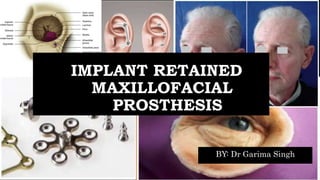
IMPLANT RETAINED
MAXILLOFACIAL
PROSTHESIS
• INTRODUCTION
• HISTORY
• SCOPE OF MAXILLOFACIAL PROSTHETICS
• BIOMECHANICAL CONSIDERATIONS
• PROSTHETIC CONSIDERATIONS
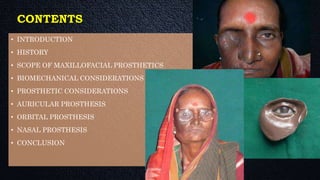
• AURICULAR PROSTHESIS
• ORBITAL PROSTHESIS
• NASAL PROSTHESIS
• CONCLUSION
CONTENTS
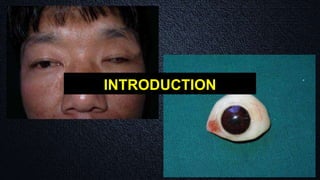
INTRODUCTION
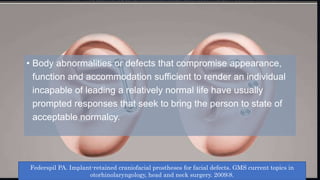
• Body abnormalities or defects that compromise appearance,
function and accommodation sufficient to render an individual
incapable of leading a relatively normal life have usually
prompted responses that seek to bring the person to state of
acceptable normalcy.
Federspil PA. Implant-retained craniofacial prostheses for facial defects. GMS current topics in
otorhinolaryngology, head and neck surgery. 2009;8.
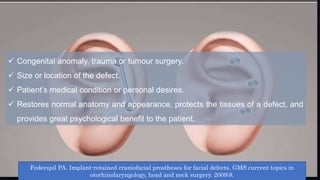
 Congenital anomaly, trauma or tumour surgery.
 Size or location of the defect.
 Patient’s medical condition or personal desires.
 Restores normal anatomy and appearance, protects the tissues of a defect, and
provides great psychological benefit to the patient.
Federspil PA. Implant-retained craniofacial prostheses for facial defects. GMS current topics in
otorhinolaryngology, head and neck surgery. 2009;8.
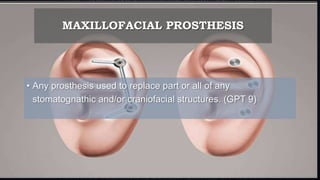
MAXILLOFACIAL PROSTHESIS
• Any prosthesis used to replace part or all of any
stomatognathic and/or craniofacial structures. (GPT 9)
HISTORY
Artificial eyes, ears, noses were found on egyptian mummies.
AMBROSE PARE (1517-1590):ears made of paper & leather, and
method of securing them with a head clip.
In 1728, Pierre Fauchard designed a prostheses supported with wings
that were positioned by patient from the oral side of obturator and made
use of floor of nose for retention
In 1889, CLAUDE MARTIN, a French man illustrated a variety of
prosthetic replacements including a particularily interesting attempt to
retain a porcelain nose prosthesis with an intraoral mechanism
Beumer III J, Marunick MT, Esposito SJ. Maxillofacial rehabilitation: prosthodontic and surgical
management of cancer-related, acquired, and congenital defects of the head and neck. Quintessence Pub.
2011;276.
• The problem of retention: KOLE and WIRTH in 1956.
• Branemark first placed modified osseointegrated fixtures in cranial
skeleton for the purpose of retaining a prosthetic ear in 1977
Beumer III J, Marunick MT, Esposito SJ. Maxillofacial rehabilitation: prosthodontic and surgical
management of cancer-related, acquired, and congenital defects of the head and neck. Quintessence Pub.
2011;276.
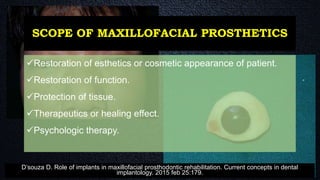
SCOPE OF MAXILLOFACIAL PROSTHETICS
Restoration of esthetics or cosmetic appearance of patient.
Restoration of function.
Protection of tissue.
Therapeutics or healing effect.
Psychologic therapy.
D’souza D. Role of implants in maxillofacial prosthodontic rehabilitation. Current concepts in dental
implantology. 2015 feb 25:179.
INDICATIONS FOR BONE-ANCHORED
PROSTHESES
 If local or general contraindications concerning procedures of reconstructive
surgery exist
Poor general condition
During individual stages in plastic reconstructive surgery (interim prosthesis)
 Following failed reconstructive procedures
The rejection of reconstructive procedures on the part of the patient
 High aesthetic demands
D’souza D. Role of implants in maxillofacial prosthodontic rehabilitation. Current concepts in dental
implantology. 2015 feb 25:179.
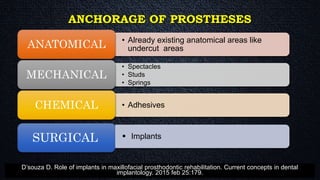
ANCHORAGE OF PROSTHESES
• Already existing anatomical areas like
undercut areasANATOMICAL
• Spectacles
• Studs
• Springs
MECHANICAL
• AdhesivesCHEMICAL
SURGICAL  Implants
D’souza D. Role of implants in maxillofacial prosthodontic rehabilitation. Current concepts in dental
implantology. 2015 feb 25:179.
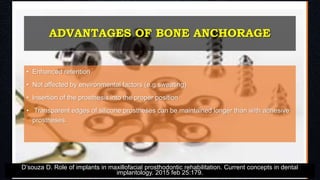
ADVANTAGES OF BONE ANCHORAGE
• Enhanced retention
• Not affected by environmental factors (e.g.sweating)
• Insertion of the prosthesis into the proper position
• Transparent edges of silicone prostheses can be maintained longer than with adhesive
prostheses.
D’souza D. Role of implants in maxillofacial prosthodontic rehabilitation. Current concepts in dental
implantology. 2015 feb 25:179.
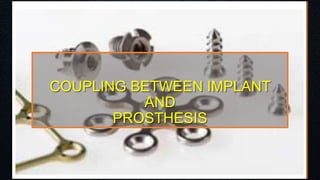
COUPLING BETWEEN IMPLANT
AND
PROSTHESIS
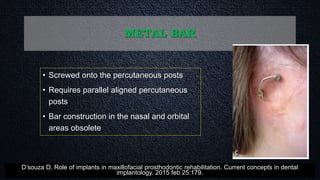
METAL BAR
• Screwed onto the percutaneous posts
• Requires parallel aligned percutaneous
posts
• Bar construction in the nasal and orbital
areas obsolete
D’souza D. Role of implants in maxillofacial prosthodontic rehabilitation. Current concepts in dental
implantology. 2015 feb 25:179.
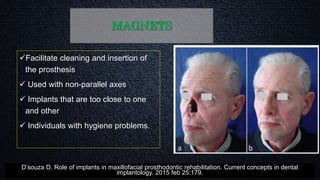
MAGNETS
Facilitate cleaning and insertion of
the prosthesis
 Used with non-parallel axes
 Implants that are too close to one
and other
 Individuals with hygiene problems.
D’souza D. Role of implants in maxillofacial prosthodontic rehabilitation. Current concepts in dental
implantology. 2015 feb 25:179.
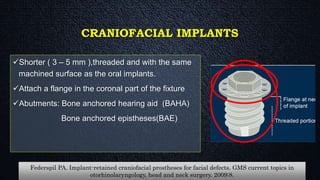
CRANIOFACIAL IMPLANTS
Shorter ( 3 – 5 mm ),threaded and with the same
machined surface as the oral implants.
Attach a flange in the coronal part of the fixture
Abutments: Bone anchored hearing aid (BAHA)
Bone anchored epistheses(BAE)
Federspil PA. Implant-retained craniofacial prostheses for facial defects. GMS current topics in
otorhinolaryngology, head and neck surgery. 2009;8.
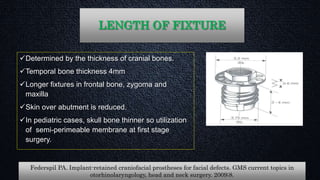
LENGTH OF FIXTURE
Determined by the thickness of cranial bones.
Temporal bone thickness 4mm
Longer fixtures in frontal bone, zygoma and
maxilla
Skin over abutment is reduced.
In pediatric cases, skull bone thinner so utilization
of semi-perimeable membrane at first stage
surgery.
Federspil PA. Implant-retained craniofacial prostheses for facial defects. GMS current topics in
otorhinolaryngology, head and neck surgery. 2009;8.
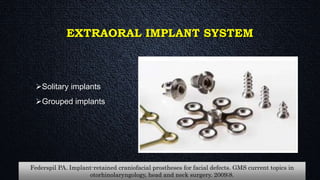
EXTRAORAL IMPLANT SYSTEM
Solitary implants
Grouped implants
Federspil PA. Implant-retained craniofacial prostheses for facial defects. GMS current topics in
otorhinolaryngology, head and neck surgery. 2009;8.
SOLITARY IMPLANTS
BRANEMARK
SYSTEM
ITI SYSTEM
ANKYLOS
SYSTEM
Federspil PA. Implant-retained craniofacial prostheses for facial defects. GMS current topics in
otorhinolaryngology, head and neck surgery. 2009;8.
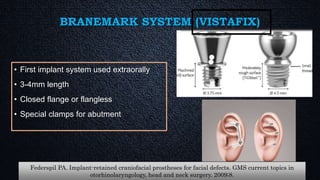
BRANEMARK SYSTEM (VISTAFIX)
• First implant system used extraorally
• 3-4mm length
• Closed flange or flangless
• Special clamps for abutment
Federspil PA. Implant-retained craniofacial prostheses for facial defects. GMS current topics in
otorhinolaryngology, head and neck surgery. 2009;8.
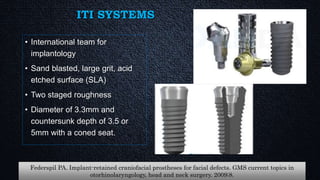
ITI SYSTEMS
• International team for
implantology
• Sand blasted, large grit, acid
etched surface (SLA)
• Two staged roughness
• Diameter of 3.3mm and
countersunk depth of 3.5 or
5mm with a coned seat.
Federspil PA. Implant-retained craniofacial prostheses for facial defects. GMS current topics in
otorhinolaryngology, head and neck surgery. 2009;8.
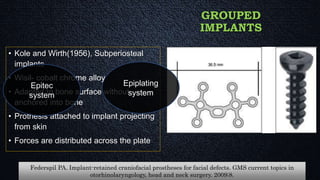
GROUPED
IMPLANTS
• Kole and Wirth(1956), Subperiosteal
implants
• Wisil- cobalt chrome alloy
• Adapted to bone surface without
anchored into bone
• Prothesis attached to implant projecting
from skin
• Forces are distributed across the plate
Epitec
system
Epiplating
system
Federspil PA. Implant-retained craniofacial prostheses for facial defects. GMS current topics in
otorhinolaryngology, head and neck surgery. 2009;8.
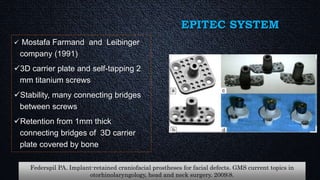
EPITEC SYSTEM
 Mostafa Farmand and Leibinger
company (1991)
3D carrier plate and self-tapping 2
mm titanium screws
Stability, many connecting bridges
between screws
Retention from 1mm thick
connecting bridges of 3D carrier
plate covered by bone
Federspil PA. Implant-retained craniofacial prostheses for facial defects. GMS current topics in
otorhinolaryngology, head and neck surgery. 2009;8.
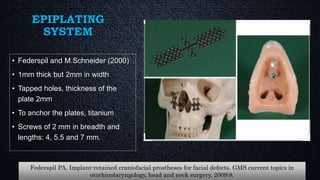
EPIPLATING
SYSTEM
• Federspil and M.Schneider (2000)
• 1mm thick but 2mm in width
• Tapped holes, thickness of the
plate 2mm
• To anchor the plates, titanium
• Screws of 2 mm in breadth and
lengths: 4, 5.5 and 7 mm.
Federspil PA. Implant-retained craniofacial prostheses for facial defects. GMS current topics in
otorhinolaryngology, head and neck surgery. 2009;8.
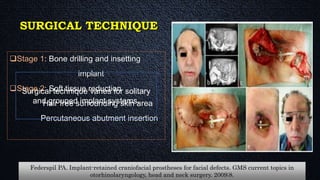
SURGICAL TECHNIQUE
Stage 1: Bone drilling and insetting
implant
Stage 2: Soft tissue reduction
Hair free surrounding skin area
Percutaneous abutment insertion
Surgical technique varies for solitary
and grouped implant systems.
Federspil PA. Implant-retained craniofacial prostheses for facial defects. GMS current topics in
otorhinolaryngology, head and neck surgery. 2009;8.
PROSTHETIC
CONSIDERATION
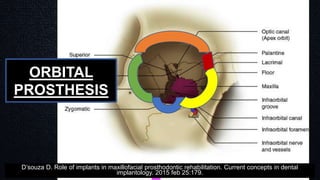
ORBITAL
PROSTHESIS
D’souza D. Role of implants in maxillofacial prosthodontic rehabilitation. Current concepts in dental
implantology. 2015 feb 25:179.
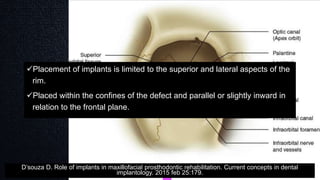
Placement of implants is limited to the superior and lateral aspects of the
rim.
Placed within the confines of the defect and parallel or slightly inward in
relation to the frontal plane.
D’souza D. Role of implants in maxillofacial prosthodontic rehabilitation. Current concepts in dental
implantology. 2015 feb 25:179.
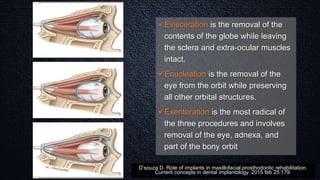
Evisceration is the removal of the
contents of the globe while leaving
the sclera and extra-ocular muscles
intact.
Enucleation is the removal of the
eye from the orbit while preserving
all other orbital structures.
Exenteration is the most radical of
the three procedures and involves
removal of the eye, adnexa, and
part of the bony orbit
D’souza D. Role of implants in maxillofacial prosthodontic rehabilitation.
Current concepts in dental implantology. 2015 feb 25:179.
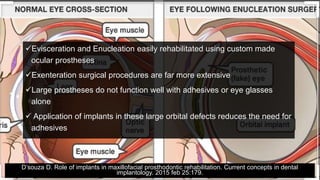
Evisceration and Enucleation easily rehabilitated using custom made
ocular prostheses
Exenteration surgical procedures are far more extensive
Large prostheses do not function well with adhesives or eye glasses
alone
 Application of implants in these large orbital defects reduces the need for
adhesives
D’souza D. Role of implants in maxillofacial prosthodontic rehabilitation. Current concepts in dental
implantology. 2015 feb 25:179.
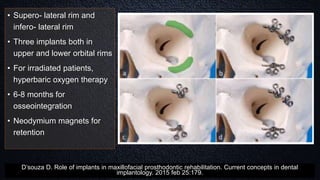
• Supero- lateral rim and
infero- lateral rim
• Three implants both in
upper and lower orbital rims
• For irradiated patients,
hyperbaric oxygen therapy
• 6-8 months for
osseointegration
• Neodymium magnets for
retention
D’souza D. Role of implants in maxillofacial prosthodontic rehabilitation. Current concepts in dental
implantology. 2015 feb 25:179.
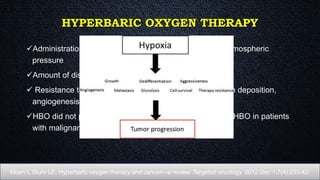
HYPERBARIC OXYGEN THERAPY
Administration of 100 % oxygen at higher than normal atmospheric
pressure
Amount of dissolved oxygen in the plasma increases.
 Resistance to infection, activation of fibroblasts, collagen deposition,
angiogenesis, and epithelization
HBO did not promote cancer growth, and that the use of HBO in patients
with malignancies was considered safe.
Moen I, Stuhr LE. Hyperbaric oxygen therapy and cancer—a review. Targeted oncology. 2012 Dec 1;7(4):233-42.
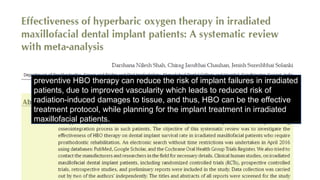
preventive HBO therapy can reduce the risk of implant failures in irradiated
patients, due to improved vascularity which leads to reduced risk of
radiation-induced damages to tissue, and thus, HBO can be the effective
treatment protocol, while planning for the implant treatment in irradiated
maxillofacial patients.
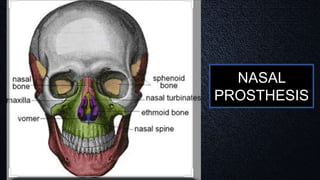
NASAL
PROSTHESIS
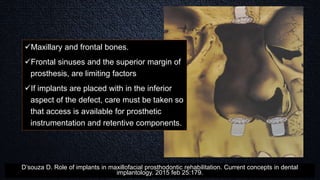
Maxillary and frontal bones.
Frontal sinuses and the superior margin of
prosthesis, are limiting factors
If implants are placed with in the inferior
aspect of the defect, care must be taken so
that access is available for prosthetic
instrumentation and retentive components.
D’souza D. Role of implants in maxillofacial prosthodontic rehabilitation. Current concepts in dental
implantology. 2015 feb 25:179.
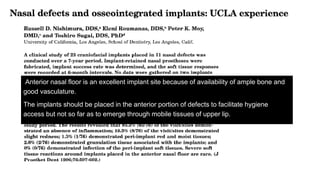
Anterior nasal floor is an excellent implant site because of availability of ample bone and
good vasculature.
The implants should be placed in the anterior portion of defects to facilitate hygiene
access but not so far as to emerge through mobile tissues of upper lip.
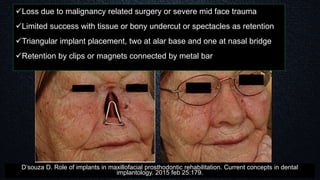
Loss due to malignancy related surgery or severe mid face trauma
Limited success with tissue or bony undercut or spectacles as retention
Triangular implant placement, two at alar base and one at nasal bridge
Retention by clips or magnets connected by metal bar
D’souza D. Role of implants in maxillofacial prosthodontic rehabilitation. Current concepts in dental
implantology. 2015 feb 25:179.
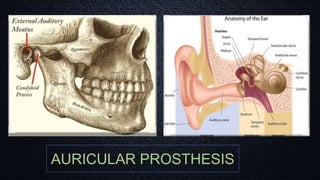
AURICULAR PROSTHESIS
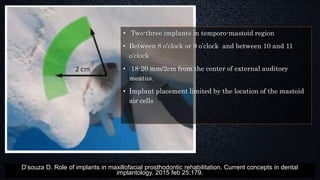
• Two-three implants in temporo-mastoid region
• Between 8 o’clock or 9 o’clock and between 10 and 11
o’clock
• 18-20 mm/2cm from the center of external auditory
meatus.
• Implant placement limited by the location of the mastoid
air cells
D’souza D. Role of implants in maxillofacial prosthodontic rehabilitation. Current concepts in dental
implantology. 2015 feb 25:179.
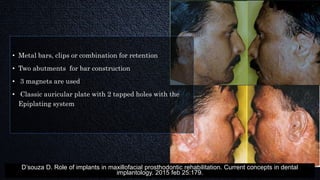
• Metal bars, clips or combination for retention
• Two abutments for bar construction
• 3 magnets are used
• Classic auricular plate with 2 tapped holes with the
Epiplating system
D’souza D. Role of implants in maxillofacial prosthodontic rehabilitation. Current concepts in dental
implantology. 2015 feb 25:179.
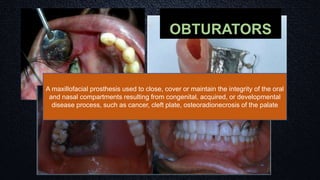
OBTURATORS
A maxillofacial prosthesis used to close, cover or maintain the integrity of the oral
and nasal compartments resulting from congenital, acquired, or developmental
disease process, such as cancer, cleft plate, osteoradionecrosis of the palate
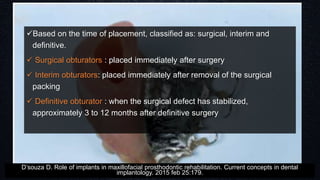
Based on the time of placement, classified as: surgical, interim and
definitive.
 Surgical obturators : placed immediately after surgery
 Interim obturators: placed immediately after removal of the surgical
packing
 Definitive obturator : when the surgical defect has stabilized,
approximately 3 to 12 months after definitive surgery
D’souza D. Role of implants in maxillofacial prosthodontic rehabilitation. Current concepts in dental
implantology. 2015 feb 25:179.
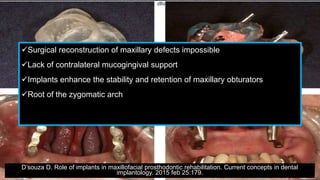
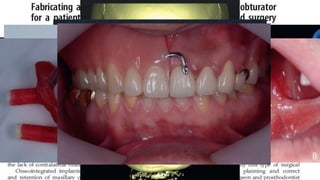
Surgical reconstruction of maxillary defects impossible
Lack of contralateral mucogingival support
Implants enhance the stability and retention of maxillary obturators
Root of the zygomatic arch
D’souza D. Role of implants in maxillofacial prosthodontic rehabilitation. Current concepts in dental
implantology. 2015 feb 25:179.
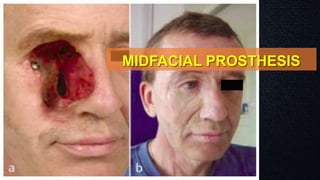
MIDFACIAL PROSTHESIS
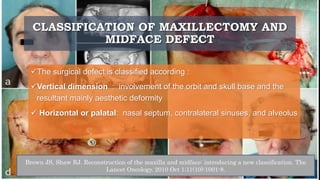
CLASSIFICATION OF MAXILLECTOMY AND
MIDFACE DEFECT
The surgical defect is classified according :
Vertical dimension : involvement of the orbit and skull base and the
resultant mainly aesthetic deformity
 Horizontal or palatal: nasal septum, contralateral sinuses, and alveolus
Brown JS, Shaw RJ. Reconstruction of the maxilla and midface: introducing a new classification. The
Lancet Oncology. 2010 Oct 1;11(10):1001-8.
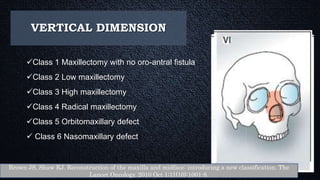
VERTICAL DIMENSION
Class 1 Maxillectomy with no oro-antral fistula
Class 2 Low maxillectomy
Class 3 High maxillectomy
Class 4 Radical maxillectomy
Class 5 Orbitomaxillary defect
 Class 6 Nasomaxillary defect
Brown JS, Shaw RJ. Reconstruction of the maxilla and midface: introducing a new classification. The
Lancet Oncology. 2010 Oct 1;11(10):1001-8.
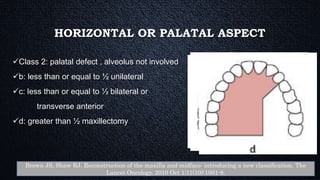
HORIZONTAL OR PALATAL ASPECT
Class 2: palatal defect , alveolus not involved
b: less than or equal to ½ unilateral
c: less than or equal to ½ bilateral or
transverse anterior
d: greater than ½ maxillectomy
Brown JS, Shaw RJ. Reconstruction of the maxilla and midface: introducing a new classification. The
Lancet Oncology. 2010 Oct 1;11(10):1001-8.
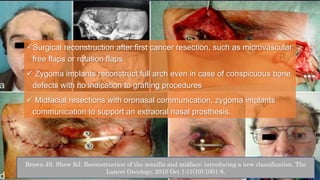
Surgical reconstruction after first cancer resection, such as microvascular
free flaps or rotation flaps
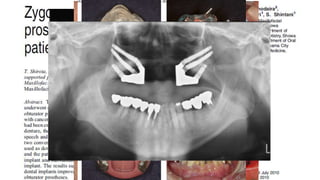
 Zygoma implants reconstruct full arch even in case of conspicuous bone
defects with no indication to grafting procedures
 Midfacial resections with oronasal communication, zygoma implants
communication to support an extraoral nasal prosthesis.
Brown JS, Shaw RJ. Reconstruction of the maxilla and midface: introducing a new classification. The
Lancet Oncology. 2010 Oct 1;11(10):1001-8.
RESULT OF
IMPLANTATION
COMPLICATIONS
D’souza D. Role of implants in maxillofacial prosthodontic rehabilitation. Current concepts in dental
implantology. 2015 feb 25:179.
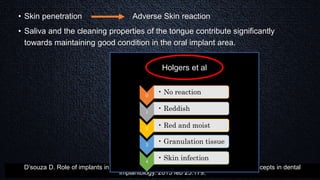
• Skin penetration Adverse Skin reaction
• Saliva and the cleaning properties of the tongue contribute significantly
towards maintaining good condition in the oral implant area.
0
• No reaction
1
• Reddish
2 • Red and moist
3
• Granulation tissue
4
• Skin infection
Holgers et al
PROCEDURE WITH
IRRADIATED PATIENTS
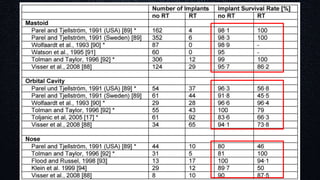
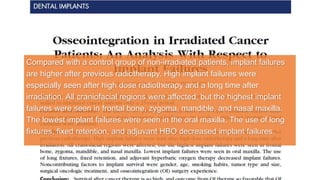
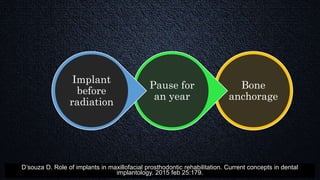
Compared with a control group of non-irradiated patients, implant failures
are higher after previous radiotherapy. High implant failures were
especially seen after high dose radiotherapy and a long time after
irradiation. All craniofacial regions were affected, but the highest implant
failures were seen in frontal bone, zygoma, mandible, and nasal maxilla.
The lowest implant failures were seen in the oral maxilla. The use of long
fixtures, fixed retention, and adjuvant HBO decreased implant failures.
Bone
anchorage
Pause for
an year
Implant
before
radiation
D’souza D. Role of implants in maxillofacial prosthodontic rehabilitation. Current concepts in dental
implantology. 2015 feb 25:179.
CRANIOFACIAL
PROSTHETIC
TREATMENT OF
CHILDREN
An implantation should be considered after puberty in adolescents.
A temporary solution is offered by an adhesive retained prosthesis.
In case of malformations in children it should not be forgotten that the
young patients should indeed be cared for and their wishes be respected
D’souza D. Role of implants in maxillofacial prosthodontic rehabilitation. Current concepts in dental
implantology. 2015 feb 25:179.
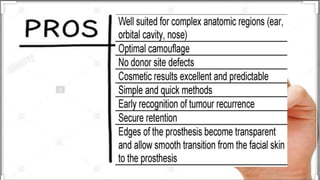
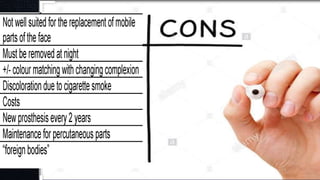
ADVANTAGES AND
DISADVANTAGES
OF IMPLANT-RETAINED
PROSTHESES
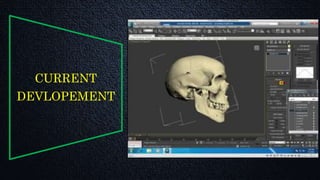
CURRENT
DEVLOPEMENT
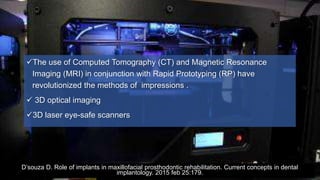
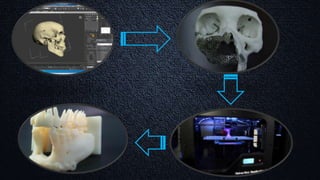
The use of Computed Tomography (CT) and Magnetic Resonance
Imaging (MRI) in conjunction with Rapid Prototyping (RP) have
revolutionized the methods of impressions .
 3D optical imaging
3D laser eye-safe scanners
D’souza D. Role of implants in maxillofacial prosthodontic rehabilitation. Current concepts in dental
implantology. 2015 feb 25:179.
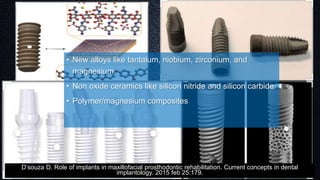
• New alloys like tantalum, niobium, zirconium, and
magnesium
• Non oxide ceramics like silicon nitride and silicon carbide
• Polymer/magnesium composites
D’souza D. Role of implants in maxillofacial prosthodontic rehabilitation. Current concepts in dental
implantology. 2015 feb 25:179.
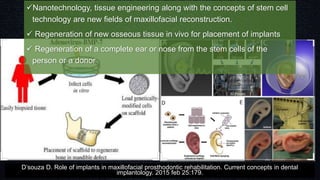
Nanotechnology, tissue engineering along with the concepts of stem cell
technology are new fields of maxillofacial reconstruction.
 Regeneration of new osseous tissue in vivo for placement of implants
 Regeneration of a complete ear or nose from the stem cells of the
person or a donor
D’souza D. Role of implants in maxillofacial prosthodontic rehabilitation. Current concepts in dental
implantology. 2015 feb 25:179.
CONCLUSION
The discovery of osseointegration has been arguably one of the
most beneficial medical breakthroughs especially in the head and
neck region. These implants have also revolutionized the scope and
the efficacy of rehabilitation of the entire craniofacial region.
The science of craniofacial implantology will ensure that the
patients receive the most comprehensive rehabilitation that can be
offered and ensure that their early return to form and function.
REFRENCES
• D’souza D. Role of implants in maxillofacial prosthodontic rehabilitation. Current
concepts in dental implantology. 2015 feb 25:179.
• Brown JS, Shaw RJ. Reconstruction of the maxilla and midface: introducing a new
classification. The Lancet Oncology. 2010 Oct 1;11(10):1001-8
• Federspil PA. Implant-retained craniofacial prostheses for facial defects. GMS
current topics in otorhinolaryngology, head and neck surgery. 2009;8.
• Maxillofacial rehabilitation: Keith F. Thomas
• Osseointegration in maxillofacial prosthesis part II.Extraoral applications Prosthet
dent 1986;55:600-06.
THANK YOU

implant retained maxillofacial prosthesis

  • 1.
  • 2.
    BY: Dr GarimaSingh IMPLANT RETAINED MAXILLOFACIAL PROSTHESIS
  • 3.
    • INTRODUCTION • HISTORY •SCOPE OF MAXILLOFACIAL PROSTHETICS • BIOMECHANICAL CONSIDERATIONS • PROSTHETIC CONSIDERATIONS • AURICULAR PROSTHESIS • ORBITAL PROSTHESIS • NASAL PROSTHESIS • CONCLUSION CONTENTS
  • 4.
  • 5.
    • Body abnormalitiesor defects that compromise appearance, function and accommodation sufficient to render an individual incapable of leading a relatively normal life have usually prompted responses that seek to bring the person to state of acceptable normalcy. Federspil PA. Implant-retained craniofacial prostheses for facial defects. GMS current topics in otorhinolaryngology, head and neck surgery. 2009;8.
  • 6.
     Congenital anomaly,trauma or tumour surgery.  Size or location of the defect.  Patient’s medical condition or personal desires.  Restores normal anatomy and appearance, protects the tissues of a defect, and provides great psychological benefit to the patient. Federspil PA. Implant-retained craniofacial prostheses for facial defects. GMS current topics in otorhinolaryngology, head and neck surgery. 2009;8.
  • 7.
    MAXILLOFACIAL PROSTHESIS • Anyprosthesis used to replace part or all of any stomatognathic and/or craniofacial structures. (GPT 9)
  • 8.
  • 9.
    Artificial eyes, ears,noses were found on egyptian mummies. AMBROSE PARE (1517-1590):ears made of paper & leather, and method of securing them with a head clip. In 1728, Pierre Fauchard designed a prostheses supported with wings that were positioned by patient from the oral side of obturator and made use of floor of nose for retention In 1889, CLAUDE MARTIN, a French man illustrated a variety of prosthetic replacements including a particularily interesting attempt to retain a porcelain nose prosthesis with an intraoral mechanism Beumer III J, Marunick MT, Esposito SJ. Maxillofacial rehabilitation: prosthodontic and surgical management of cancer-related, acquired, and congenital defects of the head and neck. Quintessence Pub. 2011;276.
  • 10.
    • The problemof retention: KOLE and WIRTH in 1956. • Branemark first placed modified osseointegrated fixtures in cranial skeleton for the purpose of retaining a prosthetic ear in 1977 Beumer III J, Marunick MT, Esposito SJ. Maxillofacial rehabilitation: prosthodontic and surgical management of cancer-related, acquired, and congenital defects of the head and neck. Quintessence Pub. 2011;276.
  • 11.
    SCOPE OF MAXILLOFACIALPROSTHETICS Restoration of esthetics or cosmetic appearance of patient. Restoration of function. Protection of tissue. Therapeutics or healing effect. Psychologic therapy. D’souza D. Role of implants in maxillofacial prosthodontic rehabilitation. Current concepts in dental implantology. 2015 feb 25:179.
  • 12.
    INDICATIONS FOR BONE-ANCHORED PROSTHESES If local or general contraindications concerning procedures of reconstructive surgery exist Poor general condition During individual stages in plastic reconstructive surgery (interim prosthesis)  Following failed reconstructive procedures The rejection of reconstructive procedures on the part of the patient  High aesthetic demands D’souza D. Role of implants in maxillofacial prosthodontic rehabilitation. Current concepts in dental implantology. 2015 feb 25:179.
  • 13.
    ANCHORAGE OF PROSTHESES •Already existing anatomical areas like undercut areasANATOMICAL • Spectacles • Studs • Springs MECHANICAL • AdhesivesCHEMICAL SURGICAL  Implants D’souza D. Role of implants in maxillofacial prosthodontic rehabilitation. Current concepts in dental implantology. 2015 feb 25:179.
  • 14.
    ADVANTAGES OF BONEANCHORAGE • Enhanced retention • Not affected by environmental factors (e.g.sweating) • Insertion of the prosthesis into the proper position • Transparent edges of silicone prostheses can be maintained longer than with adhesive prostheses. D’souza D. Role of implants in maxillofacial prosthodontic rehabilitation. Current concepts in dental implantology. 2015 feb 25:179.
  • 15.
  • 16.
    METAL BAR • Screwedonto the percutaneous posts • Requires parallel aligned percutaneous posts • Bar construction in the nasal and orbital areas obsolete D’souza D. Role of implants in maxillofacial prosthodontic rehabilitation. Current concepts in dental implantology. 2015 feb 25:179.
  • 17.
    MAGNETS Facilitate cleaning andinsertion of the prosthesis  Used with non-parallel axes  Implants that are too close to one and other  Individuals with hygiene problems. D’souza D. Role of implants in maxillofacial prosthodontic rehabilitation. Current concepts in dental implantology. 2015 feb 25:179.
  • 18.
    CRANIOFACIAL IMPLANTS Shorter (3 – 5 mm ),threaded and with the same machined surface as the oral implants. Attach a flange in the coronal part of the fixture Abutments: Bone anchored hearing aid (BAHA) Bone anchored epistheses(BAE) Federspil PA. Implant-retained craniofacial prostheses for facial defects. GMS current topics in otorhinolaryngology, head and neck surgery. 2009;8.
  • 19.
    LENGTH OF FIXTURE Determinedby the thickness of cranial bones. Temporal bone thickness 4mm Longer fixtures in frontal bone, zygoma and maxilla Skin over abutment is reduced. In pediatric cases, skull bone thinner so utilization of semi-perimeable membrane at first stage surgery. Federspil PA. Implant-retained craniofacial prostheses for facial defects. GMS current topics in otorhinolaryngology, head and neck surgery. 2009;8.
  • 20.
    EXTRAORAL IMPLANT SYSTEM Solitaryimplants Grouped implants Federspil PA. Implant-retained craniofacial prostheses for facial defects. GMS current topics in otorhinolaryngology, head and neck surgery. 2009;8.
  • 21.
    SOLITARY IMPLANTS BRANEMARK SYSTEM ITI SYSTEM ANKYLOS SYSTEM FederspilPA. Implant-retained craniofacial prostheses for facial defects. GMS current topics in otorhinolaryngology, head and neck surgery. 2009;8.
  • 22.
    BRANEMARK SYSTEM (VISTAFIX) •First implant system used extraorally • 3-4mm length • Closed flange or flangless • Special clamps for abutment Federspil PA. Implant-retained craniofacial prostheses for facial defects. GMS current topics in otorhinolaryngology, head and neck surgery. 2009;8.
  • 23.
    ITI SYSTEMS • Internationalteam for implantology • Sand blasted, large grit, acid etched surface (SLA) • Two staged roughness • Diameter of 3.3mm and countersunk depth of 3.5 or 5mm with a coned seat. Federspil PA. Implant-retained craniofacial prostheses for facial defects. GMS current topics in otorhinolaryngology, head and neck surgery. 2009;8.
  • 24.
    GROUPED IMPLANTS • Kole andWirth(1956), Subperiosteal implants • Wisil- cobalt chrome alloy • Adapted to bone surface without anchored into bone • Prothesis attached to implant projecting from skin • Forces are distributed across the plate Epitec system Epiplating system Federspil PA. Implant-retained craniofacial prostheses for facial defects. GMS current topics in otorhinolaryngology, head and neck surgery. 2009;8.
  • 25.
    EPITEC SYSTEM  MostafaFarmand and Leibinger company (1991) 3D carrier plate and self-tapping 2 mm titanium screws Stability, many connecting bridges between screws Retention from 1mm thick connecting bridges of 3D carrier plate covered by bone Federspil PA. Implant-retained craniofacial prostheses for facial defects. GMS current topics in otorhinolaryngology, head and neck surgery. 2009;8.
  • 26.
    EPIPLATING SYSTEM • Federspil andM.Schneider (2000) • 1mm thick but 2mm in width • Tapped holes, thickness of the plate 2mm • To anchor the plates, titanium • Screws of 2 mm in breadth and lengths: 4, 5.5 and 7 mm. Federspil PA. Implant-retained craniofacial prostheses for facial defects. GMS current topics in otorhinolaryngology, head and neck surgery. 2009;8.
  • 27.
    SURGICAL TECHNIQUE Stage 1:Bone drilling and insetting implant Stage 2: Soft tissue reduction Hair free surrounding skin area Percutaneous abutment insertion Surgical technique varies for solitary and grouped implant systems. Federspil PA. Implant-retained craniofacial prostheses for facial defects. GMS current topics in otorhinolaryngology, head and neck surgery. 2009;8.
  • 28.
  • 29.
    ORBITAL PROSTHESIS D’souza D. Roleof implants in maxillofacial prosthodontic rehabilitation. Current concepts in dental implantology. 2015 feb 25:179.
  • 30.
    Placement of implantsis limited to the superior and lateral aspects of the rim. Placed within the confines of the defect and parallel or slightly inward in relation to the frontal plane. D’souza D. Role of implants in maxillofacial prosthodontic rehabilitation. Current concepts in dental implantology. 2015 feb 25:179.
  • 31.
    Evisceration is theremoval of the contents of the globe while leaving the sclera and extra-ocular muscles intact. Enucleation is the removal of the eye from the orbit while preserving all other orbital structures. Exenteration is the most radical of the three procedures and involves removal of the eye, adnexa, and part of the bony orbit D’souza D. Role of implants in maxillofacial prosthodontic rehabilitation. Current concepts in dental implantology. 2015 feb 25:179.
  • 32.
    Evisceration and Enucleationeasily rehabilitated using custom made ocular prostheses Exenteration surgical procedures are far more extensive Large prostheses do not function well with adhesives or eye glasses alone  Application of implants in these large orbital defects reduces the need for adhesives D’souza D. Role of implants in maxillofacial prosthodontic rehabilitation. Current concepts in dental implantology. 2015 feb 25:179.
  • 33.
    • Supero- lateralrim and infero- lateral rim • Three implants both in upper and lower orbital rims • For irradiated patients, hyperbaric oxygen therapy • 6-8 months for osseointegration • Neodymium magnets for retention D’souza D. Role of implants in maxillofacial prosthodontic rehabilitation. Current concepts in dental implantology. 2015 feb 25:179.
  • 35.
    HYPERBARIC OXYGEN THERAPY Administrationof 100 % oxygen at higher than normal atmospheric pressure Amount of dissolved oxygen in the plasma increases.  Resistance to infection, activation of fibroblasts, collagen deposition, angiogenesis, and epithelization HBO did not promote cancer growth, and that the use of HBO in patients with malignancies was considered safe. Moen I, Stuhr LE. Hyperbaric oxygen therapy and cancer—a review. Targeted oncology. 2012 Dec 1;7(4):233-42.
  • 36.
    preventive HBO therapycan reduce the risk of implant failures in irradiated patients, due to improved vascularity which leads to reduced risk of radiation-induced damages to tissue, and thus, HBO can be the effective treatment protocol, while planning for the implant treatment in irradiated maxillofacial patients.
  • 37.
  • 38.
    Maxillary and frontalbones. Frontal sinuses and the superior margin of prosthesis, are limiting factors If implants are placed with in the inferior aspect of the defect, care must be taken so that access is available for prosthetic instrumentation and retentive components. D’souza D. Role of implants in maxillofacial prosthodontic rehabilitation. Current concepts in dental implantology. 2015 feb 25:179.
  • 39.
    Anterior nasal flooris an excellent implant site because of availability of ample bone and good vasculature. The implants should be placed in the anterior portion of defects to facilitate hygiene access but not so far as to emerge through mobile tissues of upper lip.
  • 40.
    Loss due tomalignancy related surgery or severe mid face trauma Limited success with tissue or bony undercut or spectacles as retention Triangular implant placement, two at alar base and one at nasal bridge Retention by clips or magnets connected by metal bar D’souza D. Role of implants in maxillofacial prosthodontic rehabilitation. Current concepts in dental implantology. 2015 feb 25:179.
  • 42.
  • 43.
    • Two-three implantsin temporo-mastoid region • Between 8 o’clock or 9 o’clock and between 10 and 11 o’clock • 18-20 mm/2cm from the center of external auditory meatus. • Implant placement limited by the location of the mastoid air cells D’souza D. Role of implants in maxillofacial prosthodontic rehabilitation. Current concepts in dental implantology. 2015 feb 25:179.
  • 44.
    • Metal bars,clips or combination for retention • Two abutments for bar construction • 3 magnets are used • Classic auricular plate with 2 tapped holes with the Epiplating system D’souza D. Role of implants in maxillofacial prosthodontic rehabilitation. Current concepts in dental implantology. 2015 feb 25:179.
  • 46.
    OBTURATORS A maxillofacial prosthesisused to close, cover or maintain the integrity of the oral and nasal compartments resulting from congenital, acquired, or developmental disease process, such as cancer, cleft plate, osteoradionecrosis of the palate
  • 47.
    Based on thetime of placement, classified as: surgical, interim and definitive.  Surgical obturators : placed immediately after surgery  Interim obturators: placed immediately after removal of the surgical packing  Definitive obturator : when the surgical defect has stabilized, approximately 3 to 12 months after definitive surgery D’souza D. Role of implants in maxillofacial prosthodontic rehabilitation. Current concepts in dental implantology. 2015 feb 25:179.
  • 48.
    Surgical reconstruction ofmaxillary defects impossible Lack of contralateral mucogingival support Implants enhance the stability and retention of maxillary obturators Root of the zygomatic arch D’souza D. Role of implants in maxillofacial prosthodontic rehabilitation. Current concepts in dental implantology. 2015 feb 25:179.
  • 52.
  • 53.
    CLASSIFICATION OF MAXILLECTOMYAND MIDFACE DEFECT The surgical defect is classified according : Vertical dimension : involvement of the orbit and skull base and the resultant mainly aesthetic deformity  Horizontal or palatal: nasal septum, contralateral sinuses, and alveolus Brown JS, Shaw RJ. Reconstruction of the maxilla and midface: introducing a new classification. The Lancet Oncology. 2010 Oct 1;11(10):1001-8.
  • 54.
    VERTICAL DIMENSION Class 1Maxillectomy with no oro-antral fistula Class 2 Low maxillectomy Class 3 High maxillectomy Class 4 Radical maxillectomy Class 5 Orbitomaxillary defect  Class 6 Nasomaxillary defect Brown JS, Shaw RJ. Reconstruction of the maxilla and midface: introducing a new classification. The Lancet Oncology. 2010 Oct 1;11(10):1001-8.
  • 55.
    HORIZONTAL OR PALATALASPECT Class 2: palatal defect , alveolus not involved b: less than or equal to ½ unilateral c: less than or equal to ½ bilateral or transverse anterior d: greater than ½ maxillectomy Brown JS, Shaw RJ. Reconstruction of the maxilla and midface: introducing a new classification. The Lancet Oncology. 2010 Oct 1;11(10):1001-8.
  • 56.
    Surgical reconstruction afterfirst cancer resection, such as microvascular free flaps or rotation flaps  Zygoma implants reconstruct full arch even in case of conspicuous bone defects with no indication to grafting procedures  Midfacial resections with oronasal communication, zygoma implants communication to support an extraoral nasal prosthesis. Brown JS, Shaw RJ. Reconstruction of the maxilla and midface: introducing a new classification. The Lancet Oncology. 2010 Oct 1;11(10):1001-8.
  • 58.
  • 60.
  • 61.
    D’souza D. Roleof implants in maxillofacial prosthodontic rehabilitation. Current concepts in dental implantology. 2015 feb 25:179. • Skin penetration Adverse Skin reaction • Saliva and the cleaning properties of the tongue contribute significantly towards maintaining good condition in the oral implant area. 0 • No reaction 1 • Reddish 2 • Red and moist 3 • Granulation tissue 4 • Skin infection Holgers et al
  • 62.
  • 63.
    Compared with acontrol group of non-irradiated patients, implant failures are higher after previous radiotherapy. High implant failures were especially seen after high dose radiotherapy and a long time after irradiation. All craniofacial regions were affected, but the highest implant failures were seen in frontal bone, zygoma, mandible, and nasal maxilla. The lowest implant failures were seen in the oral maxilla. The use of long fixtures, fixed retention, and adjuvant HBO decreased implant failures.
  • 64.
    Bone anchorage Pause for an year Implant before radiation D’souzaD. Role of implants in maxillofacial prosthodontic rehabilitation. Current concepts in dental implantology. 2015 feb 25:179.
  • 65.
  • 66.
    An implantation shouldbe considered after puberty in adolescents. A temporary solution is offered by an adhesive retained prosthesis. In case of malformations in children it should not be forgotten that the young patients should indeed be cared for and their wishes be respected D’souza D. Role of implants in maxillofacial prosthodontic rehabilitation. Current concepts in dental implantology. 2015 feb 25:179.
  • 67.
  • 70.
  • 71.
    The use ofComputed Tomography (CT) and Magnetic Resonance Imaging (MRI) in conjunction with Rapid Prototyping (RP) have revolutionized the methods of impressions .  3D optical imaging 3D laser eye-safe scanners D’souza D. Role of implants in maxillofacial prosthodontic rehabilitation. Current concepts in dental implantology. 2015 feb 25:179.
  • 73.
    • New alloyslike tantalum, niobium, zirconium, and magnesium • Non oxide ceramics like silicon nitride and silicon carbide • Polymer/magnesium composites D’souza D. Role of implants in maxillofacial prosthodontic rehabilitation. Current concepts in dental implantology. 2015 feb 25:179.
  • 74.
    Nanotechnology, tissue engineeringalong with the concepts of stem cell technology are new fields of maxillofacial reconstruction.  Regeneration of new osseous tissue in vivo for placement of implants  Regeneration of a complete ear or nose from the stem cells of the person or a donor D’souza D. Role of implants in maxillofacial prosthodontic rehabilitation. Current concepts in dental implantology. 2015 feb 25:179.
  • 75.
    CONCLUSION The discovery ofosseointegration has been arguably one of the most beneficial medical breakthroughs especially in the head and neck region. These implants have also revolutionized the scope and the efficacy of rehabilitation of the entire craniofacial region. The science of craniofacial implantology will ensure that the patients receive the most comprehensive rehabilitation that can be offered and ensure that their early return to form and function.
  • 76.
    REFRENCES • D’souza D.Role of implants in maxillofacial prosthodontic rehabilitation. Current concepts in dental implantology. 2015 feb 25:179. • Brown JS, Shaw RJ. Reconstruction of the maxilla and midface: introducing a new classification. The Lancet Oncology. 2010 Oct 1;11(10):1001-8 • Federspil PA. Implant-retained craniofacial prostheses for facial defects. GMS current topics in otorhinolaryngology, head and neck surgery. 2009;8. • Maxillofacial rehabilitation: Keith F. Thomas • Osseointegration in maxillofacial prosthesis part II.Extraoral applications Prosthet dent 1986;55:600-06.
  • 77.