Inflation Adjustment
Gavin Cameron
Wednesday 28 July 2004
Oxford University
Business Economics Programme
relative prices
• Phillips (1958) found relation an empirical relationship
between unemployment and inflation in the UK – the Phillips
curve.
• Original interpretation:
• There is a trade-off between inflation and unemployment
where prices are judged relative to the existing price level.
• Problem:
• After sustained inflation, the empirical relationship broke down.
• New interpretation:
• There is a trade-off between unemployment and
unexpected inflation.
AD curve
prices
Y
AD
• The level of output given by
any point on the AD curve
is such that if that level of
output is produced,
planned expenditure at the
given relative price will
exactly equal actual
expenditure and the
demand for money will
equal the supply of money.
why does the AD curve slope down?
• Three reasons why the aggregate demand curve slopes
downwards:
• The first is the Real Balance Effect. When prices rise
unexpectedly, the real value of assets whose prices are fixed in
nominal terms (such as some government bonds, money, and
gold) falls. This leads to less consumer spending.
• The second is the real exchange rate. When prices rise
unexpectedly, the real exchange rate appreciates (if the
nominal exchange rate is fixed). This leads to an deterioration
in the primary current account.
• The third is the Keynes effect. When prices rise unexpectedly,
people need more money for day to day transactions and so
try to switch their money balances from bonds and shares.
This raises the interest rate and hence reduces interest-
sensitive spending, such as investment.
long-run aggregate supply
• The labour market is in equilibrium when inflation is stable.
• At the equilibrium unemployment rate, there will be both
voluntary unemployment (workers who do not wish to work
at the current real wage) and involuntary unemployment
(workers who would like to work but cannot find jobs at the
current real wage).
• In the long-run, the economy should return to its equilibrium
rate of output, ‘money is neutral’.
• However, according to Keynes, ‘..in the long-run, we are all
dead’.
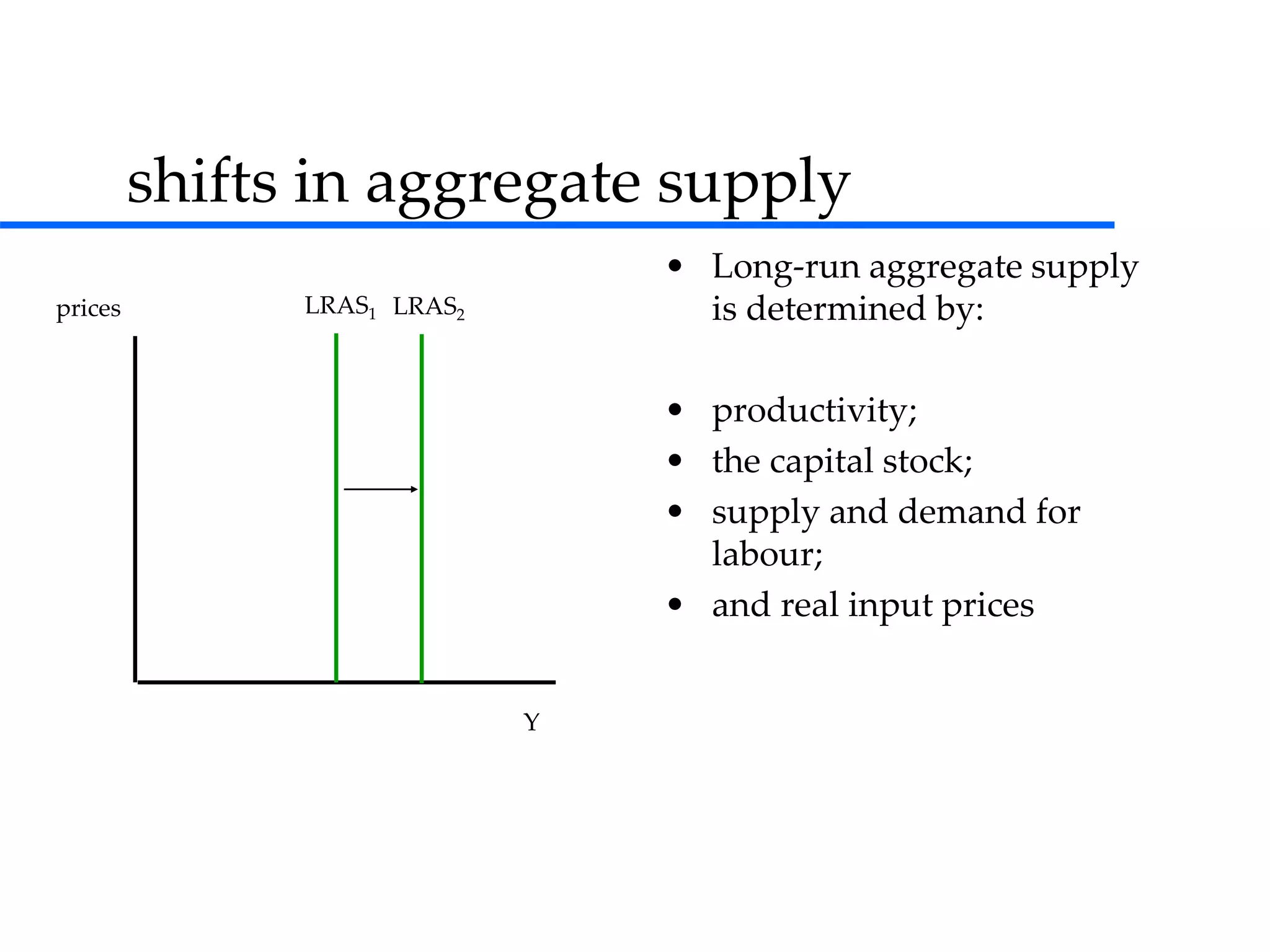
shifts in aggregate supply
prices
Y
LRAS1
• Long-run aggregate supply
is determined by:
• productivity;
• the capital stock;
• supply and demand for
labour;
• and real input prices
LRAS2
is LRAS stable?
• Lots of evidence that equilibrium unemployment and natural
output are useful concepts.
• We can estimate the NAIRU from statistical models.
• However, three complications:
• the NAIRU shifts over time and is hard to estimate
precisely;
• even when unemployment is above the NAIRU, very rapid
rises in demand could still lead to increased inflation;
• if unemployment is high for a very long time, the NAIRU
may rise due to ‘hysteresis’.
short-run aggregate supply
• In the short-run, there is no reason to expect actual output to
equal its equilibrium rate.
• Here are four reasons why output can deviate from its
equilibrium rate:
• sticky-wages;
• worker-misperception;
• imperfect information;
• sticky-prices.
• All of these lead to a ‘surprise-supply’ function, where
output =equilibrium output + b(prices – expected prices)
• Therefore output deviates from its equilibrium level by the
extent to which prices deviate from their expected level.
the sticky-wage model
• ‘I hold that in modern conditions, wages in this country are,
for various reasons, so rigid over short periods that it is
impracticable to adjust them…’ J.M.Keynes
• In many industries, especially unionized ones, nominal wages
are set by long-term contracts. Social norms, efficiency wages
and implicit contracts may also be important.
• When the nominal wage is fixed, an unexpected fall in prices
raises the real wage, making labour more expensive.
• Higher real wages induce firms to reduce employment;
• Reduced employment leads to reduced output;
• When contracts are renegotiated, workers accept lower
nominal wages to return their real wages to their original
level, so employment rises.
the worker-misperception model
• Workers may suffer from ‘money illusion’.
• This means that while firms know the price level with
certainty, workers temporarily mistake nominal changes in
wages for real changes.
• If prices rise unexpectedly, firms offer higher nominal wages
but workers mistake these higher nominal offers for higher
real wages, and so offer more labour.
• At every real wage, workers supply more labour because they
think the real wage is higher than it actually is.
• Eventually workers realise that real wages haven’t risen, so
their expectations correct themselves and labour supply
returns to its previous level.
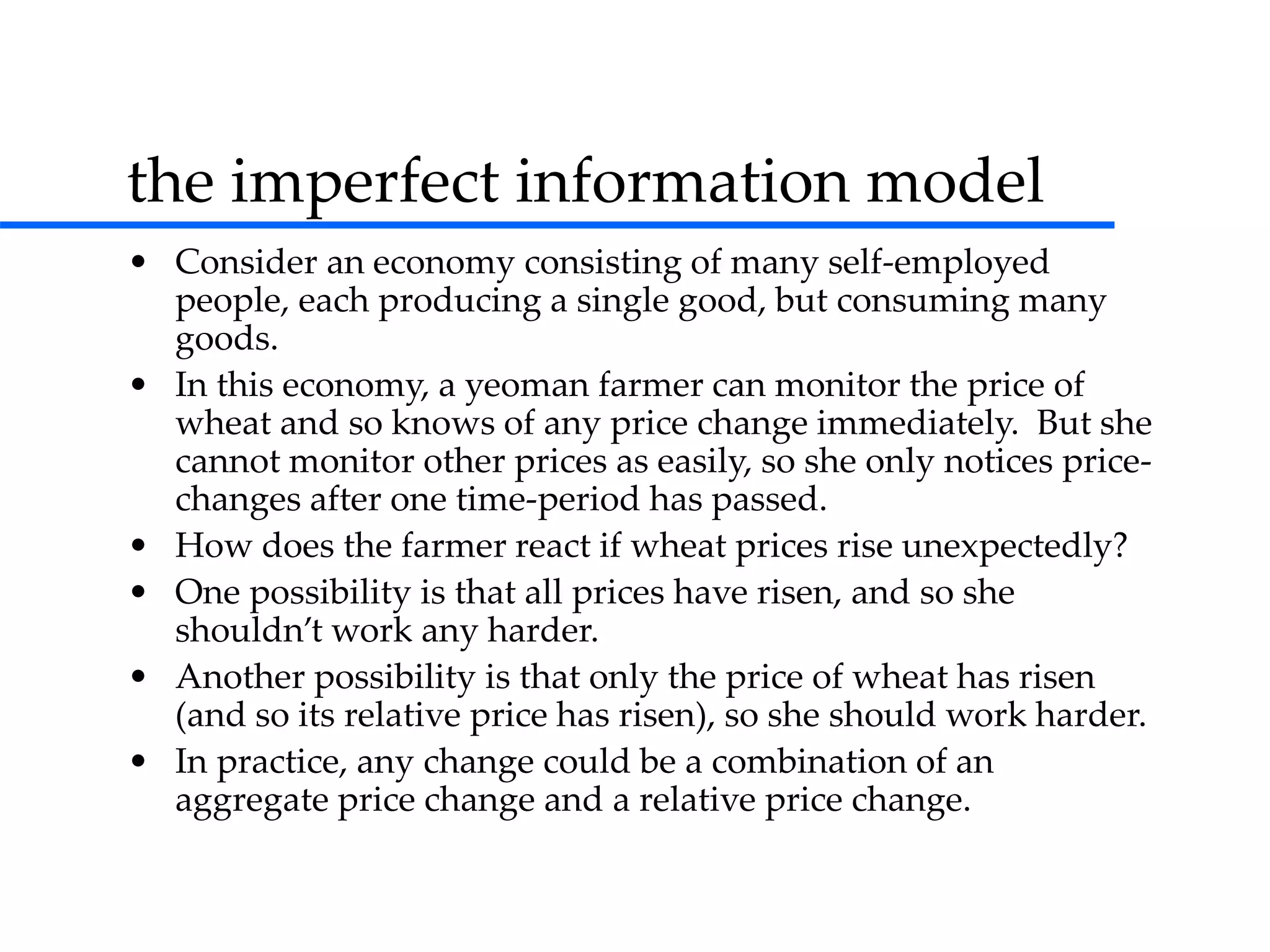
the imperfect information model
• Consider an economy consisting of many self-employed
people, each producing a single good, but consuming many
goods.
• In this economy, a yeoman farmer can monitor the price of
wheat and so knows of any price change immediately. But she
cannot monitor other prices as easily, so she only notices price-
changes after one time-period has passed.
• How does the farmer react if wheat prices rise unexpectedly?
• One possibility is that all prices have risen, and so she
shouldn’t work any harder.
• Another possibility is that only the price of wheat has risen
(and so its relative price has risen), so she should work harder.
• In practice, any change could be a combination of an
aggregate price change and a relative price change.
the sticky-price model
• It may also be the case that firms cannot adjust their prices
immediately either, since they may have long-term contracts
or there may be costs to changing prices (‘menu costs’).
• If aggregate demand falls and a firm’s price is ‘stuck’, it will
reduce its output, its demand for labour will shift inwards,
and output will fall.
• Notice that sticky-prices have an external effect since if some
firms do not adjust their prices in response to a shock, there is
less incentive for other firms to do so.
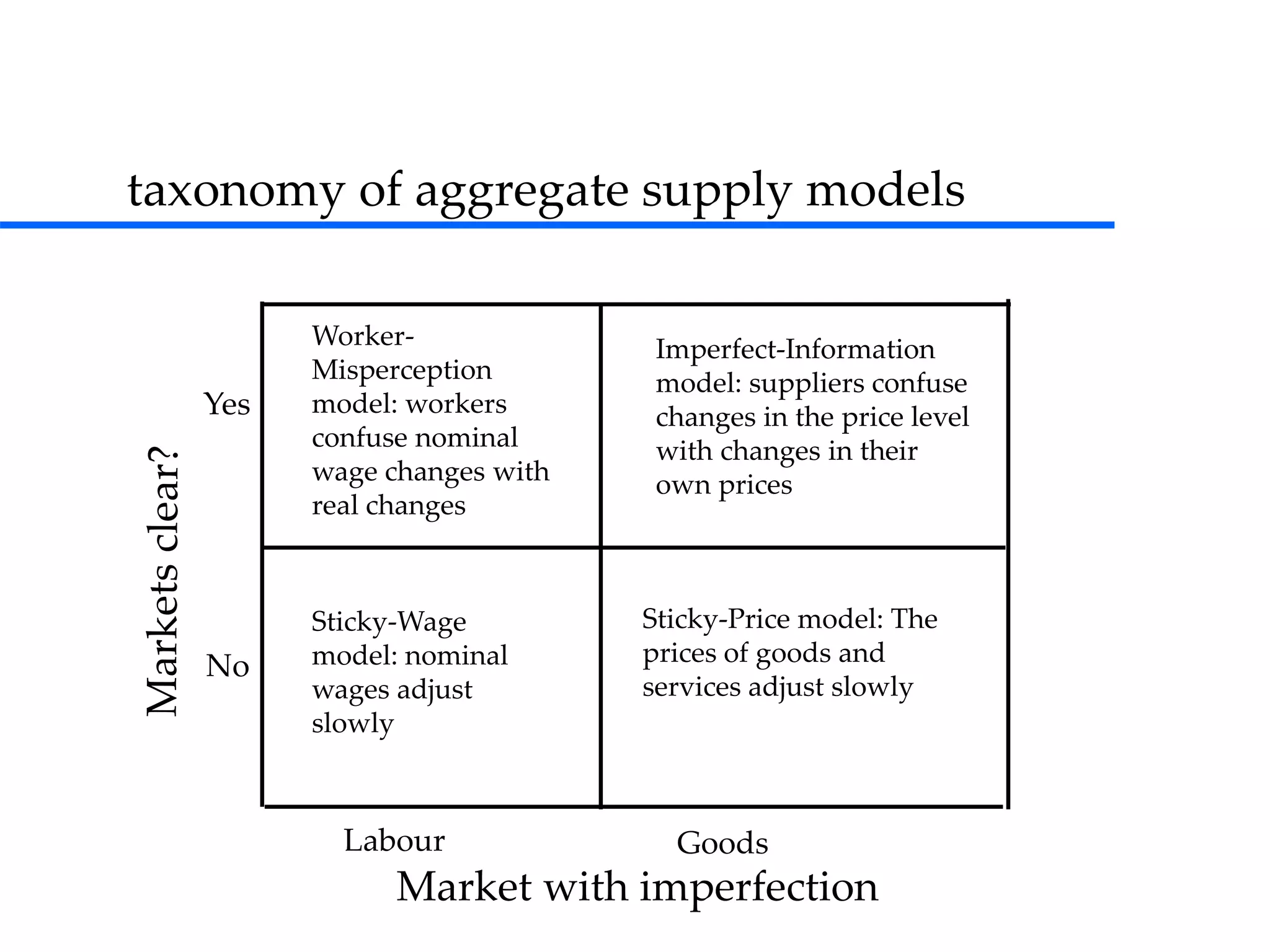
taxonomy of aggregate supply models
Yes
No
Market with imperfection
Labour Goods
Worker-
Misperception
model: workers
confuse nominal
wage changes with
real changes
Imperfect-Information
model: suppliers confuse
changes in the price level
with changes in their
own prices
Sticky-Wage
model: nominal
wages adjust
slowly
Sticky-Price model: The
prices of goods and
services adjust slowly
ASAD
prices
Y
• The economy is in
equilibrium when
aggregate supply equals
aggregate demand – there is
no tendency for inflation to
rise or fall.
• The short-run aggregate
demand curve is drawn for
a particular level of
inflation expectations.
AD
SAS (Pe=P1)
LAS
Y*
ASAD in disequilibrium
prices
Y
• In the short-run, the
economy can be in
disequilibrium with the
wrong level of inflation
expectations.
• Here, an unexpected fall in
aggregate demand
temporarily decreases
output below its
equilibrium level.
• Once inflation expectations
adapt, the economy returns
to equilibrium.
AD2
SAS (πe=π2)
LAS
Y*
SAS (πe=π0)
P0
P1
P2
AD1
shocks to the economy
• Why might the economy get ‘shocked’ away from
equilibrium?
• Aggregate demand shocks
• an investment boom
• an imprudent government spending spree
• a surge in the exchange rate
• a slump in foreign markets
• a boom in the housing market
• a slump in share prices
• Aggregate supply shocks
• a sudden rise in oil prices
• the invention and diffusion of a new technology
the Phillips Curve
• Just as the short-run aggregate supply curve is drawn for a
particular level of inflation expectations, we can draw a short-
run Phillips curve which depicts the trade-off between
unemployment and unexpected inflation.
Y
prices
LRAS inflation
U
LRPC
U*
SRPC (πe=π1)
SRAS (πe=π1)
AD1
Y*
inflation adjustment
• For a given rate of expected inflation, the economy can
sustain lower unemployment at the cost of rising inflation. In
the long-run, there is no trade-off.
Y
prices
LRAS
inflation
U
LRPC
U*
SRPC (πe=π1)
SRAS (πe=π1)
AD1
Y*
AD2
SRAS (πe=π2)
SRPC (πe=π2)
A A
B
C B C
summary
• Equilibrium in the economy is determined by the interaction
of aggregate demand (the goods and money market) and
aggregate supply (the labour market).
• In the long-run, a country’s capacity to produce goods and
services determines the standard of living of its citizens.
• In the short-run, aggregate demand influences the amount of
goods and services the a country produces.
• In the long-run, the rate of money growth determines the rate
of inflation but does not affect the rate of unemployment.
• In the short-run, policymakers face a trade-off between
unemployment and unexpected changes in the price level.
syndicate topics
• What determines the slope of the aggregate demand curve?
• What determines the slope of the short-run aggregate supply
curve?
• How would an oil shock affect the economy? Does it matter
whether a country is a net exporter or importer?
• Should policymakers try to stabilize the economy?
• How costly is inflation, and how costly is reducing inflation?
• Can the economy get ‘stuck’ away from equilibrium?
• Might there be more than one equilibrium for the economy?

Inflation Adjustment

  • 1.
    Inflation Adjustment Gavin Cameron Wednesday28 July 2004 Oxford University Business Economics Programme
  • 2.
    relative prices • Phillips(1958) found relation an empirical relationship between unemployment and inflation in the UK – the Phillips curve. • Original interpretation: • There is a trade-off between inflation and unemployment where prices are judged relative to the existing price level. • Problem: • After sustained inflation, the empirical relationship broke down. • New interpretation: • There is a trade-off between unemployment and unexpected inflation.
  • 3.
    AD curve prices Y AD • Thelevel of output given by any point on the AD curve is such that if that level of output is produced, planned expenditure at the given relative price will exactly equal actual expenditure and the demand for money will equal the supply of money.
  • 4.
    why does theAD curve slope down? • Three reasons why the aggregate demand curve slopes downwards: • The first is the Real Balance Effect. When prices rise unexpectedly, the real value of assets whose prices are fixed in nominal terms (such as some government bonds, money, and gold) falls. This leads to less consumer spending. • The second is the real exchange rate. When prices rise unexpectedly, the real exchange rate appreciates (if the nominal exchange rate is fixed). This leads to an deterioration in the primary current account. • The third is the Keynes effect. When prices rise unexpectedly, people need more money for day to day transactions and so try to switch their money balances from bonds and shares. This raises the interest rate and hence reduces interest- sensitive spending, such as investment.
  • 5.
    long-run aggregate supply •The labour market is in equilibrium when inflation is stable. • At the equilibrium unemployment rate, there will be both voluntary unemployment (workers who do not wish to work at the current real wage) and involuntary unemployment (workers who would like to work but cannot find jobs at the current real wage). • In the long-run, the economy should return to its equilibrium rate of output, ‘money is neutral’. • However, according to Keynes, ‘..in the long-run, we are all dead’.
  • 6.
    shifts in aggregatesupply prices Y LRAS1 • Long-run aggregate supply is determined by: • productivity; • the capital stock; • supply and demand for labour; • and real input prices LRAS2
  • 7.
    is LRAS stable? •Lots of evidence that equilibrium unemployment and natural output are useful concepts. • We can estimate the NAIRU from statistical models. • However, three complications: • the NAIRU shifts over time and is hard to estimate precisely; • even when unemployment is above the NAIRU, very rapid rises in demand could still lead to increased inflation; • if unemployment is high for a very long time, the NAIRU may rise due to ‘hysteresis’.
  • 8.
    short-run aggregate supply •In the short-run, there is no reason to expect actual output to equal its equilibrium rate. • Here are four reasons why output can deviate from its equilibrium rate: • sticky-wages; • worker-misperception; • imperfect information; • sticky-prices. • All of these lead to a ‘surprise-supply’ function, where output =equilibrium output + b(prices – expected prices) • Therefore output deviates from its equilibrium level by the extent to which prices deviate from their expected level.
  • 9.
    the sticky-wage model •‘I hold that in modern conditions, wages in this country are, for various reasons, so rigid over short periods that it is impracticable to adjust them…’ J.M.Keynes • In many industries, especially unionized ones, nominal wages are set by long-term contracts. Social norms, efficiency wages and implicit contracts may also be important. • When the nominal wage is fixed, an unexpected fall in prices raises the real wage, making labour more expensive. • Higher real wages induce firms to reduce employment; • Reduced employment leads to reduced output; • When contracts are renegotiated, workers accept lower nominal wages to return their real wages to their original level, so employment rises.
  • 10.
    the worker-misperception model •Workers may suffer from ‘money illusion’. • This means that while firms know the price level with certainty, workers temporarily mistake nominal changes in wages for real changes. • If prices rise unexpectedly, firms offer higher nominal wages but workers mistake these higher nominal offers for higher real wages, and so offer more labour. • At every real wage, workers supply more labour because they think the real wage is higher than it actually is. • Eventually workers realise that real wages haven’t risen, so their expectations correct themselves and labour supply returns to its previous level.
  • 11.
    the imperfect informationmodel • Consider an economy consisting of many self-employed people, each producing a single good, but consuming many goods. • In this economy, a yeoman farmer can monitor the price of wheat and so knows of any price change immediately. But she cannot monitor other prices as easily, so she only notices price- changes after one time-period has passed. • How does the farmer react if wheat prices rise unexpectedly? • One possibility is that all prices have risen, and so she shouldn’t work any harder. • Another possibility is that only the price of wheat has risen (and so its relative price has risen), so she should work harder. • In practice, any change could be a combination of an aggregate price change and a relative price change.
  • 12.
    the sticky-price model •It may also be the case that firms cannot adjust their prices immediately either, since they may have long-term contracts or there may be costs to changing prices (‘menu costs’). • If aggregate demand falls and a firm’s price is ‘stuck’, it will reduce its output, its demand for labour will shift inwards, and output will fall. • Notice that sticky-prices have an external effect since if some firms do not adjust their prices in response to a shock, there is less incentive for other firms to do so.
  • 13.
    taxonomy of aggregatesupply models Yes No Market with imperfection Labour Goods Worker- Misperception model: workers confuse nominal wage changes with real changes Imperfect-Information model: suppliers confuse changes in the price level with changes in their own prices Sticky-Wage model: nominal wages adjust slowly Sticky-Price model: The prices of goods and services adjust slowly
  • 14.
    ASAD prices Y • The economyis in equilibrium when aggregate supply equals aggregate demand – there is no tendency for inflation to rise or fall. • The short-run aggregate demand curve is drawn for a particular level of inflation expectations. AD SAS (Pe=P1) LAS Y*
  • 15.
    ASAD in disequilibrium prices Y •In the short-run, the economy can be in disequilibrium with the wrong level of inflation expectations. • Here, an unexpected fall in aggregate demand temporarily decreases output below its equilibrium level. • Once inflation expectations adapt, the economy returns to equilibrium. AD2 SAS (πe=π2) LAS Y* SAS (πe=π0) P0 P1 P2 AD1
  • 16.
    shocks to theeconomy • Why might the economy get ‘shocked’ away from equilibrium? • Aggregate demand shocks • an investment boom • an imprudent government spending spree • a surge in the exchange rate • a slump in foreign markets • a boom in the housing market • a slump in share prices • Aggregate supply shocks • a sudden rise in oil prices • the invention and diffusion of a new technology
  • 17.
    the Phillips Curve •Just as the short-run aggregate supply curve is drawn for a particular level of inflation expectations, we can draw a short- run Phillips curve which depicts the trade-off between unemployment and unexpected inflation. Y prices LRAS inflation U LRPC U* SRPC (πe=π1) SRAS (πe=π1) AD1 Y*
  • 18.
    inflation adjustment • Fora given rate of expected inflation, the economy can sustain lower unemployment at the cost of rising inflation. In the long-run, there is no trade-off. Y prices LRAS inflation U LRPC U* SRPC (πe=π1) SRAS (πe=π1) AD1 Y* AD2 SRAS (πe=π2) SRPC (πe=π2) A A B C B C
  • 19.
    summary • Equilibrium inthe economy is determined by the interaction of aggregate demand (the goods and money market) and aggregate supply (the labour market). • In the long-run, a country’s capacity to produce goods and services determines the standard of living of its citizens. • In the short-run, aggregate demand influences the amount of goods and services the a country produces. • In the long-run, the rate of money growth determines the rate of inflation but does not affect the rate of unemployment. • In the short-run, policymakers face a trade-off between unemployment and unexpected changes in the price level.
  • 20.
    syndicate topics • Whatdetermines the slope of the aggregate demand curve? • What determines the slope of the short-run aggregate supply curve? • How would an oil shock affect the economy? Does it matter whether a country is a net exporter or importer? • Should policymakers try to stabilize the economy? • How costly is inflation, and how costly is reducing inflation? • Can the economy get ‘stuck’ away from equilibrium? • Might there be more than one equilibrium for the economy?