Determining System
Requirements
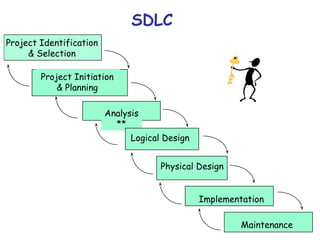
SDLC
Project Identification
& Selection
Project Initiation
& Planning
Analysis
**
Logical Design
Physical Design
Implementation
Maintenance
Requirements Determination
 System requirements
 Functional requirements

Current and future functions

Current and future data

Current and future employee jobs
Requirements Structuring
 Two essential views of the current and
replacement information systems. Both are
describing the same system, but in a different
way.
 Process view: The sequence of data movement &
handling operations within the system

Data flow diagrams
 Data: The inherent structure of data independent of
how or when it is processed

Entity-relation diagrams
Remember to...
Who will you get info from?
 User Stakeholders
 Users
 Managers
 Client Stakeholders
 Technical Stakeholders
What Information Do You
Need?
 1.
 2.
 3.
Traditional Methods for
Determining System
Requirements
 Administering questionnaires
 Interviewing and listening
 Interviewing groups
 Directly observing users
 Analyzing procedures & other
documents
Administering Questionnaires
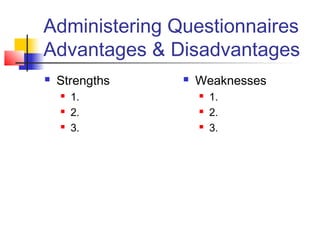
Advantages & Disadvantages
 Strengths
 1.
 2.
 3.
 Weaknesses
 1.
 2.
 3.
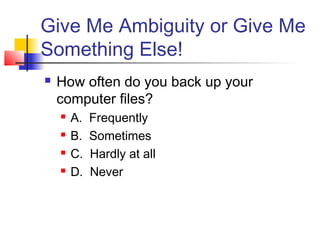
Give Me Ambiguity or Give Me
Something Else!
 How often do you back up your
computer files?
 A. Frequently
 B. Sometimes
 C. Hardly at all
 D. Never
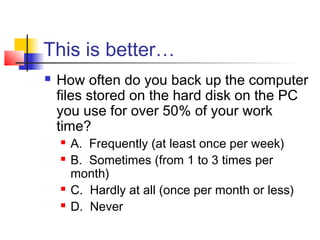
This is better…
 How often do you back up the computer
files stored on the hard disk on the PC
you use for over 50% of your work
time?
 A. Frequently (at least once per week)
 B. Sometimes (from 1 to 3 times per
month)
 C. Hardly at all (once per month or less)
 D. Never
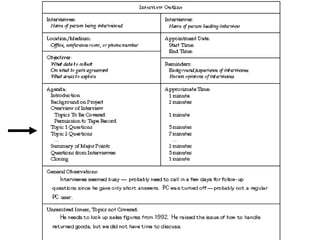
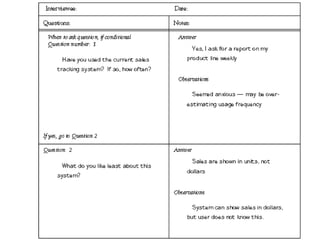
Interviewing & Listening
 Before
 During the interview
 Afterwards
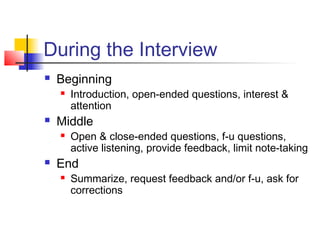
During the Interview
 Beginning
 Introduction, open-ended questions, interest &
attention
 Middle
 Open & close-ended questions, f-u questions,
active listening, provide feedback, limit note-taking
 End
 Summarize, request feedback and/or f-u, ask for
corrections
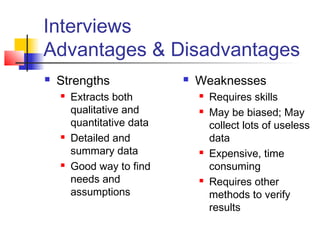
Interviews
Advantages & Disadvantages
 Strengths
 Extracts both
qualitative and
quantitative data
 Detailed and
summary data
 Good way to find
needs and
assumptions
 Weaknesses
 Requires skills
 May be biased; May
collect lots of useless
data
 Expensive, time
consuming
 Requires other
methods to verify
results
How do you choose
interview questions?
 Open-ended questions
 1.
 2.
 3.
 Closed-ended questions
 1.
 2.
 3.
Find out about someone’s
job
 Write 3 open-ended
questions
 Ask 3 open-ended
questions (You may
substitute questions
during interview.)
 Write down answers
 Write 3 closed-ended
questions
 Ask 3 closed-ended
questions (You may
substitute questions
during interview.)
 Write down answers
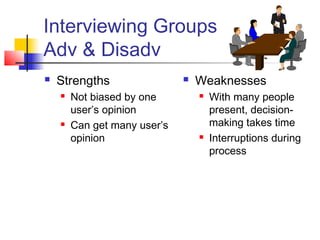
Interviewing Groups
Adv & Disadv
 Strengths
 Not biased by one
user’s opinion
 Can get many user’s
opinion
 Weaknesses
 With many people
present, decision-
making takes time
 Interruptions during
process
You May Need to Analyze
Work Procedures
 Work procedures describe a particular
job or task
 May show duplication of effort
 May find missing steps
 May contradict info collected from
interviews, questionnaires, and
observations
 Formal systems vs informal systems
Directly Observing
Users
 Strengths
 Doesn’t rely on a
user’s memory
 More objective and
accurate than
interviews
 Weaknesses
 Hawthorne effect
 Time consuming
Temporary Job Assignment
 Strengths
 Good for learning
context, terminology,
procedures
 Provides insight for
other questions
 Get operation “feel”;
adds to analysts
credibility with users
 Weaknesses
 Time Consuming
 May bias future work
design towards way
things are currently
done
Reviewing internal documents
 Strengths
 Good way to learn
history and politics
 Explains current
context
 May help understand
why and way of
current procedures &
applications
 Weaknesses
 May bias future work
design
 Not useful for
obtaining current
attitudes or motives
Modern Methods for Determining
System Requirements
 Prototyping
 Joint Application Design (JAD) - Intensive
meetings between users, managers, sponsor,
& systems analysts to discuss & review
system requirements
 Group Support Systems (GSS) to share ideas
& voice opinions
 BPR – Business process reengineering
 CASE tools to analyze existing systems

Lecture 4

  • 1.
  • 2.
    SDLC Project Identification & Selection ProjectInitiation & Planning Analysis ** Logical Design Physical Design Implementation Maintenance
  • 3.
    Requirements Determination  Systemrequirements  Functional requirements  Current and future functions  Current and future data  Current and future employee jobs
  • 4.
    Requirements Structuring  Twoessential views of the current and replacement information systems. Both are describing the same system, but in a different way.  Process view: The sequence of data movement & handling operations within the system  Data flow diagrams  Data: The inherent structure of data independent of how or when it is processed  Entity-relation diagrams
  • 5.
  • 6.
    Who will youget info from?  User Stakeholders  Users  Managers  Client Stakeholders  Technical Stakeholders
  • 7.
    What Information DoYou Need?  1.  2.  3.
  • 8.
    Traditional Methods for DeterminingSystem Requirements  Administering questionnaires  Interviewing and listening  Interviewing groups  Directly observing users  Analyzing procedures & other documents
  • 9.
    Administering Questionnaires Advantages &Disadvantages  Strengths  1.  2.  3.  Weaknesses  1.  2.  3.
  • 10.
    Give Me Ambiguityor Give Me Something Else!  How often do you back up your computer files?  A. Frequently  B. Sometimes  C. Hardly at all  D. Never
  • 11.
    This is better… How often do you back up the computer files stored on the hard disk on the PC you use for over 50% of your work time?  A. Frequently (at least once per week)  B. Sometimes (from 1 to 3 times per month)  C. Hardly at all (once per month or less)  D. Never
  • 12.
    Interviewing & Listening Before  During the interview  Afterwards
  • 13.
    During the Interview Beginning  Introduction, open-ended questions, interest & attention  Middle  Open & close-ended questions, f-u questions, active listening, provide feedback, limit note-taking  End  Summarize, request feedback and/or f-u, ask for corrections
  • 14.
    Interviews Advantages & Disadvantages Strengths  Extracts both qualitative and quantitative data  Detailed and summary data  Good way to find needs and assumptions  Weaknesses  Requires skills  May be biased; May collect lots of useless data  Expensive, time consuming  Requires other methods to verify results
  • 17.
    How do youchoose interview questions?  Open-ended questions  1.  2.  3.  Closed-ended questions  1.  2.  3.
  • 18.
    Find out aboutsomeone’s job  Write 3 open-ended questions  Ask 3 open-ended questions (You may substitute questions during interview.)  Write down answers  Write 3 closed-ended questions  Ask 3 closed-ended questions (You may substitute questions during interview.)  Write down answers
  • 19.
    Interviewing Groups Adv &Disadv  Strengths  Not biased by one user’s opinion  Can get many user’s opinion  Weaknesses  With many people present, decision- making takes time  Interruptions during process
  • 20.
    You May Needto Analyze Work Procedures  Work procedures describe a particular job or task  May show duplication of effort  May find missing steps  May contradict info collected from interviews, questionnaires, and observations  Formal systems vs informal systems
  • 21.
    Directly Observing Users  Strengths Doesn’t rely on a user’s memory  More objective and accurate than interviews  Weaknesses  Hawthorne effect  Time consuming
  • 22.
    Temporary Job Assignment Strengths  Good for learning context, terminology, procedures  Provides insight for other questions  Get operation “feel”; adds to analysts credibility with users  Weaknesses  Time Consuming  May bias future work design towards way things are currently done
  • 23.
    Reviewing internal documents Strengths  Good way to learn history and politics  Explains current context  May help understand why and way of current procedures & applications  Weaknesses  May bias future work design  Not useful for obtaining current attitudes or motives
  • 24.
    Modern Methods forDetermining System Requirements  Prototyping  Joint Application Design (JAD) - Intensive meetings between users, managers, sponsor, & systems analysts to discuss & review system requirements  Group Support Systems (GSS) to share ideas & voice opinions  BPR – Business process reengineering  CASE tools to analyze existing systems