CYBER – SAFETY
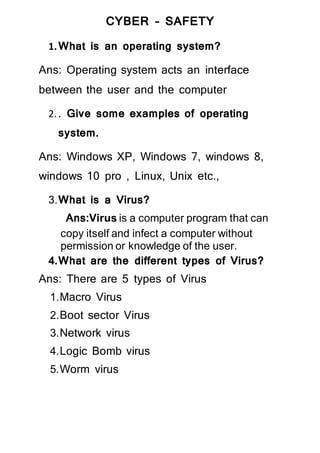
1.What is an operating system?
Ans: Operating system acts an interface
between the user and the computer
2.. Give some examples of operating
system.
Ans: Windows XP, Windows 7, windows 8,
windows 10 pro , Linux, Unix etc.,
3.What is a Virus?
Ans:Virus is a computer program that can
copy itself and infect a computer without
permission or knowledge of the user.
4.What are the different types of Virus?
Ans: There are 5 types of Virus
1.Macro Virus
2.Boot sector Virus
3.Network virus
4.Logic Bomb virus
5.Worm virus
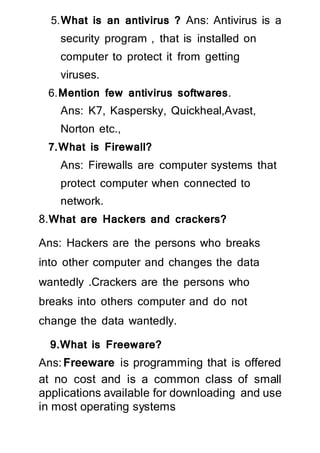
5.What is an antivirus ? Ans: Antivirus is a
security program , that is installed on
computer to protect it from getting
viruses.
6.Mention few antivirus softwares.
Ans: K7, Kaspersky, Quickheal,Avast,
Norton etc.,
7.What is Firewall?
Ans: Firewalls are computer systems that
protect computer when connected to
network.
8.What are Hackers and crackers?
Ans: Hackers are the persons who breaks
into other computer and changes the data
wantedly .Crackers are the persons who
breaks into others computer and do not
change the data wantedly.
9.What is Freeware?
Ans: Freeware is programming that is offered
at no cost and is a common class of small
applications available for downloading and use
in most operating systems
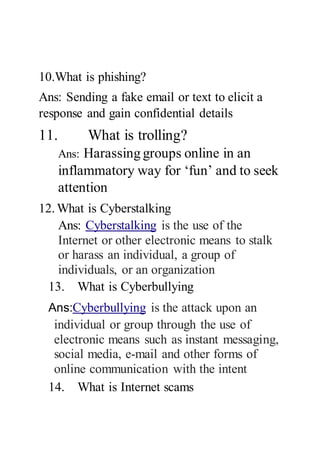
10.What is phishing?
Ans: Sending a fake email or text to elicit a
response and gain confidential details
11. What is trolling?
Ans: Harassing groups online in an
inflammatory way for ‘fun’ and to seek
attention
12. What is Cyberstalking
Ans: Cyberstalking is the use of the
Internet or other electronic means to stalk
or harass an individual, a group of
individuals, or an organization
13. What is Cyberbullying
Ans:Cyberbullying is the attack upon an
individual or group through the use of
electronic means such as instant messaging,
social media, e-mail and other forms of
online communication with the intent
14. What is Internet scams
Ans: Internet scams often aim to cheat the
victim of personal property directly rather
than personal information through false
promises, confidence tricks and more.

CLASS IX COMPUTER APPLICATIONS

  • 1.
    CYBER – SAFETY 1.Whatis an operating system? Ans: Operating system acts an interface between the user and the computer 2.. Give some examples of operating system. Ans: Windows XP, Windows 7, windows 8, windows 10 pro , Linux, Unix etc., 3.What is a Virus? Ans:Virus is a computer program that can copy itself and infect a computer without permission or knowledge of the user. 4.What are the different types of Virus? Ans: There are 5 types of Virus 1.Macro Virus 2.Boot sector Virus 3.Network virus 4.Logic Bomb virus 5.Worm virus
  • 2.
    5.What is anantivirus ? Ans: Antivirus is a security program , that is installed on computer to protect it from getting viruses. 6.Mention few antivirus softwares. Ans: K7, Kaspersky, Quickheal,Avast, Norton etc., 7.What is Firewall? Ans: Firewalls are computer systems that protect computer when connected to network. 8.What are Hackers and crackers? Ans: Hackers are the persons who breaks into other computer and changes the data wantedly .Crackers are the persons who breaks into others computer and do not change the data wantedly. 9.What is Freeware? Ans: Freeware is programming that is offered at no cost and is a common class of small applications available for downloading and use in most operating systems
  • 3.
    10.What is phishing? Ans:Sending a fake email or text to elicit a response and gain confidential details 11. What is trolling? Ans: Harassing groups online in an inflammatory way for ‘fun’ and to seek attention 12. What is Cyberstalking Ans: Cyberstalking is the use of the Internet or other electronic means to stalk or harass an individual, a group of individuals, or an organization 13. What is Cyberbullying Ans:Cyberbullying is the attack upon an individual or group through the use of electronic means such as instant messaging, social media, e-mail and other forms of online communication with the intent 14. What is Internet scams
  • 4.
    Ans: Internet scamsoften aim to cheat the victim of personal property directly rather than personal information through false promises, confidence tricks and more.