Cyber Security
By
Gaurav Singh
• The only system which is truly secure is one which is switched off and
unplugged, locked in a titanium safe, buried in a concrete bunker, and
is surrounded by nerve gas and very highly paid armed guards. Even
then, I wouldn’t stake my life on it.
(By Professor Gene Spafford)
Need For Cyber Security
• Advances in information and communications technologies have
revolutionised government, scientific , educational and commercial
infrastructures.
• The IT infrastructure has become integral part of the critical infrastructure
which supports national capabilities such as power grids, emergency
communication systems, financial systems , defence systems and air traffic
control networks. The operational stability and security of critical
information infrastructure is vital for economic security of the country.
• It also enables large scale processes through out the economy by
facilitating complex interactions among individuals, organisations and
systems across global networks for trade and economic requirements.
Contd
• Increasing complexity of IT systems and networks will mount security
challenges for both providers and consumers.
• The evolving nature of the telecommunications infrastructure, as the
traditional phone systems and IT networks converge into a more
unified architecture.
• The expanding wireless connectivity to individual computers and
networks making it increasingly difficult to determine the physical
and logical boundaries of networks.
• The increasing interconnectivity and accessibility (and consequently
risk) to computer based systems that are critical to country’s
economy.
Security Trends
• Increasing complexity of IT systems and networks will mount security
challenges for both providers and consumers.
• The evolving nature of the telecommunications infrastructure, as the
traditional phone systems and IT networks converge into a more
unified architecture.
• The expanding wireless connectivity to individual computers and
networks making it increasingly difficult to determine the physical
and logical boundaries of networks.
• The increasing interconnectivity and accessibility (and consequently
risk) to computer based systems that are critical to country’s
economy.
Threats : National Security
• Increasing complexity of IT systems and networks will mount security
challenges for both providers and consumers.
• The evolving nature of the telecommunications infrastructure, as the
traditional phone systems and IT networks converge into a more
unified architecture.
• The expanding wireless connectivity to individual computers and
networks making it increasingly difficult to determine the physical
and logical boundaries of networks.
• The increasing interconnectivity and accessibility (and consequently
risk) to computer based systems that are critical to country’s
economy.
Threats : Public
Online services are becoming prime targets for cyber criminals
• Cyber criminals continue to refine their means of deceit as well as their victims In summary, the global threats
affecting users are:
 New & sophisticated forms of attacks.
 Attacks targeting new technologies, such as VoIP (vishing – phishing via VoIP & phreaking – hacking tel
networks to make free long distance calls) and peer-to-peer services.
 Attacks targeting online social networks.
 Attacks targeting online services, particularly online banking services.
• There is a new level of complexity in malware not seen before. These are more resilient, are modified over and
over again and contain highly sophisticated functionality such as encryption (Ex. Nuwar also known as ‘Zhelatin’
and ‘Storm’ worm’ – with a new variant appearing almost daily)
• As a trend we will see an increase in threats that hijack PCs with bots. Another challenging trend is the arrival of
self-modifying threats
• Given the exponential growth in social networking sites, social engineering may shortly become the easiest &
quickest way to commit ID theft
Hi-Tech Crime is a Growing Market
The market is growing for zero-day threats & tools for cyber crime
• With so many PCs now infected (around 5 % of all global machines are zombies), competition to supply
botnets has become intense. The cost of renting a platform for spamming is now around $ 3 - 7 Cents per
zombie per week.
• A budget as little as $ 25 to $ 1500 USD can buy you a trojan that is built to steal credit card data and mail it
you. Malware is being custom written to target specific companies and agencies.
• Computer skills are no longer necessary to execute cyber crime. On the flip side malware writers today need
not commit crimes themselves. People can subscribe to the tools that can keep them updated with latest
vulnerabilities and even test themselves against security solutions (Ex. MPACK pr Pinch include support
service).
• The black market for stolen data (Ex. Credit cards, e-mails, skype accounts etc) is now well established and
the cost of obtaining credit cards is upwards of $ 5 USD.
• Another black market that is causing alarm to Govts is that of Zero-day exploits. In Jan 2006 a Microsoft
WMF (windows meta file) exploit was sold for $ 4000 USD.
• Competition is so intense among cyber criminals that ‘customer service’ has now become a specific selling
point
Possible Future
Trends suggest an increase in safe havens for cyber criminals and hence
the need for International cooperation arrangements.
• It is an inevitable that some countries will become safe havens for
cyber criminals and international pressure to crack down won’t work
well.
• It is believed that in next few years Govts are likely to get aggressive
and pursue action against the specific individuals/groups/companies,
regardless of location.
• It is also likely that Govts will start putting pressure on intermediary
bodies that have the skills and resources, such as banks, ISPs and
software vendors to protect the public from malware, hacking and
social engineering.
• We may see industry sector codes of practice demanding improved
security measures, backed probably by assurance and insurance
schemes.
• Greater connectivity, more embedded systems and less obvious
perimeters.
• Compliance regulations will drive upgrades and changes and also
increase system complexity and legal wrangles – increase in civil suits
for security breaches.
• Massive data storing patterns that ensure data never goes away – a
boon to law enforcement agencies .
• As of now, cyber criminals seem to have no real threat of prosecution.
Our job is to create a climate of fear of effective prosecution, as in
other types of crime.
Categories of Cyber Crime
• We may see industry sector codes of practice demanding improved
security measures, backed probably by assurance and insurance
schemes.
• Greater connectivity, more embedded systems and less obvious
perimeters.
• Compliance regulations will drive upgrades and changes and also
increase system complexity and legal wrangles – increase in civil suits
for security breaches.
• Massive data storing patterns that ensure data never goes away – a
boon to law enforcement agencies .
• As of now, cyber criminals seem to have no real threat of prosecution.
Our job is to create a climate of fear of effective prosecution, as in
other types of crime.
Common Methods of Cyber Crime
• Hacking – Unauthorised attempts to bypass the security mechanism
of an information system or network.
• Data theft ( using flash/pen drives, digital cameras).
• Virus or worms, Malware or Trojan horses.
• Identity Theft
• E- mail spoofing
• Botnets and Zombies
• Scareware
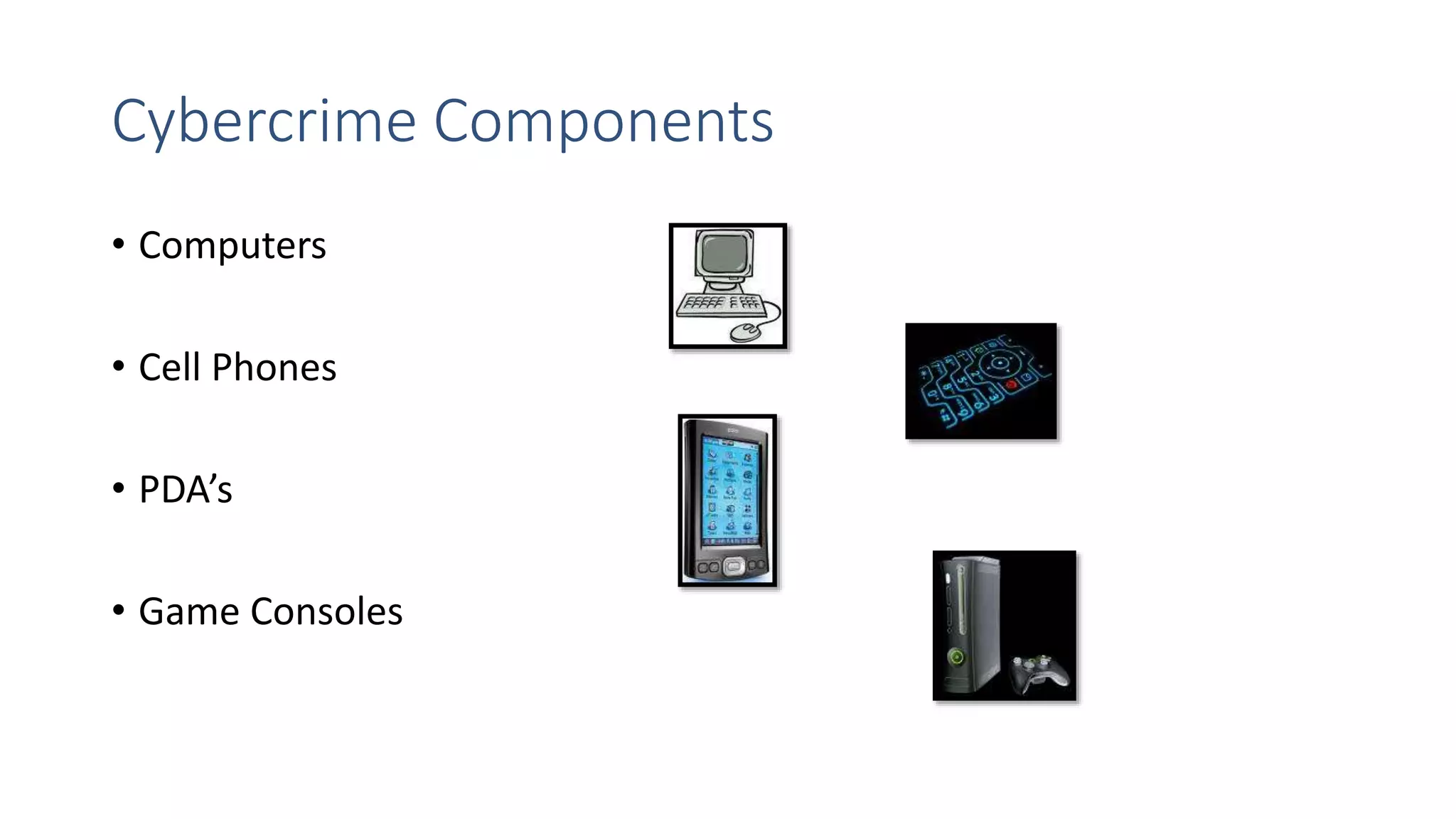
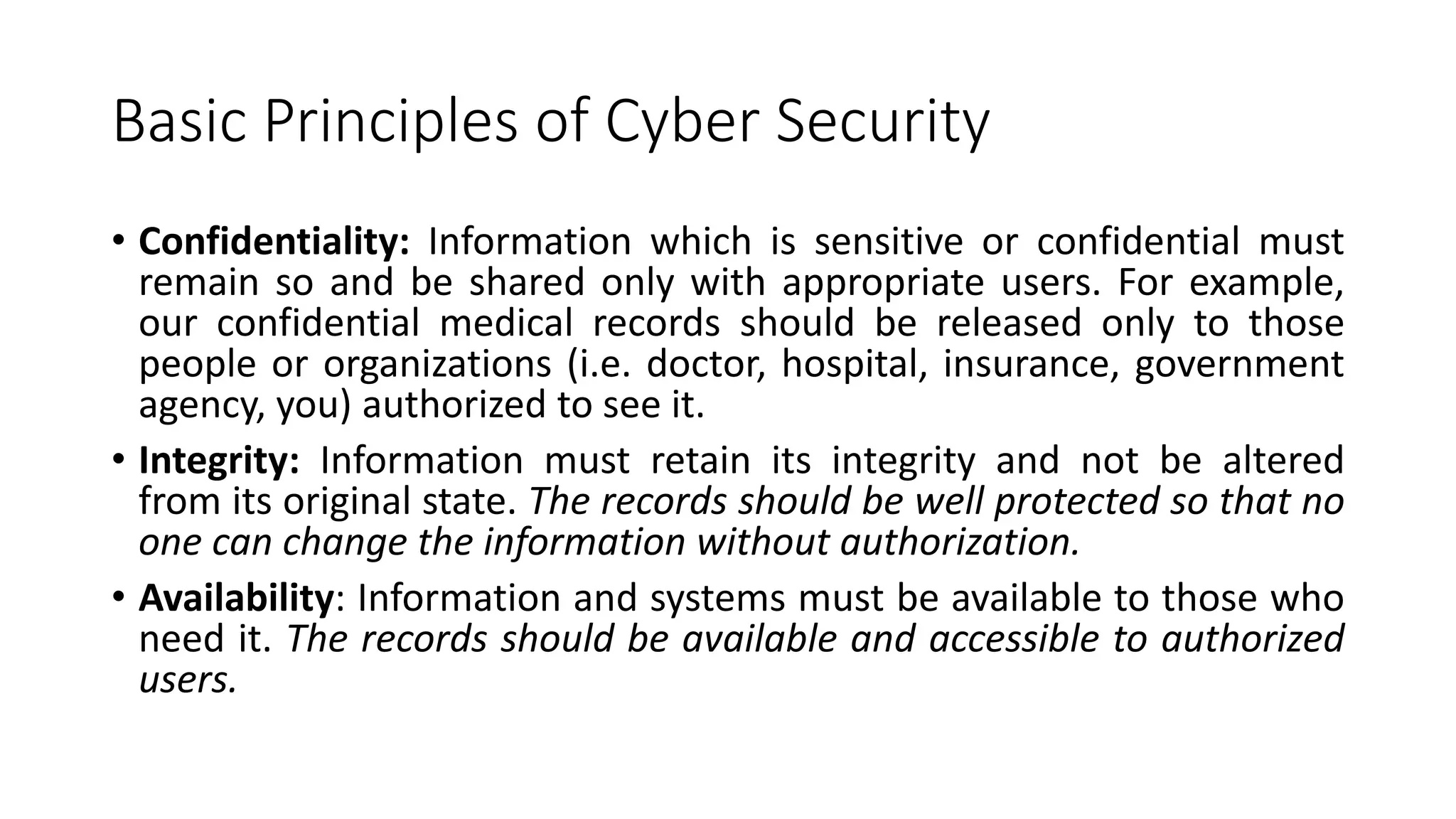
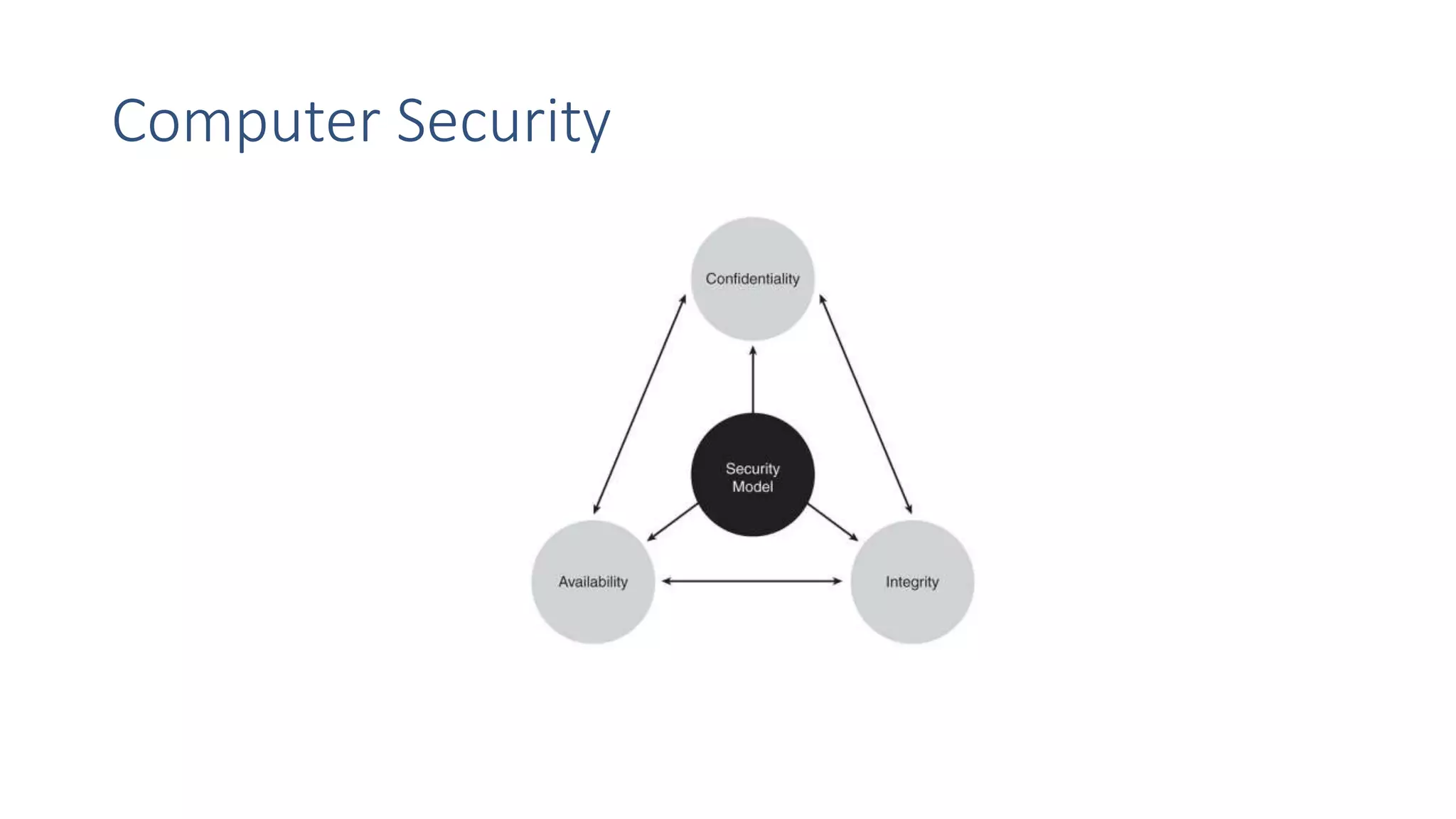
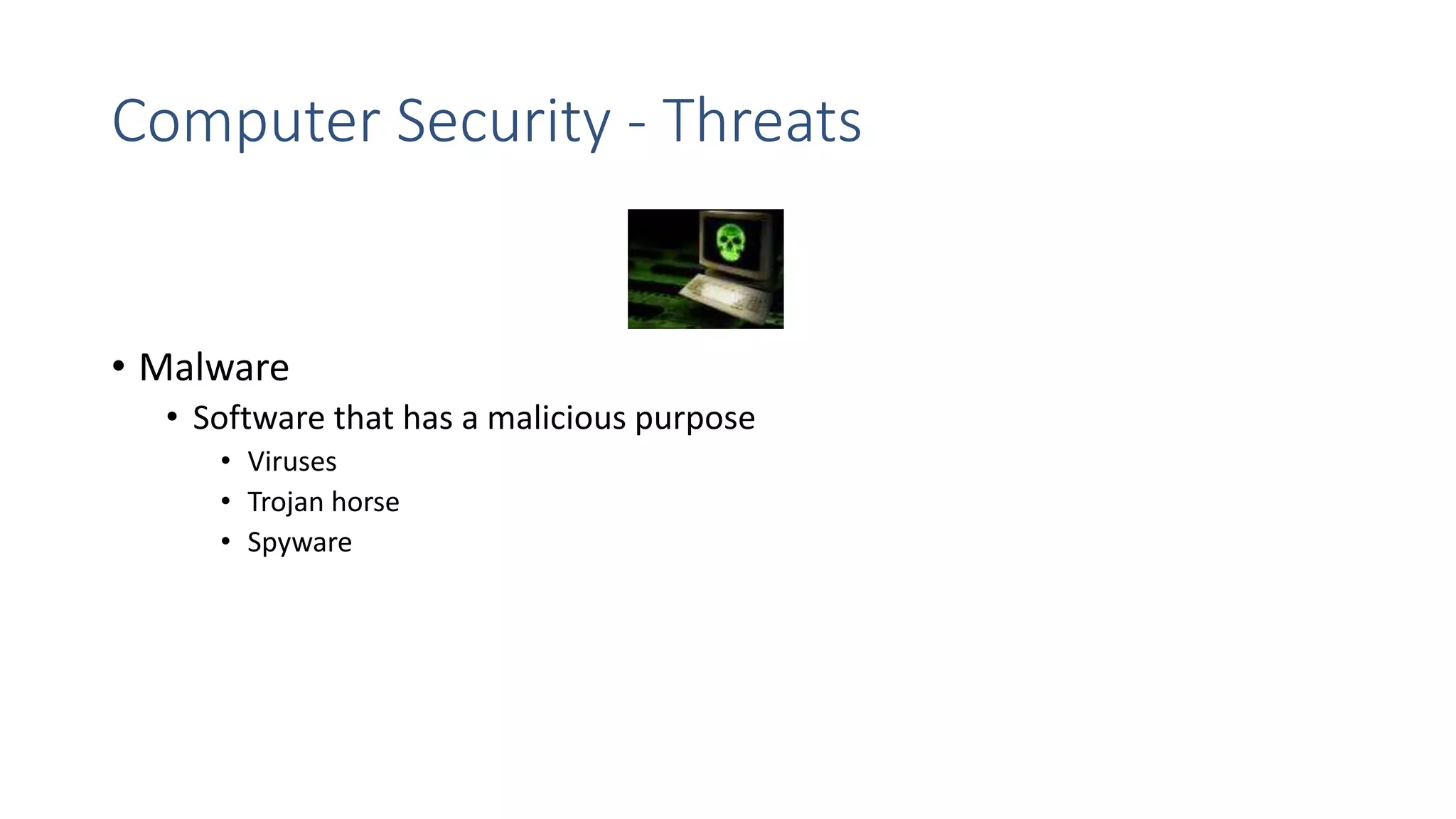
Cybercrime Components
• Computers
• Cell Phones
• PDA’s
• Game Consoles
Basic Principles of Cyber Security
• Confidentiality: Information which is sensitive or confidential must
remain so and be shared only with appropriate users. For example,
our confidential medical records should be released only to those
people or organizations (i.e. doctor, hospital, insurance, government
agency, you) authorized to see it.
• Integrity: Information must retain its integrity and not be altered
from its original state. The records should be well protected so that no
one can change the information without authorization.
• Availability: Information and systems must be available to those who
need it. The records should be available and accessible to authorized
users.
Computer Security
Computer Security - Threats
• Malware
• Software that has a malicious purpose
• Viruses
• Trojan horse
• Spyware
Computer Security - Threats
• Intrusions
• Any attempt to gain unauthorized access to a system
• Cracking
• Hacking
• Social Engineering
• War-driving
Computer Security - Threats
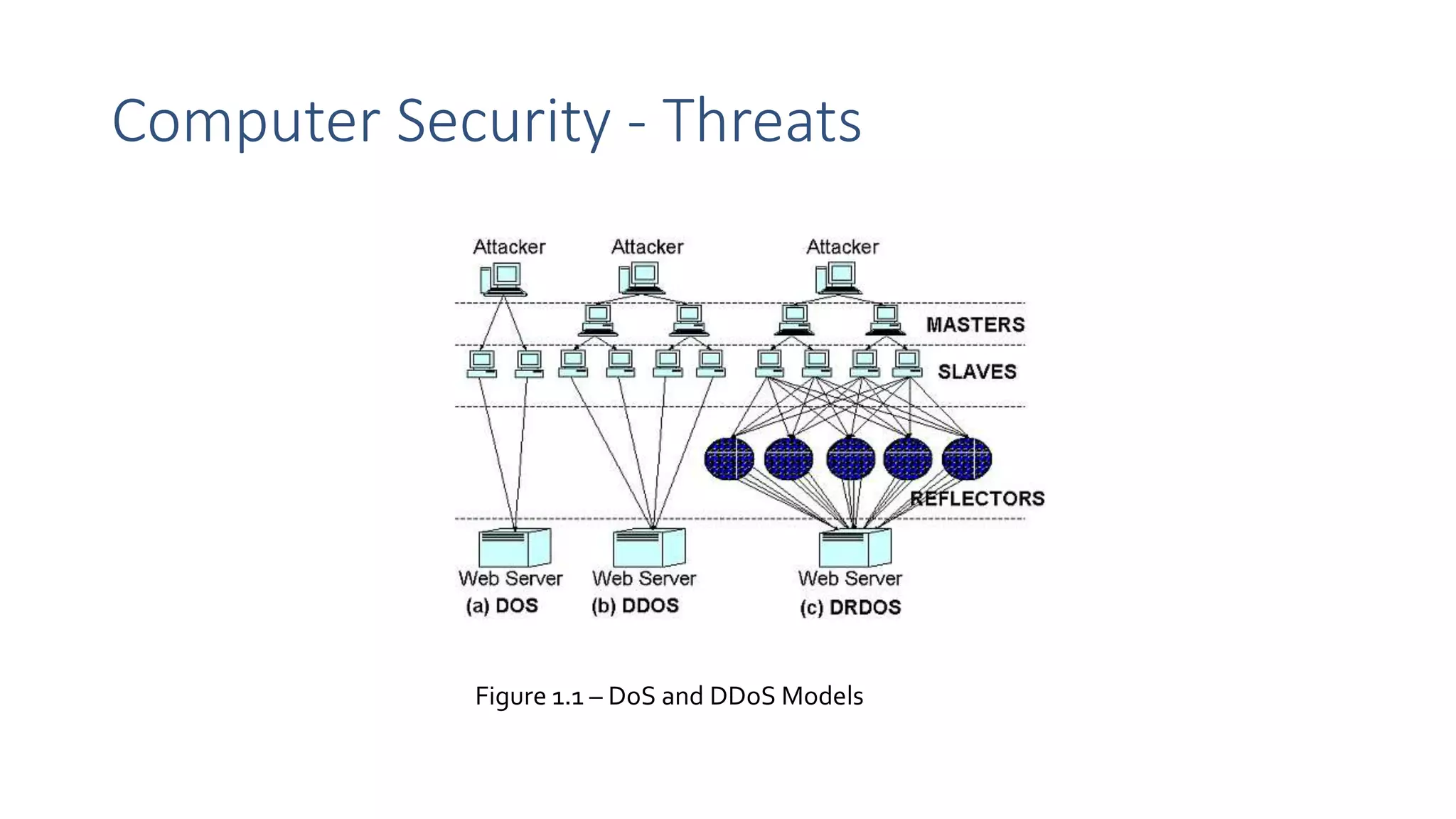
• Denial-of-Service (DOS)
• Prevention of legitimate access to systems
• Also Distributed-Denial-of-Service (DDoS)
• Different types:
• Ping-of-Death
• Teardrop
• Smurf
• SYN
Computer Security - Threats
Figure 1.1 – DoS and DDoS Models
Computer Security - Terminology
• People
• Hackers
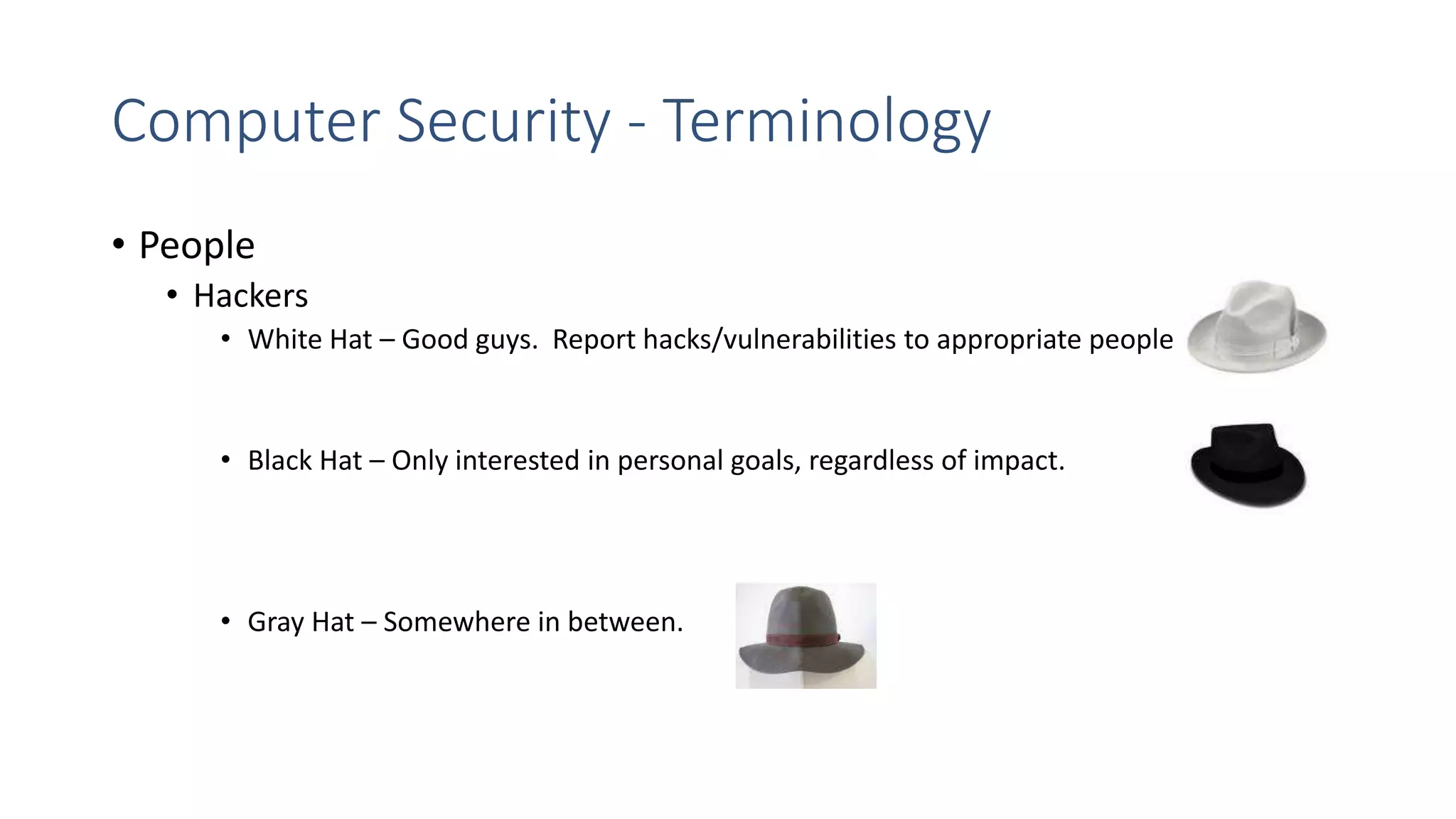
• White Hat – Good guys. Report hacks/vulnerabilities to appropriate people
• Black Hat – Only interested in personal goals, regardless of impact.
• Gray Hat – Somewhere in between.
Computer Security - Terminology
• Script Kiddies
• Someone that calls themselves a ‘hacker’ but really isn’t
• Ethical Hacker
• Someone hired to hack a system to find vulnerabilities and report on them.
• Also called a ‘sneaker’
Computer Security - Terminology
• Security Devices
• Firewall
• Barrier between network and the outside world.
• Proxy server
• Sits between users and server. Two main functions are to improve performance and
filter requests.
• Intrusion Detection Systems (IDS)
• Monitors network traffic for suspicious activity.
Computer Security - Terminology
• Activities
• Phreaking
• Breaking into telephone systems (used in conjunction with war-dialing)
• Authentication
• Determines whether credentials are authorized to access a resource
• Auditing
• Reviewing logs, records, or procedures for compliance with standards
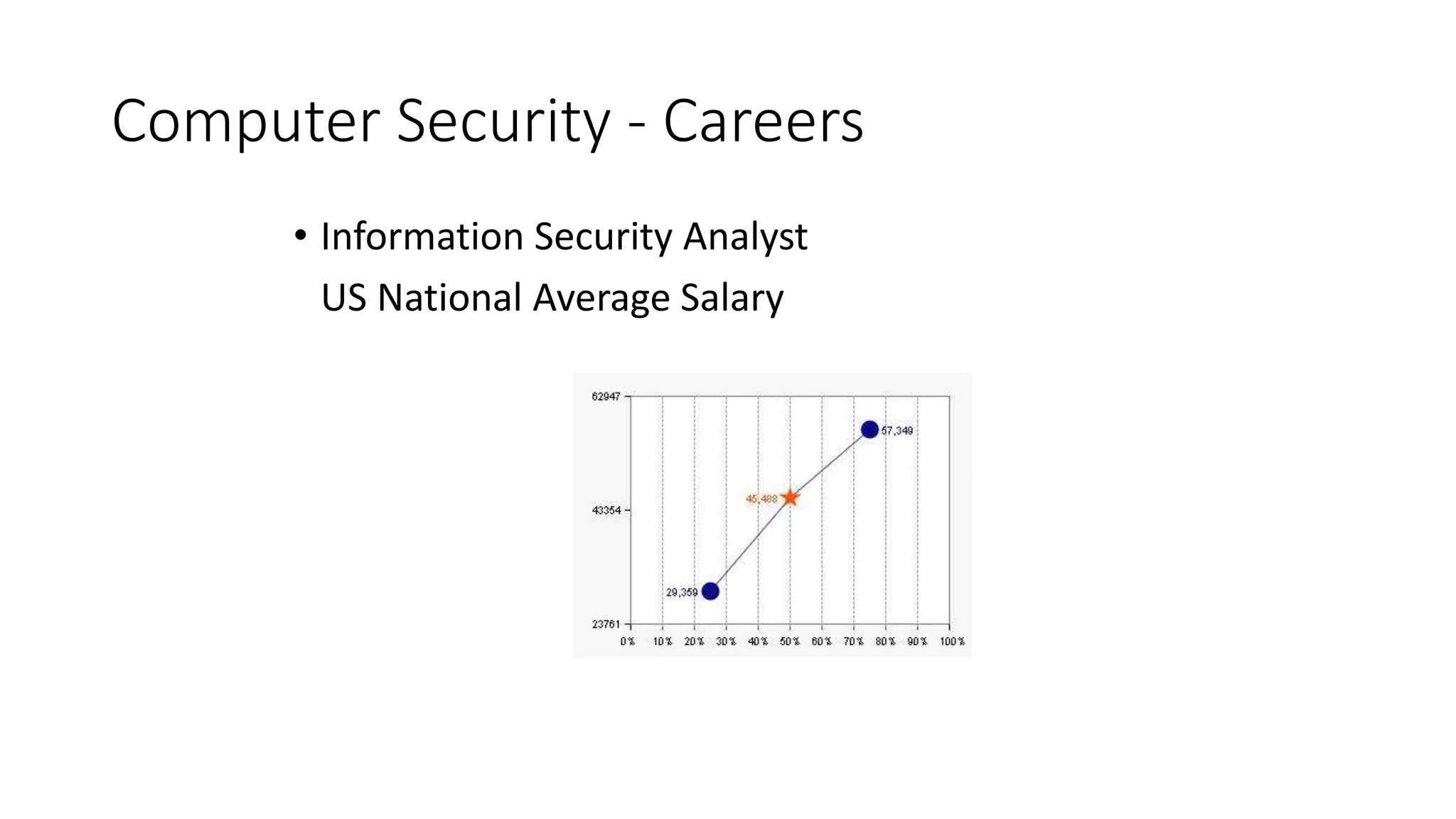
Computer Security - Careers
• Information Security Analyst
US National Average Salary

Cyber security by Gaurav Singh

  • 1.
  • 2.
    • The onlysystem which is truly secure is one which is switched off and unplugged, locked in a titanium safe, buried in a concrete bunker, and is surrounded by nerve gas and very highly paid armed guards. Even then, I wouldn’t stake my life on it. (By Professor Gene Spafford)
  • 3.
    Need For CyberSecurity • Advances in information and communications technologies have revolutionised government, scientific , educational and commercial infrastructures. • The IT infrastructure has become integral part of the critical infrastructure which supports national capabilities such as power grids, emergency communication systems, financial systems , defence systems and air traffic control networks. The operational stability and security of critical information infrastructure is vital for economic security of the country. • It also enables large scale processes through out the economy by facilitating complex interactions among individuals, organisations and systems across global networks for trade and economic requirements.
  • 4.
    Contd • Increasing complexityof IT systems and networks will mount security challenges for both providers and consumers. • The evolving nature of the telecommunications infrastructure, as the traditional phone systems and IT networks converge into a more unified architecture. • The expanding wireless connectivity to individual computers and networks making it increasingly difficult to determine the physical and logical boundaries of networks. • The increasing interconnectivity and accessibility (and consequently risk) to computer based systems that are critical to country’s economy.
  • 5.
    Security Trends • Increasingcomplexity of IT systems and networks will mount security challenges for both providers and consumers. • The evolving nature of the telecommunications infrastructure, as the traditional phone systems and IT networks converge into a more unified architecture. • The expanding wireless connectivity to individual computers and networks making it increasingly difficult to determine the physical and logical boundaries of networks. • The increasing interconnectivity and accessibility (and consequently risk) to computer based systems that are critical to country’s economy.
  • 6.
    Threats : NationalSecurity • Increasing complexity of IT systems and networks will mount security challenges for both providers and consumers. • The evolving nature of the telecommunications infrastructure, as the traditional phone systems and IT networks converge into a more unified architecture. • The expanding wireless connectivity to individual computers and networks making it increasingly difficult to determine the physical and logical boundaries of networks. • The increasing interconnectivity and accessibility (and consequently risk) to computer based systems that are critical to country’s economy.
  • 7.
    Threats : Public Onlineservices are becoming prime targets for cyber criminals • Cyber criminals continue to refine their means of deceit as well as their victims In summary, the global threats affecting users are:  New & sophisticated forms of attacks.  Attacks targeting new technologies, such as VoIP (vishing – phishing via VoIP & phreaking – hacking tel networks to make free long distance calls) and peer-to-peer services.  Attacks targeting online social networks.  Attacks targeting online services, particularly online banking services. • There is a new level of complexity in malware not seen before. These are more resilient, are modified over and over again and contain highly sophisticated functionality such as encryption (Ex. Nuwar also known as ‘Zhelatin’ and ‘Storm’ worm’ – with a new variant appearing almost daily) • As a trend we will see an increase in threats that hijack PCs with bots. Another challenging trend is the arrival of self-modifying threats • Given the exponential growth in social networking sites, social engineering may shortly become the easiest & quickest way to commit ID theft
  • 8.
    Hi-Tech Crime isa Growing Market The market is growing for zero-day threats & tools for cyber crime • With so many PCs now infected (around 5 % of all global machines are zombies), competition to supply botnets has become intense. The cost of renting a platform for spamming is now around $ 3 - 7 Cents per zombie per week. • A budget as little as $ 25 to $ 1500 USD can buy you a trojan that is built to steal credit card data and mail it you. Malware is being custom written to target specific companies and agencies. • Computer skills are no longer necessary to execute cyber crime. On the flip side malware writers today need not commit crimes themselves. People can subscribe to the tools that can keep them updated with latest vulnerabilities and even test themselves against security solutions (Ex. MPACK pr Pinch include support service). • The black market for stolen data (Ex. Credit cards, e-mails, skype accounts etc) is now well established and the cost of obtaining credit cards is upwards of $ 5 USD. • Another black market that is causing alarm to Govts is that of Zero-day exploits. In Jan 2006 a Microsoft WMF (windows meta file) exploit was sold for $ 4000 USD. • Competition is so intense among cyber criminals that ‘customer service’ has now become a specific selling point
  • 9.
    Possible Future Trends suggestan increase in safe havens for cyber criminals and hence the need for International cooperation arrangements. • It is an inevitable that some countries will become safe havens for cyber criminals and international pressure to crack down won’t work well. • It is believed that in next few years Govts are likely to get aggressive and pursue action against the specific individuals/groups/companies, regardless of location. • It is also likely that Govts will start putting pressure on intermediary bodies that have the skills and resources, such as banks, ISPs and software vendors to protect the public from malware, hacking and social engineering.
  • 10.
    • We maysee industry sector codes of practice demanding improved security measures, backed probably by assurance and insurance schemes. • Greater connectivity, more embedded systems and less obvious perimeters. • Compliance regulations will drive upgrades and changes and also increase system complexity and legal wrangles – increase in civil suits for security breaches. • Massive data storing patterns that ensure data never goes away – a boon to law enforcement agencies . • As of now, cyber criminals seem to have no real threat of prosecution. Our job is to create a climate of fear of effective prosecution, as in other types of crime.
  • 11.
    Categories of CyberCrime • We may see industry sector codes of practice demanding improved security measures, backed probably by assurance and insurance schemes. • Greater connectivity, more embedded systems and less obvious perimeters. • Compliance regulations will drive upgrades and changes and also increase system complexity and legal wrangles – increase in civil suits for security breaches. • Massive data storing patterns that ensure data never goes away – a boon to law enforcement agencies . • As of now, cyber criminals seem to have no real threat of prosecution. Our job is to create a climate of fear of effective prosecution, as in other types of crime.
  • 12.
    Common Methods ofCyber Crime • Hacking – Unauthorised attempts to bypass the security mechanism of an information system or network. • Data theft ( using flash/pen drives, digital cameras). • Virus or worms, Malware or Trojan horses. • Identity Theft • E- mail spoofing • Botnets and Zombies • Scareware
  • 13.
    Cybercrime Components • Computers •Cell Phones • PDA’s • Game Consoles
  • 14.
    Basic Principles ofCyber Security • Confidentiality: Information which is sensitive or confidential must remain so and be shared only with appropriate users. For example, our confidential medical records should be released only to those people or organizations (i.e. doctor, hospital, insurance, government agency, you) authorized to see it. • Integrity: Information must retain its integrity and not be altered from its original state. The records should be well protected so that no one can change the information without authorization. • Availability: Information and systems must be available to those who need it. The records should be available and accessible to authorized users.
  • 15.
  • 16.
    Computer Security -Threats • Malware • Software that has a malicious purpose • Viruses • Trojan horse • Spyware
  • 17.
    Computer Security -Threats • Intrusions • Any attempt to gain unauthorized access to a system • Cracking • Hacking • Social Engineering • War-driving
  • 18.
    Computer Security -Threats • Denial-of-Service (DOS) • Prevention of legitimate access to systems • Also Distributed-Denial-of-Service (DDoS) • Different types: • Ping-of-Death • Teardrop • Smurf • SYN
  • 19.
    Computer Security -Threats Figure 1.1 – DoS and DDoS Models
  • 20.
    Computer Security -Terminology • People • Hackers • White Hat – Good guys. Report hacks/vulnerabilities to appropriate people • Black Hat – Only interested in personal goals, regardless of impact. • Gray Hat – Somewhere in between.
  • 21.
    Computer Security -Terminology • Script Kiddies • Someone that calls themselves a ‘hacker’ but really isn’t • Ethical Hacker • Someone hired to hack a system to find vulnerabilities and report on them. • Also called a ‘sneaker’
  • 22.
    Computer Security -Terminology • Security Devices • Firewall • Barrier between network and the outside world. • Proxy server • Sits between users and server. Two main functions are to improve performance and filter requests. • Intrusion Detection Systems (IDS) • Monitors network traffic for suspicious activity.
  • 23.
    Computer Security -Terminology • Activities • Phreaking • Breaking into telephone systems (used in conjunction with war-dialing) • Authentication • Determines whether credentials are authorized to access a resource • Auditing • Reviewing logs, records, or procedures for compliance with standards
  • 24.
    Computer Security -Careers • Information Security Analyst US National Average Salary