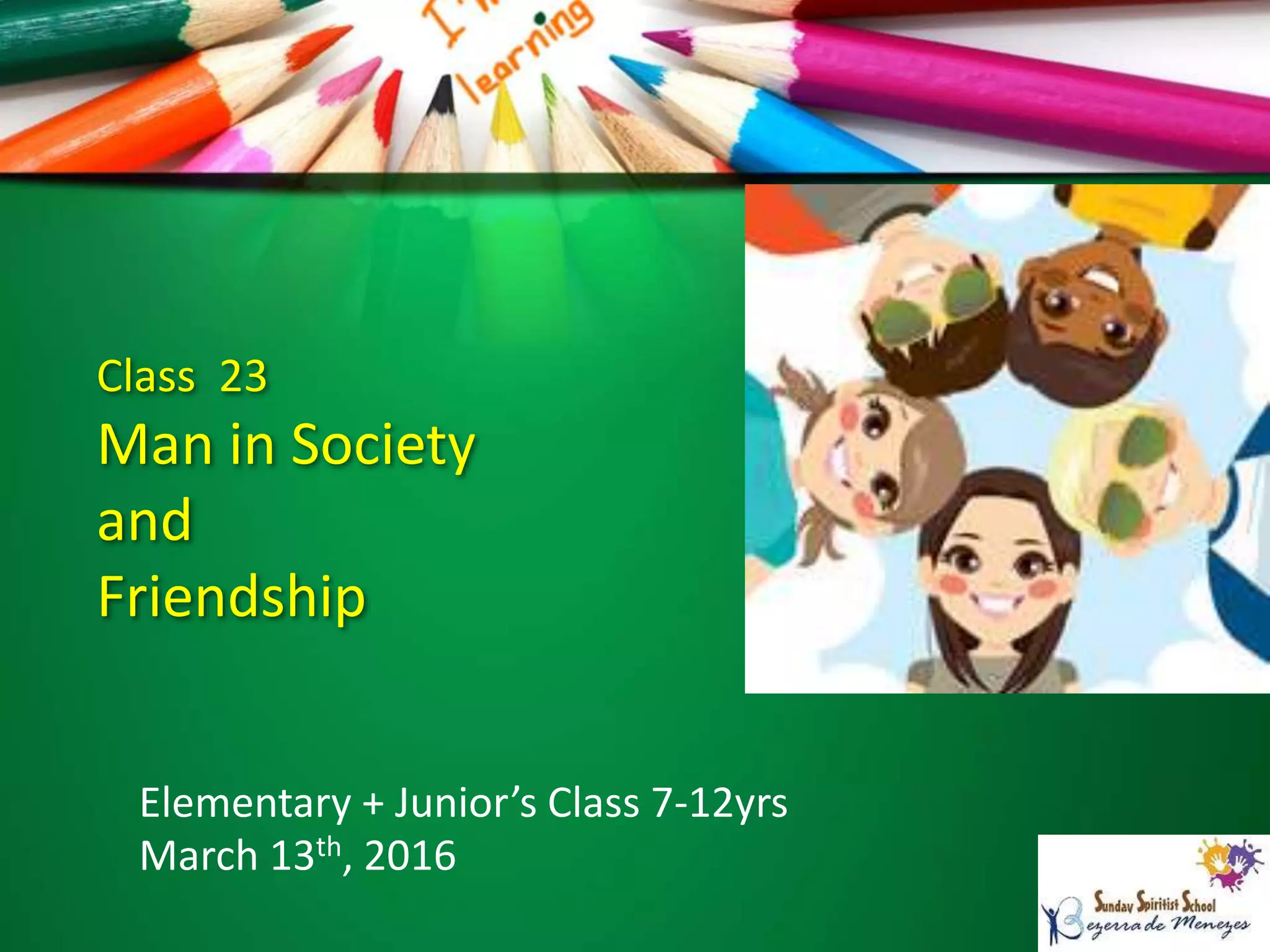
Class 23
Man in Society
and
Friendship
Elementary + Junior’s Class 7-12yrs
March 13th, 2016
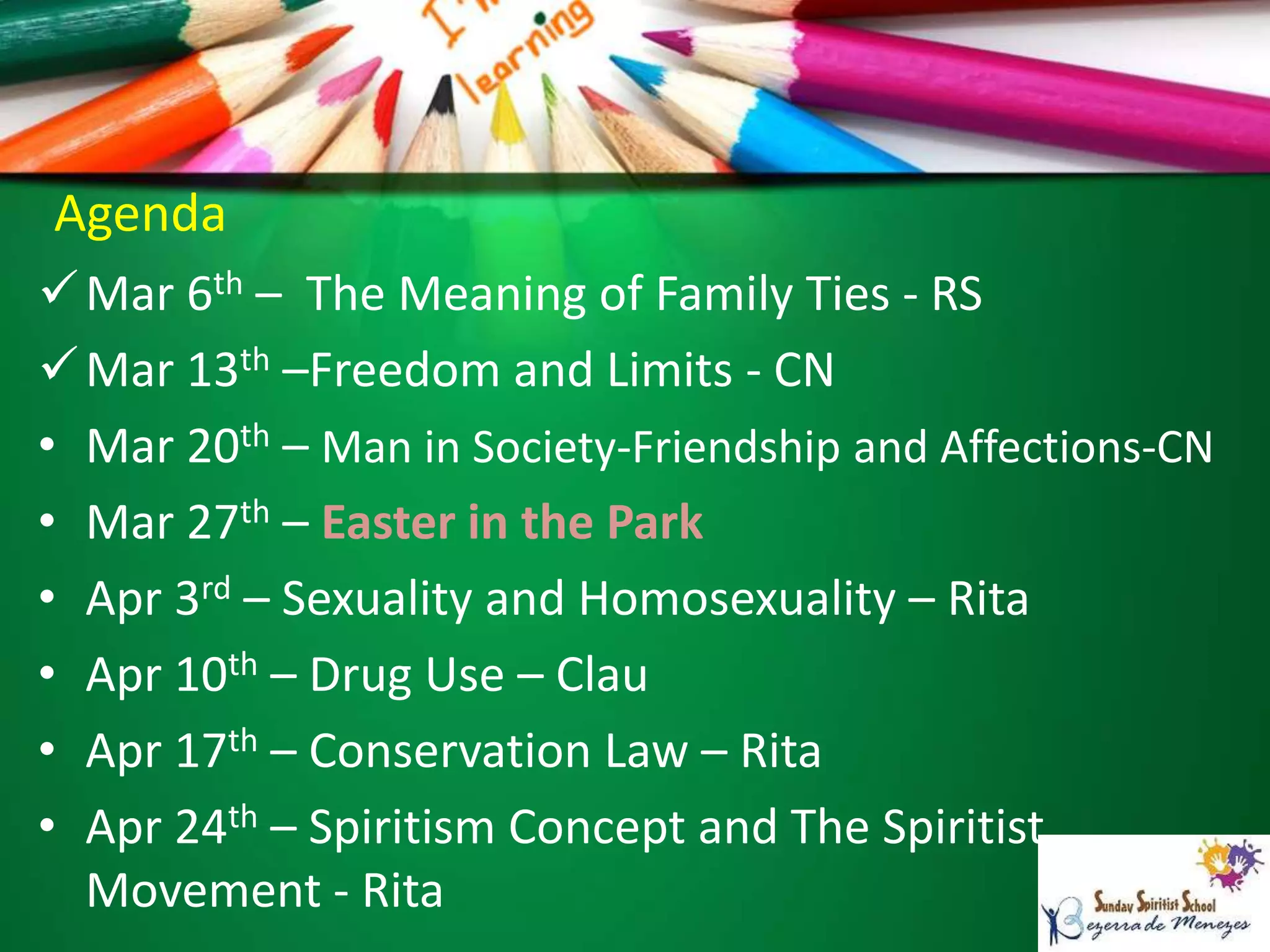
Agenda
Mar 6th – The Meaning of Family Ties - RS
Mar 13th –Freedom and Limits - CN
• Mar 20th – Man in Society-Friendship and Affections-CN
• Mar 27th – Easter in the Park
• Apr 3rd – Sexuality and Homosexuality – Rita
• Apr 10th – Drug Use – Clau
• Apr 17th – Conservation Law – Rita
• Apr 24th – Spiritism Concept and The Spiritist
Movement - Rita
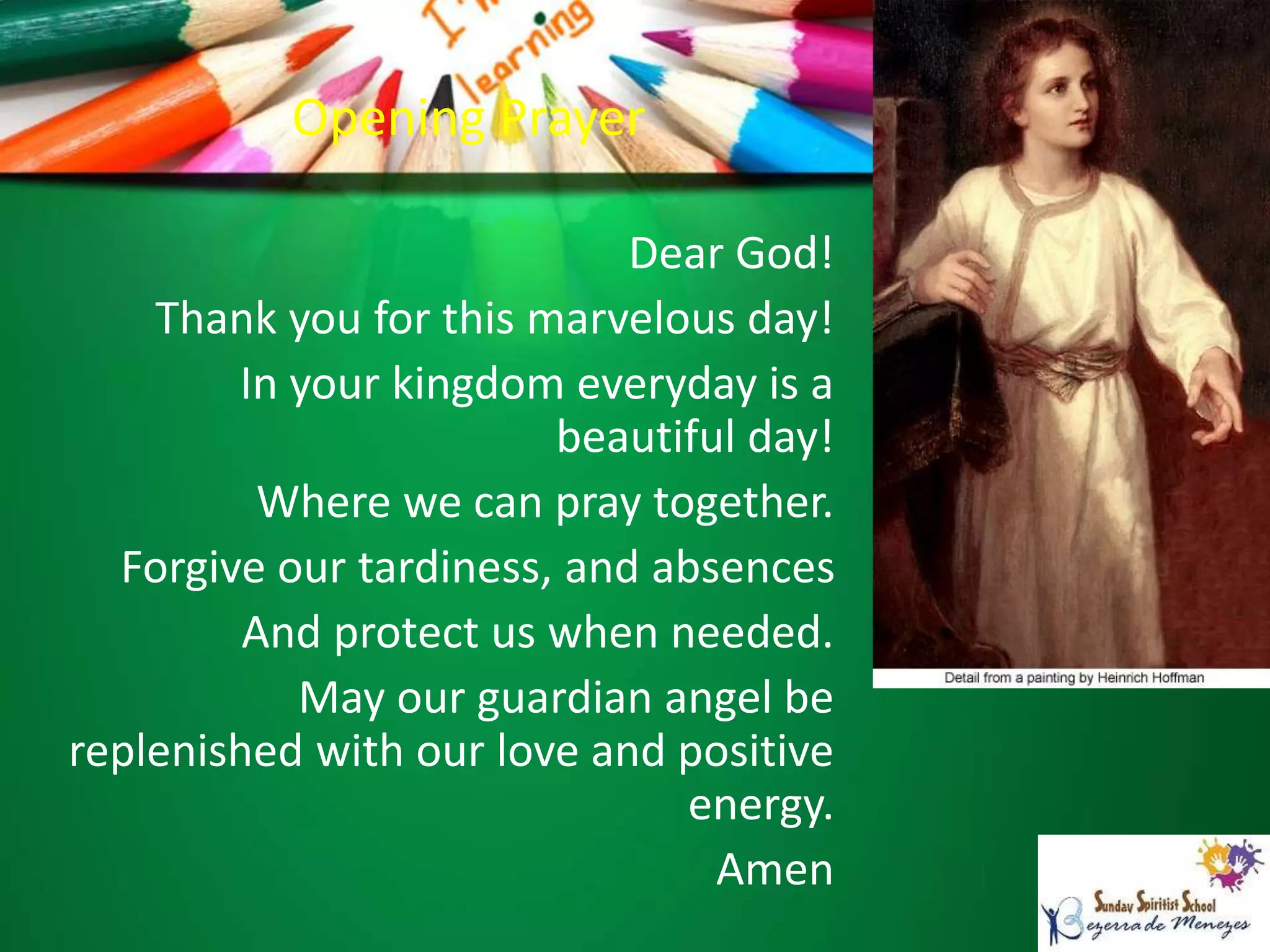
Opening Prayer
Dear God!
Thank you for this marvelous day!
In your kingdom everyday is a
beautiful day!
Where we can pray together.
Forgive our tardiness, and absences
And protect us when needed.
May our guardian angel be
replenished with our love and positive
energy.
Amen
Relationship with Man and Society
• Today our class will be very DELICIOUS. Let's start it,
savoring different types of candy. I want to hear from
each of you what you think about the flavors you
experimented, because we’ll talk about it during class.
• Please pick a partner
Let’s Reflect
• 1st Pair will choose one type of chocolate.
• Get all 3 units, give the 2nd to the next team.
• OK, All pairs get into a line.
• How was everyone’s attitude?
• How did everyone deal with their goal?
• How important are the material things in life?
Impatience
• Do you get upset when you have to wait? Do you eat fast? Do you often feel
pressured at the end of a normal day (school, extra activities ...)? Do you
often feel pressed for time? Why not take a self-assessment? We live in hectic
days. We are always under pressure: pressure for a better performance,
comparisons and many appointments on the same day...
• The vast majority of people are immediate; i.e., they want things right now.
These lead to impatience and hence irritability. Many disputes arise
motivated by nonsense, but that piles up and stimulates discussions. This is
because some people have the silly idea that they shouldn’t take any insults
home, but ultimately this leads to going to prison, hospital or even the
cemetery! So it’s important to learn to have patience, especially for waiting,
learn the art of not feeling irritated and finding a solution.
• The person who gets annoyed, aspires the toxic air externalize around and
poisons her/himself. Impatience is a manifestation of unbelief and distrust in
God, leading to frustrations and disappointments. We must realize that
everything happens at the right time that God determines.
Questions and Answers…
• WHAT OTHER PEOPLE’S ATTITUDES BOTTHER YOU MORE? Have you ever thought you
could behave in the same way? Other people are our mirror. What we don’t like on
others say something about ourselves. We don’t like to see in others what we don’t
wish to see in ourselves; that is, what irritates us in others is often something that we
have within ourselves, but we are not aware. The attitude of the other person makes
us aware of this behavior that we have hidden within ourselves.
• We don’t like to be reminded of it and that's why we get angry. We identify with the
other person, even if it’s very difficult to admit. We are obviously not exactly like the
other person. But if you, for example, gets angry with a colleague who is irresponsible
at work, this can bring you some awareness of how you are irresponsible with your life
and your development.
• Therefore, we project on others. This is the psychological mechanism by which we
wish avoid awareness of our problems, projecting our own characteristics in others.
Both problems as well as qualities can be projected.
– WHAT CHARACTERISTICS DO YOU APPRECIATE THE MOST IN OTHERS? You
probably have these characteristics in you, but maybe you are not aware of them.
You realize and appreciate the other individual it matches with you.
– WHAT ATTITUDES DO YOU THINK OTHERS DON’T LIKE IN YOU? We
sometimes only see problems in other individuals. We can judge others
more harshly than we judge ourselves. Isn’t that what happens in most
cases? When others don’t do something, we think they are lazy. When we
don’t do something, it's because we're busy.
• When others talk about our faults, we think they are attacking us. When we
talk about the faults of others, we are helping them by offering constructive
feedback. When others say things that displease us, they are rude; pushy.
When we are the ones saying something that displeases others, they are
fastidious; proud.
• On the one hand we shouldn’t be too squeamish, but otherwise, wouldn’t it
be more prudent to be cautious when we speak? We can say anything; but to
reach a positive outcome, we need to watch out how we speak.
• It’s impressive how some people can position themselves in a way that will
enable them to take advantage of his neighbor. WHAT DO YOU THINK ABOUT
THAT?
The two horses
• On the road which leads to my house there is a field. Two horses live
there.
• We can see, from distance that the horses look just like any other horses.
Therefore, when you look at them closer you can see one of them is
blind. Their owner decided to keep him and find the blind horse a new
friend – a younger horse.
• This causes a admiration...
• If you keep observing them, you will hear a bell.
• It is placed on the neck of the younger horse, once you search for where
the sound comes from.
• Thus, the blind horse knows where his friend is and goes towards him.
The two horses
• Both horses spend the day eating. By the end of each day the blind horse follows
his companion all the way to the stable.
• You then realize the horse wearing the bell is always looking after the other one.
The animal keeps an eye on the other, waiting for him every time he walks a bit
quicker until his friend reaches him. The blind horse trusted his friend, following
the bell knowing the animal was being lead to the right path.
• As the horses’ owners, God doesn’t give up on us because we are not perfect or
because we have problems or challenges. He looks after us and allows other
people to come in to help when we need. Some times we are the blind horse
guided by the sound of the bell that God places in our lives. Other times, we are
the horse that guides, helping others to find its way.
• That’s how good friends are.
• You don’t need to see them, but they are there.
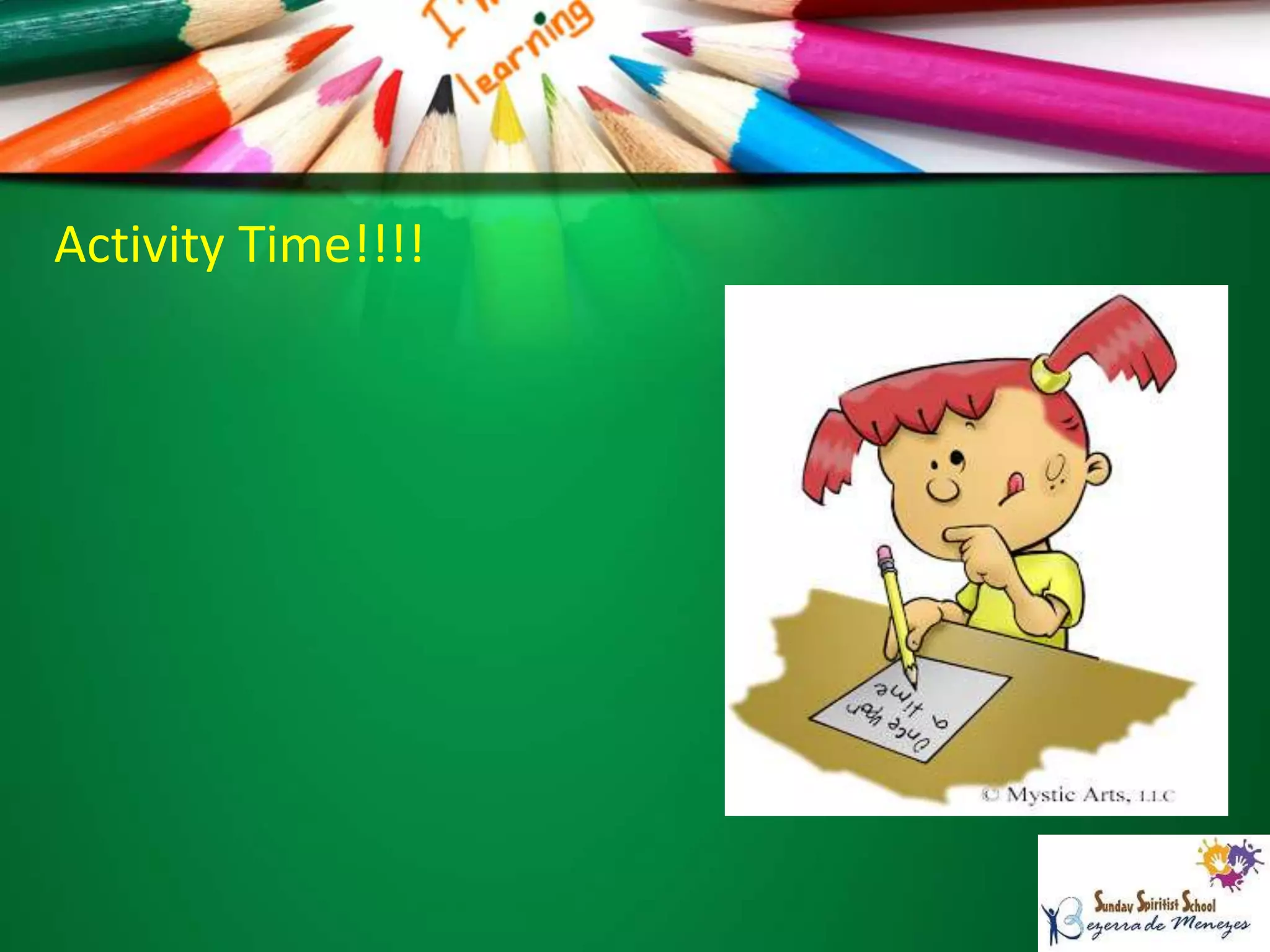
Activity Time!!!!
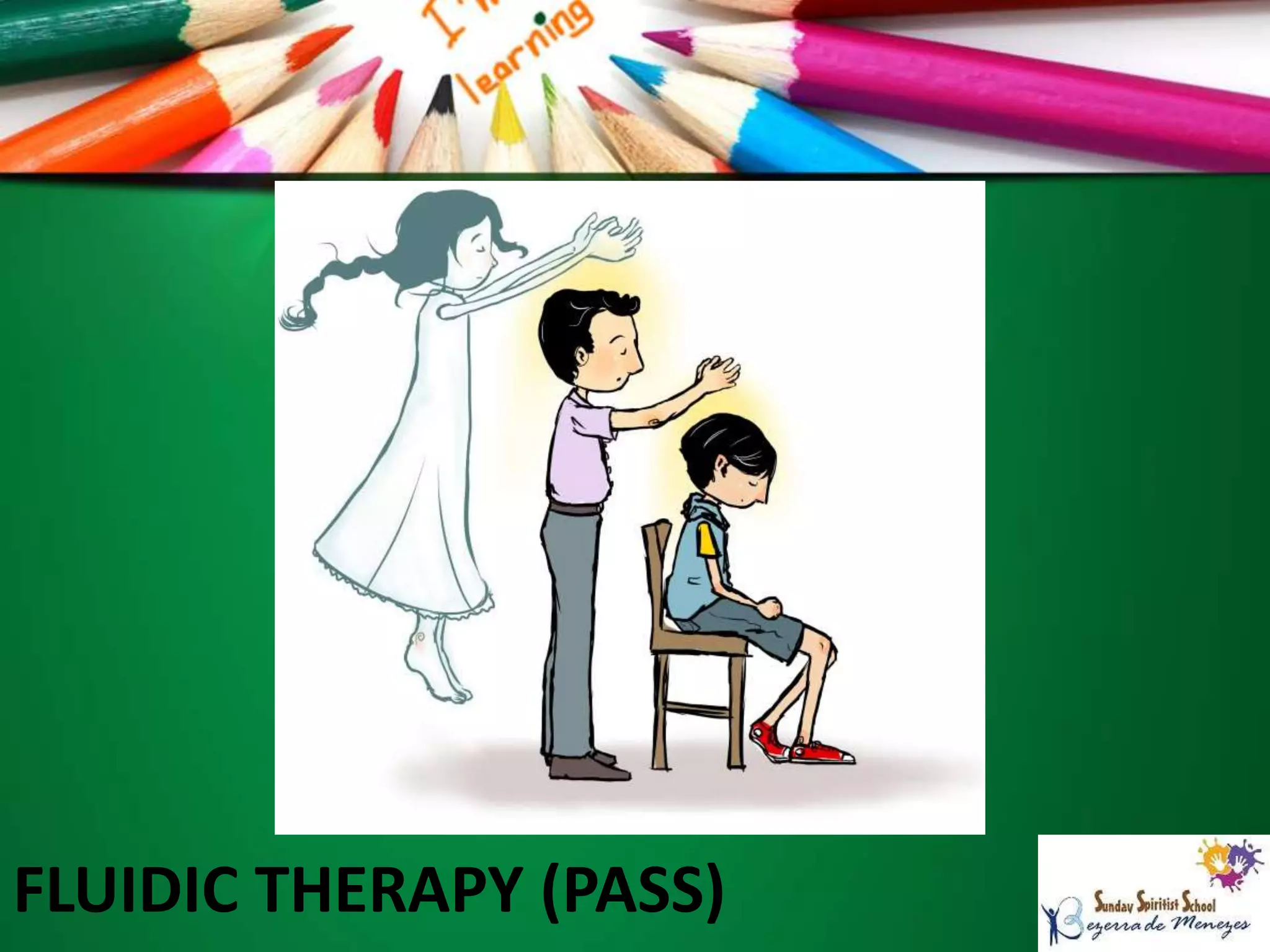
FLUIDIC THERAPY (PASS)
Agenda
Mar 6th – The Meaning of Family Ties - RS
Mar 13th –Freedom and Limits - CN
• Mar 20th – Man in Society-Friendship and Affections-CN
• Mar 27th – Easter in the Park
• Apr 3rd – Sexuality and Homosexuality – Rita
• Apr 10th – Drug Use – Clau
• Apr 17th – Conservation Law – Rita
• Apr 24th – Spiritism Concept and The Spiritist
Movement - Rita
COMMUNITY PRAYER

Class 24 main in society and friendship

  • 1.
    Class 23 Man inSociety and Friendship Elementary + Junior’s Class 7-12yrs March 13th, 2016
  • 2.
    Agenda Mar 6th –The Meaning of Family Ties - RS Mar 13th –Freedom and Limits - CN • Mar 20th – Man in Society-Friendship and Affections-CN • Mar 27th – Easter in the Park • Apr 3rd – Sexuality and Homosexuality – Rita • Apr 10th – Drug Use – Clau • Apr 17th – Conservation Law – Rita • Apr 24th – Spiritism Concept and The Spiritist Movement - Rita
  • 3.
    Opening Prayer Dear God! Thankyou for this marvelous day! In your kingdom everyday is a beautiful day! Where we can pray together. Forgive our tardiness, and absences And protect us when needed. May our guardian angel be replenished with our love and positive energy. Amen
  • 4.
    Relationship with Manand Society • Today our class will be very DELICIOUS. Let's start it, savoring different types of candy. I want to hear from each of you what you think about the flavors you experimented, because we’ll talk about it during class. • Please pick a partner
  • 5.
    Let’s Reflect • 1stPair will choose one type of chocolate. • Get all 3 units, give the 2nd to the next team. • OK, All pairs get into a line. • How was everyone’s attitude? • How did everyone deal with their goal? • How important are the material things in life?
  • 6.
    Impatience • Do youget upset when you have to wait? Do you eat fast? Do you often feel pressured at the end of a normal day (school, extra activities ...)? Do you often feel pressed for time? Why not take a self-assessment? We live in hectic days. We are always under pressure: pressure for a better performance, comparisons and many appointments on the same day... • The vast majority of people are immediate; i.e., they want things right now. These lead to impatience and hence irritability. Many disputes arise motivated by nonsense, but that piles up and stimulates discussions. This is because some people have the silly idea that they shouldn’t take any insults home, but ultimately this leads to going to prison, hospital or even the cemetery! So it’s important to learn to have patience, especially for waiting, learn the art of not feeling irritated and finding a solution. • The person who gets annoyed, aspires the toxic air externalize around and poisons her/himself. Impatience is a manifestation of unbelief and distrust in God, leading to frustrations and disappointments. We must realize that everything happens at the right time that God determines.
  • 7.
    Questions and Answers… •WHAT OTHER PEOPLE’S ATTITUDES BOTTHER YOU MORE? Have you ever thought you could behave in the same way? Other people are our mirror. What we don’t like on others say something about ourselves. We don’t like to see in others what we don’t wish to see in ourselves; that is, what irritates us in others is often something that we have within ourselves, but we are not aware. The attitude of the other person makes us aware of this behavior that we have hidden within ourselves. • We don’t like to be reminded of it and that's why we get angry. We identify with the other person, even if it’s very difficult to admit. We are obviously not exactly like the other person. But if you, for example, gets angry with a colleague who is irresponsible at work, this can bring you some awareness of how you are irresponsible with your life and your development. • Therefore, we project on others. This is the psychological mechanism by which we wish avoid awareness of our problems, projecting our own characteristics in others. Both problems as well as qualities can be projected. – WHAT CHARACTERISTICS DO YOU APPRECIATE THE MOST IN OTHERS? You probably have these characteristics in you, but maybe you are not aware of them. You realize and appreciate the other individual it matches with you.
  • 8.
    – WHAT ATTITUDESDO YOU THINK OTHERS DON’T LIKE IN YOU? We sometimes only see problems in other individuals. We can judge others more harshly than we judge ourselves. Isn’t that what happens in most cases? When others don’t do something, we think they are lazy. When we don’t do something, it's because we're busy. • When others talk about our faults, we think they are attacking us. When we talk about the faults of others, we are helping them by offering constructive feedback. When others say things that displease us, they are rude; pushy. When we are the ones saying something that displeases others, they are fastidious; proud. • On the one hand we shouldn’t be too squeamish, but otherwise, wouldn’t it be more prudent to be cautious when we speak? We can say anything; but to reach a positive outcome, we need to watch out how we speak. • It’s impressive how some people can position themselves in a way that will enable them to take advantage of his neighbor. WHAT DO YOU THINK ABOUT THAT?
  • 9.
    The two horses •On the road which leads to my house there is a field. Two horses live there. • We can see, from distance that the horses look just like any other horses. Therefore, when you look at them closer you can see one of them is blind. Their owner decided to keep him and find the blind horse a new friend – a younger horse. • This causes a admiration... • If you keep observing them, you will hear a bell. • It is placed on the neck of the younger horse, once you search for where the sound comes from. • Thus, the blind horse knows where his friend is and goes towards him.
  • 10.
    The two horses •Both horses spend the day eating. By the end of each day the blind horse follows his companion all the way to the stable. • You then realize the horse wearing the bell is always looking after the other one. The animal keeps an eye on the other, waiting for him every time he walks a bit quicker until his friend reaches him. The blind horse trusted his friend, following the bell knowing the animal was being lead to the right path. • As the horses’ owners, God doesn’t give up on us because we are not perfect or because we have problems or challenges. He looks after us and allows other people to come in to help when we need. Some times we are the blind horse guided by the sound of the bell that God places in our lives. Other times, we are the horse that guides, helping others to find its way. • That’s how good friends are. • You don’t need to see them, but they are there.
  • 11.
  • 12.
  • 13.
    Agenda Mar 6th –The Meaning of Family Ties - RS Mar 13th –Freedom and Limits - CN • Mar 20th – Man in Society-Friendship and Affections-CN • Mar 27th – Easter in the Park • Apr 3rd – Sexuality and Homosexuality – Rita • Apr 10th – Drug Use – Clau • Apr 17th – Conservation Law – Rita • Apr 24th – Spiritism Concept and The Spiritist Movement - Rita
  • 14.