Class 19
EWRT 1A
Make-up Vocabulary
Exam
 You may take or re-take
any one exam (1-5).
 Let me know which one
you want.
 You have 15 minutes to
finish the Exam.
 May the odds be ever in
your favor!
AGENDA
 Essay #4 was due before class today.
 Introduction to Essay #5
 Martin Luther King’s “I Have A Dream”
Speech.
 Organizing your speech
Essay #5: Proposing a
Solution
 Assignment: 100 points: Write a
speech 700-800 words in length (five
to six minutes of presentation).
 Prompt: Write a speech (based on
essay #4) proposing a solution to a
well-defined problem faced by a
community or group to which you
may belong. Alternatively, you may
address a well-defined problem faced
by one of the districts or communities
in The Hunger Games. Address your
proposal to your audience: one or
more members of the group, its
leadership, or to outsiders who may
be able to contribute to solving the
problem. Present your speech to the
class to convince them that your ideas
are correct.
 You will turn in a hard copy of your formal
speech (MLA style) on the first speech day.
 You will perform your speech in class.
 Speech Form:
 You may give your presentation as a formal speech; in other words, you
may read in front of the class.
 You may video yourself, put up the video on YouTube, and then show it
during class.
 You may combine the two methods; for example, you may play a video in
the background as you talk to the class.
 You may engage others in your presentation as long as they have a clear
role in what you are doing.
 You may suggest another form.
Martin Luther King Jr. has now been
dead longer than he lived. But what an
extraordinary life it was.
 At 33, he was pressing the case of civil rights with
President John Kennedy. At 34, he galvanized the
nation with his "I Have a Dream" speech. At 35, he
won the Nobel Peace Prize. At 39, he was
assassinated, but he left a legacy of hope and
inspiration that continues today.
 King's most famous speech, "I Have a Dream," was
delivered in 1963 at the March on Washington, one
of the largest political rallies for human rights in
United States history; it called for civil and
economic rights for African Americans.
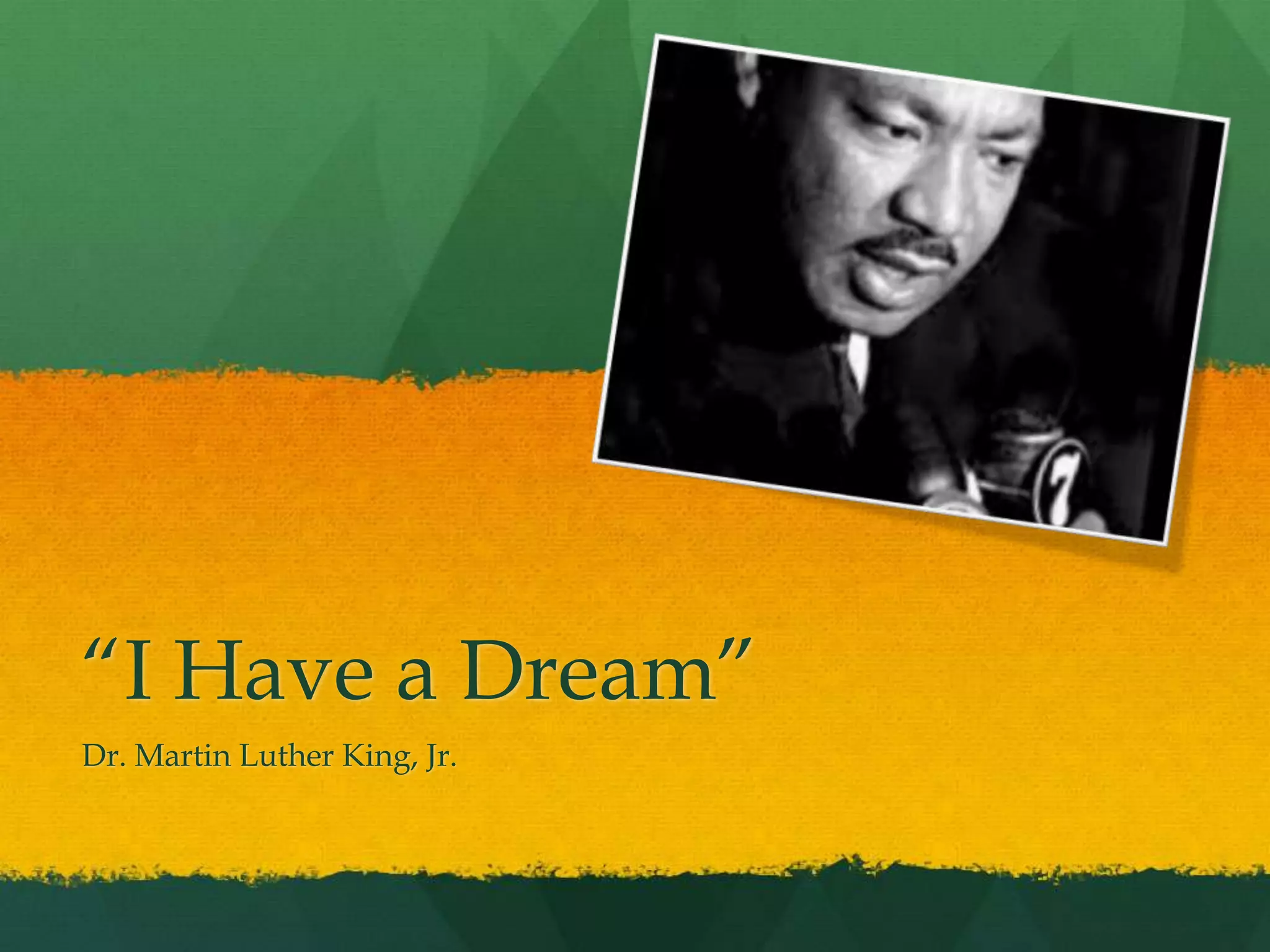
“I Have a Dream”
Dr. Martin Luther King, Jr.
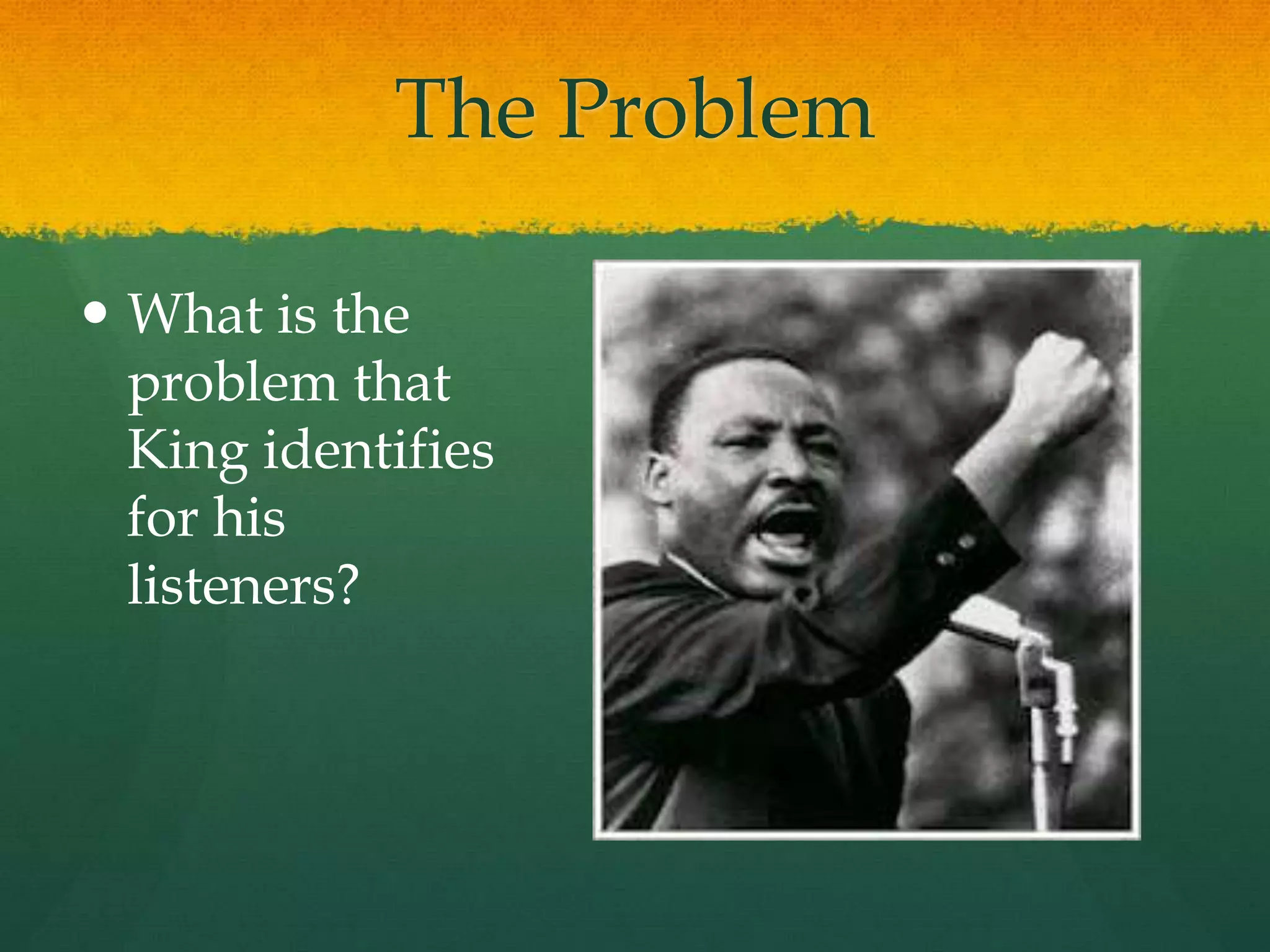
The Problem
 What is the
problem that
King identifies
for his
listeners?
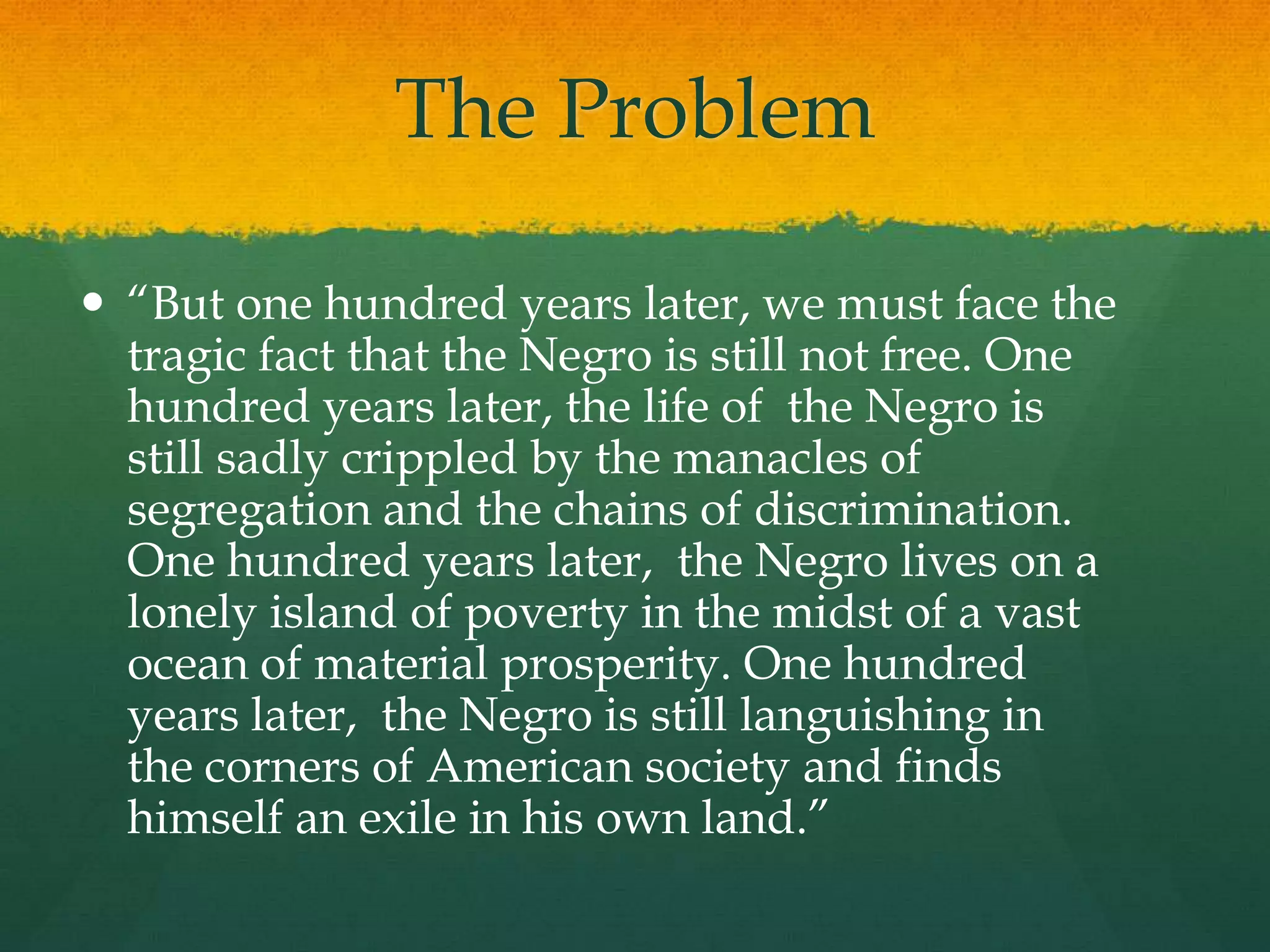
The Problem
 “But one hundred years later, we must face the
tragic fact that the Negro is still not free. One
hundred years later, the life of the Negro is
still sadly crippled by the manacles of
segregation and the chains of discrimination.
One hundred years later, the Negro lives on a
lonely island of poverty in the midst of a vast
ocean of material prosperity. One hundred
years later, the Negro is still languishing in
the corners of American society and finds
himself an exile in his own land.”
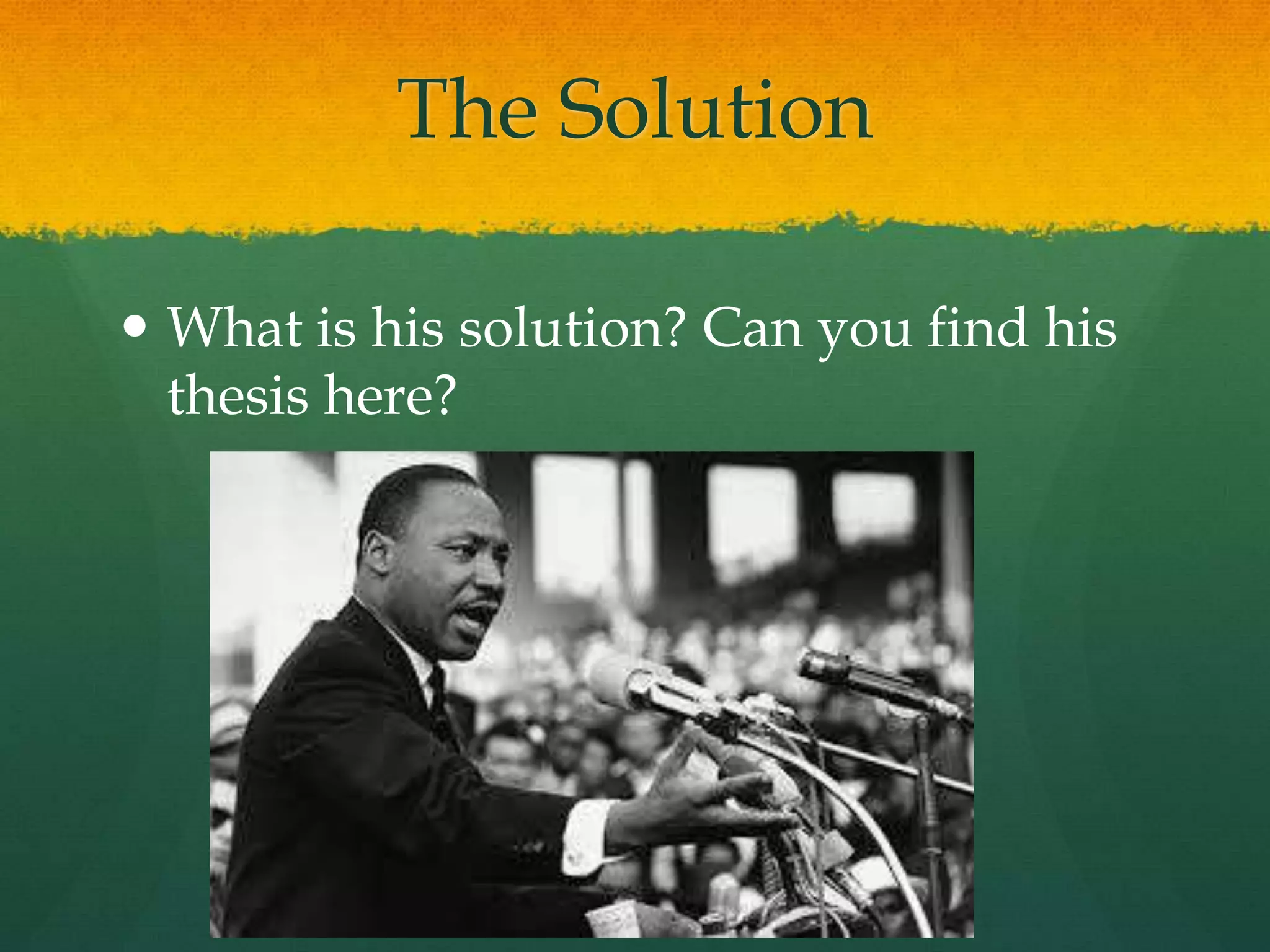
The Solution
 What is his solution? Can you find his
thesis here?
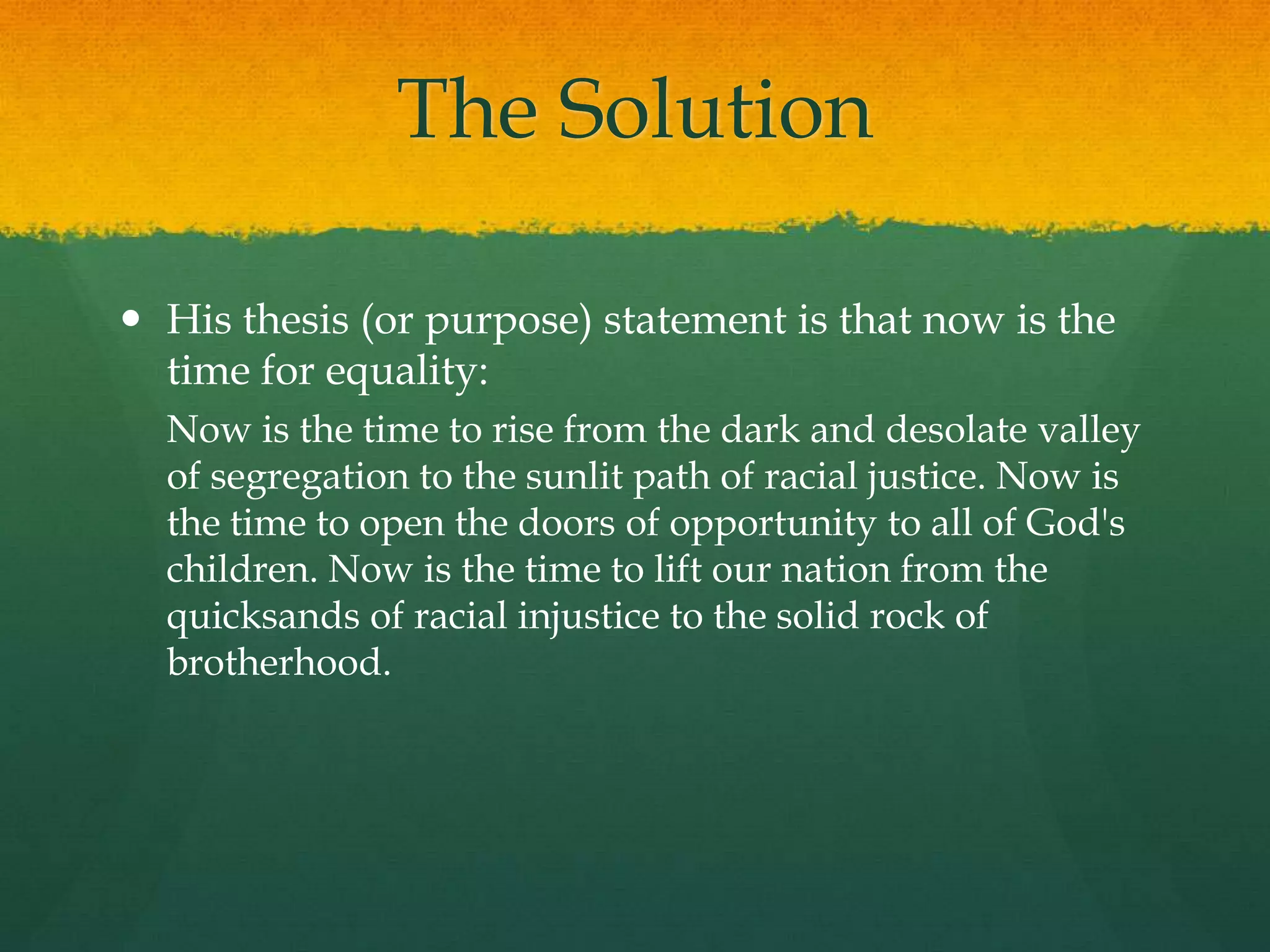
The Solution
 His thesis (or purpose) statement is that now is the
time for equality:
Now is the time to rise from the dark and desolate valley
of segregation to the sunlit path of racial justice. Now is
the time to open the doors of opportunity to all of God's
children. Now is the time to lift our nation from the
quicksands of racial injustice to the solid rock of
brotherhood.
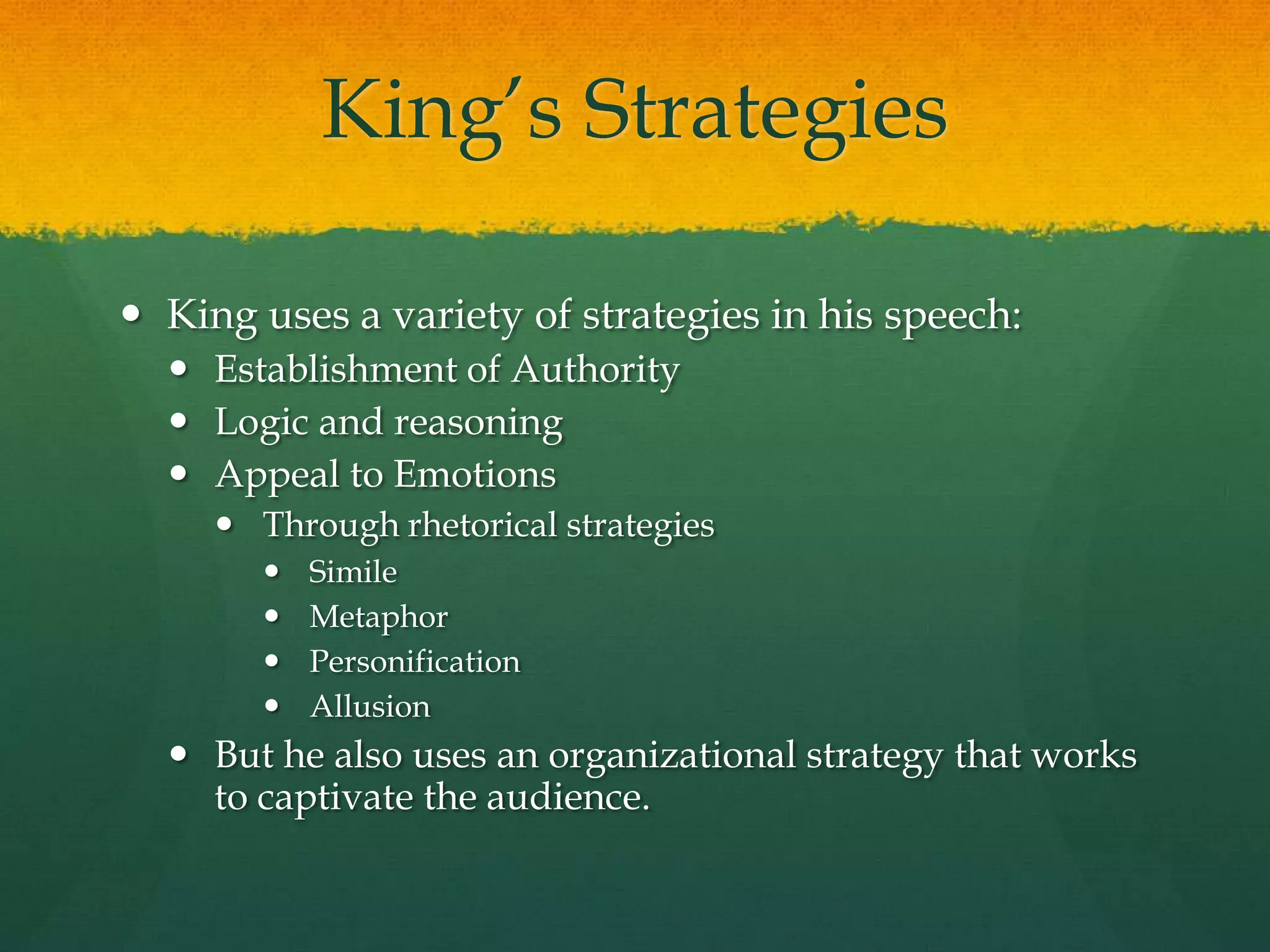
King‟s Strategies
 King uses a variety of strategies in his speech:
 Establishment of Authority
 Logic and reasoning
 Appeal to Emotions
 Through rhetorical strategies
 Simile
 Metaphor
 Personification
 Allusion
 But he also uses an organizational strategy that works
to captivate the audience.
King followed Monroe‟s Motivated Sequence:
A Method in Five Steps!
 The five steps of the Monroe motivated sequence
 attention
 need
 satisfaction
 visualization
 action
The Attention Step
 In the attention step, speakers call attention to the
situation. King, speaking from the steps of the Lincoln
Memorial, calls attention to Lincoln‟s signing of the
Emancipation Proclamation, the situation of the Negro
today (“One hundred years later, the Negro still is not
free.”), and the fact that the words of the Constitution and
Declaration of Independence granting all people the
unalienable rights of life, liberty, and the pursuit of
happiness have not been fulfilled.
The Need Step
 For the need step, speakers describe the difficulty, trouble,
distress, crisis, emergency, or urgency. King says, “Instead
of honoring this sacred obligation [what the Constitution
and Declaration of Independence promise], America has
given the Negro people a bad check, a check that has come
back marked „insufficient funds.‟” And why have they come
to Washington, D.C.? — to “remind America of the fierce
urgency of now.”
The Satisfaction Step
 In the satisfaction step, speakers tell listeners how to
satisfy the need they establish. King says, “We must make
the pledge that we shall always march ahead.” To march
ahead, he said, “We can never be satisfied.” Then he tells
listeners to go back home knowing their situation can and
will be changed.
The Visualization Step
For visualization, speakers offer
listeners a vision of what life can
be once their solution (offered in
the satisfaction step) is adopted.
This is where King offers listeners
his dream: “I have a dream”
offered along with five different
descriptions of what life can and
will be like in Georgia,
Mississippi, Alabama, in
communities, and around the
world.
The Action Step
The final stage is the action step
when speakers offer listeners a
specific course of action to follow.
King‟s action step occurs when he
asks his audience to “Let freedom
ring,” and he uses the phrase at the
end of the speech focusing on eight
states symbolizing the whole nation.
ORGANIZE YOUR SPEECH
GET OUT YOUR
ESSAY #4
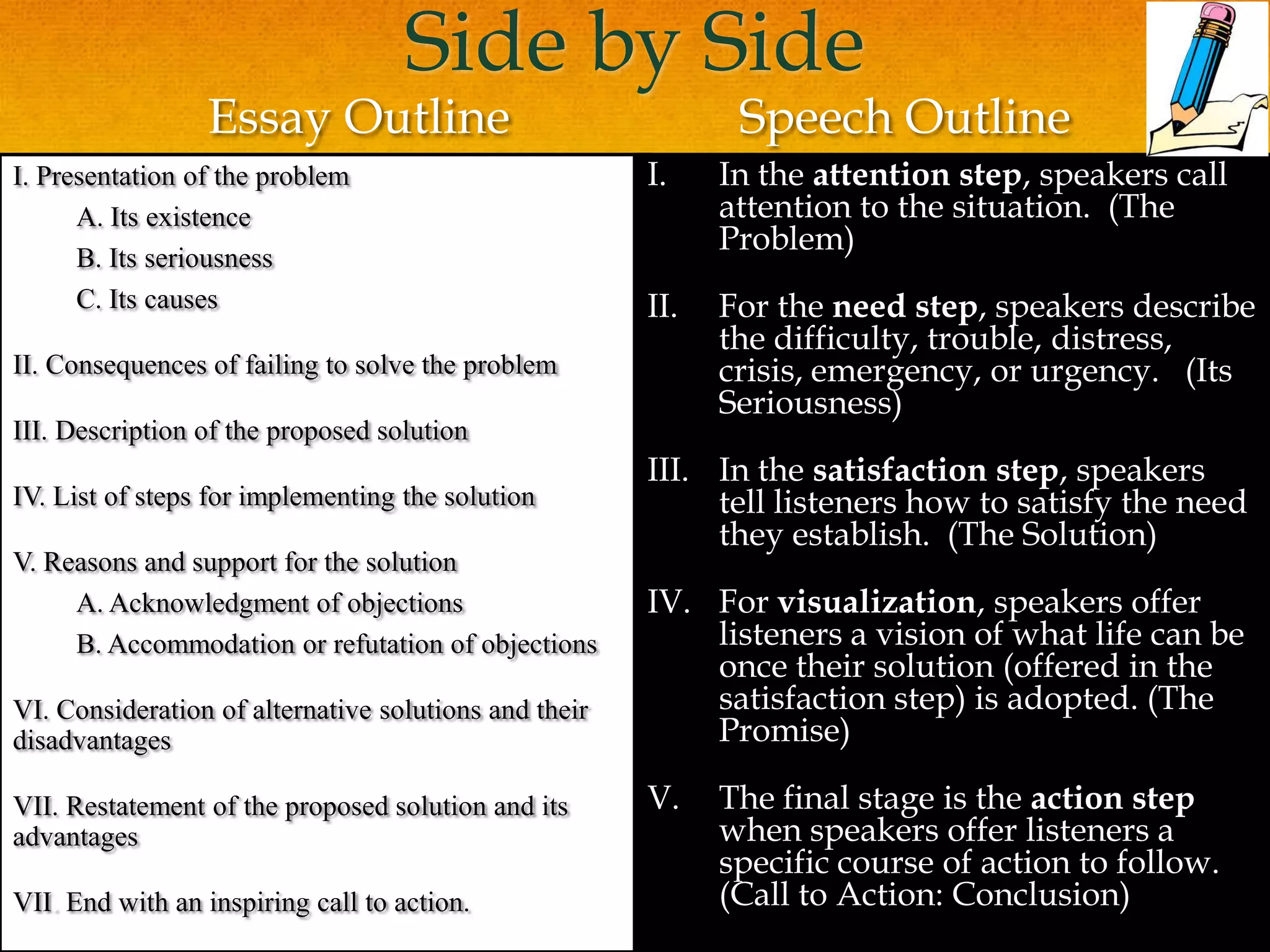
Side by Side
Essay Outline
I. Presentation of the problem
A. Its existence
B. Its seriousness
C. Its causes
II. Consequences of failing to solve the problem
III. Description of the proposed solution
IV. List of steps for implementing the solution
V. Reasons and support for the solution
A. Acknowledgment of objections
B. Accommodation or refutation of objections
VI. Consideration of alternative solutions and their
disadvantages
VII. Restatement of the proposed solution and its
advantages
VII. End with an inspiring call to action.
Speech Outline
I. In the attention step, speakers call
attention to the situation. (The
Problem)
II. For the need step, speakers describe
the difficulty, trouble, distress,
crisis, emergency, or urgency. (Its
Seriousness)
III. In the satisfaction step, speakers
tell listeners how to satisfy the need
they establish. (The Solution)
IV. For visualization, speakers offer
listeners a vision of what life can be
once their solution (offered in the
satisfaction step) is adopted. (The
Promise)
V. The final stage is the action step
when speakers offer listeners a
specific course of action to follow.
(Call to Action: Conclusion)
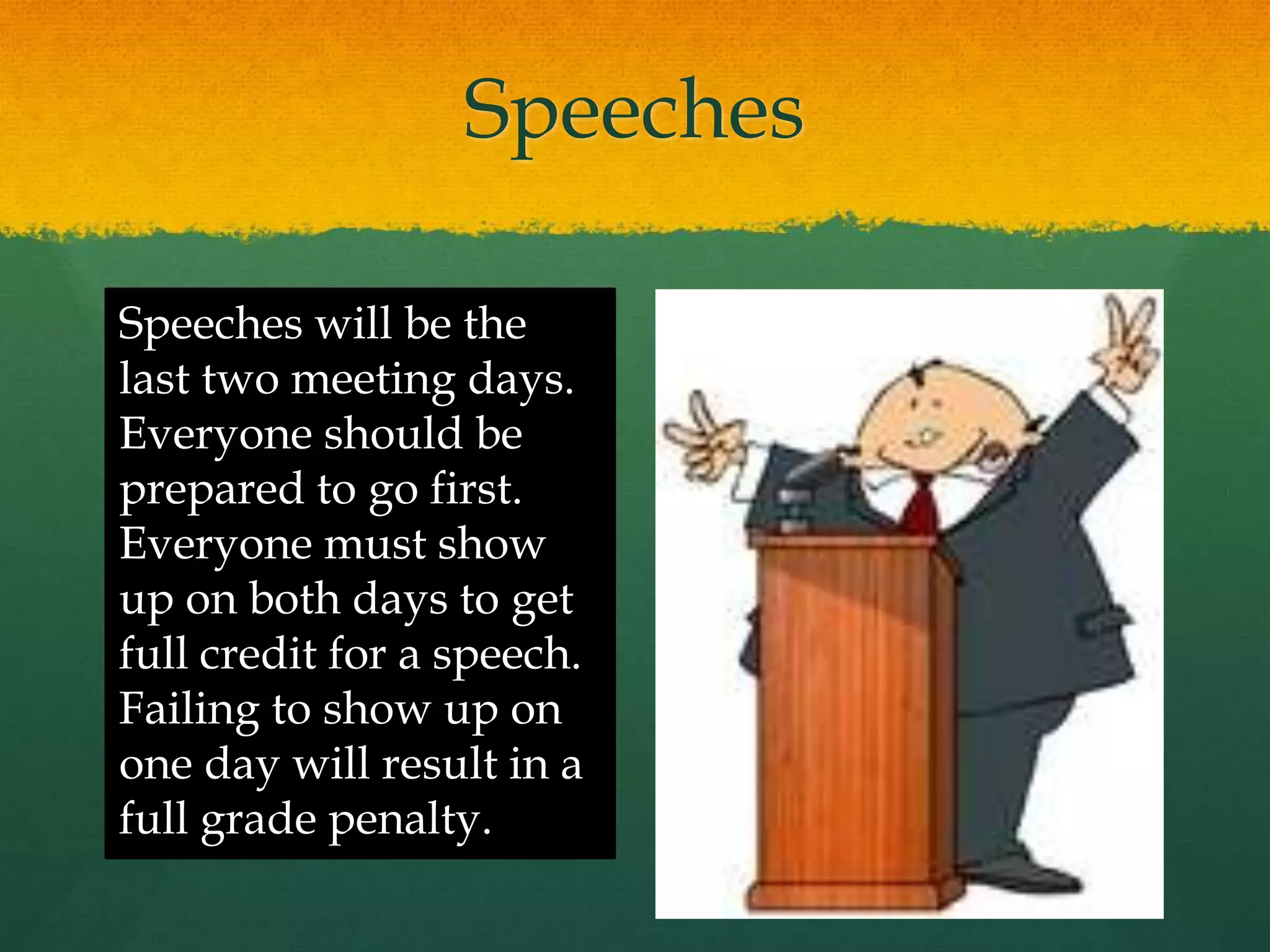
Speeches
Speeches will be the
last two meeting days.
Everyone should be
prepared to go first.
Everyone must show
up on both days to get
full credit for a speech.
Failing to show up on
one day will result in a
full grade penalty.
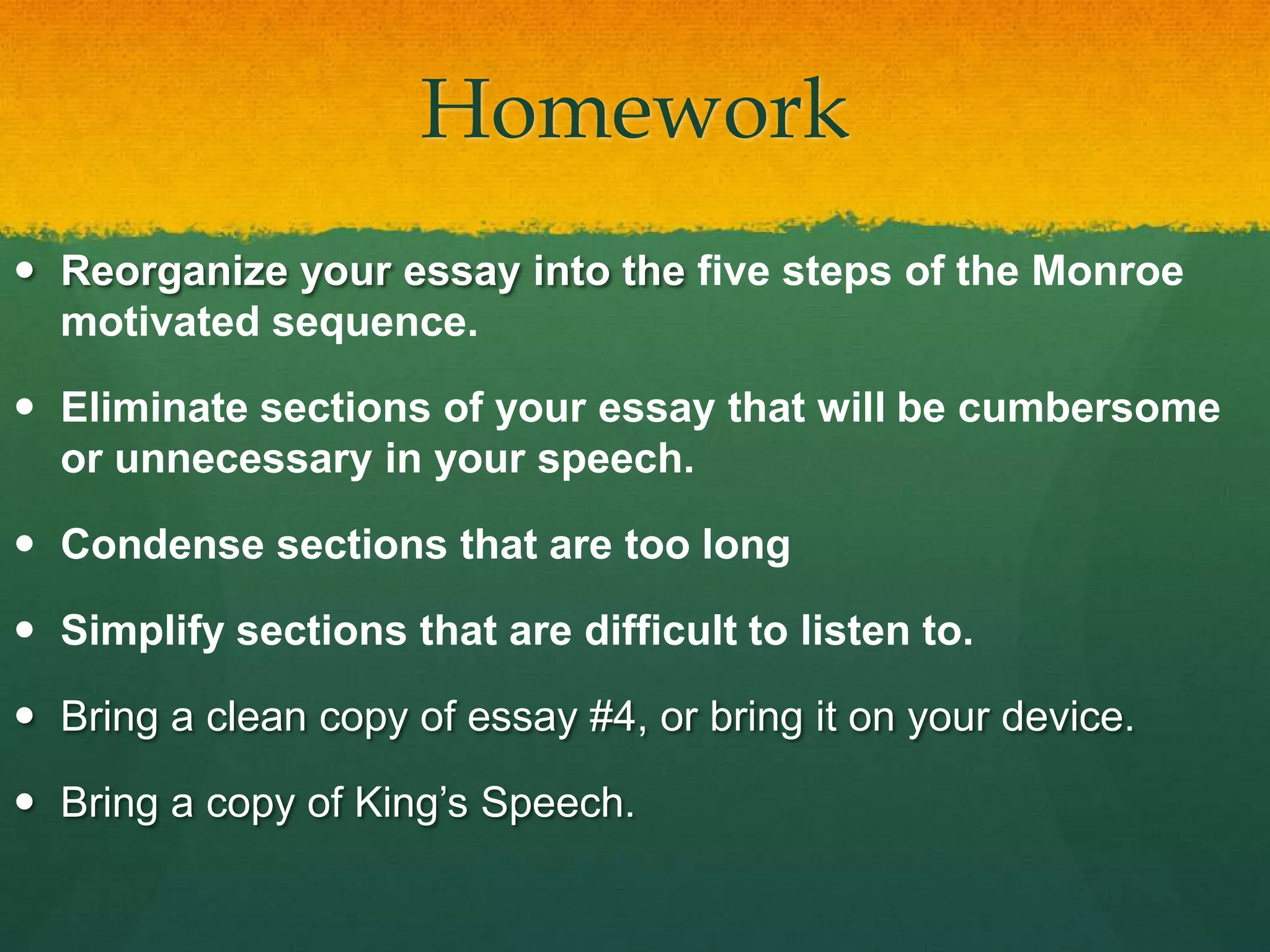
Homework
 Reorganize your essay into the five steps of the Monroe
motivated sequence.
 Eliminate sections of your essay that will be cumbersome
or unnecessary in your speech.
 Condense sections that are too long
 Simplify sections that are difficult to listen to.
 Bring a clean copy of essay #4, or bring it on your device.
 Bring a copy of King’s Speech.

Class 19

  • 1.
  • 2.
    Make-up Vocabulary Exam  Youmay take or re-take any one exam (1-5).  Let me know which one you want.  You have 15 minutes to finish the Exam.  May the odds be ever in your favor!
  • 3.
    AGENDA  Essay #4was due before class today.  Introduction to Essay #5  Martin Luther King’s “I Have A Dream” Speech.  Organizing your speech
  • 4.
    Essay #5: Proposinga Solution  Assignment: 100 points: Write a speech 700-800 words in length (five to six minutes of presentation).  Prompt: Write a speech (based on essay #4) proposing a solution to a well-defined problem faced by a community or group to which you may belong. Alternatively, you may address a well-defined problem faced by one of the districts or communities in The Hunger Games. Address your proposal to your audience: one or more members of the group, its leadership, or to outsiders who may be able to contribute to solving the problem. Present your speech to the class to convince them that your ideas are correct.
  • 5.
     You willturn in a hard copy of your formal speech (MLA style) on the first speech day.  You will perform your speech in class.  Speech Form:  You may give your presentation as a formal speech; in other words, you may read in front of the class.  You may video yourself, put up the video on YouTube, and then show it during class.  You may combine the two methods; for example, you may play a video in the background as you talk to the class.  You may engage others in your presentation as long as they have a clear role in what you are doing.  You may suggest another form.
  • 6.
    Martin Luther KingJr. has now been dead longer than he lived. But what an extraordinary life it was.  At 33, he was pressing the case of civil rights with President John Kennedy. At 34, he galvanized the nation with his "I Have a Dream" speech. At 35, he won the Nobel Peace Prize. At 39, he was assassinated, but he left a legacy of hope and inspiration that continues today.  King's most famous speech, "I Have a Dream," was delivered in 1963 at the March on Washington, one of the largest political rallies for human rights in United States history; it called for civil and economic rights for African Americans.
  • 7.
    “I Have aDream” Dr. Martin Luther King, Jr.
  • 8.
    The Problem  Whatis the problem that King identifies for his listeners?
  • 9.
    The Problem  “Butone hundred years later, we must face the tragic fact that the Negro is still not free. One hundred years later, the life of the Negro is still sadly crippled by the manacles of segregation and the chains of discrimination. One hundred years later, the Negro lives on a lonely island of poverty in the midst of a vast ocean of material prosperity. One hundred years later, the Negro is still languishing in the corners of American society and finds himself an exile in his own land.”
  • 10.
    The Solution  Whatis his solution? Can you find his thesis here?
  • 11.
    The Solution  Histhesis (or purpose) statement is that now is the time for equality: Now is the time to rise from the dark and desolate valley of segregation to the sunlit path of racial justice. Now is the time to open the doors of opportunity to all of God's children. Now is the time to lift our nation from the quicksands of racial injustice to the solid rock of brotherhood.
  • 12.
    King‟s Strategies  Kinguses a variety of strategies in his speech:  Establishment of Authority  Logic and reasoning  Appeal to Emotions  Through rhetorical strategies  Simile  Metaphor  Personification  Allusion  But he also uses an organizational strategy that works to captivate the audience.
  • 13.
    King followed Monroe‟sMotivated Sequence: A Method in Five Steps!  The five steps of the Monroe motivated sequence  attention  need  satisfaction  visualization  action
  • 14.
    The Attention Step In the attention step, speakers call attention to the situation. King, speaking from the steps of the Lincoln Memorial, calls attention to Lincoln‟s signing of the Emancipation Proclamation, the situation of the Negro today (“One hundred years later, the Negro still is not free.”), and the fact that the words of the Constitution and Declaration of Independence granting all people the unalienable rights of life, liberty, and the pursuit of happiness have not been fulfilled.
  • 15.
    The Need Step For the need step, speakers describe the difficulty, trouble, distress, crisis, emergency, or urgency. King says, “Instead of honoring this sacred obligation [what the Constitution and Declaration of Independence promise], America has given the Negro people a bad check, a check that has come back marked „insufficient funds.‟” And why have they come to Washington, D.C.? — to “remind America of the fierce urgency of now.”
  • 16.
    The Satisfaction Step In the satisfaction step, speakers tell listeners how to satisfy the need they establish. King says, “We must make the pledge that we shall always march ahead.” To march ahead, he said, “We can never be satisfied.” Then he tells listeners to go back home knowing their situation can and will be changed.
  • 17.
    The Visualization Step Forvisualization, speakers offer listeners a vision of what life can be once their solution (offered in the satisfaction step) is adopted. This is where King offers listeners his dream: “I have a dream” offered along with five different descriptions of what life can and will be like in Georgia, Mississippi, Alabama, in communities, and around the world.
  • 18.
    The Action Step Thefinal stage is the action step when speakers offer listeners a specific course of action to follow. King‟s action step occurs when he asks his audience to “Let freedom ring,” and he uses the phrase at the end of the speech focusing on eight states symbolizing the whole nation.
  • 19.
    ORGANIZE YOUR SPEECH GETOUT YOUR ESSAY #4
  • 20.
    Side by Side EssayOutline I. Presentation of the problem A. Its existence B. Its seriousness C. Its causes II. Consequences of failing to solve the problem III. Description of the proposed solution IV. List of steps for implementing the solution V. Reasons and support for the solution A. Acknowledgment of objections B. Accommodation or refutation of objections VI. Consideration of alternative solutions and their disadvantages VII. Restatement of the proposed solution and its advantages VII. End with an inspiring call to action. Speech Outline I. In the attention step, speakers call attention to the situation. (The Problem) II. For the need step, speakers describe the difficulty, trouble, distress, crisis, emergency, or urgency. (Its Seriousness) III. In the satisfaction step, speakers tell listeners how to satisfy the need they establish. (The Solution) IV. For visualization, speakers offer listeners a vision of what life can be once their solution (offered in the satisfaction step) is adopted. (The Promise) V. The final stage is the action step when speakers offer listeners a specific course of action to follow. (Call to Action: Conclusion)
  • 21.
    Speeches Speeches will bethe last two meeting days. Everyone should be prepared to go first. Everyone must show up on both days to get full credit for a speech. Failing to show up on one day will result in a full grade penalty.
  • 22.
    Homework  Reorganize youressay into the five steps of the Monroe motivated sequence.  Eliminate sections of your essay that will be cumbersome or unnecessary in your speech.  Condense sections that are too long  Simplify sections that are difficult to listen to.  Bring a clean copy of essay #4, or bring it on your device.  Bring a copy of King’s Speech.