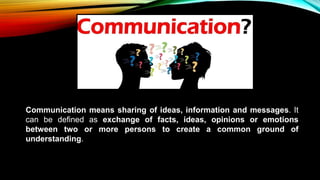
Communication means sharing of ideas, information and messages. It
can be defined as exchange of facts, ideas, opinions or emotions
between two or more persons to create a common ground of
understanding.
Verbal Communication
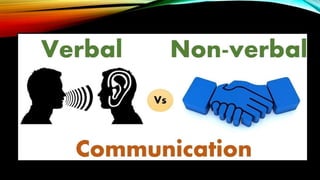
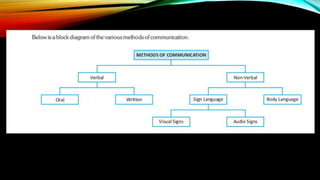
Verbal communication means sharing information with the help of words –
spoken or written. It is what most people use as a method of
communication.
The important forms of verbal communication are :
1. Oral Communication
2. Written Communication
Oral or Spoken Communication
Oral communication is the mode of communication in which messages are
communicated between the sender and receiver through spoken words.
Need for learning Oral Communication Skills
For a successful life, it is not enough to just speak, talk or discuss a matter.
More important is how you talk, discuss or speak.
Thus, oral communication skills are a must for success.
Written Communication
Communication which involves written or typed words is called written
communication.
Sometimes written communication is better than oral communication because it can be edited
and revised several times before it is sent, to
ensure the content is most effective, whereas oral communication can be spontaneous
Methods Of Written Communication
E-mails
Reports
Notes
Orders
Letters notices minutes of the meeting circulars
Notifications quotations mailers books
Enquiries newspapers complaints forms
Advantages and Disadvantages Of Verbal Communication
There are advantages as well as disadvantages of verbal communication.
Advantages Of Verbal Communication
1. Verbal communication is always easy and fast. One can express what one
wants and get a quick reply.
2. In terms of flexibility also, verbal communication is better than any other
form of communication as one can discuss different aspects of an issue
and make decisions more quickly.
3. Verbal communication boosts up the morale of the concerned persons and
maintains energy and enthusiasm within a team.
Disadvantages Of Verbal Communication
Where there are advantages of verbal communication, there are certain
disadvantages too. Some of the disadvantages are as follows :
1. Style of writing or speaking is the soul of any content and matters a lot
in verbal communication. Sometimes, people are very good at their
work but are unable to express themselves effectively. As a result,
they
are unable to make a mark. This affects their reputation also.
2. The other disadvantage of verbal communication is the cultural
differences between the sender and receiver of the information.
Handling Stage Fright
The following strategies can be used to control and reduce stage fright and
make an individual a confident and effective speaker.
1.Concentrate on the Three P's : Prepare, Practice and Perform
2. No Negative Thoughts : Negative thoughts sometimes create more
anxiety. Avoid thoughts such as “I am a
failure”, “I can't speak in front of a crowd”,
“My topic is boring”, “I am not fully prepared”.
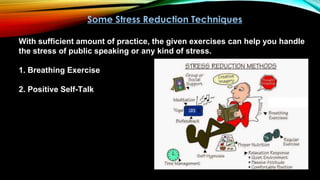
Some Stress Reduction Techniques
With sufficient amount of practice, the given exercises can help you handle
the stress of public speaking or any kind of stress.
1. Breathing Exercise
2. Positive Self-Talk
Session 2
NON-VERBAL COMMUNICATION
When communication occurs without using words, it is known as non-verbal
communication.
Importance Of Non- verbal Communication
In our day-to-day life, most communication is done using body movements
like facial expressions, hand movements, etc., and voice control like tone of
speech, pauses after a sentence or a phrase, etc.
Types of Non-verbal Communication
Non-verbal communication is divided into three types :
1. Auditory Method
2. Body Language Method
3. Visual Method
Auditory Method
The method which can be heard is called the auditory method. for example,
the ringing of a bell, a whistle by the conductor of a bus
Body Language
It plays an important role in oral communication. Body language can be
divided into the following types :
(a) Kinesics
(b) Oculesics
(c) Touch
(d) Space
(e) Appearance
Kinesics :
Kinesics includes certain body movements and gestures that serve as a
form of non-verbal communication. For example, facial expressions,
gestures, postures, handshakes, arms, etc.
Oculesics :
Eye contact indicates interest, openness and sometimes even
aggression. Even lack of eye contact conveys a message.
Touch :
We communicate much through touch. When a teacher or a parent pats
the shoulder of a student or his/her kids, it shows appreciation.
Space :
Space also speaks. It shows how intimate the other person is with you.
Appearance :
Whatever you carry or wear speaks a lot about your personality,
especially your dressing sense, has the greatest impact with respect to
influencing others.
Visual Methods
Another important method of communication is visual communication
which involves sending and comprehending messages only through
images or pictures. The main benefit of visual communication is that
you do not need to know any particular language.
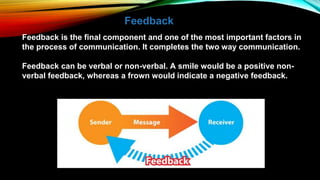
Feedback is the final component and one of the most important factors in
the process of communication. It completes the two way communication.
Feedback can be verbal or non-verbal. A smile would be a positive non-
verbal feedback, whereas a frown would indicate a negative feedback.
Feedback
Effective feedback needs to be
Clear:
The feedback should be clear to represent the understanding.
Well-timed:
Feedback may not be instant. But, much delayed feedback may not be
worthwhile or even may not serve any purpose at all.
Specific:
For a feedback to be effective, it must be specific.
Bearing Right Attitude:
Both undermining attitude of the sender and fault-finding attitude of the
receiver should be avoided to make the feedback effective.
Truly Representative:
Feedback may be positive or negative. One should not hesitate to
convey negative feedback.
Informative:
The feedback must be informative, as the receiver of a message
expects from the sender some information in the form of feedback
which the receiver does not already know. Whatever may be the
mode (i.e., verbal, non-verbal or written), feedback is very important
Impersonal:
Feedback, to be effective, should be free from personal reactions.
Some of the advantages of feedback are highlighted below.
1. Feedback is effective listening
2. Feedback can motivate
3. Feedback leads to problem solving
4.Feedback can improve performance
5.Better Understanding
6.Creating healthy relations
7. Effective coordination
Barriers to Effective Communication
Factors responsible for communication Barrier
• Language
• Visual Perception
• Past Experience
• Prejudice
• Feelings
• Mechanical Factors and Personal Factors
Types of Barriers In Communication
There are different types of barriers to effective communication that prevent
accurate exchange of ideas or carry incorrect meaning. It can create
misunderstandings.
• Linguistic Barriers
• Psychological and Emotional Barriers
• Physical Barriers
• Physiological Barriers
• Attitudinal Barriers and Cultural Barriers
Measures To Overcome Barriers In Effective Communication
• Active Listening
• Use of simple language
• Clear thoughts, concise and logical presentation
• Analyse and recognise the need of the receiver
• Reduction and elimination of physical barrier
• Technical glitches in communication medium
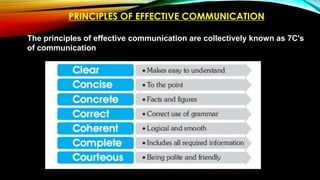
PRINCIPLES OF EFFECTIVE COMMUNICATION
The principles of effective communication are collectively known as 7C's
of communication

Class 10_IT402 Communication Skills.pptx

  • 1.
    Communication means sharingof ideas, information and messages. It can be defined as exchange of facts, ideas, opinions or emotions between two or more persons to create a common ground of understanding.
  • 4.
    Verbal Communication Verbal communicationmeans sharing information with the help of words – spoken or written. It is what most people use as a method of communication. The important forms of verbal communication are : 1. Oral Communication 2. Written Communication
  • 5.
    Oral or SpokenCommunication Oral communication is the mode of communication in which messages are communicated between the sender and receiver through spoken words. Need for learning Oral Communication Skills For a successful life, it is not enough to just speak, talk or discuss a matter. More important is how you talk, discuss or speak. Thus, oral communication skills are a must for success.
  • 6.
    Written Communication Communication whichinvolves written or typed words is called written communication. Sometimes written communication is better than oral communication because it can be edited and revised several times before it is sent, to ensure the content is most effective, whereas oral communication can be spontaneous Methods Of Written Communication E-mails Reports Notes Orders Letters notices minutes of the meeting circulars Notifications quotations mailers books Enquiries newspapers complaints forms
  • 7.
    Advantages and DisadvantagesOf Verbal Communication There are advantages as well as disadvantages of verbal communication. Advantages Of Verbal Communication 1. Verbal communication is always easy and fast. One can express what one wants and get a quick reply. 2. In terms of flexibility also, verbal communication is better than any other form of communication as one can discuss different aspects of an issue and make decisions more quickly. 3. Verbal communication boosts up the morale of the concerned persons and maintains energy and enthusiasm within a team.
  • 8.
    Disadvantages Of VerbalCommunication Where there are advantages of verbal communication, there are certain disadvantages too. Some of the disadvantages are as follows : 1. Style of writing or speaking is the soul of any content and matters a lot in verbal communication. Sometimes, people are very good at their work but are unable to express themselves effectively. As a result, they are unable to make a mark. This affects their reputation also. 2. The other disadvantage of verbal communication is the cultural differences between the sender and receiver of the information.
  • 9.
    Handling Stage Fright Thefollowing strategies can be used to control and reduce stage fright and make an individual a confident and effective speaker. 1.Concentrate on the Three P's : Prepare, Practice and Perform 2. No Negative Thoughts : Negative thoughts sometimes create more anxiety. Avoid thoughts such as “I am a failure”, “I can't speak in front of a crowd”, “My topic is boring”, “I am not fully prepared”.
  • 10.
    Some Stress ReductionTechniques With sufficient amount of practice, the given exercises can help you handle the stress of public speaking or any kind of stress. 1. Breathing Exercise 2. Positive Self-Talk
  • 11.
    Session 2 NON-VERBAL COMMUNICATION Whencommunication occurs without using words, it is known as non-verbal communication. Importance Of Non- verbal Communication In our day-to-day life, most communication is done using body movements like facial expressions, hand movements, etc., and voice control like tone of speech, pauses after a sentence or a phrase, etc.
  • 12.
    Types of Non-verbalCommunication Non-verbal communication is divided into three types : 1. Auditory Method 2. Body Language Method 3. Visual Method Auditory Method The method which can be heard is called the auditory method. for example, the ringing of a bell, a whistle by the conductor of a bus
  • 13.
    Body Language It playsan important role in oral communication. Body language can be divided into the following types : (a) Kinesics (b) Oculesics (c) Touch (d) Space (e) Appearance Kinesics : Kinesics includes certain body movements and gestures that serve as a form of non-verbal communication. For example, facial expressions, gestures, postures, handshakes, arms, etc.
  • 14.
    Oculesics : Eye contactindicates interest, openness and sometimes even aggression. Even lack of eye contact conveys a message. Touch : We communicate much through touch. When a teacher or a parent pats the shoulder of a student or his/her kids, it shows appreciation. Space : Space also speaks. It shows how intimate the other person is with you. Appearance : Whatever you carry or wear speaks a lot about your personality, especially your dressing sense, has the greatest impact with respect to influencing others.
  • 15.
    Visual Methods Another importantmethod of communication is visual communication which involves sending and comprehending messages only through images or pictures. The main benefit of visual communication is that you do not need to know any particular language.
  • 16.
    Feedback is thefinal component and one of the most important factors in the process of communication. It completes the two way communication. Feedback can be verbal or non-verbal. A smile would be a positive non- verbal feedback, whereas a frown would indicate a negative feedback. Feedback
  • 17.
    Effective feedback needsto be Clear: The feedback should be clear to represent the understanding. Well-timed: Feedback may not be instant. But, much delayed feedback may not be worthwhile or even may not serve any purpose at all. Specific: For a feedback to be effective, it must be specific. Bearing Right Attitude: Both undermining attitude of the sender and fault-finding attitude of the receiver should be avoided to make the feedback effective.
  • 18.
    Truly Representative: Feedback maybe positive or negative. One should not hesitate to convey negative feedback. Informative: The feedback must be informative, as the receiver of a message expects from the sender some information in the form of feedback which the receiver does not already know. Whatever may be the mode (i.e., verbal, non-verbal or written), feedback is very important Impersonal: Feedback, to be effective, should be free from personal reactions.
  • 19.
    Some of theadvantages of feedback are highlighted below. 1. Feedback is effective listening 2. Feedback can motivate 3. Feedback leads to problem solving 4.Feedback can improve performance 5.Better Understanding 6.Creating healthy relations 7. Effective coordination
  • 20.
    Barriers to EffectiveCommunication Factors responsible for communication Barrier • Language • Visual Perception • Past Experience • Prejudice • Feelings • Mechanical Factors and Personal Factors
  • 21.
    Types of BarriersIn Communication There are different types of barriers to effective communication that prevent accurate exchange of ideas or carry incorrect meaning. It can create misunderstandings. • Linguistic Barriers • Psychological and Emotional Barriers • Physical Barriers • Physiological Barriers • Attitudinal Barriers and Cultural Barriers
  • 22.
    Measures To OvercomeBarriers In Effective Communication • Active Listening • Use of simple language • Clear thoughts, concise and logical presentation • Analyse and recognise the need of the receiver • Reduction and elimination of physical barrier • Technical glitches in communication medium
  • 23.
    PRINCIPLES OF EFFECTIVECOMMUNICATION The principles of effective communication are collectively known as 7C's of communication