ODE TO THE WEST WIND
BY
P.B. SHELLY
Born : 1792, Horshom in Sussex
Education : Eton and University College Oxford
Spouse : Harriet Westbrook – 1811
Mary Shelley – 1814
Speciality : English Romantic poet, finest lyric,
epic, poets in the English language.
Dead : 8 July 1822, Italy
 Spirit of solitude – 1816
 The Cenci – 1819
 Witches of Atlas – 1820
 Defence of poetry – 1821
O wild West Wind, thou breath of Autumn's being,
Thou, from whose unseen presence the leaves dead
Are driven, like ghosts from an enchanter fleeing,
Yellow, and black, and pale, and hectic red,
Pestilence-stricken multitudes: O thou,
Who chariotest to their dark wintry bed
The winged seeds, where they lie cold and low,
Each like a corpse within its grave, until
Thine azure sister of the Spring shall blow
Her clarion o'er the dreaming earth, and fill
(Driving sweet buds like flocks to feed in air)
With living hues and odours plain and hill:
Wild Spirit, which art moving everywhere;
Destroyer and preserver; hear, oh hear!
 West wind – action over the land.
 Description – How the wind blow over the
leaves of various colors to make them fall.
 West wind portrayed as Destroyer and
Preserver.
 Reason : Makes leaves to fall - Destroyer and
Carrying the seeds and Burying – Preserver .
 Poet mention spring, upon arrival the valley
will filled with vibrant colors and pleasant
smells.
Thou on whose stream, mid the steep sky's commotion,
Loose clouds like earth's decaying leaves are shed,
Shook from the tangled boughs of Heaven and Ocean,
Angels of rain and lightning: there are spread
On the blue surface of thine airy surge,
Like the bright hair uplifted from the head
Of some fierce Maenad, even from the dim verge
Of the horizon to the zenith's height,
The locks of the approaching storm. Thou dirge
Of the dying year, to which this closing night
Will be the dome of a vast sepulchre,
Vaulted with all thy congregated might
Of vapours, from whose solid atmosphere
Black rain, and fire, and hail will burst: oh hear!
 West wind – action over the sky.
 Description – the arrival of the west wind as
coming together of clouds and approaching
storms.
 Wind is depicted as the messenger of thunder
and lightening.
 Presents – west wind as the funeral song of the
dying year and asks it to listen to him.
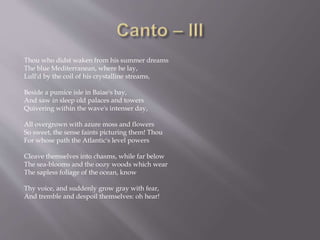
Thou who didst waken from his summer dreams
The blue Mediterranean, where he lay,
Lull'd by the coil of his crystalline streams,
Beside a pumice isle in Baiae's bay,
And saw in sleep old palaces and towers
Quivering within the wave's intenser day,
All overgrown with azure moss and flowers
So sweet, the sense faints picturing them! Thou
For whose path the Atlantic's level powers
Cleave themselves into chasms, while far below
The sea-blooms and the oozy woods which wear
The sapless foliage of the ocean, know
Thy voice, and suddenly grow gray with fear,
And tremble and despoil themselves: oh hear!
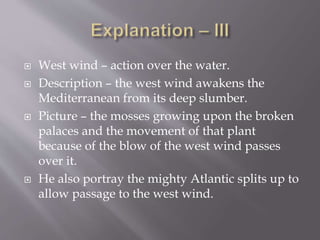
 West wind – action over the water.
 Description – the west wind awakens the
Mediterranean from its deep slumber.
 Picture – the mosses growing upon the broken
palaces and the movement of that plant
because of the blow of the west wind passes
over it.
 He also portray the mighty Atlantic splits up to
allow passage to the west wind.
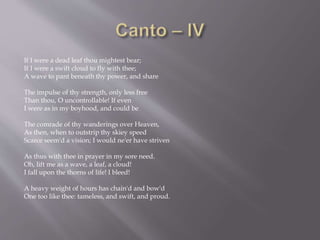
If I were a dead leaf thou mightest bear;
If I were a swift cloud to fly with thee;
A wave to pant beneath thy power, and share
The impulse of thy strength, only less free
Than thou, O uncontrollable! If even
I were as in my boyhood, and could be
The comrade of thy wanderings over Heaven,
As then, when to outstrip thy skiey speed
Scarce seem'd a vision; I would ne'er have striven
As thus with thee in prayer in my sore need.
Oh, lift me as a wave, a leaf, a cloud!
I fall upon the thorns of life! I bleed!
A heavy weight of hours has chain'd and bow'd
One too like thee: tameless, and swift, and proud.
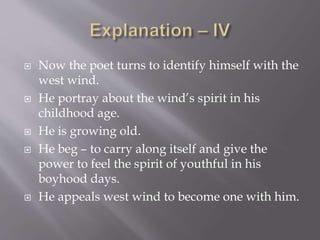
 Now the poet turns to identify himself with the
west wind.
 He portray about the wind’s spirit in his
childhood age.
 He is growing old.
 He beg – to carry along itself and give the
power to feel the spirit of youthful in his
boyhood days.
 He appeals west wind to become one with him.
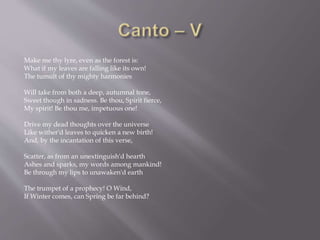
Make me thy lyre, even as the forest is:
What if my leaves are falling like its own!
The tumult of thy mighty harmonies
Will take from both a deep, autumnal tone,
Sweet though in sadness. Be thou, Spirit fierce,
My spirit! Be thou me, impetuous one!
Drive my dead thoughts over the universe
Like wither'd leaves to quicken a new birth!
And, by the incantation of this verse,
Scatter, as from an unextinguish'd hearth
Ashes and sparks, my words among mankind!
Be through my lips to unawaken'd earth
The trumpet of a prophecy! O Wind,
If Winter comes, can Spring be far behind?
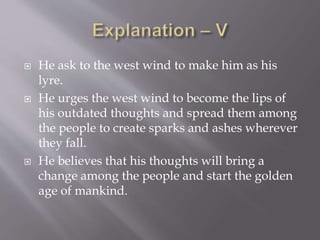
 He ask to the west wind to make him as his
lyre.
 He urges the west wind to become the lips of
his outdated thoughts and spread them among
the people to create sparks and ashes wherever
they fall.
 He believes that his thoughts will bring a
change among the people and start the golden
age of mankind.
ODE TO THE WEST WIND
BY
P.B. SHELLY
A figure of speech
involving the
comparison of one thing
with another thing of a
different kind, used to
make a description more
emphatic or vivid.
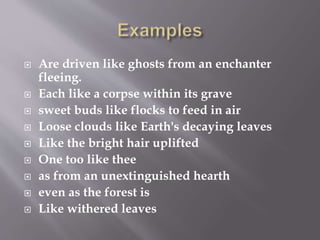
 Are driven like ghosts from an enchanter
fleeing.
 Each like a corpse within its grave
 sweet buds like flocks to feed in air
 Loose clouds like Earth's decaying leaves
 Like the bright hair uplifted
 One too like thee
 as from an unextinguished hearth
 even as the forest is
 Like withered leaves
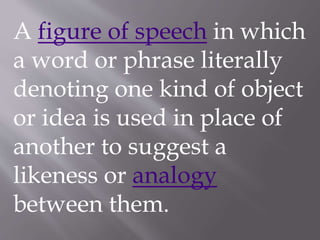
A figure of speech in which
a word or phrase literally
denoting one kind of object
or idea is used in place of
another to suggest a
likeness or analogy
between them.
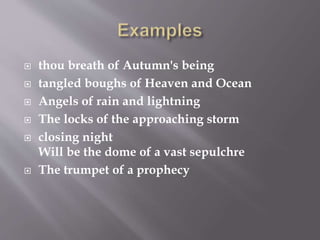
 thou breath of Autumn's being
 tangled boughs of Heaven and Ocean
 Angels of rain and lightning
 The locks of the approaching storm
 closing night
Will be the dome of a vast sepulchre
 The trumpet of a prophecy
The attribution of a
personal nature or human
characteristics to
something non-human, or
the representation of an
abstract quality in human
form.
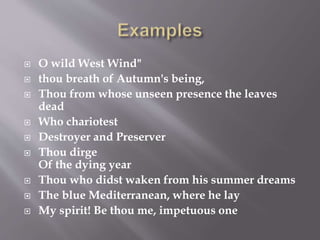
 O wild West Wind"
 thou breath of Autumn's being,
 Thou from whose unseen presence the leaves
dead
 Who chariotest
 Destroyer and Preserver
 Thou dirge
Of the dying year
 Thou who didst waken from his summer dreams
 The blue Mediterranean, where he lay
 My spirit! Be thou me, impetuous one
A mark or
character used as a
conventional
representation of
an object, function,
or process.
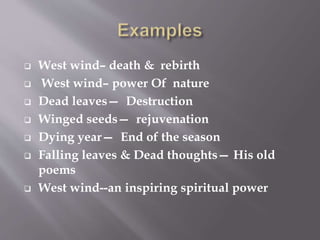
 West wind– death & rebirth
 West wind– power Of nature
 Dead leaves— Destruction
 Winged seeds— rejuvenation
 Dying year— End of the season
 Falling leaves & Dead thoughts— His old
poems
 West wind--an inspiring spiritual power
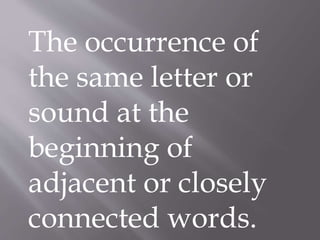
The occurrence of
the same letter or
sound at the
beginning of
adjacent or closely
connected words.
 O wild West Wind"
 the leaves dead
 Are driven
 Thou dirge
Of the dying year
 in Baiae's bay,
 grow grey with fear,
 when to outstrip thy skiey speed
 Scarce seemed a vision
BY
ANTO H
14ENG03

Ode to the west wind ppt

  • 1.
    ODE TO THEWEST WIND BY P.B. SHELLY
  • 2.
    Born : 1792,Horshom in Sussex Education : Eton and University College Oxford Spouse : Harriet Westbrook – 1811 Mary Shelley – 1814 Speciality : English Romantic poet, finest lyric, epic, poets in the English language. Dead : 8 July 1822, Italy
  • 3.
     Spirit ofsolitude – 1816  The Cenci – 1819  Witches of Atlas – 1820  Defence of poetry – 1821
  • 4.
    O wild WestWind, thou breath of Autumn's being, Thou, from whose unseen presence the leaves dead Are driven, like ghosts from an enchanter fleeing, Yellow, and black, and pale, and hectic red, Pestilence-stricken multitudes: O thou, Who chariotest to their dark wintry bed The winged seeds, where they lie cold and low, Each like a corpse within its grave, until Thine azure sister of the Spring shall blow Her clarion o'er the dreaming earth, and fill (Driving sweet buds like flocks to feed in air) With living hues and odours plain and hill: Wild Spirit, which art moving everywhere; Destroyer and preserver; hear, oh hear!
  • 5.
     West wind– action over the land.  Description – How the wind blow over the leaves of various colors to make them fall.  West wind portrayed as Destroyer and Preserver.  Reason : Makes leaves to fall - Destroyer and Carrying the seeds and Burying – Preserver .  Poet mention spring, upon arrival the valley will filled with vibrant colors and pleasant smells.
  • 6.
    Thou on whosestream, mid the steep sky's commotion, Loose clouds like earth's decaying leaves are shed, Shook from the tangled boughs of Heaven and Ocean, Angels of rain and lightning: there are spread On the blue surface of thine airy surge, Like the bright hair uplifted from the head Of some fierce Maenad, even from the dim verge Of the horizon to the zenith's height, The locks of the approaching storm. Thou dirge Of the dying year, to which this closing night Will be the dome of a vast sepulchre, Vaulted with all thy congregated might Of vapours, from whose solid atmosphere Black rain, and fire, and hail will burst: oh hear!
  • 7.
     West wind– action over the sky.  Description – the arrival of the west wind as coming together of clouds and approaching storms.  Wind is depicted as the messenger of thunder and lightening.  Presents – west wind as the funeral song of the dying year and asks it to listen to him.
  • 8.
    Thou who didstwaken from his summer dreams The blue Mediterranean, where he lay, Lull'd by the coil of his crystalline streams, Beside a pumice isle in Baiae's bay, And saw in sleep old palaces and towers Quivering within the wave's intenser day, All overgrown with azure moss and flowers So sweet, the sense faints picturing them! Thou For whose path the Atlantic's level powers Cleave themselves into chasms, while far below The sea-blooms and the oozy woods which wear The sapless foliage of the ocean, know Thy voice, and suddenly grow gray with fear, And tremble and despoil themselves: oh hear!
  • 9.
     West wind– action over the water.  Description – the west wind awakens the Mediterranean from its deep slumber.  Picture – the mosses growing upon the broken palaces and the movement of that plant because of the blow of the west wind passes over it.  He also portray the mighty Atlantic splits up to allow passage to the west wind.
  • 10.
    If I werea dead leaf thou mightest bear; If I were a swift cloud to fly with thee; A wave to pant beneath thy power, and share The impulse of thy strength, only less free Than thou, O uncontrollable! If even I were as in my boyhood, and could be The comrade of thy wanderings over Heaven, As then, when to outstrip thy skiey speed Scarce seem'd a vision; I would ne'er have striven As thus with thee in prayer in my sore need. Oh, lift me as a wave, a leaf, a cloud! I fall upon the thorns of life! I bleed! A heavy weight of hours has chain'd and bow'd One too like thee: tameless, and swift, and proud.
  • 11.
     Now thepoet turns to identify himself with the west wind.  He portray about the wind’s spirit in his childhood age.  He is growing old.  He beg – to carry along itself and give the power to feel the spirit of youthful in his boyhood days.  He appeals west wind to become one with him.
  • 12.
    Make me thylyre, even as the forest is: What if my leaves are falling like its own! The tumult of thy mighty harmonies Will take from both a deep, autumnal tone, Sweet though in sadness. Be thou, Spirit fierce, My spirit! Be thou me, impetuous one! Drive my dead thoughts over the universe Like wither'd leaves to quicken a new birth! And, by the incantation of this verse, Scatter, as from an unextinguish'd hearth Ashes and sparks, my words among mankind! Be through my lips to unawaken'd earth The trumpet of a prophecy! O Wind, If Winter comes, can Spring be far behind?
  • 13.
     He askto the west wind to make him as his lyre.  He urges the west wind to become the lips of his outdated thoughts and spread them among the people to create sparks and ashes wherever they fall.  He believes that his thoughts will bring a change among the people and start the golden age of mankind.
  • 14.
    ODE TO THEWEST WIND BY P.B. SHELLY
  • 16.
    A figure ofspeech involving the comparison of one thing with another thing of a different kind, used to make a description more emphatic or vivid.
  • 17.
     Are drivenlike ghosts from an enchanter fleeing.  Each like a corpse within its grave  sweet buds like flocks to feed in air  Loose clouds like Earth's decaying leaves  Like the bright hair uplifted  One too like thee  as from an unextinguished hearth  even as the forest is  Like withered leaves
  • 19.
    A figure ofspeech in which a word or phrase literally denoting one kind of object or idea is used in place of another to suggest a likeness or analogy between them.
  • 20.
     thou breathof Autumn's being  tangled boughs of Heaven and Ocean  Angels of rain and lightning  The locks of the approaching storm  closing night Will be the dome of a vast sepulchre  The trumpet of a prophecy
  • 22.
    The attribution ofa personal nature or human characteristics to something non-human, or the representation of an abstract quality in human form.
  • 23.
     O wildWest Wind"  thou breath of Autumn's being,  Thou from whose unseen presence the leaves dead  Who chariotest  Destroyer and Preserver  Thou dirge Of the dying year  Thou who didst waken from his summer dreams  The blue Mediterranean, where he lay  My spirit! Be thou me, impetuous one
  • 25.
    A mark or characterused as a conventional representation of an object, function, or process.
  • 26.
     West wind–death & rebirth  West wind– power Of nature  Dead leaves— Destruction  Winged seeds— rejuvenation  Dying year— End of the season  Falling leaves & Dead thoughts— His old poems  West wind--an inspiring spiritual power
  • 28.
    The occurrence of thesame letter or sound at the beginning of adjacent or closely connected words.
  • 29.
     O wildWest Wind"  the leaves dead  Are driven  Thou dirge Of the dying year  in Baiae's bay,  grow grey with fear,  when to outstrip thy skiey speed  Scarce seemed a vision
  • 30.