
Introduction to  Classical Mythology Dr. Michael Broder University of South Carolina February 21, 2012
Please write your Daily Write on a complete sheet of paper, not a half sheet, and not a sheet with other Daily Writes already on it. Violators will be docked 1 point no matter how good their answer is. Starting TODAY
If you leave the room early, I will ask for your name and deduct 1 point from your Daily Write. If it’s an emergency we can discuss it at another time. But I know it is usually NOT an emergency. And I will not tolerate it without a penalty.
Daily Write #11: Review At  Odyssey  19.463-464, Autolycus, father of Anticleia, tells Anticleia and Laertes to name their newborn son Odysseus … the Son of Pain, a name he’ll earn in full. Some students suggested that Autolycus meant the name to indicate the pain that Odysseus will give others, but that in the end it refers more to the pain Odysseus suffers at the hands of others
Daily Write #12 At  Odyssey  23.198, Penelope orders Eurycleia to “M o ve the sturdy bedstead out of our bridal chamber. ”  How does Odysseus react when he hears this request, and why? How does this episode relate to Homer’s earlier descriptions of beds and sleeping arrangements? How does Homer relate the poetic theme of beds to the cultural values of marriage and family? Be sure to support your answer with examples that show familiarity with the text (what is special about the construction of this particular bed?).
Daily Write #12: Review How does Odysseus react when he hears this request, and why? He gets angry because he knows the bed cannot be moved without destroying it; it is constructed around an olive tree that remains rooted in the ground How does this episode relate to Homer’s earlier descriptions of beds and sleeping arrangements? Unmarried people like Telemachus and Nausicaa sleep alone (or with same-sex friends); married couples like Nestor and his wife, Menelaus and Helen, Alcinous and Arete, sleep together. Odysseus and Penelope have slept apart for 20 years How does Homer relate the poetic theme of beds to the cultural values of marriage and family? Beds symbolize the centrality of marriage and family to Homeric society and ancient Greek society Single people generally sleep in the outer part of the house; married couples sleep in an inner room; Odysseus says he built his entire house around the olive tree rooted in the ground
Daily Write #13 What is the major message you take away from the  Odyssey ? By message I do not mean “moral of the story.” Instead, I mean what do you learn from having read the  Odyssey  about the human condition? Of course this question is wide open, but to get full credit, you  must  provide examples from the text to support your response.
Lyric Poets Today’s Readings in ACM Archilochus, page 58 Pindar, pages 356-360 Sappho, pages 385-386 Semonides, pages 387-390 Simonides, page 391 Xenophanes, pages 433-434
Lyric Poetry Personal speaking voice Sometimes viewed as “the poet” Better viewed as “the speaker” Speaker: Speaking voice of the poem Often a fictional version of the poet who differ from the real-life poet in some ways Can sometimes be completely different from the poet
Sappho’s Prayer to Aphrodite In Sappho’s prayer to Aphrodite, Sappho asks Aphrodite to make the person Sappho loves, love her back
The Epic View of the World Factual, not conceptual Narrative, not logical Concerned with  remembering ,  recognizing ,  recalling Not  concerned with  understanding  or  explaining * *With some exceptions…
Lyric vs Epic? How do the lyric poems you have read compare with the epic poems you have read? Who speaks? What do they speak about? How do they represent gods, heroes, and other mythological figures? How do they represent the real-life human world?
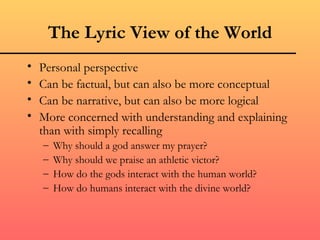
The Lyric View of the World Personal perspective Can be factual, but can also be more conceptual Can be narrative, but can also be more logical More concerned with understanding and explaining than with simply recalling Why should a god answer my prayer? Why should we praise an athletic victor? How do the gods interact with the human world? How do humans interact with the divine world?
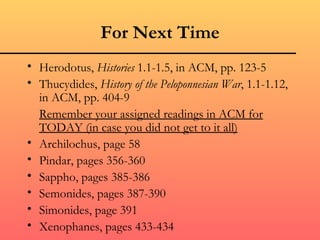
For Next Time Herodotus,  Histories  1.1-1.5, in ACM, pp. 123-5 Thucydides,  History of the Peloponnesian War , 1.1-1.12, in ACM, pp. 404-9 Remember your assigned readings in ACM for TODAY (in case you did not get to it all) Archilochus, page 58 Pindar, pages 356-360 Sappho, pages 385-386 Semonides, pages 387-390 Simonides, page 391 Xenophanes, pages 433-434
Introduction to  Classical Mythology Dr. Michael Broder University of South Carolina February 21, 2012

CLAS220 - Lecture Notes for February 21, 2012

  • 1.
    Introduction to Classical Mythology Dr. Michael Broder University of South Carolina February 21, 2012
  • 2.
    Please write yourDaily Write on a complete sheet of paper, not a half sheet, and not a sheet with other Daily Writes already on it. Violators will be docked 1 point no matter how good their answer is. Starting TODAY
  • 3.
    If you leavethe room early, I will ask for your name and deduct 1 point from your Daily Write. If it’s an emergency we can discuss it at another time. But I know it is usually NOT an emergency. And I will not tolerate it without a penalty.
  • 4.
    Daily Write #11:Review At Odyssey 19.463-464, Autolycus, father of Anticleia, tells Anticleia and Laertes to name their newborn son Odysseus … the Son of Pain, a name he’ll earn in full. Some students suggested that Autolycus meant the name to indicate the pain that Odysseus will give others, but that in the end it refers more to the pain Odysseus suffers at the hands of others
  • 5.
    Daily Write #12At Odyssey 23.198, Penelope orders Eurycleia to “M o ve the sturdy bedstead out of our bridal chamber. ” How does Odysseus react when he hears this request, and why? How does this episode relate to Homer’s earlier descriptions of beds and sleeping arrangements? How does Homer relate the poetic theme of beds to the cultural values of marriage and family? Be sure to support your answer with examples that show familiarity with the text (what is special about the construction of this particular bed?).
  • 6.
    Daily Write #12:Review How does Odysseus react when he hears this request, and why? He gets angry because he knows the bed cannot be moved without destroying it; it is constructed around an olive tree that remains rooted in the ground How does this episode relate to Homer’s earlier descriptions of beds and sleeping arrangements? Unmarried people like Telemachus and Nausicaa sleep alone (or with same-sex friends); married couples like Nestor and his wife, Menelaus and Helen, Alcinous and Arete, sleep together. Odysseus and Penelope have slept apart for 20 years How does Homer relate the poetic theme of beds to the cultural values of marriage and family? Beds symbolize the centrality of marriage and family to Homeric society and ancient Greek society Single people generally sleep in the outer part of the house; married couples sleep in an inner room; Odysseus says he built his entire house around the olive tree rooted in the ground
  • 7.
    Daily Write #13What is the major message you take away from the Odyssey ? By message I do not mean “moral of the story.” Instead, I mean what do you learn from having read the Odyssey about the human condition? Of course this question is wide open, but to get full credit, you must provide examples from the text to support your response.
  • 8.
    Lyric Poets Today’sReadings in ACM Archilochus, page 58 Pindar, pages 356-360 Sappho, pages 385-386 Semonides, pages 387-390 Simonides, page 391 Xenophanes, pages 433-434
  • 9.
    Lyric Poetry Personalspeaking voice Sometimes viewed as “the poet” Better viewed as “the speaker” Speaker: Speaking voice of the poem Often a fictional version of the poet who differ from the real-life poet in some ways Can sometimes be completely different from the poet
  • 10.
    Sappho’s Prayer toAphrodite In Sappho’s prayer to Aphrodite, Sappho asks Aphrodite to make the person Sappho loves, love her back
  • 11.
    The Epic Viewof the World Factual, not conceptual Narrative, not logical Concerned with remembering , recognizing , recalling Not concerned with understanding or explaining * *With some exceptions…
  • 12.
    Lyric vs Epic?How do the lyric poems you have read compare with the epic poems you have read? Who speaks? What do they speak about? How do they represent gods, heroes, and other mythological figures? How do they represent the real-life human world?
  • 13.
    The Lyric Viewof the World Personal perspective Can be factual, but can also be more conceptual Can be narrative, but can also be more logical More concerned with understanding and explaining than with simply recalling Why should a god answer my prayer? Why should we praise an athletic victor? How do the gods interact with the human world? How do humans interact with the divine world?
  • 14.
    For Next TimeHerodotus, Histories 1.1-1.5, in ACM, pp. 123-5 Thucydides, History of the Peloponnesian War , 1.1-1.12, in ACM, pp. 404-9 Remember your assigned readings in ACM for TODAY (in case you did not get to it all) Archilochus, page 58 Pindar, pages 356-360 Sappho, pages 385-386 Semonides, pages 387-390 Simonides, page 391 Xenophanes, pages 433-434
  • 15.
    Introduction to Classical Mythology Dr. Michael Broder University of South Carolina February 21, 2012