 Romanticism – intellectual movement that was
a reaction against the Enlightenment
 Urged a revival of Christianity/Religion
 Liked art, music, and literature of medieval
times
 Used folk tales and medieval art to solidify
nationalism
 Remember, 18th
century….all about
human reason
 Romanticism is
about emotion
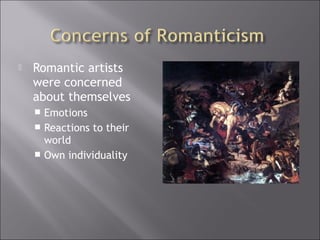
 Romantic artists
were concerned
about themselves
 Emotions
 Reactions to their
world
 Own individuality
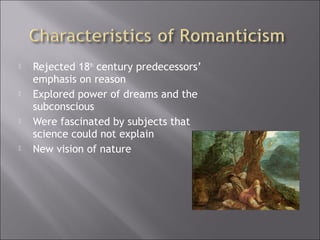
 Rejected 18th
century predecessors’
emphasis on reason
 Explored power of dreams and the
subconscious
 Were fascinated by subjects that
science could not explain
 New vision of nature
 Marveled at the power,
majesty, and inevitability
of nature.
 Natural universe was
mysterious world of its
own
 Believed in “remoteness”
of time or place
 Inspired by ancient British
Druids and medieval
knights
 Percy and Mary Shelley
 Samuel Taylor Coleridge – wrote Gothic poems of the
supernatural
 William Wordsworth – wrote, sometimes with
Coleridge about how humans lose their childlike
imagination as they get older
 Lord Byron – rebel Romanticist, who wrote about
personal liberty and mocked his own beliefs in famous
works such as Don Juan (1819)
 John Keats
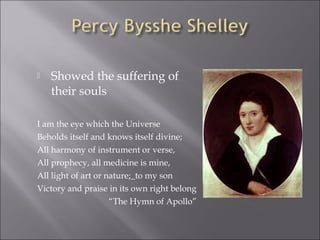
 Showed the suffering of
their souls
I am the eye which the Universe
Beholds itself and knows itself divine;
All harmony of instrument or verse,
All prophecy, all medicine is mine,
All light of art or nature;_to my son
Victory and praise in its own right belong
“The Hymn of Apollo”
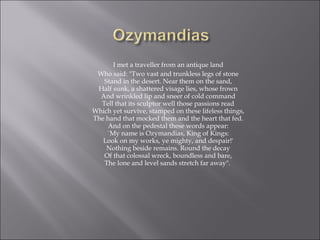
I met a traveller from an antique land
Who said: "Two vast and trunkless legs of stone
Stand in the desert. Near them on the sand,
Half sunk, a shattered visage lies, whose frown
And wrinkled lip and sneer of cold command
Tell that its sculptor well those passions read
Which yet survive, stamped on these lifeless things,
The hand that mocked them and the heart that fed.
And on the pedestal these words appear:
`My name is Ozymandias, King of Kings:
Look on my works, ye mighty, and despair!'
Nothing beside remains. Round the decay
Of that colossal wreck, boundless and bare,
The lone and level sands stretch far away".
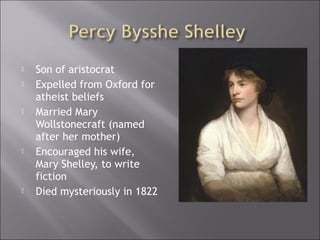
 Son of aristocrat
 Expelled from Oxford for
atheist beliefs
 Married Mary
Wollstonecraft (named
after her mother)
 Encouraged his wife,
Mary Shelley, to write
fiction
 Died mysteriously in 1822
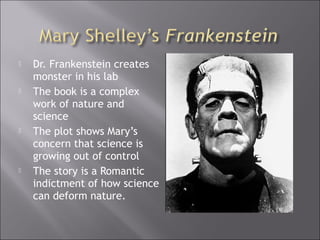
 Dr. Frankenstein creates
monster in his lab
 The book is a complex
work of nature and
science
 The plot shows Mary’s
concern that science is
growing out of control
 The story is a Romantic
indictment of how science
can deform nature.
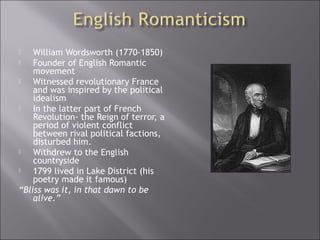
 William Wordsworth (1770-1850)
 Founder of English Romantic
movement
 Witnessed revolutionary France
and was inspired by the political
idealism
 In the latter part of French
Revolution- the Reign of terror, a
period of violent conflict
between rival political factions,
disturbed him.
 Withdrew to the English
countryside
 1799 lived in Lake District (his
poetry made it famous)
“Bliss was it, in that dawn to be
alive.”
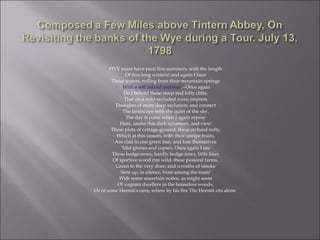
FIVE years have past; five summers, with the length
Of five long winters! and again I hear
These waters, rolling from their mountain-springs
With a soft inland murmur.--Once again
Do I behold these steep and lofty cliffs,
That on a wild secluded scene impress
Thoughts of more deep seclusion; and connect
The landscape with the quiet of the sky.
The day is come when I again repose
Here, under this dark sycamore, and view
These plots of cottage-ground, these orchard-tufts,
Which at this season, with their unripe fruits,
Are clad in one green hue, and lose themselves
'Mid groves and copses. Once again I see
These hedge-rows, hardly hedge-rows, little lines
Of sportive wood run wild: these pastoral farms,
Green to the very door; and wreaths of smoke
Sent up, in silence, from among the trees!
With some uncertain notice, as might seem
Of vagrant dwellers in the houseless woods,
Or of some Hermit's cave, where by his fire The Hermit sits alone.
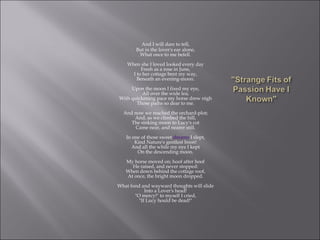
And I will dare to tell,
But in the lover's ear alone,
What once to me befell.
When she I loved looked every day
Fresh as a rose in June,
I to her cottage bent my way,
Beneath an evening-moon.
Upon the moon I fixed my eye,
All over the wide lea;
With quickening pace my horse drew nigh
Those paths so dear to me.
And now we reached the orchard-plot;
And, as we climbed the hill,
The sinking moon to Lucy's cot
Came near, and nearer still.
In one of those sweet dreams I slept,
Kind Nature's gentlest boon!
And all the while my eye I kept
On the descending moon.
My horse moved on; hoof after hoof
He raised, and never stopped:
When down behind the cottage roof,
At once, the bright moon dropped.
What fond and wayward thoughts will slide
Into a Lover's head!
"O mercy!" to myself I cried,
"If Lucy hould be dead!"
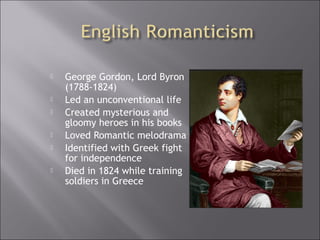
 George Gordon, Lord Byron
(1788-1824)
 Led an unconventional life
 Created mysterious and
gloomy heroes in his books
 Loved Romantic melodrama
 Identified with Greek fight
for independence
 Died in 1824 while training
soldiers in Greece
She walks in beauty, like the night Of cloudless
climes and starry skies; And all that's best of
dark and bright Meet in her aspect and her
eyes: Thus mellow'd to that tender light
Which heaven to gaudy day denies. .
From “She Walks in Beauty”
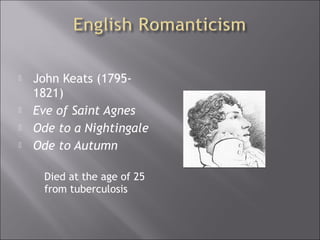
 John Keats (1795-
1821)
 Eve of Saint Agnes
 Ode to a Nightingale
 Ode to Autumn
Died at the age of 25
from tuberculosis
In drear-nighted December,
Too happy, happy tree,
Thy branches ne'er remember
Their green felicity:
The north cannot undo them
With a sleety whistle through them;
Nor frozen thawings glue them
From budding at the prime.
From “In Drear-nighted December”
http://commons.wikimedia.org/wiki/File:The_Battle_of_Taillebourg,_21st_July_1
http://commons.wikimedia.org/wiki/File:Adam_Elsheimer_-_Jacob%27s_Dream
http://commons.wikimedia.org/wiki/File:Uk_map.png
http://commons.wikimedia.org/wiki/File:Portrait_of_Percy_Bysshe_
Shelley_by_Curran,_1819.jpg
http://commons.wikimedia.org/wiki/File:Marywollstonecraft.jpg
http://commons.wikimedia.org/wiki/File:Frankenstein
%27s_monster_%28Boris_Karloff%29.jpg
http://commons.wikimedia.org/wiki/File:William_wordsworth.jpg
http://commons.wikimedia.org/wiki/File:Lord_Byron_coloured_drawi
ng.png
http://commons.wikimedia.org/wiki/File:John_keats.jpg

British Romantic Writers

  • 2.
     Romanticism –intellectual movement that was a reaction against the Enlightenment  Urged a revival of Christianity/Religion  Liked art, music, and literature of medieval times  Used folk tales and medieval art to solidify nationalism
  • 3.
     Remember, 18th century….allabout human reason  Romanticism is about emotion
  • 4.
     Romantic artists wereconcerned about themselves  Emotions  Reactions to their world  Own individuality
  • 5.
     Rejected 18th centurypredecessors’ emphasis on reason  Explored power of dreams and the subconscious  Were fascinated by subjects that science could not explain  New vision of nature
  • 6.
     Marveled atthe power, majesty, and inevitability of nature.  Natural universe was mysterious world of its own  Believed in “remoteness” of time or place  Inspired by ancient British Druids and medieval knights
  • 8.
     Percy andMary Shelley  Samuel Taylor Coleridge – wrote Gothic poems of the supernatural  William Wordsworth – wrote, sometimes with Coleridge about how humans lose their childlike imagination as they get older  Lord Byron – rebel Romanticist, who wrote about personal liberty and mocked his own beliefs in famous works such as Don Juan (1819)  John Keats
  • 9.
     Showed thesuffering of their souls I am the eye which the Universe Beholds itself and knows itself divine; All harmony of instrument or verse, All prophecy, all medicine is mine, All light of art or nature;_to my son Victory and praise in its own right belong “The Hymn of Apollo”
  • 10.
    I met atraveller from an antique land Who said: "Two vast and trunkless legs of stone Stand in the desert. Near them on the sand, Half sunk, a shattered visage lies, whose frown And wrinkled lip and sneer of cold command Tell that its sculptor well those passions read Which yet survive, stamped on these lifeless things, The hand that mocked them and the heart that fed. And on the pedestal these words appear: `My name is Ozymandias, King of Kings: Look on my works, ye mighty, and despair!' Nothing beside remains. Round the decay Of that colossal wreck, boundless and bare, The lone and level sands stretch far away".
  • 11.
     Son ofaristocrat  Expelled from Oxford for atheist beliefs  Married Mary Wollstonecraft (named after her mother)  Encouraged his wife, Mary Shelley, to write fiction  Died mysteriously in 1822
  • 12.
     Dr. Frankensteincreates monster in his lab  The book is a complex work of nature and science  The plot shows Mary’s concern that science is growing out of control  The story is a Romantic indictment of how science can deform nature.
  • 13.
     William Wordsworth(1770-1850)  Founder of English Romantic movement  Witnessed revolutionary France and was inspired by the political idealism  In the latter part of French Revolution- the Reign of terror, a period of violent conflict between rival political factions, disturbed him.  Withdrew to the English countryside  1799 lived in Lake District (his poetry made it famous) “Bliss was it, in that dawn to be alive.”
  • 14.
    FIVE years havepast; five summers, with the length Of five long winters! and again I hear These waters, rolling from their mountain-springs With a soft inland murmur.--Once again Do I behold these steep and lofty cliffs, That on a wild secluded scene impress Thoughts of more deep seclusion; and connect The landscape with the quiet of the sky. The day is come when I again repose Here, under this dark sycamore, and view These plots of cottage-ground, these orchard-tufts, Which at this season, with their unripe fruits, Are clad in one green hue, and lose themselves 'Mid groves and copses. Once again I see These hedge-rows, hardly hedge-rows, little lines Of sportive wood run wild: these pastoral farms, Green to the very door; and wreaths of smoke Sent up, in silence, from among the trees! With some uncertain notice, as might seem Of vagrant dwellers in the houseless woods, Or of some Hermit's cave, where by his fire The Hermit sits alone.
  • 15.
    And I willdare to tell, But in the lover's ear alone, What once to me befell. When she I loved looked every day Fresh as a rose in June, I to her cottage bent my way, Beneath an evening-moon. Upon the moon I fixed my eye, All over the wide lea; With quickening pace my horse drew nigh Those paths so dear to me. And now we reached the orchard-plot; And, as we climbed the hill, The sinking moon to Lucy's cot Came near, and nearer still. In one of those sweet dreams I slept, Kind Nature's gentlest boon! And all the while my eye I kept On the descending moon. My horse moved on; hoof after hoof He raised, and never stopped: When down behind the cottage roof, At once, the bright moon dropped. What fond and wayward thoughts will slide Into a Lover's head! "O mercy!" to myself I cried, "If Lucy hould be dead!"
  • 16.
     George Gordon,Lord Byron (1788-1824)  Led an unconventional life  Created mysterious and gloomy heroes in his books  Loved Romantic melodrama  Identified with Greek fight for independence  Died in 1824 while training soldiers in Greece
  • 17.
    She walks inbeauty, like the night Of cloudless climes and starry skies; And all that's best of dark and bright Meet in her aspect and her eyes: Thus mellow'd to that tender light Which heaven to gaudy day denies. . From “She Walks in Beauty”
  • 18.
     John Keats(1795- 1821)  Eve of Saint Agnes  Ode to a Nightingale  Ode to Autumn Died at the age of 25 from tuberculosis
  • 19.
    In drear-nighted December, Toohappy, happy tree, Thy branches ne'er remember Their green felicity: The north cannot undo them With a sleety whistle through them; Nor frozen thawings glue them From budding at the prime. From “In Drear-nighted December”
  • 20.

Editor's Notes

  • #2 The 18 th century had been a time of enlightenment and the people believed in reason. But after the French Revolution came the Industrial Revolution and a new approach to writing and literature, characterized by emotion. The individual was valued over society, imagination was valued over logic and nature was valued over the artificial. Many saw this movement as a reaction to and rejection of the de-personalization and urbanization brought on by the Industrial Revolution.
  • #5 They were no longer so concerned with society and where it was going. They wanted to get back to a simpler, more rural way of life. Romantics believed in the natural goodness of humans which is hindered by the urban life of civilization.
  • #6 Romantics believed that knowledge is gained through intuition rather than deduction.
  • #7 Romantics stressed the awe of nature in art and language and the experience of sublimity through a connection with nature. Romantics rejected the rationalization of nature by the previous thinkers of the Enlightenment period.
  • #10 Shelley’s writing shows a restlessness, a love of nature and freedom, a rebellion against authority. He was never afraid to take the controversial side even if it made him unpopular. For example, while studying at Oxford, he and a friend wrote a pamphlet titled The Necessity of Atheism even though this had a devastating effect on his relationship with his family. His second wife, Mary Shelley, is the author of Frankenstein.
  • #11 “ Ozymandias” is probably his most famous short poem. A traveler tells of an old broken statue in the desert of Egypt. The statue is crumbling yet the facial features and the inscription, there in the middle of nothingness, seem to exude a pride and power.
  • #13 Mary started writing Frankenstein when she was 19 and published it at 21. The story idea came from a dream. She and three friends were having a contest to see who could write the best horror story. Mary had a dream about a scientist who created a new form of man and was horrified by what he had done.
  • #14 William Wordsworth was also concerned about man’s interest in science. He said, Our meddling intellect/Mis-shapes the beauteous forms of things” Wordsworth along with Samuel Taylor Coleridge actually launched the Romantic period in English Literature when they published together a book of poems titled Lyrical Ballads. The poems were written in a simple verse form and their subjects came from the lives of simple people.
  • #15 Wordsworth's descriptions of the banks of the River Wye outline his general philosophies on nature.
  • #17 Lord Byron was known for his huge debts, numerous love affairs, rumors of a scandalous incestuous liaison with his half-sister, and today many believe he suffered from bi-polar disorder. He was perhaps the most fashionable poet of the times. He was a freethinker who never lost touch with reality. A defiant, brooding young man dressed flamboyantly, but pining away about something mysterious in his past, Lord Byron was described by a friend as ‘mad, bad and dangerous to know”.
  • #18 She Walks in Beauty is considered one of Byron’s most famous works. It is believed that he wrote the poem about one of his cousins by marriage when he was struck by her unusual beauty at a ball where she was dressed in an ornate gown.
  • #19 John Keats, like many of the other British Romantic poets, died at an early age. Although he was only 25 when he died, he had published 54 poems. His poetry is characterized by sensory imagery, an honest love of the country , descriptions of the beauty in nature, and deep philosophical questions.
  • #20 In Drear-nighted December dramatizes the constancy of things in nature while showing that the worst part of suffering is to remember a time when we were happy.