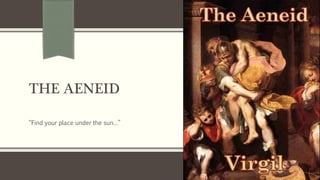
THE AENEID
“Find your place under the sun…”
Intended Learning Outcomes
 Explain the characteristics of Roman Literature.
 Point out the parallel elements between the Greek and Roman
Literatures.
 Appreciate the influence of Roman epic to the present body of
literature.
12/15/2019 LIT 313 | TheMindsmithPh | College of Arts | T.I.P. Quezon City 2
Introduction to Roman Literature
 Roman Literature is written in Latin language, the lingua franca of the
Roman Empire and the world until the Middle Ages.
 Latin literature drew heavily on the traditions of other cultures,
particularly the more matured literary tradition of Greece.
 Catullus pioneered the naturalization of Greek lyric verse forms into
Latin.
 The Hellenizing tendencies of Golden Age Latin reached their apex in
the epic poetry of Virgil, the odes and satires of Horace and the
elegiac couplets of Ovid.
12/15/2019 LIT 313 | TheMindsmithPh | College of Arts | T.I.P. Quezon City 3
Introduction to Roman Literature
 Formal Latin literature began in 240 BC.
 Livius Andronicus translated Homer's Greek epic The Odyssey into an
old type of Latin verse called Saturnian.
 Gnaeus Naevius was the first Latin poet to write on a Roman theme.
 He composed an epic poem about the first Punic War, in which he had
fought.
 Naevius's dramas were mainly reworkings of Greek originals, but he
also created tragedies based on Roman myths and history.
12/15/2019 LIT 313 | TheMindsmithPh | College of Arts | T.I.P. Quezon City 4
The Roman Literary Giants - Ovid
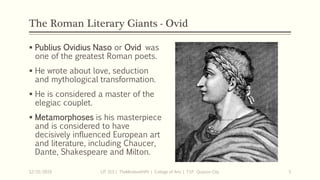
 Publius Ovidius Naso or Ovid was
one of the greatest Roman poets.
 He wrote about love, seduction
and mythological transformation.
 He is considered a master of the
elegiac couplet.
 Metamorphoses is his masterpiece
and is considered to have
decisively influenced European art
and literature, including Chaucer,
Dante, Shakespeare and Milton.
12/15/2019 LIT 313 | TheMindsmithPh | College of Arts | T.I.P. Quezon City 5
The Roman Literary Giants – Ovid’s other works
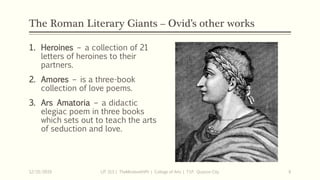
1. Heroines – a collection of 21
letters of heroines to their
partners.
2. Amores – is a three-book
collection of love poems.
3. Ars Amatoria – a didactic
elegiac poem in three books
which sets out to teach the arts
of seduction and love.
12/15/2019 LIT 313 | TheMindsmithPh | College of Arts | T.I.P. Quezon City 6
The Roman Literary Giants - Horace
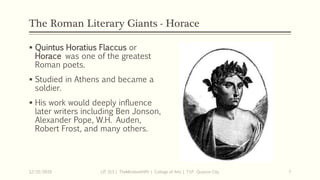
 Quintus Horatius Flaccus or
Horace was one of the greatest
Roman poets.
 Studied in Athens and became a
soldier.
 His work would deeply influence
later writers including Ben Jonson,
Alexander Pope, W.H. Auden,
Robert Frost, and many others.
12/15/2019 LIT 313 | TheMindsmithPh | College of Arts | T.I.P. Quezon City 7
The Roman Literary Giants – Horace’s Works
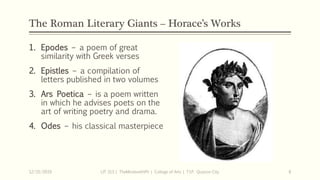
1. Epodes – a poem of great
similarity with Greek verses
2. Epistles – a compilation of
letters published in two volumes
3. Ars Poetica – is a poem written
in which he advises poets on the
art of writing poetry and drama.
4. Odes – his classical masterpiece
12/15/2019 LIT 313 | TheMindsmithPh | College of Arts | T.I.P. Quezon City 8
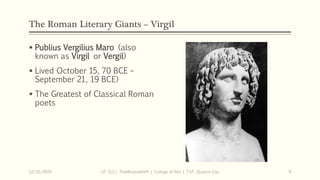
The Roman Literary Giants – Virgil
 Publius Vergilius Maro (also
known as Virgil or Vergil)
 Lived October 15, 70 BCE –
September 21, 19 BCE)
 The Greatest of Classical Roman
poets
12/15/2019 LIT 313 | TheMindsmithPh | College of Arts | T.I.P. Quezon City 9
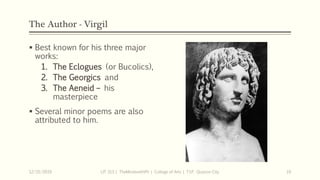
The Author - Virgil
 Best known for his three major
works:
1. The Eclogues (or Bucolics),
2. The Georgics and
3. The Aeneid – his
masterpiece
 Several minor poems are also
attributed to him.
12/15/2019 LIT 313 | TheMindsmithPh | College of Arts | T.I.P. Quezon City 10
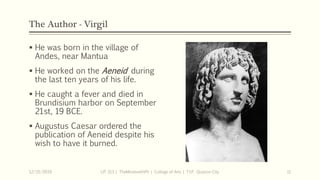
The Author - Virgil
 He was born in the village of
Andes, near Mantua
 He worked on the Aeneid during
the last ten years of his life.
 He caught a fever and died in
Brundisium harbor on September
21st, 19 BCE.
 Augustus Caesar ordered the
publication of Aeneid despite his
wish to have it burned.
12/15/2019 LIT 313 | TheMindsmithPh | College of Arts | T.I.P. Quezon City 11
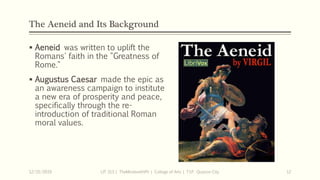
The Aeneid and Its Background
 Aeneid was written to uplift the
Romans' faith in the "Greatness of
Rome."
 Augustus Caesar made the epic as
an awareness campaign to institute
a new era of prosperity and peace,
specifically through the re-
introduction of traditional Roman
moral values.
12/15/2019 LIT 313 | TheMindsmithPh | College of Arts | T.I.P. Quezon City 12
The Aeneid and Its Background
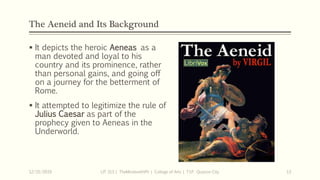
 It depicts the heroic Aeneas as a
man devoted and loyal to his
country and its prominence, rather
than personal gains, and going off
on a journey for the betterment of
Rome.
 It attempted to legitimize the rule of
Julius Caesar as part of the
prophecy given to Aeneas in the
Underworld.
12/15/2019 LIT 313 | TheMindsmithPh | College of Arts | T.I.P. Quezon City 13
The Aeneid and Its Background
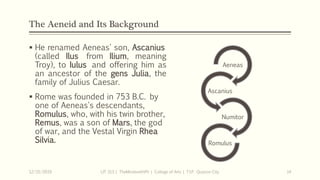
 He renamed Aeneas' son, Ascanius
(called Ilus from Ilium, meaning
Troy), to Iulus and offering him as
an ancestor of the gens Julia, the
family of Julius Caesar.
 Rome was founded in 753 B.C. by
one of Aeneas's descendants,
Romulus, who, with his twin brother,
Remus, was a son of Mars, the god
of war, and the Vestal Virgin Rhea
Silvia.
12/15/2019 LIT 313 | TheMindsmithPh | College of Arts | T.I.P. Quezon City 14
Aeneas
Ascanius
Numitor
Romulus
The Aeneid and Its Writing Style
 The Aeneid has 12 books.
 First 6 books – patterned after
Odyssey
 Second books – patterned after
Iliad
 The Aeneid is written in dactylic
hexameter or more commonly
known as “heroic hexameter.”
 “Dactyl” in Greek means finger,
which has one long and two short
nodes (syllables)
12/15/2019 LIT 313 | TheMindsmithPh | College of Arts | T.I.P. Quezon City 15
 “Hexameter” is a poetic line with
six feet
 As with other classical Latin
poetry, the meter is based on the
length of syllables rather than the
stress, though the interplay of
meter and stress is also
important.
 Virgil also incorporated such
poetic devices as alliteration,
onomatopoeia, synecdoche, and
assonance.
The Main Characters of Aeneid - Mortals
 Aeneas - The protagonist of the
Aeneid. Aeneas is a survivor of the
siege of Troy,
 Dido - The queen of Carthage, a city
in northern Africa, in what is now
Libya, and lover of Aeneas.
 Turnus - The ruler of the Rutulians in
Italy and Aeneas’s major antagonist
among mortals.
 Ascanius - (also called Iulus).
Aeneas’s young son by his first wife,
Creusa.
 Anchises - Aeneas’s father, and a
symbol of Aeneas’s Trojan heritage.
12/15/2019 LIT 313 | TheMindsmithPh | College of Arts | T.I.P. Quezon City 16
 Creusa - Aeneas’s wife at Troy, and
the mother of Ascanius.
 Sinon - The young Greek spy who
pretends to have been left behind at
the end of the Trojan War
 Latinus - The king of the Latins, the
people of what is now central Italy,
around the Tiber River.
 Lavinia - Latinus’s daughter and a
symbol of Latium in general.
 Amata - Queen of Laurentum (a
region of Latium, in Italy) and wife of
Latinus.
The Main Characters of Aeneid – Mortals
 Evander - King of Pallanteum (a
region of Arcadia, in Italy) and father
of Pallas.
 Pallas - Son of Evander, whom
Evander entrusts to Aeneas’s care
and tutelage.
 Drancës - A Latin leader who desires
an end to the Trojan-Latin struggle.
 Camilla - The leader of the
Volscians, a race of warrior maidens.
 Juturna - Turnus’s sister.
12/15/2019 LIT 313 | TheMindsmithPh | College of Arts | T.I.P. Quezon City 17
 Achates - A Trojan and a personal
friend of Aeneas
 Ulysses - (Latin name of Odysseus)
The hero of Homer’s Odyssey
 Achilles - The greatest of the Greek
warriors.
 Hector - The greatest of the Trojan
warriors, killed at Troy.
 Andromachë - Hector’s wife, who
survives the siege of Troy.
The Main Characters of Aeneid – Deities
 Juno - (Hera in Greek) The queen of the
gods, the wife and sister of Jupiter
 Venus - (Aphrodite in Greek) The goddess of
love and the mother of Aeneas.
 Jupiter - (also known as Jove, and Zeus in
Greek) The king of the gods, and the son of
Saturn.
 Neptune - (Poseidon in Greek) God of the
sea is generally an ally of Venus and
Aeneas.
 Mercury - (Hermes in Greek) The messenger
god. The other gods often send Mercury on
errands.
12/15/2019 LIT 313 | TheMindsmithPh | College of Arts | T.I.P. Quezon City 18
 Aeolus - The god of the winds.
 Cupid - (Eros in Greek) A son of
Venus and the god of erotic desire.
 Allecto - One of the Furies, or
deities who avenge sins, sent by
Juno to incite the Latin people to
war against the Trojans.
 Vulcan - (Hephaestus in Greek) God
of fire and the forge, and husband of
Venus.
 Tiberinus - The river god associated
with the Tiber River, where Rome will
eventually be built
The Main Characters of Aeneid – Deities
 Saturn - (Cronus in Greek) The father of
the gods. Saturn was king of Olympus
until his son Jupiter overthrew him.
 Minerva - (Athena in Greek mythology)
The goddess who protects the Greeks
during the Trojan War and helps them
conquer Troy.
 Apollo - A son of Jupiter. God of truth,
prophecy, archery.
 Diana – (Artemis in Greek) Apollo’s twin
sister, Goddess of hunting, the moon
and youth
12/15/2019 LIT 313 | TheMindsmithPh | College of Arts | T.I.P. Quezon City 19
 Penates – the Trojan and Roman
household gods or gods of the state
 Lares – small ancestral gods brought by
Anchises from Troy
 Iris – the messenger goddess of Jupiter
 Mars – (Ares in Greek) The god of war
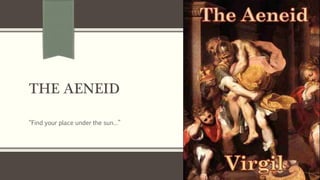
THE AENEID
“Find your place under the sun…”
The Aeneid – Book 1
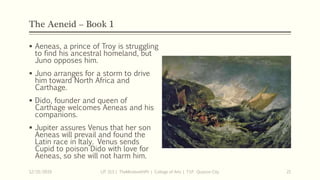
 Aeneas, a prince of Troy is struggling
to find his ancestral homeland, but
Juno opposes him.
 Juno arranges for a storm to drive
him toward North Africa and
Carthage.
 Dido, founder and queen of
Carthage welcomes Aeneas and his
companions.
 Jupiter assures Venus that her son
Aeneas will prevail and found the
Latin race in Italy. Venus sends
Cupid to poison Dido with love for
Aeneas, so she will not harm him.
12/15/2019 LIT 313 | TheMindsmithPh | College of Arts | T.I.P. Quezon City 21
The Aeneid – Book 2
 Dido is gracious to Aeneas and his
companions and interested in the
story of the fall of Troy.
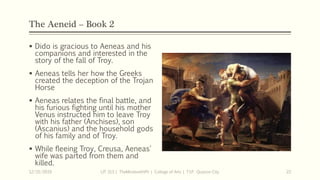
 Aeneas tells her how the Greeks
created the deception of the Trojan
Horse
 Aeneas relates the final battle, and
his furious fighting until his mother
Venus instructed him to leave Troy
with his father (Anchises), son
(Ascanius) and the household gods
of his family and of Troy.
 While fleeing Troy, Creusa, Aeneas'
wife was parted from them and
killed.
12/15/2019 LIT 313 | TheMindsmithPh | College of Arts | T.I.P. Quezon City 22
The Aeneid – Book 3
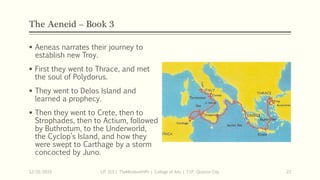
 Aeneas narrates their journey to
establish new Troy.
 First they went to Thrace, and met
the soul of Polydorus.
 They went to Delos Island and
learned a prophecy.
 Then they went to Crete, then to
Strophades, then to Actium, followed
by Buthrotum, to the Underworld,
the Cyclop’s Island, and how they
were swept to Carthage by a storm
concocted by Juno.
12/15/2019 LIT 313 | TheMindsmithPh | College of Arts | T.I.P. Quezon City 23
The Aeneid – Book 4
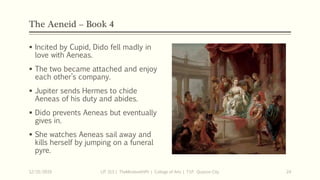
 Incited by Cupid, Dido fell madly in
love with Aeneas.
 The two became attached and enjoy
each other’s company.
 Jupiter sends Hermes to chide
Aeneas of his duty and abides.
 Dido prevents Aeneas but eventually
gives in.
 She watches Aeneas sail away and
kills herself by jumping on a funeral
pyre.
12/15/2019 LIT 313 | TheMindsmithPh | College of Arts | T.I.P. Quezon City 24
The Aeneid – Book 5
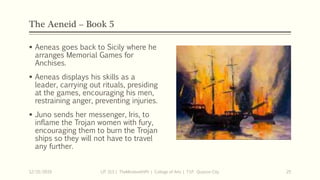
 Aeneas goes back to Sicily where he
arranges Memorial Games for
Anchises.
 Aeneas displays his skills as a
leader, carrying out rituals, presiding
at the games, encouraging his men,
restraining anger, preventing injuries.
 Juno sends her messenger, Iris, to
inflame the Trojan women with fury,
encouraging them to burn the Trojan
ships so they will not have to travel
any further.
12/15/2019 LIT 313 | TheMindsmithPh | College of Arts | T.I.P. Quezon City 25
The Aeneid – Book 6
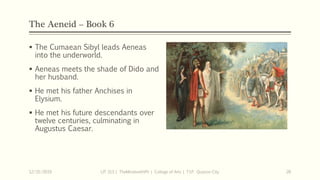
 The Cumaean Sibyl leads Aeneas
into the underworld.
 Aeneas meets the shade of Dido and
her husband.
 He met his father Anchises in
Elysium.
 He met his future descendants over
twelve centuries, culminating in
Augustus Caesar.
12/15/2019 LIT 313 | TheMindsmithPh | College of Arts | T.I.P. Quezon City 26
The Aeneid – Book 7
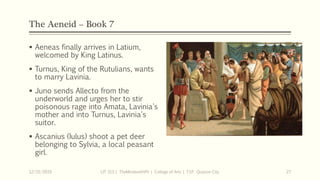
 Aeneas finally arrives in Latium,
welcomed by King Latinus.
 Turnus, King of the Rutulians, wants
to marry Lavinia.
 Juno sends Allecto from the
underworld and urges her to stir
poisonous rage into Amata, Lavinia's
mother and into Turnus, Lavinia's
suitor.
 Ascanius (Iulus) shoot a pet deer
belonging to Sylvia, a local peasant
girl.
12/15/2019 LIT 313 | TheMindsmithPh | College of Arts | T.I.P. Quezon City 27
The Aeneid – Book 8
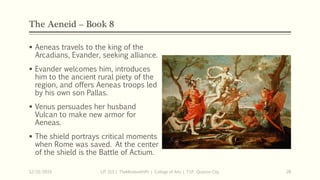
 Aeneas travels to the king of the
Arcadians, Evander, seeking alliance.
 Evander welcomes him, introduces
him to the ancient rural piety of the
region, and offers Aeneas troops led
by his own son Pallas.
 Venus persuades her husband
Vulcan to make new armor for
Aeneas.
 The shield portrays critical moments
when Rome was saved. At the center
of the shield is the Battle of Actium.
12/15/2019 LIT 313 | TheMindsmithPh | College of Arts | T.I.P. Quezon City 28
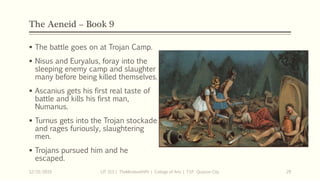
The Aeneid – Book 9
 The battle goes on at Trojan Camp.
 Nisus and Euryalus, foray into the
sleeping enemy camp and slaughter
many before being killed themselves.
 Ascanius gets his first real taste of
battle and kills his first man,
Numanus.
 Turnus gets into the Trojan stockade
and rages furiously, slaughtering
men.
 Trojans pursued him and he
escaped.
12/15/2019 LIT 313 | TheMindsmithPh | College of Arts | T.I.P. Quezon City 29
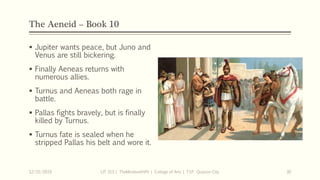
The Aeneid – Book 10
 Jupiter wants peace, but Juno and
Venus are still bickering.
 Finally Aeneas returns with
numerous allies.
 Turnus and Aeneas both rage in
battle.
 Pallas fights bravely, but is finally
killed by Turnus.
 Turnus fate is sealed when he
stripped Pallas his belt and wore it.
12/15/2019 LIT 313 | TheMindsmithPh | College of Arts | T.I.P. Quezon City 30
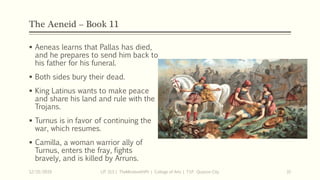
The Aeneid – Book 11
 Aeneas learns that Pallas has died,
and he prepares to send him back to
his father for his funeral.
 Both sides bury their dead.
 King Latinus wants to make peace
and share his land and rule with the
Trojans.
 Turnus is in favor of continuing the
war, which resumes.
 Camilla, a woman warrior ally of
Turnus, enters the fray, fights
bravely, and is killed by Arruns.
12/15/2019 LIT 313 | TheMindsmithPh | College of Arts | T.I.P. Quezon City 31
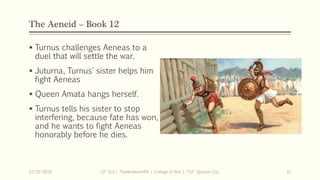
The Aeneid – Book 12
 Turnus challenges Aeneas to a
duel that will settle the war.
 Juturna, Turnus' sister helps him
fight Aeneas
 Queen Amata hangs herself.
 Turnus tells his sister to stop
interfering, because fate has won,
and he wants to fight Aeneas
honorably before he dies.
12/15/2019 LIT 313 | TheMindsmithPh | College of Arts | T.I.P. Quezon City 32
The Aeneid – Book 12
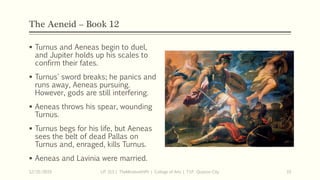
 Turnus and Aeneas begin to duel,
and Jupiter holds up his scales to
confirm their fates.
 Turnus' sword breaks; he panics and
runs away, Aeneas pursuing.
However, gods are still interfering.
 Aeneas throws his spear, wounding
Turnus.
 Turnus begs for his life, but Aeneas
sees the belt of dead Pallas on
Turnus and, enraged, kills Turnus.
 Aeneas and Lavinia were married.
12/15/2019 LIT 313 | TheMindsmithPh | College of Arts | T.I.P. Quezon City 33

The Aeneid

  • 1.
    THE AENEID “Find yourplace under the sun…”
  • 2.
    Intended Learning Outcomes Explain the characteristics of Roman Literature.  Point out the parallel elements between the Greek and Roman Literatures.  Appreciate the influence of Roman epic to the present body of literature. 12/15/2019 LIT 313 | TheMindsmithPh | College of Arts | T.I.P. Quezon City 2
  • 3.
    Introduction to RomanLiterature  Roman Literature is written in Latin language, the lingua franca of the Roman Empire and the world until the Middle Ages.  Latin literature drew heavily on the traditions of other cultures, particularly the more matured literary tradition of Greece.  Catullus pioneered the naturalization of Greek lyric verse forms into Latin.  The Hellenizing tendencies of Golden Age Latin reached their apex in the epic poetry of Virgil, the odes and satires of Horace and the elegiac couplets of Ovid. 12/15/2019 LIT 313 | TheMindsmithPh | College of Arts | T.I.P. Quezon City 3
  • 4.
    Introduction to RomanLiterature  Formal Latin literature began in 240 BC.  Livius Andronicus translated Homer's Greek epic The Odyssey into an old type of Latin verse called Saturnian.  Gnaeus Naevius was the first Latin poet to write on a Roman theme.  He composed an epic poem about the first Punic War, in which he had fought.  Naevius's dramas were mainly reworkings of Greek originals, but he also created tragedies based on Roman myths and history. 12/15/2019 LIT 313 | TheMindsmithPh | College of Arts | T.I.P. Quezon City 4
  • 5.
    The Roman LiteraryGiants - Ovid  Publius Ovidius Naso or Ovid was one of the greatest Roman poets.  He wrote about love, seduction and mythological transformation.  He is considered a master of the elegiac couplet.  Metamorphoses is his masterpiece and is considered to have decisively influenced European art and literature, including Chaucer, Dante, Shakespeare and Milton. 12/15/2019 LIT 313 | TheMindsmithPh | College of Arts | T.I.P. Quezon City 5
  • 6.
    The Roman LiteraryGiants – Ovid’s other works 1. Heroines – a collection of 21 letters of heroines to their partners. 2. Amores – is a three-book collection of love poems. 3. Ars Amatoria – a didactic elegiac poem in three books which sets out to teach the arts of seduction and love. 12/15/2019 LIT 313 | TheMindsmithPh | College of Arts | T.I.P. Quezon City 6
  • 7.
    The Roman LiteraryGiants - Horace  Quintus Horatius Flaccus or Horace was one of the greatest Roman poets.  Studied in Athens and became a soldier.  His work would deeply influence later writers including Ben Jonson, Alexander Pope, W.H. Auden, Robert Frost, and many others. 12/15/2019 LIT 313 | TheMindsmithPh | College of Arts | T.I.P. Quezon City 7
  • 8.
    The Roman LiteraryGiants – Horace’s Works 1. Epodes – a poem of great similarity with Greek verses 2. Epistles – a compilation of letters published in two volumes 3. Ars Poetica – is a poem written in which he advises poets on the art of writing poetry and drama. 4. Odes – his classical masterpiece 12/15/2019 LIT 313 | TheMindsmithPh | College of Arts | T.I.P. Quezon City 8
  • 9.
    The Roman LiteraryGiants – Virgil  Publius Vergilius Maro (also known as Virgil or Vergil)  Lived October 15, 70 BCE – September 21, 19 BCE)  The Greatest of Classical Roman poets 12/15/2019 LIT 313 | TheMindsmithPh | College of Arts | T.I.P. Quezon City 9
  • 10.
    The Author -Virgil  Best known for his three major works: 1. The Eclogues (or Bucolics), 2. The Georgics and 3. The Aeneid – his masterpiece  Several minor poems are also attributed to him. 12/15/2019 LIT 313 | TheMindsmithPh | College of Arts | T.I.P. Quezon City 10
  • 11.
    The Author -Virgil  He was born in the village of Andes, near Mantua  He worked on the Aeneid during the last ten years of his life.  He caught a fever and died in Brundisium harbor on September 21st, 19 BCE.  Augustus Caesar ordered the publication of Aeneid despite his wish to have it burned. 12/15/2019 LIT 313 | TheMindsmithPh | College of Arts | T.I.P. Quezon City 11
  • 12.
    The Aeneid andIts Background  Aeneid was written to uplift the Romans' faith in the "Greatness of Rome."  Augustus Caesar made the epic as an awareness campaign to institute a new era of prosperity and peace, specifically through the re- introduction of traditional Roman moral values. 12/15/2019 LIT 313 | TheMindsmithPh | College of Arts | T.I.P. Quezon City 12
  • 13.
    The Aeneid andIts Background  It depicts the heroic Aeneas as a man devoted and loyal to his country and its prominence, rather than personal gains, and going off on a journey for the betterment of Rome.  It attempted to legitimize the rule of Julius Caesar as part of the prophecy given to Aeneas in the Underworld. 12/15/2019 LIT 313 | TheMindsmithPh | College of Arts | T.I.P. Quezon City 13
  • 14.
    The Aeneid andIts Background  He renamed Aeneas' son, Ascanius (called Ilus from Ilium, meaning Troy), to Iulus and offering him as an ancestor of the gens Julia, the family of Julius Caesar.  Rome was founded in 753 B.C. by one of Aeneas's descendants, Romulus, who, with his twin brother, Remus, was a son of Mars, the god of war, and the Vestal Virgin Rhea Silvia. 12/15/2019 LIT 313 | TheMindsmithPh | College of Arts | T.I.P. Quezon City 14 Aeneas Ascanius Numitor Romulus
  • 15.
    The Aeneid andIts Writing Style  The Aeneid has 12 books.  First 6 books – patterned after Odyssey  Second books – patterned after Iliad  The Aeneid is written in dactylic hexameter or more commonly known as “heroic hexameter.”  “Dactyl” in Greek means finger, which has one long and two short nodes (syllables) 12/15/2019 LIT 313 | TheMindsmithPh | College of Arts | T.I.P. Quezon City 15  “Hexameter” is a poetic line with six feet  As with other classical Latin poetry, the meter is based on the length of syllables rather than the stress, though the interplay of meter and stress is also important.  Virgil also incorporated such poetic devices as alliteration, onomatopoeia, synecdoche, and assonance.
  • 16.
    The Main Charactersof Aeneid - Mortals  Aeneas - The protagonist of the Aeneid. Aeneas is a survivor of the siege of Troy,  Dido - The queen of Carthage, a city in northern Africa, in what is now Libya, and lover of Aeneas.  Turnus - The ruler of the Rutulians in Italy and Aeneas’s major antagonist among mortals.  Ascanius - (also called Iulus). Aeneas’s young son by his first wife, Creusa.  Anchises - Aeneas’s father, and a symbol of Aeneas’s Trojan heritage. 12/15/2019 LIT 313 | TheMindsmithPh | College of Arts | T.I.P. Quezon City 16  Creusa - Aeneas’s wife at Troy, and the mother of Ascanius.  Sinon - The young Greek spy who pretends to have been left behind at the end of the Trojan War  Latinus - The king of the Latins, the people of what is now central Italy, around the Tiber River.  Lavinia - Latinus’s daughter and a symbol of Latium in general.  Amata - Queen of Laurentum (a region of Latium, in Italy) and wife of Latinus.
  • 17.
    The Main Charactersof Aeneid – Mortals  Evander - King of Pallanteum (a region of Arcadia, in Italy) and father of Pallas.  Pallas - Son of Evander, whom Evander entrusts to Aeneas’s care and tutelage.  Drancës - A Latin leader who desires an end to the Trojan-Latin struggle.  Camilla - The leader of the Volscians, a race of warrior maidens.  Juturna - Turnus’s sister. 12/15/2019 LIT 313 | TheMindsmithPh | College of Arts | T.I.P. Quezon City 17  Achates - A Trojan and a personal friend of Aeneas  Ulysses - (Latin name of Odysseus) The hero of Homer’s Odyssey  Achilles - The greatest of the Greek warriors.  Hector - The greatest of the Trojan warriors, killed at Troy.  Andromachë - Hector’s wife, who survives the siege of Troy.
  • 18.
    The Main Charactersof Aeneid – Deities  Juno - (Hera in Greek) The queen of the gods, the wife and sister of Jupiter  Venus - (Aphrodite in Greek) The goddess of love and the mother of Aeneas.  Jupiter - (also known as Jove, and Zeus in Greek) The king of the gods, and the son of Saturn.  Neptune - (Poseidon in Greek) God of the sea is generally an ally of Venus and Aeneas.  Mercury - (Hermes in Greek) The messenger god. The other gods often send Mercury on errands. 12/15/2019 LIT 313 | TheMindsmithPh | College of Arts | T.I.P. Quezon City 18  Aeolus - The god of the winds.  Cupid - (Eros in Greek) A son of Venus and the god of erotic desire.  Allecto - One of the Furies, or deities who avenge sins, sent by Juno to incite the Latin people to war against the Trojans.  Vulcan - (Hephaestus in Greek) God of fire and the forge, and husband of Venus.  Tiberinus - The river god associated with the Tiber River, where Rome will eventually be built
  • 19.
    The Main Charactersof Aeneid – Deities  Saturn - (Cronus in Greek) The father of the gods. Saturn was king of Olympus until his son Jupiter overthrew him.  Minerva - (Athena in Greek mythology) The goddess who protects the Greeks during the Trojan War and helps them conquer Troy.  Apollo - A son of Jupiter. God of truth, prophecy, archery.  Diana – (Artemis in Greek) Apollo’s twin sister, Goddess of hunting, the moon and youth 12/15/2019 LIT 313 | TheMindsmithPh | College of Arts | T.I.P. Quezon City 19  Penates – the Trojan and Roman household gods or gods of the state  Lares – small ancestral gods brought by Anchises from Troy  Iris – the messenger goddess of Jupiter  Mars – (Ares in Greek) The god of war
  • 20.
    THE AENEID “Find yourplace under the sun…”
  • 21.
    The Aeneid –Book 1  Aeneas, a prince of Troy is struggling to find his ancestral homeland, but Juno opposes him.  Juno arranges for a storm to drive him toward North Africa and Carthage.  Dido, founder and queen of Carthage welcomes Aeneas and his companions.  Jupiter assures Venus that her son Aeneas will prevail and found the Latin race in Italy. Venus sends Cupid to poison Dido with love for Aeneas, so she will not harm him. 12/15/2019 LIT 313 | TheMindsmithPh | College of Arts | T.I.P. Quezon City 21
  • 22.
    The Aeneid –Book 2  Dido is gracious to Aeneas and his companions and interested in the story of the fall of Troy.  Aeneas tells her how the Greeks created the deception of the Trojan Horse  Aeneas relates the final battle, and his furious fighting until his mother Venus instructed him to leave Troy with his father (Anchises), son (Ascanius) and the household gods of his family and of Troy.  While fleeing Troy, Creusa, Aeneas' wife was parted from them and killed. 12/15/2019 LIT 313 | TheMindsmithPh | College of Arts | T.I.P. Quezon City 22
  • 23.
    The Aeneid –Book 3  Aeneas narrates their journey to establish new Troy.  First they went to Thrace, and met the soul of Polydorus.  They went to Delos Island and learned a prophecy.  Then they went to Crete, then to Strophades, then to Actium, followed by Buthrotum, to the Underworld, the Cyclop’s Island, and how they were swept to Carthage by a storm concocted by Juno. 12/15/2019 LIT 313 | TheMindsmithPh | College of Arts | T.I.P. Quezon City 23
  • 24.
    The Aeneid –Book 4  Incited by Cupid, Dido fell madly in love with Aeneas.  The two became attached and enjoy each other’s company.  Jupiter sends Hermes to chide Aeneas of his duty and abides.  Dido prevents Aeneas but eventually gives in.  She watches Aeneas sail away and kills herself by jumping on a funeral pyre. 12/15/2019 LIT 313 | TheMindsmithPh | College of Arts | T.I.P. Quezon City 24
  • 25.
    The Aeneid –Book 5  Aeneas goes back to Sicily where he arranges Memorial Games for Anchises.  Aeneas displays his skills as a leader, carrying out rituals, presiding at the games, encouraging his men, restraining anger, preventing injuries.  Juno sends her messenger, Iris, to inflame the Trojan women with fury, encouraging them to burn the Trojan ships so they will not have to travel any further. 12/15/2019 LIT 313 | TheMindsmithPh | College of Arts | T.I.P. Quezon City 25
  • 26.
    The Aeneid –Book 6  The Cumaean Sibyl leads Aeneas into the underworld.  Aeneas meets the shade of Dido and her husband.  He met his father Anchises in Elysium.  He met his future descendants over twelve centuries, culminating in Augustus Caesar. 12/15/2019 LIT 313 | TheMindsmithPh | College of Arts | T.I.P. Quezon City 26
  • 27.
    The Aeneid –Book 7  Aeneas finally arrives in Latium, welcomed by King Latinus.  Turnus, King of the Rutulians, wants to marry Lavinia.  Juno sends Allecto from the underworld and urges her to stir poisonous rage into Amata, Lavinia's mother and into Turnus, Lavinia's suitor.  Ascanius (Iulus) shoot a pet deer belonging to Sylvia, a local peasant girl. 12/15/2019 LIT 313 | TheMindsmithPh | College of Arts | T.I.P. Quezon City 27
  • 28.
    The Aeneid –Book 8  Aeneas travels to the king of the Arcadians, Evander, seeking alliance.  Evander welcomes him, introduces him to the ancient rural piety of the region, and offers Aeneas troops led by his own son Pallas.  Venus persuades her husband Vulcan to make new armor for Aeneas.  The shield portrays critical moments when Rome was saved. At the center of the shield is the Battle of Actium. 12/15/2019 LIT 313 | TheMindsmithPh | College of Arts | T.I.P. Quezon City 28
  • 29.
    The Aeneid –Book 9  The battle goes on at Trojan Camp.  Nisus and Euryalus, foray into the sleeping enemy camp and slaughter many before being killed themselves.  Ascanius gets his first real taste of battle and kills his first man, Numanus.  Turnus gets into the Trojan stockade and rages furiously, slaughtering men.  Trojans pursued him and he escaped. 12/15/2019 LIT 313 | TheMindsmithPh | College of Arts | T.I.P. Quezon City 29
  • 30.
    The Aeneid –Book 10  Jupiter wants peace, but Juno and Venus are still bickering.  Finally Aeneas returns with numerous allies.  Turnus and Aeneas both rage in battle.  Pallas fights bravely, but is finally killed by Turnus.  Turnus fate is sealed when he stripped Pallas his belt and wore it. 12/15/2019 LIT 313 | TheMindsmithPh | College of Arts | T.I.P. Quezon City 30
  • 31.
    The Aeneid –Book 11  Aeneas learns that Pallas has died, and he prepares to send him back to his father for his funeral.  Both sides bury their dead.  King Latinus wants to make peace and share his land and rule with the Trojans.  Turnus is in favor of continuing the war, which resumes.  Camilla, a woman warrior ally of Turnus, enters the fray, fights bravely, and is killed by Arruns. 12/15/2019 LIT 313 | TheMindsmithPh | College of Arts | T.I.P. Quezon City 31
  • 32.
    The Aeneid –Book 12  Turnus challenges Aeneas to a duel that will settle the war.  Juturna, Turnus' sister helps him fight Aeneas  Queen Amata hangs herself.  Turnus tells his sister to stop interfering, because fate has won, and he wants to fight Aeneas honorably before he dies. 12/15/2019 LIT 313 | TheMindsmithPh | College of Arts | T.I.P. Quezon City 32
  • 33.
    The Aeneid –Book 12  Turnus and Aeneas begin to duel, and Jupiter holds up his scales to confirm their fates.  Turnus' sword breaks; he panics and runs away, Aeneas pursuing. However, gods are still interfering.  Aeneas throws his spear, wounding Turnus.  Turnus begs for his life, but Aeneas sees the belt of dead Pallas on Turnus and, enraged, kills Turnus.  Aeneas and Lavinia were married. 12/15/2019 LIT 313 | TheMindsmithPh | College of Arts | T.I.P. Quezon City 33

Editor's Notes

  • #5 What are the predominant Roman themes?