INSURANCE & RISK MANAGEMENT (BBAA04A52)
Unit -4:
CLAIM MANAGEMENT & REINSURANCE
Dr. J.Mexon ,
Department of Management,
Kristu Jayanti College, Bengaluru.
Contents
• Claim Management
• Claim settlement legal framework
• Third party administration
• Insurance ombudsman
• Consumer Protection Act
• Re-insurance in life insurance
• Retention limits
• Methods of re-insurance
Introduction to Claim Management
The prompt settlement of valid claim is an important function of an
insurance organization. In fact, the efficiency of the organization is
tested wherever a claim arises, by the time that is taken by the
insurers to finalize it. The goodwill of the organization depends
primarily on the claims satisfaction level among its customers.
The claims system passes through two stages, the claims
management and the claims handling. Claims handling is an integral
part of claims management and executes the decision made by the
claims management machinery of an insurance company
In every insurance company effective claim administration is
of paramount importance since it results in cash outflows.
Though, the insurers are legally and morally liable to service
the contracted claims, yet it becomes extremely important
to correctly assume the claims filed in order to decline
• Claims with fraudulent intentions
• Claims filed due to incorrect interpretations of clauses
contained in the policy document.
• Settling Claims: The time it takes to process a claim involves
several stages beginning with a person filing a claim. The stages
that follow determine if a claim has merit as well as how much
the insurance company will pay. Insurance customers expect a
company to settle claims quickly and to their satisfaction. The
use of claims management system software that speeds the
process and minimizes costs offers a practical solution.
Simplifying the claims process through automation helps reduce
expenses for smaller companies that operate with smaller
budgets.
• Detecting Fraud: Paying fraudulent claims costs insurance
companies money -- a cost the insurance industry then passes
on to its customers. Consequently, underwriting guidelines
become tougher and the insurance premiums consumers pay
increase. Software tools designed to examine payment history
and evaluate trends in claim payoffs can help insurance
companies detect fraud.
• For example, how often the same individual files an insurance
claim can be a warning that a person might be filing a
fraudulent claim. Unfortunately, settling claims too quickly
increases a company‘s chance of paying out on a greater
number of fraudulent claims.
• Lowering Costs: Monitoring costs throughout the claims
management process determines how much of a customer‘s
premium rate goes toward paying for the insurance company‘s
administrative costs.
• Generally speaking, when settling a claim is delayed, it costs the
insurance company more money. The higher claim costs reduce
profitability. Other essential functions of the claims
management process that can reduce costs include developing
programs directed at preventing claims before they occur and
avoiding future claims.
• Avoiding Litigation: In most cases involving insurance claim
disputes, the insurance company eventually agrees to pay an
equitable amount if a customer has a legitimate claim and can
present evidence supporting it. Although quickly settling a claim
can avoid the chances for litigation, accurate liability
assessment is crucial to achieving a quick resolution in a claim
dispute. Insurers work to evade litigation because it
substantially increases the company's cost of settling a claim.
Steps to File a Claim
1. Claim intimation/notification
2. Documents required for claim processing
3. Submission of required documents for claim processing
4. Settlement of claim
1. Claim intimation/notification: The claimant must submit the
written intimation as soon as possible to enable the insurance
company to initiate the claim processing. The claim intimation
should consist of basic information such as policy number, name
of the insured, date of death, cause of death, place of death,
name of the claimant. Alternatively, some insurance companies
also provide the facility of downloading the form from their
website.
2. Documents required for claim processing: The claimant will be
required to provide a claimant's statement, original policy
document, death certificate, police FIR and post mortem exam
report (for accidental death), certificate and records from the
treating doctor/hospital (for death due to illness) and advance
discharge form for claim processing.
3. Submission of required documents for claim processing: For faster
claim processing, it is essential that the claimant submits complete
documentation as early as possible. Once all relevant documents,
records and forms have been submitted, the life insurer can take a
decision about the claim.
4. Settlement of claim: As per the regulation 8 of the IRDA (Policy
holder's Interest) Regulations, 2002, the insurer is required to settle a
claim within 30 days of receipt of all documents including clarification
sought by the insurer. If the claim requires further investigation, the
insurer has to complete its procedures within six months from
receiving the written intimation of claim.
Types of Claims
Payment of claim is the ultimate objective of life insurance and the
policyholder has waited for it for a quite long time and in some
cases for the entire life time literally for the payment. It is the final
obligation of the insurer in terms of the insurance contract as per
the conditions mentioned in the schedule of the policy document.
There may be three types of claim in life insurance policies–
• 1. Survival Benefit Claim
• 2. Maturity Benefit Claim
• 3. Death Benefit Claim
1. Survival Benefit:
It is payable in endowment or money back plans after a lapse of a
fixed period say 4 or 5 years, provided firstly the policy is in force
and secondly the policyholder is alive. As the insurer sends out
premium notices to the policy holder for payment of due premium,
so it sends out intimation also to the policyholder if and when a
survival benefit falls due. The letter of intimation of survival benefit
carries with it a discharge voucher mentioning the amount payable.
The policyholder has merely to return the discharge voucher duly
signed along with the policy document.
2. Maturity Benefit Claim: It is a final payment under the policy as per
the terms of the contract. Any insurer is under obligation to pay the
amount on the due date. Therefore the intimation of maturity claim and
discharge voucher is sent in advance with the instruction to return it
immediately.
If the life assured dies after the maturity date, but before receiving the
claim, there arises a typical problem as to who is entitled to receive the
money. As the policyholder was surviving till the date of maturity, the
nominee is not entitled to receive the claim. The policy under such
conditions is treated as a death claim where the policy does not have a
nomination. The insurer in such a case shall ask for a will or a succession
certificate, before it can get a valid discharge for payment of this maturity
claim.
3. Death Claim: If the life assured dies during the term of the policy,
the death claim arises.
If the death has taken place within the first two to three years of the
commencement of the policy, it is called an early death claim and If
the death has taken after 2 to 3 years, it is called a non-early death
claim.
If the insured dies before the expiry of the term of the policy, the
death of the life assured has to be intimated in writing to the
insurer. It may be done by the nominee, assignee, a relative of the
life assured, the employer, agent or development officer.
Particulars like policy number, name of the life assured, the date of
the death, the cause of death and the relationship of the informant
to the decreased are to be mentioned. The intimation must satisfy
two conditions.
• It must be form a concerned person and
• Must establish beyond doubt, the identity of the deceased person
as the life assured under the policy.
Documents Required for Claim Settlement
1. The documents required for payment of maturity claim
2. The documents required for payment of a death claim
3. In case the life assured has disappeared
4. In case the premature death claim
1. The documents required for payment of maturity claim :
• Age proof, if age is not admitted.
• Original policy document for cancellation.
• In case assignment is executed on a separate paper, that
document has to be surrendered.
• Discharge form duly executed.
• Indemnity bond in case the policy document is lost or destroyed,
duly executed by the policyholder and a surety of sound financial
standing.
2. The documents required for payment of a death claim:
• An intimation of death by the nominee or a near relative.
• Proof of age if not already admitted.
• Proof of death.
• Doctor’s certificate who attended the deceased during his last
illness.
• Identity certificate from a reputable person who saw the body of
the deceased life assured.
• Certificate of cremation or burial from a reputable person who
attended the funeral.
• An employer certificate if any, of the deceased.
• If the policy has been assigned validly or if there is a valid
nomination in the policy document, no further proof of title to the
policy money is necessary. In other cases, the satisfactory evidence
of title to the estate of the deceased is required from competent
court of law. e.g.
• A probate of the will, if a will has been executed by the deceased life
assured.
• A succession certificate if no will has been left.
• A certificate from the Administrator General, if the total amount of
the estate left does not exceed Rs. 2,000/-. In case there is a rival
claim court’s prohibitory order may be required to prevent the
insurer from making the payment to the nominee as mentioned in
the policy document.
3. In case the life assured has disappeared :
Under Indian Evidence Act, 1872, Section 108, a person who has
disappeared is presumed to be dead only if he has not been heard
of for 7 years by those who would naturally have heard of him, if he
had been alive. The claimant has to produce the decree of the court
to the effect that the assured should be presumed to be dead. The
legal heirs are required to keep on paying the premium payment till
such court order is received failing which the policy will be treated
as a paid up policy.
4. In case the premature death claim:
In case of a premature death claim, i.e. a death within two years of the
commencement of the policy, the insurer asks from claimant
documents in order to eliminate the possibility of any suppression of a
material fact at the time of submitting the proposal.
• Hospital treatment details where the assured was hospitalised.
• Certified copies of postmortem report
• The police investigation report if death is due to an accident or
unnatural cause.
Procedure of Claim Settlement
1. Maturity benefit
2. Death Claim
3. Premature Claim
4. Claim Concession
5. Ex-Gratia Claim
1. Maturity Benefit: As the policyholder is alive, the nomination is of
no significance. Age is normally admitted at the stage of the proposal. If
it has not been admitted for some reason, it is necessary to submit the
age proof before the payment of the maturity value. Much before the
date of maturity the insurer sends the claim discharge voucher which
has to be returned duly signed and witnessed along with the policy
document for payment of the maturity value.
2. Death Claim : Insurer deals with the death claim differently on the
basis of the duration or the policy. If the policyholder has died within
two years of the commencement of the policy, it is treated as “early or
premature claim” and if the death has occured after 2 yrs of the
commencement, it is treated as normal death claim.
In a normal death claim, the insurer, on being intimated about the
death of the policyholder, calls for the age proof, if not earlier
admitted, the original policy document and proof of death The
claimant generally is required to fill in a form giving certain routine
information about his title to the policy money and the information
relating to death, which is normally called a claimant’s statement.
3. Premature claim: Under this insurer takes certain precautions
before making payment under such a premature claim.
It wants to satisfy itself that it is a genuine case i.e., the correct
policyholder has died and that the cause of death does not go back to a
date prior to the commencement of the policy. The duration of last
illness is of vital importance to eliminate any fraudulent intention. Last
medical attendants’ certificate, hospital report, burial certificate,
employees’ leave record, if he was an employee in a reputed firm etc,
are the different records examined and normally a senior officer is
deputed by the insurer to make on the spot investigation, through
neighbours, colleagues or doctor of the locality.
• As the revival of the policy is a de novo contract of insurance, the insurer
would like to verify whether the statement contained in the declaration of
good health given at the time of revival is correct. If such a statement is
proved fraudulent relating to a material fact, the claim, may be rejected.
• If the premature death has been due to an accident, it is necessary to get a
police inquiry report in lieu of the attending physician certificate. Suicide, if
it has taken place within one year of the beginning of the risk, exempts the
insurer from the liability of the payment of the claim. The propensity to
commit suicide is a moral hazard and is not expected to continue beyond
one year.
4. Claim concession : Normally, a death claim becomes payable so long as
the policy is kept in force. Under a lapsed policy no claim is payable.
However, some companies provide concessions, if the policy has run for 3 yrs
or more:
• If the premiums have been paid for a minimum period of three full years,
and the life assured has died within 6 months from the date of the first
unpaid premium insurer pays the full sum assured and only the unpaid
premiums deducted.
• This concession is extended to a period of twelve months and the full sum
assured is paid if the life assured dies within one year from the due date of
the first unpaid premium, the premiums have been paid for a minimum
period of 5 years subject to deduction of the unpaid premiums for the
policy year.
5. Ex Gratia claim : When a policy has not acquired paid up value and
claim concession rules are not applicable, nothing is payable in case of
death. However some insurers relax the rules in favour of the claimant.
If the premiums have been paid for more than 2 years and
• (a) the death occurs within 3 months from the first unpaid premium,
full sum assured with bonus, if any, is payable ;
• (b) if the death occurs after 3 months, but within 6 months, half the
sum assured is paid ;
• (c) if the death occurs within one year from first unpaid premium,
notional paid up value is paid.
Third Party Administration
• ‘TPA’ is a person appointed by an insurance company to render
services in connection with health insurance business or health cover,
excluding the insurance business of an insurer and soliciting or
procuring insurance business directly or through an intermediary or
an insurance agent.
• TPAs are normally engaged to provide services in connection with
hospitalization of an insured under a health insurance policy
• They also offer certain other services like arranging for medical
examination of the insured before a policy is issued by an insurance
company etc.
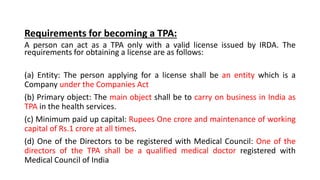
Requirements for becoming a TPA:
A person can act as a TPA only with a valid license issued by IRDA. The
requirements for obtaining a license are as follows:
(a) Entity: The person applying for a license shall be an entity which is a
Company under the Companies Act
(b) Primary object: The main object shall be to carry on business in India as
TPA in the health services.
(c) Minimum paid up capital: Rupees One crore and maintenance of working
capital of Rs.1 crore at all times.
(d) One of the Directors to be registered with Medical Council: One of the
directors of the TPA shall be a qualified medical doctor registered with
Medical Council of India
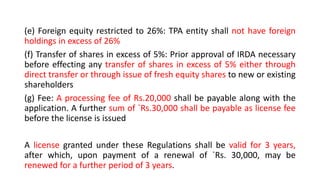
(e) Foreign equity restricted to 26%: TPA entity shall not have foreign
holdings in excess of 26%
(f) Transfer of shares in excess of 5%: Prior approval of IRDA necessary
before effecting any transfer of shares in excess of 5% either through
direct transfer or through issue of fresh equity shares to new or existing
shareholders
(g) Fee: A processing fee of Rs.20,000 shall be payable along with the
application. A further sum of `Rs.30,000 shall be payable as license fee
before the license is issued
A license granted under these Regulations shall be valid for 3 years,
after which, upon payment of a renewal of `Rs. 30,000, may be
renewed for a further period of 3 years.
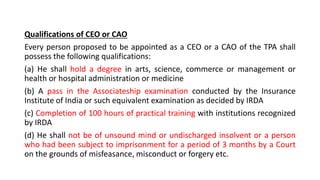
Qualifications of CEO or CAO
Every person proposed to be appointed as a CEO or a CAO of the TPA shall
possess the following qualifications:
(a) He shall hold a degree in arts, science, commerce or management or
health or hospital administration or medicine
(b) A pass in the Associateship examination conducted by the Insurance
Institute of India or such equivalent examination as decided by IRDA
(c) Completion of 100 hours of practical training with institutions recognized
by IRDA
(d) He shall not be of unsound mind or undischarged insolvent or a person
who had been subject to imprisonment for a period of 3 months by a Court
on the grounds of misfeasance, misconduct or forgery etc.
Decision making on claims by TPAs prohibited
A TPA is prohibited from taking any decisions on any claims. A TPA can
only assess and recommend admission of a claim or otherwise based
on the guidelines provided by the insurer in terms of the agreement
entered with them. Once the insurer takes a decision on the claim and
communicates it to the TPA as follows :
“As per the instructions of the insurer <Name of the Insurer>. the claim
is being settled/denied for Rs. <amount> on account of <specifics of
treatment/grounds of denial>. For any further clarifications, you may
directly contact the insurer.”
Agreement between a TPA and an Insurance company
a. The insurer and the TPA shall themselves define the scope of the
Agreement, the health and related services and the remuneration therefor.
b. The remuneration to the TPA shall be based on the services rendered to
the insurer and shall not be related to the product/policy experience.
c. A copy of the Agreement entered into between the TPA and the Insurance
Company or any modification thereof, shall be filed, within 15 days of its
execution .
d. More than one TPA may be engaged by an insurance company and,
similarly, a TPA can serve more than one insurance company.
e. The Authority from time to time may prescribe minimum standard clauses
to be included in the agreement between insurer and TPA.
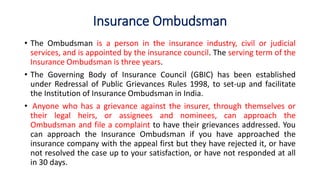
Insurance Ombudsman
• The Ombudsman is a person in the insurance industry, civil or judicial
services, and is appointed by the insurance council. The serving term of the
Insurance Ombudsman is three years.
• The Governing Body of Insurance Council (GBIC) has been established
under Redressal of Public Grievances Rules 1998, to set-up and facilitate
the Institution of Insurance Ombudsman in India.
• Anyone who has a grievance against the insurer, through themselves or
their legal heirs, or assignees and nominees, can approach the
Ombudsman and file a complaint to have their grievances addressed. You
can approach the Insurance Ombudsman if you have approached the
insurance company with the appeal first but they have rejected it, or have
not resolved the case up to your satisfaction, or have not responded at all
in 30 days.
According to the current data available on the website, there are 17
Ombudsman in different locations across India.
Ahmedabad, Bengaluru, Bhopal, Bhubaneswar,
Chandigarh, Chennai, Delhi, Guwahati,
Hyderabad, Jaipur, Kochi, Kolkata, Lucknow,
Mumbai, Pune , Patna and Noida.
Powers of Ombudsmen:
An Ombudsmen is empower to entertain the following disputes:
(a) A complaint as specified under Rule 13
(b) Partial or total repudiation of claims by an insurer
(c) Dispute with regard to the premium paid or payable in terms of the
policy
(d) Dispute on the legal construction of policies with regard to claims
(e) Delay in settlement of claims
(f) Non-issuance of any insurance document to customers after receipt
of premium
Persons eligible to be appointed as Insurance Ombudsmen:
(a) Persons who served in the capacity of Chairman or Managing
Director in Public Sector Insurance Companies
(b) Persons who have served the Indian Administrative Service or the
Indian Revenue Service
(c) Persons who are retired Judges of the Supreme Court or the High
Courts
An Ombudsman shall be appointed by the Governing body
from a panel prepared by a Committee comprising of:
(a) Chairman, IRDA
(b) Two representatives of Insurance council including one
each from Life Insurance business and from General Insurance
respectively
(c) One representative of Central Government
Procedure for making a complaint : The Complaint shall be in writing duly signed
by the complainant or through his legal heirs and shall state clearly the name and
address of the complainant, the name of the branch, the fact giving rise to the
complaint, supported by the documents, if any, relied on by the complainant, the
nature and extent of the loss caused to the complainant and the relief sought from
the Ombudsman. In order that a complaint is entertained before the Ombudsman,
the following conditions must be satisfied:
• The complainant must approach the Ombudsman only if either the insurance
company rejects the grievance or complainant not satisfied with the reply or the
insurer fails to respond within one month of submission of the grievance
• No complaint can be preferred before the Ombudsman after one year from the
date of rejection
• If the complainant has not preferred alternative legal remedies and the
proceedings are not pending before any Court or Consumer forum.
Settlement Process: The Ombudsman acts as a mediator in these
disputes and tries to arrive at an honest recommendation, which is
based on the facts involved in the dispute. If you accept the decision
taken by them, then they inform the insurance company of the same,
and the company has to comply to the terms within 15 days.
• If a recommended settlement works and it is found to be satisfactory,
then the Ombudsman will be issuing an award within three months of
receiving the complaint. However, if the satisfaction is still not
reached and the case is not closed, then you have the option to go to
an alternate authority. There, the insurance company has no other
choice, but to adhere to the orders set out by the Ombudsman
Reinsurance
• Reinsurance means insuring again by the insurer of a risk already insured.
Every insurer has a limit to the risk that he can bear. If at anytime a
profitable venture comes his way, he may insure it even if the risk involved
is beyond his capacity which is his retention limit. In such cases, in order to
safeguard his interest, he may reinsure the same risk for an amount in
excess of his retention limit with other insurers, so that the loss due to risk
is spread over many insurers.
• Reinsurance is, therefore, a contract between two insurers and the original
contract or the insured is not at all affected by it. Now there are two
contracts on the subject matter. The first contract is between the original
insurer and the original insured. The other contract (reinsurance contract)
is between the original insurer and the reinsurer.
• In the case of loss on the subject matter, the original insurer collects
the insured sum from the reinsurer and then settles the loss value in
full to the original insured.
Definition by Federation of Insurance Institute, Mumbai
• Reinsurance is an arrangement whereby an insurer so has accepted
all insurance, transfers a part of the risk to another insurer so that his
liability on any one risk is limited to a figure proportionate to his
financial capacity.
TERMS USED IN REINSURANCE:
• Direct Insurer:
• Reinsurer:
• Ceding company:
• Cession:
• Reinsurance policy:
• Retention:
• Surplus:
• Reinsurance Commission:
Retention Limit
Retention limits are determined by the insurer and may vary depending on the
underwriting criteria. The retention limits for different insurance products will
also differ. Retention is computed on the basis of Net Amount at Risk. This
metric is computed as the sum assured minus accumulated amount.
The higher the retention limit, the lower the reinsurance costs. Lower
retention limit may lead to a phenomenon called fronting wherein the insurers
will cede the total risk to the reinsurer which is often a captive of the primary
insurer.
• Definition:
The maximum amount of risk retained by an insurer per life is called retention.
Beyond that, the insurer cedes the excess risk to a reinsurer. The point beyond
which the insurer cedes the risk to the reinsurer is called retention limit.
Methods of Reinsurance
The selection of these methods depends upon the practice of insurers
and the scope of their resources. These methods are:
1. Facultative Reinsurance; and
2. Treaty Reinsurance
a. Quota share treaty;
b. Surplus treaty and
c. Excess of loss treaty
1. Facultative Reinsurance:
This method is also known as “Specific reinsurance“. Under this
method, each individual risk is submitted by the ceding insurer to the
reinsurer who can accept or decline whatever sum they consider
appropriate subject to the amount of their acceptance being approved
by the ceding insurer.
The reinsurer will go through the contents of the proposal form (such
as the sum assured, perils covered, rate of premium and period of
insurance etc.) and decide whether to accept or reject the risks. If he
decides to accept, he should specify the amount of reinsurance.
Reinsurance for a single risk or a defined package of risks.
2. Treaty Reinsurance:
Treaty reinsurance has been defined as a formal, legally binding
agreement or a treaty (agreement) between the principal and the
reinsurer that the reinsurer shall accept without the option of rejecting,
a specified proportion of the excess on any risk over the insurer’s limit
of retention.
Thus, under this method, there is an agreement between the ceding
company and the reinsurance company that amount of every risk over
and above the retention shall automatically be transferred to the
reinsurance company.
a.) Quota Share Treaty:
• Under this method, the ceding company is bound to cede and the
reinsurer is bound to accept a fixed share of every risk coming within
the scope of the treaty.
• This method is highly beneficial to the reinsurer. The liability of the
reinsurer attaches as soon as the ceding office assumes the risk.
Then, the ceding office provides the accepting office with full details
of each cession, copies of proposal papers. It does not give the
insurer an option of acceptance or rejection.
• Pro rata reinsurance contract in which the insurer and reinsurer share
premiums and losses according to fixed percentage.
b.) Surplus Treaty
• Under this method, the insurers agree to accept the surplus i.e.,
the difference between ceding insurers’ retention and gross
acceptance. Surplus treaties are arranged on the basis of ‘lines’. A
‘line’ is equivalent to the ceding insurer’s retention.
• Ceding insurer retains a fixed amount of policy liability and the
reinsurer takes responsibility of what remains.
• For example, a treaty may be arranged on a ten line basis. Under
this arrangement, the insurers will accept automatically upto ten
times the retention of ceding insurer.
c.) Excess of Loss Treaty
• Under this method the protection arranged is not linked with the sum insured
but comes into operation when the total net loss suffered by the insured due to
one event exceeds the figure agreed in the treaty.
• Thus, under this method the original insurer has to decide the maximum
amount which he can bear on any one loss and seeks reinsurance under which
the reinsurer will be responsible for the amount of any losses and above the
amount retained by the direct reinsurer.
• This method is employed mainly to protect large catastrophic losses such as
those caused by Special perils fire insurance i.e. storm, flood, earthquake, large
marine acceptance etc. It is also applied to protect legal liability classes i.e.,
motor third party, public liability, products liability and workmen’s
compensation risks.
Consumer Protection Act, 2019
An Act to provide for protection of the interests of consumers and for
the said purpose, to establish authorities for timely and effective
administration and settlement of consumers' disputes and for matters
connected therewith or incidental thereto.
• This Act may be called the Consumer Protection Act, 2019.
• It extends to the whole of India except the State of Jammu and
Kashmir.
• It shall come into force on such date as the Central Government may,
by notification, appoint and different dates may be appointed for
different States and for different provisions of this Act.
• Save as otherwise expressly provided by the Central Government, by
notification, this Act shall apply to all goods and services.
• "consumer" means any person who—
• buys any goods for a consideration which has been paid or promised or partly
paid and partly promised, or under any system of deferred payment and includes
any user of such goods other than a person who obtains such goods for resale or
for any commercial purpose; or
• hires or avails of any service for a consideration which has been paid or promised
or partly paid and partly promised, or under any system of deferred payment and
includes any beneficiary of such service other than a person who avails of such
service for any commercial purpose
• "advertisement" means any audio or visual publicity, representation,
endorsement or pronouncement made by means of light, sound, smoke,
gas, print, electronic media, internet or website and includes any notice,
circular, label, wrapper, invoice or such other documents;
• "defect" means any fault, imperfection or shortcoming in the quality,
quantity, potency, purity or standard which is required to be maintained by
or under any law for the time being in force or under any contract, express
or implied or as is claimed by the trader in any manner whatsoever in
relation to any goods or product and the expression "defective" shall be
construed accordingly;
• "goods" means every kind of movable property and includes "food" as
defined in clause (j) of sub-section (1) of section 3 of the Food Safety and
Standards Act, 2006;
Central Consumer Protection Council
(1) The Central Government shall, by notification, establish with effect
from such date as it may specify in that notification, the Central
Consumer Protection Council to be known as the Central Council.
(2) The Central Council shall be an advisory council and consist of the
following members, namely:—
• (a) the Minister-in-charge of the Department of Consumer Affairs in
the Central Government, who shall be the Chairperson; and
• (b) such number of other official or non-official members
representing such interests as may be prescribed.
Establishment of Central Consumer Protection Authority
(1) The Central Government shall, by notification, establish with effect from such
date as it may specify in that notification, a Central Consumer Protection Authority
to be known as the Central Authority to regulate matters relating to violation of
rights of consumers, unfair trade practices and false or misleading advertisements
which are prejudicial to the interests of public and consumers and to promote,
protect and enforce the rights of consumers as a class.
(2) The Central Authority shall consist of a Chief Commissioner and such number of
other Commissioners as may be prescribed, to be appointed by the Central
Government to exercise the powers and discharge the functions under this Act.
(3) The headquarters of the Central Authority shall be at such place in the National
Capital Region of Delhi, and it shall have regional and other offices in any other
place in India as the Central Government may decide.
Establishment of State Consumer Disputes Redressal Commission
(1) The State Government shall, by notification, establish a State Consumer
Disputes Redressal Commission, to be known as the State Commission, in the
State.
(2) The State Commission shall ordinarily function at the State capital and
perform its functions at such other places as the State Government may in
consultation with the State Commission notify in the Official Gazette:
Provided that the State Government may, by notification, establish regional
benches of the State Commission, at such places, as it deems fit.
(3) Each State Commission shall consist of—
• (a) a President; and
• (b) not less than four or not more than such number of members as may be
prescribed in consultation with the Central Government.
Establishment of District Consumer Disputes Redressal Commission
(1) The State Government shall, by notification, establish a District
Consumer Disputes Redressal Commission, to be known as the District
Commission, in each district of the State: Provided that the State
Government may, if it deems fit, establish more than one District
Commission in a district.
(2) Each District Commission shall consist of—
• (a) a President; and
• (b) not less than two and not more than such number of members as
may be prescribed, in consultation with the Central Government.
Establishment of Consumer Mediation Cell
(1) The State Government shall establish, by notification, a consumer
mediation cell to be attached to each of the District Commissions and
the State Commissions of that State.
(2) The Central Government shall establish, by notification, a consumer
mediation cell to be attached to the National Commission and each of
the regional Benches.
(3) A consumer mediation cell shall consist of such persons as may be
prescribed.
(4) Every consumer mediation cell shall maintain—
• (a) a list of empanelled mediators;
• (b) a list of cases handled by the cell;
• (c) record of proceeding; and
• (d) any other information as may be specified by regulations.
(5) Every consumer mediation cell shall submit a quarterly report to the
District Commission, State Commission or the National Commission to
which it is attached, in the manner specified by regulations.
• Product Liability Action: A product liability action may be brought by a
complainant against a product manufacturer or a product service provider or a
product seller, as the case may be, for any harm caused to him on account of a
defective product.
• Penalty for Non-Compliance of Direction of Central Authority: Whoever, fails to
comply with any direction of the Central Authority under sections 20 and 21, shall
be punished with imprisonment for a term which may extend to six months or
with fine which may extend to twenty lakh rupees, or with both.
• Punishment for False and Misleading Advertisement: Any manufacturer or
service provider who causes a false or misleading advertisement to be made
which is prejudicial to the interest of consumers shall be punished with
imprisonment for a term which may extend to two years and with fine which may
extend to ten lakh rupees; and for every subsequent offence, be punished with
imprisonment for a term which may extend to five years and with fine which may
extend to fifty lakh rupees.
Liability of Product Manufacturer
(1) A product manufacturer shall be liable in a product liability action, if—
• (a) the product contains a manufacturing defect; or
• (b) the product is defective in design; or
• (c) there is a deviation from manufacturing specifications; or
• (d) the product does not conform to the express warranty; or
• (e) the product fails to contain adequate instructions of correct usage to
prevent any harm or any warning regarding improper or incorrect usage.
(2) A product manufacturer shall be liable in a product liability action even if
he proves that he was not negligent or fraudulent in making the express
warranty of a product.
Liability of Product service Provider
A product service provider shall be liable in a product liability action, if—
(a) the service provided by him was faulty or imperfect or deficient or
inadequate in quality, nature or manner of performance which is required to
be provided by or under any law for the time being in force, or pursuant to
any contract or otherwise; or
(b) there was an act of omission or commission or negligence or conscious
withholding any information which caused harm; or
(c) the service provider did not issue adequate instructions or warnings to
prevent any harm; or
(d) the service did not conform to express warranty or the terms and
conditions of the contract.
Thank you

Claim Management

  • 1.
    INSURANCE & RISKMANAGEMENT (BBAA04A52) Unit -4: CLAIM MANAGEMENT & REINSURANCE Dr. J.Mexon , Department of Management, Kristu Jayanti College, Bengaluru.
  • 2.
    Contents • Claim Management •Claim settlement legal framework • Third party administration • Insurance ombudsman • Consumer Protection Act • Re-insurance in life insurance • Retention limits • Methods of re-insurance
  • 3.
    Introduction to ClaimManagement The prompt settlement of valid claim is an important function of an insurance organization. In fact, the efficiency of the organization is tested wherever a claim arises, by the time that is taken by the insurers to finalize it. The goodwill of the organization depends primarily on the claims satisfaction level among its customers. The claims system passes through two stages, the claims management and the claims handling. Claims handling is an integral part of claims management and executes the decision made by the claims management machinery of an insurance company
  • 4.
    In every insurancecompany effective claim administration is of paramount importance since it results in cash outflows. Though, the insurers are legally and morally liable to service the contracted claims, yet it becomes extremely important to correctly assume the claims filed in order to decline • Claims with fraudulent intentions • Claims filed due to incorrect interpretations of clauses contained in the policy document.
  • 5.
    • Settling Claims:The time it takes to process a claim involves several stages beginning with a person filing a claim. The stages that follow determine if a claim has merit as well as how much the insurance company will pay. Insurance customers expect a company to settle claims quickly and to their satisfaction. The use of claims management system software that speeds the process and minimizes costs offers a practical solution. Simplifying the claims process through automation helps reduce expenses for smaller companies that operate with smaller budgets.
  • 6.
    • Detecting Fraud:Paying fraudulent claims costs insurance companies money -- a cost the insurance industry then passes on to its customers. Consequently, underwriting guidelines become tougher and the insurance premiums consumers pay increase. Software tools designed to examine payment history and evaluate trends in claim payoffs can help insurance companies detect fraud. • For example, how often the same individual files an insurance claim can be a warning that a person might be filing a fraudulent claim. Unfortunately, settling claims too quickly increases a company‘s chance of paying out on a greater number of fraudulent claims.
  • 7.
    • Lowering Costs:Monitoring costs throughout the claims management process determines how much of a customer‘s premium rate goes toward paying for the insurance company‘s administrative costs. • Generally speaking, when settling a claim is delayed, it costs the insurance company more money. The higher claim costs reduce profitability. Other essential functions of the claims management process that can reduce costs include developing programs directed at preventing claims before they occur and avoiding future claims.
  • 8.
    • Avoiding Litigation:In most cases involving insurance claim disputes, the insurance company eventually agrees to pay an equitable amount if a customer has a legitimate claim and can present evidence supporting it. Although quickly settling a claim can avoid the chances for litigation, accurate liability assessment is crucial to achieving a quick resolution in a claim dispute. Insurers work to evade litigation because it substantially increases the company's cost of settling a claim.
  • 9.
    Steps to Filea Claim 1. Claim intimation/notification 2. Documents required for claim processing 3. Submission of required documents for claim processing 4. Settlement of claim
  • 10.
    1. Claim intimation/notification:The claimant must submit the written intimation as soon as possible to enable the insurance company to initiate the claim processing. The claim intimation should consist of basic information such as policy number, name of the insured, date of death, cause of death, place of death, name of the claimant. Alternatively, some insurance companies also provide the facility of downloading the form from their website.
  • 11.
    2. Documents requiredfor claim processing: The claimant will be required to provide a claimant's statement, original policy document, death certificate, police FIR and post mortem exam report (for accidental death), certificate and records from the treating doctor/hospital (for death due to illness) and advance discharge form for claim processing.
  • 12.
    3. Submission ofrequired documents for claim processing: For faster claim processing, it is essential that the claimant submits complete documentation as early as possible. Once all relevant documents, records and forms have been submitted, the life insurer can take a decision about the claim. 4. Settlement of claim: As per the regulation 8 of the IRDA (Policy holder's Interest) Regulations, 2002, the insurer is required to settle a claim within 30 days of receipt of all documents including clarification sought by the insurer. If the claim requires further investigation, the insurer has to complete its procedures within six months from receiving the written intimation of claim.
  • 13.
    Types of Claims Paymentof claim is the ultimate objective of life insurance and the policyholder has waited for it for a quite long time and in some cases for the entire life time literally for the payment. It is the final obligation of the insurer in terms of the insurance contract as per the conditions mentioned in the schedule of the policy document. There may be three types of claim in life insurance policies– • 1. Survival Benefit Claim • 2. Maturity Benefit Claim • 3. Death Benefit Claim
  • 14.
    1. Survival Benefit: Itis payable in endowment or money back plans after a lapse of a fixed period say 4 or 5 years, provided firstly the policy is in force and secondly the policyholder is alive. As the insurer sends out premium notices to the policy holder for payment of due premium, so it sends out intimation also to the policyholder if and when a survival benefit falls due. The letter of intimation of survival benefit carries with it a discharge voucher mentioning the amount payable. The policyholder has merely to return the discharge voucher duly signed along with the policy document.
  • 15.
    2. Maturity BenefitClaim: It is a final payment under the policy as per the terms of the contract. Any insurer is under obligation to pay the amount on the due date. Therefore the intimation of maturity claim and discharge voucher is sent in advance with the instruction to return it immediately. If the life assured dies after the maturity date, but before receiving the claim, there arises a typical problem as to who is entitled to receive the money. As the policyholder was surviving till the date of maturity, the nominee is not entitled to receive the claim. The policy under such conditions is treated as a death claim where the policy does not have a nomination. The insurer in such a case shall ask for a will or a succession certificate, before it can get a valid discharge for payment of this maturity claim.
  • 16.
    3. Death Claim:If the life assured dies during the term of the policy, the death claim arises. If the death has taken place within the first two to three years of the commencement of the policy, it is called an early death claim and If the death has taken after 2 to 3 years, it is called a non-early death claim. If the insured dies before the expiry of the term of the policy, the death of the life assured has to be intimated in writing to the insurer. It may be done by the nominee, assignee, a relative of the life assured, the employer, agent or development officer.
  • 17.
    Particulars like policynumber, name of the life assured, the date of the death, the cause of death and the relationship of the informant to the decreased are to be mentioned. The intimation must satisfy two conditions. • It must be form a concerned person and • Must establish beyond doubt, the identity of the deceased person as the life assured under the policy.
  • 18.
    Documents Required forClaim Settlement 1. The documents required for payment of maturity claim 2. The documents required for payment of a death claim 3. In case the life assured has disappeared 4. In case the premature death claim
  • 19.
    1. The documentsrequired for payment of maturity claim : • Age proof, if age is not admitted. • Original policy document for cancellation. • In case assignment is executed on a separate paper, that document has to be surrendered. • Discharge form duly executed. • Indemnity bond in case the policy document is lost or destroyed, duly executed by the policyholder and a surety of sound financial standing.
  • 20.
    2. The documentsrequired for payment of a death claim: • An intimation of death by the nominee or a near relative. • Proof of age if not already admitted. • Proof of death. • Doctor’s certificate who attended the deceased during his last illness. • Identity certificate from a reputable person who saw the body of the deceased life assured. • Certificate of cremation or burial from a reputable person who attended the funeral. • An employer certificate if any, of the deceased.
  • 21.
    • If thepolicy has been assigned validly or if there is a valid nomination in the policy document, no further proof of title to the policy money is necessary. In other cases, the satisfactory evidence of title to the estate of the deceased is required from competent court of law. e.g. • A probate of the will, if a will has been executed by the deceased life assured. • A succession certificate if no will has been left. • A certificate from the Administrator General, if the total amount of the estate left does not exceed Rs. 2,000/-. In case there is a rival claim court’s prohibitory order may be required to prevent the insurer from making the payment to the nominee as mentioned in the policy document.
  • 22.
    3. In casethe life assured has disappeared : Under Indian Evidence Act, 1872, Section 108, a person who has disappeared is presumed to be dead only if he has not been heard of for 7 years by those who would naturally have heard of him, if he had been alive. The claimant has to produce the decree of the court to the effect that the assured should be presumed to be dead. The legal heirs are required to keep on paying the premium payment till such court order is received failing which the policy will be treated as a paid up policy.
  • 23.
    4. In casethe premature death claim: In case of a premature death claim, i.e. a death within two years of the commencement of the policy, the insurer asks from claimant documents in order to eliminate the possibility of any suppression of a material fact at the time of submitting the proposal. • Hospital treatment details where the assured was hospitalised. • Certified copies of postmortem report • The police investigation report if death is due to an accident or unnatural cause.
  • 24.
    Procedure of ClaimSettlement 1. Maturity benefit 2. Death Claim 3. Premature Claim 4. Claim Concession 5. Ex-Gratia Claim
  • 25.
    1. Maturity Benefit:As the policyholder is alive, the nomination is of no significance. Age is normally admitted at the stage of the proposal. If it has not been admitted for some reason, it is necessary to submit the age proof before the payment of the maturity value. Much before the date of maturity the insurer sends the claim discharge voucher which has to be returned duly signed and witnessed along with the policy document for payment of the maturity value.
  • 26.
    2. Death Claim: Insurer deals with the death claim differently on the basis of the duration or the policy. If the policyholder has died within two years of the commencement of the policy, it is treated as “early or premature claim” and if the death has occured after 2 yrs of the commencement, it is treated as normal death claim. In a normal death claim, the insurer, on being intimated about the death of the policyholder, calls for the age proof, if not earlier admitted, the original policy document and proof of death The claimant generally is required to fill in a form giving certain routine information about his title to the policy money and the information relating to death, which is normally called a claimant’s statement.
  • 27.
    3. Premature claim:Under this insurer takes certain precautions before making payment under such a premature claim. It wants to satisfy itself that it is a genuine case i.e., the correct policyholder has died and that the cause of death does not go back to a date prior to the commencement of the policy. The duration of last illness is of vital importance to eliminate any fraudulent intention. Last medical attendants’ certificate, hospital report, burial certificate, employees’ leave record, if he was an employee in a reputed firm etc, are the different records examined and normally a senior officer is deputed by the insurer to make on the spot investigation, through neighbours, colleagues or doctor of the locality.
  • 28.
    • As therevival of the policy is a de novo contract of insurance, the insurer would like to verify whether the statement contained in the declaration of good health given at the time of revival is correct. If such a statement is proved fraudulent relating to a material fact, the claim, may be rejected. • If the premature death has been due to an accident, it is necessary to get a police inquiry report in lieu of the attending physician certificate. Suicide, if it has taken place within one year of the beginning of the risk, exempts the insurer from the liability of the payment of the claim. The propensity to commit suicide is a moral hazard and is not expected to continue beyond one year.
  • 29.
    4. Claim concession: Normally, a death claim becomes payable so long as the policy is kept in force. Under a lapsed policy no claim is payable. However, some companies provide concessions, if the policy has run for 3 yrs or more: • If the premiums have been paid for a minimum period of three full years, and the life assured has died within 6 months from the date of the first unpaid premium insurer pays the full sum assured and only the unpaid premiums deducted. • This concession is extended to a period of twelve months and the full sum assured is paid if the life assured dies within one year from the due date of the first unpaid premium, the premiums have been paid for a minimum period of 5 years subject to deduction of the unpaid premiums for the policy year.
  • 30.
    5. Ex Gratiaclaim : When a policy has not acquired paid up value and claim concession rules are not applicable, nothing is payable in case of death. However some insurers relax the rules in favour of the claimant. If the premiums have been paid for more than 2 years and • (a) the death occurs within 3 months from the first unpaid premium, full sum assured with bonus, if any, is payable ; • (b) if the death occurs after 3 months, but within 6 months, half the sum assured is paid ; • (c) if the death occurs within one year from first unpaid premium, notional paid up value is paid.
  • 31.
    Third Party Administration •‘TPA’ is a person appointed by an insurance company to render services in connection with health insurance business or health cover, excluding the insurance business of an insurer and soliciting or procuring insurance business directly or through an intermediary or an insurance agent. • TPAs are normally engaged to provide services in connection with hospitalization of an insured under a health insurance policy • They also offer certain other services like arranging for medical examination of the insured before a policy is issued by an insurance company etc.
  • 32.
    Requirements for becominga TPA: A person can act as a TPA only with a valid license issued by IRDA. The requirements for obtaining a license are as follows: (a) Entity: The person applying for a license shall be an entity which is a Company under the Companies Act (b) Primary object: The main object shall be to carry on business in India as TPA in the health services. (c) Minimum paid up capital: Rupees One crore and maintenance of working capital of Rs.1 crore at all times. (d) One of the Directors to be registered with Medical Council: One of the directors of the TPA shall be a qualified medical doctor registered with Medical Council of India
  • 33.
    (e) Foreign equityrestricted to 26%: TPA entity shall not have foreign holdings in excess of 26% (f) Transfer of shares in excess of 5%: Prior approval of IRDA necessary before effecting any transfer of shares in excess of 5% either through direct transfer or through issue of fresh equity shares to new or existing shareholders (g) Fee: A processing fee of Rs.20,000 shall be payable along with the application. A further sum of `Rs.30,000 shall be payable as license fee before the license is issued A license granted under these Regulations shall be valid for 3 years, after which, upon payment of a renewal of `Rs. 30,000, may be renewed for a further period of 3 years.
  • 34.
    Qualifications of CEOor CAO Every person proposed to be appointed as a CEO or a CAO of the TPA shall possess the following qualifications: (a) He shall hold a degree in arts, science, commerce or management or health or hospital administration or medicine (b) A pass in the Associateship examination conducted by the Insurance Institute of India or such equivalent examination as decided by IRDA (c) Completion of 100 hours of practical training with institutions recognized by IRDA (d) He shall not be of unsound mind or undischarged insolvent or a person who had been subject to imprisonment for a period of 3 months by a Court on the grounds of misfeasance, misconduct or forgery etc.
  • 35.
    Decision making onclaims by TPAs prohibited A TPA is prohibited from taking any decisions on any claims. A TPA can only assess and recommend admission of a claim or otherwise based on the guidelines provided by the insurer in terms of the agreement entered with them. Once the insurer takes a decision on the claim and communicates it to the TPA as follows : “As per the instructions of the insurer <Name of the Insurer>. the claim is being settled/denied for Rs. <amount> on account of <specifics of treatment/grounds of denial>. For any further clarifications, you may directly contact the insurer.”
  • 36.
    Agreement between aTPA and an Insurance company a. The insurer and the TPA shall themselves define the scope of the Agreement, the health and related services and the remuneration therefor. b. The remuneration to the TPA shall be based on the services rendered to the insurer and shall not be related to the product/policy experience. c. A copy of the Agreement entered into between the TPA and the Insurance Company or any modification thereof, shall be filed, within 15 days of its execution . d. More than one TPA may be engaged by an insurance company and, similarly, a TPA can serve more than one insurance company. e. The Authority from time to time may prescribe minimum standard clauses to be included in the agreement between insurer and TPA.
  • 37.
    Insurance Ombudsman • TheOmbudsman is a person in the insurance industry, civil or judicial services, and is appointed by the insurance council. The serving term of the Insurance Ombudsman is three years. • The Governing Body of Insurance Council (GBIC) has been established under Redressal of Public Grievances Rules 1998, to set-up and facilitate the Institution of Insurance Ombudsman in India. • Anyone who has a grievance against the insurer, through themselves or their legal heirs, or assignees and nominees, can approach the Ombudsman and file a complaint to have their grievances addressed. You can approach the Insurance Ombudsman if you have approached the insurance company with the appeal first but they have rejected it, or have not resolved the case up to your satisfaction, or have not responded at all in 30 days.
  • 38.
    According to thecurrent data available on the website, there are 17 Ombudsman in different locations across India. Ahmedabad, Bengaluru, Bhopal, Bhubaneswar, Chandigarh, Chennai, Delhi, Guwahati, Hyderabad, Jaipur, Kochi, Kolkata, Lucknow, Mumbai, Pune , Patna and Noida.
  • 39.
    Powers of Ombudsmen: AnOmbudsmen is empower to entertain the following disputes: (a) A complaint as specified under Rule 13 (b) Partial or total repudiation of claims by an insurer (c) Dispute with regard to the premium paid or payable in terms of the policy (d) Dispute on the legal construction of policies with regard to claims (e) Delay in settlement of claims (f) Non-issuance of any insurance document to customers after receipt of premium
  • 40.
    Persons eligible tobe appointed as Insurance Ombudsmen: (a) Persons who served in the capacity of Chairman or Managing Director in Public Sector Insurance Companies (b) Persons who have served the Indian Administrative Service or the Indian Revenue Service (c) Persons who are retired Judges of the Supreme Court or the High Courts
  • 41.
    An Ombudsman shallbe appointed by the Governing body from a panel prepared by a Committee comprising of: (a) Chairman, IRDA (b) Two representatives of Insurance council including one each from Life Insurance business and from General Insurance respectively (c) One representative of Central Government
  • 42.
    Procedure for makinga complaint : The Complaint shall be in writing duly signed by the complainant or through his legal heirs and shall state clearly the name and address of the complainant, the name of the branch, the fact giving rise to the complaint, supported by the documents, if any, relied on by the complainant, the nature and extent of the loss caused to the complainant and the relief sought from the Ombudsman. In order that a complaint is entertained before the Ombudsman, the following conditions must be satisfied: • The complainant must approach the Ombudsman only if either the insurance company rejects the grievance or complainant not satisfied with the reply or the insurer fails to respond within one month of submission of the grievance • No complaint can be preferred before the Ombudsman after one year from the date of rejection • If the complainant has not preferred alternative legal remedies and the proceedings are not pending before any Court or Consumer forum.
  • 43.
    Settlement Process: TheOmbudsman acts as a mediator in these disputes and tries to arrive at an honest recommendation, which is based on the facts involved in the dispute. If you accept the decision taken by them, then they inform the insurance company of the same, and the company has to comply to the terms within 15 days. • If a recommended settlement works and it is found to be satisfactory, then the Ombudsman will be issuing an award within three months of receiving the complaint. However, if the satisfaction is still not reached and the case is not closed, then you have the option to go to an alternate authority. There, the insurance company has no other choice, but to adhere to the orders set out by the Ombudsman
  • 44.
    Reinsurance • Reinsurance meansinsuring again by the insurer of a risk already insured. Every insurer has a limit to the risk that he can bear. If at anytime a profitable venture comes his way, he may insure it even if the risk involved is beyond his capacity which is his retention limit. In such cases, in order to safeguard his interest, he may reinsure the same risk for an amount in excess of his retention limit with other insurers, so that the loss due to risk is spread over many insurers. • Reinsurance is, therefore, a contract between two insurers and the original contract or the insured is not at all affected by it. Now there are two contracts on the subject matter. The first contract is between the original insurer and the original insured. The other contract (reinsurance contract) is between the original insurer and the reinsurer.
  • 45.
    • In thecase of loss on the subject matter, the original insurer collects the insured sum from the reinsurer and then settles the loss value in full to the original insured. Definition by Federation of Insurance Institute, Mumbai • Reinsurance is an arrangement whereby an insurer so has accepted all insurance, transfers a part of the risk to another insurer so that his liability on any one risk is limited to a figure proportionate to his financial capacity.
  • 46.
    TERMS USED INREINSURANCE: • Direct Insurer: • Reinsurer: • Ceding company: • Cession: • Reinsurance policy: • Retention: • Surplus: • Reinsurance Commission:
  • 47.
    Retention Limit Retention limitsare determined by the insurer and may vary depending on the underwriting criteria. The retention limits for different insurance products will also differ. Retention is computed on the basis of Net Amount at Risk. This metric is computed as the sum assured minus accumulated amount. The higher the retention limit, the lower the reinsurance costs. Lower retention limit may lead to a phenomenon called fronting wherein the insurers will cede the total risk to the reinsurer which is often a captive of the primary insurer. • Definition: The maximum amount of risk retained by an insurer per life is called retention. Beyond that, the insurer cedes the excess risk to a reinsurer. The point beyond which the insurer cedes the risk to the reinsurer is called retention limit.
  • 48.
    Methods of Reinsurance Theselection of these methods depends upon the practice of insurers and the scope of their resources. These methods are: 1. Facultative Reinsurance; and 2. Treaty Reinsurance a. Quota share treaty; b. Surplus treaty and c. Excess of loss treaty
  • 49.
    1. Facultative Reinsurance: Thismethod is also known as “Specific reinsurance“. Under this method, each individual risk is submitted by the ceding insurer to the reinsurer who can accept or decline whatever sum they consider appropriate subject to the amount of their acceptance being approved by the ceding insurer. The reinsurer will go through the contents of the proposal form (such as the sum assured, perils covered, rate of premium and period of insurance etc.) and decide whether to accept or reject the risks. If he decides to accept, he should specify the amount of reinsurance. Reinsurance for a single risk or a defined package of risks.
  • 50.
    2. Treaty Reinsurance: Treatyreinsurance has been defined as a formal, legally binding agreement or a treaty (agreement) between the principal and the reinsurer that the reinsurer shall accept without the option of rejecting, a specified proportion of the excess on any risk over the insurer’s limit of retention. Thus, under this method, there is an agreement between the ceding company and the reinsurance company that amount of every risk over and above the retention shall automatically be transferred to the reinsurance company.
  • 51.
    a.) Quota ShareTreaty: • Under this method, the ceding company is bound to cede and the reinsurer is bound to accept a fixed share of every risk coming within the scope of the treaty. • This method is highly beneficial to the reinsurer. The liability of the reinsurer attaches as soon as the ceding office assumes the risk. Then, the ceding office provides the accepting office with full details of each cession, copies of proposal papers. It does not give the insurer an option of acceptance or rejection. • Pro rata reinsurance contract in which the insurer and reinsurer share premiums and losses according to fixed percentage.
  • 52.
    b.) Surplus Treaty •Under this method, the insurers agree to accept the surplus i.e., the difference between ceding insurers’ retention and gross acceptance. Surplus treaties are arranged on the basis of ‘lines’. A ‘line’ is equivalent to the ceding insurer’s retention. • Ceding insurer retains a fixed amount of policy liability and the reinsurer takes responsibility of what remains. • For example, a treaty may be arranged on a ten line basis. Under this arrangement, the insurers will accept automatically upto ten times the retention of ceding insurer.
  • 53.
    c.) Excess ofLoss Treaty • Under this method the protection arranged is not linked with the sum insured but comes into operation when the total net loss suffered by the insured due to one event exceeds the figure agreed in the treaty. • Thus, under this method the original insurer has to decide the maximum amount which he can bear on any one loss and seeks reinsurance under which the reinsurer will be responsible for the amount of any losses and above the amount retained by the direct reinsurer. • This method is employed mainly to protect large catastrophic losses such as those caused by Special perils fire insurance i.e. storm, flood, earthquake, large marine acceptance etc. It is also applied to protect legal liability classes i.e., motor third party, public liability, products liability and workmen’s compensation risks.
  • 54.
    Consumer Protection Act,2019 An Act to provide for protection of the interests of consumers and for the said purpose, to establish authorities for timely and effective administration and settlement of consumers' disputes and for matters connected therewith or incidental thereto. • This Act may be called the Consumer Protection Act, 2019. • It extends to the whole of India except the State of Jammu and Kashmir. • It shall come into force on such date as the Central Government may, by notification, appoint and different dates may be appointed for different States and for different provisions of this Act. • Save as otherwise expressly provided by the Central Government, by notification, this Act shall apply to all goods and services.
  • 55.
    • "consumer" meansany person who— • buys any goods for a consideration which has been paid or promised or partly paid and partly promised, or under any system of deferred payment and includes any user of such goods other than a person who obtains such goods for resale or for any commercial purpose; or • hires or avails of any service for a consideration which has been paid or promised or partly paid and partly promised, or under any system of deferred payment and includes any beneficiary of such service other than a person who avails of such service for any commercial purpose
  • 56.
    • "advertisement" meansany audio or visual publicity, representation, endorsement or pronouncement made by means of light, sound, smoke, gas, print, electronic media, internet or website and includes any notice, circular, label, wrapper, invoice or such other documents; • "defect" means any fault, imperfection or shortcoming in the quality, quantity, potency, purity or standard which is required to be maintained by or under any law for the time being in force or under any contract, express or implied or as is claimed by the trader in any manner whatsoever in relation to any goods or product and the expression "defective" shall be construed accordingly; • "goods" means every kind of movable property and includes "food" as defined in clause (j) of sub-section (1) of section 3 of the Food Safety and Standards Act, 2006;
  • 57.
    Central Consumer ProtectionCouncil (1) The Central Government shall, by notification, establish with effect from such date as it may specify in that notification, the Central Consumer Protection Council to be known as the Central Council. (2) The Central Council shall be an advisory council and consist of the following members, namely:— • (a) the Minister-in-charge of the Department of Consumer Affairs in the Central Government, who shall be the Chairperson; and • (b) such number of other official or non-official members representing such interests as may be prescribed.
  • 58.
    Establishment of CentralConsumer Protection Authority (1) The Central Government shall, by notification, establish with effect from such date as it may specify in that notification, a Central Consumer Protection Authority to be known as the Central Authority to regulate matters relating to violation of rights of consumers, unfair trade practices and false or misleading advertisements which are prejudicial to the interests of public and consumers and to promote, protect and enforce the rights of consumers as a class. (2) The Central Authority shall consist of a Chief Commissioner and such number of other Commissioners as may be prescribed, to be appointed by the Central Government to exercise the powers and discharge the functions under this Act. (3) The headquarters of the Central Authority shall be at such place in the National Capital Region of Delhi, and it shall have regional and other offices in any other place in India as the Central Government may decide.
  • 59.
    Establishment of StateConsumer Disputes Redressal Commission (1) The State Government shall, by notification, establish a State Consumer Disputes Redressal Commission, to be known as the State Commission, in the State. (2) The State Commission shall ordinarily function at the State capital and perform its functions at such other places as the State Government may in consultation with the State Commission notify in the Official Gazette: Provided that the State Government may, by notification, establish regional benches of the State Commission, at such places, as it deems fit. (3) Each State Commission shall consist of— • (a) a President; and • (b) not less than four or not more than such number of members as may be prescribed in consultation with the Central Government.
  • 60.
    Establishment of DistrictConsumer Disputes Redressal Commission (1) The State Government shall, by notification, establish a District Consumer Disputes Redressal Commission, to be known as the District Commission, in each district of the State: Provided that the State Government may, if it deems fit, establish more than one District Commission in a district. (2) Each District Commission shall consist of— • (a) a President; and • (b) not less than two and not more than such number of members as may be prescribed, in consultation with the Central Government.
  • 61.
    Establishment of ConsumerMediation Cell (1) The State Government shall establish, by notification, a consumer mediation cell to be attached to each of the District Commissions and the State Commissions of that State. (2) The Central Government shall establish, by notification, a consumer mediation cell to be attached to the National Commission and each of the regional Benches. (3) A consumer mediation cell shall consist of such persons as may be prescribed.
  • 62.
    (4) Every consumermediation cell shall maintain— • (a) a list of empanelled mediators; • (b) a list of cases handled by the cell; • (c) record of proceeding; and • (d) any other information as may be specified by regulations. (5) Every consumer mediation cell shall submit a quarterly report to the District Commission, State Commission or the National Commission to which it is attached, in the manner specified by regulations.
  • 63.
    • Product LiabilityAction: A product liability action may be brought by a complainant against a product manufacturer or a product service provider or a product seller, as the case may be, for any harm caused to him on account of a defective product. • Penalty for Non-Compliance of Direction of Central Authority: Whoever, fails to comply with any direction of the Central Authority under sections 20 and 21, shall be punished with imprisonment for a term which may extend to six months or with fine which may extend to twenty lakh rupees, or with both. • Punishment for False and Misleading Advertisement: Any manufacturer or service provider who causes a false or misleading advertisement to be made which is prejudicial to the interest of consumers shall be punished with imprisonment for a term which may extend to two years and with fine which may extend to ten lakh rupees; and for every subsequent offence, be punished with imprisonment for a term which may extend to five years and with fine which may extend to fifty lakh rupees.
  • 64.
    Liability of ProductManufacturer (1) A product manufacturer shall be liable in a product liability action, if— • (a) the product contains a manufacturing defect; or • (b) the product is defective in design; or • (c) there is a deviation from manufacturing specifications; or • (d) the product does not conform to the express warranty; or • (e) the product fails to contain adequate instructions of correct usage to prevent any harm or any warning regarding improper or incorrect usage. (2) A product manufacturer shall be liable in a product liability action even if he proves that he was not negligent or fraudulent in making the express warranty of a product.
  • 65.
    Liability of Productservice Provider A product service provider shall be liable in a product liability action, if— (a) the service provided by him was faulty or imperfect or deficient or inadequate in quality, nature or manner of performance which is required to be provided by or under any law for the time being in force, or pursuant to any contract or otherwise; or (b) there was an act of omission or commission or negligence or conscious withholding any information which caused harm; or (c) the service provider did not issue adequate instructions or warnings to prevent any harm; or (d) the service did not conform to express warranty or the terms and conditions of the contract.
  • 66.