P a g e 1 | 17
FOUNDATION IN NATURAL AND BUILT
ENVIRONMENT
CONSTRUCTED LANDSCAPE
GROUP MEMBERS
DARSHIINI VIG (LEADER)
ILHAMI IBRAHIM
NURINA AIDA
MUSTAQIM CHOO
TAN WEN HAO
DANIEL CHOW KOK THENG
TITLE
LANDSCAPE PROJECT
SUBMISSION DATE
8TH AUGUST 2014
TUTOR
MS. NORMAH SULAIMAN
P a g e 2 | 17
CONTENT
PAGE NUMBER
INTRODUCTION 3-4
SITE ANALYSIS 5
SITE PLAN 6
CONCEPT PLAN 7
ELEMENTS OF THE SITE 8-10
MASTER PLAN 11
PLANTING PLAN 12-14
MAINTENANCE PLAN 15
COSTING PLAN (BILL OF QUANTITY) 16
CONCLUSION 17
P a g e 3 | 17
INTRODUCTION
In this particular project, we are divided into groups of six. We are tasked to
choose a 10mx10m site within Taylor’s University Lakeside Campus compound.
We are to study the site and come up with a landscape planning for the
selected area. Besides than planning, we need to include the site analysis,
concept, master plan, planting plan, maintenance plan and also costing (bill of
quantity.
We are proposing to construct a Meditation Garden for the selected site. This
construction is located in Block E, level 2 where the open space is. This site is
facing the staff parking zone and also the basketball court.
Pictures in the next page illustrates our site.
P a g e 4 | 17
P a g e 5 | 17
SITE ANALYSIS
The site is located on the second floor of Taylor’s University Lakeside Campus’s
Block E. It is facing the staff parking and the basketball court of the university.
The site occasionally receives a lot of wind coming from the south of the site.
From the south side of the site, the sun rises from the east and sets at the west of
the site. Therefore, the site gets more than enough sunlight during the day for
the plants to get enough sunlight for the photosynthesis process to commence.
From east to the west direction, the site has a perfect 180 degree view of the
car park, basketball court and also the lake. Besides than that, the only built
form that exists around that site is the high rises which includes the commercial
block and academic block in the campus (Taylor’s University Lakeside).
OUR SITE
P a g e 6 | 17
SITE PLAN
P a g e 7 | 17
CONCEPT PLAN
A meditation garden implies a sense of seclusion and personal space. Naturally
a place where one can relax, reflect, unwind, ponder new ideas, and
contemplate in peace and quiet.
These gardens often contain elements, plants, or oddities that are placed to stir
the senses and imagination into thought. The sound and visual of moving water,
decor of interest, something to think about. And in private gardens these
elements are most times personal.
With that in mind, it's easy to understand why the following pictures show so
many themes and varieties for this one type of garden. These gardens are as
varied as the personalities that create them and are named what they are
simply because that's what their creators created them to be.
There is no right or wrong way to make a meditation garden; the whole goal is
to make a garden that both calms and inspires you and when you open your
eyes, inspires you even more. Try to see this garden as an “outdoor room”. It’s a
place where you’ll go to relax, rest, and recline, so it will need to have features
in it that you find comfortable, comforting, and secure from prying eyes.
P a g e 8 | 17
ELEMENTS OF THE SITE PLANNING
Stone
Great stones and boulders are viewed
in the Japanese garden as islands.
Stone exists in dozens of other
applications, from bridges to stepping
pads. The role of stone cannot be
over-emphasized because it is the
structural basis of the hardscape
design.
Pebbles
Pebbles in the Asian garden are most
often river-rounded and cobble-like
from pea size to as large as a potato.
They are used to create fields on the
ground, offer a base plane for art, and
to outline stepping stone pathways.
P a g e 9 | 17
Sand and fine gravel
In Asian gardens without ponds or streams, sand and finer gravels are used to
create a metaphor for water. Whether composed as a dry streambed, or in the
great uniform seas that are raked to create a flowing or rippled effect, this is a
most common way to cover areas of ground and to serve as the basis for
organizing planting.
Water
Ponds, streams and waterfalls are beautiful elements in the meditative garden.
Created in a natural style with rocks
and plants often found at water’s
edge.
P a g e 10 | 17
Greens
Green plants add lush backdrops for brilliant herbs and flowers. Plant ferns and
foxglove in your meditation garden for shade and for a cooling sensibility.
Imagine perennial green fern fronds reaching up and out, reminiscent of a forest
floor. Plant biennial foxglove toward the back of the garden, taking advantage
of the plant's imposing -- 4 to 5 feet -- shade and thimble-shaped pastel flowers.
Zen Deck
A platform that is used for
meditation purposes. Made up
of bamboo which makes it to
be firm that it is always so easy
to walk on and sit to meditate.
P a g e 11 | 17
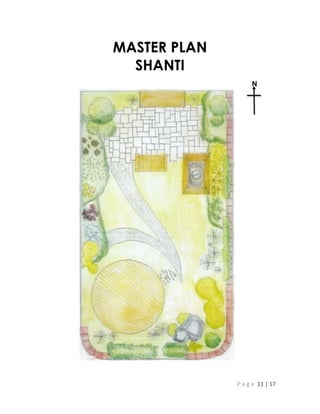
MASTER PLAN
SHANTI
P a g e 12 | 17
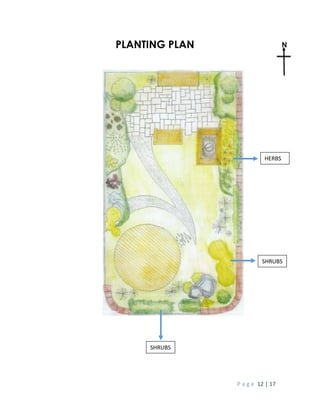
PLANTING PLAN
HERBS
SHRUBS
SHRUBS
P a g e 13 | 17
PLANTING SPECIES
PLANT NAME CHARACTERISTICS
1. Anise Hyssop
(Agastache
FoeniculuM)
Hyssop is easily grown from seed, either by starting
indoors as you would tomatoes or by sprinkling
outside in spring or fall. Fall-planted seed will
remain dormant and then sprout in the spring; this is
the way mature plants sow their seed.
2. Tea olive tree
(Osmanthus
Fragrans)
Tea olive is also a versatile plant that can make a
great backdrop for other plants. It looks good as a
specimen plant, and its glossy, evergreen leaves
and dense growth habit make it well suited for
screens and hedges. The plants typically flower at
several times throughout the year, with some
bloom cycles heavier than others. Flowers of the
species type are creamy white, while improved
cultivars offer yellow or orange flowers (Osmanthus
fragrans 'Butter Yellow', O. fragrans 'Apricot Gold',
and O. fragrans f. aurantiacus).
3. Mint Plant
(Mentha)
Fast-growing, spreading plants, so you must give
them a place to spread without getting in the way,
or plant them in a pot. Mint sends out runners that
spread above and just below the ground, quickly
forming large, lush green patches. In the right
place it makes a pretty seasonal ground cover.
You can also contain mint in tight places such as
between pavers of a walkway where your feet will
brush against the leaves to release its fragrance.
4. Lotus flower Symbolizes purity, beauty, majesty, grace, fertility,
P a g e 14 | 17
(Nelumbo
Nucifera)
wealth, richness, knowledge and serenity. The Pink
Lotus is the National Flower of India. Nelumbo
nucifera is known by a number of common names,
including Sacred lotus, Indian lotus and Sacred
water-lily. The Lotus plant is an aquatic perennial,
native to southern Asia and Australia and most
commonly cultivated in water gardens. The plant
has its roots firmly in the mud and sends out long
stems to which their leaves are attached. The
leaves are sometimes, and Lotus flowers always,
raised above the water surface. The beautiful and
fragrant Lotus flower opens in the morning and
petals fall in the afternoon.
5. Croton Petra
(Codiaeum
Variegatum)
Grown successfully as a house plant or outdoors in
a tropical landscape. It is brightly colored gree,
gold, yellow, rust and red foliage. Grown outdoor
that it can attain to height of 5 – 6 feet , but when
grown indoors, it can be remained as a small
potted plant.
6. Corn Plant
(Dracaena
Fragrans)
Top purifying ornamental plants as declared by the
national aeronautics and space administration. This
plant is widely used in any meditative plants
everywhere.
P a g e 15 | 17
MAINTENANCE PLAN
Maintenance ` Quantity Per
Month
Cost
(RM)
Cost Per Month
(RM)
3 Gardeners 12 50.00 1,800.00
1 Supervisor 12 55.00 660.00
Fertilizers 1 100.00 100.00
Pest Control 2 150.00 300.00
Replacing Dead
Plants
4 100.00 400.00
Changing water
for the pond
4 65.00 260.00
Total Per Month 3,520.00
P a g e 16 | 17
BILL OF QUANTITY
P a g e 17 | 17
CONCLUSION
In this project, it is beneficial to know a lot about landscapes on how
to make it a better place for the convenience of the people.
Likewise, this proposal of constructing a meditative garden is very
useful as anybody can always come to this garden to relax
thenselves in order to distress themselves.
Building this meditative garden in Taylors University Lakeside Campus
will be a great outcome because not only we will be well known for
the education standards of excellence but also the university will be
also well known for its outstanding landscape architecture places
within the campus.

CL Green Space Proposal

  • 1.
    P a ge 1 | 17 FOUNDATION IN NATURAL AND BUILT ENVIRONMENT CONSTRUCTED LANDSCAPE GROUP MEMBERS DARSHIINI VIG (LEADER) ILHAMI IBRAHIM NURINA AIDA MUSTAQIM CHOO TAN WEN HAO DANIEL CHOW KOK THENG TITLE LANDSCAPE PROJECT SUBMISSION DATE 8TH AUGUST 2014 TUTOR MS. NORMAH SULAIMAN
  • 2.
    P a ge 2 | 17 CONTENT PAGE NUMBER INTRODUCTION 3-4 SITE ANALYSIS 5 SITE PLAN 6 CONCEPT PLAN 7 ELEMENTS OF THE SITE 8-10 MASTER PLAN 11 PLANTING PLAN 12-14 MAINTENANCE PLAN 15 COSTING PLAN (BILL OF QUANTITY) 16 CONCLUSION 17
  • 3.
    P a ge 3 | 17 INTRODUCTION In this particular project, we are divided into groups of six. We are tasked to choose a 10mx10m site within Taylor’s University Lakeside Campus compound. We are to study the site and come up with a landscape planning for the selected area. Besides than planning, we need to include the site analysis, concept, master plan, planting plan, maintenance plan and also costing (bill of quantity. We are proposing to construct a Meditation Garden for the selected site. This construction is located in Block E, level 2 where the open space is. This site is facing the staff parking zone and also the basketball court. Pictures in the next page illustrates our site.
  • 4.
    P a ge 4 | 17
  • 5.
    P a ge 5 | 17 SITE ANALYSIS The site is located on the second floor of Taylor’s University Lakeside Campus’s Block E. It is facing the staff parking and the basketball court of the university. The site occasionally receives a lot of wind coming from the south of the site. From the south side of the site, the sun rises from the east and sets at the west of the site. Therefore, the site gets more than enough sunlight during the day for the plants to get enough sunlight for the photosynthesis process to commence. From east to the west direction, the site has a perfect 180 degree view of the car park, basketball court and also the lake. Besides than that, the only built form that exists around that site is the high rises which includes the commercial block and academic block in the campus (Taylor’s University Lakeside). OUR SITE
  • 6.
    P a ge 6 | 17 SITE PLAN
  • 7.
    P a ge 7 | 17 CONCEPT PLAN A meditation garden implies a sense of seclusion and personal space. Naturally a place where one can relax, reflect, unwind, ponder new ideas, and contemplate in peace and quiet. These gardens often contain elements, plants, or oddities that are placed to stir the senses and imagination into thought. The sound and visual of moving water, decor of interest, something to think about. And in private gardens these elements are most times personal. With that in mind, it's easy to understand why the following pictures show so many themes and varieties for this one type of garden. These gardens are as varied as the personalities that create them and are named what they are simply because that's what their creators created them to be. There is no right or wrong way to make a meditation garden; the whole goal is to make a garden that both calms and inspires you and when you open your eyes, inspires you even more. Try to see this garden as an “outdoor room”. It’s a place where you’ll go to relax, rest, and recline, so it will need to have features in it that you find comfortable, comforting, and secure from prying eyes.
  • 8.
    P a ge 8 | 17 ELEMENTS OF THE SITE PLANNING Stone Great stones and boulders are viewed in the Japanese garden as islands. Stone exists in dozens of other applications, from bridges to stepping pads. The role of stone cannot be over-emphasized because it is the structural basis of the hardscape design. Pebbles Pebbles in the Asian garden are most often river-rounded and cobble-like from pea size to as large as a potato. They are used to create fields on the ground, offer a base plane for art, and to outline stepping stone pathways.
  • 9.
    P a ge 9 | 17 Sand and fine gravel In Asian gardens without ponds or streams, sand and finer gravels are used to create a metaphor for water. Whether composed as a dry streambed, or in the great uniform seas that are raked to create a flowing or rippled effect, this is a most common way to cover areas of ground and to serve as the basis for organizing planting. Water Ponds, streams and waterfalls are beautiful elements in the meditative garden. Created in a natural style with rocks and plants often found at water’s edge.
  • 10.
    P a ge 10 | 17 Greens Green plants add lush backdrops for brilliant herbs and flowers. Plant ferns and foxglove in your meditation garden for shade and for a cooling sensibility. Imagine perennial green fern fronds reaching up and out, reminiscent of a forest floor. Plant biennial foxglove toward the back of the garden, taking advantage of the plant's imposing -- 4 to 5 feet -- shade and thimble-shaped pastel flowers. Zen Deck A platform that is used for meditation purposes. Made up of bamboo which makes it to be firm that it is always so easy to walk on and sit to meditate.
  • 11.
    P a ge 11 | 17 MASTER PLAN SHANTI
  • 12.
    P a ge 12 | 17 PLANTING PLAN HERBS SHRUBS SHRUBS
  • 13.
    P a ge 13 | 17 PLANTING SPECIES PLANT NAME CHARACTERISTICS 1. Anise Hyssop (Agastache FoeniculuM) Hyssop is easily grown from seed, either by starting indoors as you would tomatoes or by sprinkling outside in spring or fall. Fall-planted seed will remain dormant and then sprout in the spring; this is the way mature plants sow their seed. 2. Tea olive tree (Osmanthus Fragrans) Tea olive is also a versatile plant that can make a great backdrop for other plants. It looks good as a specimen plant, and its glossy, evergreen leaves and dense growth habit make it well suited for screens and hedges. The plants typically flower at several times throughout the year, with some bloom cycles heavier than others. Flowers of the species type are creamy white, while improved cultivars offer yellow or orange flowers (Osmanthus fragrans 'Butter Yellow', O. fragrans 'Apricot Gold', and O. fragrans f. aurantiacus). 3. Mint Plant (Mentha) Fast-growing, spreading plants, so you must give them a place to spread without getting in the way, or plant them in a pot. Mint sends out runners that spread above and just below the ground, quickly forming large, lush green patches. In the right place it makes a pretty seasonal ground cover. You can also contain mint in tight places such as between pavers of a walkway where your feet will brush against the leaves to release its fragrance. 4. Lotus flower Symbolizes purity, beauty, majesty, grace, fertility,
  • 14.
    P a ge 14 | 17 (Nelumbo Nucifera) wealth, richness, knowledge and serenity. The Pink Lotus is the National Flower of India. Nelumbo nucifera is known by a number of common names, including Sacred lotus, Indian lotus and Sacred water-lily. The Lotus plant is an aquatic perennial, native to southern Asia and Australia and most commonly cultivated in water gardens. The plant has its roots firmly in the mud and sends out long stems to which their leaves are attached. The leaves are sometimes, and Lotus flowers always, raised above the water surface. The beautiful and fragrant Lotus flower opens in the morning and petals fall in the afternoon. 5. Croton Petra (Codiaeum Variegatum) Grown successfully as a house plant or outdoors in a tropical landscape. It is brightly colored gree, gold, yellow, rust and red foliage. Grown outdoor that it can attain to height of 5 – 6 feet , but when grown indoors, it can be remained as a small potted plant. 6. Corn Plant (Dracaena Fragrans) Top purifying ornamental plants as declared by the national aeronautics and space administration. This plant is widely used in any meditative plants everywhere.
  • 15.
    P a ge 15 | 17 MAINTENANCE PLAN Maintenance ` Quantity Per Month Cost (RM) Cost Per Month (RM) 3 Gardeners 12 50.00 1,800.00 1 Supervisor 12 55.00 660.00 Fertilizers 1 100.00 100.00 Pest Control 2 150.00 300.00 Replacing Dead Plants 4 100.00 400.00 Changing water for the pond 4 65.00 260.00 Total Per Month 3,520.00
  • 16.
    P a ge 16 | 17 BILL OF QUANTITY
  • 17.
    P a ge 17 | 17 CONCLUSION In this project, it is beneficial to know a lot about landscapes on how to make it a better place for the convenience of the people. Likewise, this proposal of constructing a meditative garden is very useful as anybody can always come to this garden to relax thenselves in order to distress themselves. Building this meditative garden in Taylors University Lakeside Campus will be a great outcome because not only we will be well known for the education standards of excellence but also the university will be also well known for its outstanding landscape architecture places within the campus.