• Ornamental plants are those
plants grown for decorative
purpose. They enhance the
beauty of the surroundings of the
home. They are used as
decorative materials in
constructing a lawn, plaza and
various kinds of gardens.
2 Classifications of
Ornamental Plants
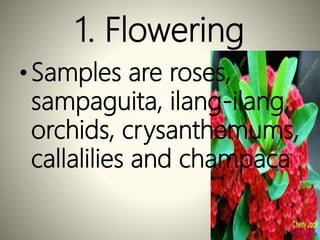
1. Flowering
•Samples are roses,
sampaguita, ilang-ilang,
orchids, crysanthemums,
callalilies and champaca
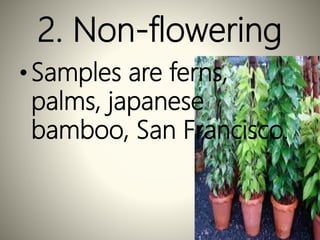
2. Non-flowering
•Samples are ferns,
palms, japanese
bamboo, San Francisco.
Importance of Ornamental
Plants.
• Ornamental plants give a cooling effect
in the house.
• They are used to make perfumes,
medicines, and dyes.
• They can a source of income for the
family. The growing of flowering and
non-flowering ornamental plants is a
thriving business in the cities and urban
areas.
Factors to Consider in Growing
Ornamental Plants
• Total green garden area available
• The focal area
• The site conditions-favorable and
unfavorable
• The type of soil
• List of suitable plants for consideration
• Requirements of plants for healthy
growth
• What you desire-the plants that you
like the most
• Any specific color scheme
• Where you need height/borders
• Time required for care
• Special consideration (kids and pets)
• Budget set for decorating garden
Classification of Ornamental
Plants
1. Seed Structure
• Flowering plants produce seeds which are
enclosed in a fruit. They are subdivided
into two main groups.
• A. Monocotelydon-plants belonging to this
group have only one cotyledon or seed
leaf. Ex: grasses and orchids.
• B. Dicotyledon-plants belonging to this
group have two cotyledons or seed leaves.
Ex: sunflower
2. Life Span
• A. Annual Plants – are those that
grow, produce seeds, and die in
less than one year. They
complete their life cycle in one
growing season.
• B. Biennial Plants – are those that
live for more than a year but not
over two years. They grow and
store foods in the first year of
their life. They produce flowers
during their second year.
• C. Perennial Plants – are those
that live for more than two years.
They live longer than annual and
biennial plants. They also bear
fruits and flowers yearly.
3. Habitat
• A. Desert Plants – are plants that
do not need much water. Plants
like cactus have a structure for
desert living. They have a
succulent stem that stores water
for the long dry season.
• B. Forests or Land Plants – are
plants that usually grow in your
yard can also be grown in the
forest.
• C. Aerial Plants – Orchid is an
example of an aerial plant, it
loves to grow on branches and
trunk trees. It is a shade-loving
plant. Some kinds of ferns are
also aerial.
4. Physical Properties
• A. Herbs and Herbaceous Plants
– these are plants with soft stems
and grow relatively short in
height are classified as herbs.
They have a short life span.
Orchids, dahlia, sunflower, zinnia,
and camia are examples of these
plants.
• B. Shrubs and Bushes – A woody
plant with two or more stems
that grow form the ground is
identified as a shrub. This kind of
plant is smaller than the trees.
Examples of these are
sampaguita, rose, santan, and
gumamela.
• C. Vines – Plants that cannot
maintain an upright growing
position and instead creep along
the ground are called vines.
• D. Trees – any plant with a large and
woody stem is identified as a tree.
These the largest kinds of plants
with a single upright woody trunk
with spreading branches containing
twigs where the leaves are attached,
which form the foliage or crown,
Factors to Consider in Growing
Ornamental Plants
• Selection of the Garden Site
• Types of Soil
• Selection of the Ornamental Plants
• Preparation of Land
• Air and Sunlight
• Indoor Plant Care
• Temperature
• Light
• Humidity
• Fertilizers
• Watering
• Tools and Equpment
Some Basic Tools and
Equipment for Gardening
Shovel
• Round-ended, preferred for
digging especially for planting
trees and smaller shrubs.
Garden Hoe
• It is useful for weeding and
cultivating soil surfaces to allow
for deeper plant root penetration
of nutrients and water.
Bow Rake
• A good heavy duty bow rake,
which has short tines on one side
attached to a metal frame or
‘bow’. This tool is vital for leveling
the soil to make it ready for
planting, or for removing large
clods of earth or rocks from the
soil.
Spading Fork
• Is needed to open and improve
the soil. It looks like a pitchfork
but has a shorter handle and
wander tines. It is used to dig
down into hard soil and break up
the ground.
Dull Bolo
• This tool is common in the
Philippines, and its uses are
similar with a garden hoe used
for weeding and cultivation.
Sharp Bolo
• It is used to cut some grasses
and small branches or generally
for the clearing operations prior
to soil cultivation.
Garden Shears
• These are sometimes called as
clippers, used for pruning,
shaping and removing foliage or
branches.
Garden Hose
• Used for watering the plants.
Sprinkler Can
• Used in watering the plants
Hand Sprayer
• It is useful for spraying some
minor insect pests that are easily
managed foe minor insect attack
in the garden.
Spade
• Similar to shovel, but it has a
square end point used for
digging and making straight plot
and beds.
Garden Pruner
• Used for cutting small twigs and
branches.
Carts and Wheelbarrows
• Are necessary to transfer some
gardening tools and equipment
used in your garden works.
Garden Trowel
• Used for weeding and cultivation
Containers
• Plants are usually placed here
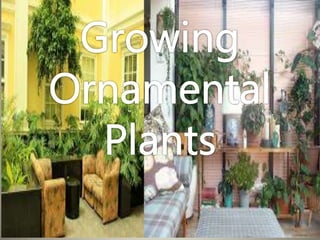
Growing Ornamental Plants

Growing Ornamental Plants

  • 2.
    • Ornamental plantsare those plants grown for decorative purpose. They enhance the beauty of the surroundings of the home. They are used as decorative materials in constructing a lawn, plaza and various kinds of gardens.
  • 3.
  • 4.
    1. Flowering •Samples areroses, sampaguita, ilang-ilang, orchids, crysanthemums, callalilies and champaca
  • 5.
    2. Non-flowering •Samples areferns, palms, japanese bamboo, San Francisco.
  • 6.
    Importance of Ornamental Plants. •Ornamental plants give a cooling effect in the house. • They are used to make perfumes, medicines, and dyes. • They can a source of income for the family. The growing of flowering and non-flowering ornamental plants is a thriving business in the cities and urban areas.
  • 7.
    Factors to Considerin Growing Ornamental Plants • Total green garden area available • The focal area • The site conditions-favorable and unfavorable • The type of soil • List of suitable plants for consideration • Requirements of plants for healthy growth
  • 8.
    • What youdesire-the plants that you like the most • Any specific color scheme • Where you need height/borders • Time required for care • Special consideration (kids and pets) • Budget set for decorating garden
  • 9.
  • 10.
    1. Seed Structure •Flowering plants produce seeds which are enclosed in a fruit. They are subdivided into two main groups. • A. Monocotelydon-plants belonging to this group have only one cotyledon or seed leaf. Ex: grasses and orchids. • B. Dicotyledon-plants belonging to this group have two cotyledons or seed leaves. Ex: sunflower
  • 11.
    2. Life Span •A. Annual Plants – are those that grow, produce seeds, and die in less than one year. They complete their life cycle in one growing season.
  • 12.
    • B. BiennialPlants – are those that live for more than a year but not over two years. They grow and store foods in the first year of their life. They produce flowers during their second year.
  • 13.
    • C. PerennialPlants – are those that live for more than two years. They live longer than annual and biennial plants. They also bear fruits and flowers yearly.
  • 14.
    3. Habitat • A.Desert Plants – are plants that do not need much water. Plants like cactus have a structure for desert living. They have a succulent stem that stores water for the long dry season.

  • 15.
    • B. Forestsor Land Plants – are plants that usually grow in your yard can also be grown in the forest.
  • 16.
    • C. AerialPlants – Orchid is an example of an aerial plant, it loves to grow on branches and trunk trees. It is a shade-loving plant. Some kinds of ferns are also aerial.
  • 18.
    4. Physical Properties •A. Herbs and Herbaceous Plants – these are plants with soft stems and grow relatively short in height are classified as herbs. They have a short life span. Orchids, dahlia, sunflower, zinnia, and camia are examples of these plants.
  • 19.
    • B. Shrubsand Bushes – A woody plant with two or more stems that grow form the ground is identified as a shrub. This kind of plant is smaller than the trees. Examples of these are sampaguita, rose, santan, and gumamela.
  • 20.
    • C. Vines– Plants that cannot maintain an upright growing position and instead creep along the ground are called vines.
  • 21.
    • D. Trees– any plant with a large and woody stem is identified as a tree. These the largest kinds of plants with a single upright woody trunk with spreading branches containing twigs where the leaves are attached, which form the foliage or crown,
  • 22.
    Factors to Considerin Growing Ornamental Plants • Selection of the Garden Site • Types of Soil • Selection of the Ornamental Plants • Preparation of Land • Air and Sunlight • Indoor Plant Care • Temperature • Light • Humidity • Fertilizers • Watering • Tools and Equpment
  • 23.
    Some Basic Toolsand Equipment for Gardening
  • 24.
    Shovel • Round-ended, preferredfor digging especially for planting trees and smaller shrubs.
  • 25.
    Garden Hoe • Itis useful for weeding and cultivating soil surfaces to allow for deeper plant root penetration of nutrients and water.
  • 26.
    Bow Rake • Agood heavy duty bow rake, which has short tines on one side attached to a metal frame or ‘bow’. This tool is vital for leveling the soil to make it ready for planting, or for removing large clods of earth or rocks from the soil.
  • 27.
    Spading Fork • Isneeded to open and improve the soil. It looks like a pitchfork but has a shorter handle and wander tines. It is used to dig down into hard soil and break up the ground.
  • 28.
    Dull Bolo • Thistool is common in the Philippines, and its uses are similar with a garden hoe used for weeding and cultivation.
  • 29.
    Sharp Bolo • Itis used to cut some grasses and small branches or generally for the clearing operations prior to soil cultivation.
  • 30.
    Garden Shears • Theseare sometimes called as clippers, used for pruning, shaping and removing foliage or branches.
  • 31.
    Garden Hose • Usedfor watering the plants.
  • 32.
    Sprinkler Can • Usedin watering the plants
  • 33.
    Hand Sprayer • Itis useful for spraying some minor insect pests that are easily managed foe minor insect attack in the garden.
  • 34.
    Spade • Similar toshovel, but it has a square end point used for digging and making straight plot and beds.
  • 35.
    Garden Pruner • Usedfor cutting small twigs and branches.
  • 36.
    Carts and Wheelbarrows •Are necessary to transfer some gardening tools and equipment used in your garden works.
  • 37.
    Garden Trowel • Usedfor weeding and cultivation
  • 38.
    Containers • Plants areusually placed here