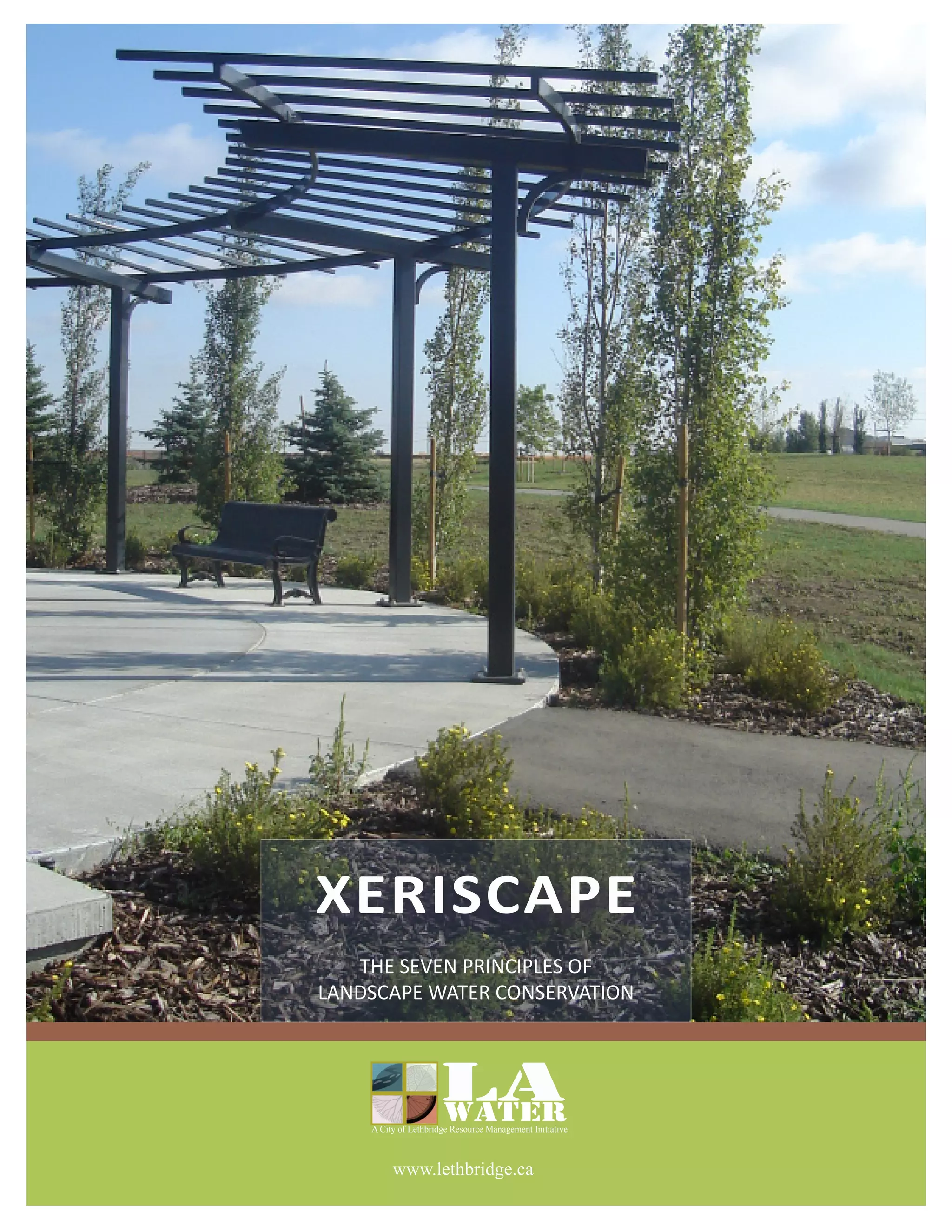
XERISCAPE
   THE SEVEN PRINCIPLES OF
LANDSCAPE WATER CONSERVATION


                     LA
                     WATER
    A City of Lethbridge Resource Management Initiative


         www.lethbridge.ca
Xeriscape
[‘xeros’ meaning dry and ‘scape’ as in landscape]

Xeriscaping refers to a set of principles that are practical and environmentally friendly. Xeriscaping
is not the same as zero-scaping and does not focus on rocks, stone and gravel but on greenery.

There are 7 principles of xeriscaping:

1) Plan & design
2) Improve the soil
3) Vegetation
4) Turf areas
5) Irrigation
6) Mulch
7) Maintenance

Benefits of Xeriscaping

• Beautify your urban spaces – spaces with more than just lawn are more attractive.
• Spend less time maintaining your yard and more time enjoying it.
• Protects our environment – overwatering causes erosion of coulee slopes and river
banks.
• Municipalities can treat less water, saving money and chemical use.
• Showcase the attractive flowers and shrubs that naturally grow in the prairies.
• Conserve water – share this limited resource with others and leave some for fish and
wildlife.
• Use less pesticides and fertilizers, thereby reducing the risk of polluting stormwater
and saving money.
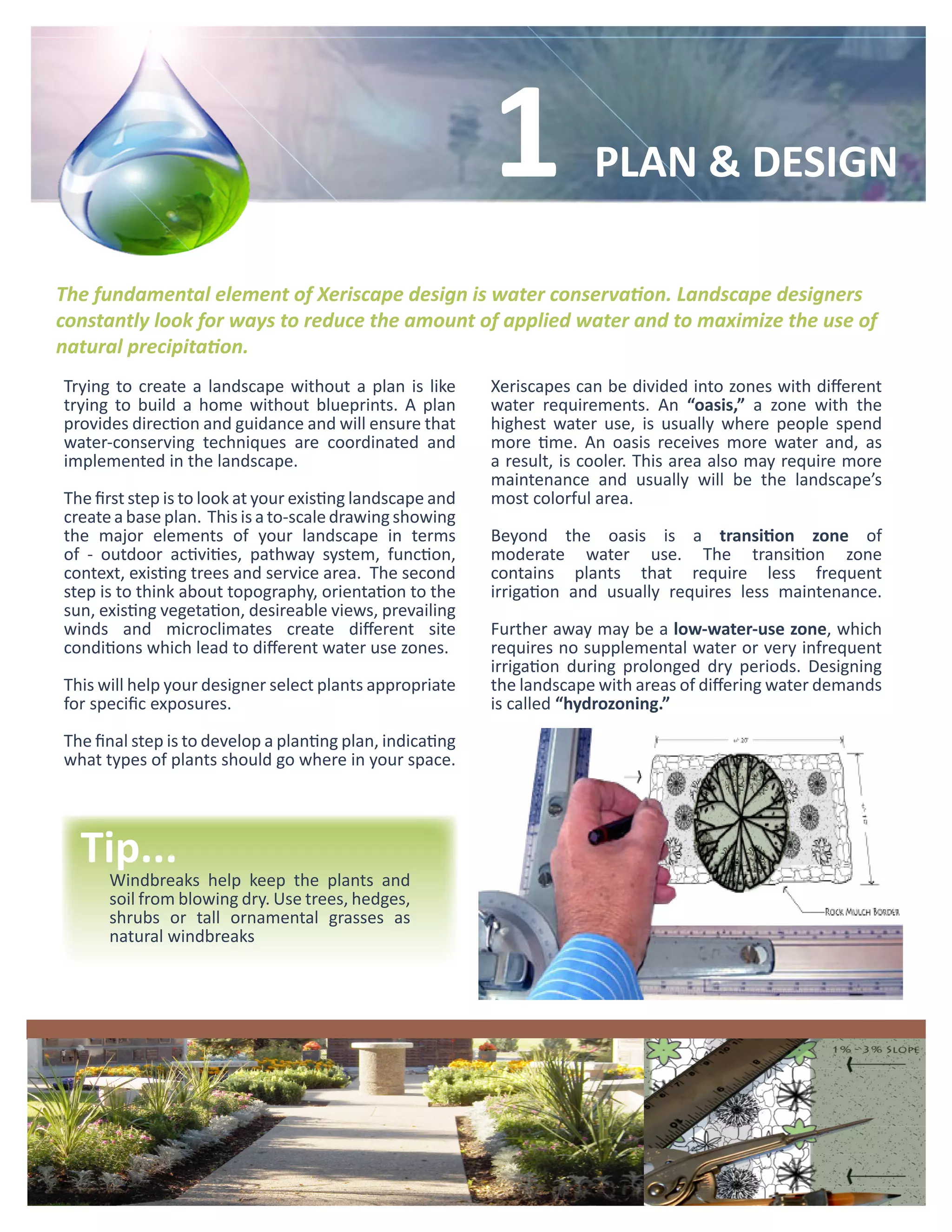
1            PLAN & DESIGN

The fundamental element of Xeriscape design is water conservation. Landscape designers
constantly look for ways to reduce the amount of applied water and to maximize the use of
natural precipitation.
Trying to create a landscape without a plan is like        Xeriscapes can be divided into zones with different
trying to build a home without blueprints. A plan          water requirements. An “oasis,” a zone with the
provides direction and guidance and will ensure that       highest water use, is usually where people spend
water-conserving techniques are coordinated and            more time. An oasis receives more water and, as
implemented in the landscape.                              a result, is cooler. This area also may require more
                                                           maintenance and usually will be the landscape’s
The first step is to look at your existing landscape and   most colorful area.
create a base plan. This is a to-scale drawing showing
the major elements of your landscape in terms              Beyond the oasis is a transition zone of
of - outdoor activities, pathway system, function,         moderate water use. The transition zone
context, existing trees and service area. The second       contains plants that require less frequent
step is to think about topography, orientation to the      irrigation and usually requires less maintenance.
sun, existing vegetation, desireable views, prevailing
winds and microclimates create different site              Further away may be a low-water-use zone, which
conditions which lead to different water use zones.        requires no supplemental water or very infrequent
                                                           irrigation during prolonged dry periods. Designing
This will help your designer select plants appropriate     the landscape with areas of differing water demands
for specific exposures.                                    is called “hydrozoning.”

The final step is to develop a planting plan, indicating
what types of plants should go where in your space.


  Tip...
      Windbreaks help keep the plants and
      soil from blowing dry. Use trees, hedges,
      shrubs or tall ornamental grasses as
      natural windbreaks
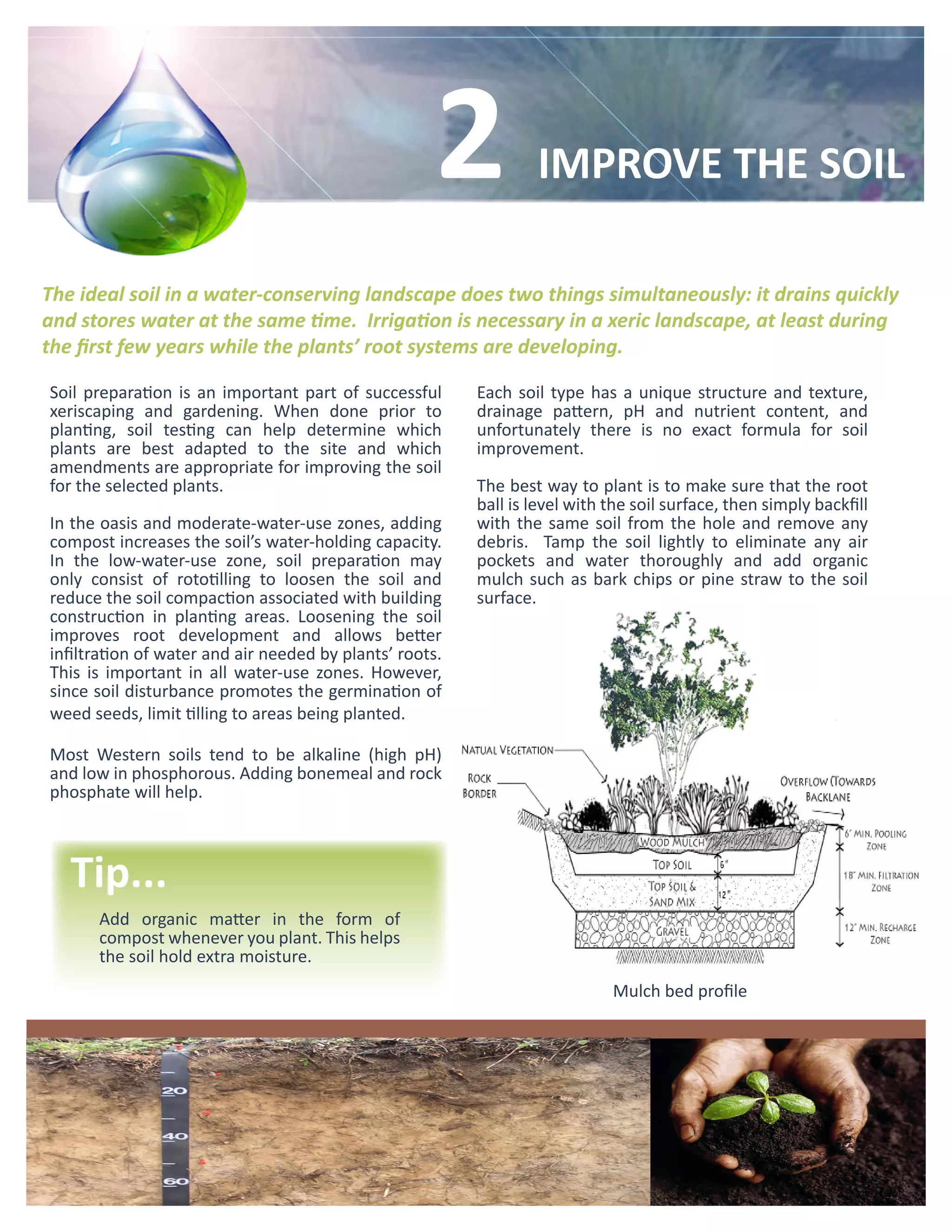
2           IMPROVE THE SOIL

The ideal soil in a water-conserving landscape does two things simultaneously: it drains quickly
and stores water at the same time. Irrigation is necessary in a xeric landscape, at least during
the first few years while the plants’ root systems are developing.

Soil preparation is an important part of successful      Each soil type has a unique structure and texture,
xeriscaping and gardening. When done prior to            drainage pattern, pH and nutrient content, and
planting, soil testing can help determine which          unfortunately there is no exact formula for soil
plants are best adapted to the site and which            improvement.
amendments are appropriate for improving the soil
for the selected plants.                                 The best way to plant is to make sure that the root
                                                         ball is level with the soil surface, then simply backfill
In the oasis and moderate-water-use zones, adding        with the same soil from the hole and remove any
compost increases the soil’s water-holding capacity.     debris. Tamp the soil lightly to eliminate any air
In the low-water-use zone, soil preparation may          pockets and water thoroughly and add organic
only consist of rototilling to loosen the soil and       mulch such as bark chips or pine straw to the soil
reduce the soil compaction associated with building      surface.
construction in planting areas. Loosening the soil
improves root development and allows better
infiltration of water and air needed by plants’ roots.
This is important in all water-use zones. However,
since soil disturbance promotes the germination of
weed seeds, limit tilling to areas being planted.

Most Western soils tend to be alkaline (high pH)
and low in phosphorous. Adding bonemeal and rock
phosphate will help.


   Tip...
      Add organic matter in the form of
      compost whenever you plant. This helps
      the soil hold extra moisture.
                                                                            Mulch bed profile
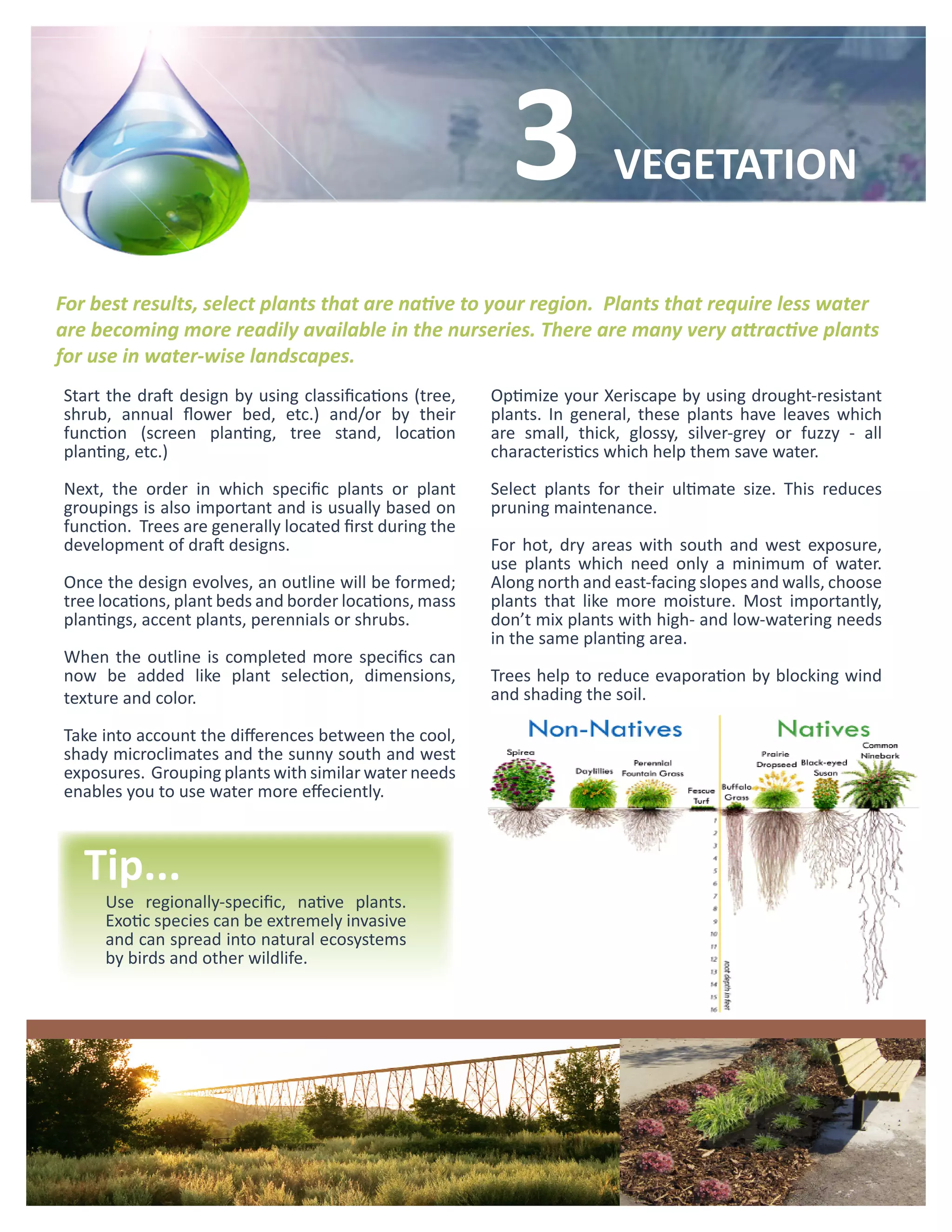
3             VEGETATION

For best results, select plants that are native to your region. Plants that require less water
are becoming more readily available in the nurseries. There are many very attractive plants
for use in water-wise landscapes.
Start the draft design by using classifications (tree,   Optimize your Xeriscape by using drought-resistant
shrub, annual flower bed, etc.) and/or by their          plants. In general, these plants have leaves which
function (screen planting, tree stand, location          are small, thick, glossy, silver-grey or fuzzy - all
planting, etc.)                                          characteristics which help them save water.

Next, the order in which specific plants or plant        Select plants for their ultimate size. This reduces
groupings is also important and is usually based on      pruning maintenance.
function. Trees are generally located first during the
development of draft designs.                            For hot, dry areas with south and west exposure,
                                                         use plants which need only a minimum of water.
Once the design evolves, an outline will be formed;      Along north and east-facing slopes and walls, choose
tree locations, plant beds and border locations, mass    plants that like more moisture. Most importantly,
plantings, accent plants, perennials or shrubs.          don’t mix plants with high- and low-watering needs
                                                         in the same planting area.
When the outline is completed more specifics can
now be added like plant selection, dimensions,           Trees help to reduce evaporation by blocking wind
texture and color.                                       and shading the soil.

Take into account the differences between the cool,
shady microclimates and the sunny south and west
exposures. Grouping plants with similar water needs
enables you to use water more effeciently.


   Tip...
     Use regionally-specific, native plants.
     Exotic species can be extremely invasive
     and can spread into natural ecosystems
     by birds and other wildlife.
4             TURF AREAS

Reduce the size of turf areas as much as possible, while retaining some turf for open space,
functionality and visual appeal. When planting new turf, or reseeding existing areas, use
water-saving species adapted to your area.

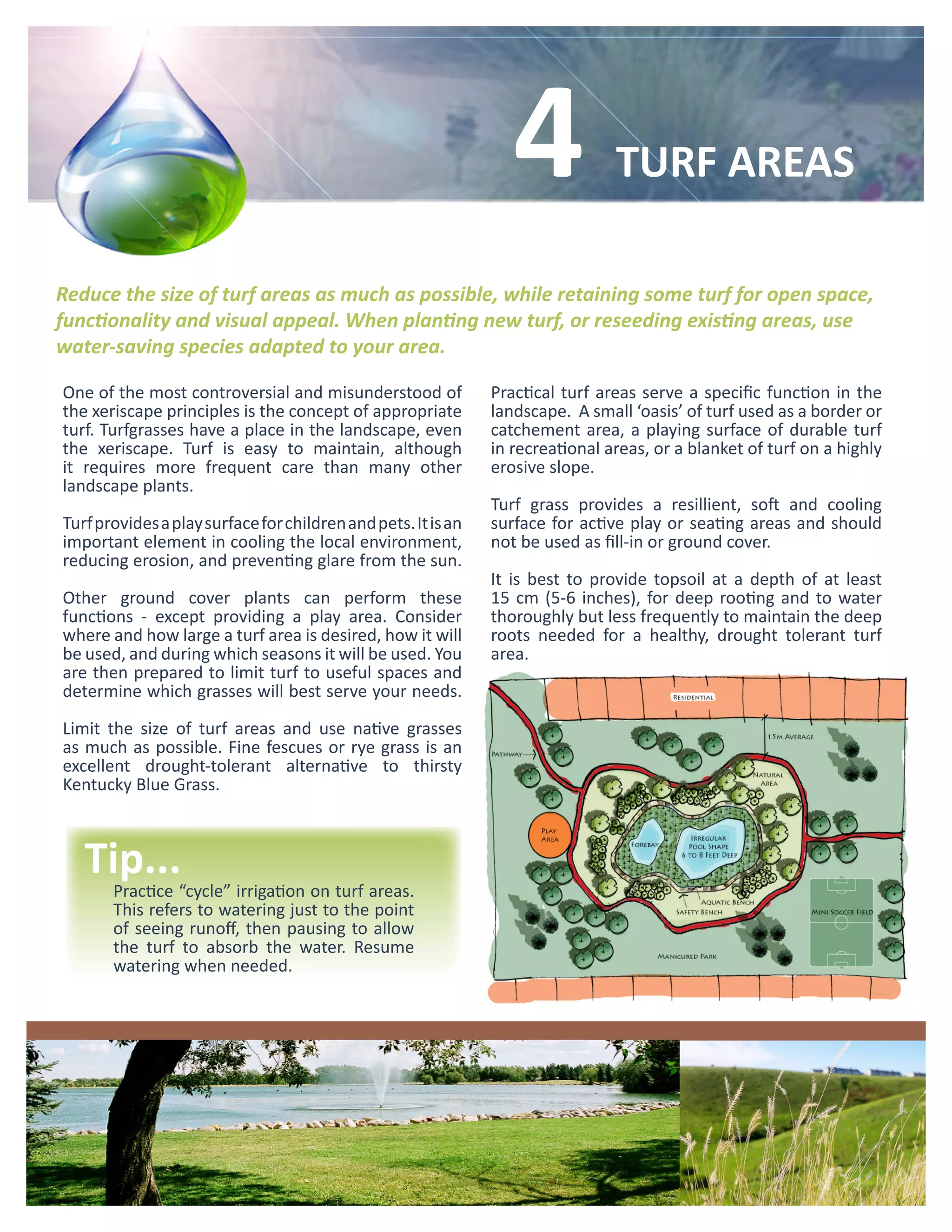
One of the most controversial and misunderstood of             Practical turf areas serve a specific function in the
the xeriscape principles is the concept of appropriate         landscape. A small ‘oasis’ of turf used as a border or
turf. Turfgrasses have a place in the landscape, even          catchement area, a playing surface of durable turf
the xeriscape. Turf is easy to maintain, although              in recreational areas, or a blanket of turf on a highly
it requires more frequent care than many other                 erosive slope.
landscape plants.
                                                               Turf grass provides a resillient, soft and cooling
Turf provides a play surface for children and pets. It is an   surface for active play or seating areas and should
important element in cooling the local environment,            not be used as fill-in or ground cover.
reducing erosion, and preventing glare from the sun.
                                                               It is best to provide topsoil at a depth of at least
Other ground cover plants can perform these                    15 cm (5-6 inches), for deep rooting and to water
functions - except providing a play area. Consider             thoroughly but less frequently to maintain the deep
where and how large a turf area is desired, how it will        roots needed for a healthy, drought tolerant turf
be used, and during which seasons it will be used. You         area.
are then prepared to limit turf to useful spaces and
determine which grasses will best serve your needs.

Limit the size of turf areas and use native grasses
as much as possible. Fine fescues or rye grass is an
excellent drought-tolerant alternative to thirsty
Kentucky Blue Grass.


   Tip...
       Practice “cycle” irrigation on turf areas.
       This refers to watering just to the point
       of seeing runoff, then pausing to allow
       the turf to absorb the water. Resume
       watering when needed.
5             IRRIGATION

Water conservation is the goal, so avoid overwatering. Soaker hoses and drip-irrigation sys-
tems offer the easiest and most efficient watering for xeriscapes because they deliver water
directly to the base of the plant.

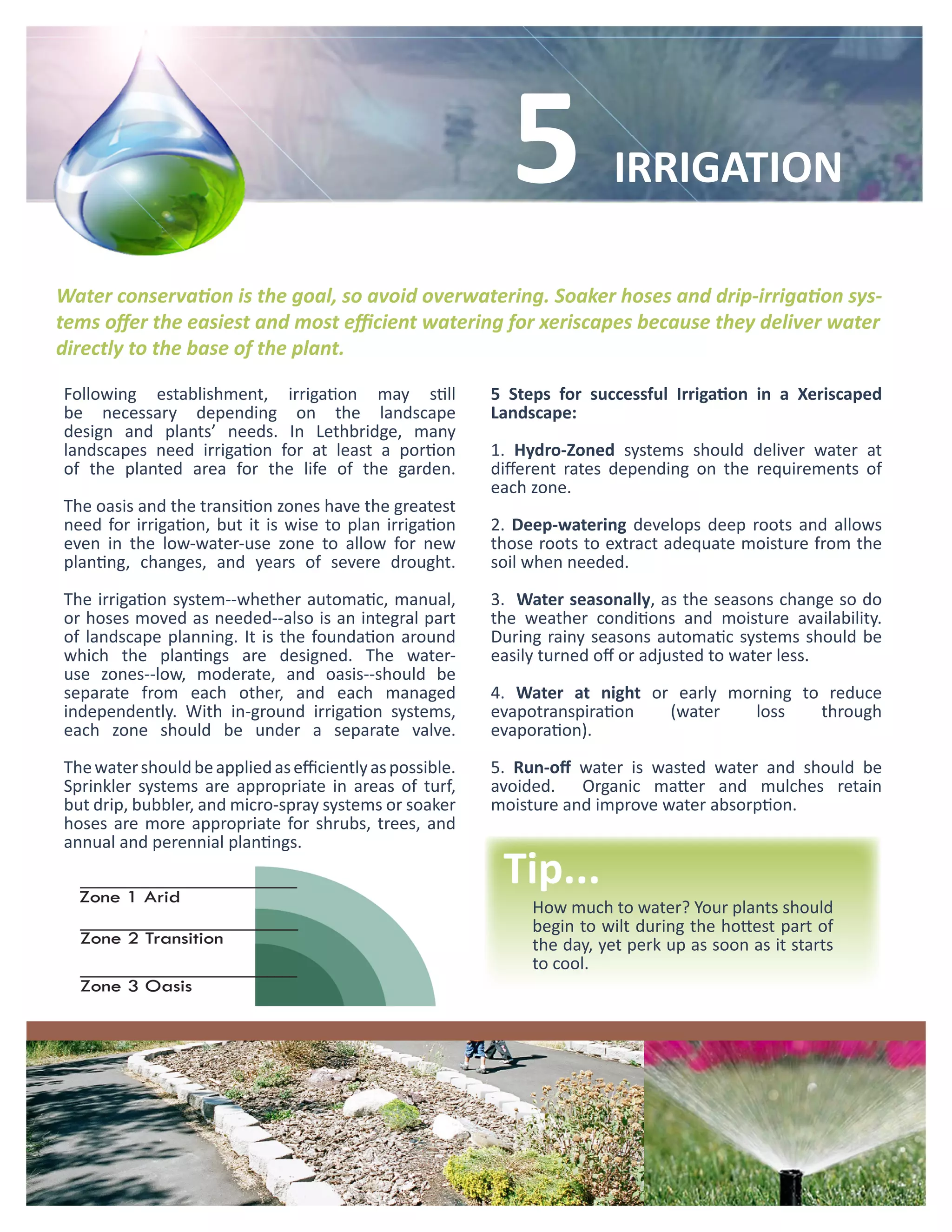
Following establishment, irrigation may still             5 Steps for successful Irrigation in a Xeriscaped
be necessary depending on the landscape                   Landscape:
design and plants’ needs. In Lethbridge, many
landscapes need irrigation for at least a portion         1. Hydro-Zoned systems should deliver water at
of the planted area for the life of the garden.           different rates depending on the requirements of
                                                          each zone.
The oasis and the transition zones have the greatest
need for irrigation, but it is wise to plan irrigation    2. Deep-watering develops deep roots and allows
even in the low-water-use zone to allow for new           those roots to extract adequate moisture from the
planting, changes, and years of severe drought.           soil when needed.

The irrigation system--whether automatic, manual,         3. Water seasonally, as the seasons change so do
or hoses moved as needed--also is an integral part        the weather conditions and moisture availability.
of landscape planning. It is the foundation around        During rainy seasons automatic systems should be
which the plantings are designed. The water-              easily turned off or adjusted to water less.
use zones--low, moderate, and oasis--should be
separate from each other, and each managed                4. Water at night or early morning to reduce
independently. With in-ground irrigation systems,         evapotranspiration  (water    loss   through
each zone should be under a separate valve.               evaporation).

The water should be applied as efficiently as possible.   5. Run-off water is wasted water and should be
Sprinkler systems are appropriate in areas of turf,       avoided. Organic matter and mulches retain
but drip, bubbler, and micro-spray systems or soaker      moisture and improve water absorption.
hoses are more appropriate for shrubs, trees, and
annual and perennial plantings.
                                                           Tip...
                                                               How much to water? Your plants should
                                                               begin to wilt during the hottest part of
                                                               the day, yet perk up as soon as it starts
                                                               to cool.
6            MULCH

Cover the soil’s surface around plants with a mulch, such as leaves, coarse compost, pine
needles, wood chips, bark or gravel. Mulch helps retain soil moisture and temperature, pre-
vent erosion and block out competing weeds.
Mulch provides a cover over the soil, reducing            Organic mulches keep the soil moist and reflect
evaporation, soil temperature, and erosion. It also       less heat. They work well with plants adapted
limits weed growth and competition for water and          to cooler microclimates. Bark mulch should
nutrients. Landscape mulch materials vary in their        not be used on steep slopes or in drainage
suitability for various uses.                             ways because it washes away in heavy rains.

 There are a range of mulches: Organic and inorganic.     Some plants native to very well drained soils
Organic mulches inlcude wood chips, straw, peat           grow better in gravel mulches. Remember, rock
moss, sawdust, dry manure, leaves, pine needles,          mulch becomes very hot in our climate and can
grass clippings and bark chips. Inorganic mulches         injure or limit growth of some plants. Ultimately,
include rock, gravel and fabricated materials.            the mulch should be shaded by landscape plants
                                                          that will provide environmental cooling. Using
Permeable weed barriers, bark, gravel, and other          gravel mulch alone as a landscape element
porous mulches allow water and oxygen to pass to          may result increased weed control efforts.
plant roots. Dust will eventually collect over the weed
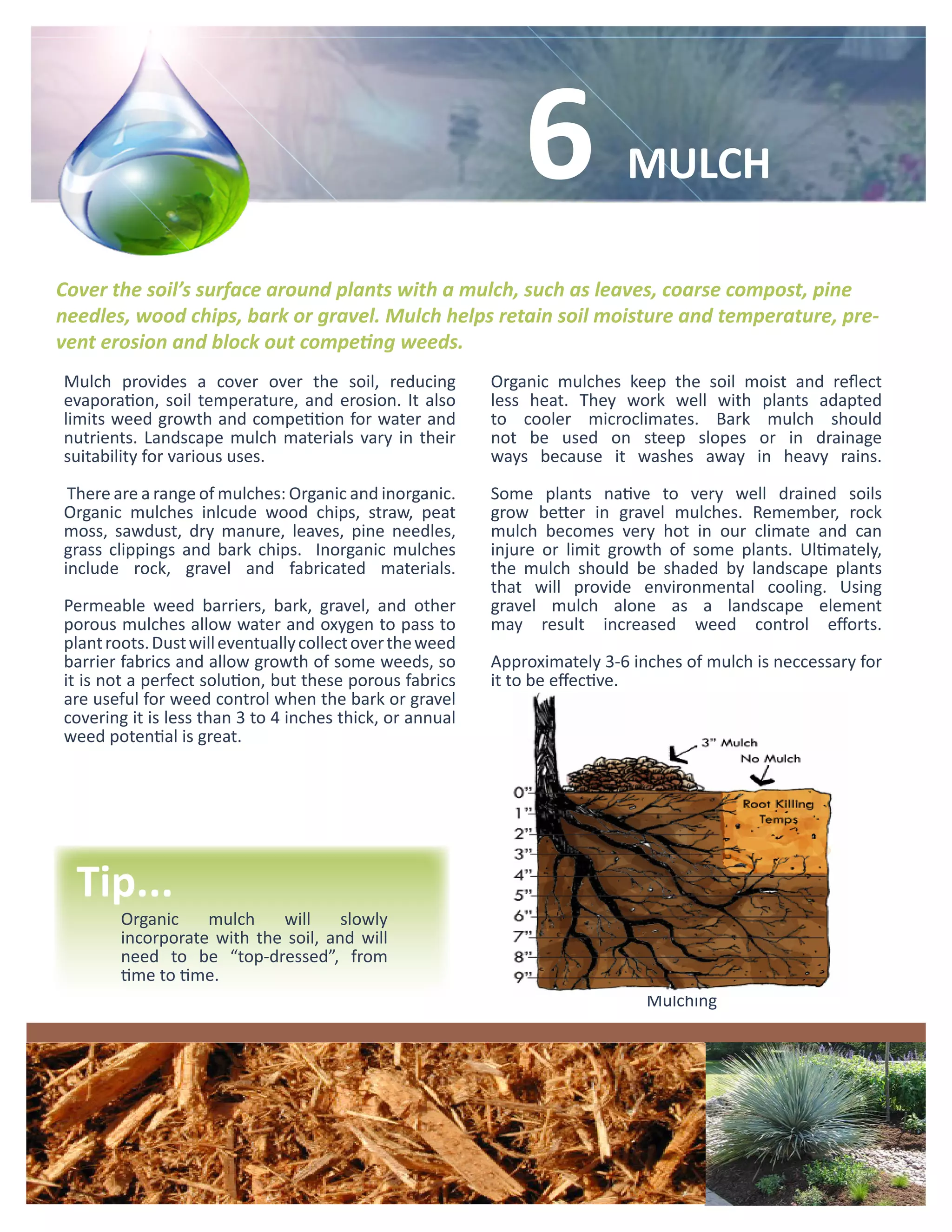
barrier fabrics and allow growth of some weeds, so        Approximately 3-6 inches of mulch is neccessary for
it is not a perfect solution, but these porous fabrics    it to be effective.
are useful for weed control when the bark or gravel
covering it is less than 3 to 4 inches thick, or annual
weed potential is great.


  Tip...
        Organic    mulch    will     slowly
        incorporate with the soil, and will
        need to be “top-dressed”, from
        time to time.
                                                                              Mulching
7             MAINTENANCE

Low-maintenance is one of the benefits of xeriscape. Keeping the weeds from growing up
through the mulch may require some attention. Thickening the layer of mulch will help. Turf
areas should not be cut too short - taller grass is a natural mulch which shades the roots and
helps retain moisture. Avoid overfertilizing.
Maintaining the landscape cannot be forgotten,          Plantings: Healthy, actively growing plant systems
even in a xeriscape.                                    that are biodiverse are the best defense against
                                                        pests and diseases.
The design will determine the required maintenance.
Any landscape will require some maintenance:            Turf Maintenance: Water deeply and less often to
pruning, removing trash that has blown into             encourage deep roots and only when needed. A
the landscape, occasional weeding and pest              good rule for efficient fertilization is to sparingly
management, checking that the irrigation system         apply Phosphorus in the spring to promote root
is functioning properly, and adjusting automatic        development and Nitrogen in the late fall.
irrigation systems as the seasons change.
                                                        It is most effecient to mow high and often and to
Xeriscaping offers a way to have beautiful, livable     leave the clippings for added nutrients. The grass
landscapes without excess water use. It allows some     becomes more drought tolerant and heat resistant
areas to be cooler and hospitable, while investing      when the mower height is set to no lower than 2.5
less water on parts of the landscape in which we        to 3 inches.
spend less time. Even lower-water-use areas can be
very attractive if the seven xeriscape principles are   Irrigation System: Overwatering increases insect
employed.                                               control expenses, plant replacement costs, diseases
                                                        and wasted water. Adjust watering according to
Using xeriscape makes our landscapes more               seasonal changes and condition of plantings in the
compatible with our Southern Alberta environment.       landscape. Winterize the system in mid-October
                                                        and ensure the system is operating correctly in the
                                                        Spring.


  Tip...
      Keep irrigation systems running properly.
      Avoid the lush, thirsty plant growth that
      results from over-watering.
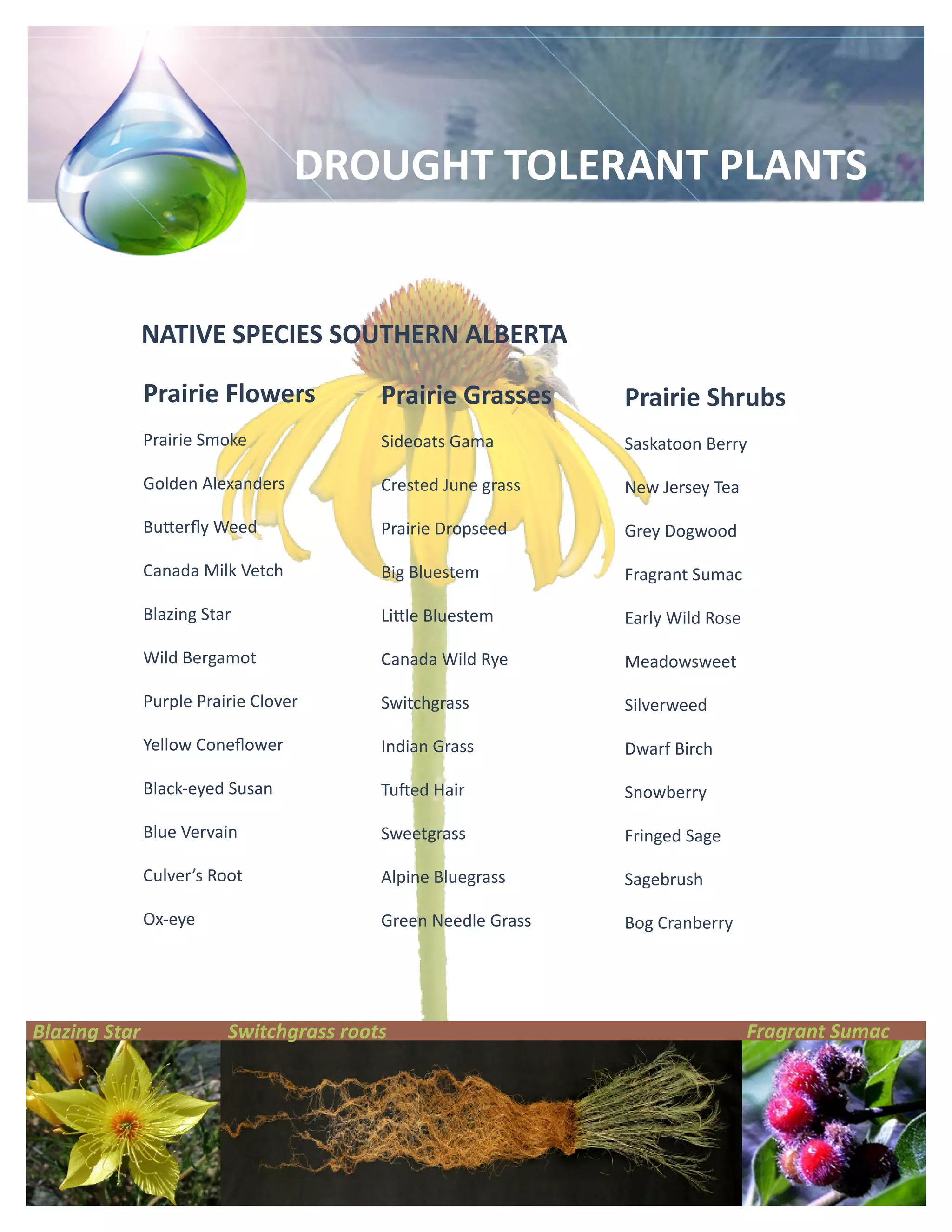
DROUGHT TOLERANT PLANTS


               NATIVE SPECIES SOUTHERN ALBERTA

               Prairie Flowers            Prairie Grasses      Prairie Shrubs
               Prairie Smoke              Sideoats Gama        Saskatoon Berry

               Golden Alexanders          Crested June grass   New Jersey Tea

               Butterfly Weed             Prairie Dropseed     Grey Dogwood

               Canada Milk Vetch          Big Bluestem         Fragrant Sumac

               Blazing Star               Little Bluestem      Early Wild Rose

               Wild Bergamot              Canada Wild Rye      Meadowsweet

               Purple Prairie Clover      Switchgrass          Silverweed

               Yellow Coneflower          Indian Grass         Dwarf Birch

               Black-eyed Susan           Tufted Hair          Snowberry

               Blue Vervain               Sweetgrass           Fringed Sage

               Culver’s Root              Alpine Bluegrass     Sagebrush

               Ox-eye                     Green Needle Grass   Bog Cranberry


Blazing Star              Switchgrass roots                                      Fragrant Sumac
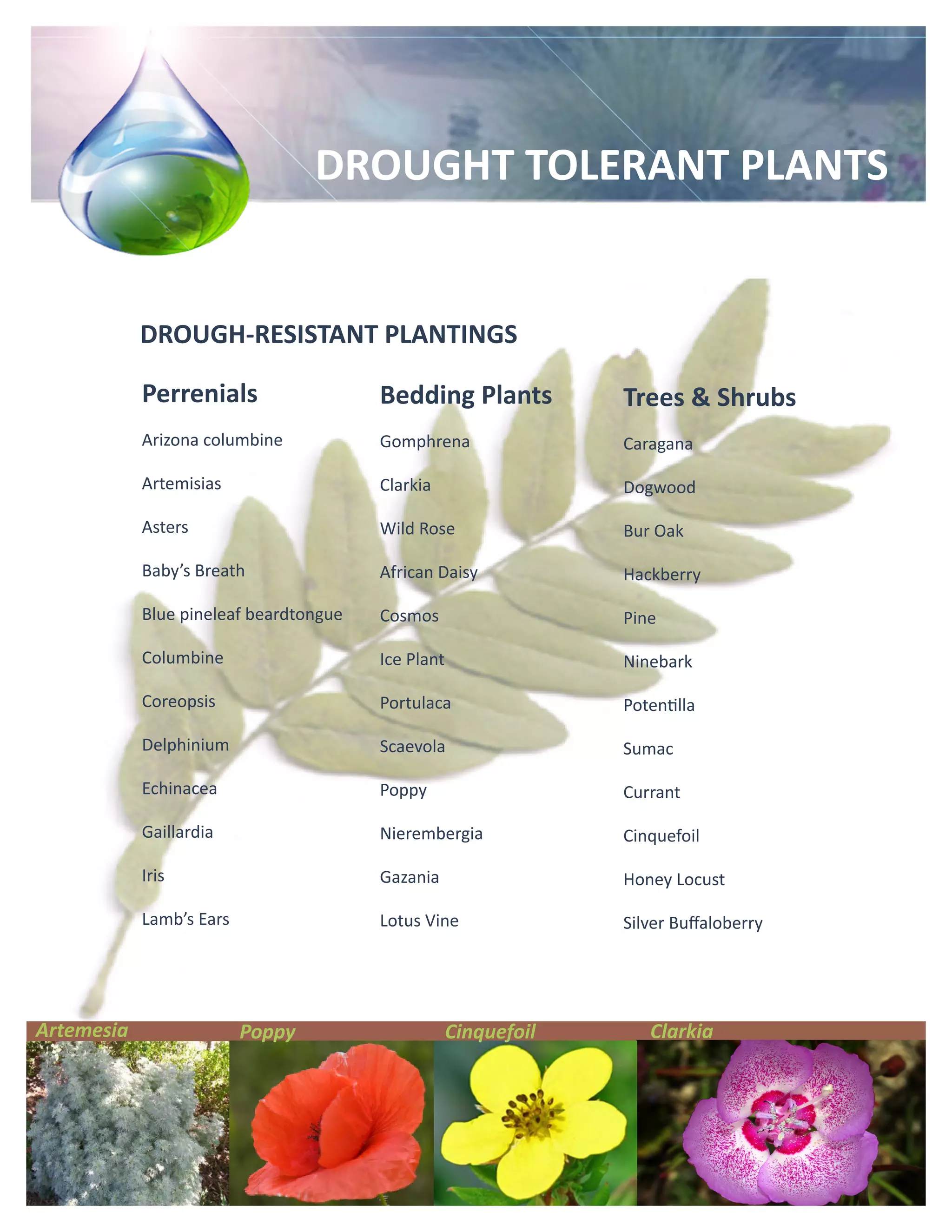
DROUGHT TOLERANT PLANTS


            DROUGH-RESISTANT PLANTINGS

            Perrenials                  Bedding Plants           Trees & Shrubs
            Arizona columbine           Gomphrena                Caragana

            Artemisias                  Clarkia                  Dogwood

            Asters                      Wild Rose                Bur Oak

            Baby’s Breath               African Daisy            Hackberry

            Blue pineleaf beardtongue   Cosmos                   Pine

            Columbine                   Ice Plant                Ninebark

            Coreopsis                   Portulaca                Potentilla

            Delphinium                  Scaevola                 Sumac

            Echinacea                   Poppy                    Currant

            Gaillardia                  Nierembergia             Cinquefoil

            Iris                        Gazania                  Honey Locust

            Lamb’s Ears                 Lotus Vine               Silver Buffaloberry


Artemesia                 Poppy                     Cinquefoil      Clarkia
REFERENCES


WEBSITES
  http://alclanativeplants.com/
  http://eartheasy.com/grow_xeriscape.htm
  http://www.xeriscape.org/
  http://www.lethbridge.ca/home/City+Hall/Departments/Environmental+Management/


FURTHER READING
  Bennett, Jennifer. Dry-land gardening: a xeriscaping guide for dry-summer, cold-
  winter climates
  Foster, Ruth S. Landscaping that saves energy and dollars
  Perry, Bob. Landscape plants for western regions : an illustrated guide to plants for
  water conservation
  Weinstein, Gayle. Xeriscape Handbook: A How-to Guide to Natural Resource-Wise
  Gardening
  Williams, Sara. Creating the prairie xeriscape: low-maintenance, water-efficient
  gardening
  Winger, David. Xeriscape color guide: 100 water-wise plants for gardens and
  landscapes

Xeriscape: the Seven Principles of Landscape Water Conservation - City of Lethbridge

  • 1.
    XERISCAPE THE SEVEN PRINCIPLES OF LANDSCAPE WATER CONSERVATION LA WATER A City of Lethbridge Resource Management Initiative www.lethbridge.ca
  • 2.
    Xeriscape [‘xeros’ meaning dryand ‘scape’ as in landscape] Xeriscaping refers to a set of principles that are practical and environmentally friendly. Xeriscaping is not the same as zero-scaping and does not focus on rocks, stone and gravel but on greenery. There are 7 principles of xeriscaping: 1) Plan & design 2) Improve the soil 3) Vegetation 4) Turf areas 5) Irrigation 6) Mulch 7) Maintenance Benefits of Xeriscaping • Beautify your urban spaces – spaces with more than just lawn are more attractive. • Spend less time maintaining your yard and more time enjoying it. • Protects our environment – overwatering causes erosion of coulee slopes and river banks. • Municipalities can treat less water, saving money and chemical use. • Showcase the attractive flowers and shrubs that naturally grow in the prairies. • Conserve water – share this limited resource with others and leave some for fish and wildlife. • Use less pesticides and fertilizers, thereby reducing the risk of polluting stormwater and saving money.
  • 3.
    1 PLAN & DESIGN The fundamental element of Xeriscape design is water conservation. Landscape designers constantly look for ways to reduce the amount of applied water and to maximize the use of natural precipitation. Trying to create a landscape without a plan is like Xeriscapes can be divided into zones with different trying to build a home without blueprints. A plan water requirements. An “oasis,” a zone with the provides direction and guidance and will ensure that highest water use, is usually where people spend water-conserving techniques are coordinated and more time. An oasis receives more water and, as implemented in the landscape. a result, is cooler. This area also may require more maintenance and usually will be the landscape’s The first step is to look at your existing landscape and most colorful area. create a base plan. This is a to-scale drawing showing the major elements of your landscape in terms Beyond the oasis is a transition zone of of - outdoor activities, pathway system, function, moderate water use. The transition zone context, existing trees and service area. The second contains plants that require less frequent step is to think about topography, orientation to the irrigation and usually requires less maintenance. sun, existing vegetation, desireable views, prevailing winds and microclimates create different site Further away may be a low-water-use zone, which conditions which lead to different water use zones. requires no supplemental water or very infrequent irrigation during prolonged dry periods. Designing This will help your designer select plants appropriate the landscape with areas of differing water demands for specific exposures. is called “hydrozoning.” The final step is to develop a planting plan, indicating what types of plants should go where in your space. Tip... Windbreaks help keep the plants and soil from blowing dry. Use trees, hedges, shrubs or tall ornamental grasses as natural windbreaks
  • 4.
    2 IMPROVE THE SOIL The ideal soil in a water-conserving landscape does two things simultaneously: it drains quickly and stores water at the same time. Irrigation is necessary in a xeric landscape, at least during the first few years while the plants’ root systems are developing. Soil preparation is an important part of successful Each soil type has a unique structure and texture, xeriscaping and gardening. When done prior to drainage pattern, pH and nutrient content, and planting, soil testing can help determine which unfortunately there is no exact formula for soil plants are best adapted to the site and which improvement. amendments are appropriate for improving the soil for the selected plants. The best way to plant is to make sure that the root ball is level with the soil surface, then simply backfill In the oasis and moderate-water-use zones, adding with the same soil from the hole and remove any compost increases the soil’s water-holding capacity. debris. Tamp the soil lightly to eliminate any air In the low-water-use zone, soil preparation may pockets and water thoroughly and add organic only consist of rototilling to loosen the soil and mulch such as bark chips or pine straw to the soil reduce the soil compaction associated with building surface. construction in planting areas. Loosening the soil improves root development and allows better infiltration of water and air needed by plants’ roots. This is important in all water-use zones. However, since soil disturbance promotes the germination of weed seeds, limit tilling to areas being planted. Most Western soils tend to be alkaline (high pH) and low in phosphorous. Adding bonemeal and rock phosphate will help. Tip... Add organic matter in the form of compost whenever you plant. This helps the soil hold extra moisture. Mulch bed profile
  • 5.
    3 VEGETATION For best results, select plants that are native to your region. Plants that require less water are becoming more readily available in the nurseries. There are many very attractive plants for use in water-wise landscapes. Start the draft design by using classifications (tree, Optimize your Xeriscape by using drought-resistant shrub, annual flower bed, etc.) and/or by their plants. In general, these plants have leaves which function (screen planting, tree stand, location are small, thick, glossy, silver-grey or fuzzy - all planting, etc.) characteristics which help them save water. Next, the order in which specific plants or plant Select plants for their ultimate size. This reduces groupings is also important and is usually based on pruning maintenance. function. Trees are generally located first during the development of draft designs. For hot, dry areas with south and west exposure, use plants which need only a minimum of water. Once the design evolves, an outline will be formed; Along north and east-facing slopes and walls, choose tree locations, plant beds and border locations, mass plants that like more moisture. Most importantly, plantings, accent plants, perennials or shrubs. don’t mix plants with high- and low-watering needs in the same planting area. When the outline is completed more specifics can now be added like plant selection, dimensions, Trees help to reduce evaporation by blocking wind texture and color. and shading the soil. Take into account the differences between the cool, shady microclimates and the sunny south and west exposures. Grouping plants with similar water needs enables you to use water more effeciently. Tip... Use regionally-specific, native plants. Exotic species can be extremely invasive and can spread into natural ecosystems by birds and other wildlife.
  • 6.
    4 TURF AREAS Reduce the size of turf areas as much as possible, while retaining some turf for open space, functionality and visual appeal. When planting new turf, or reseeding existing areas, use water-saving species adapted to your area. One of the most controversial and misunderstood of Practical turf areas serve a specific function in the the xeriscape principles is the concept of appropriate landscape. A small ‘oasis’ of turf used as a border or turf. Turfgrasses have a place in the landscape, even catchement area, a playing surface of durable turf the xeriscape. Turf is easy to maintain, although in recreational areas, or a blanket of turf on a highly it requires more frequent care than many other erosive slope. landscape plants. Turf grass provides a resillient, soft and cooling Turf provides a play surface for children and pets. It is an surface for active play or seating areas and should important element in cooling the local environment, not be used as fill-in or ground cover. reducing erosion, and preventing glare from the sun. It is best to provide topsoil at a depth of at least Other ground cover plants can perform these 15 cm (5-6 inches), for deep rooting and to water functions - except providing a play area. Consider thoroughly but less frequently to maintain the deep where and how large a turf area is desired, how it will roots needed for a healthy, drought tolerant turf be used, and during which seasons it will be used. You area. are then prepared to limit turf to useful spaces and determine which grasses will best serve your needs. Limit the size of turf areas and use native grasses as much as possible. Fine fescues or rye grass is an excellent drought-tolerant alternative to thirsty Kentucky Blue Grass. Tip... Practice “cycle” irrigation on turf areas. This refers to watering just to the point of seeing runoff, then pausing to allow the turf to absorb the water. Resume watering when needed.
  • 7.
    5 IRRIGATION Water conservation is the goal, so avoid overwatering. Soaker hoses and drip-irrigation sys- tems offer the easiest and most efficient watering for xeriscapes because they deliver water directly to the base of the plant. Following establishment, irrigation may still 5 Steps for successful Irrigation in a Xeriscaped be necessary depending on the landscape Landscape: design and plants’ needs. In Lethbridge, many landscapes need irrigation for at least a portion 1. Hydro-Zoned systems should deliver water at of the planted area for the life of the garden. different rates depending on the requirements of each zone. The oasis and the transition zones have the greatest need for irrigation, but it is wise to plan irrigation 2. Deep-watering develops deep roots and allows even in the low-water-use zone to allow for new those roots to extract adequate moisture from the planting, changes, and years of severe drought. soil when needed. The irrigation system--whether automatic, manual, 3. Water seasonally, as the seasons change so do or hoses moved as needed--also is an integral part the weather conditions and moisture availability. of landscape planning. It is the foundation around During rainy seasons automatic systems should be which the plantings are designed. The water- easily turned off or adjusted to water less. use zones--low, moderate, and oasis--should be separate from each other, and each managed 4. Water at night or early morning to reduce independently. With in-ground irrigation systems, evapotranspiration (water loss through each zone should be under a separate valve. evaporation). The water should be applied as efficiently as possible. 5. Run-off water is wasted water and should be Sprinkler systems are appropriate in areas of turf, avoided. Organic matter and mulches retain but drip, bubbler, and micro-spray systems or soaker moisture and improve water absorption. hoses are more appropriate for shrubs, trees, and annual and perennial plantings. Tip... How much to water? Your plants should begin to wilt during the hottest part of the day, yet perk up as soon as it starts to cool.
  • 8.
    6 MULCH Cover the soil’s surface around plants with a mulch, such as leaves, coarse compost, pine needles, wood chips, bark or gravel. Mulch helps retain soil moisture and temperature, pre- vent erosion and block out competing weeds. Mulch provides a cover over the soil, reducing Organic mulches keep the soil moist and reflect evaporation, soil temperature, and erosion. It also less heat. They work well with plants adapted limits weed growth and competition for water and to cooler microclimates. Bark mulch should nutrients. Landscape mulch materials vary in their not be used on steep slopes or in drainage suitability for various uses. ways because it washes away in heavy rains. There are a range of mulches: Organic and inorganic. Some plants native to very well drained soils Organic mulches inlcude wood chips, straw, peat grow better in gravel mulches. Remember, rock moss, sawdust, dry manure, leaves, pine needles, mulch becomes very hot in our climate and can grass clippings and bark chips. Inorganic mulches injure or limit growth of some plants. Ultimately, include rock, gravel and fabricated materials. the mulch should be shaded by landscape plants that will provide environmental cooling. Using Permeable weed barriers, bark, gravel, and other gravel mulch alone as a landscape element porous mulches allow water and oxygen to pass to may result increased weed control efforts. plant roots. Dust will eventually collect over the weed barrier fabrics and allow growth of some weeds, so Approximately 3-6 inches of mulch is neccessary for it is not a perfect solution, but these porous fabrics it to be effective. are useful for weed control when the bark or gravel covering it is less than 3 to 4 inches thick, or annual weed potential is great. Tip... Organic mulch will slowly incorporate with the soil, and will need to be “top-dressed”, from time to time. Mulching
  • 9.
    7 MAINTENANCE Low-maintenance is one of the benefits of xeriscape. Keeping the weeds from growing up through the mulch may require some attention. Thickening the layer of mulch will help. Turf areas should not be cut too short - taller grass is a natural mulch which shades the roots and helps retain moisture. Avoid overfertilizing. Maintaining the landscape cannot be forgotten, Plantings: Healthy, actively growing plant systems even in a xeriscape. that are biodiverse are the best defense against pests and diseases. The design will determine the required maintenance. Any landscape will require some maintenance: Turf Maintenance: Water deeply and less often to pruning, removing trash that has blown into encourage deep roots and only when needed. A the landscape, occasional weeding and pest good rule for efficient fertilization is to sparingly management, checking that the irrigation system apply Phosphorus in the spring to promote root is functioning properly, and adjusting automatic development and Nitrogen in the late fall. irrigation systems as the seasons change. It is most effecient to mow high and often and to Xeriscaping offers a way to have beautiful, livable leave the clippings for added nutrients. The grass landscapes without excess water use. It allows some becomes more drought tolerant and heat resistant areas to be cooler and hospitable, while investing when the mower height is set to no lower than 2.5 less water on parts of the landscape in which we to 3 inches. spend less time. Even lower-water-use areas can be very attractive if the seven xeriscape principles are Irrigation System: Overwatering increases insect employed. control expenses, plant replacement costs, diseases and wasted water. Adjust watering according to Using xeriscape makes our landscapes more seasonal changes and condition of plantings in the compatible with our Southern Alberta environment. landscape. Winterize the system in mid-October and ensure the system is operating correctly in the Spring. Tip... Keep irrigation systems running properly. Avoid the lush, thirsty plant growth that results from over-watering.
  • 10.
    DROUGHT TOLERANT PLANTS NATIVE SPECIES SOUTHERN ALBERTA Prairie Flowers Prairie Grasses Prairie Shrubs Prairie Smoke Sideoats Gama Saskatoon Berry Golden Alexanders Crested June grass New Jersey Tea Butterfly Weed Prairie Dropseed Grey Dogwood Canada Milk Vetch Big Bluestem Fragrant Sumac Blazing Star Little Bluestem Early Wild Rose Wild Bergamot Canada Wild Rye Meadowsweet Purple Prairie Clover Switchgrass Silverweed Yellow Coneflower Indian Grass Dwarf Birch Black-eyed Susan Tufted Hair Snowberry Blue Vervain Sweetgrass Fringed Sage Culver’s Root Alpine Bluegrass Sagebrush Ox-eye Green Needle Grass Bog Cranberry Blazing Star Switchgrass roots Fragrant Sumac
  • 11.
    DROUGHT TOLERANT PLANTS DROUGH-RESISTANT PLANTINGS Perrenials Bedding Plants Trees & Shrubs Arizona columbine Gomphrena Caragana Artemisias Clarkia Dogwood Asters Wild Rose Bur Oak Baby’s Breath African Daisy Hackberry Blue pineleaf beardtongue Cosmos Pine Columbine Ice Plant Ninebark Coreopsis Portulaca Potentilla Delphinium Scaevola Sumac Echinacea Poppy Currant Gaillardia Nierembergia Cinquefoil Iris Gazania Honey Locust Lamb’s Ears Lotus Vine Silver Buffaloberry Artemesia Poppy Cinquefoil Clarkia
  • 12.
    REFERENCES WEBSITES http://alclanativeplants.com/ http://eartheasy.com/grow_xeriscape.htm http://www.xeriscape.org/ http://www.lethbridge.ca/home/City+Hall/Departments/Environmental+Management/ FURTHER READING Bennett, Jennifer. Dry-land gardening: a xeriscaping guide for dry-summer, cold- winter climates Foster, Ruth S. Landscaping that saves energy and dollars Perry, Bob. Landscape plants for western regions : an illustrated guide to plants for water conservation Weinstein, Gayle. Xeriscape Handbook: A How-to Guide to Natural Resource-Wise Gardening Williams, Sara. Creating the prairie xeriscape: low-maintenance, water-efficient gardening Winger, David. Xeriscape color guide: 100 water-wise plants for gardens and landscapes