


CYNTHIA BEE,
OUTREACH
COORDINATOR,
CONSERVATION
GARDEN PARK
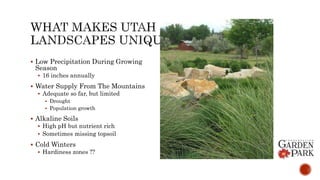
 Low Precipitation During Growing
Season
 16 inches annually
 Water Supply From The Mountains
 Adequate so far, but limited
 Drought
 Population growth
 Alkaline Soils
 High pH but nutrient rich
 Sometimes missing topsoil
 Cold Winters
 Hardiness zones ??
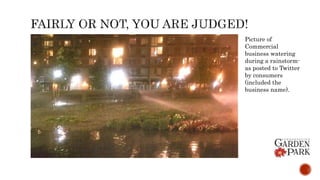
Picture of
Commercial
business watering
during a rainstorm-
as posted to Twitter
by consumers
(included the
business name).
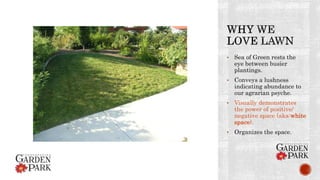
• Sea of Green rests the
eye between busier
plantings.
• Conveys a lushness
indicating abundance to
our agrarian psyche.
• Visually demonstrates
the power of positive/
negative space (aka:white
space).
• Organizes the space.
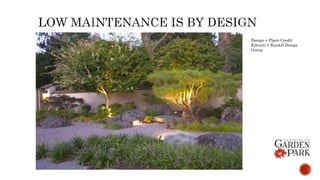
Conserve water AND reduce maintenance through design.
Design + Photo Credit:
Kikuchi + Kankel Design
Group
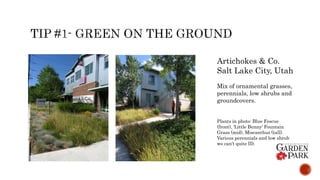
Artichokes & Co.
Salt Lake City, Utah
Mix of ornamental grasses,
perennials, low shrubs and
groundcovers.
Plants in photo: Blue Fescue
(front), ‘Little Bunny’ Fountain
Grass (mid), Miscanthus (tall).
Various perennials and low shrub
we can’t quite ID.
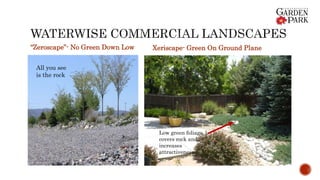
“Zeroscape”- No Green Down Low Xeriscape- Green On Ground Plane
All you see
is the rock
Low green foliage
covers rock and
increases
attractiveness.
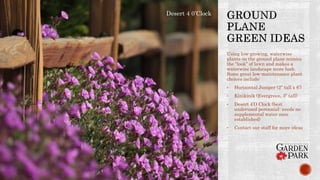
Using low-growing, waterwise
plants on the ground plane mimics
the “look” of lawn and makes a
waterwise landscape more lush.
Some great low-maintenance plant
choices include:
• Horizontal Juniper (2” tall x 6’)
• Kinikinik (Evergreen, 3” tall)
• Desert 4’O Clock (best
underused perennial- needs no
supplemental water once
established)
• Contact our staff for more ideas
Desert 4 0’Clock
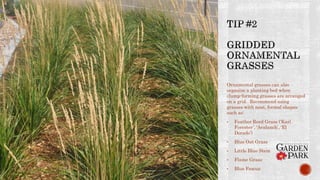
Ornamental grasses can also
organize a planting bed when
clump-forming grasses are arranged
on a grid. Recommend using
grasses with neat, formal shapes
such as:
• Feather Reed Grass (‘Karl
Forester’, ‘Avalanch’, ‘El
Dorado’)
• Blue Oat Grass
• Little Blue Stem
• Flame Grass
• Blue Fescue
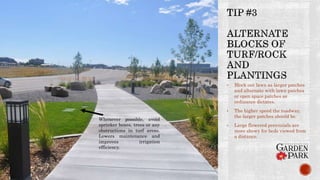
• Block out lawn as larger patches
and alternate with lawn patches
or open space patches as
ordinance dictates.
• The higher speed the roadway,
the larger patches should be.
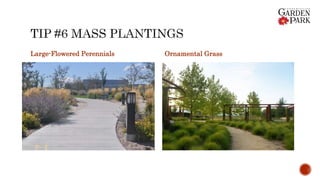
• Large flowered perennials are
more showy for beds viewed from
a distance.
Whenever possible, avoid
sprinker boxes, trees or any
obstructions in turf areas.
Lowers maintenance and
improves irrigation
efficiency.
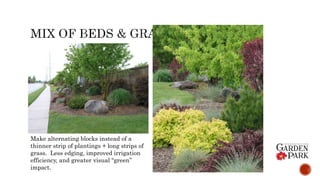
Make alternating blocks instead of a
thinner strip of plantings + long strips of
grass. Less edging, improved irrigation
efficiency, and greater visual “green”
impact.
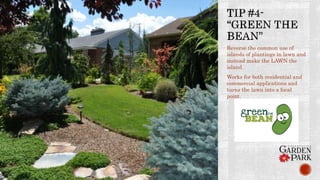
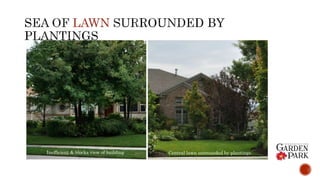
Reverse the common use of
islands of plantings in lawn and
instead make the LAWN the
island.
Works for both residential and
commercial applications and
turns the lawn into a focal
point.
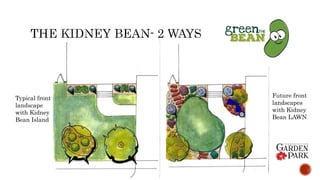
Typical front
landscape
with Kidney
Bean Island
Future front
landscapes
with Kidney
Bean LAWN
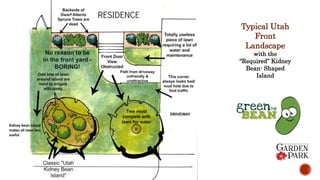
Typical Utah
Front
Landscape
with the
“Required” Kidney
Bean- Shaped
Island
Kidney bean Island
makes all lawn less
useful
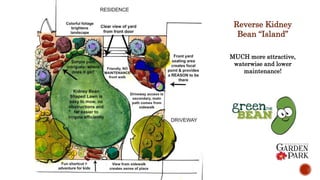
Reverse Kidney
Bean “Island”
MUCH more attractive,
waterwise and lower
maintenance!
LAWN
Inefficient & blocks view of building Central lawn surrounded by plantings.
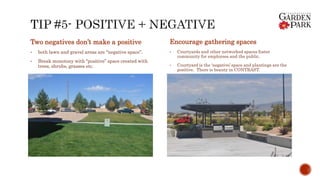
Two negatives don’t make a positive
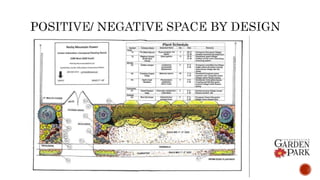
• both lawn and gravel areas are “negative space”.
• Break monotony with “positive” space created with
trees, shrubs, grasses etc.
Encourage gathering spaces
• Courtyards and other networked spaces foster
community for employees and the public.
• Courtyard is the ‘negative’ space and plantings are the
positive. There is beauty in CONTRAST.
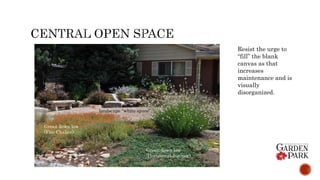
Resist the urge to
“fill” the blank
canvas as that
increases
maintenance and is
visually
disorganized.
landscape “white space”.
Green down low
(Horizontal Juniper)
Green down low
(Fire Chalice)
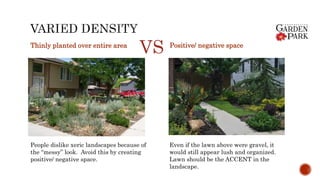
Thinly planted over entire area Positive/ negative space
VS
Even if the lawn above were gravel, it
would still appear lush and organized.
Lawn should be the ACCENT in the
landscape.
People dislike xeric landscapes because of
the “messy” look. Avoid this by creating
positive/ negative space.
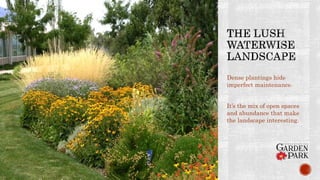
Dense plantings hide
imperfect maintenance.
It’s the mix of open spaces
and abundance that make
the landscape interesting.
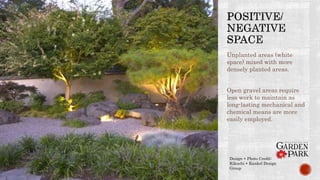
Unplanted areas (white
space) mixed with more
densely planted areas.
Open gravel areas require
less work to maintain as
long-lasting mechanical and
chemical means are more
easily employed.
Design + Photo Credit:
Kikuchi + Kankel Design
Group
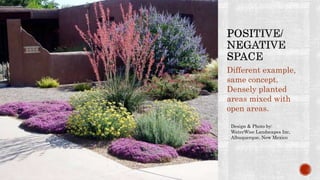
Different example,
same concept.
Densely planted
areas mixed with
open areas.
Design & Photo by:
WaterWise Landscapes Inc,
Albuquerque, New Mexico
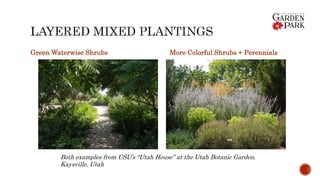
Green Waterwise Shrubs More Colorful Shrubs + Perennials
Both examples from USU’s “Utah House” at the Utah Botanic Garden.
Kaysville, Utah
Large-Flowered Perennials Ornamental Grass
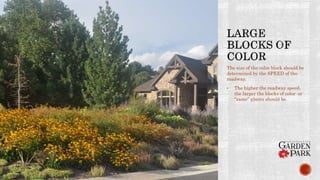
The size of the color block should be
determined by the SPEED of the
roadway.
• The higher the roadway speed,
the larger the blocks of color or
“same” plants should be.
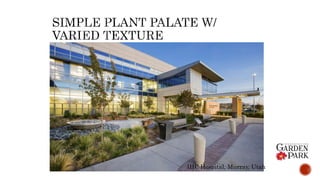
IHC Hospital, Murray, Utah
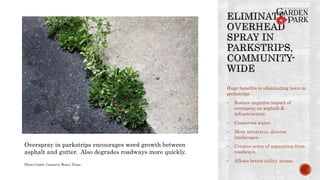
Huge benefits to eliminating lawn in
parkstrips:
• Reduce negative impact of
overspray on asphalt &
infrastructure.
• Conserves water.
• More attractive, diverse
landscapes.
• Creates sense of separation from
roadways.
• Allows better utility access.
Overspray in parkstrips encourages weed growth between
asphalt and gutter. Also degrades roadways more quickly.
Photo Credit: Conserve Water Texas
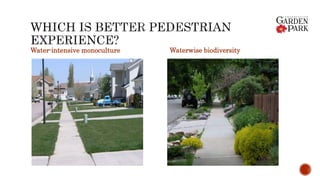
Water-intensive monoculture Waterwise biodiversity
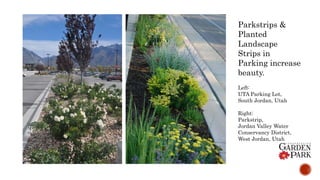
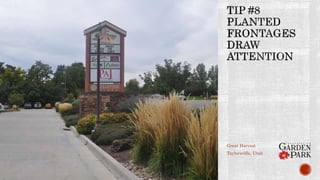
Parkstrips &
Planted
Landscape
Strips in
Parking increase
beauty.
Left:
UTA Parking Lot,
South Jordan, Utah
Right:
Parkstrip,
Jordan Valley Water
Conservancy District,
West Jordan, Utah
Great Harvest
Taylorsville, Utah
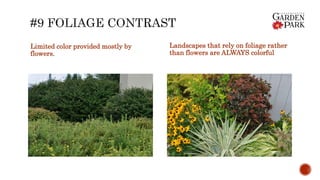
Limited color provided mostly by
flowers.
Landscapes that rely on foliage rather
than flowers are ALWAYS colorful
No matter how it’s designed and
planted, water savings are achieved
through the watering infrastructure
and human management.
• Install “smart timers” on
commercial landscapes.
• Require water-efficient spray
heads (MP Rotators) on turf.
• All beds should be drip irrigated.
• Drip irrigation and overhead
spray should never run on the
same zone.
• Soil moisture sensors & rain
sensors are key to automate
water savings.
Photo credit: Conserve Water Texas
Examples of waterwise commercial landscapes that WORK!
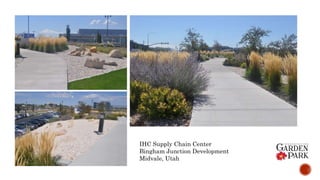
IHC Supply Chain Center
Bingham Junction Development
Midvale, Utah
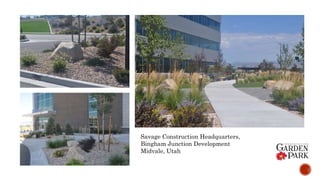
Savage Construction Headquarters,
Bingham Junction Development
Midvale, Utah
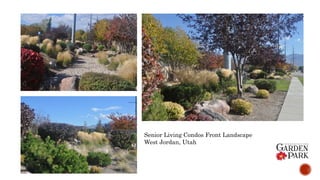
Senior Living Condos Front Landscape
West Jordan, Utah
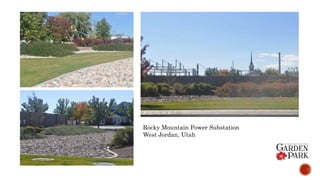
Rocky Mountain Power Substation
West Jordan, Utah
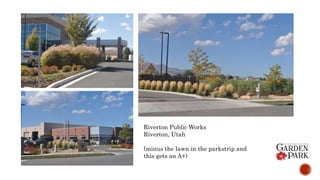
Riverton Public Works
Riverton, Utah
(minus the lawn in the parkstrip and
this gets an A+)

Commercial Landscape design

  • 1.
  • 2.
     Low PrecipitationDuring Growing Season  16 inches annually  Water Supply From The Mountains  Adequate so far, but limited  Drought  Population growth  Alkaline Soils  High pH but nutrient rich  Sometimes missing topsoil  Cold Winters  Hardiness zones ??
  • 3.
    Picture of Commercial business watering duringa rainstorm- as posted to Twitter by consumers (included the business name).
  • 5.
    • Sea ofGreen rests the eye between busier plantings. • Conveys a lushness indicating abundance to our agrarian psyche. • Visually demonstrates the power of positive/ negative space (aka:white space). • Organizes the space.
  • 6.
    Conserve water ANDreduce maintenance through design.
  • 7.
    Design + PhotoCredit: Kikuchi + Kankel Design Group
  • 8.
    Artichokes & Co. SaltLake City, Utah Mix of ornamental grasses, perennials, low shrubs and groundcovers. Plants in photo: Blue Fescue (front), ‘Little Bunny’ Fountain Grass (mid), Miscanthus (tall). Various perennials and low shrub we can’t quite ID.
  • 9.
    “Zeroscape”- No GreenDown Low Xeriscape- Green On Ground Plane All you see is the rock Low green foliage covers rock and increases attractiveness.
  • 10.
    Using low-growing, waterwise plantson the ground plane mimics the “look” of lawn and makes a waterwise landscape more lush. Some great low-maintenance plant choices include: • Horizontal Juniper (2” tall x 6’) • Kinikinik (Evergreen, 3” tall) • Desert 4’O Clock (best underused perennial- needs no supplemental water once established) • Contact our staff for more ideas Desert 4 0’Clock
  • 11.
    Ornamental grasses canalso organize a planting bed when clump-forming grasses are arranged on a grid. Recommend using grasses with neat, formal shapes such as: • Feather Reed Grass (‘Karl Forester’, ‘Avalanch’, ‘El Dorado’) • Blue Oat Grass • Little Blue Stem • Flame Grass • Blue Fescue
  • 12.
    • Block outlawn as larger patches and alternate with lawn patches or open space patches as ordinance dictates. • The higher speed the roadway, the larger patches should be. • Large flowered perennials are more showy for beds viewed from a distance. Whenever possible, avoid sprinker boxes, trees or any obstructions in turf areas. Lowers maintenance and improves irrigation efficiency.
  • 13.
    Make alternating blocksinstead of a thinner strip of plantings + long strips of grass. Less edging, improved irrigation efficiency, and greater visual “green” impact.
  • 14.
    Reverse the commonuse of islands of plantings in lawn and instead make the LAWN the island. Works for both residential and commercial applications and turns the lawn into a focal point.
  • 15.
    Typical front landscape with Kidney BeanIsland Future front landscapes with Kidney Bean LAWN
  • 16.
    Typical Utah Front Landscape with the “Required”Kidney Bean- Shaped Island Kidney bean Island makes all lawn less useful
  • 17.
    Reverse Kidney Bean “Island” MUCHmore attractive, waterwise and lower maintenance!
  • 18.
    LAWN Inefficient & blocksview of building Central lawn surrounded by plantings.
  • 19.
    Two negatives don’tmake a positive • both lawn and gravel areas are “negative space”. • Break monotony with “positive” space created with trees, shrubs, grasses etc. Encourage gathering spaces • Courtyards and other networked spaces foster community for employees and the public. • Courtyard is the ‘negative’ space and plantings are the positive. There is beauty in CONTRAST.
  • 20.
    Resist the urgeto “fill” the blank canvas as that increases maintenance and is visually disorganized. landscape “white space”. Green down low (Horizontal Juniper) Green down low (Fire Chalice)
  • 21.
    Thinly planted overentire area Positive/ negative space VS Even if the lawn above were gravel, it would still appear lush and organized. Lawn should be the ACCENT in the landscape. People dislike xeric landscapes because of the “messy” look. Avoid this by creating positive/ negative space.
  • 22.
    Dense plantings hide imperfectmaintenance. It’s the mix of open spaces and abundance that make the landscape interesting.
  • 24.
    Unplanted areas (white space)mixed with more densely planted areas. Open gravel areas require less work to maintain as long-lasting mechanical and chemical means are more easily employed. Design + Photo Credit: Kikuchi + Kankel Design Group
  • 25.
    Different example, same concept. Denselyplanted areas mixed with open areas. Design & Photo by: WaterWise Landscapes Inc, Albuquerque, New Mexico
  • 26.
    Green Waterwise ShrubsMore Colorful Shrubs + Perennials Both examples from USU’s “Utah House” at the Utah Botanic Garden. Kaysville, Utah
  • 27.
  • 28.
    The size ofthe color block should be determined by the SPEED of the roadway. • The higher the roadway speed, the larger the blocks of color or “same” plants should be.
  • 29.
  • 30.
    Huge benefits toeliminating lawn in parkstrips: • Reduce negative impact of overspray on asphalt & infrastructure. • Conserves water. • More attractive, diverse landscapes. • Creates sense of separation from roadways. • Allows better utility access. Overspray in parkstrips encourages weed growth between asphalt and gutter. Also degrades roadways more quickly. Photo Credit: Conserve Water Texas
  • 31.
  • 33.
    Parkstrips & Planted Landscape Strips in Parkingincrease beauty. Left: UTA Parking Lot, South Jordan, Utah Right: Parkstrip, Jordan Valley Water Conservancy District, West Jordan, Utah
  • 34.
  • 35.
    Limited color providedmostly by flowers. Landscapes that rely on foliage rather than flowers are ALWAYS colorful
  • 36.
    No matter howit’s designed and planted, water savings are achieved through the watering infrastructure and human management. • Install “smart timers” on commercial landscapes. • Require water-efficient spray heads (MP Rotators) on turf. • All beds should be drip irrigated. • Drip irrigation and overhead spray should never run on the same zone. • Soil moisture sensors & rain sensors are key to automate water savings. Photo credit: Conserve Water Texas
  • 37.
    Examples of waterwisecommercial landscapes that WORK!
  • 38.
    IHC Supply ChainCenter Bingham Junction Development Midvale, Utah
  • 39.
    Savage Construction Headquarters, BinghamJunction Development Midvale, Utah
  • 40.
    Senior Living CondosFront Landscape West Jordan, Utah
  • 41.
    Rocky Mountain PowerSubstation West Jordan, Utah
  • 42.
    Riverton Public Works Riverton,Utah (minus the lawn in the parkstrip and this gets an A+)