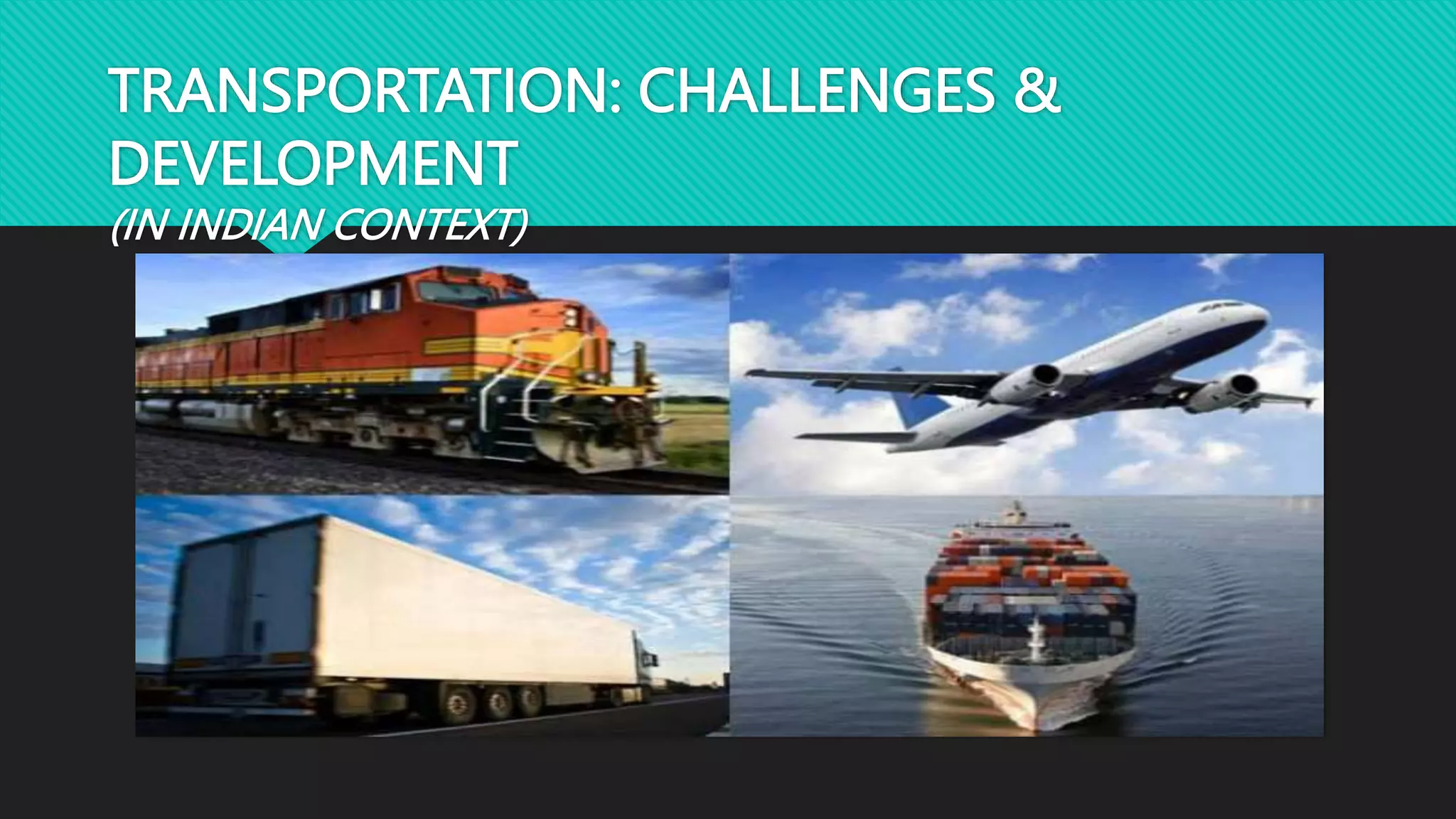
TRANSPORTATION: CHALLENGES &
DEVELOPMENT
(IN INDIAN CONTEXT)
INTRODUCTION:
 Transport is a means of carrying goods and people from one place to another. It helps in removing
the distance barrier.
 The transport system in India comprises a number of distinct modes and services , such as railways,
road transport, ports, water transport, coastal shipping, pipelines and so on.
 India's transport sector is large and diverse; it caters to the needs of 1.1 billion people. Since the
early 1990s, India's growing economy has witnessed a rise in demand for transport infrastructure
and services.
 Unsustainable transport activities can produce widespread negative impacts like degradation of air
quality, green house gas emissions , increased threat of global climate change and habitat loss of
animals and fragmentation.
 Therefore, there is a need to pay greater attention to sustainable or green transport at city, state,
national level as the way forward for India’s mobility sector.
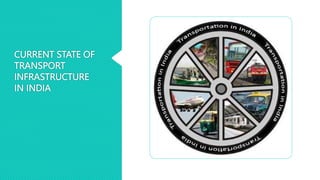
CURRENT STATE OF
TRANSPORT
INFRASTRUCTURE
IN INDIA
Road transport
Roads are the most dominant mode of transportation in India today. They carry almost 85% of the
country’s passenger traffic. Road transport also helps the industrial sector by moving raw materials to
to industries and finished goods to market.
Ports and shipping
India has 13 major ports along its more than 7500 km long coastline. Ports play a very significant
role in improving foreign trade in growing Indian economy.
Railway
It is called as lifeline of India which provides both freight and passenger mode of transportation.
India’s railway network is the 4th largest railway network in the world.
Civil Aviation
The civil Aviation industry in India has emerged as one of the fastest growing industries in the
country. India has become the 3rd largest domestic aviation market in the world and is expected to
overtake UK to become the 3rd largest air passenger market by 2024.
CHALLENGES:
Major challenges facing the sector are:
• India’s roads are congested and of poor quality. Lane capacity is low – majority of national highways
are two lanes or less. A quarter of all India's highways are congested.
• Rural areas have poor access. Roads are significant for the development of the rural areas - home to
almost 70 percent of India's population. Although the rural road network is extensive, some 33 percent
of India’s villages do not have access to all-weather roads and remain cut off during the monsoon
season.
• Road accidents are increasing day by day. India has 1% of the world’s vehicles but accounts for 11% of
all road crash deaths . According to the Ministry of Road Transport and Highways 2020 : speeding
accounted for 69.3% of deaths , non wearing of helmets resulted in 30.1% deaths, non use of seatbelts
caused 11.5% of deaths.
• The railways are facing severe capacity constraints. All the country’s high-density rail corridors face
severe capacity constraints.
• Ports are congested and inefficient. The average annual growth of cargo volume in the ports
in the last decade was close to 10%, However, capacity utilization in some of the major ports
remain as low as 58-60%.
• Poor regional connectivity, inadequate hanger space and lack of land for airport expansions
are some of the key constraints of airways transportation. Also because of high central and
state taxes , aviation fuel in India is approximately 60% more expensive than it is in ASEAN
and the Middle East Countries.
• The growing number of vehicles in Indian cities is viewed as the essential driver of climate
change. Urban transportation is the second leading source of carbon dioxide emissions due
to its dependency on fossil fuels.
• Transport sector has been recognized as a primary cause of habitat loss and a subsequent
decline in biodiversity. Expansion of roads ,railways ,airways network creates fragmentation
and degradation of habitat.
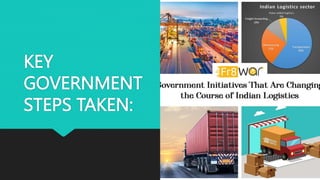
KEY
GOVERNMENT
STEPS TAKEN:
KEY GOVERNMENT STRATEGIES:
 Increasing public funding for transportation in its Five Year Plans.
 Launching the ambitious National Highway Development Program which has seven phases and is
expected to be completed by 2012. It includes improved connectivity between Delhi, Mumbai, Chennai
and Kolkata, popularly called the Golden Quadrilateral
 Accelerated Road Development Program for the North East Region to provide road connectivity to all
State capitals and district headquarters in the North East region.
 Improving rural access by launching the Pradhan Mantri Gram Sadak Yojana (Prime Minister’s Rural Roads
Program).
 Upgrading infrastructure and connectivity in the country's twelve major ports by initiating the National
Maritime Development Program (NMDP).
 Privatization and expansion of the Mumbai and New Delhi Airports and development of new
international airports at Hyderabad and Bangalore.
 The Ministry of Electronics and Information Technology has launched Onboard Driver Assistance
and Warning System (ODAWS).It incorporates vehicle borne sensors for monitoring driver
propensity and vehicle surroundings to deliver acoustic and visual alerts for driver assistance.
 The Sagarmala Programme was approved by the Union Cabinet in 2015 which aims at holistic port
infrastructure development along the 7516 km long coastline through modernisation,
mechanization and computerization.
 National Electric Mobility Mission:2020 aims to achieve national fuel security by promoting hybrid
and electric vehicles in the country. The primary objectives are – achieve national energy security ,
mitigation of the adverse impact of vehicles on the environment and growth of domestic
manufacturing capabilities in the automobile sector.
WAY FORWARD:
WAY FORWARD:
 What Should be the Way Forward?
 Intelligent Transportation System (ITS):
 There is a need to shift towards an intelligent transport system to enable users to be better informed
and make safer, more coordinated, and 'smarter' use of transport networks.
 Example: Intelligent traffic management, V2X communication, Electric toll collection.
 Awareness Towards Green Travel Habits:
 It is necessary to launch intensive awareness campaigns that educate people on the ill effects of the
growing transport problems. Promoting greater use of non motorized vehicles, proper maintenance
of their vehicles, safer driving practices, etc.
 Such campaigns will encourage individuals, families and communities to adopt “Green Travel
Habits” that would make travel less polluting and damaging.
WAY FORWARD(contd.)
 Resilience, Equity, and Sustainability in Transport (REST):
 Resilience: There is a need to rethink and restore confidence in public transport, including the procurement of more
buses, the adoption of e-buses, bus corridors and bus rapid transit systems with digitalization of public transport.
 Equity: Last mile road and railway connectivity should be at priority with special attention to the north east region.
 Sustainability: Emission norms should be tightened and electric vehicles should be promoted, as well as biofuels should
replace fossil fuels.
 The development of several electric freight corridors to promote electrification is also crucial to reaping the benefits of electric vehicles.
 Manufacturing Hub in Green Mobility:
 With proper policy support, industry action, market generation, increased investor interest and acceptance, India can
position itself as a low-cost, zero-carbon manufacturing hub in green mobility at the same time fulfilling its goal
of economic development, job creation, and improved public health.

Transportation(India)

  • 1.
  • 2.
    INTRODUCTION:  Transport isa means of carrying goods and people from one place to another. It helps in removing the distance barrier.  The transport system in India comprises a number of distinct modes and services , such as railways, road transport, ports, water transport, coastal shipping, pipelines and so on.  India's transport sector is large and diverse; it caters to the needs of 1.1 billion people. Since the early 1990s, India's growing economy has witnessed a rise in demand for transport infrastructure and services.  Unsustainable transport activities can produce widespread negative impacts like degradation of air quality, green house gas emissions , increased threat of global climate change and habitat loss of animals and fragmentation.  Therefore, there is a need to pay greater attention to sustainable or green transport at city, state, national level as the way forward for India’s mobility sector.
  • 3.
  • 4.
    Road transport Roads arethe most dominant mode of transportation in India today. They carry almost 85% of the country’s passenger traffic. Road transport also helps the industrial sector by moving raw materials to to industries and finished goods to market. Ports and shipping India has 13 major ports along its more than 7500 km long coastline. Ports play a very significant role in improving foreign trade in growing Indian economy. Railway It is called as lifeline of India which provides both freight and passenger mode of transportation. India’s railway network is the 4th largest railway network in the world. Civil Aviation The civil Aviation industry in India has emerged as one of the fastest growing industries in the country. India has become the 3rd largest domestic aviation market in the world and is expected to overtake UK to become the 3rd largest air passenger market by 2024.
  • 5.
    CHALLENGES: Major challenges facingthe sector are: • India’s roads are congested and of poor quality. Lane capacity is low – majority of national highways are two lanes or less. A quarter of all India's highways are congested. • Rural areas have poor access. Roads are significant for the development of the rural areas - home to almost 70 percent of India's population. Although the rural road network is extensive, some 33 percent of India’s villages do not have access to all-weather roads and remain cut off during the monsoon season. • Road accidents are increasing day by day. India has 1% of the world’s vehicles but accounts for 11% of all road crash deaths . According to the Ministry of Road Transport and Highways 2020 : speeding accounted for 69.3% of deaths , non wearing of helmets resulted in 30.1% deaths, non use of seatbelts caused 11.5% of deaths. • The railways are facing severe capacity constraints. All the country’s high-density rail corridors face severe capacity constraints.
  • 6.
    • Ports arecongested and inefficient. The average annual growth of cargo volume in the ports in the last decade was close to 10%, However, capacity utilization in some of the major ports remain as low as 58-60%. • Poor regional connectivity, inadequate hanger space and lack of land for airport expansions are some of the key constraints of airways transportation. Also because of high central and state taxes , aviation fuel in India is approximately 60% more expensive than it is in ASEAN and the Middle East Countries. • The growing number of vehicles in Indian cities is viewed as the essential driver of climate change. Urban transportation is the second leading source of carbon dioxide emissions due to its dependency on fossil fuels. • Transport sector has been recognized as a primary cause of habitat loss and a subsequent decline in biodiversity. Expansion of roads ,railways ,airways network creates fragmentation and degradation of habitat.
  • 7.
  • 8.
    KEY GOVERNMENT STRATEGIES: Increasing public funding for transportation in its Five Year Plans.  Launching the ambitious National Highway Development Program which has seven phases and is expected to be completed by 2012. It includes improved connectivity between Delhi, Mumbai, Chennai and Kolkata, popularly called the Golden Quadrilateral  Accelerated Road Development Program for the North East Region to provide road connectivity to all State capitals and district headquarters in the North East region.  Improving rural access by launching the Pradhan Mantri Gram Sadak Yojana (Prime Minister’s Rural Roads Program).  Upgrading infrastructure and connectivity in the country's twelve major ports by initiating the National Maritime Development Program (NMDP).  Privatization and expansion of the Mumbai and New Delhi Airports and development of new international airports at Hyderabad and Bangalore.
  • 9.
     The Ministryof Electronics and Information Technology has launched Onboard Driver Assistance and Warning System (ODAWS).It incorporates vehicle borne sensors for monitoring driver propensity and vehicle surroundings to deliver acoustic and visual alerts for driver assistance.  The Sagarmala Programme was approved by the Union Cabinet in 2015 which aims at holistic port infrastructure development along the 7516 km long coastline through modernisation, mechanization and computerization.  National Electric Mobility Mission:2020 aims to achieve national fuel security by promoting hybrid and electric vehicles in the country. The primary objectives are – achieve national energy security , mitigation of the adverse impact of vehicles on the environment and growth of domestic manufacturing capabilities in the automobile sector.
  • 10.
  • 11.
    WAY FORWARD:  WhatShould be the Way Forward?  Intelligent Transportation System (ITS):  There is a need to shift towards an intelligent transport system to enable users to be better informed and make safer, more coordinated, and 'smarter' use of transport networks.  Example: Intelligent traffic management, V2X communication, Electric toll collection.  Awareness Towards Green Travel Habits:  It is necessary to launch intensive awareness campaigns that educate people on the ill effects of the growing transport problems. Promoting greater use of non motorized vehicles, proper maintenance of their vehicles, safer driving practices, etc.  Such campaigns will encourage individuals, families and communities to adopt “Green Travel Habits” that would make travel less polluting and damaging.
  • 12.
    WAY FORWARD(contd.)  Resilience,Equity, and Sustainability in Transport (REST):  Resilience: There is a need to rethink and restore confidence in public transport, including the procurement of more buses, the adoption of e-buses, bus corridors and bus rapid transit systems with digitalization of public transport.  Equity: Last mile road and railway connectivity should be at priority with special attention to the north east region.  Sustainability: Emission norms should be tightened and electric vehicles should be promoted, as well as biofuels should replace fossil fuels.  The development of several electric freight corridors to promote electrification is also crucial to reaping the benefits of electric vehicles.  Manufacturing Hub in Green Mobility:  With proper policy support, industry action, market generation, increased investor interest and acceptance, India can position itself as a low-cost, zero-carbon manufacturing hub in green mobility at the same time fulfilling its goal of economic development, job creation, and improved public health.