•                Table of Contents
•                Index
Metro Ethernet

BySam Halabi


    Publisher: Cisco Press
    Pub Date: October 01, 2003
        ISBN: 1-58705-096-X
       Pages: 240


The definitive guide to Enterprise and Carrier Metro Ethernet applications.


      Discover the latest developments in metro networking, Ethernet, and MPLS services and
      what they can do for your organization

      Learn from the easy-to-read format that enables networking professionals of all levels to
      understand the concepts

      Gain from the experience of industry innovator and best-selling Cisco Press author, Sam
      Halabi, author of Internet Routing Architectures

Metro networks will emerge as the next area of growth for the networking industry and will
represent a major shift in how data services are offered to businesses and residential customers.
The metro has always been a challenging environment for delivering data services because it has
been built to handle the stringent reliability and availability needs for voice. Carriers will have to
go through fundamental shifts to equip the metro for next-generation data services demanded
by enterprise customers and consumers. This is not only a technology shift, but also a shift in the
operational and business model that will allow the incumbent carriers to transform the metro to
offer enhanced data services.

Metro Ethernet from Cisco Press looks at the deployment of metro data services from a holistic
view. It describes the current metro, which is based on TDM technology, and discusses the
drivers and challenges carriers will face in transforming the metro to address data services.

Metro Ethernet discusses the adoption of metro Ethernet services and how that has led carriers
to the delivery of metro data services. With a changing mix of transport technologies, the book
then examines current and emerging trends, and delves into the role of virtual private networks
(VPN), virtual private local area networks (VLAN), virtual private LAN services (VPLS), traffic
engineering, and MPLS and Generalized MPLS (GMPLS).
•                 Table of Contents
•                 Index
Metro Ethernet

BySam Halabi


    Publisher: Cisco Press
    Pub Date: October 01, 2003
        ISBN: 1-58705-096-X
       Pages: 240


      Copyright
The definitive guide to Enterprise and Carrier Metro Ethernet applications.
     About the Author
         About the Technical Reviewers
      Acknowledgments
      Discover the latest      developments in metro networking, Ethernet, and MPLS services and
      Icons they This do
      whatUsed in can Bookfor    your organization
      Introduction
      Learn from the easy-to-read format that enables networking professionals of all levels to
        Goals and Methods
      understand Read concepts
        Who Should the This Book?
         How This Book Is Organized
      Gain from the experience of industry innovator and best-selling Cisco Press author, Sam
      Part I: Ethernet: From Internet Routing Architectures
      Halabi, author of the LAN to the MAN
          Chapter 1. Introduction to Data in the Metro
Metro networks will emerge as the next area of growth for the networking industry and will
         The Metro Network
representEthernet in the Metro how data services are offered to businesses and residential customers.
          a major shift in
The metro has alwaysEtherneta challenging environment for delivering data services because it has
         The Early Metro been Movers
been built to handle the stringent reliability and availability needs for voice. Carriers will have to
         The U.S. Incumbent Landscape
go through fundamental shifts to equip the metro for next-generation data services demanded
         The International Landscape
by enterprise customers and consumers. This is not only a technology shift, but also a shift in the
operationalData View of the Metro
         A and business model that will allow the incumbent carriers to transform the metro to
         Metro Services
offer enhanced data services.
            Ethernet Access and Frame Relay Comparison
Metro Ethernet from Cisco Press looks at the deployment of metro data services from a holistic
          Conclusion
view. It Chapter 2. Metro Technologies
         describes the current metro, which is based on TDM technology, and discusses the
drivers and challenges carriers will face in transforming the metro to address data services.
            Ethernet over SONET/SDH
          Resilient Packet Ring
Metro Ethernet discusses the adoption of metro Ethernet services and how that has led carriers
          Ethernet Transport
to the delivery of metro data services. With a changing mix of transport technologies, the book
then examines current and emerging trends, and delves into the role of virtual private networks
          Conclusion
(VPN), virtual private Ethernet Services
        Chapter 3. Metro local area networks (VLAN), virtual private LAN services (VPLS), traffic
engineering, and MPLS and Generalized MPLS (GMPLS).
          L2 Switching Basics
            Metro Ethernet Services Concepts
            Example of an L2 Metro Ethernet Service
            Challenges with All-Ethernet Metro Networks
            Conclusion
Chapter 4. Hybrid L2 and L3 IP/MPLS Networks
             Understanding VPN Components
             Delivering L3VPNs over IP
             L2 Ethernet Services over an IP/MPLS Network
             Conclusion
      Part II: MPLS: Controlling Traffic over Your Optical Metro
         Chapter 5. MPLS Traffic Engineering
•                Table of Contents
             Advantages of Traffic Engineering
•                Index
           Pre-MPLS Traffic Engineering Techniques
Metro Ethernet
           MPLS and Traffic Engineering
BySam Halabi
           Conclusion
          Chapter 6. RSVP for Traffic Engineering and Fast Reroute
    Publisher: Cisco Press
            Understanding RSVP-TE
    Pub Date: October 01, 2003
            Understanding MPLS Fast Reroute
        ISBN: 1-58705-096-X
            Conclusion
       Pages: 240
          Chapter 7. MPLS Controlling Optical Switches
             Understanding GMPLS
             Establishing the Need for GMPLS
             Signaling Models
             Label Switching in a Nonpacket World
The definitive guide to Enterprise and Carrier Metro Ethernet applications.
             Conclusion
         Chapter 8. GMPLS Architecture
      Discover the latest developments in metro networking, Ethernet, and MPLS services and
          GMPLS Interfaces
      what they canof RoutingyourSignaling
          Modification do for and organization
             Inclusion of Technology-Specific Parameters
      Learn from the easy-to-read format that enables networking professionals of all levels to
          Link Management Protocol
      understand the concepts
             GMPLS Protection and Restoration Mechanisms
      GainSummary of Differences Between MPLS and innovator and best-selling Cisco Press author, Sam
           from the experience of industry GMPLS
      Halabi, author of Internet Routing Architectures
          Conclusion
       Appendix A. SONET/SDH Basic Framing and Concatenation
Metro networks will emerge as the next area of growth for the networking industry and will
        SONET/SDH Frame Formats
represent a major shift in how data services are offered to businesses and residential customers.
        SONET/SDH Architecture
The metro has always been a challenging environment for delivering data services because it has
        SONET/SDH Concatenation
been built to handle the stringent reliability and availability needs for voice. Carriers will have to
go through fundamental shifts to equip the metro for next-generation data services demanded
        Conclusion
by enterprise customers and consumers. This is not only a technology shift, but also a shift in the
      Glossary
operational and business model that will allow the incumbent carriers to transform the metro to
        A
offer enhanced data services.
        B
         C
Metro Ethernet from Cisco Press looks at the deployment of metro data services from a holistic
view. ItDdescribes the current metro, which is based on TDM technology, and discusses the
drivers E
        and challenges carriers will face in transforming the metro to address data services.
         F
Metro Ethernet discusses the adoption of metro Ethernet services and how that has led carriers
        G
to the delivery of metro data services. With a changing mix of transport technologies, the book
        I
then examines current and emerging trends, and delves into the role of virtual private networks
        L
(VPN), virtual private local area networks (VLAN), virtual private LAN services (VPLS), traffic
        M
engineering, and MPLS and Generalized MPLS (GMPLS).
         N
         O
         P
         Q
         R
S
         T
         U
         V
         W
      Index

•                Table of Contents
•                Index
Metro Ethernet

BySam Halabi


    Publisher: Cisco Press
    Pub Date: October 01, 2003
        ISBN: 1-58705-096-X
       Pages: 240


The definitive guide to Enterprise and Carrier Metro Ethernet applications.


      Discover the latest developments in metro networking, Ethernet, and MPLS services and
      what they can do for your organization

      Learn from the easy-to-read format that enables networking professionals of all levels to
      understand the concepts

      Gain from the experience of industry innovator and best-selling Cisco Press author, Sam
      Halabi, author of Internet Routing Architectures

Metro networks will emerge as the next area of growth for the networking industry and will
represent a major shift in how data services are offered to businesses and residential customers.
The metro has always been a challenging environment for delivering data services because it has
been built to handle the stringent reliability and availability needs for voice. Carriers will have to
go through fundamental shifts to equip the metro for next-generation data services demanded
by enterprise customers and consumers. This is not only a technology shift, but also a shift in the
operational and business model that will allow the incumbent carriers to transform the metro to
offer enhanced data services.

Metro Ethernet from Cisco Press looks at the deployment of metro data services from a holistic
view. It describes the current metro, which is based on TDM technology, and discusses the
drivers and challenges carriers will face in transforming the metro to address data services.

Metro Ethernet discusses the adoption of metro Ethernet services and how that has led carriers
to the delivery of metro data services. With a changing mix of transport technologies, the book
then examines current and emerging trends, and delves into the role of virtual private networks
(VPN), virtual private local area networks (VLAN), virtual private LAN services (VPLS), traffic
engineering, and MPLS and Generalized MPLS (GMPLS).
Copyright
Copyright© 2003 Cisco Systems

Published by:
•              Table of Contents
Cisco Press
•              Index
800 East 96th Street, 3rd Floor
Metro Ethernet
Indianapolis, IN 46240 USA
BySam Halabi
All rights reserved. No part of this book may be reproduced or transmitted in any form or by any
means, electronic or mechanical, including photocopying, recording, or by any information
    Publisher: Cisco Press
storage andOctober 01, 2003
    Pub Date: retrieval system, without written permission from the publisher, except for the
inclusion of 1-58705-096-X
        ISBN:
               brief quotations in a review.
      Pages: 240
Printed in the United States of America 1 2 3 4 5 6 7 8 9 0

Library of Congress Cataloging-in-Publication Number: 2002103527

First Printing September 2003
The definitive guide to Enterprise and Carrier Metro Ethernet applications.
Warning and Disclaimer
     Discover the latest developments in metro networking, Ethernet, and MPLS services and
     what they can do for your organization
This book is designed to provide information about Metro Ethernet. Every effort has been made
to make this book as complete and as accurate as possible, but no warranty or fitness is implied.
     Learn from the easy-to-read format that enables networking professionals of all levels to
     understand the concepts
The information is provided on an "as is" basis. The author, Cisco Press, and Cisco Systems,
Inc., shall have neither liability nor responsibility to any person or entity with respect to any loss
or damages arising experience of industry innovatorin this book or from thePress author, Sam
      Gain from the from the information contained and best-selling Cisco use of the discs or
programs that may accompany Routing Architectures
      Halabi, author of Internet it.

Metro networks will emerge as book belong to the author and are not necessarily those of Cisco
The opinions expressed in this the next area of growth for the networking industry and will
represent Inc.
Systems, a major shift in how data services are offered to businesses and residential customers.
The metro has always been a challenging environment for delivering data services because it has
been built to handle the stringent reliability and availability needs for voice. Carriers will have to
Trademark Acknowledgments
go through fundamental shifts to equip the metro for next-generation data services demanded
by enterprise customers and consumers. This is not only a technology shift, but also a shift in the
operational and business model that will allow the incumbent carriers to transform the metro to
All terms mentioned services.
offer enhanced data in this book that are known to be trademarks or service marks have been
appropriately capitalized. Cisco Press or Cisco Systems, Inc. cannot attest to the accuracy of this
information. Use of aCisco Press looks at the deployment of metro affecting the validity of any
Metro Ethernet from term in this book should not be regarded as data services from a holistic
trademark or service mark. metro, which is based on TDM technology, and discusses the
view. It describes the current
drivers and challenges carriers will face in transforming the metro to address data services.
Feedback Information
Metro Ethernet discusses the adoption of metro Ethernet services and how that has led carriers
to the delivery of metro data services. With a changing mix of transport technologies, the book
then examines current andto create in-depth technical books of the highest quality and networks
At Cisco Press, our goal is emerging trends, and delves into the role of virtual private value.
(VPN), virtual private local area networks (VLAN), virtual rigorousLAN services (VPLS), traffic the
Each book is crafted with care and precision, undergoing private development that involves
engineering, and of members from the professional technical community.
unique expertise MPLS and Generalized MPLS (GMPLS).

Readers' feedback is a natural continuation of this process. If you have any comments regarding
how we could improve the quality of this book, or otherwise alter it to better suit your needs,
you can contact us through e-mail at feedback@ciscopress.com. Please make sure to include the
book title and ISBN in your message.
We greatly appreciate your assistance.


Publisher                                            John Wait

Editor-in-Chief                                      John Kane

Cisco Representative                                 Anthony Wolfenden
•               Table of Contents
•Cisco Press Program Manager
             Index                                   Sonia Torres Chavez
Metro Ethernet
 Manager, Marketing          Communications, Cisco
 Systems
BySam Halabi                                         Scott Miller
Cisco Marketing Program Manager                      Edie Quiroz
    Publisher: Cisco Press
Production October 01, 2003
   Pub Date: Manager                                 Patrick Kanouse
        ISBN: 1-58705-096-X
Development Editor                                   Dayna Isley
       Pages: 240
Copy Editor                                          Bill McManus

Technical Editors                                    Mike Bernico, Mark Gallo, Giles Heron, Irwin
                                                     Lazar

 Team Coordinator                                  Tammi Ross
The definitive guide to Enterprise and Carrier Metro Ethernet applications.
Cover Designer                                       Louisa Adair
Composition the latest developments in metro networking, Ethernet, and MPLS services and
    Discover                                    Interactive Composition Corporation
    what they can do for your organization
Proofreader                                     Gayle Johnson
    Learn from the easy-to-read format that enables networking professionals of all levels to
Indexer
    understand the concepts                     Larry Sweazy

      Gain from the experience of industry innovator and best-selling Cisco Press author, Sam
      Halabi, author of Internet Routing Architectures

Metro networks will emerge as the next area of growth for the networking industry and will
represent a major shift in how data services are offered to businesses and residential customers.
Corporatehas always been a challenging environment for delivering data services because it has
The metro Headquarters
Cisco built to handle the stringent reliability and availability needs for voice. Carriers will have to
been Systems, Inc.
170 West Tasman Drive shifts to equip the metro for next-generation data services demanded
go through fundamental
San Jose, CA 95134-1706
by enterprise customers and consumers. This is not only a technology shift, but also a shift in the
USA
operational and business model that will allow the incumbent carriers to transform the metro to
www.cisco.com data services.
offer enhanced
Tel: 408 526-4000
    800 553-NETS (6387)
Metro Ethernet from Cisco Press looks at the deployment of metro data services from a holistic
Fax: 408 526-4100
view. It describes the current metro, which is based on TDM technology, and discusses the
drivers and challenges carriers will face in transforming the metro to address data services.
European Headquarters
Cisco Ethernet discusses the adoption of metro Ethernet services and how that has led carriers
Metro Systems International BV
Haarlerbergpark
to the delivery of metro data services. With a changing mix of transport technologies, the book
Haarlerbergweg 13-19
then examines current and emerging trends, and delves into the role of virtual private networks
1101 CH Amsterdam
(VPN), virtual private local area networks (VLAN), virtual private LAN services (VPLS), traffic
The Netherlands
engineering, and MPLS and Generalized MPLS (GMPLS).
www-europe.cisco.com
Tel: 31 0 20 357 1000
Fax: 31 0 20 357 1100

Americas Headquarters
Cisco Systems, Inc.
170 West Tasman Drive
San Jose, CA 95134-1706
USA
www.cisco.com
Tel: 408 526-7660
Fax:408 527-0883
•            Table of Contents
Asia Pacific Headquarters
•              Index
Cisco Systems, Inc.
Metro Ethernet
Capital Tower
BySam Halabi
168 Robinson Road
#22-01 to #29-01
Singapore 068912
   Publisher: Cisco Press
www.cisco.com 01, 2003
    Pub Date: October
Tel: +65 6317 7777
       ISBN: 1-58705-096-X
Fax: +65 6317 7799
      Pages: 240

Cisco Systems has more than 200 offices in the following countries and regions. Addresses,
phone numbers, and fax numbers are listed on the Cisco.com Web site at
www.cisco.com/go/offices.

Argentina • Australia • Austria • and Carrier Metro Ethernet Canada • Chile • China PRC •
The definitive guide to EnterpriseBelgium • Brazil • Bulgaria •applications.
Colombia • Costa Rica • Croatia • Czech Republic • Denmark • Dubai, UAE • Finland • France •
Germany • Greece • Hong Kong SAR • Hungary • India • Indonesia • Ireland • Israel • Italy •
Japan • Korea the latest developments in•metro networking, Ethernet, New MPLS services and •
     Discover • Luxembourg • Malaysia Mexico • The Netherlands • and Zealand • Norway
Peru • Philippines • Polandyour organization Rico • Romania • Russia • Saudi Arabia •
     what they can do for • Portugal • Puerto
Scotland • Singapore • Slovakia • Slovenia • South Africa • Spain • Sweden • Switzerland •
Taiwan • Thailand • Turkey • Ukraine • United enables networking professionals of all•levels to •
     Learn from the easy-to-read format that Kingdom • United States • Venezuela Vietnam
     understand the concepts
Zimbabwe

Copyright © 2003 Cisco Systems,industry rights reserved. CCIP, CCSP, the Press author, Samthe
      Gain from the experience of Inc. All innovator and best-selling Cisco Cisco Arrow logo,
CiscoHalabi, author of Internet Routing Systems Verified logo, Cisco Unity, Follow Me Browsing,
      Powered Network mark, the Cisco Architectures
FormShare, iQ Net Readiness Scorecard, Networking Academy, and ScriptShare are trademarks
Metro networks will emerge as the next area of growth for Play, and Learn,industry and Way to
of Cisco Systems, Inc.; Changing the Way We Work, Live, the networking The Fastest will
representYour Internet Quotient, and iQuick Study are service marks of Cisco Systems, Inc.; and
Increase a major shift in how data services are offered to businesses and residential customers.
The metro has always been a challenging environment for CCNP, Cisco, the Cisco Certified it has
Aironet, ASIST, BPX, Catalyst, CCDA, CCDP, CCIE, CCNA, delivering data services because
been built to handle the stringent reliability and availability needs for Cisco Systems, will have to
Internetwork Expert logo, Cisco IOS, the Cisco IOS logo, Cisco Press, voice. Carriers Cisco
go through fundamental shifts to equip the metro for next-generation data services demanded
Systems Capital, the Cisco Systems logo, Empowering the Internet Generation,
by enterprise customers and consumers. This is not Step,a technology shift, but also a shift in the
Enterprise/Solver, EtherChannel, EtherSwitch, Fast only GigaStack, Internet Quotient, IOS,
operational and business model that will allow MGX, MICA, thecarriers to transform the metro to
IP/TV, iQ Expertise, the iQ logo, LightStream, the incumbent Networkers logo, Network
offer enhanced data services.
Registrar,Packet, PIX, Post-Routing, Pre-Routing, RateMUX, Registrar, SlideCast, SMARTnet,
StrataView Plus, Stratm, SwitchProbe, TeleRouter, TransPath, and VCO are registered
Metro Ethernet from Cisco Press looks at the deployment of metro data services from a holistic
trademarks of Cisco Systems, Inc. and/or its affiliates in the U.S. and certain other countries.
view. It describes the current metro, which is based on TDM technology, and discusses the
drivers and challenges carriers will this document or Web site are the address data services.
All other trademarks mentioned in face in transforming the metro to property of their respective
owners. The use of the word partner does not imply a partnership relationship between Cisco
Metro Ethernet discusses the adoption of metro Ethernet services and how that has led carriers
and any other company. (0303R)
to the delivery of metro data services. With a changing mix of transport technologies, the book
then examines current and emerging trends, and delves into the role of virtual private networks
Printed in the USA
(VPN), virtual private local area networks (VLAN), virtual private LAN services (VPLS), traffic
engineering, and MPLS and Generalized MPLS (GMPLS).

Dedications
I dedicate this book to my wonderful family, who spent many nights and weekends alone to help
me finish the manuscript. To my lovely wife, Roula, I promised you after the IRA book that I
wouldn't write another book. Sorry I lied. Thank you for supporting me. To my sons, Joe and
Jason, I love you both for the sacrifices you had to make during the last year for me to finish this
book.


•                Table of Contents
•                Index
Metro Ethernet

BySam Halabi


    Publisher: Cisco Press
    Pub Date: October 01, 2003
        ISBN: 1-58705-096-X
       Pages: 240


The definitive guide to Enterprise and Carrier Metro Ethernet applications.


      Discover the latest developments in metro networking, Ethernet, and MPLS services and
      what they can do for your organization

      Learn from the easy-to-read format that enables networking professionals of all levels to
      understand the concepts

      Gain from the experience of industry innovator and best-selling Cisco Press author, Sam
      Halabi, author of Internet Routing Architectures

Metro networks will emerge as the next area of growth for the networking industry and will
represent a major shift in how data services are offered to businesses and residential customers.
The metro has always been a challenging environment for delivering data services because it has
been built to handle the stringent reliability and availability needs for voice. Carriers will have to
go through fundamental shifts to equip the metro for next-generation data services demanded
by enterprise customers and consumers. This is not only a technology shift, but also a shift in the
operational and business model that will allow the incumbent carriers to transform the metro to
offer enhanced data services.

Metro Ethernet from Cisco Press looks at the deployment of metro data services from a holistic
view. It describes the current metro, which is based on TDM technology, and discusses the
drivers and challenges carriers will face in transforming the metro to address data services.

Metro Ethernet discusses the adoption of metro Ethernet services and how that has led carriers
to the delivery of metro data services. With a changing mix of transport technologies, the book
then examines current and emerging trends, and delves into the role of virtual private networks
(VPN), virtual private local area networks (VLAN), virtual private LAN services (VPLS), traffic
engineering, and MPLS and Generalized MPLS (GMPLS).
About the Author
Mr. Halabi is a seasoned executive and an industry veteran with more than 18 years of
experience marketing and selling to the worldwide Enterprise and Carrier networking markets.
While at Cisco, heof Contents first Cisco Internet routing book, Internet Routing Architectures, a
•              Table wrote the
best-seller inIndex U.S. and international markets. He has held multiple executive management
•               the
positions in the field of marketing, sales, and business development and has been instrumental
Metro Ethernet
in evolving fast-growing businesses for the Enterprise and Carrier Ethernet markets.
BySam Halabi


   Publisher: Cisco Press
   Pub Date: October 01, 2003
       ISBN: 1-58705-096-X
      Pages: 240


The definitive guide to Enterprise and Carrier Metro Ethernet applications.


     Discover the latest developments in metro networking, Ethernet, and MPLS services and
     what they can do for your organization

     Learn from the easy-to-read format that enables networking professionals of all levels to
     understand the concepts

     Gain from the experience of industry innovator and best-selling Cisco Press author, Sam
     Halabi, author of Internet Routing Architectures

Metro networks will emerge as the next area of growth for the networking industry and will
represent a major shift in how data services are offered to businesses and residential customers.
The metro has always been a challenging environment for delivering data services because it has
been built to handle the stringent reliability and availability needs for voice. Carriers will have to
go through fundamental shifts to equip the metro for next-generation data services demanded
by enterprise customers and consumers. This is not only a technology shift, but also a shift in the
operational and business model that will allow the incumbent carriers to transform the metro to
offer enhanced data services.

Metro Ethernet from Cisco Press looks at the deployment of metro data services from a holistic
view. It describes the current metro, which is based on TDM technology, and discusses the
drivers and challenges carriers will face in transforming the metro to address data services.

Metro Ethernet discusses the adoption of metro Ethernet services and how that has led carriers
to the delivery of metro data services. With a changing mix of transport technologies, the book
then examines current and emerging trends, and delves into the role of virtual private networks
(VPN), virtual private local area networks (VLAN), virtual private LAN services (VPLS), traffic
engineering, and MPLS and Generalized MPLS (GMPLS).
About the Technical Reviewers
Mike Bernico is a senior networking engineer at the Illinois Century Network. In this position,
he focuses primarily on network design and integrating advanced network services such as QoS,
IP Multicast, IPv6, and MPLS into the network. He has also authored open-source software
•              Table of Contents
related to his interests in new networking technologies. He enjoys reading and spending time in
•              Index
the lab increasing his knowledge of the networking industry. He lives in Illinois with his wife
Metro Ethernet
Jayme. He can be contacted at mike@bernico.net.
BySam Halabi
Mark Gallo is a technical manager with America Online. His network certifications include Cisco
CCNP and Cisco CCDP. He has led several engineering groups responsible for designing and
   Publisher: Cisco Press
implementing enterprise LANs and international IP networks. He has a BS in electrical
engineeringOctober the2003
   Pub Date:
               from 01, University of Pittsburgh. He resides in northern Virginia with his wife,
       ISBN: son, Paul.
Betsy, and    1-58705-096-X
      Pages: 240
Giles Heron is the principal network architect for PacketExchange, a next-generation carrier
providing Ethernet services on a global basis. He designed PacketExchange's MPLS network and
has been instrumental in the development of its service portfolio. A cofounder of
PacketExchange, he previously worked in the Network Architecture group at Level(3)
Communications. Heto Enterpriseof the draft-martiniEthernet applications.
The definitive guide is coauthor and Carrier Metro specification for transport of Layer 2
protocols over IP and MPLS networks and the draft-lasserre-vkompella specification for
emulation of multipoint Ethernet LAN segments over MPLS, as well as various other Internet
drafts.
      Discover the latest developments in metro networking, Ethernet, and MPLS services and
      what they can do for your organization
Irwin Lazar is practice manager for Burton Group in its Networks and Telecom group,
managing afrom the consultants who advise large end-user organizations on topics including
      Learn team of easy-to-read format that enables networking professionals of all levels to
network architecture concepts
      understand the and emerging network technologies. He administers The MPLS Resource
Center (http://www.mplsrc.com) and is the conference director for the MPLScon Conference and
Exhibition.from the experience of industry innovator and relating to data networking and Sam
      Gain He has published numerous articles on topics best-selling Cisco Press author, the
Internet and author of Internet Routing Architectures
      Halabi, is a frequent speaker on networking-related topics at many industry conferences.
He holds a bachelor's degree in management information systems from Radford University and
Metro networks will emerge as the next He is of growth for the networkingSystems Security
an MBA from George Mason University. area also a Certified Information industry and will
represent a major shift in how data services are offered to businesses and residential customers.
Professional (CISSP).
The metro has always been a challenging environment for delivering data services because it has
been built to handle the stringent reliability and availability needs for voice. Carriers will have to
go through fundamental shifts to equip the metro for next-generation data services demanded
by enterprise customers and consumers. This is not only a technology shift, but also a shift in the
operational and business model that will allow the incumbent carriers to transform the metro to
offer enhanced data services.

Metro Ethernet from Cisco Press looks at the deployment of metro data services from a holistic
view. It describes the current metro, which is based on TDM technology, and discusses the
drivers and challenges carriers will face in transforming the metro to address data services.

Metro Ethernet discusses the adoption of metro Ethernet services and how that has led carriers
to the delivery of metro data services. With a changing mix of transport technologies, the book
then examines current and emerging trends, and delves into the role of virtual private networks
(VPN), virtual private local area networks (VLAN), virtual private LAN services (VPLS), traffic
engineering, and MPLS and Generalized MPLS (GMPLS).
Acknowledgments
I would like to acknowledge many individuals who made this book possible. Many thanks to Giles
Heron from PacketExchange for his thorough review of the material and to his many
contributions to the Contents
•               Table of Metro Ethernet space. I would like to thank Irwin Lazar, Mike Bernico, Mark
Gallo, and Saaed Sardar for their contributions and for keeping me honest. Thanks to Andrew
•               Index
Malis Ethernetinitial work on this project. I also would like to thank many of the authors of the
Metro for his
IETF RFCs and IETF drafts whose information has been used for some of the concepts and
BySam Halabi
definitions in this book. This includes the following people: Luca Martini, Nasser El-Aawar, Eric
Rosen, and Giles Heron for their work on the encapsulation of Ethernet frames over IP/MPLS
networks. V. Kompella, Mark Lasserre, Nick Tingle, Sunil Khandekar, Ali Sajassi, Tom Soon,
    Publisher: Cisco Press
Yetik Serbest, Eric01, 2003 Vasile Radaoca, Rob Nath, Andrew Smith, Juha Heinanen, Nick
    Pub Date: October Puetz,
Slabakov, J. Achirica, L. Andersson, Giles Heron, S. Khandekar, P. Lin, P. Menezes, A.
        ISBN: 1-58705-096-X
Moranganti, H. Ould-Brahim, and S. Yeong-il for their work on the VPLS draft specification. K.
       Pages: 240
Kompella for his original work on the DTLS draft specification. Special thanks to Daniel O.
Awduche for his many contributions to traffic engineering requirements and his phenomenal
work in driving multiprotocol lambda switching and GMPLS. Thanks to J. Malcolm, J. Agogbua,
M. O'Dell, and J. McManus for their contributions to TE requirements. Many thanks to the CCAMP
group and its many contributors to GMPLS, including Peter Ashwood Smith, Eric Mannie, Thomas
The definitive guide to Enterprise and Carrier Metro Ethernet applications.
D. Nadeau, Ayan Banerjee, Lyndon Ong, Debashis Basak, Dimitri Papadimitriou, Lou Berger,
Dimitrios Pendarakis, Greg Bernstein, Bala Rajagopalan, Sudheer Dharanikota, Yakov Rekhter,
John Discover the latest developments in Hal Sandick, Don Fedyk, Vishal Sharma,services and
      Drake, Debanjan Saha, Yanhe Fan, metro networking, Ethernet, and MPLS Gert Grammel,
George Swallow, Dan Guo,your organization Jennifer Yates, Alan Kullberg, George R. Young,
      what they can do for Kireeti Kompella,
Jonathan P. Lang, John Yu, Fong Liaw, and Alex Zinin. I would also like to thank the Metro
Ethernet Forum and the MPLS Forum for manyenables networking professionals of allMPLS and
      Learn from the easy-to-read format that of their informative references about levels to
VPLS. I am sure Ithe concepts many of the names of talented people who contributed indirectly
      understand have missed
to the concepts in this book, many thanks for your efforts.
      Gain from the experience of industry innovator and best-selling Cisco Press author, Sam
Last but not least, many thanksRouting Architectures the Cisco Press team, John Kane, Dayna
      Halabi, author of Internet to Cisco Systems and
Isley, and others for supporting this project.
Metro networks will emerge as the next area of growth for the networking industry and will
represent a major shift in how data services are offered to businesses and residential customers.
The metro has always been a challenging environment for delivering data services because it has
been built to handle the stringent reliability and availability needs for voice. Carriers will have to
go through fundamental shifts to equip the metro for next-generation data services demanded
by enterprise customers and consumers. This is not only a technology shift, but also a shift in the
operational and business model that will allow the incumbent carriers to transform the metro to
offer enhanced data services.

Metro Ethernet from Cisco Press looks at the deployment of metro data services from a holistic
view. It describes the current metro, which is based on TDM technology, and discusses the
drivers and challenges carriers will face in transforming the metro to address data services.

Metro Ethernet discusses the adoption of metro Ethernet services and how that has led carriers
to the delivery of metro data services. With a changing mix of transport technologies, the book
then examines current and emerging trends, and delves into the role of virtual private networks
(VPN), virtual private local area networks (VLAN), virtual private LAN services (VPLS), traffic
engineering, and MPLS and Generalized MPLS (GMPLS).
Icons Used in This Book
Throughout this book, you see the following icons:

•                Table of Contents
•                Index
Metro Ethernet

BySam Halabi


    Publisher: Cisco Press
    Pub Date: October 01, 2003
        ISBN: 1-58705-096-X
       Pages: 240


The definitive guide to Enterprise and Carrier Metro Ethernet applications.


      Discover the latest developments in metro networking, Ethernet, and MPLS services and
      what they can do for your organization

      Learn from the easy-to-read format that enables networking professionals of all levels to
      understand the concepts

      Gain from the experience of industry innovator and best-selling Cisco Press author, Sam
      Halabi, author of Internet Routing Architectures

Metro networks will emerge as the next area of growth for the networking industry and will
represent a major shift in how data services are offered to businesses and residential customers.
The metro has always been a challenging environment for delivering data services because it has
been built to handle the stringent reliability and availability needs for voice. Carriers will have to
go through fundamental shifts to equip the metro for next-generation data services demanded
by enterprise customers and consumers. This is not only a technology shift, but also a shift in the
operational and business model that will allow the incumbent carriers to transform the metro to
offer enhanced data services.

Metro Ethernet from Cisco Press looks at the deployment of metro data services from a holistic
view. It describes the current metro, which is based on TDM technology, and discusses the
drivers and challenges carriers will face in transforming the metro to address data services.

Metro Ethernet discusses the adoption of metro Ethernet services and how that has led carriers
to the delivery of metro data services. With a changing mix of transport technologies, the book
then examines current and emerging trends, and delves into the role of virtual private networks
(VPN), virtual private local area networks (VLAN), virtual private LAN services (VPLS), traffic
engineering, and MPLS and Generalized MPLS (GMPLS).
Introduction
Metro Ethernet—opposites attract. Ethernet is a technology that has had major success in the
LAN, displacing other once-promising technologies such as Token Ring, FDDI, and ATM.
Ethernet's simplicityContents
•               Table of and price/performance advantages have made it the ultimate winner,
extending from the enterprise workgroup closet all the way to the enterprise backbone and data
•               Index
centers. The metro is the last portion of the network standing between subscribers or businesses
Metro Ethernet
and the vast amount of information that is available on the Internet. The metro is entrenched
BySam Halabi
with legacy time-division multiplexing (TDM) and SONET/SDH technology that is designed for
traditional voice and leased-line services. These legacy technologies are inadequate for handling
the Publisher: Ciscodemands of emerging data applications.
     bandwidth Press
   Pub Date: October 01, 2003
Ethernet in 1-58705-096-X
        ISBN: the metro can be deployed as an access interface to replace traditional T1/E1 TDM
interfaces. Many data services are being deployed in the metro, including point-to-point Ethernet
       Pages: 240
Line Services and multipoint-to-multipoint Ethernet LAN services or Virtual Private LAN services
(VPLS) that extend the enterprise campus across geographically dispersed backbones. Ethernet
can run over many metro transport technologies, including SONET/SDH, next-generation
SONET/SDH, Resilient Packet Ring (RPR), and wavelength-division multiplexing (WDM), as well
as over pure Ethernet transport.
The definitive guide to Enterprise and Carrier Metro Ethernet applications.
Ethernet, however, was not designed for metro applications and lacks the scalability and
reliability required for mass deployments. Deploying Ethernet in the metro requires the
scalability and the latest developments in metro networking,Multiprotocol Label Switching and
      Discover robustness features that exist only in IP and Ethernet, and MPLS services (MPLS)
      what they can do for your organization
control planes. As such, hybrid Layer 2 (L2) and Layer 3 (L3) IP and MPLS networks have
emerged as a solution that marries Ethernet's simplicity and cost effectiveness with the scale of
      Learn from the easy-to-read format that enables networking professionals of all levels to
IP and MPLS networks. With many transport technologies deployed in the metro, Ethernet
      understand the concepts
services have to be provisioned and monitored over a mix of data switches and optical switches.
It becomes essential to find a control plane that can spanbest-sellingand optical networks. MPLS
      Gain from the experience of industry innovator and both data Cisco Press author, Sam
has been extended to do this task via the use of the Generalized MPLS (GMPLS) control plane,
      Halabi, author of Internet Routing Architectures
which controls both data and optical switches. Understanding these topics and more will help
you master the metro space as the next area of growth for the networking industry and will
Metro networks will emerge and its many intricacies.
represent a major shift in how data services are offered to businesses and residential customers.
The metro has always been a challenging environment for delivering data services because it has
been built to handle the stringent reliability and availability needs for voice. Carriers will have to
go through fundamental shifts to equip the metro for next-generation data services demanded
by enterprise customers and consumers. This is not only a technology shift, but also a shift in the
operational and business model that will allow the incumbent carriers to transform the metro to
offer enhanced data services.

Metro Ethernet from Cisco Press looks at the deployment of metro data services from a holistic
view. It describes the current metro, which is based on TDM technology, and discusses the
drivers and challenges carriers will face in transforming the metro to address data services.

Metro Ethernet discusses the adoption of metro Ethernet services and how that has led carriers
to the delivery of metro data services. With a changing mix of transport technologies, the book
then examines current and emerging trends, and delves into the role of virtual private networks
(VPN), virtual private local area networks (VLAN), virtual private LAN services (VPLS), traffic
engineering, and MPLS and Generalized MPLS (GMPLS).
Goals and Methods
The goal of this book is to make you familiar with the topic of metro Ethernet—what it is, how it
started, and how it has evolved. One thing is for certain: after you read this book, you will never
be intimidated by the metro Ethernet topic again. You will be familiar with the different
•            Table of Contents
technologies, such as Ethernet switching, RPR, next-generation SONET/SDH, MPLS, and so on, in
•            Index
the context of metro deployments.
Metro Ethernet
The industry today is divided among different pools of expertise—LAN switching, IP routing, and
BySam Halabi
transport. These are three different worlds that require their own special knowledge base. LAN
switching expertise is specific to individuals who come from the enterprise space, IP routing
   Publisher: Cisco Press
expertise is more specific to individuals who deal with public and private IP routed backbones,
andPub Date: October 01, 2003 specific to individuals who deal with TDM and optical networks. The
    transport expertise is
metro ISBN: 1-58705-096-Xareas of expertise. This book attempts to bridge the gap between
       blends all these
enterprise LAN, IP/MPLS, and transport knowledge in the same way metro bridges the gap
      Pages: 240
between enterprise networks and IP routed backbones over a blend of transport technologies.

The style of this book is narrative. It goes from simple to more challenging within each chapter
and across chapters. The big picture is always presented first to give you a better view of what is
being described in the chapter, and then the text goes into more details. It is possible to skip the
The definitive guide to Enterprise and Carrier Metro Ethernet applications.
more detailed sections of the book and still have a complete picture of the topic. I call the
different levels within a chapter or across chapters "warps." Different readers will find comfort in
different warps. The main thing is to learn something new and challenging every services and
      Discover the latest developments in metro networking, Ethernet, and MPLS time you enter
a new warp.
      what they can do for your organization

     Learn from the easy-to-read format that enables networking professionals of all levels to
     understand the concepts

     Gain from the experience of industry innovator and best-selling Cisco Press author, Sam
     Halabi, author of Internet Routing Architectures

Metro networks will emerge as the next area of growth for the networking industry and will
represent a major shift in how data services are offered to businesses and residential customers.
The metro has always been a challenging environment for delivering data services because it has
been built to handle the stringent reliability and availability needs for voice. Carriers will have to
go through fundamental shifts to equip the metro for next-generation data services demanded
by enterprise customers and consumers. This is not only a technology shift, but also a shift in the
operational and business model that will allow the incumbent carriers to transform the metro to
offer enhanced data services.

Metro Ethernet from Cisco Press looks at the deployment of metro data services from a holistic
view. It describes the current metro, which is based on TDM technology, and discusses the
drivers and challenges carriers will face in transforming the metro to address data services.

Metro Ethernet discusses the adoption of metro Ethernet services and how that has led carriers
to the delivery of metro data services. With a changing mix of transport technologies, the book
then examines current and emerging trends, and delves into the role of virtual private networks
(VPN), virtual private local area networks (VLAN), virtual private LAN services (VPLS), traffic
engineering, and MPLS and Generalized MPLS (GMPLS).
Who Should Read This Book?
The book is targeted at a wide audience, ranging from nontechnical, business-oriented
individuals to very technical individuals. The different people who have interest in the subject
include network operators, engineers, consultants, managers, CEOs, and venture capitalists.
•
Enterprise directors Contents
                Table of of technology and CIOs will read the book to assess how they can build
•               Index
scalable virtual enterprise networks. Telecom operators will find in the book a way to move into
Metro Ethernet
selling next-generation data services. Engineers will augment their knowledge base in the areas
of Ethernet
BySam Halabi switching, IP/MPLS, and optical networks. Salespeople will gain expertise in selling in
a fast-growing metro Ethernet market. Last but not least, businesspeople will understand the
topic to theCisco Press
    Publisher:
               level where they can make wise investments in the metro Ethernet space.
   Pub Date: October 01, 2003
      ISBN: 1-58705-096-X
      Pages: 240


The definitive guide to Enterprise and Carrier Metro Ethernet applications.


     Discover the latest developments in metro networking, Ethernet, and MPLS services and
     what they can do for your organization

     Learn from the easy-to-read format that enables networking professionals of all levels to
     understand the concepts

     Gain from the experience of industry innovator and best-selling Cisco Press author, Sam
     Halabi, author of Internet Routing Architectures

Metro networks will emerge as the next area of growth for the networking industry and will
represent a major shift in how data services are offered to businesses and residential customers.
The metro has always been a challenging environment for delivering data services because it has
been built to handle the stringent reliability and availability needs for voice. Carriers will have to
go through fundamental shifts to equip the metro for next-generation data services demanded
by enterprise customers and consumers. This is not only a technology shift, but also a shift in the
operational and business model that will allow the incumbent carriers to transform the metro to
offer enhanced data services.

Metro Ethernet from Cisco Press looks at the deployment of metro data services from a holistic
view. It describes the current metro, which is based on TDM technology, and discusses the
drivers and challenges carriers will face in transforming the metro to address data services.

Metro Ethernet discusses the adoption of metro Ethernet services and how that has led carriers
to the delivery of metro data services. With a changing mix of transport technologies, the book
then examines current and emerging trends, and delves into the role of virtual private networks
(VPN), virtual private local area networks (VLAN), virtual private LAN services (VPLS), traffic
engineering, and MPLS and Generalized MPLS (GMPLS).
How This Book Is Organized
This book is organized into two main parts:


•    Part I—Ethernet: From the LAN to the MAN
            Table of Contents
•            Index
Metro This part
      Ethernet    of the book—Chapters 1 through 4—starts by describing the different drivers that
      motivated the adoption of metro Ethernet services and how they have evolved in the United
BySam Halabi
      States versus internationally. You will see how Ethernet has moved from the LAN into the
      MAN and how it is complementing existing and emerging metro technologies such as
   Publisher: Cisco Press
      SONET/SDH, next-generation SONET, RPR, and WDM. You will then learn about the
      different Ethernet services, such as point-to-point Ethernet Line Services and multipoint-to-
    Pub Date: October 01, 2003
      multipoint Ethernet LAN services as represented by the concept of Virtual Private LAN
        ISBN: 1-58705-096-X
      Service (VPLS). This part of the book explains the challenges of deploying Ethernet
       Pages: 240
      networks and how hybrid Ethernet and IP MPLS networks have emerged as a scalable
      solution for deploying L2 Ethernet VPN services.

     Part II—MPLS Controlling Traffic over Your Optical Metro

The definitivean important technologyCarrier Metro Ethernet applications.
      MPLS is guide to Enterprise and for scaling metro deployments. Whereas the first part of
      the book discusses MPLS in the context of building Layer 2 metro Ethernet VPNs, Part
      II—Chapters 5 through 8—explores the use of MPLS to control the traffic trajectory in the
      Discover the latest developments in metro networking, Ethernet, and MPLS services and
      optical metro. The metro is built with data-switching, SONET/SDH, and optical-switching
      what they can do for your organization
      systems. The act of provisioning different systems and controlling traffic across packet and
      opticalfrom the easy-to-read format that enables networking professionals of all levels to
      Learn systems is difficult and consitutes a major operational expense. GMPLS has
      extended the use of MPLS as a universal control plane for both packet/cell and optical
      understand the concepts
      systems. GMPLS is one of those "warp 7" subjects. Part II first familiarizes you with the
      subject of the experience of and how the RSVP-TE best-selling Cisco is used to control
      Gain from traffic engineeringindustry innovator and signaling protocol Press author, Sam
      traffic trajectory Internet Routing Architectures
      Halabi, author ofand reroute traffic in the case of failure. This makes the transition into the
      topic of GMPLS go smoother, with many of the basic traffic engineering in packet/cell
      networks already defined.
Metro networks will emerge as the next area of growth for the networking industry and will
represent a major shift in how data services are offered to businesses and residential customers.
Chapters 1has alwaysand the challenging environment for delivering data services because it has
The metro through 8 been a appendix cover the following topics:
been built to handle the stringent reliability and availability needs for voice. Carriers will have to
go through fundamental shifts to equip the metro for next-generation data services demanded
      Chapter 1, "Introduction to Data in the Metro"— The metro has always been a
by enterprise customers and consumers. This is not only a technology shift, but also a shift in the
      challenging environment for delivering data services, because it was built to handle the
operational and business model that will allow the incumbent carriers to transform the metro to
      stringent reliability and availability needs of voice communications. The metro is evolving
offer enhanced data services.
      differently in different regions of the world, depending on many factors. For example,
Metrometro Ethernet Cisco Press slowlyat the deployment ofof legacy TDM deployments and stiff
       Ethernet from is evolving looks in the U.S. because metro data services from a holistic
view. It describes the current metro, which is based on TDM technology, and discusses and
      regulations, but it is evolving quickly in other parts of the world, especially in Asiathe
drivers and challenges carriers willmany in transforming the metro and are not data services.
      Japan, which do not have as face legacy TDM deployments to address as heavily
      regulated.
Metro Ethernet discusses the adoption of metro Ethernet services and how that has led carriers
to the delivery 2, "Metro Technologies"— Metro Ethernet services do not necessitatethe book
      Chapter of metro data services. With a changing mix of transport technologies, an all-
then examinesLayer 2 network; rather, they can be deployed the role of virtual private networks
      Ethernet current and emerging trends, and delves into over different technologies such as
(VPN), virtual private SONET/SDH and IP/MPLS networks.private LAN services (VPLS), traffic
      next-generation local area networks (VLAN), virtual This chapter goes into more details
engineering, and MPLS and Generalized MPLSthe metro.
      about the different technologies used in (GMPLS).

     Chapter 3, "Metro Ethernet Services"— Ethernet over SONET, Resilient Packet Ring,
     and Ethernet transport are all viable methods to deploy a metro Ethernet service. However,
     functionality needs to be offered on top of metro equipment to deliver revenue-generating
     services such as Internet connectivity or VPN services. Chapter 3 starts by discussing the
     basics of Layer 2 Ethernet switching to familiarize you with Ethernet switching concepts.
You'll then learn about the different metro Ethernet services concepts as introduced by the
     Metro Ethernet Forum (MEF). Defining the right traffic and performance parameters, class
     of service, and service frame delivery ensures that buyers and users of the service
     understand what they are paying for and also helps service providers communicate their
     capabilities.

      Chapter 4, "Hybrid L2 and L3 IP/MPLS Networks"— Chapter 4 focuses first on
      describing a pure Layer 3 VPN implementation and its applicability to metro Ethernet. This
•              Table of Contents
      gives you enough information to compare Layer 3 VPNs and Layer 2 VPNs relative to metro
•              Index
      Ethernet applications. The chapter then delves into the topic of deploying L2 Ethernet
Metro Ethernet
      services over a hybrid L2 Ethernet and an L3 IP/MPLS network. Some of the basic
BySamscalability issues that are considered include restrictions on the number of customers
       Halabi
      because of the VLAN-ID limitations, scaling the Layer 2 backbone with spanning tree,
      service provisioning and monitoring, and carrying VLAN information within the network.
   Publisher: Cisco Press
   Pub Date: October 01, 2003
     Chapter 5, "MPLS Traffic Engineering"— Previous chapters discussed how metro
       ISBN: 1-58705-096-X
     Ethernet Layer 2 services can be deployed over an MPLS network. Those chapters also
      Pages: 240
     covered the concept of pseudowires and LSP tunnels. In Chapter 5, you'll learn about the
     different parameters used for traffic engineering. Traffic engineering is an important MPLS
     function that allows the network operator to have more control over how traffic traverses
     its network. This chapter details the concept of traffic engineering and its use.

The definitive guide to Enterprise and Carrier Metro Ethernet Reroute"— MPLS plays a big role
     Chapter 6, "RSVP for Traffic Engineering and Fast applications.
     in delivering and scaling services in the metro, so you need to understand how it can be
     used to achieve traffic engineering and protection via the use of Resource Reservation
     Discover traffic engineering (RSVP-TE). In this chapter, Ethernet, and MPLS through the use
     Protocol the latest developments in metro networking, you see how MPLS, services and
     what they can do for your organization
     of RSVP-TE, can be used to establish backup paths in the case of failure. This chapter
     discusses the basics of RSVP-TE and how it can be applied to establish LSPs, bandwidth
     Learn fromand fast-reroute techniques. You'll getnetworkingexplanation of of all levels to
     allocation, the easy-to-read format that enables a detailed professionals the RSVP-TE
     understand the concepts give you a better understanding of this complex protocol.
     messages and objects to

     Gain from the experience of industry innovator and best-selling Cisco upon which MPLS
     Chapter 7, "MPLS Controlling Optical Switches"— The principles Press author, Sam
     Halabi, author of Internet Routing Architecturesto multiple layers of the transport network.
     technology is based are generic and applicable
      As such, MPLS-based control of other network layers, such as the TDM and optical layers, is
Metro networks will Chapter 7 discusses why Generalized MPLS networking industryto
      also possible. emerge as the next area of growth for the (GMPLS) is needed and will
represent a majorprovision optical networks.are offered to businesses and residential customers.
      dynamically shift in how data services You'll learn about the benefits and drawbacks of
The metro static centralized and dynamic decentralized for deliveringmodels. Chapter 7 also it has
      both has always been a challenging environment provisioning data services because
been introduces you the stringent reliability and availability needs forand augmented) and to to
      built to handle to the different signaling models (overlay, peer, voice. Carriers will have
go through fundamental shifts to equip the metro circuits for TDM and data services demanded
      how GMPLS uses labels to cross-connect the for next-generation WDM networks.
by enterprise customers and consumers. This is not only a technology shift, but also a shift in the
operational and business model that will allow the incumbent carriers to attempts to address to
      Chapter 8, "GMPLS Architecture"— Generalized MPLS (GMPLS) transform the metro
offer some of the challenges that exist in optical networks by building on MPLS and extending its
      enhanced data services.
     control parameters to handle the scalability and manageability aspects of optical networks.
MetroThis chapter explains Press looks at the deployment of architecture, such asfromextensions
      Ethernet from Cisco the characteristics of the GMPLS metro data services the a holistic
view.to routing and signaling and thewhich is based on TDM technology, and discusses the be
      It describes the current metro, technology parameters that GMPLS adds to MPLS to
drivers and challenges carriers will face in transforming the metro to address data services.
     able to control optical networks.
MetroAppendix, "SONET/SDH Basic Framing Ethernet services and how that has led carriers
       Ethernet discusses the adoption of metro and Concatenation"— This appendix presents
to the delivery of metro data services. With a changing mix of transport technologies,adapted via
      the basics of SONET/SDH framing and how the SONET/SDH technology is being the book
then examines current and emergingconcatenation to meet the challenging needs of emerging
      the use of standard and virtual trends, and delves into the role of virtual private networks
(VPN), virtual private local area networks (VLAN), virtual private LAN services (VPLS), traffic
      data over SONET/SDH networks in the metro. The emergence of L2 metro services will
engineering, and MPLS and Generalized MPLS (GMPLS).
      challenge the legacy SONET/SDH network deployments and will drive the emergence of
     multiservice provisioning platforms that will efficiently transport Ethernet, Frame Relay,
     ATM, and other data services over SONET/SDH.
Part I: Ethernet: From the LAN to the MAN
    Chapter 1 Introduction to Data in the Metro
    Chapter 2 Metro Technologies
•           Table of Contents
• Chapter 3 Metro Ethernet Services
            Index
Metro Ethernet
    Chapter 4 Hybrid L2 and L3 IP/MPLS Networks
BySam Halabi


     Publisher: Cisco Press
     Pub Date: October 01, 2003
         ISBN: 1-58705-096-X
        Pages: 240


The definitive guide to Enterprise and Carrier Metro Ethernet applications.


       Discover the latest developments in metro networking, Ethernet, and MPLS services and
       what they can do for your organization

       Learn from the easy-to-read format that enables networking professionals of all levels to
       understand the concepts

       Gain from the experience of industry innovator and best-selling Cisco Press author, Sam
       Halabi, author of Internet Routing Architectures

Metro networks will emerge as the next area of growth for the networking industry and will
represent a major shift in how data services are offered to businesses and residential customers.
The metro has always been a challenging environment for delivering data services because it has
been built to handle the stringent reliability and availability needs for voice. Carriers will have to
go through fundamental shifts to equip the metro for next-generation data services demanded
by enterprise customers and consumers. This is not only a technology shift, but also a shift in the
operational and business model that will allow the incumbent carriers to transform the metro to
offer enhanced data services.

Metro Ethernet from Cisco Press looks at the deployment of metro data services from a holistic
view. It describes the current metro, which is based on TDM technology, and discusses the
drivers and challenges carriers will face in transforming the metro to address data services.

Metro Ethernet discusses the adoption of metro Ethernet services and how that has led carriers
to the delivery of metro data services. With a changing mix of transport technologies, the book
then examines current and emerging trends, and delves into the role of virtual private networks
(VPN), virtual private local area networks (VLAN), virtual private LAN services (VPLS), traffic
engineering, and MPLS and Generalized MPLS (GMPLS).
Chapter 1. Introduction to Data in the
Metro
•
This chapter Table of Contents
             covers the following topics:
•                Index
Metro Ethernet
      The Metro Network
BySam Halabi

      Ethernet in the Metro
    Publisher: Cisco Press
      The Early Metro Ethernet
    Pub Date: October 01, 2003   Movers
        ISBN: 1-58705-096-X
      The U.S. Incumbent Landscape
       Pages: 240

      The International Landscape

      A Data View of the Metro

     Metro Services
The definitive guide to Enterprise and Carrier Metro Ethernet applications.
      Ethernet Access and Frame Relay Comparison
      Discover the latest developments in metro networking, Ethernet, and MPLS services and
The metro,they first do forof the organization connects subscribers and businesses to the WAN,
      what the can span your network that
has always been a challenging environment for delivering data services because it has been built
to handle the stringent reliability and availability needs of voice communications. The levels to
      Learn from the easy-to-read format that enables networking professionals of all metro is
evolving differently in different regions of the world depending on many factors, including the
      understand the concepts
following:
      Gain from the experience of industry innovator and best-selling Cisco Press author, Sam
      Halabi, author of Internet Routing Architectures
      Type of service provider— Metro deployments vary with respect to the type of service
Metro networksthat are building them. While of growth for operating companies (RBOCs) are
      providers will emerge as the next area regional Bell the networking industry and will
      inclined to build traditional SONET/SDH metro networks, greenfield operators have the
represent a major shift in how data services are offered to businesses and residential customers.
The metro has to buildbeen arevolutionary rather than evolutionary networks.
      tendency always more challenging environment for delivering data services because it has
been built to handle the stringent reliability and availability needs for voice. Carriers will have to
go through fundamental shifts to equip the metro deployments in Europe, Asia Pacific, Japan, and
      Geography— U.S. deployments differ from for next-generation data services demanded
by enterprise customers and consumers. This is not only ain the U.S. are SONET also a shift in the
      so on. For example, while many metro deployments technology shift, but centric, China
operational and are not tied down to will allow the incumbent carriers to transform the Ethernet
      and Korea business model that legacy deployments and therefore could adopt an metro to
offer network faster. services.
      enhanced data

MetroRegulations— Cisco Press looks at the deployment of metro service providers. Europe, for
       Ethernet from Regulations tie to geography and the type of data services from a holistic
      example, has less regulation than the U.S. as far as defining the boundary between a data
view. It describes the current metro, which is based on TDM technology, and discusses the
      network and a Synchronous Digital Hierarchy (SDH) network; hence, the adoption of
drivers and challenges carriers will face in transforming the metro to address data services.
      Ethernet over SDH deployments could move faster in Europe than in the U.S.
Metro Ethernet discusses the adoption of metro Ethernet services and how that has led carriers
to the delivery of metro data services. With a changing mix of transport technologies, the book
then examines current and emerging trends, and delves into the role of virtual private networks
(VPN), virtual private local area networks (VLAN), virtual private LAN services (VPLS), traffic
engineering, and MPLS and Generalized MPLS (GMPLS).
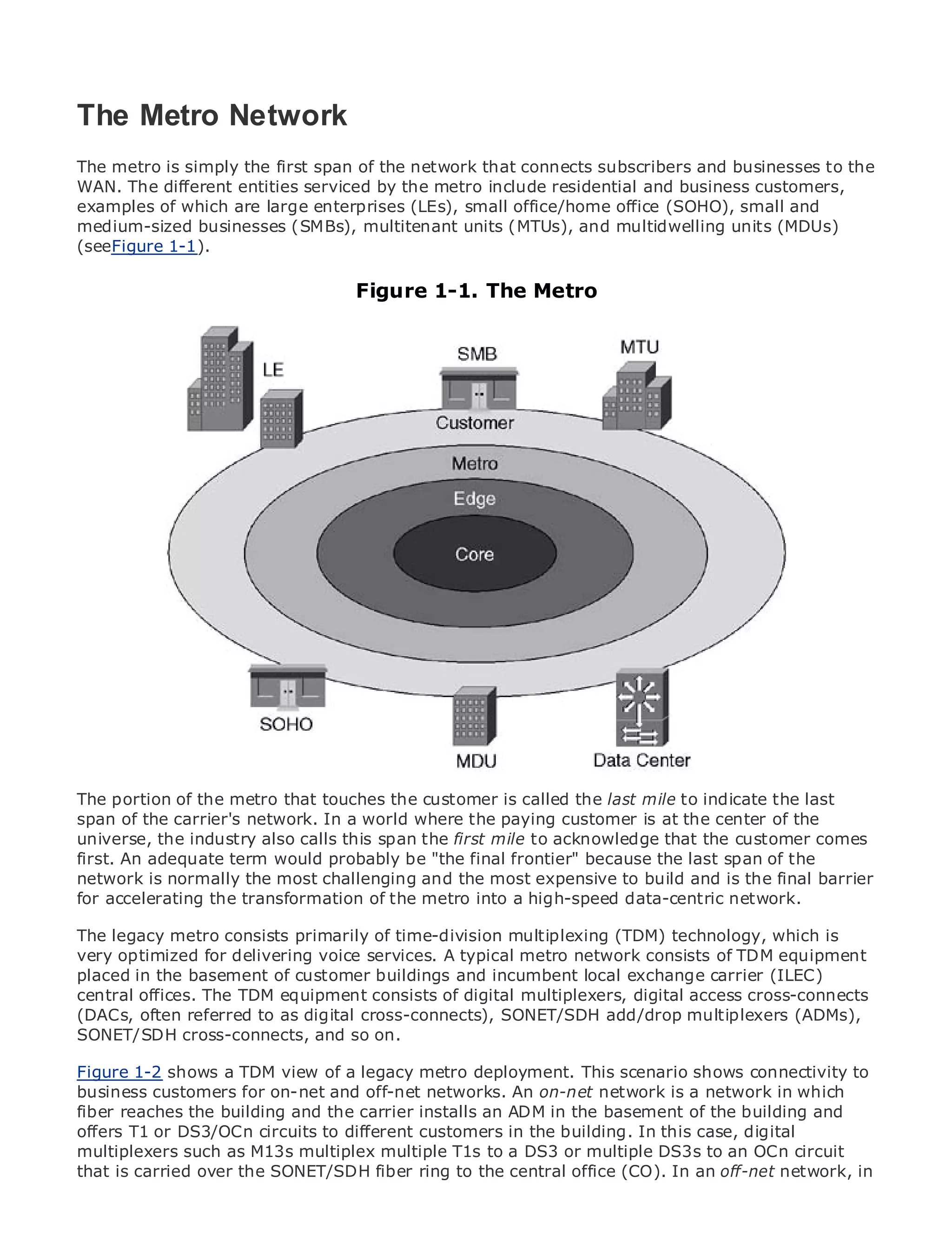
The Metro Network
The metro is simply the first span of the network that connects subscribers and businesses to the
WAN. The different entities serviced by the metro include residential and business customers,
examples of which are large enterprises (LEs), small office/home office (SOHO), small and
•           Table of Contents
medium-sized businesses (SMBs), multitenant units (MTUs), and multidwelling units (MDUs)
•           Index
(seeFigure 1-1).
Metro Ethernet

BySam Halabi                       Figure 1-1. The Metro

   Publisher: Cisco Press
   Pub Date: October 01, 2003
       ISBN: 1-58705-096-X
      Pages: 240


The definitive guide to Enterprise and Carrier Metro Ethernet applications.


     Discover the latest developments in metro networking, Ethernet, and MPLS services and
     what they can do for your organization

     Learn from the easy-to-read format that enables networking professionals of all levels to
     understand the concepts

     Gain from the experience of industry innovator and best-selling Cisco Press author, Sam
     Halabi, author of Internet Routing Architectures

Metro networks will emerge as the next area of growth for the networking industry and will
represent a major shift in how data services are offered to businesses and residential customers.
The metro has always been a challenging environment for delivering data services because it has
been built to handle the stringent reliability and availability needs for voice. indicate the last to
The portion of the metro that touches the customer is called the last mile to Carriers will have
go through fundamental shiftsIn a world where the paying customer isdata services demanded
span of the carrier's network. to equip the metro for next-generation at the center of the
by enterprise industry also calls this spanThis first mile toaacknowledge that the customer comes
universe, the customers and consumers. the is not only technology shift, but also a shift in the
operational and business model that willbe "thethe incumbent because to transform thethe
first. An adequate term would probably allow final frontier" carriers the last span of metro to
offer enhanced data the most challenging and the most expensive to build and is the final barrier
network is normally services.
for accelerating the transformation of the metro into a high-speed data-centric network.
Metro Ethernet from Cisco Press looks at the deployment of metro data services from a holistic
view. It describes consists primarily of time-division multiplexing (TDM) technology, which is
The legacy metro the current metro, which is based on TDM technology, and discusses the
drivers and challenges carriers will services. A typical metro metro to consists of TDM equipment
very optimized for delivering voice face in transforming the network address data services.
placed in the basement of customer buildings and incumbent local exchange carrier (ILEC)
Metro Ethernet discusses the adoption of metro Ethernet services and how that has led carriers
central offices. The TDM equipment consists of digital multiplexers, digital access cross-connects
to the delivery of metro data services. With a changing mix of transport technologies, the book
(DACs, often referred to as digital cross-connects), SONET/SDH add/drop multiplexers (ADMs),
then examines current and emerging trends, and delves into the role of virtual private networks
SONET/SDH cross-connects, and so on.
(VPN), virtual private local area networks (VLAN), virtual private LAN services (VPLS), traffic
engineering, and MPLS and Generalized MPLS (GMPLS).
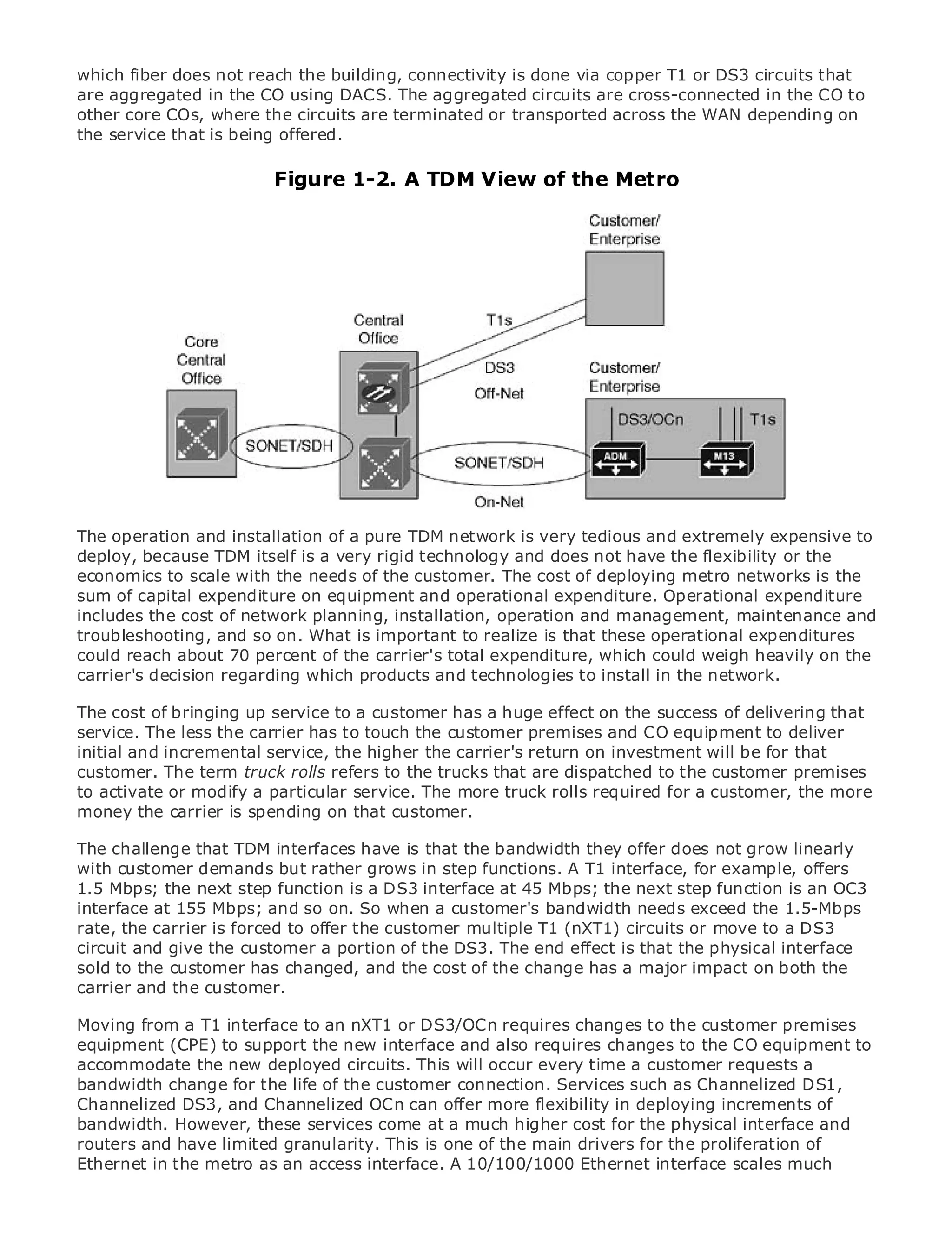
Figure 1-2 shows a TDM view of a legacy metro deployment. This scenario shows connectivity to
business customers for on-net and off-net networks. An on-net network is a network in which
fiber reaches the building and the carrier installs an ADM in the basement of the building and
offers T1 or DS3/OCn circuits to different customers in the building. In this case, digital
multiplexers such as M13s multiplex multiple T1s to a DS3 or multiple DS3s to an OCn circuit
that is carried over the SONET/SDH fiber ring to the central office (CO). In an off-net network, in
which fiber does not reach the building, connectivity is done via copper T1 or DS3 circuits that
are aggregated in the CO using DACS. The aggregated circuits are cross-connected in the CO to
other core COs, where the circuits are terminated or transported across the WAN depending on
the service that is being offered.

                              Figure 1-2. A TDM View of the Metro

•                Table of Contents
•                Index
Metro Ethernet

BySam Halabi


    Publisher: Cisco Press
    Pub Date: October 01, 2003
        ISBN: 1-58705-096-X
       Pages: 240


The definitive guide to Enterprise and Carrier Metro Ethernet applications.
The operation and installation of a pure TDM network is very tedious and extremely expensive to
deploy, because TDM itself is a very rigid technology and does not have the flexibility or the
       Discover the latest developments in metro networking, Ethernet, and MPLS services and
economics they canwith the needs of the customer. The cost of deploying metro networks is the
       what to scale do for your organization
sum of capital expenditure on equipment and operational expenditure. Operational expenditure
includes the cost thenetwork planning, installation, operation and management, of all levels toand
       Learn from of easy-to-read format that enables networking professionals maintenance
troubleshooting, and concepts
       understand the so on. What is important to realize is that these operational expenditures
could reach about 70 percent of the carrier's total expenditure, which could weigh heavily on the
carrier's decision regarding which industry innovator and best-selling Cisco Press author, Sam
       Gain from the experience of products and technologies to install in the network.
       Halabi, author of Internet Routing Architectures
The cost of bringing up service to a customer has a huge effect on the success of delivering that
service. The less the carrier as the next the of growth for the networking industry to deliver
Metro networks will emerge has to toucharea customer premises and CO equipment and will
initial and incremental in how the services are offered to businesses and residential customers.
represent a major shift service, datahigher the carrier's return on investment will be for that
customer. has always been a refers to the trucks that are dispatched to services because it has
The metro The term truck rollschallenging environment for delivering datathe customer premises
to activate or modify a particular reliability and availability needs for voice. customer, the more
been built to handle the stringent service. The more truck rolls required for aCarriers will have to
money the fundamental shifts to that customer.
go through carrier is spending on equip the metro for next-generation data services demanded
by enterprise customers and consumers. This is not only a technology shift, but also a shift in the
The challenge that TDM interfaces have allow
operational and business model that willis that the incumbent carriers todoes not grow linearly
                                                     bandwidth they offer transform the metro to
with enhanced data services.
offer customer demands but rather grows in step functions. A T1 interface, for example, offers
1.5 Mbps; the next step function is a DS3 interface at 45 Mbps; the next step function is an OC3
interface at 155 Mbps; and so on. So at the customer's of metro data services from 1.5-Mbps
Metro Ethernet from Cisco Press lookswhen a deployment bandwidth needs exceed the a holistic
rate, It carrier is forced to offer the customer multiple T1 (nXT1) circuits or discusses DS3
view. thedescribes the current metro, which is based on TDM technology, and move to a the
circuit and challenges carriers portion in transforming the effect to address data services.
driversand give the customer a will faceof the DS3. The end metro is that the physical interface
sold to the customer has changed, and the cost of the change has a major impact on both the
Metro Ethernet customer. the adoption of metro Ethernet services and how that has led carriers
carrier and the discusses
to the delivery of metro data services. With a changing mix of transport technologies, the book
Moving from a current and to an nXT1 or DS3/OCn requires the role of virtual private networks
then examines T1 interface emerging trends, and delves intochanges to the customer premises
equipment (CPE) to support the new interface and also requires LAN services (VPLS), traffic
(VPN), virtual private local area networks (VLAN), virtual privatechanges to the CO equipment to
accommodate the new and Generalized This (GMPLS).
engineering, and MPLS deployed circuits.MPLS will occur every time a customer requests a
bandwidth change for the life of the customer connection. Services such as Channelized DS1,
Channelized DS3, and Channelized OCn can offer more flexibility in deploying increments of
bandwidth. However, these services come at a much higher cost for the physical interface and
routers and have limited granularity. This is one of the main drivers for the proliferation of
Ethernet in the metro as an access interface. A 10/100/1000 Ethernet interface scales much
better from submegabit speeds all the way to gigabit, at a fraction of the cost of a TDM interface.

Figure 1-3 shows the difference between the TDM model and Ethernet model for delivering
Internet connectivity. In the TDM model, the metro carrier, such as an ILEC or RBOC, offers the
point-to-point T1 circuit, while the ISP manages the delivery of Internet services, which includes
managing the customer IP addresses and the router connectivity in the point of presence (POP).
This normally has been the preferred model for ILECs who do not want to get involved in the IP
addressing and in routing the IP traffic. In some cases, the ILECs can outsource the service or
•            Table of Contents
manage the whole IP connection if they want to. However, this model keeps a demarcation line
•            Index
between the delivery of IP services and the delivery of connectivity services.
Metro Ethernet

BySam Halabi
                     Figure 1-3. Connectivity: TDM Versus Ethernet
   Publisher: Cisco Press
   Pub Date: October 01, 2003
       ISBN: 1-58705-096-X
      Pages: 240


The definitive guide to Enterprise and Carrier Metro Ethernet applications.


     Discover the latest developments in metro networking, Ethernet, and MPLS services and
     what they can do for your organization

     Learn from the easy-to-read format that enables networking professionals of all levels to
     understand the concepts

      Gain from the experience of industry innovator and best-selling Cisco Press author, Sam
In the Ethernet model,Internet Routing Architectures customer side and the ISP side are
      Halabi, author of both network interfaces on the
Ethernet interfaces. The ILEC manages the Layer 2 (L2) connection, while the ISP manages the
IP services. From anemerge as the next area of growth for the networking ILEC in a and will
Metro networks will operational perspective, this arrangement keeps the industry model similar
to the T1 private-line service; however, it opens offered opportunity for theresidential customers.
represent a major shift in how data services are up the to businesses and ILEC to up-sell
additional service on top of the same Ethernet connection without any changes to the CPE and
The metro has always been a challenging environment for delivering data services because it has
the network. handle the stringent reliability and availability needs for voice. Carriers will have to
been built to
go through fundamental shifts to equip the metro for next-generation data services demanded
by enterprise customers and consumers. This is not only a technology shift, but also a shift in the
operational and business model that will allow the incumbent carriers to transform the metro to
offer enhanced data services.

Metro Ethernet from Cisco Press looks at the deployment of metro data services from a holistic
view. It describes the current metro, which is based on TDM technology, and discusses the
drivers and challenges carriers will face in transforming the metro to address data services.

Metro Ethernet discusses the adoption of metro Ethernet services and how that has led carriers
to the delivery of metro data services. With a changing mix of transport technologies, the book
then examines current and emerging trends, and delves into the role of virtual private networks
(VPN), virtual private local area networks (VLAN), virtual private LAN services (VPLS), traffic
engineering, and MPLS and Generalized MPLS (GMPLS).
Ethernet in the Metro
Ethernet technology has so far been widely accepted in enterprise deployments, and millions of
Ethernet ports have already been deployed. The simplicity of this technology enables you to
scale the Ethernet interface to high bandwidth while remaining cost effective. The cost of a 100-
•
Mbps interface forof Contents workgroup L2 LAN switches will be less than $50 in the next few
             Table enterprise
•
years.       Index
Metro Ethernet
These Halabi and performance metrics and Ethernet's ease of use are motivating carrier networks
BySam costs
to use Ethernet as an access technology. In this new model, the customer is given an Ethernet
interface rather than a TDM interface.
   Publisher: Cisco Press

ThePub Date: October 01, 2003
    following is a summary of the value proposition that an Ethernet access line offers relative to
TDM private lines:
      ISBN: 1-58705-096-X
      Pages: 240

     Bandwidth scalability— The low cost of an Ethernet access interface on both the CPE
     device and the carrier access equipment favors the installation of a higher-speed Ethernet
     interface that can last the life of the customer connection. Just compare the cost of having a
     single installation of a 100-Mbps Ethernet interface versus the installation of a T1 interface
The definitive guide to Enterprise and Carrierservice,Ethernet OC3 (155 Mbps) for 100-Mbps
     for 1.5-Mbps service, a T3 for 45-Mbps Metro and an applications.
     service. A TDM interface offering results in many CPE interface changes, many truck rolls
     deployed thethe customer premises, metro networking, Ethernet, and MPLS services andthe
     Discover to latest developments in and equipment that only gets more expensive with
     speedthey can do for your organization
     what of the interface.
      Bandwidththe easy-to-read format thatinterface can be provisioned to deliver tiered to
      Learn from granularity— An Ethernet enables networking professionals of all levels
      bandwidth that scales to the maximum interface speed. By comparison, a rigid TDM
      understand the concepts
      hierarchy changes in big step functions. It is important to note that bandwidth granularity
      is not a function specific to Ethernet innovator and best-selling packet interface. Early
      Gain from the experience of industrybut rather is specific to any Cisco Press author, Sam
      deployments of metro Ethernet struggled with this function because many enterprise-class
      Halabi, author of Internet Routing Architectures
      Ethernet switches did not have the capability to police the traffic and enforce SLAs.
Metro networks will emerge as the next area of growth for the networking industry and will
represent a major shift in how data services are offered to businessesdifferent operational model
      Fast provisioning— Deploying an Ethernet service results in a and residential customers.
The metro haspacket leased a challenging environment forof TDM circuit leased lines. The packet
      in which always been lines are provisioned instead delivering data services because it has
been provisioning model stringent reliability faster than the legacy TDM model because have to
      built to handle the can be done much and availability needs for voice. Carriers will
go through fundamental done to equip the metro for next-generation data services Packet
      provisioning can be shifts without changing network equipment and interfaces. demanded
by enterprise customers and consumers. changing softwaretechnology shift, but also a shift thethe
      provisioning is a simple function of This is not only a parameters that would throttle in
      packets and can increase or decrease bandwidth, establish a connection in minutes, and bill
operational and business model that will allow the incumbent carriers to transform the metro to
offer for the new service.
      enhanced data services.

Metro Ethernet from Cisco Press looks at the deployment of metro data services from a holistic
view. It describes the current metro, which is based on TDM technology, and discusses the
drivers and challenges carriers will face in transforming the metro to address data services.

Metro Ethernet discusses the adoption of metro Ethernet services and how that has led carriers
to the delivery of metro data services. With a changing mix of transport technologies, the book
then examines current and emerging trends, and delves into the role of virtual private networks
(VPN), virtual private local area networks (VLAN), virtual private LAN services (VPLS), traffic
engineering, and MPLS and Generalized MPLS (GMPLS).
The Early Metro Ethernet Movers
The earliest service providers to move into the metro Ethernet space appeared in the 1999–2000
timeframe in the midst of the telecom bubble and have adopted variations of the same business
model across the world.
•               Table of Contents
• the U.S., the early adopters of metro Ethernet were the greenfield service providers that
In             Index
wanted to provide services to some niche segments, such as SMBs that are underserved by the
Metro Ethernet
incumbent providers. Other providers have found an opportunity in promoting cheaper
BySam Halabi
bandwidth by selling Ethernet pipes to large enterprises or to other providers such as ISPs or
content providers.
    Publisher: Cisco Press

ThePub Date: October 01, 2003 consist of BLECs and metro operators, which are discussed next.
    greenfield operators
        ISBN: 1-58705-096-X
       Pages: 240

The BLECs
The Building Local Exchange Carriers (BLECs) have adopted a retail bandwidth model that offers
services to SMBs which are concentrated in large MTUs. (These are the "tall and shiny buildings"
The definitive guide to Enterprise and Carrier Metrocity areas.) The BLECs focus on wiring the
that are usually located in concentrated downtown Ethernet applications.
inside of the MTUs for broadband by delivering Ethernet connections to individual offices. The
BLECs capitalize on the fact that from the time an SMB places an order, it takes an incumbent
      Discover the latest developments in metro networking, Ethernet, and MPLS services and
operator three to six months to deploy a T1 circuit for that SMB. The BLECs can service the
      what they can do for your organization
customers in weeks, days, or even hours rather than months and at much less cost.
      Learn from the easy-to-read format that enables networking professionals of all levels to
As shown in Figure 1-4, a BLEC installs its equipment in the basement of the MTU, runs Ethernet
      understand the concepts
in the risers of the building, and installs an Ethernet jack in the customer office. The customer
can then get all the experience of industry innovator and best-selling Cisco Press author, Sam
      Gain from of its data services from the Ethernet connection.
      Halabi, author of Internet Routing Architectures
                              Figure 1-4. The BLEC Network Model
Metro networks will emerge as the next area of growth for the networking industry and will
represent a major shift in how data services are offered to businesses and residential customers.
The metro has always been a challenging environment for delivering data services because it has
been built to handle the stringent reliability and availability needs for voice. Carriers will have to
go through fundamental shifts to equip the metro for next-generation data services demanded
by enterprise customers and consumers. This is not only a technology shift, but also a shift in the
operational and business model that will allow the incumbent carriers to transform the metro to
offer enhanced data services.

Metro Ethernet from Cisco Press looks at the deployment of metro data services from a holistic
view. It describes the current metro, which is based on TDM technology, and discusses the
drivers and challenges carriers will face in transforming the metro to address data services.

Metro Ethernet discusses the adoption of metro Ethernet services and how that has led carriers
to the delivery of metro data services. With a changing mix of transport technologies, the book
then examines current and emerging trends, and delves into the role of virtual private networks
(VPN), virtual private local area networks (VLAN), virtual private LAN services (VPLS), traffic
engineering, and MPLS and Generalized MPLS (GMPLS).
The Metro Ethernet Carrier
Although the BLECs are considered metro operators, they specialize in servicing the MTU
customers rather than building connectivity within the metro itself. The metro carriers are
focused on building connectivity within the metro and then selling connectivity to BLECs, large
enterprises, or even other service providers, depending on the business model. However, a lot of
consolidation has occurred because metro operators have acquired BLECs, blurring the
•
distinction between Contents different providers.
             Table of the two
•               Index
Whereas some metro carriers have adopted a retail model, selling bandwidth to large
Metro Ethernet
enterprises, other metro carriers have adopted a wholesale model, selling bandwidth to other
BySam Halabi
service providers (see Figure 1-5).
    Publisher: Cisco Press
                         Figure 1-5. Retail Versus Wholesale Model
    Pub Date: October 01, 2003
        ISBN: 1-58705-096-X
       Pages: 240


The definitive guide to Enterprise and Carrier Metro Ethernet applications.


      Discover the latest developments in metro networking, Ethernet, and MPLS services and
      what they can do for your organization

      Learn from the easy-to-read format that enables networking professionals of all levels to
      understand the concepts

     Gain from the experience of industry innovator and best-selling Cisco Press author, Sam
OtherHalabi, author of Internet Routing Architectures
      business plans for metro deployments target cities that want to enhance the quality of life
and attract business by tying the whole city with a fiber network that connects schools,
Metro networks will emerge as the next area of growth for the networking industry and will
universities, businesses, financial districts, and government agencies.
represent a major shift in how data services are offered to businesses and residential customers.
The metro has always been a challenging environment for delivering data services because it has
been built to handle the stringent reliability and availability needs for voice. Carriers will have to
The Greenfield Value Proposition
go through fundamental shifts to equip the metro for next-generation data services demanded
by enterprise customers and consumers. This is not only a technology shift, but also a shift in the
operational and business model the value allow the incumbent carriers to transform offermetro to
The following sections describe that will proposition that greenfield operators can the to
offer enhanced data services. incumbents.
attract business away from the

Metro Ethernet from Cisco Press looks at the deployment of metro data services from a holistic
view. It describes the current metro, which is based on TDM technology, and discusses the
Bringing the ServicecarriersDays Rather Than Monthsmetro to address data services.
                         Up in will face in transforming the
drivers and challenges

As mentioned earlier, one of adoption of metro Ethernet metro greenfield operators is their
Metro Ethernet discusses the the key selling points for theservices and how that has led carriers
ability to bring service up in services. With to accomplish of transport technologies, the book
to the delivery of metro datadays. However,a changing mixthis, the service has to be almost
ready to be brought up once the customer requests it. Greenfields spend a lot private networks
then examines current and emerging trends, and delves into the role of virtualof money on idle
connections, waiting local area networks (VLAN), virtual private LAN services (VPLS), traffic
(VPN), virtual privatefor a customer to appear.
engineering, and MPLS and Generalized MPLS (GMPLS).

Pay as You Grow Model

With an Ethernet connection, the customer can purchase an initial amount of bandwidth and SLA
and then has the option to change the service in the future by simply calling the provider. The
provider could then immediately assign the customer to a different SLA by changing the network
parameters via software. Some metro operators offer their customers the ability to change their
own bandwidth parameters via a web-based application.


Service Flexibility

•              Table of Contents
With an Ethernet interface, the provider can offer the customer different types of services, such
• Internet access, transparent LAN service (TLS), Voice over IP (VoIP), and so on, with minimal
as             Index
operational overhead. Each service is provided over its own virtual LAN (VLAN) and is switched
Metro Ethernet
differently in the network. The different services can be sold over the same Ethernet interface or,
BySam Halabi
alternatively, each service can have a separate physical interface.
   Publisher: Cisco Press
   Pub Date: October 01, 2003
Lower Pricing Model
    ISBN: 1-58705-096-X
      Pages: 240

The initial claims for the metro Ethernet service were very aggressive. Some of the early
marketing campaigns claimed "twice the bandwidth at half the price." The quotes for 100-Mbps
Ethernet connections initially ranged from $100 per month to $5000 per month depending on
which carrier you talked to and at what time of the day you talked to them. Table 1-1 compares
The definitive guide to Enterprise and Carrier Metro Ethernet applications. vary widely
sample pricing for Ethernet and T1/T3 services. The Ethernet pricing might
depending on the region and how aggressive the carrier gets.

     Discover the latest developments in metro networking, Ethernet, and MPLS services and
     what they can do for your organization

    Tablefrom the easy-to-read format that enables networking professionals of all levels to
    Learn
           1-1. Sample Pricing Comparison for Ethernet Versus T1/T3
    understand the concepts
                                Private-Line Service
     Gain from the experience of industry innovator and best-selling Cisco Press author, Sam
     Halabi, author of Internet Routing Architectures
               Greenfield                                      Incumbent

Metro networks will emerge as the next area of(1.5 Mbps) at ~$750/month
 1.5 Mbps at ~$500/month                     T1 growth for the networking industry and will
represent a major shift in how data services are offered to businesses and residential customers.
 3 Mbps at ~$750/month                       2 * T1 at ~$1500
The metro has always been a challenging environment for delivering data services because it has
been builtat ~$2250/month
 45 Mbps to handle the stringent reliability T3 (45 Mbps) at needs for voice. Carriers will have to
                                             and availability ~$6000/month
go through fundamental shifts to equip the metro for next-generation data services demanded
by enterprise customers and consumers. This is not only a technology shift, but also a shift in the
operational and business Greenfield Operators
The Challenges of the model that will allow the incumbent carriers to transform the metro to
offer enhanced data services.
The BLECs and metro Ethernet carriers have encountered many challenges in their business
Metro Ethernet from Cisco their success and caused a lot of them to cease to exist after the
model that have hindered Press looks at the deployment of metro data services from a holistic
view. It describes the current metro, which is based on TDM technology, and discusses the
telecom downturn. This section explores several of those challenges.
drivers and challenges carriers will face in transforming the metro to address data services.

Metro Ethernet discusses the adoption of metro Ethernet services and how that has led carriers
The Fight for of metro data services. With a changing mix of transport technologies, the book
to the delivery the Building Riser
then examines current and emerging trends, and delves into the role of virtual private networks
Delivering Ethernet connections to the MTU offices requires having access to the building riser,
(VPN), virtual private local area networks (VLAN), virtual private LAN services (VPLS), traffic
which means dealing with the building owner—although
engineering, and MPLS and Generalized MPLS (GMPLS). there are regulations that prevent
building owners from refusing to allow access to providers. The BLECs, who normally manage to
have the first access to the building, have the early field advantage in capturing real estate in
the basement and the riser. Of course, how much real estate becomes available or unavailable to
other BLECs who are competing for the same MTU usually depends on what percentage of the
profits the building owner is receiving.
Cost of Overbuilding the Network

Because many providers in the past operated on the "build it and they will come" theory,
millions of dollars were spent on overbuilding the network, which consisted of


•    Pulling fiber of Contents
             Table in the riser
•              Index
Metro Building
      Ethernet   the last-mile connectivity
BySam Halabi
     Building the core metro network

A challengeCisco the BLECs is to figure out how much connectivity they need inside the building.
   Publisher: for Press
Many BLECs have 01, 2003
    Pub Date: October deployed as many connections as possible in the building on the hope that the
BLECs ISBN:attract customers. This model has, again, resulted in a lot of money spent with no
        will 1-58705-096-X
returnPages: 240
        on investment, forcing many BLECs out of business.

The premise of delivering services to customers in hours and days rather than months is made
under the assumption that the BLEC has control of the network facilities inside and outside the
building. The perfect solution is to have the BLEC lease or own fiber connections into the
building. However, only about five percent of buildings in a metro area have access to fiber,
The definitive guide to Enterprise and Carrier Metro Ethernet applications.
while the rest can only be accessed via copper T1 and DS3 lines. Many BLECs are looking for the
"low-hanging fruit," buildings that are already connected via fiber. In many cases, the BLECs try
to have arrangements with utility companies to pull fiber into the buildings using existing
      Discover the latest developments in metro networking, Ethernet, and MPLS services and
conduits. In the cases where fiber passes across the building and not into the buildings, the
      what they can do for your organization
BLECs have to share the cost of digging up the streets with building owners or utility companies.
The challenge is that easy-to-read format that access into a building has to shareof allcost of to
      Learn from the the first BLEC to ask for enables networking professionals the levels
digging the trench, while the BLECs who come after can easily have access to the existing
      understand the concepts
conduit.
      Gain from the experience of industry innovator and best-selling Cisco Press author, Sam
For buildingsauthor of Internet Routing Architectures BLECs had to rely on existing copper T1
      Halabi, that couldn't have fiber connectivity, the
and DS3 lines to deliver bandwidth into the building. So although the BLECs were competing
with the ILECs, will still had to rely on area to provide the copper lines at the ILECs' slow
Metro networks theyemerge as the next them of growth for the networking industry and will pace
of operation.
represent a major shift in how data services are offered to businesses and residential customers.
The metro has always been a challenging environment for delivering data services because it has
The metro to handle theare building the metro edge and core infrastructure have sunk a lot of to
been built carriers that stringent reliability and availability needs for voice. Carriers will have
money into fundamental shifts to equipthat connects the different points of presence. Many metro
go through buying or leasing the fiber the metro for next-generation data services demanded
providers have locked themselves into multimillion-dollarafiber leases based but the hope that the
by enterprise customers and consumers. This is not only technology shift, on also a shift in
their business will grow to fill upthat big pipes. the incumbent carriers to transform the metro to
operational and business model the will allow
offer enhanced data services.

Metro Ethernetand ReachPress looks at the deployment of metro data services from a holistic
The Breadth from Cisco of Services
view. It describes the current metro, which is based on TDM technology, and discusses the
drivers and challenges carriers will with thetransforming the metro to address data services.
Metro carriers have also struggled face in different types of services that they offer and
whether the service is offered on a regional or national basis. High-end customers such as large
Metro Ethernet discusses the adoption of metro Ethernet services and how that has led carriers
enterprises and financial institutions usually use a one-stop shop: one provider offering local and
to the delivery of metro data services. With a changing mix of transport technologies, the book
national connectivity with different types of services, such as Frame Relay or ATM VPN services.
then examines current and emerging trends, and delves into the role of virtual private networks
An Ethernet-only service approach with no national coverage isn't too attractive. This has forced
(VPN), virtual private local area networks (VLAN), virtual private LAN services (VPLS), traffic
the metro providers to remain as niche players that do not have the support and reach that the
engineering, and MPLS and Generalized MPLS (GMPLS).
incumbents have.


The Pricing Model
The cheap Ethernet connectivity pricing model could not be sustained. High-speed connections
between 10 and 100 Mbps require a higher-speed backbone, which is expensive to build and
manage. Also, the greenfield providers were still building up their customer base, and the low
Ethernet pricing model did not help with a very small customer base. So Ethernet pricing for
100-Mbps connections was across the map and a trial-and-error process with prices varying by
thousands of dollars depending on who you talk to.

•                Table of Contents
•                Index
Metro Ethernet

BySam Halabi


    Publisher: Cisco Press
    Pub Date: October 01, 2003
        ISBN: 1-58705-096-X
       Pages: 240


The definitive guide to Enterprise and Carrier Metro Ethernet applications.


      Discover the latest developments in metro networking, Ethernet, and MPLS services and
      what they can do for your organization

      Learn from the easy-to-read format that enables networking professionals of all levels to
      understand the concepts

      Gain from the experience of industry innovator and best-selling Cisco Press author, Sam
      Halabi, author of Internet Routing Architectures

Metro networks will emerge as the next area of growth for the networking industry and will
represent a major shift in how data services are offered to businesses and residential customers.
The metro has always been a challenging environment for delivering data services because it has
been built to handle the stringent reliability and availability needs for voice. Carriers will have to
go through fundamental shifts to equip the metro for next-generation data services demanded
by enterprise customers and consumers. This is not only a technology shift, but also a shift in the
operational and business model that will allow the incumbent carriers to transform the metro to
offer enhanced data services.

Metro Ethernet from Cisco Press looks at the deployment of metro data services from a holistic
view. It describes the current metro, which is based on TDM technology, and discusses the
drivers and challenges carriers will face in transforming the metro to address data services.

Metro Ethernet discusses the adoption of metro Ethernet services and how that has led carriers
to the delivery of metro data services. With a changing mix of transport technologies, the book
then examines current and emerging trends, and delves into the role of virtual private networks
(VPN), virtual private local area networks (VLAN), virtual private LAN services (VPLS), traffic
engineering, and MPLS and Generalized MPLS (GMPLS).
The U.S. Incumbent Landscape
While the greenfield operators were fast to build their metro networks, the U.S. incumbents took
a sit-and-watch approach to see how the market would shake out. If the greenfield metro
Ethernet model were to succeed, it would start stealing customers from the incumbents, thereby
•
affecting the Table of Contents their private-line services. Threatened by the newcomers, the RBOCs
                deployment of
•              Index
and IXCs, such as SBC, Verizon, Bellsouth, Qwest, and MCI, initiated requests for information
Metro Ethernet
(RFIs) to solicit information from vendors about how to deliver Ethernet services in the metro.
BySam Halabi
The challenges the incumbents face in deploying metro Ethernet are very different than the
challenges of the greenfields. This section discusses some of those challenges, including the
    Publisher: Cisco Press
following:
   Pub Date: October 01, 2003
      ISBN: 1-58705-096-X
     Existing legacy TDM infrastructure
     Pages: 240

     Building an all-Ethernet data network

     Pricing the services

The definitive guide to Enterprise and Carrier Metro Ethernet applications.
     Regulations


     Discover the latest developments in metro networking, Ethernet, and MPLS services and
Existingthey can doTDM Infrastructure
    what Legacy for your organization

       Learn from the easy-to-read format that enables networking professionals of all levels to
The U.S. metro is entrenched in TDM technology, and billions of dollars have already been spent
       understand the concepts
on building that network. Anyone who intends to build a new service has to consider the existing
infrastructure. As inefficient as it may seem, building an Ethernet service over the legacy
infrastructure mightexperience of industry innovator and best-selling Cisco Press entry into the
       Gain from the be the only viable way for some incumbents to make a first author, Sam
metro Ethernet business. Many Routing Architectures
       Halabi, author of Internet of the operational models have already been built for the SONET
network. Operators know how to build the network, how to manage and maintain it, and how to
Metro networks will emerge as the next area of growth for the networking industry and will
deliver a service and bill for it. The incumbents have the challenge of adopting their existing
represent a major shift in how data services are offered to businesses and residential customers.
discipline to the metro Ethernet model.
The metro has always been a challenging environment for delivering data services because it has
been built to handle the stringent reliability and availability needs for voice. Carriers will have to
go through fundamental shifts to equip the metro for next-generation data services demanded
Building an All-Ethernet Data Network only a technology shift, but also a shift in the
by enterprise customers and consumers. This is not
operational and business model that will allow the incumbent carriers to transform the metro to
offer enhanced dataU.S. incumbents have opted (after many internal debates) to build an all-
Alternatively, some services.
Ethernet network tailored for data services. However, as of the writing of this book, none of
Metro networks from Cisco Press looks at the deployment of metrodealt with SONET technology,
these Ethernet have materialized. Incumbents, who have always data services from a holistic
view. It describes the current metro, networks. Incumbents normally build their networks
still do not quite understand Ethernetwhich is based on TDM technology, and discusses the and
drivers and challenges masses, so face in transforming the deploy needs to data to support
services to tailor to thecarriers will any new technology theymetro to address scale services.
thousands of customers nationwide. With Ethernet's roots in enterprise networks, a big gap still
Metro Ethernet what the incumbents needmetro Ethernet services and switches, has led carriers
exists between discusses the adoption of and what existing Ethernet how that or existing
to the delivery of metro dataoffer. Incumbents are also unfamiliar with how to manage an book
Ethernet standards, have to services. With a changing mix of transport technologies, the
then examines current and emerging trends,for it.delves these factors of virtual private networks
Ethernet network, price the service, and bill and All of into the role have contributed to the
(VPN), virtual private local area networks (VLAN), virtual private LAN services (VPLS), traffic
delay in the deployment of such networks.
engineering, and MPLS and Generalized MPLS (GMPLS).
The deficiencies in Ethernet technology and Ethernet standards in dealing with the metro
scalability and availability requirements were one of the main reasons for the proliferation of
MPLS in the metro. This topic will be explained in more detail in Chapter 4, "Hybrid L2 and L3
IP/MPLS Networks."
Pricing the Service
For the incumbents, pricing the metro Ethernet services is an extremely challenging exercise.
Incumbents that are selling T1 and DS3 connectivity services would be competing with
themselves by offering Ethernet services. A very aggressive Ethernet pricing model would
jeopardize the sales of T1 and DS3 lines and disrupt the incumbent's business model.
•              Table of Contents
For incumbents selling T1/E1 and DS3 services, their Ethernet pricing model has to do the
•              Index
following to succeed:
Metro Ethernet

BySam Halabi
      Move hand in hand with existing pricing for legacy services to avoid undercutting the legacy
      services.
    Publisher: Cisco Press
    Pub Date: October 01, 2003
     Offer different levels of services with different price points, in addition to the basic
       ISBN: 1-58705-096-X
     connectivity service. Metro Ethernet services present a good value proposition for both the
      Pages: 240
     customer and carrier. The customer can enjoy enhanced data services at higher
     performance levels, and the carrier can benefit from selling services that it otherwise
     wouldn't have been able to sell with a simple TDM connection. So the carrier can actually
     sell the Ethernet connection at a lower price than the legacy connection, based on the hope
     that the additional services will eventually result in a more profitable service than the
The definitive guide to Enterprise and Carrier Metro Ethernet applications.
     legacy services.


      Discover the latest developments in metro networking, Ethernet, and MPLS services and
The what they can do for your organization
    Incumbent Regulations
Another area that challenges the deployment of metro networking professionals of all levels to
      Learn from the easy-to-read format that enables Ethernet services in the U.S. are the
      understand the concepts
regulations that the incumbent carriers have and the delineation between the regulated and
unregulated operation inside the same carriers. The regulated portions of the incumbents deal
mainly with transport equipment and haveinnovator and best-selling Cisco Press author, Sam of
      Gain from the experience of industry rules and guidelines about the use and the location
      Halabi, author of Internet Routing Architectures
data switching equipment. The unregulated portion of the incumbent normally has enough
flexibility to deploy a mix of hybrid data switching and transport equipment without many ties.
Metro networks will emerge as the next area of growth for the networking industry and will
represent a major have in how data services are offeredincumbents and have created two
These regulations shift created a big barrier inside the to businesses and residential customers.
The metro has always been ato deal with data and transport. The deployment of new data it has
different operational entities challenging environment for delivering data services because
been built to handle the stringent reliability and availability needs for voice. Carriers will have to
services such as metro Ethernet will prove to be challenging in the U.S. because such services
go through fundamental shifts to equip the metro for next-generation data operation of the same
require a lot of coordination between the data operation and the transport services demanded
by enterprise customers and consumers. This is not only a technology shift, but also a shift in the
incumbent carrier.
operational and business model that will allow the incumbent carriers to transform the metro to
offer enhanced data services.

Metro Ethernet from Cisco Press looks at the deployment of metro data services from a holistic
view. It describes the current metro, which is based on TDM technology, and discusses the
drivers and challenges carriers will face in transforming the metro to address data services.

Metro Ethernet discusses the adoption of metro Ethernet services and how that has led carriers
to the delivery of metro data services. With a changing mix of transport technologies, the book
then examines current and emerging trends, and delves into the role of virtual private networks
(VPN), virtual private local area networks (VLAN), virtual private LAN services (VPLS), traffic
engineering, and MPLS and Generalized MPLS (GMPLS).
The International Landscape
In 2000, while the U.S. market was bubbling with greenfield operators building their metro
networks and challenging the almighty RBOCs and IXCs, the metro Ethernet market was taking
its own form and shape across the globe. What was different about the rest of the world was the
•            Table of Contents
lack of venture capital funding that had allowed new greenfield providers to mushroom in the
•
U.S.         Index
Metro Ethernet

BySam Halabi

The European Landscape
   Publisher: Cisco Press
    Pub Date: October 01, 2003
In Europe, the first activities in metro Ethernet occurred in Scandinavia, specifically Sweden.
Telia, the largest Swedish telecom provider, had submitted an RFI for metro Ethernet services.
       ISBN: 1-58705-096-X
UnlikePages:U.S., where the providers were focusing on T1 private-line replacement, the target
        the 240
application in Sweden was residential. Many MDU apartment complexes were located in
concentrated residential areas, and many of the new developments had fiber already deployed in
the basements of the MDUs. Ethernet services seemed like the perfect vehicle to deliver value-
added services such as converged voice, data, and video applications. A single Ethernet
connection to an MDU could provide Internet access, VoIP, video on demand, and so on.
The definitive guide to Enterprise and Carrier Metro Ethernet applications.
Also across Europe, a handful of greenfield operators had very aggressive plans to deploy metro
Ethernet services, latest developments in metro networking, Ethernet, and MPLS services and
      Discover the but most faced the same challenges as the U.S. greenfield operators. In
pockets of they can do for your organization such as Telecom Italia were experimenting with an
      what Europe such as Italy, large players
all-Ethernet metro for residential customers.
      Learn from the easy-to-read format that enables networking professionals of all levels to
In general, however, concepts
      understand the the European metro is entrenched in SDH technology and, like the U.S.,
has invested in legacy TDM deployments. This puts the big European providers in the same
challenging positionexperience of industry innovator and best-selling Cisco Press author, Sam
      Gain from the as the U.S. incumbents in dealing with service cannibalization and the cost
of a new buildout. However, Europe differs from the U.S. in that it doesn't have stringent
      Halabi, author of Internet Routing Architectures
regulations that require a strict boundary between the operation of data switching equipment
and SDH transport emerge as which could play a big role the networking industry Ethernet
Metro networks willequipment, the next area of growth for in the shift toward metroand will
buildouts.
represent a major shift in how data services are offered to businesses and residential customers.
The metro has always been a challenging environment for delivering data services because it has
been built to handle the stringent reliability and availability needs for voice. Carriers will have to
go through fundamental shifts to equip the metro for next-generation data services demanded
The Asian Landscape
by enterprise customers and consumers. This is not only a technology shift, but also a shift in the
operational and business model that will allow the incumbent carriers to transform the metro to
The metro Ethernet landscape in Asia is very different than in the U.S. and Europe. Japan,
offer enhanced data services.
Korea, and China will prove to be the major players in the deployment of all-Ethernet metro
services. One offrom major Press looksthatthe deployment of metro invested as much inaSONET or
Metro Ethernet the Cisco reasons is at these countries haven't data services from holistic
SDH and, thus, have acurrent metro,than the U.S. and Europe from which to deploy new data
view. It describes the cleaner slate which is based on TDM technology, and discusses the
services in the metro. carriers will face in transforming the metro to address data services.
drivers and challenges
Many Ethernet discusses the adoption of metro been announced and how that by led carriers
Metro metro Ethernet deployments have alreadyEthernet services and deployed hasbig telecom
providers such as Korea Telecom SK and others. China mix of transport technologies, the book
to the delivery of metro data services. With a changing will also emerge as a big player in this
market after the restructuring of China Telecom into different entities, China Netcom, networks
then examines current and emerging trends, and delves into the role of virtual privateUnicom,
and Railcom.
(VPN), virtual private local area networks (VLAN), virtual private LAN services (VPLS), traffic
engineering, and MPLS and Generalized MPLS (GMPLS).
In Japan, tough competition between telecom providers has driven the cost of private-line
services lower than in most other countries. Japan is also a leader in all-metro Ethernet
deployments for multimedia services.
A Data View of the Metro
A data view of the metro puts in perspective the different metro services and how they are
offered by the different providers.

•
Figure 1-6 shows of view of the metro with the emphasis on the data access, data aggregation,
             Table a Contents
and service delivery. As you can see, the metro is divided into three segments:
•            Index
Metro Ethernet

BySam Halabi
     Metro access— This segment constitutes the last-mile portion, which is the part of the
     network that touches the end customer. For business applications, for example, access
   Publisher: Cisco Press
     equipment resides in a closet in the basement of the enterprise or MTU.
   Pub Date: October 01, 2003
     Metro1-58705-096-X segment constitutes the first level of metro aggregation. The
       ISBN: edge— This
     connections leaving the buildings are aggregated at this CO location into bigger pipes that
      Pages: 240
     in turn get transported within the metro or across the WAN.

     Metro core— This segment constitutes a second level of aggregation where many edge
     COs are aggregated into a core CO. In turn, the core COs are connected to one another to
     form a metro core from which traffic is overhauled across the WAN.
The definitive guide to Enterprise and Carrier Metro Ethernet applications.
                                Figure 1-6. Data View of the Metro
     Discover the latest developments in metro networking, Ethernet, and MPLS services and
     what they can do for your organization
                                          [View full size image]
     Learn from the easy-to-read format that enables networking professionals of all levels to
     understand the concepts

     Gain from the experience of industry innovator and best-selling Cisco Press author, Sam
     Halabi, author of Internet Routing Architectures

Metro networks will emerge as the next area of growth for the networking industry and will
represent a major shift in how data services are offered to businesses and residential customers.
The metro has always been a challenging environment for delivering data services because it has
been built to handle the stringent reliability and availability needs for voice. Carriers will have to
go through fundamental shifts to equip the metro for next-generation data services demanded
by enterprise customers and consumers. This is not only a technology shift, but also a shift in the
operational and business model that will allow the incumbent carriers to transform the metro to
offer enhanced data services.
The terminology and Cisco Press looksof the metro can beof metro data services fromthere is only
Metro Ethernet from many variations at the deployment confusing. In some cases, a holistic
one level of aggregation; hence, the building connections are aggregatedand discusses the
view. It describes the current metro, which is based on TDM technology, into one place and
then directly connectedcarriers will face in transforming the metro to address data services.called
drivers and challenges to a core router. In other scenarios, the metro core CO, sometimes
the metro hub, co-locates with the wide-area POP.
Metro Ethernet discusses the adoption of metro Ethernet services and how that has led carriers
to the delivery of metro data services. With a changing mix of transport technologies, the book
then examines current and emerging trends, and delves into the role of virtual private networks
(VPN), virtual private local area networks (VLAN), virtual private LAN services (VPLS), traffic
engineering, and MPLS and Generalized MPLS (GMPLS).
Metro Services
The metro services vary depending on the target market—commercial or residential—and
whether it is a retail service or a wholesale service. The following list gives a summary of some
of the metro services that are promoted:
•              Table of Contents
•              Index
Metro Internet
      Ethernet   connectivity
BySam Halabi
      Transparent LAN service (point-to-point LAN to LAN)

      L2VPN (point-to-point
    Publisher: Cisco Press         or multipoint-to-multipoint LAN to LAN)
    Pub Date: October 01, 2003
      LAN to network resources (remote data center)
       ISBN: 1-58705-096-X
      Pages: 240
      Extranet

      LAN to Frame Relay/ATM VPN

     Storage area networks (SANs)
The definitive guide to Enterprise and Carrier Metro Ethernet applications.
     Metro transport (backhaul)

      VoIP
      Discover the latest developments in metro networking, Ethernet, and MPLS services and
      what they can do for your organization
Some of these services, such as Internet connectivity and TLS, have been offered for many
years. The differenceeasy-to-readthese services are provided with Ethernet connectivity, andto
      Learn from the now is that format that enables networking professionals of all levels the
carriers are moving toward a model in which all of these services can be offered on the same
      understand the concepts
infrastructure and can be sold to the same customer without any major operational overhead.
This introduces an excellent valueindustry innovator and best-selling Cisco Press author,services
      Gain from the experience of proposition to both the customer and the carrier. The Sam
are provisioned through transporting the application over point-to-point or multipoint-to-
      Halabi, author of Internet Routing Architectures
multipoint L2 connections. The following sections discuss some of these services in greater
Metro networks will emerge as the next area of growth for the networking industry and will
detail.
represent a major shift in how data services are offered to businesses and residential customers.
The metro has always been a challenging environment for delivering data services because it has
been built to handle the stringent reliability and availability needs for voice. Carriers will have to
LAN to Network Resources the metro for next-generation data services demanded
go through fundamental shifts to equip
by enterprise customers and consumers. This is not only a technology shift, but also a shift in the
Earlier, in the section "The Metro Network," you saw how Internet service can be delivered by
operational and business model that will allow the incumbent carriers to transform the metro to
installing at the customer premises an Ethernet connection rather than a T1 TDM connection.
offer enhanced data services.
After the Ethernet connection is installed at the end customer, the ILEC can sell different services
to the customer, such as LAN to looks at resources. An example of such a service is one that
Metro Ethernet from Cisco Press network the deployment of metro data services from a holistic
enables an enterprise to back up its which a based on TDM technology, for discusses the
view. It describes the current metro,data in is remote and secure locationand disaster recovery.
drivers and challenges carriers will face in transforming the metro to address data services.
Figure 1-7 shows that in addition to Internet service, the customer can have a data backup and
disaster recovery service the constantly metro Ethernet services metro.
Metro Ethernet discusses thatadoption of backs up data across theand how that has led carriers
to the delivery of metro data services. With a changing mix of transport technologies, the book
then examines current Figure 1-7. trends,to Network Resources
                         and emerging LAN and delves into the role of virtual private networks
(VPN), virtual private local area networks (VLAN), virtual private LAN services (VPLS), traffic
engineering, and MPLS and Generalized MPLS (GMPLS).
•                Table of Contents
•                Index
Metro Ethernet

BySam Halabi


    Publisher: Cisco Press
    Pub Date: October 01, 2003
        ISBN: 1-58705-096-X
       Pages: 240


For new data networks in which the connectivity is done via gigabit and 10 gigabit pipes, the
metro can be transformed into a high-speed LAN that offers bandwidth-intensive applications
that would not normally be feasible to deploy over legacy TDM infrastructure.
The definitive guide to Enterprise and Carrier Metro Ethernet applications.
As previously mentioned, the service in the metro will take many shapes and forms depending
on the target customer. The same LAN to network resources model could be applied toward
      Discover the latest developments in metro networking, Ethernet, and MPLS services and
residential applications, enabling the ILECs to start competing with cable companies in
      what they can do for your organization
distributing multimedia services. In a residential application, video servers would be located in a
metro POP and residential MDU customers could access high-speed digital videoof all levels to
      Learn from the easy-to-read format that enables networking professionals on demand over
an Ethernet connection. While these services still seem futuristic in the U.S., the international
      understand the concepts
landscape soon could be very different in Europe (particularly Sweden), Japan, and Korea, where
the fast deploymentexperience of industry is already making these applications a reality. Sam
      Gain from the of Ethernet networks innovator and best-selling Cisco Press author,
      Halabi, author of Internet Routing Architectures

Metro networks will emerge as the next area of growth for the networking industry and will
Ethernet L2VPN Services
represent a major shift in how data services are offered to businesses and residential customers.
The metro has always been a challenging environment for delivering data services because it has
You may have noticed that many of the services mentioned are pure L2 services that offer
been built to handle the stringent reliability and availability needs for voice. Carriers will have to
connectivity only. This is similar to legacy Frame Relay and ATM services, where the Frame
go through fundamental shifts to equip the metro for next-generation data services demanded
Relay/ATM connection offers a pure L2 pipe and the IP routed services can ride on top of that
by enterprise customers and consumers. This is not only a technology shift, but also a shift in the
pipe.
operational and business model that will allow the incumbent carriers to transform the metro to
offer enhanced data services.
Figure 1-8 shows a carrier deploying an Ethernet L2VPN service. The carrier network behaves as
an L2 Ethernet switch that offers multipoint-to-multipoint connectivity between the different
Metro Ethernet from Cisco Press looks at the deployment of metro data services from a holistic
customer sites. The customer can benefit from running its own control plane transparently over
view. It describes the current metro, which is based on TDM technology, and discusses the
the carrier's network. The customer routers at the edge of the enterprise could exchange routing
drivers and challenges carriers will face in transforming the metro to address data services.
protocols without interference with the carrier routing, and the carrier would not have to support
any of Ethernet discussesaddressing. An important observation is that while the has led carriers
Metro the customer's IP the adoption of metro Ethernet services and how that carrier's network
behaves like anof metro dataswitch, the underlying technology transport technologies, the book
to the delivery L2 Ethernet services. With a changing mix of and the different control planes
used examines current and emerging trends, and delves into the rolea Layer 2 control plane.
then in the carrier network are not necessarily based on Ethernet or of virtual private networks
(VPN), virtual private local area networks (VLAN), virtual private LAN services (VPLS), traffic
engineering, and MPLS and Generalized1-8. L2VPN services
                                Figure MPLS (GMPLS).

                                         [View full size image]
•                Table of Contents
•                Index
Metro Ethernet

BySam Halabi


    Publisher: Cisco Press
    Pub Date: October 01, 2003
        ISBN: 1-58705-096-X
       Pages: 240


The definitive guide to Enterprise and Carrier Metro Ethernet applications.


      Discover the latest developments in metro networking, Ethernet, and MPLS services and
      what they can do for your organization

      Learn from the easy-to-read format that enables networking professionals of all levels to
      understand the concepts

      Gain from the experience of industry innovator and best-selling Cisco Press author, Sam
      Halabi, author of Internet Routing Architectures

Metro networks will emerge as the next area of growth for the networking industry and will
represent a major shift in how data services are offered to businesses and residential customers.
The metro has always been a challenging environment for delivering data services because it has
been built to handle the stringent reliability and availability needs for voice. Carriers will have to
go through fundamental shifts to equip the metro for next-generation data services demanded
by enterprise customers and consumers. This is not only a technology shift, but also a shift in the
operational and business model that will allow the incumbent carriers to transform the metro to
offer enhanced data services.

Metro Ethernet from Cisco Press looks at the deployment of metro data services from a holistic
view. It describes the current metro, which is based on TDM technology, and discusses the
drivers and challenges carriers will face in transforming the metro to address data services.

Metro Ethernet discusses the adoption of metro Ethernet services and how that has led carriers
to the delivery of metro data services. With a changing mix of transport technologies, the book
then examines current and emerging trends, and delves into the role of virtual private networks
(VPN), virtual private local area networks (VLAN), virtual private LAN services (VPLS), traffic
engineering, and MPLS and Generalized MPLS (GMPLS).
Ethernet Access and Frame Relay Comparison
Frame Relay VPN services have been widely accepted and have proven to be very cost effective
compared to point-to-point private-line service. In essence, Ethernet services can be considered
the next-generation of Frame Relay because they provide most of the benefits of Frame Relay
•              Table of Contents
with better scalability as far as providing higher bandwidth and multipoint-to-multipoint
•              Index
connectivity services. The following list shows some of the similarities and dissimilarities
Metro Ethernet
between an Ethernet and a Frame Relay service:
BySam Halabi

     Interface speed— Frame Relay interface speeds range from sub-T1 rates up to OCn
   Publisher: Cisco Press
     speeds. However, Frame Relay has been widely deployed at the lower sub-T1, T1, and DS3
   Pub Date: October 01, 2003 interface can run at up to 10 Gbps.
     speeds. An Ethernet
       ISBN: 1-58705-096-X
     Last-mile connectivity— Ethernet services will find better acceptance in on-net
      Pages: 240
     deployments (where fiber reaches the building), irrespective of the transport method (as
     will be explained in the next chapter). Frame Relay has the advantage of being deployed in
     off-net applications over existing copper T1 and DS3 lines, which so far constitutes a very
     high percentage of deployments. There are existing efforts in forums, such as the Ethernet
     in the First Mile (EFM) forum, to run Ethernet directly over existing copper lines. It is
The definitive guide to Enterprise and Carrier Metro Ethernet applications.
     unknown at this point whether such a deployment would find acceptance compared to a
     traditional Frame Relay service.
     Discover the latest developments in metro networking, Ethernet, and MPLS services and
     Virtual circuitdo for your organization and Frame Relay offer a multiplexed interface that
     what they can support— Both Ethernet
     allows one customer location to talk to different locations over the same physical interface.
     The VLAN notion of Ethernet is similar to enables networking professionals of circuit (PVC).
     Learn from the easy-to-read format that the Frame Relay permanent virtual all levels to
      understand the concepts
      Multipoint connectivity— An obvious difference between Frame Relay and Ethernet is
      that from the experience of industry innovator and best-selling point-to-multipoint Sam
      Gain Frame Relay virtual circuits are point-to-point circuits. Any Cisco Press author, or
      multipoint-to-multipoint connectivity between sites is done via the provisioning of multiple
      Halabi, author of Internet Routing Architectures
      point-to-point PVCs and routing between these PVCs at a higher layer, the IP layer. With
Metro networksthe VLAN constitutes a broadcastgrowth forand many sites can share and will
      Ethernet, will emerge as the next area of domain, the networking industry multipoint-
      to-multipoint connectivity at L2.
represent a major shift in how data services are offered to businesses and residential customers.
The metro has always been a challenging environment for delivering data services because it has
been L2 interface— the stringent reliability and availability needs forand Ethernet offer is the to
      built to handle A very important benefit that both Frame Relay voice. Carriers will have
go through to keep the shifts to equip the the network connectivity data services demanded
      ability fundamentalseparation betweenmetro for next-generationat L2 and the higher-level
by enterprise customers and consumers. This is not only a technologyhave control overshift in the
      IP application, including L3 routing. This allows the customer to shift, but also a its
operational and business modeland keep a demarcation between the customer's network and the
      existing L2 or L3 network that will allow the incumbent carriers to transform the metro to
offer carrier's network.
      enhanced data services.

Metro Ethernet from Cisco Press looks at the deployment of metro data services from a holistic
view. It describes the current metro, which is based on TDM technology, and discusses the
drivers and challenges carriers will face in transforming the metro to address data services.

Metro Ethernet discusses the adoption of metro Ethernet services and how that has led carriers
to the delivery of metro data services. With a changing mix of transport technologies, the book
then examines current and emerging trends, and delves into the role of virtual private networks
(VPN), virtual private local area networks (VLAN), virtual private LAN services (VPLS), traffic
engineering, and MPLS and Generalized MPLS (GMPLS).
Conclusion
The proliferation of data services in the metro is already taking place. You have seen in this
chapter how metro data services and specifically Ethernet services are making their move into
the metro. The greenfield metro operators have had quite an influence on this shift by putting
•              Table of Contents
pressure on traditional metro operators, such as the ILECs. While metro Ethernet is evolving
•
slowly in theIndex due to legacy TDM deployments and regulations, it has found good success in
                U.S.
Metro Ethernet
different parts of the world, especially in Asia and Japan. Metro Ethernet services offer an
excellent value proposition both to service providers and to businesses and consumers. Metro
BySam Halabi
Ethernet services will reduce the recurring cost of service deployment while offering much
flexibility inCisco Press value-added data services.
    Publisher:
               offering
   Pub Date: October 01, 2003
Metro Ethernet services do not necessitate an all-Ethernet L2 network; rather, they can be
       ISBN: 1-58705-096-X
deployed over different technologies such as next-generation SONET/SDH and IP/MPLS
networks.Chapter 2, "Metro Technologies," goes into more details about the different
      Pages: 240
technologies used in the metro.


The definitive guide to Enterprise and Carrier Metro Ethernet applications.


     Discover the latest developments in metro networking, Ethernet, and MPLS services and
     what they can do for your organization

     Learn from the easy-to-read format that enables networking professionals of all levels to
     understand the concepts

     Gain from the experience of industry innovator and best-selling Cisco Press author, Sam
     Halabi, author of Internet Routing Architectures

Metro networks will emerge as the next area of growth for the networking industry and will
represent a major shift in how data services are offered to businesses and residential customers.
The metro has always been a challenging environment for delivering data services because it has
been built to handle the stringent reliability and availability needs for voice. Carriers will have to
go through fundamental shifts to equip the metro for next-generation data services demanded
by enterprise customers and consumers. This is not only a technology shift, but also a shift in the
operational and business model that will allow the incumbent carriers to transform the metro to
offer enhanced data services.

Metro Ethernet from Cisco Press looks at the deployment of metro data services from a holistic
view. It describes the current metro, which is based on TDM technology, and discusses the
drivers and challenges carriers will face in transforming the metro to address data services.

Metro Ethernet discusses the adoption of metro Ethernet services and how that has led carriers
to the delivery of metro data services. With a changing mix of transport technologies, the book
then examines current and emerging trends, and delves into the role of virtual private networks
(VPN), virtual private local area networks (VLAN), virtual private LAN services (VPLS), traffic
engineering, and MPLS and Generalized MPLS (GMPLS).
Chapter 2. Metro Technologies
This chapter covers the following topics:

•               Table of Contents
      Ethernet over SONET/SDH (EOS)
•               Index
Metro Resilient
      Ethernet      Packet Ring (RPR)
BySam Halabi
      Ethernet Transport
    Publisher: Cisco Press
Metro Ethernet services and applications do not necessarily require Ethernet as the underlying
    Pub Date: October 01, 2003
transport technology. The metro can be built on different technologies, such as
        ISBN: 1-58705-096-X
       Pages: 240
      Ethernet over SONET/SDH (EOS)

      Resilient Packet Ring (RPR)

     Ethernet Transport
The definitive guide to Enterprise and Carrier Metro Ethernet applications.


      Discover the latest developments in metro networking, Ethernet, and MPLS services and
      what they can do for your organization

      Learn from the easy-to-read format that enables networking professionals of all levels to
      understand the concepts

      Gain from the experience of industry innovator and best-selling Cisco Press author, Sam
      Halabi, author of Internet Routing Architectures

Metro networks will emerge as the next area of growth for the networking industry and will
represent a major shift in how data services are offered to businesses and residential customers.
The metro has always been a challenging environment for delivering data services because it has
been built to handle the stringent reliability and availability needs for voice. Carriers will have to
go through fundamental shifts to equip the metro for next-generation data services demanded
by enterprise customers and consumers. This is not only a technology shift, but also a shift in the
operational and business model that will allow the incumbent carriers to transform the metro to
offer enhanced data services.

Metro Ethernet from Cisco Press looks at the deployment of metro data services from a holistic
view. It describes the current metro, which is based on TDM technology, and discusses the
drivers and challenges carriers will face in transforming the metro to address data services.

Metro Ethernet discusses the adoption of metro Ethernet services and how that has led carriers
to the delivery of metro data services. With a changing mix of transport technologies, the book
then examines current and emerging trends, and delves into the role of virtual private networks
(VPN), virtual private local area networks (VLAN), virtual private LAN services (VPLS), traffic
engineering, and MPLS and Generalized MPLS (GMPLS).
Ethernet over SONET/SDH
Many incumbent carriers in the U.S. and Europe have already spent billions of dollars building
SONET/SDH metro infrastructures. These carriers would like to leverage the existing
infrastructure to deliver next-generation Ethernet services. For such deployments, bandwidth
•            Table of Contents
management on the network is essential, because of the low capacity of existing SONET/SDH
•            Index
rings and the fact that they can be easily oversubscribed when used for data services.
Metro Ethernet
Incumbents who want to deploy EOS services face tough challenges. Traditionally, for RBOCs
BySam Halabi
and ILECs in the U.S., there is a clear-cut delineation between transport and data. The regulated
part of the organization deals with transport-only equipment, not data equipment. With EOS, the
   Publisher: Cisco Press
equipment vendors blur the line between data and transport, which creates a problem for the
adoption of October 01, technology. So, it is worth spending some time explaining the EOS
    Pub Date:
              the new 2003
       ISBN: 1-58705-096-X
technology itself.
      Pages: 240
The benefit of EOS is that it introduces an Ethernet service while preserving all the attributes of
the SONET infrastructure, such as SONET fast restoration, link-quality monitoring, and the use of
existing SONET OAM&P network management. With EOS, the full Ethernet frame is still
preserved and gets encapsulated inside the SONET payload at the network ingress and gets
removed at the egress.Enterprise and Carrier Metro Ethernet applications.
The definitive guide to
AsFigure 2-1 shows, the entire Ethernet frame is encapsulated inside an EOS header by the EOS
function of thethe latest developments in metro networking, Ethernet, and MPLS services and
      Discover end system at the ingress. The Ethernet frame is then mapped onto the
SONET/SDH Synchronous Payload Envelope (SPE) and is transported over the SONET/SDH ring.
      what they can do for your organization
The Ethernet frame is then extracted at the EOS function on the egress side.
      Learn from the easy-to-read format that enables networking professionals of all levels to
      understand the concepts
                           Figure 2-1. Ethernet over SONET
     Gain from the experience of industry innovator and best-selling Cisco Press author, Sam
     Halabi, author of Internet Routing Architectures

Metro networks will emerge as the next area of growth for the networking industry and will
represent a major shift in how data services are offered to businesses and residential customers.
The metro has always been a challenging environment for delivering data services because it has
been built to handle the stringent reliability and availability needs for voice. Carriers will have to
go through fundamental shifts to equip the metro for next-generation data services demanded
by enterprise customers and consumers. This is not only a technology shift, but also a shift in the
operational and business model that transport Ethernet frames over a SONET/SDH network: to
There are two standardized ways to will allow the incumbent carriers to transform the metro
offer enhanced data services.

MetroLAPS— Ethernet overPress looks at the deployment ofis defined by the ITU-T, which
      Ethernet from Cisco the Link Access Procedure SDH metro data services from a holistic
view.published the X.86 standard in February based on TDM a connectionless discussessimilar to
      It describes the current metro, which is 2001. LAPS is technology, and protocol the
drivers and challenges carriers will (HDLC).transforming the metro to address data services.
     High-Level Data Link Control face in

MetroGFP— Generic Framing Procedure ismetroan ITU standard that uses the Simple Data Link
       Ethernet discusses the adoption of also Ethernet services and how that has led carriers
to the delivery of metroa starting point. Onea changing mix of transportGFP and LAPS the book
      (SDL) protocol as data services. With of the differences between technologies, is that
then examines current and emerging trends, and than Ethernet, such of virtual private networks
      GFP can accommodate frame formats other delves into the role as PPP, Fiber Channel, fiber
(VPN), virtual private local area Enterprise(VLAN), virtual private LAN services (VPLS), traffic
      connectivity (FICON), and networks Systems Connection (ESCON).
engineering, and MPLS and Generalized MPLS (GMPLS).
The EOS function can reside inside the SONET/SDH equipment or inside the packet switch. This
creates some interesting competing scenarios between switch vendors and transport vendors to
offer the Ethernet connection.

Figures 2-2,2-3, and 2-4 show different scenarios for the EOS connection. In Figure 2-2, the
EOS function is inside the ADM. This is normally done via a combination framer/mapper that
supports EOS and is placed on a line card or daughter card inside the ADM. The EOS mapping
function adds an X.86 or GFP wrapper around the whole Ethernet frame, and the framing
function encapsulates the frame in the SONET/SDH SPE. From then on, the SONET/SDH SPE is
transported across the SONET/SDH ring and gets peeled off on the egress side. ADMs that
contain the EOS function plus other functions such as virtual concatenation (discussed in the
next section) are called next-generation ADMs. Figure 2-3 places the EOS function inside the
switch.
•            Table of Contents
•                Index
Metro Ethernet               Figure 2-2. EOS Function Inside the ADM
BySam Halabi


    Publisher: Cisco Press
    Pub Date: October 01, 2003
        ISBN: 1-58705-096-X
       Pages: 240
                         Figure 2-3. EOS Function Inside the Switch


The definitive guide to Enterprise and Carrier Metro Ethernet applications.

            Figure 2-4. EOS and Switching Functions Inside the ADM
      Discover the latest developments in metro networking, Ethernet, and MPLS services and
      what they can do for your organization

      Learn from the easy-to-read format that enables networking professionals of all levels to
      understand the concepts

      Gain from the experience of industry innovator and best-selling Cisco Press author, Sam
      Halabi, author of Internet Routing Architectures

Metro networks will emerge as the next area of growth for the networking industry and will
The difference here is that the data equipment and the transport equipment are two different
represent a major shift in how data services are offered to businesses and residential customers.
entities that can be owned by different operational groups within the same carrier. This makes it
The metro has always been a challenging environment for delivering data services because it has
much easier for regulated and unregulated entities within the carrier to deploy a new service.
been built to handle the stringent reliability and availability needs for voice. Carriers will have to
The regulated group's sole responsibility is to provision SONET/SDH circuits, as they would do
go through fundamental shifts to equip the metro for next-generation data services demanded
for traditional voice or leased-line circuits. The unregulated group in turn deploys the higher-
by enterprise customers and consumers. This is not only a technology shift, but also a shift in the
layer data services. It is also worth mentioning that in this scenario, the Ethernet switch that
operational and business model that will allow the incumbent carriers to transform the metro to
delivers the data services has full control of the SONET/SDH tributaries. This is in contrast to
offer enhanced data services.
Figure 2-2, in which the SONET/SDH tributaries are terminated inside the ADM, and the Ethernet
switch sees only a concatenated Ethernet pipe. Figure 2-4 combines the packet-switching, ADM,
Metro Ethernet from Cisco Press looks at the deployment of metro data services from a holistic
and EOS functions in the same equipment.
view. It describes the current metro, which is based on TDM technology, and discusses the
drivers and challenges carriers will face in transforming the metro to address data services.
For equipment efficiency, this is the optimal solution; however, the deployment of such systems
can be challenging if strict operational delineation between packet and transport exists. Such
Metro Ethernet discusses the adoption of metro Ethernet services and how that has led carriers
deployments are occurring in the U.S. by smaller competitive telecom providers and by the
to the delivery of metro data services. With a changing mix of transport technologies, the book
unregulated portion of the RBOCs/ILECs that do not have many restrictions about data versus
then examines current and emerging trends, and delves into the role of virtual private networks
transport. Deployments of such systems in Europe are more prevalent because Europe has fewer
(VPN), virtual private local area networks (VLAN), virtual private LAN services (VPLS), traffic
restrictions than the U.S.
engineering, and MPLS and Generalized MPLS (GMPLS).
EOS introduces some bandwidth inefficiencies in deploying metro Ethernet services because of
the coarse bandwidth granularity of SONET/SDH circuits and the bandwidth mismatch with the
sizes of Ethernet pipes. Virtual concatenation (VCAT) is a mechanism used to alleviate such
inefficiencies, as discussed next.
The Role of Virtual Concatenation

Virtual concatenation is a measure for reducing the TDM bandwidth inefficiencies on SONET/SDH
rings. With standard SONET/SDH concatenation, SONET/SDH pipes are provisioned with coarse
granularity that cannot be tailored to the actual bandwidth requirement. The TDM circuits are
either too small or too large to accommodate the required bandwidth. On a SONET/SDH ring,
•              Table of Contents
once the circuit is allocated, the ring loses that amount of bandwidth whether the bandwidth is
•              Index
used or not.
Metro Ethernet

BySam Halabi
Appendix A, "SONET/SDH Basic Framing and Concatenation," briefly describes SONET/SDH and
the different terminology you see throughout this chapter.
   Publisher: Cisco Press
With VCAT, October 01, 2003 smaller pipes are concatenated and assembled to create a bigger pipe
    Pub Date: a number of
that carries1-58705-096-Xper second. Virtual concatenation is done on the SONET/SDH layer (L1)
         ISBN: more data
itself, Pages: 240 that the different individual circuits are bonded and presented to the upper
        meaning
network layer as one physical pipe. Virtual concatenation allows the grouping of n * STS/STM or
n * VT/VC, allowing the creation of pipes that can be sized to the bandwidth that is needed.

Figure 2-5 highlights the bandwidth efficiency that VCAT can provide. If standard concatenation
is used and the bandwidth requirement is for 300 Mbps (about six STS-1s), the carrier has the
The definitive guide tomultiple DS3 interfaces Metro Ethernet applications.
option of provisioning Enterprise and Carrier and using packet multiplexing techniques at the
customer premises equipment (CPE) to distribute the traffic over the interfaces. (Note that a DS3
interface is the physical interface that runs at a 45-Mbps rate, while an STS-1 is a SONET
      Discover the latest developments in metro networking, Ethernet, and MPLS services and
envelope that can carry 50 Mbps.) Provisioning multiple DS3s at the CPE is normally inefficient,
      what they can do for your organization
because it increases the cost, does not guarantee the full bandwidth (because of packet load-
sharing techniques), and restricts the packet flow to 45 Mbps (because the individual physical
      Learn from the easy-to-read format that enables networking professionals of all levels to
circuits are restricted to DS3 bandwidth). The other alternative is for the carrier to allocate a full
      understand the concepts
OC12 (12 STS-1s); this causes the carrier to lose revenue from selling six STS-1s, because they
are allocated to the experience of industry innovator and best-selling Cisco Press author, Sam
      Gain from a particular customer and cannot be used for other customers on the ring. With
virtual concatenation, the carrier can provision a 300 Mbps pipe by bonding six STS-1s as one
      Halabi, author of Internet Routing Architectures
big pipe—hence no wasted bandwidth.
Metro networks will emerge as the next area of growth for the networking industry and will
represent a major shift in Figure 2-5. Virtual Concatenation
                            how data services are offered to businesses and residential customers.
The metro has always been a challenging environment for delivering data services because it has
been built to handle the stringent reliability and availability needs for voice. Carriers will have to
go through fundamental shifts to equip the metro for next-generation data services demanded
by enterprise customers and consumers. This is not only a technology shift, but also a shift in the
operational and business model that will allow the incumbent carriers to transform the metro to
offer enhanced data services.

Metro Ethernet from Cisco Press looks at the deployment of metro data services from a holistic
view. It describes the current metro, which is based on TDM technology, and discusses the
drivers and challenges carriers will face in transforming the metro to address data services.

Metro Ethernet discusses the adoption of metro Ethernet services and how that has led carriers
to the delivery of metro data services. With a changing mix of transport technologies, the book
then examines current and emerging trends, and delves into the role of virtual private networks
(VPN), virtual private local area networks (VLAN), virtual private LAN services (VPLS), traffic
engineering, and MPLS and Generalized MPLS (GMPLS).


Figure 2-6 shows an example of how multiple services such as Ethernet connectivity services and
traditional TDM services can be carried over the same SONET/SDH infrastructure. If the
SONET/SDH equipment supports VCAT, a Gigabit Ethernet interface can be carried over a
concatenated 21 STS-1 pipe, another Fast Ethernet (FE) 100-Mbps interface can be carried over
two STS-1s, and a traditional DS3 interface can be carried over a single STS-1. In many cases,
the speed of the Ethernet interface does not have to match the speed on the SONET/SDH side.

                      Figure 2-6. Transporting Ethernet over SONET
•                Table of Contents
•                Index
Metro Ethernet

BySam Halabi


    Publisher: Cisco Press
    Pub Date: October 01, 2003
        ISBN: 1-58705-096-X
       Pages: 240


The definitive guide to Enterprise and Carrier Metro Ethernet applications.

A Fast Ethernet 100-Mbps interface, for example, can be carried over an STS-1 (50 Mbps), two
STS-1s, or three STS-1s. To handle this oversubscription, throttling of dataMPLSqueuing of
     Discover the latest developments in metro networking, Ethernet, and and services and
packets or they can do for your organization happen to minimize packet loss.
     what some kind of data backoff need to

Most Learn today the easy-to-read formatdown enables networking professionals of all levels to
      rings from support channelization that to the STS-1 (DS3) level and can cross-connect
      understand the concepts
circuits at that level. For T1 services, M13 multiplexers are used to aggregate multiple T1 lines to
a DS3 before transporting them on the ring. SONET/SDH equipment that operates at the VT/VC
level is starting the experience of industry innovator and best-selling Cisco Press author, Sam
      Gain from to be deployed by some RBOCs, which means that with virtual concatenation,
circuits of n *author of Internet Routing Architectures
      Halabi, VT/VC size can be provisioned.

Metro networks will functionsas the next area ofat the entry the networking industry and will
The EOS and VCAT emerge are implemented growth for and exit points of the SONET/SDH
represent a major shift necessarily at every SONET/SDH to businesses the way. In Figure 2-6,
infrastructure, and not in how data services are offered station along and residential customers.
The metro hassupport been a challenging environment for the cross-connect (XC) that connects
ADMs 1 and 2 always the EOS and VCAT functions, while delivering data services because it has
been built to handle theas a traditional cross-connect. However, for VCAT to Carriers will have to
the two rings functions stringent reliability and availability needs for voice. be effective, the
go through fundamentalon the to equip the metro for cross-connect the tributaries supported by
SONET/SDH equipment shifts ring has to be able to next-generation data services demanded
by enterprise customers and consumers. This is the ring are not realized. So, if the equipmentthe
the VCAT; otherwise, the bandwidth savings on not only a technology shift, but also a shift in on
operational and business model of STS-1 allow the incumbentthe smallesttransform the metro to
the ring supports the allocation that will circuits and higher, carriers to circuit that can be
offer enhanced STS-1 circuit. If the terminating equipment supports VCAT to the VT 1.5 level
allocated is an data services.
(T1), a full STS-1 bandwidth is still wasted on the ring even if the CPE is allocated n * VT 1.5 via
Metro Ethernet from Cisco Press looks at the and 2 support VCAT down to the VT from(T1) level,
VCAT. In Figure 2-6, for example, if ADMs 1 deployment of metro data services 1.5 a holistic
view. It describes the current metro, which is based on TDM technology, and discusses the
and the cross-connect can cross-connect only at the STS-1 (DS3) level, the savings are not
drivers and challenges carriers will face in transforming the metro to address data services.
realized.
Metro Ethernet discusses the adoption of metro Ethernet services and how that has led carriers
to the delivery of metro data services. With a changing mix of transport technologies, the book
Link examines current and emerging trends, and delves into the role of virtual private networks
then Capacity Adjustment Scheme
(VPN), virtual private local area networks (VLAN), virtual private LAN services (VPLS), traffic
Virtual concatenation is a powerful tool MPLS (GMPLS).
engineering, and MPLS and Generalizedfor efficiently grouping the bandwidth and creating pipes
that match the required bandwidth. However, the customer bandwidth requirement could
change over time, which requires the SONET/SDH pipes to be resized. This could cause network
disruption as more SONET/SDH channels are added or removed. Link Capacity Adjustment
Scheme (LCAS) is a protocol that allows the channels to be resized at any time without
disrupting the traffic or the link. LCAS also performs connectivity checks to allow failed links to
be removed and new links to be added dynamically without network disruption.

The combination of EOS, VCAT, and LCAS provides maximum efficiency when deploying Ethernet
services over SONET.


•
     NOTE Table of Contents
•              Index
MetroVirtual concatenation
     Ethernet                and EOS are orthogonal technologies, meaning that they are
     totally
BySam Halabi   independent. EOS is a mapping technology that runs over standard
      concatenation and VCAT; however, the full benefits are achieved if done over the
      latter.
    Publisher: Cisco Press
    Pub Date: October 01, 2003
       ISBN: 1-58705-096-X

The following sections describe different scenarios in which EOS is used as a pure transport
      Pages: 240
service or is applied in conjunction with packet switching.


EOS Used as a Transport Service
The definitive guide to Enterprise and Carrier Metro Ethernet applications.
Ethernet over SONET/SDH by itself is still a transport service with an Ethernet interface, similar
to the traditional private-line service with metro DS3, or OCn Ethernet, and MPLS services and
      Discover the latest developments in a T1, networking, interface. EOS offers what is
comparable to a point-to-point packet leased-line service. It provides an easy migration for
      what they can do for your organization
carriers that sell transport to get their feet wet with Ethernet services. EOS is a "packet
mapping" technology, not a "packet switching" technology, and does not offer the packet
      Learn from the easy-to-read format that enables networking professionals of all levels to
multiplexing that the concepts the aggregation and deaggregation of services. To deliver
      understand is needed for
enhanced switched data services, you need to introduce packet-switching functionality into the
metro equipment. experience of industry innovator and best-selling Cisco Press author, Sam
      Gain from the
      Halabi, author of Internet Routing Architectures
The lack of packet multiplexing for the EOS service and the fact that thousands of point-to-point
circuits need to will emerge as the next the customers for the central office (CO) create a
Metro networks be provisioned between area of growth and the networking industry and will
problem in major shift in how data services are offered to businesses and residential customers.
represent athe aggregation of services in large-scale deployments. Each individual EOS circuit
could be presented as been a challenging interface in for CO. With data services because
The metro has always a separate Ethernetenvironment the deliveringthousands of customersit has
getting an EOS circuit, the CO would have to terminate thousands of voice. Carriers will have
been built to handle the stringent reliability and availability needs forindividual Ethernet wires.to
Imagine if fundamental shifts to equip the metro (PSTN) were still operating with demanded
go throughthe Public Switched Telephone Networkfor next-generation data services each
customer line terminated inside the CO as a physical wire technology shift, but also a shift in
by enterprise customers and consumers. This is not only arather than as a logical circuit. This the
would create a business model that and a nightmare for provisioning and switching between
operational andbig patch-panel effectwill allow the incumbent carriers to transform the metro to
circuits. This patch-panel effect
offer enhanced data services. presents a scalability limitation for large-scale EOS deployments,
as explained next.
Metro Ethernet from Cisco Press looks at the deployment of metro data services from a holistic
Figure 2-7 shows the current metro, a carrier is using TDM technology, and discusses the
view. It describes a scenario in which which is based on EOS to sell a basic Internet-connectivity
service. A SONET/SDH metro access ring transforming the metro to address data services.
drivers and challenges carriers will face inconnects multiple enterprise and multitenant unit
(MTU) buildings to a CO location. Next-generation ADMs in the basements of the buildings
Metro Ethernet discusses the adoption of metro Ethernet services and routers athas led carriers
provide 100-Mbps Ethernet connections that connect to the individual how that each customer
to the delivery of metro data services. With a changing mix of transportthe VT 1.5 (T1) level,
premise. The ring itself, in this example, allows channelization down to technologies, the book
theneach Ethernet connection is mapped to one or n * VT 1.5the role of virtual private networks
and examines current and emerging trends, and delves into circuits.
(VPN), virtual private local area networks (VLAN), virtual private LAN services (VPLS), traffic
engineering, and MPLS and Generalized MPLS (GMPLS).
                     Figure 2-7. EOS Inside Transport Equipment

                                         [View full size image]
•                Table of Contents
•                Index
Metro Ethernet

BySam Halabi


    Publisher: Cisco Press
    Pub Date: October 01, 2003
        ISBN: 1-58705-096-X
       Pages: 240

For every customer who is provisioned with an Ethernet interface, an Ethernet interface is
extended out of the XC at the CO, because the XC works at the TDM level, and each circuit has to
be terminated individually. The individual Ethernet interfaces are then connected to an Ethernet
switch that aggregates the traffic toward the ISP router. This means that if a building has 20
The definitive guide to Enterprise and Carrier Metro Ethernet applications. have to be
customers, 20 different circuits have to be provisioned for that building and
terminated in the CO. If the CO supports 50 buildings with 20 customers per building, 1000 TDM
circuits have to be provisioned, and hence 1000 Ethernet interfaces have to be terminated in the
      Discover the latest developments in metro networking, Ethernet, and MPLS services and
CO. This model is very inefficient and does not scale well in terms of equipment or management.
      what they can do for your organization
The XC will be loaded with physical Fast Ethernet interfaces, and the physical connectivity is
unmanageable. The logical solution for this problem is networking professionals of all levels to
      Learn from the easy-to-read format that enables to introduce aggregation techniques
inside the cross-connect using Ethernet VLANs and to aggregate multiple Ethernet circuits over a
      understand the concepts
single Gigabit or 10 Gigabit Ethernet interface where each circuit is individually identified. While
such techniquesthe experience of industrymean moreand best-selling transport vendors on the
      Gain from are possible, they would innovator involvement of Cisco Press author, Sam
data side, which is challenging from an Architectures
      Halabi, author of Internet Routing operational perspective, especially in the U.S.

Figurenetworks will emerge as the next area of growth for the different EOS circuits and will
Metro 2-8 shows an example in which the XC aggregates the networking industry over a single
Ethernet interface that connects to an Ethernet switch. For businesses and residential customers.
represent a major shift in how data services are offered to this to happen, the XC needs to be
ablemetro has always been a individual EOS circuits when presenting data servicesEthernet it has
The to logically separate the challenging environment for delivering them to the because
switch. This needs tothe stringent reliability and availability the Ethernet switch to thewill have to
been built to handle be done because the traffic sent from needs for voice. Carriers XC over
thethrough fundamental taggedto equip the metro for ID to reach the correctservices demanded
go GE port needs to be shifts with the right circuit next-generation data destination. One
method is to have the XC tagconsumers.circuits withonly a technology shift, butthe traffic to in the
by enterprise customers and individual This is not a VLAN ID before sending also a shift the
Ethernet switch. business model that will allow the incumbent carriers to transform the metro to
operational and Other current implementations put the whole Ethernet bridging function inside
the XC itself to allow services.
offer enhanced data the multiple EOS streams to be aggregated over a single interface when
leaving the transport equipment. This has all the signs of fueling an ongoing industry debate
over what functions reside Press looks at the deployment ofvendors and services from a holistic
Metro Ethernet from Cisco in which equipment as the data metro data transport vendors start
steppingdescribesother's toes.metro, which is based on TDM technology, and discusses the
view. It on each the current
drivers and challenges carriers will face in transforming the metro to address data services.
            Figure 2-8. EOS Aggregation Inside Transport Equipment
Metro Ethernet discusses the adoption of metro Ethernet services and how that has led carriers
to the delivery of metro data services. With a changing mix of transport technologies, the book
then examines current and emerging trends, full size image]
                                         [View and delves into the role of virtual private networks
(VPN), virtual private local area networks (VLAN), virtual private LAN services (VPLS), traffic
engineering, and MPLS and Generalized MPLS (GMPLS).
•                Table of Contents
•                Index
Metro Ethernet

BySam Halabi


    Publisher: Cisco Press
    Pub Date: October 01, 2003
        ISBN: 1-58705-096-X
       Pages: 240

An obvious benefit of a transport service that gives each customer its own TDM circuit is that the
customer is guaranteed the full bandwidth. The metro carriers that sell SONET/SDH circuits have
dealt with this model for years and know full well how to substantiate the SLAs they sell. When
this model is used with VCAT, which enables carriers to tailor the size of the circuit to the
The definitive guide to Enterprise andgreat bandwidth efficiency and offer firm QoS guarantees.
customer's need, carriers can realize Carrier Metro Ethernet applications.
However, you need to weigh this with the complexity of managing the multitude of additional
TDM circuits that have to be provisioned, because all these new circuits need to be cross-
      Discover the latest developments in metro networking, Ethernet, and MPLS services and
connected in the network.
      what they can do for your organization

      Learn from the easy-to-read format that enables networking professionals of all levels to
EOS with Packet Multiplexing at the Access
   understand the concepts

     Gain from the experience of industry innovator and best-selling Cisco Press author, Sam
The previous example assumes that each customer in the building gets an individual TDM circuit.
     Halabi, author of Internet Routing Architectures
Another alternative is for the service provider to introduce packet multiplexing in the access
switch. The service provider as the next area of growth for the networking industry and will
Metro networks will emerge can achieve cost savings by having multiple customers share the
same TDMacircuit. These cost savings translate into lower cost for the basic connectivity service
represent major shift in how data services are offered to businesses and residential customers.
provided to thealways been a challenging environment for delivering data services because it has
The metro has customer.
been built to handle the stringent reliability and availability needs for voice. Carriers will have to
Figure 2-9 shows a scenario where, in the same 50-building metro, each building has an STS-1
go through fundamental shifts to equip the metro for next-generation data services demanded
(DS3) link that is shared by all 20 customers in each building. This greatly reduces the number
by enterprise customers and consumers. This is not only a technology shift, but also a shift in the
of TDM circuits that have to be provisioned, because all customers in the same building share the
operational and business model that will allow the incumbent carriers to transform the metro to
same STS-1 circuit toward the CO. This reduces the total TDM circuits from 1000 to 50. Notice
offer enhanced data services.
that 50 Ethernet ports still need to be terminated in the CO if the cross-connect does not have
tagging or packet-multiplexing capabilities. deployment of metro data services from a holistic
Metro Ethernet from Cisco Press looks at the
view. It describes the current metro, which is based on TDM technology, and discusses the
drivers and Figure 2-9. EOS with in transforming the metro to address data services.
            challenges carriers will face Packet Multiplexing at the Access

Metro Ethernet discusses the adoption of metro Ethernet services and how that has led carriers
to the delivery of metro data services. With afull size image] of transport technologies, the book
                                         [View changing mix
then examines current and emerging trends, and delves into the role of virtual private networks
(VPN), virtual private local area networks (VLAN), virtual private LAN services (VPLS), traffic
engineering, and MPLS and Generalized MPLS (GMPLS).
•                Table of Contents
•                Index
Metro Ethernet

BySam Halabi


    Publisher: Cisco Press
    Pub Date: October 01, 2003

PacketISBN: 1-58705-096-X
         multiplexing in the last mile is yet another incremental step that the metro carriers would
       Pages: 240
have to adopt to move in the direction of delivering switched Ethernet services. Although this
model reduces the number of TDM circuits that need to be provisioned, it introduces issues of
circuit oversubscription and SLA guarantees. Traffic from multiple customers would be fighting
for the STS-1 link, and one customer with a Fast Ethernet (100 Mbps) interface could easily
oversubscribe the 45-Mbps link. The carrier would need to use techniques such as traffic policing
and traffic shaping to Enterprise and Carrier Metro Ethernet applications.
The definitive guide tobe able to sell its customers tiered bandwidth. These techniques are
discussed in Chapter 3, "Metro Ethernet Services," as part of a discussion about bandwidth
parameters defined by the Metro Ethernet Forum (MEF).
      Discover the latest developments in metro networking, Ethernet, and MPLS services and
      what they can do for your organization
EOS with Packet Switching
   Learn from the easy-to-read format that enables networking professionals of all levels to
      understand the concepts
The discussion thus far has addressed the ability to deliver a basic point-to-point leased-line or
Internet-connectivity service. More-advanced VPN services can also be delivered author, Sam
      Gain from the experience of industry innovator and best-selling Cisco Press over a
      Halabi, author of Internet Routing Architectures
SONET/SDH metro network that supports EOS. With a VPN service, the assumption is that
different locations of the "same" customer exist in a metro area, and the customer wants to be
Metro networks will locations as thevirtual network. This for the networking industry andswitching.
able to tie to these emerge via a next area of growth type of service requires packet will
represent a major shift in how data services are offered to businesses and residential customers.
Of course, if all the customer wants is a point-to-point service, no switching is required.
The metro has always been a challenging environment for delivering data services because it has
been built to handle the delivered reliability and availability needs for voice. Carriers will have to
Packet switching can be stringent using either of two methods:
go through fundamental shifts to equip the metro for next-generation data services demanded
by enterprise customers and consumers. This is not only a technology shift, but also a shift in the
      Centralized switching
operational and business model that will allow the incumbent carriers to transform the metro to
offer enhanced data services.
      Local switching
Metro Ethernet from Cisco Press looks at the deployment of metro data services from a holistic
view. It describes the current metro, which is based on TDM technology, and discusses the
EOS with Centralized Switching
drivers and challenges carriers will face in transforming the metro to address data services.

Metro Ethernet discusses the adoption of metro Ethernet services and how that has led carriers
With centralized switching, a TDM circuit is provisioned from each building to the CO. All circuits
to the delivery of metro data services. With a changing mix of transport technologies, the book
are terminated in the CO, which is where the packet switching happens. Note that the standard
then examines current and emerging trends, and delves into the role of virtual private networks
SONET/SDH operation in unidirectional path switched rings (UPSRs) is to have active circuits and
(VPN), virtual private local area networks (VLAN), virtual private LAN services (VPLS), traffic
protect circuits on the other side of the ring to achieve the 50-ms ring failure. So, in the metro
engineering, and MPLS and Generalized MPLS (GMPLS).
that has 50 buildings, 50 active STS-1s and 50 protect STS-1 circuits are provisioned. Also note
that in case the XC does not support packet tagging or switching, 50 Ethernet interfaces need to
be connected to the Ethernet switch at the CO. In Figure 2-10, customer A in sites 1 and 2
belongs to VPN A, while customer B in sites 1 and 2 belongs to VPN B.
Figure 2-10. EOS with Centralized Switching

                                         [View full size image]


•                Table of Contents
•                Index
Metro Ethernet

BySam Halabi


    Publisher: Cisco Press
    Pub Date: October 01, 2003
        ISBN: 1-58705-096-X
       Pages: 240


EOS with Local Switching

With local switching, packet switching occurs on each node in the ring. The difference here is
The definitive guide to Enterprise and Carrier Metro Ethernet applications. CO but are instead
that TDM circuits are no longer provisioned between the buildings and the
provisioned around the ring. Each ADM in the building terminates circuits for both east and west,
and packets get switched at the local switching function in the basement of the building, as
      Discover the latest developments in metro networking, Ethernet, and MPLS services and
shown in Figure 2-11. In this case, SONET/SDH ring protection is not used. The metro carrier
      what they can do for your organization
must rely on higher-level protection. In the case of L2 Ethernet, this means implementing
standard spanning-tree mechanisms, such as the Spanning Tree Protocol (STP), or some other
      Learn from the easy-to-read format that enables networking professionals of all levels to
proprietary mechanisms that the Ethernet switch vendor offers. For example, STP would block
      understand the concepts
one side of the ring to prevent a broadcast storm. Also note in Figure 2-11 that in each ADM, a
separate Ethernet interface is dedicated to innovator and best-selling Cisco Press author, Sam
      Gain from the experience of industry each TDM circuit that gets terminated, unless the
ADM Halabi, author of Internet Routing Architectures
      itself has a packet-switching function to aggregate the traffic toward the building. If more
bandwidth is needed for the building, VCAT can be used to aggregate more circuits while still
making them look like a single the next area of growth for the networking industry and will
Metro networks will emerge as pipe.
represent a major shift in how data services are offered to businesses and residential customers.
                        Figure 2-11. EOS with Local Switching
The metro has always been a challenging environment for delivering data services because it has
been built to handle the stringent reliability and availability needs for voice. Carriers will have to
go through fundamental shifts to equip the metro for next-generation data services demanded
by enterprise customers and consumers. This is size image] technology shift, but also a shift in the
                                          [View full not only a
operational and business model that will allow the incumbent carriers to transform the metro to
offer enhanced data services.

Metro Ethernet from Cisco Press looks at the deployment of metro data services from a holistic
view. It describes the current metro, which is based on TDM technology, and discusses the
drivers and challenges carriers will face in transforming the metro to address data services.

Metro Ethernet discusses the adoption of metro Ethernet services and how that has led carriers
to the delivery of metro data services. With a changing mix of transport technologies, the book
then examines current and emerging trends, and delves into the role of virtual private networks
(VPN), virtual private local area networks (VLAN), virtual private LAN services (VPLS), traffic
engineering, and MPLS and Generalized MPLS (GMPLS).


A variation of local switching is to integrate the Ethernet switching function and the ADM/EOS
function into one box, as shown in Figure 2-12.
Figure 2-12. A Variation of EOS with Local Switching


•                Table of Contents
•                Index
Metro Ethernet

BySam Halabi


    Publisher: Cisco Press
    Pub Date: October 01, 2003
        ISBN: 1-58705-096-X
      Pages: 240
In this case, the TDM circuits are still terminated at each switch/ADM box on the ring. The
benefit of this model is that it reduces the number of boxes deployed in the network; however, it
blurs the line between the operation of data and TDM networks.

You probably realize by now why metro carriers that are used to SONET/SDH provisioning would
like definitive guide to same old and Carrier Metro Ethernet applications.
The to stay close to theEnterprise circuit-provisioning model. The terms "spanning tree" and
"broadcast storms" give metro operators the jitters, because these are enterprise terms that
sound very threatening for carriers that are bound to strict SLAs.
      Discover the latest developments in metro networking, Ethernet, and MPLS services and
      what they can do for your organization
EOS Interfaces easy-to-read format that enables networking professionals of all levels to
   Learn from the in the Data Equipment
      understand the concepts
So far, this chapter has discussed different scenarios for having an EOS interface within the
transport equipment. This section industry innovator and in which theCisco interfaces are part of
      Gain from the experience of discusses the scenario best-selling EOS Press author, Sam
the data equipment of Internet Routing Architectures
      Halabi, author rather than the transport equipment. In this model, the transport equipment
does not have to deal with mapping the Ethernet frames carried in the SONET/SDH payload; the
Metro networksequipment doesthe next area of growth for the networking industry and will
data-switching will emerge as that instead.
represent a major shift in how data services are offered to businesses and residential customers.
The metro has always been a data equipment, as shown indelivering data services because it has
     EOS interfaces inside the challenging environment for Figure 2-13, are SONET/SDH
been built with a mapping function that maps the EOS frames carried inside Carriers will have to
interfaces to handle the stringent reliability and availability needs for voice. the SONET/SDH
go through an Ethernet frame. The Ethernetmetro for in turn presented data services demanded
payload to fundamental shifts to equip the frame is next-generation to the switching logic
by enterprise customers and consumers. This is not only a technology EOS interface can support
inside the data equipment. As in the case of transport equipment, the shift, but also a shift in the
operationaladvantage of this model iswill allow switching function, the EOS function,the metro to
VCAT. The and business model that that the the incumbent carriers to transform and the
offer enhanced dataall in the same box and are decoupled from the TDM box, which may already
VCAT functions are services.
be installed in the network. This allows the data equipment to have better control over mapping
Metro Ethernet from Cisco over the SONET/SDH circuits. With this model, multipoint-to-holistic
the different data streams Press looks at the deployment of metro data services from a
view. It describes the current serviceswhich isdelivered efficiently while leveraging the existing
multipoint switched Ethernet metro, can be based on TDM technology, and discusses the
drivers SONET/SDH infrastructure. This also fits better with the current operational services.
legacy and challenges carriers will face in transforming the metro to address data model, in
which transport and data are managed separately.
Metro Ethernet discusses the adoption of metro Ethernet services and how that has led carriers
to the delivery of metro data services. With a changing mix of transport technologies, the book
then examines current and emerging trends, andthe Data Equipment
                       Figure 2-13. EOS in delves into the role of virtual private networks
(VPN), virtual private local area networks (VLAN), virtual private LAN services (VPLS), traffic
engineering, and MPLS and Generalized MPLS (GMPLS).
                                        [View full size image]
•                Table of Contents
•                Index
Metro Ethernet

BySam Halabi


    Publisher: Cisco Press
    Pub Date: October 01, 2003
The previously mentioned EOS scenarios are bound to create a lot of debates and confusion in
       ISBN: 1-58705-096-X
the industry. From a technology perspective, all options are viable, assuming the vendor
      Pages: 240
equipment is capable of delivering the services. From a business perspective, the ownership of
the EOS interface determines who makes money on the sale: the data-switching vendors or the
transport vendors. You will see numerous debates from both ends about where the EOS services
and functions such as VCAT start and terminate.
The definitive guide to Enterprise and Carrier Metro Ethernet applications.


      Discover the latest developments in metro networking, Ethernet, and MPLS services and
      what they can do for your organization

      Learn from the easy-to-read format that enables networking professionals of all levels to
      understand the concepts

      Gain from the experience of industry innovator and best-selling Cisco Press author, Sam
      Halabi, author of Internet Routing Architectures

Metro networks will emerge as the next area of growth for the networking industry and will
represent a major shift in how data services are offered to businesses and residential customers.
The metro has always been a challenging environment for delivering data services because it has
been built to handle the stringent reliability and availability needs for voice. Carriers will have to
go through fundamental shifts to equip the metro for next-generation data services demanded
by enterprise customers and consumers. This is not only a technology shift, but also a shift in the
operational and business model that will allow the incumbent carriers to transform the metro to
offer enhanced data services.

Metro Ethernet from Cisco Press looks at the deployment of metro data services from a holistic
view. It describes the current metro, which is based on TDM technology, and discusses the
drivers and challenges carriers will face in transforming the metro to address data services.

Metro Ethernet discusses the adoption of metro Ethernet services and how that has led carriers
to the delivery of metro data services. With a changing mix of transport technologies, the book
then examines current and emerging trends, and delves into the role of virtual private networks
(VPN), virtual private local area networks (VLAN), virtual private LAN services (VPLS), traffic
engineering, and MPLS and Generalized MPLS (GMPLS).
Resilient Packet Ring
RPR also plays an important role in the development of data services in the metro. RPR is a new
Media Access Control (MAC) protocol that is designed to optimize bandwidth management and to
facilitate the deployment of data services over a ring network. The roots of RPR go back to the
•
point at which CiscoContents adopted a proprietary Data Packet Transport (DPT) technology to
               Table of Systems
•              Index
optimize packet rings for resiliency and bandwidth management. DPT found its way into the IEEE
Metro Ethernet
802.17 workgroup, which led to the creation of an RPR standard that differs from the initial DPT
approach.
BySam Halabi

RPR has so far been a very attractive approach to multiple service operators (MSOs), such as
    Publisher: Cisco Press
cable operators that are aggregating traffic from cable modem termination systems (CMTSs) in
the Pub Date: It remains to been seen whether RPR will be deployed by the incumbent carriers,
     metro. October 01, 2003
such as the 1-58705-096-X ILECs, that so far haven't been widely attracted to the RPR concept. The
        ISBN: RBOCs and

primary reason why they lack interest is that they view RPR deployments as new deployments,
       Pages: 240
compared to EOS deployments, which leverage existing infrastructure and are therefore more
evolutionary. RPR is a new packet-ring technology that is deployed over dark fiber or wavelength
division multiplexing (WDM) instead of the traditional SONET/SDH rings. RPR could be deployed
as an overlay over existing SONET/SDH infrastructure; however, the complexity of overlaying
logical RPR rings over physical SONET/SDH rings will probably not be too attractive to many
The definitive guide to Enterprise and Carrier Metro Ethernet applications.
operators. Although RPR and EOS solve different issues in the metro (EOS solves Ethernet
service deployment, and RPR solves bandwidth efficiency on packet rings), both technologies will
compete for the metro provider's mind in metro networking, Ethernet, and MPLS services and
      Discover the latest developments share.
      what they can do for your organization
Figure 2-14 shows a typical RPR deployment with a cable operator. The CMTSs aggregate the
traffic coming over the coaxial cable from that enables networking professionals of all levels to
      Learn from the easy-to-read format businesses and homes and hand over the data portion
(assuming the cable is carrying voice/video as well) to the RPR router. Multiple RPR routers
      understand the concepts
connect via an OC48 packet ring, and the traffic gets aggregated in the core hub, where Internet
      Gain from the experience of industry innovator and best-selling Cisco Press author, Sam
connectivity is established.
      Halabi, author of Internet Routing Architectures
                             Figure 2-14. RPR Deployments
Metro networks will emerge as the next area of growth for the networking industry and will
represent a major shift in how data services are offered to businesses and residential customers.
The metro has always been a challenging environment for delivering data services because it has
been built to handle the stringent reliability and availability needs for voice. Carriers will have to
go through fundamental shifts to equip the metro for next-generation data services demanded
by enterprise customers and consumers. This is not only a technology shift, but also a shift in the
operational and business model that will allow the incumbent carriers to transform the metro to
offer enhanced data services.

Metro Ethernet from Cisco Press looks at the deployment of metro data services from a holistic
view. It describes the current metro, which is based on TDM technology, and discusses the
drivers and challenges carriers will face in transforming the metro to address data services.

Metro Ethernet discusses the adoption of metro Ethernet services and how that has led carriers
to the delivery of metro data services. With a changing mix of transport technologies, the book
then is somehow more commonly associated with delves into the role of virtual private EOS is
RPR examines current and emerging trends, and routers than with switches, whereas networks
(VPN), virtual private local area networks than routers. The reason forservices (VPLS), traffic
more commonly associated with switches (VLAN), virtual private LAN these associations is that
engineering, and MPLS and Generalized MPLS (GMPLS). for delivering routed IP services over a
DPT historically has been deployed using Cisco IP routers
packet ring. While the IEEE 802.17 standards body would like to make RPR independent of Layer
2 (L2) switching or Layer 3 (L3) routing, the fact remains that RPR has so far been adopted for
L3 services. Also, many routers lack the right functionality to deliver L2 services, which makes
EOS more suitable for switches. Again, while the technologically savvy reader might argue that
L2 or L3 could be delivered with either technology—and there are existing platforms that support
both L2 and L3 services—service provider adoption will be the determining factor in how each
technology will most likely be used.

In comparing RPR with traditional SONET/SDH rings, you will realize that RPR deployments have
many advantages simply because RPR is a protocol built from the ground up to support data
rings. The following sections discuss several features of RPR.


•                Table of Contents
RPR Packet Add, Drop, and Forward
•      Index
Metro Ethernet
The RPR operation consists of three basic operations: add, drop, and forward. These operations
BySam Halabi
mimic the add/drop mechanisms that are used in traditional SONET networks, where circuits get
added, dropped, and cross-connected inside a ring.
    Publisher: Cisco Press

ThePub Date: October 01,RPR has over a traditional Ethernet switched packet ring is that Ethernet
    advantage that 2003
802.3 ISBN: 1-58705-096-X
       MAC operation processes packets at each node of the ring irrespective of whether the
packet destination is behind that node. In contrast, RPR 802.17 MAC forwards the traffic on the
      Pages: 240
ring without doing any intermediary switching or buffering if the traffic does not belong to the
node. This reduces the amount of work individual nodes have to do.

In the RPR operation shown in Figure 2-15, traffic that does not belong to a particular node is
transited (forwarded) on the ring by the 802.17 MAC. In the Ethernet 802.3 MAC operation, the
The definitive guide to Enterprise and Carrier Metro Ethernet applications.
traffic is processed and buffered at each node for the switching function to determine the exit
interface.
      Discover the latest developments in metro networking, Ethernet, and MPLS services and
      what they can do for your organization Add, Drop, and Forward
                      Figure 2-15. RPR
      Learn from the easy-to-read format that enables networking professionals of all levels to
      understand the concepts          [View full size image]

      Gain from the experience of industry innovator and best-selling Cisco Press author, Sam
      Halabi, author of Internet Routing Architectures

Metro networks will emerge as the next area of growth for the networking industry and will
represent a major shift in how data services are offered to businesses and residential customers.
The metro has always been a challenging environment for delivering data services because it has
been built to handle the stringent reliability and availability needs for voice. Carriers will have to
go through fundamental shifts to equip the metro for next-generation data services demanded
by enterprise customers and consumers. This is not only a technology shift, but also a shift in the
operational and business model that will allow the incumbent carriers to transform the metro to
offer enhanced data services.

Metro Ethernet from Cisco Press looks at the deployment of metro data services from a holistic
view. It describes the current metro, which is based on TDM technology, and discusses the
drivers and challenges carriers will face in transforming the metro to address data services.

Metro Ethernet discusses the adoption of metro Ethernet services and how that has led carriers
to the delivery of metro data services. With a changing mix of transport technologies, the book
RPR's advantage over and emerging trends, and delves into the role of virtual ring share the
then examines currenta SONET/SDH ring is that all the packets coming into theprivate networks
full-ring bandwidth, and the RPR mechanism manages the bandwidth services (VPLS), traffic
(VPN), virtual private local area networks (VLAN), virtual private LAN allocation to avoid
congestion and hot spots. In a SONET/SDH ring, TDM time slots are allocated to each circuit,
engineering, and MPLS and Generalized MPLS (GMPLS).
and the bandwidth is removed from the ring whether there is traffic on that circuit or not.


RPR Resiliency
RPR offers ring protection in 50 ms, comparable with the traditional SONET/SDH protection. RPR
fast protection with full-ring bandwidth utilization is probably one of the main assets that RPR
has when compared to SONET/SDH and other packet-protection mechanisms.

RPR protection is achieved in two ways:


     Ring wrapping— The ring is patched at the location of the fault.
•              Table of Contents
•     Ring steering— In case of failure, the traffic is redirected (steered) at the source toward
               Index
Metro the working portion of the ring.
      Ethernet

BySam Halabi
In general, the physical layer detects faults and signals that information to the MAC layer. If the
failure is determined to be critical, each affected RPR node initiates a fail-over action for the
    Publisher: Cisco Press
service flows it originates that are affected by the facility outage. The fail-over action is a simple
    Pub Date: October 01, 2003
redirection of the traffic from the failed path to the protection path. The process of alarm
notification 1-58705-096-X
        ISBN: and redirecting traffic is completed within 50 ms of the outage.
      Pages: 240
Figure 2-16 compares and contrasts RPR and SONET/SDH. In the SONET/SDH UPSR schemes,
for example, 50-ms protection is achieved by having a working fiber and a standby protect fiber
at all times. A sending node transmits on both fibers (east and west) at the same time, and a
receiving node accepts traffic from only one side. In case of a fiber cut, recovery is done in less
than 50 ms. In UPSRs, only 50 percent of the fiber capacity is used, because the other half is
The definitive guide to Enterprise and Carrier Metro Ethernet applications.
kept for failure mode. In RPR, both fiber rings—the outer ring and the inner ring—are used to
utilize 100 percent of the ring capacity. In case of a failure, the ring wraps, isolating the failed
portion. So, in the latest the effective bandwidth of an RPR ring is twiceandmuch as a SONET/SDH
      Discover essence, developments in metro networking, Ethernet, as MPLS services and
ring because of can SONET/SDHorganization
      what they the do for your protection.

     Learn from the easy-to-read format that enables networking professionals of all levels to
                            Figure 2-16. RPR Protection
     understand the concepts

     Gain from the experience of industry innovatorimage]best-selling Cisco Press author, Sam
                                        [View full size and
     Halabi, author of Internet Routing Architectures

Metro networks will emerge as the next area of growth for the networking industry and will
represent a major shift in how data services are offered to businesses and residential customers.
The metro has always been a challenging environment for delivering data services because it has
been built to handle the stringent reliability and availability needs for voice. Carriers will have to
go through fundamental shifts to equip the metro for next-generation data services demanded
by enterprise customers and consumers. This is not only a technology shift, but also a shift in the
operational and business model that will allow the incumbent carriers to transform the metro to
offer enhanced data services.

Metro Ethernet from Cisco Press looks at the deployment of metro data services from a holistic
view. It describes the current metro, which is based on TDM technology, and discusses the
drivers and challenges carriers will face in transforming the metro to address data services.

Metro Ethernet discusses the adoption of metro Ethernet services and how that has led carriers
RPR delivery of metro data services. With a changing mix of transport technologies, the book
to the
       Fairness
then examines current and emerging trends, and delves into the role of virtual private networks
RPR implements a fairness algorithm to give every node private LAN fair share of the ring. RPR
(VPN), virtual private local area networks (VLAN), virtualon the ring a services (VPLS), traffic
uses access-control mechanisms to ensure fairness and
engineering, and MPLS and Generalized MPLS (GMPLS).to bound latency on the ring. The access
control can be broken into two types, which can be applied at the same time:


     Global access control— Controls access so that every node can get a fair share of the
     ring's global bandwidth.
Local access control— Gives the node additional ring access—that is, bandwidth beyond
     what was globally allocated—to take advantage of segments that are less-used.

RPR uses the special reuse protocol (SRP), which is a concept used in rings to increase the ring's
overall aggregate bandwidth. This is possible because multiple spans of the ring can be used
simultaneously without having the traffic on one span affect the traffic on the other spans. If a
node experiences congestion, it notifies the upstream nodes on the ring, which in turn adjust the
transmit rate to relieve downstream congestion.
•            Table of Contents
• helps to contrast ring bandwidth fairness between RPR and L2 Ethernet rings. In the case of
It           Index
Metro Ethernetring
an Ethernet           with L2 switching, there is no such thing as ring fairness, because the QoS
decisions are local to each node, irrespective of what is on the ring. You can use rate-limiting
BySam Halabi
techniques to prevent a set of customers who are coming in on one node from oversubscribing
the Publisher: Cisco Press would be hard to have a global fairness mechanism without resorting to
     ring; however, it
complicated QoS management software applications that would coordinate between all nodes.
    Pub Date: October 01, 2003

Figure ISBN: 1-58705-096-X different scenarios for SONET/SDH UPSR, RPR, and L2 Ethernet rings.
        2-17 shows three
In thePages: 240
       SONET/SDH case, if an STS-1 is allocated, the ring loses an STS-1 worth of bandwidth,
irrespective of actual traffic. In the Ethernet case, traffic from A to C and from B to C might
oversubscribe the capacity of the point-to-point link between switches SW2 and SW3. In the RPR
case, the MAC entity on each node monitors the utilization on its immediate links and makes that
information available to all nodes on the ring. Each node can then send more data or throttle
back.
The definitive guide to Enterprise and Carrier Metro Ethernet applications.

                                 Figure 2-17. Ring Bandwidth
     Discover the latest developments in metro networking, Ethernet, and MPLS services and
     what they can do for your organization
                                         [View full size image]
     Learn from the easy-to-read format that enables networking professionals of all levels to
     understand the concepts

     Gain from the experience of industry innovator and best-selling Cisco Press author, Sam
     Halabi, author of Internet Routing Architectures

Metro networks will emerge as the next area of growth for the networking industry and will
represent a major shift in how data services are offered to businesses and residential customers.
The metro has always been a challenging environment for delivering data services because it has
been built to handle the stringent reliability and availability needs for voice. Carriers will have to
go through fundamental shifts to equip the metro for next-generation data services demanded
by enterprise customers and consumers. This is not only a technology shift, but also a shift in the
operational and business model that will allow the incumbent carriers to transform the metro to
offer enhanced data services.

Metro Ethernet from Cisco Press looks at the deployment of metro data services from a holistic
view. It describes the current metro, which is based on TDM technology, and discusses the
drivers and challenges carriers will face in transforming the metro to address data services.

Metro Ethernet discusses the adoption of metro Ethernet services and how that has led carriers
to the delivery of metro data services. With a changing mix of transport technologies, the book
then examines current and emerging trends, and delves into the role of virtual private networks
(VPN), virtual private local area networks (VLAN), virtual private LAN services (VPLS), traffic
engineering, and MPLS and Generalized MPLS (GMPLS).
Ethernet Transport
So far, this book has addressed the reasoning behind adopting Ethernet as an access interface
rather than a TDM interface. But as discussed in this section, Ethernet isn't limited to being an
access technology. Many efforts have been made to extend Ethernet itself into the MAN as a
•              Table of Contents
transport technology. Since the early 2000s, metro Ethernet deployments have taken many
•              Index
shapes and forms; some have proven to work, and others have not. When Ethernet is used as a
Metro Ethernet
transport technology, the access network can be built in either ring or hub-and-spoke topologies.
These are discussed next.
BySam Halabi


   Publisher: Cisco Press
Gigabit Ethernet Hub-and-Spoke Configuration
  Pub Date: October 01, 2003
       ISBN: 1-58705-096-X
In a Gigabit Ethernet hub-and-spoke configuration, Ethernet switches deployed in the basement
       Pages: 240
of buildings are dual-homed into the nearest point of presence (POP) or CO. Dedicated fiber, or
dedicated wavelengths using WDM, is used for connectivity. Although this is the most expensive
approach for metro access deployments because of the cost of fiber, some carriers consider it to
be the better solution as far as survivability and scalability compared to deploying Ethernet in a
ring topology (described in the next section). With the hub-and-spoke model, the bandwidth
The definitive guide to Enterprise and Carrier Metro Ethernet applications.
dedicated to each building can scale, because the full fiber is dedicated to the building.
Protection schemes can be achieved via mechanisms such as link aggregation 802.3ad or dual
homing. With link aggregation, two fibersmetro networking, Ethernet, and MPLS services andthe
      Discover the latest developments in are aggregated into a bigger pipe that connects to
CO. Traffic they can do for your organization fibers, and if one fiber is damaged, the other
      what is load-balanced between the two
absorbs the full load. This, of course, assumes that the two fibers are run into two different
conduits to the CO for better protection. This scenario is shown in Figure 2-18 for the levels to
      Learn from the easy-to-read format that enables networking professionals of all connection
between building the concepts
      understand 1 and the CO.

     Gain from the experience of2-18. Ethernet and best-selling Cisco Press author, Sam
                        Figure industry innovator Hub and Spoke
     Halabi, author of Internet Routing Architectures

Metro networks will emerge as the next area of growth for the networking industry and will
represent a major shift in how data services are offered to businesses and residential customers.
The metro has always been a challenging environment for delivering data services because it has
been built to handle the stringent reliability and availability needs for voice. Carriers will have to
go through fundamental shifts to equip the metro for next-generation data services demanded
by enterprise customers and consumers. This is not only a technology shift, but also a shift in the
operational and business model that will allow the incumbent carriers to transform the metro to
offer enhanced data services.

Metro Ethernet from Cisco Press looks at the deployment of metro data services from a holistic
view. It describes the current metro, which is based on TDM technology, and discusses the
drivers and challenges carriers will face in transforming the metro to address data services.

Metro Ethernet discusses the adoption of metro Ethernet services and how that has led carriers
to the delivery of metro data services. With a changing mix of transport technologies, the book
then examines current and emerging trends, and delves into the role of virtual private networks
(VPN), virtual private local area networks (VLAN), virtual private LAN services (VPLS), traffic
engineering, and MPLS and Generalized MPLS (GMPLS).


Another approach is to dual-home the fiber into different switches at the CO, as shown in Figure
2-18 for buildings 2 and 3. Although this prevents a single point of failure on the switching side,
it creates more complexities, because STP must be run between the buildings and the CO,
causing traffic on one of the dual-homed links to be blocked.


Gigabit Ethernet Rings
Many fiber deployments in the metro are laid in ring configurations. Consequently, ring
topologies are the most natural to implement and result in cost savings. However, the situation
•
differs depending of Contents you are dealing with U.S. carriers or international carriers,
                Table on whether
•
incumbents, Indexor greenfields. Ring deployments could be extremely cost-effective for one carrier
Metro Ethernet
but a nonissue for another. For existing fiber laid out in a ring topology, Gigabit Ethernet rings
are a Halabi
BySam series of point-to-point connections between the switches in the building basements and
the CO, as shown in Figure 2-19. As simple as they might look, Gigabit Ethernet rings may
create many issues for the operators because of protection and bandwidth limitations. First of
    Publisher: Cisco Press
all, ring capacity could be a major issue. Gigabit Ethernet rings have only 1 GB of capacity to
     Pub Date: October 01, 2003
share between all buildings, and some of that capacity is not available because spanning tree
        ISBN: 1-58705-096-X
blocks portions of the ring to prevent loops.
      Pages: 240

                         Figure 2-19. Gigabit Ethernet Rings


The definitive guide to Enterprise and Carrier Metro Ethernet applications.


     Discover the latest developments in metro networking, Ethernet, and MPLS services and
     what they can do for your organization

     Learn from the easy-to-read format that enables networking professionals of all levels to
     understand the concepts

     Gain from the experience of industry innovator and best-selling Cisco Press author, Sam
     Halabi, author of Internet Routing Architectures

Metro networks will emerge as the next area of growth for the networking industry and will
represent a major shift in how data services are offered to businesses and residential customers.
The metro has always been a challenging environment for delivering data services because it has
been built to handle the stringent reliability and availability needs for voice. Carriers will have to
go through fundamental shifts to equip the metro for next-generation data services demanded
by enterprise customers and consumers. This is not only a technology shift, but also a shift in the
operational and business model that will allow the incumbent carriers to transform the metro to
offer enhanced data services.
With an Ethernet L2 switched operation, the ring itself becomes a collection of point-to-point
Metro Ethernet from Cisco Press looks at the deployment of metro data services from a holistic
links. Even without a fiber cut, spanning tree blocks portions of the ring to prevent broadcast
view. It describes the current metro, which is based on TDM technology, and discusses the
storms caused by loops (see Part A of Figure 2-20). Broadcast storms occur, for example, when
drivers and challenges carriers will face in transforming the metro to address data services.
a packet with an unknown destination reaches a node. The node floods the packet over the ring
according to standard bridging operation metro Ethernet services there is athat hasthe network
Metro Ethernet discusses the adoption of as defined in 802.3d. If and how loop in led carriers
(inthe delivery of ring), the packet could endaup being receivedtransport technologies,same node
to this case, the metro data services. With changing mix of and forwarded by the the book
over and over. The spanning-tree algorithm uses control into the role of bridge protocolnetworks
then examines current and emerging trends, and delves packets called virtual private data
units (BPDUs) private localloops and block (VLAN), virtual private LAN services (VPLS), traffic
(VPN), virtual to discover area networks them. Spanning tree normally takes between 30 and
60 seconds to converge. The new 802.1W Rapid Spanning Tree allows faster convergence but
engineering, and MPLS and Generalized MPLS (GMPLS).
still doesn't come close to 50 ms. Many proprietary algorithms have been introduced to achieve
ring convergence in less than 1 second, which many operators view as good enough for data
services and even for Voice over IP (VoIP) services. However, because L2 switching cannot
operate in a loop environment, many of these algorithms still need to block redundant paths in
the ring to prevent broadcast storms, and are not considered as reliable as RPR or SONET/SDH
protection mechanisms that are more carrier-class. When a fiber cut occurs, spanning tree
readjusts, and the new path between the different nodes is established, as shown in Part B of
Figure 2-20.

                  Figure 2-20. Gigabit Ethernet Rings—Spanning Tree


•                Table of Contents
•                Index
Metro Ethernet

BySam Halabi


    Publisher: Cisco Press
    Pub Date: October 01, 2003
        ISBN: 1-58705-096-X
       Pages: 240


The definitive guide to Enterprise and Carrier Metro Ethernet applications.


      Discover the latest developments in metro networking, Ethernet, and MPLS services and
      what they can do for your organization

Although 10-Gigabit easy-to-read format that enables networking professionals of all levels to
       Learn from the Ethernet rings would alleviate the congestion issues, initial solutions for 10-
GE switches are cost-prohibitive. Initial equipment with 10-GE interfaces was designed for core
       understand the concepts
networks rather than building access. As 10-GE solutions mature and their prices are reduced to
fit the building access, 10-GE rings will become a viable solution.
       Gain from the experience of industry innovator and best-selling Cisco Press author, Sam
       Halabi, author of Internet Routing Architectures
Other methods, such as deploying WDM, could be used to add capacity on the ring. It is
debatable whether emerge as the next area of growth for the networking industry and will
Metro networks willsuch methods are cost-effective for prime-time deployments, because they
increase the operational overhead of deploying offered to businesses and residential customers.
represent a major shift in how data services arethe access ring.
The metro has always been a challenging environment for delivering data services because it has
been built to handle the stringent reliability and availability needs for voice. Carriers will have to
go through fundamental shifts to equip the metro for next-generation data services demanded
by enterprise customers and consumers. This is not only a technology shift, but also a shift in the
operational and business model that will allow the incumbent carriers to transform the metro to
offer enhanced data services.

Metro Ethernet from Cisco Press looks at the deployment of metro data services from a holistic
view. It describes the current metro, which is based on TDM technology, and discusses the
drivers and challenges carriers will face in transforming the metro to address data services.

Metro Ethernet discusses the adoption of metro Ethernet services and how that has led carriers
to the delivery of metro data services. With a changing mix of transport technologies, the book
then examines current and emerging trends, and delves into the role of virtual private networks
(VPN), virtual private local area networks (VLAN), virtual private LAN services (VPLS), traffic
engineering, and MPLS and Generalized MPLS (GMPLS).
Conclusion
So far, you have read about different technologies that can be used for physical metro
connectivity. Ethernet over SONET, RPRs, and Ethernet transport are all viable methods to
deploy a metro Ethernet service. Ethernet over SONET presents a viable solution for deploying
•
Ethernet services of Contents
                Table over an existing installed base. You have seen how virtual concatenation allows
•               Index
better efficiency and bandwidth granularity when mapping Ethernet pipes over SONET/SDH
Metro Ethernet a packet-ring technology that is attracting much interest from MSOs because it
rings. RPR is
solves many
BySam Halabi of the restoration and bandwidth inefficiencies that exist in SONET/SDH rings.
Ethernet as a transport technology is also a simple and efficient way to deploy Ethernet services;
however, by itself, this solution inherits many of the deficiencies of L2 switched Ethernet
    Publisher: Cisco Press
networks.
   Pub Date: October 01, 2003
        ISBN: 1-58705-096-X
Much functionality still needs to be offered on top of metro equipment to deliver revenue-
generating services such as Internet connectivity and VPN services. Ethernet, for example, has
       Pages: 240
always been used in a single-customer environment, such as an enterprise network. It is now
moving to a multicustomer environment in which the same equipment delivers services to
different customers over a shared carrier network. Issues of virtualization of the service and
service scalability become major issues. Ethernet over MPLS (EoMPLS) is becoming a viable
solution for deploying scalable metro EthernetMetro EthernetMPLS control plane delivers most of
The definitive guide to Enterprise and Carrier services. The applications.
the functionality that is lacking in Ethernet switched networks as far as scalability and resiliency.
Chapter 3 discusses metro Ethernet services and Layer 2 switching, in preparation for Chapter 4,
which discusses delivering Ethernet over hybrid Ethernet andEthernet, networks. services and
      Discover the latest developments in metro networking, IP/MPLS and MPLS
      what they can do for your organization

     Learn from the easy-to-read format that enables networking professionals of all levels to
     understand the concepts

     Gain from the experience of industry innovator and best-selling Cisco Press author, Sam
     Halabi, author of Internet Routing Architectures

Metro networks will emerge as the next area of growth for the networking industry and will
represent a major shift in how data services are offered to businesses and residential customers.
The metro has always been a challenging environment for delivering data services because it has
been built to handle the stringent reliability and availability needs for voice. Carriers will have to
go through fundamental shifts to equip the metro for next-generation data services demanded
by enterprise customers and consumers. This is not only a technology shift, but also a shift in the
operational and business model that will allow the incumbent carriers to transform the metro to
offer enhanced data services.

Metro Ethernet from Cisco Press looks at the deployment of metro data services from a holistic
view. It describes the current metro, which is based on TDM technology, and discusses the
drivers and challenges carriers will face in transforming the metro to address data services.

Metro Ethernet discusses the adoption of metro Ethernet services and how that has led carriers
to the delivery of metro data services. With a changing mix of transport technologies, the book
then examines current and emerging trends, and delves into the role of virtual private networks
(VPN), virtual private local area networks (VLAN), virtual private LAN services (VPLS), traffic
engineering, and MPLS and Generalized MPLS (GMPLS).
Chapter 3. Metro Ethernet Services
This chapter covers the following topics:

•               Table of Contents
      L2 Switching Basics
•               Index
Metro Metro Ethernet
      Ethernet               Services Concepts
BySam Halabi
      Example of an L2 Metro Ethernet Service
    Publisher: Cisco Press
      Challenges with All-Ethernet Metro Networks
    Pub Date: October 01, 2003
As discussed in Chapter 1, "Introduction to Data in the Metro," Ethernet services can take either
        ISBN: 1-58705-096-X
of twoPages: 240a retail service that competes with traditional T1/E1 private-line services, or a
         forms:
wholesale service where a carrier sells a big Ethernet transport pipe to another, smaller service
provider. In either case, multiple customers share the same metro infrastructure and equipment.
For TDM deployments, sharing the infrastructure is a nonissue, because the services are limited
to selling transport pipes, and each customer is allocated a circuit that isolates its traffic from
other customers. The customer gets well-defined SLAs, mainly dictated by the circuit that is
The definitive guide to Enterprise and Carrier Metro Ethernet applications.
purchased.

WhenDiscovermultiplexing and switching are applied, such asEthernet, andof switched EOS,
       packet the latest developments in metro networking, in the cases MPLS services and
Ethernet Transport, do for your organization Packets from different customers are multiplexed
      what they can and RPR, things change.
over the same pipe, and the bandwidth is shared. No physical boundaries separate one
customer's traffic from another's, only logical boundaries. Separation of customer traffic and
      Learn from the easy-to-read format that enables networking professionals of all levels to
packet queuing techniques have to be used to ensure QoS. Multiple functions have to be well-
      understand the concepts
defined to offer a service:
      Gain from the experience of industry innovator and best-selling Cisco Press author, Sam
      Halabi, author of Internet Routing Architectures
      How to identify different customers' traffic over a shared pipe or shared network
Metro networks will emerge as the next area of growth for the networking industry and will
represent tomajor shift in enforce the service are offeredparticular customerresidential customers.
      How a identify and how data services given to a to businesses and
The metro has always been a challenging environment for delivering data services because it has
been How to allocatethe stringent reliability and availability needs for voice. Carriers will have to
      built to handle certain bandwidth to a specific customer
go through fundamental shifts to equip the metro for next-generation data services demanded
      How to "transparently" move customers' traffic between different locations, such as in the
by enterprise customers and consumers. This is not only a technology shift, but also a shift in the
      case of transparent LAN services
operational and business model that will allow the incumbent carriers to transform the metro to
offer How to scale the number of customers
      enhanced data services.

MetroHow to deploy a VPN service that at the deployment connectivity for the same customer
      Ethernet from Cisco Press looks offers any-to-any of metro data services from a holistic
view. It describes the current metro, which is based on TDM technology, and discusses the
drivers and starts by carriers will face in transforming the metro to address data services.
This chapterchallengesdiscussing the basics of L2 Ethernet switching to familiarize you with
Ethernet-switching concepts. Then it discusses the different metro Ethernet service concepts as
Metro Ethernet discusses the adoption of (MEF). Ethernet services and how that has led carriers
introduced by the Metro Ethernet Forum metro
to the delivery of metro data services. With a changing mix of transport technologies, the book
then examines current and emerging trends, and delves into the role of virtual private networks
(VPN), virtual private local area networks (VLAN), virtual private LAN services (VPLS), traffic
engineering, and MPLS and Generalized MPLS (GMPLS).
L2 Switching Basics
L2 switching allows packets to be switched in the network based on their Media Access Control
(MAC) address. When a packet arrives at the switch, the switch checks the packet's destination
MAC address and, if known, sends the packet to the output port from which it learned the
•
destination MAC. of Contents
             Table
•            Index
The two fundamental elements in Ethernet L2 switching are the MAC address and the virtual LAN
Metro Ethernet
(VLAN). In the same way that IP routing references stations on the networks via an L3 IP
BySam Halabi
address, Ethernet L2 switching references end stations via the MAC address. However, unlike IP,
in which IP addresses are assigned by administrators and can be reused in different private
   Publisher: Cisco Press
networks, MAC addresses are supposed to be unique, because they are indicative of the
    Pub Date: October 01, 2003
hardware itself. Thus, MAC addresses should not be assigned by the network administrator. (Of
        ISBN: 1-58705-096-X
course, in some cases the MAC addresses can be overwritten or duplicated, but this is not the
norm.) Pages: 240


Ethernet is a broadcast medium. Without the concept of VLANs, a broadcast sent by a station on
the LAN is sent to all physical segments of the switched LAN. The VLAN concept allows the
segmentation of the LAN into logical entities, and traffic is localized within those logical entities.
For example, a university campusand Carrier Metromultiple VLANs—one dedicated for faculty,
The definitive guide to Enterprise can be allocated Ethernet applications.
one dedicated for students, and the third dedicated for visitors. Broadcast traffic within each of
these VLANs is isolated to that VLAN.
      Discover the latest developments in metro networking, Ethernet, and MPLS services and
Figure 3-1 they can do for your organization LAN using a hub (Part A) and an Ethernet switch
      what shows the concept of an Ethernet
(Part B). With an Ethernet hub, all stations on the LAN share the same physical segment. A 10-
MbpsLearn for example, allows broadcast and unicast traffic between the stations thatlevels to
       hub, from the easy-to-read format that enables networking professionals of all share the
10-Mbps bandwidth. The switched LAN on the right allows each segment a 100-Mbps connection
      understand the concepts
(for this example), and it segments the LAN into two logical domains, VLAN 10 and VLAN 20. The
concept of from the experience of of the stations themselves. The VLAN is an allocation bySam
      Gain VLANs is independent industry innovator and best-selling Cisco Press author, the
switch. In this example, ports 1Routing Architectures VLAN 10, while ports 3 and 4 are
      Halabi, author of Internet and 2 are allocated to
allocated to VLAN 20. When stations A1 and A2 send traffic, the switch tags the traffic with the
Metro assigned to the interface the next area of growth for the networking industry andnumber.
VLAN networks will emerge as and makes the switching decisions based on that VLAN will
represent a majortraffic in how a VLAN is isolatedoffered to businesses andVLANs.
The result is that shift within data services are from traffic within other residential customers.
The metro has always been a challenging environment for delivering data services because it has
been built to handle the stringent reliability and availability needs for voice. Carriers will have to
                        Figure 3-1. Ethernet MACs and VLANs
go through fundamental shifts to equip the metro for next-generation data services demanded
by enterprise customers and consumers. This is not only a technology shift, but also a shift in the
operational and business model that will allow the incumbent carriers to transform the metro to
offer enhanced data services.

Metro Ethernet from Cisco Press looks at the deployment of metro data services from a holistic
view. It describes the current metro, which is based on TDM technology, and discusses the
drivers and challenges carriers will face in transforming the metro to address data services.

Metro Ethernet discusses the adoption of metro Ethernet services and how that has led carriers
to the delivery of metro data services. With a changing mix of transport technologies, the book
then examines current and emerging trends, and delves into the role of virtual private networks
(VPN), virtual private local area networks (VLAN), virtual private LAN services (VPLS), traffic
engineering, and MPLS and Generalized MPLS (GMPLS).
•                Table of Contents
•                Index
Metro Ethernet

BySam Halabi


    Publisher: Cisco Press
    Pub Date: October 01, 2003
        ISBN: 1-58705-096-X
       Pages: 240


The definitive guide to Enterprise and Carrier Metro Ethernet applications.
Ethernet switching includes the following basic concepts:


      Discover the latest developments in metro networking, Ethernet, and MPLS services and
      MAC learning
      what they can do for your organization
      Flooding
      Learn from the easy-to-read format that enables networking professionals of all levels to
      Using broadcast and multicast
      understand the concepts

      Expanding the network with trunks
      Gain from the experience of industry innovator and best-selling Cisco Press author, Sam
      Halabi, author of Internet Routing Architectures
      VLAN tagging
Metro networks will emerge as the next area of growth for the networking industry and will
representneed for the Spanning Tree Protocol (STP)
      The a major shift in how data services are offered to businesses and residential customers.
The metro has always been a challenging environment for delivering data services because it has
been built to handle the stringent reliability and availability needs for voice. Carriers will have to
go through fundamental shifts to equip the metro for next-generation data services demanded
MAC Learning
by enterprise customers and consumers. This is not only a technology shift, but also a shift in the
operational and business model that will allow the incumbent carriers to transform the metro to
MAC learning allows the Ethernet switch to learn the MAC addresses of the stations in the
offer enhanced data services.
network to identify on which port to send the traffic. LAN switches normally keep a MAC learning
table (or a bridge table) and a VLAN table. The MAC learning tabledata services from a holistic
Metro Ethernet from Cisco Press looks at the deployment of metro associates the MACs/VLANs
with aIt describes the current metro, which is based on TDM technology, and discusses theB, the
view. given port, and the VLAN table associates the port with a VLAN. In Figure 3-1, Part
switch has learned the carriers will face in transforming the metro B2 address data services.
drivers and challenges MAC addresses of stations A1, A2, B1, and to on ports 1, 2, 4, and 3,
respectively. It also shows that ports 1 and 2 are associated with VLAN 10 and ports 3 and 4 are
associated with VLAN 20.
Metro Ethernet discusses the adoption of metro Ethernet services and how that has led carriers
to the delivery of metro data services. With a changing mix of transport technologies, the book
then examines current and emerging trends, and delves into the role of virtual private networks
Flooding
(VPN), virtual private local area networks (VLAN), virtual private LAN services (VPLS), traffic
engineering, and MPLS and Generalized MPLS (GMPLS).
If the switch receives a packet with a destination MAC address that does not exist in the bridge
table, the switch sends that packet over all its interfaces that belong to the same VLAN assigned
to the interface where the packet came in from. The switch does not flood the frame out the port
that generated the original frame. This mechanism is called flooding. It allows the fast delivery of
packets to their destinations even before all MAC addresses have been learned by all switches in
the network. The drawback of flooding is that it consumes switch and network resources that
otherwise wouldn't have been used if the switch had already learned which port to send the
packet to.

VLANs minimize the effect of flooding because they concentrate the flooding within a particular
VLAN. The switch uses the VLAN table to map the VLAN number of the port on which the packet
arrived to a list of ports that the packet is flooded on.
•              Table of Contents
•              Index
Using Broadcast and Multicast
Metro Ethernet

BySam Halabi
Broadcast is used to enable clients to discover resources that are advertised by servers. When a
server advertises its services to its clients, it sends broadcast messages to MAC address FFFF
    Publisher: Cisco Press
FFFF FFFF, which means "all stations." End clients listen to the broadcast and pick up only the
    Pub Date: October 01, 2003
broadcasts they are interested in, to minimize their CPU usage. With multicast, a subset of
        ISBN: 1-58705-096-X
broadcast, a station sends traffic only to a group of stations and not to all stations. Broadcast
       Pages: 240
and multicast addresses are treated as unknown destinations and are flooded over all ports
within a VLAN. Some higher-layer protocols such IGMP snooping help mitigate the flooding of IP
multicast packets over an L2 switched network by identifying which set of ports a packet is to be
flooded on.

The definitive guide to Enterprise and Carrier Metro Ethernet applications.
Expanding the Network with Trunks
     Discover the latest developments in metro networking, Ethernet, and MPLS services and
So far you they can do forcase of a single L2 switch. An L2 Ethernet-switched network would
     what have seen the your organization
consist of many interconnected switches with trunk ports. The trunk ports are similar to the
access ports used to easy-to-readstations; however, they have theprofessionals of all levels to
     Learn from the connect end format that enables networking added task of carrying traffic
coming in from manyconcepts the network. This scenario is shown in Figure 3-2. Trunk ports
     understand the VLANs in
could connect Ethernet switches built by different vendors—hence the need for standardization
for VLAN tagging mechanisms. of industry innovator and best-selling Cisco Press author, Sam
     Gain from the experience
     Halabi, author of Internet Routing Architectures
                                   Figure 3-2. Trunk Ports
Metro networks will emerge as the next area of growth for the networking industry and will
represent a major shift in how data services are offered to businesses and residential customers.
The metro has always been a challenging environment for delivering data services because it has
been built to handle the stringent reliability and availability needs for voice. Carriers will have to
go through fundamental shifts to equip the metro for next-generation data services demanded
by enterprise customers and consumers. This is not only a technology shift, but also a shift in the
operational and business model that will allow the incumbent carriers to transform the metro to
offer enhanced data services.

Metro Ethernet from Cisco Press looks at the deployment of metro data services from a holistic
view. It describes the current metro, which is based on TDM technology, and discusses the
drivers and challenges carriers will face in transforming the metro to address data services.

Metro Ethernet discusses the adoption of metro Ethernet services and how that has led carriers
to the delivery of metro data services. With a changing mix of transport technologies, the book
InFigure 3-2, switches and and SW3 have assigned access port role of virtual private networks
then examines current SW1emerging trends, and delves into the 1 with VLAN 10 and access port
2 with virtual private local trunk port that is used to connect to other switches in the network.
(VPN), VLAN 20. Port 3 is a area networks (VLAN), virtual private LAN services (VPLS), traffic
Note that SW2 in the middle has no access ports and is
engineering, and MPLS and Generalized MPLS (GMPLS).used only to interconnect trunk ports.
You can see that the simplicity of switched Ethernet becomes extremely complex because VLAN
assignments need to be tracked inside the network to allow the right traffic to be switched on the
right ports. In Frame Relay, ATM, and MPLS, similar complexities do exist, and signaling is
introduced to solve the network connectivity issues. Ethernet has not defined a signaling
protocol. The only mechanisms that Ethernet networks have are third-party applications that surf
the network and make it easier to do some VLAN allocations. While these mechanisms work in
small enterprise environments, they immediately became showstoppers in larger enterprise
deployments and carrier networks. Chapter 4 discusses LDP as a signaling mechanism for
delivering Ethernet services. Chapter 7 discusses RSVP-TE and its use in relation to scaling the
Ethernet services.


VLAN Tagging Contents
•       Table of
•               Index
Metro 802.1Q
IEEE Ethernet   defines how an Ethernet frame gets tagged with a VLAN ID. The VLAN ID is
assigned by
BySam Halabi the switch and not the end station. The switch assigns a VLAN number to a port, and
every packet received on that port gets allocated that VLAN ID. The Ethernet switches switch
packets between the same VLANs. Traffic between different VLANs is sent to a routing function
   Publisher: Cisco Press
within the switch itself (if the switch supports L3 forwarding) or an external router. Figure 3-3
    Pub Date: October 01, 2003
shows how the VLAN tags get inserted inside the untagged VLAN packet.
      ISBN: 1-58705-096-X
      Pages: 240
                            Figure 3-3. VLAN Tagged Packet


The definitive guide to Enterprise and Carrier Metro Ethernet applications.


     Discover the latest developments in metro networking, Ethernet, and MPLS services and
     what they can do for your organization

     Learn from the easy-to-read format that enables networking professionals of all levels to
     understand the concepts

     Gain from the experience of industry innovator and best-selling Cisco Press author, Sam
     Halabi, author of Internet Routing Architectures

Metro networks will emerge as the next area of growth for the networking industry and will
The untagged Ethernet in how data services are offered to businesses and source MAC address,
represent a major shift packet consists of the destination MAC addressand residential customers.
a Type field, and the data. a challenging environment inserted between services because
The metro has always beenThe 802.1Q tag header gets for delivering datathe source MAC it has
address and handle the stringent reliability and availability and a 2-byte Tag Control Info field.
been built to the Type field. It consists of a 2-byte Type field needs for voice. Carriers will have to
The 2-byte fundamental shifts to equip the metro for next-generation data services demanded
go through Type field is set to 0X8100 to indicate an 802.1Q tagged packet. The 2-byte Tag
Control Info field consists of consumers. This is not only technology shift, but also shift in the
by enterprise customers and the 3 leftmost bits indicatingathe 802.1P priority and thea12
rightmost bits indicating model that will allow the incumbent carriers to transform the metro to
operational and business the VLAN tag ID. The 802.1P field gives the Ethernet packet up to eight
different priority levels that can
offer enhanced data services. be used to offer different levels of service within the network.
The 12-bit VLAN ID field allows the assignment of up to 4096 (212 ) VLAN numbers to distinguish
Metro Ethernet from Cisco packets.
the different VLAN tagged Press looks at the deployment of metro data services from a holistic
view. It describes the current metro, which is based on TDM technology, and discusses the
Metro Ethernet applications require extensions to L2 switching that are not defined in the
drivers and challenges carriers will face in transforming the metro to address data services.
standards. An example is the ability to do VLAN stacking—that is, to do multiple VLAN tagging to
Metro Ethernet discusses the adoption of metro VLAN IDs. Different entitiesthat hasL2 switching
the same Ethernet packet and create a stack of Ethernet services and how can do led carriers
to the delivery of metro data VLAN stack. Cisco Systemsmix of transport technologies, the book
on the different levels of the services. With a changing calls this concept Q-in-Q, short for
then examines currentshown in Figure 3-4. and delves into the role of virtual private networks
802.1Q-in-802.1Q, as and emerging trends,
(VPN), virtual private local area networks (VLAN), virtual private LAN services (VPLS), traffic
engineering, and MPLS and Generalized MPLS3-4. Q-in-Q
                                       Figure (GMPLS).
• shown, an already tagged frame can be tagged again to create a hierarchy. The simplicity of
As           Table of Contents
•            Index
Ethernet, the lack of standardization for many such extensions, the reliance on STP, and the
Metro Ethernet MAC
explosion of       addresses contribute to the lack of confidence of many providers in deploying a
large-scale,
BySam Halabi all-Ethernet network.

VLAN tag support is discussed more in the section "VLAN Tag Support Attribute."
   Publisher: Cisco Press
   Pub Date: October 01, 2003
       ISBN: 1-58705-096-X
The Need for the Spanning Tree Protocol
    Pages: 240


L2 Ethernet-switched networks work on the basis of MAC address learning and flooding. If
multiple paths exist to the same destination, and the packet has an unknown destination, packet
flooding might cause the packet to be sent back to the original switch that put it on the network,
causing a broadcast storm. STP prevents loops in the network by blocking redundant paths and
The definitive guide to Enterprise and Carrier Metro Ethernet applications.
ensuring that only one active path exists between every two switches in the network. STP uses
bridge protocol data units (BPDUs), which are control packets that travel in the network and
identify which path, and developments in metro networking, Ethernet, and MPLS services and
      Discover the latest hence ports, need to be blocked.
     what they can do for your organization
The next section covers in detail the Ethernet services concepts as defined by the Metro Ethernet
Forum.
     Learn from the easy-to-read format that enables networking professionals of all levels to
     understand the concepts

     Gain from the experience of industry innovator and best-selling Cisco Press author, Sam
     Halabi, author of Internet Routing Architectures

Metro networks will emerge as the next area of growth for the networking industry and will
represent a major shift in how data services are offered to businesses and residential customers.
The metro has always been a challenging environment for delivering data services because it has
been built to handle the stringent reliability and availability needs for voice. Carriers will have to
go through fundamental shifts to equip the metro for next-generation data services demanded
by enterprise customers and consumers. This is not only a technology shift, but also a shift in the
operational and business model that will allow the incumbent carriers to transform the metro to
offer enhanced data services.

Metro Ethernet from Cisco Press looks at the deployment of metro data services from a holistic
view. It describes the current metro, which is based on TDM technology, and discusses the
drivers and challenges carriers will face in transforming the metro to address data services.

Metro Ethernet discusses the adoption of metro Ethernet services and how that has led carriers
to the delivery of metro data services. With a changing mix of transport technologies, the book
then examines current and emerging trends, and delves into the role of virtual private networks
(VPN), virtual private local area networks (VLAN), virtual private LAN services (VPLS), traffic
engineering, and MPLS and Generalized MPLS (GMPLS).
Metro Ethernet Services Concepts
The Metro Ethernet Forum is a nonprofit organization that has been active in defining the scope,
concepts, and terminology for deploying Ethernet services in the metro. Other standards bodies,
such as the Internet Engineering Task Force (IETF), have also defined ways of scaling Ethernet
•            Table of Contents
services through the use of MPLS. While the terminologies might differ slightly, the concepts and
•            Index
directions taken by these different bodies are converging.
Metro Ethernet
For Ethernet services, the MEF defines a set of attributes and parameters that describe the
BySam Halabi
service and SLA that are set between the metro carrier and its customer.
   Publisher: Cisco Press
   Pub Date: October 01, 2003
Ethernet1-58705-096-XDefinition
    ISBN: Service
      Pages: 240
The MEF defines a User-to-Network Interface (UNI) and Ethernet Virtual Connection (EVC). The
UNI is a standard Ethernet interface that is the point of demarcation between the customer
equipment and the service provider's metro Ethernet network.

The EVC is defined by the MEF as "an association of two or more UNIs." In other words, the EVC
The logical tunnel that connects two (P2P) or more (MP2MP) sites, enabling the transfer of
is a definitive guide to Enterprise and Carrier Metro Ethernet applications.
Ethernet frames between them. The EVC also acts as a separation between the different
customers and provides data privacy and security similar to Frame Relay or ATM permanent
      Discover the latest developments in metro networking, Ethernet, and MPLS services and
virtual circuits (PVCs).
      what they can do for your organization
The MEF has defined two Ethernet service types:
     Learn from the easy-to-read format that enables networking professionals of all levels to
     understand the concepts
     Ethernet Line Service (ELS)— This is basically a point-to-point (P2P) Ethernet service.
     Gain from the experience of industry innovator and best-selling Cisco Press author, Sam
     Halabi, author of Internet Routing Architectures
     Ethernet LAN Service (E-LAN)— This is a multipoint-to-multipoint (MP2MP) Ethernet
      service.
Metro networks will emerge as the next area of growth for the networking industry and will
represent a major Service how data a P2P EVC between twobusinesses and residential customers.
The Ethernet Line shift in provides services are offered to subscribers, similar to a Frame Relay
The metro leased-line service (see Figure 3-5).
or private has always been a challenging environment for delivering data services because it has
been built to handle the stringent reliability and availability needs for voice. Carriers will have to
go through fundamental shifts to equip the metro for next-generation data services demanded
by enterprise customers and consumers. This is notService Concepts but also a shift in the
                       Figure 3-5. Ethernet only a technology shift,
operational and business model that will allow the incumbent carriers to transform the metro to
offer enhanced data services.

Metro Ethernet from Cisco Press looks at the deployment of metro data services from a holistic
view. It describes the current metro, which is based on TDM technology, and discusses the
drivers and challenges carriers will face in transforming the metro to address data services.

Metro Ethernet discusses the adoption of metro Ethernet services and how that has led carriers
to the delivery of metro data services. With a changing mix of transport technologies, the book
then examines current and emerging trends, and delves into the role of virtual private networks
(VPN), virtual private local area networks (VLAN), virtual private LAN services (VPLS), traffic
engineering, and MPLS and Generalized MPLS (GMPLS).
•                Table of Contents
•                Index
Metro Ethernet

BySam Halabi


    Publisher: Cisco Press
    Pub Date: October 01, 2003
        ISBN: 1-58705-096-X
       Pages: 240


The definitive guide to Enterprise and Carrier Metro Ethernet applications.


      Discover the latest developments in metro networking, Ethernet, and MPLS services and
      what they can do for your organization

      Learn from the easy-to-read format that enables networking professionals of all levels to
      understand the concepts

      Gain from the experience of industry innovator and best-selling Cisco Press author, Sam
      Halabi, author of Internet Routing Architectures

Metro networks will emerge as the next area of growth for the networking industry and will
represent a major shift in how data services are offered to businesses and residential customers.
The metro has always been a challenging environment for delivering data services because it has
been built to handle the stringent reliability and availability needs for voice. Carriers will have to
go through fundamental shifts to equip the metro for next-generation data services demanded
by enterprise customers and consumers. This is not only a technology shift, but also a shift in the
operational and business model that will allow the incumbent carriers to transform the metro to
offer enhanced data services.
Figure 3-5 also illustrates the E-LAN, which provides multipoint connectivity between multiple
subscribers in exactly the same manner as an Ethernet-switched network. An E-LAN service
Metro Ethernet from Cisco Press looks at the deployment of metro data services from a holistic
offers It describes the current metro, which is based because technology, and discusses If a new
view. the most flexibility in providing a VPN service on TDM one EVC touches all sites. the
site is added to the VPN, the new site participates in the the metrohasaddress data services. to
drivers and challenges carriers will face in transforming EVC and to automatic connectivity
all other sites.
Metro Ethernet discusses the adoption of metro Ethernet services and how that has led carriers
to the delivery of metro data services. With a changing mix of transport technologies, the book
then examines current and emerging and Parameters the role of virtual private networks
Ethernet Service Attributes trends, and delves into
(VPN), virtual private local area networks (VLAN), virtual private LAN services (VPLS), traffic
engineering, and MPLS and Generalized MPLS (GMPLS).
The MEF has developed an Ethernet services framework to help subscribers and service providers
have a common nomenclature when talking about the different service types and their
attributes. For each of the two service types, ELS and E-LAN, the MEF has defined the following
service attributes and their corresponding parameters that define the capabilities of the service
type:
Ethernet physical interface attribute

      Traffic parameters

      Performance parameters

      Class of service parameters
•                Table of Contents
•     ServiceIndex delivery attribute
              frame
Metro Ethernet
      VLAN tag support attribute
BySam Halabi
      Service multiplexing attribute
    Publisher: Cisco Press
      Bundling attribute
    Pub Date: October 01, 2003
       ISBN: 1-58705-096-X
      Security filters attribute
       Pages: 240


Ethernet Physical Interface Attribute

The Ethernet physical interface attribute has the following parameters:
The definitive guide to Enterprise and Carrier Metro Ethernet applications.

      Physical medium— Defines the physical medium per the IEEE 802.3 standard. Examples
      Discover the latest developments in metro networking, Ethernet, and MPLS services and
      are 10BASE-T, 100BASE-T, and 1000BASE-X.
      what they can do for your organization
      Speed— Defines the Ethernet speed: 10 Mbps, 100 Mbps, 1 Gbps, or 10 Gbps.
      Learn from the easy-to-read format that enables networking professionals of all levels to
      understand the concepts for full duplex or half duplex and support for autospeed
      Mode— Indicates support
      negotiation between Ethernet ports.
      Gain from the experience of industry innovator and best-selling Cisco Press author, Sam
      Halabi, author of Internet Routing Architectures
      MAC layer— Specifies which MAC layer is supported as specified in the 802.3-2002
      standard.
Metro networks will emerge as the next area of growth for the networking industry and will
represent a major shift in how data services are offered to businesses and residential customers.
The metro has always been a challenging environment for delivering data services because it has
Traffic Parameters stringent reliability and availability needs for voice. Carriers will have to
been built to handle the
go through fundamental shifts to equip the metro for next-generation data services demanded
The MEF has customers and bandwidth This is that can be applied at the UNI also a shift in the
by enterprisedefined a set of consumers.profiles not only a technology shift, butor to an EVC. A
bandwidth and business model that will which Ethernet frames can traverse the UNI metro
operationalprofile is a limit on the rate at allow the incumbent carriers to transform theor the to
EVC. Administering services.
offer enhanced datathe bandwidth profiles can be a tricky business. For P2P connections where
there is a single EVC between two sites, it is easy to calculate a bandwidth profile coming in and
out of the pipe. However, Press cases where a multipoint service data services from a holistic
Metro Ethernet from Ciscofor thelooks at the deployment of metro is delivered and there is the
possibility of having multiple metro, the same physical interface, it becomes difficult to
view. It describes the current EVCs onwhich is based on TDM technology, and discusses the
determine the bandwidth profile of an EVC. In such cases, limiting the bandwidth services.
drivers and challenges carriers will face in transforming the metro to address dataprofile per UNI
might be more practical.
Metro Ethernet discusses the adoption of metro Ethernet services and how that has led carriers
The Bandwidth Profile service attributes are as follows:
to the delivery of metro data services. With a changing mix of transport technologies, the book
then examines current and emerging trends, and delves into the role of virtual private networks
(VPN), virtual private local area networks (VLAN), virtual private LAN services (VPLS), traffic
      Ingress and egress bandwidth profile per UNI
engineering, and MPLS and Generalized MPLS (GMPLS).

      Ingress and egress bandwidth profile per EVC

      Ingress and egress bandwidth profile per CoS identifier

      Ingress bandwidth profile per destination UNI per EVC
Egress bandwidth profile per source UNI per EVC

The Bandwidth Profile service attributes consist of the following traffic parameters:


      CIR (Committed Information Rate)— This is the minimum guaranteed throughput that
      the network must deliver for the service under normal operating conditions. A service can
•     supportTable of per VLAN on the UNI interface; however, the sum of all CIRs should not
                 a CIR Contents
•     exceed Index
                the physical port speed. The CIR has an additional parameter associated with it
Metro called the Committed Burst Size (CBS). The CBS is the size up to which subscriber traffic is
      Ethernet
      allowed to burst in profile and not be discarded or shaped. The in-profile frames are those
BySam Halabi
      that meet the CIR and CBS parameters. The CBS may be specified in KB or MB. If, for
      example, a subscriber is allocated a 3-Mbps CIR and a 500-KB CBS, the subscriber is
   Publisher: Cisco Press
      guaranteed a minimum of 3 Mbps and can burst up to 500 KB of traffic and still remain
    Pub Date: October 01,limits. If the traffic bursts above 500 KB, the traffic may be dropped or
      within the SLA 2003
      delayed.
       ISBN: 1-58705-096-X
      Pages: 240
     PIR (Peak Information Rate)— The PIR specifies the rate above the CIR at which traffic
     is allowed into the network and that may get delivered if the network is not congested. The
     PIR has an additional parameter associated with it called the Maximum Burst Size (MBS).
     The MBS is the size up to which the traffic is allowed to burst without being discarded. The
     MBS can be specified in KB or MB, similar to CBS. A sample service may provide a 3-Mbps
The definitive guide to EnterprisePIR, and 1-MB MBS. In this case, the following behavior occurs:
     CIR, 500-KB CBS, 10-Mbps and Carrier Metro Ethernet applications.

           -Traffic is less than or equal to CIR (3 Mbps)— Traffic is in profile with a guaranteed
     Discover the latest developments in metro networking, Ethernet, and MPLS services and
           delivery. Traffic is also in profile if it bursts to CBS (500 KB) and may be dropped or
     what they can do for your organization
           delayed if it bursts beyond 500 KB.
     Learn from the easy-to-read format that enables networking professionals of all levels to
           -Traffic is more than CIR (3 Mbps) and less than PIR (10 Mbps)— Traffic is out of
     understand the concepts
           profile. It may get delivered if the network is not congested and the burst size is less
           than MBS (1 MB).
     Gain from the experience of industry innovator and best-selling Cisco Press author, Sam
      Halabi, author of Internet Routing Architectures
            -Traffic is more than PIR (10 Mbps)— Traffic is discarded.
Metro networks will emerge as the next area of growth for the networking industry and will
represent a major shift in how data services are offered to businesses and residential customers.
The metro has always been a challenging environment for delivering data services because it has
Performance Parameters
been built to handle the stringent reliability and availability needs for voice. Carriers will have to
go through fundamental shifts to equip the metro for next-generation data services demanded
by enterprise customers and consumers. This is not only a technologyby thebut also a shift in the
The performance parameters indicate the service quality experienced shift, subscriber. They
operational and business model that will allow the incumbent carriers to transform the metro to
consist of the following:
offer enhanced data services.

MetroAvailability
      Ethernet from Cisco Press looks at the deployment of metro data services from a holistic
view. It describes the current metro, which is based on TDM technology, and discusses the
drivers and challenges carriers will face in transforming the metro to address data services.
     Delay

MetroJitter
       Ethernet discusses the adoption of metro Ethernet services and how that has led carriers
to the delivery of metro data services. With a changing mix of transport technologies, the book
      Loss
then examines current and emerging trends, and delves into the role of virtual private networks
(VPN), virtual private local area networks (VLAN), virtual private LAN services (VPLS), traffic
engineering, and MPLS and Generalized MPLS (GMPLS).
Availability

Availability is specified by the following service attributes:
UNI Service Activation Time— Specifies the time from when the new or modified service
      order is placed to the time service is activated and usable. Remember that the main value
      proposition that an Ethernet service claims is the ability to cut down the service activation
      time to hours versus months with respect to the traditional telco model.

      UNI Mean Time to Restore (MTTR)— Specifies the time it takes from when the UNI is
      unavailable to when it is restored. Unavailability can be caused by a failure such as a fiber
      cut.
•               Table of Contents
•            Index
     EVC Service Activation Time— Specifies the time from when a new or modified service
Metro order is
      Ethernetplaced to when the service is activated and usable. The EVC service activation time
BySambegins when all UNIs are activated. For a multipoint EVC, for example, the service is
      Halabi
     considered active when all UNIs are active and operational.
    Publisher: Cisco Press
      EVC Availability— Specifies how often the subscriber's EVC meets or exceeds the delay,
    Pub Date: October 01, 2003
      loss, and jitter service performance over the same measurement interval. If an EVC does
        ISBN: 1-58705-096-X
      not meet the performance criteria, it is considered unavailable.
       Pages: 240
      EVC (MTTR)— Specifies the time from when the EVC is unavailable to when it becomes
      available again. Many restoration mechanisms can be used on the physical layer (L1), the
      MAC layer (L2), or the network layer (L3).

The definitive guide to Enterprise and Carrier Metro Ethernet applications.
Delay
     Discover the latest developments in metro networking, Ethernet, and MPLS services and
Delay is a critical parameter that significantly impacts the quality of service (QoS) for real-time
     what they can do for your organization
applications. Delay has traditionally been specified in one direction as one-way delay or end-to-
end delay. The delayeasy-to-read format that enables networking professionals of starting from
     Learn from the between two sites in the metro is an accumulation of delays, all levels to
one UNI at one end, going through the metro network, and going through the UNI on the other
     understand the concepts
end. The delay at the UNI is affected by the line rate at the UNI connection and the supported
Ethernet frame size. For example,industry innovator with best-selling Cisco Press author,size
     Gain from the experience of a UNI connection and 10 Mbps and 1518-byte frame Sam
would cause author of Internet Routing Architectures                       6
     Halabi, 1.2 milliseconds (ms) of transmission delay (1518 * 8 / 10 ).

The metro network itself introducesnext area of growth for the networking industry and will and
Metro networks will emerge as the additional delays based on the network backbone speed
level of congestion. Thein how performance is defined byto businesses and residential customers.
represent a major shift delay data services are offered the 95th percentile (95 percent) of the
delay of successfully deliveredchallenging environment forinterval. For example, a delay of 15 has
The metro has always been a egress frames over a time delivering data services because it ms
over 24 hours means that over a period of 24 hours, 95 percent offor voice. Carriers will have a
been built to handle the stringent reliability and availability needs the "delivered" frames had to
one-way delay of less than or equal to 15 ms.
go through fundamental shifts to equip the metro for next-generation data services demanded
by enterprise customers and consumers. This is not only a technology shift, but also a shift in the
The delay parameter is used in the following attributes:
operational and business model that will allow the incumbent carriers to transform the metro to
offer enhanced data services.
     Ingress and egress bandwidth profile per CoS identifier (UNI service attribute)
Metro Ethernet from Cisco Press looks at the deployment of metro data services from a holistic
view.Class of service (EVC service attribute) based on TDM technology, and discusses the
      It describes the current metro, which is
drivers and challenges carriers will face in transforming the metro to address data services.

Metro Ethernet discusses the adoption of metro Ethernet services and how that has led carriers
Jitter delivery of metro data services. With a changing mix of transport technologies, the book
to the
then examines current and emerging trends, and delves into the role of virtual private networks
Jitter is another parameter that networks (VLAN), quality. Jitter LAN services as delay
(VPN), virtual private local area affects the service virtual privateis also known (VPLS), traffic
variation. Jitter has a very Generalized MPLS (GMPLS).
engineering, and MPLS andadverse effect on real-time applications such as IP telephony. The
jitter parameter is used in the following service attributes:


      Ingress and egress bandwidth profile per CoS identifier (UNI service attribute)

      Class of service (EVC service attribute)
Loss

Loss indicates the percentage of Ethernet frames that are in-profile and that are not reliably
delivered between UNIs over a time interval. On a P2P EVC, for example, if 100 frames have
been sent from a UNI on one end and 90 frames that are in profile have been received on the
other end, the loss would be (100 – 90) / 100 = 10%. Loss can have adverse effects, depending
•              Table of Contents
on
• the application. Applications such as e-mail and HTTP web browser requests can tolerate
               Index
more loss than VoIP, for example. The loss parameter is used in the following attributes:
Metro Ethernet

BySam Halabi

     Ingress and egress bandwidth profile per CoS identifier (UNI service attribute)
   Publisher: Cisco Press
   Pub Date: of service 2003
     Class October 01, (EVC    service attribute)
       ISBN: 1-58705-096-X
       Pages: 240
Class of Service Parameters

Class of service (CoS) parameters can be defined for metro Ethernet subscribers based on
various CoS identifiers, such as the following:
The definitive guide to Enterprise and Carrier Metro Ethernet applications.
      Physical port— This is the simplest form of QoS that applies to the physical port of the
      UNI connection. All traffic that enters and networking, receives and MPLS services and
      Discover the latest developments in metroexits the portEthernet, the same CoS.
      what they can do for your organization
      Source/destination MAC addresses— This type of classification is used to give different
      types of serviceeasy-to-read format that enables networking professionals of all levels tothis
      Learn from the based on combinations of source and destination MAC addresses. While
      model is very flexible, it is difficult to administer, depending on the service itself. If the
      understand the concepts
      customer premises equipment (CPE) at the ends of the connections are Layer 2 switches
      that from the experience of industry innovator and best-selling MAC Press author, Sam
      Gain are part of a LAN-to-LAN service, hundreds or thousands ofCisco addresses might have
      to be monitored. Internet Routing Architectures
      Halabi, author of On the other hand, if the CPEs are routers, the MAC addresses that are
      monitored are those of the router interfaces themselves. Hence, the MAC addresses are
Metro networks will emerge as the next area of growth for the networking industry and will
      much more manageable.
represent a major shift in how data services are offered to businesses and residential customers.
The metro has always is a very practical way of assigning CoS if the subscriber has because it has
      VLAN ID— This been a challenging environment for delivering data services different
been serviceshandle the stringent reliabilityservice is definedneedsVLAN ID (these would be theto
      built to on the physical port where a and availability by a for voice. Carriers will have
      carrier-assigned VLANs).
go through fundamental shifts to equip the metro for next-generation data services demanded
by enterprise customers and consumers. This is not only a technology shift, but also a shift in the
operational and business model that will allowthe carrier to assign up to eight different metro of
      802.1p value— The 802.1p field allows the incumbent carriers to transform the levels to
offer priorities to theservices. traffic. Ethernet switches use this field to specify some basic
      enhanced data customer
      forwarding priorities, such as that frames with priority number 7 get forwarded ahead of
Metroframes with priority number 6, and so on. This is one methoddata services from a holistic
       Ethernet from Cisco Press looks at the deployment of metro that can be used to
view.differentiate between VoIP traffic and regular traffic or between high-priority and best-
       It describes the current metro, which is based on TDM technology, and discusses the
drivers andtraffic. In all practicality, service providers are unlikely to addresstwo orservices.
      effort challenges carriers will face in transforming the metro       exceed data three levels
      of priority, for the sake of manageability.
Metro Ethernet discusses the adoption of metro Ethernet services and how that has led carriers
to the delivery of metro data services. With a 3-bit field mix of transport technologies, the book
      Diffserv/IP ToS— The IP ToS field is changing inside the IP packet that is used to
then examines current and emerging trends, and delvesIP precedence. This field is similar to the
      provide eight different classes of service known as into the role of virtual private networks
(VPN), virtual private local area networks (VLAN), virtual private LAN services inside the IP
      802.1p field if used for basic forwarding priorities; however, it is located (VPLS), traffic
engineering, rather than theGeneralized MPLStag header. Diffserv has defined a more
      header and MPLS and Ethernet 802.1Q (GMPLS).
      sophisticated CoS scheme than the simple forwarding priority scheme defined by ToS.
      Diffserv allows for 64 different CoS values, called Diffserv codepoints (DSCPs). Diffserv
      includes different per-hop behaviors (PHBs), such as Expedited Forwarding (EF) for a low
      delay, low-loss service, four classes of Assured Forwarding (AF) for bursty real-time and
      non-real-time services, Class Selector (CS) for some backward compatibility with IP ToS,
and Default Forwarding (DF) for best-effort services.

     Although Diffserv gives much more flexibility to configure CoS parameters, service
     providers are still constrained with the issue of manageability. This is similar to the airline
     QoS model. Although there are so many ways to arrange seats and who sits where and so
     many types of food service and luggage service to offer travelers, airlines can manage at
     most only three or four levels of service, such as economy, economy plus, business class,
     and first class. Beyond that, the overhead of maintaining these services and the SLAs
•            Table of Contents
     associated with them becomes cost-prohibitive.
•                Index
Metro Ethernet

BySam Halabi
Service Frame Delivery Attribute
   Publisher: Cisco Press
Because the metro network behaves like a switched LAN, you must understand which frames
need to flow over 01, 2003
   Pub Date: October the network and which do not. On a typical LAN, the frames traversing the
network could be data frames or control frames. Some Ethernet services support delivery of all
       ISBN: 1-58705-096-X
types Pages: 240
      of Ethernet protocol data units (PDUs); others may not. To ensure the full functionality of
the subscriber network, it is important to have an agreement between the subscriber and the
metro carriers on which frames get carried. The EVC service attribute can define whether a
particular frame is discarded, delivered unconditionally, or delivered conditionally for each
ordered UNI pair. The different possibilities of the Ethernet data frames are as follows:
The definitive guide to Enterprise and Carrier Metro Ethernet applications.
     Unicast frames— These are frames that have a specified destination MAC address. If the
     destination MAC address is knownin metro networking, frame getsand MPLS services and
     Discover the latest developments by the network, the Ethernet, delivered to the exact
     destination. If thefor your organization
     what they can do MAC address is unknown, the LAN behavior is to flood the frame within
     the particular VLAN.
     Learn from the easy-to-read format that enables networking professionals of all levels to
     Multicast frames— These are frames that are transmitted to a select group of
     understand the concepts
     destinations. This would be any frame with the least significant bit (LSB) of the destination
     address set to 1, except for industry innovator and best-selling destination address are
     Gain from the experience of broadcast, where all bits of the MACCisco Press author, Sam set
     to 1.
     Halabi, author of Internet Routing Architectures

Metro networks will emerge as the next area of growth for the networking destination MAC
      Broadcast frames— IEEE 802.3 defines the broadcast address as a industry and will
      address, FF-FF-FF-FF-FF-FF.
represent a major shift in how data services are offered to businesses and residential customers.
The metro has always been a challenging environment for delivering data services because it has
Layerbuilt to handle the stringent reliabilitydifferent L2 control-protocol packets needed for
been 2 Control Processing packets are the and availability needs for voice. Carriers will have to
specific applications. For shifts to equip the metroare needed for STP. The provider might decide
go through fundamental example, BPDU packets for next-generation data services demanded
to tunnel or discard these packets over the EVC,not only a technology shift,The following is a list
by enterprise customers and consumers. This is depending on the service. but also a shift in the
of currently and business model that will allow the incumbent carriers to transform the metro to
operational standardized L2 protocols that can flow over an EVC:
offer enhanced data services.
     IEEE 802.3x MAC control frames— 802.3.x is an XON/XOFF flow-control mechanism that
Metro Ethernet from Cisco Press looks at the deployment of metro data services from a holistic
     lets an Ethernet interface send a PAUSE frame in case of traffic congestion on the egress of
view. It describes the current metro, which is based on TDM technology, and discusses the
     the Ethernet switch. The 802.3x MAC control frames have destination address 01-80-C2-
drivers and challenges carriers will face in transforming the metro to address data services.
     00-00-01.
Metro Ethernet discusses the adoption of metro Ethernet services and how that has led carriers
      Link Aggregation Control Protocol (LACP)— This protocol allows the dynamic bundling
to the delivery of metro data services. With a changing mix of transport technologies, the book
      of multiple Ethernet interfaces between two switches to form an aggregate bigger pipe. The
then examines current and emerging trends, and delves into the role of virtual private networks
      destination MAC address for these control frames is 01-80-C2-00-00-02.
(VPN), virtual private local area networks (VLAN), virtual private LAN services (VPLS), traffic
engineering, and MPLS and Generalized MPLS (GMPLS). allows a user (an Ethernet port) to be
      IEEE 802.1x port authentication— This protocol
     authenticated into the network via a back-end server, such as a RADIUS server. The
     destination MAC address is 01-80-C2-00-00-03.

     Generic Attribute Registration Protocol (GARP)— The destination MAC address is 01-
     80-C2-00-00-2X.
STP— The destination MAC address is 01-80-C2-00-00-00.

     All-bridge multicast— The destination MAC address is 01-80-C2-00-00-10.


VLAN Tag Support Attribute
•            Table of Contents
VLAN tag support provides another set of capabilities that are important for service frame
•               Index
delivery. Enterprise LANs are single-customer environments, meaning that the end users belong
Metro Ethernet
to a single organization. VLAN tags within an organization are indicative of different logical
broadcast domains, such as different workgroups. Metro Ethernet creates a different
BySam Halabi
environment in which the Ethernet network supports multiple enterprise networks that share the
same infrastructure, and in which each enterprise network can still have its own segmentation.
    Publisher: Cisco Press
Support for October 01, 2003 of VLANs and the ability to manipulate VLAN tags become very
    Pub Date: different levels
important.
      ISBN: 1-58705-096-X
       Pages: 240
Consider the example of an MTU building in which the metro provider installs a switch in the
basement that offers multiple Ethernet connections to different small offices in the building. In
this case, from a carrier perspective, each customer is identified by the physical Ethernet
interface port that the customer connects to. This is shown in Figure 3-6.

The definitiveFigure 3-6. Ethernet in Multicustomer Environments
               guide to Enterprise and Carrier Metro Ethernet applications.


     Discover the latest developments in metro networking, Ethernet, and MPLS services and
     what they can do for your organization

     Learn from the easy-to-read format that enables networking professionals of all levels to
     understand the concepts

     Gain from the experience of industry innovator and best-selling Cisco Press author, Sam
     Halabi, author of Internet Routing Architectures

Metro networks will emerge as the next area of growth for the networking industry and will
represent a major shift in how data services are offered to businesses and residential customers.
The metro has always been a challenging environment for delivering data services because it has
been built to handle the stringent reliability and availability needs for voice. Carriers will have to
go through fundamental shifts to equip the metro for next-generation data services demanded
by enterprise customers and consumers. This is not only a technology shift, but also a shift in the
operational and business model that will allow the incumbent carriers to transform the metro to
offer enhanced data services.

Metro Ethernet from Cisco Press looks at the deployment of metro data services from a holistic
view. It describes the current metro, which is based on TDM technology, and discusses the
drivers and challenges carriers willitself is easy, isolatingthe metro to address data services.
Although identifying the customer face in transforming the traffic between the different
customers becomes an interesting issue and requires some attention on the provider's part.
Metro Ethernet discusses the adoption of metro Ethernet services and how that has led in the
Without special attention, traffic might get exchanged between the different customers carriers
to the delivery of the basement switch. With have already seen in the section "L2 Switching book
building through metro data services. You a changing mix of transport technologies, the
then examines current andused to separate physical segments into many logical segments;
Basics" that VLANs can be emerging trends, and delves into the role of virtual private networks
(VPN), virtual works in a single-customer environment, where theLAN services global meaning. In
however, this private local area networks (VLAN), virtual private VLAN has a (VPLS), traffic
engineering, andenvironment, each customer can have its own set of VLANs that overlap with
a multicustomer MPLS and Generalized MPLS (GMPLS).
VLANs from another customer. To work in this environment, carriers are adopting a model very
similar to how Frame Relay and ATM services have been deployed. In essence, each customer is
given service identifiers similar to Frame Relay data-link connection identifiers (DLCIs), which
identify EVCs over which the customer's traffic travels. In the case of Ethernet, the VLAN ID
given by a carrier becomes that identifier. This is illustrated in Figure 3-7.
Figure 3-7. Logical Separation of Traffic and Services

                                         [View full size image]


•                Table of Contents
•                Index
Metro Ethernet

BySam Halabi


    Publisher: Cisco Press
    Pub Date: October 01, 2003
        ISBN: 1-58705-096-X
       Pages: 240


The definitive guide to Enterprise and Carrier Metro Ethernet applications.


      Discover the latest developments in metro networking, Ethernet, and MPLS services and
      what they can do for your organization

      Learn from the easy-to-read format that enables networking professionals of all levels to
      understand the concepts
In this example, the carrier needsindustry innovator physical port a set of VLAN IDs that are
      Gain from the experience of to assign to each and best-selling Cisco Press author, Sam
representative of the services sold to each customer. Customer 1, for example, is assigned VLAN
      Halabi, author of Internet Routing Architectures
10, customer 2 is assigned VLAN 20, and customer 3 is assigned VLAN 30. VLANs 10, 20, and 30
are carrier-assigned VLANs as the next area of growth customer's internal VLAN assignments.
Metro networks will emergethat are independent of the for the networking industry and will
To make a major shift in how data services are offered to businesses and residential customers.
representthat distinction, the MEF has given the name CE-VLANs to the customer-internal VLANs.
The customers themselves a challenging environment for delivering data services because it
The metro has always beencan have existing VLAN assignments (CE-VLANs) that overlap withhas
each built and the carrier's VLAN. There are two types of VLAN tag support:
been other to handle the stringent reliability and availability needs for voice. Carriers will have to
go through fundamental shifts to equip the metro for next-generation data services demanded
by enterprise customers and consumers. This is not only a technology shift, but also a shift in the
      VLAN Tag Preservation/Stacking
operational and business model that will allow the incumbent carriers to transform the metro to
offer enhanced data services.
      VLAN Tag Translation/Swapping
Metro Ethernet from Cisco Press looks at the deployment of metro data services from a holistic
view. It describes the current metro, which is based on TDM technology, and discusses the
VLAN Tag challenges carriers will face in transforming the metro to address data services.
drivers and Preservation/Stacking

Metro Ethernet Preservation, all Ethernet metro Ethernet services and how that has ledbe carried
With VLAN Tag discusses the adoption of frames received from the subscriber need to carriers
to the delivery of metro data services. With a changing mix of means that the VLAN ID thethe
untouched within the provider's network across the EVC. This transport technologies, at book
then examines current and to the VLAN ID on and delves into the typical of services such as LAN
ingress of the EVC is equal emerging trends, the egress. This is role of virtual private networks
(VPN), virtual private same area is extended between two different locations and the enterprise-
extension, where the local LAN networks (VLAN), virtual private LAN services (VPLS), traffic
engineering, and MPLS and need to be preserved. Because the carrier's Ethernet switch supports
internal VLAN assignments Generalized MPLS (GMPLS).
multiple customers with overlapping CE-VLANs, the carrier's switch needs to be able to stack its
own VLAN assignment on top of the customer's VLAN assignment to keep the separation
between the traffic of different customers. This concept is called 802.1Q-in-802.1Q or Q-in-Q
stacking, as explained earlier in the section "VLAN Tagging." With Q-in-Q, the carrier VLAN ID
becomes indicative of the EVC, while the customer VLAN ID (CE-VLAN) is indicative of the
internals of the customer network and is hidden from the carrier's network.


    WARNING
     The Q-in-Q function is not standardized, and many vendors have their own variations.
•
     For the service Contents the Q-in-Q function must work on a "per-port" basis, meaning
               Table of
                         to work,
•              Index
     that each customer can be tagged with a different carrier VLAN tag. Some enterprise
Metroswitches on the market can perform a double-tagging function; however, these
      Ethernet

     switches can assign only a single VLAN-ID as a carrier ID for the whole switch. These
BySam Halabi
     types of switches work only if a single customer is serviced and the carrier wants to be
   Publisher: Cisco Press customer VLANs transparently within its network. These switches do
     able to carry the
     not work when the carrier switch is servicing multiple customers, because it is
    Pub Date: October 01, 2003
     impossible to differentiate between these customers using a single carrier VLAN tag.
      ISBN: 1-58705-096-X
     Pages: 240


VLAN Tag Translation/Swapping

VLAN Tag Translation or Swapping occurs when the Ethernet applications. the UNI, meaning
The definitive guide to Enterprise and Carrier Metro VLAN tags are local to
that the VLAN tag value, if it exists on one side of the EVC, is independent of the VLAN tag
values on the other side. In the case where one side of the EVC supports VLAN tagging and the
other Discover the latest developments in metro networking, Ethernet, and MPLS services and
      side doesn't, the carrier removes the VLAN tag from the Ethernet frames before they are
delivered to the can do for your organization
      what they destination.

Another case is two organizations format that enables networking professionalstogether, but the
       Learn from the easy-to-read that have merged and want to tie their LANs of all levels to
internal VLAN assignments of each organization do not match. The provider can offer a service
       understand the concepts
where the VLANs are removed from one side of the EVC and are translated to the correct VLANs
on the other side of experience of industry service, the only way to join the two organizations is
       Gain from the the EVC. Without this innovator and best-selling Cisco Press author, Sam
via IP routing, which ignores the VLAN assignments and delivers the traffic based on IP
       Halabi, author of Internet Routing Architectures
addresses.
Metro networks will emerge as the next area of growth for the networking industry and will
Another example shift translation services are where to businesses and are given customers.
represent a majorof tag in how data is a scenario offereddifferent customersresidential Internet
connectivity to an ISP. The a challenging environment a delivering data services assigns its
The metro has always been carrier gives each customer forseparate EVC. The carrierbecause it has
own built to to the EVC and strips the VLAN tag before handing off the traffic to the ISP. This is
beenVLAN-IDhandle the stringent reliability and availability needs for voice. Carriers will have to
illustrated fundamental
go throughin Figure 3-8. shifts to equip the metro for next-generation data services demanded
by enterprise customers and consumers. This is not only a technology shift, but also a shift in the
operational and business model that will allow the incumbent carriers to transform the metro to
                               Figure 3-8. VLAN Translation
offer enhanced data services.

Metro Ethernet from Cisco Press looks at the deployment of metro data services from a holistic
view. It describes the current metro, which is based on TDM technology, and discusses the
drivers and challenges carriers will face in transforming the metro to address data services.

Metro Ethernet discusses the adoption of metro Ethernet services and how that has led carriers
to the delivery of metro data services. With a changing mix of transport technologies, the book
then examines current and emerging trends, and delves into the role of virtual private networks
(VPN), virtual private local area networks (VLAN), virtual private LAN services (VPLS), traffic
engineering, and MPLS and Generalized MPLS (GMPLS).
Figure 3-8 shows the metro carrier delivering Internet connectivity to three customers. The
carrier is receiving untagged frames from the CPE routers located at each customer premises.
The carrier inserts a VLAN tag 10 for all of customer 1's traffic, VLAN 20 for customer 2's traffic,
and VLAN 30 for customer 3's traffic. The carrier uses the VLAN tags to separate the three
customers' traffic within its own network. At the point of presence (POP), the VLAN tags are
removed from all EVCs and handed off to an ISP router, which is offering the Internet IP service.

•                Table of Contents
Service Multiplexing Attribute
•         Index
Metro Ethernet
Service multiplexing is used to support multiple instances of EVCs on the same physical
BySam Halabi
connection. This allows the same customer to have different services with the same Ethernet
wire.
    Publisher: Cisco Press
    Pub Date: October 01, 2003
    ISBN: 1-58705-096-X
Bundling Attribute
       Pages: 240

The Bundling service attribute enables two or more VLAN IDs to be mapped to a single EVC at a
UNI. With bundling, the provider and subscriber must agree on the VLAN IDs used at the UNI
and the mapping between each VLAN ID and a specific EVC. A special case of bundling is where
every VLAN ID at the UNI interface maps to a single EVC. This service attribute is called all-to-
The bundling. guide to Enterprise and Carrier Metro Ethernet applications.
one definitive


      Discover the latest developments in metro networking, Ethernet, and MPLS services and
Security Filters Attribute organization
    what they can do for your

Security filters are MAC access lists that the carrier uses to block certain addressesall levels to
      Learn from the easy-to-read format that enables networking professionals of from flowing
      understand the concepts
over the EVC. This could be an additional service the carrier can offer at the request of the
subscriber who would like a level of protection against certain MAC addresses. MAC addresses
that matchfrom the experience of industry innovator allowed.
      Gain a certain access list could be dropped or and best-selling Cisco Press author, Sam
      Halabi, author of Internet Routing Architectures
Tables 3-1 and 3-2 summarize the Ethernet service attributes and their associated parameters
Metro networks will emerge as the next area of growth for the networking industry and will
for UNI and EVCs.
represent a major shift in how data services are offered to businesses and residential customers.
The metro has always been a challenging environment for delivering data services because it has
been built to handle the stringent reliability and availability needs for voice. Carriers will have to
go through fundamental shifts to equip the metro for next-generation data services demanded
by enterprise customers and consumers. UNI ServiceaAttributeshift, but also a shift in the
                            Table 3-1. This is not only technology
operational and business model that will allow the incumbent carriers to transform the metro to
offer enhanced data services.

Metro Ethernet from Cisco Press looks at the deployment of metro data services from a holistic
view. It describes the current metro, which is based on TDM technology, and discusses the
drivers and challenges carriers will face in transforming the metro to address data services.

Metro Ethernet discusses the adoption of metro Ethernet services and how that has led carriers
to the delivery of metro data services. With a changing mix of transport technologies, the book
then examines current and emerging trends, and delves into the role of virtual private networks
(VPN), virtual private local area networks (VLAN), virtual private LAN services (VPLS), traffic
engineering, and MPLS and Generalized MPLS (GMPLS).
UNIService Attribute                    Parameter Values or Range of Values
 Physical medium                     A standard Ethernet physical interface.

 Speed                               10 Mbps, 100 Mbps, 1 Gbps, or 10 Gbps.

 Mode                                Full-duplex or autospeed negotiation.
 MAC layer                           Ethernet and/or IEEE 802.3-2002.
•                Table of Contents
•Service multiplexing
            Index                    Yes or no. If yes, all-to-one bundling must be no.
Metro Ethernet
 Bundling                            Yes or no. Must be no if all-to-one bundling is yes and yes if
BySam Halabi
                                     all-to-one bundling is no.

 All-to-one bundling
    Publisher: Cisco Press           Yes or no. If yes, service multiplexing and bundling must be
    Pub Date: October 01, 2003
                                     no. Must be no if bundling is yes.
 Ingress and egress bandwidth
        ISBN: 1-58705-096-X          No or one of the following parameters: CIR, CBS, PIR, MBS.
 profile per 240
       Pages: UNI
                                     If no, no bandwidth profile per UNI is set; otherwise, the
                                     traffic parameters CIR, CBS, PIR, and MBS need to be set.

 Ingress and egress bandwidth       No or one of the following parameters: CIR, CBS, PIR, MBS.
 profile per EVC
The definitive guide to Enterprise and Carrier Metro Ethernet applications.
 Ingress and egress bandwidth       No or one of the following parameters: CIR, CBS, PIR, MBS.
 profile per CoS identifier
      Discover the latest developments in metro networking, is chosen, and MPLS services and
                                    If one of the parameters Ethernet, specify the CoS
      what they can do for your organization Delay value, Jitter value, Loss value.
                                    identifier,

      Learn from the easy-to-read format no bandwidth profile per professionals of all levels to
                                    If no, that enables networking CoS identifier is set;
      understand the concepts       otherwise, the traffic parameters CIR, CBS, PIR, and MBS
                                    need to be set.
      Gain from the experience of industry innovator and best-selling Cisco Press author, Sam
 Ingress and author of Internet Routingor one of the following parameters: CIR, CBS, PIR, MBS.
      Halabi, egress bandwidth      No Architectures
 profile per destination UNI per
 EVC
Metro networks will emerge as the next area of growth for the networking industry and will
represent a major shift in how data No or one of the following parameters: residential PIR, MBS.
 Egress bandwidth profile per         services are offered to businesses and CIR, CBS, customers.
The metro has always been a challenging environment for delivering data services because it has
 source UNI per EVC
been built to handle the stringent reliability and availability needs for voice. Carriers will have to
go through fundamental shifts to equip the metro for or pass to EVC the following control
 Layer 2 Control Protocol            Process, discard, next-generation data services demanded
by enterprise customers and consumers. This is not only a technology shift, but also a shift in the
 processing                          protocol frames:
operational and business model that will allow the incumbent carriers to transform the metro to
offer enhanced data services.
                                           IEEE 802.3x MAC control
Metro Ethernet from Cisco Press looks at the deployment of metro data services from a holistic
view. It describes the current metro, which is Aggregation Control Protocol (LACP)
                                           Link based on TDM technology, and discusses the
drivers and challenges carriers will face in transforming the metro to address data services.
                                           IEEE 802.1x port authentication
Metro Ethernet discusses the adoption of metro Ethernet services and how that has led carriers
                                         Generic Attribute Registration Protocol (GARP)
to the delivery of metro data services. With a changing mix of transport technologies, the book
then examines current and emerging trends, and delves into the role of virtual private networks
                                         STP
(VPN), virtual private local area networks (VLAN), virtual private LAN services (VPLS), traffic
engineering, and MPLS and Generalized MPLS (GMPLS).
                                         Protocols multicast to all bridges in a bridged LAN

 UNI service activation time         Time value
Table 3-2. EVC Service Attributes

   EVCService Attribute                             Type of Parameter Value

EVC Type                         P2P or MP2MP

CE-VLAN ID preservation          Yes or no
•CE-VLAN CoS preservation
           Table of Contents     Yes or no
•          Index
 Unicast frame
Metro Ethernet     delivery      Discard, deliver unconditionally, or deliver conditionally for each
                                 ordered UNI pair
BySam Halabi
Multicast frame delivery         Discard, deliver unconditionally, or deliver conditionally for each
   Publisher: Cisco Press        ordered UNI pair

Broadcast October 01, 2003
  Pub Date:
            frame delivery       Discard, deliver unconditionally, or deliver conditionally for each
       ISBN: 1-58705-096-X       ordered UNI pair
      Pages: 240
Layer 2 Control Protocol         Discard or tunnel the following control frames:
processing

                                      IEEE 802.3x MAC control

                                     Link Aggregation Control Protocol (LACP)
The definitive guide to Enterprise and Carrier Metro Ethernet applications.

                                   IEEE 802.1x port authentication
     Discover the latest developments in metro networking, Ethernet, and MPLS services and
     what they can do for your organization Attribute Registration Protocol (GARP)
                                   Generic

                                      STP
      Learn from the easy-to-read format that enables networking professionals of all levels to
      understand the concepts
                                      Protocols multicast to all bridges in a bridged LAN
      Gain from the experience of industry innovator and best-selling Cisco Press author, Sam
 EVC service activation time     Time value
      Halabi, author of Internet Routing Architectures
 EVC availability                Time value
Metro networks will emerge as the next area of growth for the networking industry and will
represent a time toshift in how data services are offered to businesses and residential customers.
 EVC mean major restore          Time value
The metro has always been a challenging environment for delivering data services because it has
 Class of service                CoS identifier, Delay value, Jitter value, Loss value
been built to handle the stringent reliability and availability needs for voice. Carriers will have to
go through fundamental shifts to equip the metro for next-generation data services demanded
                                 This assigns the Class of Service Identifier to the EVC
by enterprise customers and consumers. This is not only a technology shift, but also a shift in the
operational and business model that will allow the incumbent carriers to transform the metro to
offer enhanced data services.

Metro Ethernet from Cisco Press looks at the deployment of metro data services from a holistic
view. It describes the current metro, which is based on TDM technology, and discusses the
drivers and challenges carriers will face in transforming the metro to address data services.

Metro Ethernet discusses the adoption of metro Ethernet services and how that has led carriers
to the delivery of metro data services. With a changing mix of transport technologies, the book
then examines current and emerging trends, and delves into the role of virtual private networks
(VPN), virtual private local area networks (VLAN), virtual private LAN services (VPLS), traffic
engineering, and MPLS and Generalized MPLS (GMPLS).
Example of an L2 Metro Ethernet Service
This section gives an example of an L2 metro Ethernet service and how all the parameters
defined by the MEF are applied. The example attempts to highlight many of the definitions and
concepts discussed in this chapter.
•            Table of Contents
• you have noticed, the concept of VPNs is inherent in L2 Ethernet switching. The carrier VLAN is
If             Index
actually a VPN, and all customer sites within the same carrier VLAN form their own user group
Metro Ethernet
and exchange traffic independent of other customers on separate VLANs.
BySam Halabi

The issue of security arises in dealing with VLAN isolation between customers; however, because
the Publisher: Cisco Press owned by a central entity (such as the metro carrier), security is enforced.
     metro network is
First ofDate: the access switches in the customer basement are owned and administered by the
    Pub all, October 01, 2003
carrier, so physical access is prevented. Second, the VLANs that are switched in the network are
        ISBN: 1-58705-096-X
assigned by the carrier, so VLAN isolation is guaranteed. Of course, misconfiguration of switches
       Pages: 240
and VLAN IDs could cause traffic to be mixed, but this problem can occur with any technology
used, not just Ethernet. Issues of security always arise in public networks whether they are
Ethernet, IP, MPLS, or Frame Relay networks. The only definite measure to ensure security is to
have the customer-to-customer traffic encrypted at the customer sites and to have the
customers administer that encryption.Carrier Metro Ethernet applications.
The definitive guide to Enterprise and
Figure 3-9 shows an example of an L2 metro Ethernet VPN. This example attempts to show in a
practical way how latest developments in metro the concepts Ethernet, and MPLS services and
     Discover the many of the parameters and networking, that are discussed in this chapter
are used. they can do for your organization
     what

     Learn from the easy-to-read format that enables networking professionals of all levels to
              Figure 3-9. All-Ethernet L2 Metro Service Example
     understand the concepts

     Gain from the experience of industry innovator and best-selling Cisco Press author, Sam
     Halabi, author of Internet Routing Architectures

Metro networks will emerge as the next area of growth for the networking industry and will
represent a major shift in how data services are offered to businesses and residential customers.
The metro has always been a challenging environment for delivering data services because it has
been built to handle the stringent reliability and availability needs for voice. Carriers will have to
go through fundamental shifts to equip the metro for next-generation data services demanded
by enterprise customers and consumers. This is not only a technology shift, but also a shift in the
operational and business model that will allow the incumbent carriers to transform the metro to
offer enhanced data services.

Metro Ethernet from Cisco Press looks at the deployment of metro data services from a holistic
view. It describes the current metro, which is based on TDM technology, and discusses the
drivers and challenges carriers will face in transforming the metro to address data services.

Metro Ethernet discusses the adoption of metro Ethernet services and how that has led carriers
to the delivery of metro data services. With a changing mix of transport technologies, the book
then examines current and emerging trends, and delves into the role of virtual private networks
(VPN), virtual private local area networks (VLAN), virtual private LAN services (VPLS), traffic
engineering, and MPLS and Generalized MPLS (GMPLS).


Figure 3-9 shows a metro carrier offering an L2 MP2MP VPN service to customer A and a packet
leased-line service (comparable to a traditional T1 leased line) to an ISP. In turn, the ISP is
offering Internet service to customers B and C. It is assumed that customer A connects to the
carrier via L2 Ethernet switches and customers B and C connect via IP routers. Notice the
difference between access ports and trunk ports on the Ethernet switches. The ports connecting
the customer's Ethernet switch to the carrier's Ethernet switch are trunk ports, because these
ports are carrying multiple VLANs between the two switches. When the carrier's switch port is
configured for Q-in-Q, it encapsulates the customers' CE-VLAN tags VLAN 10 and VLAN 20 inside
the carrier VLAN 100. On the other hand, the ports connecting the customer router with the
carrier switch are of Contents
•             Table
                    access ports and are carrying untagged traffic from the router. Tables 3-3 and
3-4 describe the UNI and EVC service attributes for customers A, B, and C as defined by the
•             Index
MEF.
Metro Ethernet

BySam Halabi


   Publisher: Cisco Press
                 Table 3-3. Customer A E-LAN UNI Service Attributes
   Pub Date: October 01, 2003
       ISBN: 1-58705-096-X

     Customer A E-LANUNIService
      Pages: 240
                 Attribute                          Parameter Values or Range of Values

 Physical medium                              Standard Ethernet physical interfaces

 Speed                                       100 Mbps site 1, 10 Mbps sites 2 and 3
The definitive guide to Enterprise and Carrier Metro Ethernet applications.
 Mode                                        Full duplex all sites

 MAC layer                                 IEEE 802.3-2002
     Discover the latest developments in metro networking, Ethernet, and MPLS services and
 Service multiplexing for your organizationNo
     what they can do

 Bundling from the easy-to-read format that enables networking professionals of all levels to
      Learn                              No
      understand the concepts
 All-to-one bundling                     Yes
 Ingress and egressexperience of industry innovator CoS 1:
     Gain from the bandwidth profile per All sites and best-selling Cisco Press author, Sam
 CoS Halabi, author of Internet Routing Architectures
     identifier

Metro networks will emerge as the next area of growth forMbps, CBS = 100 KB, PIRand will
                                                      CIR = 1 the networking industry = 2 Mbps,
represent a major shift in how data services are offered to businesses and residential customers.
                                                      MBS = 100 KB
The metro has always been a challenging environment for delivering data services because it has
been built to handle the stringent reliability and availability 802.1pfor voice. Carriers will have to
                                                      CoS ID = needs 6–7
go through fundamental shifts to equip the metro for next-generation data services demanded
by enterprise customers and consumers. This is not only a10 ms, Loss shift, but also a shift in the
                                                      Delay < technology < 1%
operational and business model that will allow the incumbent carriers to transform the metro to
offer enhanced data services.                  All sites CoS 0:

Metro Ethernet from Cisco Press looks at the deployment of metro data services from a holistic
view. It describes the current metro, which is based on TDM technology, and discusses10 Mbps,
                                                    CIR = 1 Mbps, CBS = 100 KB, PIR = the
                                                    MBS = 100 KB
drivers and challenges carriers will face in transforming the metro to address data services.

Metro Ethernet discusses the adoption of metro Ethernet = 802.1p 0–5, Delay < 35 led carriers
                                                  CoS ID services and how that has ms, Loss <
                                                  2%
to the delivery of metro data services. With a changing mix of transport technologies, the book
then examines current and emerging trends, and delves into the role of virtual private networks
(VPN), virtual private local area networks (VLAN), virtual private LAN services (VPLS), traffic
engineering, and MPLS and Generalized MPLS (GMPLS).
Layer 2 Control Protocol processing
                                                   Process IEEE 802.3x MAC control

                                                   Process Link Aggregation Control Protocol
                                                   (LACP)

                                                   Process IEEE 802.1x port authentication
•                Table of Contents
                                                   Pass Generic Attribute Registration Protocol
•                Index
                                                   (GARP)
Metro Ethernet

BySam Halabi                                       Pass STP

                                                   Pass protocols multicast to all bridges in a
    Publisher: Cisco Press
                                                   bridged LAN
    Pub Date: October 01, 2003
 UNI service activation time
      ISBN: 1-58705-096-X                     One hour after equipment is installed
       Pages: 240
Note in Table 3-3 that customer A is given only one MP2P EVC; hence, there is no service
multiplexing. All customer VLANs 10 and 20 are mapped to the MP2MP EVC in the form of carrier
VLAN 100. Customer A is given two Class of Service profiles—CoS 1 and CoS 0. Each profile has
its set of performance attributes. Profile 1, for example, is applied to high-priority traffic, as
indicated by 802.1p to Enterprise and Carrier Metro Ethernet priority, with less-stringent
The definitive guide priority levels 6 and 7. Profile 0 is lower applications.
performance parameters. For customer A, the metro carrier processes the 802.3x and LACP
frames on the UNI connection and passes other L2 control traffic that belongs to the customer.
Passing the STP control packets, for example, prevents any potential loops MPLS services and
      Discover the latest developments in metro networking, Ethernet, and within the customer
network, in case thedo for yourhas any L2 backdoor direct connection between its different sites.
      what they can customer organization

      Learn from the easy-to-read format that enables networking professionals of all levels to
      understand the concepts

      Gain from the experience of industryA E-LAN and best-selling Cisco Press author, Sam
              Table 3-4. Customer innovator EVC Service Attributes
      Halabi, author of Internet Routing Architectures

Metro networks E-LANEVCService next area of growth for the networking industry and will
   Customer A will emerge as the
               Attribute                                 Type of Parameter Value
represent a major shift in how data services are offered to businesses and residential customers.
The metro has always been a challenging environment for delivering data services because it has
 EVC type                                MP2MP
been built to handle the stringent reliability and availability needs for voice. Carriers will have to
go through fundamental shifts to equip Yes metro for next-generation data services demanded
 CE-VLAN ID preservation                 the
by enterprise customers and consumers. This is not only a technology shift, but also a shift in the
 CE-VLAN CoS preservation                Yes
operational and business model that will allow the incumbent carriers to transform the metro to
offer enhanced delivery
 Unicast frame data services.            Deliver unconditionally for each UNI pair
Metro Ethernet from Cisco Press looks at the deployment of metro each UNI pair from a holistic
 Multicast frame delivery               Deliver unconditionally for data services
view. It describes the current metro, which is based on TDM technology, and discusses the
drivers and frame delivery
 Broadcast challenges carriers will faceDeliver unconditionally for each UNI pair
                                         in transforming the metro to address data services.

Metro Ethernet discusses the adoption of metro Ethernet services and how that has led carriers
to the delivery of metro data services. With a changing mix of transport technologies, the book
then examines current and emerging trends, and delves into the role of virtual private networks
(VPN), virtual private local area networks (VLAN), virtual private LAN services (VPLS), traffic
engineering, and MPLS and Generalized MPLS (GMPLS).
Layer 2 Control Protocol processing    Tunnel the following control frames:


                                             IEEE 802.3x MAC control

                                             Link Aggregation Control Protocol (LACP)

                                             IEEE 802.1x port authentication
•                Table of Contents
•                Index                       Generic Attribute Registration Protocol (GARP)
Metro Ethernet

BySam Halabi                                 STP

                                             Protocols multicast to all bridges in a bridged LAN
    Publisher: Cisco Press
 EVC service activation time
   Pub Date: October 01, 2003           Twenty minutes after UNI is operational
        ISBN: 1-58705-096-X
 EVC availability                       Three hours
       Pages: 240
 EVC mean time to restore               One hour

 Class of service                       All sites CoS 1:


                                             CoS ID = 802.1p 6–7
The definitive guide to Enterprise and Carrier Metro Ethernet applications.

                                              Delay < 10 ms, Loss < 1%, Jitter (value)
      Discover the latest developments in metro networking, Ethernet, and MPLS services and
                                       All sites CoS 0:
      what they can do for your organization

      Learn from the easy-to-read format that enables networking professionals of all levels to
      understand the concepts                   CoS ID = 802.1p 0–5, Delay < 35 ms, Loss < 2%,
                                                Jitter (value)
      Gain from the experience of industry innovator and best-selling Cisco Press author, Sam
The EVC service parameters for Routing Architecturesthat the EVC is an MP2MP connection and
      Halabi, author of Internet customer A indicate
the carrier transparently moves the customer VLANs between sites. The carrier does this using
Metro networks will emerge as theVLAN area of growth carrier also makes sure thatand will
Q-in-Q tag stacking with a carrier next ID of 100. The for the networking industry the 802.1p
represent a major the customer sends are still carried within the network. Note that the carrier
priority fields that shift in how data services are offered to businesses and residential customers.
The metro has always beennetwork whichever way it wants as long as the services because it has
allocates priority within its a challenging environment for delivering data carrier delivers the
beenagreed upon with the customer as describedavailability needs forFor customer A,will have to
SLA built to handle the stringent reliability and in the CoS profiles. voice. Carriers the carrier
go through fundamental shifts to equip the metro for next-generation data services between the
passes all unicast, multicast, and broadcast traffic and also tunnels all L2 protocols demanded
by enterprise customers and consumers. This is not only a technology shift, but also a shift in the
different sites.
operational and business model that will allow the incumbent carriers to transform the metro to
offer enhanced datadescribe customers B and C and ISP POP service profile for the Internet
Tables 3-5 and 3-6 services.
connectivity service. These are the service attributes and associated parameters for customers B
Metro Ethernet from service attributes at the deployment of metro for the ISP POP offering
and C as well as the Cisco Press looks and associated parameters data services from a holistic
view. It describes theto these metro, which is based on TDM technology, and discusses the
Internet connectivity current customers.
drivers and challenges carriers will face in transforming the metro to address data services.

Metro Ethernet discusses the adoption of metro Ethernet services and how that has led carriers
to the delivery of metro data services. With a changing mix of transport technologies, the book
then examines current and emerging trends,anddelves POP UNI Service private networks
    Table 3-5. Customers B and C and ISP into the role of virtual Attributes
(VPN), virtual private local area networks (VLAN), virtual private LAN services (VPLS), traffic
engineering, and MPLS and Generalized MPLS (GMPLS).
Customers B and C and ISPPOPInternet
         AccessUNIService Attribute                     Parameter Values or Range of Values

 Physical medium                                       Standard Ethernet physical interfaces

 Speed                                                 10 Mbps for customers B and C, 100 Mbps
                                                       for the ISP POP

•Mode            Table of Contents                     Full duplex all sites
•                Index
 MAC layer                                             IEEE 802.3-2002
Metro Ethernet
 Service multiplexing
BySam Halabi                                           Yes, only at ISP POP UNI

 Bundling                                              No
    Publisher: Cisco Press
 All-to-one bundling 2003
    Pub Date: October 01,
                                                       No
 Ingress and egress bandwidth profile per EVC
      ISBN: 1-58705-096-X                              Customers B and C
       Pages: 240
                                                       CIR = 1 Mbps, CBS = 100 KB, PIR = 2
                                                       Mbps, MBS = 100 KB

                                                       ISP POP

The definitive guide to Enterprise and Carrier Metro Ethernet applications. = 1 MB, PIR = 100
                                                      CIR = 10 Mbps, CBS
                                                      Mbps, MBS = 1 MB

 Layer 2 Control Protocoldevelopments in metro networking, Ethernet, and controlservices and
     Discover the latest processing                Discard the following MPLS frames:
     what they can do for your organization

      Learn from the easy-to-read format that enables networking professionals of all levels to
                                                              IEEE 802.3x MAC control
      understand the concepts
                                                              Link Aggregation Control Protocol
      Gain from the experience of industry innovator and best-selling Cisco Press author, Sam
                                                              (LACP)
      Halabi, author of Internet Routing Architectures
                                                              IEEE 802.1x port authentication
Metro networks will emerge as the next area of growth for the networking industry and will
represent a major shift in how data services are offered toGeneric Attribute Registration
                                                               businesses and residential customers.
The metro has always been a challenging environment for Protocol (GARP) services because it has
                                                               delivering data
been built to handle the stringent reliability and availability needs for voice. Carriers will have to
                                                              STP
go through fundamental shifts to equip the metro for next-generation data services demanded
by enterprise customers and consumers. This is not only a technology shift, but also a shift in the
                                                              Protocols multicast to all bridges in a
operational and business model that will allow the incumbent carriers to transform the metro to
offer enhanced data services.                                 bridged LAN

 UNI service activation time                           One hour after equipment is installed
Metro Ethernet from Cisco Press looks at the deployment of metro data services from a holistic
view. It describes the current metro, which is based on TDM technology, and discusses the
For customers B and C carriers will face in transforming the metro to address data services.
drivers and challenges and ISP POP UNI service parameters, because two different P2P EVCs
(carrier VLANs 200 and 300) are configured between the customers and the ISP POP, service
multiplexing occurs at the ISP UNI connection where two EVCs are multiplexed has led carriers
Metro Ethernet discusses the adoption of metro Ethernet services and how that on the same
physical connection. For this services. With changing mix of transport technologies, the
to the delivery of metro data Internet accessascenario, routers are the customer premises book
equipment, so current and that the customer will send any L2 control-protocol packets to the
then examines it is unlikely emerging trends, and delves into the role of virtual private networks
carrier. In any case, all L2 area networks (VLAN), virtual private if any occur.
(VPN), virtual private local control-protocol packets are discarded LAN services (VPLS), traffic
engineering, and MPLS and Generalized MPLS (GMPLS).


    Table 3-6. Customers B and C and ISP POP EVC Service Attributes
Customers B and C and ISPPOPInternet
          AccessEVCService Attribute                            Type of Parameter Value

EVC type                                                P2P

CE-VLAN ID preservation                                 No; mapped VLAN ID for provider use
CE-VLAN CoS preservation                                No
•              Table of Contents
Unicast frame delivery                                  Deliver unconditionally for each UNI pair
•              Index
 Multicast frame
Metro Ethernet      delivery                            Deliver unconditionally for each UNI pair
BySam Halabi
Broadcast frame delivery                                Deliver unconditionally for each UNI pair

Layer 2 ControlPress
  Publisher: Cisco Protocol processing                  Discard the following control frames:
    Pub Date: October 01, 2003
       ISBN: 1-58705-096-X                                    IEEE 802.3x MAC control
      Pages: 240
                                                              Link Aggregation Control Protocol
                                                              (LACP)

                                                              IEEE 802.1x port authentication
The definitive guide to Enterprise and Carrier Metro Ethernet applications.
                                                            Generic Attribute Registration
                                                            Protocol (GARP)
      Discover the latest developments in metro networking, Ethernet, and MPLS services and
                                                           STP
      what they can do for your organization
                                                          Protocols multicast to all bridges in
    Learn from the easy-to-read format that enables networking professionals of all levels to
                                                          a bridged LAN
    understand the concepts
EVC service activation time                          Twenty minutes after UNI is operational
    Gain from the experience of industry innovator and best-selling Cisco Press author, Sam
EVC Halabi, author of Internet Routing Architectures Three hours
    availability

Metromean timewill restore as the next area of growth Onethe networking industry and will
 EVC networks to emerge                                   for hour
representservice shift in how data services are offered to businesses and supported: customers.
 Class of a major                                        One CoS service is residential
The metro has always been a challenging environment for delivering data services because it has
been built to handle the stringent reliability and availability needs for voice. < 1%, Jitter (value)
                                                         Delay < 30 ms, Loss Carriers will have to
go through fundamental shifts to equip the metro for next-generation data services demanded
by enterprise customers and consumers. Thisis not preserving any customerbut alsoor shift info.
The EVC parameters indicate that the carrier is not only a technology shift, VLANs a CoS in the
operational and business model that will allow the incumbent provider to transform the metro to
Also, because this is an Internet access service, normally the carriers receives untagged frames
offer enhanced data services.
from the CPE router. The provider can map those frames to carrier VLANs 200 and 300 if it
needs to separate the traffic in its network. The VLAN IDs are normally stripped off before given
Metro Ethernet from Cisco Press looks at the deployment of metro data services from a holistic
to the ISP router.
view. It describes the current metro, which is based on TDM technology, and discusses the
drivers and challenges carriers will face in transforming the metro to address data services.

Metro Ethernet discusses the adoption of metro Ethernet services and how that has led carriers
to the delivery of metro data services. With a changing mix of transport technologies, the book
then examines current and emerging trends, and delves into the role of virtual private networks
(VPN), virtual private local area networks (VLAN), virtual private LAN services (VPLS), traffic
engineering, and MPLS and Generalized MPLS (GMPLS).
Challenges w ith All-Ethernet Metro Networks
All-Ethernet metro networks pose many scalability and reliability challenges. The following are
some of the issues that arise with an all-Ethernet control plane:

•                Table of Contents
•     Restrictions on the number of customers
              Index
Metro Ethernet
      Service monitoring
BySam Halabi

      Scaling the L2 backbone
    Publisher: Cisco Press
      Service provisioning
    Pub Date: October 01, 2003
        ISBN: 1-58705-096-X
      Interworking with legacy deployments
       Pages: 240

The following sections describe each of these challenges.


Restrictions onto Enterprise and of Customers
The definitive guide
                     the Number Carrier Metro Ethernet applications.
The Ethernet control plane restricts the carrier to 4096 customers, because the 802.1Q defines
12 bits that can belatest developments in metro networking, Ethernet, and MPLS12 = 4096.
      Discover the used as a VLAN ID, which restricts the number of VLANs to 2 services and
Remember they can do forQ-in-Q allows the customer VLANs (CE-VLANs) to be hidden from the
      what that although your organization
carrier network, the carrier is still restricted to 4096 VLAN IDs that are global within its network.
For many operators that are experimenting with the metro Ethernet service, theof all levels to
      Learn from the easy-to-read format that enables networking professionals 4096 number
      understand the concepts
seems good enough for an experimental network but presents a long-term roadblock if the
service is to grow substantially.
      Gain from the experience of industry innovator and best-selling Cisco Press author, Sam
      Halabi, author of Internet Routing Architectures

Service Monitoring as the next area of growth for the networking industry and will
Metro networks will emerge
represent a major shift in how data services are offered to businesses and residential customers.
Ethernet does always been a challenging environment for delivering data services With Frame
The metro hasnot have an embedded mechanism that lends to service monitoring. because it has
Relay LMI, for example, service monitoring and availability needs for voice. Carriers will have to
been built to handle the stringent reliability and service integrity are facilitated via messages that
report the fundamental shifts to equip the metro for next-generation data services demanded
go throughstatus of the PVC. Ethernet service monitoring requires additional control-plane
intelligence. New Link Management Interface is not only a technology shift, but and instituted
by enterprise customers and consumers. This (LMI) protocols need to be definedalso a shift in the
between the service provider network and the the to allow the customer to discover the different
operational and business model that will allow CPE incumbent carriers to transform the metro to
EVCs that exist on the UNI connection. The LMI could learn the CE-VLAN to EVC map and could
offer enhanced data services.
learn the different service parameters such as bandwidth profiles. Other protocols need to be
Metro Ethernet from Cisco Press of the at the deployment of metro dataYou have from a holistic
defined to discover the integrity looks EVC in case of possible failures. services seen in the
view. It describes the performance parametersbased on TDM technology, and of an EVC. the
previous section how current metro, which is could indicate the availability discusses Protocols
drivers and challengesfrom the will face in transforming the make such information services.
to extract information carriers UNI and EVC are needed to metro to address data usable.

Metro Ethernet discusses the adoption of metro Ethernet services and how that has led carriers
to the delivery of metro data services. With a changing mix of transport technologies, the book
Scaling the current and emerging trends, and delves into the role of virtual private networks
then examines L2 Backbone
(VPN), virtual private local area networks (VLAN), virtual private LAN services (VPLS), traffic
A metro carrier that is and Generalized MPLS network
engineering, and MPLSbuilding an all-Ethernet(GMPLS).is at the mercy of STP. STP blocks
Ethernet ports to prevent network loops. Traffic engineering (discussed in Chapter 5, "MPLS
Traffic Engineering") is normally a major requirement for carriers to have control over network
bandwidth and traffic trajectory. It would seem very odd for any carrier to have the traffic flow
in its network be dependant on loop prevention rather than true bandwidth-optimization metrics.
Service Provisioning
Carrying a VLAN through the network is not a simple task. Any time a new carrier VLAN is
created (a new VPN), care must be taken to configure that VLAN across all switches that need to
participate in that VPN. The lack of any signaling protocols that allow VPN information to be
exchanged makes the task manual and tedious. Early adopters of metro Ethernet have endured
the pains of carrying VLANs across many switches. Even with the adoption of new protocols such
•             Table of Contents
as 802.1s ("Amendment to 802.1Q (TM) Virtual Bridged Local Area Networks: Multiple Spanning
•             Index
Trees"), the task of scaling the network is almost impossible.
Metro Ethernet

BySam Halabi

Interworking with Legacy Deployments
   Publisher: Cisco Press
   Pub Date: October 01, 2003
Another challenge facing Ethernet deployments is interworking with legacy deployments such as
        ISBN: 1-58705-096-X
existing Frame Relay and ATM networks. Frame Relay has been widely deployed by many
enterprises 240 a WAN service. Remote offices are connected to headquarters via P2P Frame
       Pages: as
Relay circuits forming a hub-and-spoke topology. Enterprises that want to adopt Ethernet as an
access technology expect the carrier to provide a means to connect the new sites enabled with
Ethernet access with existing headquarters sites already enabled with Frame Relay. This means
that a function must exist in the network that enables Frame Relay and Ethernet services to work
together.
The definitive guide to Enterprise and Carrier Metro Ethernet applications.

The IETF has standardized in RFC 2427, Multiprotocol Interconnect over Frame Relay, how to
carry Discover the latest developments in metro networking, Ethernet, and MPLS services and
      different protocols over Frame Relay, including Ethernet. In some other cases, the Ethernet
and Frame they can do for your organization
      what Relay access networks are connected by an ATM core network. In this case, two
service-interworking functions need to happen, one between Ethernet and ATM and another
between ATM and Frame Relay. Ethernet-to-ATM interworking is achieved using of all 2684, and
      Learn from the easy-to-read format that enables networking professionals RFC levels to
ATM-to-Frame Relay concepts
      understand the interworking is achieved via the Frame Relay Forum specification FRF 8.1.
Figure 3-10 illustrates the service-interworking functions.
      Gain from the experience of industry innovator and best-selling Cisco Press author, Sam
      Halabi, author of Internet Routing Architectures
                                Figure 3-10. Service Interworking
Metro networks will emerge as the next area of growth for the networking industry and will
represent a major shift in how data services are offered to businesses and residential customers.
The metro has always been a challenging environment for delivering data services because it has
been built to handle the stringent reliability and availability needs for voice. Carriers will have to
go through fundamental shifts to equip the metro for next-generation data services demanded
by enterprise customers and consumers. This is not only a technology shift, but also a shift in the
operational and business model that will allow the incumbent carriers to transform the metro to
offer enhanced data services.

Metro Ethernet from Cisco Press looks at the deployment of metro data services from a holistic
view. It describes the current metro, which is based on TDM technology, and discusses the
drivers and challenges carriers will face in transforming the metro to address data services.

Metro Ethernet discusses the adoption of metro Ethernet services and how that has led carriers
to the delivery of metro data services. With a changing mix of transport technologies, the book
then examines current and emerging trends, and delves into the role of virtual private networks
(VPN), virtual private local area networks (VLAN), virtual private LAN services (VPLS), traffic
engineering, and MPLS and Generalized MPLS (GMPLS).
Figure 3-10 shows a scenario in which an enterprise headquarters is connected to its remote
sites via Frame Relay connections carried over an ATM network. The different service-
interworking functions are displayed to allow such networks to operate. For service interworking,
two encapsulation methods are defined: one is bridged, and the other is routed. Both sides of
the connection are either bridged or routed. Some challenges might exist if one end of the
connection is connected to a LAN switch, and hence bridged, while the other end is connected to
a router. Other issues will arise because of the different Address Resolution Protocol (ARP)
formats between the different technologies, such as Ethernet, Frame Relay, and ATM. Some
•            Table of Contents
vendors are attempting to solve these problems with special software enhancements; however,
•            Index
such practices are still experimental and evolving.
Metro Ethernet

BySam Halabi
It is all these challenges that motivated the emergence of hybrid architectures consisting of
multiple L2 domains that are connected via L3 IP/MPLS cores. The network can scale because L2
Ethernet would be constrained to more-controlled access deployments that limit the VLAN and
    Publisher: Cisco Press
STPPub Date: October 01, 2003
      inefficiencies. The network can then be scaled by building a reliable IP/MPLS core. This is
discussed in Chapter 4, "Hybrid L2 and L3 IP/MPLS Networks."
        ISBN: 1-58705-096-X
      Pages: 240


The definitive guide to Enterprise and Carrier Metro Ethernet applications.


     Discover the latest developments in metro networking, Ethernet, and MPLS services and
     what they can do for your organization

     Learn from the easy-to-read format that enables networking professionals of all levels to
     understand the concepts

     Gain from the experience of industry innovator and best-selling Cisco Press author, Sam
     Halabi, author of Internet Routing Architectures

Metro networks will emerge as the next area of growth for the networking industry and will
represent a major shift in how data services are offered to businesses and residential customers.
The metro has always been a challenging environment for delivering data services because it has
been built to handle the stringent reliability and availability needs for voice. Carriers will have to
go through fundamental shifts to equip the metro for next-generation data services demanded
by enterprise customers and consumers. This is not only a technology shift, but also a shift in the
operational and business model that will allow the incumbent carriers to transform the metro to
offer enhanced data services.

Metro Ethernet from Cisco Press looks at the deployment of metro data services from a holistic
view. It describes the current metro, which is based on TDM technology, and discusses the
drivers and challenges carriers will face in transforming the metro to address data services.

Metro Ethernet discusses the adoption of metro Ethernet services and how that has led carriers
to the delivery of metro data services. With a changing mix of transport technologies, the book
then examines current and emerging trends, and delves into the role of virtual private networks
(VPN), virtual private local area networks (VLAN), virtual private LAN services (VPLS), traffic
engineering, and MPLS and Generalized MPLS (GMPLS).
Conclusion
This chapter has discussed many aspects of metro Ethernet services. The MEF is active in
defining the characteristics of these services, including the service definitions and framework and
the many service attributes that make up the services. Defining the right traffic and performance
•
parameters, Table of Contents service frame delivery, and other aspects ensures that buyers and
              class of service,
•             Index
users of the service understand what they are paying for and also helps service providers
Metro Ethernet their capabilities.
communicate
BySam Halabi


   Publisher: Cisco Press
   Pub Date: October 01, 2003
       ISBN: 1-58705-096-X
      Pages: 240


The definitive guide to Enterprise and Carrier Metro Ethernet applications.


     Discover the latest developments in metro networking, Ethernet, and MPLS services and
     what they can do for your organization

     Learn from the easy-to-read format that enables networking professionals of all levels to
     understand the concepts

     Gain from the experience of industry innovator and best-selling Cisco Press author, Sam
     Halabi, author of Internet Routing Architectures

Metro networks will emerge as the next area of growth for the networking industry and will
represent a major shift in how data services are offered to businesses and residential customers.
The metro has always been a challenging environment for delivering data services because it has
been built to handle the stringent reliability and availability needs for voice. Carriers will have to
go through fundamental shifts to equip the metro for next-generation data services demanded
by enterprise customers and consumers. This is not only a technology shift, but also a shift in the
operational and business model that will allow the incumbent carriers to transform the metro to
offer enhanced data services.

Metro Ethernet from Cisco Press looks at the deployment of metro data services from a holistic
view. It describes the current metro, which is based on TDM technology, and discusses the
drivers and challenges carriers will face in transforming the metro to address data services.

Metro Ethernet discusses the adoption of metro Ethernet services and how that has led carriers
to the delivery of metro data services. With a changing mix of transport technologies, the book
then examines current and emerging trends, and delves into the role of virtual private networks
(VPN), virtual private local area networks (VLAN), virtual private LAN services (VPLS), traffic
engineering, and MPLS and Generalized MPLS (GMPLS).
Chapter 4. Hybrid L2 and L3 IP/MPLS
Networks
•
This chapter Table of Contents
             covers the following topics:
•                Index
Metro Ethernet
      Understanding VPN Components
BySam Halabi

      Delivering L3VPNs over IP
    Publisher: Cisco Press
    Pub Date: October Services
      L2 Ethernet 01, 2003       over an IP/MPLS Network
        ISBN: 1-58705-096-X
InChapter 3, "Metro Ethernet Services," you reviewed the issues that can be created by an L2-
      Pages: 240
only Ethernet model. This chapter first focuses on describing a pure L3VPN implementation and
its applicability to metro Ethernet. This gives you enough information to compare L3VPNs and
L2VPNs relative to metro Ethernet applications. The chapter then delves into the topics of
deploying L2 Ethernet services over a hybrid L2 Ethernet and L3 IP/MPLS network. Some of the
basic scalability issues to be considered include restrictions on the number of customers because
The definitive guide to Enterprise and Carrier Metro Ethernet applications.
of the VLAN-ID limitations, scaling the L2 backbone with spanning tree, service provisioning and
monitoring, and carrying VLAN information within the network. The following section describes
some basic VPN definitions and terminology.
      Discover the latest developments in metro networking, Ethernet, and MPLS services and
      what they can do for your organization

      Learn from the easy-to-read format that enables networking professionals of all levels to
      understand the concepts

      Gain from the experience of industry innovator and best-selling Cisco Press author, Sam
      Halabi, author of Internet Routing Architectures

Metro networks will emerge as the next area of growth for the networking industry and will
represent a major shift in how data services are offered to businesses and residential customers.
The metro has always been a challenging environment for delivering data services because it has
been built to handle the stringent reliability and availability needs for voice. Carriers will have to
go through fundamental shifts to equip the metro for next-generation data services demanded
by enterprise customers and consumers. This is not only a technology shift, but also a shift in the
operational and business model that will allow the incumbent carriers to transform the metro to
offer enhanced data services.

Metro Ethernet from Cisco Press looks at the deployment of metro data services from a holistic
view. It describes the current metro, which is based on TDM technology, and discusses the
drivers and challenges carriers will face in transforming the metro to address data services.

Metro Ethernet discusses the adoption of metro Ethernet services and how that has led carriers
to the delivery of metro data services. With a changing mix of transport technologies, the book
then examines current and emerging trends, and delves into the role of virtual private networks
(VPN), virtual private local area networks (VLAN), virtual private LAN services (VPLS), traffic
engineering, and MPLS and Generalized MPLS (GMPLS).
Understanding VPN Components
There are normally two types of VPNs: customer premises equipment-(CPE) based VPNs and
network-based VPNs. With CPE-based VPNs, secure connections are created between the
different customer premises equipment to form a closed user group/VPN. This normally creates
•
scalability issues, of Contents
              Table because many CPE devices have to be interconnected in a full mesh or a
•
partial mesh Index
               to allow point-to-multipoint connectivity. On the other hand, network-based VPNs
Metro Ethernet level of hierarchy where connections from many CEs are aggregated into an edge
create some
switch or router offering the VPN service.
BySam Halabi

The definitions of the different elements of the network follow:
   Publisher: Cisco Press
   Pub Date: October 01, 2003
     Customer edge (CE)— The customer edge device resides at the edge of the enterprise.
       ISBN: 1-58705-096-X
     This device is usually a router or a host in L3VPNs; however, as you will see with L2VPNs,
      Pages: 240
     the CE could also be an L2 switch. The CE connects to the provider network via different
     data-link protocols such as PPP, ATM, Frame Relay, Ethernet, GRE, and so on.

     Provider edge (PE)— The provider edge device is a provider-owned device that offers the
     first level of aggregation for the different CEs. The PE logically separates the different VPNs
The definitive guidein. The PE does not have to participate in applications. would only participate
     it participates to Enterprise and Carrier Metro Ethernet all VPNs but
     in the VPNs of the enterprises that are directly attached to it.
     Discover the latest developments in metro networking, Ethernet, and MPLS services and
     Provider (P)— The provider device is normally a core IP/MPLS router that offers a second
     what they can do for your organization
     level of aggregation for the PEs. This device does not participate in any VPN functionality
     and is from the easy-to-read format that enables networking professionals of all levels to
     Learn normally agnostic to the presence of any VPNs.
     understand the concepts
The remainder of the chapter mainly focuses on different types of VPNs and how they differ
between an L2 or L3 service. The different innovator and best-selling Cisco Press author, Sam
     Gain from the experience of industry types of VPNs include
     Halabi, author of Internet Routing Architectures
      GRE- and MPLS-based L3VPNs
Metro networks will emerge as the next area of growth for the networking industry and will
represent a major shift in IP/MPLS L2VPNs via L2TPv3, Ethernet over MPLS (EoMPLS),customers.
      Hybrid Ethernet and how data services are offered to businesses and residential and
The metro has always been a challenging environment for delivering data services because it has
      Virtual Private LAN Service (VPLS)
been built to handle the stringent reliability and availability needs for voice. Carriers will have to
go through fundamental shifts to equip the metro for next-generation data services demanded
by enterprise customers and consumers. This is not only a technology shift, but also a shift in the
operational and business model that will allow the incumbent carriers to transform the metro to
offer enhanced data services.

Metro Ethernet from Cisco Press looks at the deployment of metro data services from a holistic
view. It describes the current metro, which is based on TDM technology, and discusses the
drivers and challenges carriers will face in transforming the metro to address data services.

Metro Ethernet discusses the adoption of metro Ethernet services and how that has led carriers
to the delivery of metro data services. With a changing mix of transport technologies, the book
then examines current and emerging trends, and delves into the role of virtual private networks
(VPN), virtual private local area networks (VLAN), virtual private LAN services (VPLS), traffic
engineering, and MPLS and Generalized MPLS (GMPLS).
Delivering L3VPNs over IP
L3VPNs allow the provider to extend its customer's private IP network over the provider's
backbone. When delivering an L3 service, the service provider is normally involved in the
assignment and management of a pool of IP addresses allocated to its customer. This is typical
• carriers that are also ISPs offering Internet services or carriers offering IP multicast services
of           Table of Contents
•            Index
and so on. L3VPNs can be delivered via GRE tunnels or MPLS L3VPNs.
Metro Ethernet

BySam Halabi

GRE-Based VPNs
   Publisher: Cisco Press

L3VPN Date: October 01, IP have traditionally been done using generic routing encapsulation (GRE)
    Pub services over 2003
tunnels, which allow the encapsulation of IP packets inside IP packets. GRE-based VPNs are CE-
       ISBN: 1-58705-096-X
basedPages: 240 network hierarchy can be maintained in which an enterprise that has, for
       VPNs. A
example, a private IP addressing scheme can create a private VPN on top of a service provider's
network. IP forwarding is used to exchange traffic between the endpoints of GRE tunnels,
allowing full or partial connectivity between the different sites of the same enterprise. From a
scalability perspective, this scheme could scale to a certain point and then become
unmanageable, because the VPN becomes the collection of many point-to-point tunnels. As
The definitive guide to Enterprise and Carrier Metro Ethernet applications.
many sites are added to the VPN and many tunnels have to be created to all or a partial set of
the other sites, the operational management of such a scheme becomes cost-prohibitive,
especially becauselatest developments in metro networking, Ethernet, and MPLS services and
      Discover the there are no rules or guidelines or an industry push to allow such tunneling
schemes tothey can do for your organization
      what scale.

Figure 4-1 showsthe easy-to-read format that enables networking professionals service using
      Learn from an example of a service provider delivering a GRE-based VPN of all levels to
managed CEs locatedconcepts
      understand the at different enterprise sites. The provider is managing the CEs at each site
of each enterprise and is managing the tunnel connectivity between the different sites. As the
number of from the experience of the number of sites per best-sellinggrows Press author, Sam
      Gain enterprises grows and industry innovator and enterprise Cisco as well, this model
will definitelyauthorscalability issues. Notice that different enterprises could use overlapping
      Halabi, have of Internet Routing Architectures
private IP addresses, because all IP and routing information between the enterprise sites is
Metro networks will emerge as the next area of growth for the network and other enterprises.
carried within tunnels and hence is hidden from the provider's networking industry and will
represent a major shift in how data services are offered to businesses and residential customers.
The metro has always been a challenging 4-1. GRE Tunnels
                                    Figure environment for delivering data services because it has
been built to handle the stringent reliability and availability needs for voice. Carriers will have to
go through fundamental shifts to equip the metro for next-generation data services demanded
by enterprise customers and consumers. This is not only a technology shift, but also a shift in the
operational and business model that will allow the incumbent carriers to transform the metro to
offer enhanced data services.

Metro Ethernet from Cisco Press looks at the deployment of metro data services from a holistic
view. It describes the current metro, which is based on TDM technology, and discusses the
drivers and challenges carriers will face in transforming the metro to address data services.

Metro Ethernet discusses the adoption of metro Ethernet services and how that has led carriers
to the delivery of metro data services. With a changing mix of transport technologies, the book
then examines current and emerging trends, and delves into the role of virtual private networks
(VPN), virtual private local area networks (VLAN), virtual private LAN services (VPLS), traffic
engineering, and MPLS and Generalized MPLS (GMPLS).
•                Table of Contents
•                Index
Metro Ethernet

BySam Halabi


    Publisher: Cisco Press
    Pub Date: October 01, 2003
        ISBN: 1-58705-096-X
       Pages: 240


The definitive guide to Enterprise and Carrier Metro Ethernet applications.


      Discover the latest developments in metro networking, Ethernet, and MPLS services and
For large-scale deployments of IP VPNs, the industry has gradually moved toward adopting
      what they can do for your organization
MPLS L3VPNs, as defined in RFC 2547.
      Learn from the easy-to-read format that enables networking professionals of all levels to
      understand the concepts
MPLS L3VPNs
      Gain from the experience of industry innovator and best-selling Cisco Press author, Sam
      Halabi, author of Internet Routing Architectures
MPLS L3VPNs are network-based VPNs. This scheme defines a scalable way for the service
provider to offerwill emerge asfor enterprises.of growth forcan leverage theindustry provider
Metro networks VPN services the next area Enterprises the networking service and will
backbone tomajor shift in how data services and extranets. businesses and residential customers.
represent a globally expand their intranets are offered to An intranet normally means that all
sitesmetro has always beenthe same customer, and extranet means that the various sites init has
The in the VPN connect to a challenging environment for delivering data services because the
VPN are owned by different enterprises, such as availability needs for voice. Carriers will have an
been built to handle the stringent reliability and the suppliers of an enterprise. An example of to
extranet would be a car manufacturer that builds a network that connects it and all its parts
go through fundamental shifts to equip the metro for next-generation data services demanded
suppliers in a customers and consumers. This is not only a technology shift, but also a shift in the
by enterprise private network.
operational and business model that will allow the incumbent carriers to transform the metro to
Although MPLS data services. a sound and scalable solution for delivering VPNs over IP, they
offer enhanced L3VPNs provide
have some characteristics that make them overkill for metro Ethernet services. L3VPNs, for
example, are more adequate for looks at the deployment of L2VPN data services from a of the
Metro Ethernet from Cisco Press delivering IP services than metro services. This is one holistic
reasons describes the current metro, which is based on TDM technology, and discusses thethe
view. It that the industry is looking at L2VPNs for metro Ethernet services. To understand
differences between L2VPNs and L3VPNs, it helps to identifymetro to address data services.
drivers and challenges carriers will face in transforming the the different elements of MPLS
L3VPNs (RFC 2547) and the challenges that come with them.
Metro Ethernet discusses the adoption of metro Ethernet services and how that has led carriers
MPLS delivery of the CE, PE, and P terminology described of transport "Understanding VPN
to the L3VPNs usemetro data services. With a changing mixearlier in the technologies, the book
Components" section. and emerging trends, and a router, the CE and virtual private networks
then examines currentIn the case where the CE isdelves into the role of PE become routing peers
if a routing protocol is used between the two to exchange IP prefixes. In other scenarios, static
(VPN), virtual private local area networks (VLAN), virtual private LAN services (VPLS), traffic
routing is used between the PE and CE to alleviate the exchange of routing information. With
engineering, and MPLS and Generalized MPLS (GMPLS).
L3VPNs, enterprise edge routers have to talk only to their direct neighbor, which is the router
owned by the provider. From a scalability perspective, the L3VPN model scales very well,
because each site does not need to know of the existence of other sites. On the other hand, this
model is not so good for enterprises that would like to maintain their own internal routing
practices and control the routing mechanism used between the different sites. Also, this model
forces the service provider to participate in and manage the IP addressing schemes for its
customers, as is typically done when IP services are sold. This model is not adequate for selling
L2 services only (L2VPN) where the customer's IP network becomes an overlay on top of the
service provider's network.

Another disadvantage of L3VPNs when used for metro Ethernet services is that L3VPNs apply
only to the transport of IPv4 packets. For metro deployments, enterprise traffic consists of IPv4
as well as other types of traffic such as IPX and SNA. An L2VPN allows any type of traffic to be
•             Table of Contents
encapsulated and transported across the metro network.
•             Index
Metro Ethernet look
Take a close           at the example in Figure 4-2. The provider is delivering VPN services to two
different enterprises, A and B, and each enterprise has two different sites. Sites A1 and A2 are
BySam Halabi
part of enterprise A and belong to VPN-A. Sites B1 and B2 are part of enterprise B and belong to
VPN-B. Note that enterprises A and B could have overlapping IP addresses. The following are the
    Publisher: Cisco Press
reasons why the MPLS L3VPN model scales:
    Pub Date: October 01, 2003
       ISBN: 1-58705-096-X

     Each PE knows only of the VPNs it attaches to. PE1 knows only of VPN-A, and PE3 knows
      Pages: 240
     only of VPN-B.

     The P routers do not have any VPN information.

     The CE routers peer with their directly attached PEs. A1 peers with PE1, B1 peers with PE3,
The definitive guide to Enterprise and Carrier Metro Ethernet applications.
     and so on.

     Discover the latest developments inMPLS networking, Ethernet, and MPLS services and
                         Figure 4-2. metro L3VPN Principles
     what they can do for your organization

     Learn from the easy-to-read format that enables networking professionals of all levels to
     understand the concepts

     Gain from the experience of industry innovator and best-selling Cisco Press author, Sam
     Halabi, author of Internet Routing Architectures

Metro networks will emerge as the next area of growth for the networking industry and will
represent a major shift in how data services are offered to businesses and residential customers.
The metro has always been a challenging environment for delivering data services because it has
been built to handle the stringent reliability and availability needs for voice. Carriers will have to
go through fundamental shifts to equip the metro for next-generation data services demanded
by enterprise customers and consumers. This is not only a technology shift, but also a shift in the
operational and business model that will allow the incumbent carriers to transform the metro to
offer enhanced data services.
The following sections describe
Metro Ethernet from Cisco Press looks at the deployment of metro data services from a holistic
view. It describes the current metro, which is based on TDM technology, and discusses the
     How MPLS L3VPN PEs maintain separate forwarding tables between different VPNs
drivers and challenges carriers will face in transforming the metro to address data services.
      The concept of VPN-IPv4 addresses
Metro Ethernet discusses the adoption of metro Ethernet services and how that has led carriers
to the delivery of metro data services. With a backbone mix ofthe MPLS L3VPN mechanismbook
      How packets are transported across the changing using transport technologies, the
then examines current and emerging trends, and delves into the role of virtual private networks
(VPN), virtual private local area networks (VLAN), virtual private LAN services (VPLS), traffic
engineering, and MPLS and Generalized MPLS (GMPLS).
Maintaining Site Virtual Router Forwarding Tables

The fundamental operation of the MPLS L3VPN model follows:


     Each PE router maintains a separate virtual router forwarding (VRF) table for each site the
PE is attached to. The forwarding table contains the routes to all other sites that participate
     in a set of VPNs.

      The PEs populate the forwarding tables from information learned from the directly attached
      sites or learned across the backbone from other PEs that have a VPN in common.
      Information from directly attached CEs is learned via routing protocols such as OSPF, IS-
      IS, RIP, and BGP or via static configuration. Distribution of VPN information across the
      backbone is done via multiprotocol BGP (MP-BGP). MP-BGP introduces extensions to the
•              Table of Contents
      BGP-4 protocol to allow IPv4 prefixes that are learned from different VPNs to be exchanged
•              Index
      across the backbone. IP prefixes can overlap between different VPNs via the use of VPN-
Metro Ethernet
      IPv4 address, as explained later, in the section "Using VPN-IPv4 Addresses in MPLS
BySamL3VPNs."
       Halabi

     The CEs learn from
   Publisher: Cisco Press       the PEs about the routes they can reach via routing protocols or static
     configuration.
   Pub Date: October 01, 2003

Traffic ISBN: 1-58705-096-X
         is forwarded across the backbone using MPLS. MPLS is used because the backbone P
       Pages: 240
routers have no VPN routes; hence, traditional IP routing cannot be used. Figure 4-3 illustrates
the packet forwarding process.

                      Figure 4-3. The Packet Forwarding Process
The definitive guide to Enterprise and Carrier Metro Ethernet applications.


     Discover the latest developments in metro networking, Ethernet, and MPLS services and
     what they can do for your organization

     Learn from the easy-to-read format that enables networking professionals of all levels to
     understand the concepts

     Gain from the experience of industry innovator and best-selling Cisco Press author, Sam
     Halabi, author of Internet Routing Architectures

Metro networks will emerge as the next area of growth for the networking industry and will
represent a major shift in how data services are offered to businesses and residential customers.
The metro has always been a challenging environment for delivering data services because it has
been built to handle the stringent reliability and availability needs for voice. Carriers will have to
go through fundamental shifts to equip the metro for next-generation data services demanded
by enterprise customers and consumers. This is not only a technology shift, but also a shift in the
operational and business model that will allow the incumbent carriers to transform the metro to
AsFigure 4-3 shows, when a packet is received from a site, the PE looks up the IP destination in
offer enhanced data services.
the site's forwarding table and, if found, forwards the packet via MPLS. Otherwise, the PE checks
the destination in other forwarding tables and discards the packet if no match has been made.
Metro Ethernet from Cisco Press looks at the deployment of metro data services from a holistic
view. It describes the current metro, which is based on TDM technology, and discusses the
Figure 4-4 shows how the PEs maintain a different forwarding table per site. PE1 contains a
drivers and challenges carriers will face in transforming the metro to address data services.
forwarding table for enterprise A site 1 (A1). That forwarding table is populated from routes
learned from A1 and from BGP routes across the backbone. PE2 contains a forwarding table for
Metro Ethernet discusses the adoption of metro Ethernet services and how that has led carriers
both enterprise A site 2 (A2) and enterprise B site 2 (B2).
to the delivery of metro data services. With a changing mix of transport technologies, the book
then examines current and emerging trends, and delves into the role of virtual private networks
(VPN), virtual private local area networks PE Logical Separation
                           Figure 4-4. (VLAN), virtual private LAN services (VPLS), traffic
engineering, and MPLS and Generalized MPLS (GMPLS).

                                               [View full size image]
•                Table of Contents
•                Index
Metro Ethernet

BySam Halabi


    Publisher: Cisco Press
    Pub Date: October 01, 2003
        ISBN: 1-58705-096-X
       Pages: 240


MPLS L3VPNs use target VPNs, VPN of origin, and site of origin to be able to identify and
The definitive guide toroutes belonging to different VPNs and applications.
separate the different Enterprise and Carrier Metro Ethernet to clearly identify the origin of a
particular route. The following sections describe these features.
      Discover the latest developments in metro networking, Ethernet, and MPLS services and
      what they can do for your organization
Target VPN
      Learn from the easy-to-read format that enables networking professionals of all levels to
      understand the concepts
For identifying different VPNs, every per-site forwarding table is associated with one or more
target VPN attributes. When a PE router creates a VPN-IPv4 route, the route is associated with
one or more target VPN attributes, which are carried and best-selling Cisco Pressroute. A route
      Gain from the experience of industry innovator in BGP as attributes of the author, Sam
attribute is a author of Internet Routingroute special characteristics and is a field that is
      Halabi, parameter that gives the Architectures
distributed inside a BGP advertisement. The target VPN attribute identifies a set of sites.
Metro networks will emerge as the next area of growth for the networking industry and will
Associating a particular target VPN attribute with a route allows the route to be placed in the
represent a major shift in how data services are offered to businesses and residential customers.
per-site forwarding tables used for routing traffic that is received from the corresponding site. In
The metro has always been a challenging environment for delivering data services because it has
Figure 4-4, when PE1 receives BGP routes from PE2, PE1 installs in the A1 forwarding table only
been built to handle the stringent reliability and availability needs for voice. Carriers will have to
routes that have a target VPN attribute VPN-A. This ensures that PE1 does not contain any
go through fundamental shifts to equip the metro for next-generation data services demanded
routes to VPN-B, because PE1 does not have any attached sites that belong to VPN-B. On the
by enterprise customers and consumers. This is not only a technology shift, but also a shift in the
other hand, PE2 installs in the respective forwarding tables routes that belong to VPN-A and
operational and business model that will allow the incumbent carriers to transform the metro to
VPN-B, because PE2 is attached to sites that belong to both VPNs.
offer enhanced data services.

Metro Ethernet from Cisco Press looks at the deployment of metro data services from a holistic
view. It describes the current metro, which is based on TDM technology, and discusses the
drivers and challenges carriers will face in transforming the metro to address data services.
     NOTE
Metro Ethernet discusses the adoption of metro Ethernet services and how that has led carriers
     In the context of MPLS L3VPN, IPv4 addresses are referred to as VPN-IPv4 addresses.
to the delivery of metro data services. With a changing mix of transport technologies, the book
     The section "Using VPN-IPv4 Addresses in MPLS L3VPNs" discusses scenarios for VPN-
then examines current and emerging trends, and delves into the role of virtual private networks
     IPv4 addresses in more detail.
(VPN), virtual private local area networks (VLAN), virtual private LAN services (VPLS), traffic
engineering, and MPLS and Generalized MPLS (GMPLS).


VPN of Origin

Additionally, a VPN-IPv4 route may be optionally associated with a VPN of origin attribute. This
attribute uniquely identifies a set of sites and identifies the corresponding route as having come
from one of the sites in that set. Typical uses of this attribute might be to identify the enterprise
that owns the site where the route leads, or to identify the site's intranet. However, other uses
are also possible, such as to identify which routes to accept and which to drop based on the VPN
of origin. By using both the target VPN and the VPN of origin attributes, different kinds of VPNs
can be constructed.

•                Table of Contents
Site of Origin
•           Index
Metro Ethernet
Another attribute, called the site of origin attribute, uniquely identifies the site from which the PE
BySam Halabi
router learned the route (this attribute could be encoded as an extended BGP community
attribute). All routes learned from a particular site must be assigned the same site of origin
    Publisher: Cisco Press
attribute.
    Pub Date: October 01, 2003
       ISBN: 1-58705-096-X
    Pages: 240
Using VPN-IPv4 Addresses in MPLS L3VPNs

The purpose of VPN-IPv4 addresses is to allow routers to create different routes to a common
IPv4 address. This is useful in different scenarios that relate to L3VPNs.

The definitive guide to Enterprise and Carrier Metro overlapping IPv4 addresses. In this case,
One such scenario occurs when multiple VPNs have Ethernet applications.
routers need to treat each address differently when populating the per-site forwarding table. If
the same address belongs in two different VPNs, the router needs to place the same address into
two different VRF tables.developments inVPN-IPv4 is to create separate routes to services and
     Discover the latest Another use of metro networking, Ethernet, and MPLS reach the same
IPv4 destinationcan do for In the case of an enterprise that has an intranet and an extranet, the
     what they address. your organization
same server can have its IP address advertised in two different routes, one used by the intranet
     Learn from the easy-to-read format that enables networking professionals of all levels to
and another by the extranet. The extranet route could be forced to go through a firewall before
     understand the concepts
reaching the server.
       Gain from the experience of industry innovator and best-selling Cisco Press author, Sam
The VPN-IPv4 address, as shown in Figure 4-5, is a 12-byte quantity, beginning with an 8-byte
       Halabi, author of Internet Routing Architectures
Route Distinguisher (RD) and ending with a 4-byte IPv4 address. The RD consists of a Type field
that indicates the length of the the next area of growth for the networking industry and will
Metro networks will emerge as Administrator and Assigned Number fields. The Administrator
field identifies an Assigned Number authority field, such to businesses and residential customers.
represent a major shift in how data services are offered as an autonomous system number given
to a metro has always been a The service provider can thendelivering data services because it has
The certain service provider. challenging environment for allocate the assigned number to be
used for a to handle the stringent reliability andby itself does not contain enough information to
been built particular purpose. Note that the RD availability needs for voice. Carriers will have to
indicate thefundamental shifts to equip theVPNs the route needs to be data services demanded
go through origin of the route or to which metro for next-generation distributed. In other
words, the RDcustomers and consumers. This VPN. The purpose of the shift, but also allow the the
by enterprise is not indicative of a particular is not only a technology RD is only to a shift in
router to create business routes to the same IPv4 address.
operational and different model that will allow the incumbent carriers to transform the metro to
offer enhanced data services.
                                     Figure 4-5. VPN-IPv4 Address
Metro Ethernet from Cisco Press looks at the deployment of metro data services from a holistic
view. It describes the current metro, which is based on TDM technology, and discusses the
drivers and challenges carriers will face in transforming the metro to address data services.

Metro Ethernet discusses the adoption of metro Ethernet services and how that has led carriers
to the delivery of metro data services. With a changing mix of transport technologies, the book
then examines current and emerging trends, and delves into the role of virtual private networks
(VPN), virtual private local area networks (VLAN), virtual private LAN services (VPLS), traffic
engineering, and MPLS and Generalized MPLS (GMPLS).


As referenced in Figure 4-5, ISP A wants to distinguish between two IPv4 addresses 10.10.10.0;
therefore, it assigns these two addresses two different RDs. The RD administrator number is ISP
A's autonomous system (AS) number (1111). The assigned numbers 1 and 2 are just arbitrary
numbers that help the routers distinguish between the two IP addresses that could be in the
same VPN or different VPNs. Again, it is important to understand that the VPN-IPv4 does not
modify the IP address itself but rather is an attribute sent within BGP (RFC 2283) that indicates
that the IP address belongs to a certain family.


ForwardingTable of Contents the Backbone
•          Traffic Across
•            Index
Metro the edge PE routers have information about the VPN IP prefixes. The backbone P routers do
Only Ethernet
not carry any VPN IP prefixes. With traditional IP forwarding, this model does not work, because
BySam Halabi
the P routers drop any traffic destined for the VPN IP addresses. MPLS is used to allow packet
forwarding based on labels rather than IP addresses. The PE routers tag the traffic with the right
    Publisher: Cisco Press
label based on the destination IP address it needs to go to, and the MPLS P routers switch the
    Pub Date: October 01, 2003
traffic based on the MPLS labels. If this model is not adopted, the P routers would have to carry
        ISBN: 1-58705-096-X
IP prefixes for all VPNs, which would not scale.
      Pages: 240
MPLS L3VPN does not mandate the use of traffic engineering (a topic that is explained in more
detail in Chapter 5, "MPLS Traffic Engineering"). When traffic moves from one site to another
across the carrier's backbone, it follows the MPLS label switched path (LSP) assigned for that
traffic. The LSP itself could have been formed via dynamic routing calculated by the routing
protocols. On the otherEnterprise and Carrier Metro Ethernet applications. certain types of traffic
The definitive guide to hand, the LSP could be traffic-engineered to allow
to follow a well-defined trajectory. Also, many mechanisms can be used for traffic rerouting in
case of failure. The mechanism used depends on whether the carrier requires normal IP routing
or MPLS fast reroute mechanisms (as explained networking, Ethernet, and MPLS services and
      Discover the latest developments in metro in Chapter 6, "RSVP for Traffic Engineering and
Fast Reroute"). can do for your organization
      what they

The traffic acrossthe easy-to-read format thataenables networking professionals of stack is called
      Learn from the MPLS backbone carries label stack. The label on top of the all levels to
the packet-switched network (PSN) tunnel label and is indicative of the path that a packet needs
      understand the concepts
to take from the ingress PE to the egress PE. The label beneath is indicative of the particular VPN
that the packet the experiencethe industry innovator and best-selling Cisco Press author, Sam
      Gain from belongs to. In of case where IP forwarding (rather than MPLS) is used in the
provider routers, the PSN tunnel can be Architecturesa GRE tunnel, and the packet would carry
      Halabi, author of Internet Routing replaced by
the VPN label inside the GRE tunnel.
Metro networks will emerge as the next area of growth for the networking industry and will
represent a major shift in how data services are offered to businesses and residential customers.
The metro has always been a challenging environment for delivering data services because it has
Applicability of MPLS L3VPNs for Metro Ethernet
been built to handle the stringent reliability and availability needs for voice. Carriers will have to
go through fundamental shifts to equip the metro for next-generation data services demanded
The MPLS L3VPN model presents many challenges if only ato deliver metro Ethernet services. This
by enterprise customers and consumers. This is not used technology shift, but also a shift in the
model is more applicable for delivering IP services,incumbent enterprise is outsourcing the
operational and business model that will allow the where an carriers to transform the metro to
operation of its data services. network to a service provider. From an administration point of
offer enhanced WAN/metro IP
view, the MPLS L3VPN model dictates that the carrier is involved with the customer's IP
addressing scheme. Remember that the CE routers wouldof metro peer with the provider's
Metro Ethernet from Cisco Press looks at the deployment have to data services from a holistic
routers. describes the current metro, routingis based onbetween the PE and CE might involve
view. It If static routing is not used, which exchange TDM technology, and discusses the
configuring routing protocols like RIP and OSPF and will the metro to address data services.
drivers and challenges carriers will face in transforming involve many guidelines to allow
protocols such as OSPF to understand the separation between the different VPN routes and to
distribute the correct routes adoption of and OSPF.
Metro Ethernet discusses thebetween BGPmetro Ethernet services and how that has led carriers
to the delivery of metro data services. With a changing mix of transport technologies, the book
From an equipment vendor perspective, while the MPLS into the role scales in theory, it
then examines current and emerging trends, and delves L3VPN modelof virtual private networks
introduces major overhead on the edge routers. If you assume that an edge router needs to
(VPN), virtual private local area networks (VLAN), virtual private LAN services (VPLS), traffic
support 1000 VPNs, and each VPN has 1000 IP prefixes,
engineering, and MPLS and Generalized MPLS (GMPLS). the edge routers would have to
maintain at least 1,000,000 IP prefixes in 1000 separate forwarding tables. Most routers on the
market are still struggling to reach 256,000 to 500,000 IP entries, depending on the vendor's
implementation. So what would happen if the IP prefixes per VPN reaches 5000 entries rather
than 1000? A clever answer would be to support 200 VPNs per PE router to stay within the
1,000,000 prefix limit, until vendors find a way to increase that number.
There are other ways of deploying L3VPNs, such as using virtual routers where different
instances of routing protocols run on each router. Each routing instance carries the IP prefixes of
a different VPN, and traffic is forwarded across the network using traditional IP forwarding;
hence, the final outcome is very similar to running MPLS L3VPNs. The MPLS L3VPN and virtual
routers have their advantages in delivering IP services, which include IP QoS mechanisms, IP
address pool management, and so on. These advantages are very important but are outside the
scope of this book and will not be discussed. However, L3VPN is still overkill for deploying metro
Ethernet services,of Contents
•            Table
                   which focuses on simpler deployments and L2 services.
•            Index
It is understandable why the industry started looking at simpler VPN schemes like L2VPNs to
Metro Ethernet
avoid many of the L3VPN complexities and to create a model in which simpler services like
BySam Halabi LAN Service (TLS) can be deployed with less operational overhead.
Transparent

In an L2 service, the carrier offers its customers the ability to "transparently" overlay their own
    Publisher: Cisco Press
networks on top of the carrier's network. The customer of a carrier could be an ISP that offers
    Pub Date: October 01, 2003
Internet services and purchases last-mile connectivity from the carrier, or an enterprise
        ISBN: 1-58705-096-X
customer that uses the carrier's backbone to build the enterprise WAN while still controlling its
       Pages: 240
internal IP routing.


The definitive guide to Enterprise and Carrier Metro Ethernet applications.


     Discover the latest developments in metro networking, Ethernet, and MPLS services and
     what they can do for your organization

     Learn from the easy-to-read format that enables networking professionals of all levels to
     understand the concepts

     Gain from the experience of industry innovator and best-selling Cisco Press author, Sam
     Halabi, author of Internet Routing Architectures

Metro networks will emerge as the next area of growth for the networking industry and will
represent a major shift in how data services are offered to businesses and residential customers.
The metro has always been a challenging environment for delivering data services because it has
been built to handle the stringent reliability and availability needs for voice. Carriers will have to
go through fundamental shifts to equip the metro for next-generation data services demanded
by enterprise customers and consumers. This is not only a technology shift, but also a shift in the
operational and business model that will allow the incumbent carriers to transform the metro to
offer enhanced data services.

Metro Ethernet from Cisco Press looks at the deployment of metro data services from a holistic
view. It describes the current metro, which is based on TDM technology, and discusses the
drivers and challenges carriers will face in transforming the metro to address data services.

Metro Ethernet discusses the adoption of metro Ethernet services and how that has led carriers
to the delivery of metro data services. With a changing mix of transport technologies, the book
then examines current and emerging trends, and delves into the role of virtual private networks
(VPN), virtual private local area networks (VLAN), virtual private LAN services (VPLS), traffic
engineering, and MPLS and Generalized MPLS (GMPLS).
L2 Ethernet Services over an IP/MPLS Network
The inherent properties of an IP/MPLS network mitigate most of the scalability issues by design.
IP and MPLS have been widely deployed in large service provider networks, and these protocols
have been fine-tuned over the years to offer high levels of stability and flexibility. Table 4-1
•           Table of Contents
shows a brief comparison of the merits of IP/MPLS versus L2 Ethernet networks.
•                Index
Metro Ethernet

BySam Halabi

                         Table 4-1. Comparing Ethernet and IP/MPLS
    Publisher: Cisco Press
    Pub Date: October 01, 2003
           Feature
        ISBN: 1-58705-096-X                 Ethernet                           IP/MPLS
 Signaling 240
      Pages:
                                 No signaling                      LDP, RSVP-TE, and so on

 Loop-free topology              Blocked ports via Spanning Tree   Yes, via routing protocols and
                                 Protocol                          Time To Live

 User and service           VLAN ID space limited              Label space more scalable
The definitive guide to Enterprise and Carrier Metro Ethernet applications.
 identification

 Traffic engineering (TE)    No TE                           RSVP-TE
      Discover the latest developments in metro networking, Ethernet, and MPLS services and
 Restoration
      what they can do for your STP
                             Via organization                Backup path, MPLS fast reroute

 Address aggregation      No aggregation for MAC           Yes, via classless interdomain
     Learn from the easy-to-read format that enables networking professionals of all levels to
                          addresses                        routing
     understand the concepts

Segmenting thethe Ethernet network with IP/MPLS creates an L2 Ethernet domain at the Sam
      Gain from L2 experience of industry innovator and best-selling Cisco Press author, metro
access and an IP/MPLSInternet Routing Architectures
      Halabi, author of metro edge/core and WAN backbone capable of carrying the L2 services.
As you will see in this chapter, the closer the IP/MPLS network gets to the customer, the more
scalable the service becomes; the next it introduces more complications.
Metro networks will emerge ashowever, area of growth for the networking industry and will
represent a major shift in how data services are offered to businesses and residential customers.
     exercise of deploying Ethernet L2 services becomes one of balance between the L2 Ethernet
The metro has always been a challenging environment for delivering data services because it has
simplicity to handle the stringent reliability and IP/MPLS scalability voice. Carriers will
been built and its scalability shortfalls and the L3availability needs forand its complexity have to
shortfalls. First, it helps shifts to equip contrast for next-generation data offers over flat L2
go through fundamental to compare andthe metrothe benefits that IP/MPLS services demanded
networks.
by enterprise customers and consumers. This is not only a technology shift, but also a shift in the
operational and business model that will allow the incumbent carriers to transform the metro to
You have seen so farservices.
offer enhanced data in this book two extremes: one with an MPLS L3VPN service and one with
an all-L2 Ethernet service. In this chapter, you see the hybrid model that falls in between. Figure
4-6 shows how from Cisco Press looks at the deploymenthierarchy data allows the L2 services to
Metro Ethernet an IP/MPLS domain can create a level of of metro that services from a holistic
be confined to the the current metro, which is based on TDM technology, and discusses the
view. It describes access/edge network. There could be either an L2 access with IP/MPLS edge
and core or challenges carriers will with in transforming the metro to address data services.
drivers and an L2 access and edge face IP/MPLS core.

Metro Ethernet discusses the adoption of metro Ethernet services and how that has led carriers
                     Figure 4-6. Hybrid L2 and IP/MPLS Metro
to the delivery of metro data services. With a changing mix of transport technologies, the book
then examines current and emerging trends, and delves into the role of virtual private networks
(VPN), virtual private local area networks (VLAN), virtual private LAN services (VPLS), traffic
engineering, and MPLS and Generalized MPLS (GMPLS).
•                Table of Contents
•                Index
Metro Ethernet

BySam Halabi edge/core network limits the L2 domains to the access or access/edge side and
The IP/MPLS
provides a scalable vehicle to carry the L2 services across.
    Publisher: Cisco Press
The L2 Ethernet service across an IP/MPLS cloud can be a point-to-point (P2P) or multipoint-to-
   Pub Date: October 01, 2003
multipoint (MP2MP) service. This is very similar to the Metro Ethernet Forum (MEF) definitions of
       ISBN: 1-58705-096-X
an Ethernet Line Service (ELS) and Ethernet LAN Service (E-LAN). The following associates the
service with240 different methods to deliver it:
      Pages: the


      P2P Ethernet Service— Comparable to ELS, delivered via:

The definitive guide to Enterprise and Carrier Metro Ethernet applications.
            - L2TPv3 over an IP network

            - Ethernet over MPLS, also known as draft-martini in reference to the author of the
      Discover the latest developments in metro networking, Ethernet, and MPLS services and
            original draft
      what they can do for your organization
      MP2MP Ethernet Service— Comparable to E-LAN, delivered via VPLS
      Learn from the easy-to-read format that enables networking professionals of all levels to
      understand the concepts
Before getting into more details of the different mechanisms to deploy P2P and MP2MP L2
services, it helps to understand the packet leased-line concept, which is also referred to as
      Gain from the experience of industry innovator and best-selling Cisco Press author, Sam
pseudowire (PW), as explained next.
      Halabi, author of Internet Routing Architectures

Metro networks will emerge as the next area of growth for the networking industry and will
The Pseudowire Concept services are offered to businesses and residential customers.
represent a major shift in how data
The metro has always been a challenging environment for delivering data services because it has
been built to Engineeringstringent reliability and defined the needs for voice. Carriers will Ethernet
The Internet handle the Task Force (IETF) has availability concept of a pseudowire. An have to
go throughEthernet/802.3 protocol datathe metro for to be carried over a PSN, suchdemanded
PW allows fundamental shifts to equip units (PDUs) next-generation data services as an
by enterprise customers and consumers. This is or enterprise networksshift, but also a existing the
IP/MPLS network. This allows service providers not only a technology to leverage an shift in
operational and business model that will allow the incumbent carriers to transform the metro to
IP/MPLS network to offer Ethernet services.
offer enhanced data services.
You could set up the PW via manual configuration or a signaling protocol such as BGP or LDP.
Metro Ethernet from Cisco an MPLS, IPv4,the deployment of metro data services from a holistic
The PW may operate over Press looks at or IPv6 PSN.
view. It describes the current metro, which is based on TDM technology, and discusses the
drivers and PW emulates a single face in link between exactly two address data services.
An Ethernet challenges carriers willEthernettransforming the metro to endpoints. The PW
terminates a logical port within the PE. This port provides an Ethernet MAC service that delivers
MetroEthernet packet thatthereceived at the logical port to the logical port in the corresponding
each Ethernet discusses is adoption of metro Ethernet services and how that has led carriers
to thethe other of metro data services.a packet is inserted into transport technologies, the book
PE at delivery end of the PW. Before With a changing mix of the PW at the PE, the packet can
then examines current and emerging trends,may includeinto following: virtual private networks
go through packet processing functions that and delves the the role of
(VPN), virtual private local area networks (VLAN), virtual private LAN services (VPLS), traffic
engineering, and MPLS and Generalized MPLS (GMPLS).
      Stripping

      Tag stacking or swapping

      Bridging
L2 encapsulation

     Policing

     Shaping

Figure 4-7 shows a reference model that the IETF has adopted to support the Ethernet PW
emulated services. As Figure 4-7 shows, multiple PWs can be carried across the network inside a
•
bigger tunnel calledContents tunnel. The PSN tunnel is a measure to aggregate multiple PWs into
                Table of the PSN
• single tunnel across the network. The PSN tunnel could be formed using generic routing
a               Index
Metro Ethernet (GRE), Layer 2 Tunneling Protocol (L2TP), or MPLS and is a way to shield the
encapsulation
internals of
BySam Halabi the network, such as the P routers, from information relating to the service provided
by the PEs. In Figure 4-7, while the PE routers are involved in creating the PWs and mapping the
L2 service to the PW, the P routers are agnostic to the L2 service and are passing either IP or
    Publisher: Cisco Press
MPLS packets from one edge of the backbone to the other.
   Pub Date: October 01, 2003
      ISBN: 1-58705-096-X
      Pages: 240
                                Figure 4-7. Creating Pseudowires


The definitive guide to Enterprise and Carrier Metro Ethernet applications.


     Discover the latest developments in metro networking, Ethernet, and MPLS services and
     what they can do for your organization

     Learn from the easy-to-read format that enables networking professionals of all levels to
     understand the concepts

     Gain from the experience of industry innovator and best-selling Cisco Press author, Sam
     Halabi, author of Internet Routing Architectures

Metro networks will emerge as the next area of growth for the networking industry and will
represent a major shift in how data services are offered to businesses and residential customers.
The metro has always been a challenging environment for delivering data services because it has
been built to handle the stringent reliability and availability needs for voice. Carriers will have to
The following sections describe the different mechanisms used to deliver P2P and MP2MP L2
go through fundamental shifts to equip the metro for next-generation data services demanded
Ethernet service over MPLS, starting with L2TPv3. You then learn more about Ethernet over
by enterprise customers and consumers. This is not only a technology shift, but also a shift in the
MPLS—draft-martini and VPLS.
operational and business model that will allow the incumbent carriers to transform the metro to
offer enhanced data services.

PW Ethernet from Cisco Press looks at the deployment of metro data services from a holistic
MetroSetup Via L2TPv3
view. It describes the current metro, which is based on TDM technology, and discusses the
drivers and challenges carriers will mechanism for multiple metro to address data services.
L2TP provides a dynamic tunneling face in transforming the L2 circuits across a packet-oriented
data network. L2TP was originally defined as a standard method for tunneling the Point-to-Point
Metro Ethernet and has evolved as a mechanism Ethernet services and how that has led carriers
Protocol (PPP) discusses the adoption of metro to tunnel a number of other L2 protocols,
to the delivery of metro data services. RFC 2661, Layer 2 Tunneling Protocol (L2TP), is the book
including Ethernet. L2TP as defined in With a changing mix of transport technologies, referred
then examines current and extension trends, protocol that allows role offlexibility in carrying L2
to as L2TPv2. L2TPv3 is an emerging of that and delves into the more virtual private networks
(VPN), virtual private local area networks (VLAN), virtual private LAN services (VPLS), traffic of
protocols other than PPP. Notable differences between L2TPv2 and L2TPv3 are the separation
engineering, and MPLS and Generalized MPLS (GMPLS).
all PPP-related attributes and references and the transition from a 16-bit Session ID and Tunnel
ID to a 32-bit Session ID and Control Connection ID, offering more scalability in deploying L2
tunnels.

With L2TPv3 as the tunneling protocol, Ethernet PWs are actually L2TPv3 sessions. An L2TP
control connection has to be set up first between two L2TP control connection endpoints (LCCEs)
at each end, and then individual PWs can be established as L2TP sessions.

The provisioning of an Ethernet port or Ethernet VLAN and its association with a PW on the PE
triggers the establishment of an L2TP session. The following are the elements needed for the PW
establishment:


     PW type— The type of PW can be either Ethernet port or Ethernet VLAN. The Ethernet port
•            Table of Contents
     type allows the connection of two physical Ethernet ports, and the Ethernet VLAN indicates
•    that an Index
              Ethernet VLAN is connected to another Ethernet VLAN.
Metro Ethernet

BySamPW ID—
      Halabi     Each PW is associated with a PW ID that identifies the actual PW.

The entire Ethernet frame without the preamble or FCS is encapsulated in L2TPv3 and is sent as
    Publisher: Cisco Press
a single packet by the ingress side of the L2TPv3 tunnel. This is done regardless of whether an
802.1Q tag October 01, 2003 the Ethernet frame. For a PW of type Ethernet port, the egress side of
    Pub Date: is present in
the tunnel simply de-encapsulates the Ethernet frame and sends it out on the appropriate
        ISBN: 1-58705-096-X
interface without modifying the Ethernet header. The Ethernet PW over L2TP is homogeneous
       Pages: 240
with respect to packet encapsulation, meaning that both ends of the PW are either VLAN tagged
or untagged; however, once the packet leaves the PW, a Native Service Processing (NSP)
function within the PE can still manipulate the tag information. For VLAN-to-VLAN connectivity,
for example, the egress NSP function may rewrite the VLAN tag if a tag replacement or swapping
function is needed. to Enterprise and Carrier Metro Ethernet applications.
The definitive guide


     Discover the latest developments in metro networking, Ethernet, and MPLS services and
     what they can do for your organization
     NOTE
     Learn from the easy-to-read format that enables networking professionals of all levels to
     The preamble is concepts of 0s and 1s that tells a station that an Ethernet frame is
     understand the a pattern
     coming. FCS is the frame check sequence that checks for damage that might have
     occurred tothe experience of industry innovator and best-selling Cisco Press author, Sam
     Gain from the frame in transit. These fields are not carried inside the PW.
     Halabi, author of Internet Routing Architectures

Metro networks will emerge as the next area of growth for the networking industry and will
Figure 4-8 shows shift in control connection formed between PE1 and PE2. Over that connection
represent a major an L2TP how data services are offered to businesses and residential customers.
two metro L2TPV3 sessions challenging environment for are of type Ethernet VLAN, which
The PWs orhas always been aare formed. The two sessions delivering data services because it has
means that the PW represents a connection between two VLANs. For voice. 1, VLAN 10 have
been built to handle the stringent reliability and availability needs forsession Carriers will has to
been left intact on both shifts to session 2, the NSP next-generation data services demanded
go through fundamentalsides. Forequip the metro for function within PE2 rewrites VLAN ID 20 to
VLAN ID 30 before delivering the packet This is not segment.
by enterprise customers and consumers. on the localonly a technology shift, but also a shift in the
operational and business model that will allow the incumbent carriers to transform the metro to
offer enhanced data services.
                           Figure 4-8. Ethernet over L2TPV3
Metro Ethernet from Cisco Press looks at the deployment of metro data services from a holistic
view. It describes the current metro, which is based on TDM technology, and discusses the
drivers and challenges carriers will face in transforming the metro to address data services.

Metro Ethernet discusses the adoption of metro Ethernet services and how that has led carriers
to the delivery of metro data services. With a changing mix of transport technologies, the book
then examines current and emerging trends, and delves into the role of virtual private networks
(VPN), virtual private local area networks (VLAN), virtual private LAN services (VPLS), traffic
engineering, and MPLS and Generalized MPLS (GMPLS).
•                Table of Contents
•                Index
Metro Ethernet

BySam Halabi


    Publisher: Cisco Press
    Pub Date: October 01, 2003
        ISBN: 1-58705-096-X
       Pages: 240


Ethernet over MPLS—Draft-Martini
You have seen in the previous section how an Ethernet packet can be transported using an
L2TPv3 tunnel over to IP network. The IETF has also defined a way to carry
The definitive guide an Enterprise and Carrier Metro Ethernet applications. L2 traffic over an
MPLS network. This includes carrying Ethernet over MPLS (EoMPLS), Frame Relay, and ATM. This
is also referred to as "draft-martini" encapsulation in reference to the author of the original
Internet draft that latest developments in metro networking, Ethernet, and MPLS services and
      Discover the defined Layer 2 encapsulation over MPLS. With this type of encapsulation,
PWs are constructeddo for your organization
      what they can by building a pair of unidirectional MPLS virtual connection (VC) LSPs
between the two PE endpoints. One VC-LSP is for outgoing traffic, and the other is for incoming
traffic. The VC-LSPs are identified format that enables networking professionals of all levels to
      Learn from the easy-to-read using MPLS labels that are statically assigned or assigned
usingunderstand the concepts
       the Label Distribution Protocol (LDP).

EoMPLS uses "targeted" LDP, which allowsinnovator and best-selling Cisco Press author, Sam
      Gain from the experience of industry the LDP session to be established between the ingress
      Halabi, author of Internet Routing Architectures
and egress PEs irrespective of whether the PEs are adjacent (directly connected) or nonadjacent
(not directly connected). The following section explains the mechanism of encapsulating the
Metro networks will emerge as the next area of growth for the networking industry and will
Ethernet frames over the MPLS network and shows two scenarios of using LDP to establish PWs
represent a major shift in how data services are offered to businesses and residential customers.
between directly connected and non-directly connected PEs.
The metro has always been a challenging environment for delivering data services because it has
been built to handle the stringent reliability and availability needs for voice. Carriers will have to
go through fundamental shifts to equip the metro for next-generation data services demanded
Ethernet Encapsulation consumers. This is not only a technology shift, but also a shift in the
by enterprise customers and
operational and business model that will allow the incumbent carriers to transform the metro to
Ethernet encapsulation is very
offer enhanced data services. similar to what was described in the "PW Setup Via L2TPv3"
section, but a different terminology is introduced. The entire Ethernet frame without any
Metro Ethernet from Cisco Pressas a single packet over the PW. The PW services from a holistic
preamble or FCS is transported looks at the deployment of metro data could be configured as
view. It describes the current metro, which is based on TDM technology, and discusses the
one of the following:
drivers and challenges carriers will face in transforming the metro to address data services.

MetroRaw mode— In raw mode, the assumption is that the PW representsthat has led carriers
       Ethernet discusses the adoption of metro Ethernet services and how a virtual connection
to the deliverytwometro data services. With a in one side goes out the other side. The traffic
      between of Ethernet ports. What goes changing mix of transport technologies, the book
then examinestagged or untagged and comesand delves into theuntouched.
      could be current and emerging trends, out on the egress role of virtual private networks
(VPN), virtual private local area networks (VLAN), virtual private LAN services (VPLS), traffic
engineering, and MPLSIn tagged mode, the assumption is that the PW represents a connection
      Tagged mode— and Generalized MPLS (GMPLS).
      between two VLANs. Each VLAN is represented by a different PW and is switched differently
      in the network. The tag value that comes in on ingress might be overwritten on the egress
      side of the PW.

The raw and tagged modes are represented in Figure 4-9.
Figure 4-9. Martini Tunnel Modes


•                Table of Contents
•                Index
Metro Ethernet

BySam Halabi


    Publisher: Cisco Press
    Pub Date: October 01, 2003
        ISBN: 1-58705-096-X
       Pages: 240


Figure 4-9 shows that PE1 has established a PW of type raw with PE2 over which all traffic
coming in on port 1 is mapped. As such, the traffic comes out as-is at the other end of the PW on
PE2 port 1. Also, PE1 has defined on port 2 two PWs of type tagged. The first PW maps VLAN 20
on PE1 port 2 guide to Enterprise and CarrierPE2 port 1, and the second PW maps VLAN 30 on
The definitive and connects it to VLAN 20 on Metro Ethernet applications.
PE1 port 2 and maps it to VLAN 30 on PE2 port 2.

    Discover the latest developments in metro networking, Ethernet, and MPLS services and
Maximumthey can do Unit
    what Transmit for your organization

      Learn from the easy-to-read format that enables networking professionals of all levels to
Both understand PW must agree on their maximum transmission unit size to be transported over
      ends of the the concepts
the PSN, and the network must be configured to transport the largest encapsulation frames. If
MPLSGain from the experienceprotocol, the addition of the MPLS shim layerPress author, Sam
       is used as the tunneling of industry innovator and best-selling Cisco increases the frame
size. If the vendor implementation doesArchitecturesfragmentation when tunneling the Ethernet
      Halabi, author of Internet Routing not support
service over MPLS, care must be taken to ensure that the IP/MPLS routers in the network are
adjusted to the will emerge as the next area of growth for the networking industry and will
Metro networks largest maximum transmission unit.
represent a major shift in how data services are offered to businesses and residential customers.
The metro has always been a challenging environment for delivering data services because it has
been built to handle the stringent reliability and availability needs for voice. Carriers will have to
Frame Reordering
go through fundamental shifts to equip the metro for next-generation data services demanded
by enterprise customers and consumers. This is not only a technology shift, but also a shift in the
The IEEE 802.3 requires that frames from the same conversation be delivered in sequence.
operational and business model that will allow the incumbent carriers to transform the metro to
Because the frames are now encapsulated inside PWs, the PW must be able to support frame
offer enhanced data services.
reordering.
Metro Ethernet from Cisco Press looks at the deployment of metro data services from a holistic
view. It describes the current metro, which is based on TDM technology, and discusses the
Using LDPchallenges carriers will face in transforming the metro to address data services.
drivers and with Directly Connected PEs

Metro Ethernet discusses the adoption of metro Ethernet servicesLDP between two directly
Figure 4-10 shows how martini tunnels can be established using and how that has led carriers
to the delivery of metro PE1 and PE2. First, anchanging mix of transport technologies, the book
connected PEs, such as data services. With a LDP session needs to be established between the
thenPEs. Once the LDP and emerging trends, and delves PWs the role of virtual private networks
two examines current session has been established, all into are signaled over that session. In
(VPN), virtual you can localthe establishment of one bidirectional PW via two unidirectional VC-
this example, private see area networks (VLAN), virtual private LAN services (VPLS), traffic
engineering, andVC-LSPs are established, the PW is considered operational. PE2 assigns label
LSPs. Once both MPLS and Generalized MPLS (GMPLS).
102 and sends it to PE1 to be used for propagating traffic from PE1 to PE2. In turn, PE1 assigns
label 201 and sends it to PE2 to be used for propagating traffic from PE2 to PE1. The label is
pushed into the data packet before transmission, and it indicates to the opposite endpoint what
to expect regarding the encapsulated traffic. Remember that this type of encapsulation is used to
tunnel not only Ethernet but other types of traffic such as ATM, Frame Relay, and Circuit
Emulation traffic. The VC label gives the opposite side an indication of how to process the data
traffic that is coming over the VC-LSP.

                    Figure 4-10. LDP Between Directly Connected PEs


•                Table of Contents
•                Index
Metro Ethernet

BySam Halabi


    Publisher: Cisco Press
    Pub Date: October 01, 2003
        ISBN: 1-58705-096-X
       Pages: 240


The definitive guide to Enterprise and Carrier Metro Ethernet applications.


     Discover the latest developments in metro networking, Ethernet, and MPLS services and
     what they can do for your organization
The VC information is carried in a label mapping message sent in downstream unsolicited mode
with a new type of forwarding equivalency class element defined as follows (refer to Figure 4-
     Learn from the easy-to-read format that enables networking professionals of all levels to
11): understand the concepts

      Gain from the experience of industry innovator and best-selling Cisco Press author, Sam
      VC Type— A value that represents whether the
      Halabi, author of Internet Routing Architectures VC is of type Frame Relay data-link
      connection identifier (DLCI), PPP, Ethernet tagged or untagged frames, ATM cell, Circuit
      Emulation, and so on.
Metro networks will emerge as the next area of growth for the networking industry and will
represent a major shift in how data services are offered to businesses and residential customers.
The metro has always beenconnection ID that together for delivering data services a particularhas
      PW ID or VC ID— A a challenging environment with the PW type identifies because it
been PW (VC). For P2P tunnels, the VC ID gives an indication of a particular Carriers You have to
      built to handle the stringent reliability and availability needs for voice. service. will will see
go through next section shifts the context metro for next-generation the services demanded
      in the fundamental that in to equip the of an MP2MP VPLS service,dataVC ID is indicative of
      a LAN.
by enterprise customers and consumers. This is not only a technology shift, but also a shift in the
operational and business model that will allow the incumbent carriers to transform the metro to
      Group ID— Represents a group of PWs. The Group ID is intended to be used as a port
offer enhanced data services.
      index or a virtual tunnel index. The Group ID can simplify configuration by creating a group
Metromembership forCisco Press looks at thethe same group, such as anservices from acarrying
       Ethernet from all PWs that belong to deployment of metro data Ethernet port holistic
      multiple PWs.
view. It describes the current metro, which is based on TDM technology, and discusses the
drivers and challenges carriers will face in transforming the metro to address data services.
     Interface Parameters— A field that is used to provide interface-specific parameters, such
Metroas the interface maximum transmission unit.
      Ethernet discusses the adoption of metro Ethernet services and how that has led carriers
to the delivery of metro data services. With a changing mix of transport technologies, the book
                 Figure 4-11. LDP Forwarding Equivalency Class
then examines current and emerging trends, and delves into the role of virtual private networks
(VPN), virtual private local area networks (VLAN), virtual private LAN services (VPLS), traffic
engineering, and MPLS and Generalized MPLS (GMPLS).
•                Table of Contents
•                Index
Metro Ethernet
MPLS PWs are formed using two unidirectional VC-LSPs, which means that for each PW that is
BySam Halabi
established from ingress to egress, a "matching" PW needs to be established between egress and
ingress with the same PW ID and PW type.
     Publisher: Cisco Press
    Pub Date: October 01, 2003
In the remainder of this book, the terms PW and VC-LSP are used interchangeably, but
remember that a PW is formed of two unidirectional VC-LSPs, one inbound and one outbound.
       ISBN: 1-58705-096-X
        Pages: 240


Non-Directly Connected PEs

If the PEs are not directly connected, the PE-to-PE traffic has to traverse the MPLS backbone
The definitive routers. These routers do not need to get involved with the different services
across P core guide to Enterprise and Carrier Metro Ethernet applications.
offered at the edge and are concerned only with transporting the traffic from PE to PE. To hide
the information from the P routers, LSP tunnels are constructed between the different PEs using
targeted LDP, and latest developments inshare these tunnels.Ethernet, and MPLS services tunnels
      Discover the the different PWs can metro networking, The construction of the LSP and
does what they to the Ethernet MPLS service whatsoever. These tunnels can be constructed via
      not relate can do for your organization
different methods, such as GRE, L2TP, or MPLS. If constructed via MPLS, a signaling protocol
      Learn from the easy-to-read format that enables networking professionals of all levels to
such as RSVP-TE can be constructed to traffic-engineer these LSP tunnels across the network
      understand the concepts
(RSVP-TE is explained in Chapter 6.
      Gain from the experience of industry innovator and best-selling Cisco Press author, Sam
InFigure 4-12, an LSP tunnel, called a packet-switched network (PSN) tunnel LSP, is
      Halabi, author of Internet Routing Architectures
constructed between PE1 and PE2, and the PW is carried across that tunnel. The PSN tunnel LSP
is constructed by having PE1as the a tunnel label that gets the packets from PE1 to PE2. will PSN
Metro networks will emerge push next area of growth for the networking industry and The
tunnel label major shift in top of the VC label,are offered tothe other side anresidential of how to
represent a is pushed on how data services which gives businesses and indication customers.
process the traffic. The P routers do not see the VC label and are onlydata services because it has
The metro has always been a challenging environment for delivering concerned with switching
the traffic between the PE routers reliability and availability needs for voice. Carriers will that is
been built to handle the stringent irrespective of the service (indicated by the VC labels) have to
carried. The following describes the processmetro for next-generation dataingress PE to egress
go through fundamental shifts to equip the of transporting a packet from services demanded
PE:enterprise customers and consumers. This is not only a technology shift, but also a shift in the
by
operational and business model that will allow the incumbent carriers to transform the metro to
offer When PE1 data services. 2 PDU to PE2, it first pushes a VC label on its label stack and then
  1. enhanced sends a Layer
      a PSN tunnel label.
Metro Ethernet from Cisco Press looks at the deployment of metro data services from a holistic
view.As describes Figure 4-12,metro, which is based on TDM technology, and discusses the
  2. It shown in the current a targeted LDP session is formed between PE1 and PE2.
drivers and challenges carriers will face in transforming the metro to address data services.
  3. PE2 gives PE1 label 102 to be used for traffic going from PE1 to PE2 (the same scenario
Metrohappens in the reverse direction).of metro Ethernet services and how that has led carriers
       Ethernet discusses the adoption
to the delivery of metro data services. With a changing mix of transport technologies, the book
then examines current and emerging trends, and delves into the roleis pushed on top. networks
  4. Label 102 is pushed by PE1, and then a PSN tunnel LSP label 5 of virtual private
(VPN), virtual private local area networks (VLAN), virtual private LAN services (VPLS), traffic
engineering, and MPLS the upper label to switch the traffic toward PE2. The P routers do not
  5. The P routers use and Generalized MPLS (GMPLS).
      have visibility to the VC labels.

    6. The last router before PE2 performs a penultimate hop popping function to remove the
       upper label before it reaches PE2. Penultimate hop popping is a standard MPLS function
       that alleviates the router at the end of the LSP (PE2 in this case) from performing a
6.


         popping function and examining the traffic beneath at the same time. PE2 receives the
         traffic with the inner label 102, which gives an indication of what is expected in the PW.

               Figure 4-12. LDP Between Non-Directly Connected PEs


•                Table of Contents
•                Index
Metro Ethernet

BySam Halabi


     Publisher: Cisco Press
     Pub Date: October 01, 2003
          ISBN: 1-58705-096-X
         Pages: 240


The definitive guide to Enterprise and Carrier Metro Ethernet applications.

So far you have seen a P2P L2 service over MPLS. Next, MP2MP is discussed when a LAN is
     Discover the latest developments in metro networking, Ethernet, and MPLS services and
emulated over MPLSdo for your organization
     what they can using VPLS.

    Learn from the easy-to-read format that enables networking professionals of all levels to
    understand the concepts
Virtual Private LAN Service
     Gain from the experience of industry innovator and best-selling Cisco Press author, Sam
With Virtual Private LAN Service, an L2VPN emulates a LAN that provides full learning and
     Halabi, author of Internet Routing Architectures
switching capabilities. Learning and switching are done by allowing PE routers to forward
Ethernet frameswill emerge as the next area of growth of end stations that industry and will
Metro networks based on learning the MAC addresses for the networking belong to the VPLS.
VPLS allows major shift in how data services full control of its WAN routing residential customers.
represent a an enterprise customer to be in are offered to businesses and policies by running
the routinghas always been a challenging environment for delivering data services because are
The metro service transparently over a private or public IP/MPLS backbone. VPLS services it has
transparent to higher-layer protocols and use L2availabilityLANs tofor voice. Carriers will have to
been built to handle the stringent reliability and emulated needs transport any type of traffic,
such as IPv4, IPv6, MPLS, IPX, to equipon. metro for next-generation data services demanded
go through fundamental shifts and so the
by enterprise customers and consumers. This is not only a technology shift, but also a shift in the
VPLS is flexible because itmodel thata LAN, but the doing so it has all the limitations theEthernet
operational and business emulates will allow by incumbent carriers to transform of metro to
protocols, including MAC addresses, learning, broadcasts, flooding, and so on. The difference
offer enhanced data services.
between VPLS and EoMPLS is that VPLS offers an MP2MP model instead of the previously
discussed P2P model CiscoL2TPv3 or EoMPLS deployment oftunnels.
Metro Ethernet from with Press looks at the using martini metro data services from a holistic
view. It describes the current metro, which is based on TDM technology, and discusses the
With VPLS, the CEs arecarriers willto PEs that are VPLS-capable. The PEs can participate in one
drivers and challenges connected face in transforming the metro to address data services.
or many VPLS domains. To the CEs, the VPLS domains look like an Ethernet switch, and the CEs
can exchange information with each other as if Ethernet connected via a that This also
Metro Ethernet discusses the adoption of metro they wereservices and howLAN. has led carriers
facilitates the IP metro data services. With a because mix of transport technologies, a single
to the delivery ofnumbering of the WAN links, changingthe VPLS could be formed with the bookIP
subnet. Separate L2 broadcast domains are maintained into the role of virtual PEs. Such
then examines current and emerging trends, and delveson a per-VPLS basis byprivate networks
domains are then mapped area networks (VLAN), virtual private LAN services (VPLS), traffic
(VPN), virtual private local into tunnels in the service provider network. These tunnels can either
be specific to a VPLS (for example, IP tunnels) or shared
engineering, and MPLS and Generalized MPLS (GMPLS). among several VPLSs (for example,
with MPLS LSPs).

The PE-to-PE links carry tunneled Ethernet frames using different technologies such as GRE,
IPSec, L2TP, MPLS, and so on. Figure 4-13 shows a typical VPLS reference model.
Figure 4-13. VPLS Reference Model

                                           [View full size image]


•                Table of Contents
•                Index
Metro Ethernet

BySam Halabi


    Publisher: Cisco Press
    Pub Date: October 01, 2003
        ISBN: 1-58705-096-X
       Pages: 240


The definitive guide toMPLS LSP tunnels are created Ethernet applications. These MPLS tunnels
AsFigure 4-13 shows, Enterprise and Carrier Metro between different PEs.
can be shared among different VPLS domains and with other services such as EoMPLS tunnels,
Layer 3 MPLS VPN tunnels, and so on. The PE routers are configured to be part of one, many, or
no VPLS, depending on whether they are participating in a VPLS service. MPLS services and
     Discover the latest developments in metro networking, Ethernet, and
     what they can do for your organization

      Learn from the easy-to-read format that enables networking professionals of all levels to
      understand the concepts
     NOTE
     Gain from the experience of industry innovator and best-selling Cisco Press author, Sam
     The access network connecting the Architectures could be built with Ethernet
     Halabi, author of Internet Routing CEs to the PEs
     technology or with next-generation SONET/SDH running Ethernet framing over the
Metro networks will emerge as the next area of growth for the networking industry and will
     Generic Framing Protocol (GFP) or any logical links such as ATM PVCs or T1/E1 TDM or
represent a major shift in how data services are offered to businesses and residential customers.
     any virtual or physical connections over which bridged Ethernet traffic is carried.
The metro has always been a challenging environment for delivering data services because it has
been built to handle the stringent reliability and availability needs for voice. Carriers will have to
go through fundamental shifts to equip the metro for next-generation data services demanded
by enterprise sections discuss the different aspects of a VPLS model: shift, but also a shift in the
The following customers and consumers. This is not only a technology
operational and business model that will allow the incumbent carriers to transform the metro to
offer enhanced data services.
      VPLS requirements
Metro Ethernet from Cisco Press looks at the deployment of metro data services from a holistic
view.Signaling thethe current metro, which is based on TDM technology, and discusses the
      It describes VPLS service
drivers and challenges carriers will face in transforming the metro to address data services.
      VPLS encapsulation
Metro Ethernet discusses the adoption of metro Ethernet services and how that has led carriers
to the deliverya loop-free topology
      Creating of metro data services. With a changing mix of transport technologies, the book
then examines current and emerging trends, and delves into the role of virtual private networks
      MAC address learning
(VPN), virtual private local area networks (VLAN), virtual private LAN services (VPLS), traffic
engineering, and MPLS and Generalized MPLS (GMPLS).
      MAC address withdrawal

      Unqualified versus qualified learning

      Scaling the VPLS service via hierarchical VPLS (HVPLS)
Autodiscovery

      Signaling using BGP versus LDP

      Comparing the Frame Relay and MPLS/BGP approaches

      L2VPN BGP model

•     Frame Relayof Contents
            Table access with MPLS edge/core
•              Index
Metro Decoupled
      Ethernet     Transparent LAN Service (DTLS)
BySam Halabi

VPLS Requirements
  Publisher: Cisco Press
    Pub Date: October 01, 2003
Following are the basic requirements of a VPLS service:
      ISBN: 1-58705-096-X
      Pages: 240
      Separation between VPLS domains— A VPLS system must distinguish different
      customer domains. Each customer domain emulates its own LAN. VPLS PEs must maintain
      a separate virtual switching instance per VPN.

The definitive guide to A VPLS should be capable of learning and forwarding based on MAC
     MAC learning— Enterprise and Carrier Metro Ethernet applications.
     addresses. The VPLS looks exactly like a LAN switch to the CEs.

      Switching— A VPLS switch should metro to switch packets between different tunnels
      Discover the latest developments inbe able networking, Ethernet, and MPLS services and
      based on can addresses. organization
      what theyMAC do for your The VPLS switch should also be able to work on 802.1p/q tagged
      and untagged Ethernet packets and should support per-VLAN functionality.
      Learn from the easy-to-read format that enables networking professionals of all levels to
      Flooding— the concepts be able to support the flooding of packets with unknown MAC
      understand A VPLS should
      addresses as well as broadcast and multicast packets. Remember that with Ethernet, if a
      switch does not recognize a industry innovator and best-selling Cisco Press author, Sam
      Gain from the experience of destination MAC address, it should flood the traffic to all ports
      within certain VLAN. With the VPLS model shown in Figure 4-13, if a VPLS-capable device
      Halabi,aauthor of Internet Routing Architectures
      receives a packet from VPLS A with an unknown MAC destination address, the VPLS device
Metro networks will emerge as the next areaVPLS-capable devices that participate in VPLS A.
      should replicate the packet to all other of growth for the networking industry and will
represent a major shift in how data services are offered to businesses and residential customers.
The metro has always been a challenging environmentshould be able data services because it has
      Redundancy and failure recovery— The VPLS for delivering to recover from network
been failure to ensure high availability. The service should be restoredvoice. Carriers will have to
      built to handle the stringent reliability and availability needs for around an alternative
go through and the restoration to equip the be lessfor next-generation data services demanded
      path, fundamental shifts time should metro than the time the CEs or customer L2 control
by enterprise customers and consumers. of the VPLS. The failure recovery and redundancy of the
      protocols need to detect the failure This is not only a technology shift, but also a shift in
operational depends on how fast that will allow the incumbentin case ofto transform the metro the
      MPLS and business model MPLS paths can be restored carriers a failure and how fast to
offer network can stabilize. Chapter 6 discusses MPLS fast restoration.
      enhanced data services.

MetroProvider edge Cisco Press looks at the deploymentconfiguration methods, VPLS a holistic
       Ethernet from signaling— In addition to manual of metro data services from should
view.provide a way to currentbetweenwhich isauto-configure and to inform thediscusses the
       It describes the signal metro, PEs to based on TDM technology, and PEs of
drivers and challenges carriers will face in transforming the metro to address dataadopted LDP
      membership, tunneling, and other relevant parameters. Many vendors have services.
      as a signaling mechanism; however, there are some who prefer BGP as used in RFC 2547,
MetroBGP/MPLSdiscusses the adoption of metro Ethernet services and how that has led carriers
       Ethernet VPNs.
to the delivery of metro data services. With a changing mix of transport technologies, the book
then examines current and emerging trends, and control into the role of virtual private networks
      VPLS membership discovery— The VPLS delves plane and management plane should
(VPN), virtualmethodslocal area networks (VLAN), virtual private LAN VPLS. Different traffic
      provide private to discover the PEs that connect CEs forming a services (VPLS),
engineering, and MPLS and Generalized MPLS (GMPLS). method is via the use of BGP, as
      mechanisms can be used to achieve discovery. One
      adopted in the L3VPN model. However, there is some disagreement in the industry on
      whether BGP implementations are appropriate, due to the complexity of BGP and the fact
      that it cannot signal a different label to each VPLS peer, as required by MAC learning. A
      proposal for using BGP promotes the use of block label distribution, as explained in the
      "DTLS—Decoupling L2PE and PE Functionality" section later in this chapter.
Interprovider connectivity— The VPLS domain should be able to cross multiple
     providers, and the VPLS identification should be globally unique.

     VPLS management and operations— VPLS configuration, management, and monitoring
     are very important to the success of the VPLS service. Customer SLAs should be able to be
     monitored for availability, bandwidth usage, packet counts, restoration times, and so on.
     The metrics that have been defined by the MEF regarding performance and bandwidth
•    parameters should apply to the VPLS service.
            Table of Contents
•                Index
Metro Ethernet
Signaling the VPLS Service
BySam Halabi

Signaling with VPLS is the same as described in the section "Ethernet over MPLS—Draft-Martini,"
   Publisher: Cisco Press
with LDP using a forwarding equivalency class element. The main difference is that in the P2P
   Pub Date: October 01, 2003
martini tunnel, the VC ID is a service identifier representing a particular service on the Ethernet
       ISBN: 1-58705-096-X
port, such as a different P2P VLAN. With VPLS, the VC ID represents an emulated LAN segment,
      Pages: 240
and its meaning needs to be global within the same provider and across multiple providers.


VPLS Encapsulation
The definitive guide is derived from the martini encapsulation applications.
VPLS encapsulation to Enterprise and Carrier Metro Ethernet used for a P2P EoMPLS service.
The packet is always stripped from any service-related delimiter that is imposed by the local PE.
This ensures that the Ethernet packet that traverses a VPLS is always a customer Ethernet
     Discover the latest developments in metro networking, Ethernet, and MPLS services and
packet. Any service delimiters, such as VLAN or MPLS labels, can be assigned locally at the
     what they can do for your organization
ingress PE and stripped or modified in the egress PE.
     Learn from the easy-to-read format that enables networking professionals of all levels to
     understand the concepts
Creating a Loop-Free Topology
      Gain from the experience of industry innovator and best-selling Cisco Press author, Sam
The problem author of Internet Routing Architectures
      Halabi, with having a VPLS domain emulate a LAN is that it can create the same
circumstances that create a loop in a LAN. With L2 Ethernet networks, Spanning Tree Protocol is
Metro networks will emerge as the next area of growth for the networking industry and will
used to prevent loops caused by the L2 flooding mechanism. In the case of VPLS, the same
represent a major shift in how data services are offered to businesses and residential customers.
scenario could happen as illustrated in Figure 4-14.
The metro has always been a challenging environment for delivering data services because it has
been built to handle the stringent reliability and availability needs for voice. Carriers will have to
go through fundamental shifts to equip the 4-14.for next-generation data services demanded
                                  Figure metro L2 Loops
by enterprise customers and consumers. This is not only a technology shift, but also a shift in the
operational and business model that will allow the incumbent carriers to transform the metro to
offer enhanced data services.            [View full size image]


Metro Ethernet from Cisco Press looks at the deployment of metro data services from a holistic
view. It describes the current metro, which is based on TDM technology, and discusses the
drivers and challenges carriers will face in transforming the metro to address data services.

Metro Ethernet discusses the adoption of metro Ethernet services and how that has led carriers
to the delivery of metro data services. With a changing mix of transport technologies, the book
then examines current and emerging trends, and delves into the role of virtual private networks
(VPN), virtual private local area networks (VLAN), virtual private LAN services (VPLS), traffic
engineering, and MPLS and Generalized MPLS (GMPLS).
•                Table of Contents
•                Index
Metro Ethernet

BySam Halabi


    Publisher: Cisco Press
    Pub Date: October 01, 2003
        ISBN: 1-58705-096-X
       Pages: 240
InFigure 4-14, three LSP tunnels connect PE1, PE2, and PE3. VPLS A is emulating a LAN that is
carried over these LSP tunnels. If CE1 sends a packet with a destination MAC address, say
080002001234, that is unknown by PE1, PE1 has to flood, or replicate, that packet over the two
tunnels connecting it to PE2 and PE3 that participate in the same VPLS. If PE2 does not know of
the destination as well, it sends the packet to PE3 and CE2. In the same manner, if PE3 does not
The definitive guide to Enterprisethe packet to PE1 and CE3, and the loop continues. To break
know of the destination, it sends and Carrier Metro Ethernet applications.
the loop, Spanning Tree Protocol (STP) has to run on the PEs, and in the same way that Ethernet
frames are tunneled over the MPLS LSPs, STP BPDUs also have to be tunneled.
      Discover the latest developments in metro networking, Ethernet, and MPLS services and
      what they can do for your organization
To avoid the deployment of spanning trees, a full mesh of LSPs needs to be installed between the
PEs, and each PE must support a split-horizon scheme wherein the PE must not forward traffic
      Learn from the easy-to-read format that enables networking professionals of all levels to
from one PW to another in the same VPN. This works because each PE has direct connectivity to
      understand the concepts
all other PEs in the same VPN.
      Gain from the experience of industry innovator and best-selling Cisco Press author, Sam
InFigure 4-15, a full mesh of tunnel LSPs and VC-LSPs (which are used to demultiplex the
      Halabi, author of Internet Routing Architectures
service over the tunnel LSPs) has been configured between all PEs. A PE receiving a packet over
a VC-LSP cannot forward that packet to area of growth for the networking industry and will an
Metro networks will emerge as the next other VC-LSPs. PE1 receives an Ethernet packet with
unknown destination and replicates that packet over theto businesses and residentialit to PE2,
represent a major shift in how data services are offered three VC-LSPs that connect customers.
PE3,metro has Becausebeen a is a full mesh, PE2, PE3, and delivering data services because it has
The and PE4. always there challenging environment for PE4 assume that the same packet
they receivedhandle the stringent reliability otheravailability needs not voice. Carriers will have to
been built to has already been sent by the and PEs and thus do for replicate it. This prevents
loops from taking place. Requiring a fullthe metroLSPsnext-generation data the PE functionality is
go through fundamental shifts to equip mesh of for becomes an issue if services demanded
moved closer customers and consumers. as inis not only a technology shift, unit also a shift in the
by enterprise into the access cloud, such This the basement of multitenant but (MTU) buildings.
This would create an explosion of an will allow the incumbentscale. The section "Scaling the to
operational and business model that LSP mesh that does not carriers to transform the metro
VPLS enhanced data services. VPLS" later in this chapter explains how such a scenario is solved.
offer Service Via Hierarchical

Metro Ethernet fromFigure 4-15. Avoiding Loops Via Full Mesh
                      Cisco Press looks at the deployment of metro data services from a holistic
view. It describes the current metro, which is based on TDM technology, and discusses the
drivers and challenges carriers will face in transforming the metro to address data services.

Metro Ethernet discusses the adoption of metro size image]services and how that has led carriers
                                         [View full Ethernet
to the delivery of metro data services. With a changing mix of transport technologies, the book
then examines current and emerging trends, and delves into the role of virtual private networks
(VPN), virtual private local area networks (VLAN), virtual private LAN services (VPLS), traffic
engineering, and MPLS and Generalized MPLS (GMPLS).
•                Table of Contents
•                Index
Metro Ethernet

BySam Halabi


    Publisher: Cisco Press
    Pub Date: October 01, 2003
        ISBN: 1-58705-096-X
       Pages: 240
In some cases, an enterprise customer can create a backdoor loop by connecting multiple sites
directly via an L2 connection. To avoid loops, STP can be run on the CEs, and the STP BPDUs are
tunneled over the MPLS cloud like any other data packets. This is shown in Figure 4-16.

                              Figure 4-16. Backdoor Loops
The definitive guide to Enterprise and Carrier Metro Ethernet applications.


      Discover the latest developments in metro size image]
                                        [View full networking, Ethernet, and MPLS services and
      what they can do for your organization

      Learn from the easy-to-read format that enables networking professionals of all levels to
      understand the concepts

      Gain from the experience of industry innovator and best-selling Cisco Press author, Sam
      Halabi, author of Internet Routing Architectures

Metro networks will emerge as the next area of growth for the networking industry and will
represent a major shift in how data services are offered to businesses and residential customers.
The metro has always been a challenging environment for delivering data services because it has
been built to handle the stringent reliability and availability needs for voice. Carriers will have to
go through fundamental shifts to equip the metro for next-generation data services demanded
by enterprise customers and consumers. This is not only a technology shift, but also a shift in the
InFigure 4-16, CE2 and CE3 have a direct L2 connection, creating a loop,transformtraffic
operational and business model that will allow the incumbent carriers to because the metro to
between CE2 and CE3 can traverse two different paths: the direct connection and the MPLS
offer enhanced data services.
cloud. If the customer runs STP between the two CEs, STP BPDUs can be tunneled over the MPLS
cloud, Ethernet the loop to break.looks at the deployment of metro data services from afails,
Metro causing from Cisco Press In case the MPLS connection or the direct connection holistic
trafficIt describes overcurrent metro, which is based on TDM technology, and discusses the
view. is switched the the remaining connection.
drivers and challenges carriers will face in transforming the metro to address data services.
So, there are many ways to create loops in an Ethernet L2 switched architecture. Some of these
loops Ethernet discusses the adoption of metro Ethernet services by the enterprise led carriers
Metro can be caused by the service provider equipment and some and how that has equipment
itself. delivery of metro strain on the With a changing mix of transport technologies, the
to the This creates more data services.operation and management of these systems, when book
problems occur. Well-defined rules need to be set to indicate which L2 control private networks
then examines current and emerging trends, and delves into the role of virtualPDUs are to be
carried over the provider network. This prevents finger-pointing LAN services (VPLS), and
(VPN), virtual private local area networks (VLAN), virtual privatebetween the customer traffic
provider in case MPLS and Generalized MPLS (GMPLS).
engineering, andproblems such as broadcast storms occur.


MAC Address Learning

In the P2P PW scenarios in which Ethernet packets come in on one side of the PW and come out
on the other side, MAC learning is not necessary. What goes in the tunnel comes out on the
other end. VPLS operates in any-to-any MP2MP mode. This means that a PE is connected with
multiple VC-LSPs to different PEs that participate in the multiple VPLS domains, and the PE
needs to decide which LSPs to put the traffic on. This decision is based on destination MAC
addresses that belong to a certain VPLS. It is unreasonable to assume that this function can be
statically configured (although it could), because many MAC addresses would need to be
mapped to many LSPs. MAC learning allows the PE to determine from which physical port or LSP
a particular MAC address came.
•             Table of Contents
•                Index
Figure 4-17 shows an example of how MAC learning is achieved.
Metro Ethernet

BySam Halabi
                                 Figure 4-17. MAC Learning
    Publisher: Cisco Press
    Pub Date: October 01, 2003
        ISBN: 1-58705-096-X
       Pages: 240


The definitive guide to Enterprise and Carrier Metro Ethernet applications.


      Discover the latest developments in metro networking, Ethernet, and MPLS services and
      what they can do for your organization

      Learn from the easy-to-read format that enables networking professionals of all levels to
      understand the concepts

      Gain from the experience of industry innovator and best-selling Cisco Press author, Sam
      Halabi, author of Internet Routing Architectures

Metro networks will emerge as the next area of growth for the networking industry and will
InFigure 4-17, PE1, PE2, and PE3 establish pairsoffered to businesses each residential customers.
represent a major shift in how data services are of VC-LSPs between and other as follows:
The metro has always been a challenging environment for delivering data services because it has
been Usingto handle the stringent reliability and availability needs VC label 102 to PE2. have to
  1. built LDP, PE2 signals VC label 201 to PE1, and PE1 signals for voice. Carriers will
go through fundamental shifts to equip the metro for next-generation data services demanded
by enterprise customers and consumers. This is not only a technology shift, but also a shift in the
  2. A station behind CE2, STA 2, with a MAC address of 080002002222, sends a broadcast
operational and business model FFFFFFFFFFFF. the incumbent carriers to2 belongs to VPLS A (via
      packet to destination MAC that will allow PE2 recognizes that STA transform the metro to
offer configuration or other mechanism) and replicates the packet to the two VC-LSPs connected
      enhanced data services.
     to PE1 and PE3 that also participate in VPLS A.
Metro Ethernet from Cisco Press looks at the deployment of metro data services from a holistic
view.When the packet current to PE1 on PE1's inbound VC-LSP, it associates the MAC address of
  3. It describes the comes metro, which is based on TDM technology, and discusses the
drivers and with the "outbound" VC-LSP in transforming the metro to address data services.
     STA 2 challenges carriers will face in the same VC-LSP pair that constitutes the PW
       between PE2 and PE1.
Metro Ethernet discusses the adoption of metro Ethernet services and how that has led carriers
to4. From then on, if PE1 receives a packet a changing mix of 080002002222, it automatically
    the delivery of metro data services. With destined for MAC transport technologies, the book
then examines current and emerging trends, and 201 (which wasrole of virtual private networks
       sends it on its outbound VC-LSP using label delves into the signaled by PE2).
(VPN), virtual private local area networks (VLAN), virtual private LAN services (VPLS), traffic
engineering, constitutesand Generalized MPLS (GMPLS).
This process and MPLS MAC learning on the VC-label side. Standard Ethernet MAC learning
occurs on the Ethernet port side, where PE2, for example, associates MAC 080002002222 with
its local Ethernet port or the VLAN it came on. This process continues until all PEs have learned
all MAC addresses on their local ports/VLANs and across the MPLS cloud. Notice that PE1 signals
two different labels to PE2 and PE3. In this example, PE1 signals label 102 to PE2 and 103 to
PE3. This way, PE1 can distinguish inbound packets from PE2 and PE3.
MAC Address Withdrawal

L2 Ethernet switching includes a mechanism called MAC aging that lets MAC addresses be aged
out of an Ethernet switch MAC table after a certain period of inactivity. In some cases, such as
an MTU building that is dual-homed to two different Ethernet switches in the central office (CO),
faster convergence can occur if a mechanism exists to age out (withdraw) or relearn MAC
•              Table of Contents
addresses in a way that is faster than the traditional L2 MAC aging. The IETF has defined a MAC
•              Index
type length value (TLV) field that can be used to expedite learning of MAC addresses as a result
Metro Ethernet
of topology change.
BySam Halabi


Unqualified Versus Qualified Learning
  Publisher: Cisco Press
   Pub Date: October 01, 2003
       ISBN: 1-58705-096-X
When a PE learns MAC addresses from the attached customers, these MAC addresses are kept in
a Forwarding Information Base (FIB). The FIB should keep track of the MAC addresses and on
      Pages: 240
which PWs they were learned. This allows MAC addresses to be tracked by VPLS. This is different
from the traditional MAC learning of Ethernet switches, where all MAC addresses are shared by a
single customer. VPLS can operate in two learning modes, unqualified and qualified.

In unqualified learning, a customer VPLS is a port-based service where the VPLS is considered a
The definitive guide to Enterprise and Carrier Metro Ethernet applications.
single broadcast domain that contains all the VLANs that belong to the same customer. In this
case, a single customer is handled with a single VPLS. On the other hand, qualified learning
assumes a VLAN-based VPLS where each metro networking, Ethernet, and MPLS services and
      Discover the latest developments in customer VLAN can be treated as a separate VPLS and
as a separate broadcast domain. The advantage of qualified learning is that customer broadcast
      what they can do for your organization
is confined to a particular VLAN.
      Learn from the easy-to-read format that enables networking professionals of all levels to
      understand the concepts
Scaling the VPLS Service Via Hierarchical VPLS
      Gain from the experience of industry innovator and best-selling Cisco Press author, Sam
      Halabi, author of Internet Routing Architectures
The VPLS service requires a full mesh of VC-LSPs between the PE routers. This works adequately
if the PE routerswill emerge as in COs and the different for the networking industry and willCOs.
Metro networks are contained the next area of growth customers are aggregated in these
In the case of MTU shift in how data services are offered to businesses basements where multiple
represent a major deployments, the PEs are deployed in the building and residential customers.
customers are aggregated. In challenging environment for service in the PE might cause
The metro has always been a this case, starting the VPLS delivering data services because it has
scalability problems because there are many more buildingsneeds COs. A fullCarriers will have to
been built to handle the stringent reliability and availability than for voice. mesh of LSPs
between all fundamental shiftsparticipate in metro for service would cause an unmanageable LSP
go through the buildings that to equip the the VPLS next-generation data services demanded
deployment. For x PEs that are deployed,This (x not only bidirectional LSPs needalso a deployed.
by enterprise customers and consumers. x * is – 1) / 2 a technology shift, but to be shift in the
Remember also business model that will allow the incumbent outbound—to construct a metro to
operational and that it takes two LSPs—one inbound and one carriers to transform the
bidirectional PW, which means that x * (x – 1) unidirectional VC-LSPs need to be signaled.
offer enhanced data services.
FigureEthernet from deploymentlooks at the deployment of metro data services from a holistic
Metro 4-18 shows a Cisco Press in which the VPLS starts in the basement of MTU buildings and
a full mesh of LSPs is requiredmetro, which is based on TDM technology, and discusses the
view. It describes the current between PEs. This LSP explosion will cause an operational
nightmare. challenges carriers will face in transforming the metro to address data services.
drivers and

Metro Ethernet discusses the adoption of metro Ethernet Mesh and how that has led carriers
                                   Figure 4-18. Full services
to the delivery of metro data services. With a changing mix of transport technologies, the book
then examines current and emerging trends, and delves into the role of virtual private networks
(VPN), virtual private local area networks (VLAN), virtual private LAN services (VPLS), traffic
engineering, and MPLS and Generalized MPLS (GMPLS).
•                Table of Contents
•                Index
Metro Ethernet

BySam Halabi


    Publisher: Cisco Press
    Pub Date: October 01, 2003
        ISBN: 1-58705-096-X
       Pages: 240


The definitive guide to Enterprise and Carrier Metro Ethernet applications.


      Discover the latest developments in metro networking, Ethernet, and MPLS services and
      what they can do for your organization

      Learn from the easy-to-read format that enables networking professionals of all levels to
      understand the concepts

      Gain from the experience of industry innovator and best-selling Cisco Press author, Sam
For any "new" MTU building that is added to the network, the new MTU must be meshed to every
      Halabi, author of Internet Routing Architectures
PE in the existing MTUs, which doesn't scale. Packets get flooded over all LSPs participating in a
VPLS; if the MAC destination is unknown, this puts a big load networking industry and will
Metro networks will emerge as the next area of growth for theon the MTU PE.
represent a major shift in how data services are offered to businesses and residential customers.
A better approach for been a to create a environment for (HVPLS) data services because it has
The metro has always MTUs is challenging hierarchical VPLSdelivering model in which the MTU PEs
establish access tunnels (spokes) reliability PEs, and the CO PEs (hubs) establish a full mesh.
been built to handle the stringent to the CO and availability needs for voice. Carriers will have to
This is shown in Figure 4-19.
go through fundamental shifts to equip the metro for next-generation data services demanded
by enterprise customers and consumers. This is not only a technology shift, but also a shift in the
                                     Figure 4-19. HVPLS
operational and business model that will allow the incumbent carriers to transform the metro to
offer enhanced data services.

Metro Ethernet from Cisco Press looks at the deployment of metro data services from a holistic
view. It describes the current metro, which is based on TDM technology, and discusses the
drivers and challenges carriers will face in transforming the metro to address data services.

Metro Ethernet discusses the adoption of metro Ethernet services and how that has led carriers
to the delivery of metro data services. With a changing mix of transport technologies, the book
then examines current and emerging trends, and delves into the role of virtual private networks
(VPN), virtual private local area networks (VLAN), virtual private LAN services (VPLS), traffic
engineering, and MPLS and Generalized MPLS (GMPLS).
•                Table of Contents
•                Index
Metro Ethernet

BySam Halabi


    Publisher: Cisco Press
    Pub Date: October 01, 2003
        ISBN: 1-58705-096-X
       Pages: 240


The definitive guide to Enterprise and Carrier Metro Ethernet applications.


      Discover the latest developments in metro networking, Ethernet, and MPLS services and
      what they can do for your organization

      Learn from the easy-to-read format that enables networking professionals of all levels to
      understand the concepts

      Gain from the experience of industry innovator and best-selling Cisco Press author, Sam
      Halabi, author of Internet Routing Architectures
The hierarchical model scales better, because a new MTU that is added to the network has to
Metro networks will emerge as the next area of growth for the networking industry and will
establish an LSP only with the local PE and does not need to establish LSPs with every other PE.
represent a major shift in how data services are offered to businesses and residential customers.
This is a major operational cost saving.
The metro has always been a challenging environment for delivering data services because it has
been built many flavors for the MTU and the and PEs. The IETF has for voice. Carriers will have to
There are to handle the stringent reliability CO availability needs adopted the following
go through fundamental shifts to equip the metro for next-generation data services demanded
terminology that is used in the rest of the chapter:
by enterprise customers and consumers. This is not only a technology shift, but also a shift in the
operational and business model that will allow the incumbent carriers to transform the metro to
offer MTU-s— This is a PE that is placed in the MTU and is capable of doing MAC learning and L2
      enhanced data services.
      switching/bridging. This could be a pure L2 Ethernet switch, or an L2 Ethernet switch that
Metrois capable from Cisco Press and forwarding but does of metro data services routing.holistic
       Ethernet of MPLS tagging looks at the deployment not have to do any IP from a
view. It describes the current metro, which is based on TDM technology, and discusses the
drivers and challenges carriers will face of IP routing/MPLS but is not address of MAC learning.
      PE-r— This is a PE that is capable in transforming the metro to capable data services.
      This device can be placed in the MTU or the CO. This is basically an IP/MPLS router.
Metro Ethernet discusses the adoption of metro Ethernet services and how that has led carriers
to the delivery of metrothat is capable With a changing mix and IP routing.
      PE-rs— This a PE data services. of both L2 switching of transport technologies, the book
then examines current and emerging trends, and delves into the role of virtual private networks
The following private explain two different scenarios used in service services (VPLS), traffic
(VPN), virtual sectionslocal area networks (VLAN), virtual private LANprovider deployments: one
for MTU-s deployments and the other for PE-rs.
engineering, and MPLS and Generalized MPLS (GMPLS).


MTU Device Supports MAC Learning and L2 Switching (MTU-s)

In this scenario, the MTU-s is an L2 Ethernet switch that is capable of MAC learning and can do
switching based on MAC addresses. The MTU-s does all the normal bridging functions of learning
and replications on all its ports, including the virtual spoke ports, which are the PWs that connect
the MTU-s to the PE-rs. The ability of the MTU-s to do MAC learning and bridging simplifies the
signaling between the MTU-s and the PE-rs at the CO, because the MTU-s can associate all the
access ports belonging to the same VPLS with a single PW between the MTU-s and the PE-rs.
This is better illustrated in Figure 4-20.

•                Table of Contents   Figure 4-20. Sample MTU-s
•                Index
Metro Ethernet

BySam Halabi


    Publisher: Cisco Press
    Pub Date: October 01, 2003
        ISBN: 1-58705-096-X
       Pages: 240


The definitive guide to Enterprise and Carrier Metro Ethernet applications.


      Discover the latest developments in metro networking, Ethernet, and MPLS services and
      what they can do for your organization
InFigure 4-20, a service provider is offering a VPLS service to two customers via an MTU-s in
the basement of the building. The format connects to anetworking professionals ofon the MTU-s,
      Learn from the easy-to-read MTU-s that enables PE-rs in the CO. Note that all levels to
      understand the concepts
two access Ethernet ports are assigned to VPLS A. These access ports are connected to CE11 and
CE12, which both connect to the same customer. This scenario could occur if the same customer
has two different locations that of industrysame MTU and best-selling Cisco Press author, Samare
      Gain from the experience are in the innovator or a nearby building and all connections
serviced by the same MTU-s toward the Architectures
      Halabi, author of Internet Routing CO. In this case, the MTU-s switches all traffic between
CE11 and CE12 locally via regular L2 switching and switches traffic between CE11 and CE12 and
Metro networks will emerge as the next area of growth for the networking industry and will
the remote sites in VPLS A using a single PW between the MTU-s and the PE-rs in the CO.
represent a major shift in how data services are offered to businesses and residential customers.
The metro has always been a challenging the service provider has to assign a service delimiterhas
Because the MTU-s also services VPLS B, environment for delivering data services because it to
been built to handleVPLSstringent reliability and availability needs for voice. Carriers will have to
traffic coming from the A and VPLS B to differentiate between the two customers. Remember
go through fundamental shifts to equip the metro for next-generation data services demandedof
that this was discussed in Chapter 3, "Metro Ethernet Services," which introduced the concept
by enterpriseVLAN IDs to differentiate between customera technology shift, but also a could in the
using carrier customers and consumers. This is not only traffic. In this example, you shift set
operational and two ways:
up the spoke in business model that will allow the incumbent carriers to transform the metro to
offer enhanced data services.

MetroThe service provider is using Q-in-Q the separate the of metro data services from a holistic
        Ethernet from Cisco Press looks at to deployment customer traffic on the MTU-s and to
view.indicate to the PE-rs which traffic belongs to whichTDM technology, and discusses delimiter
       It describes the current metro, which is based on VPLS. In this case, the service the
drivers and challenges ID carried onface in transforming the metro to address data services.
      is a carrier VLAN carriers will top of the customer's Ethernet packet. The customer traffic
      itself also could carry customer-specific VLAN tags; however, those tags are not seen by the
Metroservice provider.
        Ethernet discusses the adoption of metro Ethernet services and how that has led carriers
to the delivery of metro data services. With a changing mix of transport technologies, the book
then examines current and emerging trends, and delves into the role of virtual private networks
      The service provider is using two martini EoMPLS PWs to carry traffic from the different
(VPN), virtual private local area networks (VLAN), virtualcustomer's Ethernet traffic is the service
      customers. In this case, the MPLS tag on top of the private LAN services (VPLS), traffic
engineering, and MPLS and Generalized MPLS (GMPLS).
      delimiter recognized by the PE-rs.

The decision of whether to use Q-in-Q or martini tunnels depends on the equipment the vendor
uses in the MTU and the CO. In some cases, the MTU equipment doesn't support MPLS. In other
cases, the MTU and CO equipment does not interoperate when using Q-in-Q. You should also
remember that some Ethernet switch vendors support neither VLAN stacking on a per-customer
basis nor MPLS. You should not use such equipment in MTU deployments.

Notice in this example that the PWs used between the MTU-s and the PE-rs have achieved
multiple functions:


      The need for full PW mesh between the MTU-rs is eliminated. Only one PW is used per
      VPLS.
•                Table of Contents
•     The signaling overhead is minimized because fewer PWs are used.
             Index
Metro Ethernet
      MTU-s devices are only aware of the PE-rs they attach to and not to all MTU-s devices that
BySam Halabi
      participate in the VPLS.

    Publisher: Cisco Pressa
      An addition of          new MTU-s does not affect the rest of the network.
    Pub Date: October 01, 2003
The MTU-s learns MAC addresses both from the Ethernet customer connections in the building
        ISBN: 1-58705-096-X
and from the spoke PWs. The MTU-s associates the MAC addresses per VPLS. If an MTU-s
       Pages: 240
receives a broadcast packet or a packet with an unknown destination MAC, the packet is flooded
(replicated) over all the MTU-s physical or logical connections that participate within the VPLS.
Note that there is one PW per VPLS on the spoke connection, so the packet is replicated only
once per VPLS.

The definitive guide to the PE-rs device treat each spoke connection like a physical port on the
The MTU-s device and Enterprise and Carrier Metro Ethernet applications.
VPLS service. On the physical ports, the combination of the physical port and VLAN tag is used to
associate the traffic with a VPLS instance. On the spoke port, the VC label or carrier VLAN ID (for
     Discover the latest developments in metro networking, Ethernet, and MPLS services and
Q-in-Q) is used to associate the traffic with a particular VPLS. L2 MAC address lookup is then
     what they can do for your organization
used to find out which physical port the traffic needs to be sent on.
      Learn from the easy-to-read format that enables networking professionals of all levels to
The PE-rs forms a full mesh of tunnels and PWs with all other PE-rs devices that are participating
      understand the concepts
in the VPLS. A broadcast/multicast or a packet with an unknown MAC destination is replicated on
all PWs connected to the PE-rs forindustry innovator and best-selling Ciscocontain more VPLS
      Gain from the experience of a certain VPLS. Note that the PE-rs can Press author, Sam
instances than the MTU-s, because the PE-rs participates in all the VPLSs of the MTU buildings
      Halabi, author of Internet Routing Architectures
that are attached to it, while the MTU-s only participates in the VPLS of the customers in a
particular building. Also, theas thelearning function is donethe networking the MTU-s and another
Metro networks will emerge MAC next area of growth for twice: once at industry and will
time at the PE-rs. shift in how data services are offered to businesses and residential customers.
represent a major
The metro has always been a challenging environment for delivering data services because it has
been built to handle the stringent reliability and availability needs for voice. Carriers will have to
PE-rs Issues with MAC Learning the metro for next-generation data services demanded
go through fundamental shifts to equip
by enterprise customers and consumers. This is not only a technology shift, but also a shift in the
operational and business doing MAC learning raises concerns with service providers. The PE-rs
The fact that the PE-rs is model that will allow the incumbent carriers to transform the metro to
offerto learn all the MAC addresses that exist in all VPLS instances it participates in. This could be
has enhanced data services.
in the hundreds of thousands of MAC addresses that need to be learned if the VPLS service is
Metro Ethernet connectivityPress looks at thatdeployment of metro data services from a holistic
delivering LAN from Cisco between CEs the are L2 switches. Remember that a VPLS emulates
view. It describes the current metro, which is based from all stations connected to the LAN. If the
a LAN service and learns all MAC addresses it hears on TDM technology, and discusses the
drivers andEthernet switches, the VPLS will learn all MAC addresses behind the Ethernet switch.
CEs are L2 challenges carriers will face in transforming the metro to address data services.
Some of these concerns can be alleviated through different approaches:
Metro Ethernet discusses the adoption of metro Ethernet services and how that has led carriers
to the delivery of metro data services. With a changing mix of transport technologies, the book
then examinesequipment isemerging trends, and delves into the role of addresses of the IP
      If the CE current and an IP router, the VPLS learns only the MAC virtual private networks
(VPN), virtual private local are connected to the VPLS. MAC stations behind IP routers are
      router interfaces that area networks (VLAN), virtual private LAN services (VPLS), traffic
engineering, and MPLS and Generalized MPLS (GMPLS).
      hidden, because IP routers route based on IP addresses and not MAC addresses. In this
      model, the MAC address space is very manageable.

      If the CEs are L2 switches, it is possible to use filtering mechanisms on the MTU-s to allow
      service for only a block of the customer's MAC addresses and not all of them. Filtering helps
      reduce the explosion of MAC addresses on the PE-rs; however, it adds more management
overhead for both the customer and the service provider.

A different model can be used to allow the MTU-s to do MAC learning at the building and not to
do MAC learning at the PE-rs. This model is called the Decoupled Transparent LAN Service
(DTLS), which is explained later in this chapter in the section "DTLS—Decoupling L2PE and PE
Functionality."


•                Table of Contents
Non-Bridging Devices as Spokes
•         Index
Metro Ethernet
InSam Halabi
By
   some cases, existing IP routers are deployed as spokes. As previously described, the IETF
calls such a device a PE-r, to indicate routing functionality only. These routers are not capable of
bridging and cannot switch packets based on MAC addresses. To offer an L2 service using the
    Publisher: Cisco Press
PE-r, it is possible to create PWs between the PE-r and the CO PE-rs, where all the L2 switching
functions are done at2003 CO. This model creates more overhead, because unlike the MTU-s,
    Pub Date: October 01, the
where ISBN: 1-58705-096-X
         all access ports belonging to the same VPLS are mapped to a single PW, the PE-r requires
that each access port is mapped to its own PW. This is illustrated in Figure 4-21.
       Pages: 240


                            Figure 4-21. Spoke Device Is a Router


The definitive guide to Enterprise and Carrier Metro Ethernet applications.


     Discover the latest developments in metro networking, Ethernet, and MPLS services and
     what they can do for your organization

     Learn from the easy-to-read format that enables networking professionals of all levels to
     understand the concepts

     Gain from the experience of industry innovator and best-selling Cisco Press author, Sam
     Halabi, author of Internet Routing Architectures

Metro networks will emerge as the next area of growth for the networking industry and will
represent a major shift in how data services are offered to businesses and residential customers.
Figure 4-21 uses a PE-r as
The metro has always beenaaspoke. Note that VPLS A now delivering data servicesfor CE11 and
                               challenging environment for requires two PWs—one because it has
one for CE12—that belong to the reliability and availability needs for voice. Carriers will have to
been built to handle the stringentsame customer. For any traffic that needs to be switched
between the two access shifts to equip the metro for next-generation data services CE12, that
go through fundamental ports of the same customer that are connected to CE11 and demanded
traffic needs customers and consumers. This is not only the PE-rs.
by enterpriseto be transported to the CO and switched at a technology shift, but also a shift in the
operational and business model that will allow the incumbent carriers to transform the metro to
offer enhanced data services.
Dual-Homed MTU Devices
Metro Ethernet from Cisco Press looks at the deployment of metro data services from a holistic
view. It describes the current metro, which is based on TDM technology, and discusses the
It is possible to dual-home an MTU device to protect against the failure of a spoke or the failure
drivers and challenges carriers will face in transforming the metro to address data services.
of a PE-rs at the CO. Dual-home refers to connecting the MTU device via two separate spokes.
Metro Ethernet discusses the adoption of metro Ethernet services and how that has led carriers
Figure 4-22 shows an MTU-s device that is dual-homed to the PR-rs at the CO via two PWs, one
to the delivery of metro data services. With a changing mix of transport technologies, the book
primary and one backup. To prevent an L2 loop in the network, the primary PW is active and
then examines current and emerging trends, and delves into the role of virtual private networks
passing traffic while the secondary PW is inactive. In this scenario, spanning tree is not needed,
(VPN), virtual private local area networks (VLAN), virtual private LAN services (VPLS), traffic
because only a single PW is active at the same time. In normal operation, all PE-rs devices
engineering, and MPLS and Generalized MPLS (GMPLS).
participating in VPLS A learn the MAC addresses behind MTU-s via the primary PW connected to
PE1-rs. The following two scenarios might take place:


     Failure of the primary PW— In this case the MTU-s immediately switches to the
     secondary PW. At this point the PE2-rs that is terminating the secondary PW starts learning
MAC addresses on the spoke PW. The speed of convergence in the network depends on
      whether MAC TLVs are used, as described in the "MAC Address Withdrawal" section earlier
      in this chapter. If the MAC address TLVs are used, PE2-rs sends a flush message to all other
      PE-rs devices participating in the VPLS service. As such, all PE-rs devices converge on PE2-
      rs to learn the MAC addresses. If the MAC TLV is not used, the network is still operational
      and converges using the traditional L2 MAC learning and aging. During this slow
      convergence, the PE-rs devices slowly learn the MAC addresses in the network.
•                Table of Contents
      Failure of the PE1-rs— In this case, all PWs that are terminated at PE1-rs fail, and the
•            Index
      network converges toward PE2-rs.
Metro Ethernet

BySam Halabi
                             Figure 4-22. Dual-Homed MTU Device
    Publisher: Cisco Press
    Pub Date: October 01, 2003
        ISBN: 1-58705-096-X
       Pages: 240


The definitive guide to Enterprise and Carrier Metro Ethernet applications.


      Discover the latest developments in metro networking, Ethernet, and MPLS services and
      what they can do for your organization

      Learn from the easy-to-read format that enables networking professionals of all levels to
      understand the concepts
Autodiscovery experience of industry innovator and best-selling Cisco Press author, Sam
    Gain from the
      Halabi, author of Internet Routing Architectures
Autodiscovery refers to the process of finding all the PEs that participate in a given VPLS. So far,
Metro networks will emerge as this next area of growth meaning that the network operator
this chapter has assumed that the function is manual, for the networking industry and will
represent certain PEs toin how data servicesVPLSoffered to businessesinformation on each PE
dedicates a major shift belong to a certain are and configures that and residential customers.
The metro to the VPLS.been a challenging environment for delivering data services because it has
belonging has always This process can be configuration-intensive, especially with a large
been built to handle the stringent reliability and availability are needed every time a PE ishave to
number of PEs, because manual configuration and deletion needs for voice. Carriers will added
go or removed from the network. equipautodiscovery, next-generation data services demanded
to through fundamental shifts to With the metro for each PE discovers which other PEs are part
by the same VPLS and discovers PEs when they are added to or removed from the network. in the
of enterprise customers and consumers. This is not only a technology shift, but also a shift
operational and business model that will allow different vendors, such as the use of the metro to
Different mechanisms have been proposed by the incumbent carriers to transform BGP, LDP, or
offer to achieve data services. This section elaborates on BGP and how it compares with LDP.
DNS enhanced autodiscovery.

Metro Ethernet from Cisco Press looks at the deployment of metro dataexchangefrom a holistic
BGP uses the concept of extended communities to identify a VPLS. PEs services information via
view. It describes the current External BGP (EBGP) peering or route reflectors.
direct Internal BGP (IBGP) or metro, which is based on TDM technology, and discusses the
drivers and challenges carriers will face in transforming the metro to address data services.
You saw at the beginning of this chapter that BGP is used with MPLS L3VPNs to achieve
Metro Ethernet discusses the adoption of metro Ethernet services and how that has led carriers
discovery of VPN information. A similar approach is used to achieve VPLS autodiscovery by
to the delivery of metro data services. With a changing mix ofA VPN-L2 address contains abook
having the routes exchanged in BGP carry a VPN-L2 address. transport technologies, the route
then examines current and emerging trends, and delves intoVPN-L2 addresses. private networks
distinguisher (RD) field that distinguishes between different the role of virtual Also, a BGP route
(VPN),(RT) extended community is used to constrain route distribution between PEs. The RT is
target virtual private local area networks (VLAN), virtual private LAN services (VPLS), traffic
engineering, a particular VPLS. Because a PE is fully meshed with all other PEs, it receives BGP
indicative of and MPLS and Generalized MPLS (GMPLS).
information from all PEs. The PE filters out the information based on the route target and learns
only information pertinent to the route targets (VPLSs) it belongs to.


Signaling Using BGP Versus LDP
In this chapter, you have learned about the use of LDP as a signaling mechanism to establish
and tear down PWs between PEs. Some vendors have adopted BGP as a signaling mechanism
because of its scalability and its ability to support VPLS deployment across multiple providers.
This section presents a more detailed comparison of the use of LDP and BGP as a signaling
mechanism and BGP.

With LDP used as the signaling protocol, targeted LDP sessions are established between PE
•               Table of Contents
peers. An LDP session is called "targeted" because it is set directly between two PEs that do not
•               Index
have to be adjacent. These PEs exchange MPLS labels directly, and that information is hidden
Metro Ethernet
from the routers that exist on the path between these PE peers. You have seen that a full mesh
of these peers between PEs is needed per VPLS. If all PE routers participate in every VPLS, a full
BySam Halabi
mesh is needed between all PEs. Also, each PE needs to carry a separate FIB per VPLS, which
increases the number of FIBs per PE. However, it is possible to segment the network into PEs
    Publisher: Cisco Press
that have separate VPLS coverage, meaning that they do not serve a common set of VPLSs. In
    Pub Date: October 01, 2003
this case, the LDP mesh is needed only between the PEs covering a particular VPLS, and the
        ISBN: 1-58705-096-X
signaling and the number of FIBs per PE are reduced.
      Pages: 240
If all PEs participate in all VPLS instances, there is a full LDP mesh between all PEs, and each PE
carries a FIB per VPLS, as shown in Figure 4-23, Part A. Figure 4-23, Part B, shows that three
PEs participate in VPLS A and carry a VPLS A FIB (FIB A) while the other PEs carry a VPLS B FIB.
Note that a full mesh between all PEs is not required.
The definitive guide to Enterprise and Carrier Metro Ethernet applications.
                         Figure 4-23. LDP Signaling Options
     Discover the latest developments in metro networking, Ethernet, and MPLS services and
     what they can do for your organization

     Learn from the easy-to-read format that enables networking professionals of all levels to
     understand the concepts

     Gain from the experience of industry innovator and best-selling Cisco Press author, Sam
     Halabi, author of Internet Routing Architectures

Metro networks will emerge as the next area of growth for the networking industry and will
represent a major shift in how data services are offered to businesses and residential customers.
The metro has always been a challenging environment for delivering data services because it has
been built to handle the stringent reliability and availability needs for voice. Carriers will have to
go through fundamental shifts to equip the metro for next-generation data services demanded
by enterprise customers and consumers. This is not only a technology shift, but also a shift in the
operational and business model that will allow the incumbent carriers to transform the metro to
offer enhanced data services.

Metro Ethernet from Cisco Press looks at the deployment of metro data services from a holistic
view. It describes the current metro, which is based on TDM technology, and discusses the
Vendors proposing BGP as a signaling mechanism between PEs argue that BGP offers more
drivers and challenges carriers will face in transforming the metro to address data services.
scalability and is already proven to work for L3VPNs as defined in RFC 2547. Also, BGP can be
used for both signaling and PE discovery, metro Ethernet services and how that has leduses what
Metro Ethernet discusses the adoption of whereas LDP is used only for signaling. BGP carriers
is called a route reflectordata services. With a changing mix of transport technologies, the book
to the delivery of metro to solve the full-mesh PE-to-PE session issue and the fact that, with
LDP, examines current and emerging trends, and delves into the role of virtual private networks
then every time a new PE is added to the network, a full mesh needs to be established with all
PEs (in virtual private local area networks (VLAN), virtual private LAN services (VPLS), traffic
(VPN), the same VPLS). The route reflector concept allows PEs to operate in a client/server
model, where theMPLS and with a single MPLS (GMPLS). reflectors (for redundancy), and the
engineering, and PEs peer Generalized or multiple route
route reflector relays information between the different PEs. In this case, if a new PE is added to
the network, that PE needs to establish only a single peering session with the route reflector.

Figure 4-24 shows all PEs peering with a route reflector. A new PE added to the network has to
peer only with the route reflector.
Figure 4-24. Signaling Via BGP with Route Reflectors


•                Table of Contents
•                Index
Metro Ethernet

BySam Halabi


    Publisher: Cisco Press
    Pub Date: October 01, 2003
        ISBN: 1-58705-096-X
       Pages: 240


The definitive guide to Enterprise and Carrier Metro Ethernet applications.


     Discover the latest developments in metro networking, Ethernet, and MPLS services and
On the other hand, using BGP does create the issue of requiring label ranges, because BGP
     what they can do for your organization
cannot direct label mappings to a specific peer. The use of label ranges is covered in the
     Learn from the easy-to-read format that enables networking professionals of all levels to
upcoming section "L2VPN BGP Model."
     understand the concepts

   Gain from the experience of industry innovator and best-selling Cisco Press author, Sam
Comparison Between the Frame Relay and MPLS/BGP Approaches
   Halabi, author of Internet Routing Architectures

This section first briefly compares next area of growth for the L2VPNs and then delves into
Metro networks will emerge as theFrame Relay VPNs and MPLSnetworking industry and will a
discussion about how some IETF drafts proposing BGP are businesses and residential customers.
represent a major shift in how data services are offered to influenced by the Frame Relay VPN
model.
The metro has always been a challenging environment for delivering data services because it has
been built to handle the stringent reliability and availability needs for voice. Carriers will have to
AsFigure 4-25 shows, a Frame to equip the metro for next-generation data services demanded
go through fundamental shifts Relay VPN with any-to-any connectivity between the different
sites requires customers andPVCs between theis not only a technology shift, butFrame Relayin the
by enterprise a full mesh of consumers. This different CEs. The network uses also a shift at
the access and Frame Relay/ATM at the edge and core. The physical connection between the CE
operational and business model that will allow the incumbent carriers to transform the metro to
and the Frame Relayservices. is assigned multiple DLCIs, and each DLCI is used to switch the
offer enhanced data network
traffic from one CE all the way to another CE.
Metro Ethernet from Cisco Press looks at the deployment of metro data services from a holistic
view. It describes the current metro, which is based on TDM technology, and discusses the
                 Figure 4-25. Frame Relay Access, Edge, and Core
drivers and challenges carriers will face in transforming the metro to address data services.

Metro Ethernet discusses the adoption of metro Ethernet services and how that has led carriers
to the delivery of metro data services. With a changing mix of transport technologies, the book
then examines current and emerging trends, and delves into the role of virtual private networks
(VPN), virtual private local area networks (VLAN), virtual private LAN services (VPLS), traffic
engineering, and MPLS and Generalized MPLS (GMPLS).
•                Table of Contents
•                Index
Metro Ethernet

BySam Halabi


    Publisher: Cisco Press
    Pub Date: October 01, 2003
        ISBN: 1-58705-096-X
       Pages: 240


The definitive guide to Enterprise and Carrier Metro Ethernet applications.


      Discover the latest developments in metro networking, Ethernet, and MPLS services and
      what they can do for your organization

      Learn from the easy-to-read format that enables networking professionals of all levels to
Such understand the two drawbacks. First, the whole network is locked into a single technology,
       networks have concepts
such as Frame Relay or ATM. Second, adding a new site into the VPN and connecting that site to
the rest of fromVPN causes an operational headache because many PVCs need to be configured
      Gain the the experience of industry innovator and best-selling Cisco Press author, Sam
site to site. author of Internet Routing Architectures
      Halabi,

Figurenetworks willthe sameas the next area of growth for the networking industry and will
Metro 4-26 shows emerge VPN but with an MPLS deployment at the core and with the
possibility a major shift in how data services are offered to access.
represent of using Frame Relay, Ethernet, or MPLS at the businesses and residential customers.
The metro has always been a challenging environment for delivering data services because it has
            Figure 4-26. Frame Relay Access and MPLS Edge/Core
been built to handle the stringent reliability and availability needs for voice. Carriers will have to
go through fundamental shifts to equip the metro for next-generation data services demanded
by enterprise customers and consumers. This is not only a technology shift, but also a shift in the
operational and business model that will allow the incumbent carriers to transform the metro to
offer enhanced data services.

Metro Ethernet from Cisco Press looks at the deployment of metro data services from a holistic
view. It describes the current metro, which is based on TDM technology, and discusses the
drivers and challenges carriers will face in transforming the metro to address data services.

Metro Ethernet discusses the adoption of metro Ethernet services and how that has led carriers
to the delivery of metro data services. With a changing mix of transport technologies, the book
then examines current and emerging trends, and delves into the role of virtual private networks
(VPN), virtual private local area networks (VLAN), virtual private LAN services (VPLS), traffic
engineering, and MPLS and Generalized MPLS (GMPLS).
•                Table of Contents
•                Index
Metro Ethernet

BySam Halabi


    Publisher: Cisco Press
    Pub Date: October 01, 2003
        ISBN: 1-58705-096-X
       Pages: 240


The definitive guide to Enterprise and Carrier Metro Ethernet applications.


      Discover the latest developments in metro networking, Ethernet, and MPLS services and
      what they can do for your organization

      Learn from the easy-to-read format that enables networking professionals of all levels to
      understand the concepts

On the physical the experience of industry innovatorFrame Relay DLCI can still be used to
      Gain from connection between the CE and PE, and best-selling Cisco Press author, Sam
indicate the particular service. However, these services are now carried through pre-established
      Halabi, author of Internet Routing Architectures
packet tunnels in the network. The provisioning is now simplified, because rather than
configuring end-to-end PVCs in the network of growth for the networking industry and will
Metro networks will emerge as the next areato establish connectivity between the different sites,
the same a major shift in how by assigning are offered to businesses and residential customers.
represent can be accomplished data services the right DLCIs at the CE-to-PE connection;
however, the services been a challenging carried over for delivering data services because it has
The metro has always to different CEs are environment pre-established tunnels in the network.
been built to handle the stringent reliability and availability needs for voice. Carriers will have to
go through fundamental shifts to equip the metro for next-generation data services demanded
by enterprise customers and consumers. This is not only a technology shift, but also a shift in the
L2VPN BGP Model
operational and business model that will allow the incumbent carriers to transform the metro to
offer enhanced data services.
The L2VPN BGP model introduces some new terminology for referencing customer sites,
customer equipment,Ciscothe way blocks theMPLS labels are metro data services from a holistic
Metro Ethernet from and Press looks at of deployment of allocated in the network.
view. It describes the current metro, which is based on TDM technology, and discusses the
The L2VPN BGP model divides the network into two levels:
drivers and challenges carriers will face in transforming the metro to address data services.

MetroThe provider backbone— Contains all the PEs.
       Ethernet discusses the adoption of metro Ethernet services and how that has led carriers
to the delivery of metro data services. With a changing mix of transport technologies, the book
then examines current and emerging trends, and delves into the role ofequipment (CE)networks
      The sites— These are the different locations where the customer virtual private resides.
(VPN), virtual private local area networks (VLAN), virtual private moreservices (VPLS), traffic
      A site can belong to a single customer and can have one or LAN CEs. Each CE is
engineering, andusing its own CE ID thatMPLS (GMPLS). the VPLS.
      referenced MPLS and Generalized is unique within

      In other scenarios, a site can belong to multiple customers, in the case of an MTU, and each
      customer can have one or more CEs in that site. In this case, a customer connection is
      represented via a combination site ID and VPLS ID and a physical port on the MTU device.
In the BGP L2VPN scheme, each PE transmits pieces of information such as label blocks and
information about the CEs to which it connects to all other PEs. To reach a destination, the PE
need only install a route to the site where the destination exits. This allows the service to scale
well, because this model tracks the number of VPN sites rather than individual customers.

The L2VPN BGP model is generalized to cover the following:


•              Table of Contents
      Connectivity of a CE to a PE— In this model, the CE is a Frame Relay–capable or MPLS-
•     capableIndex
                device and can allocate a Frame Relay DLCI or an MPLS label after negotiation with
Metro the PE.
      Ethernet

BySam Halabi
      Connectivity of a CE to an L2PE and then to a PE— This model reflects an MTU
      installation where an L2PE is used to connect the multiple customers within a site to a
    Publisher: Cisco Press
      common piece of equipment in the basement. The L2PE is similar to the MTU-s that was
    Pub Date: October 01, 2003
      already discussed. The L2PE is a switch that does MAC learning and bridging/switching, and
      itISBN: 1-58705-096-X Ethernet customer traffic inside an MPLS packet with labels that are
         encapsulates the
      allocated by the PE. In the MTU case, the CE need only have an Ethernet connection to the
       Pages: 240
      L2PE and does not need to have any MPLS functionality.

The following section describes an example of an L2VPN with Frame Relay connectivity used on
the access and MPLS used on the edge/core.
The definitive guide to Enterprise and Carrier Metro Ethernet applications.

Example of Frame Relay Access with MPLS Edge/Core
      Discover the latest developments in metro networking, Ethernet, and MPLS services and
In this scenario,can do for your organization PEs via Frame Relay, and the PEs carry the service
      what they the CEs are connected to the
over the network using MPLS. This is shown in Figure 4-27.
      Learn from the easy-to-read format that enables networking professionals of all levels to
      understand the concepts
               Figure 4-27. Frame Relay Access with MPLS Edge/Core
     Gain from the experience of industry innovator and best-selling Cisco Press author, Sam
     Halabi, author of Internet Routing Architectures
                                         [View full size image]
Metro networks will emerge as the next area of growth for the networking industry and will
represent a major shift in how data services are offered to businesses and residential customers.
The metro has always been a challenging environment for delivering data services because it has
been built to handle the stringent reliability and availability needs for voice. Carriers will have to
go through fundamental shifts to equip the metro for next-generation data services demanded
by enterprise customers and consumers. This is not only a technology shift, but also a shift in the
operational and business model that will allow the incumbent carriers to transform the metro to
offer enhanced data services.

Metro Ethernet from Cisco Press looks at the deployment of metro data services from a holistic
view. It describes the current metro, which is based on TDM technology, and discusses the
drivers and challenges carriers will face in transforming the metro to address data services.

Metro Ethernet discusses the adoption of metro Ethernet services and how that has led carriers
to the delivery of metro data services. With a changing mix of transport technologies, the book
then examines current and emerging trends, and delves into the role of virtual private networks
(VPN), virtual private local area networks (VLAN), virtual private LAN services (VPLS), traffic
engineering, and MPLS and Generalized MPLS (GMPLS).
Both CE and PE must agree on the FR DLCI that will be used on the interface connecting them.
Each CE that belongs to a VPN is given a CE ID, which is unique in the context of the VPN. In
Figure 4-27, a VPN consists of the three CEs: CE1, CE2, and CE3, where CE1 and CE2 are
located in site 3 and CE3 is located in site 2. The CE IDs 1, 2, and 3 are supposed to be unique
within the same VPN.
Each CE is configured with a list of Frame Relay DLCIs that allows it to connect to the other CEs
in the VPN. The size of this list for a particular CE is called the CE's range. In Figure 4-27, for
CE3 in site 2 to connect to both CE1 and CE2 in site 3, it would need two DLCIs, one for each
remote CE. As such, the CE range determines the number of remote sites a CE can connect to.
The larger the range, the more remote CEs a CE can connect to. Each CE also knows which DLCI
connects it to every other CE. When a packet comes to a CE from inside the customer network,
the CE can use the correct DLCI based on where that packet is going. From then on, the packet
• "switched"Table of Contents to the other. The network behaves as a Frame Relay switch with
is            from one end
respect to the CEs.
•            Index
Metro Ethernet
Each PE is configured with the VPNs in which it participates. For each VPN, the PE has a list of
BySam Halabi
CEs that are members of that VPN. For each CE, the PE knows the CE ID, the CE range, and
which DLCIs to expect from the CE. When a PE is configured with all the needed information for
a CE, it chooses PressMPLS label block, which is a contiguous set of labels. The number of these
    Publisher: Cisco an

labels is the initial01, 2003
    Pub Date: October CE range, meaning if the CE has a range of ten DLCIs, the PE chooses ten
MPLS labels. The smallest label in this label block is called the label base, and the number of
        ISBN: 1-58705-096-X
labelsPages: 240
        in the label block is called a label range. The PE then uses BGP Network Layer Reachability
Information (NLRI) to advertise the label blocks and the CE ID to which it connects, to all other
PEs. Only the PEs that are part of the VPN (through the use of the BGP route target) accept the
information. Other PEs discard the information or keep it for future use if they become part of
that VPN.
The definitive guide to Enterprise and Carrier Metro Ethernet applications.
A CE can have one or more label blocks, because when the VPN grows, more CEs participate in
the VPN, and the CE label ranges might need to be expanded. If a CE has more than one label
block, the notion of block offset is used. The block offset identifies the position of services and in
     Discover the latest developments in metro networking, Ethernet, and MPLS a label block
the set of label blocks of a your organization
     what they can do for given CE.
In reference to Figure 4-27, PEs 1,format that enables networking professionals of all levels to
      Learn from the easy-to-read 2, and 3 participate in VPN1. The following is an example of
the information that needs to be configured on PE1 and the information that PE1 advertises and
      understand the concepts
learns via BGP.
      Gain from the experience of industry innovator and best-selling Cisco Press author, Sam
Figure 4-27 shows the Internet Routing Architectures
      Halabi, author of following:

Metro networks will emerge as the next area of growth for the networking industry and will
      CE3 in site 2 and CE1 and CE2 in site 3 all belong to VPN1, as shown by the dotted line.
represent a major shift in how data services are offered to businesses and residential customers.
The metro has always been a challenging environment for delivering data services because it has
      CE3 is given the following set of DLCIs: [10,20,30,40,50,60,70,80,90,100], which
been built to handle the stringent reliability and availability needs for voice. Carriers will have to
      correspond to a CE range of 10 (10 DLCIs).
go through fundamental shifts to equip the metro for next-generation data services demanded
by enterprise customers and consumers. This is not 10 labels, from label 50 butlabel 59. Label the
      PE1 is given an MPLS label block that contains only a technology shift, to also a shift in
operational = 10, label base = 50, block offset = 0.
      range and business model that will allow the incumbent carriers to transform the metro to
offer enhanced data services.
      CE1 is given the following set of DLCIs: [100,200,300,400,500,600,700,800,900,1000],
Metrowhich correspond to a CE range of 10 (10 DLCIs). of metro data services from a holistic
       Ethernet from Cisco Press looks at the deployment
view. It describes the current metro, which is based on TDM technology, and discusses the
drivers andlabel block for CE1 contains 10 transforminglabel metro to address data services. 10,
      PE3's challenges carriers will face in labels, from the 100 to label 109. Label range =
      label base = 100, block offset = 0.
Metro Ethernet discusses the adoption of metro Ethernet services and how that has led carriers
to the delivery of metro data services.DLCIs: [1,4,6,8,11], which correspond to a CE range of 5
      CE2 is given the following set of With a changing mix of transport technologies, the book
then examines current and emerging trends, and delves into the role of virtual private networks
      (5 DLCIs).
(VPN), virtual private local area networks (VLAN), virtual private LAN services (VPLS), traffic
engineering, andblock for CE2 contains 5MPLS (GMPLS).
      PE3's label MPLS and Generalized labels, from label 200 to label 204. Label range = 5,
      label base = 1, block offset = 0.

For PE1, the following takes place:


 1. PE1 is configured as part of VPN1. BGP route target = VPN1.

 2.
1.

 2. PE1 is configured to have CE3 be part of VPN1. This can be done by configuring a physical
    port or a combination physical port and VLAN to be part of VPN1. CE1 is then assigned to
    that port/VLAN.

 3. PE1 learns of CE1 and CE2 and the respective label blocks' offset and label base via BGP
    NLRI.

• 4. The following label information is configured on PE1 for CE3:
             Table of Contents
•            Index
Metro Ethernet

BySam Halabi
               - Label block: 50–59

               - Label base = 50
   Publisher: Cisco Press
   Pub Date: - Label range
             October 01, 2003   (size of the block) = 10
       ISBN: 1-58705-096-X
               - Block offset = 0 (there is only one block)
      Pages: 240

               Note that PE1's label block is the same size as CE3's range of DLCIs, which is [10, 20,
               30, 40, . . . , 100].

            - PE1 advertises the ID of CE3 and the label block to all other PEs via BGP NLRI.
The definitive guide to Enterprise and Carrier Metro Ethernet applications.
The choice of assigning a DLCI to a particular CE is a local matter. Some simple algorithms could
be used such that the CE ID of the remote CE becomes an index into the DLCI list of the local CE
(with Discover being the first entry in the list, 1 being the second entry in the list, services andSo,
       index 0 the latest developments in metro networking, Ethernet, and MPLS and so on).
for a connection between your organization
      what they can do forCE3 and CE1, CE3 could be allocated the second DLCI in the list (DLCI
20) because the remote CE is CE1, and CE1 is allocated the fourth DLCI in its list (DLCI 400)
because thefrom the CE is CE3.
      Learn remote easy-to-read format that enables networking professionals of all levels to
      understand the concepts
The PE in turn can use a simple algorithm to identify which MPLS label is used to reach a remote
CE. In our from the experience of industry innovator and best-selling Cisco PressCE1 has Sam
      Gain example, suppose PE1 receives a BGP NLRI from PE3, indicating that author, a label
blockHalabi, author of Internetthe CE IDArchitectures index into CE1's label block. In this case,
       100–109. PE1 could use Routing of CE3 as an
PE1 could use label 103, which is CE1's label base (100) + CE3's ID (3). PE3 then uses label 51
Metro networks will 1) to reach the next such,of growth coming networking industry and will
(CE3's label base + emerge as CE3. As area a packet for the from CE3 on DLCI 20 is
represent a major MPLS label 103, and a packet offered to businesses DLCIresidential customers.
encapsulated with shift in how data services are coming from CE1 on and 400 is encapsulated
The metro has always been a challenging used on top of the stack to data services becauseLSP
with MPLS label 51. An additional label is environment for delivering indicate the PE-to-PE it has
been built to handle and stringent reliability and availability needs for voice. Carriers will have to
tunnel between PE1 the PE3.
go through fundamental shifts to equip the metro for next-generation data services demanded
by enterprise customers and consumers. This is not only a technology shift, but also a shift in the
operational and business model that will allow the incumbent carriers to transform the metro to
DTLS—Decoupling L2PE and PE Functionality
offer enhanced data services.

The concept discussed in the preceding section is extended metro data services from a holistic
Metro Ethernet from Cisco Press looks at the deployment of to address the Ethernet-to-MPLS
scenario—specifically, for MTU deployments. based on scenario, multiple customers in the
view. It describes the current metro, which isIn an MTU TDM technology, and discusses the
building are connected to a basement box, the MTU-s, which is referred to as "L2PE" in this
drivers and challenges carriers will face in transforming the metro to address data services.
section. In this case, the CEs are talking Ethernet to the L2PE, and the L2PE can talk either
Metro Ethernet discusses the adoption of metro Ethernet services andall the connections are P2P,
Ethernet or MPLS to the PE. Unlike the Frame Relay service, in which how that has led carriers
to the delivery of metro data services. With VPLS service. Inof transport technologies, the book
the Ethernet service allows P2P and MP2MP a changing mix a multipoint service, MAC addresses
then examines current and emerging trends, and over the MPLS network. MAC learningnetworks
are used to distinguish how the traffic is directed delves into the role of virtual private in PEs
(VPN), virtual privateissues, depending on (VLAN), virtual private LAN services (VPLS), traffic
can cause scalability local area networks the L2 service. It is possible to decouple the functions
engineering, and MPLS service between the L2PE and the PE. These functions consist of the
needed to offer a VPLS and Generalized MPLS (GMPLS).
following:


      MAC learning— Learning MAC addresses from customers in the MTU and from other L2PEs
      across the metro
STP— Building a loop-free topology on both the LAN side and the metro side

     Discovery— Discovering other L2PEs connected to the metro

It is possible to have the L2PE do the MAC learning and STP functions and to have the PE do the
discovery function. As you know, the discovery function can be done via a protocol such as BGP
to exchange information between the PEs. The benefit of this decoupling, called Decoupled
Transparent LAN Service (DTLS), is to alleviate the PEs from the L2 functionality. Most PEs that
•              Table of Contents
have been deployed in provider networks are IP routers. These routers have been designed for
•              Index
IP core routing and L3 edge functionality and lack most of the functionality of L2 switches. L2
Metro Ethernet
switches, on the other hand, come from an enterprise background and lack most of the
scalability functions offered by L3 IP/MPLS routers.
BySam Halabi


Although new equipment is coming on the market that does both L2 switching and L3 IP routing,
    Publisher: Cisco Press
most of the deployed equipment are routers. DTLS allows the PE to function as IP routers and
    Pub Date: October 01, 2003
MPLS switches and puts all the L2 functionality in the L2PE. The PE does the VPN/VPLS discovery
        ISBN: 1-58705-096-X
and runs BGP. The L2PE could then be a simpler L2 switch. The L2PE does not have to do any IP
       Pages: 240
routing or run complex protocols such as BGP. The L2PE needs to be able to do L2 functions,
such as MAC learning, STP, and bridging/switching, and be able to label the packets via either
VLAN IDs or MPLS labels.


The definitive guide to Enterprise and Carrier Metro Ethernet applications.
Alleviating PEs from MAC Learning in the DTLS Model

One of the main issues for L2VPN servicesmetro networking, Ethernet, and MPLS You haveand
      Discover the latest developments in in the metro is MAC address learning. services seen
in this book that if the service offers a LAN connection between different sites and if the CEs are
      what they can do for your organization
L2 switches (not routers), all MAC addresses that exist in the different connected LANs become
part of the VPLS.the an example, assume that followingnetworking professionals ofmetro:
      Learn from As easy-to-read format the enables scenario in a hypothetical all levels to
      understand the concepts
     The from contains 60 PEs
     Gainmetro the experience of industry innovator and best-selling Cisco Press author, Sam
     Halabi, author of Internet Routing Architectures
     Each PE is connected to ten buildings—that is, ten L2PEs
Metro networks will emerge as the next area of growth for the networking industry and will
      Each L2PE services ten customers
represent a major shift in how data services are offered to businesses and residential customers.
The metro has always been a challenging environment for delivering data services because it has
      Each customer has two VPLS
been built to handle the stringent reliability and availability needs for voice. Carriers will have to
go throughVPLS has 100 shifts to equip the metro for next-generation data services demanded
      Each fundamental stations
by enterprise customers and consumers. This is not only a technology shift, but also a shift in the
operational and business model the difference between starting the VPLS transform the metroand
The following calculations show that will allow the incumbent carriers to service at the L2PE to
offer enhanced dataat the PE, based on the preceding information.
starting the service services.

Metro Ethernet from Cisco Press looks at the deploymentto supportdata following:
If you start the VPLS service at the L2PE, each L2PE has of metro the services from a holistic
view. It describes the current metro, which is based on TDM technology, and discusses the
drivers and challenges carriers will face in transforming the metro to address data services.
      Ten customers
Metro Ethernet discusses the adoption of metro Ethernet services and how that has led carriers
to the delivery 20 metro data services. With a changing mix of transport technologies, the book
      10 * 2 = of VPLS
then examines current and emerging trends, and delves into the role of virtual private networks
      20 * 100 = 2000 MAC addresses
(VPN), virtual private local area networks (VLAN), virtual private LAN services (VPLS), traffic
engineering, and MPLS and Generalized MPLS (GMPLS).
Also, because there are 60 * 10 = 600 L2PEs, assuming that each L2PE talks to every other L2PE
in a full mesh (BGP or LDP), the number of bidirectional sessions between the L2PEs is 600 *
(600 – 1) / 2 = 179,700 sessions.

Starting the VPLS service at the PE, the PE has to support the following:
10 * 10 = 100 customers

      100 * 2 = 200 VPLS

      200 * 100 = 20,000 MAC addresses

If there is a full LDP/BGP mesh between the PEs, the number of bidirectional sessions is 60 * (60
– 1) / 2 = 1770 sessions.
•              Table of Contents
•               Index
From Ethernet
Metro the previous calculations, the following can be easily deduced:

BySam Halabi
      Doing MAC learning at the L2PE and not at the PE scales much better. Otherwise, the PE
    Publisher: Cisco Press an explosion of MAC addresses.
      has to deal with
    Pub Date: October 01, 2003
      Doing a hierarchy in which the full mesh of BGP/LDP sessions starts at the PE prevents a
       ISBN: 1-58705-096-X
      session explosion.
      Pages: 240
The DTLS model keeps the MAC learning at the L2PE, assigns MPLS labels at the L2PE, and puts
the VPLS discovery with BGP or other protocols at the shoulder of the PE. This way, the model
can scale much better. The following needs to happen on the L2PE and on the PE:

The definitive guide to Enterprise and Carrier Metro Ethernet applications.
     The L2PE:

      Discover the latest developments in metro networking, Ethernet, and MPLS services and
      what they can to behave as a bridge/switch. It should be able to learn MAC addresses from
            - Needs do for your organization
            the building customers and from other L2PEs.
      Learn from the easy-to-read format that enables networking professionals of all levels to
      understand thebe able to send or receive tagged packets. The L2PE should be able to
            - Should concepts
            perform tag stacking and swapping and handle both VLAN and MPLS tags.
     Gain from the experience of industry innovator and best-selling Cisco Press author, Sam
     Halabi, author of Internet take an Ethernet frame from a customer-facing port (access
           - Should be able to Routing Architectures
           port), strip the CRC and preamble, and encapsulate the remaining frame using an
           MPLS packet.
Metro networks will emerge as the next area of growth for the networking industry and will
represent a major shift in how data services are offered to businesses and residential customers.
The metro has alwaysthat receives an MPLS packet should delivering data services because it has
            - An L2PE been a challenging environment for be able to decide which VPLS this
been built to handle the stringent then send and availability needs forports that belong to have to
            packet belongs to and reliability it to all customer-facing voice. Carriers will the
go through VPLS.
            fundamental shifts to equip the metro for next-generation data services demanded
by enterprise customers and consumers. This is not only a technology shift, but also a shift in the
            - Maintains mapping between the learned MAC addresses and the customer's ports
operational and business model that will allow the incumbent carriers to transform the metro to
            and mapping between learned MAC addresses and labels. This mapping constitutes
offer enhanced data services.
            the L2PE's MAC address cache.
Metro Ethernet from Cisco Press looks at the deployment of metro data services from a holistic
            - Maintains a separate MAC address cache per VPLS.
view. It describes the current metro, which is based on TDM technology, and discusses the
drivers and-challenges a mapping betweentransforming the metroand the different services.
              Maintains carriers will face in customer-facing ports to address data VPLS.
Metro Ethernet discusses the between it and the Ethernet services andmodel. The PE led carriers
            - Runs a protocol adoption of metro PE in a client/server how that has has the
to the delivery of metroto discover the VPLSs in the networkof transport technologies, the book
            intelligence data services. With a changing mix and to inform the L2PE of right
then examines current andblocks, as described earlier). The L2PErole ofthese labels to reach its
            labels (or label emerging trends, and delves into the uses virtual private networks
(VPN), virtual private local area networks (VLAN), virtual private LAN services (VPLS), traffic
            destination.
engineering, and MPLS and Generalized MPLS (GMPLS).
      The PE:


               - Needs to support the L2VPN functionality as described previously in the "L2VPN BGP
               Model" section. This means that a PE should be able to discover all the VPLSs in
which it participates and distribute information about labels and about other L2PEs in
             the network.

             - Runs a PE-to-L2PE protocol that allows the decoupling of functionality between
             these two devices.


Configuring theof Contents PE
•         Table L2PE and
•              Index
An L2PE needs to be told which VPLS it is a member of. This can be done by statically
Metro Ethernet
configuring a physical port or port/VLAN as part of a VPLS. In turn, for each (L2PE, VPLS) pair,
BySam Halabi
the PE needs to be told the site ID of the (L2PE, VPLS). The PE also needs to be told which L2PEs
it is connected to, and over which physical link and which VPLSs each L2PE participates in. This
     Publisher: Cisco Press
is illustrated in Figure 4-28.
    Pub Date: October 01, 2003
       ISBN: 1-58705-096-X
                          Figure 4-28. L2PE and PE Configuration
      Pages: 240


The definitive guide to Enterprise and Carrier Metro Ethernet applications.


      Discover the latest developments in metro networking, Ethernet, and MPLS services and
      what they can do for your organization

      Learn from the easy-to-read format that enables networking professionals of all levels to
      understand the concepts

      Gain from the experience of industry innovator and best-selling Cisco Press author, Sam
      Halabi, author of Internet Routing Architectures

Metro networks will emerge as the next area of growth for the networking industry and will
represent a major shift in how data services are offered to businesses and residential customers.
The metro has always been a challenging environment for delivering data services because it has
been built to handle the stringent reliability and availability needs for voice. Carriers will have to
go through fundamental shifts to equip the metro for next-generation data services demanded
by enterprise customers and consumers. This is not only a technology shift, but also a shift in the
operational and business model that willthe following:
InFigure 4-28, L2PE1 is configured with allow the incumbent carriers to transform the metro to
offer enhanced data services.

MetroThe L2PE1from Cisco Press looks at the deployment of metro data services from a holistic
      Ethernet ID is its router ID, 1.1.1.1
view. It describes the current metro, which is based on TDM technology, and discusses the
drivers and challenges carriers will face in transforming the metro to address data services.
     Port 1 (P1) belongs to VPLS1

MetroPort 2 (P2) belongs to VPLS2
       Ethernet discusses the adoption of metro Ethernet services and how that has led carriers
to the delivery of metro data services. With a changing mix of transport technologies, the book
then examinesconnected to emerging trends, and delves into the role of virtual private networks
      L2PE1 is current and PE1
(VPN), virtual private local area networks (VLAN), virtual private LAN services (VPLS), traffic
      For the pair (L2PE1, VPLS1) the L2PE1 site ID is 1
engineering, and MPLS and Generalized MPLS (GMPLS).

      For the pair (L2PE1, VPLS2) the L2PE1 site ID is 1

      L2PE1 has a mapping between MAC addresses MAC x-MAC y with VPLS1

      L2PE1 has a mapping between MAC addresses MAC z-MAC w with VPLS2
If all information is configured on the PE, the PE can be given information pertinent to the L2PE
that it can "push" into the L2PE via a certain client/server protocol. In this case, the PE needs to
be configured with the following:

      L2PE ID (router ID)

      <connecting interface>
•                Table of Contents
•     <VPLS Index<L2PE site ID>
            ID>
Metro Ethernet
             <L2PE port ID, VLAN tag> <L2PE port ID, VLAN tag>
BySam Halabi
      <VPLS ID> <L2PE site ID>
    Publisher: Cisco Press
    Pub Date: October port ID,
            <L2PE 01, 2003       VLAN tag> <L2PE port ID, VLAN tag>
        ISBN: 1-58705-096-X
For each L2PE and each VPLS that the L2PE participates in, the PE is given the customer-facing
      Pages: 240
port IDs and corresponding VLAN tags that belong to that VPLS. The PE then transfers all
information relevant to that L2PE using the L2PE-PE protocol. The protocol that allows the
information exchange between the L2PE and PE can be an extension to LDP or via other
protocols. The PE transfers all information relevant to other PEs using the L2VPN BGP
mechanism.
The definitive guide to Enterprise and Carrier Metro Ethernet applications.
The following is a sample configuration for PE1, as shown in Figure 4-28. In this example, PE1 is
connected to two different sites, 1 and 2. In site 1, L2PE1 offers service to two customers.
Customer 1 onthe latest developments in metro networking, Ethernet, and MPLS services and
      Discover port 1 has VPLS1, which emulates a LAN between VLAN 100 across different sites
(siteswhat they 3). Customer 2 has VPLS2, which emulates a LAN for all VLANs.
       1, 2, and can do for your organization

PE1 is connected theL2PE1 and L2PE2. The following is networking professionals of all PE1: to
     Learn from to easy-to-read format that enables the configuration for L2PE1 in levels
     understand the concepts

      L2PE1 has router ID 1.1.1.1
      Gain from the experience of industry innovator and best-selling Cisco Press author, Sam
      Halabi, author of Internet Routing Architectures
      Connecting interface: P1
Metro networks will emerge as the next area of growth for the networking industry and will
represent a major shift1> how data services are offered to businesses and residential customers.
      <VPLS 1, site ID in
The metro has always been a challenging environment for delivering data services because it has
been built to handle the stringent reliability and availability needs for voice. Carriers will have to
go through - <L2PE1 port 1, VLAN 100>
             fundamental shifts to equip the metro for next-generation data services demanded
by enterprise customers and consumers. This is not only a technology shift, but also a shift in the
      <VPLS 2, site ID 1>
operational and business model that will allow the incumbent carriers to transform the metro to
offer enhanced data services.
           - <L2PE1 port 2, all>
Metro Ethernet from Cisco Press looks at the deployment of metro data services from a holistic
view.Fordescribes the current metro, which is based on TDM technology, and discusses the
      It VPLS1:
drivers and challenges carriers will face in transforming the metro to address data services.

Metro Ethernet discusses the adoption of metro Ethernet services and how that has led 0
            - WAN label block 50–59, label range = 10, label base = 50, block offset = carriers
to the delivery of metro data services. With a changing mix of transport technologies, the book
then examines current and emerging label range = 10, label base = 30, virtualoffset = 0
            - L2PE label block 30–39, trends, and delves into the role of block private networks
(VPN), virtual private local area networks (VLAN), virtual private LAN services (VPLS), traffic
      For VPLS2:
engineering, and MPLS and Generalized MPLS (GMPLS).


               - WAN label block is x

               - L2PE label block is y
The following is the configuration for L2PE2 in PE1:


      L2PE2 has router ID 2.2.2.2

      Connecting interface: P2

      <VPLS 1, site ID 2>
•               Table of Contents
•               Index
Metro Ethernet <L2PE2
            -                port 1, VLAN 100>
BySam Halabi
      For VPLS1:

    Publisher: Cisco Press
    Pub Date: - WAN 01, 2003
              October label is   etc.
        ISBN: 1-58705-096-X
               - L2PE label block is etc.
       Pages: 240
Note that the PE1 configuration includes the indication of label blocks and label ranges. This is
the same concept discussed earlier for the Frame Relay scenario; however, two sets of label
blocks need to be configured for each PE. One set, called the WAN label block, is used to direct
traffic received from L2PEs served by other PEs to the correct L2PE served by this PE. The other
set definitive guide the L2PE label block that tells the L2PEs which label to
Theof label blocks is to Enterprise and Carrier Metro Ethernet applications. use when sending
traffic to another L2PE. This creates in the network a hierarchy where the L2PEs exchange
information with the connected PEs and the PEs exchange information with each other.
      Discover the latest developments in metro networking, Ethernet, and MPLS services and
The site IDthey can do could be organization
      what of an L2PE for your used as an offset from a label base to create a label. The next
two sections explain how this is applied for WAN labels and the L2PE labels.
      Learn from the easy-to-read format that enables networking professionals of all levels to
      understand the concepts
WANGain from the experience of industry innovator and best-selling Cisco Press author, Sam
    Labels
      Halabi, author of Internet Routing Architectures
For VPLS1, PE3, which is connected to L2PE3 in site 3, sends a BGP advertisement to PE1. This
advertisement contains PE3's WAN label base of 100, a block offset of 0 (because only will
Metro networks will emerge as the next area of growth for the networking industry andone label
block is used), and the in how data services are offered to businesses and residential customers.
represent a major shift label range of 10.
The metro has always been a challenging environment for delivering data services because it has
For VPLS1, PE1, which isstringent reliability and site 1, sends a BGP advertisement to will have to
been built to handle the connected to L2PE1 in availability needs for voice. Carriers PE3. This
advertisement contains PE1's WAN labelthe metro foranext-generation data services range of 10.
go through fundamental shifts to equip base of 50, block offset of 0, and a label demanded
PE1 also sends advertisements for all the This is not only pairs it connects to, such asa shift in the
by enterprise customers and consumers. <L2PE, VPLS> a technology shift, but also <L2PE1,
VPLS2> andand business model that will allow the incumbent carriers to transform the metro to
operational L2PE2 and its respective VPLS.
offer enhanced data services.
PE1 uses label 101 when sending packets to L2PE3. This is calculated by taking PE3's label base
(100) Ethernet from Cisco Press looks atuses deployment of sending packets to L2PE1.aThis is
Metro and adding PE1's site ID (1). PE3 the label 53 when metro data services from holistic
calculated by taking PE1's label base which is based on TDMsite ID (3). and discusses the
view. It describes the current metro, (50) and adding PE3's technology,
drivers and challenges carriers will face in transforming the metro to address data services.

Metro Ethernet discusses the adoption of metro Ethernet services and how that has led carriers
L2PE Labels
to the delivery of metro data services. With a changing mix of transport technologies, the book
then examines current a setemerging trends, and delves into the role ofbe usedprivate L2PEs.
Each PE also allocates and of label blocks, called L2PE labels, that will virtual by the networks
(VPN), virtual private local areaa label base of 30, virtual privateof 10,services (VPLS), traffic
For VPLS1, PE1 sends to L2PE1 networks (VLAN), a label range LAN and a block offset of 0.
engineering, and MPLS and Generalized MPLS (GMPLS). range of 10.
For VPLS1, PE3 sends to L2PE3 a label base of 20 and a

L2PE1 uses label 33 when sending packets to PE1. This is calculated by taking PE1's label base
(30) and adding L2PE3's site ID (3). L2PE3 uses label 21 when sending packets to PE3. This is
calculated by adding PE3's label base (20) to L2PE1's site ID (1).
Following a packet in VPLS1 from L2PE1, L2PE1 takes the Ethernet frame coming from port 1,
VLAN 100, and encapsulates it in an MPLS frame with label 33. PE1 receives the packet with
label 33 and swaps this label with label 101, which is sent to L2PE3. PE1 encapsulates another
PE-to-PE label, which directs the packet from PE1 to PE3. When the packet reaches PE3, PE3
swaps the label 103 for a label 21 and directs the packet to L2PE3. Based on this label, L2PE3
directs the packet to VPLS1.

Flooding, learning, and spanning-tree behavior at the L2PE are similar to what was previously
•               Table of Contents
described with the L2VPN and the LDP PW model. When a packet with an unknown destination
•               Index
reaches the L2PE, the L2PE identifies to which VPLS this packet belongs. It then replicates the
Metro Ethernet
packet over all ports in the VPLS. If the packet is received on a customer-facing port, the L2PE
BySam Halabi
sends a copy out every other physical port or VLAN that participates in the VPLS, as well as to
every other L2PE participating in the VPLS. If the packet is received from a PE, the packet is sent
to only customer-facing ports in the MPLS, assuming that a full mesh of PEs already exists.
    Publisher: Cisco Press
   Pub Date: October 01, 2003
If an L2PE wants to flood a VPLS packet to all other L2PEs in the VPLS, the L2PE sends a copy of
       ISBN: 1-58705-096-X
the packet with each label in the L2PE label ranges for that VPLS, except for the label that
      Pages: 240
corresponds to the L2PE itself.

The drawback of doing the flooding at the L2PE is that the L2PE is connected to many other
L2PEs in other sites and has to do quite a lot of replications. You have to weigh this against the
benefits of removing the MAC learning from the PEs and keeping it in the L2PEs.
The definitive guide to Enterprise and Carrier Metro Ethernet applications.
As mentioned, the protocol used for the PE-to-L2PE information exchange can be an extension of
LDP. Also, there is no technical restriction on whether the tags used between the L2PE and the
PE are MPLS labels. Using VLAN tags withmetro networking, Ethernet,The choice of one approach
     Discover the latest developments in Q-in-Q is also a possibility. and MPLS services and
or the other is implementation-specific and depends on the L2PE and PE equipment capability.
     what they can do for your organization
The upper VLAN tag sent between the L2PE and the PE is indicative of the VPLS. The PE needs to
match that tag with the right WANformatto transport the packet to professionals of all levels to
     Learn from the easy-to-read label that enables networking the remote L2PEs. It is also
     understand the concepts
possible to use LDP as a universal protocol to allow the exchange of Q-in-Q tags between the PE
and L2PE in the same way that MPLS labels are exchanged.
     Gain from the experience of industry innovator and best-selling Cisco Press author, Sam
     Halabi, author of Internet Routing Architectures

Metro networks will emerge as the next area of growth for the networking industry and will
represent a major shift in how data services are offered to businesses and residential customers.
The metro has always been a challenging environment for delivering data services because it has
been built to handle the stringent reliability and availability needs for voice. Carriers will have to
go through fundamental shifts to equip the metro for next-generation data services demanded
by enterprise customers and consumers. This is not only a technology shift, but also a shift in the
operational and business model that will allow the incumbent carriers to transform the metro to
offer enhanced data services.

Metro Ethernet from Cisco Press looks at the deployment of metro data services from a holistic
view. It describes the current metro, which is based on TDM technology, and discusses the
drivers and challenges carriers will face in transforming the metro to address data services.

Metro Ethernet discusses the adoption of metro Ethernet services and how that has led carriers
to the delivery of metro data services. With a changing mix of transport technologies, the book
then examines current and emerging trends, and delves into the role of virtual private networks
(VPN), virtual private local area networks (VLAN), virtual private LAN services (VPLS), traffic
engineering, and MPLS and Generalized MPLS (GMPLS).
Conclusion
You have seen in this chapter how IP/MPLS can be used to scale L2 Ethernet service
deployments. By keeping L2 Ethernet networks confined to the access/edge and IP/MPLS at the
edge/core, service providers can leverage the simplicity of deploying Ethernet LANs with the
•
scalability offered of Contents MPLS. L2 Ethernet services can be offered as P2P or MP2MP
               Table by IP and
•
services. P2PIndex be achieved via mechanisms such as L2TPv3 or EoMPLS draft-martini. MP2MP
                can
Metro Ethernet
can be achieved via VPLS.
BySam Halabi
You have seen that the flexibility VPLS offers with any-to-any connectivity is also coupled with
the drawbacks of delivering Ethernet LANs in dealing with L2 loops and broadcast storms. Also
   Publisher: Cisco Press
with VPLS come the challenges of dealing with MAC address explosion, because PEs have to keep
    Pub Date: October 01, 2003
track of all MAC addresses advertised within the VPLS(s) the PEs belong to. Some alternatives,
        ISBN: 1-58705-096-X
such as DTLS, are proposed for dealing with MAC explosion; however, different network designs
and different L2PE-to-PE protocols would have to be defined and standardized.
       Pages: 240


Part II of this book, starting with Chapters 5 and 6, builds on the fact that scalable L2VPN
networks are built with hybrid Ethernet and IP/MPLS networks. It also focuses on scaling the
MPLS portion of the network with mechanisms such as traffic engineering via RSVP-TE and traffic
protection via guide to Enterprise Chapters 7 and 8 move into applications.
The definitive MPLS fast reroute. and Carrier Metro Ethernet the more advanced topic of
Generalized MPLS (GMPLS). Metro networks are built with legacy TDM technology, so it is
important to understand how the proliferation of MPLS in the metro will affect network
provisioning on both packet and TDM networks—hence the need for a generalized control and
      Discover the latest developments in metro networking, Ethernet, and MPLS services plane
like GMPLS.
      what they can do for your organization

     Learn from the easy-to-read format that enables networking professionals of all levels to
     understand the concepts

     Gain from the experience of industry innovator and best-selling Cisco Press author, Sam
     Halabi, author of Internet Routing Architectures

Metro networks will emerge as the next area of growth for the networking industry and will
represent a major shift in how data services are offered to businesses and residential customers.
The metro has always been a challenging environment for delivering data services because it has
been built to handle the stringent reliability and availability needs for voice. Carriers will have to
go through fundamental shifts to equip the metro for next-generation data services demanded
by enterprise customers and consumers. This is not only a technology shift, but also a shift in the
operational and business model that will allow the incumbent carriers to transform the metro to
offer enhanced data services.

Metro Ethernet from Cisco Press looks at the deployment of metro data services from a holistic
view. It describes the current metro, which is based on TDM technology, and discusses the
drivers and challenges carriers will face in transforming the metro to address data services.

Metro Ethernet discusses the adoption of metro Ethernet services and how that has led carriers
to the delivery of metro data services. With a changing mix of transport technologies, the book
then examines current and emerging trends, and delves into the role of virtual private networks
(VPN), virtual private local area networks (VLAN), virtual private LAN services (VPLS), traffic
engineering, and MPLS and Generalized MPLS (GMPLS).
Part II: MPLS: Controlling Traffic over
Your Optical Metro
•
    Chapter 5 MPLSof Contents
              Table
                    Traffic Engineering
•                Index
Metro EthernetRSVP
  Chapter 6              for Traffic Engineering and Fast Reroute
  Chapter 7
BySam Halabi    MPLS Controlling Optical Switches
    Chapter 8 GMPLS Architecture
     Publisher: Cisco Press
     Pub Date: October 01, 2003
         ISBN: 1-58705-096-X
        Pages: 240


The definitive guide to Enterprise and Carrier Metro Ethernet applications.


       Discover the latest developments in metro networking, Ethernet, and MPLS services and
       what they can do for your organization

       Learn from the easy-to-read format that enables networking professionals of all levels to
       understand the concepts

       Gain from the experience of industry innovator and best-selling Cisco Press author, Sam
       Halabi, author of Internet Routing Architectures

Metro networks will emerge as the next area of growth for the networking industry and will
represent a major shift in how data services are offered to businesses and residential customers.
The metro has always been a challenging environment for delivering data services because it has
been built to handle the stringent reliability and availability needs for voice. Carriers will have to
go through fundamental shifts to equip the metro for next-generation data services demanded
by enterprise customers and consumers. This is not only a technology shift, but also a shift in the
operational and business model that will allow the incumbent carriers to transform the metro to
offer enhanced data services.

Metro Ethernet from Cisco Press looks at the deployment of metro data services from a holistic
view. It describes the current metro, which is based on TDM technology, and discusses the
drivers and challenges carriers will face in transforming the metro to address data services.

Metro Ethernet discusses the adoption of metro Ethernet services and how that has led carriers
to the delivery of metro data services. With a changing mix of transport technologies, the book
then examines current and emerging trends, and delves into the role of virtual private networks
(VPN), virtual private local area networks (VLAN), virtual private LAN services (VPLS), traffic
engineering, and MPLS and Generalized MPLS (GMPLS).
Chapter 5. MPLS Traffic Engineering
This chapter covers the following topics:

•               Table of Contents
      Advantages of Traffic Engineering
•               Index
Metro Pre-MPLS
      Ethernet      Traffic Engineering Techniques
BySam Halabi
      MPLS and Traffic Engineering
    Publisher: Cisco Press
You have seen in the previous chapters how metro Ethernet Layer 2 (L2) services can be
deployed over an 01, 2003
   Pub Date: October
                     MPLS network. You also learned about the concept of pseudowires and label
       ISBN: 1-58705-096-X
switched path (LSP) tunnels. The LSP tunnels are simply a means to tunnel the pseudowires
from one end of the MPLS cloud to the other with the opportunity of aggregating multiple
      Pages: 240
pseudowires within a single LSP tunnel. The LSP tunnels themselves can be constructed
manually, or via MPLS signaling using the Label Distribution Protocol (LDP) or RSVP traffic
engineering (TE). TE is an important MPLS function that gives the network operator more control
over how traffic traverses the network. This chapter details the concept of TE and its use.
The definitive guide to Enterprise and Carrier Metro Ethernet applications.


      Discover the latest developments in metro networking, Ethernet, and MPLS services and
      what they can do for your organization

      Learn from the easy-to-read format that enables networking professionals of all levels to
      understand the concepts

      Gain from the experience of industry innovator and best-selling Cisco Press author, Sam
      Halabi, author of Internet Routing Architectures

Metro networks will emerge as the next area of growth for the networking industry and will
represent a major shift in how data services are offered to businesses and residential customers.
The metro has always been a challenging environment for delivering data services because it has
been built to handle the stringent reliability and availability needs for voice. Carriers will have to
go through fundamental shifts to equip the metro for next-generation data services demanded
by enterprise customers and consumers. This is not only a technology shift, but also a shift in the
operational and business model that will allow the incumbent carriers to transform the metro to
offer enhanced data services.

Metro Ethernet from Cisco Press looks at the deployment of metro data services from a holistic
view. It describes the current metro, which is based on TDM technology, and discusses the
drivers and challenges carriers will face in transforming the metro to address data services.

Metro Ethernet discusses the adoption of metro Ethernet services and how that has led carriers
to the delivery of metro data services. With a changing mix of transport technologies, the book
then examines current and emerging trends, and delves into the role of virtual private networks
(VPN), virtual private local area networks (VLAN), virtual private LAN services (VPLS), traffic
engineering, and MPLS and Generalized MPLS (GMPLS).
Advantages of Traffic Engineering
One of the main applications of MPLS is TE. A major goal of Internet TE is to facilitate efficient
and reliable network operations while simultaneously optimizing network resource utilization and
traffic performance. TE has become an indispensable function in many large provider networks
•
because of the high Contents network assets and the commercial and competitive nature of the
              Table of cost of
•
Internet.     Index
Metro Ethernet
The purpose of TE is to optimize the performance of operational networks. TE forces packets to
BySam Halabi
take predetermined paths to meet network policies. In general, TE provides more efficient use of
available network resources; provides control of how traffic is rerouted in the case of failure;
   Publisher: Cisco Press
enhances performance characteristics of the network relative to packet loss, delay, and so on;
andPub Date: October 01, 2003 services, such as guaranteeing QoS and enforcing SLAs.
    enables value-added
       ISBN: 1-58705-096-X
With metro 240
       Pages: Ethernet services, you have seen that setting bandwidth parameters on the UNI
connection between the customer edge (CE) and the provider edge (PE) devices is part of the
service sold to the customer. An Ethernet service with a committed information rate (CIR) of 1
Mbps should guarantee the customer that much bandwidth. It is the service provider's duty to
make sure that the bandwidth promised to the customer can be allocated on the network and
that definitive guide to Enterprise andloss and Metro Ethernet applications.
The the traffic adheres to the packet Carrier delay parameters that are promised. TE gives the
service provider more control over how traffic from multiple customers is sent over the network,
enabling the service provider to make the most use of the resources available and to optimize
performance. the latest developments in metro networking, Ethernet, and MPLS services and
      Discover
      what they can do for your organization
In reference to RFC 2702, Requirements for Traffic Engineering over MPLS, the key performance
objectives for TE the easy-to-read as either of the following:
      Learn from can be classified format that enables networking professionals of all levels to
      understand the concepts

     Traffic-oriented
     Gain from the experience of industry innovator and best-selling Cisco Press author, Sam
     Halabi, author of Internet Routing Architectures
     Resource-oriented
Metro networks will emerge as the next area of growth for the networking industry and will
Traffic-oriented performance objectives deal are offered characteristicsand residential customers.
represent a major shift in how data services with traffic to businesses such as minimizing loss
and metro to enhance traffic a challenging environment for delivering data services because it has
The delay has always been quality. In reference to the performance parameters defined in
Chapter 3,to handle the stringent reliability and availability include availability, delay, jitter, and
been built "Metro Ethernet Services," traffic characteristics needs for voice. Carriers will have to
packet loss.fundamental shifts to equip the metro for next-generation data services demanded
go through
by enterprise customers and consumers. This is not only a technology shift, but also a shift in the
Resource-oriented performance objectives are mainly concerned with the optimization of
operational and business model that will allow the incumbent carriers to transform the metro to
resource utilization. The top priority of these objectives is to manage bandwidth resources
offer enhanced data services.
through congestion control. Network congestion typically manifests under two scenarios:
Metro Ethernet from Cisco Press looks at the deployment of metro data services from a holistic
view.When network resources metro, which is based on TDM to accommodate discusses the
      It describes the current are insufficient or inadequate technology, and the traffic load. An
drivers and challenges carriers will face in transforming the device and a provider edge router at
     example is a spoke between a multitenant unit (MTU) metro to address data services.
      the central office (CO) that has less bandwidth than required to service all the customers of
Metro Ethernet discusses the adoption of metro Ethernet services and how that has led carriers
      the building according to an agreed-upon SLA with the service provider.
to the delivery of metro data services. With a changing mix of transport technologies, the book
then examines current andare inefficiently mapped onto available resources, causing subsets of
      When traffic streams emerging trends, and delves into the role of virtual private networks
(VPN), virtual resources to become overutilized while others remain underutilized. An example is
      network private local area networks (VLAN), virtual private LAN services (VPLS), traffic
engineering, and MPLS and Generalized MPLS (GMPLS).
      the existence of multiple parallel links on the backbone where some of these links are
     oversubscribed and are dropping traffic while others are sitting idle. This is because of how
     Interior Gateway Protocols (IGPs) calculate the shortest path, as explained in the next
     section.

Expanding capacity, or overprovisioning, alleviates the first type of congestion. Adding more or
bigger network pipes is a quick and easy fix, but it comes at additional cost. Other classic
congestion-control techniques, such as rate limiting, queue management, and others, can also
be used to deal with insufficient network resources. These techniques are important to prevent a
set of users or traffic types from consuming the whole bandwidth and starving other users on the
network.

This chapter mainly addresses the second type of congestion problems—those resulting from
inefficient resource allocation. You can usually address these congestion problems through TE. In
•               Table of Contents
general, you can reduce congestion resulting from inefficient resource allocation by adopting
•               Index
load-balancing policies. The objective of such strategies is to minimize maximum congestion, or
Metro Ethernet
alternatively to minimize maximum resource utilization, through efficient resource allocation.
BySam Halabi
When congestion is minimized through efficient resource allocation, packet loss decreases,
transit delay decreases, and aggregate throughput increases. This significantly enhances the end
users' perception of network service quality.
    Publisher: Cisco Press
   Pub Date: October 01, 2003
As you have noticed, this chapter so far hasn't mentioned MPLS, because TE by itself is universal
      ISBN: 1-58705-096-X
and a well-understood problem. The use of MPLS for TE is one of the methods for dealing with
     Pages: 240
resource optimization, and the industry has begun adopting MPLS techniques only after going
through many alternatives to solve the TE problem. The next section discusses some of the pre-
MPLS TE techniques.


The definitive guide to Enterprise and Carrier Metro Ethernet applications.


     Discover the latest developments in metro networking, Ethernet, and MPLS services and
     what they can do for your organization

     Learn from the easy-to-read format that enables networking professionals of all levels to
     understand the concepts

     Gain from the experience of industry innovator and best-selling Cisco Press author, Sam
     Halabi, author of Internet Routing Architectures

Metro networks will emerge as the next area of growth for the networking industry and will
represent a major shift in how data services are offered to businesses and residential customers.
The metro has always been a challenging environment for delivering data services because it has
been built to handle the stringent reliability and availability needs for voice. Carriers will have to
go through fundamental shifts to equip the metro for next-generation data services demanded
by enterprise customers and consumers. This is not only a technology shift, but also a shift in the
operational and business model that will allow the incumbent carriers to transform the metro to
offer enhanced data services.

Metro Ethernet from Cisco Press looks at the deployment of metro data services from a holistic
view. It describes the current metro, which is based on TDM technology, and discusses the
drivers and challenges carriers will face in transforming the metro to address data services.

Metro Ethernet discusses the adoption of metro Ethernet services and how that has led carriers
to the delivery of metro data services. With a changing mix of transport technologies, the book
then examines current and emerging trends, and delves into the role of virtual private networks
(VPN), virtual private local area networks (VLAN), virtual private LAN services (VPLS), traffic
engineering, and MPLS and Generalized MPLS (GMPLS).
Pre-MPLS Traffic Engineering Techniques
Pre-MPLS TE techniques involved multiple mechanisms:


•     Altering IGP of Contents
              Table routing metrics
•              Index
Metro Equal-cost
      Ethernet     multipath
BySam Halabi
      Policy-based routing

      Offline design of
    Publisher: Cisco Press   virtual circuit overlays
    Pub Date: October 01, 2003
       ISBN: 1-58705-096-X
Altering IGP Routing Metrics
     Pages: 240


IGPs have many limitations when used to achieve traffic engineering. IGPs rely on metrics that
do not reflect actual network resources and constraints. IGPs based on Shortest Path First (SPF)
algorithms contribute significantly to congestion problems in IP networks. SPF algorithms
generally optimize based on a simple Carrier metric. These applications.
The definitive guide to Enterprise and additiveMetro Ethernet protocols are topology-driven, so
real-time bandwidth availability and traffic characteristics are not factors considered in routing
decisions. As such, congestion occurs when the shortest paths of multiple streams converge over
one link that becomes overutilized while other existing links are underutilized, asservices and
      Discover the latest developments in metro networking, Ethernet, and MPLS shown in
Figure 5-1.they can do for your organization
      what

      Learn from the easy-to-read format that enables networking professionals of all levels to
      understand Figure 5-1. IGP Shortest Path First Congestion
                 the concepts

      Gain from the experience of industry innovator and best-selling Cisco Press author, Sam
      Halabi, author of Internet Routing Architectures

Metro networks will emerge as the next area of growth for the networking industry and will
represent a major shift in how data services are offered to businesses and residential customers.
The metro has always been a challenging environment for delivering data services because it has
been built to handle the stringent reliability and availability needs for voice. Carriers will have to
go through fundamental shifts to equip the metro for next-generation data services demanded
by enterprise customers and consumers. This is not only a technology shift, but also a shift in the
operational and business model that will allow the incumbent carriers to transform the metro to
offer enhanced data services.

Metro Ethernet from Cisco Press looks at the deployment of metro data services from a holistic
view. It describes the current metro, which is based on TDM technology, and discusses the
drivers and challenges carriers will face in transforming the metro to address data services.

Metro Ethernet discusses the adoption of metro Ethernet services and how that has led carriers
to the delivery of metro data services. With a changing mix of transport technologies, the book
then examines current and emerging trends, and delves into the role of virtual private networks
(VPN), virtual private local area networks (VLAN), virtual private LAN services (VPLS), traffic
engineering, and MPLS and Generalized MPLS (GMPLS).
InFigure 5-1, based on the indicated link metric, an OSPF routing algorithm allows traffic
coming from routers A and B, destined for router H, to use path C-G-I-H. Traffic from routers E
and G, destined for H, uses path G-I-H. As you can see, multiple streams of traffic have
converged on the same links or routers, causing congestion on link G-I, for example, while other
links in the network remain underutilized.
Altering IGP metrics could cause traffic to shift between links. Changing the metric of link F-H
from 15 to 10 or 5 could cause the traffic to start taking links C-D-F-H or C-G-F-H. Link
manipulation for the purposes of TE works for quick-fix solutions but is mainly a trial-and-error
process and does not scale as an operational model. Adjusting the link metrics might fix one
problem but create other problems in the network.


Equal-Cost Multipath
•       Table of Contents
•            Index
Metro Ethernet
Equal-cost multipath      is a mechanism that allows routers to distribute traffic between equal-cost
links Halabi
BySamto efficiently use the network resources and avoid the problem of link oversubscription and
undersubscription. If, for example, a router calculates the shortest path based on link metrics
andPublisher: Cisco Press
      determines multiple equal paths exist to the same destination, the router can use load-
balancing techniques2003spread the traffic flows over the equal-cost links. Referring to Figure 5-
    Pub Date: October 01,
                           to
1, if the metric of link F-H is changed to 10 instead of 15, the paths C-D-F-H and C-G-I-H would
        ISBN: 1-58705-096-X
have the same metric, 30 (10 + 10 + 10). Traffic from routers A and B, destined for H, could be
       Pages: 240
load balanced across the two equal-cost paths.


Policy-Based Routing
The definitive guide to Enterprise and Carrier Metro Ethernet applications.
Policy-based routing is another mechanism that can be used for TE. It allows routers to dictate
the traffic trajectory. That is, they pick the router output interface on which to route traffic based
on a policy—for example, based on thein metro networking, Ethernet,the destination IP address.
      Discover the latest developments source IP address rather than and MPLS services and
With this type of TE,do for your organization
      what they can you can dictate that traffic coming from a certain customer or provider goes
one way, while traffic from other customers or providers goes the other way, irrespective of what
its actual destinationeasy-to-read format that enables networking professionals of all levels to
      Learn from the is.
      understand the concepts
Policy-based mechanisms can be used to allow more granularity in identifying the source traffic.
For example, the traffic can be of industry innovator and best-selling Cisco Press author, Sam
      Gain from the experience identified based on source IP address, router port numbers, QoS,
      Halabi, author of Internet Routing Architectures
application type, and so on. Although this type of TE is useful, it has its drawbacks. First, it acts
against the nature of routing, which is primarily destination-based. Second, it becomes yet
Metro networks will emerge as the next area of growth for to traffic loops and to the lack of
another form of intelligent static routing with vulnerability the networking industry and will
represent a major shift in how data of network elements. businesses and residential customers.
dynamic rerouting in case of failure services are offered to
The metro has always been a challenging environment for delivering data services because it has
been built to handle the stringent reliability and availability needs for voice. Carriers will have to
go through fundamental shifts to equip the metro for next-generation data services demanded
Offline Design of Virtual Circuit Overlays a technology shift, but also a shift in the
by enterprise customers and consumers. This is not only
operational and business model that will allow the incumbent carriers to transform the metro to
A popular approach services.
offer enhanced data to circumvent the inadequacies of current IGPs is to use an overlay model,
such as IP over ATM or IP over Frame Relay. The overlay model extends the design space by
enabling arbitrary virtual topologies to be provisioned on top of the network's physical holistic
Metro Ethernet from Cisco Press looks at the deployment of metro data services from a topology.
The virtual topology is constructed from virtual circuits TDM that appear as discusses the
view. It describes the current metro, which is based on (VCs)technology, and physical links to the
IGP routing protocols. carriers will face in transforming the metro to address data services.
drivers and challenges Overlay techniques can range from simple permanent virtual circuit (PVC)
provisioning between routed edge networks to more fancy mechanisms that include constraint-
Metro Ethernetat the VC level adoption of metro Ethernet services and paths, traffic shaping and
based routing discusses the with support of configurable explicit VC how that has led carriers
to the delivery of metro data services. With a changing mix of transport technologies, the book
policing, survivability of VCs, and so on.
then examines current and emerging trends, and delves into the role of virtual private networks
Figure virtual private local area networks (VLAN), virtual other LAN overlay model traffic
(VPN), 5-2 shows edge routers that are connected to eachprivatevia anservices (VPLS),on top of
an ATM network. For the IGPs, the VCs MPLS as direct
engineering, and MPLS and Generalizedappear(GMPLS). physical links between the routers.
Traffic can be engineered between the routed edges and is agnostic to the L2 switched network
in the middle of the cloud. This type of TE has several benefits: It enables you to achieve full
traffic control, measure link statistics, divert traffic based on link utilization, apply load-
balancing techniques, and so on. It also has several obvious drawbacks: It creates multiple
independent control planes—IP and ATM—that act independently of one another, a full mesh
between the routers, an IGP neighbor explosion (each router has all other routers as neighbors
and has to exchange routing updates with them), and finally a network management challenge
constituting multiple control layers.

                         Figure 5-2. IGP TE Via Virtual Circuit Overlays


•                Table of Contents
•                Index
Metro Ethernet

BySam Halabi


    Publisher: Cisco Press
    Pub Date: October 01, 2003
        ISBN: 1-58705-096-X
       Pages: 240


The definitive guide to Enterprise and Carrier Metro Ethernet applications.


      Discover the latest developments in metro networking, Ethernet, and MPLS services and
      what they can do for your organization

      Learn from the easy-to-read format that enables networking professionals of all levels to
      understand the concepts

      Gain from the experience of industry innovator and best-selling Cisco Press author, Sam
      Halabi, author of Internet Routing Architectures

Metro networks will emerge as the next area of growth for the networking industry and will
represent a major shift in how data services are offered to businesses and residential customers.
The metro has always been a challenging environment for delivering data services because it has
been built to handle the stringent reliability and availability needs for voice. Carriers will have to
go through fundamental shifts to equip the metro for next-generation data services demanded
by enterprise customers and consumers. This is not only a technology shift, but also a shift in the
operational and business model that will allow the incumbent carriers to transform the metro to
offer enhanced data services.

Metro Ethernet from Cisco Press looks at the deployment of metro data services from a holistic
view. It describes the current metro, which is based on TDM technology, and discusses the
drivers and challenges carriers will face in transforming the metro to address data services.

Metro Ethernet discusses the adoption of metro Ethernet services and how that has led carriers
to the delivery of metro data services. With a changing mix of transport technologies, the book
then examines current and emerging trends, and delves into the role of virtual private networks
(VPN), virtual private local area networks (VLAN), virtual private LAN services (VPLS), traffic
engineering, and MPLS and Generalized MPLS (GMPLS).
MPLS and Traffic Engineering
MPLS is strategically significant for TE because it can potentially provide most of the functionality
available from the overlay model (described in the preceding section), with much better
integration with IP. MPLS for TE is attractive because it enables you to do the following:
•              Table of Contents
•              Index
Metro Manually
      Ethernet     or dynamically build explicit LSPs
BySam Halabi
      Efficiently manage LSPs

      Define traffic trunks
    Publisher: Cisco Press       and map them to LSPs
    Pub Date: October 01, 2003
      Associate a set of attributes with traffic trunks to change their characteristics
       ISBN: 1-58705-096-X
      Pages: 240
      Associate a set of attributes with resources that constrain the placement of LSPs and traffic
      trunks mapped to those LSPs

      Aggregate and deaggregate traffic (whereas IP routing only allows aggregation)

     Easily incorporate a constraint-based routing framework with MPLS
The definitive guide to Enterprise and Carrier Metro Ethernet applications.

      Deliver good traffic implementation with less overhead than pre-MPLS techniques
      Discover the latest developments in metro networking, Ethernet, and MPLS services and
      Define backup paths your organization
      what they can do for with fast failover

Before delving into more details about TE, it helps to explain the terminology of of all levels to
     Learn from the easy-to-read format that enables networking professionals trunks versus
LSPs,understand the concepts confused with one another.
      because the two are often

      Gain from the experience of industry innovator and best-selling Cisco Press author, Sam
      Halabi, author of Internet Routing Architectures
Traffic Trunks Versus LSPs
Metro networks will emerge as the next area of growth for the networking industry and will
Traffic trunks are shift in how data services traffic trunks businesses in RFC 2430 follows: "A
represent a majornot LSPs. The definition of are offered toas indicated and residential customers.
traffic trunk is always been a of traffic flows of the same delivering are services because it has
The metro has an aggregationchallenging environment forclass which dataplaced inside an LSP."
Examples to handle the can be similar to Diffserv. Traffic trunks for voice. Carriers will have to
been built of flow classesstringent reliability and availability needsare also routable objects,
similar to VCs for ATM. A traffic trunk can be mapped to a set of LSPs data services demanded
go through fundamental shifts to equip the metro for next-generation and can be moved from
one LSP to another.
by enterprise customers and consumers. This is not only a technology shift, but also a shift in the
operational and business model that will allow the incumbent carriers to transform the metro to
An LSP, on the other services. a specification of the path through which the traffic traverses. The
offer enhanced data hand, is
LSP is constructed through label swapping between ingress to egress to switch the traffic to its
destination. Trunks traverse LSPs and can bedeployment of metro data services from illustrated
Metro Ethernet from Cisco Press looks at the routed from one LSP to another. This is a holistic
inFigure describes the current metro, which is based on TDM technology, and discusses the
view. It 5-3.
drivers and challenges carriers will face in transforming the metro to address data services.
                                    Figure 5-3. Trunks and LSPs
Metro Ethernet discusses the adoption of metro Ethernet services and how that has led carriers
to the delivery of metro data services. With a changing mix of transport technologies, the book
then examines current and emerging trends, and delves into the role of virtual private networks
(VPN), virtual private local area networks (VLAN), virtual private LAN services (VPLS), traffic
engineering, and MPLS and Generalized MPLS (GMPLS).
•                Table of Contents
•                Index
Metro Ethernet

BySam Halabi


    Publisher: Cisco Press
    Pub Date: October 01, 2003
        ISBN: 1-58705-096-X
       Pages: 240
Figure 5-3 shows two LSPs between routers C and H, LSP C-D-F-H and LSP C-G-I-H. Another
LSP exists between routers F and H, LSP F-G-I-H. A set of traffic flows belonging to the same
class, coming from router A and destined for destinations beyond router H, could be mapped to
either LSP C-D-F-H or LSP C-G-I-H. This aggregated traffic flow is the traffic trunk. The same
traffic trunk can be to Enterprise and Carrier some trunk attributes, such
The definitive guiderouted over LSP F-G-I-H ifMetro Ethernet applications. as resiliency or
bandwidth, are being enforced.

      Discover the latest developments in metro networking, Ethernet, and MPLS services and
      what they can do for your organization
Capabilities of Traffic Engineering over MPLS
      Learn from the easy-to-read format that enables networking professionals of all levels to
The functional capabilities required to support TE over MPLS in large networks involve the
      understand the concepts
following:
      Gain from the experience of industry innovator and best-selling Cisco Press author, Sam
      Halabi, author of Internet Routing Architectures
      A set of attributes that affect the behavior and characteristics of traffic trunks
Metro networks will emerge as the next area of growth for the networking industry and will
represent a major shift in how data services are resources and that constrain the placement of
      A set of attributes that are associated with offered to businesses and residential customers.
      traffic trunks over LSPs
The metro has always been a challenging environment for delivering data services because it has
been built to handle the stringent reliability and availability needs for voice. Carriers will have to
go through fundamental routing framework metro for next-generation data services demanded
      A constraint-based shifts to equip the that is used to select paths subject to constraints
by enterprise customerstrunkconsumers.and available resources
      imposed by traffic and attributes This is not only a technology shift, but also a shift in the
operational and business model that will allow the incumbent carriers to transform the metro to
The attributes associated with traffic trunks and resources, as well as parameters associated with
offer enhanced data services.
routing, represent a set of variables that can be used to engineer the network. These attributes
can beEthernet from Cisco Press looks automated means. of metro data services fromtraffic trunk
Metro set either manually or through at the deployment The next section discusses a holistic
operation and attributes.
view. It describes the current metro, which is based on TDM technology, and discusses the
drivers and challenges carriers will face in transforming the metro to address data services.

Traffic Trunk Operation and Attributes
Metro Ethernet discusses the adoption of metro Ethernet services and how that has led carriers
to the delivery of metro data services. With a changing mix of transport technologies, the book
then examines current and emerging trends, and it is possible to role of virtual private networks
Traffic trunks are by definition unidirectional, but delves into the instantiate two trunks in
(VPN), virtual private local area networks (VLAN),set of traffic trunks, services (VPLS), traffic
opposite directions with the same endpoints. The virtual private LAN one called forward trunk
engineering, and MPLS and Generalized MPLS (GMPLS).
and the other called backward trunk, form a logical bidirectional traffic trunk. The bidirectional
traffic trunks can be topologically symmetrical or asymmetrical. A bidirectional traffic trunk is
symmetrical if opposite trunks take the same physical path, and it is asymmetrical if opposite
trunks take different physical paths.

The basic operations that you can perform on a trunk include establishing a trunk; activating,
deactivating, and destroying a trunk; modifying a trunk's attributes; and causing a trunk to
reroute from its original path via manual or dynamic configuration. You can also police the traffic
to comply with a certain SLA and shape and smooth the traffic before it enters the network.

As described in RFC 2702, the following are the basic attributes of traffic trunks that are
particularly significant for TE:


•             Table of Contents
      Traffic parameter attributes
•              Index
Metro Generic
      Ethernet   path selection and maintenance attributes
BySam Halabi
      Priority attribute

    Publisher: Cisco Press
      Preemption attribute
    Pub Date: October 01, 2003
      Resilience attribute
       ISBN: 1-58705-096-X
      Pages: 240
      Policing attribute

      Resource attributes


The definitive guide to Enterprise and Carrier Metro Ethernet applications.
Traffic Parameter Attributes

Traffic parameter attributes indicate the resource requirements of a traffic trunk that are useful
      Discover the latest developments in metro networking, Ethernet, and MPLS services and
for resource allocation andyour organization
      what they can do for congestion avoidance. Such attributes include peak rates, average
rates, permissible burst size, and so on. Chapter 3 describes the applicable parameters, such as
committed information rate (CIR),formatinformation rate (PIR), and so on.
      Learn from the easy-to-read peak that enables networking professionals of all levels to
      understand the concepts

Generic Path Selection andof industry innovator and best-selling Cisco Press author, Sam
   Gain from the experience Maintenance Attributes
      Halabi, author of Internet Routing Architectures

Generic path selection and maintenancearea of growth for the paths are selected, such as via
Metro networks will emerge as the next attributes define how networking industry and will
underlyinganetwork protocols, via manual means, or via to businesses and residential customers.
represent major shift in how data services are offered signaling. If no restrictions exist on how
a traffic trunk is established, IGPs can be used to selectfor path. If restrictions exist, constraint-
The metro has always been a challenging environment a delivering data services because it has
based routing signaling, stringent reliability and availability needs for voice. Carriers will have to
been built to handle the such as RSVP-TE, should be used.
go through fundamental shifts to equip the metro for next-generation data services demanded
Chapter 4, "Hybrid L2 and L3consumers. This is not only a technology shift, but also a shift in the
by enterprise customers and IP/MPLS Networks," describes how a metro provider carries L2
services over an business model thatuse of pseudowires (VC-LSPs) carried in LSP tunnels. If the
operational and MPLS cloud via the will allow the incumbent carriers to transform the metro to
LSP tunnels aredata traffic-engineered, the traffic on the MPLS cloud follows the path dictated by
offer enhanced not services.
the IGP. If multiple IGP paths collide, traffic congestion could occur. Setting resource
requirements coupled with Press looks atthis problem.
Metro Ethernet from Cisco TE alleviates the deployment of metro data services from a holistic
view. It describes the current metro, which is based on TDM technology, and discusses the
drivers and challenges carriers will face in transforming the metro to address data services.
Priority Attribute
Metro Ethernet discusses the adoption of metro Ethernet services and how that has led carriers
to the delivery of metro data the relative importance of mix of trunks. Priorities determine book
The priority attribute defines services. With a changing traffic transport technologies, the which
then examines current and emerging trends, and delves into the role of virtual private networks
paths should be used versus other paths at connection establishment and under fault scenarios.
(VPN), virtual private local area networks (VLAN), well as private LAN services over different
A metro operator could deliver Internet service as virtual IP storage backhaul (VPLS), traffic
engineering, and MPLS and Generalized MPLS (GMPLS). a separate LSP tunnel and given a high
pseudowires. The IP storage traffic could be carried over
priority to be rerouted first in case of failure.


Preemption Attribute
The preemption attribute determines whether a traffic trunk can preempt another traffic trunk
from a given path. Preemption can be used to ensure that high-priority traffic can always be
routed in favor of lower-priority traffic that can be preempted. Service providers can use this
attribute to offer varying levels of service. A service that has preemption could be priced at a
higher rate than a regular service.


Resilience Table of Contents
•          Attribute
•              Index
Metro Ethernet
The resilience     attribute determines the behavior of a traffic trunk when fault conditions occur
along the path through which the traffic trunk traverses. The resiliency attribute indicates
BySam Halabi
whether to reroute or leave the traffic trunk as is under a failure condition. More extended
resilience attributes could specify detailed actions to be taken under failure, such as the use of
    Publisher: Cisco Press
alternate paths, and specify the rules that govern the selection of these paths.
    Pub Date: October 01, 2003
       ISBN: 1-58705-096-X
      Pages: 240
Policing Attribute

The policing attribute determines the actions that should be taken by the underlying protocols
when a traffic trunk exceeds its contract as specified in the traffic parameters. Policing is usually
done on the input of the network, and it indicates whether traffic that does not conform to a
The definitive guide to Enterprise and Carrier Metro Ethernet applications.
certain SLA should be passed, rate limited, dropped, or marked for further action.

      Discover the latest developments in metro networking, Ethernet, and MPLS services and
Resourcethey can do for your organization
    what Attributes

Resource attributes constrain the placement ofenablestrunks. An example of resource levels to
      Learn from the easy-to-read format that traffic networking professionals of all attributes
is theunderstand allocation multiplier. This attribute applies to bandwidth that can be
       maximum the concepts
oversubscribed or undersubscribed. This attribute is comparable to the subscription and booking
      Gain from the experience of industry innovator and best-selling Cisco Press author, Sam
factors in ATM and Frame Relay. A resource is overallocated or overbooked if the sum of traffic
      Halabi, author of Internet Routing Architectures
from all traffic trunks using that resource exceeds the resource capacity. Overbooking is a typical
mechanism used by service providers to take advantage of the traffic's statistical multiplexing
Metro networks will emerge as the next area of growth for the networking industry and will
and the fact that peak demand periods for different traffic trunks do not coincide in time.
represent a major shift in how data services are offered to businesses and residential customers.
The metro has always been a challenging environment for delivering data services because it has
Another example of resource attributes is the resource class attribute, which attempts to give a
been built to handle the stringent reliability and availability needs for voice. Carriers will have to
"class" to a set of resources. Resource class attributes can be viewed as "colors" assigned to
go through fundamental shifts to equip the metro for next-generation data services demanded
resources such that resources with the same "color" conceptually belong to the same class. The
by enterprise customers and consumers. This is not only a technology shift, but also a shift in the
resource class attribute can be used to implement many policies with regard to both traffic- and
operational and business model that will allow the incumbent carriers to transform the metro to
resource-oriented performance optimization. Resource class attributes can be used, for example,
offer enhanced data services.
to implement generalized inclusion and exclusion to restrict the placement of traffic trunks to a
specific subset of resources.
Metro Ethernet from Cisco Press looks at the deployment of metro data services from a holistic
view. It describes the current metro, which is based on TDM technology, and discusses the
drivers and challenges carriers will face in transforming the metro to address data services.
Constraint-Based Routing
Metro Ethernet discusses the adoption of metro Ethernet services and how that has led carriers
to the delivery of metro data services. With a changing mix ofof operational networks by finding
Constraint-based routing assists in performance optimization transport technologies, the book
then examines current and emerging trends,Constraint-based routingof virtual private networks
a traffic path that meets certain constraints. and delves into the role is a demand-driven,
(VPN), virtual private local mechanism that coexists with hop-by-hop IGP routing.
reservation-aware routing area networks (VLAN), virtual private LAN services (VPLS), traffic
engineering, and MPLS and Generalized MPLS (GMPLS).
Constraints are none other than the attributes that were previously discussed: Trunk attributes
such as path selection attributes, policing, preemption, and so on, coupled with resource
attributes and some link-state parameter, would affect the characteristics and behavior of the
traffic trunk.
A constraint-based routing framework can greatly reduce the level of manual configuration and
intervention required to set TE policies. In practice, an operator specifies the endpoints of a
traffic trunk and assigns a set of attributes to the trunk. The constraint-based routing framework
is then expected to find a feasible path to satisfy the expectations. If necessary, the operator or
a TE support system can then use administratively configured explicit routes to perform fine-
grained optimization.

Figures 5-4a and 5-4b show two different types of routing applied to the same scenario. In
•              Table of Contents
Figure 5-4a, simple IGP routing is applied, and the shortest path is calculated based on the IGP
•              Index
metrics. A traffic trunk coming from router A is mapped to path (LSP) C-E-G-I-H. In Figure 5-4b,
Metro Ethernet
constraints are imposed on the routing construct. The constraint is not to use any path that has
BySam Halabi
available bandwidth less than 250 Mbps. As such, the two links E-G and G-I have been removed,
or pruned, from the selection algorithm, and the traffic trunk coming from router A has been
mapped to path Press
   Publisher: Cisco C-D-G-F-H.
   Pub Date: October 01, 2003
                    Figure 5-4a. Aggregating Trunks into Tunnels
      ISBN: 1-58705-096-X
      Pages: 240


The definitive guide to Enterprise and Carrier Metro Ethernet applications.


     Discover the latest developments in metro networking, Ethernet, and MPLS services and
     what they can do for your organization

     Learn from the easy-to-read format that enables networking professionals of all levels to
     understand the concepts

     Gain from the experience of industry innovator and best-selling Cisco Press author, Sam
     Halabi, author of Internet Routing Architectures

Metro networks will emerge as the next area of growth for the networking industry and will
represent a major shift in how data services are offered to businesses and residential customers.
                       Figure 5-4b. Constraint-Based Routing
The metro has always been a challenging environment for delivering data services because it has
been built to handle the stringent reliability and availability needs for voice. Carriers will have to
go through fundamental shifts to equip the metro for next-generation data services demanded
by enterprise customers and consumers. This is not only a technology shift, but also a shift in the
operational and business model that will allow the incumbent carriers to transform the metro to
offer enhanced data services.

Metro Ethernet from Cisco Press looks at the deployment of metro data services from a holistic
view. It describes the current metro, which is based on TDM technology, and discusses the
drivers and challenges carriers will face in transforming the metro to address data services.

Metro Ethernet discusses the adoption of metro Ethernet services and how that has led carriers
to the delivery of metro data services. With a changing mix of transport technologies, the book
then examines current and emerging trends, and delves into the role of virtual private networks
(VPN), virtual private local area networks (VLAN), virtual private LAN services (VPLS), traffic
engineering, and MPLS and Generalized MPLS (GMPLS).
Conclusion
This chapter has discussed the different parameters used for TE. Some of the concepts, such as
traffic parameter attributes and policing attributes, were discussed in the context of metro
deployments in Chapter 3.
•            Table of Contents
The next steps for TE entail a mechanism for exchanging the traffic attributes and parameters in
•               Index
Metro Ethernet for each router to build a TE database. This database gives the routers visibility to
the network
all theHalabi
BySam network resources and attributes that can be used as input into a Constrained Shortest
Path First (CSPF) algorithm. CSPF determines the path in the network based on different
constraints and attributes. Finally, a signaling protocol such as RSVP-TE is used to signal the LSP
    Publisher: Cisco Press
in the network based on the path determined by the CSPF. The next chapters explain the
     Pub Date: October 01, 2003
concepts behind RSVP-TE to familiarize you with how Label Switched Path are signaled across a
packetISBN: 1-58705-096-X
          network. The book extends this concept further in Chapters 7 and 8 to discuss how MPLS
signaling and routing can be extended as well to cover nonpacket networks, such as the case of
        Pages: 240
an optical metro.


The definitive guide to Enterprise and Carrier Metro Ethernet applications.


     Discover the latest developments in metro networking, Ethernet, and MPLS services and
     what they can do for your organization

     Learn from the easy-to-read format that enables networking professionals of all levels to
     understand the concepts

     Gain from the experience of industry innovator and best-selling Cisco Press author, Sam
     Halabi, author of Internet Routing Architectures

Metro networks will emerge as the next area of growth for the networking industry and will
represent a major shift in how data services are offered to businesses and residential customers.
The metro has always been a challenging environment for delivering data services because it has
been built to handle the stringent reliability and availability needs for voice. Carriers will have to
go through fundamental shifts to equip the metro for next-generation data services demanded
by enterprise customers and consumers. This is not only a technology shift, but also a shift in the
operational and business model that will allow the incumbent carriers to transform the metro to
offer enhanced data services.

Metro Ethernet from Cisco Press looks at the deployment of metro data services from a holistic
view. It describes the current metro, which is based on TDM technology, and discusses the
drivers and challenges carriers will face in transforming the metro to address data services.

Metro Ethernet discusses the adoption of metro Ethernet services and how that has led carriers
to the delivery of metro data services. With a changing mix of transport technologies, the book
then examines current and emerging trends, and delves into the role of virtual private networks
(VPN), virtual private local area networks (VLAN), virtual private LAN services (VPLS), traffic
engineering, and MPLS and Generalized MPLS (GMPLS).
Chapter 6. RSVP for Traffic Engineering
and Fast Reroute
•
This chapter Table of Contents
             covers the following topics:
•                Index
Metro Ethernet
      Understanding RSVP-TE
BySam Halabi

      Understanding MPLS Fast Reroute
    Publisher: Cisco Press
Traffic Date: October 01, 2003 the service provider to manipulate the traffic trajectory to map traffic
    Pub engineering allows
demand to network resources. You have seen in Chapter 5, "MPLS Traffic Engineering," that
        ISBN: 1-58705-096-X
trafficPages: 240
        engineering can be achieved by manipulating Interior Gateway Protocol (IGP) metrics or,
better yet, by using a signaling protocol such as RSVP-TE. RSVP-TE offers the ability to move
trunks away from the path selected by the ISP's IGP and onto a different path. This allows a
network operator to route traffic around known points of congestion in the network, thereby
making more efficient use of the available bandwidth. It also allows trunks to be routed across
engineered paths that provide guaranteed service levels, enabling the sale of classes of service.
The definitive guide to Enterprise and Carrier Metro Ethernet applications.
In metro networks, traffic engineering goes hand in hand with traffic path restoration upon
failures. The behavior of a network upon failure depends on what layer the restoration methods
are applied to.the latest developments for metro networking, Ethernet, and MPLS services and
      Discover SONET/SDH networks, in example, can achieve restoration at Layer 1, meaning
that if part they can do for your organization is always a backup TDM circuit provisioned on
      what of a SONET/SDH ring fails, there
another fiber (unidirectional path switched ring, UPSR) or another pair of fibers (bidirectional
      Learn from the easy-to-read format that enables networking professionals of all levels to
line switched ring, BLSR). With Resilient Packet Ring (RPR), the ring is always fully utilized and a
      understand the concepts
failure will cause the ring to wrap, allowing the rest of the ring to remain functional.
     Gain from the experience of industry innovator and best-selling Cisco Press author, Sam
Restoration can also be done at Layer 2. Spanning Tree Protocol (STP) and Rapid Spanning Tree
     Halabi, author of Internet Routing Architectures
Protocol (RSTP) (802.1w) are typical methods that allow the network to converge after failure.
Layer 3 methods can also beas the next area of growth for as Open Shortest Path First (OSPF)
Metro networks will emerge used. Routing protocols such the networking industry and will
and Intermediate System-to-Intermediate System (IS-IS) are capableandcomputing multiple
represent a major shift in how data services are offered to businesses of residential customers.
paths to the same destination. If the mainenvironment for delivering data services alternateit has
The metro has always been a challenging path fails, the protocols converge to an because
path. built to handle the stringent multipaths canavailability needs for voice. Carriers will have to
been Mechanisms like equal-cost reliability and also be used to allow faster convergence by
having parallel active paths to the same destination. next-generation data services demanded
go through fundamental shifts to equip the metro for
by enterprise customers and consumers. This is not only a technology shift, but also a shift in the
In the use of traffic engineering and traffic restoration methods, operators look for the following:
operational and business model that will allow the incumbent carriers to transform the metro to
offer enhanced data services.
     The ability to maintain customer SLAs in case of a network failure.
Metro Ethernet from Cisco Press looks at the deployment of metro data services from a holistic
view.The ability tothe current metro,efficient use of network resources, in a way that provides
      It describes achieve the most which is based on TDM technology, and discusses the
drivers and challenges carriers willwith their customers. the metro to address data services.
     good QoS that meets an SLA face in transforming

MetroThe abilitydiscusses the adoption ofametro Ethernet servicesviolate any SLAs they carriers
       Ethernet to restore failure within timeline that does not and how that has led
to the delivery of with their customers. With a changing mix of transport technologies, the book
      established metro data services.
then examines current and emerging trends, and delves into the role of virtual private networks
(VPN), virtual private localrole innetworks (VLAN), virtual privatein theservices it is important to
Because MPLS plays a big area delivering and scaling services LAN metro, (VPLS), traffic
engineering, andit can be used to achieve TE and protection via the use of RSVP-TE. In this
understand how MPLS and Generalized MPLS (GMPLS).
chapter, you see how MPLS, through the use of RSVP-TE, can be used to establish backup paths
in the case of failure.
Understanding RSVP-TE
MPLS TE may be used to divert traffic over an explicit route. The specification of the explicit
route is done by enumerating an explicit list of the routers in the path. Given this list, TE trunks
can be constructed in a variety of ways. For example, a trunk could be manually configured
•
along the explicit of Contents involves configuring each router along the path with state
             Table path. This
•            Index
information for forwarding the particular MPLS label.
Metro Ethernet
Alternately, a signaling protocol such RSVP-TE can be used with an EXPLICIT_ROUTE object
BySam Halabi
(ERO) so that the first router in the path can establish the trunk. The ERO is basically a list of
router IP addresses.
   Publisher: Cisco Press
   Pub Date: October 01, 2003
       ISBN: 1-58705-096-X
      Pages: 240
     NOTE
    Constraint-based routing LDP (CR-LDP) is another signaling protocol that can be used
    to build traffic-engineered paths. However, the use of RSVP-TE is more widely
    deployed and as such will be discussed in this book.
The definitive guide to Enterprise and Carrier Metro Ethernet applications.


     Discover the latest developments in metro networking, Ethernet, and MPLS services and
Originally, they can do forin RFC 2205, Resource ReSerVation Protocol—Version 1 Functional
     what RSVP (defined your organization
Specification) was designed as a protocol to deliver QoS in the network by allowing routers to
establish resource reservation state for individual flows originated professionals of all levels to
     Learn from the easy-to-read format that enables networking between hosts (computers).
This model has not taken off with network operators because of scalability issues in maintaining
     understand the concepts
the per-flow state between pairs of hosts in each router along the IGP path. The RSVP
implementation the experience of industry innovator and best-selling Cisco Press author, Sam
     Gain from is illustrated in Figure 6-1.
     Halabi, author of Internet Routing Architectures
                        Figure 6-1. Original RSVP Implementation
Metro networks will emerge as the next area of growth for the networking industry and will
represent a major shift in how data services are offered to businesses and residential customers.
The metro has always been a challenging environment for delivering data services because it has
been built to handle the stringent reliability and availability needs for voice. Carriers will have to
go through fundamental shifts to equip the metro for next-generation data services demanded
by enterprise customers and consumers. This is not only a technology shift, but also a shift in the
operational and business model that will allow the incumbent carriers to transform the metro to
offer enhanced data services.

Metro Ethernet from Cisco Press looks at the deployment of metro data services from a holistic
view. It describes the current metro, which is based on TDM technology, and discusses the
drivers and challenges carriers will face in transforming the metro to address data services.

Metro Ethernet discusses the adoption of metro Ethernet services and how that has led carriers
to the delivery of metro data services. With a changing mix of transport technologies, the book
Figure 6-1 illustrates two RSVP sessions between hosts A andtheand hosts C and D. The routers
then examines current and emerging trends, and delves into B role of virtual private networks
in the path would have to maintain state information for these sessions to allocate certain
(VPN), virtual private local area networks (VLAN), virtual private LAN services (VPLS), traffic
bandwidth toand MPLS and flows. With a large(GMPLS).of hosts (millions) in a public network,
engineering, the individual Generalized MPLS number
this model has not proven to be efficient and hence has not been adopted in the public Internet.

In the late 1990s, RSVP was extended to support the creation of MPLS label switched paths
(LSPs). The extended RSVP implementations introduced a lot of changes to the traditional RSVP,
to support scalability issues and TE. In particular, RSVP sessions take place between ingress and
egress label switch routers (LSRs) rather than individual hosts. The aggregated traffic flow,
called a traffic trunk, is then mapped to LSPs, also called LSP tunnels. The RSVP-TE
implementation is shown in Figure 6-2.

                              Figure 6-2. RSVP-TE Implementation


•                Table of Contents
•                Index
Metro Ethernet

BySam Halabi


    Publisher: Cisco Press
    Pub Date: October 01, 2003
        ISBN: 1-58705-096-X
       Pages: 240
The extensions of RSVP to support MPLS and TE can accomplish the following:


     Establish a forwarding path— RSVP can be used to establish LSPs by exchanging label
     information. This mechanism is similar to the Label Distribution Protocol (LDP).
The definitive guide to Enterprise and Carrier Metro Ethernet applications.
      Establish an explicit path— RSVP-TE is used to establish an LSP along an explicit route
      according to specific constraints. LSPs can be rerouted upon failure. (Fast reroute is
      Discover the latest developments in metro networking, Ethernet, and MPLS services and
      discussed later, in the section "Understanding MPLS Fast Reroute.")
      what they can do for your organization
      Resource reservation— The existing RSVP procedures for resource reservation can be
      Learn from the easy-to-read format that enables networking professionals of all levels to
      applied on aggregated flows or traffic trunks. This model scales because it is done on
      understand the concepts
      trunks rather than flows and is done between pairs of routers rather than pairs of hosts, as
      was originally experience of industry innovator and best-selling Cisco Press author, Sam
      Gain from the intended for RSVP.
      Halabi, author of Internet Routing Architectures
The reason IETF chose to extend RSVP to support MPLS and TE has to do with the fact that RSVP
was originally designed for resource reservationgrowth Internet, a concept industry and will to
Metro networks will emerge as the next area of in the for the networking that is closely tied
TE, so it makes sense to extend the services are offered to businesses and residential customers.
represent a major shift in how data protocol rather than create a new one. RSVP also can carry
opaque objectsalways been a that can be delivered to routers, which data services because itnew
The metro has such as fields challenging environment for delivering makes it easy to define has
objects for to handle purposes. Thereliability of some of theseneeds for voice. Carriers will have to
been built different the stringent purpose and availability objects is to carry labels for the
label distribution function, whereas the the metro for next-generation explicit routes.
go through fundamental shifts to equip purpose of others is to create data services demanded
by enterprise customers and consumers. This is not only a technology shift, but also a shift in the
The following sections describe how RSVP tunnels are created and the mechanisms that are used
operational and business model that will allow the incumbent carriers to transform the metro to
to exchange MPLS labels and reserve bandwidth:
offer enhanced data services.

MetroRSVP LSP from Cisco Press looks at the deployment of metro data services from a holistic
      Ethernet Tunnels
view. It describes the current metro, which is based on TDM technology, and discusses the
drivers andBinding andcarriers will face in transforming the metro to address data services.
     Label challenges LSP Tunnel Establishment Via RSVP

MetroReservation Styles the adoption of metro Ethernet services and how that has led carriers
       Ethernet discusses
to the delivery of metro data services. With a changing mix of transport technologies, the book
then examines current and emerging trends, and delves into the role of virtual private networks
      Details of the PATH Message
(VPN), virtual private local area networks (VLAN), virtual private LAN services (VPLS), traffic
engineering, of the Reservation Message MPLS (GMPLS).
      Details and MPLS and Generalized


RSVP LSP Tunnels
Service providers create LSP tunnels to aggregate traffic belonging to the same forwarding
equivalency class. You have seen in Chapter 4, "Hybrid L2 and L3 in IP/MPLS Networks," that
multiple Virtual Private LAN Services (VPLSs) can be carried over a single LSP tunnel across the
network.

LSPs are called LSP tunnels because the traffic going through an LSP tunnel is opaque to the
intermediate LSRs between the ingress and egress LSRs. Figure 6-3 shows the establishment of
an LSP tunnel between an ingress LSR and an egress LSR that is peering with multiple providers.
Notice how the LSP tunnel is formed using two unidirectional tunnels in both directions.
•                Table of Contents
•                Index
            Figure 6-3. LSP Tunnel Between Ingress and Egress LSRs
Metro Ethernet

BySam Halabi


    Publisher: Cisco Press
    Pub Date: October 01, 2003
        ISBN: 1-58705-096-X
       Pages: 240


The definitive guide to Enterprise and Carrier Metro Ethernet applications.


      Discover the latest developments in metro networking, Ethernet, and MPLS services and
      what they can do for your organization
InFigure 6-3, traffic coming into router A and transiting the service provider's network toward
other Learn from the easy-to-read format that enables networking professionals of all levels to
       service providers' networks, such as ISP 1, ISP 2, and ISP 3, can all be grouped in the
sameunderstand the conceptsclass. This class is defined by all traffic destined for the exit router
       forwarding equivalency
with IP address 10.10.10.10. In this case, all traffic toward 10.10.10.10 is tagged with the same
      Gain from the experience of industry innovator and best-selling Cisco Press author, Sam
outbound label at router A. This maps all transit traffic toward the same LSP tunnel.
      Halabi, author of Internet Routing Architectures
The exit point for a given external route (10.10.10.10) is normally learned via the Internal
Metro networks will emerge as the nextthe traffic reaches the exit router, itindustryto the correct
Border Gateway Protocol (IBGP). After area of growth for the networking is sent and will
represent a major shiftfinal external services are offered to businesses and residential customers.
ISP, depending on the in how data route.
The metro has always been a challenging environment for delivering data services because it has
been built to handle the stringent reliability and availability needs for voice. Carriers will have to
go through fundamental shifts to equip the metro for next-generation data services demanded
Label Binding andand consumers. This is not only a technology shift, but also a shift in the
by enterprise customers
                           LSP Tunnel Establishment Via RSVP
operational and business model that will allow the incumbent carriers to transform the metro to
RFC 3209, RSVP-TE: services.
offer enhanced data Extensions to RSVP for LSP Tunnels, defines the capabilities of extended
RSVP. Regarding the operation of LSP tunnels, extended RSVP enables you to do the following:
Metro Ethernet from Cisco Press looks at the deployment of metro data services from a holistic
view. It describes the current metro, which is based on TDM technology, and discusses the
drivers and challenges carriers will facelabel allocation, distribution, and binding. services.
      Perform downstream-on-demand in transforming the metro to address data

MetroObserve the actual route traversed by an established LSP tunnel.how that has led carriers
       Ethernet discusses the adoption of metro Ethernet services and
to the delivery of metro data services. With a changing mix of transport technologies, the book
      Identify and diagnose LSP tunnels.
then examines current and emerging trends, and delves into the role of virtual private networks
(VPN), virtual private local with or without(VLAN), virtual private LAN services (VPLS), traffic
      Establish LSP tunnels area networks QoS requirements.
engineering, and MPLS and Generalized MPLS (GMPLS).
      Dynamically reroute an established LSP tunnel.

      Preempt an established LSP tunnel under administrative policy control.

To establish an LSP tunnel, the ingress LSR sends a PATH message to the egress LSR, which in
turn replies with a reservation message (RESV). Upon completion of the handshake, an LSP
tunnel is established. The PATH message indicates the PATH that the LSP should take, and the
RESV message attempts to establish a bandwidth reservation following the opposite direction of
the PATH message. PATH and RESV messages are explained in detail in the sections "Details of
the PATH Message" and "Details of the RESV Message," respectively.

RSVP-TE has defined new objects in support of creating LSP tunnels. These new objects, called
LSP_TUNNEL_IPv4 and ISP_Tunnel_IPv6, help, among other things, identify LSP tunnels. The
•          Table of Contents
SESSION object, for instance, carries a tunnel ID, while the SENDER_TEMPLATE and
•          Index
FILTER_SPEC objects uniquely identify an LSP tunnel.
Metro Ethernet

The following is the sequence of events needed to establish an LSP tunnel:
BySam Halabi


   Publisher: Cisco Press

 1.Pub Date: October 01,node on the path—that is, the ingress LSR (sender)—creates an RSVP PATH
     The first MPLS 2003
     message with a session type of LSP_TUNNEL_IPv4 or LSP_TUNNEL_IPv6 and inserts a
       ISBN: 1-58705-096-X
     LABEL_REQUEST object into the PATH message.
      Pages: 240


 2. The LABEL_REQUEST object indicates that a label binding for this path is requested and
    also indicates the network layer protocol that is to be carried over this path.

     In addition to the LABEL_REQUEST object, the PATH message can carry a number of
The definitive objects: Enterprise and Carrier Metro Ethernet applications.
     optional guide to

           -EXPLICIT_ROUTE object (ERO)— Specifies a predetermined path between the
     Discover the latest developments in metro networking, Ethernet, and MPLS services and
           ingress and egress LSRs. When the ERO object is present, the PATH message is sent
     what they can do for your organization
           toward the first node indicated by the ERO, independent of the IGP shortest path.
     Learn from the easy-to-read format that enables networking professionals of all levels to
     understand the concepts object (RRO)— Used to record information about the actual
           -RECORD_ROUTE
           route taken by the LSP. This information can be relayed back to the sender node. The
     Gain from the experience ofuse this object to request notification fromPress author, Sam
           sender node can also industry innovator and best-selling Cisco the network
     Halabi, author of changes Routing Architectures
           concerning Internet in the routing path.

Metro networks will emerge as the next area of growth for the networking industryhelp in
            -SESSION_ATTRIBUTE object— Can be added to PATH messages to and will
represent asession shift in how data services are offered to businesses and residential customers.
             major identification and diagnostics. Additional control information, such as setup
The metro has always been a challenging environment for included in data object. because it has
            and hold priorities and local protection, is also delivering this services
been built to handle the stringent reliability and availability needs for voice. Carriers will have to
go through fundamental shifts to equip the metro for next-generation data services demanded
by enterprise customers and consumers. This is not only a technology shift, butlabel assignment
  3. The label allocation with RSVP is done using the downstream-on-demand also a shift in the
      mechanism.
operational and business model that will allow the incumbent carriers to transform the metro to
offer enhanced data services.
  4. The RESV message is sent back upstream toward the sender, following the path created by
Metrothe PATH message, inPress looks at the deployment of metro data services from a holistic
       Ethernet from Cisco reverse order.
view. It describes the current metro, which is based on TDM technology, and discusses the
drivers and challenges carriers will face in transforming thea LABEL object uses that label for
  5. Each node that receives an RESV message containing metro to address data services.
     outgoing traffic associated with this LSP tunnel.
Metro Ethernet discusses the adoption of metro Ethernet services and how that has led carriers
to6. When the of metro data services. at theaingress LSR, the LSP tunneltechnologies, the book
   the delivery RESV message arrives With changing mix of transport is established.
then examines current and emerging trends, and delves into the role of virtual private networks
This process is illustrated in Figure 6-4.
(VPN), virtual private local area networks (VLAN), virtual private LAN services (VPLS), traffic
engineering, and MPLS and Generalized MPLS (GMPLS).
                            Figure 6-4. Establishing an LSP Tunnel
•                Table of Contents
•                Index
Metro Ethernet
InFigure 6-4, ingress LSR A sends a PATH message toward LSR C with a session type object and
BySam Halabi
an ERO. The ERO contains the explicit route that the PATH message needs to take. The ERO in
this case is the set {B,C}, which dictates the path to be taken via LSR B, then LSR C.
    Publisher: Cisco Press
In turn, LSR B propagates the PATH message toward LSR C according to the ERO. When LSR C
    Pub Date: October 01, 2003
receives the PATH message, it sends an RESV message that takes the reverse PATH indicated in
        ISBN: 1-58705-096-X
the ERO toward LSR A. LSR C includes an inbound label of 10. Label 10 is used as an outbound
       Pages: 240
label in LSR B. LSR B sends an RESV message toward LSR A with an inbound label of 5. Label 5
is used as an outbound label by LSR A. An LSP tunnel is formed between LSRs A and C. All traffic
that is mapped to this LSP tunnel is tagged with label 5 at LSR A.


The definitive guide to Enterprise and Carrier Metro Ethernet applications.
Reservation Styles
The existing RSVP latest developments in metro networking, Ethernet, on aggregated flows or
      Discover the procedures for resource reservation can be applied and MPLS services and
traffic trunks. This model scalesorganization done on trunks rather than flows and between pairs
      what they can do for your because it is
of routers rather than pairs of hosts, as was originally intended for RSVP. The receiver node can
select from from the easy-to-read format that enables for each session, and each RSVP session
      Learn among a set of possible reservation styles networking professionals of all levels to
must understand the concepts
       have a particular style. Senders have no influence on the choice of reservation style. The
receiver can choose different reservation styles for different LSPs. Bandwidth reservation is not
      Gain from the experience of industry innovator and best-selling Cisco Press author, Sam
mandatory for the operation of RSVP-TE. It is up to the service provider to engineer the
      Halabi, author of Internet Routing Architectures
networks as necessary to meet the SLAs.
Metro networks will emerge as the next area of growth for the networking industry and will
The following sections discuss the different reservation styles listed here and their advantages
represent a major shift in how data services are offered to businesses and residential customers.
and disadvantages:
The metro has always been a challenging environment for delivering data services because it has
been built to handle the stringent reliability and availability needs for voice. Carriers will have to
go through Filter (FF)
      Fixed fundamental shifts to equip the metro for next-generation data services demanded
by enterprise customers and consumers. This is not only a technology shift, but also a shift in the
operational and business model that will allow the incumbent carriers to transform the metro to
      Shared Explicit (SE)
offer enhanced data services.
      Wildcard Filter (WF)
Metro Ethernet from Cisco Press looks at the deployment of metro data services from a holistic
view. It describes the current metro, which is based on TDM technology, and discusses the
drivers Filter Reservation Style face in transforming the metro to address data services.
Fixed and challenges carriers will
Metro Ethernet discusses the adoption of metro Ethernet services and how that has led carriers
The FF reservation style creates a distinct reservation for traffic from each sender. This style is
to the delivery of metro data services. With a changing mix of transport technologies, the book
normally used current and emerging traffic from delves into is role of virtual other networks
then examines for applications whose trends, and each sendertheindependent ofprivatesenders.
The total amount of reserved bandwidth on a link virtual private LAN services (VPLS), traffic
(VPN), virtual private local area networks (VLAN),for sessions using FF is the sum of the
reservations and MPLS and Generalized MPLS (GMPLS).
engineering, for the individual senders. Because each sender has its own reservation, a unique
label is assigned to each sender. This can result in a point-to-point LSP between every
sender/receiver pair. An example of such an application is a one-on-one videoconferencing
session. Bandwidth reservations between different pairs of senders and receivers are
independent of each other.

InFigure 6-5, ingress LSRs A and B create distinct FF-style reservations toward LSR D. The total
amount of bandwidth reserved on link C-D is equal to the sum of reservations requested by A
and B. Notice also that LSR D has assigned different labels in the RESV messages toward A and
B. Label 10 is assigned for sender A, and label 20 is assigned for sender B. This creates two
distinct point-to-point LSPs—one between A and D and the other between B and D.

                             Figure 6-5. Fixed Filter Reservation Style

•                Table of Contents
•                Index
Metro Ethernet

BySam Halabi


    Publisher: Cisco Press
    Pub Date: October 01, 2003
        ISBN: 1-58705-096-X
       Pages: 240


The definitive guide to Enterprise and Carrier Metro Ethernet applications.

Shared Explicit Reservation Style
     Discover the latest developments in metro networking, Ethernet, and MPLS services and
The SE reservation style allows organization explicitly select a reservation for a group of
     what they can do for your a receiver to
senders—rather than one reservation per sender, as in the FF style. Only a single reservation is
     Learn from the easy-to-read format that enables networking professionals of all levels to
shared between all senders listed in the particular group.
     understand the concepts
SE style reservations can be provided using one or more multipoint-to-point LSPs per sender.
     Gain from the experience of industry innovator and best-selling Cisco Press author, Sam
Multipoint-to-point LSPs may be used when PATH messages do not carry the ERO, or when PATH
     Halabi, author of Internet Routing Architectures
messages have identical EROs. In either of these cases, a common label may be assigned.
Metro networks will emerge as the next area of growth for the networking industry and will
PATH messages from different senders can each carry their own ERO, and the paths taken by the
represent a major shift in how data services are offered to businesses and residential customers.
senders can converge and diverge at any point in the network topology. When PATH messages
The metro has always been a challenging environment for delivering data services because it has
have differing EROs, separate LSPs for each ERO must be established. Figure 6-6 explains the SE
been built to handle the stringent reliability and availability needs for voice. Carriers will have to
style even further.
go through fundamental shifts to equip the metro for next-generation data services demanded
by enterprise customers and consumers. This is not only a technology shift, but also a shift in the
operational and business model that will allow the incumbent carriers toStyle
                   Figure 6-6. Shared Explicit Reservation transform the metro to
offer enhanced data services.

Metro Ethernet from Cisco Press looks at the deployment of metro data services from a holistic
view. It describes the current metro, which is based on TDM technology, and discusses the
drivers and challenges carriers will face in transforming the metro to address data services.

Metro Ethernet discusses the adoption of metro Ethernet services and how that has led carriers
to the delivery of metro data services. With a changing mix of transport technologies, the book
then examines current and emerging trends, and delves into the role of virtual private networks
(VPN), virtual private local area networks (VLAN), virtual private LAN services (VPLS), traffic
engineering, and MPLS and Generalized MPLS (GMPLS).
InFigure 6-6, LSRs A and B are using the SE style to establish a session with LSR D. The
reservation for link C-D is shared between A and B. In this example, both PATH messages
coming from A and B have the same ERO and are converging on node C. Notice that D has
allocated a single label 10 in its RESV message, hence creating the multipoint-to-point LSP. An
example of such an application is a videoconferencing session between multiple branch offices in
Europe and the main office in the United States. The bandwidth reserved on the international
link is set for a certain amount, and the number of remote branch offices is set in a way that the
•
total amountTable of Contentsused by the branch offices does not exceed the total reserved
                of bandwidth
•
bandwidth. Index
Metro Ethernet

BySam Halabi
Wildcard Filter Reservation Style
   Publisher: Cisco Press
A third Date: October 01, 2003 that is defined by RSVP is the WF reservation style. Unlike the SE style,
   Pub reservation style
where ISBN:receiver indicates the specific list of senders that are to share a reservation, with the
        the 1-58705-096-X
WF reservation style, a single shared reservation is used for all senders to a session. The total
      Pages: 240
reservation on a link remains the same regardless of the number of senders.

This style is useful for applications in which not all senders send traffic at the same time. If,
however, all senders send simultaneously, there is no means of getting the proper reservations
made. This restricts the applicability of WF for TE purposes.
The definitive guide to Enterprise and Carrier Metro Ethernet applications.
Furthermore, because of the merging rules of WF, EROs cannot be used with WF reservations.
This is another reason that prevents the use of the WF style for traffic engineering.
      Discover the latest developments in metro networking, Ethernet, and MPLS services and
      what they can do for your organization

Details of the PATH Message that enables networking professionals of all levels to
   Learn from the easy-to-read format
      understand the concepts
The PATH message can include several different RSVP objects, including the following:
      Gain from the experience of industry innovator and best-selling Cisco Press author, Sam
      Halabi, author of Internet Routing Architectures
      LABEL_REQUEST
Metro networks will emerge as the next area of growth for the networking industry and will
represent a major shift in how data services are offered to businesses and residential customers.
      EXPLICIT_ROUTE
The metro has always been a challenging environment for delivering data services because it has
been RECORD_ROUTE stringent reliability and availability needs for voice. Carriers will have to
      built to handle the
go through fundamental shifts to equip the metro for next-generation data services demanded
      SESSION_ATTRIBUTE
by enterprise customers and consumers. This is not only a technology shift, but also a shift in the
operational and business model that will allow the incumbent carriers to transform the metro to
offer FLOW_SPEC
      enhanced data services.

MetroSENDER_TEMPLATE Press looks at the deployment of metro data services from a holistic
      Ethernet from Cisco
view. It describes the current metro, which is based on TDM technology, and discusses the
     SESSION
drivers and challenges carriers will face in transforming the metro to address data services.
Figure 6-7 shows the format of the PATH message.
Metro Ethernet discusses the adoption of metro Ethernet services and how that has led carriers
to the delivery of metro data services. With a changing mix of transport technologies, the book
then examines current and emerging trends, and delves into Message
                          Figure 6-7. RSVP-TE PATH the role of virtual private networks
(VPN), virtual private local area networks (VLAN), virtual private LAN services (VPLS), traffic
engineering, and MPLS and Generalized MPLS (GMPLS).
•                Table of Contents
•                Index
Metro Ethernet

BySam Halabi


    Publisher: Cisco Press
    Pub Date: October 01, 2003
        ISBN: 1-58705-096-X
       Pages: 240


The definitive guide to Enterprise and Carrier Metro Ethernet applications.
The following sections describe each object in more detail.
      Discover the latest developments in metro networking, Ethernet, and MPLS services and
      what they can do for your organization
LABEL_REQUEST Object
      Learn from the easy-to-read format that enables networking professionals of all levels to
The LABEL_REQUESTconcepts used to establish label binding for a certain path. It also indicates
      understand the object is
the network layer protocol that is to be carried over this path. The reason for this is that the
network layer protocol sent down industrydoes not necessarily have to be IP and cannot be
      Gain from the experience of an LSP innovator and best-selling Cisco Press author, Sam
deduced from the L2of Internet Routing Architectures higher-layer protocol as MPLS. The
      Halabi, author header, which only identifies the
LABEL_REQUEST object has three possible C_Types (Class_Types):
Metro networks will emerge as the next area of growth for the networking industry and will
represent a major shift in how data services are offered to businesses and residential customers.
The metro haslabel request without label range— This is a request for a regularbecause it has
      Type 1, always been a challenging environment for delivering data services 32-bit MPLS
been label to handle the stringent reliability and availabilityand network layer headers. have to
      built that sits in the shim layer between the data link needs for voice. Carriers will
go through fundamental shifts to equip the metro for next-generation data services demanded
by enterprise customers and consumers. This is not only a This request specifiesalso minimum the
      Type 2, label request with an ATM label range— technology shift, but the a shift in
operational and business model that will allow the incumbent carriers to transform the values to
      and maximum virtual path identifier (VPI) and virtual connection identifier (VCI) metro
offer that are supported on the originating switch. This is used when the MPLS label is carried in
      enhanced data services.
      an ATM header.
Metro Ethernet from Cisco Press looks at the deployment of metro data services from a holistic
view.Type 3, label request with Frame Relay label range— This request specifies the
       It describes the current metro, which is based on TDM technology, and discusses the
drivers and challenges carriersdata-link connection identifiermetro tovalues that are supported on
      minimum and maximum will face in transforming the (DLCI) address data services.
      the originating switch. This is used when the MPLS label is carried in a Frame Relay header.
Metro Ethernet discusses the adoption of metro Ethernet services and how that has led carriers
When delivery message reaches an LSR, the LABEL_REQUEST object gets stored in the path
to the the PATHof metro data services. With a changing mix of transport technologies, the book
state block for current and emerging trends, and delves into the role of virtual private networks
then examines further use by refresh messages. When the PATH message reaches the receiver,
the presence private local area networks triggers the receiver to allocate a label and to place
(VPN), virtualof a LABEL_REQUEST object (VLAN), virtual private LAN services (VPLS), traffic
the label in the LABEL object for the corresponding RESV
engineering, and MPLS and Generalized MPLS (GMPLS). message. If a label range is specified,
the label must be allocated from that range. Error messages might occur in cases where the
receiver cannot assign a label, cannot recognize the protocol ID, or cannot recognize the
LABEL_REQUEST object.
EXPLICIT_ROUTE Object

The EXPLICIT_ROUTE object (ERO) is used to specify an explicit path across the network
independent of the path specified by the IGP. The contents of an ERO are a series of variable-
length data items called subobjects.

A subobject is an abstract node that can be either a single node or a group of nodes such as an
autonomous Table of Contents
•              system. This means that the explicit path can cross multiple autonomous systems,
and the hopsIndex
•               within each autonomous system are opaque (hidden) from the ingress LSR for that
path.
Metro Ethernet

BySam Halabi
The subobject contains a 1-bit Loose Route field (L). If set to 1, this field indicates that the
subobject is a loose hop in the explicit path, and if set to 0, it indicates that the subobject is a
    Publisher: Cisco Press
strict hop. A strict hop indicates that this hop is physically adjacent to the previous node in the
path. Date: October 01, 2003
    Pub
      ISBN: 1-58705-096-X
The subobject also contains a Type field, which indicates the types of the content subobjects.
     Pages: 240
Some defined values of the Type field are as follows:


     1: IPv4 Prefix— Identifies an abstract node with a set of IP prefixes that lie within this
     IPv4 prefix. A prefix of length 32 is a single node (for example, a router's IP loopback
The definitive guide to Enterprise and Carrier Metro Ethernet applications.
     address).

     2: IPv6 Prefix— Identifies an abstract node with a set of IP prefixes that lie within this
     Discover theA prefix of length 128in metro networking, example, a router's IP loopback
     IPv6 prefix. latest developments is a single node (for Ethernet, and MPLS services and
     what they can do for your organization
     address).

     Learn from the easy-to-read format that enables an abstract node consisting of the set to
     32: Autonomous System number— Identifies networking professionals of all levels of
     understand the concepts
     nodes belonging to the autonomous system.

Figures 6-8 andthe experience of industry innovator and explicit path Cisco Press author, Sam
       Gain from 6-9 illustrate two scenarios in which an best-selling is being established using
strict Halabi, author of Internet Routing Architectures IPv4 prefix and with a subobject length of
       and loose subobjects, respectively, of the Type
32.
Metro networks will emerge as the next area of growth for the networking industry and will
represent a major shift in how data services are offered to businesses and residential customers.
                         Figure 6-8. Explicit Route, Strict Hops
The metro has always been a challenging environment for delivering data services because it has
been built to handle the stringent reliability and availability needs for voice. Carriers will have to
go through fundamental shifts to equip the metro for next-generation data services demanded
by enterprise customers and consumers. This is not only a technology shift, but also a shift in the
operational and business model that will allow the incumbent carriers to transform the metro to
offer enhanced data services.

Metro Ethernet from Cisco Press looks at the deployment of metro data services from a holistic
view. It describes the current metro, which is based on TDM technology, and discusses the
drivers and challenges carriers will face in transforming the metro to address data services.

Metro Ethernet discusses the adoption of metro Ethernet services and how that has led carriers
to the delivery of metro data services. With a changing mix of transport technologies, the book
then examines current and emerging trends, and delves into the role of virtual private networks
(VPN), virtual private local area networks (VLAN), virtual private LAN services (VPLS), traffic
engineering, and MPLS and Generalized MPLS (GMPLS).
                        Figure 6-9. Explicit Route, Loose Hops
•                Table of Contents
•                Index
Metro Ethernet

BySam Halabi


    Publisher: Cisco Press
InFigure 6-8, ingress LSR A sends a PATH message toward LSR D with an ERO that indicates a
    Pub Date: October 01, 2003
strict hop across routers B (192.213.1.1), C (192.213.2.1), and D (192.213.3.1). When B
        ISBN: 1-58705-096-X
receives the PATH message, it propagates it toward C, and C propagates the message toward D.
       Pages: 240
In turn, D sends a RESV message to A along the same path, and the label binding takes place.
The ERO itself is modified at each hop. Each node in the ERO list removes itself from the ERO as
the PATH message is forwarded.

InFigure 6-9, ingress LSR A sends a PATH message toward LSR D with an ERO that indicates a
strict hop toward B. to EnterpriseB, a loose hop is used. When router B receives the PATH
The definitive guide From router and Carrier Metro Ethernet applications.
message, it would send the PATH message to D along any available route. In this example, there
are two possible routes toward D—one via a direct connection to C and the other via router E.
The way the loose latest developments in on the networking, Ethernet, and MPLS services and
       Discover the hop is picked depends metro IGP route that is available toward D.
       what they can do for your organization
It is important to note that intermediate LSRs between the sender and receiver may also change
the ERO by from the easy-to-read format that is where networking professionals of all a loose
       Learn inserting subobjects. An example enables an intermediate node replaces levels to
routeunderstandwith a strict route subobject to force the traffic around a specific path. Also, the
        subobject the concepts
presence of loose nodes in an explicit route implies that it is possible to create forwarding loops
in the underlying routing protocol industry innovator Loops in an LSP tunnelPressbe detected
       Gain from the experience of during transients. and best-selling Cisco can author, Sam
usingHalabi, author of Internet Routing Architectures in the next section.
        the RECORD_ROUTE object (RRO), as discussed

Metro networks will emerge as the next area of growth for the networking industry and will
represent a major shift in how data services are offered to businesses and residential customers.
RECORD_ROUTE Object challenging environment for delivering data services because it has
The metro has always been a
been built to handle the stringent reliability and availability needs for voice. Carriers will have to
The RRO is fundamental shifts to equip information next-generation data services demanded
go through used to collect detailed paththe metro forand is useful for loop detection and for
diagnostics. By adding an RRO to the PATH message, the sender can receive information about
by enterprise customers and consumers. This is not only a technology shift, but also a shift in the
the actual PATH taken by the LSP. Remember the although the ERO specifies an explicit PATH,
operational and business model that will allow that incumbent carriers to transform the metro to
the PATH might contain loose
offer enhanced data services. hops, and some intermediate nodes might change the ERO, so the
final PATH recorded by the RRO could be different from the ERO specified by the sender. The
RRO can be present Cisco Press looks at the deployment of metro data services in an holistic
Metro Ethernet fromin both RSVP PATH and RESV messages. The RRO is presentfrom aRESV
message if the RRO that has metro, which on the PATH message needs and discusses to
view. It describes the currentbeen recorded is based on TDM technology, to be returned thethe
ingress LSR.
drivers and challenges carriers will face in transforming the metro to address data services.

There are three possible the of RROs of metro
Metro Ethernet discussesusesadoption in RSVP: Ethernet services and how that has led carriers
to the delivery of metro data services. With a changing mix of transport technologies, the book
then examines current and emerging trends, and delves into the role of virtual private networks
(VPN), virtual private local area networks (VLAN), loop-detection mechanism to discover L3
      Loop detection— An RRO can function as a virtual private LAN services (VPLS), traffic
engineering, loops or loops inherent in the explicit route.
      routing and MPLS and Generalized MPLS (GMPLS).

      Path information collection— An RRO collects up-to-date detailed path information hop-
      by-hop about RSVP sessions, providing valuable information to the sender or receiver. Any
      path change (because of network topology changes) is reported.

      Feedback into ERO— An RRO can be used as input to the ERO object. If the sender
receives an RRO via the RESV message, it can alter its ERO in the next PATH message. This
     can be used to "pin down" a session path to prevent the path from being altered even if a
     better path becomes available.

The initial RRO contains only one subobject: the sender's IP addresses. When a PATH message
containing an RRO is received by an intermediate router, the router stores a copy of it in the
path state block. When the PATH message is forwarded to the next hop, the router adds to the
RRO a new subobject that contains its own IP address. When the receiver sends the RRO to the
•             Table of Contents
sender via the RESV message, the RRO has the complete route of the LSP from ingress to
•             Index
egress.
Metro Ethernet

BySam Halabi

SESSION_ATTRIBUTE Object
   Publisher: Cisco Press

ThePub Date: October 01, 2003 object allows RSVP-TE to set different LSP priorities, preemption, and
     SESSION_ATTRIBUTE
fast-reroute features. These are used to select alternate LSPs in case of a failure in the network.
        ISBN: 1-58705-096-X
The SESSION_ATTRIBUTE is carried in the PATH message. It includes fields such as Setup
       Pages: 240
Priority and Holding Priority, which affect whether this session can preempt or can be preempted
by other sessions. A Flag field is also used to introduce options such as whether transit routers
can use local mechanisms that would violate the ERO and cause local repair. Other Flag options
indicate that the tunnel ingress node may choose to reroute this tunnel without tearing it down.
The definitive guide to Enterprise and Carrier Metro Ethernet applications.

FLOW_SPEC Object
     Discover the latest developments in metro networking, Ethernet, and MPLS services and
     what they can do for your organization
An elementary RSVP reservation request consists of a FLOW_SPEC together with a
FILTER_SPEC; this pair is called a flow descriptor. The FLOW_SPEC object specifies a desired
     Learn from the easy-to-read format that enables networking professionals of all levels to
QoS. The FILTER_SPEC object, together with a SESSION object specification, defines the set of
     understand the concepts
data packets—the "flow"—to receive the QoS defined by the flowspec. An example of the use of
FLOW_SPEC with RSVP-TE would be to indicate which path certain traffic gets put on based on
     Gain from the experience of industry innovator and best-selling Cisco Press author, Sam
the QoS characteristicsInternet traffic. Data packets that are addressed to a particular session
     Halabi, author of of such Routing Architectures
but that do not match any of the filter specs for that session are handled as best-effort traffic.
The flowspec in a reservation request generally includes a service class and two sets of numeric
Metro networks will emerge as the next area of growth for the networking industry and will
parameters:major shift in how data services are offered to businesses and residential customers.
represent a
The metro has always been a challenging environment for delivering data services because it has
been built to handle the stringent reliability and availability needs for voice. Carriers will have to
      An Rspec (R for "reserve") that defines the desired QoS
go through fundamental shifts to equip the metro for next-generation data services demanded
by enterprise (T for "traffic") that describes the data only a technology shift, but also a shift in the
      A Tspec customers and consumers. This is not flow
operational and business model that will allow the incumbent carriers to transform the metro to
offer enhanced data services.

SENDER_TEMPLATE Object looks at the deployment of metro data services from a holistic
Metro Ethernet from Cisco Press
view. It describes the current metro, which is based on TDM technology, and discusses the
PATH messages are required to carry a in transforming the object, which describes the format of
drivers and challenges carriers will face SENDER_TEMPLATE metro to address data services.
data packets that this specific sender originates. This template is in the form of a FILTER_SPEC
Metro Ethernet discusses the adoption of metro Ethernet others inand how that has led carriers
that is typically used to select this sender's packets from services the same session on the same
to the delivery of metro data for TE define a a changing mix of transport technologies, the book
link. The extensions of RSVP services. With new SENDER_TEMPLATE C-Type
then examines current and emerging trends, and delvesthe sender node virtual unique 16-bit
(LSP_TUNNEL_IPv4) that contains the IPv4 address for into the role of and a private networks
(VPN), virtual LSP_ID,local areabe changed to allow a sender to share services (VPLS), traffic
identifier, the private that can networks (VLAN), virtual private LAN resources with itself. This
engineering, and MPLS and Generalized MPLS (GMPLS). with an SE reservation style is rerouted.
LSP_ID is used when an LSP tunnel that was established


SESSION Object

The SESSION object is added to the PATH message to help identify and diagnose the session.
The new LSP_TUNNEL_IPv4 C-Type contains the IPv4 address of the tunnel's egress node and a
unique 16-bit identifier that remains constant over the life of the LSP tunnel, even if the tunnel is
rerouted.


Details of the RESV Message
• RESV message is transmitted from the egress LSR toward the ingress in response to the
An            Table of Contents
•             Index
receipt of a PATH message. The RESV message is used for multiple functions, including:
Metro Ethernet
distributing label bindings, requesting resource reservations along the path, and specifying the
reservation
BySam Halabi style (FF or SE).

The RSVP RESV message can contain a number of different objects such as LABEL,
   Publisher: Cisco Press
RECORD_ROUTE, SESSION, and STYLE.
   Pub Date: October 01, 2003

Figure ISBN: 1-58705-096-Xformat of the RESV message.
        6-10 shows the
      Pages: 240

                           Figure 6-10. RSVP-TE RESV Message


The definitive guide to Enterprise and Carrier Metro Ethernet applications.


     Discover the latest developments in metro networking, Ethernet, and MPLS services and
     what they can do for your organization

     Learn from the easy-to-read format that enables networking professionals of all levels to
     understand the concepts

     Gain from the experience of industry innovator and best-selling Cisco Press author, Sam
     Halabi, author of Internet Routing Architectures

Metro networks will emerge as the next area of growth for the networking industry and will
represent a major shift in how data services are offered to businesses and residential customers.
The metro has always been a challenging environment for delivering data services because it has
been built to handle the stringent reliability and availability needs for voice. Carriers will have to
go through fundamental shifts to equip the metrodescribed as part of the PATH message in the
The RECORD_ROUTE and SESSION objects were for next-generation data services demanded
by enterprise customers and consumers. This the label ora technology shift, but sent from the the
preceding section. The LABEL object contains is not only stack of labels that is also a shift in
operational and business upstream node. allow the incumbent carriers toreservationthe metro to
downstream node to the model that will The STYLE object specifies the transform style used.
offer enhanced data services.
As you have learned, the FF and SE reservation styles filters are used for TE. For the FF and SE
styles, a label is provided for each sender to the LSP.
Metro Ethernet from Cisco Press looks at the deployment of metro data services from a holistic
view. It describes the current metro, which is based on TDM technology, and discusses the
drivers and challenges carriers will face in transforming the metro to address data services.

Metro Ethernet discusses the adoption of metro Ethernet services and how that has led carriers
to the delivery of metro data services. With a changing mix of transport technologies, the book
then examines current and emerging trends, and delves into the role of virtual private networks
(VPN), virtual private local area networks (VLAN), virtual private LAN services (VPLS), traffic
engineering, and MPLS and Generalized MPLS (GMPLS).
Understanding MPLS Fast Reroute
One of the requirements for TE is the capability to reroute an established TE tunnel under
various conditions. Such rerouting capabilities could include the following:

•              Table of Contents
•     Setting Index
               administrative policies to allow the LSP to reroute, such as when the LSP does not
Metro meet QoS requirements.
      Ethernet

BySam Halabi
      Rerouting an LSP upon failure of a resource along the TE tunnel's established path.

      Setting an administrative
    Publisher: Cisco Press            policy that might require that an LSP that has been rerouted
    Pub Date:return to its original
      must October 01, 2003           path when a failed link or router becomes available.
       ISBN: 1-58705-096-X
Network operation must not be disrupted while TE rerouting is in progress. This means that you
      Pages: 240
need to establish backup tunnels ahead of time and transfer traffic from the old tunnel to the
new tunnel before you tear down the old tunnel. This concept is called make-before-break. A
problem could arise if the old and new tunnels are competing for network resources; this might
prevent the new tunnel from being established, because the old tunnel that needs to be torn
down still has the allocated resources.
The definitive guide to Enterprise and Carrier Metro Ethernet applications.
One of the advantages of using RSVP-TE is that the protocol has many hooks to take care of such
problems. RSVP uses the SE reservation style to prevent the resources used by an old tunnel
from Discover the latest developments in is established. The SE reservation MPLS also prevents
     being released until the new tunnel metro networking, Ethernet, and style services and
double counting of do for your organization
     what they canthe resources when moving from an old tunnel to a new tunnel.

     Learn from the easy-to-read format that enables networking professionals of all levels to
The speed of rerouting a failed tunnel is crucial for maintaining SLAs for real-time applications in
the metro. When the LSP tunnel fails, the propagation of the failure to the ingress LSR/LER that
     understand an concepts
established the tunnel and the convergence of the network to a new LSP tunnel could cause
     Gain from the experience of industry innovator and best-selling Cisco Press author, Sam
higher-level applications to time out. MPLS fast reroute allows an LSP tunnel to be rerouted in
     Halabi, author of Internet Routing Architectures
tens of milliseconds.
Metro networks will emerge as the next area of growth for the networking industry and will
RSVP-TE can be used to establish backup LSP tunnels if active LSP tunnels fail. There are two
represent a major shift in how data services are offered to businesses and residential customers.
methods of doing so:
The metro has always been a challenging environment for delivering data services because it has
been built to handle the stringent reliability and availability needs for voice. Carriers will have to
go through fundamental shifts to equip the metro for next-generation data services demanded
      End-to-end repair
by enterprise customers and consumers. This is not only a technology shift, but also a shift in the
operationalrepair
      Local and business model that will allow the incumbent carriers to transform the metro to
offer enhanced data services.

Metro Ethernet from Cisco Press looks at the deployment of metro data services from a holistic
End-to-End Repair
view. It describes the current metro, which is based on TDM technology, and discusses the
drivers and challenges carriers will face in transforming the metro to address data services.
With the end-to-end repair method, the whole LSP tunnel is backed up from the ingress LSR to
Metro Ethernet discusses the adoption of metro Ethernet services and how that has led carriers
the egress LSR. If the LSP fails because of a break in the network, a whole new LSP is
to the delivery of metro In this case, it With a changing mix of the secondary path, which is
established end to end. data services. is possible to presignal transport technologies, the book
then examines current and emerging trends, and delves into the role of virtual private networks
quicker than resignaling the LSP.
(VPN), virtual private local area networks (VLAN), virtual private LAN services (VPLS), traffic
engineering, and MPLS and Generalized MPLS (GMPLS).
Local Repair
Local repair allows the LSP to be repaired at the place of failure. This allows the existing LSP to
reroute around a local point of failure rather than establish a new end-to-end LSP. The benefit of
repairing an LSP at the point of failure is that it decreases the network convergence time and
allows the traffic to be restored in tens of milliseconds. This is important to meet the needs of
real-time applications such as Voice over IP or video over IP, which are the next-generation
services for metro networks.

To achieve restoration in tens of milliseconds, backup LSPs are signaled and established in
advance of failure. The traffic is also redirected as close to the failure as possible. This reduces
the delays caused by propagating failure notification between LSRs.
•                Table of Contents
•           Index
Figure 6-11 shows the difference between using local repair and end-to-end repair.
Metro Ethernet

BySam Halabi                 Figure 6-11. The Value of Local Repair
    Publisher: Cisco Press
    Pub Date: October 01, 2003
        ISBN: 1-58705-096-X
       Pages: 240


The definitive guide to Enterprise and Carrier Metro Ethernet applications.


      Discover the latest developments in metro networking, Ethernet, and MPLS services and
      what they can do for your organization

      Learn from the easy-to-read format that enables networking professionals of all levels to
      understand the concepts

      Gain from the experience of industry innovator and best-selling Cisco Press author, Sam
      Halabi, author of Internet Routing Architectures
InFigure 6-11, an LSP tunnel is established between R1 and R5. If end-to-end repair is used and
Metro networks anywhere onas the next area of growth for R1 and R5—the R3-R4 link in will
a failure occurs will emerge the links or routers between the networking industry and this
represent a major shift in how data propagate from R3 all the way to R1. Also, all the customers.
example—failure notification has to services are offered to businesses and residential LSRs,
The metro has always beento be involved in recomputing the new path. If the secondary path has
including R1 and R2, have a challenging environment for delivering data services because it is
been built to handle the stringentconvergence occurs much faster. for voice. Carriers will have to
presignaled between R1 and R5, reliability and availability needs
go through fundamental shifts to equip the metro for next-generation data services demanded
Conversely, local repair and consumers. to be redirected technology shift, but also a shift
by enterprise customers allows the traffic This is not only aclosest to the failure and hence in the
dramatically reduces the model that will allow the incumbent carriers to could be the metro to
operational and business restoration time. If local repair is used, the LSP transformspliced
between R3 and R5, bypassing
offer enhanced data services. the failure. Of course, this is all great as long as you know where
the failure will occur so that you can work around it. Because this is impossible to know, you
Metroto predict from Cisco Press looks at the deployment need to be protected. Two local repair
have Ethernet which links are carrying critical data and of metro data services from a holistic
view. It describes the current metro, which backup, are TDM technology, and discusses the
techniques, one-to-one backup and facility is based on discussed next.
drivers and challenges carriers will face in transforming the metro to address data services.

Metro Ethernet discusses the adoption of metro Ethernet services and how that has led carriers
One-to-One Backup data services. With a changing mix of transport technologies, the book
to the delivery of metro
then examines current and emerging trends, and delves into the role of virtual private networks
In the virtual private local area networks is protected against a LAN services (VPLS), traffic
(VPN),one-to-one backup method, a node (VLAN), virtual privatefailure on its downstream link or
node by creating MPLS and Generalized MPLS (GMPLS).
engineering, and an LSP that starts upstream of that node and intersects with the original LSP
somewhere downstream of the point of link or node failure. In Figure 6-11 (local repair) the one-
to-one backup method was used to protect against a failure of the link R3-R4, or the failure of
node R4. In this case, R3's backup is an LSP that starts at R3 and ends downstream of the R3-R4
link on the R5 node. The partial LSP that starts from R3 and goes around R4 and splices back
into the original LSP is called a detour LSP. To fully protect an LSP that passes N nodes, there
could be as many as N–1 detours. In the example in Figure 6-12, to protect the LSP between R1
and R5, there could be as many as four detour LSPs.

                                 Figure 6-12. Full LSP Protection


•                Table of Contents
•                Index
Metro Ethernet

BySam Halabi


    Publisher: Cisco Press
    Pub Date: October 01, 2003
        ISBN: 1-58705-096-X
       Pages: 240

The LSP that needs to be protected is R1-R2-R3-R4-R5:


      Upon failure of the R1-R2 link, or R2 node, R1's detour LSP would be R1-R6-R7-R8-R3.
The definitive guide to Enterprise and Carrier Metro Ethernet applications.
     Upon failure of the R2-R3 link, or R3 node, R2's detour LSP would be R2-R7-R8-R4.

      Upon failure of the R3-R4 link, or in metro networking, Ethernet, and R3-R8-R9-R5. and
      Discover the latest developments R4 node, R3's detour LSP would be MPLS services
      what they can do for your organization
      Upon failure of the R4-R5 link, R4's detour LSP would be R4-R9-R5.
      Learn from the easy-to-read format that enables networking professionals of all levels to
The point (router) that initiates the detour LSP is called the point of local repair (PLR). When a
      understand the concepts
failure occurs along the protected LSP, the PLR redirects the traffic onto the local detour. If R1-
R2 fails, R1 switches the traffic of industry innovator and best-selling Cisco Press author, Sam
      Gain from the experience into the detour LSP R1-R6-R7-R8-R3.
      Halabi, author of Internet Routing Architectures

Metro networks will emerge as the next area of growth for the networking industry and will
Facility Backup—Bypass
represent a major shift in how data services are offered to businesses and residential customers.
The metro has always been a challenging environment for delivering data backup. Instead of has
Another method for protecting the LSP against failure is called the facility services because it
been built to handleLSP for every backed-upand availability needs for voice. Carriers will have to
creating a separate the stringent reliability LSP, a single LSP is created that serves to back up a
go through fundamental shiftsato equip tunnel. The bypass tunnel intersectsservices demanded
set of LSPs. This LSP is called bypass the metro for next-generation data the path of the
by enterprise downstream of the PLR. This is shown in Figure 6-13.
original LSPs customers and consumers. This is not only a technology shift, but also a shift in the
operational and business model that will allow the incumbent carriers to transform the metro to
offer enhanced data services.
                                     Figure 6-13. Bypass Tunnel
Metro Ethernet from Cisco Press looks at the deployment of metro data services from a holistic
view. It describes the current metro, which is based on TDM technology, and discusses the
drivers and challenges carriers will face in transforming the metro to address data services.

Metro Ethernet discusses the adoption of metro Ethernet services and how that has led carriers
to the delivery of metro data services. With a changing mix of transport technologies, the book
then examines current and emerging trends, and delves into the role of virtual private networks
(VPN), virtual private local area networks (VLAN), virtual private LAN services (VPLS), traffic
engineering, and MPLS and Generalized MPLS (GMPLS).
•                Table of Contents
•                Index
Metro Ethernet

BySam Halabi


    Publisher: Cisco Press
    Pub Date: October 01, 2003
        ISBN: 1-58705-096-X
       Pages: 240


The bypass tunnel R2-R6-R7-R4 is established between R2 and R4. The scalability improvement
The definitive guide comes from the fact that this bypass tunnel can protect any LSP from R1,
from this technique to Enterprise and Carrier Metro Ethernet applications.
R2, and R8 to R4, R5, and R9. As with the one-to-one technique, to fully protect an LSP that
traverses N nodes, there could be as many as N–1 bypass tunnels. However, each of these
bypass tunnels can protect a set of LSPs. metro networking, Ethernet, and MPLS services and
     Discover the latest developments in
     what they can do for your organization

      Learn from the easy-to-read format that enables networking professionals of all levels to
      understand the concepts

      Gain from the experience of industry innovator and best-selling Cisco Press author, Sam
      Halabi, author of Internet Routing Architectures

Metro networks will emerge as the next area of growth for the networking industry and will
represent a major shift in how data services are offered to businesses and residential customers.
The metro has always been a challenging environment for delivering data services because it has
been built to handle the stringent reliability and availability needs for voice. Carriers will have to
go through fundamental shifts to equip the metro for next-generation data services demanded
by enterprise customers and consumers. This is not only a technology shift, but also a shift in the
operational and business model that will allow the incumbent carriers to transform the metro to
offer enhanced data services.

Metro Ethernet from Cisco Press looks at the deployment of metro data services from a holistic
view. It describes the current metro, which is based on TDM technology, and discusses the
drivers and challenges carriers will face in transforming the metro to address data services.

Metro Ethernet discusses the adoption of metro Ethernet services and how that has led carriers
to the delivery of metro data services. With a changing mix of transport technologies, the book
then examines current and emerging trends, and delves into the role of virtual private networks
(VPN), virtual private local area networks (VLAN), virtual private LAN services (VPLS), traffic
engineering, and MPLS and Generalized MPLS (GMPLS).
Conclusion
This chapter has discussed the basics of RSVP-TE and how it can be applied to establish LSPs,
bandwidth allocation, and fast-reroute techniques. A detailed explanation of the RSVP-TE
messages and objects was offered to give you a better feel for this complex protocol, which
•
probably requiresof Contents its own. Many of the techniques explained in this chapter apply to
             Table a book of
•
provisioning Index
             scalable L2 metro Ethernet services.
Metro Ethernet
The metro will consist of a mix of technologies ranging from Ethernet switches to SONET/SDH
BySam Halabi
equipment to optical switches. Creating a unified control plane that is capable of provisioning
LSP tunnels end to end and helping in the configuration and management of such equipment
   Publisher: Cisco Press
becomes crucial. You have seen the MPLS control plane used for packet networks. The flexibility
andPub Date: October 01, of MPLS is extending its use to TDM and optical networks. The next two
    standardization 2003
       ISBN: 1-58705-096-X
chapters discuss Generalized MPLS (GMPLS) and how this control plane becomes universal in
adapting not only to packet networks but also across TDM and optical networks.
      Pages: 240


The definitive guide to Enterprise and Carrier Metro Ethernet applications.


     Discover the latest developments in metro networking, Ethernet, and MPLS services and
     what they can do for your organization

     Learn from the easy-to-read format that enables networking professionals of all levels to
     understand the concepts

     Gain from the experience of industry innovator and best-selling Cisco Press author, Sam
     Halabi, author of Internet Routing Architectures

Metro networks will emerge as the next area of growth for the networking industry and will
represent a major shift in how data services are offered to businesses and residential customers.
The metro has always been a challenging environment for delivering data services because it has
been built to handle the stringent reliability and availability needs for voice. Carriers will have to
go through fundamental shifts to equip the metro for next-generation data services demanded
by enterprise customers and consumers. This is not only a technology shift, but also a shift in the
operational and business model that will allow the incumbent carriers to transform the metro to
offer enhanced data services.

Metro Ethernet from Cisco Press looks at the deployment of metro data services from a holistic
view. It describes the current metro, which is based on TDM technology, and discusses the
drivers and challenges carriers will face in transforming the metro to address data services.

Metro Ethernet discusses the adoption of metro Ethernet services and how that has led carriers
to the delivery of metro data services. With a changing mix of transport technologies, the book
then examines current and emerging trends, and delves into the role of virtual private networks
(VPN), virtual private local area networks (VLAN), virtual private LAN services (VPLS), traffic
engineering, and MPLS and Generalized MPLS (GMPLS).
Chapter 7. MPLS Controlling Optical
Switches
•
This chapter Table of Contents
             covers the following topics:
•                Index
Metro Ethernet
      Understanding GMPLS
BySam Halabi

      Establishing the Need for GMPLS
    Publisher: Cisco Press
      Signaling Models
    Pub Date: October 01, 2003
        ISBN: 1-58705-096-X
      Label Switching in a Nonpacket World
       Pages: 240

The operation of today's optical networks is manual and operator-driven, which increases
network operational complexities and cost. The industry has been looking for methods that
reduce the operational burden of manual circuit provisioning, reduce costs, and offer a more
dynamic response to customer requirements. In other words, the industry wants to be able to
deploy time-division multiplexing (TDM) and Metro circuits applications.
The definitive guide to Enterprise and Carrier optical Ethernetmore dynamically and wants faster
provisioning times.

      Discover the latest developments in metro networking, Ethernet, and MPLS services and
The principles upon which MPLS technology is based are generic and applicable to multiple
layers of the transport network.organization
      what they can do for your As such, MPLS-based control of other network layers, such as
the TDM and optical layers, is also possible. The Common Control and Measurement Plane
      Learn from the easy-to-read format that enables networking professionals of all levels to
(CCAMP) Working Group of the IETF is currently working on extending MPLS protocols to support
multiple network the concepts
      understand layers and new TDM and optical services. This concept, which was originally
referred to as Multiprotocol Lambda Switching (MPlS), is now referred to as Generalized MPLS
(GMPLS). This chapter refers toof industry innovator CCAMP Working Group Press author,that
      Gain from the experience definitions from the and best-selling Cisco in the areas Sam
coverHalabi, author of Internet Routing Architectures
       the GMPLS architecture and concepts.
Metro networks will emerge as the next area of growth for the networking industry and will
represent a major shift in how data services are offered to businesses and residential customers.
The metro has always been a challenging environment for delivering data services because it has
been built to handle the stringent reliability and availability needs for voice. Carriers will have to
go through fundamental shifts to equip the metro for next-generation data services demanded
by enterprise customers and consumers. This is not only a technology shift, but also a shift in the
operational and business model that will allow the incumbent carriers to transform the metro to
offer enhanced data services.

Metro Ethernet from Cisco Press looks at the deployment of metro data services from a holistic
view. It describes the current metro, which is based on TDM technology, and discusses the
drivers and challenges carriers will face in transforming the metro to address data services.

Metro Ethernet discusses the adoption of metro Ethernet services and how that has led carriers
to the delivery of metro data services. With a changing mix of transport technologies, the book
then examines current and emerging trends, and delves into the role of virtual private networks
(VPN), virtual private local area networks (VLAN), virtual private LAN services (VPLS), traffic
engineering, and MPLS and Generalized MPLS (GMPLS).
Understanding GMPLS
Generalized MPLS is a set of architectures and protocols that enables TDM and optical networks
to behave more dynamically. GMPLS builds on the MPLS control, which is well known and proven
to work, and extends the capabilities of MPLS to control TDM and optical networks, including
•           Table of Contents
TDM switches, wavelength switches, and physical port switches.
•               Index
Metro Ethernet way that MPLS builds label switched paths (LSPs) between packet switches, GMPLS
In the same
extends the concept of LSPs to TDM and optical switches. Figure 7-1 illustrates a three-layer
BySam Halabi
hierarchy where GMPLS LSPs are built between two points in the network over multiple layers.
    Publisher: Cisco Press
    Pub Date: October 01, 2003   Figure 7-1. GMPLS LSPs
        ISBN: 1-58705-096-X
       Pages: 240


The definitive guide to Enterprise and Carrier Metro Ethernet applications.


      Discover the latest developments in metro networking, Ethernet, and MPLS services and
      what they can do for your organization

      Learn from the easy-to-read format that enables networking professionals of all levels to
      understand the concepts

      Gain from the experience of industry innovator and best-selling Cisco Press author, Sam
      Halabi, author of Internet Routing Architectures

Metro networks will emerge as the next area that is used for the IP packet/cell layer can be
Figure 7-1 shows how the MPLS LSP concept of growth for the networking industry and will
represent to major shift in howand optical layers. offered to businesses and residential customers.
extended a address the TDM data services are On the IP layer, an LSP is formed between
The metro hasI. On the TDMalayer, an LSPenvironment for delivering data services because it has
routers A and always been challenging is formed between SONET/SDH multiplexers J and N.
been built to handle the an LSP is formed between optical switches forand W along thewill have to
On the photonics layer, stringent reliability and availability needs S voice. Carriers path S-T-
go through fundamental shifts to equip the metro for next-generation data services demanded
U-V-W. The establishment of LSPs of course necessitates that TDM and optical switches become
by enterpriseGMPLS control plane while still using their own multiplexing and switching
aware of the customers and consumers. This is not only a technology shift, but also a shift in the
operational and business model that will allow the incumbent carriersthe transform the metro to
techniques. This is one of the powerful advantages of MPLS, because to control and forwarding
offer enhanced data services.
planes are decoupled.

Metro Ethernet from Cisco Press looks at the deployment of metro data services from a holistic
GMPLS has two applications, both of which can be used in metro network deployments. First, for
view. It describes the current GMPLS can be is based establishtechnology, andor multipoint-to-
dynamic circuit provisioning, metro, which used to on TDM point-to-point discusses the
drivers and challenges carriers will face in transforming the metro to address data services.
point virtual private optical networks. Second, GMPLS can be used for protection on the circuit
level. In the context of deploying Ethernet services over an optical cloud, GMPLS would extend
Metro Ethernet discusses the adoption of metro Ethernet services and how that has led carriers
across L2 Ethernet switches/routers, SONET/SDH multiplexers, and optical cross-connects
to the delivery of metro data services. With a that such deployments have not occurred yet, and
(OXCs) to establish end-to-end circuits. Note changing mix of transport technologies, the book
thenunclear at the moment emergingor slow the adoption of GMPLS will virtual private networks
it is examines current and how fast trends, and delves into the role of evolve. The next section
(VPN), virtual private local area networks (VLAN), virtual private LAN services (VPLS), traffic
describes in more detail the need for GMPLS in optical networks.
engineering, and MPLS and Generalized MPLS (GMPLS).
Establishing the Need for GMPLS
Anyone who has been in the networking industry for a while would likely raise the issue of
whether GMPLS is really needed or is overkill. After all, we have managed so far to build large-
scale TDM networks with all sorts of methods, and we have seen improvement in tools to
•
facilitate the Table of Contents management of those networks. To understand the issue of whether
                operation and
•              Index
GMPLS is necessary, you need to look first at how TDM networks function today and then at how
Metro could benefit from GMPLS.
they Ethernet
BySam Halabi
The following section describes the provisioning model of today's network deployments, which
are more static with centralized management. The problem with this model is that it doesn't
    Publisher: Cisco Press
enable carriers to provide new services that involve the dynamic establishment and restoration
of TDMDate: October 01, 2003 while minimizing the operational cost and provisioning times. This is
    Pub
          and optical circuits
        ISBN: 1-58705-096-X
the problem that the GMPLS model attempts to address. If GMPLS could solve this problem, the
result Pages: 240 a better service experience for customers and increased revenue for the carrier.
        would be
However, adopting GMPLS would also require fundamental changes to the way you administer,
manage, and build networks.


The definitive guide to Enterprise and Carrier Metro TDM Networks
Static and Centralized Provisioning in Ethernet applications.
Currently, TDM and optical networks are statically provisioned. Provisioning a point-to-point
      Discover the latest developments in metro networking, Ethernet, and MPLS services and
circuit takes weeks to accomplish, because it entails lengthy administrative and architectural
      what they can do for your organization
tasks. The majority of today's TDM network management and provisioning models are
centralized.from the easy-to-read format that enables networking professionals of all levels to
      Learn Provisioning is done either manually or with automated tools and procedures that
reside in a central network management entity that has knowledge of the whole network and its
      understand the concepts
elements. To handle scalability issues, such as having too many nodes (thousands) to manage,
network managers use a hierarchical approach in which they manageCisco Press author, Sam
      Gain from the experience of industry innovator and best-selling multiple domains
separately and higher management layers oversee the whole service operation. The network
      Halabi, author of Internet Routing Architectures
topology includes topology information about rings and meshed networks. The network
Metro networks will emerge as the next area of growth for the networking industry and and their
resources include information about the network elements, such as fibers, ducts, links, will
represent capacity. shift in how data services are offeredis tedious and error-prone, especially in
available a major Entering such information manually to businesses and residential customers.
The metro hasrequire constant changes for expansion and delivering data services because it has
networks that always been a challenging environment for upgrades.
been built to handle the stringent reliability and availability needs for voice. Carriers will have to
The provisioning process involves the following:
go through fundamental shifts to equip the metro for next-generation data services demanded
by enterprise customers and consumers. This is not only a technology shift, but also a shift in the
operational and business model that will allow the incumbent carriers to transform the metro to
offer Administrative tasks— Request for a circuit involves the paperwork or web-based tools
      enhanced data services.
      for a customer such as a large enterprise to fill out and submit as a request for a circuit.
MetroThe request is fulfilled by the network operator.
       Ethernet from Cisco Press looks at the deployment of metro data services from a holistic
view. It describes the current metro, which is based on TDM technology, and discusses the
drivers and challenges carriers will face in transforming the metro to address data services. the
      Network planning— The network operator has to run simulations to find out whether
      network has the capacity to absorb the additional circuits and to determine how to optimize
Metrothe network resources. This task is normally done on a set ofand how at regular intervals.
       Ethernet discusses the adoption of metro Ethernet services circuits that has led carriers
to the deliveryplanning touches different partschanging mix of transport technologies, the circuits
      Network of metro data services. With a of the network, depending on where these book
then examines end. High-capacity circuits normally put ainto the role of virtual private networks
      start and current and emerging trends, and delves major strain on metropolitan area
(VPN), virtual private local area networks (VLAN), services. In some cases, the(VPLS), traffic
      networks that were built for traditional voice virtual private LAN services addition of one
engineering, and might and Generalized MPLSbuild more metro SONET rings to absorb additional
      TDM circuit MPLS cause the operator to (GMPLS).
      capacity; hence, the service could be rejected or delayed until the operator justifies the
      economics of building more circuits for a particular customer.

     Installing the physical ports— This is the manual task of installing the WAN ports at the
     customer premises and installing the connection/circuit between the customer premises
     and the operator's networks.
Circuit provisioning— This is the task of establishing the circuit end to end, using either
      management tools or manual configuration. Circuit provisioning is one of the most
      challenging areas because it requires establishing circuits across multiple components,
      sometimes from different vendors, with different interfaces and different protocols. Circuit
      provisioning also involves testing the circuit to see whether it complies with the SLA that
      was promised to the customer.
•
      Billing— As of Contents it may sound, a service cannot be deployed until it can be billed for.
               Table
                     simple as
•              Index
      Whether flat billing or usage-based billing is used, the task of defining and accounting for
Metro the right variables is not simple.
      Ethernet

BySam Halabi
      Network management— Last but not least is the continuous process of managing the
      different network elements, keeping the circuits up and running, and restoring the circuits
    Publisher: Cisco Press
      in case of network failures.
    Pub Date: October 01, 2003
       ISBN: 1-58705-096-X
      Pages: 240
The Effect of a Dynamic Provisioning Model
GMPLS offers a dynamic provisioning model for building optical networks. In this more dynamic
and decentralized model, information about the network topology and resources can be
exchanged via protocols such as OSPF traffic engineering (OSPF-TE) and IS-IS traffic
The definitive guide to Enterprise and Carrier Metro Ethernet applications.
engineering (ISIS-TE). The information is available to all nodes in the network, including the
Network Management System (NMS), which can act upon it. The dissemination of such
information via the routing protocols gives the operator a clearer view and MPLS services and
       Discover the latest developments in metro networking, Ethernet, of the network, which
facilitates planning, do for your organization
       what they can provisioning, and operation.

Figures 7-2 from 7-3 show two scenarios of centralization and decentralization. of all levels to
     Learn and the easy-to-read format that enables networking professionals
     understand the concepts
                           Figure 7-2. Centralized, Static Control
      Gain from the experience of industry innovator and best-selling Cisco Press author, Sam
      Halabi, author of Internet Routing Architectures

Metro networks will emerge as the next area of growth for the networking industry and will
represent a major shift in how data services are offered to businesses and residential customers.
The metro has always been a challenging environment for delivering data services because it has
been built to handle the stringent reliability and availability needs for voice. Carriers will have to
go through fundamental shifts to equip the metro for next-generation data services demanded
by enterprise customers and consumers. This is not only a technology shift, but also a shift in the
operational and business model that will allow the incumbent carriers to transform the metro to
offer enhanced data services.

Metro Ethernet from Cisco Press looks at the deployment of metro data services from a holistic
view. It describes the current metro, which is based on TDM technology, and discusses the
drivers and challenges carriers will face in transforming the metro to address data services.

Metro Ethernet discusses the adoption of metro Ethernet services and how that has led carriers
to the delivery of metro data services. With a changing mix of transport technologies, the book
                    Figure 7-3. Decentralized, Dynamic Control
then examines current and emerging trends, and delves into the role of virtual private networks
(VPN), virtual private local area networks (VLAN), virtual private LAN services (VPLS), traffic
engineering, and MPLS and Generalized MPLS (GMPLS).
•                Table of Contents
•                Index
Metro Ethernet

BySam Halabi
Figure 7-2 shows the centralized approach, in which all nodes communicate with the NMS and
relay information about topology and resources to a central database. The NMS acts on this
    Publisher: Cisco Press
information for path computation and provisioning.
    Pub Date: October 01, 2003
In optical networks, the control plane can be exchanged between the different network systems
       ISBN: 1-58705-096-X
(optical switches, routers, and so on) via in-band or out-of-band communications. The GMPLS
      Pages: 240
control plane can use multiple communication models:


      Over a separate fiber

The definitive guide to Enterprise and Carrier Metro Ethernet applications.
     Over a separate wavelength

      Over an Ethernet link
      Discover the latest developments in metro networking, Ethernet, and MPLS services and
      what an IPcan do for your organization
      Over they tunnel through a separate management network

      Learnthe overhead bytes of the data-bearing link networking professionals of all levels to
      Over from the easy-to-read format that enables
      understand the concepts
A communication over a SONET/SDH data communication channel (DCC), for example, could use
the SONET/SDHthe experience of industry innovator and best-selling Cisco Press author, Sam
      Gain from DCC path D1-D3 or the line D4-D24 overhead bytes. For wavelength-division
multiplexing (WDM) of Internet Routing wavelength could be dedicated as an IP management
      Halabi, author nodes, a separate Architectures
channel. It is important that the management channel be operational at all times. If, for
Metro networks will emergeis done next areaa network failure could cause the management
example, the management as the in-band, of growth for the networking industry and will
represent a major shiftthehow data services are offered to businesses and couldn't be customers.
channel to fail. Hence, in nodes and links could become inaccessible and residential restored.
The metro has always been a challenging environment for delivering data services because it has
been built to handle the stringent reliability and availabilitynodes exchange topology will have to
Figure 7-3 shows the decentralized approach, in which the needs for voice. Carriers and
go through fundamental shifts to equip the metro for next-generation data services control plane
resource information via different protocols (for example, OSPF-TE) through the IP demanded
by enterprise customers and consumers. This is notand provisioning can be triggereda shift in the
running in-band or out-of-band. Path computation only a technology shift, but also
operational andvia an NMS station. The NMS station could simply sendto transformto one of the
dynamically or business model that will allow the incumbent carriers commands the metro to
offer enhanced data services.
ingress nodes to initiate a path.

Metro Ethernet routing to circuit-switchedthe deployment useful to compare and contrast this
When applying from Cisco Press looks at networks, it is of metro data services from a holistic
view. It describes IP packet routing case, which includes the following two scenarios: the
situation with the the current metro, which is based on TDM technology, and discusses
drivers and challenges carriers will face in transforming the metro to address data services.

MetroTopology and resource discovery of metro Ethernet services and how that has led carriers
       Ethernet discusses the adoption
to the delivery of metro data services. With a changing mix of transport technologies, the book
      Path computation and provisioning
then examines current and emerging trends, and delves into the role of virtual private networks
(VPN), virtual private local area networks (VLAN), virtual private LAN services (VPLS), traffic
engineering, and MPLS and Generalized MPLS (GMPLS).
Topology and Resource Discovery

In the case of routing IP packets, all routes on all nodes must be calculated exactly the same
way to avoid loops and "black holes." Conversely, in circuit switching, routes are established per
circuit and are fixed for that circuit. To accommodate the optical layer, routing protocols need to
be supplemented with new information, such as available link capacity. Due to the increase in
information transferred in the routing protocol, it is important to separate a link's relatively
static parameters from those that may be subject to frequent changes.

Using a dynamic model to report link capacity in TDM and optical networks can be challenging.
You have to find a balance where you are getting accurate reports about specific signals without
flooding the network with too much information.
•              Table of Contents
•              Index
Path Ethernet
Metro Computation and Provisioning

BySam Halabi
In packet networks, path computation and reachability are very dynamic processes. Routing
protocols determine the best path to a destination based on simple metrics such as link
bandwidth. Cisco Press
   Publisher:
              As described in Chapter 6, "RSVP for Traffic Engineering and Fast Reroute," MPLS
    Pub Date: October 01, 2003
with RSVP-TE gives you more control to traffic-engineer the network. For optical networks, path
computation and provisioning depend on the following information:
       ISBN: 1-58705-096-X
      Pages: 240

     The available capacity of the network links

     The switching and termination capabilities of the nodes and interfaces

The definitive guide to Enterprise and Carrier Metro Ethernet applications.
     The link's protection properties

When such information is exchanged dynamically via routing protocols, the network always has
a real-time view oflatestand node capacitymetro networking, Ethernet,used to calculate the most
     Discover the link developments in and properties that can be and MPLS services and
suitable path. can do for your organization
     what they

With all the from the easy-to-read formata service, optimizing the right mix of tasks becomes
      Learn required tasks for deploying that enables networking professionals of all levels to
      understand the concepts
challenging. No one solution has a positive impact on all variables at the same time. Applying a
dynamic provisioning model to the network, for example, would shorten provisioning but would
also make from the planning, service billing, and network best-selling Cisco Press author, Sam
      Gain network experience of industry innovator and management more challenging. After
      Halabi, author of Internet Routing Architectures
all, carriers have always dealt with a static provisioning and TE model, because they have
always had total control of the network, its resources, and its behavior. Besides, for legacy
Metro networks will emerge as the next area of growth for the networking industry and will
SONET equipment that does not have the capability to run GMPLS and dynamic protocols, static
represent a major shift in how data services are offered to businesses and residential customers.
approaches remain necessary. As such, a combination of static and dynamic, centralized and
The metro has always been a challenging environment for delivering data services because it has
decentralized approaches would apply to most network designs.
been built to handle the stringent reliability and availability needs for voice. Carriers will have to
go through fundamental shifts to equip the many steps and will happen faster with some
The transition to adopting GMPLS will take metro for next-generation data services demanded
by enterprise customers and consumers. This is will only a technology shift, but also a shift in the
providers than others. Adopting this new model not be much easier for alternative providers and
operational and business model that will allow the incumbent carriers to transform tools that to
greenfield operators than for incumbents, which have well-defined procedures and the metro
offer enhanced datayears. The cost justification for adopting GMPLS is not yet as clear as its
have been used for services.
benefits are. The next section discusses the dynamic provisioning model in more detail.
Metro Ethernet from Cisco Press looks at the deployment of metro data services from a holistic
view. It describes control TDMmetro, which is based on TDM technology, and discusses to be
To adapt MPLS to the current and optical networks, the following primary issues need the
drivers and challenges carriers will face in transforming the metro to address data services.
addressed:
Metro Ethernet discusses the adoption of metro Ethernet services and how that has led carriers
to the delivery of metro data services. With a changing mix of transport technologies, the book
      Addressing
then examines current and emerging trends, and delves into the role of virtual private networks
(VPN), virtual private local area networks (VLAN), virtual private LAN services (VPLS), traffic
      Signaling
engineering, and MPLS and Generalized MPLS (GMPLS).
      Routing

     Restoration and survivability

The following section begins by looking at the different signaling models that are in use and that
are proposed for optical networks. Chapter 8, "GMPLS Architecture," provides more details about
the rest of the topics in the preceding list.


•                Table of Contents
•                Index
Metro Ethernet

BySam Halabi


    Publisher: Cisco Press
    Pub Date: October 01, 2003
        ISBN: 1-58705-096-X
       Pages: 240


The definitive guide to Enterprise and Carrier Metro Ethernet applications.


      Discover the latest developments in metro networking, Ethernet, and MPLS services and
      what they can do for your organization

      Learn from the easy-to-read format that enables networking professionals of all levels to
      understand the concepts

      Gain from the experience of industry innovator and best-selling Cisco Press author, Sam
      Halabi, author of Internet Routing Architectures

Metro networks will emerge as the next area of growth for the networking industry and will
represent a major shift in how data services are offered to businesses and residential customers.
The metro has always been a challenging environment for delivering data services because it has
been built to handle the stringent reliability and availability needs for voice. Carriers will have to
go through fundamental shifts to equip the metro for next-generation data services demanded
by enterprise customers and consumers. This is not only a technology shift, but also a shift in the
operational and business model that will allow the incumbent carriers to transform the metro to
offer enhanced data services.

Metro Ethernet from Cisco Press looks at the deployment of metro data services from a holistic
view. It describes the current metro, which is based on TDM technology, and discusses the
drivers and challenges carriers will face in transforming the metro to address data services.

Metro Ethernet discusses the adoption of metro Ethernet services and how that has led carriers
to the delivery of metro data services. With a changing mix of transport technologies, the book
then examines current and emerging trends, and delves into the role of virtual private networks
(VPN), virtual private local area networks (VLAN), virtual private LAN services (VPLS), traffic
engineering, and MPLS and Generalized MPLS (GMPLS).
Signaling Models
Signaling is a critical element in the control plane. It is responsible for establishing paths along
packet-switched capable (PSC) and non-PSC networking devices such as routers, TDM cross-
connects, and OXCs. PSC networks have no separation between the data and signaling paths;
•             Table of Contents
both data traffic and control traffic are carried over the same channels. In optical networks,
•             Index
control traffic needs to be separated from data traffic. One of the reasons is that OXCs are
Metro Ethernetto the data, because they perform light or lambda switching, whereas control traffic
transparent
needs to be
BySam Halabi terminated at each intermediary OXC, because it carries the information to manage
the data flows and information exchange between OXCs.
   Publisher: Cisco Press
Multiple proposals exist for a signaling infrastructure over optical networks. The most common
models are October 01, 2003
   Pub Date:
             the following:
       ISBN: 1-58705-096-X
      Pages: 240
     The overlay model

     The peer model

     The augmented model
The definitive guide to Enterprise and Carrier Metro Ethernet applications.


The Discover the latest developments in metro networking, Ethernet, and MPLS services and
    Overlay Model
      what they can do for your organization
In this model, illustrated in Figure 7-4, the internals of the optical infrastructure are totally
transparentfrom the easy-to-read infrastructure. The optical infrastructure is treated as a to
      Learn to the data-switching format that enables networking professionals of all levels
      understand the concepts
separate intelligent network layer. Data switches at the edges of the optical infrastructure can
statically or dynamically provision a path across the optical cloud. This is very similar to the IP-
      Gain from the experience of industry innovator and best-selling Cisco Press author, Sam
over-ATM model that exists today in carrier backbones. In this model, two independent control
      Halabi, author of Internet Routing Architectures
planes exist:
Metro networks will emerge as the next area of growth for the networking industry and will
represent a majorpacket layer— The controlare offered to businesses and residential customers.
      Within the shift in how data services plane runs on the User-to-Network Interface (UNI)
The metro hasthe databeen a challenging environment for cloud and the optical switches. it has
      between always switches at the edge of the optical delivering data services because
been built to handle the stringent reliability and availability needs for voice. Carriers will have to
go through fundamental shifts to equip the metroplane runs on the Network-to-Network
      Within the optical network— The control for next-generation data services demanded
by enterprise customers and consumers. This is not only a technology shift, but also a shift in the
      Interface (NNI) between the optical switches.
operational and business model that will allow the incumbent carriers to transform the metro to
offer enhanced data services.
                                Figure 7-4. Overlay Model
Metro Ethernet from Cisco Press looks at the deployment of metro data services from a holistic
view. It describes the current metro, which is based on TDM technology, and discusses the
drivers and challenges carriers will face in transforming the metro to address data services.

Metro Ethernet discusses the adoption of metro Ethernet services and how that has led carriers
to the delivery of metro data services. With a changing mix of transport technologies, the book
then examines current and emerging trends, and delves into the role of virtual private networks
(VPN), virtual private local area networks (VLAN), virtual private LAN services (VPLS), traffic
engineering, and MPLS and Generalized MPLS (GMPLS).
•                Table of Contents
•                Index
Metro Ethernet

BySam Halabi


    Publisher: Cisco Press
    Pub Date: October 01, 2003

The overlay1-58705-096-X
        ISBN: model applies in environments with limited or unknown trust that apply strict levels

of policy and authentication and that limit routing information transfer.
       Pages: 240


The Peer Model
The definitive guide to Enterprise and Carrier Metro Ethernet applications.
In the peer model, illustrated in Figure 7-5, the IP/MPLS layers act as peers of the optical
transport network, such that a single control plane runs over both the IP/MPLS and optical
domains. As far aslatest developments inconcerned, each edge device is adjacent services and
     Discover the routing protocols are metro networking, Ethernet, and MPLS to the optical
switch it is they can do for your organization
     what attached to. The label switch routers (LSRs) and OXCs exchange complete
information. The routers/data switches know the full optical network topology and can compute
pathsLearn it. Forthe easy-to-read format thataenables networking professionals of all levels to
      over from data-forwarding purposes, full optical mesh between edge devices is still
needed so that any edge node can communicate with any other edge node.
     understand the concepts

      Gain from the experience of Figure innovator and best-selling Cisco Press author, Sam
                                   industry 7-5. Peer Model
      Halabi, author of Internet Routing Architectures

Metro networks will emerge as the next area of growth for the networking industry and will
represent a major shift in how data services are offered to businesses and residential customers.
The metro has always been a challenging environment for delivering data services because it has
been built to handle the stringent reliability and availability needs for voice. Carriers will have to
go through fundamental shifts to equip the metro for next-generation data services demanded
by enterprise customers and consumers. This is not only a technology shift, but also a shift in the
operational and business model that will allow the incumbent carriers to transform the metro to
offer enhanced data services.

Metro Ethernet from Cisco Press looks at the deployment of metro data services from a holistic
view. It describes the current metro, which is based on TDM technology, and discusses the
drivers and challenges carriers will face in transforming the metro to address data services.

Metro Ethernet discusses the adoption of metro Ethernet services and how that has led carriers
to the delivery of metro data services. With a changing mix of transport technologies, the book
then examines current and emerging trends, and delves into the role of virtual private networks
(VPN), virtual private local area networks (VLAN), virtual private LAN services (VPLS), traffic
The advantage of the peer Generalized MPLS (GMPLS).
engineering, and MPLS andmodel is that, by developing uniform control, it gives the IP layer
visibility into the optical layer and supports better IGP scaling if routers are meshed over an
operational network. The peer model is much more similar to the use of MPLS than is an IP-
over-ATM overlay model.
The Augmented Model
The augmented model, illustrated in Figure 7-6, is a hybrid model that falls between the overlay
and peer models. In the augmented model, separate control planes for the optical and IP
domains are used, but some edge data switches still could have a limited exchange of routing
information with border optical switches. This model allows for a transition from the overlay
model to the more evolved peer model. One possible scenario in which the augmented model
•             Table of Contents
could be used is where a provider owns the data switches and the border optical switches and
•             Index
relies on a transport service offered by a different provider that owns the core optical switches.
Metro Ethernet

BySam Halabi                    Figure 7-6. Augmented Model

   Publisher: Cisco Press
   Pub Date: October 01, 2003
       ISBN: 1-58705-096-X
      Pages: 240


The definitive guide to Enterprise and Carrier Metro Ethernet applications.


     Discover the latest developments in metro networking, Ethernet, and MPLS services and
     what they can do for your organization

     Learn from the easy-to-read format that enables networking professionals of all levels to
     understand the concepts

     Gain from the experience of industry innovator and best-selling Cisco Press author, Sam
     Halabi, author of Internet Routing Architectures

Metro networks will emerge as the next area of growth for the networking industry and will
represent a major shift in how data services are offered to businesses and residential customers.
The metro has always been a challenging environment for delivering data services because it has
been built to handle the stringent reliability and availability needs for voice. Carriers will have to
go through fundamental shifts to equip the metro for next-generation data services demanded
by enterprise customers and consumers. This is not only a technology shift, but also a shift in the
operational and business model that will allow the incumbent carriers to transform the metro to
offer enhanced data services.

Metro Ethernet from Cisco Press looks at the deployment of metro data services from a holistic
view. It describes the current metro, which is based on TDM technology, and discusses the
drivers and challenges carriers will face in transforming the metro to address data services.

Metro Ethernet discusses the adoption of metro Ethernet services and how that has led carriers
to the delivery of metro data services. With a changing mix of transport technologies, the book
then examines current and emerging trends, and delves into the role of virtual private networks
(VPN), virtual private local area networks (VLAN), virtual private LAN services (VPLS), traffic
engineering, and MPLS and Generalized MPLS (GMPLS).
Label Switching in a Nonpacket World
MPLS networks consist of LSRs connected via circuits called label switched paths (LSPs). To
establish an LSP, a signaling protocol is required. Between two adjacent LSRs, an LSP is locally
identified by a short, fixed-length identifier called a label, which is only significant between these
•              Table of Contents
two LSRs. When a packet enters an MPLS-based packet network, it is classified according to its
•              Index
forwarding equivalency class and, possibly, additional rules, which together determine the LSP
Metro Ethernet the packet must be sent. For this purpose, the ingress LSR attaches an appropriate
along which
label Halabi
BySamto the packet and forwards the packet to the next hop. The label itself is a shim layer
header, a virtual path identifier/virtual channel identifier (VPI/VCI) for ATM, or a data-link
connection identifier (DLCI) for Frame Relay. When a packet reaches a core packet LSR, that LSR
   Publisher: Cisco Press
uses the label as an index into a forwarding table to determine the next hop, and the
    Pub Date: October 01, 2003
corresponding outgoing label. The LSR then writes the new label into the packet and forwards
        ISBN: 1-58705-096-X
the packet to the next hop. When the packet reaches the egress LSR (or the one node before the
egress LSR 240 penultimate hop popping), the label is removed and the packet is forwarded
       Pages: for
using appropriate forwarding, such as normal IP forwarding.

So how do these concepts apply to networks that are not packet-oriented, such as TDM- and
WDM-based networks?
The definitive guide to Enterprise and Carrier Metro Ethernet applications.
In TDM networks, the concept of label switching happens at the circuit level or segment level.
Switching can happen, for example, at the time-slot level where an input OC3 time slot is cross-
connected to an output OC3 time slot. in metro networking, Ethernet, and MPLS services and
      Discover the latest developments
      what they can do for your organization
For WDM-capable nodes, switching happens at the wavelength level, where an input wavelength
is cross-connected toeasy-to-read format that enablesSONET/SDH professionals of all levels to
      Learn from the an output wavelength. As such, networking add/drop multiplexers (ADMs)
and OXCs become equivalent to MPLS LSRs, time-slot LSPs and lambda LSPs become equivalent
      understand the concepts
to packet-based LSPs, and the selection of time slots and wavelength becomes equivalent to the
selection of packet labels. Also,of industry innovator bidirectional in nature, Press author, Sam
      Gain from the experience nonpacket LSPs are and best-selling Cisco in contrast to packet
LSPs,Halabi, are unidirectional (this is covered in more depth in Chapter 8).
       which author of Internet Routing Architectures

The following section takes as the look at label switching the networking industry and will
Metro networks will emergea closernext area of growth for in TDM-based networks and touches
upon label major shift WDM networks. The are offered to businesses and residential customers.
represent aswitching in in how data services concepts of label switching in both TDM and WDM
networks are similar in the a challenging environment for delivering data circuits because it has
The metro has always been sense that with TDM networks GMPLS controls servicesand with WDM
GMPLS controls wavelengths.
been built to handle the stringent reliability and availability needs for voice. Carriers will have to
go through fundamental shifts to equip the metro for next-generation data services demanded
by enterprise customers and consumers. This is not only a technology shift, but also a shift in the
operational and business model that will allow the incumbent carriers to transform the metro to
Label Switching in TDM Networks
offer enhanced data services.

SONET and SDH are two TDM standards that deployment multiplexdata services from signals
Metro Ethernet from Cisco Press looks at the are used to of metro multiple tributary a holistic
over optical links, the current metro, which is based on TDMthe SONET/SDH multiplex. Details
view. It describes thus creating a multiplex structure called technology, and discusses the
about the SONET/SDH carriers will face in transforming the metro to address data services.
drivers and challenges structure are covered in Appendix A, "SONET/SDH Basic Framing and
Concatenation."
Metro Ethernet discusses the adoption of metro Ethernet services and how that has led carriers
If the choose to metro GMPLS control plane to control the SONET/SDH multiplex, you must
to you delivery ofuse the data services. With a changing mix of transport technologies, the book
decide which of the different components of the SONET/SDH the role of virtual be switched need
then examines current and emerging trends, and delves into multiplex that can private networks
to be controlled using GMPLS. As described in Appendix A, the SONET/SDH frame format
(VPN), virtual private local area networks (VLAN), virtual private LAN services (VPLS), traffic
consists of overhead bytes, Generalized MPLS (GMPLS).
engineering, and MPLS and a payload, and a pointer to the payload. Essentially, every
SONET/SDH element that is referenced by a pointer can be switched. These component signals
in the SONET case are the synchronous transport signal (STS), Synchronous Payload Envelopes
(SPEs), and virtual tributaries (VTs), such as STS-1, VT-6, VT-3, VT-2, and VT-1.5. For SDH, the
elements that can be switched are the VC-4, VC-3, VC-2, VC-12, and VC-11.

When concatenation is used in the case of SONET or SDH, the new structure can also be
referenced and switched using GMPLS. As explained in Chapter 2, "Metro Technologies,"
concatenation—standard or virtual—allows multiple tributaries or STS/STM to be bonded to
create a bigger pipe. GMPLS can be applied on the concatenated pipe.

The following sections discuss in more detail the concepts of label switching in a TDM network,
including the following:


•     Signaling in of TDM network
              Table a Contents
•               Index
Metro SONET/SDH
      Ethernet          LSRs and LSPs
BySam Halabi
      The mechanics and function of a TDM label

    Publisher: Cisco Press
   Pub Date: October 01, 2003
Signaling in a TDM Network
        ISBN: 1-58705-096-X
       Pages: 240
To support signaling in the TDM network, several modifications need to be made to MPLS. First,
the traditional MPLS label needs to be modified to provide better binding between the label itself
and the circuit it represents on a particular interface. Second, an LSP hierarchy needs to be
introduced so that LSPs that represent signals can be tunneled inside other LSPs. Third, the
capabilities of the label distribution protocols need to be extended so that they can distribute the
The definitive guide to Enterprise and Carrier Metro Ethernet path. A high-level description of the
information that is necessary to switch the signals along the applications.
signaling modifications is covered in the next section, and a more detailed description is
available in Chapter 8.
      Discover the latest developments in metro networking, Ethernet, and MPLS services and
      what they can do for your organization

SONET/SDH LSRseasy-to-read format that enables networking professionals of all levels to
   Learn from the and LSPs
       understand the concepts
GMPLS defines a SONET/SDH terminal multiplexer, an ADM, and a SONET cross-connect as
SONET/SDH LSRs. A path or circuit between two SONET/SDH LSRs becomes an LSP. A Sam
       Gain from the experience of industry innovator and best-selling Cisco Press author,
SONET/SDH LSP is a logical connection Architecturespoint at which a tributary signal (client
       Halabi, author of Internet Routing between the
layer) is adapted to its SPE for SONET or to its virtual container for SDH, and the point at which
Metro networks will its SPE or virtual container. Figure 7-7 shows a SONET/SDH LSP. In will
it is extracted from emerge as the next area of growth for the networking industry and this
represent anmajor shift in how data services are terminalto businesses and residential customers.
example, a STS-1 LSP is formed between path offered equipment—PTE1 and PTE2—across
The terminal equipment—LTE1 and LTE2. The LTEs are for delivering data services because it has
line metro has always been a challenging environment the SONET/SDH network elements that
been built toterminate the line signal. The PTEs are the SONET/SDH networkCarriers will have to
originate or handle the stringent reliability and availability needs for voice. elements that
go through fundamental shifts to equip thefor example, would take multipleservices demanded
multiplex/demultiplex the payload. A PTE, metro for next-generation data DS1s to form an
by enterprise customers and consumers. This is not only a technology shift, but also a shift in the
STS-1 payload.
operational and business model that will allow the incumbent carriers to transform the metro to
offer enhanced data services.
                    Figure 7-7. GMPLS LSP Across SONET Equipment
Metro Ethernet from Cisco Press looks at the deployment of metro data services from a holistic
view. It describes the current metro, which is based on TDM technology, and discusses the
drivers and challenges carriers will face in transforming the metro to address data services.

Metro Ethernet discusses the adoption of metro Ethernet services and how that has led carriers
to the delivery of metro data services. With a changing mix of transport technologies, the book
then examines current and emerging trends, and delves into the role of virtual private networks
(VPN), virtual private local area networks (VLAN), virtual private LAN services (VPLS), traffic
engineering, and MPLS and Generalized MPLS (GMPLS).

To establish a SONET/SDH LSP, a signaling protocol is required to configure the input interface,
switch fabric, and output interface of each SONET/SDH LSR along the path. A SONET/SDH LSP
can be point-to-point or point-to-multipoint, but not multipoint-to-point, because no merging is
possible with SONET/SDH signals. To facilitate the signaling and setup of SONET/SDH circuits, a
SONET/SDH LSR must identify each possible signal individually per interface, because each
signal corresponds to a potential LSP that can be established through the SONET/SDH LSR.
GMPLS switching does not apply to all possible SONET/SDH signals—only to those signals that
can be referenced by a SONET/SDH pointer, such as the STS SPEs and VTs for SONET and the
VC-Xs for SDH.

The next section addresses the mechanics and functions of a GMPLS label in the context of TDM
networks.
•                Table of Contents
•                Index
Metro Ethernet
The Mechanics and Function of a TDM Label
BySam Halabi

You have already seen label switching adopted with an asynchronous technology such as IP
    Publisher: Cisco Press
where a label attaches to an IP packet and helps put that packet on the right LSP in the direction
of its destination. 01, 2003
    Pub Date: October For SONET/SDH, which are synchronous technologies that define a
multiplexing structure, GMPLS switching does not apply to individual SONET/SDH frames.
        ISBN: 1-58705-096-X
GMPLS switching applies to signals, which are continuous sequences of time slots that appear in
       Pages: 240
a SONET/SDH frame. GMPLS can switch SONET/SDH signals. As such, a SONET/SDH label needs
to indicate the signals that can be switched, such as the STS SPE, VTs, and virtual containers.

Figure 7-8 compares label switching applied to TDM and traditional label switching in the packet
world.
The definitive guide to Enterprise and Carrier Metro Ethernet applications.

                           Figure 7-8. SONET/SDH Label Switching
     Discover the latest developments in metro networking, Ethernet, and MPLS services and
     what they can do for your organization

     Learn from the easy-to-read format that enables networking professionals of all levels to
     understand the concepts

     Gain from the experience of industry innovator and best-selling Cisco Press author, Sam
     Halabi, author of Internet Routing Architectures

Metro networks will emerge as the next area of growth for the networking industry and will
represent a major shift in how data services are offered to businesses and residential customers.
The metro has always been a challenging environment for delivering data services because it has
been built to handle the stringent reliability and availability needs for voice. Carriers will have to
go through fundamental shifts to equip the metro for next-generation data services demanded
by enterprise customers and consumers. This is not only a technology shift, but also a shift in the
operational and business model that will allow the incumbent carriers to transform the metro to
offer enhanced data services.

As you can see, with a packet LSR, the labels are identified metro data forwarding equivalency
Metro Ethernet from Cisco Press looks at the deployment of for a certainservices from a holistic
class It describes to current metro, which is based on TDM technology, and discusses the
view. and are usedthe label-switch the packet to its destination. The labels themselves are carried
inside the IP packets for the LSR to perform the label-switching function. In the case of a
drivers and challenges carriers will face in transforming the metro to address data services.
SONET/SDH LSR, the GMPLS control plane needs to map labels for the signals that need to be
Metro Ethernet discusses the adoption of metro Ethernet servicesinterface I1 is mappedcarriers
switched on each interface. In this example, the STS-1 signal on and how that has led to label
to the delivery of metro data the STS-1 signal changing mix of which is mapped to label 30. The
10 and is cross-connected to services. With a on interface I3, transport technologies, the book
then examines current and emerging trends, and delves into the role of virtual private networks
VT 1.5 signal on interface I2 is mapped to label 20 and is cross-connected to the VT 1.5 signal
(VPN), virtual private local area networks 40. Note virtual private LAN services (VPLS), traffic
on interface I4, which is mapped to label (VLAN), that the SONET/SDH frames themselves do
engineering, and MPLS and Generalized an indication by the GMPLS plane to allow the
not carry any label; the mapping is just MPLS (GMPLS).
SONET/SDH node to perform the required switching function of the appropriate signals.

A SONET/SDH LSR has to identify each possible signal individually per interface to fulfill the
GMPLS operations. To stay transparent, the LSR obviously should not touch the SONET/SDH
overheads; this is why an explicit label is not encoded in the SONET/SDH overheads. Rather, a
label is associated with each individual signal and is locally unique for each signal at each
interface.

Because the GMPLS label is not coded in the signal itself, a mechanism needs to be established
to allow the association of a label with SONET/SDH signals. The GMPLS label is defined in a way
that enables it to give information about the SONET/SDH multiplex, such as information about
the particular signal and its type and position in the multiplex.
•              Table of Contents
•              Index
Label Switching in WDM Networks
Metro Ethernet

BySam Halabi
WDM is a technology that allows multiple optical signals operating at different wavelengths to be
multiplexed onto a single fiber so that they can be transported in parallel through the fiber.
   Publisher: Cisco Press
OXCs in turn cross-connect the different wavelengths, in essence creating an optical path from
   Pub Date: October 01, 2003
source to destination. The optical path itself can carry different types of traffic, such as
       ISBN: 1-58705-096-X
SONET/SDH, Ethernet, ATM, and so on. OXCs can be all optical, cross-connecting the
      Pages: 240
wavelengths in the optical domain, or they can have optical-to-electrical-to-optical conversion,
which allows for wavelength conversion mechanisms. In the GMPLS context, OXCs would run the
GMPLS control plane and would become comparable to LSRs. Lambda LSPs are considered
similar to packet-based LSPs, and the selection of wavelengths and OXC ports is considered
similar to label selection.
The definitive guide to Enterprise and Carrier Metro Ethernet applications.
Figure 7-9 compares the concept of MPLS switching in a WDM network in the same way that
Figure 7-8 did for the TDM network.
      Discover the latest developments in metro networking, Ethernet, and MPLS services and
      what they can do for Figure 7-9. WDM Label Switching
                              your organization

     Learn from the easy-to-read format that enables networking professionals of all levels to
     understand the concepts

     Gain from the experience of industry innovator and best-selling Cisco Press author, Sam
     Halabi, author of Internet Routing Architectures

Metro networks will emerge as the next area of growth for the networking industry and will
represent a major shift in how data services are offered to businesses and residential customers.
The metro has always been a challenging environment for delivering data services because it has
been built to handle the stringent reliability and availability needs for voice. Carriers will have to
go through fundamental shifts to equip the metro for next-generation data services demanded
by enterprise customers and consumers. This is not only a technology shift, but also a shift in the
operational and business model that will allow the incumbent carriers to transform the metro to
offer enhanced data services.

Metro Ethernet from Cisco Press looks at the deployment of metro data services from a holistic
view. It describes the current metro, which is based on TDM technology, and discusses the
drivers andshown in the TDM example, thetransforming the metro to address data services.
As already challenges carriers will face in GMPLS labels are not carried inside the actual packet.
In the case of an OXC LSR, the GMPLS control plane needs to map labels for the lambdas that
Metroto be switched on each interface. of metro Ethernet services and how thatis mapped to
need Ethernet discusses the adoption In this example, label 1 on interface I1 has led carriers
to the deliverycross-connected to lambda 1 on I3, which is mapped to label 1. Again, because
lambda 1 and of metro data services. With a changing mix of transport technologies, the book
then examines current coded in the wavelength, adelves into the role to be established to
the GMPLS label is not and emerging trends, and mechanism needs of virtual private networks
(VPN), virtual private local area networks (VLAN), virtual private LAN services (VPLS), traffic
associate lambdas with labels. This is discussed in Chapter 8.
engineering, and MPLS and Generalized MPLS (GMPLS).
Conclusion
As discussed in this chapter, GMPLS is necessary to establish a dynamic way to provision optical
networks. You have seen the benefits and drawbacks of both the static centralized and dynamic
decentralized provisioning models. The chapter also discussed the different signaling models,
•
such as the overlay,Contents
              Table of peer, and augmented models. These resemble how IP packet-based
•
networks areIndex
               deployed today over ATM or Frame Relay circuit-based networks. You have also
Metro how GMPLS uses labels to cross-connect the circuits for TDM and WDM networks. Although
seen Ethernet
the concept
BySam Halabi of labels was adopted, the use of these labels is quite different from the traditional
use of labels in data forwarding.
   Publisher: Cisco Press
The next chapter goes into more detail about the extensions to routing and signaling that were
added Date: October 01, 2003MPLS control plane to accommodate optical networks.
   Pub
       to the traditional
       ISBN: 1-58705-096-X
      Pages: 240


The definitive guide to Enterprise and Carrier Metro Ethernet applications.


     Discover the latest developments in metro networking, Ethernet, and MPLS services and
     what they can do for your organization

     Learn from the easy-to-read format that enables networking professionals of all levels to
     understand the concepts

     Gain from the experience of industry innovator and best-selling Cisco Press author, Sam
     Halabi, author of Internet Routing Architectures

Metro networks will emerge as the next area of growth for the networking industry and will
represent a major shift in how data services are offered to businesses and residential customers.
The metro has always been a challenging environment for delivering data services because it has
been built to handle the stringent reliability and availability needs for voice. Carriers will have to
go through fundamental shifts to equip the metro for next-generation data services demanded
by enterprise customers and consumers. This is not only a technology shift, but also a shift in the
operational and business model that will allow the incumbent carriers to transform the metro to
offer enhanced data services.

Metro Ethernet from Cisco Press looks at the deployment of metro data services from a holistic
view. It describes the current metro, which is based on TDM technology, and discusses the
drivers and challenges carriers will face in transforming the metro to address data services.

Metro Ethernet discusses the adoption of metro Ethernet services and how that has led carriers
to the delivery of metro data services. With a changing mix of transport technologies, the book
then examines current and emerging trends, and delves into the role of virtual private networks
(VPN), virtual private local area networks (VLAN), virtual private LAN services (VPLS), traffic
engineering, and MPLS and Generalized MPLS (GMPLS).
Chapter 8. GMPLS Architecture
This chapter covers the following topics:

•               Table of Contents
      GMPLS Interfaces
•               Index
Metro Modification
      Ethernet          of Routing and Signaling
BySam Halabi
      Inclusion of Technology-Specific Parameters
    Publisher: Cisco Press
      Link Management Protocol
    Pub Date: October 01, 2003
      GMPLS Protection and Restoration Mechanisms
       ISBN: 1-58705-096-X
       Pages: 240
      Summary of Differences Between MPLS and GMPLS

Optical networks present some added challenges that do not normally exist in packet-switched
networks (PSNs) and hence cannot be fully addressed by the traditional MPLS schemes. Here are
a few examples of these challenges:
The definitive guide to Enterprise and Carrier Metro Ethernet applications.

      Optical/TDM bandwidth allocation is done in discrete amounts, whereas in PSNs, bandwidth
      Discover the latest developments inspectrum.
      can be allocated from a continuous metro networking, Ethernet, and MPLS services and
      what they can do for your organization
     The number of links in an optical network can be orders of magnitude larger than in a
     Learn fromnetwork, due to the possible explosionnetworking professionals of all levels to
     traditional the easy-to-read format that enables in the number of parallel fibers deployed
     understand the concepts
     and the number of lambdas on each fiber. This in turn raises the issues of IP address
     assignment for optical links and the manageability of connecting ports on different network
     Gain from the experience of industry innovator and best-selling Cisco Press author, Sam
     elements. If a fiber has 32 wavelengths, for example, between points A and B, and if each
     Halabi, author of Internet Routing Architectures
     wavelength is treated as a separate link with its own addressing, the one fiber will create
Metro networks will emerge as the next area of growth for managed.
     32 different networks that need to be addressed and the networking industry and will
represent a major shift in how data services are offered to businesses and residential customers.
      Fast fault detection and isolation have always been advantages that optical networks have
The metro has always been a challenging environment for delivering data services because it has
      over PSNs.
been built to handle the stringent reliability and availability needs for voice. Carriers will have to
go through fundamental shifts to equip the metro fortransparently switched services demanded
      The fact that user data in an optical network is next-generation data necessitates the
by enterprise customers data consumers. This is not only a technology shift, but also a shift in the
      decoupling of user and from control plane information.
operational and business model that will allow the incumbent carriers to transform the metro to
offer enhanced data services.
Generalized MPLS (GMPLS) attempts to address these challenges by building on MPLS and
extending its control parameters to handle the scalability and manageability aspects of optical
Metro Ethernet chapter explains the characteristics of the GMPLS architecture, such asa holistic
networks. This from Cisco Press looks at the deployment of metro data services from the
view. It describes the and signaling and the is based on technology parameters, that GMPLS adds
extensions to routing current metro, which addition of TDM technology, and discusses the
drivers andbe able to control optical networks.
to MPLS to challenges carriers will face in transforming the metro to address data services.
Metro Ethernet discusses the adoption of metro Ethernet services and how that has led carriers
to the delivery of metro data services. With a changing mix of transport technologies, the book
then examines current and emerging trends, and delves into the role of virtual private networks
(VPN), virtual private local area networks (VLAN), virtual private LAN services (VPLS), traffic
engineering, and MPLS and Generalized MPLS (GMPLS).
GMPLS Interfaces
The GMPLS architecture extends MPLS to include five different types of interfaces used on label
switch routers:

•             Table of Contents
•     Packet-switch capable (PSC) interfaces— Interfaces that can recognize packet
               Index
Metro boundaries and forward data based on packet headers. This is typical of interfaces on
      Ethernet
      routers and L3 Ethernet switches.
BySam Halabi

      Layer 2–switch capable (L2SC) interfaces— Interfaces that can recognize L2 cell or
    Publisher: Cisco Press
      frame boundaries      and forward data based on L2 headers. This is typical of interfaces on
    Pub Date: October 01,Frame Relay switches, and L2 Ethernet switches.
      ATM switches, 2003
       ISBN: 1-58705-096-X
      Time-division multiplexing (TDM) interfaces— Interfaces that can recognize time slots
       Pages: 240
      and forward data based on the data's time slot in a repeating cycle. This is typical of
      interfaces on digital cross-connects (DACSs), SONET add/drop multiplexers (ADMs), and
      SONET cross-connects. Such interfaces are referred to as TDM capable.

     Lambda-switch capable (LSC) interfaces— Interfaces that can forward data based on
The definitive guide to Enterprisewas receivedMetro Ethernet applications. cross-connects (OXCs)
     the lambda (wavelength) it and Carrier on. This is typical of optical
     that switch traffic on the wavelength level.
      Discover the latest developments in metro networking, that can forward data based on the
      Fiber-switch capable (FSC) interfaces— Interfaces Ethernet, and MPLS services and
      what they can do for your organization
      position of the data in real-world physical spaces. This is typical of OXCs that switch traffic
      on the fiber or multiple-fiber level.
      Learn from the easy-to-read format that enables networking professionals of all levels to
      understand the concepts

      Gain from the experience of industry innovator and best-selling Cisco Press author, Sam
      Halabi, author of Internet Routing Architectures

Metro networks will emerge as the next area of growth for the networking industry and will
represent a major shift in how data services are offered to businesses and residential customers.
The metro has always been a challenging environment for delivering data services because it has
been built to handle the stringent reliability and availability needs for voice. Carriers will have to
go through fundamental shifts to equip the metro for next-generation data services demanded
by enterprise customers and consumers. This is not only a technology shift, but also a shift in the
operational and business model that will allow the incumbent carriers to transform the metro to
offer enhanced data services.

Metro Ethernet from Cisco Press looks at the deployment of metro data services from a holistic
view. It describes the current metro, which is based on TDM technology, and discusses the
drivers and challenges carriers will face in transforming the metro to address data services.

Metro Ethernet discusses the adoption of metro Ethernet services and how that has led carriers
to the delivery of metro data services. With a changing mix of transport technologies, the book
then examines current and emerging trends, and delves into the role of virtual private networks
(VPN), virtual private local area networks (VLAN), virtual private LAN services (VPLS), traffic
engineering, and MPLS and Generalized MPLS (GMPLS).
Modification of Routing and Signaling
The development of GMPLS requires the modification of current routing and signaling protocols.
The adoption of a common, standardized control plane for managing packet/cell switches and
optical switches is extremely important to the networking industry. This introduces a unified
•             Table of Contents
method for achieving fast provisioning, restoration, routing, monitoring, and managing data-
•
switched andIndex
               optical-switched networks while maintaining interoperability between multiple
Metro Ethernet MPLS control plane is being extended from controlling data switches to a more
vendors. The
generic role
BySam Halabi of controlling any type of switching, including optical switching—hence the term
Generalized MPLS.
   Publisher: Cisco Press
To help MPLS span switches that are not packet-oriented, GMPLS introduces some modifications
to MPLS in the areas 2003
   Pub Date: October 01,
                         of routing and signaling. The modifications take place in the following
areas: ISBN: 1-58705-096-X
      Pages: 240


     Enhancements to routing protocols

     Enhancements to signaling protocols

The definitive sections discuss routing Carrier Metro Ethernet applications.
The following guide to Enterprise and and signaling enhancements.


     Discover the latest developments in metro networking, Ethernet, and MPLS services and
Enhancementsdo for your organization
   what they can to Routing

Introducing from theinto TDM and optical networks does not mean professionals and optical nodes
      Learn routing easy-to-read format that enables networking turning TDM of all levels to
      understand the concepts
into IP routers, but rather using the benefits of routing protocols as far as relaying paths and
resource information to better use network resources. In optical and TDM networks, this
      Gain from the experience of industry innovator and best-selling Cisco Press author, Sam
information includes the following:
      Halabi, author of Internet Routing Architectures

Metro networks willcapacity of the network linksgrowth for the networking industry and will
      The available emerge as the next area of
represent a major shift in how data services are offered to businesses and residential customers.
The metro has always been a challenging environmentnodes and interfaces
      The switching and termination capabilities of the for delivering data services because it has
been built to handle the stringent reliability and availability needs for voice. Carriers will have to
go through fundamental shifts to equip the metro for next-generation data services demanded
      The link's protection properties
by enterprise customers and consumers. This is not only a technology shift, but also a shift in the
This information is carried inside routing protocols such as Open Shortest Path First for Traffic
operational and business model that will allow the incumbent carriers to transform the metro to
Engineering (OSPF-TE) and IS-IS Traffic Engineering (IS-IS–TE). GMPLS introduces extensions
offer enhanced data services.
to OSPF-TE and IS-IS–TE to allow these protocols to tailor to the specific information required by
Metro networks.from Cisco Press looks at the deployment of metro data services from protocols
these Ethernet OSPF-TE and IS-IS–TE are extensions of the OSPF and IS-IS routing a holistic
view. It describes the current metro, which is about availabletechnology, and discusses the
that allow them to carry network information based on TDM network resources. This
drivers and challenges protocols such asin transforming the metrotraffic in the network.
information is used by carriers will face RSVP-TE to engineer the to address data services.

Metro Ethernet discusses the adoption of metro Ethernet services and how that a routing
An MPLS TE link is considered to be like any regular link, meaning a link where has led carriers
to the delivery of metro data services. With a changingOSPF. The link's Shortest Path Firstbook
protocol adjacency is brought up via protocols such as mix of transport technologies, the (SPF)
then examines the TE properties are calculated and advertised. For GMPLS to accommodate
properties and current and emerging trends, and delves into the role of virtual private networks
(VPN), networks, a few variations need to (VLAN), virtual private LAN services (VPLS), traffic
optical virtual private local area networks be introduced:
engineering, and MPLS and Generalized MPLS (GMPLS).

     Nonpacket links can be brought up without establishing a routing adjacency.

     A label switched path (LSP) can be advertised as a point-to-point TE link, and the
     advertised TE link need no longer be between two OSPF/IS-IS direct neighbors.
A number of links can be advertised as a single TE link, and there is no one-to-one
      association between routing adjacencies and a TE link.

A GMPLS TE link has special TE properties that can be configured or obtained via a routing
protocol. An example of TE properties would be the bandwidth accounting for the TE link,
including the unreserved bandwidth, the maximum reservable bandwidth, and the maximum LSP
bandwidth. Other properties include protection and restoration characteristics.
•              Table of Contents
IS-IS–TE and OSPF-TE explain how to associate TE properties to regular (packet-switched) links.
•              Index
GMPLS extends the set of TE properties and also explains how to associate TE properties with
Metro that are not packet-switched, such as links between OXCs.
links Ethernet

BySam Halabi
Figure 8-1 shows a TE link.
    Publisher: Cisco Press
    Pub Date: October 01, 2003   Figure 8-1. GMPLS TE Link
        ISBN: 1-58705-096-X
       Pages: 240


The definitive guide to Enterprise and Carrier Metro Ethernet applications.


      Discover the latest developments in metro networking, Ethernet, and MPLS services and
      what they can do for your organization

      Learn from the easy-to-read format that enables networking professionals of all levels to
      understand the concepts

As shown in Figure 8-1, a GMPLS industry innovator and best-selling Cisco Press author, Sam
      Gain from the experience of TE link extends beyond two adjacent nodes and can include
      Halabi, author of Internet Routing Architectures
multiple parallel component links. The end nodes of the link do not have to be part of a routing
adjacency. In the context of MPLS, the link is between two adjacent nodes A and B and forms a
Metro networks will emerge as the next area of growth for the networking industry and will
routing adjacency using a routing protocol, say OSPF. In the GMPLS context, the link traverses
represent a major shift in how data services are offered to businesses and residential customers.
multiple nodes and the two label switch routers (LSRs) B and C. A and F do not have to establish
The metro has always been a challenging environment for delivering data services because it has
a routing adjacency.
been built to handle the stringent reliability and availability needs for voice. Carriers will have to
go through fundamental shifts to equip the metrofollowing:
The GMPLS enhancements to routing include the for next-generation data services demanded
by enterprise customers and consumers. This is not only a technology shift, but also a shift in the
operational and business model that will allow the incumbent carriers to transform the metro to
offer LSP hierarchy—routing
      enhanced data services.

MetroUnnumbered links
      Ethernet from Cisco Press looks at the deployment of metro data services from a holistic
view. It describes the current metro, which is based on TDM technology, and discusses the
     Link bundling
drivers and challenges carriers will face in transforming the metro to address data services.

MetroLink protection types
       Ethernet discusses the adoption of metro Ethernet services and how that has led carriers
to the delivery of metro data services. With a changing mix of transport technologies, the book
      Shared link group information
then examines current and emerging trends, and delves into the role of virtual private networks
(VPN), virtual private local area networks (VLAN), virtual private LAN services (VPLS), traffic
      Interface switching capability descriptor
engineering, and MPLS and Generalized MPLS (GMPLS).
The next sections examine each of these enhancements to routing introduced by GMPLS.


LSP Hierarchy—Routing
The difference between the traditional fiber networks and WDM networks is that WDM introduces
a significant increase in the number of paths between two endpoints, mainly because it
introduces hundreds of wavelengths on each fiber. Couple that with the possibility of tens and
hundreds of fibers between two optical switches, and the number of paths could become
challenging to traditional routing protocols if every path (LSP) is considered a separate link in
interior routing protocols such as OSPF and IS-IS.

LSP hierarchy canof Contentsthis issue by allowing LSPs to be aggregated inside other LSPs. There
•               Table address
is a natural order for this aggregation that is based on the multiplexing capability of the LSP
•               Index
types. With GMPLS, LSPs start and end on devices of the same kind, such as routers, TDM
Metro Ethernet
switches, WDM switches, and fiber switches. An LSP that starts and ends on a packet-switch-
BySam Halabi
capable (PSC) interface can be nested with other LSPs into an LSP of type TDM that starts and
ends on a TDM interface, which can be nested in LSC-LSPs that start and end on an LSC
interface, which Press be nested in FSC-LSPs that start and end on FSC interfaces. This is
    Publisher: Cisco could
illustrated in Figure 8-2.
    Pub Date: October 01, 2003
       ISBN: 1-58705-096-X
      Pages: 240             Figure 8-2. GMPLS LSP Hierarchy


The definitive guide to Enterprise and Carrier Metro Ethernet applications.


      Discover the latest developments in metro networking, Ethernet, and MPLS services and
      what they can do for your organization

      Learn from the easy-to-read format that enables networking professionals of all levels to
      understand the concepts

    Gain from the experience of industry innovator and best-selling Cisco Press author, Sam
WhenHalabi, author of Internet Routing Architectures LSP in its instance of routing protocol
     an LSR establishes an LSP, it can advertise the
(OSPF or IS-IS) as a TE link. This link is called a forwarding adjacency (FA). The LSP itself is
Metro networks will emerge as the next area or growth for the networking industry and will
referred to as the forwarding adjacency LSP, of FA-LSP.
represent a major shift in how data services are offered to businesses and residential customers.
The metro has always been a challengingFAs just as it floods the information aboutbecause it has
IS-IS/OSPF floods the information about environment for delivering data services any other
been built to handlethis flooding, an LSR has in its TE link-state database informationwill have to
links. As a result of the stringent reliability and availability needs for voice. Carriers about not
go through fundamental shiftswell. Figure 8-2 shows how GMPLS FA-LSP can be carried within
just basic TE links, but FAs as to equip the metro for next-generation data services demanded
by enterprise customers and FA-LSPs introduced notthis figure are FA-LSCs, FA-TDMs, and FA- the
other FA-LSPs. The different consumers. This is in only a technology shift, but also a shift in
operational and business model that will allow the incumbent carriers to transform the metro to
PSCs.
offer enhanced data services.
Figure 8-2 shows the following:
Metro Ethernet from Cisco Press looks at the deployment of metro data services from a holistic
view. It describes the current metro, which is based on TDM technology, and discusses the
drivers and challenges carriers will face in transforming the metro to address data services.
  1. FA-LSCs are formed by nodes that sit at the boundary of a lambda cloud and a fiber cloud.
      The FA-LSCs get advertised in the routing protocols and are available to be used as any
Metroother TE links.
       Ethernet discusses the adoption of metro Ethernet services and how that has led carriers
to the delivery of metro data services. With a changing mix of transport technologies, the book
then examines currentthe boundary of a TDM and delves a lambda cloud virtual private networks
  2. Nodes that sit at and emerging trends, cloud and into the role of form FA-TDMs. The FA-
(VPN), virtual private localas TE networks (VLAN), virtual private LAN services (VPLS), traffic
      TDMs get advertised area links.
engineering, and MPLS and Generalized MPLS (GMPLS).
  3. Nodes that sit at the boundary of a PSC/L2SC and TDM cloud form FA-PSCs or FA-L2SCs
      that get advertised as TE links.

 4. Low-order packet LSPs can be combined and tunneled inside higher-order FA-PSCs. In the
    same manner, low-order FA-PSCs can be combined and tunneled inside higher-order FA-


 5.
4.

         TDMs, which can be combined and tunneled inside higher-order FA-LSCs.

    5. FAs (links) are either numbered or unnumbered and can be bundled according to the
       GMPLS bundling procedures.


Unnumbered Links
•               Table of Contents
As
• in an IP network, the nodes in an optical network have to be addressed and referenced.
               Index
Addressing these nodes helps identify not only the nodes but also the components—that is, the
Metro Ethernet
links of each of these nodes. Addressing allows signaling protocols such as RSVP to establish
BySam Halabi
optical paths across the OXCs.

    Publisher: Cisco Press
In normal routing, each link in the network can be identified via its own subnet. This has proven
to be challenging even in packet networks because it requires the assignment and management
    Pub Date: October 01, 2003
of many small subnets. In optical networks, in which the number of links can increase
        ISBN: 1-58705-096-X
dramatically, IP address assignment proves much more challenging because a fiber can carry
       Pages: 240
hundreds of wavelengths. Thus, the concept of unnumbered links should be quite useful.

Anunnumbered link is a point-to-point link that is referenced using a link identifier. The link
identifier is a unique, nonzero, 32-bit local identifier. The identifier for the local node is called
thelocal link identifier, while the link identifier for the remote node is called the remote link
The definitive guide to Enterprise and is not known, a 0 identifier is used instead.
identifier. If the remote link identifier Carrier Metro Ethernet applications.

A network node can be addressed via a router ID (normally the highest or lowest IP address on
     Discover the latest developments in metro networking, Ethernet, and MPLS services and
that node). The links on that node can then be identified locally via the tuple (router ID, link
     what they can do for your organization
number). Exchanging the identifiers may be accomplished by multiple methods, including
configuration, LMP, RSVP-TE, IS-IS/OSPF, andenables networking professionals of all levels to
     Learn from the easy-to-read format that so on.
     understand the concepts
Figure 8-3 illustrates the concept of unnumbered links.
         Gain from the experience of industry innovator and best-selling Cisco Press author, Sam
                                Figure 8-3. Unnumbered Links
         Halabi, author of Internet Routing Architectures

Metro networks will emerge as the next area of growth for the networking industry and will
represent a major shift in how data services are offered to businesses and residential customers.
The metro has always been a challenging environment for delivering data services because it has
been built to handle the stringent reliability and availability needs for voice. Carriers will have to
go through fundamental shifts to equip the metro for next-generation data services demanded
by enterprise customers and consumers. This is not only a technology shift, but also a shift in the
operational and business model that will allow the incumbent carriers to transform the metro to
offer enhanced data services.

Metro Ethernet from Cisco Press looks at the deployment of metro data services from a holistic
view. It describes the current metro, which is based on TDM technology, and discusses the
drivers and challenges carriers will face in transforming the metro to address data services.

Metro Ethernet discusses the adoption of metro Ethernet services and how that has led carriers
to the delivery of metro data services. With a changing mix of transport technologies, the book
then examines current and emerging trends, and delves into the role of virtual private networks
(VPN), virtual private local area networks (VLAN), virtual private LAN services (VPLS), traffic
engineering, and MPLS and Generalized MPLS (GMPLS).


Figure 8-3 shows how node A identifies each link with a tuple formed with its router ID RID-A
and the local link identifier.
Current signaling used by MPLS TE doesn't provide support for unnumbered links because the
current signaling doesn't provide a way to indicate an unnumbered link in its EXPLICIT_ROUTE
object (ERO) and RECORD_ROUTE object (RRO). Extensions to RSVP-TE define an optional
object called LSP_TUNNEL_INTERFACE_ID that could be used in RSVP PATH or Reservation
(RESV) messages. The LSP_TUNNEL_INTERFACE_ID object is an LSR router ID and a 32-bit
interface ID tuple. Also, subobjects of the ERO and RRO are defined for the support of
unnumbered links.
•              Table of Contents
•              Index
Link Bundling
Metro Ethernet

BySam Halabi
Link bundling allows multiple TE links to be bundled into one bigger TE link. The subset links are
calledcomponent links, and the group of links is called a bundled link.
    Publisher: Cisco Press

On Pub Date: October 01, 2003
    a bundled link, a combination of <(bundled) link identifier, component link identifier, label>
is sufficient 1-58705-096-X
        ISBN: to unambiguously identify the appropriate resources used by an LSP.
      Pages: 240
Link bundling improves routing by reducing the number of links and associated attributes that
are flooded into routing protocols such as OSPF and IS-IS. Link bundling allows multiple parallel
links of similar characteristics to be aggregated and flooded as a bundled link. Figure 8-4 shows
this concept.
The definitive guide to Enterprise and Carrier Metro Ethernet applications.
                                   Figure 8-4. Link Bundling
     Discover the latest developments in metro networking, Ethernet, and MPLS services and
     what they can do for your organization

     Learn from the easy-to-read format that enables networking professionals of all levels to
     understand the concepts

     Gain from the experience of industry innovator and best-selling Cisco Press author, Sam
     Halabi, author of Internet Routing Architectures

Metro networks will emerge as the next area of growth for the networking industry and will
represent a major shift in how data services are offered to businesses and residential customers.
The metro has always been a challenging environment for delivering data services because it has
been built to handle the stringent reliability and availability needs for voice. Carriers will have to
go through fundamental shifts to equip the metro for next-generation data services demanded
by enterprise customers and consumers. This is not only a technology shift, but also a shift in the
operational and business model that will allow the incumbent carriers to transform the metro to
offer enhanced data services.

Metro Ethernet links in a bundle must: at the deployment of metro data services from a holistic
All component from Cisco Press looks
view. It describes the current metro, which is based on TDM technology, and discusses the
drivers and challenges carriers will face in transforming the metro to address data services.
      Begin and end on the same pair of LSRs
Metro Ethernet discusses the adoption of metro Ethernet services and how that has led carriers
to the delivery same linkdata services. With a changing mix of transport technologies, the book
      Have the of metro type, such as point-to-point or multiaccess
then examines current and emerging trends, and delves into the role of virtual private networks
      Have the same TE metric
(VPN), virtual private local area networks (VLAN), virtual private LAN services (VPLS), traffic
engineering, and MPLS and Generalized MPLS (GMPLS).
      Have the same set of resource classes at each end of the links

A bundled link is considered alive if one of its component links is alive. Determining the liveliness
of the component links can be done via routing protocols, LMP, or L1 or L2 information. Once a
bundled link is considered alive, the information about the bundled link is flooded as a TE link.
WARNING
     The benefits of link bundling in reducing the number of flooded links come at the
     expense of loss of information. Link bundling involves the aggregation of the
     component links, and in the process of summarizing the attributes of several links into
•    a bundled link, Contents
               Table of information is lost. Remember that the information that is flooded in
•    the routing protocols is information about the bundled link itself and not information
               Index
Metroabout the component links. As an example, when multiple parallel SONET links are
      Ethernet
     summarized, information about the total reservable bandwidth of the component links
BySam Halabi
     is advertised, but information about the bandwidth and time slots of each link is lost.
   Publisher: Cisco Press
   Pub Date: October 01, 2003
While the link-state protocols carry a single bundled link, signaling requires that individual
        ISBN: 1-58705-096-X
component 240 be identified. Because the ERO does not carry information about the component
       Pages: links
links, the component link selection becomes a local matter between the LSR bundle neighbors.
LMP offers a way to identify individual component links. (LMP is described later in the chapter, in
the section "Link Management Protocol.")

The definitive guide to Enterprise and Carrier Metro Ethernet applications.
Link Protection Types

GMPLS introduces latest developments in metro networking, Ethernet, and MPLS services and
      Discover the the concept of a link protection type, which indicates the protection
capabilities thatcan do for your organization
      what they exist for a link. Path computation algorithms use this information to establish
links with the appropriate protection characteristics. This information is organized in a hierarchy
      Learn from the easy-to-read format that enables networking professionals of all levels to
where typically the minimum acceptable protection is specified at path instantiation and a path
      understand the concepts
selection technique is used to find a path that satisfies at least the minimum acceptable
protection.from different link protection types are as follows:
      Gain The the experience of industry innovator and best-selling Cisco Press author, Sam
     Halabi, author of Internet Routing Architectures
      Extra Traffic— This type of link protects another link or links. In case of failure of the
Metro networks will emerge as the next area of growth for the networking industry and will
      protected links, all LSPs on this link are lost.
represent a major shift in how data services are offered to businesses and residential customers.
The metro has alwaysThis type of link is simply not protected by any other servicesthe
      Unprotected— been a challenging environment for delivering data link. If because it has
been unprotected link fails, all LSPs on the link are lost.
      built to handle the stringent reliability and availability needs for voice. Carriers will have to
go through fundamental shifts to equip the metro for next-generation data services demanded
by enterprise customers andlink is protected by one or more disjoint links of but also a shift in the
      Shared— This type of consumers. This is not only a technology shift, type Extra Traffic.
operational and business model that will allow the incumbent carriers to transform the metro to
offer Dedicated 1:1— This type of link is protected by a disjoint link of type Extra Traffic.
      enhanced data services.

MetroDedicated 1+1— This type of link is protected by a of metro link of type Extra Traffic.
      Ethernet from Cisco Press looks at the deployment disjoint data services from a holistic
view.However, thethe current link is not advertised in the link-state database discusses the is
      It describes protecting metro, which is based on TDM technology, and and therefore
drivers and challenges carriers will face in transforming the metro to address data services.
     not used by any routing LSPs.

MetroEnhanced— This type of link indicates that a protection scheme that is more reliable than
       Ethernet discusses the adoption of metro Ethernet services and how that has led carriers
to the delivery of metro data services. With a changing mix of transport technologies, the book
      Dedicated 1+1 should be used—for example, four-fiber BLSR.
then examines current and emerging trends, and delves into the role of virtual private networks
Figure virtual private local area networks (VLAN), virtual private LAN services (VPLS), traffic
(VPN), 8-5 shows the different protection types.
engineering, and MPLS and Generalized MPLS (GMPLS).
                                Figure 8-5. Link Protection Types
•                Table of Contents
•                Index
Metro Ethernet

BySam Halabi


    Publisher: Cisco Press
    Pub Date: October 01, 2003
        ISBN: 1-58705-096-X
       Pages: 240


The definitive guide to Enterprise and Carrier Metro Ethernet applications.


     Discover the latest developments in metro networking, Ethernet, and MPLS services and
Link A-B-Dthey can do for your A-C-D. Link A-C-D is of type Extra Shared. The following
     what is protected by link organization
protection scenarios can occur:
     Learn from the easy-to-read format that enables networking professionals of all levels to
     understand the concepts
     Link A-B-D is 1+1 protected— Link A-C-D protects link A-B-D. Link A-C-D is not
     advertised and hence does not carry innovator and best-selling fails.
     Gain from the experience of industry any LSPs unless link A-B-D Cisco Press author, Sam
     Halabi, author of Internet Routing Architectures
     Link A-B-D is 1:1 protected— Link A-C-D protects link A-B-D. Link A-C-D is advertised
Metro networks will LSPs, but it the next area of growth for link A-B-D if linkindustry and will
     and can carry emerge as gets preempted to protect the networking A-B-D fails.
represent a major shift in how data services are offered to businesses and residential customers.
The metro has always been a challenging environment for delivering data services because it has
Shared Risk Link Group Information and availability needs for voice. Carriers will have to
been built to handle the stringent reliability
go through fundamental shifts to equip the metro for next-generation data services demanded
by enterprise may constitute a shared riskThis is not only a technology shift, resource a shift in the
A set of links customers and consumers. link group (SRLG) if they share a but also whose
operational and business model that will allow the incumbent carriers to transform thecould to
failure may affect all links in the set. Multiple fibers in the same conduit, for example, metro
offer enhanced databecause a conduit cut may affect all the fibers. The same applies to multiple
constitute an SRLG services.
lambdas in a fiber that can all be affected if a fiber cut occurs. The SRLG is an optional 32-bit
Metro Ethernet unique within an IGP domain.deployment of metroto multiple SRLGs. The SRLG
number that is from Cisco Press looks at the A link might belong data services from a holistic
view. LSP is the union current metro, which is based on TDM technology, and discusses the make
of an It describes the of the SRLGs of the links in the LSP. The SRLG information is used to
drivers and challenges carriers will not have a common SRLG—thatto address data share the
sure that diversely routed LSPs do face in transforming the metro is, they do not services.
same risks of failure. Figure 8-6 illustrates the concept of an SRLG.
Metro Ethernet discusses the adoption of metro Ethernet services and how that has led carriers
to the delivery of metro data services. With a changing mix of transport technologies, the book
then examines current and emerging trends, and delves into theGroupvirtual private networks
                           Figure 8-6. Shared Risk Link role of
(VPN), virtual private local area networks (VLAN), virtual private LAN services (VPLS), traffic
engineering, and MPLS and Generalized MPLS (GMPLS).
•                Table of Contents
•                Index
Metro Ethernet

BySam Halabi


    Publisher: Cisco Press
    Pub Date: October 01, 2003
        ISBN: 1-58705-096-X
       Pages: 240


Figure 8-6 shows that all links that pass through conduit 1 share the same SRLG. The same is
true for all links that pass through conduit 2. If the SRLG option is used, two LSPs that need to
be diversely routed between node A and node D cannot both pass through conduit 1 or conduit
2, because they would have the same SRLGs in common.
The definitive guide to Enterprise and Carrier Metro Ethernet applications.


Interface Switching Capability Descriptor networking, Ethernet, and MPLS services and
     Discover the latest developments in metro
      what they can do for your organization
In the context of GMPLS, a link is connected to a node via an interface. An interface on the same
node Learn from the easy-to-read format thatmultiple switching capabilities. Theof all levels to
      and on either side of the link may have enables networking professionals interface
switching capability concepts
      understand thedescriptor is used to handle interfaces that support multiple switching
capabilities, for interfaces that have Max LSP Bandwidth values that differ by priority level (P),
      Gain from the experience of industry innovator and best-selling Cisco Press author, Sam
and for interfaces that support discrete bandwidth. A fiber interface, for example, that is
      Halabi, author of Internet Routing Architectures
connected to a node can carry multiple lambdas, and each lambda can be terminated. If the
lambda is carrying packets, packet-switching of growth for the networking industry and will TDM
Metro networks will emerge as the next area can be performed. If the lambda is carrying a
circuit, the TDM circuit is switched. If the lambda is not terminated at the node, the lambda itself
represent a major shift in how data services are offered to businesses and residential customers.
can be lambda always been a challenging environment link-state advertisement would carryit has
The metro has switched. To support such interfaces, a for delivering data services because a list
of interface switching descriptors. reliability and availability needs for voice. Carriers will have to
been built to handle the stringent
go through fundamental shifts to equip the metro for next-generation data services demanded
You saw in the "GMPLS Interfaces" section that GMPLS defines five types of interfaces: PSC,
by enterprise customers and consumers. This is not only a technology shift, but also a shift in the
L2SC, TDM, LSC, and FSC. The following list describes the interface descriptors associated with
operational and business model that will allow the incumbent carriers to transform the metro to
these types of interfaces:
offer enhanced data services.

MetroFor the PSC interfaces, various levels of deployment of metro4 exist to establish a hierarchy
      Ethernet from Cisco Press looks at the PSC from 1 through data services from a holistic
view.of LSPs tunneled currentLSPs, with PSC 1based on TDM technology, and discusses the
      It describes the within metro, which is being the highest order.
drivers and challenges carriers will face in transforming the metro to address data services.
      For interfaces of type PSC1 through 4, TDM, and LSC, the interface descriptor carries
Metroadditional discusses the adoption of metro Ethernet services and how that has led carriers
       Ethernet information in the following manner:
to the delivery of metro data services. With a changing mix of transport technologies, the book
then examines current and emerging trends, and delves into the role of virtual private networks
(VPN), virtual privateinterfaces, networks (VLAN), virtual private LAN services (Max) LSP
            - For PSC local area the additional information includes Maximum (VPLS), traffic
engineering, and MPLS Minimum (Min) LSP Bandwidth, and interface MTU.
            Bandwidth, and Generalized MPLS (GMPLS).

               - For TDM-capable interfaces, the additional information includes Maximum LSP
               Bandwidth, information on whether the interface supports standard or arbitrary
               SONET/SDH, and Minimum LSP Bandwidth.
- For LSC interfaces, the additional information includes Reservable Bandwidth per
               priority, which specifies the bandwidth of an LSP that can be supported by the
               interface at a given priority number.


Determining the Link Capability

•             Table of Contents
The link capability is determined based on the tuple <interface switching capability, label>.
Carrying label information on a given TE link depends on the interface switching capability at
•             Index
Metro ends of the link and is determined as follows:
both Ethernet
BySam Halabi

     [PSC, PSC]— The label is carried in the "shim" header (RFC 3032, MPLS Label Stack
   Publisher: Cisco Press
     Encoding).
   Pub Date: October 01, 2003
     [TDM,1-58705-096-X label represents a TDM time slot.
      ISBN: TDM]— The
      Pages: 240
     [LSC, LSC]— The label represents a port on an OXC.

     [PSC, TDM]— The label represents a TDM time slot.

     [TDM, LSC]— The label represents a port.
The definitive guide to Enterprise and Carrier Metro Ethernet applications.

Interface Switching Capability Descriptor Examples Ethernet, and MPLS services and
     Discover the latest developments in metro networking,
     what they can do for your organization
The following are examples of interface switching capability descriptors.
     Learn from the easy-to-read format that enables networking professionals of all levels to
Fast Ethernet 100-Mbps Ethernet packet interface on an LSR:
     understand the concepts

     Gain from the experience of industry innovator and best-selling Cisco Press author, Sam
     Interface switching capability descriptor:
     Halabi, author of Internet Routing Architectures

Metro networks will emerge as the next area of growth for the networking industry and will
            - Interface Switching Capability = PSC-1
represent a major shift in how data services are offered to businesses and residential customers.
The metro has always been a challenging environment for delivering data services because it has
            - Encoding = Ethernet 802.3
been built to handle the stringent reliability and availability needs for voice. Carriers will have to
go through - Max LSP Bandwidth[P] = 100 Mbps for all P (where P indicatesservices demanded
             fundamental shifts to equip the metro for next-generation data the LSP priority
by enterprise customers and consumers. This gives the LSPtechnology shift, but also a shift in the
            level; a priority of 7, for example, is not only a high priority)
operational and business model that will allow the incumbent carriers to transform the metro to
offerfollowing isdata services.
The enhanced how the interface descriptor is represented for an OC-192 SONET interface on a
digital cross-connect with Standard SONET.
Metro Ethernet from Cisco Press looks at the deployment of metro data services from a holistic
view. It describes the current metro, which is based on TDM technology, and discusses the STS-
Assuming that it is possible to establish the following connections, VT-1.5, STS-1, STS-3c,
drivers and challenges carriers will face in transforming thedescriptor addressinterface can be
12c, STS-48c, STS-192c, the interface switching capability metro to of that data services.
advertised as follows:
Metro Ethernet discusses the adoption of metro Ethernet services and how that has led carriers
to the delivery of metro data services. With a changing mix of transport technologies, the book
then examines Switching Capability = trends, and delves into the role of virtual private networks
      Interface current and emerging TDM [Standard SONET]
(VPN), virtual private local area networks (VLAN), virtual private LAN services (VPLS), traffic
engineering, and SONET ANSI T1.105 MPLS (GMPLS).
      Encoding = MPLS and Generalized

     Min LSP Bandwidth = VT1.5

     Max LSP Bandwidth[p] = STS192 for all p (where p refers to LSP priority)
Enhancements to Signaling
GMPLS enhances the traditional MPLS control plane to support additional different classes of
interfaces, such as TDM, LSC, and FSC. The support of these interfaces requires some changes to
signaling, such as the following:


•     LSP hierarchy—signaling
             Table of Contents
•              Index
Metro Enhancements
      Ethernet          to labels
BySam Halabi
      Bandwidth encoding

      Bidirectional LSPs
    Publisher: Cisco Press
    Pub Date: October 01, 2003
      Notification of label error
       ISBN: 1-58705-096-X
      Pages: 240
      Explicit label control

      Protection information

      Administrative status information
The definitive guide to Enterprise and Carrier Metro Ethernet applications.
     Separation of control and data channels

     Notify messages
     Discover the latest developments in metro networking, Ethernet, and MPLS services and
     what they can do for your organization
The following sections describe the different enhancements to signaling introduced by GMPLS.
      Learn from the easy-to-read format that enables networking professionals of all levels to
      understand the concepts
LSP Hierarchy—Signaling
      Gain from the experience of industry innovator and best-selling Cisco Press author, Sam
      Halabi, author of Internet Routing Architectures
As already explained in the "LSP Hierarchy—Routing" section, GMPLS supports the concept of
hierarchical LSPs, which allows multiple LSPs to be nested; that is, it allows newly initiated LSPs
Metro networks will emerge as the next area of growth for the networking industry and will
to be aggregated within existing LSPs. The newly initiated LSPs are tunneled inside an existing
represent a major shift in how data services are offered to businesses and residential customers.
higher-order LSP, which becomes a link along the path of the new LSP. This dramatically
The metro has always been a challenging environment for delivering data services because it has
enhances network scalability and manageability because it minimizes the number of elements
been built to handle the stringent reliability and availability needs for voice. Carriers will have to
that are flooded and advertised within the network. This section explains the signaling aspect of
go through fundamental shifts to equip the metro for next-generation data services demanded
the LSP hierarchy.
by enterprise customers and consumers. This is not only a technology shift, but also a shift in the
operationalexample of how GMPLS signaling uses the LSP hierarchy, assume that a the metro to
To give an and business model that will allow the incumbent carriers to transform certain router
offer enhanced data to be allocated along a network consisting of data switches, SONET cross-
requests bandwidth services.
connects, WDM-capable switches, and fiber switches.
Metro Ethernet from Cisco Press looks at the deployment of metro data services from a holistic
view. It describes the edge router to establish based on TDM technology, and discusses the
The request from the current metro, which is a PSC LSP with a certain bandwidth could trigger
drivers and challenges carriers will face in transforming the metroby other switches along the
the establishment of multiple higher-order LSPs that get initiated to address data services.
path. Lower-order LSPs (the new LSPs) get nested inside the higher-order LSPs that already
Metro Ethernet discusses the adoption of metro Ethernet services and how that has led carriers
exist or that get triggered based on the edge router's request.
to the delivery of metro data services. With a changing mix of transport technologies, the book
then examines current and emerging trends, and delves into the role of virtual private networks
Figure 8-7 shows the establishment of a series of LSPs along a path that consists of routers (R0,
(VPN), virtual private local area networks (VLAN), virtual private LAN services (VPLS), traffic
R1, R8, and R9), SONET ADMs (S2 and S7), WDM Optical Electrical Optical (OEO) switches (W3
engineering, and MPLS and Generalized MPLS (GMPLS). path 0, needed for the formation of
and W6), and fiber switches (F4 and F5). A PATH request,
LSP0 between R0 and R9, is sent from R0 to R1. At router R1, this triggers the initiation of LSP1
between R1 and R8. LSP1 is nested inside LSP0. The PATH messages—path1, path2, and
path3—continue to propagate, and the LSPs keep getting created until the final establishment of
LSP0 between R0 and R9.
Figure 8-7. Initiation of New Nested LSPs

                                           [View full size image]


•                Table of Contents
•                Index
Metro Ethernet

BySam Halabi


    Publisher: Cisco Press
    Pub Date: October 01, 2003
        ISBN: 1-58705-096-X
       Pages: 240


The definitive guide to Enterprise and Carrier Metro Ethernet applications.


      Discover the latest developments in metro networking, Ethernet, and MPLS services and
      what they can do for your organization

An LSP is establishedeasy-to-read format that has completed its path inside higher-level LSPs
      Learn from the when the path message enables networking professionals of all levels to
and aunderstand the concepts
       RESV message is received. Note in Figure 8-8 how LSP3, the higher-level LSP, gets
established first, then LSP2 gets established inside LSP3, then LSP 1 inside LSP2, and LSP 0
      Gain from the experience of industry innovator and best-selling Cisco Press author, Sam
inside LSP1.
      Halabi, author of Internet Routing Architectures

Metro networks will emerge as the next area of growth for LSPs
                                 Figure 8-8. Nested the networking industry and will
represent a major shift in how data services are offered to businesses and residential customers.
The metro has always been a challenging environment for delivering data services because it has
been built to handle the stringent reliability and availability needs for voice. Carriers will have to
go through fundamental shifts to equip the metro for next-generation data services demanded
by enterprise customers and consumers. This is not only a technology shift, but also a shift in the
operational and business model that will allow the incumbent carriers to transform the metro to
offer enhanced data services.

Metro Ethernet from Cisco Press looks at the deployment of metro data services from a holistic
view. It describes the current metro, which is based on TDM technology, and discusses the
drivers and challenges carriers will face in transforming the metro to address data services.

Metro Ethernet discusses the adoption of metro Ethernet services and how that has led carriers
to the delivery of metro data services. With a changing mix of transport technologies, the book
then examines current and emerging trends, and delves into the role of virtual private networks
(VPN), virtual private local area networks (VLAN), virtual private LAN services (VPLS), traffic
engineering, and MPLS and Generalized MPLS (GMPLS).
Now assume that a carrier is offering an Ethernet packet transport service between two service
providers—ISP1 and ISP2—with an SLA set to 200 Mbps. For simplicity, assume that the carrier's
end-to-end network is formed via routers (R0, R1, R8, and R9), SONET ADMs (S2 and S7), WDM
OEO switches (W3 and W6), and fiber switches (F4 and F5). Also, for the sake of simplicity, the
GE service for the carrier is assumed to be point-to-point between R0 and R9, meaning that all
traffic that comes in on the GE links of R0 comes out on the GE links of R9. Physical connectivity
is done in the following way:
•                Table of Contents
•     R0-R1 Index R8-R9— Ethernet GE (1 Gbps) link
            and
Metro Ethernet

BySamR1-S2
      Halabi     and R8-S7— OC48c (2.4 Gbps) packet over SONET (PoS) link

      S2-W3 and S7-W6— OC192 (9.6 Gbps) TDM link
    Publisher: Cisco Press
    Pub Date: October 01, 2003
      W3-F4 and W6-F5—               16 OC192 lambdas
        ISBN: 1-58705-096-X
      F4-F5— 16 fibers, carrying 16 OC192 lambdas each
      Pages: 240

The following illustrates the process of LSP creation on all the boxes between ISP1 and ISP2:


     LSP0 between R0 and R9 as a 200-Mbps connection
The definitive guide to Enterprise and Carrier Metro Ethernet applications.
     LSP1 between R1 and R8 as an OC48c connection

      Discover the latest developments in metro networking, Ethernet, and MPLS services and
      LSP2 between S2 and S7 as an OC192 connection
      what they can do for your organization
      LSP3 between W3 and W6 as a lambda connection
      Learn from the easy-to-read format that enables networking professionals of all levels to
      LSP4 between P4 and P5
      understand the concepts as a fiber connection

LSP0 Gain frominside LSP1, LSP1 is nested innovator and best-selling Cisco Press author, Sam
      is nested the experience of industry inside LSP2, and LSP2 is nested inside LSP3.
      Halabi, author of Internet Routing Architectures
In addition to the creation of the LSPs, the nodes announce the residual bandwidth available in
the LSP hierarchy in the following next area
Metro networks will emerge as themanner: of growth for the networking industry and will
represent a major shift in how data services are offered to businesses and residential customers.
The metro has always been a challenging environment for delivering data services because it has
been Node to handle the stringent reliability andR9 with bandwidthfor voice. the difference
  1. built R0 announces a PSC link from R0 to availability needs equal to Carriers will have to
go through fundamental shifts200 Mbps—that is, 800 next-generation data services demanded
      between the GE link and to equip the metro for Mbps.
by enterprise customers and consumers. This is not only a technology shift, but also a shift in the
operationalR1 announces model link fromallow the incumbent carriers to transform the metro to
  2. Node and business a PSC that will R1 to R8 with bandwidth equal to the difference
offer between the OC48c capacity (2.4 Gbps) and 200 Mbps—that is, 2.2 Gbps.
      enhanced data services.

MetroNode S2 announces aPress link fromthe deployment of metro data services difference
  3. Ethernet from Cisco TDM looks at S2 to S7 with bandwidth equal to the from a holistic
view.between the the current metro,link capacity and the allocated OC48and discusses the
      It describes OC192 (STS-192) which is based on TDM technology, (STS-48) time
     slots—that is, STS-144. will face in transforming the metro to address data services.
drivers and challenges carriers

MetroNode W3 announcesthe LSC link from W3 to W6 with bandwidth equal to the difference
  4. Ethernet discusses an adoption of metro Ethernet services and how that has led carriers
to the delivery16 lambdas and the allocated a changing mix of15 lambdas.
      between of metro data services. With lambda—that is, transport technologies, the book
then examines current and emerging trends, and delves into the role of virtual private networks
  5. Node P4 announces an FSC link from P4 to P5 with bandwidth equal to the difference
(VPN), virtual private local area networks (VLAN), virtual private LAN services (VPLS), traffic
      between 16 fibers and the allocated fiber—that is, 15 fibers.
engineering, and MPLS and Generalized MPLS (GMPLS).
As part of enhancements to signaling, GMPLS introduces enhancements to the MPLS label itself,
as described next.


Enhancements to Labels
GMPLS introduces new label concepts to accommodate the specific requirements of the optical
space. The new concepts include the generalized label, the label set, and the suggested label.


The Generalized Label
•            Table of Contents
• accommodate the scope of GMPLS that includes non-packet/cell interfaces, several new forms
To              Index
Metro Ethernet required, which are called generaliz ed labels. A generalized label extends the
of labels are
traditional label by allowing the label to identify time slots, wavelengths, or space-division
BySam Halabi
multiplexed positions. Examples are label representation of a fiber in a bundle, a waveband
within a fiber, a wavelength in a waveband, and a set of time slots within a wavelength, as well
    Publisher: Cisco Press
as the traditional MPLS label. The generalized label has enough information to allow the
    Pub Date: October 01, 2003
receiving node to program a cross-connect regardless of the type of the cross-connect. As you
        ISBN: 1-58705-096-X
have already seen in Chapter 7, "MPLS Controlling Optical Switches," the label is purely a
       Pages: 240
signaling construct used to give information about how interfaces are cross-connected and is not
part of the forwarding plane.

An example of a SONET/SDH label format is shown in Figure 8-9. This is an extension of the (K,
L, M) numbering scheme defined in ITU-T Recommendation G.707, "Network Node Interface for
the Synchronous Digital Hierarchy" (October 2000). Ethernet applications. fields help identify the
The definitive guide to Enterprise and Carrier Metro The S, U, K, L, and M
signals in the SONET/SDH multiplex. Each letter indicates a possible branch number starting at
the parent node in the SONET/SDH multiplex structure.
     Discover the latest developments in metro networking, Ethernet, and MPLS services and
     what they can do Figureorganization
                        for your 8-9. SONET/SDH Label Format

     Learn from the easy-to-read format that enables networking professionals of all levels to
     understand the concepts

     Gain from the experience of industry innovator and best-selling Cisco Press author, Sam
     Halabi, author of Internet Routing Architectures

A generalized label emerge as the to communicate the characteristics required to and will
Metro networks will request is used next area of growth for the networking industrysupport the
LSP being requested. The how data services are offered to businesses and residential customers.
represent a major shift in information carried in the generalized label request includes the
following:
The metro has always been a challenging environment for delivering data services because it has
been built to handle the stringent reliability and availability needs for voice. Carriers will have to
go through fundamental shifts to equip the metro for next-generation data services demanded
by enterprise customers and An 8-bit field that indicates the LSP encoding types, such as packet,
      LSP Encoding Type— consumers. This is not only a technology shift, but also a shift in the
operational and business model that will allow the incumbent carriers to and Fiber Channel. to
      Ethernet, PDH, SDH, SONET, Digital Wrapper (DW), lambda, fiber, transform the metro
offer enhanced data services.
      When a generalized label request is made, the request carries an LSP encoding type
Metroparameterfrom Cisco Press looks at the deployment of metro data services from a holistic
       Ethernet that indicates the type of the LSP, such as SONET, SDH, Gigabit Ethernet,
view. It describes the current metro, which is based type, for example, and discusses the
      lambda, fiber, and so on. The lambda encodingon TDM technology,refers to an LSP that
drivers and challenges carriers will face in transforming the type refers to an LSP that
      encompasses a whole wavelength. The fiber encoding metro to address data services.
      encompasses a whole fiber port. The encoding type represents the type of the LSP and not
Metrothe naturediscusses the adoption of metro Ethernet services and how encoding led carriers
       Ethernet of the links the LSP traverses. A link may support a set of that has formats
to the delivery of metro carryservices. Withsignal of one or more of these encoding formats
      where the link can data and switch a a changing mix of transport technologies, the book
      depending on the link's resource availability and capacity.
then examines current and emerging trends, and delves into the role of virtual private networks
(VPN), virtual private local area networks (VLAN), virtual private LAN services (VPLS), traffic
engineering, andType— An Generalized MPLS (GMPLS). type of switching that should be
      Switching MPLS and 8-bit field that indicates the
      performed on a particular link. This field is needed for links that advertise more than one
      type of switching capability, such as PSC, L2SC, TDM, LSC, and FSC.

     Generalized Payload Identifier (G-PID)— A 16-bit field used by the nodes at the
     endpoint of the LSP to identify the payload carried by the LSP. Examples of the PID are
     standard Ethertype values for packet and Ethernet LSPs. Other values include payload
types such as SONET, SDH, Digital Wrapper (DW), STS, POS, ATM mapping, and so on.

A generalized label carries only a single level of labels—that is, the label is nonhierarchical.
When multiple levels of labels are required, each LSP must be established separately, as
discussed in the previous section "LSP Hierarchy—Signaling."


Waveband Switching Support
•        Table of Contents
•              Index
Awaveband represents a set of contiguous wavelengths that can be switched together to a new
Metro Ethernet
waveband. For optimization reasons, it may be desirable for an OXC to optically switch multiple
BySam Halabi
wavelengths as a unit. This may reduce the distortion on the individual wavelengths and allow
tighter separation of the individual wavelengths. The waveband label is defined to support this
    Publisher: Cisco Press
special case.
    Pub Date: October 01, 2003
Waveband switching uses the same format as the generalized label. Figure 8-10 shows the
      ISBN: 1-58705-096-X
format of the generalized label in the context of waveband switching.
     Pages: 240


              Figure 8-10. Generalized Label—Waveband Switching


The definitive guide to Enterprise and Carrier Metro Ethernet applications.


      Discover the latest developments in metro networking, Ethernet, and MPLS services and
      what they can do for your organization

      Learn from the easy-to-read format that enables networking professionals of all levels to
      understand the concepts

      Gain from the experience of industry innovator and best-selling Cisco Press author, Sam
      Halabi, author of Internet Routing Architectures

Metro networks will emerge as the next area of growth for the networking industry and will
represent a major shift in how data services are offered to businesses and residential customers.
The metro has always been a challenging environment for delivering data services because it has
been built to handle the stringent reliability and availability needs for voice. Carriers will have to
The Label fundamental shifts to equip the metro for next-generation data services demanded
go through
             Set
by enterprise customers and consumers. This is not only a technology shift, but also a shift in the
Thelabel set is used to restrict the label allow that may be used for a particular LSP between
operational and business model that willranges the incumbent carriers to transform the metro to
two enhanced data services.
offerpeers. The receiver of a label set must restrict its choice to one label range that is in the
label set. The label set is useful in the optical domain because of the restrictions on how optical
equipment allocates Cisco Press looks at the deployment of metro data services from the use of
Metro Ethernet from wavelengths and handles wavelength conversion, which restricts a holistic
labels that are bound current wavelengths. Reasons for using the label and discusses following:
view. It describes the to thesemetro, which is based on TDM technology,set include the the
drivers and challenges carriers will face in transforming the metro to address data services.

MetroThe end equipment can transmit and receive only on a small, specific thatof
       Ethernet discusses the adoption of metro Ethernet services and how set has led carriers
      wavelengths/bands.
to the delivery of metro data services. With a changing mix of transport technologies, the book
then examines current and emerging trends, and delves into the role of virtual private networks
(VPN), virtual a sequence ofarea networks (VLAN), virtual private LAN services (VPLS), that
      There is private local interfaces that cannot support wavelength conversion and traffic
      requires the same wavelength to be used end-to-end over a sequence of hops or an entire
engineering, and MPLS and Generalized MPLS (GMPLS).
      path.

      For operators, it is desirable to limit the amount of wavelength conversion being performed
      to reduce the distortion of the optical signals.

      The two ends of a link support different sets of wavelengths.
The use of a label set is optional, and if it is not present, it is assumed that all labels can be
used.


The Suggested Label

GMPLS allows an upstream node to suggest a label to the downstream (one hop away) node for
•               Table of Contents
different optimization purposes that are specific to optical networks. The downstream node may
•               Index
override the suggested label at the expense of higher LSP setup times and perhaps suboptimal
Metro Ethernet
allocation of network resources. A typical example is when an optical switch configures its own
BySam Halabi
label to adjust its mirrors and save valuable time before the downstream switch allocates the
label. Other examples involve any activity where there is latency in configuring the switching
fabric.
    Publisher: Cisco Press
   Pub Date: October 01, 2003
Early configuration can reduce setup latency and may be important for restoration purposes
       ISBN: 1-58705-096-X
wherePages: 240 LSPs may need to be rapidly established as a result of network failures.
       alternate


Bandwidth Encoding

GMPLS LSPs supportto Enterprise and Carrier Metro Ethernet applications.
The definitive guide packet or nonpacket LSPs. For nonpacket LSPs, it is useful to list the
discrete bandwidth value of the LSP. Bandwidth encoding values include values for DS0 to
OC768, E1 to STM-256, 10/100/1000/10,000-Mbps Ethernet, and 133- to 1062-Mbps Fiber
Channel. The bandwidth developments in metroin protocol-specific (RSVP-TE, CR-LDP) objects.
      Discover the latest encodings are carried networking, Ethernet, and MPLS services and
Examples of RSVP-TE are the SENDER_TEMPLATE and FLOW_SPEC objects.
      what they can do for your organization

     Learn from the easy-to-read format that enables networking professionals of all levels to
Bidirectional LSPsconcepts
     understand the

      Gain from the experience of industry innovator and best-selling Cisco Press author, Sam
ManyHalabi, author of Internet consider Architectures optical LSPs a requirement, because many
       optical service providers Routing bidirectional
of the underlying constructs for SONET/SDH networks are inherently bidirectional. It is assumed
that bidirectional LSPs have the same TE requirements for the networking industry and will
Metro networks will emerge as the next area of growth (including fate sharing, protection, and
restoration) and resource how data services are latency and jitter) in and direction.
represent a major shift in requirements (such as offered to businesses eachresidential customers.
The metro has always been a challenging environment for delivering data services because it has
The traditional MPLSthe stringent reliability and availability needs for voice. Carriers LSP have to
been built to handle LSP establishment is unidirectional. Establishing a bidirectional will
requires establishing twoshifts to equip the metro for next-generation data services demanded
go through fundamental unidirectional LSPs, which has many disadvantages:
by enterprise customers and consumers. This is not only a technology shift, but also a shift in the
operational and business model that will allow the incumbent carriers to transform the metro to
      The latency to establish the bidirectional LSP is equal to one round-trip signaling time plus
offer enhanced data services.
      one initiator-terminator signaling transit delay. This extends the setup latency for
Metrosuccessful fromestablishment andat the deployment of metro datafor discovering a holistic
       Ethernet LSP Cisco Press looks extends the worst-case latency services from an
view. It describes LSP. These delays which is based significant for LSPs and discusses the
      unsuccessful the current metro, are particularly on TDM technology, that are established for
      restoration purposes.
drivers and challenges carriers will face in transforming the metro to address data services.

MetroThe control overhead of adoption of metro LSPs is twice that and how that has led carriers
       Ethernet discusses the two unidirectional Ethernet services of one bidirectional LSP,
to the delivery of metro data services. With a changing mix for each unidirectional LSP.
      because separate control messages must be generatedof transport technologies, the book
then examines current and emerging trends, and delves into the role of virtual private networks
      Because the resources are established in separate segments, route selection gets
(VPN), virtual private local area networks (VLAN), virtual private LAN services (VPLS), traffic
      complicated. Also, if the resources needed to establish the LSP are not available, one
engineering, and MPLS and Generalized MPLS (GMPLS).
      unidirectional LSP gets established, but the other doesn't. This decreases the overall
      probability of successful establishment of the bidirectional connection.

     SONET equipment in particular relies on hop-by-hop paths for protection switching.
     SONET/SDH transmits control information in-band. This requires connections to be paired,
     meaning that bidirectional LSP setup is highly desirable. Therefore, GMPLS supports
additional methods that allow bidirectional LSP setup, to reduce session establishment
     overhead.


Notification of Label Error

Some situations in traditional MPLS and GMPLS result in an error message containing an
•
"Unacceptable label Contentsindication. When these situations occur, it is useful if the node that is
               Table of value"
generating the error message indicates which labels are acceptable. To cover these situations,
•              Index
GMPLS introduces the ability to convey such information via an acceptable label set. An
Metro Ethernet
acceptable label set is carried in appropriate protocol-specific error messages.
BySam Halabi

The format of an acceptable label set is identical to a label set, as described earlier in this
   Publisher: Cisco Press
chapter in the section "The Label Set."
   Pub Date: October 01, 2003
      ISBN: 1-58705-096-X
     Pages: 240
Explicit Label Control

As discussed in Chapter 7, with RSVP-TE, the interfaces used by an LSP may be controlled by an
explicit route via the ERO or ERO hop. This allows the LSP to control which nodes/interfaces it
goes in and out on. The problem is that the ERO and ERO hop do not support explicit label
The definitive guide to Enterprise and Carrier Metro Ethernet applications. by optical networks.
subobjects, which means that they cannot support the granularity needed
For example, in networks that are not packet-based, LSPs sometimes need to be spliced
together. This means that the tail end of an LSP needs to be spliced with the head end of another
      Discover the latest developments in metro networking, Ethernet, and MPLS services and
LSP. GMPLS introduces the ERO subobject/ERO hop to allow finer granularity for explicit routes.
      what they can do for your organization

     Learn from the easy-to-read format that enables networking professionals of all levels to
Protection Information
    understand the concepts

GMPLS uses a new object type length value (TLV) field tobest-selling Cisco Press author, Sam
      Gain from the experience of industry innovator and carry LSP protection information. The
use of this information Internet Routing Architectures
      Halabi, author of is optional. Protection information indicates the LSP's link protection type.
When a protection type is indicated, the connection request is processed only if the desired
Metro networks can be honored. A link's area of growth for the networking industry and will
protection type will emerge as the next protection capabilities may be advertised in routing.
represent a major shift in how data services are offered to businesses and residential customers.
The metro information been indicates whether the LSP is a primary or data services because it has
Protection has always also a challenging environment for delivering secondary LSP. A
been built to handle the stringent reliability and availability of a secondary LSP are not used until
secondary LSP is a backup to a primary LSP. The resources needs for voice. Carriers will have to
go through fundamental shifts to equip the metro a secondary LSP may be used by other LSPs
the primary LSP fails. The resources allocated for for next-generation data services demanded
by enterprise customers and consumers. This is not only that point, any set of LSPs that arein the
until the primary LSP fails over to the secondary LSP. At a technology shift, but also a shift
operational and business model that will allow the incumbent carriers to transform the metro to
using the resources for the secondary LSP must be preempted.
offer enhanced data services.

Metro Ethernet from Cisco Press looks at the deployment of metro data services from a holistic
Administrative Status Information
view. It describes the current metro, which is based on TDM technology, and discusses the
drivers and challenges carriers will face in transforming the metro to address data services.
GMPLS introduces a new object/TLV for administrative status information. The use of this
information is discusses the adoption of metro Ethernet services
Metro Ethernetoptional. The information can be used in two ways: and how that has led carriers
to the delivery of metro data services. With a changing mix of transport technologies, the book
then examines current and emerging trends, and delves into the role of virtual private networks
(VPN), virtual private localadministrative state, such as "Administratively down," "testing," or
      To indicate the LSP's area networks (VLAN), virtual private LAN services (VPLS), traffic
engineering, and progress." Generalized MPLS (GMPLS).
      "deletion in MPLS and The nodes can use this information to allow local decisions, such as
      making sure an alarm is not sent if the LSP is put in a test mode. In RSVP-TE, this object is
      carried in the PATH and RESV messages.

     To send a request to set the LSP's administrative state. This request is always sent to the
     ingress nodes that act on the request. In RSVP-TE, this object is carried in a Notify
     message (discussed later, in the section "Notify Messages").
Separation of Control and Data Channels

In optical networks, the control and data channels need to be separated for multiple reasons,
including these:

•                Table of Contents
•
      Multiple links can be bundled.
              Index
Metro Ethernet
      Some data channels cannot carry control information.
BySam Halabi
      The integrity of a data channel does not affect the integrity of control channels.
    Publisher: Cisco Press
The following two sections discuss two critical issues for the separation of data and control
   Pub Date: October 01, 2003
channels.
        ISBN: 1-58705-096-X
       Pages: 240

Interface Identification

In MPLS, a one-to-one association exists between the data and control channels (except for
MPLS link bundling). In GMPLS, where such association does not exist, it is necessary to convey
The definitive guide to Enterprise and Carrier Metro Ethernet applications.
additional information in signaling to identify the particular data channel being controlled.
GMPLS supports explicit data channel identification by providing interface identification
information. GMPLS allows the use of several interface identification schemes, including IPv4 or
     Discover the latest developments in metro networking, Ethernet, and MPLS services and
IPv6 addresses,can do for indexes, and component interfaces (established via configuration or a
     what they interface your organization
protocol such as LMP). In all cases, the choice of the data interface is indicated by the addresses
and identifiers used by the upstream node.
     Learn from the easy-to-read format that enables networking professionals of all levels to
     understand the concepts

Fault Handling experience of industry innovator and best-selling Cisco Press author, Sam
    Gain from the
      Halabi, author of Internet Routing Architectures
Two new faults must be handled when the control channel is independent of the data channel:
Metro networks will emerge as the next area of growth for the networking industry and will
represent a major shift in how data services are offered to businesses and residential customers.
The metro has always been a challenging environment for delivering data servicesof neighboring
      Control channel fault— A link or other type of failure that limits the ability because it has
been nodes to pass control messages. In this situation, neighboring nodes are unablewill have to
      built to handle the stringent reliability and availability needs for voice. Carriers to
go through fundamental shifts to for a period of time. next-generation data services demanded
      exchange control messages equip the metro for Once communication is restored, the
by enterprise customers and consumers. indicatenot only a technologymaintained their shift in the
      underlying signaling protocol must This is that the nodes have shift, but also a state
operational and business The signaling protocol must also ensure that to transform the metro to
      through the failure. model that will allow the incumbent carriers any state changes that
offer were instantiated during the failure are synchronized between the nodes.
      enhanced data services.

MetroNodal fault— A node's control plane fails and then restarts and loses mostfrom astate
      Ethernet from Cisco Press looks at the deployment of metro data services of its holistic
view.information but does notmetro, which forwarding state. technology, and discusses the
      It describes the current lose its data is based on TDM In this case, both upstream and
drivers and challenges carrierssynchronize transforming the metrowith the restarted node. For
     downstream nodes must will face in their state information to address data services.
      any resynchronization to occur, the node undergoing the restart needs to preserve some
Metro Ethernet discusses the adoption of metro Ethernet services and how that has led carriers
      information, such as its mappings of incoming labels to outgoing labels.
to the delivery of metro data services. With a changing mix of transport technologies, the book
then examines current and emerging trends, and delves into the role of virtual private networks
(VPN), virtual private local area networks (VLAN), virtual private LAN services (VPLS), traffic
Notify Messages
engineering, and MPLS and Generalized MPLS (GMPLS).

GMPLS provides a mechanism to inform nonadjacent nodes of LSP-related failures using Notify
messages. In optical networks, failure notification sometimes has to traverse transparent nodes
to notify the nodes responsible for restoring failed connections (transparent nodes do not
originate or terminate connections). This mechanism enables target nodes to be notified directly
and more quickly of a network failure. The Notify message has been added to RSVP-TE. The
Notify message includes the IP address of the node that needs to be notified. Other nodes in the
path just pass on the message until it reaches the targeted node. The Notify message differs
from the error messages Path-Error and Reservation-Error in that it can be "targeted" to a node
other than the immediate upstream and downstream neighbor.

Another application of the Notify message is to notify when the control plane has failed while the
data plane is still functional. GMPLS uses this mechanism to identify degraded links.
•                Table of Contents
•                Index
Metro Ethernet

BySam Halabi


    Publisher: Cisco Press
    Pub Date: October 01, 2003
        ISBN: 1-58705-096-X
       Pages: 240


The definitive guide to Enterprise and Carrier Metro Ethernet applications.


      Discover the latest developments in metro networking, Ethernet, and MPLS services and
      what they can do for your organization

      Learn from the easy-to-read format that enables networking professionals of all levels to
      understand the concepts

      Gain from the experience of industry innovator and best-selling Cisco Press author, Sam
      Halabi, author of Internet Routing Architectures

Metro networks will emerge as the next area of growth for the networking industry and will
represent a major shift in how data services are offered to businesses and residential customers.
The metro has always been a challenging environment for delivering data services because it has
been built to handle the stringent reliability and availability needs for voice. Carriers will have to
go through fundamental shifts to equip the metro for next-generation data services demanded
by enterprise customers and consumers. This is not only a technology shift, but also a shift in the
operational and business model that will allow the incumbent carriers to transform the metro to
offer enhanced data services.

Metro Ethernet from Cisco Press looks at the deployment of metro data services from a holistic
view. It describes the current metro, which is based on TDM technology, and discusses the
drivers and challenges carriers will face in transforming the metro to address data services.

Metro Ethernet discusses the adoption of metro Ethernet services and how that has led carriers
to the delivery of metro data services. With a changing mix of transport technologies, the book
then examines current and emerging trends, and delves into the role of virtual private networks
(VPN), virtual private local area networks (VLAN), virtual private LAN services (VPLS), traffic
engineering, and MPLS and Generalized MPLS (GMPLS).
Inclusion of Technology-Specific Parameters
The previous sections discussed the enhancements to signaling that allow GMPLS to control the
different types of packet and nonpacket networks. GMPLS also allows the inclusion of
technology-specific parameters that are carried in the signaling protocol in traffic
•              Table of Contents
parameter–specific objects. This section looks at how this applies to SONET/SDH. A description
• parameters that are specific to optical transport network (OTN) technology is not included in
of             Index
Metro Ethernet
this book.
BySam Halabi
The SONET/SDH traffic parameters specify a set for SONET (ANSI T1.105) and a set for SDH
(ITU-T G.707), such as concatenation and transparency. Other capabilities can be defined and
   Publisher: Cisco Press
standardized as well. These traffic parameters must be used when SONET/SDH is specified in the
LSPPub Date: October 01, 2003of a generalized label request, discussed earlier in the section "The
    Encoding Type field
Generalized1-58705-096-X SONET/SDH traffic parameters are carried in the SENDER_TSPEC and
       ISBN: Label." The

FLOWSPEC 240
      Pages: objects of RSVP-TE and in SONET/SDH TLVs in CR-LDP.


Figure 8-11 shows how the SONET/SDH traffic parameters are organized. The Signal Type
indicates the type of the elementary signal of the request LSP. Several parameters can be
applied on the signal to build the final requested signals. These parameters are applied using the
Request Contiguous to Enterprise and Carrier Metroof Contiguous Components (NCC), and
The definitive guide Concatenation (RCC), Number Ethernet applications.
Transparency fields included in the traffic parameter.

     Discover the latest developments in metro networking, Ethernet, and MPLS services and
                  Figure 8-11. SONET/SDH Traffic Parameters
     what they can do for your organization

     Learn from the easy-to-read format that enables networking professionals of all levels to
     understand the concepts

     Gain from the experience of industry innovator and best-selling Cisco Press author, Sam
     Halabi, author of Internet Routing Architectures

Metro networks will emerge as the next area of growth for the networking industry and will
represent a major shift in how data services are offered to businesses and residential customers.
The metro has always been a challenging environment for delivering data services because it has
been built to handle the stringent reliability and availability needs for voice. Carriers will have to
Examples of signal types for SONET/SDH include VT1.5, VT2, VT3, VT6, STS1, VC-11, VC-12,
go through fundamental shifts to equip the metro for next-generation data services demanded
VC2, VC-3, and VC-4, plus other possible types, depending on the level of concatenation and
by enterprise customers and consumers. This is not only a technology shift, but also a shift in the
transparency.
operational and business model that will allow the incumbent carriers to transform the metro to
offerRCC field, the NCC field, and the Number of Virtual Components (NVC) field are used to
The enhanced data services.
negotiate the type of concatenation and the number of signals that are to be concatenated. As
Metro Ethernet from Cisco Press looks at the deployment of metro data services from a holistic
mentioned in Chapter 2, "Metro Technologies," concatenation can be applied to signals to form
view. It describes the current metro, which is based on TDM technology, and discusses the
larger signals. Different types of concatenation, such as contiguous or virtual, can be applied,
drivers and challenges carriers will face in transforming the metro to address data services.
and the information is related in the signaling protocol.
Metro Ethernet discusses the adoption of metro Ethernet services and how that has led carriers
to the delivery of metro data services. With a changing mix of transport technologies, the book
then examines current and emerging trends, and delves into the role of virtual private networks
(VPN), virtual private local area networks (VLAN), virtual private LAN services (VPLS), traffic
     NOTE
engineering, and MPLS and Generalized MPLS (GMPLS).
     Transparency, in the context of SDH/SONET signals, refers to the overhead signals,
     such as the section overhead (SOH) and the line overhead (LOH) in the case of SONET.
     Transparency indicates which of these overhead fields needs to remain untouched
     when delivered to the other end of the LSP.
•                Table of Contents
•                Index
Metro Ethernet

BySam Halabi


    Publisher: Cisco Press
    Pub Date: October 01, 2003
        ISBN: 1-58705-096-X
       Pages: 240


The definitive guide to Enterprise and Carrier Metro Ethernet applications.


      Discover the latest developments in metro networking, Ethernet, and MPLS services and
      what they can do for your organization

      Learn from the easy-to-read format that enables networking professionals of all levels to
      understand the concepts

      Gain from the experience of industry innovator and best-selling Cisco Press author, Sam
      Halabi, author of Internet Routing Architectures

Metro networks will emerge as the next area of growth for the networking industry and will
represent a major shift in how data services are offered to businesses and residential customers.
The metro has always been a challenging environment for delivering data services because it has
been built to handle the stringent reliability and availability needs for voice. Carriers will have to
go through fundamental shifts to equip the metro for next-generation data services demanded
by enterprise customers and consumers. This is not only a technology shift, but also a shift in the
operational and business model that will allow the incumbent carriers to transform the metro to
offer enhanced data services.

Metro Ethernet from Cisco Press looks at the deployment of metro data services from a holistic
view. It describes the current metro, which is based on TDM technology, and discusses the
drivers and challenges carriers will face in transforming the metro to address data services.

Metro Ethernet discusses the adoption of metro Ethernet services and how that has led carriers
to the delivery of metro data services. With a changing mix of transport technologies, the book
then examines current and emerging trends, and delves into the role of virtual private networks
(VPN), virtual private local area networks (VLAN), virtual private LAN services (VPLS), traffic
engineering, and MPLS and Generalized MPLS (GMPLS).
Link Management Protocol
Future networks may consist of optical switches, data switches that are managed by GMPLS.
Thousands of fibers may connect a pair of nodes, and hundreds of wavelengths may exist on
each fiber. Multiple fibers and wavelengths can be bundled to form TE links. These links need a
•
control channel toof Contents routing, signaling, and link connectivity and management. LMP is a
              Table manage
•             Index
link-control protocol that runs between neighboring nodes to manage TE links.
Metro Ethernet
LMP was created to address the issues of link provisioning and fault isolation to improve and
BySam Halabi
scale network manageability. With GMPLS, the control channel between two adjacent nodes is no
longer required to use the same physical medium as the data channels between those nodes. A
    Publisher: Cisco Press
control channel can run on a separate IP management network, a separate fiber, or a separate
    Pub Date: October 01, 2003
wavelength. LMP allows for the decoupling of the control channel from the component links. As
        ISBN: 1-58705-096-X
such, the health of the control channel does not necessarily correlate to the health of the data
links, Pages: 240 versa.
       and vice

LMP is designed to provide four basic functions to a node pair:


     Control channel management— A core function of LMP that is used to establish and
The definitive guide tochannel connectivity between Ethernet applications.
     maintain control Enterprise and Carrier Metro neighboring nodes. This consists of
     lightweight Hello messages that act as a fast keepalive mechanism between the nodes.
     Discover the latest developments in metro networking, Ethernet, and MPLS services and
     Link connectivity verification— An optional LMP function that is used to verify physical
     what they can do for your organization
     connectivity of the data-bearing channels between the nodes and to exchange the interface
     IDs that are used in GMPLS signaling. The error-prone manual cabling procedures make
     Learn from the easy-to-read format that enables networking professionals of all levels to
     LMP link connectivity verification very useful.
     understand the concepts
     Link from the experience of industry innovator and best-selling Cisco to aggregate multiple
     Gain property correlation— A core function of LMP that is designed Press author, Sam
     ports orauthor of Internetinto a TE Architectures
     Halabi, component links Routing link and to synchronize the properties of the TE link.
     Link properties, such as link IDs for local and remote nodes, the protection mechanism, and
Metro networks will emerge as the next area ofthe LinkSummary message industry and will
     priority, can be exchanged via LMP using growth for the networking between adjacent
     nodes.
represent a major shift in how data services are offered to businesses and residential customers.
The metro has always been a challenging environment for delivering data services because it has
been Faultto handle the stringent reliability An optional LMP needs forthat provides a mechanism
      built management and isolation— and availability function voice. Carriers will have to
go through fundamental shifts to equip in metro for next-generation data services demanded
      to isolate link and channel failures theboth opaque and transparent networks, irrespective of
by enterprise customers and consumers. nodes where channels can beshift, but also a the in the
      the data format. Opaque nodes are This is not only a technology terminated for shift
operational and business modelheaders and data. Transparentcarriersare transform the channels
      purpose of examining the that will allow the incumbent nodes to nodes where metro to
offer pass through without termination.
      enhanced data services.
LMP requires that a pair of Press looks at the deployment of metro datacontrol channel between
Metro Ethernet from Cisco nodes have at least one active bidirectional services from a holistic
them.It describes the current metro, which is based on two unidirectional and discusses thethat
view. This control channel may be implemented using TDM technology, control channels
are coupled challengesLMP Hello messages. LMP allows backup control channels to be defined,
drivers and using the carriers will face in transforming the metro to address data services.
such as using the data-bearing channels as backup in case of failure in the primary control
channels.
Metro Ethernet discusses the adoption of metro Ethernet services and how that has led carriers
to the delivery of metro data services. With a changing mix of transport technologies, the book
then examines current and emerging trends, and delves into the role of virtual private networks
(VPN), virtual private local area networks (VLAN), virtual private LAN services (VPLS), traffic
engineering, and MPLS and Generalized MPLS (GMPLS).
GMPLS Protection and Restoration Mechanisms
GMPLS introduces the necessary features in routing, signaling, and link management to support
the fault management required in optical and electronic networks. Fault management requires
the following capabilities:
•               Table of Contents
•               Index
Metro Fault detection—
      Ethernet            For optical networks, fault detection can be handled via mechanisms
     such as loss of light (LOL) and optical signal-to-noise ratio (OSNR) at the optical level, and
BySam Halabi
     bit error rate (BER), SONET/SDH Alarm Indicator Signal (AIS), or LOL at the SONET/SDH
     level.
    Publisher: Cisco Press
      Fault isolation— For  GMPLS, LMP can be used for fault isolation. The LMP fault-
    Pub Date: October 01, 2003
      management procedure is based on sending ChannelActive and ChannelFail messages over
        ISBN: 1-58705-096-X
      the control channel. The ChannelActive message is used to indicate that one or more data-
       Pages: 240
      bearing channels are now carrying user data. The ChannelFail message is used to indicate
      that one or more active data channels or an entire TE link has failed.

     Fault notification— GMPLS uses the RSVP-TE Notify message to notify nodes of any
     possible failures. The Notify message can be used over the data-bearing links to indicate a
The definitive guide to Enterpriseor over the control Ethernet applications. failure in the data
     failure in the control plane, and Carrier Metro channels to indicate a
     plane. The notify request object can be carried in the RSVP PATH or RESV messages and
     indicates the latest developments in metro networking, Ethernet, and MPLS services and
     Discover the IP address of the node that should be notified when generating an error
     message. can do for your organization
     what they
GMPLS uses the following protection mechanisms:
    Learn from the easy-to-read format that enables networking professionals of all levels to
    understand the concepts
      1+1 protection— The data is transmitted simultaneously over the two disjoint paths. The
      Gain from the experience of industry innovator and best-selling Cisco Press author, Sam
      receiver selects the working path based on the best signal.
      Halabi, author of Internet Routing Architectures
      1:1 protection— A dedicated backup path is preallocated to protect the primary path.
Metro networks will emerge as the next area of growth for the networking industry and will
represent a major shift in how data services are offered to businesses primary paths. However,
      M:N protection— M backup paths are preallocated to protect N and residential customers.
The metro is not replicated onto a backup path, but only transmitted in case of failure on the has
      data has always been a challenging environment for delivering data services because it
been primary handle the stringent reliability and availability needs for voice. Carriers will have to
      built to path.
go through fundamental shifts to equip the metro for next-generation data services demanded
by enterpriseand M:N protection, the backup paths may betechnology shift, but also 1+1
      For 1:1 customers and consumers. This is not only a used by other LSPs. For a shift in the
operational and business model that will allow used by other LSPs because the datathe metro to
      protection, the backup paths may not be the incumbent carriers to transform is
offer transmitted on services.
      enhanced data both paths.

MetroSpan protection— Intermediateat the deployment recovery that requires switching to an
      Ethernet from Cisco Press looks nodes initiate the of metro data services from a holistic
view.alternative path. current metro, GMPLSis based extensions, the link protection typethe
      It describes the As part of the which routing on TDM technology, and discusses is
drivers and challenges carriers will face in transforming the metro to address data services.
     advertised so that span protection can be used.

MetroSpan restoration—the adoption of metro Ethernet services and how that has led carriers
       Ethernet discusses Intermediate nodes initiate the recovery that requires switching to an
to the delivery ofpath. The alternative path is dynamically computed.
      alternative metro data services. With a changing mix of transport technologies, the book
then examines current and emerging trends, and delves into the role of virtual private networks
(VPN), virtual private local area networks (VLAN), virtualthat requires services (VPLS),alternative
      Path protection— End nodes initiate the recovery private LAN switching to an traffic
engineering, and MPLS and Generalizedbackup path.
      path. The end nodes switch to the MPLS (GMPLS).

      Path restoration— End nodes initiate the recovery that requires switching to an
      alternative path. The backup path is dynamically calculated upon failure.
Summary of Differences Between MPLS and GMPLS
As you've learned in this chapter, GMPLS extends MPLS to support non-packet/cell interfaces.
The support of the additional TDM, lambda, and fiber interfaces impacts the basic LSP
properties, such as how labels are requested and communicated and the unidirectional LSP
•            Table of Contents
behavior, error propagation, and so on.
•               Index
Table 8-1 summarizes the basic differences between MPLS and GMPLS described in this chapter.
Metro Ethernet

BySam Halabi


    Publisher: Cisco Press
    Pub Date: October 01, 2003
                    Table 8-1. Differences Between MPLS and GMPLS
        ISBN: 1-58705-096-X
       Pages: 240
                MPLS                                           GMPLS

Supports packet/cell-based       Supports packet/cell, TDM, lambda, and fiber.
interfaces only.

 LSPs start and end on           LSPs start and end on "similar type" LSRs (that is, PSC, L2SC,
The definitive guide to Enterprise and Carrier Metro Ethernet applications.
 packet/cell LSRs.               TDM, LSC, FSC).

 Bandwidth allocation can be Bandwidth allocation can only be done in discrete units for some
 done in any number of units. switching metro networking, Ethernet, and MPLS services and
      Discover the latest developments in capabilities such as TDM, LSC, and FSC.
      what they can do for your organization
 Typical large number of          Fewer labels are allocated when applied to bundled links.
      Learn from the easy-to-read format that enables networking professionals of all levels to
 labels.
      understand the concepts
 No restrictions on label use     An ingress or upstream node may restrict the labels that may be
 by upstream nodes.               used by an LSP along a single hop or the whole path. This is
      Gain from the experience of industry innovator and best-selling Cisco Press author, Sam
      Halabi, author of Internet Routing Architectures restrict the number of wavelengths that
                                  used, for example, to
                                  can be used in the case where optical equipment provides a
Metro networks will emerge as the next area of growth for the networking industry and will
                                  small number of wavelengths.
represent a major shift in how data services are offered to businesses and residential customers.
The metro labelalways been a challenging environment for delivering data services because it has
 Only one has format.             Use of a specific label on a specific interface.
been built to handle the stringent reliability and availability needs for voice. Carriers will have to
                                  Label formats depend on the specific interface used, such as
go through fundamental shifts to equip the metro for next-generation data services demanded
                                  PSC, L2SC, TDM, LSC, FSC.
by enterprise customers and consumers. This is not only a technology shift, but also a shift in the
operational usedbusiness model Labels are a control plane construct only in GMPLS and metro to
 Labels are and for data           that will allow the incumbent carriers to transform the are not
offer enhanced data services. part of the traffic.
 forwarding and are carried
 within the traffic.
Metro Ethernet from Cisco Press looks at the deployment of metro data services from a holistic
view. It describes the current metro, which isinclusion of technology-specific parameters in
 No need for technology-          Supports the based on TDM technology, and discusses the
drivers and challenges carriers signaling.
 specific parameters, because will face in transforming the metro to address data services.
 this is applied to packet/cell
Metro Ethernet discusses the adoption of metro Ethernet services and how that has led carriers
 interfaces only.
to the delivery of metro data services. With a changing mix of transport technologies, the book
 Data and control channels        Separation of control and data channels
then examines current and emerging trends, and delves into the role of virtual private networks
 follow virtual private local area networks (VLAN), virtual private LAN services (VPLS), traffic
(VPN),   the same path.
engineering, and MPLS and Generalized MPLSmechanism for rapid failover (Notify message)
 MPLS fast-reroute.               RSVP-specific (GMPLS).
Unidirectional LSPs.                Bidirectional LSPs enable the following:


                                          Possible resource contention when allocating reciprocal
                                          LSPs via separate signaling sessions

                                          Simplified failure restoration procedures
•                Table of Contents
                                          Lower setup latency
•                Index
Metro Ethernet                            Lower number of messages required during setup
BySam Halabi
 Labels cannot be suggested          Allow a label to be suggested by an upstream node and can be
 by upstream node.                   overwritten by a downstream node (to prevent delays with
    Publisher: Cisco Press           setting optical mirrors, for example)
    Pub Date: October 01, 2003
        ISBN: 1-58705-096-X
       Pages: 240


The definitive guide to Enterprise and Carrier Metro Ethernet applications.


      Discover the latest developments in metro networking, Ethernet, and MPLS services and
      what they can do for your organization

      Learn from the easy-to-read format that enables networking professionals of all levels to
      understand the concepts

      Gain from the experience of industry innovator and best-selling Cisco Press author, Sam
      Halabi, author of Internet Routing Architectures

Metro networks will emerge as the next area of growth for the networking industry and will
represent a major shift in how data services are offered to businesses and residential customers.
The metro has always been a challenging environment for delivering data services because it has
been built to handle the stringent reliability and availability needs for voice. Carriers will have to
go through fundamental shifts to equip the metro for next-generation data services demanded
by enterprise customers and consumers. This is not only a technology shift, but also a shift in the
operational and business model that will allow the incumbent carriers to transform the metro to
offer enhanced data services.

Metro Ethernet from Cisco Press looks at the deployment of metro data services from a holistic
view. It describes the current metro, which is based on TDM technology, and discusses the
drivers and challenges carriers will face in transforming the metro to address data services.

Metro Ethernet discusses the adoption of metro Ethernet services and how that has led carriers
to the delivery of metro data services. With a changing mix of transport technologies, the book
then examines current and emerging trends, and delves into the role of virtual private networks
(VPN), virtual private local area networks (VLAN), virtual private LAN services (VPLS), traffic
engineering, and MPLS and Generalized MPLS (GMPLS).
Conclusion
As you have seen in this chapter, many extensions for routing, signaling, technology-specific
parameters, and LMP allow the use of MPLS over non-packet/cell networks. Mechanisms such as
link bundling and shared link groups are added to routing to influence the traffic trajectory and
• take advantage of how the physical network topology is laid out. Signaling mechanisms such
to             Table of Contents
• the enhancements to the label allow the GMPLS label to be used as a control construct that
as             Index
Metro Ethernet
indicates to the TDM/optical devices what circuits to switch and how to switch them. The
introduction
BySam Halabi of LMP helps in the easy provisioning and protection of optical circuits by allowing
channel link connectivity verification and fault management and isolation.
   Publisher: Cisco Press
   Pub Date: October 01, 2003
       ISBN: 1-58705-096-X
      Pages: 240


The definitive guide to Enterprise and Carrier Metro Ethernet applications.


     Discover the latest developments in metro networking, Ethernet, and MPLS services and
     what they can do for your organization

     Learn from the easy-to-read format that enables networking professionals of all levels to
     understand the concepts

     Gain from the experience of industry innovator and best-selling Cisco Press author, Sam
     Halabi, author of Internet Routing Architectures

Metro networks will emerge as the next area of growth for the networking industry and will
represent a major shift in how data services are offered to businesses and residential customers.
The metro has always been a challenging environment for delivering data services because it has
been built to handle the stringent reliability and availability needs for voice. Carriers will have to
go through fundamental shifts to equip the metro for next-generation data services demanded
by enterprise customers and consumers. This is not only a technology shift, but also a shift in the
operational and business model that will allow the incumbent carriers to transform the metro to
offer enhanced data services.

Metro Ethernet from Cisco Press looks at the deployment of metro data services from a holistic
view. It describes the current metro, which is based on TDM technology, and discusses the
drivers and challenges carriers will face in transforming the metro to address data services.

Metro Ethernet discusses the adoption of metro Ethernet services and how that has led carriers
to the delivery of metro data services. With a changing mix of transport technologies, the book
then examines current and emerging trends, and delves into the role of virtual private networks
(VPN), virtual private local area networks (VLAN), virtual private LAN services (VPLS), traffic
engineering, and MPLS and Generalized MPLS (GMPLS).
Appendix A. SONET/SDH Basic Framing
and Concatenation
•           Table of Contents
This appendix discusses the following topics:
•                Index
Metro Ethernet
      SONET/SDH Frame Formats
BySam Halabi

      SONET/SDH Architecture
    Publisher: Cisco Press
      SONET/SDH Concatenation
    Pub Date: October 01, 2003
        ISBN: 1-58705-096-X
This appendix explains basic SONET/SDH framing and concatenation. With the emergence of L2
       Pages: 240
metro services, SONET/SDH metro networks are being challenged to offer cost-effective and
bandwidth-efficient solutions for transporting data services. The following sections describe the
different elements of a SONET/SDH frame and how the elements can be combined to form bigger
SONET/SDH pipes.

The definitive guide to Enterprise and Carrier Metro Ethernet applications.


      Discover the latest developments in metro networking, Ethernet, and MPLS services and
      what they can do for your organization

      Learn from the easy-to-read format that enables networking professionals of all levels to
      understand the concepts

      Gain from the experience of industry innovator and best-selling Cisco Press author, Sam
      Halabi, author of Internet Routing Architectures

Metro networks will emerge as the next area of growth for the networking industry and will
represent a major shift in how data services are offered to businesses and residential customers.
The metro has always been a challenging environment for delivering data services because it has
been built to handle the stringent reliability and availability needs for voice. Carriers will have to
go through fundamental shifts to equip the metro for next-generation data services demanded
by enterprise customers and consumers. This is not only a technology shift, but also a shift in the
operational and business model that will allow the incumbent carriers to transform the metro to
offer enhanced data services.

Metro Ethernet from Cisco Press looks at the deployment of metro data services from a holistic
view. It describes the current metro, which is based on TDM technology, and discusses the
drivers and challenges carriers will face in transforming the metro to address data services.

Metro Ethernet discusses the adoption of metro Ethernet services and how that has led carriers
to the delivery of metro data services. With a changing mix of transport technologies, the book
then examines current and emerging trends, and delves into the role of virtual private networks
(VPN), virtual private local area networks (VLAN), virtual private LAN services (VPLS), traffic
engineering, and MPLS and Generalized MPLS (GMPLS).
SONET/SDH Frame Formats
The fundamental signal in SONET is the STS-1, which operates at a rate of about 51 Mbps. The
fundamental signal for SDH is STM-1, which operates at a rate of about 155 Mbps (three times
the STS-1 rate). The signals are made of contiguous frames that consist of two parts: the
•
transport overhead Contents
               Table of (TOH) contained in the header, and the payload. For synchronization
•              Index
purposes, the data can be allowed to shift inside the payload inside a Synchronous Payload
Metro Ethernet
Envelope (SPE) for SONET and inside the Virtual Container for SDH. The SPE inside the payload
is referenced using a pointer. Figures A-1 and A-2 show the SONET and SDH frames.
BySam Halabi


   Publisher: Cisco Press       Figure A-1. SONET Frame Format
   Pub Date: October 01, 2003
       ISBN: 1-58705-096-X
      Pages: 240


The definitive guide to Enterprise and Carrier Metro Ethernet applications.


     Discover the latest developments in metro networking, Ethernet, and MPLS services and
     what they can do for your organization

     Learn from the easy-to-read format that enables networking professionals of all levels to
     understand the concepts

     Gain from the experience of industry innovator and best-selling Cisco Press author, Sam
     Halabi, author of Internet Routing Architectures

Metro networks will emerge as the next area of growth for the networking industry and will
represent a major shift in how data services are offered to businesses and residential customers.
The metro has always been a challenging environment for delivering data services because it has
been built to handle the stringent reliability SDH Frame Format voice. Carriers will have to
                             Figure A-2. and availability needs for
go through fundamental shifts to equip the metro for next-generation data services demanded
by enterprise customers and consumers. This is not only a technology shift, but also a shift in the
operational and business model that will allow the incumbent carriers to transform the metro to
offer enhanced data services.

Metro Ethernet from Cisco Press looks at the deployment of metro data services from a holistic
view. It describes the current metro, which is based on TDM technology, and discusses the
drivers and challenges carriers will face in transforming the metro to address data services.

Metro Ethernet discusses the adoption of metro Ethernet services and how that has led carriers
to the delivery of metro data services. With a changing mix of transport technologies, the book
then examines current and emerging trends, and delves into the role of virtual private networks
(VPN), virtual private local area networks (VLAN), virtual private LAN services (VPLS), traffic
engineering, and MPLS and Generalized MPLS (GMPLS).
•                Table of Contents
•                Index
Metro Ethernet

BySam Halabi


    Publisher: Cisco Press
    Pub Date: October 01, 2003
        ISBN: 1-58705-096-X
       Pages: 240


The definitive guide to Enterprise and Carrier Metro Ethernet applications.


      Discover the latest developments in metro networking, Ethernet, and MPLS services and
      what they can do for your organization

      Learn from the easy-to-read format that enables networking professionals of all levels to
      understand the concepts

      Gain from the experience of industry innovator and best-selling Cisco Press author, Sam
      Halabi, author of Internet Routing Architectures

Metro networks will emerge as the next area of growth for the networking industry and will
represent a major shift in how data services are offered to businesses and residential customers.
The metro has always been a challenging environment for delivering data services because it has
been built to handle the stringent reliability and availability needs for voice. Carriers will have to
go through fundamental shifts to equip the metro for next-generation data services demanded
by enterprise customers and consumers. This is not only a technology shift, but also a shift in the
operational and business model that will allow the incumbent carriers to transform the metro to
offer enhanced data services.

Metro Ethernet from Cisco Press looks at the deployment of metro data services from a holistic
view. It describes the current metro, which is based on TDM technology, and discusses the
drivers and challenges carriers will face in transforming the metro to address data services.

Metro Ethernet discusses the adoption of metro Ethernet services and how that has led carriers
to the delivery of metro data services. With a changing mix of transport technologies, the book
then examines current and emerging trends, and delves into the role of virtual private networks
(VPN), virtual private local area networks (VLAN), virtual private LAN services (VPLS), traffic
engineering, and MPLS and Generalized MPLS (GMPLS).
SONET/SDH Architecture
The SONET/SDH architecture identifies three different layers, each of which corresponds to one
level of communication between SONET/SDH equipment. The layers are as follows, starting with
the lowest:
•               Table of Contents
•               Index
Metro The regenerator
      Ethernet               section, or section layer
BySam Halabi
      The multiplex section, or line layer

      The path layer
    Publisher: Cisco Press
    Pub Date: October 01, 2003
Figure ISBN: shows the three SONET/SDH layers.
        A-3 1-58705-096-X
       Pages: 240
                                 Figure A-3. SONET and SDH Layers

                                               [View full size image]

The definitive guide to Enterprise and Carrier Metro Ethernet applications.


      Discover the latest developments in metro networking, Ethernet, and MPLS services and
      what they can do for your organization

      Learn from the easy-to-read format that enables networking professionals of all levels to
      understand the concepts

      Gain from the experience of industry innovator and best-selling Cisco Press author, Sam
      Halabi, author of Internet Routing Architectures
As shown in Figures A-1 and A-2, each of these layers in turn has its own overhead (header).
Metro networks will emerge as the next area of growth for the networking industry and will
The transport overhead (TOH) of a SONET/SDH frame is mainly subdivided into two parts that
represent a major shift in how data services are offered to businesses and residential customers.
contain the section overhead (SOH) and the line overhead (LOH). In addition, a pointer indicates
The metro has always been a challenging environment for delivering data services because it has
the beginning of the SPE/Virtual Container in the payload of the overall frame. The SPE/Virtual
been built to handle the stringent reliability and availability needs for voice. Carriers will have to
Container itself is made up of the path overhead (POH) and a payload. This payload can be
go through fundamental shifts to equip the metro for next-generation data services demanded
further subdivided into subelements, or a multiplex structure (signals). This multiplex structure
by enterprise customers and consumers. This is not only a technology shift, but also a shift in the
leads to identifying time slots that contain tributary signals such as T1 (1.5 Mbps), E1 (2 Mbps),
operational and business model that will allow the incumbent carriers to transform the metro to
and so on. For example, a SONET STS-1 can be further divided into 7 * VT-6 (virtual
offer enhanced data services.
tributaries), where VT-6 is equal to 6.321 Mbps. A VT-6 can be divided into 4 * VT 1.5, where a
VT-1.5Ethernet from Cisco T1. Figure A-4 the deployment of multiplexingservices from a holistic
Metro is 1.544 Mbps or a Press looks at shows the SONET metro data structure. Figures A-5
and A-6 show the SDH current metro, which is based A-1 TDM technology, andmapping between
view. It describes the multiplexing structure. Table on shows some helpful discusses the
SONET and challenges carriers will face in transforming the metro to address data services.
drivers and SDH.

Metro Ethernet discusses the adoption of metro Ethernet servicesMultiplexing Structure
  Figure A-4. SONET High-Order and Low-Order and how that has led carriers
to the delivery of metro data services. With a changing mix of transport technologies, the book
then examines current and emerging trends, and delves into the role of virtual private networks
(VPN), virtual private local area networks (VLAN), virtual private LAN services (VPLS), traffic
                                         [View full size image]
engineering, and MPLS and Generalized MPLS (GMPLS).
•                Table of Contents
•                Index
Metro Ethernet

BySam Halabi


    Publisher: Cisco Press

                  Figure A-5. SDH High-Order Multiplexing Structure
    Pub Date: October 01, 2003
        ISBN: 1-58705-096-X
       Pages: 240
                                         [View full size image]


The definitive guide to Enterprise and Carrier Metro Ethernet applications.


      Discover the latest developments in metro networking, Ethernet, and MPLS services and
      what they can do for your organization

      Learn from the easy-to-read format that enables networking professionals of all levels to
      understand the concepts

      Gain from the experience of industry innovator and best-selling Cisco Press author, Sam
      Halabi, author of Internet Routing Architectures

Metro networks will emerge as the next area of growth for the networking industry and will
               Figure A-6. SDH Low-Order Multiplexing Structure
represent a major shift in how data services are offered to businesses and residential customers.
The metro has always been a challenging environment for delivering data services because it has
been built to handle the stringent reliability and size image] needs for voice. Carriers will have to
                                         [View full
                                                    availability
go through fundamental shifts to equip the metro for next-generation data services demanded
by enterprise customers and consumers. This is not only a technology shift, but also a shift in the
operational and business model that will allow the incumbent carriers to transform the metro to
offer enhanced data services.

Metro Ethernet from Cisco Press looks at the deployment of metro data services from a holistic
view. It describes the current metro, which is based on TDM technology, and discusses the
drivers and challenges carriers will face in transforming the metro to address data services.

Metro Ethernet discusses the adoption of metro Ethernet services and how that has led carriers
to the delivery of metro data services. With a changing mix of transport technologies, the book
then examines current and emerging trends, and delves into the role of virtual private networks
(VPN), virtual private local area networks (VLAN), virtual private LAN services (VPLS), traffic
engineering, and MPLS and Generalized MPLS (GMPLS).
Table A-1. Helpful SONET/SDH Equivalency

                 SONET                                            SDH

 STS-1                               VC-3                            STM-0

 STS-3c                              VC-4                            STM-1
•VT-6            Table of Contents   VC-2
•                Index
 VT-3
Metro Ethernet

BySam Halabi
 VT-2                                VC-12

 VT-1.5
   Publisher: Cisco Press            VC-11
    Pub Date: October 01, 2003
 STS-12c                             VC-4-4c                         STM-4
        ISBN: 1-58705-096-X
 STS-48c 240
     Pages:                          VC-4-16c                        STM-16

 STS-192c                            VC-4-64c                        STM-64

 STS-768c                            VC-4-256c                       STM-256

The definitive guide to Enterprise and Carrier Metro Ethernet applications.

     NOTE
     Discover the latest developments in metro networking, Ethernet, and MPLS services and
     Note that STS-3, -12,your organizationand so on are referred to as OC-3, -12, -48, -
     what they can do for -48, -192, -768,
     192, and so on.
     Learn from the easy-to-read format that enables networking professionals of all levels to
     understand the concepts

An STS-N/STM-N signal is formedindustrySTS-1/STM-1 signals via byte interleaving. TheSam
      Gain from the experience of from N innovator and best-selling Cisco Press author,
SPEs/Virtual author of InternetN interleaved frames are independent and float according to their
      Halabi, Containers in the Routing Architectures
own clocking. This means that an STS-3 (OC3) pipe with bandwidth of about 155 Mbps is formed
Metro networks will emerge as the next area of growth for the networking industry and will
from three STS-1 signals. An STS-12 (OC12) pipe with bandwidth of about 622 Mbps is formed
represent a major shift in how data services are offered to businesses and residential customers.
from 12 STS-1 signals. The STS-1 signals are independent.
The metro has always been a challenging environment for delivering data services because it has
been built to handle the stringent reliability and availability needs for voice. Carriers will have to
go through fundamental shifts to equip the metro for next-generation data services demanded
by enterprise customers and consumers. This is not only a technology shift, but also a shift in the
operational and business model that will allow the incumbent carriers to transform the metro to
offer enhanced data services.

Metro Ethernet from Cisco Press looks at the deployment of metro data services from a holistic
view. It describes the current metro, which is based on TDM technology, and discusses the
drivers and challenges carriers will face in transforming the metro to address data services.

Metro Ethernet discusses the adoption of metro Ethernet services and how that has led carriers
to the delivery of metro data services. With a changing mix of transport technologies, the book
then examines current and emerging trends, and delves into the role of virtual private networks
(VPN), virtual private local area networks (VLAN), virtual private LAN services (VPLS), traffic
engineering, and MPLS and Generalized MPLS (GMPLS).
SONET/SDH Concatenation
To transport tributary signals in excess of the basic STS-1/STM-1 signal rates, the SPEs/Virtual
Containers can be concatenated—that is, glued together. In this case, their relationship with
respect to each other is fixed in time, and they act as one bonded pipe.
•              Table of Contents
Different types of concatenations are defined, including contiguous standard concatenation and
•              Index
virtual concatenation.
Metro Ethernet

BySam Halabi


Contiguous Press
  Publisher: Cisco Standard Concatenation
    Pub Date: October 01, 2003
Contiguous 1-58705-096-X
       ISBN: standard SONET concatenation allows the concatenation of M STS-1 signals within an
STS-NPages: 240with M <= N and M = 3, 12, 48, 192, 768, and so on in multiples of 4. The SPEs of
        signal,
theseM STS-1s can be concatenated to form an STS-Mc. The STS-Mc notation is shorthand for
describing an STS-M signal whose SPEs have been concatenated (c stands for concatenated).
This means that an STS-12c (OC12c) is formed from the concatenation of 12 STS-1 signals, and
the 12 STS-1s act as one bonded pipe. Constraints are imposed on the size of STS-Mc signals
(that is, they must be a multiple of 3) and on their starting location and interleaving.
The definitive guide to Enterprise and Carrier Metro Ethernet applications.
Figure A-7 shows an example of a SONET OC192 pipe (9.6 Gbps) that is multiplexed into 192
STS-1s or into four concatenated STS-48c pipes.
     Discover the latest developments in metro networking, Ethernet, and MPLS services and
     what they can do for your organization
                            Figure A-7. Sample SONET Structure
      Learn from the easy-to-read format that enables networking professionals of all levels to
      understand the concepts

      Gain from the experience of industry innovator and best-selling Cisco Press author, Sam
      Halabi, author of Internet Routing Architectures

Metro networks will emerge as the next area of growth for the networking industry and will
represent a major shift in how data services are offered to businesses and residential customers.
The metro has always been a challenging environment for delivering data services because it has
been built to handle the stringent reliability and availability needs for voice. Carriers will have to
go through fundamental shifts to equip the metro for next-generation data services demanded
by enterprise customers and consumers. This is not only a technology shift, but also a shift in the
operational and business model that will allow the incumbent carriers to transform the metro to
offer enhanced data services.

Metro Ethernet from Cisco Press looks at the deployment of metro data services from a holistic
view. It describes the current metro, which is based on TDM technology, and discusses the
drivers and challenges carriers will face in transforming the metro to address data services.

Metro Ethernet discusses the adoption of metro Ethernet services and how that has led carriers
to the delivery of metro data services. With a changing mix of transport technologies, the book
One examines current and emerging concatenation is the lack of flexibility in private networks
then of the disadvantages of standard trends, and delves into the role of virtualstarting time slots
for STS-Mc signals and in their interleaving. This means that the LAN services (VPLS), traffic
(VPN), virtual private local area networks (VLAN), virtual private provider has to deploy
SONET/SDH and MPLS and Generalized concatenation bandwidth size and with bandwidth
engineering, circuits with the predefined MPLS (GMPLS).
increments that do not match its customer needs. This leads to inefficiencies in bandwidth
deployment. Virtual concatenation solves this problem.


Virtual Concatenation
Virtual concatenation is a SONET/SDH end-system service approved by the committee T1 of
ANSI and ITU-T. The essence of this service is to have SONET/SDH end systems "glue" together
the Virtual Containers or SPEs of separate signals rather than requiring that the signals be
carried through the network as a single unit. In one example of virtual concatenation, two end
systems that support this feature could essentially combine two STS-1s into a virtual STS-2c for
the efficient transport of 100-Mbps Ethernet traffic. If instead these two end systems were to use
standard concatenation with increments of STS-1, STS-3, and STS-12, a 100-Mbps pipe would
•              Table of Contents
not fit into an STS-1 (51 Mbps) circuit and would have to use an STS-3c (155 Mbps) circuit,
•              Index
therefore wasting about 55 Mbps of bandwidth. By using a virtual-concatenated STS-2c circuit
Metro Ethernet
(around 100 Mbps), the operator can achieve 100 percent efficiency in transporting a 100-Mbps
BySam Halabi
Ethernet pipe.

   Publisher: Cisco Press
   Pub Date: October 01, 2003
      ISBN: 1-58705-096-X
     NOTE
      Pages: 240
    The industry has suggested the use of arbitrary contiguous concatenation, which is
    similar in nature to virtual concatenation; however, it is applied inside the SONET/SDH
    network rather than the SONET/SDH end systems. Virtual concatenation will emerge as
    the solution of choice for next-generation data over SONET/SDH network deployments.
The definitive guide to Enterprise and Carrier Metro Ethernet applications.


     Discover the latest developments in metro networking, Ethernet, and MPLS services and
     what they can do for your organization

     Learn from the easy-to-read format that enables networking professionals of all levels to
     understand the concepts

     Gain from the experience of industry innovator and best-selling Cisco Press author, Sam
     Halabi, author of Internet Routing Architectures

Metro networks will emerge as the next area of growth for the networking industry and will
represent a major shift in how data services are offered to businesses and residential customers.
The metro has always been a challenging environment for delivering data services because it has
been built to handle the stringent reliability and availability needs for voice. Carriers will have to
go through fundamental shifts to equip the metro for next-generation data services demanded
by enterprise customers and consumers. This is not only a technology shift, but also a shift in the
operational and business model that will allow the incumbent carriers to transform the metro to
offer enhanced data services.

Metro Ethernet from Cisco Press looks at the deployment of metro data services from a holistic
view. It describes the current metro, which is based on TDM technology, and discusses the
drivers and challenges carriers will face in transforming the metro to address data services.

Metro Ethernet discusses the adoption of metro Ethernet services and how that has led carriers
to the delivery of metro data services. With a changing mix of transport technologies, the book
then examines current and emerging trends, and delves into the role of virtual private networks
(VPN), virtual private local area networks (VLAN), virtual private LAN services (VPLS), traffic
engineering, and MPLS and Generalized MPLS (GMPLS).
Conclusion
This appendix has presented the basics of SONET/SDH framing and explained how the
SONET/SDH technology is being adapted via the use of standard and virtual concatenation to
meet the challenging needs of emerging data over SONET/SDH networks in the metro. The
•              Table of Contents
emergence of L2 metro services will challenge the legacy SONET/SDH network deployments and
•
will drive theIndex
                emergence of multiservice provisioning platforms (MSPPs) that will efficiently
Metro Ethernet
transport Ethernet, Frame Relay, ATM, and other data services over SONET/SDH.
BySam Halabi


   Publisher: Cisco Press
   Pub Date: October 01, 2003
       ISBN: 1-58705-096-X
      Pages: 240


The definitive guide to Enterprise and Carrier Metro Ethernet applications.


     Discover the latest developments in metro networking, Ethernet, and MPLS services and
     what they can do for your organization

     Learn from the easy-to-read format that enables networking professionals of all levels to
     understand the concepts

     Gain from the experience of industry innovator and best-selling Cisco Press author, Sam
     Halabi, author of Internet Routing Architectures

Metro networks will emerge as the next area of growth for the networking industry and will
represent a major shift in how data services are offered to businesses and residential customers.
The metro has always been a challenging environment for delivering data services because it has
been built to handle the stringent reliability and availability needs for voice. Carriers will have to
go through fundamental shifts to equip the metro for next-generation data services demanded
by enterprise customers and consumers. This is not only a technology shift, but also a shift in the
operational and business model that will allow the incumbent carriers to transform the metro to
offer enhanced data services.

Metro Ethernet from Cisco Press looks at the deployment of metro data services from a holistic
view. It describes the current metro, which is based on TDM technology, and discusses the
drivers and challenges carriers will face in transforming the metro to address data services.

Metro Ethernet discusses the adoption of metro Ethernet services and how that has led carriers
to the delivery of metro data services. With a changing mix of transport technologies, the book
then examines current and emerging trends, and delves into the role of virtual private networks
(VPN), virtual private local area networks (VLAN), virtual private LAN services (VPLS), traffic
engineering, and MPLS and Generalized MPLS (GMPLS).
Glossary
      A

•
      B          Table of Contents
•                Index
      C
Metro Ethernet

BySamDHalabi

      E
    Publisher: Cisco Press
    Pub Date: October 01, 2003
      F
          ISBN: 1-58705-096-X
      G
      Pages: 240


      I

      L

The definitive guide to Enterprise and Carrier Metro Ethernet applications.
     M

      N
      Discover the latest developments in metro networking, Ethernet, and MPLS services and
      what they can do for your organization
      O

      Learn from the easy-to-read format that enables networking professionals of all levels to
      P
      understand the concepts
      Q
      Gain from the experience of industry innovator and best-selling Cisco Press author, Sam
      Halabi, author of Internet Routing Architectures
      R

Metro networks will emerge as the next area of growth for the networking industry and will
      S
represent a major shift in how data services are offered to businesses and residential customers.
The metro has always been a challenging environment for delivering data services because it has
      T
been built to handle the stringent reliability and availability needs for voice. Carriers will have to
      U
go through fundamental shifts to equip the metro for next-generation data services demanded
by enterprise customers and consumers. This is not only a technology shift, but also a shift in the
      V
operational and business model that will allow the incumbent carriers to transform the metro to
offer enhanced data services.
      W
Metro Ethernet from Cisco Press looks at the deployment of metro data services from a holistic
view. It describes the current metro, which is based on TDM technology, and discusses the
drivers and challenges carriers will face in transforming the metro to address data services.

Metro Ethernet discusses the adoption of metro Ethernet services and how that has led carriers
to the delivery of metro data services. With a changing mix of transport technologies, the book
then examines current and emerging trends, and delves into the role of virtual private networks
(VPN), virtual private local area networks (VLAN), virtual private LAN services (VPLS), traffic
engineering, and MPLS and Generalized MPLS (GMPLS).
A

add/drop multiplexer (ADM).

       A device installed at an intermediate point on a transmission line that enables new signals
       to come in and existing signals to go out. Add/drop multiplexing can be done with optical
•             Table of Contents
       or electronic signals. The device may deal only with wavelengths, or it may convert
•             Index
       between wavelengths and electronic TDM signals.
Metro Ethernet

BySam Halabi


adjacency.
   Publisher: Cisco Press
    Pub Date: October 01, 2003
       A relationship formed between selected neighboring routers and end nodes for the purpose
       ISBN: 1-58705-096-X
       of exchanging routing information.
       Pages: 240


The definitive guide to Enterprise and Carrier Metro Ethernet applications.


      Discover the latest developments in metro networking, Ethernet, and MPLS services and
      what they can do for your organization

      Learn from the easy-to-read format that enables networking professionals of all levels to
      understand the concepts

      Gain from the experience of industry innovator and best-selling Cisco Press author, Sam
      Halabi, author of Internet Routing Architectures

Metro networks will emerge as the next area of growth for the networking industry and will
represent a major shift in how data services are offered to businesses and residential customers.
The metro has always been a challenging environment for delivering data services because it has
been built to handle the stringent reliability and availability needs for voice. Carriers will have to
go through fundamental shifts to equip the metro for next-generation data services demanded
by enterprise customers and consumers. This is not only a technology shift, but also a shift in the
operational and business model that will allow the incumbent carriers to transform the metro to
offer enhanced data services.

Metro Ethernet from Cisco Press looks at the deployment of metro data services from a holistic
view. It describes the current metro, which is based on TDM technology, and discusses the
drivers and challenges carriers will face in transforming the metro to address data services.

Metro Ethernet discusses the adoption of metro Ethernet services and how that has led carriers
to the delivery of metro data services. With a changing mix of transport technologies, the book
then examines current and emerging trends, and delves into the role of virtual private networks
(VPN), virtual private local area networks (VLAN), virtual private LAN services (VPLS), traffic
engineering, and MPLS and Generalized MPLS (GMPLS).
B

black hole.

       Routing term for an area of the internetwork where packets enter but do not emerge due
       to adverse conditions or poor system configuration within a portion of the network.
•                Table of Contents
•                Index
Metro Ethernet

Building Local Exchange Carriers (BLECs).
BySam Halabi

       Service providers that offer broadband services to businesses and tenants concentrated in
    Publisher: Cisco Press
       building offices.
    Pub Date: October 01, 2003
        ISBN: 1-58705-096-X
       Pages: 240


The definitive guide to Enterprise and Carrier Metro Ethernet applications.


      Discover the latest developments in metro networking, Ethernet, and MPLS services and
      what they can do for your organization

      Learn from the easy-to-read format that enables networking professionals of all levels to
      understand the concepts

      Gain from the experience of industry innovator and best-selling Cisco Press author, Sam
      Halabi, author of Internet Routing Architectures

Metro networks will emerge as the next area of growth for the networking industry and will
represent a major shift in how data services are offered to businesses and residential customers.
The metro has always been a challenging environment for delivering data services because it has
been built to handle the stringent reliability and availability needs for voice. Carriers will have to
go through fundamental shifts to equip the metro for next-generation data services demanded
by enterprise customers and consumers. This is not only a technology shift, but also a shift in the
operational and business model that will allow the incumbent carriers to transform the metro to
offer enhanced data services.

Metro Ethernet from Cisco Press looks at the deployment of metro data services from a holistic
view. It describes the current metro, which is based on TDM technology, and discusses the
drivers and challenges carriers will face in transforming the metro to address data services.

Metro Ethernet discusses the adoption of metro Ethernet services and how that has led carriers
to the delivery of metro data services. With a changing mix of transport technologies, the book
then examines current and emerging trends, and delves into the role of virtual private networks
(VPN), virtual private local area networks (VLAN), virtual private LAN services (VPLS), traffic
engineering, and MPLS and Generalized MPLS (GMPLS).
C

class of service (CoS).

       A classification whereby different data packets that belong to a certain class receive similar
       quality of service.
•                Table of Contents
•                Index
Metro Ethernet

committed
BySam Halabi burst size (CBS).

       A parameter associated with CIR that indicates the size up to which subscriber traffic is
    Publisher: Cisco Press
       allowed to burst in profile and not be discarded or shaped.
    Pub Date: October 01, 2003
        ISBN: 1-58705-096-X
       Pages: 240
committed information rate (CIR).

       The minimum guaranteed throughput that the network must deliver for the service under
       normal operating conditions.
The definitive guide to Enterprise and Carrier Metro Ethernet applications.


component link. latest developments in metro networking, Ethernet, and MPLS services and
    Discover the
    what they can do for your organization
     A subset of a bigger link. A channel within a SONET/SDH channelized interface is an
     example of a component link.
    Learn from the easy-to-read format that enables networking professionals of all levels to
      understand the concepts

     Gain from the experience of industry innovator and best-selling Cisco Press author, Sam
control plane.
     Halabi, author of Internet Routing Architectures

Metro A logical plane where protocol packets get exchanged fornetworking industry and will
        networks will emerge as the next area of growth for the the purpose of achieving multiple
represent a major shift in how data services are offered to businesses and managing customers.
       functions, such as setting up paths used for packet forwarding or for residential the nodes
       in the network.
The metro has always been a challenging environment for delivering data services because it has
been built to handle the stringent reliability and availability needs for voice. Carriers will have to
go through fundamental shifts to equip the metro for next-generation data services demanded
by enterprise customers and consumers. This is not only a technology shift, but also a shift in the
customer edgebusiness model that will allow the incumbent carriers to transform the metro to
operational and (CE) device.
offer enhanced data services.
       A device such as a switch or router that resides at the customer premises. The device could
Metro be ownedfrom Cisco Press looks at the deployment of metro data services from a holistic
       Ethernet by the customer or the provider.
view. It describes the current metro, which is based on TDM technology, and discusses the
drivers and challenges carriers will face in transforming the metro to address data services.
customer premises equipment (CPE). metro Ethernet services and how that has led carriers
Metro Ethernet discusses the adoption of
to the delivery of metro data services. With a changing mix of transport technologies, the book
      Terminating equipment, such as switches, routers, terminals, telephones, and modems,
then examines current and emerging trends, and delves into the role of virtual private networks
      supplied by the telephone company, installed at customer sites, and connected to the
(VPN), virtual private local area networks (VLAN), virtual private LAN services (VPLS), traffic
      telephone company network.
engineering, and MPLS and Generalized MPLS (GMPLS).
D

Data Packet Transport (DPT).

       A Media Access Control protocol that adds resiliency and protection to packet networks
       deployed in a ring topology.
•                Table of Contents
•                Index
Metro Ethernet

Decoupled
BySam Halabi Transparent LAN Service (DTLS).

       A service that emulates a LAN over an IP/MPLS network, similar to VPLS. DTLS, however,
    Publisher: Cisco Press
       proposes to remove any L2 switching from the provider edge devices and restrict the L2
    Pub Date: October 01, 2003
       switching to the customer edge devices.
        ISBN: 1-58705-096-X
       Pages: 240


detour LSP.

       An LSP that is set up to reroute the traffic in case the main LSP fails.
The definitive guide to Enterprise and Carrier Metro Ethernet applications.


Diffserv.
     Discover the latest developments in metro networking, Ethernet, and MPLS services and
     what they can do for your organization
      A method used to classify IP packets so that different classes receive different quality of
     Learn from the easy-to-read format in the network.
      service treatment when forwarded that enables networking professionals of all levels to
      understand the concepts

      Gain from the experience of industry innovator and best-selling Cisco Press author, Sam
      Halabi, author of Internet Routing Architectures

Metro networks will emerge as the next area of growth for the networking industry and will
represent a major shift in how data services are offered to businesses and residential customers.
The metro has always been a challenging environment for delivering data services because it has
been built to handle the stringent reliability and availability needs for voice. Carriers will have to
go through fundamental shifts to equip the metro for next-generation data services demanded
by enterprise customers and consumers. This is not only a technology shift, but also a shift in the
operational and business model that will allow the incumbent carriers to transform the metro to
offer enhanced data services.

Metro Ethernet from Cisco Press looks at the deployment of metro data services from a holistic
view. It describes the current metro, which is based on TDM technology, and discusses the
drivers and challenges carriers will face in transforming the metro to address data services.

Metro Ethernet discusses the adoption of metro Ethernet services and how that has led carriers
to the delivery of metro data services. With a changing mix of transport technologies, the book
then examines current and emerging trends, and delves into the role of virtual private networks
(VPN), virtual private local area networks (VLAN), virtual private LAN services (VPLS), traffic
engineering, and MPLS and Generalized MPLS (GMPLS).
E

Ethernet LAN Service (E-LAN).

       A multipoint-to-multipoint Ethernet service.
•              Table of Contents
•              Index
Metro Ethernet
Ethernet over      MPLS (EoMPLS).
BySam Halabi
       An L2 tunneling technique that allows Ethernet frames to be carried over an IP/MPLS
       network.
    Publisher: Cisco Press
    Pub Date: October 01, 2003
       ISBN: 1-58705-096-X

Ethernet over SONET/SDH (EOS).
     Pages: 240


       A technology that allows Ethernet packets to be transported over a SONET/SDH TDM
       network.

The definitive guide to Enterprise and Carrier Metro Ethernet applications.
Ethernet Virtual Connection (EVC).
      Discover the latest developments in metro networking, Ethernet, and MPLS services and
      what they can do Ethernet organization
      A point-to-point for your service.

     Learn from the easy-to-read format that enables networking professionals of all levels to
     understand the concepts
Explicit Route Object (ERO).
      Gain from the experience of industry innovator and best-selling Cisco Press author, Sam
      Halabi, author of Internet path to be taken when traffic is forwarded.
       A field that indicates the Routing Architectures

Metro networks will emerge as the next area of growth for the networking industry and will
represent a major shift in how data services are offered to businesses and residential customers.
The metro has always been a challenging environment for delivering data services because it has
been built to handle the stringent reliability and availability needs for voice. Carriers will have to
go through fundamental shifts to equip the metro for next-generation data services demanded
by enterprise customers and consumers. This is not only a technology shift, but also a shift in the
operational and business model that will allow the incumbent carriers to transform the metro to
offer enhanced data services.

Metro Ethernet from Cisco Press looks at the deployment of metro data services from a holistic
view. It describes the current metro, which is based on TDM technology, and discusses the
drivers and challenges carriers will face in transforming the metro to address data services.

Metro Ethernet discusses the adoption of metro Ethernet services and how that has led carriers
to the delivery of metro data services. With a changing mix of transport technologies, the book
then examines current and emerging trends, and delves into the role of virtual private networks
(VPN), virtual private local area networks (VLAN), virtual private LAN services (VPLS), traffic
engineering, and MPLS and Generalized MPLS (GMPLS).
F

fiber-switch capable (FSC) interfaces.

       Interfaces that can forward data based on a position of the data in the real-world physical
       spaces. This is typical of optical cross-connects that switch traffic on the fiber or multiple-
•              Table of Contents
       fiber level.
•                Index
Metro Ethernet

BySam Halabi
Fixed Filter (FF).
    Publisher: Cisco Press
       Reservation style that creates a distinct reservation for traffic from each sender. This style
    Pub Date: October 01, 2003
       is common for applications in which traffic from each sender is likely to be concurrent and
        ISBN: 1-58705-096-X
       independent. The total amount of reserved bandwidth on a link for sessions using FF is the
       Pages:of the reservations for the individual senders.
       sum 240


Forwarding Information Base (FIB).
The definitive guide to Enterprise and Carrier Metro Ethernet applications.
     A data structure and way of managing forwarding in which destinations and incoming
     labels are associated with outgoing interfaces and labels.
     Discover the latest developments in metro networking, Ethernet, and MPLS services and
     what they can do for your organization

frame check sequence (FCS). format that enables networking professionals of all levels to
    Learn from the easy-to-read
    understand the concepts
     Extra characters added to a frame for error control purposes. Used in HDLC, Frame Relay,
    Gain other the experience of industry innovator and best-selling Cisco Press author, Sam
     and from data link layer protocols.
    Halabi, author of Internet Routing Architectures

Metro networks will emerge as the next area of growth for the networking industry and will
represent a major shift in how data services are offered to businesses and residential customers.
The metro has always been a challenging environment for delivering data services because it has
been built to handle the stringent reliability and availability needs for voice. Carriers will have to
go through fundamental shifts to equip the metro for next-generation data services demanded
by enterprise customers and consumers. This is not only a technology shift, but also a shift in the
operational and business model that will allow the incumbent carriers to transform the metro to
offer enhanced data services.

Metro Ethernet from Cisco Press looks at the deployment of metro data services from a holistic
view. It describes the current metro, which is based on TDM technology, and discusses the
drivers and challenges carriers will face in transforming the metro to address data services.

Metro Ethernet discusses the adoption of metro Ethernet services and how that has led carriers
to the delivery of metro data services. With a changing mix of transport technologies, the book
then examines current and emerging trends, and delves into the role of virtual private networks
(VPN), virtual private local area networks (VLAN), virtual private LAN services (VPLS), traffic
engineering, and MPLS and Generalized MPLS (GMPLS).
G

generalized label request.

       An MPLS label scheme that extends the use of the MPLS label to nonpacket networks.
•              Table of Contents
•              Index
Metro Ethernet
Generalized      Multiprotocol Label Switching (GMPLS).
BySam Halabi
       A generalized MPLS control plane that allows the provisioning and protection of circuits
       over both packet and nonpacket networks.
    Publisher: Cisco Press
    Pub Date: October 01, 2003
       ISBN: 1-58705-096-X

Generic Attribute Registration Protocol (GARP).
    Pages: 240


       A protocol defined by the IEEE to constrain multicast traffic in bridged Ethernet networks.


The definitive guide to Enterprise and Carrier Metro Ethernet applications.
Gigabit Ethernet (GE).

      Discover the latest developments in metro networking,IEEE 802.3z standards committee in
      Standard for a high-speed Ethernet, approved by the Ethernet, and MPLS services and
      1996.
      what they can do for your organization

      Learn from the easy-to-read format that enables networking professionals of all levels to
      understand the concepts

      Gain from the experience of industry innovator and best-selling Cisco Press author, Sam
      Halabi, author of Internet Routing Architectures

Metro networks will emerge as the next area of growth for the networking industry and will
represent a major shift in how data services are offered to businesses and residential customers.
The metro has always been a challenging environment for delivering data services because it has
been built to handle the stringent reliability and availability needs for voice. Carriers will have to
go through fundamental shifts to equip the metro for next-generation data services demanded
by enterprise customers and consumers. This is not only a technology shift, but also a shift in the
operational and business model that will allow the incumbent carriers to transform the metro to
offer enhanced data services.

Metro Ethernet from Cisco Press looks at the deployment of metro data services from a holistic
view. It describes the current metro, which is based on TDM technology, and discusses the
drivers and challenges carriers will face in transforming the metro to address data services.

Metro Ethernet discusses the adoption of metro Ethernet services and how that has led carriers
to the delivery of metro data services. With a changing mix of transport technologies, the book
then examines current and emerging trends, and delves into the role of virtual private networks
(VPN), virtual private local area networks (VLAN), virtual private LAN services (VPLS), traffic
engineering, and MPLS and Generalized MPLS (GMPLS).
I

incumbent local exchange carrier (ILEC).

       Traditional telephony company.
•              Table of Contents
•              Index
Metro Ethernet
interexchange      carrier (IXC).
BySam Halabi
       Common carrier that provides long-distance connectivity between dialing areas serviced by
       a single local telephone company.
    Publisher: Cisco Press
    Pub Date: October 01, 2003
       ISBN: 1-58705-096-X

interface. 240
      Pages:


       In routing or transport terminology, a network connection or a port.


The definitive guide to Enterprise and Carrier Metro Ethernet applications.
Interior Gateway Protocol (IGP).

      Discover the latestused to exchange metro networking, Ethernet, and MPLS services and
      Internet protocol developments in routing information within an autonomous system.
      Examples of common Internet IGPs include IGRP, OSPF, and RIP.
      what they can do for your organization

      Learn from the easy-to-read format that enables networking professionals of all levels to
      understand the concepts

      Gain from the experience of industry innovator and best-selling Cisco Press author, Sam
      Halabi, author of Internet Routing Architectures

Metro networks will emerge as the next area of growth for the networking industry and will
represent a major shift in how data services are offered to businesses and residential customers.
The metro has always been a challenging environment for delivering data services because it has
been built to handle the stringent reliability and availability needs for voice. Carriers will have to
go through fundamental shifts to equip the metro for next-generation data services demanded
by enterprise customers and consumers. This is not only a technology shift, but also a shift in the
operational and business model that will allow the incumbent carriers to transform the metro to
offer enhanced data services.

Metro Ethernet from Cisco Press looks at the deployment of metro data services from a holistic
view. It describes the current metro, which is based on TDM technology, and discusses the
drivers and challenges carriers will face in transforming the metro to address data services.

Metro Ethernet discusses the adoption of metro Ethernet services and how that has led carriers
to the delivery of metro data services. With a changing mix of transport technologies, the book
then examines current and emerging trends, and delves into the role of virtual private networks
(VPN), virtual private local area networks (VLAN), virtual private LAN services (VPLS), traffic
engineering, and MPLS and Generalized MPLS (GMPLS).
L

L2TPv3.

       An L2 tunneling protocol that allows the tunneling of Ethernet packets over an L3 IP
       network.
•                Table of Contents
•                Index
Metro Ethernet

label Halabi
BySam block.

       A block of MPLS labels exchanged between two MPLS routers.
    Publisher: Cisco Press
    Pub Date: October 01, 2003
        ISBN: 1-58705-096-X

LabelPages: 240
      Distribution Protocol (LDP).

       A standard protocol between MPLS-enabled routers to negotiate the labels (addresses)
       used to forward packets. The Cisco proprietary version of this protocol is the Tag
       Distribution Protocol (TDP).
The definitive guide to Enterprise and Carrier Metro Ethernet applications.


labelDiscover router (LSR).
     switch the latest developments in metro networking, Ethernet, and MPLS services and
     what they can do for your organization
     Forwards packets in an MPLS network by looking only at the fixed-length label.
      Learn from the easy-to-read format that enables networking professionals of all levels to
      understand the concepts

labelGain from the experience of industry innovator and best-selling Cisco Press author, Sam
      switched path (LSP).
     Halabi, author of Internet Routing Architectures
      A path that MPLS packets traverse between two edge LSRs.
Metro networks will emerge as the next area of growth for the networking industry and will
represent a major shift in how data services are offered to businesses and residential customers.
The metro has always been a challenging environment for delivering data services because it has
lambda-switch capable (LSC) interfaces.
been built to handle the stringent reliability and availability needs for voice. Carriers will have to
go through fundamental shifts to equip the metro for next-generation data services demanded
       Interfaces that can forward data based on the wavelength on which it was received. This is
by enterprise customers and consumers. This is not only a technology shift, but also a shift in the
       typical of optical cross-connects that switch traffic on the wavelength level.
operational and business model that will allow the incumbent carriers to transform the metro to
offer enhanced data services.

Metro Ethernet from Cisco Press looks at the deployment of metro data services from a holistic
Layer 2-switch capable (L2SC) interfaces.
view. It describes the current metro, which is based on TDM technology, and discusses the
drivers and challenges carriers will face in transforming the metro to address data services. on
      Interfaces that can recognize L2 cell or frame boundaries and can forward data based
      L2 headers. This is typical of interfaces on ATM switches, Frame Relay switches, and L2
Metro Ethernet discusses the adoption of metro Ethernet services and how that has led carriers
      Ethernet switches.
to the delivery of metro data services. With a changing mix of transport technologies, the book
then examines current and emerging trends, and delves into the role of virtual private networks
(VPN), virtual private local area networks (VLAN), virtual private LAN services (VPLS), traffic
engineering, and MPLS and Generalized MPLS (GMPLS).
Link Aggregation Control Protocol (LACP).

       A protocol that allows multiple Ethernet links to be bundled in a larger pipe.
link bundling.

       Aggregating multiple links into a bigger pipe.


Link Management Protocol (LMP).

•      Establishes of Contents
               Table and maintains control channel connectivity between neighbors. LMP also
•              Index
       enables neighbor discovery, which allows neighbors to identify connected devices, obtain
Metro Ethernet
       UNI connectivity information, and identify and verify port-level connections, network-level
BySam addresses, and corresponding operational states for every link.
       Halabi


    Publisher: Cisco Press
   Pub Date: October 01, 2003
LSP tunnel.
        ISBN: 1-58705-096-X
       A configured
       Pages: 240        connection between two routers that uses MPLS to carry the packets.


The definitive guide to Enterprise and Carrier Metro Ethernet applications.


      Discover the latest developments in metro networking, Ethernet, and MPLS services and
      what they can do for your organization

      Learn from the easy-to-read format that enables networking professionals of all levels to
      understand the concepts

      Gain from the experience of industry innovator and best-selling Cisco Press author, Sam
      Halabi, author of Internet Routing Architectures

Metro networks will emerge as the next area of growth for the networking industry and will
represent a major shift in how data services are offered to businesses and residential customers.
The metro has always been a challenging environment for delivering data services because it has
been built to handle the stringent reliability and availability needs for voice. Carriers will have to
go through fundamental shifts to equip the metro for next-generation data services demanded
by enterprise customers and consumers. This is not only a technology shift, but also a shift in the
operational and business model that will allow the incumbent carriers to transform the metro to
offer enhanced data services.

Metro Ethernet from Cisco Press looks at the deployment of metro data services from a holistic
view. It describes the current metro, which is based on TDM technology, and discusses the
drivers and challenges carriers will face in transforming the metro to address data services.

Metro Ethernet discusses the adoption of metro Ethernet services and how that has led carriers
to the delivery of metro data services. With a changing mix of transport technologies, the book
then examines current and emerging trends, and delves into the role of virtual private networks
(VPN), virtual private local area networks (VLAN), virtual private LAN services (VPLS), traffic
engineering, and MPLS and Generalized MPLS (GMPLS).
M

maximum transmission unit (MTU).

      Maximum packet size, in bytes, that a particular interface can handle.
•              Table of Contents
•              Index
Metro Ethernet
Media Access       Control (MAC) address.
BySam Halabi
       Standardized data link layer address that is required for every port or device that connects
       to a LAN. Other devices in the network use these addresses to locate specific ports in the
    Publisher: Cisco Press
       network and to create and update routing tables and data structures. MAC addresses are 6
    Pub Date: October 01, 2003
       bytes long and are controlled by the IEEE.
       ISBN: 1-58705-096-X
      Pages: 240


metropolitan area network (MAN).

     Network that spans a defined metropolitan or regional area; smaller than a WAN but
The definitive guideLAN.
     larger than a to Enterprise and Carrier Metro Ethernet applications.


    Discover the latest developments in metro networking, Ethernet, and MPLS services and
multidwelling units (MDUs). organization
    what they can do for your

     Learn from the contain multiple housing units, such as apartment complexes and university
      Buildings that easy-to-read format that enables networking professionals of all levels to
      dormitories.
     understand the concepts

      Gain from the experience of industry innovator and best-selling Cisco Press author, Sam
      Halabi, author of Internet Routing Architectures
multiple service operator (MSO).
Metro networks will emerge as the next area of growth for the networking industry and will
       Cable service provider that also provides other services, such as data and voice telephony.
represent a major shift in how data services are offered to businesses and residential customers.
The metro has always been a challenging environment for delivering data services because it has
been built to handle the stringent reliability and availability needs for voice. Carriers will have to
go through fundamental shifts to equip the metro for next-generation data services demanded
multiplexing.
by enterprise customers and consumers. This is not only a technology shift, but also a shift in the
operational and business model that will allow the incumbent carriers to transform the metro to
       Scheme that allows multiple logical signals to be transmitted simultaneously across a
offer enhanced data services.
       single physical channel.
Metro Ethernet from Cisco Press looks at the deployment of metro data services from a holistic
view. It describes the current metro, which is based on TDM technology, and discusses the
drivers and challenges carriers will face in transforming the metro to address data services.
multipoint-to-multipoint (MP2MP).
Metro Ethernet discusses the adoption of metro Ethernet services and how that has led carriers
      An any-to-any connection between end systems.
to the delivery of metro data services. With a changing mix of transport technologies, the book
then examines current and emerging trends, and delves into the role of virtual private networks
(VPN), virtual private local area networks (VLAN), virtual private LAN services (VPLS), traffic
engineering, and MPLS and Generalized MPLS (GMPLS).
Multiprotocol Label Switching (MPLS).

      Switching method that forwards IP traffic using a label. This label instructs the routers and
      switches in the network where to forward the packets based on pre-established IP routing
      information.
multitenant units (MTUs).

       Multitenant building offices that are recipients of broadband services by a BLEC.


•                Table of Contents
•                Index
Metro Ethernet

BySam Halabi


    Publisher: Cisco Press
    Pub Date: October 01, 2003
        ISBN: 1-58705-096-X
       Pages: 240


The definitive guide to Enterprise and Carrier Metro Ethernet applications.


      Discover the latest developments in metro networking, Ethernet, and MPLS services and
      what they can do for your organization

      Learn from the easy-to-read format that enables networking professionals of all levels to
      understand the concepts

      Gain from the experience of industry innovator and best-selling Cisco Press author, Sam
      Halabi, author of Internet Routing Architectures

Metro networks will emerge as the next area of growth for the networking industry and will
represent a major shift in how data services are offered to businesses and residential customers.
The metro has always been a challenging environment for delivering data services because it has
been built to handle the stringent reliability and availability needs for voice. Carriers will have to
go through fundamental shifts to equip the metro for next-generation data services demanded
by enterprise customers and consumers. This is not only a technology shift, but also a shift in the
operational and business model that will allow the incumbent carriers to transform the metro to
offer enhanced data services.

Metro Ethernet from Cisco Press looks at the deployment of metro data services from a holistic
view. It describes the current metro, which is based on TDM technology, and discusses the
drivers and challenges carriers will face in transforming the metro to address data services.

Metro Ethernet discusses the adoption of metro Ethernet services and how that has led carriers
to the delivery of metro data services. With a changing mix of transport technologies, the book
then examines current and emerging trends, and delves into the role of virtual private networks
(VPN), virtual private local area networks (VLAN), virtual private LAN services (VPLS), traffic
engineering, and MPLS and Generalized MPLS (GMPLS).
N

Network Management System (NMS).

       System responsible for managing at least part of a network. An NMS is generally a
       reasonably powerful and well-equipped computer, such as an engineering workstation.
•            Table of Contents
       NMSs communicate with agents to help keep track of network statistics and resources.
•                Index
Metro Ethernet

BySam Halabi
Network-to-Network Interface (NNI).
    Publisher: Cisco Press
       A specification of the interface between a backbone system and another backbone system.
    Pub Date: October 01, 2003
       For example, the specification of an optical interface that connects two optical switches in
        ISBN: 1-58705-096-X
       the carrier network.
       Pages: 240


Notify message.

The definitive guide to by RSVP-TE to notify other nodes of certain failures.
     A message used Enterprise and Carrier Metro Ethernet applications.


      Discover the latest developments in metro networking, Ethernet, and MPLS services and
      what they can do for your organization

      Learn from the easy-to-read format that enables networking professionals of all levels to
      understand the concepts

      Gain from the experience of industry innovator and best-selling Cisco Press author, Sam
      Halabi, author of Internet Routing Architectures

Metro networks will emerge as the next area of growth for the networking industry and will
represent a major shift in how data services are offered to businesses and residential customers.
The metro has always been a challenging environment for delivering data services because it has
been built to handle the stringent reliability and availability needs for voice. Carriers will have to
go through fundamental shifts to equip the metro for next-generation data services demanded
by enterprise customers and consumers. This is not only a technology shift, but also a shift in the
operational and business model that will allow the incumbent carriers to transform the metro to
offer enhanced data services.

Metro Ethernet from Cisco Press looks at the deployment of metro data services from a holistic
view. It describes the current metro, which is based on TDM technology, and discusses the
drivers and challenges carriers will face in transforming the metro to address data services.

Metro Ethernet discusses the adoption of metro Ethernet services and how that has led carriers
to the delivery of metro data services. With a changing mix of transport technologies, the book
then examines current and emerging trends, and delves into the role of virtual private networks
(VPN), virtual private local area networks (VLAN), virtual private LAN services (VPLS), traffic
engineering, and MPLS and Generalized MPLS (GMPLS).
O

OAM&P.

       Operations, administration, maintenance, and provisioning. Provides the facilities and
       personnel required to manage a network.
•                Table of Contents
•                Index
Metro Ethernet

optical cross-connect (OXC).
BySam Halabi

       A network device that switches high-speed optical signals.
    Publisher: Cisco Press
    Pub Date: October 01, 2003
        ISBN: 1-58705-096-X
       Pages: 240


The definitive guide to Enterprise and Carrier Metro Ethernet applications.


      Discover the latest developments in metro networking, Ethernet, and MPLS services and
      what they can do for your organization

      Learn from the easy-to-read format that enables networking professionals of all levels to
      understand the concepts

      Gain from the experience of industry innovator and best-selling Cisco Press author, Sam
      Halabi, author of Internet Routing Architectures

Metro networks will emerge as the next area of growth for the networking industry and will
represent a major shift in how data services are offered to businesses and residential customers.
The metro has always been a challenging environment for delivering data services because it has
been built to handle the stringent reliability and availability needs for voice. Carriers will have to
go through fundamental shifts to equip the metro for next-generation data services demanded
by enterprise customers and consumers. This is not only a technology shift, but also a shift in the
operational and business model that will allow the incumbent carriers to transform the metro to
offer enhanced data services.

Metro Ethernet from Cisco Press looks at the deployment of metro data services from a holistic
view. It describes the current metro, which is based on TDM technology, and discusses the
drivers and challenges carriers will face in transforming the metro to address data services.

Metro Ethernet discusses the adoption of metro Ethernet services and how that has led carriers
to the delivery of metro data services. With a changing mix of transport technologies, the book
then examines current and emerging trends, and delves into the role of virtual private networks
(VPN), virtual private local area networks (VLAN), virtual private LAN services (VPLS), traffic
engineering, and MPLS and Generalized MPLS (GMPLS).
P

packet multiplexing.

       Data packets coming in from different locations and being multiplexed over the same
       output wire.
•                Table of Contents
•                Index
Metro Ethernet

packet-switch capable (PSC).
BySam Halabi

       Systems such as IP/MPLS routers that can switch data packets.
    Publisher: Cisco Press
    Pub Date: October 01, 2003
        ISBN: 1-58705-096-X

Packet-switch capable (PSC) interfaces.
    Pages: 240


       Interfaces that can recognize packet boundaries and can forward data based on packet
       headers. This is typical of interfaces on routers and Layer 3 Ethernet switches.

The definitive guide to Enterprise and Carrier Metro Ethernet applications.
packet switching.
      Discover the latest developments in metro networking, Ethernet, and MPLS services and
      what ability to forward packets in the network based on packet headers or fixed labels.
      The they can do for your organization

    Learn from the easy-to-read format that enables networking professionals of all levels to
    understand the concepts
peak information rate (PIR).
      Gain from the experience of industry innovator and best-selling Cisco Press author, Sam
      Halabi, authormaximum rate above the CIR at which traffic is allowed into the network and
       Specifies the of Internet Routing Architectures
       may get delivered if the network is not congested.
Metro networks will emerge as the next area of growth for the networking industry and will
represent a major shift in how data services are offered to businesses and residential customers.
The metro has always been a challenging environment for delivering data services because it has
pointbuilt to handle the stringent reliability and availability needs for voice. Carriers will have to
been of local repair (PLR).
go through fundamental shifts to equip the metro for next-generation data services demanded
       The router at which a failed LSP can be locally rerouted.
by enterprise customers and consumers. This is not only a technology shift, but also a shift in the
operational and business model that will allow the incumbent carriers to transform the metro to
offer enhanced data services.
point-to-point (P2P).
Metro Ethernet from Cisco Press looks at the deployment of metro data services from a holistic
view. It one-to-one connection between twois based on TDM technology, and discusses the
      A describes the current metro, which end systems.
drivers and challenges carriers will face in transforming the metro to address data services.

Metro Ethernet discusses the adoption of metro Ethernet services and how that has led carriers
to the deliverydevice. data services. With a changing mix of transport technologies, the book
provider (P) of metro
then examines current and emerging trends, and delves into the role of virtual private networks
(VPN), virtual private local area router that offers a second level of aggregation for the traffic
      Normally, a core IP/MPLS networks (VLAN), virtual private LAN services (VPLS), provider
engineering, and MPLS and Generalized MPLS (GMPLS).
      edge devices.


provider edge (PE) device.
A provider-owned device that offers the first level of aggregation for the different customer
       edge (CE) devices.


pseudowire (PW).

       A representation of packet-leased line, or a virtual circuit between two nodes.
•                Table of Contents
•                Index
Metro Ethernet

BySam Halabi


    Publisher: Cisco Press
    Pub Date: October 01, 2003
        ISBN: 1-58705-096-X
       Pages: 240


The definitive guide to Enterprise and Carrier Metro Ethernet applications.


      Discover the latest developments in metro networking, Ethernet, and MPLS services and
      what they can do for your organization

      Learn from the easy-to-read format that enables networking professionals of all levels to
      understand the concepts

      Gain from the experience of industry innovator and best-selling Cisco Press author, Sam
      Halabi, author of Internet Routing Architectures

Metro networks will emerge as the next area of growth for the networking industry and will
represent a major shift in how data services are offered to businesses and residential customers.
The metro has always been a challenging environment for delivering data services because it has
been built to handle the stringent reliability and availability needs for voice. Carriers will have to
go through fundamental shifts to equip the metro for next-generation data services demanded
by enterprise customers and consumers. This is not only a technology shift, but also a shift in the
operational and business model that will allow the incumbent carriers to transform the metro to
offer enhanced data services.

Metro Ethernet from Cisco Press looks at the deployment of metro data services from a holistic
view. It describes the current metro, which is based on TDM technology, and discusses the
drivers and challenges carriers will face in transforming the metro to address data services.

Metro Ethernet discusses the adoption of metro Ethernet services and how that has led carriers
to the delivery of metro data services. With a changing mix of transport technologies, the book
then examines current and emerging trends, and delves into the role of virtual private networks
(VPN), virtual private local area networks (VLAN), virtual private LAN services (VPLS), traffic
engineering, and MPLS and Generalized MPLS (GMPLS).
Q

Q-in-Q.

       An Ethernet encapsulation technique that allows Ethernet packets that already have an
       802.1Q VLAN tag to be 802.1Q VLAN tagged again.
•                Table of Contents
•                Index
Metro Ethernet

BySam Halabi


    Publisher: Cisco Press
    Pub Date: October 01, 2003
        ISBN: 1-58705-096-X
       Pages: 240


The definitive guide to Enterprise and Carrier Metro Ethernet applications.


      Discover the latest developments in metro networking, Ethernet, and MPLS services and
      what they can do for your organization

      Learn from the easy-to-read format that enables networking professionals of all levels to
      understand the concepts

      Gain from the experience of industry innovator and best-selling Cisco Press author, Sam
      Halabi, author of Internet Routing Architectures

Metro networks will emerge as the next area of growth for the networking industry and will
represent a major shift in how data services are offered to businesses and residential customers.
The metro has always been a challenging environment for delivering data services because it has
been built to handle the stringent reliability and availability needs for voice. Carriers will have to
go through fundamental shifts to equip the metro for next-generation data services demanded
by enterprise customers and consumers. This is not only a technology shift, but also a shift in the
operational and business model that will allow the incumbent carriers to transform the metro to
offer enhanced data services.

Metro Ethernet from Cisco Press looks at the deployment of metro data services from a holistic
view. It describes the current metro, which is based on TDM technology, and discusses the
drivers and challenges carriers will face in transforming the metro to address data services.

Metro Ethernet discusses the adoption of metro Ethernet services and how that has led carriers
to the delivery of metro data services. With a changing mix of transport technologies, the book
then examines current and emerging trends, and delves into the role of virtual private networks
(VPN), virtual private local area networks (VLAN), virtual private LAN services (VPLS), traffic
engineering, and MPLS and Generalized MPLS (GMPLS).
R

Record Route Object (RRO).

       A field that indicates the path that traffic takes when forwarded.
•               Table of Contents
•               Index
Metro Ethernet
regional Bell       operating company (RBOC).
BySam Halabi
       Regional telephone company formed by the breakup of AT&T.
    Publisher: Cisco Press
    Pub Date: October 01, 2003
      ISBN: 1-58705-096-X
Resilient Packet Ring (RPR).
       Pages: 240
       A Media Access Control standard protocol that adds resiliency and protection to packet
       networks deployed in a ring topology.


The definitive guide to Enterprise and Carrier Metro Ethernet applications.
Resource Reservation Protocol (RSVP).

      Discover the latest developments in metro networking, Ethernet, network. Applications
      Protocol that supports the reservation of resources across an IP and MPLS services and
      running on IP end systems can use RSVP to indicate to other nodes the nature (bandwidth,
      what they can do for your organization
      jitter, maximum burst, and so on) of the packet streams they want to receive.
      Learn from the easy-to-read format that enables networking professionals of all levels to
      understand the concepts

RSVP-TE. from the experience of industry innovator and best-selling Cisco Press author, Sam
    Gain
    Halabi, author of Internet Routing Architectures
     A protocol that extends RSVP to support traffic engineering over an IP/MPLS network.
Metro networks will emerge as the next area of growth for the networking industry and will
represent a major shift in how data services are offered to businesses and residential customers.
The metro has always been a challenging environment for delivering data services because it has
been built to handle the stringent reliability and availability needs for voice. Carriers will have to
go through fundamental shifts to equip the metro for next-generation data services demanded
by enterprise customers and consumers. This is not only a technology shift, but also a shift in the
operational and business model that will allow the incumbent carriers to transform the metro to
offer enhanced data services.

Metro Ethernet from Cisco Press looks at the deployment of metro data services from a holistic
view. It describes the current metro, which is based on TDM technology, and discusses the
drivers and challenges carriers will face in transforming the metro to address data services.

Metro Ethernet discusses the adoption of metro Ethernet services and how that has led carriers
to the delivery of metro data services. With a changing mix of transport technologies, the book
then examines current and emerging trends, and delves into the role of virtual private networks
(VPN), virtual private local area networks (VLAN), virtual private LAN services (VPLS), traffic
engineering, and MPLS and Generalized MPLS (GMPLS).
S

Shared Explicit (SE).

       Reservation style that allows a receiver to explicitly select a reservation for a group of
       senders, rather than one reservation per sender, such as in the FF style. Only a single
•            Table of Contents
       reservation is shared between all senders listed in the particular group.
•                Index
Metro Ethernet

BySam Halabi
shared risk link group (SRLG).
    Publisher: Cisco Press
       A grouping that indicates similar risk characteristics for a set of elements. A set of fibers,
    Pub Date: October 01, 2003
       for example, that share the same conduit belong to the same SRLG, because if the conduit
        ISBN: 1-58705-096-X
       is cut, all fibers will fail.
       Pages: 240


shortest path first (SPF) algorithm.

The definitive guide to Enterprise and on length of path to determine a shortest-path spanning
     Routing algorithm that iterates Carrier Metro Ethernet applications.
     tree. Commonly used in link-state routing algorithms. Sometimes called Dijkstra's
     algorithm.
     Discover the latest developments in metro networking, Ethernet, and MPLS services and
     what they can do for your organization

SONET/SDH terminal multiplexer (TM). enables networking professionals of all levels to
   Learn from the easy-to-read format that
   understand the concepts
    A device installed at an endpoint on a transmission line that multiplexes multiple
   Gain from the lines, such as DS1s/DS3s, into a SONET/SDH network. Press author, Sam
    transmission experience of industry innovator and best-selling Cisco
   Halabi, author of Internet Routing Architectures

Metro networks will emerge as the next area of growth for the networking industry and will
spanning tree.
represent a major shift in how data services are offered to businesses and residential customers.
The metro has always been a challenging environment for delivering data services because it has
       Loop-free subset of a network topology.
been built to handle the stringent reliability and availability needs for voice. Carriers will have to
go through fundamental shifts to equip the metro for next-generation data services demanded
by enterprise customers and consumers. This is not only a technology shift, but also a shift in the
operational and business model that will allow the incumbent carriers to transform the metro to
Synchronous Digital Hierarchy (SDH).
offer enhanced data services.

Metro A standard for Cisco Press looks at the deployment of is useddata services from a holistic
      Ethernet from delivering data over optical fiber. SDH metro in Europe.
view. It describes the current metro, which is based on TDM technology, and discusses the
drivers and challenges carriers will face in transforming the metro to address data services.
Synchronous Optical Network (SONET).
Metro Ethernet discusses the adoption of metro Ethernet services and how that has led carriers
to the delivery of metro data services. With a changing mix of transport technologies, the book
      A standard for delivering data over optical fiber. SONET is used in North America and parts
then examines current and emerging trends, and delves into the role of virtual private networks
      of Asia.
(VPN), virtual private local area networks (VLAN), virtual private LAN services (VPLS), traffic
engineering, and MPLS and Generalized MPLS (GMPLS).

Synchronous Payload Envelope (SPE).

       The payload-carrying portion of the STS signal in SONET. The SPE is used to transport a
       tributary signal across the synchronous network. In most cases, this signal is assembled at
the point of entry to the synchronous network and is disassembled at the point of exit from
       the synchronous network. Within the synchronous network, the SPE is passed on intact
       between network elements on its route through the network.


•                Table of Contents
•                Index
Metro Ethernet

BySam Halabi


    Publisher: Cisco Press
    Pub Date: October 01, 2003
        ISBN: 1-58705-096-X
       Pages: 240


The definitive guide to Enterprise and Carrier Metro Ethernet applications.


      Discover the latest developments in metro networking, Ethernet, and MPLS services and
      what they can do for your organization

      Learn from the easy-to-read format that enables networking professionals of all levels to
      understand the concepts

      Gain from the experience of industry innovator and best-selling Cisco Press author, Sam
      Halabi, author of Internet Routing Architectures

Metro networks will emerge as the next area of growth for the networking industry and will
represent a major shift in how data services are offered to businesses and residential customers.
The metro has always been a challenging environment for delivering data services because it has
been built to handle the stringent reliability and availability needs for voice. Carriers will have to
go through fundamental shifts to equip the metro for next-generation data services demanded
by enterprise customers and consumers. This is not only a technology shift, but also a shift in the
operational and business model that will allow the incumbent carriers to transform the metro to
offer enhanced data services.

Metro Ethernet from Cisco Press looks at the deployment of metro data services from a holistic
view. It describes the current metro, which is based on TDM technology, and discusses the
drivers and challenges carriers will face in transforming the metro to address data services.

Metro Ethernet discusses the adoption of metro Ethernet services and how that has led carriers
to the delivery of metro data services. With a changing mix of transport technologies, the book
then examines current and emerging trends, and delves into the role of virtual private networks
(VPN), virtual private local area networks (VLAN), virtual private LAN services (VPLS), traffic
engineering, and MPLS and Generalized MPLS (GMPLS).
T

time-division multiplexing (TDM).

       Technique in which information from multiple channels can be allocated bandwidth on a
       single wire based on preassigned time slots. Bandwidth is allocated to each channel
•             Table of Contents
       regardless of whether the station has data to transmit.
•                Index
Metro Ethernet

BySam Halabi
time-division multiplexing (TDM) interfaces.
    Publisher: Cisco Press
       Interfaces that can recognize time slots and can forward data based on the data's time slot
    Pub Date: October 01, 2003
       in a repeating cycle. This is typical of interfaces on digital cross-connects, SONET ADMs,
        ISBN: 1-58705-096-X
       and SONET cross-connects.
       Pages: 240


Time To Live (TTL).

The definitive guide to prevent loops in IP networks. Ethernet field gets decremented every time a
     A mechanism to Enterprise and Carrier Metro The TTL applications.
     packet traverses a router. When TTL reaches 0, the packet can no longer be forwarded.

      Discover the latest developments in metro networking, Ethernet, and MPLS services and
      what they can do for your organization
traffic engineered (TE) link.
      Learn from the easy-to-read format that enables networking professionals of all levels to
      understand is set up to divert the traffic over a path different than what is calculated by
       A link that the concepts
       Interior Gateway Protocols.
      Gain from the experience of industry innovator and best-selling Cisco Press author, Sam
      Halabi, author of Internet Routing Architectures

traffic engineering (TE).
Metro networks will emerge as the next area of growth for the networking industry and will
represent a major shift in how data services are offered to businesses and residential customers.
The metro has always processes that cause routed traffic to travel through services because it has
       Techniques and been a challenging environment for delivering data the network on a path
been built to handle the stringent reliability andchosen if standard for voice. Carriers will have to
       other than the one that would have been availability needs routing methods were used.
go through fundamental shifts to equip the metro for next-generation data services demanded
by enterprise customers and consumers. This is not only a technology shift, but also a shift in the
operational and business model that will allow the incumbent carriers to transform the metro to
traffic engineering services.
offer enhanced data (TE) tunnel.

Metro A label-switched tunnel that is usedthe deployment of metro dataa tunnel is set up through
      Ethernet from Cisco Press looks at for traffic engineering. Such services from a holistic
view. It describes than normal L3 routing; it based to direct traffic over a path different from
      means otherthe current metro, which is is usedon TDM technology, and discusses the
drivers and challenges carriers will face in the tunnel to take.
      the one that L3 routing could cause transforming the metro to address data services.

Metro Ethernet discusses the adoption of metro Ethernet services and how that has led carriers
to the delivery of metro data services. With a changing mix of transport technologies, the book
traffic trunk. current and emerging trends, and delves into the role of virtual private networks
then examines
(VPN), virtual private local area networks (VLAN), virtual private LAN services (VPLS), traffic
       Physical and logical connection between two switches across which network traffic travels.
engineering, and MPLS and Generalized MPLS (GMPLS).
       A backbone is composed of a number of trunks.


Transparent LAN Service (TLS).
A service that extends the LAN over the MAN and WAN.


trunk.

       Physical and logical connection between two switches across which network traffic travels.
       A backbone is composed of a number of trunks.
•                Table of Contents
•                Index
Metro Ethernet
tunnel.
BySam Halabi

       A connection between two end systems that allows the encapsulation of packets within it.
    Publisher: Cisco Press
    Pub Date: October 01, 2003
        ISBN: 1-58705-096-X
       Pages: 240


The definitive guide to Enterprise and Carrier Metro Ethernet applications.


      Discover the latest developments in metro networking, Ethernet, and MPLS services and
      what they can do for your organization

      Learn from the easy-to-read format that enables networking professionals of all levels to
      understand the concepts

      Gain from the experience of industry innovator and best-selling Cisco Press author, Sam
      Halabi, author of Internet Routing Architectures

Metro networks will emerge as the next area of growth for the networking industry and will
represent a major shift in how data services are offered to businesses and residential customers.
The metro has always been a challenging environment for delivering data services because it has
been built to handle the stringent reliability and availability needs for voice. Carriers will have to
go through fundamental shifts to equip the metro for next-generation data services demanded
by enterprise customers and consumers. This is not only a technology shift, but also a shift in the
operational and business model that will allow the incumbent carriers to transform the metro to
offer enhanced data services.

Metro Ethernet from Cisco Press looks at the deployment of metro data services from a holistic
view. It describes the current metro, which is based on TDM technology, and discusses the
drivers and challenges carriers will face in transforming the metro to address data services.

Metro Ethernet discusses the adoption of metro Ethernet services and how that has led carriers
to the delivery of metro data services. With a changing mix of transport technologies, the book
then examines current and emerging trends, and delves into the role of virtual private networks
(VPN), virtual private local area networks (VLAN), virtual private LAN services (VPLS), traffic
engineering, and MPLS and Generalized MPLS (GMPLS).
U

unidirectional path switched ring (UPSR).

       Path-switched SONET rings that employ redundant, fiber-optic transmission facilities in a
       pair configuration. One fiber transmits in one direction, and the backup fiber transmits in
•             Table of Contents
       the other. If the primary ring fails, the backup takes over.
•                Index
Metro Ethernet

BySam Halabi
unnumbered link.
    Publisher: Cisco Press
       A link that does not have an IP address assigned to it.
    Pub Date: October 01, 2003
        ISBN: 1-58705-096-X
       Pages: 240
User-to-Network Interface (UNI).

     A specification of the interface between an end system and a backbone system. An
     example is the specification of an Ethernet interface that connects a switch at the customer
     site and a router at the provider site.
The definitive guide to Enterprise and Carrier Metro Ethernet applications.


      Discover the latest developments in metro networking, Ethernet, and MPLS services and
      what they can do for your organization

      Learn from the easy-to-read format that enables networking professionals of all levels to
      understand the concepts

      Gain from the experience of industry innovator and best-selling Cisco Press author, Sam
      Halabi, author of Internet Routing Architectures

Metro networks will emerge as the next area of growth for the networking industry and will
represent a major shift in how data services are offered to businesses and residential customers.
The metro has always been a challenging environment for delivering data services because it has
been built to handle the stringent reliability and availability needs for voice. Carriers will have to
go through fundamental shifts to equip the metro for next-generation data services demanded
by enterprise customers and consumers. This is not only a technology shift, but also a shift in the
operational and business model that will allow the incumbent carriers to transform the metro to
offer enhanced data services.

Metro Ethernet from Cisco Press looks at the deployment of metro data services from a holistic
view. It describes the current metro, which is based on TDM technology, and discusses the
drivers and challenges carriers will face in transforming the metro to address data services.

Metro Ethernet discusses the adoption of metro Ethernet services and how that has led carriers
to the delivery of metro data services. With a changing mix of transport technologies, the book
then examines current and emerging trends, and delves into the role of virtual private networks
(VPN), virtual private local area networks (VLAN), virtual private LAN services (VPLS), traffic
engineering, and MPLS and Generalized MPLS (GMPLS).
V

virtual circuit (VC).

       Logical circuit created to ensure reliable communication between two network devices. A
       virtual circuit is defined by a VPI/VCI pair, and can be either permanent (PVC) or switched
•             Table of Contents
       (SVC).
•                Index
Metro Ethernet

BySam Halabi
Virtual Container.
    Publisher: Cisco Press
       An SDH signal that transports payloads that are smaller than an STM-0 (48,384 kbps)
    Pub Date: October 01, 2003
       payload. VC is part of the SDH hierarchy.
        ISBN: 1-58705-096-X
       Pages: 240


virtual LAN (VLAN).

     Group of devices on one or more LANs that are configured (using management software)
The definitivethey can communicate as if theyMetro Ethernet applications.wire, when in fact they
     so that guide to Enterprise and Carrier were attached to the same
     are located on a number of different LAN segments. Because VLANs are based on logical
     instead of physical connections, they are extremely flexible.
     Discover the latest developments in metro networking, Ethernet, and MPLS services and
     what they can do for your organization

Virtual Private LANeasy-to-read format that enables networking professionals of all levels to
     Learn from the Service (VPLS).
     understand the concepts
      A service that extends the notion of a switched Ethernet LAN over an IP/MPLS network.
     Gain from the experience of industry innovator and best-selling Cisco Press author, Sam
     Halabi, author of Internet Routing Architectures

virtual router will emerge (VRF).
Metro networksforwarding as the next area of growth for the networking industry and will
represent a major shift in how data services are offered to businesses and residential customers.
The metro has always been a challenging environment for delivering datatable, a derived it has
       A VPN routing/forwarding instance. A VRF consists of an IP routing services because
been built to handle thea set of interfaces that use the forwarding for voice. Carriers will have to
       forwarding table, stringent reliability and availability needs table, and a set of rules and
go through fundamental shifts to equip what goes intonext-generation table.services demanded
       routing protocols that determine the metro for the forwarding data In general, a VRF
by enterprise customers and consumers. This is notaonly a technology shift, but also a shiftain the
       includes the routing information that defines customer VPN site that is attached to PE
       router.
operational and business model that will allow the incumbent carriers to transform the metro to
offer enhanced data services.

Metro Ethernet from Cisco Press looks at the deployment of metro data services from a holistic
Virtual Tributary.
view. It describes the current metro, which is based on TDM technology, and discusses the
drivers and challenges carriers will face in transforming the metro to address data services.
      A SONET signal that transports payloads that are smaller than an STS-1 (44,736 kbps)
Metro payload. VT is part of the SONETof metro Ethernet services and how that has led carriers
      Ethernet discusses the adoption hierarchy.
to the delivery of metro data services. With a changing mix of transport technologies, the book
then examines current and emerging trends, and delves into the role of virtual private networks
(VPN), virtual private local area networks (VLAN), virtual private LAN services (VPLS), traffic
engineering, and MPLS and Generalized MPLS (GMPLS).
W

waveband.

       A set of contiguous wavelengths that can be switched together as a unit.
•              Table of Contents
•              Index
Metro Ethernet
wavelength-division          multiplexing (WDM).
BySam Halabi
       Optical technology whereby multiple optical wavelengths can share the same transmission
       fiber. The spectrum occupied by each channel must be adequately separated from the
    Publisher: Cisco Press
       others.
    Pub Date: October 01, 2003
       ISBN: 1-58705-096-X
      Pages: 240
Wildcard Filter (WF).

       Reservation style in which a single shared reservation is used for all senders to a session.
       The total reservation on a link remains the same regardless of the number of senders.
The definitive guide to Enterprise and Carrier Metro Ethernet applications.


      Discover the latest developments in metro networking, Ethernet, and MPLS services and
      what they can do for your organization

      Learn from the easy-to-read format that enables networking professionals of all levels to
      understand the concepts

      Gain from the experience of industry innovator and best-selling Cisco Press author, Sam
      Halabi, author of Internet Routing Architectures

Metro networks will emerge as the next area of growth for the networking industry and will
represent a major shift in how data services are offered to businesses and residential customers.
The metro has always been a challenging environment for delivering data services because it has
been built to handle the stringent reliability and availability needs for voice. Carriers will have to
go through fundamental shifts to equip the metro for next-generation data services demanded
by enterprise customers and consumers. This is not only a technology shift, but also a shift in the
operational and business model that will allow the incumbent carriers to transform the metro to
offer enhanced data services.

Metro Ethernet from Cisco Press looks at the deployment of metro data services from a holistic
view. It describes the current metro, which is based on TDM technology, and discusses the
drivers and challenges carriers will face in transforming the metro to address data services.

Metro Ethernet discusses the adoption of metro Ethernet services and how that has led carriers
to the delivery of metro data services. With a changing mix of transport technologies, the book
then examines current and emerging trends, and delves into the role of virtual private networks
(VPN), virtual private local area networks (VLAN), virtual private LAN services (VPLS), traffic
engineering, and MPLS and Generalized MPLS (GMPLS).
[A] [B] [C ] [D] [E] [F] [G] [H] [I ] [J] [L] [M] [N] [O ] [P ] [Q ] [R ] [S] [T] [U] [V] [W] [X]


•                 Table of Contents
•                 Index
Metro Ethernet

BySam Halabi


    Publisher: Cisco Press
     Pub Date: October 01, 2003
         ISBN: 1-58705-096-X
        Pages: 240


The definitive guide to Enterprise and Carrier Metro Ethernet applications.


       Discover the latest developments in metro networking, Ethernet, and MPLS services and
       what they can do for your organization

       Learn from the easy-to-read format that enables networking professionals of all levels to
       understand the concepts

       Gain from the experience of industry innovator and best-selling Cisco Press author, Sam
       Halabi, author of Internet Routing Architectures

Metro networks will emerge as the next area of growth for the networking industry and will
represent a major shift in how data services are offered to businesses and residential customers.
The metro has always been a challenging environment for delivering data services because it has
been built to handle the stringent reliability and availability needs for voice. Carriers will have to
go through fundamental shifts to equip the metro for next-generation data services demanded
by enterprise customers and consumers. This is not only a technology shift, but also a shift in the
operational and business model that will allow the incumbent carriers to transform the metro to
offer enhanced data services.

Metro Ethernet from Cisco Press looks at the deployment of metro data services from a holistic
view. It describes the current metro, which is based on TDM technology, and discusses the
drivers and challenges carriers will face in transforming the metro to address data services.

Metro Ethernet discusses the adoption of metro Ethernet services and how that has led carriers
to the delivery of metro data services. With a changing mix of transport technologies, the book
then examines current and emerging trends, and delves into the role of virtual private networks
(VPN), virtual private local area networks (VLAN), virtual private LAN services (VPLS), traffic
engineering, and MPLS and Generalized MPLS (GMPLS).
[A] [B] [C ] [D] [E] [F] [G] [H] [I ] [J] [L] [M] [N] [O ] [P ] [Q ] [R ] [S] [T] [U] [V] [W] [X]


access
   control
   EOS with packet multiplexing
   Ethernet 2nd
   to building risers
add operation
•                   Table of Contents
add/drop multiplexers (ADMs)
•               Index
addresses
Metro Ethernet
  MAC
BySam Halabi
     learning 2nd 3rd
   switching 2nd
   VPN-IPv4 Cisco Press
    Publisher:
    Pub Date: October 01, 2003
adjacency
   FA     ISBN: 1-58705-096-X
ADM    Pages: 240
   EOS function inside
administration
   provisioning
administrative status information
ADMs (add/drop multiplexers)
The definitive guide to Enterprise and Carrier Metro Ethernet applications.
aggregation
   trunks into tunnels
AIS (Alarm Indicator Signal)
       Discover the latest         developments in metro networking, Ethernet, and MPLS services and
Alarm Indicator Signal (AIS)
      what they can do           for your organization
algorithms
   pathLearn from
        computation      the easy-to-read format that enables networking professionals of all levels to
          understand the
        link protection typesconcepts
all-Ethernet networks, building
        Gain from
all-to-one bundling     the experience of industry innovator and best-selling Cisco Press author, Sam
       Halabi, author of Internet Routing Architectures
arbitrary contiguous concatenation [See also concatenation]
architecture
Metro networks will emerge as the next area of growth for the networking industry and will
   GMPLS 2nd
represent a major shift in how data services are offered to businesses and residential customers.
      interfaces 2nd
The need for has always been a challenging environment for delivering data services because it has
      metro 2nd
been built to handle the stringent reliability and availability needs for voice. Carriers will have to
   SONET/SDH 2nd
go through
Asian markets fundamental shifts to equip the metro for next-generation data services demanded
by enterprise customers and consumers. This is not only a technology shift, but also a shift in the
attributes
operational and business model that will allow the incumbent carriers to transform the metro to
   MEF 2nd
offerexample of 2nd
        enhanced data services.
   routes
Metroof origin
  site Ethernet from Cisco Press looks at the deployment of metro data services from a holistic
view. It describes the current metro, which is based on TDM technology, and discusses the
  traffic
drivers and challenges carriers will face in transforming the metro to address data services.
     parameters
   traffic trunks
Metro Ethernet[See also siganling]adoption of metro Ethernet services and how that has led carriers
augmented model
                discusses the
to the delivery of metro data services. With a changing mix of transport technologies, the book
autodiscovery
then examines current and emerging trends, and delves into the role of virtual private networks
availability
(VPN), virtual private local area networks (VLAN), virtual private LAN services (VPLS), traffic
avoiding
engineering, and MPLS and Generalized MPLS (GMPLS).
  loops
[A] [B] [C ] [D] [E] [F] [G] [H] [I ] [J] [L] [M] [N] [O ] [P ] [Q ] [R ] [S] [T] [U] [V] [W] [X]


backbones
    L3VPNs
       delivering IP over 2nd
    scaling
    traffic
•      forwarding Table of Contents
backdoor loops Index
•
backward trunks
Metro Ethernet
bandwidth
BySam Halabi
  encoding
    Ethernet
      Publisher: Cisco Press
    requirements
     Pub Date: October 01, 2003
    RPR 2nd
    VCAT ISBN: 1-58705-096-X
         2nd
benefitsPages: 240
         of link bundling
BER (bit error rate)
BGP
    signaling
bidirectional LSPs
billing
The definitive guide to Enterprise and Carrier Metro Ethernet applications.
binding
    labels 2nd
bit error rate (BER)the
        Discover            latest developments in metro networking, Ethernet, and MPLS services and
BLECs (Building Local Exchange Carriers) organization
      what they can do for your
block offset
      Learn from
breadth of services     the easy-to-read format that enables networking professionals of all levels to
       understand
breaking                the concepts
    loops
      Gain
broadcast        from the experience of industry innovator and best-selling Cisco Press author, Sam
broadcast framesauthor
      Halabi,             of Internet Routing Architectures
broadcast storms
Metro networks will emerge    as the next area of growth for the networking industry and will
building all-Ethernt data networks
represent a major shift in(BLECs)data
Building Local Exchange Carriers how  services are offered to businesses and residential customers.
The metro has always been a challenging environment for delivering data services because it has
building risers, access to
been built to handle the stringent reliability and availability needs for voice. Carriers will have to
bundling
golinks
     through fundamental shifts to equip the metro for next-generation data services demanded
by enterprise customers and consumers. This is not only a technology shift, but also a shift in the
Bundling service attribute
operational
bypass tunnels and business model that will allow the incumbent carriers to transform the metro to
offer enhanced data services.

Metro Ethernet from Cisco Press looks at the deployment of metro data services from a holistic
view. It describes the current metro, which is based on TDM technology, and discusses the
drivers and challenges carriers will face in transforming the metro to address data services.

Metro Ethernet discusses the adoption of metro Ethernet services and how that has led carriers
to the delivery of metro data services. With a changing mix of transport technologies, the book
then examines current and emerging trends, and delves into the role of virtual private networks
(VPN), virtual private local area networks (VLAN), virtual private LAN services (VPLS), traffic
engineering, and MPLS and Generalized MPLS (GMPLS).
[A] [B] [C] [D] [E] [F] [G] [H] [I ] [J] [L] [M] [N] [O ] [P ] [Q ] [R ] [S] [T] [U] [V] [W] [X]


cable modem termination systems (CMTSs)
capabilties
   interface switching descriptors 2nd 3rd
carriers, metro Ethernet
CBS (Committed Burst Size)
CCAMP (Common Control Contents
•           Table of and Measurement Plane) Working Group
CE (customer edge)
•              Index
central Ethernet
Metro office (CO)
centralized provisioning
BySam Halabi
  TDM networks 2nd
centralized switching
    Publisher: Cisco Press
  EOS with
channels Date: October 01, 2003
    Pub
   control
        ISBN: 1-58705-096-X
        separating
          Pages: 240
   data
        separating
   fault handling 2nd
CIR (Committed Information Rate)
circuits
The definitive guide to Enterprise and Carrier Metro Ethernet applications.
   provisioning
class of service (CoS) parameters
CMTSs Discover the latest developments
      (cable modem termination systems)       in metro networking, Ethernet, and MPLS services and
CO (central office)
      what they        can do for your organization
Committed Burst Size (CBS)
     Learn from the easy-to-read
Committed Information Rate (CIR)                 format that enables networking professionals of all levels to
    understand the concepts
Common Control and Measurement Plane (CCAMP) Working Group
comparisons
       Gain from
   Frame Relay 2nd     the experience of industry innovator and best-selling Cisco Press author, Sam
      Halabi, author
   GMPLS/MPLS 2nd          of Internet Routing Architectures
component links
Metro networks
components            will emerge as the next area of growth for the networking industry and will
represent a major shift in how data services are offered to businesses and residential customers.
  VPN 2nd
The metro
computation has always been a challenging environment for delivering data services because it has
been built to handle the stringent reliability and availability needs for voice. Carriers will have to
  paths
go through fundamental shifts to equip the metro for next-generation data services demanded
     link protection types
by enterprise customers and consumers. This is not only a technology shift, but also a shift in the
concatenation
operational 2nd business model that will allow the incumbent carriers to transform the metro to
  SONET/SDH and
offer enhanced data services.
  VCAT 2nd
configuration
Metro Ethernet from Cisco Press looks at the deployment of metro data services from a holistic
  hub-and-spoke
view. It describes the current metro, which is based on TDM technology, and discusses the
    Gigabit Ethernet
drivers and challenges carriers will face in transforming the metro to address data services.
  L2PE
   PE
Metro Ethernet discusses the adoption of metro Ethernet services and how that has led carriers
  PW
to the delivery of metro data services. With a changing mix of transport technologies, the book
congestion
then examines current and emerging trends, and delves into the role of virtual private networks
  TE
(VPN), virtual private local area networks (VLAN), virtual private LAN services (VPLS), traffic
connections
engineering, and MPLS and Generalized MPLS (GMPLS).
  EVC
   last-mile
   metro [See metro]
   mulitpoint
   VPN
        components 2nd
connectivity
    LCAS-
constrained-based routing LDP (CR-LDP)
constraint-based routing 2nd
contiguous standard SONET concatenation [See also concatenation, SONET/SDH]
control channels
    fault handling
    separating
•                    Table of Contents
CoS (class of service) parameters
•                    Index
costs
Metro Ethernet
   overbuilding networks
BySam Halabi premises equipment)
CPE (customer
CR-LDP (constrained-based routing LDP)
cross-connect (XC) Press
    Publisher: Cisco
customerDate: October 01, 2003
    Pub edge (CE)
customer premises equipment (CPE)
        ISBN: 1-58705-096-X
customers
        Pages: 240
  restrictions to number of


The definitive guide to Enterprise and Carrier Metro Ethernet applications.


        Discover the latest developments in metro networking, Ethernet, and MPLS services and
        what they can do for your organization

        Learn from the easy-to-read format that enables networking professionals of all levels to
        understand the concepts

        Gain from the experience of industry innovator and best-selling Cisco Press author, Sam
        Halabi, author of Internet Routing Architectures

Metro networks will emerge as the next area of growth for the networking industry and will
represent a major shift in how data services are offered to businesses and residential customers.
The metro has always been a challenging environment for delivering data services because it has
been built to handle the stringent reliability and availability needs for voice. Carriers will have to
go through fundamental shifts to equip the metro for next-generation data services demanded
by enterprise customers and consumers. This is not only a technology shift, but also a shift in the
operational and business model that will allow the incumbent carriers to transform the metro to
offer enhanced data services.

Metro Ethernet from Cisco Press looks at the deployment of metro data services from a holistic
view. It describes the current metro, which is based on TDM technology, and discusses the
drivers and challenges carriers will face in transforming the metro to address data services.

Metro Ethernet discusses the adoption of metro Ethernet services and how that has led carriers
to the delivery of metro data services. With a changing mix of transport technologies, the book
then examines current and emerging trends, and delves into the role of virtual private networks
(VPN), virtual private local area networks (VLAN), virtual private LAN services (VPLS), traffic
engineering, and MPLS and Generalized MPLS (GMPLS).
[A] [B] [C ] [D] [E] [F] [G] [H] [I ] [J] [L] [M] [N] [O ] [P ] [Q ] [R ] [S] [T] [U] [V] [W] [X]


data channels
   separating
data equipment
   EOS interfaces in
Data Packet Transport (DPT)
data-link connection identifier (DLCI)
•               Table of Contents
Decoupled Transparent LAN Service (DTLS)
•              Index
delay Ethernet
Metro
delivering
BySam Halabi
   L3VPNs over IP 2nd
deployment
    Publisher: Cisco Press
  Ethernet L2 services
   incumbents 2nd 3rd 01, 2003
     Pub Date: October
   international1-58705-096-X
         ISBN: 2nd
   legacyPages: 240
      interworking with 2nd
   metro 2nd
   RPR
   services
        RPR 2nd
The definitive guide to Enterprise and Carrier Metro Ethernet applications.
descriptors
   interface switching capability 2nd 3rd
detour Discover
       LSPs          the latest developments in metro networking, Ethernet, and MPLS services and
deviceswhat       they can do for your organization
   CE
   non-bridgingfrom
       Learn            the easy-to-read format that enables networking professionals of all levels to
         understand
        as spokes       the concepts
   P
   PE    Gain from the experience of industry innovator and best-selling Cisco Press author, Sam
       Halabi, author of  Internet Routing Architectures
Diffserv codepoints (DSCPs)
Digital Wrapper (DW)
Metro networks
discovery           will emerge as the next area of growth for the networking industry and will
represent a major shift in how data services are offered to businesses and residential customers.
   resource
The topologies
      metro has always been a challenging environment for delivering data services because it has
been built to handle identifier)
DLCI (data-link connection the stringent reliability and availability needs for voice. Carriers will have to
go through
documentation fundamental shifts to equip the metro for next-generation data services demanded
byMEF [See MEF]customers and consumers. This is not only a technology shift, but also a shift in the
    enterprise
operational and business model that will allow the incumbent carriers to transform the metro to
DPT (Data Packet Transport)
offer enhanced data services.
drop operation
DSCPs (Diffserv codepoints)
Metro Ethernet from Cisco Service)looks
DTLS (Decoupled Transparent LAN Press   at the deployment of metro data services from a holistic
view. It describes the
dual-homed MTU devicescurrent metro, which is based on TDM technology, and discusses the
drivers and challenges carriers will face in transforming the metro to address data services.
DW (Digital Wrapper)
dynamic provisioning model 2nd
Metro Ethernet discusses the adoption of metro Ethernet services and how that has led carriers
to the delivery of metro data services. With a changing mix of transport technologies, the book
then examines current and emerging trends, and delves into the role of virtual private networks
(VPN), virtual private local area networks (VLAN), virtual private LAN services (VPLS), traffic
engineering, and MPLS and Generalized MPLS (GMPLS).
[A] [B] [C ] [D] [E] [F] [G] [H] [I ] [J] [L] [M] [N] [O ] [P ] [Q ] [R ] [S] [T] [U] [V] [W] [X]


E-LAN (Ethernet LAN Service)
early service providers of metro Ethernet 2nd
EBGP (External BGP)
edge,core
ELS (Ethernet Line Service)
emulation
•                  Table of Contents
• links            Index
encapsulation
Metro Ethernet
  Ethernet
BySam Halabi
  GRE
  VPLS
    Publisher: Cisco Press
encoding
  bandwidth October 01, 2003
    Pub Date:
   LSP types 1-58705-096-X
         ISBN:
end-to-end repair method
        Pages: 240
Enterprise Systems Connection (ESCON)
EOS
   interfaces
   packet mulitplexing at access
   packet switching 2nd
The definitive guide to Enterprise and Carrier Metro Ethernet applications.
   transport services 2nd
EOS functions
ERO (EXPLICIT_ROUTE object)
      Discover the latest          developments in metro networking, Ethernet, and MPLS services and
ERO (EXPLICIT_ROUTE) objectfor your
      what they can do 2nd                organization
ESCON (Enterprise Systems Connection)
       Learn from the easy-to-read
establishing trunks, RSVP-TE 2nd                 format that enables networking professionals of all levels to
      understand
Ethernet 2nd            the concepts
   access 2nd
       Gain from the experience
   early service providers of 2nd            of industry innovator and best-selling Cisco Press author, Sam
       Halabi, author of Internet Routing
   Gigabit Ethernet [See Gigabit Ethernet]            Architectures
   L2VPN services 2nd
Metro2nd
  MEF networks will emerge as the next area of growth for the networking industry and will
represent a major shift in how data services are offered to businesses and residential customers.
     example of 2nd
The metro has always been a challenging environment for delivering data services because it has
  over SONET/SDH 2nd
been built to handle the stringent reliability and availability needs for voice. Carriers will have to
  services
go through fundamental shifts to equip the metro for next-generation data services demanded
     over IP/MPLS networks 2nd
by enterprise customers and consumers. This is not only a technology shift, but also a shift in the
     over MPLS 2nd
operational and business model that will allow the incumbent carriers to transform the metro to
     PW 2nd
offerVPLS 2nd
      enhanced data services.
   transport 2nd
Metro Ethernet from Cisco
Ethernet LAN Service (E-LAN)       Press looks at the deployment of metro data services from a holistic
view. It describes the
Ethernet Line Service (ELS) current metro, which is based on TDM technology, and discusses the
driversphysical interface attribute
Ethernet and challenges carriers will face in transforming the metro to address data services.
Ethernet Virtual Connection (EVC)
Metro Ethernet discusses the adoption of metro Ethernet services and how that has led carriers
European markets 2nd
to the delivery ofConnection)
EVC (Ethernet Virtual
                       metro data services. With a changing mix of transport technologies, the book
then examines current and emerging trends, and delves into the role of virtual private networks
existing legacy TDM infrastructure
(VPN), virtual private local area networks (VLAN), virtual private LAN services (VPLS), traffic
expanding capacity
engineering, and MPLS and Generalized MPLS (GMPLS).
explicit label control
explicit paths, establishing
EXPLICIT_ROUTE object (ERO) 2nd 3rd
extensions
   RSVP
External BGP (EBGP)
extranets


•                Table of Contents
•                Index
Metro Ethernet

BySam Halabi


    Publisher: Cisco Press
    Pub Date: October 01, 2003
        ISBN: 1-58705-096-X
       Pages: 240


The definitive guide to Enterprise and Carrier Metro Ethernet applications.


      Discover the latest developments in metro networking, Ethernet, and MPLS services and
      what they can do for your organization

      Learn from the easy-to-read format that enables networking professionals of all levels to
      understand the concepts

      Gain from the experience of industry innovator and best-selling Cisco Press author, Sam
      Halabi, author of Internet Routing Architectures

Metro networks will emerge as the next area of growth for the networking industry and will
represent a major shift in how data services are offered to businesses and residential customers.
The metro has always been a challenging environment for delivering data services because it has
been built to handle the stringent reliability and availability needs for voice. Carriers will have to
go through fundamental shifts to equip the metro for next-generation data services demanded
by enterprise customers and consumers. This is not only a technology shift, but also a shift in the
operational and business model that will allow the incumbent carriers to transform the metro to
offer enhanced data services.

Metro Ethernet from Cisco Press looks at the deployment of metro data services from a holistic
view. It describes the current metro, which is based on TDM technology, and discusses the
drivers and challenges carriers will face in transforming the metro to address data services.

Metro Ethernet discusses the adoption of metro Ethernet services and how that has led carriers
to the delivery of metro data services. With a changing mix of transport technologies, the book
then examines current and emerging trends, and delves into the role of virtual private networks
(VPN), virtual private local area networks (VLAN), virtual private LAN services (VPLS), traffic
engineering, and MPLS and Generalized MPLS (GMPLS).
[A] [B] [C ] [D] [E] [F] [G] [H] [I ] [J] [L] [M] [N] [O ] [P ] [Q ] [R ] [S] [T] [U] [V] [W] [X]


FA (forwarding adjacency)
facility backups
fairness
   RPR
fast provisioning
fast reroute
•                    Table of Contents
• MPLS 2nd           Index
fault handling 2nd
Metro Ethernet
fault management
BySam Halabi
FCS (frame check sequence)
FF (Fixed Filter)
     Publisher: Cisco Press
FIB (Forwarding Information Base)
fiber Pub Date: October 01, 2003
       connectivity (FICON)
fiber-switch capable (FSC)
         ISBN: 1-58705-096-X
   interfaces 240
         Pages:
fibers
   SRLG
FICON (fiber connectivity)
fields
   TLV
The definitive guide to Enterprise and Carrier Metro Ethernet applications.
filters
   resource reservation styles
first mile
        Discover       the latest developments in metro networking, Ethernet, and MPLS services and
Fixed Filter
       what         they can do for your organization
flexibility of service
       Learn
flooding            from the easy-to-read format that enables networking professionals of all levels to
     understand
FLOW_SPEC object         the concepts
formatting
       Gain
   frames       from the experience of industry innovator and best-selling Cisco Press author, Sam
          Halabi, author
         SONET/SDH       of Internet Routing Architectures
   loop-free topologies
Metro operation
forward networks    will emerge as the next area of growth for the networking industry and will
represent a
forward trunks major shift in how data services are offered to businesses and residential customers.
The metro has always been a challenging environment for delivering data services because it has
forwarding
been built to handle the stringent reliability and availability needs for voice. Carriers will have to
   packets
gotables
    through fundamental shifts to equip the metro for next-generation data services demanded
bytraffic
    enterprise customers and consumers. This is not only a technology shift, but also a shift in the
operational and (FA)
forwarding adjacency business model that will allow the incumbent carriers to transform the metro to
offer enhanced data services.
Forwarding Information Base (FIB)
forwarding paths, establishing
Metro Ethernet from Cisco
frame check sequence (FCS) Press looks at the deployment of metro data services from a holistic
view.Relay
Frame It describesthe current metro, which is based on TDM technology, and discusses the
drivers and challenges carriers will face in transforming the metro to address data services.
  comparisons 2nd
   VPNs
Metro Ethernet discusses the adoption of metro Ethernet services and how that has led carriers
frames
to service frame delivery attribute
    the delivery of metro data services. With a changing mix of transport technologies, the book
then examines current and emerging trends, and delves into the role of virtual private networks
   SONET/SDH
(VPN), virtual private local area networks (VLAN), virtual private LAN services (VPLS), traffic
      formats
engineering, and MPLS and Generalized MPLS (GMPLS).
FSC (fiber-switch capable)
   interfaces
full mesh
   loops
         avioding
   LSPs
functions
    EOS
    NSP
    Q-in-Q


•                 Table of Contents
•                 Index
Metro Ethernet

BySam Halabi


     Publisher: Cisco Press
     Pub Date: October 01, 2003
           ISBN: 1-58705-096-X
          Pages: 240


The definitive guide to Enterprise and Carrier Metro Ethernet applications.


          Discover the latest developments in metro networking, Ethernet, and MPLS services and
          what they can do for your organization

          Learn from the easy-to-read format that enables networking professionals of all levels to
          understand the concepts

          Gain from the experience of industry innovator and best-selling Cisco Press author, Sam
          Halabi, author of Internet Routing Architectures

Metro networks will emerge as the next area of growth for the networking industry and will
represent a major shift in how data services are offered to businesses and residential customers.
The metro has always been a challenging environment for delivering data services because it has
been built to handle the stringent reliability and availability needs for voice. Carriers will have to
go through fundamental shifts to equip the metro for next-generation data services demanded
by enterprise customers and consumers. This is not only a technology shift, but also a shift in the
operational and business model that will allow the incumbent carriers to transform the metro to
offer enhanced data services.

Metro Ethernet from Cisco Press looks at the deployment of metro data services from a holistic
view. It describes the current metro, which is based on TDM technology, and discusses the
drivers and challenges carriers will face in transforming the metro to address data services.

Metro Ethernet discusses the adoption of metro Ethernet services and how that has led carriers
to the delivery of metro data services. With a changing mix of transport technologies, the book
then examines current and emerging trends, and delves into the role of virtual private networks
(VPN), virtual private local area networks (VLAN), virtual private LAN services (VPLS), traffic
engineering, and MPLS and Generalized MPLS (GMPLS).
[A] [B] [C ] [D] [E] [F] [G] [H] [I ] [J] [L] [M] [N] [O ] [P ] [Q ] [R ] [S] [T] [U] [V] [W] [X]


G-PID (Generalized Payload Identifier)
GARP (Generic Attribute Registration Protocol)
generalized labels 2nd
Generalized MPLS [See GMPLS]
Generalized Payload Identifier (G-PID)
Generic AttributeTable of Contents
•                 Registration Protocol (GARP)
Generic Framing Index (GFP)
•               Protocol
genericEthernet
Metro path selection
generic routing encapsulation (GRE) tunnels
BySam Halabi
geography, variations of deployment
GFP (Generic Framing Protocol)
    Publisher: Cisco Press
Gigabit Ethernet
    Pub Date: October 01, 2003
   hub-and-spoke configuration
   rings ISBN: 1-58705-096-X
global access control
        Pages: 240
GMPLS
   inclusion of technology-specific parameters 2nd
   interfaces 2nd
   LMP
   MPLS
The definitive guide to Enterprise and Carrier Metro Ethernet applications.
      comparing 2nd
   protection 2nd
   restoration 2nd
       Discover      the latest developments in metro networking, Ethernet, and MPLS services and
GMPLS what they MPLS) 2nd
      (Generalized can do for     your organization
   need for 2nd
       Learn
granularity     from the easy-to-read format that enables networking professionals of all levels to
      understand
   bandwidth         the concepts
GRE (generic routing encapsultion) tunnels
       Gain from the experience
greenfield value proposition 2nd     of industry innovator and best-selling Cisco Press author, Sam
groups Halabi,    author of Internet Routing Architectures
   SRLG
Metro networks will emerge as the next area of growth for the networking industry and will
represent a major shift in how data services are offered to businesses and residential customers.
The metro has always been a challenging environment for delivering data services because it has
been built to handle the stringent reliability and availability needs for voice. Carriers will have to
go through fundamental shifts to equip the metro for next-generation data services demanded
by enterprise customers and consumers. This is not only a technology shift, but also a shift in the
operational and business model that will allow the incumbent carriers to transform the metro to
offer enhanced data services.

Metro Ethernet from Cisco Press looks at the deployment of metro data services from a holistic
view. It describes the current metro, which is based on TDM technology, and discusses the
drivers and challenges carriers will face in transforming the metro to address data services.

Metro Ethernet discusses the adoption of metro Ethernet services and how that has led carriers
to the delivery of metro data services. With a changing mix of transport technologies, the book
then examines current and emerging trends, and delves into the role of virtual private networks
(VPN), virtual private local area networks (VLAN), virtual private LAN services (VPLS), traffic
engineering, and MPLS and Generalized MPLS (GMPLS).
[A] [B] [C ] [D] [E] [F] [G] [H] [I ] [J] [L] [M] [N] [O ] [P ] [Q ] [R ] [S] [T] [U] [V] [W] [X]


hierarchies
   LSP 2nd
   LSPs
   VPLS
       scaling
hops
•                 Table of Contents
• loose           Index
  strict
Metro Ethernet
hub-and-spoke configuration
BySam Halabi
  Gigabit Ethernet

    Publisher: Cisco Press
     Pub Date: October 01, 2003
          ISBN: 1-58705-096-X
          Pages: 240


The definitive guide to Enterprise and Carrier Metro Ethernet applications.


        Discover the latest developments in metro networking, Ethernet, and MPLS services and
        what they can do for your organization

        Learn from the easy-to-read format that enables networking professionals of all levels to
        understand the concepts

        Gain from the experience of industry innovator and best-selling Cisco Press author, Sam
        Halabi, author of Internet Routing Architectures

Metro networks will emerge as the next area of growth for the networking industry and will
represent a major shift in how data services are offered to businesses and residential customers.
The metro has always been a challenging environment for delivering data services because it has
been built to handle the stringent reliability and availability needs for voice. Carriers will have to
go through fundamental shifts to equip the metro for next-generation data services demanded
by enterprise customers and consumers. This is not only a technology shift, but also a shift in the
operational and business model that will allow the incumbent carriers to transform the metro to
offer enhanced data services.

Metro Ethernet from Cisco Press looks at the deployment of metro data services from a holistic
view. It describes the current metro, which is based on TDM technology, and discusses the
drivers and challenges carriers will face in transforming the metro to address data services.

Metro Ethernet discusses the adoption of metro Ethernet services and how that has led carriers
to the delivery of metro data services. With a changing mix of transport technologies, the book
then examines current and emerging trends, and delves into the role of virtual private networks
(VPN), virtual private local area networks (VLAN), virtual private LAN services (VPLS), traffic
engineering, and MPLS and Generalized MPLS (GMPLS).
[A] [B] [C ] [D] [E] [F] [G] [H] [I] [J] [L] [M] [N] [O ] [P ] [Q ] [R ] [S] [T] [U] [V] [W] [X]


IBGP (Internal BGP)
identification
   interfaces
   PW
IGP
• metrics           Table of Contents
ILEC (incumbentIndexexchange carrier)
•               local
implementation
Metro Ethernet
   RSVP
BySam Halabi
inclusion of technology-specific parameters 2nd
incumbent local exchange carrier (ILEC)
    Publisher: Cisco Press
incumbents
   deployment 2nd 3rd 01, 2003
    Pub Date: October
infrastructure 1-58705-096-X
         ISBN:
   signaling models 2nd
        Pages: 240
   SONET/SDH
        Ethernet over 2nd
infrastructureLexisting legacy TDM
installing
   physical ports
The definitive guide to Enterprise and Carrier Metro Ethernet applications.
interfaces
   EOS
   Frame Relay
       Discover     the latest developments in metro networking, Ethernet, and MPLS services and
   FSC what      they can do for your organization
   GMPLS 2nd
   identificationfrom
       Learn       the easy-to-read format that enables networking professionals of all levels to
   L2    understand the concepts
   L2SC
   LSC Gain      from the experience of industry innovator and best-selling Cisco Press author, Sam
   NNI Halabi,      author of Internet Routing Architectures
   PSC
Metro networks will emerge as the next area of growth for the networking industry and will
   switching 2nd 3rd
represent a major shift in how data services are offered to businesses and residential customers.
   TDM
The metro has always been a challenging environment for delivering data services because it has
   UNI 2nd
been built to handle the stringent reliability and availability needs for voice. Carriers will have to
Internal BGP (IBGP)
go through fundamental shifts to equip the metro for next-generation data services demanded
international deployment 2nd
by enterprise customers and consumers. This is not only a technology shift, but also a shift in the
interworking with legacy deployments 2nd
operational and business model that will allow the incumbent carriers to transform the metro to
intranets
offer enhanced
IP/MPLS networks data services.
   Ethernet services over 2nd
Metro Ethernet from Cisco Press looks at the deployment of metro data services from a holistic
    MPLS 2nd
view. It2nd
    PW describes the current metro, which is based on TDM technology, and discusses the
drivers and challenges carriers will face in transforming the metro to address data services.
    VPLS 2nd
IPv4
Metro Ethernet discusses the adoption of metro Ethernet services and how that has led carriers
   VPN-IPv4 addresses
to the delivery of metro data services. With a changing mix of transport technologies, the book
IS-IS Traffic Engineering (IS-IS-TE)
then examines current and emerging trends, and delves into the role of virtual private networks
(VPN), virtual private local area networks (VLAN), virtual private LAN services (VPLS), traffic
engineering, and MPLS and Generalized MPLS (GMPLS).
[A] [B] [C ] [D] [E] [F] [G] [H] [I ] [J] [L] [M] [N] [O ] [P ] [Q ] [R ] [S] [T] [U] [V] [W] [X]


jitter


•                 Table of Contents
•                 Index
Metro Ethernet

BySam Halabi


     Publisher: Cisco Press
     Pub Date: October 01, 2003
          ISBN: 1-58705-096-X
         Pages: 240


The definitive guide to Enterprise and Carrier Metro Ethernet applications.


         Discover the latest developments in metro networking, Ethernet, and MPLS services and
         what they can do for your organization

         Learn from the easy-to-read format that enables networking professionals of all levels to
         understand the concepts

         Gain from the experience of industry innovator and best-selling Cisco Press author, Sam
         Halabi, author of Internet Routing Architectures

Metro networks will emerge as the next area of growth for the networking industry and will
represent a major shift in how data services are offered to businesses and residential customers.
The metro has always been a challenging environment for delivering data services because it has
been built to handle the stringent reliability and availability needs for voice. Carriers will have to
go through fundamental shifts to equip the metro for next-generation data services demanded
by enterprise customers and consumers. This is not only a technology shift, but also a shift in the
operational and business model that will allow the incumbent carriers to transform the metro to
offer enhanced data services.

Metro Ethernet from Cisco Press looks at the deployment of metro data services from a holistic
view. It describes the current metro, which is based on TDM technology, and discusses the
drivers and challenges carriers will face in transforming the metro to address data services.

Metro Ethernet discusses the adoption of metro Ethernet services and how that has led carriers
to the delivery of metro data services. With a changing mix of transport technologies, the book
then examines current and emerging trends, and delves into the role of virtual private networks
(VPN), virtual private local area networks (VLAN), virtual private LAN services (VPLS), traffic
engineering, and MPLS and Generalized MPLS (GMPLS).
[A] [B] [C ] [D] [E] [F] [G] [H] [I ] [J] [L] [M] [N] [O ] [P ] [Q ] [R ] [S] [T] [U] [V] [W] [X]


L2
     backbones
          scaling
     interfaces
L2PE
• configuring        Table of Contents
• labels             Index
L2SC (Layer 2 switch capable)
Metro Ethernet
  interfaces
BySam Halabi
L2TP control connection endpoints (LCCEs)
L2VPN BGP model 2nd
L2VPN services Cisco Press
    Publisher: 2nd
L3VPNs Date: October 01, 2003
    Pub
     IP      ISBN: 1-58705-096-X
      delivering240 2nd
        Pages: over
Label Distribution Protocol (LDP)
label switched path (LSP)
label switched paths (LSPs)
label switched routers (LSRs)
LABEL_REQUEST object 2nd
The definitive guide to Enterprise and Carrier Metro Ethernet applications.
labels
     binding 2nd
     explicit control
         Discover       the latest developments in metro networking, Ethernet, and MPLS services and
     generalized they
        what 2nd         can do for your organization
     L2PE
         Learn
     optimizing     from the easy-to-read format that enables networking professionals of all levels to
         understand
     ranges              the concepts
     sets
         Gain from
     suggested 2nd      the experience of industry innovator and best-selling Cisco Press author, Sam
         Halabi,
     switching        author of Internet Routing Architectures
          GMPLS 2nd
Metro networks will emerge as the next area of growth for the networking industry and will
      nonpackets
represent a major shift in how data services are offered to businesses and residential customers.
   troubleshooting
The metro has always been a challenging environment for delivering data services because it has
   WAN
been built to handle the stringent reliability and availability needs for voice. Carriers will have to
LACP (Link Aggregation Control Protocol)
go through fundamental shifts to equip the metro for next-generation data services demanded
lambda-switch capable (LSC)
byinterfaces
     enterprise customers and consumers. This is not only a technology shift, but also a shift in the
operational and business model that will allow the incumbent carriers to transform the metro to
lambdas
offer enhanced data services.
   SRLG
LAN
Metro Ethernet from Cisco Press looks at the deployment of metro data services from a holistic
  VPLS 2nd
view. It describes the current metro, which is based on TDM technology, and discusses the
LAN (local area network)
drivers and challenges carriers will face in transforming the metro to address data services.
  resources
large enterprises (LEs)
Metro Ethernet discusses the adoption of metro Ethernet services and how that has led carriers
last mile
to the delivery of metro data services. With a changing mix of transport technologies, the book
last-mile
then examines current and emerging trends, and delves into the role of virtual private networks
   connectivity
(VPN), virtual private local area networks (VLAN), virtual private LAN services (VPLS), traffic
Layer 2 switch capable (L2SC)
engineering, and MPLS and Generalized MPLS (GMPLS).
   interfaces
Layer Control Processing packets
layers
     SONET/SDH 2nd
LCAS (Link Capacity Adjustment Scheme)
LCCEs (L2TP control connection endpoints)
LDP
    BGP
         signaling
    CR-LDP
    directly connected PEs
LDP (Label Distribution Protocol)
learning
    MAC addresses
•                    Table of Contents
    qualified/unqualified
•                    Index
learning, MAC 2nd
Metro Ethernet
legacy deployments, interworking with 2nd
BySam Halabi
LEs (large enterprises)
line overhead (LOH)
Link Publisher: Cisco Press
     Aggregation Control Protocol (LACP)
Link Pub Date: October 01, 2003 (LCAS)
     Capacity Adjustment Scheme
Link Management Protocol (LMP)
        ISBN: 1-58705-096-X
links
       Pages: 240
   bundling
    emulating
    GMPLS
         protection/restoration 2nd
    protection types
The definitive guide to Enterprise and Carrier Metro Ethernet applications.
  unnumbered
LMP (Link Management Protocol)
local access control
          Discover the latest developments in metro networking, Ethernet, and MPLS services and
local area network (LAN)
          what they can do for your organization
    resources
local link identifiers
          Learn from the easy-to-read format that enables networking professionals of all levels to
local switching
          understand the concepts
    EOS with 2nd
logical Gain from
        separation
                    the experience of industry innovator and best-selling Cisco Press author, Sam
    PE    Halabi, author of Internet Routing Architectures
LOH (line overhead)
LOL (loss of light)
Metro networks    will emerge as the next area of growth for the networking industry and will
loop-free topologies, creating
represent a major shift  in how data services are offered to businesses and residential customers.
loops
The metro has always been a challenging environment for delivering data services because it has
   avoiding
been built to handle the stringent reliability and availability needs for voice. Carriers will have to
gobackdoor fundamental shifts to equip the metro for next-generation data services demanded
     through
loose hops
by enterprise customers and consumers. This is not only a technology shift, but also a shift in the
loss
operational and business model that will allow the incumbent carriers to transform the metro to
loss of enhanced data services.
offer light (LOL)
LSC (lambda-switch capable)
Metro Ethernet from Cisco Press looks at the deployment of metro data services from a holistic
  interfaces
view. It describes the current metro, which is based on TDM technology, and discusses the
LSP
drivers and challenges carriers will face in transforming the metro to address data services.
  encoding types
    full mesh
Metro Ethernet discusses the adoption of metro Ethernet services and how that has led carriers
   hierarchies 2nd
to RSVP delivery of metro data services. With a changing mix of transport technologies, the book
    the tunnels 2nd
then examines current and emerging trends, and delves into the role of virtual private networks
   tunnels
(VPN), virtual private local area networks (VLAN), virtual private LAN services (VPLS), traffic
LSP (label switched path)
engineering, and MPLS and Generalized MPLS (GMPLS).
LSPs
    bidirectional
    heriarchies
    traffic trunks
         comparing to
LSPs (label switched paths)
LSRs
    GMPLS
       interfaces 2nd
LSRs (label switched routers)


•                Table of Contents
•                Index
Metro Ethernet

BySam Halabi


     Publisher: Cisco Press
     Pub Date: October 01, 2003
         ISBN: 1-58705-096-X
         Pages: 240


The definitive guide to Enterprise and Carrier Metro Ethernet applications.


        Discover the latest developments in metro networking, Ethernet, and MPLS services and
        what they can do for your organization

        Learn from the easy-to-read format that enables networking professionals of all levels to
        understand the concepts

        Gain from the experience of industry innovator and best-selling Cisco Press author, Sam
        Halabi, author of Internet Routing Architectures

Metro networks will emerge as the next area of growth for the networking industry and will
represent a major shift in how data services are offered to businesses and residential customers.
The metro has always been a challenging environment for delivering data services because it has
been built to handle the stringent reliability and availability needs for voice. Carriers will have to
go through fundamental shifts to equip the metro for next-generation data services demanded
by enterprise customers and consumers. This is not only a technology shift, but also a shift in the
operational and business model that will allow the incumbent carriers to transform the metro to
offer enhanced data services.

Metro Ethernet from Cisco Press looks at the deployment of metro data services from a holistic
view. It describes the current metro, which is based on TDM technology, and discusses the
drivers and challenges carriers will face in transforming the metro to address data services.

Metro Ethernet discusses the adoption of metro Ethernet services and how that has led carriers
to the delivery of metro data services. With a changing mix of transport technologies, the book
then examines current and emerging trends, and delves into the role of virtual private networks
(VPN), virtual private local area networks (VLAN), virtual private LAN services (VPLS), traffic
engineering, and MPLS and Generalized MPLS (GMPLS).
[A] [B] [C ] [D] [E] [F] [G] [H] [I ] [J] [L] [M] [N] [O ] [P ] [Q ] [R ] [S] [T] [U] [V] [W] [X]


MAC
   addresses
      learning
   learning 2nd
   switching 2nd
MAC (Media Access Control)
•              Table of Contents
• RPR              Index
management
Metro Ethernet
  fault
BySam Halabi
  LMP
   networks
    Publisher: Cisco Press
   NFS
Maximum Burst Size (MBS) 2003
    Pub Date: October 01,
Maximum Transmit Unit (MTU)
      ISBN: 1-58705-096-X
MBS (Maximum Burst Size)
      Pages: 240
MDUs (multidwelling units)
Media Access Control (MAC)
   RPR
MEF (Metro Ethernet Forum) 2nd
   example of 2nd
The definitive guide to Enterprise and Carrier Metro Ethernet applications.
messages
   Notify
   PATH 2nd
      Discover      the latest developments in metro networking, Ethernet, and MPLS services and
   RESV
      what       they can do for your organization
metrics
   IGP Learn   from the easy-to-read format that enables networking professionals of all levels to
metro    understand the concepts
   data view of 2nd
   deploymentfrom
       Gain 2nd      the experience of industry innovator and best-selling Cisco Press author, Sam
       Halabi,
   Ethernet 2nd    author of Internet Routing Architectures
      early service providers of 2nd
Metro2nd
  MEF networks will emerge as the next area of growth for the networking industry and will
represent a major shift in how data services are offered to businesses and residential customers.
     example of 2nd
The metro has always been a challenging environment for delivering data services because it has
  services 2nd
been built to handle the stringent reliability and availability needs for voice. Carriers will have to
Metro Ethernet Forum [See MEF]
go through fundamental shifts to equip the metro for next-generation data services demanded
migration
byEOS as transport services 2ndand consumers. This is not only a technology shift, but also a shift in the
   enterprise customers
operational and business model that will allow the incumbent carriers to transform the metro to
modification
offer enhanced data services.
  routing 2nd
   signaling 2nd
Metro Ethernet
monitoring         from Cisco Press looks at the deployment of metro data services from a holistic
view. It describes the current metro, which is based on TDM technology, and discusses the
  services
drivers and challenges
MP-BGP (multiprotocol BGP) carriers will face in transforming the metro to address data services.
MP2MP (multipoint-to-multipoint)
Metro Ethernet discusses the adoption of metro Ethernet services and how that has led carriers
MPLS
to Ethernet over 2nd metro data services. With a changing mix of transport technologies, the book
    the delivery of
then examines current and emerging trends, and delves into the role of virtual private networks
   fast reroute 2nd
(VPN), virtual private local area networks (VLAN), virtual private LAN services (VPLS), traffic
   GMPLS
engineering, 2nd MPLS and Generalized MPLS (GMPLS).
      comparing
                  and
   TE 2nd
MPLS L3VPN 2nd
MPLS L3VPNs
MSOs (multiple service operators)
MTU
dual-homed devices
MTU (Maximum Transmit Unit)
MTU-s 2nd
MTUs (multitenant units)
mulitcast
mulitple fibers
    SRLG
mulitplexing
•                   Table of Contents
    packets at access
•                   Index
multicast frames
Metro Ethernet
multidwelling units (MDUs)
BySam Halabi
multiple lambdas
    SRLG
multiple LSPs Cisco Press
    Publisher:
  nesting 2nd October 01, 2003
    Pub Date:
multiple ISBN: 1-58705-096-X
         service operators (MSOs)
multiple services
        Pages: 240
multiple switching capabilities 2nd 3rd
multiple T1 (nXT1)
multiple TE links
    bundling
multiplexing
The definitive guide to Enterprise and Carrier Metro Ethernet applications.
  WDM
multipoint connectivity
multipoint-to-multipoint (MP2MP)
        Discover the latest developments in metro networking, Ethernet, and MPLS services and
multiprotocol BGP (MP-BGP)
        what they can do for your organization
multitenant units (MTUs)

        Learn from the easy-to-read format that enables networking professionals of all levels to
        understand the concepts

        Gain from the experience of industry innovator and best-selling Cisco Press author, Sam
        Halabi, author of Internet Routing Architectures

Metro networks will emerge as the next area of growth for the networking industry and will
represent a major shift in how data services are offered to businesses and residential customers.
The metro has always been a challenging environment for delivering data services because it has
been built to handle the stringent reliability and availability needs for voice. Carriers will have to
go through fundamental shifts to equip the metro for next-generation data services demanded
by enterprise customers and consumers. This is not only a technology shift, but also a shift in the
operational and business model that will allow the incumbent carriers to transform the metro to
offer enhanced data services.

Metro Ethernet from Cisco Press looks at the deployment of metro data services from a holistic
view. It describes the current metro, which is based on TDM technology, and discusses the
drivers and challenges carriers will face in transforming the metro to address data services.

Metro Ethernet discusses the adoption of metro Ethernet services and how that has led carriers
to the delivery of metro data services. With a changing mix of transport technologies, the book
then examines current and emerging trends, and delves into the role of virtual private networks
(VPN), virtual private local area networks (VLAN), virtual private LAN services (VPLS), traffic
engineering, and MPLS and Generalized MPLS (GMPLS).
[A] [B] [C ] [D] [E] [F] [G] [H] [I ] [J] [L] [M] [N] [O ] [P ] [Q ] [R ] [S] [T] [U] [V] [W] [X]


Native Service Processing (NSP)
need for GMPLS 2nd
nesting multiple LSPs 2nd
Network Layer Reachability Information (NLRI)
Network Management System (NMS)
Network-to-Network Interface (NNI)
•              Table of Contents
networks
•                  Index
  all-Ethernet
Metro Ethernet
      building
BySam Halabi
  GMPLS 2nd
      need for 2nd
     Publisher: Cisco Press
   IP/MPLS
     Pub Date: services over2003
      Ethernet October 01, 2nd
      over MPLS 2nd
         ISBN: 1-58705-096-X
      over VPLS 2nd
        Pages: 240
      PW 2nd
   management
   metro [See metro]
   on-net
   OTN
The definitive guide to Enterprise and Carrier Metro Ethernet applications.
   overbuilding
   reliability
      equal-cost multipath (TE)
       Discover the latest       developments in metro networking, Ethernet, and MPLS services and
      IGP metrics (TE)
       what they can        do for your organization
      routing (TE)
       Learn
      TE 2nd      from the easy-to-read format that enables networking professionals of all levels to
        understand the
      techniques (TE) 2nd  concepts
      VC overlays (TE)
   ring Gain     from the experience of industry innovator and best-selling Cisco Press author, Sam
       Halabi,
      RPR 2nd       author of Internet Routing Architectures
   signaling models 2nd
Metro networks will emerge as the next area of growth for the networking industry and will
  SONET/SDH
represent a major shift in how data services are offered to businesses and residential customers.
     bidirectional LSPs
The metro has always been a challenging environment for delivering data services because it has
  TDM
been built to handle the stringent reliability and availability needs for voice. Carriers will have to
     label switching 2nd
go through fundamental shifts to equip the metro for next-generation data services demanded
     provisioning 2nd
bytroubleshootingcustomers and consumers. This is not only a technology shift, but also a shift in the
    enterprise 2nd
operational and business model that will allow the incumbent carriers to transform the metro to
  trunking 2nd
offer enhanced data services.
  WAN
      labels
Metro Ethernet from Cisco Press looks at the deployment of metro data services from a holistic
  WDM
view. It describes the current metro, which is based on TDM technology, and discusses the
     label switching
drivers and challenges carriers will
NLRI (Network Layer Reachability Information)face in transforming the metro to address data services.
NMS (Network Management System)
Metro Ethernet discusses the adoption of metro Ethernet services and how that has led carriers
NNI (Network-to-Network Interface)
to the delivery of metro data services. With a changing mix of transport technologies, the book
nodal fault handling
thenpairs
node
       examines current and emerging trends, and delves into the role of virtual private networks
(VPN), virtual private local area networks (VLAN), virtual private LAN services (VPLS), traffic
  LMP
engineering, and MPLS and Generalized MPLS (GMPLS).
non-bridging devices
   as spokes
non-directly connected PEs
non-PSC networking devices [See also OXCs]
nonpacket label switching
Notify messages
NSP (Native Service Processing)
numbers
    unnumbered links
nXT1 (multiple T1)


•                Table of Contents
•                Index
Metro Ethernet

BySam Halabi


     Publisher: Cisco Press
     Pub Date: October 01, 2003
         ISBN: 1-58705-096-X
        Pages: 240


The definitive guide to Enterprise and Carrier Metro Ethernet applications.


       Discover the latest developments in metro networking, Ethernet, and MPLS services and
       what they can do for your organization

       Learn from the easy-to-read format that enables networking professionals of all levels to
       understand the concepts

       Gain from the experience of industry innovator and best-selling Cisco Press author, Sam
       Halabi, author of Internet Routing Architectures

Metro networks will emerge as the next area of growth for the networking industry and will
represent a major shift in how data services are offered to businesses and residential customers.
The metro has always been a challenging environment for delivering data services because it has
been built to handle the stringent reliability and availability needs for voice. Carriers will have to
go through fundamental shifts to equip the metro for next-generation data services demanded
by enterprise customers and consumers. This is not only a technology shift, but also a shift in the
operational and business model that will allow the incumbent carriers to transform the metro to
offer enhanced data services.

Metro Ethernet from Cisco Press looks at the deployment of metro data services from a holistic
view. It describes the current metro, which is based on TDM technology, and discusses the
drivers and challenges carriers will face in transforming the metro to address data services.

Metro Ethernet discusses the adoption of metro Ethernet services and how that has led carriers
to the delivery of metro data services. With a changing mix of transport technologies, the book
then examines current and emerging trends, and delves into the role of virtual private networks
(VPN), virtual private local area networks (VLAN), virtual private LAN services (VPLS), traffic
engineering, and MPLS and Generalized MPLS (GMPLS).
[A] [B] [C ] [D] [E] [F] [G] [H] [I ] [J] [L] [M] [N] [O] [P ] [Q ] [R ] [S] [T] [U] [V] [W] [X]


O4
objects
   ERO
   FLOW_SPEC
   LABEL_REQUEST 2nd
• RRO       Table of Contents
• SENDER_TEMPLATE
            Index
  SESSION
Metro Ethernet
  SESSION_ATTRIBUTE
BySam Halabi
OC12 (12 STS-1s)
OLE_LINK1 2nd 3rd 4th
   Publisher: Cisco Press
OLE_LINK3
    Pub Date: October 01, 2003
on-net networks
one-to-one backup method
        ISBN: 1-58705-096-X
Open Shortest Path First for Traffic Engineering (OSPF-TE)
      Pages: 240
operations
   packets
   traffic trunks
optical cross-connects (OXCs)
optical networks
The definitive guide to Enterprise and Carrier Metro Ethernet applications.
   GMPLS 2nd
        need for 2nd
   signaling models 2nd latest
       Discover the                developments in metro networking, Ethernet, and MPLS services and
optical what they can do for your
        signal-to-noise ratio (OSNR)      organization
optical transport network (OTN)
       Learn
optimization      from the easy-to-read format that enables networking professionals of all levels to
      understand
   bandwidth           the concepts
        RPR 2nd
   labels [See also labels]experience
       Gain from the                     of industry innovator and best-selling Cisco Press author, Sam
       Halabi, author of
   routing [See also routing]   Internet Routing Architectures
   signaling [See also signaling]
Metro networks will emerge as the next area of growth for the networking industry and will
  TE 2nd
represent a major shift in how data services are offered to businesses and residential customers.
     equal-cost multipath
The IGP metrics always been a challenging environment for delivering data services because it has
     metro has
been built to handle the stringent reliability and availability needs for voice. Carriers will have to
     routing
go through fundamental shifts to equip the metro for next-generation data services demanded
     techniques 2nd
by enterprise customers and consumers. This is not only a technology shift, but also a shift in the
     VC overlays
operational and business model that will allow the incumbent carriers to transform the metro to
OSNR (optical signal-to-noise ratio)
offer enhanced data services.
OSPF-TE (Open Shortest Path First for Traffic Engineering)
OTN (optical transport network)
Metro Ethernet from
overbuilding networks Cisco Press looks at the deployment of metro data services from a holistic
view. It describes the current metro, which is based on TDM technology, and discusses the
overlay model [See also signaling]
drivers
overlays and challenges carriers will face in transforming the metro to address data services.
   VC
Metro Ethernet discusses the adoption of metro Ethernet services and how that has led carriers
overprovisioning
to the delivery of metro data services. With a changing mix of transport technologies, the book
OXCs (optical cross-connects)
then examines current and emerging trends, and delves into the role of virtual private networks
(VPN), virtual private local area networks (VLAN), virtual private LAN services (VPLS), traffic
engineering, and MPLS and Generalized MPLS (GMPLS).
[A] [B] [C ] [D] [E] [F] [G] [H] [I ] [J] [L] [M] [N] [O ] [P] [Q ] [R ] [S] [T] [U] [V] [W] [X]


P (provider)
P2P (point-to-point)
packet-switch capable (PSC)
   interfaces
packet-switched capable (PSC)
packet-switched Table of(PSN) tunnels
•               network Contents
packets
•               Index
  DPT
Metro Ethernet
  EOS
BySam Halabi
    as transport services 2nd
      switching 2nd
   forwarding Cisco Press
     Publisher:
   Layer Date: October 01, 2003
     Pub Control Processing
   mulitplexing 1-58705-096-X
         ISBN: at access
   nonpackets 240
       Pages:
     label switching
   operations
   PW
   RPR 2nd
   switching 2nd
The definitive guide to Enterprise and Carrier Metro Ethernet applications.
parameters
   GMPLD
        inclusion of technology specific 2nd
          Discover the latest developments   in metro networking, Ethernet, and MPLS services and
   MEF what
       2nd       they can do for your organization
        example of 2nd
        Learn
   traffic       from the easy-to-read format that enables networking professionals of all levels to
         understand
        attributes    the concepts
PATH message 2nd
path overhead (POH)the
       Gain from       experience of industry innovator and best-selling Cisco Press author, Sam
paths    Halabi, author of Internet Routing Architectures
   computation
Metro networkstypes emerge as the next area of growth for the networking industry and will
      link protection will
represent a major shift in how data services are offered to businesses and residential customers.
   establishing
The metro has always been a challenging environment for delivering data services because it has
   generic selection
been built to handle the stringent reliability and availability needs for voice. Carriers will have to
   LSP
goLSPs
    through fundamental shifts to equip the metro for next-generation data services demanded
byRSVP-TE 2nd customers and consumers. This is not only a technology shift, but also a shift in the
    enterprise
operational and business model that will allow the incumbent carriers to transform the metro to
pay as you grow model
offer enhanced data services.
PE
   configuring
Metrowith directly connected
  LDP Ethernet from Cisco Press looks at the deployment of metro data services from a holistic
view. Itseparation the current metro, which is based on TDM technology, and discusses the
  logical describes
drivers and connected
  non-directly challenges carriers will face in transforming the metro to address data services.
PE (provider edge)
Metro Ethernet discusses the adoption of metro Ethernet services and how that has led carriers
PE-rs 2nd
to the delivery of (PIR) data services. With a changing mix of transport technologies, the book
Peak Information Rate
                      metro
then examines current and emerging trends, and delves into the role of virtual private networks
peer model [See also signaling]
(VPN), virtual private local area networks (VLAN), virtual private LAN services (VPLS), traffic
penultimate hop popping
engineering, and MPLS and Generalized MPLS (GMPLS).
performance
   parameters
   TE 2nd
        IGP metrics
        techniques 2nd
physical ports
installing
PIR (Peak Information Rate)
planning
    provisioning
POH (path overhead)
point of presence (POP)
point-to-point (P2P)
policing attribute
•                    Table of Contents
POP (point of presence)
•                    Index
ports
Metro Ethernet
   physical
BySam Halabi
      installing
    trunks 2nd
preemption attribute Press
     Publisher: Cisco
pricing Date: October 01, 2003
     Pub
   modelsISBN: 1-58705-096-X
    overbuilding networks
         Pages: 240
    services 2nd
pricing models
priority attribute
protection
    GMPLS 2nd
The definitive guide to Enterprise and Carrier Metro Ethernet applications.
  link types
    TLV fields
protocols
          Discover the latest developments in metro networking, Ethernet, and MPLS services and
    BGP
          what they can do for your organization
         signaling
    GFP
          Learn from the easy-to-read format that enables networking professionals of all levels to
    GMPLS 2nd
          understand the concepts
         need for 2nd
    IP
          Gain from the experience of industry innovator and best-selling Cisco Press author, Sam
         delivering L3VPNs over 2nd
          Halabi, author of Internet
                                   Routing Architectures
    MAC
     RPR
Metro networks will emerge as the next area of growth for the networking industry and will
represent 2nd
  modifying a major shift in how data services are offered to businesses and residential customers.
  RSVP
The metro has always been a challenging environment for delivering data services because it has
     extensions
been built to handle the stringent reliability and availability needs for voice. Carriers will have to
     implementing
go through fundamental shifts to equip the metro for next-generation data services demanded
bySRP
   enterprise customers and consumers. This is not only a technology shift, but also a shift in the
  STP
operational and business model that will allow the incumbent carriers to transform the metro to
offerbreaking loops data services.
      enhanced
provider (P)
Metro Ethernet from Cisco Press looks at the deployment of metro data services from a holistic
provider edge (PE)
view. It describes
provisioning      the current metro, which is based on TDM technology, and discusses the
drivers and challenges carriers will face in transforming the metro to address data services.
  dynamic 2nd
    path computation
Metro networks 2nd
   TDM Ethernet discusses the adoption of metro Ethernet services and how that has led carriers
to the delivery of metro data services. With a changing mix of transport technologies, the book
provisioning sevbrices
then examines capable) and emerging trends, and delves into the role of virtual private networks
PSC (packet-swirch current
(VPN), virtual private local area networks (VLAN), virtual private LAN services (VPLS), traffic
   interfaces
engineering, andcapable) and Generalized MPLS (GMPLS).
PSC (packet-switched MPLS
PSN (packet-switched network) tunnels
PW (pseudowire) 2nd 3rd 4th
[A] [B] [C ] [D] [E] [F] [G] [H] [I ] [J] [L] [M] [N] [O ] [P ] [Q] [R ] [S] [T] [U] [V] [W] [X]


Q-in-Q function
qualified learning


•                 Table of Contents
•                 Index
Metro Ethernet

BySam Halabi


    Publisher: Cisco Press
    Pub Date: October 01, 2003
         ISBN: 1-58705-096-X
        Pages: 240


The definitive guide to Enterprise and Carrier Metro Ethernet applications.


       Discover the latest developments in metro networking, Ethernet, and MPLS services and
       what they can do for your organization

       Learn from the easy-to-read format that enables networking professionals of all levels to
       understand the concepts

       Gain from the experience of industry innovator and best-selling Cisco Press author, Sam
       Halabi, author of Internet Routing Architectures

Metro networks will emerge as the next area of growth for the networking industry and will
represent a major shift in how data services are offered to businesses and residential customers.
The metro has always been a challenging environment for delivering data services because it has
been built to handle the stringent reliability and availability needs for voice. Carriers will have to
go through fundamental shifts to equip the metro for next-generation data services demanded
by enterprise customers and consumers. This is not only a technology shift, but also a shift in the
operational and business model that will allow the incumbent carriers to transform the metro to
offer enhanced data services.

Metro Ethernet from Cisco Press looks at the deployment of metro data services from a holistic
view. It describes the current metro, which is based on TDM technology, and discusses the
drivers and challenges carriers will face in transforming the metro to address data services.

Metro Ethernet discusses the adoption of metro Ethernet services and how that has led carriers
to the delivery of metro data services. With a changing mix of transport technologies, the book
then examines current and emerging trends, and delves into the role of virtual private networks
(VPN), virtual private local area networks (VLAN), virtual private LAN services (VPLS), traffic
engineering, and MPLS and Generalized MPLS (GMPLS).
[A] [B] [C ] [D] [E] [F] [G] [H] [I ] [J] [L] [M] [N] [O ] [P ] [Q ] [R ] [S] [T] [U] [V] [W] [X]


ranges
   labels
raw mode
RD (Route Distinguisher)
RD (route distinguisher)
reach of servicesTable of Contents
•
RECORD-ROUTE Index (RRO)
•                object
RECORD_ROUTE object (RRO)
Metro Ethernet
reducing TDM bandwidth 2nd
BySam Halabi
reference models
   VPLS
     Publisher: Cisco Press
regulations
   incumbents October 01, 2003
     Pub Date:
reliability 2nd 1-58705-096-X
           ISBN:
reliablity
         Pages: 240
   TE 2nd
        equal-cost multipath
        IGP metrics
        routing
        techniques 2nd
The definitive guide to Enterprise and Carrier Metro Ethernet applications.
        VC overlays
remote link identifiers
reordering
       Discover      the latest developments in metro networking, Ethernet, and MPLS services and
   frames
       what       they can do for your organization
requirements
      Learn
   bandwidth       from the easy-to-read format that enables networking professionals of all levels to
      understand
   VPLS                 the concepts
resilience attribute
        Gain
resiliency        from the experience of industry innovator and best-selling Cisco Press author, Sam
   RPR Halabi,       author of Internet Routing Architectures
resilient packet ring (RPR) 2nd
Metro networks
resource attributes  will emerge as the next area of growth for the networking industry and will
represent a major shift     in how data services are offered to businesses and residential customers.
resource discovery topologies
The metro has always been a challenging environment for delivering data services because it has
resource reservation
been built to handle the stringent reliability and availability needs for voice. Carriers will have to
   styles
go through fundamental shifts to equip the metro for next-generation data services demanded
resource reservations
bystyles
    enterprise customers and consumers. This is not only a technology shift, but also a shift in the
operational and business model that will allow the incumbent carriers to transform the metro to
      FF
offerSE enhanced data services.
        WF
Metro Ethernet
resources       from Cisco Press looks at the deployment of metro data services from a holistic
view. It describes the current metro, which is based on TDM technology, and discusses the
   LAN
drivers and challenges carriers will face in transforming the metro to address data services.
restoration
   GMPLS 2nd
Metro Ethernet discusses the adoption of metro Ethernet services and how that has led carriers
restrictions to number of customers
to the delivery of metro data services. With a changing mix of transport technologies, the book
RESV message
thenmodels
retail
        examines current and emerging trends, and delves into the role of virtual private networks
(VPN), virtual private local area networks (VLAN), virtual private LAN services (VPLS), traffic
ring steering
engineering, and MPLS and Generalized MPLS (GMPLS).
ring wrapping
rings
   Gigabit Ethernet
   RPR 2nd
risk
   SRLG
Route Distinguisher (RD)
route distinguisher (RD)
route reflectors
route target (RT)
routers
    attributes
    interfaces
         GMPLS 2nd
•                  Table of Contents
    RSVP-TE 2nd
•                  Index
routing
Metro Ethernet
   constraint-based 2nd
BySam Halabi
   CR-LDP
    fast reroute 2nd
    GMPLS
     Publisher: Cisco Press
      protection/restoration 2nd
     Pub Date: October 01, 2003
    GRE ISBN: 1-58705-096-X
    LSP
        Pages: 240
      hierarchies
    modifying 2nd
    TE
RPR (resilient packet ring) 2nd
RRO (RECORD-ROUTE) object
The (RECORD_ROUTE) objectEnterprise and Carrier Metro Ethernet applications.
RRO definitive guide to
RSVP
    extensions
          Discover the latest developments in metro networking, Ethernet, and MPLS services and
    implmenting
          what they can do for your organization
    LSP tunnels 2nd
RSVP-TE 2nd
          Learn from the easy-to-read format that enables networking professionals of all levels to
RT (route target)
          understand the concepts

          Gain from the experience of industry innovator and best-selling Cisco Press author, Sam
          Halabi, author of Internet Routing Architectures

Metro networks will emerge as the next area of growth for the networking industry and will
represent a major shift in how data services are offered to businesses and residential customers.
The metro has always been a challenging environment for delivering data services because it has
been built to handle the stringent reliability and availability needs for voice. Carriers will have to
go through fundamental shifts to equip the metro for next-generation data services demanded
by enterprise customers and consumers. This is not only a technology shift, but also a shift in the
operational and business model that will allow the incumbent carriers to transform the metro to
offer enhanced data services.

Metro Ethernet from Cisco Press looks at the deployment of metro data services from a holistic
view. It describes the current metro, which is based on TDM technology, and discusses the
drivers and challenges carriers will face in transforming the metro to address data services.

Metro Ethernet discusses the adoption of metro Ethernet services and how that has led carriers
to the delivery of metro data services. With a changing mix of transport technologies, the book
then examines current and emerging trends, and delves into the role of virtual private networks
(VPN), virtual private local area networks (VLAN), virtual private LAN services (VPLS), traffic
engineering, and MPLS and Generalized MPLS (GMPLS).
[A] [B] [C ] [D] [E] [F] [G] [H] [I ] [J] [L] [M] [N] [O ] [P ] [Q ] [R ] [S] [T] [U] [V] [W] [X]


scalability 2nd
   bandwidth
scaling
   backbones
   VPLS
SDH
•               Table of Contents
• architecture 2nd
                Index
Metro Ethernet 2nd
  concatenation
  frame formats
BySam Halabi
SDL (Simple Data Link)
SE (Shared Explicit)
SE (Shared explicit) Press
    Publisher: Cisco
section overhead (SOH)01, 2003
     Pub Date: October 2nd
security ISBN: 1-58705-096-X
  filters
        Pages: 240
SENDER_TEMPLATE object
seperation
   control/data channels
service
   flexibility of
The definitive guide to Enterprise and Carrier Metro Ethernet applications.
service frame delivery attribute
service multiplexing attribute
serviceDiscover
       providers      the latest developments in metro networking, Ethernet, and MPLS services and
   metro Ethernet 2nd
      what they can         do for your organization
service, time to bring up
       Learn
services 2nd        from the easy-to-read format that enables networking professionals of all levels to
   dataunderstand
        view of 2nd      the concepts
   Ethenet
       Gain from the experience
      over IP/MPLS networks 2nd          of industry innovator and best-selling Cisco Press author, Sam
       Halabi, author
      over MPLS 2nd          of Internet Routing Architectures
      PW 2nd
Metro networks will emerge as the next area of growth for the networking industry and will
     VPLS 2nd
represent a major shift in how data services are offered to businesses and residential customers.
  MEF 2nd
The example has always been a challenging environment for delivering data services because it has
     metro of 2nd
been built to handle the stringent reliability and availability needs for voice. Carriers will have to
  monitoring
gomulitple
   through fundamental shifts to equip the metro for next-generation data services demanded
bypricing 2nd
   enterprise customers and consumers. This is not only a technology shift, but also a shift in the
operational and business model that will allow the incumbent carriers to transform the metro to
  provisioning
offer enhanced data services.
  RPR 2nd
   transport
Metro Ethernet from Cisco Press looks at the deployment of metro data services from a holistic
    EOS 2nd
view. It describes the current metro, which is based on TDM technology, and discusses the
  VPN
drivers and challenges carriers will face in transforming the metro to address data services.
    components 2nd
SESSION object
Metro Ethernet discusses the adoption of metro Ethernet services and how that has led carriers
SESSION_ATTRIBUTE object 2nd
to the delivery of metro data services. With a changing mix of transport technologies, the book
sets
then examines current and emerging trends, and delves into the role of virtual private networks
   labels
(VPN), virtual private local area networks (VLAN), virtual private LAN services (VPLS), traffic
Shared Explicit [See SE]
engineering, and(SRLG) and Generalized MPLS (GMPLS).
shared risk link group
                       MPLS
siganling
   GMPLS
      protection/restoration 2nd
signaling
   BGP
models 2nd
    modifying 2nd
    VPLS
signals
    SONET/SDH
         concatenation 2nd
Simple Data Link (SDL)
site of origin
•                   Table of Contents
small and medium-sized businesses (SMBs)
•                   Index
small office/home office (SOHO)
Metro Ethernet
SMBs (small and medium-sized businesses)
BySam Halabi
SOH (section overhead) 2nd
SOHO (small office/home office)
SONET
   Publisher: Cisco Press
  architecure 2nd
    Pub Date: October 01, 2003
  concatenation 2nd
        ISBN: 1-58705-096-X
  frame formats
      Pages: 240
SONET/SDH
    Ethernet over 2nd
SONET/SDH label switching
SONET/SDH LSP
SONET/SDH LSRs
The definitive guide to Enterprise and Carrier Metro Ethernet applications.
SONET/SDH networks
    bidirectional LSPs
Spanning Tree Protocol (STP)
          Discover the latest developments in metro networking, Ethernet, and MPLS services and
    loops
          what they can do for your organization
         breaking
spans
          Learn from the easy-to-read format that enables networking professionals of all levels to
    metro [See metro]
          understand the concepts
SPE (Synchronous Payload Envelope) 2nd
special Gain protocol (SRP)
        reuse from the experience
                                     of industry innovator and best-selling Cisco Press author, Sam
speed     Halabi, author of Internet Routing Architectures
    Frame Relay speed
spokes
Metro    networks will emerge as the next area of growth for the networking industry and will
represent a major as
   non-bridging devices shift in how data services are offered to businesses and residential customers.
SRLG metro risk link group) been a challenging environment for delivering data services because it has
The (shared has always
SRP (special reuse protocol)
been built to handle the stringent reliability and availability needs for voice. Carriers will have to
stacking
go through fundamental shifts to equip the metro for next-generation data services demanded
static provisioning customers and consumers. This is not only a technology shift, but also a shift in the
by enterprise
   TDM networks 2nd
operational and business model that will allow the incumbent carriers to transform the metro to
steering, ring
offer enhanced data services.
STP (Spanning Tree Protocol)
Metro Ethernet from Cisco Press looks at the deployment of metro data services from a holistic
   loops
view. It describes the current metro, which is based on TDM technology, and discusses the
       breaking
drivers and challenges carriers will face in transforming the metro to address data services.
strict hops
STS-1 (50 Mbps)
Metro Ethernet discusses the adoption of metro Ethernet services and how that has led carriers
styles
to resource reservation metro data services. With a changing mix of transport technologies, the book
    the delivery of 2nd [See also resource reservation]
then examines current and emerging trends, and delves into the role of virtual private networks
subobjects 2nd
(VPN), virtual private local area networks (VLAN), virtual private LAN services (VPLS), traffic
suggested labels 2nd
engineering, and MPLS and Generalized MPLS (GMPLS).
support
    VC
    waveband switching
swapping
switches
    EOS functions inside
GMPLS 2nd
      need for 2nd
    LMP
switching 2nd
    interfaces 2nd 3rd
    labels
      GMPLS 2nd
      nonpackets
•                 Table of Contents
    LSP
•                 Index
  packets
Metro Ethernet
     EOS 2nd
BySam Halabi
  types
    waveband
Synchronous PayloadPress
    Publisher: Cisco Envelope (SPE) 2nd
     Pub Date: October 01, 2003
           ISBN: 1-58705-096-X
          Pages: 240


The definitive guide to Enterprise and Carrier Metro Ethernet applications.


          Discover the latest developments in metro networking, Ethernet, and MPLS services and
          what they can do for your organization

          Learn from the easy-to-read format that enables networking professionals of all levels to
          understand the concepts

          Gain from the experience of industry innovator and best-selling Cisco Press author, Sam
          Halabi, author of Internet Routing Architectures

Metro networks will emerge as the next area of growth for the networking industry and will
represent a major shift in how data services are offered to businesses and residential customers.
The metro has always been a challenging environment for delivering data services because it has
been built to handle the stringent reliability and availability needs for voice. Carriers will have to
go through fundamental shifts to equip the metro for next-generation data services demanded
by enterprise customers and consumers. This is not only a technology shift, but also a shift in the
operational and business model that will allow the incumbent carriers to transform the metro to
offer enhanced data services.

Metro Ethernet from Cisco Press looks at the deployment of metro data services from a holistic
view. It describes the current metro, which is based on TDM technology, and discusses the
drivers and challenges carriers will face in transforming the metro to address data services.

Metro Ethernet discusses the adoption of metro Ethernet services and how that has led carriers
to the delivery of metro data services. With a changing mix of transport technologies, the book
then examines current and emerging trends, and delves into the role of virtual private networks
(VPN), virtual private local area networks (VLAN), virtual private LAN services (VPLS), traffic
engineering, and MPLS and Generalized MPLS (GMPLS).
[A] [B] [C ] [D] [E] [F] [G] [H] [I ] [J] [L] [M] [N] [O ] [P ] [Q ] [R ] [S] [T] [U] [V] [W] [X]


tables
     forwarding
     MAC learning 2nd
tagged mode
tagging
• VLAN 2nd 3rdTable of Contents
target VPNs
•                   Index
targets Ethernet
Metro
   RT
BySam Halabi
TDM
     existing legacy infrastructure
     GMPLS 2nd Cisco Press
      Publisher:
      Pub Date: 2nd
       need for October 01, 2003
     label switching 2nd
           ISBN: 1-58705-096-X
     networks
          Pages: 240
        provisioning 2nd
TDM (time-division multiplexing)
     interfaces
TE
     IS-IS-TE
The definitive guide to Enterprise and Carrier Metro Ethernet applications.
     OSPF-TE
     tunnels
       MPLS fast reroute 2nd
        Discover the latest        developments in metro networking, Ethernet, and MPLS services and
TE (traffic engineering) 2nd
       what they can do          for your organization
     equal-cost multipath
     IGP Learn
         metrics   from the easy-to-read format that enables networking professionals of all levels to
        understand
     MPLS 2nd           the concepts
     routing
     techniques from
         Gain 2nd     the experience of industry innovator and best-selling Cisco Press author, Sam
         Halabi,
     VC overlays    author of Internet Routing Architectures
time to bring up service
Metro networks will (TDM)
time-division multiplexing emerge
                              as the next area of growth for the networking industry and will
represent a major shift in how data services are offered to businesses and residential customers.
   interfaces
The metro has always been a challenging environment for delivering data services because it has
TLS (Transparent LAN Service)
been built to handle the stringent reliability and availability needs for voice. Carriers will have to
TLV (type length value)
go (type length value) fields
TLV through fundamental shifts to equip the metro for next-generation data services demanded
by (transport overhead)
TOHenterprise customers and consumers. This is not only a technology shift, but also a shift in the
operational and business model that will allow the incumbent carriers to transform the metro to
TOH (transport overload)
offer enhanced data services.
topologies
     loop-free
Metro Ethernet from Cisco Press looks at the deployment of metro data services from a holistic
       creating
view. It describes the current metro, which is based on TDM technology, and discusses the
   resource discovery
drivers and challenges carriers will face in transforming the metro to address data services.
traffic
     forwarding
Metro Ethernet discusses the adoption of metro Ethernet services and how that has led carriers
  parameters
to the delivery of metro data services. With a changing mix of transport technologies, the book
     attributes
then examines current and emerging trends, and delves into the role of virtual private networks
  trunks
(VPN), virtual private local area networks (VLAN), virtual private LAN services (VPLS), traffic
     attributes/operations
engineering, to LSPs
     comparing
                 and MPLS and Generalized MPLS (GMPLS).
traffic engineering (TE) 2nd
     equal-cost multipath
     IGP metrics
     MPLS 2nd
     routing
techniques 2nd
    VC overlays
translation
    VLAN
Transparent LAN Service (TLS)
transport
    Ethernet 2nd
transport overhead (TOH)
•                  Table of Contents
transport overload (TOH)
•                  Index
transport services
Metro Ethernet
   EOS 2nd
BySam Halabi
troublehsooting
    congetsion
troubleshooting 2nd Press
     Publisher: Cisco
   fault management 01, 2003
     Pub Date: October
   LCAS ISBN: 1-58705-096-X
    MPLS L3VPN
        Pages: 240
    networks 2nd
    Notify messages
trunking 2nd
trunks
    RSVP-TE 2nd
The definitive guide to Enterprise and Carrier Metro Ethernet applications.
  traffic
      attributes/operations
      comparing to LSPs
          Discover the latest developments in metro networking, Ethernet, and MPLS services and
tunnels
          what they can do for your organization
    aggregation
    bypass
          Learn from the easy-to-read format that enables networking professionals of all levels to
    GRE
          understand the concepts
    LSPs
      hierarchies 2ndthe
       Gain from            experience of industry innovator and best-selling Cisco Press author, Sam
    MPLS fast reroute 2nd
       Halabi, author       of Internet Routing Architectures
    PSN
   RSVP LSP 2nd
Metro networks will emerge as the next area of growth for the networking industry and will
type length value (TLV) shift in how data services are offered to businesses and residential customers.
represent a major
type length value (TLV) fields been a challenging environment for delivering data services because it has
The metro has always
types built to handle the stringent reliability and availability needs for voice. Carriers will have to
been
golink protection
    through fundamental shifts to equip the metro for next-generation data services demanded
byLSP encoding customers and consumers. This is not only a technology shift, but also a shift in the
    enterprise
   of PW
operational and business model that will allow the incumbent carriers to transform the metro to
   of service providers
offer enhanced data services.
    of VC
Metro Ethernet from Cisco Press looks at the deployment of metro data services from a holistic
  switching
view. It describes the current metro, which is based on TDM technology, and discusses the
drivers and challenges carriers will face in transforming the metro to address data services.

Metro Ethernet discusses the adoption of metro Ethernet services and how that has led carriers
to the delivery of metro data services. With a changing mix of transport technologies, the book
then examines current and emerging trends, and delves into the role of virtual private networks
(VPN), virtual private local area networks (VLAN), virtual private LAN services (VPLS), traffic
engineering, and MPLS and Generalized MPLS (GMPLS).
[A] [B] [C ] [D] [E] [F] [G] [H] [I ] [J] [L] [M] [N] [O ] [P ] [Q ] [R ] [S] [T] [U] [V] [W] [X]


U.S. incumbent landscape 2nd 3rd
UNI (User-to-Network Interface) 2nd
unicast frames
unnumbered links
unqualified learning
untagged Ethernet packets 2nd
•              Table of Contents
User-to-Network Index
•               Interface (UNI) 2nd
Metro Ethernet

BySam Halabi


    Publisher: Cisco Press
     Pub Date: October 01, 2003
         ISBN: 1-58705-096-X
        Pages: 240


The definitive guide to Enterprise and Carrier Metro Ethernet applications.


       Discover the latest developments in metro networking, Ethernet, and MPLS services and
       what they can do for your organization

       Learn from the easy-to-read format that enables networking professionals of all levels to
       understand the concepts

       Gain from the experience of industry innovator and best-selling Cisco Press author, Sam
       Halabi, author of Internet Routing Architectures

Metro networks will emerge as the next area of growth for the networking industry and will
represent a major shift in how data services are offered to businesses and residential customers.
The metro has always been a challenging environment for delivering data services because it has
been built to handle the stringent reliability and availability needs for voice. Carriers will have to
go through fundamental shifts to equip the metro for next-generation data services demanded
by enterprise customers and consumers. This is not only a technology shift, but also a shift in the
operational and business model that will allow the incumbent carriers to transform the metro to
offer enhanced data services.

Metro Ethernet from Cisco Press looks at the deployment of metro data services from a holistic
view. It describes the current metro, which is based on TDM technology, and discusses the
drivers and challenges carriers will face in transforming the metro to address data services.

Metro Ethernet discusses the adoption of metro Ethernet services and how that has led carriers
to the delivery of metro data services. With a changing mix of transport technologies, the book
then examines current and emerging trends, and delves into the role of virtual private networks
(VPN), virtual private local area networks (VLAN), virtual private LAN services (VPLS), traffic
engineering, and MPLS and Generalized MPLS (GMPLS).
[A] [B] [C ] [D] [E] [F] [G] [H] [I ] [J] [L] [M] [N] [O ] [P ] [Q ] [R ] [S] [T] [U] [V] [W] [X]


values
     TLV fields
variations of deployment
VC
     types
VC (virtual circuit)
•                 Table of Contents
• support         Index
VCAT (virtual concatenation) 2nd
Metro Ethernet
VCI (virtual connection identifier)
BySam Halabi
VCs
   overlays
virtual circuit (VC) Press
     Publisher: Cisco
     Pub Date: October 01, 2003
   support
virtual concatenation [See also concatenation]
         ISBN: 1-58705-096-X
virtual concatenation (VCAT) 2nd
         Pages: 240
virtual connection identifier (VCI)
virtual path identifier (VPI)
Virtual Private LAN (VPLS) 2nd
virtual router forwarding (VRF)
VLAN
The definitive guide to Enterprise and Carrier Metro Ethernet applications.
     switching 2nd
     tagging 2nd 3rd
VLAN Tag Preservation
      Discover the        latest developments in metro networking, Ethernet, and MPLS services and
VLAN Tag Translation or Swapping your
      what they can do for              organization
VPI (virtual path identifier)
      Learn from the easy-to-read
VPLS (Virtual Private LAN) 2nd                   format that enables networking professionals of all levels to
VPN      understand the concepts
     components 2nd
        Gain from the
     L2VPN services 2nd    experience of industry innovator and best-selling Cisco Press author, Sam
        Halabi,
     L3VPNs          author of Internet Routing Architectures
       delivering over IP 2nd
Metro networks will emerge as the next area of growth for the networking industry and will
  of origin
represent a major shift in how data services are offered to businesses and residential customers.
  target
The metro has
VPN-IPv4 addressesalways been a challenging environment for delivering data services because it has
been
VPNs built to handle the stringent reliability and availability needs for voice. Carriers will have to
goFrame Relayfundamental shifts to equip the metro for next-generation data services demanded
    through
by (virtual router forwarding)
VRF enterprise customers and consumers. This is not only a technology shift, but also a shift in the
operational and business model that will allow the incumbent carriers to transform the metro to
offer enhanced data services.

Metro Ethernet from Cisco Press looks at the deployment of metro data services from a holistic
view. It describes the current metro, which is based on TDM technology, and discusses the
drivers and challenges carriers will face in transforming the metro to address data services.

Metro Ethernet discusses the adoption of metro Ethernet services and how that has led carriers
to the delivery of metro data services. With a changing mix of transport technologies, the book
then examines current and emerging trends, and delves into the role of virtual private networks
(VPN), virtual private local area networks (VLAN), virtual private LAN services (VPLS), traffic
engineering, and MPLS and Generalized MPLS (GMPLS).
[A] [B] [C ] [D] [E] [F] [G] [H] [I ] [J] [L] [M] [N] [O ] [P ] [Q ] [R ] [S] [T] [U] [V] [W] [X]


WAN
   labels
waveband switching
wavelength division multiplexing (WDM)
WDM
• label switching
                Table of Contents
WDM (wavelength division multiplexing)
•             Index
WF (Wildcard Filter) 2nd
Metro Ethernet
wholesale models
BySam Halabi
Wildcard Filter [See WF]
wrapping, ring
    Publisher: Cisco Press
     Pub Date: October 01, 2003
         ISBN: 1-58705-096-X
        Pages: 240


The definitive guide to Enterprise and Carrier Metro Ethernet applications.


       Discover the latest developments in metro networking, Ethernet, and MPLS services and
       what they can do for your organization

       Learn from the easy-to-read format that enables networking professionals of all levels to
       understand the concepts

       Gain from the experience of industry innovator and best-selling Cisco Press author, Sam
       Halabi, author of Internet Routing Architectures

Metro networks will emerge as the next area of growth for the networking industry and will
represent a major shift in how data services are offered to businesses and residential customers.
The metro has always been a challenging environment for delivering data services because it has
been built to handle the stringent reliability and availability needs for voice. Carriers will have to
go through fundamental shifts to equip the metro for next-generation data services demanded
by enterprise customers and consumers. This is not only a technology shift, but also a shift in the
operational and business model that will allow the incumbent carriers to transform the metro to
offer enhanced data services.

Metro Ethernet from Cisco Press looks at the deployment of metro data services from a holistic
view. It describes the current metro, which is based on TDM technology, and discusses the
drivers and challenges carriers will face in transforming the metro to address data services.

Metro Ethernet discusses the adoption of metro Ethernet services and how that has led carriers
to the delivery of metro data services. With a changing mix of transport technologies, the book
then examines current and emerging trends, and delves into the role of virtual private networks
(VPN), virtual private local area networks (VLAN), virtual private LAN services (VPLS), traffic
engineering, and MPLS and Generalized MPLS (GMPLS).
[A] [B] [C ] [D] [E] [F] [G] [H] [I ] [J] [L] [M] [N] [O ] [P ] [Q ] [R ] [S] [T] [U] [V] [W] [X]


XC (cross-connect)


•                 Table of Contents
•                 Index
Metro Ethernet

BySam Halabi


    Publisher: Cisco Press
     Pub Date: October 01, 2003
         ISBN: 1-58705-096-X
        Pages: 240


The definitive guide to Enterprise and Carrier Metro Ethernet applications.


       Discover the latest developments in metro networking, Ethernet, and MPLS services and
       what they can do for your organization

       Learn from the easy-to-read format that enables networking professionals of all levels to
       understand the concepts

       Gain from the experience of industry innovator and best-selling Cisco Press author, Sam
       Halabi, author of Internet Routing Architectures

Metro networks will emerge as the next area of growth for the networking industry and will
represent a major shift in how data services are offered to businesses and residential customers.
The metro has always been a challenging environment for delivering data services because it has
been built to handle the stringent reliability and availability needs for voice. Carriers will have to
go through fundamental shifts to equip the metro for next-generation data services demanded
by enterprise customers and consumers. This is not only a technology shift, but also a shift in the
operational and business model that will allow the incumbent carriers to transform the metro to
offer enhanced data services.

Metro Ethernet from Cisco Press looks at the deployment of metro data services from a holistic
view. It describes the current metro, which is based on TDM technology, and discusses the
drivers and challenges carriers will face in transforming the metro to address data services.

Metro Ethernet discusses the adoption of metro Ethernet services and how that has led carriers
to the delivery of metro data services. With a changing mix of transport technologies, the book
then examines current and emerging trends, and delves into the role of virtual private networks
(VPN), virtual private local area networks (VLAN), virtual private LAN services (VPLS), traffic
engineering, and MPLS and Generalized MPLS (GMPLS).

Cisco.Press.Metro.Ethernet.E Book Kb

  • 1.
    Table of Contents • Index Metro Ethernet BySam Halabi Publisher: Cisco Press Pub Date: October 01, 2003 ISBN: 1-58705-096-X Pages: 240 The definitive guide to Enterprise and Carrier Metro Ethernet applications. Discover the latest developments in metro networking, Ethernet, and MPLS services and what they can do for your organization Learn from the easy-to-read format that enables networking professionals of all levels to understand the concepts Gain from the experience of industry innovator and best-selling Cisco Press author, Sam Halabi, author of Internet Routing Architectures Metro networks will emerge as the next area of growth for the networking industry and will represent a major shift in how data services are offered to businesses and residential customers. The metro has always been a challenging environment for delivering data services because it has been built to handle the stringent reliability and availability needs for voice. Carriers will have to go through fundamental shifts to equip the metro for next-generation data services demanded by enterprise customers and consumers. This is not only a technology shift, but also a shift in the operational and business model that will allow the incumbent carriers to transform the metro to offer enhanced data services. Metro Ethernet from Cisco Press looks at the deployment of metro data services from a holistic view. It describes the current metro, which is based on TDM technology, and discusses the drivers and challenges carriers will face in transforming the metro to address data services. Metro Ethernet discusses the adoption of metro Ethernet services and how that has led carriers to the delivery of metro data services. With a changing mix of transport technologies, the book then examines current and emerging trends, and delves into the role of virtual private networks (VPN), virtual private local area networks (VLAN), virtual private LAN services (VPLS), traffic engineering, and MPLS and Generalized MPLS (GMPLS).
  • 2.
    Table of Contents • Index Metro Ethernet BySam Halabi Publisher: Cisco Press Pub Date: October 01, 2003 ISBN: 1-58705-096-X Pages: 240 Copyright The definitive guide to Enterprise and Carrier Metro Ethernet applications. About the Author About the Technical Reviewers Acknowledgments Discover the latest developments in metro networking, Ethernet, and MPLS services and Icons they This do whatUsed in can Bookfor your organization Introduction Learn from the easy-to-read format that enables networking professionals of all levels to Goals and Methods understand Read concepts Who Should the This Book? How This Book Is Organized Gain from the experience of industry innovator and best-selling Cisco Press author, Sam Part I: Ethernet: From Internet Routing Architectures Halabi, author of the LAN to the MAN Chapter 1. Introduction to Data in the Metro Metro networks will emerge as the next area of growth for the networking industry and will The Metro Network representEthernet in the Metro how data services are offered to businesses and residential customers. a major shift in The metro has alwaysEtherneta challenging environment for delivering data services because it has The Early Metro been Movers been built to handle the stringent reliability and availability needs for voice. Carriers will have to The U.S. Incumbent Landscape go through fundamental shifts to equip the metro for next-generation data services demanded The International Landscape by enterprise customers and consumers. This is not only a technology shift, but also a shift in the operationalData View of the Metro A and business model that will allow the incumbent carriers to transform the metro to Metro Services offer enhanced data services. Ethernet Access and Frame Relay Comparison Metro Ethernet from Cisco Press looks at the deployment of metro data services from a holistic Conclusion view. It Chapter 2. Metro Technologies describes the current metro, which is based on TDM technology, and discusses the drivers and challenges carriers will face in transforming the metro to address data services. Ethernet over SONET/SDH Resilient Packet Ring Metro Ethernet discusses the adoption of metro Ethernet services and how that has led carriers Ethernet Transport to the delivery of metro data services. With a changing mix of transport technologies, the book then examines current and emerging trends, and delves into the role of virtual private networks Conclusion (VPN), virtual private Ethernet Services Chapter 3. Metro local area networks (VLAN), virtual private LAN services (VPLS), traffic engineering, and MPLS and Generalized MPLS (GMPLS). L2 Switching Basics Metro Ethernet Services Concepts Example of an L2 Metro Ethernet Service Challenges with All-Ethernet Metro Networks Conclusion
  • 3.
    Chapter 4. HybridL2 and L3 IP/MPLS Networks Understanding VPN Components Delivering L3VPNs over IP L2 Ethernet Services over an IP/MPLS Network Conclusion Part II: MPLS: Controlling Traffic over Your Optical Metro Chapter 5. MPLS Traffic Engineering • Table of Contents Advantages of Traffic Engineering • Index Pre-MPLS Traffic Engineering Techniques Metro Ethernet MPLS and Traffic Engineering BySam Halabi Conclusion Chapter 6. RSVP for Traffic Engineering and Fast Reroute Publisher: Cisco Press Understanding RSVP-TE Pub Date: October 01, 2003 Understanding MPLS Fast Reroute ISBN: 1-58705-096-X Conclusion Pages: 240 Chapter 7. MPLS Controlling Optical Switches Understanding GMPLS Establishing the Need for GMPLS Signaling Models Label Switching in a Nonpacket World The definitive guide to Enterprise and Carrier Metro Ethernet applications. Conclusion Chapter 8. GMPLS Architecture Discover the latest developments in metro networking, Ethernet, and MPLS services and GMPLS Interfaces what they canof RoutingyourSignaling Modification do for and organization Inclusion of Technology-Specific Parameters Learn from the easy-to-read format that enables networking professionals of all levels to Link Management Protocol understand the concepts GMPLS Protection and Restoration Mechanisms GainSummary of Differences Between MPLS and innovator and best-selling Cisco Press author, Sam from the experience of industry GMPLS Halabi, author of Internet Routing Architectures Conclusion Appendix A. SONET/SDH Basic Framing and Concatenation Metro networks will emerge as the next area of growth for the networking industry and will SONET/SDH Frame Formats represent a major shift in how data services are offered to businesses and residential customers. SONET/SDH Architecture The metro has always been a challenging environment for delivering data services because it has SONET/SDH Concatenation been built to handle the stringent reliability and availability needs for voice. Carriers will have to go through fundamental shifts to equip the metro for next-generation data services demanded Conclusion by enterprise customers and consumers. This is not only a technology shift, but also a shift in the Glossary operational and business model that will allow the incumbent carriers to transform the metro to A offer enhanced data services. B C Metro Ethernet from Cisco Press looks at the deployment of metro data services from a holistic view. ItDdescribes the current metro, which is based on TDM technology, and discusses the drivers E and challenges carriers will face in transforming the metro to address data services. F Metro Ethernet discusses the adoption of metro Ethernet services and how that has led carriers G to the delivery of metro data services. With a changing mix of transport technologies, the book I then examines current and emerging trends, and delves into the role of virtual private networks L (VPN), virtual private local area networks (VLAN), virtual private LAN services (VPLS), traffic M engineering, and MPLS and Generalized MPLS (GMPLS). N O P Q R
  • 4.
    S T U V W Index • Table of Contents • Index Metro Ethernet BySam Halabi Publisher: Cisco Press Pub Date: October 01, 2003 ISBN: 1-58705-096-X Pages: 240 The definitive guide to Enterprise and Carrier Metro Ethernet applications. Discover the latest developments in metro networking, Ethernet, and MPLS services and what they can do for your organization Learn from the easy-to-read format that enables networking professionals of all levels to understand the concepts Gain from the experience of industry innovator and best-selling Cisco Press author, Sam Halabi, author of Internet Routing Architectures Metro networks will emerge as the next area of growth for the networking industry and will represent a major shift in how data services are offered to businesses and residential customers. The metro has always been a challenging environment for delivering data services because it has been built to handle the stringent reliability and availability needs for voice. Carriers will have to go through fundamental shifts to equip the metro for next-generation data services demanded by enterprise customers and consumers. This is not only a technology shift, but also a shift in the operational and business model that will allow the incumbent carriers to transform the metro to offer enhanced data services. Metro Ethernet from Cisco Press looks at the deployment of metro data services from a holistic view. It describes the current metro, which is based on TDM technology, and discusses the drivers and challenges carriers will face in transforming the metro to address data services. Metro Ethernet discusses the adoption of metro Ethernet services and how that has led carriers to the delivery of metro data services. With a changing mix of transport technologies, the book then examines current and emerging trends, and delves into the role of virtual private networks (VPN), virtual private local area networks (VLAN), virtual private LAN services (VPLS), traffic engineering, and MPLS and Generalized MPLS (GMPLS).
  • 5.
    Copyright Copyright© 2003 CiscoSystems Published by: • Table of Contents Cisco Press • Index 800 East 96th Street, 3rd Floor Metro Ethernet Indianapolis, IN 46240 USA BySam Halabi All rights reserved. No part of this book may be reproduced or transmitted in any form or by any means, electronic or mechanical, including photocopying, recording, or by any information Publisher: Cisco Press storage andOctober 01, 2003 Pub Date: retrieval system, without written permission from the publisher, except for the inclusion of 1-58705-096-X ISBN: brief quotations in a review. Pages: 240 Printed in the United States of America 1 2 3 4 5 6 7 8 9 0 Library of Congress Cataloging-in-Publication Number: 2002103527 First Printing September 2003 The definitive guide to Enterprise and Carrier Metro Ethernet applications. Warning and Disclaimer Discover the latest developments in metro networking, Ethernet, and MPLS services and what they can do for your organization This book is designed to provide information about Metro Ethernet. Every effort has been made to make this book as complete and as accurate as possible, but no warranty or fitness is implied. Learn from the easy-to-read format that enables networking professionals of all levels to understand the concepts The information is provided on an "as is" basis. The author, Cisco Press, and Cisco Systems, Inc., shall have neither liability nor responsibility to any person or entity with respect to any loss or damages arising experience of industry innovatorin this book or from thePress author, Sam Gain from the from the information contained and best-selling Cisco use of the discs or programs that may accompany Routing Architectures Halabi, author of Internet it. Metro networks will emerge as book belong to the author and are not necessarily those of Cisco The opinions expressed in this the next area of growth for the networking industry and will represent Inc. Systems, a major shift in how data services are offered to businesses and residential customers. The metro has always been a challenging environment for delivering data services because it has been built to handle the stringent reliability and availability needs for voice. Carriers will have to Trademark Acknowledgments go through fundamental shifts to equip the metro for next-generation data services demanded by enterprise customers and consumers. This is not only a technology shift, but also a shift in the operational and business model that will allow the incumbent carriers to transform the metro to All terms mentioned services. offer enhanced data in this book that are known to be trademarks or service marks have been appropriately capitalized. Cisco Press or Cisco Systems, Inc. cannot attest to the accuracy of this information. Use of aCisco Press looks at the deployment of metro affecting the validity of any Metro Ethernet from term in this book should not be regarded as data services from a holistic trademark or service mark. metro, which is based on TDM technology, and discusses the view. It describes the current drivers and challenges carriers will face in transforming the metro to address data services. Feedback Information Metro Ethernet discusses the adoption of metro Ethernet services and how that has led carriers to the delivery of metro data services. With a changing mix of transport technologies, the book then examines current andto create in-depth technical books of the highest quality and networks At Cisco Press, our goal is emerging trends, and delves into the role of virtual private value. (VPN), virtual private local area networks (VLAN), virtual rigorousLAN services (VPLS), traffic the Each book is crafted with care and precision, undergoing private development that involves engineering, and of members from the professional technical community. unique expertise MPLS and Generalized MPLS (GMPLS). Readers' feedback is a natural continuation of this process. If you have any comments regarding how we could improve the quality of this book, or otherwise alter it to better suit your needs, you can contact us through e-mail at feedback@ciscopress.com. Please make sure to include the book title and ISBN in your message.
  • 6.
    We greatly appreciateyour assistance. Publisher John Wait Editor-in-Chief John Kane Cisco Representative Anthony Wolfenden • Table of Contents •Cisco Press Program Manager Index Sonia Torres Chavez Metro Ethernet Manager, Marketing Communications, Cisco Systems BySam Halabi Scott Miller Cisco Marketing Program Manager Edie Quiroz Publisher: Cisco Press Production October 01, 2003 Pub Date: Manager Patrick Kanouse ISBN: 1-58705-096-X Development Editor Dayna Isley Pages: 240 Copy Editor Bill McManus Technical Editors Mike Bernico, Mark Gallo, Giles Heron, Irwin Lazar Team Coordinator Tammi Ross The definitive guide to Enterprise and Carrier Metro Ethernet applications. Cover Designer Louisa Adair Composition the latest developments in metro networking, Ethernet, and MPLS services and Discover Interactive Composition Corporation what they can do for your organization Proofreader Gayle Johnson Learn from the easy-to-read format that enables networking professionals of all levels to Indexer understand the concepts Larry Sweazy Gain from the experience of industry innovator and best-selling Cisco Press author, Sam Halabi, author of Internet Routing Architectures Metro networks will emerge as the next area of growth for the networking industry and will represent a major shift in how data services are offered to businesses and residential customers. Corporatehas always been a challenging environment for delivering data services because it has The metro Headquarters Cisco built to handle the stringent reliability and availability needs for voice. Carriers will have to been Systems, Inc. 170 West Tasman Drive shifts to equip the metro for next-generation data services demanded go through fundamental San Jose, CA 95134-1706 by enterprise customers and consumers. This is not only a technology shift, but also a shift in the USA operational and business model that will allow the incumbent carriers to transform the metro to www.cisco.com data services. offer enhanced Tel: 408 526-4000 800 553-NETS (6387) Metro Ethernet from Cisco Press looks at the deployment of metro data services from a holistic Fax: 408 526-4100 view. It describes the current metro, which is based on TDM technology, and discusses the drivers and challenges carriers will face in transforming the metro to address data services. European Headquarters Cisco Ethernet discusses the adoption of metro Ethernet services and how that has led carriers Metro Systems International BV Haarlerbergpark to the delivery of metro data services. With a changing mix of transport technologies, the book Haarlerbergweg 13-19 then examines current and emerging trends, and delves into the role of virtual private networks 1101 CH Amsterdam (VPN), virtual private local area networks (VLAN), virtual private LAN services (VPLS), traffic The Netherlands engineering, and MPLS and Generalized MPLS (GMPLS). www-europe.cisco.com Tel: 31 0 20 357 1000 Fax: 31 0 20 357 1100 Americas Headquarters
  • 7.
    Cisco Systems, Inc. 170West Tasman Drive San Jose, CA 95134-1706 USA www.cisco.com Tel: 408 526-7660 Fax:408 527-0883 • Table of Contents Asia Pacific Headquarters • Index Cisco Systems, Inc. Metro Ethernet Capital Tower BySam Halabi 168 Robinson Road #22-01 to #29-01 Singapore 068912 Publisher: Cisco Press www.cisco.com 01, 2003 Pub Date: October Tel: +65 6317 7777 ISBN: 1-58705-096-X Fax: +65 6317 7799 Pages: 240 Cisco Systems has more than 200 offices in the following countries and regions. Addresses, phone numbers, and fax numbers are listed on the Cisco.com Web site at www.cisco.com/go/offices. Argentina • Australia • Austria • and Carrier Metro Ethernet Canada • Chile • China PRC • The definitive guide to EnterpriseBelgium • Brazil • Bulgaria •applications. Colombia • Costa Rica • Croatia • Czech Republic • Denmark • Dubai, UAE • Finland • France • Germany • Greece • Hong Kong SAR • Hungary • India • Indonesia • Ireland • Israel • Italy • Japan • Korea the latest developments in•metro networking, Ethernet, New MPLS services and • Discover • Luxembourg • Malaysia Mexico • The Netherlands • and Zealand • Norway Peru • Philippines • Polandyour organization Rico • Romania • Russia • Saudi Arabia • what they can do for • Portugal • Puerto Scotland • Singapore • Slovakia • Slovenia • South Africa • Spain • Sweden • Switzerland • Taiwan • Thailand • Turkey • Ukraine • United enables networking professionals of all•levels to • Learn from the easy-to-read format that Kingdom • United States • Venezuela Vietnam understand the concepts Zimbabwe Copyright © 2003 Cisco Systems,industry rights reserved. CCIP, CCSP, the Press author, Samthe Gain from the experience of Inc. All innovator and best-selling Cisco Cisco Arrow logo, CiscoHalabi, author of Internet Routing Systems Verified logo, Cisco Unity, Follow Me Browsing, Powered Network mark, the Cisco Architectures FormShare, iQ Net Readiness Scorecard, Networking Academy, and ScriptShare are trademarks Metro networks will emerge as the next area of growth for Play, and Learn,industry and Way to of Cisco Systems, Inc.; Changing the Way We Work, Live, the networking The Fastest will representYour Internet Quotient, and iQuick Study are service marks of Cisco Systems, Inc.; and Increase a major shift in how data services are offered to businesses and residential customers. The metro has always been a challenging environment for CCNP, Cisco, the Cisco Certified it has Aironet, ASIST, BPX, Catalyst, CCDA, CCDP, CCIE, CCNA, delivering data services because been built to handle the stringent reliability and availability needs for Cisco Systems, will have to Internetwork Expert logo, Cisco IOS, the Cisco IOS logo, Cisco Press, voice. Carriers Cisco go through fundamental shifts to equip the metro for next-generation data services demanded Systems Capital, the Cisco Systems logo, Empowering the Internet Generation, by enterprise customers and consumers. This is not Step,a technology shift, but also a shift in the Enterprise/Solver, EtherChannel, EtherSwitch, Fast only GigaStack, Internet Quotient, IOS, operational and business model that will allow MGX, MICA, thecarriers to transform the metro to IP/TV, iQ Expertise, the iQ logo, LightStream, the incumbent Networkers logo, Network offer enhanced data services. Registrar,Packet, PIX, Post-Routing, Pre-Routing, RateMUX, Registrar, SlideCast, SMARTnet, StrataView Plus, Stratm, SwitchProbe, TeleRouter, TransPath, and VCO are registered Metro Ethernet from Cisco Press looks at the deployment of metro data services from a holistic trademarks of Cisco Systems, Inc. and/or its affiliates in the U.S. and certain other countries. view. It describes the current metro, which is based on TDM technology, and discusses the drivers and challenges carriers will this document or Web site are the address data services. All other trademarks mentioned in face in transforming the metro to property of their respective owners. The use of the word partner does not imply a partnership relationship between Cisco Metro Ethernet discusses the adoption of metro Ethernet services and how that has led carriers and any other company. (0303R) to the delivery of metro data services. With a changing mix of transport technologies, the book then examines current and emerging trends, and delves into the role of virtual private networks Printed in the USA (VPN), virtual private local area networks (VLAN), virtual private LAN services (VPLS), traffic engineering, and MPLS and Generalized MPLS (GMPLS). Dedications I dedicate this book to my wonderful family, who spent many nights and weekends alone to help me finish the manuscript. To my lovely wife, Roula, I promised you after the IRA book that I
  • 8.
    wouldn't write anotherbook. Sorry I lied. Thank you for supporting me. To my sons, Joe and Jason, I love you both for the sacrifices you had to make during the last year for me to finish this book. • Table of Contents • Index Metro Ethernet BySam Halabi Publisher: Cisco Press Pub Date: October 01, 2003 ISBN: 1-58705-096-X Pages: 240 The definitive guide to Enterprise and Carrier Metro Ethernet applications. Discover the latest developments in metro networking, Ethernet, and MPLS services and what they can do for your organization Learn from the easy-to-read format that enables networking professionals of all levels to understand the concepts Gain from the experience of industry innovator and best-selling Cisco Press author, Sam Halabi, author of Internet Routing Architectures Metro networks will emerge as the next area of growth for the networking industry and will represent a major shift in how data services are offered to businesses and residential customers. The metro has always been a challenging environment for delivering data services because it has been built to handle the stringent reliability and availability needs for voice. Carriers will have to go through fundamental shifts to equip the metro for next-generation data services demanded by enterprise customers and consumers. This is not only a technology shift, but also a shift in the operational and business model that will allow the incumbent carriers to transform the metro to offer enhanced data services. Metro Ethernet from Cisco Press looks at the deployment of metro data services from a holistic view. It describes the current metro, which is based on TDM technology, and discusses the drivers and challenges carriers will face in transforming the metro to address data services. Metro Ethernet discusses the adoption of metro Ethernet services and how that has led carriers to the delivery of metro data services. With a changing mix of transport technologies, the book then examines current and emerging trends, and delves into the role of virtual private networks (VPN), virtual private local area networks (VLAN), virtual private LAN services (VPLS), traffic engineering, and MPLS and Generalized MPLS (GMPLS).
  • 9.
    About the Author Mr.Halabi is a seasoned executive and an industry veteran with more than 18 years of experience marketing and selling to the worldwide Enterprise and Carrier networking markets. While at Cisco, heof Contents first Cisco Internet routing book, Internet Routing Architectures, a • Table wrote the best-seller inIndex U.S. and international markets. He has held multiple executive management • the positions in the field of marketing, sales, and business development and has been instrumental Metro Ethernet in evolving fast-growing businesses for the Enterprise and Carrier Ethernet markets. BySam Halabi Publisher: Cisco Press Pub Date: October 01, 2003 ISBN: 1-58705-096-X Pages: 240 The definitive guide to Enterprise and Carrier Metro Ethernet applications. Discover the latest developments in metro networking, Ethernet, and MPLS services and what they can do for your organization Learn from the easy-to-read format that enables networking professionals of all levels to understand the concepts Gain from the experience of industry innovator and best-selling Cisco Press author, Sam Halabi, author of Internet Routing Architectures Metro networks will emerge as the next area of growth for the networking industry and will represent a major shift in how data services are offered to businesses and residential customers. The metro has always been a challenging environment for delivering data services because it has been built to handle the stringent reliability and availability needs for voice. Carriers will have to go through fundamental shifts to equip the metro for next-generation data services demanded by enterprise customers and consumers. This is not only a technology shift, but also a shift in the operational and business model that will allow the incumbent carriers to transform the metro to offer enhanced data services. Metro Ethernet from Cisco Press looks at the deployment of metro data services from a holistic view. It describes the current metro, which is based on TDM technology, and discusses the drivers and challenges carriers will face in transforming the metro to address data services. Metro Ethernet discusses the adoption of metro Ethernet services and how that has led carriers to the delivery of metro data services. With a changing mix of transport technologies, the book then examines current and emerging trends, and delves into the role of virtual private networks (VPN), virtual private local area networks (VLAN), virtual private LAN services (VPLS), traffic engineering, and MPLS and Generalized MPLS (GMPLS).
  • 10.
    About the TechnicalReviewers Mike Bernico is a senior networking engineer at the Illinois Century Network. In this position, he focuses primarily on network design and integrating advanced network services such as QoS, IP Multicast, IPv6, and MPLS into the network. He has also authored open-source software • Table of Contents related to his interests in new networking technologies. He enjoys reading and spending time in • Index the lab increasing his knowledge of the networking industry. He lives in Illinois with his wife Metro Ethernet Jayme. He can be contacted at mike@bernico.net. BySam Halabi Mark Gallo is a technical manager with America Online. His network certifications include Cisco CCNP and Cisco CCDP. He has led several engineering groups responsible for designing and Publisher: Cisco Press implementing enterprise LANs and international IP networks. He has a BS in electrical engineeringOctober the2003 Pub Date: from 01, University of Pittsburgh. He resides in northern Virginia with his wife, ISBN: son, Paul. Betsy, and 1-58705-096-X Pages: 240 Giles Heron is the principal network architect for PacketExchange, a next-generation carrier providing Ethernet services on a global basis. He designed PacketExchange's MPLS network and has been instrumental in the development of its service portfolio. A cofounder of PacketExchange, he previously worked in the Network Architecture group at Level(3) Communications. Heto Enterpriseof the draft-martiniEthernet applications. The definitive guide is coauthor and Carrier Metro specification for transport of Layer 2 protocols over IP and MPLS networks and the draft-lasserre-vkompella specification for emulation of multipoint Ethernet LAN segments over MPLS, as well as various other Internet drafts. Discover the latest developments in metro networking, Ethernet, and MPLS services and what they can do for your organization Irwin Lazar is practice manager for Burton Group in its Networks and Telecom group, managing afrom the consultants who advise large end-user organizations on topics including Learn team of easy-to-read format that enables networking professionals of all levels to network architecture concepts understand the and emerging network technologies. He administers The MPLS Resource Center (http://www.mplsrc.com) and is the conference director for the MPLScon Conference and Exhibition.from the experience of industry innovator and relating to data networking and Sam Gain He has published numerous articles on topics best-selling Cisco Press author, the Internet and author of Internet Routing Architectures Halabi, is a frequent speaker on networking-related topics at many industry conferences. He holds a bachelor's degree in management information systems from Radford University and Metro networks will emerge as the next He is of growth for the networkingSystems Security an MBA from George Mason University. area also a Certified Information industry and will represent a major shift in how data services are offered to businesses and residential customers. Professional (CISSP). The metro has always been a challenging environment for delivering data services because it has been built to handle the stringent reliability and availability needs for voice. Carriers will have to go through fundamental shifts to equip the metro for next-generation data services demanded by enterprise customers and consumers. This is not only a technology shift, but also a shift in the operational and business model that will allow the incumbent carriers to transform the metro to offer enhanced data services. Metro Ethernet from Cisco Press looks at the deployment of metro data services from a holistic view. It describes the current metro, which is based on TDM technology, and discusses the drivers and challenges carriers will face in transforming the metro to address data services. Metro Ethernet discusses the adoption of metro Ethernet services and how that has led carriers to the delivery of metro data services. With a changing mix of transport technologies, the book then examines current and emerging trends, and delves into the role of virtual private networks (VPN), virtual private local area networks (VLAN), virtual private LAN services (VPLS), traffic engineering, and MPLS and Generalized MPLS (GMPLS).
  • 11.
    Acknowledgments I would liketo acknowledge many individuals who made this book possible. Many thanks to Giles Heron from PacketExchange for his thorough review of the material and to his many contributions to the Contents • Table of Metro Ethernet space. I would like to thank Irwin Lazar, Mike Bernico, Mark Gallo, and Saaed Sardar for their contributions and for keeping me honest. Thanks to Andrew • Index Malis Ethernetinitial work on this project. I also would like to thank many of the authors of the Metro for his IETF RFCs and IETF drafts whose information has been used for some of the concepts and BySam Halabi definitions in this book. This includes the following people: Luca Martini, Nasser El-Aawar, Eric Rosen, and Giles Heron for their work on the encapsulation of Ethernet frames over IP/MPLS networks. V. Kompella, Mark Lasserre, Nick Tingle, Sunil Khandekar, Ali Sajassi, Tom Soon, Publisher: Cisco Press Yetik Serbest, Eric01, 2003 Vasile Radaoca, Rob Nath, Andrew Smith, Juha Heinanen, Nick Pub Date: October Puetz, Slabakov, J. Achirica, L. Andersson, Giles Heron, S. Khandekar, P. Lin, P. Menezes, A. ISBN: 1-58705-096-X Moranganti, H. Ould-Brahim, and S. Yeong-il for their work on the VPLS draft specification. K. Pages: 240 Kompella for his original work on the DTLS draft specification. Special thanks to Daniel O. Awduche for his many contributions to traffic engineering requirements and his phenomenal work in driving multiprotocol lambda switching and GMPLS. Thanks to J. Malcolm, J. Agogbua, M. O'Dell, and J. McManus for their contributions to TE requirements. Many thanks to the CCAMP group and its many contributors to GMPLS, including Peter Ashwood Smith, Eric Mannie, Thomas The definitive guide to Enterprise and Carrier Metro Ethernet applications. D. Nadeau, Ayan Banerjee, Lyndon Ong, Debashis Basak, Dimitri Papadimitriou, Lou Berger, Dimitrios Pendarakis, Greg Bernstein, Bala Rajagopalan, Sudheer Dharanikota, Yakov Rekhter, John Discover the latest developments in Hal Sandick, Don Fedyk, Vishal Sharma,services and Drake, Debanjan Saha, Yanhe Fan, metro networking, Ethernet, and MPLS Gert Grammel, George Swallow, Dan Guo,your organization Jennifer Yates, Alan Kullberg, George R. Young, what they can do for Kireeti Kompella, Jonathan P. Lang, John Yu, Fong Liaw, and Alex Zinin. I would also like to thank the Metro Ethernet Forum and the MPLS Forum for manyenables networking professionals of allMPLS and Learn from the easy-to-read format that of their informative references about levels to VPLS. I am sure Ithe concepts many of the names of talented people who contributed indirectly understand have missed to the concepts in this book, many thanks for your efforts. Gain from the experience of industry innovator and best-selling Cisco Press author, Sam Last but not least, many thanksRouting Architectures the Cisco Press team, John Kane, Dayna Halabi, author of Internet to Cisco Systems and Isley, and others for supporting this project. Metro networks will emerge as the next area of growth for the networking industry and will represent a major shift in how data services are offered to businesses and residential customers. The metro has always been a challenging environment for delivering data services because it has been built to handle the stringent reliability and availability needs for voice. Carriers will have to go through fundamental shifts to equip the metro for next-generation data services demanded by enterprise customers and consumers. This is not only a technology shift, but also a shift in the operational and business model that will allow the incumbent carriers to transform the metro to offer enhanced data services. Metro Ethernet from Cisco Press looks at the deployment of metro data services from a holistic view. It describes the current metro, which is based on TDM technology, and discusses the drivers and challenges carriers will face in transforming the metro to address data services. Metro Ethernet discusses the adoption of metro Ethernet services and how that has led carriers to the delivery of metro data services. With a changing mix of transport technologies, the book then examines current and emerging trends, and delves into the role of virtual private networks (VPN), virtual private local area networks (VLAN), virtual private LAN services (VPLS), traffic engineering, and MPLS and Generalized MPLS (GMPLS).
  • 12.
    Icons Used inThis Book Throughout this book, you see the following icons: • Table of Contents • Index Metro Ethernet BySam Halabi Publisher: Cisco Press Pub Date: October 01, 2003 ISBN: 1-58705-096-X Pages: 240 The definitive guide to Enterprise and Carrier Metro Ethernet applications. Discover the latest developments in metro networking, Ethernet, and MPLS services and what they can do for your organization Learn from the easy-to-read format that enables networking professionals of all levels to understand the concepts Gain from the experience of industry innovator and best-selling Cisco Press author, Sam Halabi, author of Internet Routing Architectures Metro networks will emerge as the next area of growth for the networking industry and will represent a major shift in how data services are offered to businesses and residential customers. The metro has always been a challenging environment for delivering data services because it has been built to handle the stringent reliability and availability needs for voice. Carriers will have to go through fundamental shifts to equip the metro for next-generation data services demanded by enterprise customers and consumers. This is not only a technology shift, but also a shift in the operational and business model that will allow the incumbent carriers to transform the metro to offer enhanced data services. Metro Ethernet from Cisco Press looks at the deployment of metro data services from a holistic view. It describes the current metro, which is based on TDM technology, and discusses the drivers and challenges carriers will face in transforming the metro to address data services. Metro Ethernet discusses the adoption of metro Ethernet services and how that has led carriers to the delivery of metro data services. With a changing mix of transport technologies, the book then examines current and emerging trends, and delves into the role of virtual private networks (VPN), virtual private local area networks (VLAN), virtual private LAN services (VPLS), traffic engineering, and MPLS and Generalized MPLS (GMPLS).
  • 13.
    Introduction Metro Ethernet—opposites attract.Ethernet is a technology that has had major success in the LAN, displacing other once-promising technologies such as Token Ring, FDDI, and ATM. Ethernet's simplicityContents • Table of and price/performance advantages have made it the ultimate winner, extending from the enterprise workgroup closet all the way to the enterprise backbone and data • Index centers. The metro is the last portion of the network standing between subscribers or businesses Metro Ethernet and the vast amount of information that is available on the Internet. The metro is entrenched BySam Halabi with legacy time-division multiplexing (TDM) and SONET/SDH technology that is designed for traditional voice and leased-line services. These legacy technologies are inadequate for handling the Publisher: Ciscodemands of emerging data applications. bandwidth Press Pub Date: October 01, 2003 Ethernet in 1-58705-096-X ISBN: the metro can be deployed as an access interface to replace traditional T1/E1 TDM interfaces. Many data services are being deployed in the metro, including point-to-point Ethernet Pages: 240 Line Services and multipoint-to-multipoint Ethernet LAN services or Virtual Private LAN services (VPLS) that extend the enterprise campus across geographically dispersed backbones. Ethernet can run over many metro transport technologies, including SONET/SDH, next-generation SONET/SDH, Resilient Packet Ring (RPR), and wavelength-division multiplexing (WDM), as well as over pure Ethernet transport. The definitive guide to Enterprise and Carrier Metro Ethernet applications. Ethernet, however, was not designed for metro applications and lacks the scalability and reliability required for mass deployments. Deploying Ethernet in the metro requires the scalability and the latest developments in metro networking,Multiprotocol Label Switching and Discover robustness features that exist only in IP and Ethernet, and MPLS services (MPLS) what they can do for your organization control planes. As such, hybrid Layer 2 (L2) and Layer 3 (L3) IP and MPLS networks have emerged as a solution that marries Ethernet's simplicity and cost effectiveness with the scale of Learn from the easy-to-read format that enables networking professionals of all levels to IP and MPLS networks. With many transport technologies deployed in the metro, Ethernet understand the concepts services have to be provisioned and monitored over a mix of data switches and optical switches. It becomes essential to find a control plane that can spanbest-sellingand optical networks. MPLS Gain from the experience of industry innovator and both data Cisco Press author, Sam has been extended to do this task via the use of the Generalized MPLS (GMPLS) control plane, Halabi, author of Internet Routing Architectures which controls both data and optical switches. Understanding these topics and more will help you master the metro space as the next area of growth for the networking industry and will Metro networks will emerge and its many intricacies. represent a major shift in how data services are offered to businesses and residential customers. The metro has always been a challenging environment for delivering data services because it has been built to handle the stringent reliability and availability needs for voice. Carriers will have to go through fundamental shifts to equip the metro for next-generation data services demanded by enterprise customers and consumers. This is not only a technology shift, but also a shift in the operational and business model that will allow the incumbent carriers to transform the metro to offer enhanced data services. Metro Ethernet from Cisco Press looks at the deployment of metro data services from a holistic view. It describes the current metro, which is based on TDM technology, and discusses the drivers and challenges carriers will face in transforming the metro to address data services. Metro Ethernet discusses the adoption of metro Ethernet services and how that has led carriers to the delivery of metro data services. With a changing mix of transport technologies, the book then examines current and emerging trends, and delves into the role of virtual private networks (VPN), virtual private local area networks (VLAN), virtual private LAN services (VPLS), traffic engineering, and MPLS and Generalized MPLS (GMPLS).
  • 14.
    Goals and Methods Thegoal of this book is to make you familiar with the topic of metro Ethernet—what it is, how it started, and how it has evolved. One thing is for certain: after you read this book, you will never be intimidated by the metro Ethernet topic again. You will be familiar with the different • Table of Contents technologies, such as Ethernet switching, RPR, next-generation SONET/SDH, MPLS, and so on, in • Index the context of metro deployments. Metro Ethernet The industry today is divided among different pools of expertise—LAN switching, IP routing, and BySam Halabi transport. These are three different worlds that require their own special knowledge base. LAN switching expertise is specific to individuals who come from the enterprise space, IP routing Publisher: Cisco Press expertise is more specific to individuals who deal with public and private IP routed backbones, andPub Date: October 01, 2003 specific to individuals who deal with TDM and optical networks. The transport expertise is metro ISBN: 1-58705-096-Xareas of expertise. This book attempts to bridge the gap between blends all these enterprise LAN, IP/MPLS, and transport knowledge in the same way metro bridges the gap Pages: 240 between enterprise networks and IP routed backbones over a blend of transport technologies. The style of this book is narrative. It goes from simple to more challenging within each chapter and across chapters. The big picture is always presented first to give you a better view of what is being described in the chapter, and then the text goes into more details. It is possible to skip the The definitive guide to Enterprise and Carrier Metro Ethernet applications. more detailed sections of the book and still have a complete picture of the topic. I call the different levels within a chapter or across chapters "warps." Different readers will find comfort in different warps. The main thing is to learn something new and challenging every services and Discover the latest developments in metro networking, Ethernet, and MPLS time you enter a new warp. what they can do for your organization Learn from the easy-to-read format that enables networking professionals of all levels to understand the concepts Gain from the experience of industry innovator and best-selling Cisco Press author, Sam Halabi, author of Internet Routing Architectures Metro networks will emerge as the next area of growth for the networking industry and will represent a major shift in how data services are offered to businesses and residential customers. The metro has always been a challenging environment for delivering data services because it has been built to handle the stringent reliability and availability needs for voice. Carriers will have to go through fundamental shifts to equip the metro for next-generation data services demanded by enterprise customers and consumers. This is not only a technology shift, but also a shift in the operational and business model that will allow the incumbent carriers to transform the metro to offer enhanced data services. Metro Ethernet from Cisco Press looks at the deployment of metro data services from a holistic view. It describes the current metro, which is based on TDM technology, and discusses the drivers and challenges carriers will face in transforming the metro to address data services. Metro Ethernet discusses the adoption of metro Ethernet services and how that has led carriers to the delivery of metro data services. With a changing mix of transport technologies, the book then examines current and emerging trends, and delves into the role of virtual private networks (VPN), virtual private local area networks (VLAN), virtual private LAN services (VPLS), traffic engineering, and MPLS and Generalized MPLS (GMPLS).
  • 15.
    Who Should ReadThis Book? The book is targeted at a wide audience, ranging from nontechnical, business-oriented individuals to very technical individuals. The different people who have interest in the subject include network operators, engineers, consultants, managers, CEOs, and venture capitalists. • Enterprise directors Contents Table of of technology and CIOs will read the book to assess how they can build • Index scalable virtual enterprise networks. Telecom operators will find in the book a way to move into Metro Ethernet selling next-generation data services. Engineers will augment their knowledge base in the areas of Ethernet BySam Halabi switching, IP/MPLS, and optical networks. Salespeople will gain expertise in selling in a fast-growing metro Ethernet market. Last but not least, businesspeople will understand the topic to theCisco Press Publisher: level where they can make wise investments in the metro Ethernet space. Pub Date: October 01, 2003 ISBN: 1-58705-096-X Pages: 240 The definitive guide to Enterprise and Carrier Metro Ethernet applications. Discover the latest developments in metro networking, Ethernet, and MPLS services and what they can do for your organization Learn from the easy-to-read format that enables networking professionals of all levels to understand the concepts Gain from the experience of industry innovator and best-selling Cisco Press author, Sam Halabi, author of Internet Routing Architectures Metro networks will emerge as the next area of growth for the networking industry and will represent a major shift in how data services are offered to businesses and residential customers. The metro has always been a challenging environment for delivering data services because it has been built to handle the stringent reliability and availability needs for voice. Carriers will have to go through fundamental shifts to equip the metro for next-generation data services demanded by enterprise customers and consumers. This is not only a technology shift, but also a shift in the operational and business model that will allow the incumbent carriers to transform the metro to offer enhanced data services. Metro Ethernet from Cisco Press looks at the deployment of metro data services from a holistic view. It describes the current metro, which is based on TDM technology, and discusses the drivers and challenges carriers will face in transforming the metro to address data services. Metro Ethernet discusses the adoption of metro Ethernet services and how that has led carriers to the delivery of metro data services. With a changing mix of transport technologies, the book then examines current and emerging trends, and delves into the role of virtual private networks (VPN), virtual private local area networks (VLAN), virtual private LAN services (VPLS), traffic engineering, and MPLS and Generalized MPLS (GMPLS).
  • 16.
    How This BookIs Organized This book is organized into two main parts: • Part I—Ethernet: From the LAN to the MAN Table of Contents • Index Metro This part Ethernet of the book—Chapters 1 through 4—starts by describing the different drivers that motivated the adoption of metro Ethernet services and how they have evolved in the United BySam Halabi States versus internationally. You will see how Ethernet has moved from the LAN into the MAN and how it is complementing existing and emerging metro technologies such as Publisher: Cisco Press SONET/SDH, next-generation SONET, RPR, and WDM. You will then learn about the different Ethernet services, such as point-to-point Ethernet Line Services and multipoint-to- Pub Date: October 01, 2003 multipoint Ethernet LAN services as represented by the concept of Virtual Private LAN ISBN: 1-58705-096-X Service (VPLS). This part of the book explains the challenges of deploying Ethernet Pages: 240 networks and how hybrid Ethernet and IP MPLS networks have emerged as a scalable solution for deploying L2 Ethernet VPN services. Part II—MPLS Controlling Traffic over Your Optical Metro The definitivean important technologyCarrier Metro Ethernet applications. MPLS is guide to Enterprise and for scaling metro deployments. Whereas the first part of the book discusses MPLS in the context of building Layer 2 metro Ethernet VPNs, Part II—Chapters 5 through 8—explores the use of MPLS to control the traffic trajectory in the Discover the latest developments in metro networking, Ethernet, and MPLS services and optical metro. The metro is built with data-switching, SONET/SDH, and optical-switching what they can do for your organization systems. The act of provisioning different systems and controlling traffic across packet and opticalfrom the easy-to-read format that enables networking professionals of all levels to Learn systems is difficult and consitutes a major operational expense. GMPLS has extended the use of MPLS as a universal control plane for both packet/cell and optical understand the concepts systems. GMPLS is one of those "warp 7" subjects. Part II first familiarizes you with the subject of the experience of and how the RSVP-TE best-selling Cisco is used to control Gain from traffic engineeringindustry innovator and signaling protocol Press author, Sam traffic trajectory Internet Routing Architectures Halabi, author ofand reroute traffic in the case of failure. This makes the transition into the topic of GMPLS go smoother, with many of the basic traffic engineering in packet/cell networks already defined. Metro networks will emerge as the next area of growth for the networking industry and will represent a major shift in how data services are offered to businesses and residential customers. Chapters 1has alwaysand the challenging environment for delivering data services because it has The metro through 8 been a appendix cover the following topics: been built to handle the stringent reliability and availability needs for voice. Carriers will have to go through fundamental shifts to equip the metro for next-generation data services demanded Chapter 1, "Introduction to Data in the Metro"— The metro has always been a by enterprise customers and consumers. This is not only a technology shift, but also a shift in the challenging environment for delivering data services, because it was built to handle the operational and business model that will allow the incumbent carriers to transform the metro to stringent reliability and availability needs of voice communications. The metro is evolving offer enhanced data services. differently in different regions of the world, depending on many factors. For example, Metrometro Ethernet Cisco Press slowlyat the deployment ofof legacy TDM deployments and stiff Ethernet from is evolving looks in the U.S. because metro data services from a holistic view. It describes the current metro, which is based on TDM technology, and discusses and regulations, but it is evolving quickly in other parts of the world, especially in Asiathe drivers and challenges carriers willmany in transforming the metro and are not data services. Japan, which do not have as face legacy TDM deployments to address as heavily regulated. Metro Ethernet discusses the adoption of metro Ethernet services and how that has led carriers to the delivery 2, "Metro Technologies"— Metro Ethernet services do not necessitatethe book Chapter of metro data services. With a changing mix of transport technologies, an all- then examinesLayer 2 network; rather, they can be deployed the role of virtual private networks Ethernet current and emerging trends, and delves into over different technologies such as (VPN), virtual private SONET/SDH and IP/MPLS networks.private LAN services (VPLS), traffic next-generation local area networks (VLAN), virtual This chapter goes into more details engineering, and MPLS and Generalized MPLSthe metro. about the different technologies used in (GMPLS). Chapter 3, "Metro Ethernet Services"— Ethernet over SONET, Resilient Packet Ring, and Ethernet transport are all viable methods to deploy a metro Ethernet service. However, functionality needs to be offered on top of metro equipment to deliver revenue-generating services such as Internet connectivity or VPN services. Chapter 3 starts by discussing the basics of Layer 2 Ethernet switching to familiarize you with Ethernet switching concepts.
  • 17.
    You'll then learnabout the different metro Ethernet services concepts as introduced by the Metro Ethernet Forum (MEF). Defining the right traffic and performance parameters, class of service, and service frame delivery ensures that buyers and users of the service understand what they are paying for and also helps service providers communicate their capabilities. Chapter 4, "Hybrid L2 and L3 IP/MPLS Networks"— Chapter 4 focuses first on describing a pure Layer 3 VPN implementation and its applicability to metro Ethernet. This • Table of Contents gives you enough information to compare Layer 3 VPNs and Layer 2 VPNs relative to metro • Index Ethernet applications. The chapter then delves into the topic of deploying L2 Ethernet Metro Ethernet services over a hybrid L2 Ethernet and an L3 IP/MPLS network. Some of the basic BySamscalability issues that are considered include restrictions on the number of customers Halabi because of the VLAN-ID limitations, scaling the Layer 2 backbone with spanning tree, service provisioning and monitoring, and carrying VLAN information within the network. Publisher: Cisco Press Pub Date: October 01, 2003 Chapter 5, "MPLS Traffic Engineering"— Previous chapters discussed how metro ISBN: 1-58705-096-X Ethernet Layer 2 services can be deployed over an MPLS network. Those chapters also Pages: 240 covered the concept of pseudowires and LSP tunnels. In Chapter 5, you'll learn about the different parameters used for traffic engineering. Traffic engineering is an important MPLS function that allows the network operator to have more control over how traffic traverses its network. This chapter details the concept of traffic engineering and its use. The definitive guide to Enterprise and Carrier Metro Ethernet Reroute"— MPLS plays a big role Chapter 6, "RSVP for Traffic Engineering and Fast applications. in delivering and scaling services in the metro, so you need to understand how it can be used to achieve traffic engineering and protection via the use of Resource Reservation Discover traffic engineering (RSVP-TE). In this chapter, Ethernet, and MPLS through the use Protocol the latest developments in metro networking, you see how MPLS, services and what they can do for your organization of RSVP-TE, can be used to establish backup paths in the case of failure. This chapter discusses the basics of RSVP-TE and how it can be applied to establish LSPs, bandwidth Learn fromand fast-reroute techniques. You'll getnetworkingexplanation of of all levels to allocation, the easy-to-read format that enables a detailed professionals the RSVP-TE understand the concepts give you a better understanding of this complex protocol. messages and objects to Gain from the experience of industry innovator and best-selling Cisco upon which MPLS Chapter 7, "MPLS Controlling Optical Switches"— The principles Press author, Sam Halabi, author of Internet Routing Architecturesto multiple layers of the transport network. technology is based are generic and applicable As such, MPLS-based control of other network layers, such as the TDM and optical layers, is Metro networks will Chapter 7 discusses why Generalized MPLS networking industryto also possible. emerge as the next area of growth for the (GMPLS) is needed and will represent a majorprovision optical networks.are offered to businesses and residential customers. dynamically shift in how data services You'll learn about the benefits and drawbacks of The metro static centralized and dynamic decentralized for deliveringmodels. Chapter 7 also it has both has always been a challenging environment provisioning data services because been introduces you the stringent reliability and availability needs forand augmented) and to to built to handle to the different signaling models (overlay, peer, voice. Carriers will have go through fundamental shifts to equip the metro circuits for TDM and data services demanded how GMPLS uses labels to cross-connect the for next-generation WDM networks. by enterprise customers and consumers. This is not only a technology shift, but also a shift in the operational and business model that will allow the incumbent carriers to attempts to address to Chapter 8, "GMPLS Architecture"— Generalized MPLS (GMPLS) transform the metro offer some of the challenges that exist in optical networks by building on MPLS and extending its enhanced data services. control parameters to handle the scalability and manageability aspects of optical networks. MetroThis chapter explains Press looks at the deployment of architecture, such asfromextensions Ethernet from Cisco the characteristics of the GMPLS metro data services the a holistic view.to routing and signaling and thewhich is based on TDM technology, and discusses the be It describes the current metro, technology parameters that GMPLS adds to MPLS to drivers and challenges carriers will face in transforming the metro to address data services. able to control optical networks. MetroAppendix, "SONET/SDH Basic Framing Ethernet services and how that has led carriers Ethernet discusses the adoption of metro and Concatenation"— This appendix presents to the delivery of metro data services. With a changing mix of transport technologies,adapted via the basics of SONET/SDH framing and how the SONET/SDH technology is being the book then examines current and emergingconcatenation to meet the challenging needs of emerging the use of standard and virtual trends, and delves into the role of virtual private networks (VPN), virtual private local area networks (VLAN), virtual private LAN services (VPLS), traffic data over SONET/SDH networks in the metro. The emergence of L2 metro services will engineering, and MPLS and Generalized MPLS (GMPLS). challenge the legacy SONET/SDH network deployments and will drive the emergence of multiservice provisioning platforms that will efficiently transport Ethernet, Frame Relay, ATM, and other data services over SONET/SDH.
  • 18.
    Part I: Ethernet:From the LAN to the MAN Chapter 1 Introduction to Data in the Metro Chapter 2 Metro Technologies • Table of Contents • Chapter 3 Metro Ethernet Services Index Metro Ethernet Chapter 4 Hybrid L2 and L3 IP/MPLS Networks BySam Halabi Publisher: Cisco Press Pub Date: October 01, 2003 ISBN: 1-58705-096-X Pages: 240 The definitive guide to Enterprise and Carrier Metro Ethernet applications. Discover the latest developments in metro networking, Ethernet, and MPLS services and what they can do for your organization Learn from the easy-to-read format that enables networking professionals of all levels to understand the concepts Gain from the experience of industry innovator and best-selling Cisco Press author, Sam Halabi, author of Internet Routing Architectures Metro networks will emerge as the next area of growth for the networking industry and will represent a major shift in how data services are offered to businesses and residential customers. The metro has always been a challenging environment for delivering data services because it has been built to handle the stringent reliability and availability needs for voice. Carriers will have to go through fundamental shifts to equip the metro for next-generation data services demanded by enterprise customers and consumers. This is not only a technology shift, but also a shift in the operational and business model that will allow the incumbent carriers to transform the metro to offer enhanced data services. Metro Ethernet from Cisco Press looks at the deployment of metro data services from a holistic view. It describes the current metro, which is based on TDM technology, and discusses the drivers and challenges carriers will face in transforming the metro to address data services. Metro Ethernet discusses the adoption of metro Ethernet services and how that has led carriers to the delivery of metro data services. With a changing mix of transport technologies, the book then examines current and emerging trends, and delves into the role of virtual private networks (VPN), virtual private local area networks (VLAN), virtual private LAN services (VPLS), traffic engineering, and MPLS and Generalized MPLS (GMPLS).
  • 19.
    Chapter 1. Introductionto Data in the Metro • This chapter Table of Contents covers the following topics: • Index Metro Ethernet The Metro Network BySam Halabi Ethernet in the Metro Publisher: Cisco Press The Early Metro Ethernet Pub Date: October 01, 2003 Movers ISBN: 1-58705-096-X The U.S. Incumbent Landscape Pages: 240 The International Landscape A Data View of the Metro Metro Services The definitive guide to Enterprise and Carrier Metro Ethernet applications. Ethernet Access and Frame Relay Comparison Discover the latest developments in metro networking, Ethernet, and MPLS services and The metro,they first do forof the organization connects subscribers and businesses to the WAN, what the can span your network that has always been a challenging environment for delivering data services because it has been built to handle the stringent reliability and availability needs of voice communications. The levels to Learn from the easy-to-read format that enables networking professionals of all metro is evolving differently in different regions of the world depending on many factors, including the understand the concepts following: Gain from the experience of industry innovator and best-selling Cisco Press author, Sam Halabi, author of Internet Routing Architectures Type of service provider— Metro deployments vary with respect to the type of service Metro networksthat are building them. While of growth for operating companies (RBOCs) are providers will emerge as the next area regional Bell the networking industry and will inclined to build traditional SONET/SDH metro networks, greenfield operators have the represent a major shift in how data services are offered to businesses and residential customers. The metro has to buildbeen arevolutionary rather than evolutionary networks. tendency always more challenging environment for delivering data services because it has been built to handle the stringent reliability and availability needs for voice. Carriers will have to go through fundamental shifts to equip the metro deployments in Europe, Asia Pacific, Japan, and Geography— U.S. deployments differ from for next-generation data services demanded by enterprise customers and consumers. This is not only ain the U.S. are SONET also a shift in the so on. For example, while many metro deployments technology shift, but centric, China operational and are not tied down to will allow the incumbent carriers to transform the Ethernet and Korea business model that legacy deployments and therefore could adopt an metro to offer network faster. services. enhanced data MetroRegulations— Cisco Press looks at the deployment of metro service providers. Europe, for Ethernet from Regulations tie to geography and the type of data services from a holistic example, has less regulation than the U.S. as far as defining the boundary between a data view. It describes the current metro, which is based on TDM technology, and discusses the network and a Synchronous Digital Hierarchy (SDH) network; hence, the adoption of drivers and challenges carriers will face in transforming the metro to address data services. Ethernet over SDH deployments could move faster in Europe than in the U.S. Metro Ethernet discusses the adoption of metro Ethernet services and how that has led carriers to the delivery of metro data services. With a changing mix of transport technologies, the book then examines current and emerging trends, and delves into the role of virtual private networks (VPN), virtual private local area networks (VLAN), virtual private LAN services (VPLS), traffic engineering, and MPLS and Generalized MPLS (GMPLS).
  • 20.
    The Metro Network Themetro is simply the first span of the network that connects subscribers and businesses to the WAN. The different entities serviced by the metro include residential and business customers, examples of which are large enterprises (LEs), small office/home office (SOHO), small and • Table of Contents medium-sized businesses (SMBs), multitenant units (MTUs), and multidwelling units (MDUs) • Index (seeFigure 1-1). Metro Ethernet BySam Halabi Figure 1-1. The Metro Publisher: Cisco Press Pub Date: October 01, 2003 ISBN: 1-58705-096-X Pages: 240 The definitive guide to Enterprise and Carrier Metro Ethernet applications. Discover the latest developments in metro networking, Ethernet, and MPLS services and what they can do for your organization Learn from the easy-to-read format that enables networking professionals of all levels to understand the concepts Gain from the experience of industry innovator and best-selling Cisco Press author, Sam Halabi, author of Internet Routing Architectures Metro networks will emerge as the next area of growth for the networking industry and will represent a major shift in how data services are offered to businesses and residential customers. The metro has always been a challenging environment for delivering data services because it has been built to handle the stringent reliability and availability needs for voice. indicate the last to The portion of the metro that touches the customer is called the last mile to Carriers will have go through fundamental shiftsIn a world where the paying customer isdata services demanded span of the carrier's network. to equip the metro for next-generation at the center of the by enterprise industry also calls this spanThis first mile toaacknowledge that the customer comes universe, the customers and consumers. the is not only technology shift, but also a shift in the operational and business model that willbe "thethe incumbent because to transform thethe first. An adequate term would probably allow final frontier" carriers the last span of metro to offer enhanced data the most challenging and the most expensive to build and is the final barrier network is normally services. for accelerating the transformation of the metro into a high-speed data-centric network. Metro Ethernet from Cisco Press looks at the deployment of metro data services from a holistic view. It describes consists primarily of time-division multiplexing (TDM) technology, which is The legacy metro the current metro, which is based on TDM technology, and discusses the drivers and challenges carriers will services. A typical metro metro to consists of TDM equipment very optimized for delivering voice face in transforming the network address data services. placed in the basement of customer buildings and incumbent local exchange carrier (ILEC) Metro Ethernet discusses the adoption of metro Ethernet services and how that has led carriers central offices. The TDM equipment consists of digital multiplexers, digital access cross-connects to the delivery of metro data services. With a changing mix of transport technologies, the book (DACs, often referred to as digital cross-connects), SONET/SDH add/drop multiplexers (ADMs), then examines current and emerging trends, and delves into the role of virtual private networks SONET/SDH cross-connects, and so on. (VPN), virtual private local area networks (VLAN), virtual private LAN services (VPLS), traffic engineering, and MPLS and Generalized MPLS (GMPLS). Figure 1-2 shows a TDM view of a legacy metro deployment. This scenario shows connectivity to business customers for on-net and off-net networks. An on-net network is a network in which fiber reaches the building and the carrier installs an ADM in the basement of the building and offers T1 or DS3/OCn circuits to different customers in the building. In this case, digital multiplexers such as M13s multiplex multiple T1s to a DS3 or multiple DS3s to an OCn circuit that is carried over the SONET/SDH fiber ring to the central office (CO). In an off-net network, in
  • 21.
    which fiber doesnot reach the building, connectivity is done via copper T1 or DS3 circuits that are aggregated in the CO using DACS. The aggregated circuits are cross-connected in the CO to other core COs, where the circuits are terminated or transported across the WAN depending on the service that is being offered. Figure 1-2. A TDM View of the Metro • Table of Contents • Index Metro Ethernet BySam Halabi Publisher: Cisco Press Pub Date: October 01, 2003 ISBN: 1-58705-096-X Pages: 240 The definitive guide to Enterprise and Carrier Metro Ethernet applications. The operation and installation of a pure TDM network is very tedious and extremely expensive to deploy, because TDM itself is a very rigid technology and does not have the flexibility or the Discover the latest developments in metro networking, Ethernet, and MPLS services and economics they canwith the needs of the customer. The cost of deploying metro networks is the what to scale do for your organization sum of capital expenditure on equipment and operational expenditure. Operational expenditure includes the cost thenetwork planning, installation, operation and management, of all levels toand Learn from of easy-to-read format that enables networking professionals maintenance troubleshooting, and concepts understand the so on. What is important to realize is that these operational expenditures could reach about 70 percent of the carrier's total expenditure, which could weigh heavily on the carrier's decision regarding which industry innovator and best-selling Cisco Press author, Sam Gain from the experience of products and technologies to install in the network. Halabi, author of Internet Routing Architectures The cost of bringing up service to a customer has a huge effect on the success of delivering that service. The less the carrier as the next the of growth for the networking industry to deliver Metro networks will emerge has to toucharea customer premises and CO equipment and will initial and incremental in how the services are offered to businesses and residential customers. represent a major shift service, datahigher the carrier's return on investment will be for that customer. has always been a refers to the trucks that are dispatched to services because it has The metro The term truck rollschallenging environment for delivering datathe customer premises to activate or modify a particular reliability and availability needs for voice. customer, the more been built to handle the stringent service. The more truck rolls required for aCarriers will have to money the fundamental shifts to that customer. go through carrier is spending on equip the metro for next-generation data services demanded by enterprise customers and consumers. This is not only a technology shift, but also a shift in the The challenge that TDM interfaces have allow operational and business model that willis that the incumbent carriers todoes not grow linearly bandwidth they offer transform the metro to with enhanced data services. offer customer demands but rather grows in step functions. A T1 interface, for example, offers 1.5 Mbps; the next step function is a DS3 interface at 45 Mbps; the next step function is an OC3 interface at 155 Mbps; and so on. So at the customer's of metro data services from 1.5-Mbps Metro Ethernet from Cisco Press lookswhen a deployment bandwidth needs exceed the a holistic rate, It carrier is forced to offer the customer multiple T1 (nXT1) circuits or discusses DS3 view. thedescribes the current metro, which is based on TDM technology, and move to a the circuit and challenges carriers portion in transforming the effect to address data services. driversand give the customer a will faceof the DS3. The end metro is that the physical interface sold to the customer has changed, and the cost of the change has a major impact on both the Metro Ethernet customer. the adoption of metro Ethernet services and how that has led carriers carrier and the discusses to the delivery of metro data services. With a changing mix of transport technologies, the book Moving from a current and to an nXT1 or DS3/OCn requires the role of virtual private networks then examines T1 interface emerging trends, and delves intochanges to the customer premises equipment (CPE) to support the new interface and also requires LAN services (VPLS), traffic (VPN), virtual private local area networks (VLAN), virtual privatechanges to the CO equipment to accommodate the new and Generalized This (GMPLS). engineering, and MPLS deployed circuits.MPLS will occur every time a customer requests a bandwidth change for the life of the customer connection. Services such as Channelized DS1, Channelized DS3, and Channelized OCn can offer more flexibility in deploying increments of bandwidth. However, these services come at a much higher cost for the physical interface and routers and have limited granularity. This is one of the main drivers for the proliferation of Ethernet in the metro as an access interface. A 10/100/1000 Ethernet interface scales much
  • 22.
    better from submegabitspeeds all the way to gigabit, at a fraction of the cost of a TDM interface. Figure 1-3 shows the difference between the TDM model and Ethernet model for delivering Internet connectivity. In the TDM model, the metro carrier, such as an ILEC or RBOC, offers the point-to-point T1 circuit, while the ISP manages the delivery of Internet services, which includes managing the customer IP addresses and the router connectivity in the point of presence (POP). This normally has been the preferred model for ILECs who do not want to get involved in the IP addressing and in routing the IP traffic. In some cases, the ILECs can outsource the service or • Table of Contents manage the whole IP connection if they want to. However, this model keeps a demarcation line • Index between the delivery of IP services and the delivery of connectivity services. Metro Ethernet BySam Halabi Figure 1-3. Connectivity: TDM Versus Ethernet Publisher: Cisco Press Pub Date: October 01, 2003 ISBN: 1-58705-096-X Pages: 240 The definitive guide to Enterprise and Carrier Metro Ethernet applications. Discover the latest developments in metro networking, Ethernet, and MPLS services and what they can do for your organization Learn from the easy-to-read format that enables networking professionals of all levels to understand the concepts Gain from the experience of industry innovator and best-selling Cisco Press author, Sam In the Ethernet model,Internet Routing Architectures customer side and the ISP side are Halabi, author of both network interfaces on the Ethernet interfaces. The ILEC manages the Layer 2 (L2) connection, while the ISP manages the IP services. From anemerge as the next area of growth for the networking ILEC in a and will Metro networks will operational perspective, this arrangement keeps the industry model similar to the T1 private-line service; however, it opens offered opportunity for theresidential customers. represent a major shift in how data services are up the to businesses and ILEC to up-sell additional service on top of the same Ethernet connection without any changes to the CPE and The metro has always been a challenging environment for delivering data services because it has the network. handle the stringent reliability and availability needs for voice. Carriers will have to been built to go through fundamental shifts to equip the metro for next-generation data services demanded by enterprise customers and consumers. This is not only a technology shift, but also a shift in the operational and business model that will allow the incumbent carriers to transform the metro to offer enhanced data services. Metro Ethernet from Cisco Press looks at the deployment of metro data services from a holistic view. It describes the current metro, which is based on TDM technology, and discusses the drivers and challenges carriers will face in transforming the metro to address data services. Metro Ethernet discusses the adoption of metro Ethernet services and how that has led carriers to the delivery of metro data services. With a changing mix of transport technologies, the book then examines current and emerging trends, and delves into the role of virtual private networks (VPN), virtual private local area networks (VLAN), virtual private LAN services (VPLS), traffic engineering, and MPLS and Generalized MPLS (GMPLS).
  • 23.
    Ethernet in theMetro Ethernet technology has so far been widely accepted in enterprise deployments, and millions of Ethernet ports have already been deployed. The simplicity of this technology enables you to scale the Ethernet interface to high bandwidth while remaining cost effective. The cost of a 100- • Mbps interface forof Contents workgroup L2 LAN switches will be less than $50 in the next few Table enterprise • years. Index Metro Ethernet These Halabi and performance metrics and Ethernet's ease of use are motivating carrier networks BySam costs to use Ethernet as an access technology. In this new model, the customer is given an Ethernet interface rather than a TDM interface. Publisher: Cisco Press ThePub Date: October 01, 2003 following is a summary of the value proposition that an Ethernet access line offers relative to TDM private lines: ISBN: 1-58705-096-X Pages: 240 Bandwidth scalability— The low cost of an Ethernet access interface on both the CPE device and the carrier access equipment favors the installation of a higher-speed Ethernet interface that can last the life of the customer connection. Just compare the cost of having a single installation of a 100-Mbps Ethernet interface versus the installation of a T1 interface The definitive guide to Enterprise and Carrierservice,Ethernet OC3 (155 Mbps) for 100-Mbps for 1.5-Mbps service, a T3 for 45-Mbps Metro and an applications. service. A TDM interface offering results in many CPE interface changes, many truck rolls deployed thethe customer premises, metro networking, Ethernet, and MPLS services andthe Discover to latest developments in and equipment that only gets more expensive with speedthey can do for your organization what of the interface. Bandwidththe easy-to-read format thatinterface can be provisioned to deliver tiered to Learn from granularity— An Ethernet enables networking professionals of all levels bandwidth that scales to the maximum interface speed. By comparison, a rigid TDM understand the concepts hierarchy changes in big step functions. It is important to note that bandwidth granularity is not a function specific to Ethernet innovator and best-selling packet interface. Early Gain from the experience of industrybut rather is specific to any Cisco Press author, Sam deployments of metro Ethernet struggled with this function because many enterprise-class Halabi, author of Internet Routing Architectures Ethernet switches did not have the capability to police the traffic and enforce SLAs. Metro networks will emerge as the next area of growth for the networking industry and will represent a major shift in how data services are offered to businessesdifferent operational model Fast provisioning— Deploying an Ethernet service results in a and residential customers. The metro haspacket leased a challenging environment forof TDM circuit leased lines. The packet in which always been lines are provisioned instead delivering data services because it has been provisioning model stringent reliability faster than the legacy TDM model because have to built to handle the can be done much and availability needs for voice. Carriers will go through fundamental done to equip the metro for next-generation data services Packet provisioning can be shifts without changing network equipment and interfaces. demanded by enterprise customers and consumers. changing softwaretechnology shift, but also a shift thethe provisioning is a simple function of This is not only a parameters that would throttle in packets and can increase or decrease bandwidth, establish a connection in minutes, and bill operational and business model that will allow the incumbent carriers to transform the metro to offer for the new service. enhanced data services. Metro Ethernet from Cisco Press looks at the deployment of metro data services from a holistic view. It describes the current metro, which is based on TDM technology, and discusses the drivers and challenges carriers will face in transforming the metro to address data services. Metro Ethernet discusses the adoption of metro Ethernet services and how that has led carriers to the delivery of metro data services. With a changing mix of transport technologies, the book then examines current and emerging trends, and delves into the role of virtual private networks (VPN), virtual private local area networks (VLAN), virtual private LAN services (VPLS), traffic engineering, and MPLS and Generalized MPLS (GMPLS).
  • 24.
    The Early MetroEthernet Movers The earliest service providers to move into the metro Ethernet space appeared in the 1999–2000 timeframe in the midst of the telecom bubble and have adopted variations of the same business model across the world. • Table of Contents • the U.S., the early adopters of metro Ethernet were the greenfield service providers that In Index wanted to provide services to some niche segments, such as SMBs that are underserved by the Metro Ethernet incumbent providers. Other providers have found an opportunity in promoting cheaper BySam Halabi bandwidth by selling Ethernet pipes to large enterprises or to other providers such as ISPs or content providers. Publisher: Cisco Press ThePub Date: October 01, 2003 consist of BLECs and metro operators, which are discussed next. greenfield operators ISBN: 1-58705-096-X Pages: 240 The BLECs The Building Local Exchange Carriers (BLECs) have adopted a retail bandwidth model that offers services to SMBs which are concentrated in large MTUs. (These are the "tall and shiny buildings" The definitive guide to Enterprise and Carrier Metrocity areas.) The BLECs focus on wiring the that are usually located in concentrated downtown Ethernet applications. inside of the MTUs for broadband by delivering Ethernet connections to individual offices. The BLECs capitalize on the fact that from the time an SMB places an order, it takes an incumbent Discover the latest developments in metro networking, Ethernet, and MPLS services and operator three to six months to deploy a T1 circuit for that SMB. The BLECs can service the what they can do for your organization customers in weeks, days, or even hours rather than months and at much less cost. Learn from the easy-to-read format that enables networking professionals of all levels to As shown in Figure 1-4, a BLEC installs its equipment in the basement of the MTU, runs Ethernet understand the concepts in the risers of the building, and installs an Ethernet jack in the customer office. The customer can then get all the experience of industry innovator and best-selling Cisco Press author, Sam Gain from of its data services from the Ethernet connection. Halabi, author of Internet Routing Architectures Figure 1-4. The BLEC Network Model Metro networks will emerge as the next area of growth for the networking industry and will represent a major shift in how data services are offered to businesses and residential customers. The metro has always been a challenging environment for delivering data services because it has been built to handle the stringent reliability and availability needs for voice. Carriers will have to go through fundamental shifts to equip the metro for next-generation data services demanded by enterprise customers and consumers. This is not only a technology shift, but also a shift in the operational and business model that will allow the incumbent carriers to transform the metro to offer enhanced data services. Metro Ethernet from Cisco Press looks at the deployment of metro data services from a holistic view. It describes the current metro, which is based on TDM technology, and discusses the drivers and challenges carriers will face in transforming the metro to address data services. Metro Ethernet discusses the adoption of metro Ethernet services and how that has led carriers to the delivery of metro data services. With a changing mix of transport technologies, the book then examines current and emerging trends, and delves into the role of virtual private networks (VPN), virtual private local area networks (VLAN), virtual private LAN services (VPLS), traffic engineering, and MPLS and Generalized MPLS (GMPLS).
  • 25.
    The Metro EthernetCarrier Although the BLECs are considered metro operators, they specialize in servicing the MTU customers rather than building connectivity within the metro itself. The metro carriers are focused on building connectivity within the metro and then selling connectivity to BLECs, large enterprises, or even other service providers, depending on the business model. However, a lot of consolidation has occurred because metro operators have acquired BLECs, blurring the • distinction between Contents different providers. Table of the two • Index Whereas some metro carriers have adopted a retail model, selling bandwidth to large Metro Ethernet enterprises, other metro carriers have adopted a wholesale model, selling bandwidth to other BySam Halabi service providers (see Figure 1-5). Publisher: Cisco Press Figure 1-5. Retail Versus Wholesale Model Pub Date: October 01, 2003 ISBN: 1-58705-096-X Pages: 240 The definitive guide to Enterprise and Carrier Metro Ethernet applications. Discover the latest developments in metro networking, Ethernet, and MPLS services and what they can do for your organization Learn from the easy-to-read format that enables networking professionals of all levels to understand the concepts Gain from the experience of industry innovator and best-selling Cisco Press author, Sam OtherHalabi, author of Internet Routing Architectures business plans for metro deployments target cities that want to enhance the quality of life and attract business by tying the whole city with a fiber network that connects schools, Metro networks will emerge as the next area of growth for the networking industry and will universities, businesses, financial districts, and government agencies. represent a major shift in how data services are offered to businesses and residential customers. The metro has always been a challenging environment for delivering data services because it has been built to handle the stringent reliability and availability needs for voice. Carriers will have to The Greenfield Value Proposition go through fundamental shifts to equip the metro for next-generation data services demanded by enterprise customers and consumers. This is not only a technology shift, but also a shift in the operational and business model the value allow the incumbent carriers to transform offermetro to The following sections describe that will proposition that greenfield operators can the to offer enhanced data services. incumbents. attract business away from the Metro Ethernet from Cisco Press looks at the deployment of metro data services from a holistic view. It describes the current metro, which is based on TDM technology, and discusses the Bringing the ServicecarriersDays Rather Than Monthsmetro to address data services. Up in will face in transforming the drivers and challenges As mentioned earlier, one of adoption of metro Ethernet metro greenfield operators is their Metro Ethernet discusses the the key selling points for theservices and how that has led carriers ability to bring service up in services. With to accomplish of transport technologies, the book to the delivery of metro datadays. However,a changing mixthis, the service has to be almost ready to be brought up once the customer requests it. Greenfields spend a lot private networks then examines current and emerging trends, and delves into the role of virtualof money on idle connections, waiting local area networks (VLAN), virtual private LAN services (VPLS), traffic (VPN), virtual privatefor a customer to appear. engineering, and MPLS and Generalized MPLS (GMPLS). Pay as You Grow Model With an Ethernet connection, the customer can purchase an initial amount of bandwidth and SLA and then has the option to change the service in the future by simply calling the provider. The
  • 26.
    provider could thenimmediately assign the customer to a different SLA by changing the network parameters via software. Some metro operators offer their customers the ability to change their own bandwidth parameters via a web-based application. Service Flexibility • Table of Contents With an Ethernet interface, the provider can offer the customer different types of services, such • Internet access, transparent LAN service (TLS), Voice over IP (VoIP), and so on, with minimal as Index operational overhead. Each service is provided over its own virtual LAN (VLAN) and is switched Metro Ethernet differently in the network. The different services can be sold over the same Ethernet interface or, BySam Halabi alternatively, each service can have a separate physical interface. Publisher: Cisco Press Pub Date: October 01, 2003 Lower Pricing Model ISBN: 1-58705-096-X Pages: 240 The initial claims for the metro Ethernet service were very aggressive. Some of the early marketing campaigns claimed "twice the bandwidth at half the price." The quotes for 100-Mbps Ethernet connections initially ranged from $100 per month to $5000 per month depending on which carrier you talked to and at what time of the day you talked to them. Table 1-1 compares The definitive guide to Enterprise and Carrier Metro Ethernet applications. vary widely sample pricing for Ethernet and T1/T3 services. The Ethernet pricing might depending on the region and how aggressive the carrier gets. Discover the latest developments in metro networking, Ethernet, and MPLS services and what they can do for your organization Tablefrom the easy-to-read format that enables networking professionals of all levels to Learn 1-1. Sample Pricing Comparison for Ethernet Versus T1/T3 understand the concepts Private-Line Service Gain from the experience of industry innovator and best-selling Cisco Press author, Sam Halabi, author of Internet Routing Architectures Greenfield Incumbent Metro networks will emerge as the next area of(1.5 Mbps) at ~$750/month 1.5 Mbps at ~$500/month T1 growth for the networking industry and will represent a major shift in how data services are offered to businesses and residential customers. 3 Mbps at ~$750/month 2 * T1 at ~$1500 The metro has always been a challenging environment for delivering data services because it has been builtat ~$2250/month 45 Mbps to handle the stringent reliability T3 (45 Mbps) at needs for voice. Carriers will have to and availability ~$6000/month go through fundamental shifts to equip the metro for next-generation data services demanded by enterprise customers and consumers. This is not only a technology shift, but also a shift in the operational and business Greenfield Operators The Challenges of the model that will allow the incumbent carriers to transform the metro to offer enhanced data services. The BLECs and metro Ethernet carriers have encountered many challenges in their business Metro Ethernet from Cisco their success and caused a lot of them to cease to exist after the model that have hindered Press looks at the deployment of metro data services from a holistic view. It describes the current metro, which is based on TDM technology, and discusses the telecom downturn. This section explores several of those challenges. drivers and challenges carriers will face in transforming the metro to address data services. Metro Ethernet discusses the adoption of metro Ethernet services and how that has led carriers The Fight for of metro data services. With a changing mix of transport technologies, the book to the delivery the Building Riser then examines current and emerging trends, and delves into the role of virtual private networks Delivering Ethernet connections to the MTU offices requires having access to the building riser, (VPN), virtual private local area networks (VLAN), virtual private LAN services (VPLS), traffic which means dealing with the building owner—although engineering, and MPLS and Generalized MPLS (GMPLS). there are regulations that prevent building owners from refusing to allow access to providers. The BLECs, who normally manage to have the first access to the building, have the early field advantage in capturing real estate in the basement and the riser. Of course, how much real estate becomes available or unavailable to other BLECs who are competing for the same MTU usually depends on what percentage of the profits the building owner is receiving.
  • 27.
    Cost of Overbuildingthe Network Because many providers in the past operated on the "build it and they will come" theory, millions of dollars were spent on overbuilding the network, which consisted of • Pulling fiber of Contents Table in the riser • Index Metro Building Ethernet the last-mile connectivity BySam Halabi Building the core metro network A challengeCisco the BLECs is to figure out how much connectivity they need inside the building. Publisher: for Press Many BLECs have 01, 2003 Pub Date: October deployed as many connections as possible in the building on the hope that the BLECs ISBN:attract customers. This model has, again, resulted in a lot of money spent with no will 1-58705-096-X returnPages: 240 on investment, forcing many BLECs out of business. The premise of delivering services to customers in hours and days rather than months is made under the assumption that the BLEC has control of the network facilities inside and outside the building. The perfect solution is to have the BLEC lease or own fiber connections into the building. However, only about five percent of buildings in a metro area have access to fiber, The definitive guide to Enterprise and Carrier Metro Ethernet applications. while the rest can only be accessed via copper T1 and DS3 lines. Many BLECs are looking for the "low-hanging fruit," buildings that are already connected via fiber. In many cases, the BLECs try to have arrangements with utility companies to pull fiber into the buildings using existing Discover the latest developments in metro networking, Ethernet, and MPLS services and conduits. In the cases where fiber passes across the building and not into the buildings, the what they can do for your organization BLECs have to share the cost of digging up the streets with building owners or utility companies. The challenge is that easy-to-read format that access into a building has to shareof allcost of to Learn from the the first BLEC to ask for enables networking professionals the levels digging the trench, while the BLECs who come after can easily have access to the existing understand the concepts conduit. Gain from the experience of industry innovator and best-selling Cisco Press author, Sam For buildingsauthor of Internet Routing Architectures BLECs had to rely on existing copper T1 Halabi, that couldn't have fiber connectivity, the and DS3 lines to deliver bandwidth into the building. So although the BLECs were competing with the ILECs, will still had to rely on area to provide the copper lines at the ILECs' slow Metro networks theyemerge as the next them of growth for the networking industry and will pace of operation. represent a major shift in how data services are offered to businesses and residential customers. The metro has always been a challenging environment for delivering data services because it has The metro to handle theare building the metro edge and core infrastructure have sunk a lot of to been built carriers that stringent reliability and availability needs for voice. Carriers will have money into fundamental shifts to equipthat connects the different points of presence. Many metro go through buying or leasing the fiber the metro for next-generation data services demanded providers have locked themselves into multimillion-dollarafiber leases based but the hope that the by enterprise customers and consumers. This is not only technology shift, on also a shift in their business will grow to fill upthat big pipes. the incumbent carriers to transform the metro to operational and business model the will allow offer enhanced data services. Metro Ethernetand ReachPress looks at the deployment of metro data services from a holistic The Breadth from Cisco of Services view. It describes the current metro, which is based on TDM technology, and discusses the drivers and challenges carriers will with thetransforming the metro to address data services. Metro carriers have also struggled face in different types of services that they offer and whether the service is offered on a regional or national basis. High-end customers such as large Metro Ethernet discusses the adoption of metro Ethernet services and how that has led carriers enterprises and financial institutions usually use a one-stop shop: one provider offering local and to the delivery of metro data services. With a changing mix of transport technologies, the book national connectivity with different types of services, such as Frame Relay or ATM VPN services. then examines current and emerging trends, and delves into the role of virtual private networks An Ethernet-only service approach with no national coverage isn't too attractive. This has forced (VPN), virtual private local area networks (VLAN), virtual private LAN services (VPLS), traffic the metro providers to remain as niche players that do not have the support and reach that the engineering, and MPLS and Generalized MPLS (GMPLS). incumbents have. The Pricing Model
  • 28.
    The cheap Ethernetconnectivity pricing model could not be sustained. High-speed connections between 10 and 100 Mbps require a higher-speed backbone, which is expensive to build and manage. Also, the greenfield providers were still building up their customer base, and the low Ethernet pricing model did not help with a very small customer base. So Ethernet pricing for 100-Mbps connections was across the map and a trial-and-error process with prices varying by thousands of dollars depending on who you talk to. • Table of Contents • Index Metro Ethernet BySam Halabi Publisher: Cisco Press Pub Date: October 01, 2003 ISBN: 1-58705-096-X Pages: 240 The definitive guide to Enterprise and Carrier Metro Ethernet applications. Discover the latest developments in metro networking, Ethernet, and MPLS services and what they can do for your organization Learn from the easy-to-read format that enables networking professionals of all levels to understand the concepts Gain from the experience of industry innovator and best-selling Cisco Press author, Sam Halabi, author of Internet Routing Architectures Metro networks will emerge as the next area of growth for the networking industry and will represent a major shift in how data services are offered to businesses and residential customers. The metro has always been a challenging environment for delivering data services because it has been built to handle the stringent reliability and availability needs for voice. Carriers will have to go through fundamental shifts to equip the metro for next-generation data services demanded by enterprise customers and consumers. This is not only a technology shift, but also a shift in the operational and business model that will allow the incumbent carriers to transform the metro to offer enhanced data services. Metro Ethernet from Cisco Press looks at the deployment of metro data services from a holistic view. It describes the current metro, which is based on TDM technology, and discusses the drivers and challenges carriers will face in transforming the metro to address data services. Metro Ethernet discusses the adoption of metro Ethernet services and how that has led carriers to the delivery of metro data services. With a changing mix of transport technologies, the book then examines current and emerging trends, and delves into the role of virtual private networks (VPN), virtual private local area networks (VLAN), virtual private LAN services (VPLS), traffic engineering, and MPLS and Generalized MPLS (GMPLS).
  • 29.
    The U.S. IncumbentLandscape While the greenfield operators were fast to build their metro networks, the U.S. incumbents took a sit-and-watch approach to see how the market would shake out. If the greenfield metro Ethernet model were to succeed, it would start stealing customers from the incumbents, thereby • affecting the Table of Contents their private-line services. Threatened by the newcomers, the RBOCs deployment of • Index and IXCs, such as SBC, Verizon, Bellsouth, Qwest, and MCI, initiated requests for information Metro Ethernet (RFIs) to solicit information from vendors about how to deliver Ethernet services in the metro. BySam Halabi The challenges the incumbents face in deploying metro Ethernet are very different than the challenges of the greenfields. This section discusses some of those challenges, including the Publisher: Cisco Press following: Pub Date: October 01, 2003 ISBN: 1-58705-096-X Existing legacy TDM infrastructure Pages: 240 Building an all-Ethernet data network Pricing the services The definitive guide to Enterprise and Carrier Metro Ethernet applications. Regulations Discover the latest developments in metro networking, Ethernet, and MPLS services and Existingthey can doTDM Infrastructure what Legacy for your organization Learn from the easy-to-read format that enables networking professionals of all levels to The U.S. metro is entrenched in TDM technology, and billions of dollars have already been spent understand the concepts on building that network. Anyone who intends to build a new service has to consider the existing infrastructure. As inefficient as it may seem, building an Ethernet service over the legacy infrastructure mightexperience of industry innovator and best-selling Cisco Press entry into the Gain from the be the only viable way for some incumbents to make a first author, Sam metro Ethernet business. Many Routing Architectures Halabi, author of Internet of the operational models have already been built for the SONET network. Operators know how to build the network, how to manage and maintain it, and how to Metro networks will emerge as the next area of growth for the networking industry and will deliver a service and bill for it. The incumbents have the challenge of adopting their existing represent a major shift in how data services are offered to businesses and residential customers. discipline to the metro Ethernet model. The metro has always been a challenging environment for delivering data services because it has been built to handle the stringent reliability and availability needs for voice. Carriers will have to go through fundamental shifts to equip the metro for next-generation data services demanded Building an All-Ethernet Data Network only a technology shift, but also a shift in the by enterprise customers and consumers. This is not operational and business model that will allow the incumbent carriers to transform the metro to offer enhanced dataU.S. incumbents have opted (after many internal debates) to build an all- Alternatively, some services. Ethernet network tailored for data services. However, as of the writing of this book, none of Metro networks from Cisco Press looks at the deployment of metrodealt with SONET technology, these Ethernet have materialized. Incumbents, who have always data services from a holistic view. It describes the current metro, networks. Incumbents normally build their networks still do not quite understand Ethernetwhich is based on TDM technology, and discusses the and drivers and challenges masses, so face in transforming the deploy needs to data to support services to tailor to thecarriers will any new technology theymetro to address scale services. thousands of customers nationwide. With Ethernet's roots in enterprise networks, a big gap still Metro Ethernet what the incumbents needmetro Ethernet services and switches, has led carriers exists between discusses the adoption of and what existing Ethernet how that or existing to the delivery of metro dataoffer. Incumbents are also unfamiliar with how to manage an book Ethernet standards, have to services. With a changing mix of transport technologies, the then examines current and emerging trends,for it.delves these factors of virtual private networks Ethernet network, price the service, and bill and All of into the role have contributed to the (VPN), virtual private local area networks (VLAN), virtual private LAN services (VPLS), traffic delay in the deployment of such networks. engineering, and MPLS and Generalized MPLS (GMPLS). The deficiencies in Ethernet technology and Ethernet standards in dealing with the metro scalability and availability requirements were one of the main reasons for the proliferation of MPLS in the metro. This topic will be explained in more detail in Chapter 4, "Hybrid L2 and L3 IP/MPLS Networks."
  • 30.
    Pricing the Service Forthe incumbents, pricing the metro Ethernet services is an extremely challenging exercise. Incumbents that are selling T1 and DS3 connectivity services would be competing with themselves by offering Ethernet services. A very aggressive Ethernet pricing model would jeopardize the sales of T1 and DS3 lines and disrupt the incumbent's business model. • Table of Contents For incumbents selling T1/E1 and DS3 services, their Ethernet pricing model has to do the • Index following to succeed: Metro Ethernet BySam Halabi Move hand in hand with existing pricing for legacy services to avoid undercutting the legacy services. Publisher: Cisco Press Pub Date: October 01, 2003 Offer different levels of services with different price points, in addition to the basic ISBN: 1-58705-096-X connectivity service. Metro Ethernet services present a good value proposition for both the Pages: 240 customer and carrier. The customer can enjoy enhanced data services at higher performance levels, and the carrier can benefit from selling services that it otherwise wouldn't have been able to sell with a simple TDM connection. So the carrier can actually sell the Ethernet connection at a lower price than the legacy connection, based on the hope that the additional services will eventually result in a more profitable service than the The definitive guide to Enterprise and Carrier Metro Ethernet applications. legacy services. Discover the latest developments in metro networking, Ethernet, and MPLS services and The what they can do for your organization Incumbent Regulations Another area that challenges the deployment of metro networking professionals of all levels to Learn from the easy-to-read format that enables Ethernet services in the U.S. are the understand the concepts regulations that the incumbent carriers have and the delineation between the regulated and unregulated operation inside the same carriers. The regulated portions of the incumbents deal mainly with transport equipment and haveinnovator and best-selling Cisco Press author, Sam of Gain from the experience of industry rules and guidelines about the use and the location Halabi, author of Internet Routing Architectures data switching equipment. The unregulated portion of the incumbent normally has enough flexibility to deploy a mix of hybrid data switching and transport equipment without many ties. Metro networks will emerge as the next area of growth for the networking industry and will represent a major have in how data services are offeredincumbents and have created two These regulations shift created a big barrier inside the to businesses and residential customers. The metro has always been ato deal with data and transport. The deployment of new data it has different operational entities challenging environment for delivering data services because been built to handle the stringent reliability and availability needs for voice. Carriers will have to services such as metro Ethernet will prove to be challenging in the U.S. because such services go through fundamental shifts to equip the metro for next-generation data operation of the same require a lot of coordination between the data operation and the transport services demanded by enterprise customers and consumers. This is not only a technology shift, but also a shift in the incumbent carrier. operational and business model that will allow the incumbent carriers to transform the metro to offer enhanced data services. Metro Ethernet from Cisco Press looks at the deployment of metro data services from a holistic view. It describes the current metro, which is based on TDM technology, and discusses the drivers and challenges carriers will face in transforming the metro to address data services. Metro Ethernet discusses the adoption of metro Ethernet services and how that has led carriers to the delivery of metro data services. With a changing mix of transport technologies, the book then examines current and emerging trends, and delves into the role of virtual private networks (VPN), virtual private local area networks (VLAN), virtual private LAN services (VPLS), traffic engineering, and MPLS and Generalized MPLS (GMPLS).
  • 31.
    The International Landscape In2000, while the U.S. market was bubbling with greenfield operators building their metro networks and challenging the almighty RBOCs and IXCs, the metro Ethernet market was taking its own form and shape across the globe. What was different about the rest of the world was the • Table of Contents lack of venture capital funding that had allowed new greenfield providers to mushroom in the • U.S. Index Metro Ethernet BySam Halabi The European Landscape Publisher: Cisco Press Pub Date: October 01, 2003 In Europe, the first activities in metro Ethernet occurred in Scandinavia, specifically Sweden. Telia, the largest Swedish telecom provider, had submitted an RFI for metro Ethernet services. ISBN: 1-58705-096-X UnlikePages:U.S., where the providers were focusing on T1 private-line replacement, the target the 240 application in Sweden was residential. Many MDU apartment complexes were located in concentrated residential areas, and many of the new developments had fiber already deployed in the basements of the MDUs. Ethernet services seemed like the perfect vehicle to deliver value- added services such as converged voice, data, and video applications. A single Ethernet connection to an MDU could provide Internet access, VoIP, video on demand, and so on. The definitive guide to Enterprise and Carrier Metro Ethernet applications. Also across Europe, a handful of greenfield operators had very aggressive plans to deploy metro Ethernet services, latest developments in metro networking, Ethernet, and MPLS services and Discover the but most faced the same challenges as the U.S. greenfield operators. In pockets of they can do for your organization such as Telecom Italia were experimenting with an what Europe such as Italy, large players all-Ethernet metro for residential customers. Learn from the easy-to-read format that enables networking professionals of all levels to In general, however, concepts understand the the European metro is entrenched in SDH technology and, like the U.S., has invested in legacy TDM deployments. This puts the big European providers in the same challenging positionexperience of industry innovator and best-selling Cisco Press author, Sam Gain from the as the U.S. incumbents in dealing with service cannibalization and the cost of a new buildout. However, Europe differs from the U.S. in that it doesn't have stringent Halabi, author of Internet Routing Architectures regulations that require a strict boundary between the operation of data switching equipment and SDH transport emerge as which could play a big role the networking industry Ethernet Metro networks willequipment, the next area of growth for in the shift toward metroand will buildouts. represent a major shift in how data services are offered to businesses and residential customers. The metro has always been a challenging environment for delivering data services because it has been built to handle the stringent reliability and availability needs for voice. Carriers will have to go through fundamental shifts to equip the metro for next-generation data services demanded The Asian Landscape by enterprise customers and consumers. This is not only a technology shift, but also a shift in the operational and business model that will allow the incumbent carriers to transform the metro to The metro Ethernet landscape in Asia is very different than in the U.S. and Europe. Japan, offer enhanced data services. Korea, and China will prove to be the major players in the deployment of all-Ethernet metro services. One offrom major Press looksthatthe deployment of metro invested as much inaSONET or Metro Ethernet the Cisco reasons is at these countries haven't data services from holistic SDH and, thus, have acurrent metro,than the U.S. and Europe from which to deploy new data view. It describes the cleaner slate which is based on TDM technology, and discusses the services in the metro. carriers will face in transforming the metro to address data services. drivers and challenges Many Ethernet discusses the adoption of metro been announced and how that by led carriers Metro metro Ethernet deployments have alreadyEthernet services and deployed hasbig telecom providers such as Korea Telecom SK and others. China mix of transport technologies, the book to the delivery of metro data services. With a changing will also emerge as a big player in this market after the restructuring of China Telecom into different entities, China Netcom, networks then examines current and emerging trends, and delves into the role of virtual privateUnicom, and Railcom. (VPN), virtual private local area networks (VLAN), virtual private LAN services (VPLS), traffic engineering, and MPLS and Generalized MPLS (GMPLS). In Japan, tough competition between telecom providers has driven the cost of private-line services lower than in most other countries. Japan is also a leader in all-metro Ethernet deployments for multimedia services.
  • 32.
    A Data Viewof the Metro A data view of the metro puts in perspective the different metro services and how they are offered by the different providers. • Figure 1-6 shows of view of the metro with the emphasis on the data access, data aggregation, Table a Contents and service delivery. As you can see, the metro is divided into three segments: • Index Metro Ethernet BySam Halabi Metro access— This segment constitutes the last-mile portion, which is the part of the network that touches the end customer. For business applications, for example, access Publisher: Cisco Press equipment resides in a closet in the basement of the enterprise or MTU. Pub Date: October 01, 2003 Metro1-58705-096-X segment constitutes the first level of metro aggregation. The ISBN: edge— This connections leaving the buildings are aggregated at this CO location into bigger pipes that Pages: 240 in turn get transported within the metro or across the WAN. Metro core— This segment constitutes a second level of aggregation where many edge COs are aggregated into a core CO. In turn, the core COs are connected to one another to form a metro core from which traffic is overhauled across the WAN. The definitive guide to Enterprise and Carrier Metro Ethernet applications. Figure 1-6. Data View of the Metro Discover the latest developments in metro networking, Ethernet, and MPLS services and what they can do for your organization [View full size image] Learn from the easy-to-read format that enables networking professionals of all levels to understand the concepts Gain from the experience of industry innovator and best-selling Cisco Press author, Sam Halabi, author of Internet Routing Architectures Metro networks will emerge as the next area of growth for the networking industry and will represent a major shift in how data services are offered to businesses and residential customers. The metro has always been a challenging environment for delivering data services because it has been built to handle the stringent reliability and availability needs for voice. Carriers will have to go through fundamental shifts to equip the metro for next-generation data services demanded by enterprise customers and consumers. This is not only a technology shift, but also a shift in the operational and business model that will allow the incumbent carriers to transform the metro to offer enhanced data services. The terminology and Cisco Press looksof the metro can beof metro data services fromthere is only Metro Ethernet from many variations at the deployment confusing. In some cases, a holistic one level of aggregation; hence, the building connections are aggregatedand discusses the view. It describes the current metro, which is based on TDM technology, into one place and then directly connectedcarriers will face in transforming the metro to address data services.called drivers and challenges to a core router. In other scenarios, the metro core CO, sometimes the metro hub, co-locates with the wide-area POP. Metro Ethernet discusses the adoption of metro Ethernet services and how that has led carriers to the delivery of metro data services. With a changing mix of transport technologies, the book then examines current and emerging trends, and delves into the role of virtual private networks (VPN), virtual private local area networks (VLAN), virtual private LAN services (VPLS), traffic engineering, and MPLS and Generalized MPLS (GMPLS).
  • 33.
    Metro Services The metroservices vary depending on the target market—commercial or residential—and whether it is a retail service or a wholesale service. The following list gives a summary of some of the metro services that are promoted: • Table of Contents • Index Metro Internet Ethernet connectivity BySam Halabi Transparent LAN service (point-to-point LAN to LAN) L2VPN (point-to-point Publisher: Cisco Press or multipoint-to-multipoint LAN to LAN) Pub Date: October 01, 2003 LAN to network resources (remote data center) ISBN: 1-58705-096-X Pages: 240 Extranet LAN to Frame Relay/ATM VPN Storage area networks (SANs) The definitive guide to Enterprise and Carrier Metro Ethernet applications. Metro transport (backhaul) VoIP Discover the latest developments in metro networking, Ethernet, and MPLS services and what they can do for your organization Some of these services, such as Internet connectivity and TLS, have been offered for many years. The differenceeasy-to-readthese services are provided with Ethernet connectivity, andto Learn from the now is that format that enables networking professionals of all levels the carriers are moving toward a model in which all of these services can be offered on the same understand the concepts infrastructure and can be sold to the same customer without any major operational overhead. This introduces an excellent valueindustry innovator and best-selling Cisco Press author,services Gain from the experience of proposition to both the customer and the carrier. The Sam are provisioned through transporting the application over point-to-point or multipoint-to- Halabi, author of Internet Routing Architectures multipoint L2 connections. The following sections discuss some of these services in greater Metro networks will emerge as the next area of growth for the networking industry and will detail. represent a major shift in how data services are offered to businesses and residential customers. The metro has always been a challenging environment for delivering data services because it has been built to handle the stringent reliability and availability needs for voice. Carriers will have to LAN to Network Resources the metro for next-generation data services demanded go through fundamental shifts to equip by enterprise customers and consumers. This is not only a technology shift, but also a shift in the Earlier, in the section "The Metro Network," you saw how Internet service can be delivered by operational and business model that will allow the incumbent carriers to transform the metro to installing at the customer premises an Ethernet connection rather than a T1 TDM connection. offer enhanced data services. After the Ethernet connection is installed at the end customer, the ILEC can sell different services to the customer, such as LAN to looks at resources. An example of such a service is one that Metro Ethernet from Cisco Press network the deployment of metro data services from a holistic enables an enterprise to back up its which a based on TDM technology, for discusses the view. It describes the current metro,data in is remote and secure locationand disaster recovery. drivers and challenges carriers will face in transforming the metro to address data services. Figure 1-7 shows that in addition to Internet service, the customer can have a data backup and disaster recovery service the constantly metro Ethernet services metro. Metro Ethernet discusses thatadoption of backs up data across theand how that has led carriers to the delivery of metro data services. With a changing mix of transport technologies, the book then examines current Figure 1-7. trends,to Network Resources and emerging LAN and delves into the role of virtual private networks (VPN), virtual private local area networks (VLAN), virtual private LAN services (VPLS), traffic engineering, and MPLS and Generalized MPLS (GMPLS).
  • 34.
    Table of Contents • Index Metro Ethernet BySam Halabi Publisher: Cisco Press Pub Date: October 01, 2003 ISBN: 1-58705-096-X Pages: 240 For new data networks in which the connectivity is done via gigabit and 10 gigabit pipes, the metro can be transformed into a high-speed LAN that offers bandwidth-intensive applications that would not normally be feasible to deploy over legacy TDM infrastructure. The definitive guide to Enterprise and Carrier Metro Ethernet applications. As previously mentioned, the service in the metro will take many shapes and forms depending on the target customer. The same LAN to network resources model could be applied toward Discover the latest developments in metro networking, Ethernet, and MPLS services and residential applications, enabling the ILECs to start competing with cable companies in what they can do for your organization distributing multimedia services. In a residential application, video servers would be located in a metro POP and residential MDU customers could access high-speed digital videoof all levels to Learn from the easy-to-read format that enables networking professionals on demand over an Ethernet connection. While these services still seem futuristic in the U.S., the international understand the concepts landscape soon could be very different in Europe (particularly Sweden), Japan, and Korea, where the fast deploymentexperience of industry is already making these applications a reality. Sam Gain from the of Ethernet networks innovator and best-selling Cisco Press author, Halabi, author of Internet Routing Architectures Metro networks will emerge as the next area of growth for the networking industry and will Ethernet L2VPN Services represent a major shift in how data services are offered to businesses and residential customers. The metro has always been a challenging environment for delivering data services because it has You may have noticed that many of the services mentioned are pure L2 services that offer been built to handle the stringent reliability and availability needs for voice. Carriers will have to connectivity only. This is similar to legacy Frame Relay and ATM services, where the Frame go through fundamental shifts to equip the metro for next-generation data services demanded Relay/ATM connection offers a pure L2 pipe and the IP routed services can ride on top of that by enterprise customers and consumers. This is not only a technology shift, but also a shift in the pipe. operational and business model that will allow the incumbent carriers to transform the metro to offer enhanced data services. Figure 1-8 shows a carrier deploying an Ethernet L2VPN service. The carrier network behaves as an L2 Ethernet switch that offers multipoint-to-multipoint connectivity between the different Metro Ethernet from Cisco Press looks at the deployment of metro data services from a holistic customer sites. The customer can benefit from running its own control plane transparently over view. It describes the current metro, which is based on TDM technology, and discusses the the carrier's network. The customer routers at the edge of the enterprise could exchange routing drivers and challenges carriers will face in transforming the metro to address data services. protocols without interference with the carrier routing, and the carrier would not have to support any of Ethernet discussesaddressing. An important observation is that while the has led carriers Metro the customer's IP the adoption of metro Ethernet services and how that carrier's network behaves like anof metro dataswitch, the underlying technology transport technologies, the book to the delivery L2 Ethernet services. With a changing mix of and the different control planes used examines current and emerging trends, and delves into the rolea Layer 2 control plane. then in the carrier network are not necessarily based on Ethernet or of virtual private networks (VPN), virtual private local area networks (VLAN), virtual private LAN services (VPLS), traffic engineering, and MPLS and Generalized1-8. L2VPN services Figure MPLS (GMPLS). [View full size image]
  • 35.
    Table of Contents • Index Metro Ethernet BySam Halabi Publisher: Cisco Press Pub Date: October 01, 2003 ISBN: 1-58705-096-X Pages: 240 The definitive guide to Enterprise and Carrier Metro Ethernet applications. Discover the latest developments in metro networking, Ethernet, and MPLS services and what they can do for your organization Learn from the easy-to-read format that enables networking professionals of all levels to understand the concepts Gain from the experience of industry innovator and best-selling Cisco Press author, Sam Halabi, author of Internet Routing Architectures Metro networks will emerge as the next area of growth for the networking industry and will represent a major shift in how data services are offered to businesses and residential customers. The metro has always been a challenging environment for delivering data services because it has been built to handle the stringent reliability and availability needs for voice. Carriers will have to go through fundamental shifts to equip the metro for next-generation data services demanded by enterprise customers and consumers. This is not only a technology shift, but also a shift in the operational and business model that will allow the incumbent carriers to transform the metro to offer enhanced data services. Metro Ethernet from Cisco Press looks at the deployment of metro data services from a holistic view. It describes the current metro, which is based on TDM technology, and discusses the drivers and challenges carriers will face in transforming the metro to address data services. Metro Ethernet discusses the adoption of metro Ethernet services and how that has led carriers to the delivery of metro data services. With a changing mix of transport technologies, the book then examines current and emerging trends, and delves into the role of virtual private networks (VPN), virtual private local area networks (VLAN), virtual private LAN services (VPLS), traffic engineering, and MPLS and Generalized MPLS (GMPLS).
  • 36.
    Ethernet Access andFrame Relay Comparison Frame Relay VPN services have been widely accepted and have proven to be very cost effective compared to point-to-point private-line service. In essence, Ethernet services can be considered the next-generation of Frame Relay because they provide most of the benefits of Frame Relay • Table of Contents with better scalability as far as providing higher bandwidth and multipoint-to-multipoint • Index connectivity services. The following list shows some of the similarities and dissimilarities Metro Ethernet between an Ethernet and a Frame Relay service: BySam Halabi Interface speed— Frame Relay interface speeds range from sub-T1 rates up to OCn Publisher: Cisco Press speeds. However, Frame Relay has been widely deployed at the lower sub-T1, T1, and DS3 Pub Date: October 01, 2003 interface can run at up to 10 Gbps. speeds. An Ethernet ISBN: 1-58705-096-X Last-mile connectivity— Ethernet services will find better acceptance in on-net Pages: 240 deployments (where fiber reaches the building), irrespective of the transport method (as will be explained in the next chapter). Frame Relay has the advantage of being deployed in off-net applications over existing copper T1 and DS3 lines, which so far constitutes a very high percentage of deployments. There are existing efforts in forums, such as the Ethernet in the First Mile (EFM) forum, to run Ethernet directly over existing copper lines. It is The definitive guide to Enterprise and Carrier Metro Ethernet applications. unknown at this point whether such a deployment would find acceptance compared to a traditional Frame Relay service. Discover the latest developments in metro networking, Ethernet, and MPLS services and Virtual circuitdo for your organization and Frame Relay offer a multiplexed interface that what they can support— Both Ethernet allows one customer location to talk to different locations over the same physical interface. The VLAN notion of Ethernet is similar to enables networking professionals of circuit (PVC). Learn from the easy-to-read format that the Frame Relay permanent virtual all levels to understand the concepts Multipoint connectivity— An obvious difference between Frame Relay and Ethernet is that from the experience of industry innovator and best-selling point-to-multipoint Sam Gain Frame Relay virtual circuits are point-to-point circuits. Any Cisco Press author, or multipoint-to-multipoint connectivity between sites is done via the provisioning of multiple Halabi, author of Internet Routing Architectures point-to-point PVCs and routing between these PVCs at a higher layer, the IP layer. With Metro networksthe VLAN constitutes a broadcastgrowth forand many sites can share and will Ethernet, will emerge as the next area of domain, the networking industry multipoint- to-multipoint connectivity at L2. represent a major shift in how data services are offered to businesses and residential customers. The metro has always been a challenging environment for delivering data services because it has been L2 interface— the stringent reliability and availability needs forand Ethernet offer is the to built to handle A very important benefit that both Frame Relay voice. Carriers will have go through to keep the shifts to equip the the network connectivity data services demanded ability fundamentalseparation betweenmetro for next-generationat L2 and the higher-level by enterprise customers and consumers. This is not only a technologyhave control overshift in the IP application, including L3 routing. This allows the customer to shift, but also a its operational and business modeland keep a demarcation between the customer's network and the existing L2 or L3 network that will allow the incumbent carriers to transform the metro to offer carrier's network. enhanced data services. Metro Ethernet from Cisco Press looks at the deployment of metro data services from a holistic view. It describes the current metro, which is based on TDM technology, and discusses the drivers and challenges carriers will face in transforming the metro to address data services. Metro Ethernet discusses the adoption of metro Ethernet services and how that has led carriers to the delivery of metro data services. With a changing mix of transport technologies, the book then examines current and emerging trends, and delves into the role of virtual private networks (VPN), virtual private local area networks (VLAN), virtual private LAN services (VPLS), traffic engineering, and MPLS and Generalized MPLS (GMPLS).
  • 37.
    Conclusion The proliferation ofdata services in the metro is already taking place. You have seen in this chapter how metro data services and specifically Ethernet services are making their move into the metro. The greenfield metro operators have had quite an influence on this shift by putting • Table of Contents pressure on traditional metro operators, such as the ILECs. While metro Ethernet is evolving • slowly in theIndex due to legacy TDM deployments and regulations, it has found good success in U.S. Metro Ethernet different parts of the world, especially in Asia and Japan. Metro Ethernet services offer an excellent value proposition both to service providers and to businesses and consumers. Metro BySam Halabi Ethernet services will reduce the recurring cost of service deployment while offering much flexibility inCisco Press value-added data services. Publisher: offering Pub Date: October 01, 2003 Metro Ethernet services do not necessitate an all-Ethernet L2 network; rather, they can be ISBN: 1-58705-096-X deployed over different technologies such as next-generation SONET/SDH and IP/MPLS networks.Chapter 2, "Metro Technologies," goes into more details about the different Pages: 240 technologies used in the metro. The definitive guide to Enterprise and Carrier Metro Ethernet applications. Discover the latest developments in metro networking, Ethernet, and MPLS services and what they can do for your organization Learn from the easy-to-read format that enables networking professionals of all levels to understand the concepts Gain from the experience of industry innovator and best-selling Cisco Press author, Sam Halabi, author of Internet Routing Architectures Metro networks will emerge as the next area of growth for the networking industry and will represent a major shift in how data services are offered to businesses and residential customers. The metro has always been a challenging environment for delivering data services because it has been built to handle the stringent reliability and availability needs for voice. Carriers will have to go through fundamental shifts to equip the metro for next-generation data services demanded by enterprise customers and consumers. This is not only a technology shift, but also a shift in the operational and business model that will allow the incumbent carriers to transform the metro to offer enhanced data services. Metro Ethernet from Cisco Press looks at the deployment of metro data services from a holistic view. It describes the current metro, which is based on TDM technology, and discusses the drivers and challenges carriers will face in transforming the metro to address data services. Metro Ethernet discusses the adoption of metro Ethernet services and how that has led carriers to the delivery of metro data services. With a changing mix of transport technologies, the book then examines current and emerging trends, and delves into the role of virtual private networks (VPN), virtual private local area networks (VLAN), virtual private LAN services (VPLS), traffic engineering, and MPLS and Generalized MPLS (GMPLS).
  • 38.
    Chapter 2. MetroTechnologies This chapter covers the following topics: • Table of Contents Ethernet over SONET/SDH (EOS) • Index Metro Resilient Ethernet Packet Ring (RPR) BySam Halabi Ethernet Transport Publisher: Cisco Press Metro Ethernet services and applications do not necessarily require Ethernet as the underlying Pub Date: October 01, 2003 transport technology. The metro can be built on different technologies, such as ISBN: 1-58705-096-X Pages: 240 Ethernet over SONET/SDH (EOS) Resilient Packet Ring (RPR) Ethernet Transport The definitive guide to Enterprise and Carrier Metro Ethernet applications. Discover the latest developments in metro networking, Ethernet, and MPLS services and what they can do for your organization Learn from the easy-to-read format that enables networking professionals of all levels to understand the concepts Gain from the experience of industry innovator and best-selling Cisco Press author, Sam Halabi, author of Internet Routing Architectures Metro networks will emerge as the next area of growth for the networking industry and will represent a major shift in how data services are offered to businesses and residential customers. The metro has always been a challenging environment for delivering data services because it has been built to handle the stringent reliability and availability needs for voice. Carriers will have to go through fundamental shifts to equip the metro for next-generation data services demanded by enterprise customers and consumers. This is not only a technology shift, but also a shift in the operational and business model that will allow the incumbent carriers to transform the metro to offer enhanced data services. Metro Ethernet from Cisco Press looks at the deployment of metro data services from a holistic view. It describes the current metro, which is based on TDM technology, and discusses the drivers and challenges carriers will face in transforming the metro to address data services. Metro Ethernet discusses the adoption of metro Ethernet services and how that has led carriers to the delivery of metro data services. With a changing mix of transport technologies, the book then examines current and emerging trends, and delves into the role of virtual private networks (VPN), virtual private local area networks (VLAN), virtual private LAN services (VPLS), traffic engineering, and MPLS and Generalized MPLS (GMPLS).
  • 39.
    Ethernet over SONET/SDH Manyincumbent carriers in the U.S. and Europe have already spent billions of dollars building SONET/SDH metro infrastructures. These carriers would like to leverage the existing infrastructure to deliver next-generation Ethernet services. For such deployments, bandwidth • Table of Contents management on the network is essential, because of the low capacity of existing SONET/SDH • Index rings and the fact that they can be easily oversubscribed when used for data services. Metro Ethernet Incumbents who want to deploy EOS services face tough challenges. Traditionally, for RBOCs BySam Halabi and ILECs in the U.S., there is a clear-cut delineation between transport and data. The regulated part of the organization deals with transport-only equipment, not data equipment. With EOS, the Publisher: Cisco Press equipment vendors blur the line between data and transport, which creates a problem for the adoption of October 01, technology. So, it is worth spending some time explaining the EOS Pub Date: the new 2003 ISBN: 1-58705-096-X technology itself. Pages: 240 The benefit of EOS is that it introduces an Ethernet service while preserving all the attributes of the SONET infrastructure, such as SONET fast restoration, link-quality monitoring, and the use of existing SONET OAM&P network management. With EOS, the full Ethernet frame is still preserved and gets encapsulated inside the SONET payload at the network ingress and gets removed at the egress.Enterprise and Carrier Metro Ethernet applications. The definitive guide to AsFigure 2-1 shows, the entire Ethernet frame is encapsulated inside an EOS header by the EOS function of thethe latest developments in metro networking, Ethernet, and MPLS services and Discover end system at the ingress. The Ethernet frame is then mapped onto the SONET/SDH Synchronous Payload Envelope (SPE) and is transported over the SONET/SDH ring. what they can do for your organization The Ethernet frame is then extracted at the EOS function on the egress side. Learn from the easy-to-read format that enables networking professionals of all levels to understand the concepts Figure 2-1. Ethernet over SONET Gain from the experience of industry innovator and best-selling Cisco Press author, Sam Halabi, author of Internet Routing Architectures Metro networks will emerge as the next area of growth for the networking industry and will represent a major shift in how data services are offered to businesses and residential customers. The metro has always been a challenging environment for delivering data services because it has been built to handle the stringent reliability and availability needs for voice. Carriers will have to go through fundamental shifts to equip the metro for next-generation data services demanded by enterprise customers and consumers. This is not only a technology shift, but also a shift in the operational and business model that transport Ethernet frames over a SONET/SDH network: to There are two standardized ways to will allow the incumbent carriers to transform the metro offer enhanced data services. MetroLAPS— Ethernet overPress looks at the deployment ofis defined by the ITU-T, which Ethernet from Cisco the Link Access Procedure SDH metro data services from a holistic view.published the X.86 standard in February based on TDM a connectionless discussessimilar to It describes the current metro, which is 2001. LAPS is technology, and protocol the drivers and challenges carriers will (HDLC).transforming the metro to address data services. High-Level Data Link Control face in MetroGFP— Generic Framing Procedure ismetroan ITU standard that uses the Simple Data Link Ethernet discusses the adoption of also Ethernet services and how that has led carriers to the delivery of metroa starting point. Onea changing mix of transportGFP and LAPS the book (SDL) protocol as data services. With of the differences between technologies, is that then examines current and emerging trends, and than Ethernet, such of virtual private networks GFP can accommodate frame formats other delves into the role as PPP, Fiber Channel, fiber (VPN), virtual private local area Enterprise(VLAN), virtual private LAN services (VPLS), traffic connectivity (FICON), and networks Systems Connection (ESCON). engineering, and MPLS and Generalized MPLS (GMPLS). The EOS function can reside inside the SONET/SDH equipment or inside the packet switch. This creates some interesting competing scenarios between switch vendors and transport vendors to offer the Ethernet connection. Figures 2-2,2-3, and 2-4 show different scenarios for the EOS connection. In Figure 2-2, the
  • 40.
    EOS function isinside the ADM. This is normally done via a combination framer/mapper that supports EOS and is placed on a line card or daughter card inside the ADM. The EOS mapping function adds an X.86 or GFP wrapper around the whole Ethernet frame, and the framing function encapsulates the frame in the SONET/SDH SPE. From then on, the SONET/SDH SPE is transported across the SONET/SDH ring and gets peeled off on the egress side. ADMs that contain the EOS function plus other functions such as virtual concatenation (discussed in the next section) are called next-generation ADMs. Figure 2-3 places the EOS function inside the switch. • Table of Contents • Index Metro Ethernet Figure 2-2. EOS Function Inside the ADM BySam Halabi Publisher: Cisco Press Pub Date: October 01, 2003 ISBN: 1-58705-096-X Pages: 240 Figure 2-3. EOS Function Inside the Switch The definitive guide to Enterprise and Carrier Metro Ethernet applications. Figure 2-4. EOS and Switching Functions Inside the ADM Discover the latest developments in metro networking, Ethernet, and MPLS services and what they can do for your organization Learn from the easy-to-read format that enables networking professionals of all levels to understand the concepts Gain from the experience of industry innovator and best-selling Cisco Press author, Sam Halabi, author of Internet Routing Architectures Metro networks will emerge as the next area of growth for the networking industry and will The difference here is that the data equipment and the transport equipment are two different represent a major shift in how data services are offered to businesses and residential customers. entities that can be owned by different operational groups within the same carrier. This makes it The metro has always been a challenging environment for delivering data services because it has much easier for regulated and unregulated entities within the carrier to deploy a new service. been built to handle the stringent reliability and availability needs for voice. Carriers will have to The regulated group's sole responsibility is to provision SONET/SDH circuits, as they would do go through fundamental shifts to equip the metro for next-generation data services demanded for traditional voice or leased-line circuits. The unregulated group in turn deploys the higher- by enterprise customers and consumers. This is not only a technology shift, but also a shift in the layer data services. It is also worth mentioning that in this scenario, the Ethernet switch that operational and business model that will allow the incumbent carriers to transform the metro to delivers the data services has full control of the SONET/SDH tributaries. This is in contrast to offer enhanced data services. Figure 2-2, in which the SONET/SDH tributaries are terminated inside the ADM, and the Ethernet switch sees only a concatenated Ethernet pipe. Figure 2-4 combines the packet-switching, ADM, Metro Ethernet from Cisco Press looks at the deployment of metro data services from a holistic and EOS functions in the same equipment. view. It describes the current metro, which is based on TDM technology, and discusses the drivers and challenges carriers will face in transforming the metro to address data services. For equipment efficiency, this is the optimal solution; however, the deployment of such systems can be challenging if strict operational delineation between packet and transport exists. Such Metro Ethernet discusses the adoption of metro Ethernet services and how that has led carriers deployments are occurring in the U.S. by smaller competitive telecom providers and by the to the delivery of metro data services. With a changing mix of transport technologies, the book unregulated portion of the RBOCs/ILECs that do not have many restrictions about data versus then examines current and emerging trends, and delves into the role of virtual private networks transport. Deployments of such systems in Europe are more prevalent because Europe has fewer (VPN), virtual private local area networks (VLAN), virtual private LAN services (VPLS), traffic restrictions than the U.S. engineering, and MPLS and Generalized MPLS (GMPLS). EOS introduces some bandwidth inefficiencies in deploying metro Ethernet services because of the coarse bandwidth granularity of SONET/SDH circuits and the bandwidth mismatch with the sizes of Ethernet pipes. Virtual concatenation (VCAT) is a mechanism used to alleviate such inefficiencies, as discussed next.
  • 41.
    The Role ofVirtual Concatenation Virtual concatenation is a measure for reducing the TDM bandwidth inefficiencies on SONET/SDH rings. With standard SONET/SDH concatenation, SONET/SDH pipes are provisioned with coarse granularity that cannot be tailored to the actual bandwidth requirement. The TDM circuits are either too small or too large to accommodate the required bandwidth. On a SONET/SDH ring, • Table of Contents once the circuit is allocated, the ring loses that amount of bandwidth whether the bandwidth is • Index used or not. Metro Ethernet BySam Halabi Appendix A, "SONET/SDH Basic Framing and Concatenation," briefly describes SONET/SDH and the different terminology you see throughout this chapter. Publisher: Cisco Press With VCAT, October 01, 2003 smaller pipes are concatenated and assembled to create a bigger pipe Pub Date: a number of that carries1-58705-096-Xper second. Virtual concatenation is done on the SONET/SDH layer (L1) ISBN: more data itself, Pages: 240 that the different individual circuits are bonded and presented to the upper meaning network layer as one physical pipe. Virtual concatenation allows the grouping of n * STS/STM or n * VT/VC, allowing the creation of pipes that can be sized to the bandwidth that is needed. Figure 2-5 highlights the bandwidth efficiency that VCAT can provide. If standard concatenation is used and the bandwidth requirement is for 300 Mbps (about six STS-1s), the carrier has the The definitive guide tomultiple DS3 interfaces Metro Ethernet applications. option of provisioning Enterprise and Carrier and using packet multiplexing techniques at the customer premises equipment (CPE) to distribute the traffic over the interfaces. (Note that a DS3 interface is the physical interface that runs at a 45-Mbps rate, while an STS-1 is a SONET Discover the latest developments in metro networking, Ethernet, and MPLS services and envelope that can carry 50 Mbps.) Provisioning multiple DS3s at the CPE is normally inefficient, what they can do for your organization because it increases the cost, does not guarantee the full bandwidth (because of packet load- sharing techniques), and restricts the packet flow to 45 Mbps (because the individual physical Learn from the easy-to-read format that enables networking professionals of all levels to circuits are restricted to DS3 bandwidth). The other alternative is for the carrier to allocate a full understand the concepts OC12 (12 STS-1s); this causes the carrier to lose revenue from selling six STS-1s, because they are allocated to the experience of industry innovator and best-selling Cisco Press author, Sam Gain from a particular customer and cannot be used for other customers on the ring. With virtual concatenation, the carrier can provision a 300 Mbps pipe by bonding six STS-1s as one Halabi, author of Internet Routing Architectures big pipe—hence no wasted bandwidth. Metro networks will emerge as the next area of growth for the networking industry and will represent a major shift in Figure 2-5. Virtual Concatenation how data services are offered to businesses and residential customers. The metro has always been a challenging environment for delivering data services because it has been built to handle the stringent reliability and availability needs for voice. Carriers will have to go through fundamental shifts to equip the metro for next-generation data services demanded by enterprise customers and consumers. This is not only a technology shift, but also a shift in the operational and business model that will allow the incumbent carriers to transform the metro to offer enhanced data services. Metro Ethernet from Cisco Press looks at the deployment of metro data services from a holistic view. It describes the current metro, which is based on TDM technology, and discusses the drivers and challenges carriers will face in transforming the metro to address data services. Metro Ethernet discusses the adoption of metro Ethernet services and how that has led carriers to the delivery of metro data services. With a changing mix of transport technologies, the book then examines current and emerging trends, and delves into the role of virtual private networks (VPN), virtual private local area networks (VLAN), virtual private LAN services (VPLS), traffic engineering, and MPLS and Generalized MPLS (GMPLS). Figure 2-6 shows an example of how multiple services such as Ethernet connectivity services and
  • 42.
    traditional TDM servicescan be carried over the same SONET/SDH infrastructure. If the SONET/SDH equipment supports VCAT, a Gigabit Ethernet interface can be carried over a concatenated 21 STS-1 pipe, another Fast Ethernet (FE) 100-Mbps interface can be carried over two STS-1s, and a traditional DS3 interface can be carried over a single STS-1. In many cases, the speed of the Ethernet interface does not have to match the speed on the SONET/SDH side. Figure 2-6. Transporting Ethernet over SONET • Table of Contents • Index Metro Ethernet BySam Halabi Publisher: Cisco Press Pub Date: October 01, 2003 ISBN: 1-58705-096-X Pages: 240 The definitive guide to Enterprise and Carrier Metro Ethernet applications. A Fast Ethernet 100-Mbps interface, for example, can be carried over an STS-1 (50 Mbps), two STS-1s, or three STS-1s. To handle this oversubscription, throttling of dataMPLSqueuing of Discover the latest developments in metro networking, Ethernet, and and services and packets or they can do for your organization happen to minimize packet loss. what some kind of data backoff need to Most Learn today the easy-to-read formatdown enables networking professionals of all levels to rings from support channelization that to the STS-1 (DS3) level and can cross-connect understand the concepts circuits at that level. For T1 services, M13 multiplexers are used to aggregate multiple T1 lines to a DS3 before transporting them on the ring. SONET/SDH equipment that operates at the VT/VC level is starting the experience of industry innovator and best-selling Cisco Press author, Sam Gain from to be deployed by some RBOCs, which means that with virtual concatenation, circuits of n *author of Internet Routing Architectures Halabi, VT/VC size can be provisioned. Metro networks will functionsas the next area ofat the entry the networking industry and will The EOS and VCAT emerge are implemented growth for and exit points of the SONET/SDH represent a major shift necessarily at every SONET/SDH to businesses the way. In Figure 2-6, infrastructure, and not in how data services are offered station along and residential customers. The metro hassupport been a challenging environment for the cross-connect (XC) that connects ADMs 1 and 2 always the EOS and VCAT functions, while delivering data services because it has been built to handle theas a traditional cross-connect. However, for VCAT to Carriers will have to the two rings functions stringent reliability and availability needs for voice. be effective, the go through fundamentalon the to equip the metro for cross-connect the tributaries supported by SONET/SDH equipment shifts ring has to be able to next-generation data services demanded by enterprise customers and consumers. This is the ring are not realized. So, if the equipmentthe the VCAT; otherwise, the bandwidth savings on not only a technology shift, but also a shift in on operational and business model of STS-1 allow the incumbentthe smallesttransform the metro to the ring supports the allocation that will circuits and higher, carriers to circuit that can be offer enhanced STS-1 circuit. If the terminating equipment supports VCAT to the VT 1.5 level allocated is an data services. (T1), a full STS-1 bandwidth is still wasted on the ring even if the CPE is allocated n * VT 1.5 via Metro Ethernet from Cisco Press looks at the and 2 support VCAT down to the VT from(T1) level, VCAT. In Figure 2-6, for example, if ADMs 1 deployment of metro data services 1.5 a holistic view. It describes the current metro, which is based on TDM technology, and discusses the and the cross-connect can cross-connect only at the STS-1 (DS3) level, the savings are not drivers and challenges carriers will face in transforming the metro to address data services. realized. Metro Ethernet discusses the adoption of metro Ethernet services and how that has led carriers to the delivery of metro data services. With a changing mix of transport technologies, the book Link examines current and emerging trends, and delves into the role of virtual private networks then Capacity Adjustment Scheme (VPN), virtual private local area networks (VLAN), virtual private LAN services (VPLS), traffic Virtual concatenation is a powerful tool MPLS (GMPLS). engineering, and MPLS and Generalizedfor efficiently grouping the bandwidth and creating pipes that match the required bandwidth. However, the customer bandwidth requirement could change over time, which requires the SONET/SDH pipes to be resized. This could cause network disruption as more SONET/SDH channels are added or removed. Link Capacity Adjustment Scheme (LCAS) is a protocol that allows the channels to be resized at any time without disrupting the traffic or the link. LCAS also performs connectivity checks to allow failed links to
  • 43.
    be removed andnew links to be added dynamically without network disruption. The combination of EOS, VCAT, and LCAS provides maximum efficiency when deploying Ethernet services over SONET. • NOTE Table of Contents • Index MetroVirtual concatenation Ethernet and EOS are orthogonal technologies, meaning that they are totally BySam Halabi independent. EOS is a mapping technology that runs over standard concatenation and VCAT; however, the full benefits are achieved if done over the latter. Publisher: Cisco Press Pub Date: October 01, 2003 ISBN: 1-58705-096-X The following sections describe different scenarios in which EOS is used as a pure transport Pages: 240 service or is applied in conjunction with packet switching. EOS Used as a Transport Service The definitive guide to Enterprise and Carrier Metro Ethernet applications. Ethernet over SONET/SDH by itself is still a transport service with an Ethernet interface, similar to the traditional private-line service with metro DS3, or OCn Ethernet, and MPLS services and Discover the latest developments in a T1, networking, interface. EOS offers what is comparable to a point-to-point packet leased-line service. It provides an easy migration for what they can do for your organization carriers that sell transport to get their feet wet with Ethernet services. EOS is a "packet mapping" technology, not a "packet switching" technology, and does not offer the packet Learn from the easy-to-read format that enables networking professionals of all levels to multiplexing that the concepts the aggregation and deaggregation of services. To deliver understand is needed for enhanced switched data services, you need to introduce packet-switching functionality into the metro equipment. experience of industry innovator and best-selling Cisco Press author, Sam Gain from the Halabi, author of Internet Routing Architectures The lack of packet multiplexing for the EOS service and the fact that thousands of point-to-point circuits need to will emerge as the next the customers for the central office (CO) create a Metro networks be provisioned between area of growth and the networking industry and will problem in major shift in how data services are offered to businesses and residential customers. represent athe aggregation of services in large-scale deployments. Each individual EOS circuit could be presented as been a challenging interface in for CO. With data services because The metro has always a separate Ethernetenvironment the deliveringthousands of customersit has getting an EOS circuit, the CO would have to terminate thousands of voice. Carriers will have been built to handle the stringent reliability and availability needs forindividual Ethernet wires.to Imagine if fundamental shifts to equip the metro (PSTN) were still operating with demanded go throughthe Public Switched Telephone Networkfor next-generation data services each customer line terminated inside the CO as a physical wire technology shift, but also a shift in by enterprise customers and consumers. This is not only arather than as a logical circuit. This the would create a business model that and a nightmare for provisioning and switching between operational andbig patch-panel effectwill allow the incumbent carriers to transform the metro to circuits. This patch-panel effect offer enhanced data services. presents a scalability limitation for large-scale EOS deployments, as explained next. Metro Ethernet from Cisco Press looks at the deployment of metro data services from a holistic Figure 2-7 shows the current metro, a carrier is using TDM technology, and discusses the view. It describes a scenario in which which is based on EOS to sell a basic Internet-connectivity service. A SONET/SDH metro access ring transforming the metro to address data services. drivers and challenges carriers will face inconnects multiple enterprise and multitenant unit (MTU) buildings to a CO location. Next-generation ADMs in the basements of the buildings Metro Ethernet discusses the adoption of metro Ethernet services and routers athas led carriers provide 100-Mbps Ethernet connections that connect to the individual how that each customer to the delivery of metro data services. With a changing mix of transportthe VT 1.5 (T1) level, premise. The ring itself, in this example, allows channelization down to technologies, the book theneach Ethernet connection is mapped to one or n * VT 1.5the role of virtual private networks and examines current and emerging trends, and delves into circuits. (VPN), virtual private local area networks (VLAN), virtual private LAN services (VPLS), traffic engineering, and MPLS and Generalized MPLS (GMPLS). Figure 2-7. EOS Inside Transport Equipment [View full size image]
  • 44.
    Table of Contents • Index Metro Ethernet BySam Halabi Publisher: Cisco Press Pub Date: October 01, 2003 ISBN: 1-58705-096-X Pages: 240 For every customer who is provisioned with an Ethernet interface, an Ethernet interface is extended out of the XC at the CO, because the XC works at the TDM level, and each circuit has to be terminated individually. The individual Ethernet interfaces are then connected to an Ethernet switch that aggregates the traffic toward the ISP router. This means that if a building has 20 The definitive guide to Enterprise and Carrier Metro Ethernet applications. have to be customers, 20 different circuits have to be provisioned for that building and terminated in the CO. If the CO supports 50 buildings with 20 customers per building, 1000 TDM circuits have to be provisioned, and hence 1000 Ethernet interfaces have to be terminated in the Discover the latest developments in metro networking, Ethernet, and MPLS services and CO. This model is very inefficient and does not scale well in terms of equipment or management. what they can do for your organization The XC will be loaded with physical Fast Ethernet interfaces, and the physical connectivity is unmanageable. The logical solution for this problem is networking professionals of all levels to Learn from the easy-to-read format that enables to introduce aggregation techniques inside the cross-connect using Ethernet VLANs and to aggregate multiple Ethernet circuits over a understand the concepts single Gigabit or 10 Gigabit Ethernet interface where each circuit is individually identified. While such techniquesthe experience of industrymean moreand best-selling transport vendors on the Gain from are possible, they would innovator involvement of Cisco Press author, Sam data side, which is challenging from an Architectures Halabi, author of Internet Routing operational perspective, especially in the U.S. Figurenetworks will emerge as the next area of growth for the different EOS circuits and will Metro 2-8 shows an example in which the XC aggregates the networking industry over a single Ethernet interface that connects to an Ethernet switch. For businesses and residential customers. represent a major shift in how data services are offered to this to happen, the XC needs to be ablemetro has always been a individual EOS circuits when presenting data servicesEthernet it has The to logically separate the challenging environment for delivering them to the because switch. This needs tothe stringent reliability and availability the Ethernet switch to thewill have to been built to handle be done because the traffic sent from needs for voice. Carriers XC over thethrough fundamental taggedto equip the metro for ID to reach the correctservices demanded go GE port needs to be shifts with the right circuit next-generation data destination. One method is to have the XC tagconsumers.circuits withonly a technology shift, butthe traffic to in the by enterprise customers and individual This is not a VLAN ID before sending also a shift the Ethernet switch. business model that will allow the incumbent carriers to transform the metro to operational and Other current implementations put the whole Ethernet bridging function inside the XC itself to allow services. offer enhanced data the multiple EOS streams to be aggregated over a single interface when leaving the transport equipment. This has all the signs of fueling an ongoing industry debate over what functions reside Press looks at the deployment ofvendors and services from a holistic Metro Ethernet from Cisco in which equipment as the data metro data transport vendors start steppingdescribesother's toes.metro, which is based on TDM technology, and discusses the view. It on each the current drivers and challenges carriers will face in transforming the metro to address data services. Figure 2-8. EOS Aggregation Inside Transport Equipment Metro Ethernet discusses the adoption of metro Ethernet services and how that has led carriers to the delivery of metro data services. With a changing mix of transport technologies, the book then examines current and emerging trends, full size image] [View and delves into the role of virtual private networks (VPN), virtual private local area networks (VLAN), virtual private LAN services (VPLS), traffic engineering, and MPLS and Generalized MPLS (GMPLS).
  • 45.
    Table of Contents • Index Metro Ethernet BySam Halabi Publisher: Cisco Press Pub Date: October 01, 2003 ISBN: 1-58705-096-X Pages: 240 An obvious benefit of a transport service that gives each customer its own TDM circuit is that the customer is guaranteed the full bandwidth. The metro carriers that sell SONET/SDH circuits have dealt with this model for years and know full well how to substantiate the SLAs they sell. When this model is used with VCAT, which enables carriers to tailor the size of the circuit to the The definitive guide to Enterprise andgreat bandwidth efficiency and offer firm QoS guarantees. customer's need, carriers can realize Carrier Metro Ethernet applications. However, you need to weigh this with the complexity of managing the multitude of additional TDM circuits that have to be provisioned, because all these new circuits need to be cross- Discover the latest developments in metro networking, Ethernet, and MPLS services and connected in the network. what they can do for your organization Learn from the easy-to-read format that enables networking professionals of all levels to EOS with Packet Multiplexing at the Access understand the concepts Gain from the experience of industry innovator and best-selling Cisco Press author, Sam The previous example assumes that each customer in the building gets an individual TDM circuit. Halabi, author of Internet Routing Architectures Another alternative is for the service provider to introduce packet multiplexing in the access switch. The service provider as the next area of growth for the networking industry and will Metro networks will emerge can achieve cost savings by having multiple customers share the same TDMacircuit. These cost savings translate into lower cost for the basic connectivity service represent major shift in how data services are offered to businesses and residential customers. provided to thealways been a challenging environment for delivering data services because it has The metro has customer. been built to handle the stringent reliability and availability needs for voice. Carriers will have to Figure 2-9 shows a scenario where, in the same 50-building metro, each building has an STS-1 go through fundamental shifts to equip the metro for next-generation data services demanded (DS3) link that is shared by all 20 customers in each building. This greatly reduces the number by enterprise customers and consumers. This is not only a technology shift, but also a shift in the of TDM circuits that have to be provisioned, because all customers in the same building share the operational and business model that will allow the incumbent carriers to transform the metro to same STS-1 circuit toward the CO. This reduces the total TDM circuits from 1000 to 50. Notice offer enhanced data services. that 50 Ethernet ports still need to be terminated in the CO if the cross-connect does not have tagging or packet-multiplexing capabilities. deployment of metro data services from a holistic Metro Ethernet from Cisco Press looks at the view. It describes the current metro, which is based on TDM technology, and discusses the drivers and Figure 2-9. EOS with in transforming the metro to address data services. challenges carriers will face Packet Multiplexing at the Access Metro Ethernet discusses the adoption of metro Ethernet services and how that has led carriers to the delivery of metro data services. With afull size image] of transport technologies, the book [View changing mix then examines current and emerging trends, and delves into the role of virtual private networks (VPN), virtual private local area networks (VLAN), virtual private LAN services (VPLS), traffic engineering, and MPLS and Generalized MPLS (GMPLS).
  • 46.
    Table of Contents • Index Metro Ethernet BySam Halabi Publisher: Cisco Press Pub Date: October 01, 2003 PacketISBN: 1-58705-096-X multiplexing in the last mile is yet another incremental step that the metro carriers would Pages: 240 have to adopt to move in the direction of delivering switched Ethernet services. Although this model reduces the number of TDM circuits that need to be provisioned, it introduces issues of circuit oversubscription and SLA guarantees. Traffic from multiple customers would be fighting for the STS-1 link, and one customer with a Fast Ethernet (100 Mbps) interface could easily oversubscribe the 45-Mbps link. The carrier would need to use techniques such as traffic policing and traffic shaping to Enterprise and Carrier Metro Ethernet applications. The definitive guide tobe able to sell its customers tiered bandwidth. These techniques are discussed in Chapter 3, "Metro Ethernet Services," as part of a discussion about bandwidth parameters defined by the Metro Ethernet Forum (MEF). Discover the latest developments in metro networking, Ethernet, and MPLS services and what they can do for your organization EOS with Packet Switching Learn from the easy-to-read format that enables networking professionals of all levels to understand the concepts The discussion thus far has addressed the ability to deliver a basic point-to-point leased-line or Internet-connectivity service. More-advanced VPN services can also be delivered author, Sam Gain from the experience of industry innovator and best-selling Cisco Press over a Halabi, author of Internet Routing Architectures SONET/SDH metro network that supports EOS. With a VPN service, the assumption is that different locations of the "same" customer exist in a metro area, and the customer wants to be Metro networks will locations as thevirtual network. This for the networking industry andswitching. able to tie to these emerge via a next area of growth type of service requires packet will represent a major shift in how data services are offered to businesses and residential customers. Of course, if all the customer wants is a point-to-point service, no switching is required. The metro has always been a challenging environment for delivering data services because it has been built to handle the delivered reliability and availability needs for voice. Carriers will have to Packet switching can be stringent using either of two methods: go through fundamental shifts to equip the metro for next-generation data services demanded by enterprise customers and consumers. This is not only a technology shift, but also a shift in the Centralized switching operational and business model that will allow the incumbent carriers to transform the metro to offer enhanced data services. Local switching Metro Ethernet from Cisco Press looks at the deployment of metro data services from a holistic view. It describes the current metro, which is based on TDM technology, and discusses the EOS with Centralized Switching drivers and challenges carriers will face in transforming the metro to address data services. Metro Ethernet discusses the adoption of metro Ethernet services and how that has led carriers With centralized switching, a TDM circuit is provisioned from each building to the CO. All circuits to the delivery of metro data services. With a changing mix of transport technologies, the book are terminated in the CO, which is where the packet switching happens. Note that the standard then examines current and emerging trends, and delves into the role of virtual private networks SONET/SDH operation in unidirectional path switched rings (UPSRs) is to have active circuits and (VPN), virtual private local area networks (VLAN), virtual private LAN services (VPLS), traffic protect circuits on the other side of the ring to achieve the 50-ms ring failure. So, in the metro engineering, and MPLS and Generalized MPLS (GMPLS). that has 50 buildings, 50 active STS-1s and 50 protect STS-1 circuits are provisioned. Also note that in case the XC does not support packet tagging or switching, 50 Ethernet interfaces need to be connected to the Ethernet switch at the CO. In Figure 2-10, customer A in sites 1 and 2 belongs to VPN A, while customer B in sites 1 and 2 belongs to VPN B.
  • 47.
    Figure 2-10. EOSwith Centralized Switching [View full size image] • Table of Contents • Index Metro Ethernet BySam Halabi Publisher: Cisco Press Pub Date: October 01, 2003 ISBN: 1-58705-096-X Pages: 240 EOS with Local Switching With local switching, packet switching occurs on each node in the ring. The difference here is The definitive guide to Enterprise and Carrier Metro Ethernet applications. CO but are instead that TDM circuits are no longer provisioned between the buildings and the provisioned around the ring. Each ADM in the building terminates circuits for both east and west, and packets get switched at the local switching function in the basement of the building, as Discover the latest developments in metro networking, Ethernet, and MPLS services and shown in Figure 2-11. In this case, SONET/SDH ring protection is not used. The metro carrier what they can do for your organization must rely on higher-level protection. In the case of L2 Ethernet, this means implementing standard spanning-tree mechanisms, such as the Spanning Tree Protocol (STP), or some other Learn from the easy-to-read format that enables networking professionals of all levels to proprietary mechanisms that the Ethernet switch vendor offers. For example, STP would block understand the concepts one side of the ring to prevent a broadcast storm. Also note in Figure 2-11 that in each ADM, a separate Ethernet interface is dedicated to innovator and best-selling Cisco Press author, Sam Gain from the experience of industry each TDM circuit that gets terminated, unless the ADM Halabi, author of Internet Routing Architectures itself has a packet-switching function to aggregate the traffic toward the building. If more bandwidth is needed for the building, VCAT can be used to aggregate more circuits while still making them look like a single the next area of growth for the networking industry and will Metro networks will emerge as pipe. represent a major shift in how data services are offered to businesses and residential customers. Figure 2-11. EOS with Local Switching The metro has always been a challenging environment for delivering data services because it has been built to handle the stringent reliability and availability needs for voice. Carriers will have to go through fundamental shifts to equip the metro for next-generation data services demanded by enterprise customers and consumers. This is size image] technology shift, but also a shift in the [View full not only a operational and business model that will allow the incumbent carriers to transform the metro to offer enhanced data services. Metro Ethernet from Cisco Press looks at the deployment of metro data services from a holistic view. It describes the current metro, which is based on TDM technology, and discusses the drivers and challenges carriers will face in transforming the metro to address data services. Metro Ethernet discusses the adoption of metro Ethernet services and how that has led carriers to the delivery of metro data services. With a changing mix of transport technologies, the book then examines current and emerging trends, and delves into the role of virtual private networks (VPN), virtual private local area networks (VLAN), virtual private LAN services (VPLS), traffic engineering, and MPLS and Generalized MPLS (GMPLS). A variation of local switching is to integrate the Ethernet switching function and the ADM/EOS function into one box, as shown in Figure 2-12.
  • 48.
    Figure 2-12. AVariation of EOS with Local Switching • Table of Contents • Index Metro Ethernet BySam Halabi Publisher: Cisco Press Pub Date: October 01, 2003 ISBN: 1-58705-096-X Pages: 240 In this case, the TDM circuits are still terminated at each switch/ADM box on the ring. The benefit of this model is that it reduces the number of boxes deployed in the network; however, it blurs the line between the operation of data and TDM networks. You probably realize by now why metro carriers that are used to SONET/SDH provisioning would like definitive guide to same old and Carrier Metro Ethernet applications. The to stay close to theEnterprise circuit-provisioning model. The terms "spanning tree" and "broadcast storms" give metro operators the jitters, because these are enterprise terms that sound very threatening for carriers that are bound to strict SLAs. Discover the latest developments in metro networking, Ethernet, and MPLS services and what they can do for your organization EOS Interfaces easy-to-read format that enables networking professionals of all levels to Learn from the in the Data Equipment understand the concepts So far, this chapter has discussed different scenarios for having an EOS interface within the transport equipment. This section industry innovator and in which theCisco interfaces are part of Gain from the experience of discusses the scenario best-selling EOS Press author, Sam the data equipment of Internet Routing Architectures Halabi, author rather than the transport equipment. In this model, the transport equipment does not have to deal with mapping the Ethernet frames carried in the SONET/SDH payload; the Metro networksequipment doesthe next area of growth for the networking industry and will data-switching will emerge as that instead. represent a major shift in how data services are offered to businesses and residential customers. The metro has always been a data equipment, as shown indelivering data services because it has EOS interfaces inside the challenging environment for Figure 2-13, are SONET/SDH been built with a mapping function that maps the EOS frames carried inside Carriers will have to interfaces to handle the stringent reliability and availability needs for voice. the SONET/SDH go through an Ethernet frame. The Ethernetmetro for in turn presented data services demanded payload to fundamental shifts to equip the frame is next-generation to the switching logic by enterprise customers and consumers. This is not only a technology EOS interface can support inside the data equipment. As in the case of transport equipment, the shift, but also a shift in the operationaladvantage of this model iswill allow switching function, the EOS function,the metro to VCAT. The and business model that that the the incumbent carriers to transform and the offer enhanced dataall in the same box and are decoupled from the TDM box, which may already VCAT functions are services. be installed in the network. This allows the data equipment to have better control over mapping Metro Ethernet from Cisco over the SONET/SDH circuits. With this model, multipoint-to-holistic the different data streams Press looks at the deployment of metro data services from a view. It describes the current serviceswhich isdelivered efficiently while leveraging the existing multipoint switched Ethernet metro, can be based on TDM technology, and discusses the drivers SONET/SDH infrastructure. This also fits better with the current operational services. legacy and challenges carriers will face in transforming the metro to address data model, in which transport and data are managed separately. Metro Ethernet discusses the adoption of metro Ethernet services and how that has led carriers to the delivery of metro data services. With a changing mix of transport technologies, the book then examines current and emerging trends, andthe Data Equipment Figure 2-13. EOS in delves into the role of virtual private networks (VPN), virtual private local area networks (VLAN), virtual private LAN services (VPLS), traffic engineering, and MPLS and Generalized MPLS (GMPLS). [View full size image]
  • 49.
    Table of Contents • Index Metro Ethernet BySam Halabi Publisher: Cisco Press Pub Date: October 01, 2003 The previously mentioned EOS scenarios are bound to create a lot of debates and confusion in ISBN: 1-58705-096-X the industry. From a technology perspective, all options are viable, assuming the vendor Pages: 240 equipment is capable of delivering the services. From a business perspective, the ownership of the EOS interface determines who makes money on the sale: the data-switching vendors or the transport vendors. You will see numerous debates from both ends about where the EOS services and functions such as VCAT start and terminate. The definitive guide to Enterprise and Carrier Metro Ethernet applications. Discover the latest developments in metro networking, Ethernet, and MPLS services and what they can do for your organization Learn from the easy-to-read format that enables networking professionals of all levels to understand the concepts Gain from the experience of industry innovator and best-selling Cisco Press author, Sam Halabi, author of Internet Routing Architectures Metro networks will emerge as the next area of growth for the networking industry and will represent a major shift in how data services are offered to businesses and residential customers. The metro has always been a challenging environment for delivering data services because it has been built to handle the stringent reliability and availability needs for voice. Carriers will have to go through fundamental shifts to equip the metro for next-generation data services demanded by enterprise customers and consumers. This is not only a technology shift, but also a shift in the operational and business model that will allow the incumbent carriers to transform the metro to offer enhanced data services. Metro Ethernet from Cisco Press looks at the deployment of metro data services from a holistic view. It describes the current metro, which is based on TDM technology, and discusses the drivers and challenges carriers will face in transforming the metro to address data services. Metro Ethernet discusses the adoption of metro Ethernet services and how that has led carriers to the delivery of metro data services. With a changing mix of transport technologies, the book then examines current and emerging trends, and delves into the role of virtual private networks (VPN), virtual private local area networks (VLAN), virtual private LAN services (VPLS), traffic engineering, and MPLS and Generalized MPLS (GMPLS).
  • 50.
    Resilient Packet Ring RPRalso plays an important role in the development of data services in the metro. RPR is a new Media Access Control (MAC) protocol that is designed to optimize bandwidth management and to facilitate the deployment of data services over a ring network. The roots of RPR go back to the • point at which CiscoContents adopted a proprietary Data Packet Transport (DPT) technology to Table of Systems • Index optimize packet rings for resiliency and bandwidth management. DPT found its way into the IEEE Metro Ethernet 802.17 workgroup, which led to the creation of an RPR standard that differs from the initial DPT approach. BySam Halabi RPR has so far been a very attractive approach to multiple service operators (MSOs), such as Publisher: Cisco Press cable operators that are aggregating traffic from cable modem termination systems (CMTSs) in the Pub Date: It remains to been seen whether RPR will be deployed by the incumbent carriers, metro. October 01, 2003 such as the 1-58705-096-X ILECs, that so far haven't been widely attracted to the RPR concept. The ISBN: RBOCs and primary reason why they lack interest is that they view RPR deployments as new deployments, Pages: 240 compared to EOS deployments, which leverage existing infrastructure and are therefore more evolutionary. RPR is a new packet-ring technology that is deployed over dark fiber or wavelength division multiplexing (WDM) instead of the traditional SONET/SDH rings. RPR could be deployed as an overlay over existing SONET/SDH infrastructure; however, the complexity of overlaying logical RPR rings over physical SONET/SDH rings will probably not be too attractive to many The definitive guide to Enterprise and Carrier Metro Ethernet applications. operators. Although RPR and EOS solve different issues in the metro (EOS solves Ethernet service deployment, and RPR solves bandwidth efficiency on packet rings), both technologies will compete for the metro provider's mind in metro networking, Ethernet, and MPLS services and Discover the latest developments share. what they can do for your organization Figure 2-14 shows a typical RPR deployment with a cable operator. The CMTSs aggregate the traffic coming over the coaxial cable from that enables networking professionals of all levels to Learn from the easy-to-read format businesses and homes and hand over the data portion (assuming the cable is carrying voice/video as well) to the RPR router. Multiple RPR routers understand the concepts connect via an OC48 packet ring, and the traffic gets aggregated in the core hub, where Internet Gain from the experience of industry innovator and best-selling Cisco Press author, Sam connectivity is established. Halabi, author of Internet Routing Architectures Figure 2-14. RPR Deployments Metro networks will emerge as the next area of growth for the networking industry and will represent a major shift in how data services are offered to businesses and residential customers. The metro has always been a challenging environment for delivering data services because it has been built to handle the stringent reliability and availability needs for voice. Carriers will have to go through fundamental shifts to equip the metro for next-generation data services demanded by enterprise customers and consumers. This is not only a technology shift, but also a shift in the operational and business model that will allow the incumbent carriers to transform the metro to offer enhanced data services. Metro Ethernet from Cisco Press looks at the deployment of metro data services from a holistic view. It describes the current metro, which is based on TDM technology, and discusses the drivers and challenges carriers will face in transforming the metro to address data services. Metro Ethernet discusses the adoption of metro Ethernet services and how that has led carriers to the delivery of metro data services. With a changing mix of transport technologies, the book then is somehow more commonly associated with delves into the role of virtual private EOS is RPR examines current and emerging trends, and routers than with switches, whereas networks (VPN), virtual private local area networks than routers. The reason forservices (VPLS), traffic more commonly associated with switches (VLAN), virtual private LAN these associations is that engineering, and MPLS and Generalized MPLS (GMPLS). for delivering routed IP services over a DPT historically has been deployed using Cisco IP routers packet ring. While the IEEE 802.17 standards body would like to make RPR independent of Layer 2 (L2) switching or Layer 3 (L3) routing, the fact remains that RPR has so far been adopted for L3 services. Also, many routers lack the right functionality to deliver L2 services, which makes EOS more suitable for switches. Again, while the technologically savvy reader might argue that L2 or L3 could be delivered with either technology—and there are existing platforms that support
  • 51.
    both L2 andL3 services—service provider adoption will be the determining factor in how each technology will most likely be used. In comparing RPR with traditional SONET/SDH rings, you will realize that RPR deployments have many advantages simply because RPR is a protocol built from the ground up to support data rings. The following sections discuss several features of RPR. • Table of Contents RPR Packet Add, Drop, and Forward • Index Metro Ethernet The RPR operation consists of three basic operations: add, drop, and forward. These operations BySam Halabi mimic the add/drop mechanisms that are used in traditional SONET networks, where circuits get added, dropped, and cross-connected inside a ring. Publisher: Cisco Press ThePub Date: October 01,RPR has over a traditional Ethernet switched packet ring is that Ethernet advantage that 2003 802.3 ISBN: 1-58705-096-X MAC operation processes packets at each node of the ring irrespective of whether the packet destination is behind that node. In contrast, RPR 802.17 MAC forwards the traffic on the Pages: 240 ring without doing any intermediary switching or buffering if the traffic does not belong to the node. This reduces the amount of work individual nodes have to do. In the RPR operation shown in Figure 2-15, traffic that does not belong to a particular node is transited (forwarded) on the ring by the 802.17 MAC. In the Ethernet 802.3 MAC operation, the The definitive guide to Enterprise and Carrier Metro Ethernet applications. traffic is processed and buffered at each node for the switching function to determine the exit interface. Discover the latest developments in metro networking, Ethernet, and MPLS services and what they can do for your organization Add, Drop, and Forward Figure 2-15. RPR Learn from the easy-to-read format that enables networking professionals of all levels to understand the concepts [View full size image] Gain from the experience of industry innovator and best-selling Cisco Press author, Sam Halabi, author of Internet Routing Architectures Metro networks will emerge as the next area of growth for the networking industry and will represent a major shift in how data services are offered to businesses and residential customers. The metro has always been a challenging environment for delivering data services because it has been built to handle the stringent reliability and availability needs for voice. Carriers will have to go through fundamental shifts to equip the metro for next-generation data services demanded by enterprise customers and consumers. This is not only a technology shift, but also a shift in the operational and business model that will allow the incumbent carriers to transform the metro to offer enhanced data services. Metro Ethernet from Cisco Press looks at the deployment of metro data services from a holistic view. It describes the current metro, which is based on TDM technology, and discusses the drivers and challenges carriers will face in transforming the metro to address data services. Metro Ethernet discusses the adoption of metro Ethernet services and how that has led carriers to the delivery of metro data services. With a changing mix of transport technologies, the book RPR's advantage over and emerging trends, and delves into the role of virtual ring share the then examines currenta SONET/SDH ring is that all the packets coming into theprivate networks full-ring bandwidth, and the RPR mechanism manages the bandwidth services (VPLS), traffic (VPN), virtual private local area networks (VLAN), virtual private LAN allocation to avoid congestion and hot spots. In a SONET/SDH ring, TDM time slots are allocated to each circuit, engineering, and MPLS and Generalized MPLS (GMPLS). and the bandwidth is removed from the ring whether there is traffic on that circuit or not. RPR Resiliency
  • 52.
    RPR offers ringprotection in 50 ms, comparable with the traditional SONET/SDH protection. RPR fast protection with full-ring bandwidth utilization is probably one of the main assets that RPR has when compared to SONET/SDH and other packet-protection mechanisms. RPR protection is achieved in two ways: Ring wrapping— The ring is patched at the location of the fault. • Table of Contents • Ring steering— In case of failure, the traffic is redirected (steered) at the source toward Index Metro the working portion of the ring. Ethernet BySam Halabi In general, the physical layer detects faults and signals that information to the MAC layer. If the failure is determined to be critical, each affected RPR node initiates a fail-over action for the Publisher: Cisco Press service flows it originates that are affected by the facility outage. The fail-over action is a simple Pub Date: October 01, 2003 redirection of the traffic from the failed path to the protection path. The process of alarm notification 1-58705-096-X ISBN: and redirecting traffic is completed within 50 ms of the outage. Pages: 240 Figure 2-16 compares and contrasts RPR and SONET/SDH. In the SONET/SDH UPSR schemes, for example, 50-ms protection is achieved by having a working fiber and a standby protect fiber at all times. A sending node transmits on both fibers (east and west) at the same time, and a receiving node accepts traffic from only one side. In case of a fiber cut, recovery is done in less than 50 ms. In UPSRs, only 50 percent of the fiber capacity is used, because the other half is The definitive guide to Enterprise and Carrier Metro Ethernet applications. kept for failure mode. In RPR, both fiber rings—the outer ring and the inner ring—are used to utilize 100 percent of the ring capacity. In case of a failure, the ring wraps, isolating the failed portion. So, in the latest the effective bandwidth of an RPR ring is twiceandmuch as a SONET/SDH Discover essence, developments in metro networking, Ethernet, as MPLS services and ring because of can SONET/SDHorganization what they the do for your protection. Learn from the easy-to-read format that enables networking professionals of all levels to Figure 2-16. RPR Protection understand the concepts Gain from the experience of industry innovatorimage]best-selling Cisco Press author, Sam [View full size and Halabi, author of Internet Routing Architectures Metro networks will emerge as the next area of growth for the networking industry and will represent a major shift in how data services are offered to businesses and residential customers. The metro has always been a challenging environment for delivering data services because it has been built to handle the stringent reliability and availability needs for voice. Carriers will have to go through fundamental shifts to equip the metro for next-generation data services demanded by enterprise customers and consumers. This is not only a technology shift, but also a shift in the operational and business model that will allow the incumbent carriers to transform the metro to offer enhanced data services. Metro Ethernet from Cisco Press looks at the deployment of metro data services from a holistic view. It describes the current metro, which is based on TDM technology, and discusses the drivers and challenges carriers will face in transforming the metro to address data services. Metro Ethernet discusses the adoption of metro Ethernet services and how that has led carriers RPR delivery of metro data services. With a changing mix of transport technologies, the book to the Fairness then examines current and emerging trends, and delves into the role of virtual private networks RPR implements a fairness algorithm to give every node private LAN fair share of the ring. RPR (VPN), virtual private local area networks (VLAN), virtualon the ring a services (VPLS), traffic uses access-control mechanisms to ensure fairness and engineering, and MPLS and Generalized MPLS (GMPLS).to bound latency on the ring. The access control can be broken into two types, which can be applied at the same time: Global access control— Controls access so that every node can get a fair share of the ring's global bandwidth.
  • 53.
    Local access control—Gives the node additional ring access—that is, bandwidth beyond what was globally allocated—to take advantage of segments that are less-used. RPR uses the special reuse protocol (SRP), which is a concept used in rings to increase the ring's overall aggregate bandwidth. This is possible because multiple spans of the ring can be used simultaneously without having the traffic on one span affect the traffic on the other spans. If a node experiences congestion, it notifies the upstream nodes on the ring, which in turn adjust the transmit rate to relieve downstream congestion. • Table of Contents • helps to contrast ring bandwidth fairness between RPR and L2 Ethernet rings. In the case of It Index Metro Ethernetring an Ethernet with L2 switching, there is no such thing as ring fairness, because the QoS decisions are local to each node, irrespective of what is on the ring. You can use rate-limiting BySam Halabi techniques to prevent a set of customers who are coming in on one node from oversubscribing the Publisher: Cisco Press would be hard to have a global fairness mechanism without resorting to ring; however, it complicated QoS management software applications that would coordinate between all nodes. Pub Date: October 01, 2003 Figure ISBN: 1-58705-096-X different scenarios for SONET/SDH UPSR, RPR, and L2 Ethernet rings. 2-17 shows three In thePages: 240 SONET/SDH case, if an STS-1 is allocated, the ring loses an STS-1 worth of bandwidth, irrespective of actual traffic. In the Ethernet case, traffic from A to C and from B to C might oversubscribe the capacity of the point-to-point link between switches SW2 and SW3. In the RPR case, the MAC entity on each node monitors the utilization on its immediate links and makes that information available to all nodes on the ring. Each node can then send more data or throttle back. The definitive guide to Enterprise and Carrier Metro Ethernet applications. Figure 2-17. Ring Bandwidth Discover the latest developments in metro networking, Ethernet, and MPLS services and what they can do for your organization [View full size image] Learn from the easy-to-read format that enables networking professionals of all levels to understand the concepts Gain from the experience of industry innovator and best-selling Cisco Press author, Sam Halabi, author of Internet Routing Architectures Metro networks will emerge as the next area of growth for the networking industry and will represent a major shift in how data services are offered to businesses and residential customers. The metro has always been a challenging environment for delivering data services because it has been built to handle the stringent reliability and availability needs for voice. Carriers will have to go through fundamental shifts to equip the metro for next-generation data services demanded by enterprise customers and consumers. This is not only a technology shift, but also a shift in the operational and business model that will allow the incumbent carriers to transform the metro to offer enhanced data services. Metro Ethernet from Cisco Press looks at the deployment of metro data services from a holistic view. It describes the current metro, which is based on TDM technology, and discusses the drivers and challenges carriers will face in transforming the metro to address data services. Metro Ethernet discusses the adoption of metro Ethernet services and how that has led carriers to the delivery of metro data services. With a changing mix of transport technologies, the book then examines current and emerging trends, and delves into the role of virtual private networks (VPN), virtual private local area networks (VLAN), virtual private LAN services (VPLS), traffic engineering, and MPLS and Generalized MPLS (GMPLS).
  • 54.
    Ethernet Transport So far,this book has addressed the reasoning behind adopting Ethernet as an access interface rather than a TDM interface. But as discussed in this section, Ethernet isn't limited to being an access technology. Many efforts have been made to extend Ethernet itself into the MAN as a • Table of Contents transport technology. Since the early 2000s, metro Ethernet deployments have taken many • Index shapes and forms; some have proven to work, and others have not. When Ethernet is used as a Metro Ethernet transport technology, the access network can be built in either ring or hub-and-spoke topologies. These are discussed next. BySam Halabi Publisher: Cisco Press Gigabit Ethernet Hub-and-Spoke Configuration Pub Date: October 01, 2003 ISBN: 1-58705-096-X In a Gigabit Ethernet hub-and-spoke configuration, Ethernet switches deployed in the basement Pages: 240 of buildings are dual-homed into the nearest point of presence (POP) or CO. Dedicated fiber, or dedicated wavelengths using WDM, is used for connectivity. Although this is the most expensive approach for metro access deployments because of the cost of fiber, some carriers consider it to be the better solution as far as survivability and scalability compared to deploying Ethernet in a ring topology (described in the next section). With the hub-and-spoke model, the bandwidth The definitive guide to Enterprise and Carrier Metro Ethernet applications. dedicated to each building can scale, because the full fiber is dedicated to the building. Protection schemes can be achieved via mechanisms such as link aggregation 802.3ad or dual homing. With link aggregation, two fibersmetro networking, Ethernet, and MPLS services andthe Discover the latest developments in are aggregated into a bigger pipe that connects to CO. Traffic they can do for your organization fibers, and if one fiber is damaged, the other what is load-balanced between the two absorbs the full load. This, of course, assumes that the two fibers are run into two different conduits to the CO for better protection. This scenario is shown in Figure 2-18 for the levels to Learn from the easy-to-read format that enables networking professionals of all connection between building the concepts understand 1 and the CO. Gain from the experience of2-18. Ethernet and best-selling Cisco Press author, Sam Figure industry innovator Hub and Spoke Halabi, author of Internet Routing Architectures Metro networks will emerge as the next area of growth for the networking industry and will represent a major shift in how data services are offered to businesses and residential customers. The metro has always been a challenging environment for delivering data services because it has been built to handle the stringent reliability and availability needs for voice. Carriers will have to go through fundamental shifts to equip the metro for next-generation data services demanded by enterprise customers and consumers. This is not only a technology shift, but also a shift in the operational and business model that will allow the incumbent carriers to transform the metro to offer enhanced data services. Metro Ethernet from Cisco Press looks at the deployment of metro data services from a holistic view. It describes the current metro, which is based on TDM technology, and discusses the drivers and challenges carriers will face in transforming the metro to address data services. Metro Ethernet discusses the adoption of metro Ethernet services and how that has led carriers to the delivery of metro data services. With a changing mix of transport technologies, the book then examines current and emerging trends, and delves into the role of virtual private networks (VPN), virtual private local area networks (VLAN), virtual private LAN services (VPLS), traffic engineering, and MPLS and Generalized MPLS (GMPLS). Another approach is to dual-home the fiber into different switches at the CO, as shown in Figure 2-18 for buildings 2 and 3. Although this prevents a single point of failure on the switching side, it creates more complexities, because STP must be run between the buildings and the CO,
  • 55.
    causing traffic onone of the dual-homed links to be blocked. Gigabit Ethernet Rings Many fiber deployments in the metro are laid in ring configurations. Consequently, ring topologies are the most natural to implement and result in cost savings. However, the situation • differs depending of Contents you are dealing with U.S. carriers or international carriers, Table on whether • incumbents, Indexor greenfields. Ring deployments could be extremely cost-effective for one carrier Metro Ethernet but a nonissue for another. For existing fiber laid out in a ring topology, Gigabit Ethernet rings are a Halabi BySam series of point-to-point connections between the switches in the building basements and the CO, as shown in Figure 2-19. As simple as they might look, Gigabit Ethernet rings may create many issues for the operators because of protection and bandwidth limitations. First of Publisher: Cisco Press all, ring capacity could be a major issue. Gigabit Ethernet rings have only 1 GB of capacity to Pub Date: October 01, 2003 share between all buildings, and some of that capacity is not available because spanning tree ISBN: 1-58705-096-X blocks portions of the ring to prevent loops. Pages: 240 Figure 2-19. Gigabit Ethernet Rings The definitive guide to Enterprise and Carrier Metro Ethernet applications. Discover the latest developments in metro networking, Ethernet, and MPLS services and what they can do for your organization Learn from the easy-to-read format that enables networking professionals of all levels to understand the concepts Gain from the experience of industry innovator and best-selling Cisco Press author, Sam Halabi, author of Internet Routing Architectures Metro networks will emerge as the next area of growth for the networking industry and will represent a major shift in how data services are offered to businesses and residential customers. The metro has always been a challenging environment for delivering data services because it has been built to handle the stringent reliability and availability needs for voice. Carriers will have to go through fundamental shifts to equip the metro for next-generation data services demanded by enterprise customers and consumers. This is not only a technology shift, but also a shift in the operational and business model that will allow the incumbent carriers to transform the metro to offer enhanced data services. With an Ethernet L2 switched operation, the ring itself becomes a collection of point-to-point Metro Ethernet from Cisco Press looks at the deployment of metro data services from a holistic links. Even without a fiber cut, spanning tree blocks portions of the ring to prevent broadcast view. It describes the current metro, which is based on TDM technology, and discusses the storms caused by loops (see Part A of Figure 2-20). Broadcast storms occur, for example, when drivers and challenges carriers will face in transforming the metro to address data services. a packet with an unknown destination reaches a node. The node floods the packet over the ring according to standard bridging operation metro Ethernet services there is athat hasthe network Metro Ethernet discusses the adoption of as defined in 802.3d. If and how loop in led carriers (inthe delivery of ring), the packet could endaup being receivedtransport technologies,same node to this case, the metro data services. With changing mix of and forwarded by the the book over and over. The spanning-tree algorithm uses control into the role of bridge protocolnetworks then examines current and emerging trends, and delves packets called virtual private data units (BPDUs) private localloops and block (VLAN), virtual private LAN services (VPLS), traffic (VPN), virtual to discover area networks them. Spanning tree normally takes between 30 and 60 seconds to converge. The new 802.1W Rapid Spanning Tree allows faster convergence but engineering, and MPLS and Generalized MPLS (GMPLS). still doesn't come close to 50 ms. Many proprietary algorithms have been introduced to achieve ring convergence in less than 1 second, which many operators view as good enough for data services and even for Voice over IP (VoIP) services. However, because L2 switching cannot operate in a loop environment, many of these algorithms still need to block redundant paths in the ring to prevent broadcast storms, and are not considered as reliable as RPR or SONET/SDH protection mechanisms that are more carrier-class. When a fiber cut occurs, spanning tree
  • 56.
    readjusts, and thenew path between the different nodes is established, as shown in Part B of Figure 2-20. Figure 2-20. Gigabit Ethernet Rings—Spanning Tree • Table of Contents • Index Metro Ethernet BySam Halabi Publisher: Cisco Press Pub Date: October 01, 2003 ISBN: 1-58705-096-X Pages: 240 The definitive guide to Enterprise and Carrier Metro Ethernet applications. Discover the latest developments in metro networking, Ethernet, and MPLS services and what they can do for your organization Although 10-Gigabit easy-to-read format that enables networking professionals of all levels to Learn from the Ethernet rings would alleviate the congestion issues, initial solutions for 10- GE switches are cost-prohibitive. Initial equipment with 10-GE interfaces was designed for core understand the concepts networks rather than building access. As 10-GE solutions mature and their prices are reduced to fit the building access, 10-GE rings will become a viable solution. Gain from the experience of industry innovator and best-selling Cisco Press author, Sam Halabi, author of Internet Routing Architectures Other methods, such as deploying WDM, could be used to add capacity on the ring. It is debatable whether emerge as the next area of growth for the networking industry and will Metro networks willsuch methods are cost-effective for prime-time deployments, because they increase the operational overhead of deploying offered to businesses and residential customers. represent a major shift in how data services arethe access ring. The metro has always been a challenging environment for delivering data services because it has been built to handle the stringent reliability and availability needs for voice. Carriers will have to go through fundamental shifts to equip the metro for next-generation data services demanded by enterprise customers and consumers. This is not only a technology shift, but also a shift in the operational and business model that will allow the incumbent carriers to transform the metro to offer enhanced data services. Metro Ethernet from Cisco Press looks at the deployment of metro data services from a holistic view. It describes the current metro, which is based on TDM technology, and discusses the drivers and challenges carriers will face in transforming the metro to address data services. Metro Ethernet discusses the adoption of metro Ethernet services and how that has led carriers to the delivery of metro data services. With a changing mix of transport technologies, the book then examines current and emerging trends, and delves into the role of virtual private networks (VPN), virtual private local area networks (VLAN), virtual private LAN services (VPLS), traffic engineering, and MPLS and Generalized MPLS (GMPLS).
  • 57.
    Conclusion So far, youhave read about different technologies that can be used for physical metro connectivity. Ethernet over SONET, RPRs, and Ethernet transport are all viable methods to deploy a metro Ethernet service. Ethernet over SONET presents a viable solution for deploying • Ethernet services of Contents Table over an existing installed base. You have seen how virtual concatenation allows • Index better efficiency and bandwidth granularity when mapping Ethernet pipes over SONET/SDH Metro Ethernet a packet-ring technology that is attracting much interest from MSOs because it rings. RPR is solves many BySam Halabi of the restoration and bandwidth inefficiencies that exist in SONET/SDH rings. Ethernet as a transport technology is also a simple and efficient way to deploy Ethernet services; however, by itself, this solution inherits many of the deficiencies of L2 switched Ethernet Publisher: Cisco Press networks. Pub Date: October 01, 2003 ISBN: 1-58705-096-X Much functionality still needs to be offered on top of metro equipment to deliver revenue- generating services such as Internet connectivity and VPN services. Ethernet, for example, has Pages: 240 always been used in a single-customer environment, such as an enterprise network. It is now moving to a multicustomer environment in which the same equipment delivers services to different customers over a shared carrier network. Issues of virtualization of the service and service scalability become major issues. Ethernet over MPLS (EoMPLS) is becoming a viable solution for deploying scalable metro EthernetMetro EthernetMPLS control plane delivers most of The definitive guide to Enterprise and Carrier services. The applications. the functionality that is lacking in Ethernet switched networks as far as scalability and resiliency. Chapter 3 discusses metro Ethernet services and Layer 2 switching, in preparation for Chapter 4, which discusses delivering Ethernet over hybrid Ethernet andEthernet, networks. services and Discover the latest developments in metro networking, IP/MPLS and MPLS what they can do for your organization Learn from the easy-to-read format that enables networking professionals of all levels to understand the concepts Gain from the experience of industry innovator and best-selling Cisco Press author, Sam Halabi, author of Internet Routing Architectures Metro networks will emerge as the next area of growth for the networking industry and will represent a major shift in how data services are offered to businesses and residential customers. The metro has always been a challenging environment for delivering data services because it has been built to handle the stringent reliability and availability needs for voice. Carriers will have to go through fundamental shifts to equip the metro for next-generation data services demanded by enterprise customers and consumers. This is not only a technology shift, but also a shift in the operational and business model that will allow the incumbent carriers to transform the metro to offer enhanced data services. Metro Ethernet from Cisco Press looks at the deployment of metro data services from a holistic view. It describes the current metro, which is based on TDM technology, and discusses the drivers and challenges carriers will face in transforming the metro to address data services. Metro Ethernet discusses the adoption of metro Ethernet services and how that has led carriers to the delivery of metro data services. With a changing mix of transport technologies, the book then examines current and emerging trends, and delves into the role of virtual private networks (VPN), virtual private local area networks (VLAN), virtual private LAN services (VPLS), traffic engineering, and MPLS and Generalized MPLS (GMPLS).
  • 58.
    Chapter 3. MetroEthernet Services This chapter covers the following topics: • Table of Contents L2 Switching Basics • Index Metro Metro Ethernet Ethernet Services Concepts BySam Halabi Example of an L2 Metro Ethernet Service Publisher: Cisco Press Challenges with All-Ethernet Metro Networks Pub Date: October 01, 2003 As discussed in Chapter 1, "Introduction to Data in the Metro," Ethernet services can take either ISBN: 1-58705-096-X of twoPages: 240a retail service that competes with traditional T1/E1 private-line services, or a forms: wholesale service where a carrier sells a big Ethernet transport pipe to another, smaller service provider. In either case, multiple customers share the same metro infrastructure and equipment. For TDM deployments, sharing the infrastructure is a nonissue, because the services are limited to selling transport pipes, and each customer is allocated a circuit that isolates its traffic from other customers. The customer gets well-defined SLAs, mainly dictated by the circuit that is The definitive guide to Enterprise and Carrier Metro Ethernet applications. purchased. WhenDiscovermultiplexing and switching are applied, such asEthernet, andof switched EOS, packet the latest developments in metro networking, in the cases MPLS services and Ethernet Transport, do for your organization Packets from different customers are multiplexed what they can and RPR, things change. over the same pipe, and the bandwidth is shared. No physical boundaries separate one customer's traffic from another's, only logical boundaries. Separation of customer traffic and Learn from the easy-to-read format that enables networking professionals of all levels to packet queuing techniques have to be used to ensure QoS. Multiple functions have to be well- understand the concepts defined to offer a service: Gain from the experience of industry innovator and best-selling Cisco Press author, Sam Halabi, author of Internet Routing Architectures How to identify different customers' traffic over a shared pipe or shared network Metro networks will emerge as the next area of growth for the networking industry and will represent tomajor shift in enforce the service are offeredparticular customerresidential customers. How a identify and how data services given to a to businesses and The metro has always been a challenging environment for delivering data services because it has been How to allocatethe stringent reliability and availability needs for voice. Carriers will have to built to handle certain bandwidth to a specific customer go through fundamental shifts to equip the metro for next-generation data services demanded How to "transparently" move customers' traffic between different locations, such as in the by enterprise customers and consumers. This is not only a technology shift, but also a shift in the case of transparent LAN services operational and business model that will allow the incumbent carriers to transform the metro to offer How to scale the number of customers enhanced data services. MetroHow to deploy a VPN service that at the deployment connectivity for the same customer Ethernet from Cisco Press looks offers any-to-any of metro data services from a holistic view. It describes the current metro, which is based on TDM technology, and discusses the drivers and starts by carriers will face in transforming the metro to address data services. This chapterchallengesdiscussing the basics of L2 Ethernet switching to familiarize you with Ethernet-switching concepts. Then it discusses the different metro Ethernet service concepts as Metro Ethernet discusses the adoption of (MEF). Ethernet services and how that has led carriers introduced by the Metro Ethernet Forum metro to the delivery of metro data services. With a changing mix of transport technologies, the book then examines current and emerging trends, and delves into the role of virtual private networks (VPN), virtual private local area networks (VLAN), virtual private LAN services (VPLS), traffic engineering, and MPLS and Generalized MPLS (GMPLS).
  • 59.
    L2 Switching Basics L2switching allows packets to be switched in the network based on their Media Access Control (MAC) address. When a packet arrives at the switch, the switch checks the packet's destination MAC address and, if known, sends the packet to the output port from which it learned the • destination MAC. of Contents Table • Index The two fundamental elements in Ethernet L2 switching are the MAC address and the virtual LAN Metro Ethernet (VLAN). In the same way that IP routing references stations on the networks via an L3 IP BySam Halabi address, Ethernet L2 switching references end stations via the MAC address. However, unlike IP, in which IP addresses are assigned by administrators and can be reused in different private Publisher: Cisco Press networks, MAC addresses are supposed to be unique, because they are indicative of the Pub Date: October 01, 2003 hardware itself. Thus, MAC addresses should not be assigned by the network administrator. (Of ISBN: 1-58705-096-X course, in some cases the MAC addresses can be overwritten or duplicated, but this is not the norm.) Pages: 240 Ethernet is a broadcast medium. Without the concept of VLANs, a broadcast sent by a station on the LAN is sent to all physical segments of the switched LAN. The VLAN concept allows the segmentation of the LAN into logical entities, and traffic is localized within those logical entities. For example, a university campusand Carrier Metromultiple VLANs—one dedicated for faculty, The definitive guide to Enterprise can be allocated Ethernet applications. one dedicated for students, and the third dedicated for visitors. Broadcast traffic within each of these VLANs is isolated to that VLAN. Discover the latest developments in metro networking, Ethernet, and MPLS services and Figure 3-1 they can do for your organization LAN using a hub (Part A) and an Ethernet switch what shows the concept of an Ethernet (Part B). With an Ethernet hub, all stations on the LAN share the same physical segment. A 10- MbpsLearn for example, allows broadcast and unicast traffic between the stations thatlevels to hub, from the easy-to-read format that enables networking professionals of all share the 10-Mbps bandwidth. The switched LAN on the right allows each segment a 100-Mbps connection understand the concepts (for this example), and it segments the LAN into two logical domains, VLAN 10 and VLAN 20. The concept of from the experience of of the stations themselves. The VLAN is an allocation bySam Gain VLANs is independent industry innovator and best-selling Cisco Press author, the switch. In this example, ports 1Routing Architectures VLAN 10, while ports 3 and 4 are Halabi, author of Internet and 2 are allocated to allocated to VLAN 20. When stations A1 and A2 send traffic, the switch tags the traffic with the Metro assigned to the interface the next area of growth for the networking industry andnumber. VLAN networks will emerge as and makes the switching decisions based on that VLAN will represent a majortraffic in how a VLAN is isolatedoffered to businesses andVLANs. The result is that shift within data services are from traffic within other residential customers. The metro has always been a challenging environment for delivering data services because it has been built to handle the stringent reliability and availability needs for voice. Carriers will have to Figure 3-1. Ethernet MACs and VLANs go through fundamental shifts to equip the metro for next-generation data services demanded by enterprise customers and consumers. This is not only a technology shift, but also a shift in the operational and business model that will allow the incumbent carriers to transform the metro to offer enhanced data services. Metro Ethernet from Cisco Press looks at the deployment of metro data services from a holistic view. It describes the current metro, which is based on TDM technology, and discusses the drivers and challenges carriers will face in transforming the metro to address data services. Metro Ethernet discusses the adoption of metro Ethernet services and how that has led carriers to the delivery of metro data services. With a changing mix of transport technologies, the book then examines current and emerging trends, and delves into the role of virtual private networks (VPN), virtual private local area networks (VLAN), virtual private LAN services (VPLS), traffic engineering, and MPLS and Generalized MPLS (GMPLS).
  • 60.
    Table of Contents • Index Metro Ethernet BySam Halabi Publisher: Cisco Press Pub Date: October 01, 2003 ISBN: 1-58705-096-X Pages: 240 The definitive guide to Enterprise and Carrier Metro Ethernet applications. Ethernet switching includes the following basic concepts: Discover the latest developments in metro networking, Ethernet, and MPLS services and MAC learning what they can do for your organization Flooding Learn from the easy-to-read format that enables networking professionals of all levels to Using broadcast and multicast understand the concepts Expanding the network with trunks Gain from the experience of industry innovator and best-selling Cisco Press author, Sam Halabi, author of Internet Routing Architectures VLAN tagging Metro networks will emerge as the next area of growth for the networking industry and will representneed for the Spanning Tree Protocol (STP) The a major shift in how data services are offered to businesses and residential customers. The metro has always been a challenging environment for delivering data services because it has been built to handle the stringent reliability and availability needs for voice. Carriers will have to go through fundamental shifts to equip the metro for next-generation data services demanded MAC Learning by enterprise customers and consumers. This is not only a technology shift, but also a shift in the operational and business model that will allow the incumbent carriers to transform the metro to MAC learning allows the Ethernet switch to learn the MAC addresses of the stations in the offer enhanced data services. network to identify on which port to send the traffic. LAN switches normally keep a MAC learning table (or a bridge table) and a VLAN table. The MAC learning tabledata services from a holistic Metro Ethernet from Cisco Press looks at the deployment of metro associates the MACs/VLANs with aIt describes the current metro, which is based on TDM technology, and discusses theB, the view. given port, and the VLAN table associates the port with a VLAN. In Figure 3-1, Part switch has learned the carriers will face in transforming the metro B2 address data services. drivers and challenges MAC addresses of stations A1, A2, B1, and to on ports 1, 2, 4, and 3, respectively. It also shows that ports 1 and 2 are associated with VLAN 10 and ports 3 and 4 are associated with VLAN 20. Metro Ethernet discusses the adoption of metro Ethernet services and how that has led carriers to the delivery of metro data services. With a changing mix of transport technologies, the book then examines current and emerging trends, and delves into the role of virtual private networks Flooding (VPN), virtual private local area networks (VLAN), virtual private LAN services (VPLS), traffic engineering, and MPLS and Generalized MPLS (GMPLS). If the switch receives a packet with a destination MAC address that does not exist in the bridge table, the switch sends that packet over all its interfaces that belong to the same VLAN assigned to the interface where the packet came in from. The switch does not flood the frame out the port that generated the original frame. This mechanism is called flooding. It allows the fast delivery of packets to their destinations even before all MAC addresses have been learned by all switches in
  • 61.
    the network. Thedrawback of flooding is that it consumes switch and network resources that otherwise wouldn't have been used if the switch had already learned which port to send the packet to. VLANs minimize the effect of flooding because they concentrate the flooding within a particular VLAN. The switch uses the VLAN table to map the VLAN number of the port on which the packet arrived to a list of ports that the packet is flooded on. • Table of Contents • Index Using Broadcast and Multicast Metro Ethernet BySam Halabi Broadcast is used to enable clients to discover resources that are advertised by servers. When a server advertises its services to its clients, it sends broadcast messages to MAC address FFFF Publisher: Cisco Press FFFF FFFF, which means "all stations." End clients listen to the broadcast and pick up only the Pub Date: October 01, 2003 broadcasts they are interested in, to minimize their CPU usage. With multicast, a subset of ISBN: 1-58705-096-X broadcast, a station sends traffic only to a group of stations and not to all stations. Broadcast Pages: 240 and multicast addresses are treated as unknown destinations and are flooded over all ports within a VLAN. Some higher-layer protocols such IGMP snooping help mitigate the flooding of IP multicast packets over an L2 switched network by identifying which set of ports a packet is to be flooded on. The definitive guide to Enterprise and Carrier Metro Ethernet applications. Expanding the Network with Trunks Discover the latest developments in metro networking, Ethernet, and MPLS services and So far you they can do forcase of a single L2 switch. An L2 Ethernet-switched network would what have seen the your organization consist of many interconnected switches with trunk ports. The trunk ports are similar to the access ports used to easy-to-readstations; however, they have theprofessionals of all levels to Learn from the connect end format that enables networking added task of carrying traffic coming in from manyconcepts the network. This scenario is shown in Figure 3-2. Trunk ports understand the VLANs in could connect Ethernet switches built by different vendors—hence the need for standardization for VLAN tagging mechanisms. of industry innovator and best-selling Cisco Press author, Sam Gain from the experience Halabi, author of Internet Routing Architectures Figure 3-2. Trunk Ports Metro networks will emerge as the next area of growth for the networking industry and will represent a major shift in how data services are offered to businesses and residential customers. The metro has always been a challenging environment for delivering data services because it has been built to handle the stringent reliability and availability needs for voice. Carriers will have to go through fundamental shifts to equip the metro for next-generation data services demanded by enterprise customers and consumers. This is not only a technology shift, but also a shift in the operational and business model that will allow the incumbent carriers to transform the metro to offer enhanced data services. Metro Ethernet from Cisco Press looks at the deployment of metro data services from a holistic view. It describes the current metro, which is based on TDM technology, and discusses the drivers and challenges carriers will face in transforming the metro to address data services. Metro Ethernet discusses the adoption of metro Ethernet services and how that has led carriers to the delivery of metro data services. With a changing mix of transport technologies, the book InFigure 3-2, switches and and SW3 have assigned access port role of virtual private networks then examines current SW1emerging trends, and delves into the 1 with VLAN 10 and access port 2 with virtual private local trunk port that is used to connect to other switches in the network. (VPN), VLAN 20. Port 3 is a area networks (VLAN), virtual private LAN services (VPLS), traffic Note that SW2 in the middle has no access ports and is engineering, and MPLS and Generalized MPLS (GMPLS).used only to interconnect trunk ports. You can see that the simplicity of switched Ethernet becomes extremely complex because VLAN assignments need to be tracked inside the network to allow the right traffic to be switched on the right ports. In Frame Relay, ATM, and MPLS, similar complexities do exist, and signaling is introduced to solve the network connectivity issues. Ethernet has not defined a signaling protocol. The only mechanisms that Ethernet networks have are third-party applications that surf
  • 62.
    the network andmake it easier to do some VLAN allocations. While these mechanisms work in small enterprise environments, they immediately became showstoppers in larger enterprise deployments and carrier networks. Chapter 4 discusses LDP as a signaling mechanism for delivering Ethernet services. Chapter 7 discusses RSVP-TE and its use in relation to scaling the Ethernet services. VLAN Tagging Contents • Table of • Index Metro 802.1Q IEEE Ethernet defines how an Ethernet frame gets tagged with a VLAN ID. The VLAN ID is assigned by BySam Halabi the switch and not the end station. The switch assigns a VLAN number to a port, and every packet received on that port gets allocated that VLAN ID. The Ethernet switches switch packets between the same VLANs. Traffic between different VLANs is sent to a routing function Publisher: Cisco Press within the switch itself (if the switch supports L3 forwarding) or an external router. Figure 3-3 Pub Date: October 01, 2003 shows how the VLAN tags get inserted inside the untagged VLAN packet. ISBN: 1-58705-096-X Pages: 240 Figure 3-3. VLAN Tagged Packet The definitive guide to Enterprise and Carrier Metro Ethernet applications. Discover the latest developments in metro networking, Ethernet, and MPLS services and what they can do for your organization Learn from the easy-to-read format that enables networking professionals of all levels to understand the concepts Gain from the experience of industry innovator and best-selling Cisco Press author, Sam Halabi, author of Internet Routing Architectures Metro networks will emerge as the next area of growth for the networking industry and will The untagged Ethernet in how data services are offered to businesses and source MAC address, represent a major shift packet consists of the destination MAC addressand residential customers. a Type field, and the data. a challenging environment inserted between services because The metro has always beenThe 802.1Q tag header gets for delivering datathe source MAC it has address and handle the stringent reliability and availability and a 2-byte Tag Control Info field. been built to the Type field. It consists of a 2-byte Type field needs for voice. Carriers will have to The 2-byte fundamental shifts to equip the metro for next-generation data services demanded go through Type field is set to 0X8100 to indicate an 802.1Q tagged packet. The 2-byte Tag Control Info field consists of consumers. This is not only technology shift, but also shift in the by enterprise customers and the 3 leftmost bits indicatingathe 802.1P priority and thea12 rightmost bits indicating model that will allow the incumbent carriers to transform the metro to operational and business the VLAN tag ID. The 802.1P field gives the Ethernet packet up to eight different priority levels that can offer enhanced data services. be used to offer different levels of service within the network. The 12-bit VLAN ID field allows the assignment of up to 4096 (212 ) VLAN numbers to distinguish Metro Ethernet from Cisco packets. the different VLAN tagged Press looks at the deployment of metro data services from a holistic view. It describes the current metro, which is based on TDM technology, and discusses the Metro Ethernet applications require extensions to L2 switching that are not defined in the drivers and challenges carriers will face in transforming the metro to address data services. standards. An example is the ability to do VLAN stacking—that is, to do multiple VLAN tagging to Metro Ethernet discusses the adoption of metro VLAN IDs. Different entitiesthat hasL2 switching the same Ethernet packet and create a stack of Ethernet services and how can do led carriers to the delivery of metro data VLAN stack. Cisco Systemsmix of transport technologies, the book on the different levels of the services. With a changing calls this concept Q-in-Q, short for then examines currentshown in Figure 3-4. and delves into the role of virtual private networks 802.1Q-in-802.1Q, as and emerging trends, (VPN), virtual private local area networks (VLAN), virtual private LAN services (VPLS), traffic engineering, and MPLS and Generalized MPLS3-4. Q-in-Q Figure (GMPLS).
  • 63.
    • shown, analready tagged frame can be tagged again to create a hierarchy. The simplicity of As Table of Contents • Index Ethernet, the lack of standardization for many such extensions, the reliance on STP, and the Metro Ethernet MAC explosion of addresses contribute to the lack of confidence of many providers in deploying a large-scale, BySam Halabi all-Ethernet network. VLAN tag support is discussed more in the section "VLAN Tag Support Attribute." Publisher: Cisco Press Pub Date: October 01, 2003 ISBN: 1-58705-096-X The Need for the Spanning Tree Protocol Pages: 240 L2 Ethernet-switched networks work on the basis of MAC address learning and flooding. If multiple paths exist to the same destination, and the packet has an unknown destination, packet flooding might cause the packet to be sent back to the original switch that put it on the network, causing a broadcast storm. STP prevents loops in the network by blocking redundant paths and The definitive guide to Enterprise and Carrier Metro Ethernet applications. ensuring that only one active path exists between every two switches in the network. STP uses bridge protocol data units (BPDUs), which are control packets that travel in the network and identify which path, and developments in metro networking, Ethernet, and MPLS services and Discover the latest hence ports, need to be blocked. what they can do for your organization The next section covers in detail the Ethernet services concepts as defined by the Metro Ethernet Forum. Learn from the easy-to-read format that enables networking professionals of all levels to understand the concepts Gain from the experience of industry innovator and best-selling Cisco Press author, Sam Halabi, author of Internet Routing Architectures Metro networks will emerge as the next area of growth for the networking industry and will represent a major shift in how data services are offered to businesses and residential customers. The metro has always been a challenging environment for delivering data services because it has been built to handle the stringent reliability and availability needs for voice. Carriers will have to go through fundamental shifts to equip the metro for next-generation data services demanded by enterprise customers and consumers. This is not only a technology shift, but also a shift in the operational and business model that will allow the incumbent carriers to transform the metro to offer enhanced data services. Metro Ethernet from Cisco Press looks at the deployment of metro data services from a holistic view. It describes the current metro, which is based on TDM technology, and discusses the drivers and challenges carriers will face in transforming the metro to address data services. Metro Ethernet discusses the adoption of metro Ethernet services and how that has led carriers to the delivery of metro data services. With a changing mix of transport technologies, the book then examines current and emerging trends, and delves into the role of virtual private networks (VPN), virtual private local area networks (VLAN), virtual private LAN services (VPLS), traffic engineering, and MPLS and Generalized MPLS (GMPLS).
  • 64.
    Metro Ethernet ServicesConcepts The Metro Ethernet Forum is a nonprofit organization that has been active in defining the scope, concepts, and terminology for deploying Ethernet services in the metro. Other standards bodies, such as the Internet Engineering Task Force (IETF), have also defined ways of scaling Ethernet • Table of Contents services through the use of MPLS. While the terminologies might differ slightly, the concepts and • Index directions taken by these different bodies are converging. Metro Ethernet For Ethernet services, the MEF defines a set of attributes and parameters that describe the BySam Halabi service and SLA that are set between the metro carrier and its customer. Publisher: Cisco Press Pub Date: October 01, 2003 Ethernet1-58705-096-XDefinition ISBN: Service Pages: 240 The MEF defines a User-to-Network Interface (UNI) and Ethernet Virtual Connection (EVC). The UNI is a standard Ethernet interface that is the point of demarcation between the customer equipment and the service provider's metro Ethernet network. The EVC is defined by the MEF as "an association of two or more UNIs." In other words, the EVC The logical tunnel that connects two (P2P) or more (MP2MP) sites, enabling the transfer of is a definitive guide to Enterprise and Carrier Metro Ethernet applications. Ethernet frames between them. The EVC also acts as a separation between the different customers and provides data privacy and security similar to Frame Relay or ATM permanent Discover the latest developments in metro networking, Ethernet, and MPLS services and virtual circuits (PVCs). what they can do for your organization The MEF has defined two Ethernet service types: Learn from the easy-to-read format that enables networking professionals of all levels to understand the concepts Ethernet Line Service (ELS)— This is basically a point-to-point (P2P) Ethernet service. Gain from the experience of industry innovator and best-selling Cisco Press author, Sam Halabi, author of Internet Routing Architectures Ethernet LAN Service (E-LAN)— This is a multipoint-to-multipoint (MP2MP) Ethernet service. Metro networks will emerge as the next area of growth for the networking industry and will represent a major Service how data a P2P EVC between twobusinesses and residential customers. The Ethernet Line shift in provides services are offered to subscribers, similar to a Frame Relay The metro leased-line service (see Figure 3-5). or private has always been a challenging environment for delivering data services because it has been built to handle the stringent reliability and availability needs for voice. Carriers will have to go through fundamental shifts to equip the metro for next-generation data services demanded by enterprise customers and consumers. This is notService Concepts but also a shift in the Figure 3-5. Ethernet only a technology shift, operational and business model that will allow the incumbent carriers to transform the metro to offer enhanced data services. Metro Ethernet from Cisco Press looks at the deployment of metro data services from a holistic view. It describes the current metro, which is based on TDM technology, and discusses the drivers and challenges carriers will face in transforming the metro to address data services. Metro Ethernet discusses the adoption of metro Ethernet services and how that has led carriers to the delivery of metro data services. With a changing mix of transport technologies, the book then examines current and emerging trends, and delves into the role of virtual private networks (VPN), virtual private local area networks (VLAN), virtual private LAN services (VPLS), traffic engineering, and MPLS and Generalized MPLS (GMPLS).
  • 65.
    Table of Contents • Index Metro Ethernet BySam Halabi Publisher: Cisco Press Pub Date: October 01, 2003 ISBN: 1-58705-096-X Pages: 240 The definitive guide to Enterprise and Carrier Metro Ethernet applications. Discover the latest developments in metro networking, Ethernet, and MPLS services and what they can do for your organization Learn from the easy-to-read format that enables networking professionals of all levels to understand the concepts Gain from the experience of industry innovator and best-selling Cisco Press author, Sam Halabi, author of Internet Routing Architectures Metro networks will emerge as the next area of growth for the networking industry and will represent a major shift in how data services are offered to businesses and residential customers. The metro has always been a challenging environment for delivering data services because it has been built to handle the stringent reliability and availability needs for voice. Carriers will have to go through fundamental shifts to equip the metro for next-generation data services demanded by enterprise customers and consumers. This is not only a technology shift, but also a shift in the operational and business model that will allow the incumbent carriers to transform the metro to offer enhanced data services. Figure 3-5 also illustrates the E-LAN, which provides multipoint connectivity between multiple subscribers in exactly the same manner as an Ethernet-switched network. An E-LAN service Metro Ethernet from Cisco Press looks at the deployment of metro data services from a holistic offers It describes the current metro, which is based because technology, and discusses If a new view. the most flexibility in providing a VPN service on TDM one EVC touches all sites. the site is added to the VPN, the new site participates in the the metrohasaddress data services. to drivers and challenges carriers will face in transforming EVC and to automatic connectivity all other sites. Metro Ethernet discusses the adoption of metro Ethernet services and how that has led carriers to the delivery of metro data services. With a changing mix of transport technologies, the book then examines current and emerging and Parameters the role of virtual private networks Ethernet Service Attributes trends, and delves into (VPN), virtual private local area networks (VLAN), virtual private LAN services (VPLS), traffic engineering, and MPLS and Generalized MPLS (GMPLS). The MEF has developed an Ethernet services framework to help subscribers and service providers have a common nomenclature when talking about the different service types and their attributes. For each of the two service types, ELS and E-LAN, the MEF has defined the following service attributes and their corresponding parameters that define the capabilities of the service type:
  • 66.
    Ethernet physical interfaceattribute Traffic parameters Performance parameters Class of service parameters • Table of Contents • ServiceIndex delivery attribute frame Metro Ethernet VLAN tag support attribute BySam Halabi Service multiplexing attribute Publisher: Cisco Press Bundling attribute Pub Date: October 01, 2003 ISBN: 1-58705-096-X Security filters attribute Pages: 240 Ethernet Physical Interface Attribute The Ethernet physical interface attribute has the following parameters: The definitive guide to Enterprise and Carrier Metro Ethernet applications. Physical medium— Defines the physical medium per the IEEE 802.3 standard. Examples Discover the latest developments in metro networking, Ethernet, and MPLS services and are 10BASE-T, 100BASE-T, and 1000BASE-X. what they can do for your organization Speed— Defines the Ethernet speed: 10 Mbps, 100 Mbps, 1 Gbps, or 10 Gbps. Learn from the easy-to-read format that enables networking professionals of all levels to understand the concepts for full duplex or half duplex and support for autospeed Mode— Indicates support negotiation between Ethernet ports. Gain from the experience of industry innovator and best-selling Cisco Press author, Sam Halabi, author of Internet Routing Architectures MAC layer— Specifies which MAC layer is supported as specified in the 802.3-2002 standard. Metro networks will emerge as the next area of growth for the networking industry and will represent a major shift in how data services are offered to businesses and residential customers. The metro has always been a challenging environment for delivering data services because it has Traffic Parameters stringent reliability and availability needs for voice. Carriers will have to been built to handle the go through fundamental shifts to equip the metro for next-generation data services demanded The MEF has customers and bandwidth This is that can be applied at the UNI also a shift in the by enterprisedefined a set of consumers.profiles not only a technology shift, butor to an EVC. A bandwidth and business model that will which Ethernet frames can traverse the UNI metro operationalprofile is a limit on the rate at allow the incumbent carriers to transform theor the to EVC. Administering services. offer enhanced datathe bandwidth profiles can be a tricky business. For P2P connections where there is a single EVC between two sites, it is easy to calculate a bandwidth profile coming in and out of the pipe. However, Press cases where a multipoint service data services from a holistic Metro Ethernet from Ciscofor thelooks at the deployment of metro is delivered and there is the possibility of having multiple metro, the same physical interface, it becomes difficult to view. It describes the current EVCs onwhich is based on TDM technology, and discusses the determine the bandwidth profile of an EVC. In such cases, limiting the bandwidth services. drivers and challenges carriers will face in transforming the metro to address dataprofile per UNI might be more practical. Metro Ethernet discusses the adoption of metro Ethernet services and how that has led carriers The Bandwidth Profile service attributes are as follows: to the delivery of metro data services. With a changing mix of transport technologies, the book then examines current and emerging trends, and delves into the role of virtual private networks (VPN), virtual private local area networks (VLAN), virtual private LAN services (VPLS), traffic Ingress and egress bandwidth profile per UNI engineering, and MPLS and Generalized MPLS (GMPLS). Ingress and egress bandwidth profile per EVC Ingress and egress bandwidth profile per CoS identifier Ingress bandwidth profile per destination UNI per EVC
  • 67.
    Egress bandwidth profileper source UNI per EVC The Bandwidth Profile service attributes consist of the following traffic parameters: CIR (Committed Information Rate)— This is the minimum guaranteed throughput that the network must deliver for the service under normal operating conditions. A service can • supportTable of per VLAN on the UNI interface; however, the sum of all CIRs should not a CIR Contents • exceed Index the physical port speed. The CIR has an additional parameter associated with it Metro called the Committed Burst Size (CBS). The CBS is the size up to which subscriber traffic is Ethernet allowed to burst in profile and not be discarded or shaped. The in-profile frames are those BySam Halabi that meet the CIR and CBS parameters. The CBS may be specified in KB or MB. If, for example, a subscriber is allocated a 3-Mbps CIR and a 500-KB CBS, the subscriber is Publisher: Cisco Press guaranteed a minimum of 3 Mbps and can burst up to 500 KB of traffic and still remain Pub Date: October 01,limits. If the traffic bursts above 500 KB, the traffic may be dropped or within the SLA 2003 delayed. ISBN: 1-58705-096-X Pages: 240 PIR (Peak Information Rate)— The PIR specifies the rate above the CIR at which traffic is allowed into the network and that may get delivered if the network is not congested. The PIR has an additional parameter associated with it called the Maximum Burst Size (MBS). The MBS is the size up to which the traffic is allowed to burst without being discarded. The MBS can be specified in KB or MB, similar to CBS. A sample service may provide a 3-Mbps The definitive guide to EnterprisePIR, and 1-MB MBS. In this case, the following behavior occurs: CIR, 500-KB CBS, 10-Mbps and Carrier Metro Ethernet applications. -Traffic is less than or equal to CIR (3 Mbps)— Traffic is in profile with a guaranteed Discover the latest developments in metro networking, Ethernet, and MPLS services and delivery. Traffic is also in profile if it bursts to CBS (500 KB) and may be dropped or what they can do for your organization delayed if it bursts beyond 500 KB. Learn from the easy-to-read format that enables networking professionals of all levels to -Traffic is more than CIR (3 Mbps) and less than PIR (10 Mbps)— Traffic is out of understand the concepts profile. It may get delivered if the network is not congested and the burst size is less than MBS (1 MB). Gain from the experience of industry innovator and best-selling Cisco Press author, Sam Halabi, author of Internet Routing Architectures -Traffic is more than PIR (10 Mbps)— Traffic is discarded. Metro networks will emerge as the next area of growth for the networking industry and will represent a major shift in how data services are offered to businesses and residential customers. The metro has always been a challenging environment for delivering data services because it has Performance Parameters been built to handle the stringent reliability and availability needs for voice. Carriers will have to go through fundamental shifts to equip the metro for next-generation data services demanded by enterprise customers and consumers. This is not only a technologyby thebut also a shift in the The performance parameters indicate the service quality experienced shift, subscriber. They operational and business model that will allow the incumbent carriers to transform the metro to consist of the following: offer enhanced data services. MetroAvailability Ethernet from Cisco Press looks at the deployment of metro data services from a holistic view. It describes the current metro, which is based on TDM technology, and discusses the drivers and challenges carriers will face in transforming the metro to address data services. Delay MetroJitter Ethernet discusses the adoption of metro Ethernet services and how that has led carriers to the delivery of metro data services. With a changing mix of transport technologies, the book Loss then examines current and emerging trends, and delves into the role of virtual private networks (VPN), virtual private local area networks (VLAN), virtual private LAN services (VPLS), traffic engineering, and MPLS and Generalized MPLS (GMPLS). Availability Availability is specified by the following service attributes:
  • 68.
    UNI Service ActivationTime— Specifies the time from when the new or modified service order is placed to the time service is activated and usable. Remember that the main value proposition that an Ethernet service claims is the ability to cut down the service activation time to hours versus months with respect to the traditional telco model. UNI Mean Time to Restore (MTTR)— Specifies the time it takes from when the UNI is unavailable to when it is restored. Unavailability can be caused by a failure such as a fiber cut. • Table of Contents • Index EVC Service Activation Time— Specifies the time from when a new or modified service Metro order is Ethernetplaced to when the service is activated and usable. The EVC service activation time BySambegins when all UNIs are activated. For a multipoint EVC, for example, the service is Halabi considered active when all UNIs are active and operational. Publisher: Cisco Press EVC Availability— Specifies how often the subscriber's EVC meets or exceeds the delay, Pub Date: October 01, 2003 loss, and jitter service performance over the same measurement interval. If an EVC does ISBN: 1-58705-096-X not meet the performance criteria, it is considered unavailable. Pages: 240 EVC (MTTR)— Specifies the time from when the EVC is unavailable to when it becomes available again. Many restoration mechanisms can be used on the physical layer (L1), the MAC layer (L2), or the network layer (L3). The definitive guide to Enterprise and Carrier Metro Ethernet applications. Delay Discover the latest developments in metro networking, Ethernet, and MPLS services and Delay is a critical parameter that significantly impacts the quality of service (QoS) for real-time what they can do for your organization applications. Delay has traditionally been specified in one direction as one-way delay or end-to- end delay. The delayeasy-to-read format that enables networking professionals of starting from Learn from the between two sites in the metro is an accumulation of delays, all levels to one UNI at one end, going through the metro network, and going through the UNI on the other understand the concepts end. The delay at the UNI is affected by the line rate at the UNI connection and the supported Ethernet frame size. For example,industry innovator with best-selling Cisco Press author,size Gain from the experience of a UNI connection and 10 Mbps and 1518-byte frame Sam would cause author of Internet Routing Architectures 6 Halabi, 1.2 milliseconds (ms) of transmission delay (1518 * 8 / 10 ). The metro network itself introducesnext area of growth for the networking industry and will and Metro networks will emerge as the additional delays based on the network backbone speed level of congestion. Thein how performance is defined byto businesses and residential customers. represent a major shift delay data services are offered the 95th percentile (95 percent) of the delay of successfully deliveredchallenging environment forinterval. For example, a delay of 15 has The metro has always been a egress frames over a time delivering data services because it ms over 24 hours means that over a period of 24 hours, 95 percent offor voice. Carriers will have a been built to handle the stringent reliability and availability needs the "delivered" frames had to one-way delay of less than or equal to 15 ms. go through fundamental shifts to equip the metro for next-generation data services demanded by enterprise customers and consumers. This is not only a technology shift, but also a shift in the The delay parameter is used in the following attributes: operational and business model that will allow the incumbent carriers to transform the metro to offer enhanced data services. Ingress and egress bandwidth profile per CoS identifier (UNI service attribute) Metro Ethernet from Cisco Press looks at the deployment of metro data services from a holistic view.Class of service (EVC service attribute) based on TDM technology, and discusses the It describes the current metro, which is drivers and challenges carriers will face in transforming the metro to address data services. Metro Ethernet discusses the adoption of metro Ethernet services and how that has led carriers Jitter delivery of metro data services. With a changing mix of transport technologies, the book to the then examines current and emerging trends, and delves into the role of virtual private networks Jitter is another parameter that networks (VLAN), quality. Jitter LAN services as delay (VPN), virtual private local area affects the service virtual privateis also known (VPLS), traffic variation. Jitter has a very Generalized MPLS (GMPLS). engineering, and MPLS andadverse effect on real-time applications such as IP telephony. The jitter parameter is used in the following service attributes: Ingress and egress bandwidth profile per CoS identifier (UNI service attribute) Class of service (EVC service attribute)
  • 69.
    Loss Loss indicates thepercentage of Ethernet frames that are in-profile and that are not reliably delivered between UNIs over a time interval. On a P2P EVC, for example, if 100 frames have been sent from a UNI on one end and 90 frames that are in profile have been received on the other end, the loss would be (100 – 90) / 100 = 10%. Loss can have adverse effects, depending • Table of Contents on • the application. Applications such as e-mail and HTTP web browser requests can tolerate Index more loss than VoIP, for example. The loss parameter is used in the following attributes: Metro Ethernet BySam Halabi Ingress and egress bandwidth profile per CoS identifier (UNI service attribute) Publisher: Cisco Press Pub Date: of service 2003 Class October 01, (EVC service attribute) ISBN: 1-58705-096-X Pages: 240 Class of Service Parameters Class of service (CoS) parameters can be defined for metro Ethernet subscribers based on various CoS identifiers, such as the following: The definitive guide to Enterprise and Carrier Metro Ethernet applications. Physical port— This is the simplest form of QoS that applies to the physical port of the UNI connection. All traffic that enters and networking, receives and MPLS services and Discover the latest developments in metroexits the portEthernet, the same CoS. what they can do for your organization Source/destination MAC addresses— This type of classification is used to give different types of serviceeasy-to-read format that enables networking professionals of all levels tothis Learn from the based on combinations of source and destination MAC addresses. While model is very flexible, it is difficult to administer, depending on the service itself. If the understand the concepts customer premises equipment (CPE) at the ends of the connections are Layer 2 switches that from the experience of industry innovator and best-selling MAC Press author, Sam Gain are part of a LAN-to-LAN service, hundreds or thousands ofCisco addresses might have to be monitored. Internet Routing Architectures Halabi, author of On the other hand, if the CPEs are routers, the MAC addresses that are monitored are those of the router interfaces themselves. Hence, the MAC addresses are Metro networks will emerge as the next area of growth for the networking industry and will much more manageable. represent a major shift in how data services are offered to businesses and residential customers. The metro has always is a very practical way of assigning CoS if the subscriber has because it has VLAN ID— This been a challenging environment for delivering data services different been serviceshandle the stringent reliabilityservice is definedneedsVLAN ID (these would be theto built to on the physical port where a and availability by a for voice. Carriers will have carrier-assigned VLANs). go through fundamental shifts to equip the metro for next-generation data services demanded by enterprise customers and consumers. This is not only a technology shift, but also a shift in the operational and business model that will allowthe carrier to assign up to eight different metro of 802.1p value— The 802.1p field allows the incumbent carriers to transform the levels to offer priorities to theservices. traffic. Ethernet switches use this field to specify some basic enhanced data customer forwarding priorities, such as that frames with priority number 7 get forwarded ahead of Metroframes with priority number 6, and so on. This is one methoddata services from a holistic Ethernet from Cisco Press looks at the deployment of metro that can be used to view.differentiate between VoIP traffic and regular traffic or between high-priority and best- It describes the current metro, which is based on TDM technology, and discusses the drivers andtraffic. In all practicality, service providers are unlikely to addresstwo orservices. effort challenges carriers will face in transforming the metro exceed data three levels of priority, for the sake of manageability. Metro Ethernet discusses the adoption of metro Ethernet services and how that has led carriers to the delivery of metro data services. With a 3-bit field mix of transport technologies, the book Diffserv/IP ToS— The IP ToS field is changing inside the IP packet that is used to then examines current and emerging trends, and delvesIP precedence. This field is similar to the provide eight different classes of service known as into the role of virtual private networks (VPN), virtual private local area networks (VLAN), virtual private LAN services inside the IP 802.1p field if used for basic forwarding priorities; however, it is located (VPLS), traffic engineering, rather than theGeneralized MPLStag header. Diffserv has defined a more header and MPLS and Ethernet 802.1Q (GMPLS). sophisticated CoS scheme than the simple forwarding priority scheme defined by ToS. Diffserv allows for 64 different CoS values, called Diffserv codepoints (DSCPs). Diffserv includes different per-hop behaviors (PHBs), such as Expedited Forwarding (EF) for a low delay, low-loss service, four classes of Assured Forwarding (AF) for bursty real-time and non-real-time services, Class Selector (CS) for some backward compatibility with IP ToS,
  • 70.
    and Default Forwarding(DF) for best-effort services. Although Diffserv gives much more flexibility to configure CoS parameters, service providers are still constrained with the issue of manageability. This is similar to the airline QoS model. Although there are so many ways to arrange seats and who sits where and so many types of food service and luggage service to offer travelers, airlines can manage at most only three or four levels of service, such as economy, economy plus, business class, and first class. Beyond that, the overhead of maintaining these services and the SLAs • Table of Contents associated with them becomes cost-prohibitive. • Index Metro Ethernet BySam Halabi Service Frame Delivery Attribute Publisher: Cisco Press Because the metro network behaves like a switched LAN, you must understand which frames need to flow over 01, 2003 Pub Date: October the network and which do not. On a typical LAN, the frames traversing the network could be data frames or control frames. Some Ethernet services support delivery of all ISBN: 1-58705-096-X types Pages: 240 of Ethernet protocol data units (PDUs); others may not. To ensure the full functionality of the subscriber network, it is important to have an agreement between the subscriber and the metro carriers on which frames get carried. The EVC service attribute can define whether a particular frame is discarded, delivered unconditionally, or delivered conditionally for each ordered UNI pair. The different possibilities of the Ethernet data frames are as follows: The definitive guide to Enterprise and Carrier Metro Ethernet applications. Unicast frames— These are frames that have a specified destination MAC address. If the destination MAC address is knownin metro networking, frame getsand MPLS services and Discover the latest developments by the network, the Ethernet, delivered to the exact destination. If thefor your organization what they can do MAC address is unknown, the LAN behavior is to flood the frame within the particular VLAN. Learn from the easy-to-read format that enables networking professionals of all levels to Multicast frames— These are frames that are transmitted to a select group of understand the concepts destinations. This would be any frame with the least significant bit (LSB) of the destination address set to 1, except for industry innovator and best-selling destination address are Gain from the experience of broadcast, where all bits of the MACCisco Press author, Sam set to 1. Halabi, author of Internet Routing Architectures Metro networks will emerge as the next area of growth for the networking destination MAC Broadcast frames— IEEE 802.3 defines the broadcast address as a industry and will address, FF-FF-FF-FF-FF-FF. represent a major shift in how data services are offered to businesses and residential customers. The metro has always been a challenging environment for delivering data services because it has Layerbuilt to handle the stringent reliabilitydifferent L2 control-protocol packets needed for been 2 Control Processing packets are the and availability needs for voice. Carriers will have to specific applications. For shifts to equip the metroare needed for STP. The provider might decide go through fundamental example, BPDU packets for next-generation data services demanded to tunnel or discard these packets over the EVC,not only a technology shift,The following is a list by enterprise customers and consumers. This is depending on the service. but also a shift in the of currently and business model that will allow the incumbent carriers to transform the metro to operational standardized L2 protocols that can flow over an EVC: offer enhanced data services. IEEE 802.3x MAC control frames— 802.3.x is an XON/XOFF flow-control mechanism that Metro Ethernet from Cisco Press looks at the deployment of metro data services from a holistic lets an Ethernet interface send a PAUSE frame in case of traffic congestion on the egress of view. It describes the current metro, which is based on TDM technology, and discusses the the Ethernet switch. The 802.3x MAC control frames have destination address 01-80-C2- drivers and challenges carriers will face in transforming the metro to address data services. 00-00-01. Metro Ethernet discusses the adoption of metro Ethernet services and how that has led carriers Link Aggregation Control Protocol (LACP)— This protocol allows the dynamic bundling to the delivery of metro data services. With a changing mix of transport technologies, the book of multiple Ethernet interfaces between two switches to form an aggregate bigger pipe. The then examines current and emerging trends, and delves into the role of virtual private networks destination MAC address for these control frames is 01-80-C2-00-00-02. (VPN), virtual private local area networks (VLAN), virtual private LAN services (VPLS), traffic engineering, and MPLS and Generalized MPLS (GMPLS). allows a user (an Ethernet port) to be IEEE 802.1x port authentication— This protocol authenticated into the network via a back-end server, such as a RADIUS server. The destination MAC address is 01-80-C2-00-00-03. Generic Attribute Registration Protocol (GARP)— The destination MAC address is 01- 80-C2-00-00-2X.
  • 71.
    STP— The destinationMAC address is 01-80-C2-00-00-00. All-bridge multicast— The destination MAC address is 01-80-C2-00-00-10. VLAN Tag Support Attribute • Table of Contents VLAN tag support provides another set of capabilities that are important for service frame • Index delivery. Enterprise LANs are single-customer environments, meaning that the end users belong Metro Ethernet to a single organization. VLAN tags within an organization are indicative of different logical broadcast domains, such as different workgroups. Metro Ethernet creates a different BySam Halabi environment in which the Ethernet network supports multiple enterprise networks that share the same infrastructure, and in which each enterprise network can still have its own segmentation. Publisher: Cisco Press Support for October 01, 2003 of VLANs and the ability to manipulate VLAN tags become very Pub Date: different levels important. ISBN: 1-58705-096-X Pages: 240 Consider the example of an MTU building in which the metro provider installs a switch in the basement that offers multiple Ethernet connections to different small offices in the building. In this case, from a carrier perspective, each customer is identified by the physical Ethernet interface port that the customer connects to. This is shown in Figure 3-6. The definitiveFigure 3-6. Ethernet in Multicustomer Environments guide to Enterprise and Carrier Metro Ethernet applications. Discover the latest developments in metro networking, Ethernet, and MPLS services and what they can do for your organization Learn from the easy-to-read format that enables networking professionals of all levels to understand the concepts Gain from the experience of industry innovator and best-selling Cisco Press author, Sam Halabi, author of Internet Routing Architectures Metro networks will emerge as the next area of growth for the networking industry and will represent a major shift in how data services are offered to businesses and residential customers. The metro has always been a challenging environment for delivering data services because it has been built to handle the stringent reliability and availability needs for voice. Carriers will have to go through fundamental shifts to equip the metro for next-generation data services demanded by enterprise customers and consumers. This is not only a technology shift, but also a shift in the operational and business model that will allow the incumbent carriers to transform the metro to offer enhanced data services. Metro Ethernet from Cisco Press looks at the deployment of metro data services from a holistic view. It describes the current metro, which is based on TDM technology, and discusses the drivers and challenges carriers willitself is easy, isolatingthe metro to address data services. Although identifying the customer face in transforming the traffic between the different customers becomes an interesting issue and requires some attention on the provider's part. Metro Ethernet discusses the adoption of metro Ethernet services and how that has led in the Without special attention, traffic might get exchanged between the different customers carriers to the delivery of the basement switch. With have already seen in the section "L2 Switching book building through metro data services. You a changing mix of transport technologies, the then examines current andused to separate physical segments into many logical segments; Basics" that VLANs can be emerging trends, and delves into the role of virtual private networks (VPN), virtual works in a single-customer environment, where theLAN services global meaning. In however, this private local area networks (VLAN), virtual private VLAN has a (VPLS), traffic engineering, andenvironment, each customer can have its own set of VLANs that overlap with a multicustomer MPLS and Generalized MPLS (GMPLS). VLANs from another customer. To work in this environment, carriers are adopting a model very similar to how Frame Relay and ATM services have been deployed. In essence, each customer is given service identifiers similar to Frame Relay data-link connection identifiers (DLCIs), which identify EVCs over which the customer's traffic travels. In the case of Ethernet, the VLAN ID given by a carrier becomes that identifier. This is illustrated in Figure 3-7.
  • 72.
    Figure 3-7. LogicalSeparation of Traffic and Services [View full size image] • Table of Contents • Index Metro Ethernet BySam Halabi Publisher: Cisco Press Pub Date: October 01, 2003 ISBN: 1-58705-096-X Pages: 240 The definitive guide to Enterprise and Carrier Metro Ethernet applications. Discover the latest developments in metro networking, Ethernet, and MPLS services and what they can do for your organization Learn from the easy-to-read format that enables networking professionals of all levels to understand the concepts In this example, the carrier needsindustry innovator physical port a set of VLAN IDs that are Gain from the experience of to assign to each and best-selling Cisco Press author, Sam representative of the services sold to each customer. Customer 1, for example, is assigned VLAN Halabi, author of Internet Routing Architectures 10, customer 2 is assigned VLAN 20, and customer 3 is assigned VLAN 30. VLANs 10, 20, and 30 are carrier-assigned VLANs as the next area of growth customer's internal VLAN assignments. Metro networks will emergethat are independent of the for the networking industry and will To make a major shift in how data services are offered to businesses and residential customers. representthat distinction, the MEF has given the name CE-VLANs to the customer-internal VLANs. The customers themselves a challenging environment for delivering data services because it The metro has always beencan have existing VLAN assignments (CE-VLANs) that overlap withhas each built and the carrier's VLAN. There are two types of VLAN tag support: been other to handle the stringent reliability and availability needs for voice. Carriers will have to go through fundamental shifts to equip the metro for next-generation data services demanded by enterprise customers and consumers. This is not only a technology shift, but also a shift in the VLAN Tag Preservation/Stacking operational and business model that will allow the incumbent carriers to transform the metro to offer enhanced data services. VLAN Tag Translation/Swapping Metro Ethernet from Cisco Press looks at the deployment of metro data services from a holistic view. It describes the current metro, which is based on TDM technology, and discusses the VLAN Tag challenges carriers will face in transforming the metro to address data services. drivers and Preservation/Stacking Metro Ethernet Preservation, all Ethernet metro Ethernet services and how that has ledbe carried With VLAN Tag discusses the adoption of frames received from the subscriber need to carriers to the delivery of metro data services. With a changing mix of means that the VLAN ID thethe untouched within the provider's network across the EVC. This transport technologies, at book then examines current and to the VLAN ID on and delves into the typical of services such as LAN ingress of the EVC is equal emerging trends, the egress. This is role of virtual private networks (VPN), virtual private same area is extended between two different locations and the enterprise- extension, where the local LAN networks (VLAN), virtual private LAN services (VPLS), traffic engineering, and MPLS and need to be preserved. Because the carrier's Ethernet switch supports internal VLAN assignments Generalized MPLS (GMPLS). multiple customers with overlapping CE-VLANs, the carrier's switch needs to be able to stack its own VLAN assignment on top of the customer's VLAN assignment to keep the separation between the traffic of different customers. This concept is called 802.1Q-in-802.1Q or Q-in-Q stacking, as explained earlier in the section "VLAN Tagging." With Q-in-Q, the carrier VLAN ID becomes indicative of the EVC, while the customer VLAN ID (CE-VLAN) is indicative of the
  • 73.
    internals of thecustomer network and is hidden from the carrier's network. WARNING The Q-in-Q function is not standardized, and many vendors have their own variations. • For the service Contents the Q-in-Q function must work on a "per-port" basis, meaning Table of to work, • Index that each customer can be tagged with a different carrier VLAN tag. Some enterprise Metroswitches on the market can perform a double-tagging function; however, these Ethernet switches can assign only a single VLAN-ID as a carrier ID for the whole switch. These BySam Halabi types of switches work only if a single customer is serviced and the carrier wants to be Publisher: Cisco Press customer VLANs transparently within its network. These switches do able to carry the not work when the carrier switch is servicing multiple customers, because it is Pub Date: October 01, 2003 impossible to differentiate between these customers using a single carrier VLAN tag. ISBN: 1-58705-096-X Pages: 240 VLAN Tag Translation/Swapping VLAN Tag Translation or Swapping occurs when the Ethernet applications. the UNI, meaning The definitive guide to Enterprise and Carrier Metro VLAN tags are local to that the VLAN tag value, if it exists on one side of the EVC, is independent of the VLAN tag values on the other side. In the case where one side of the EVC supports VLAN tagging and the other Discover the latest developments in metro networking, Ethernet, and MPLS services and side doesn't, the carrier removes the VLAN tag from the Ethernet frames before they are delivered to the can do for your organization what they destination. Another case is two organizations format that enables networking professionalstogether, but the Learn from the easy-to-read that have merged and want to tie their LANs of all levels to internal VLAN assignments of each organization do not match. The provider can offer a service understand the concepts where the VLANs are removed from one side of the EVC and are translated to the correct VLANs on the other side of experience of industry service, the only way to join the two organizations is Gain from the the EVC. Without this innovator and best-selling Cisco Press author, Sam via IP routing, which ignores the VLAN assignments and delivers the traffic based on IP Halabi, author of Internet Routing Architectures addresses. Metro networks will emerge as the next area of growth for the networking industry and will Another example shift translation services are where to businesses and are given customers. represent a majorof tag in how data is a scenario offereddifferent customersresidential Internet connectivity to an ISP. The a challenging environment a delivering data services assigns its The metro has always been carrier gives each customer forseparate EVC. The carrierbecause it has own built to to the EVC and strips the VLAN tag before handing off the traffic to the ISP. This is beenVLAN-IDhandle the stringent reliability and availability needs for voice. Carriers will have to illustrated fundamental go throughin Figure 3-8. shifts to equip the metro for next-generation data services demanded by enterprise customers and consumers. This is not only a technology shift, but also a shift in the operational and business model that will allow the incumbent carriers to transform the metro to Figure 3-8. VLAN Translation offer enhanced data services. Metro Ethernet from Cisco Press looks at the deployment of metro data services from a holistic view. It describes the current metro, which is based on TDM technology, and discusses the drivers and challenges carriers will face in transforming the metro to address data services. Metro Ethernet discusses the adoption of metro Ethernet services and how that has led carriers to the delivery of metro data services. With a changing mix of transport technologies, the book then examines current and emerging trends, and delves into the role of virtual private networks (VPN), virtual private local area networks (VLAN), virtual private LAN services (VPLS), traffic engineering, and MPLS and Generalized MPLS (GMPLS).
  • 74.
    Figure 3-8 showsthe metro carrier delivering Internet connectivity to three customers. The carrier is receiving untagged frames from the CPE routers located at each customer premises. The carrier inserts a VLAN tag 10 for all of customer 1's traffic, VLAN 20 for customer 2's traffic, and VLAN 30 for customer 3's traffic. The carrier uses the VLAN tags to separate the three customers' traffic within its own network. At the point of presence (POP), the VLAN tags are removed from all EVCs and handed off to an ISP router, which is offering the Internet IP service. • Table of Contents Service Multiplexing Attribute • Index Metro Ethernet Service multiplexing is used to support multiple instances of EVCs on the same physical BySam Halabi connection. This allows the same customer to have different services with the same Ethernet wire. Publisher: Cisco Press Pub Date: October 01, 2003 ISBN: 1-58705-096-X Bundling Attribute Pages: 240 The Bundling service attribute enables two or more VLAN IDs to be mapped to a single EVC at a UNI. With bundling, the provider and subscriber must agree on the VLAN IDs used at the UNI and the mapping between each VLAN ID and a specific EVC. A special case of bundling is where every VLAN ID at the UNI interface maps to a single EVC. This service attribute is called all-to- The bundling. guide to Enterprise and Carrier Metro Ethernet applications. one definitive Discover the latest developments in metro networking, Ethernet, and MPLS services and Security Filters Attribute organization what they can do for your Security filters are MAC access lists that the carrier uses to block certain addressesall levels to Learn from the easy-to-read format that enables networking professionals of from flowing understand the concepts over the EVC. This could be an additional service the carrier can offer at the request of the subscriber who would like a level of protection against certain MAC addresses. MAC addresses that matchfrom the experience of industry innovator allowed. Gain a certain access list could be dropped or and best-selling Cisco Press author, Sam Halabi, author of Internet Routing Architectures Tables 3-1 and 3-2 summarize the Ethernet service attributes and their associated parameters Metro networks will emerge as the next area of growth for the networking industry and will for UNI and EVCs. represent a major shift in how data services are offered to businesses and residential customers. The metro has always been a challenging environment for delivering data services because it has been built to handle the stringent reliability and availability needs for voice. Carriers will have to go through fundamental shifts to equip the metro for next-generation data services demanded by enterprise customers and consumers. UNI ServiceaAttributeshift, but also a shift in the Table 3-1. This is not only technology operational and business model that will allow the incumbent carriers to transform the metro to offer enhanced data services. Metro Ethernet from Cisco Press looks at the deployment of metro data services from a holistic view. It describes the current metro, which is based on TDM technology, and discusses the drivers and challenges carriers will face in transforming the metro to address data services. Metro Ethernet discusses the adoption of metro Ethernet services and how that has led carriers to the delivery of metro data services. With a changing mix of transport technologies, the book then examines current and emerging trends, and delves into the role of virtual private networks (VPN), virtual private local area networks (VLAN), virtual private LAN services (VPLS), traffic engineering, and MPLS and Generalized MPLS (GMPLS).
  • 75.
    UNIService Attribute Parameter Values or Range of Values Physical medium A standard Ethernet physical interface. Speed 10 Mbps, 100 Mbps, 1 Gbps, or 10 Gbps. Mode Full-duplex or autospeed negotiation. MAC layer Ethernet and/or IEEE 802.3-2002. • Table of Contents •Service multiplexing Index Yes or no. If yes, all-to-one bundling must be no. Metro Ethernet Bundling Yes or no. Must be no if all-to-one bundling is yes and yes if BySam Halabi all-to-one bundling is no. All-to-one bundling Publisher: Cisco Press Yes or no. If yes, service multiplexing and bundling must be Pub Date: October 01, 2003 no. Must be no if bundling is yes. Ingress and egress bandwidth ISBN: 1-58705-096-X No or one of the following parameters: CIR, CBS, PIR, MBS. profile per 240 Pages: UNI If no, no bandwidth profile per UNI is set; otherwise, the traffic parameters CIR, CBS, PIR, and MBS need to be set. Ingress and egress bandwidth No or one of the following parameters: CIR, CBS, PIR, MBS. profile per EVC The definitive guide to Enterprise and Carrier Metro Ethernet applications. Ingress and egress bandwidth No or one of the following parameters: CIR, CBS, PIR, MBS. profile per CoS identifier Discover the latest developments in metro networking, is chosen, and MPLS services and If one of the parameters Ethernet, specify the CoS what they can do for your organization Delay value, Jitter value, Loss value. identifier, Learn from the easy-to-read format no bandwidth profile per professionals of all levels to If no, that enables networking CoS identifier is set; understand the concepts otherwise, the traffic parameters CIR, CBS, PIR, and MBS need to be set. Gain from the experience of industry innovator and best-selling Cisco Press author, Sam Ingress and author of Internet Routingor one of the following parameters: CIR, CBS, PIR, MBS. Halabi, egress bandwidth No Architectures profile per destination UNI per EVC Metro networks will emerge as the next area of growth for the networking industry and will represent a major shift in how data No or one of the following parameters: residential PIR, MBS. Egress bandwidth profile per services are offered to businesses and CIR, CBS, customers. The metro has always been a challenging environment for delivering data services because it has source UNI per EVC been built to handle the stringent reliability and availability needs for voice. Carriers will have to go through fundamental shifts to equip the metro for or pass to EVC the following control Layer 2 Control Protocol Process, discard, next-generation data services demanded by enterprise customers and consumers. This is not only a technology shift, but also a shift in the processing protocol frames: operational and business model that will allow the incumbent carriers to transform the metro to offer enhanced data services. IEEE 802.3x MAC control Metro Ethernet from Cisco Press looks at the deployment of metro data services from a holistic view. It describes the current metro, which is Aggregation Control Protocol (LACP) Link based on TDM technology, and discusses the drivers and challenges carriers will face in transforming the metro to address data services. IEEE 802.1x port authentication Metro Ethernet discusses the adoption of metro Ethernet services and how that has led carriers Generic Attribute Registration Protocol (GARP) to the delivery of metro data services. With a changing mix of transport technologies, the book then examines current and emerging trends, and delves into the role of virtual private networks STP (VPN), virtual private local area networks (VLAN), virtual private LAN services (VPLS), traffic engineering, and MPLS and Generalized MPLS (GMPLS). Protocols multicast to all bridges in a bridged LAN UNI service activation time Time value
  • 76.
    Table 3-2. EVCService Attributes EVCService Attribute Type of Parameter Value EVC Type P2P or MP2MP CE-VLAN ID preservation Yes or no •CE-VLAN CoS preservation Table of Contents Yes or no • Index Unicast frame Metro Ethernet delivery Discard, deliver unconditionally, or deliver conditionally for each ordered UNI pair BySam Halabi Multicast frame delivery Discard, deliver unconditionally, or deliver conditionally for each Publisher: Cisco Press ordered UNI pair Broadcast October 01, 2003 Pub Date: frame delivery Discard, deliver unconditionally, or deliver conditionally for each ISBN: 1-58705-096-X ordered UNI pair Pages: 240 Layer 2 Control Protocol Discard or tunnel the following control frames: processing IEEE 802.3x MAC control Link Aggregation Control Protocol (LACP) The definitive guide to Enterprise and Carrier Metro Ethernet applications. IEEE 802.1x port authentication Discover the latest developments in metro networking, Ethernet, and MPLS services and what they can do for your organization Attribute Registration Protocol (GARP) Generic STP Learn from the easy-to-read format that enables networking professionals of all levels to understand the concepts Protocols multicast to all bridges in a bridged LAN Gain from the experience of industry innovator and best-selling Cisco Press author, Sam EVC service activation time Time value Halabi, author of Internet Routing Architectures EVC availability Time value Metro networks will emerge as the next area of growth for the networking industry and will represent a time toshift in how data services are offered to businesses and residential customers. EVC mean major restore Time value The metro has always been a challenging environment for delivering data services because it has Class of service CoS identifier, Delay value, Jitter value, Loss value been built to handle the stringent reliability and availability needs for voice. Carriers will have to go through fundamental shifts to equip the metro for next-generation data services demanded This assigns the Class of Service Identifier to the EVC by enterprise customers and consumers. This is not only a technology shift, but also a shift in the operational and business model that will allow the incumbent carriers to transform the metro to offer enhanced data services. Metro Ethernet from Cisco Press looks at the deployment of metro data services from a holistic view. It describes the current metro, which is based on TDM technology, and discusses the drivers and challenges carriers will face in transforming the metro to address data services. Metro Ethernet discusses the adoption of metro Ethernet services and how that has led carriers to the delivery of metro data services. With a changing mix of transport technologies, the book then examines current and emerging trends, and delves into the role of virtual private networks (VPN), virtual private local area networks (VLAN), virtual private LAN services (VPLS), traffic engineering, and MPLS and Generalized MPLS (GMPLS).
  • 77.
    Example of anL2 Metro Ethernet Service This section gives an example of an L2 metro Ethernet service and how all the parameters defined by the MEF are applied. The example attempts to highlight many of the definitions and concepts discussed in this chapter. • Table of Contents • you have noticed, the concept of VPNs is inherent in L2 Ethernet switching. The carrier VLAN is If Index actually a VPN, and all customer sites within the same carrier VLAN form their own user group Metro Ethernet and exchange traffic independent of other customers on separate VLANs. BySam Halabi The issue of security arises in dealing with VLAN isolation between customers; however, because the Publisher: Cisco Press owned by a central entity (such as the metro carrier), security is enforced. metro network is First ofDate: the access switches in the customer basement are owned and administered by the Pub all, October 01, 2003 carrier, so physical access is prevented. Second, the VLANs that are switched in the network are ISBN: 1-58705-096-X assigned by the carrier, so VLAN isolation is guaranteed. Of course, misconfiguration of switches Pages: 240 and VLAN IDs could cause traffic to be mixed, but this problem can occur with any technology used, not just Ethernet. Issues of security always arise in public networks whether they are Ethernet, IP, MPLS, or Frame Relay networks. The only definite measure to ensure security is to have the customer-to-customer traffic encrypted at the customer sites and to have the customers administer that encryption.Carrier Metro Ethernet applications. The definitive guide to Enterprise and Figure 3-9 shows an example of an L2 metro Ethernet VPN. This example attempts to show in a practical way how latest developments in metro the concepts Ethernet, and MPLS services and Discover the many of the parameters and networking, that are discussed in this chapter are used. they can do for your organization what Learn from the easy-to-read format that enables networking professionals of all levels to Figure 3-9. All-Ethernet L2 Metro Service Example understand the concepts Gain from the experience of industry innovator and best-selling Cisco Press author, Sam Halabi, author of Internet Routing Architectures Metro networks will emerge as the next area of growth for the networking industry and will represent a major shift in how data services are offered to businesses and residential customers. The metro has always been a challenging environment for delivering data services because it has been built to handle the stringent reliability and availability needs for voice. Carriers will have to go through fundamental shifts to equip the metro for next-generation data services demanded by enterprise customers and consumers. This is not only a technology shift, but also a shift in the operational and business model that will allow the incumbent carriers to transform the metro to offer enhanced data services. Metro Ethernet from Cisco Press looks at the deployment of metro data services from a holistic view. It describes the current metro, which is based on TDM technology, and discusses the drivers and challenges carriers will face in transforming the metro to address data services. Metro Ethernet discusses the adoption of metro Ethernet services and how that has led carriers to the delivery of metro data services. With a changing mix of transport technologies, the book then examines current and emerging trends, and delves into the role of virtual private networks (VPN), virtual private local area networks (VLAN), virtual private LAN services (VPLS), traffic engineering, and MPLS and Generalized MPLS (GMPLS). Figure 3-9 shows a metro carrier offering an L2 MP2MP VPN service to customer A and a packet leased-line service (comparable to a traditional T1 leased line) to an ISP. In turn, the ISP is
  • 78.
    offering Internet serviceto customers B and C. It is assumed that customer A connects to the carrier via L2 Ethernet switches and customers B and C connect via IP routers. Notice the difference between access ports and trunk ports on the Ethernet switches. The ports connecting the customer's Ethernet switch to the carrier's Ethernet switch are trunk ports, because these ports are carrying multiple VLANs between the two switches. When the carrier's switch port is configured for Q-in-Q, it encapsulates the customers' CE-VLAN tags VLAN 10 and VLAN 20 inside the carrier VLAN 100. On the other hand, the ports connecting the customer router with the carrier switch are of Contents • Table access ports and are carrying untagged traffic from the router. Tables 3-3 and 3-4 describe the UNI and EVC service attributes for customers A, B, and C as defined by the • Index MEF. Metro Ethernet BySam Halabi Publisher: Cisco Press Table 3-3. Customer A E-LAN UNI Service Attributes Pub Date: October 01, 2003 ISBN: 1-58705-096-X Customer A E-LANUNIService Pages: 240 Attribute Parameter Values or Range of Values Physical medium Standard Ethernet physical interfaces Speed 100 Mbps site 1, 10 Mbps sites 2 and 3 The definitive guide to Enterprise and Carrier Metro Ethernet applications. Mode Full duplex all sites MAC layer IEEE 802.3-2002 Discover the latest developments in metro networking, Ethernet, and MPLS services and Service multiplexing for your organizationNo what they can do Bundling from the easy-to-read format that enables networking professionals of all levels to Learn No understand the concepts All-to-one bundling Yes Ingress and egressexperience of industry innovator CoS 1: Gain from the bandwidth profile per All sites and best-selling Cisco Press author, Sam CoS Halabi, author of Internet Routing Architectures identifier Metro networks will emerge as the next area of growth forMbps, CBS = 100 KB, PIRand will CIR = 1 the networking industry = 2 Mbps, represent a major shift in how data services are offered to businesses and residential customers. MBS = 100 KB The metro has always been a challenging environment for delivering data services because it has been built to handle the stringent reliability and availability 802.1pfor voice. Carriers will have to CoS ID = needs 6–7 go through fundamental shifts to equip the metro for next-generation data services demanded by enterprise customers and consumers. This is not only a10 ms, Loss shift, but also a shift in the Delay < technology < 1% operational and business model that will allow the incumbent carriers to transform the metro to offer enhanced data services. All sites CoS 0: Metro Ethernet from Cisco Press looks at the deployment of metro data services from a holistic view. It describes the current metro, which is based on TDM technology, and discusses10 Mbps, CIR = 1 Mbps, CBS = 100 KB, PIR = the MBS = 100 KB drivers and challenges carriers will face in transforming the metro to address data services. Metro Ethernet discusses the adoption of metro Ethernet = 802.1p 0–5, Delay < 35 led carriers CoS ID services and how that has ms, Loss < 2% to the delivery of metro data services. With a changing mix of transport technologies, the book then examines current and emerging trends, and delves into the role of virtual private networks (VPN), virtual private local area networks (VLAN), virtual private LAN services (VPLS), traffic engineering, and MPLS and Generalized MPLS (GMPLS).
  • 79.
    Layer 2 ControlProtocol processing Process IEEE 802.3x MAC control Process Link Aggregation Control Protocol (LACP) Process IEEE 802.1x port authentication • Table of Contents Pass Generic Attribute Registration Protocol • Index (GARP) Metro Ethernet BySam Halabi Pass STP Pass protocols multicast to all bridges in a Publisher: Cisco Press bridged LAN Pub Date: October 01, 2003 UNI service activation time ISBN: 1-58705-096-X One hour after equipment is installed Pages: 240 Note in Table 3-3 that customer A is given only one MP2P EVC; hence, there is no service multiplexing. All customer VLANs 10 and 20 are mapped to the MP2MP EVC in the form of carrier VLAN 100. Customer A is given two Class of Service profiles—CoS 1 and CoS 0. Each profile has its set of performance attributes. Profile 1, for example, is applied to high-priority traffic, as indicated by 802.1p to Enterprise and Carrier Metro Ethernet priority, with less-stringent The definitive guide priority levels 6 and 7. Profile 0 is lower applications. performance parameters. For customer A, the metro carrier processes the 802.3x and LACP frames on the UNI connection and passes other L2 control traffic that belongs to the customer. Passing the STP control packets, for example, prevents any potential loops MPLS services and Discover the latest developments in metro networking, Ethernet, and within the customer network, in case thedo for yourhas any L2 backdoor direct connection between its different sites. what they can customer organization Learn from the easy-to-read format that enables networking professionals of all levels to understand the concepts Gain from the experience of industryA E-LAN and best-selling Cisco Press author, Sam Table 3-4. Customer innovator EVC Service Attributes Halabi, author of Internet Routing Architectures Metro networks E-LANEVCService next area of growth for the networking industry and will Customer A will emerge as the Attribute Type of Parameter Value represent a major shift in how data services are offered to businesses and residential customers. The metro has always been a challenging environment for delivering data services because it has EVC type MP2MP been built to handle the stringent reliability and availability needs for voice. Carriers will have to go through fundamental shifts to equip Yes metro for next-generation data services demanded CE-VLAN ID preservation the by enterprise customers and consumers. This is not only a technology shift, but also a shift in the CE-VLAN CoS preservation Yes operational and business model that will allow the incumbent carriers to transform the metro to offer enhanced delivery Unicast frame data services. Deliver unconditionally for each UNI pair Metro Ethernet from Cisco Press looks at the deployment of metro each UNI pair from a holistic Multicast frame delivery Deliver unconditionally for data services view. It describes the current metro, which is based on TDM technology, and discusses the drivers and frame delivery Broadcast challenges carriers will faceDeliver unconditionally for each UNI pair in transforming the metro to address data services. Metro Ethernet discusses the adoption of metro Ethernet services and how that has led carriers to the delivery of metro data services. With a changing mix of transport technologies, the book then examines current and emerging trends, and delves into the role of virtual private networks (VPN), virtual private local area networks (VLAN), virtual private LAN services (VPLS), traffic engineering, and MPLS and Generalized MPLS (GMPLS).
  • 80.
    Layer 2 ControlProtocol processing Tunnel the following control frames: IEEE 802.3x MAC control Link Aggregation Control Protocol (LACP) IEEE 802.1x port authentication • Table of Contents • Index Generic Attribute Registration Protocol (GARP) Metro Ethernet BySam Halabi STP Protocols multicast to all bridges in a bridged LAN Publisher: Cisco Press EVC service activation time Pub Date: October 01, 2003 Twenty minutes after UNI is operational ISBN: 1-58705-096-X EVC availability Three hours Pages: 240 EVC mean time to restore One hour Class of service All sites CoS 1: CoS ID = 802.1p 6–7 The definitive guide to Enterprise and Carrier Metro Ethernet applications. Delay < 10 ms, Loss < 1%, Jitter (value) Discover the latest developments in metro networking, Ethernet, and MPLS services and All sites CoS 0: what they can do for your organization Learn from the easy-to-read format that enables networking professionals of all levels to understand the concepts CoS ID = 802.1p 0–5, Delay < 35 ms, Loss < 2%, Jitter (value) Gain from the experience of industry innovator and best-selling Cisco Press author, Sam The EVC service parameters for Routing Architecturesthat the EVC is an MP2MP connection and Halabi, author of Internet customer A indicate the carrier transparently moves the customer VLANs between sites. The carrier does this using Metro networks will emerge as theVLAN area of growth carrier also makes sure thatand will Q-in-Q tag stacking with a carrier next ID of 100. The for the networking industry the 802.1p represent a major the customer sends are still carried within the network. Note that the carrier priority fields that shift in how data services are offered to businesses and residential customers. The metro has always beennetwork whichever way it wants as long as the services because it has allocates priority within its a challenging environment for delivering data carrier delivers the beenagreed upon with the customer as describedavailability needs forFor customer A,will have to SLA built to handle the stringent reliability and in the CoS profiles. voice. Carriers the carrier go through fundamental shifts to equip the metro for next-generation data services between the passes all unicast, multicast, and broadcast traffic and also tunnels all L2 protocols demanded by enterprise customers and consumers. This is not only a technology shift, but also a shift in the different sites. operational and business model that will allow the incumbent carriers to transform the metro to offer enhanced datadescribe customers B and C and ISP POP service profile for the Internet Tables 3-5 and 3-6 services. connectivity service. These are the service attributes and associated parameters for customers B Metro Ethernet from service attributes at the deployment of metro for the ISP POP offering and C as well as the Cisco Press looks and associated parameters data services from a holistic view. It describes theto these metro, which is based on TDM technology, and discusses the Internet connectivity current customers. drivers and challenges carriers will face in transforming the metro to address data services. Metro Ethernet discusses the adoption of metro Ethernet services and how that has led carriers to the delivery of metro data services. With a changing mix of transport technologies, the book then examines current and emerging trends,anddelves POP UNI Service private networks Table 3-5. Customers B and C and ISP into the role of virtual Attributes (VPN), virtual private local area networks (VLAN), virtual private LAN services (VPLS), traffic engineering, and MPLS and Generalized MPLS (GMPLS).
  • 81.
    Customers B andC and ISPPOPInternet AccessUNIService Attribute Parameter Values or Range of Values Physical medium Standard Ethernet physical interfaces Speed 10 Mbps for customers B and C, 100 Mbps for the ISP POP •Mode Table of Contents Full duplex all sites • Index MAC layer IEEE 802.3-2002 Metro Ethernet Service multiplexing BySam Halabi Yes, only at ISP POP UNI Bundling No Publisher: Cisco Press All-to-one bundling 2003 Pub Date: October 01, No Ingress and egress bandwidth profile per EVC ISBN: 1-58705-096-X Customers B and C Pages: 240 CIR = 1 Mbps, CBS = 100 KB, PIR = 2 Mbps, MBS = 100 KB ISP POP The definitive guide to Enterprise and Carrier Metro Ethernet applications. = 1 MB, PIR = 100 CIR = 10 Mbps, CBS Mbps, MBS = 1 MB Layer 2 Control Protocoldevelopments in metro networking, Ethernet, and controlservices and Discover the latest processing Discard the following MPLS frames: what they can do for your organization Learn from the easy-to-read format that enables networking professionals of all levels to IEEE 802.3x MAC control understand the concepts Link Aggregation Control Protocol Gain from the experience of industry innovator and best-selling Cisco Press author, Sam (LACP) Halabi, author of Internet Routing Architectures IEEE 802.1x port authentication Metro networks will emerge as the next area of growth for the networking industry and will represent a major shift in how data services are offered toGeneric Attribute Registration businesses and residential customers. The metro has always been a challenging environment for Protocol (GARP) services because it has delivering data been built to handle the stringent reliability and availability needs for voice. Carriers will have to STP go through fundamental shifts to equip the metro for next-generation data services demanded by enterprise customers and consumers. This is not only a technology shift, but also a shift in the Protocols multicast to all bridges in a operational and business model that will allow the incumbent carriers to transform the metro to offer enhanced data services. bridged LAN UNI service activation time One hour after equipment is installed Metro Ethernet from Cisco Press looks at the deployment of metro data services from a holistic view. It describes the current metro, which is based on TDM technology, and discusses the For customers B and C carriers will face in transforming the metro to address data services. drivers and challenges and ISP POP UNI service parameters, because two different P2P EVCs (carrier VLANs 200 and 300) are configured between the customers and the ISP POP, service multiplexing occurs at the ISP UNI connection where two EVCs are multiplexed has led carriers Metro Ethernet discusses the adoption of metro Ethernet services and how that on the same physical connection. For this services. With changing mix of transport technologies, the to the delivery of metro data Internet accessascenario, routers are the customer premises book equipment, so current and that the customer will send any L2 control-protocol packets to the then examines it is unlikely emerging trends, and delves into the role of virtual private networks carrier. In any case, all L2 area networks (VLAN), virtual private if any occur. (VPN), virtual private local control-protocol packets are discarded LAN services (VPLS), traffic engineering, and MPLS and Generalized MPLS (GMPLS). Table 3-6. Customers B and C and ISP POP EVC Service Attributes
  • 82.
    Customers B andC and ISPPOPInternet AccessEVCService Attribute Type of Parameter Value EVC type P2P CE-VLAN ID preservation No; mapped VLAN ID for provider use CE-VLAN CoS preservation No • Table of Contents Unicast frame delivery Deliver unconditionally for each UNI pair • Index Multicast frame Metro Ethernet delivery Deliver unconditionally for each UNI pair BySam Halabi Broadcast frame delivery Deliver unconditionally for each UNI pair Layer 2 ControlPress Publisher: Cisco Protocol processing Discard the following control frames: Pub Date: October 01, 2003 ISBN: 1-58705-096-X IEEE 802.3x MAC control Pages: 240 Link Aggregation Control Protocol (LACP) IEEE 802.1x port authentication The definitive guide to Enterprise and Carrier Metro Ethernet applications. Generic Attribute Registration Protocol (GARP) Discover the latest developments in metro networking, Ethernet, and MPLS services and STP what they can do for your organization Protocols multicast to all bridges in Learn from the easy-to-read format that enables networking professionals of all levels to a bridged LAN understand the concepts EVC service activation time Twenty minutes after UNI is operational Gain from the experience of industry innovator and best-selling Cisco Press author, Sam EVC Halabi, author of Internet Routing Architectures Three hours availability Metromean timewill restore as the next area of growth Onethe networking industry and will EVC networks to emerge for hour representservice shift in how data services are offered to businesses and supported: customers. Class of a major One CoS service is residential The metro has always been a challenging environment for delivering data services because it has been built to handle the stringent reliability and availability needs for voice. < 1%, Jitter (value) Delay < 30 ms, Loss Carriers will have to go through fundamental shifts to equip the metro for next-generation data services demanded by enterprise customers and consumers. Thisis not preserving any customerbut alsoor shift info. The EVC parameters indicate that the carrier is not only a technology shift, VLANs a CoS in the operational and business model that will allow the incumbent provider to transform the metro to Also, because this is an Internet access service, normally the carriers receives untagged frames offer enhanced data services. from the CPE router. The provider can map those frames to carrier VLANs 200 and 300 if it needs to separate the traffic in its network. The VLAN IDs are normally stripped off before given Metro Ethernet from Cisco Press looks at the deployment of metro data services from a holistic to the ISP router. view. It describes the current metro, which is based on TDM technology, and discusses the drivers and challenges carriers will face in transforming the metro to address data services. Metro Ethernet discusses the adoption of metro Ethernet services and how that has led carriers to the delivery of metro data services. With a changing mix of transport technologies, the book then examines current and emerging trends, and delves into the role of virtual private networks (VPN), virtual private local area networks (VLAN), virtual private LAN services (VPLS), traffic engineering, and MPLS and Generalized MPLS (GMPLS).
  • 83.
    Challenges w ithAll-Ethernet Metro Networks All-Ethernet metro networks pose many scalability and reliability challenges. The following are some of the issues that arise with an all-Ethernet control plane: • Table of Contents • Restrictions on the number of customers Index Metro Ethernet Service monitoring BySam Halabi Scaling the L2 backbone Publisher: Cisco Press Service provisioning Pub Date: October 01, 2003 ISBN: 1-58705-096-X Interworking with legacy deployments Pages: 240 The following sections describe each of these challenges. Restrictions onto Enterprise and of Customers The definitive guide the Number Carrier Metro Ethernet applications. The Ethernet control plane restricts the carrier to 4096 customers, because the 802.1Q defines 12 bits that can belatest developments in metro networking, Ethernet, and MPLS12 = 4096. Discover the used as a VLAN ID, which restricts the number of VLANs to 2 services and Remember they can do forQ-in-Q allows the customer VLANs (CE-VLANs) to be hidden from the what that although your organization carrier network, the carrier is still restricted to 4096 VLAN IDs that are global within its network. For many operators that are experimenting with the metro Ethernet service, theof all levels to Learn from the easy-to-read format that enables networking professionals 4096 number understand the concepts seems good enough for an experimental network but presents a long-term roadblock if the service is to grow substantially. Gain from the experience of industry innovator and best-selling Cisco Press author, Sam Halabi, author of Internet Routing Architectures Service Monitoring as the next area of growth for the networking industry and will Metro networks will emerge represent a major shift in how data services are offered to businesses and residential customers. Ethernet does always been a challenging environment for delivering data services With Frame The metro hasnot have an embedded mechanism that lends to service monitoring. because it has Relay LMI, for example, service monitoring and availability needs for voice. Carriers will have to been built to handle the stringent reliability and service integrity are facilitated via messages that report the fundamental shifts to equip the metro for next-generation data services demanded go throughstatus of the PVC. Ethernet service monitoring requires additional control-plane intelligence. New Link Management Interface is not only a technology shift, but and instituted by enterprise customers and consumers. This (LMI) protocols need to be definedalso a shift in the between the service provider network and the the to allow the customer to discover the different operational and business model that will allow CPE incumbent carriers to transform the metro to EVCs that exist on the UNI connection. The LMI could learn the CE-VLAN to EVC map and could offer enhanced data services. learn the different service parameters such as bandwidth profiles. Other protocols need to be Metro Ethernet from Cisco Press of the at the deployment of metro dataYou have from a holistic defined to discover the integrity looks EVC in case of possible failures. services seen in the view. It describes the performance parametersbased on TDM technology, and of an EVC. the previous section how current metro, which is could indicate the availability discusses Protocols drivers and challengesfrom the will face in transforming the make such information services. to extract information carriers UNI and EVC are needed to metro to address data usable. Metro Ethernet discusses the adoption of metro Ethernet services and how that has led carriers to the delivery of metro data services. With a changing mix of transport technologies, the book Scaling the current and emerging trends, and delves into the role of virtual private networks then examines L2 Backbone (VPN), virtual private local area networks (VLAN), virtual private LAN services (VPLS), traffic A metro carrier that is and Generalized MPLS network engineering, and MPLSbuilding an all-Ethernet(GMPLS).is at the mercy of STP. STP blocks Ethernet ports to prevent network loops. Traffic engineering (discussed in Chapter 5, "MPLS Traffic Engineering") is normally a major requirement for carriers to have control over network bandwidth and traffic trajectory. It would seem very odd for any carrier to have the traffic flow in its network be dependant on loop prevention rather than true bandwidth-optimization metrics.
  • 84.
    Service Provisioning Carrying aVLAN through the network is not a simple task. Any time a new carrier VLAN is created (a new VPN), care must be taken to configure that VLAN across all switches that need to participate in that VPN. The lack of any signaling protocols that allow VPN information to be exchanged makes the task manual and tedious. Early adopters of metro Ethernet have endured the pains of carrying VLANs across many switches. Even with the adoption of new protocols such • Table of Contents as 802.1s ("Amendment to 802.1Q (TM) Virtual Bridged Local Area Networks: Multiple Spanning • Index Trees"), the task of scaling the network is almost impossible. Metro Ethernet BySam Halabi Interworking with Legacy Deployments Publisher: Cisco Press Pub Date: October 01, 2003 Another challenge facing Ethernet deployments is interworking with legacy deployments such as ISBN: 1-58705-096-X existing Frame Relay and ATM networks. Frame Relay has been widely deployed by many enterprises 240 a WAN service. Remote offices are connected to headquarters via P2P Frame Pages: as Relay circuits forming a hub-and-spoke topology. Enterprises that want to adopt Ethernet as an access technology expect the carrier to provide a means to connect the new sites enabled with Ethernet access with existing headquarters sites already enabled with Frame Relay. This means that a function must exist in the network that enables Frame Relay and Ethernet services to work together. The definitive guide to Enterprise and Carrier Metro Ethernet applications. The IETF has standardized in RFC 2427, Multiprotocol Interconnect over Frame Relay, how to carry Discover the latest developments in metro networking, Ethernet, and MPLS services and different protocols over Frame Relay, including Ethernet. In some other cases, the Ethernet and Frame they can do for your organization what Relay access networks are connected by an ATM core network. In this case, two service-interworking functions need to happen, one between Ethernet and ATM and another between ATM and Frame Relay. Ethernet-to-ATM interworking is achieved using of all 2684, and Learn from the easy-to-read format that enables networking professionals RFC levels to ATM-to-Frame Relay concepts understand the interworking is achieved via the Frame Relay Forum specification FRF 8.1. Figure 3-10 illustrates the service-interworking functions. Gain from the experience of industry innovator and best-selling Cisco Press author, Sam Halabi, author of Internet Routing Architectures Figure 3-10. Service Interworking Metro networks will emerge as the next area of growth for the networking industry and will represent a major shift in how data services are offered to businesses and residential customers. The metro has always been a challenging environment for delivering data services because it has been built to handle the stringent reliability and availability needs for voice. Carriers will have to go through fundamental shifts to equip the metro for next-generation data services demanded by enterprise customers and consumers. This is not only a technology shift, but also a shift in the operational and business model that will allow the incumbent carriers to transform the metro to offer enhanced data services. Metro Ethernet from Cisco Press looks at the deployment of metro data services from a holistic view. It describes the current metro, which is based on TDM technology, and discusses the drivers and challenges carriers will face in transforming the metro to address data services. Metro Ethernet discusses the adoption of metro Ethernet services and how that has led carriers to the delivery of metro data services. With a changing mix of transport technologies, the book then examines current and emerging trends, and delves into the role of virtual private networks (VPN), virtual private local area networks (VLAN), virtual private LAN services (VPLS), traffic engineering, and MPLS and Generalized MPLS (GMPLS).
  • 85.
    Figure 3-10 showsa scenario in which an enterprise headquarters is connected to its remote sites via Frame Relay connections carried over an ATM network. The different service- interworking functions are displayed to allow such networks to operate. For service interworking, two encapsulation methods are defined: one is bridged, and the other is routed. Both sides of the connection are either bridged or routed. Some challenges might exist if one end of the connection is connected to a LAN switch, and hence bridged, while the other end is connected to a router. Other issues will arise because of the different Address Resolution Protocol (ARP) formats between the different technologies, such as Ethernet, Frame Relay, and ATM. Some • Table of Contents vendors are attempting to solve these problems with special software enhancements; however, • Index such practices are still experimental and evolving. Metro Ethernet BySam Halabi It is all these challenges that motivated the emergence of hybrid architectures consisting of multiple L2 domains that are connected via L3 IP/MPLS cores. The network can scale because L2 Ethernet would be constrained to more-controlled access deployments that limit the VLAN and Publisher: Cisco Press STPPub Date: October 01, 2003 inefficiencies. The network can then be scaled by building a reliable IP/MPLS core. This is discussed in Chapter 4, "Hybrid L2 and L3 IP/MPLS Networks." ISBN: 1-58705-096-X Pages: 240 The definitive guide to Enterprise and Carrier Metro Ethernet applications. Discover the latest developments in metro networking, Ethernet, and MPLS services and what they can do for your organization Learn from the easy-to-read format that enables networking professionals of all levels to understand the concepts Gain from the experience of industry innovator and best-selling Cisco Press author, Sam Halabi, author of Internet Routing Architectures Metro networks will emerge as the next area of growth for the networking industry and will represent a major shift in how data services are offered to businesses and residential customers. The metro has always been a challenging environment for delivering data services because it has been built to handle the stringent reliability and availability needs for voice. Carriers will have to go through fundamental shifts to equip the metro for next-generation data services demanded by enterprise customers and consumers. This is not only a technology shift, but also a shift in the operational and business model that will allow the incumbent carriers to transform the metro to offer enhanced data services. Metro Ethernet from Cisco Press looks at the deployment of metro data services from a holistic view. It describes the current metro, which is based on TDM technology, and discusses the drivers and challenges carriers will face in transforming the metro to address data services. Metro Ethernet discusses the adoption of metro Ethernet services and how that has led carriers to the delivery of metro data services. With a changing mix of transport technologies, the book then examines current and emerging trends, and delves into the role of virtual private networks (VPN), virtual private local area networks (VLAN), virtual private LAN services (VPLS), traffic engineering, and MPLS and Generalized MPLS (GMPLS).
  • 86.
    Conclusion This chapter hasdiscussed many aspects of metro Ethernet services. The MEF is active in defining the characteristics of these services, including the service definitions and framework and the many service attributes that make up the services. Defining the right traffic and performance • parameters, Table of Contents service frame delivery, and other aspects ensures that buyers and class of service, • Index users of the service understand what they are paying for and also helps service providers Metro Ethernet their capabilities. communicate BySam Halabi Publisher: Cisco Press Pub Date: October 01, 2003 ISBN: 1-58705-096-X Pages: 240 The definitive guide to Enterprise and Carrier Metro Ethernet applications. Discover the latest developments in metro networking, Ethernet, and MPLS services and what they can do for your organization Learn from the easy-to-read format that enables networking professionals of all levels to understand the concepts Gain from the experience of industry innovator and best-selling Cisco Press author, Sam Halabi, author of Internet Routing Architectures Metro networks will emerge as the next area of growth for the networking industry and will represent a major shift in how data services are offered to businesses and residential customers. The metro has always been a challenging environment for delivering data services because it has been built to handle the stringent reliability and availability needs for voice. Carriers will have to go through fundamental shifts to equip the metro for next-generation data services demanded by enterprise customers and consumers. This is not only a technology shift, but also a shift in the operational and business model that will allow the incumbent carriers to transform the metro to offer enhanced data services. Metro Ethernet from Cisco Press looks at the deployment of metro data services from a holistic view. It describes the current metro, which is based on TDM technology, and discusses the drivers and challenges carriers will face in transforming the metro to address data services. Metro Ethernet discusses the adoption of metro Ethernet services and how that has led carriers to the delivery of metro data services. With a changing mix of transport technologies, the book then examines current and emerging trends, and delves into the role of virtual private networks (VPN), virtual private local area networks (VLAN), virtual private LAN services (VPLS), traffic engineering, and MPLS and Generalized MPLS (GMPLS).
  • 87.
    Chapter 4. HybridL2 and L3 IP/MPLS Networks • This chapter Table of Contents covers the following topics: • Index Metro Ethernet Understanding VPN Components BySam Halabi Delivering L3VPNs over IP Publisher: Cisco Press Pub Date: October Services L2 Ethernet 01, 2003 over an IP/MPLS Network ISBN: 1-58705-096-X InChapter 3, "Metro Ethernet Services," you reviewed the issues that can be created by an L2- Pages: 240 only Ethernet model. This chapter first focuses on describing a pure L3VPN implementation and its applicability to metro Ethernet. This gives you enough information to compare L3VPNs and L2VPNs relative to metro Ethernet applications. The chapter then delves into the topics of deploying L2 Ethernet services over a hybrid L2 Ethernet and L3 IP/MPLS network. Some of the basic scalability issues to be considered include restrictions on the number of customers because The definitive guide to Enterprise and Carrier Metro Ethernet applications. of the VLAN-ID limitations, scaling the L2 backbone with spanning tree, service provisioning and monitoring, and carrying VLAN information within the network. The following section describes some basic VPN definitions and terminology. Discover the latest developments in metro networking, Ethernet, and MPLS services and what they can do for your organization Learn from the easy-to-read format that enables networking professionals of all levels to understand the concepts Gain from the experience of industry innovator and best-selling Cisco Press author, Sam Halabi, author of Internet Routing Architectures Metro networks will emerge as the next area of growth for the networking industry and will represent a major shift in how data services are offered to businesses and residential customers. The metro has always been a challenging environment for delivering data services because it has been built to handle the stringent reliability and availability needs for voice. Carriers will have to go through fundamental shifts to equip the metro for next-generation data services demanded by enterprise customers and consumers. This is not only a technology shift, but also a shift in the operational and business model that will allow the incumbent carriers to transform the metro to offer enhanced data services. Metro Ethernet from Cisco Press looks at the deployment of metro data services from a holistic view. It describes the current metro, which is based on TDM technology, and discusses the drivers and challenges carriers will face in transforming the metro to address data services. Metro Ethernet discusses the adoption of metro Ethernet services and how that has led carriers to the delivery of metro data services. With a changing mix of transport technologies, the book then examines current and emerging trends, and delves into the role of virtual private networks (VPN), virtual private local area networks (VLAN), virtual private LAN services (VPLS), traffic engineering, and MPLS and Generalized MPLS (GMPLS).
  • 88.
    Understanding VPN Components Thereare normally two types of VPNs: customer premises equipment-(CPE) based VPNs and network-based VPNs. With CPE-based VPNs, secure connections are created between the different customer premises equipment to form a closed user group/VPN. This normally creates • scalability issues, of Contents Table because many CPE devices have to be interconnected in a full mesh or a • partial mesh Index to allow point-to-multipoint connectivity. On the other hand, network-based VPNs Metro Ethernet level of hierarchy where connections from many CEs are aggregated into an edge create some switch or router offering the VPN service. BySam Halabi The definitions of the different elements of the network follow: Publisher: Cisco Press Pub Date: October 01, 2003 Customer edge (CE)— The customer edge device resides at the edge of the enterprise. ISBN: 1-58705-096-X This device is usually a router or a host in L3VPNs; however, as you will see with L2VPNs, Pages: 240 the CE could also be an L2 switch. The CE connects to the provider network via different data-link protocols such as PPP, ATM, Frame Relay, Ethernet, GRE, and so on. Provider edge (PE)— The provider edge device is a provider-owned device that offers the first level of aggregation for the different CEs. The PE logically separates the different VPNs The definitive guidein. The PE does not have to participate in applications. would only participate it participates to Enterprise and Carrier Metro Ethernet all VPNs but in the VPNs of the enterprises that are directly attached to it. Discover the latest developments in metro networking, Ethernet, and MPLS services and Provider (P)— The provider device is normally a core IP/MPLS router that offers a second what they can do for your organization level of aggregation for the PEs. This device does not participate in any VPN functionality and is from the easy-to-read format that enables networking professionals of all levels to Learn normally agnostic to the presence of any VPNs. understand the concepts The remainder of the chapter mainly focuses on different types of VPNs and how they differ between an L2 or L3 service. The different innovator and best-selling Cisco Press author, Sam Gain from the experience of industry types of VPNs include Halabi, author of Internet Routing Architectures GRE- and MPLS-based L3VPNs Metro networks will emerge as the next area of growth for the networking industry and will represent a major shift in IP/MPLS L2VPNs via L2TPv3, Ethernet over MPLS (EoMPLS),customers. Hybrid Ethernet and how data services are offered to businesses and residential and The metro has always been a challenging environment for delivering data services because it has Virtual Private LAN Service (VPLS) been built to handle the stringent reliability and availability needs for voice. Carriers will have to go through fundamental shifts to equip the metro for next-generation data services demanded by enterprise customers and consumers. This is not only a technology shift, but also a shift in the operational and business model that will allow the incumbent carriers to transform the metro to offer enhanced data services. Metro Ethernet from Cisco Press looks at the deployment of metro data services from a holistic view. It describes the current metro, which is based on TDM technology, and discusses the drivers and challenges carriers will face in transforming the metro to address data services. Metro Ethernet discusses the adoption of metro Ethernet services and how that has led carriers to the delivery of metro data services. With a changing mix of transport technologies, the book then examines current and emerging trends, and delves into the role of virtual private networks (VPN), virtual private local area networks (VLAN), virtual private LAN services (VPLS), traffic engineering, and MPLS and Generalized MPLS (GMPLS).
  • 89.
    Delivering L3VPNs overIP L3VPNs allow the provider to extend its customer's private IP network over the provider's backbone. When delivering an L3 service, the service provider is normally involved in the assignment and management of a pool of IP addresses allocated to its customer. This is typical • carriers that are also ISPs offering Internet services or carriers offering IP multicast services of Table of Contents • Index and so on. L3VPNs can be delivered via GRE tunnels or MPLS L3VPNs. Metro Ethernet BySam Halabi GRE-Based VPNs Publisher: Cisco Press L3VPN Date: October 01, IP have traditionally been done using generic routing encapsulation (GRE) Pub services over 2003 tunnels, which allow the encapsulation of IP packets inside IP packets. GRE-based VPNs are CE- ISBN: 1-58705-096-X basedPages: 240 network hierarchy can be maintained in which an enterprise that has, for VPNs. A example, a private IP addressing scheme can create a private VPN on top of a service provider's network. IP forwarding is used to exchange traffic between the endpoints of GRE tunnels, allowing full or partial connectivity between the different sites of the same enterprise. From a scalability perspective, this scheme could scale to a certain point and then become unmanageable, because the VPN becomes the collection of many point-to-point tunnels. As The definitive guide to Enterprise and Carrier Metro Ethernet applications. many sites are added to the VPN and many tunnels have to be created to all or a partial set of the other sites, the operational management of such a scheme becomes cost-prohibitive, especially becauselatest developments in metro networking, Ethernet, and MPLS services and Discover the there are no rules or guidelines or an industry push to allow such tunneling schemes tothey can do for your organization what scale. Figure 4-1 showsthe easy-to-read format that enables networking professionals service using Learn from an example of a service provider delivering a GRE-based VPN of all levels to managed CEs locatedconcepts understand the at different enterprise sites. The provider is managing the CEs at each site of each enterprise and is managing the tunnel connectivity between the different sites. As the number of from the experience of the number of sites per best-sellinggrows Press author, Sam Gain enterprises grows and industry innovator and enterprise Cisco as well, this model will definitelyauthorscalability issues. Notice that different enterprises could use overlapping Halabi, have of Internet Routing Architectures private IP addresses, because all IP and routing information between the enterprise sites is Metro networks will emerge as the next area of growth for the network and other enterprises. carried within tunnels and hence is hidden from the provider's networking industry and will represent a major shift in how data services are offered to businesses and residential customers. The metro has always been a challenging 4-1. GRE Tunnels Figure environment for delivering data services because it has been built to handle the stringent reliability and availability needs for voice. Carriers will have to go through fundamental shifts to equip the metro for next-generation data services demanded by enterprise customers and consumers. This is not only a technology shift, but also a shift in the operational and business model that will allow the incumbent carriers to transform the metro to offer enhanced data services. Metro Ethernet from Cisco Press looks at the deployment of metro data services from a holistic view. It describes the current metro, which is based on TDM technology, and discusses the drivers and challenges carriers will face in transforming the metro to address data services. Metro Ethernet discusses the adoption of metro Ethernet services and how that has led carriers to the delivery of metro data services. With a changing mix of transport technologies, the book then examines current and emerging trends, and delves into the role of virtual private networks (VPN), virtual private local area networks (VLAN), virtual private LAN services (VPLS), traffic engineering, and MPLS and Generalized MPLS (GMPLS).
  • 90.
    Table of Contents • Index Metro Ethernet BySam Halabi Publisher: Cisco Press Pub Date: October 01, 2003 ISBN: 1-58705-096-X Pages: 240 The definitive guide to Enterprise and Carrier Metro Ethernet applications. Discover the latest developments in metro networking, Ethernet, and MPLS services and For large-scale deployments of IP VPNs, the industry has gradually moved toward adopting what they can do for your organization MPLS L3VPNs, as defined in RFC 2547. Learn from the easy-to-read format that enables networking professionals of all levels to understand the concepts MPLS L3VPNs Gain from the experience of industry innovator and best-selling Cisco Press author, Sam Halabi, author of Internet Routing Architectures MPLS L3VPNs are network-based VPNs. This scheme defines a scalable way for the service provider to offerwill emerge asfor enterprises.of growth forcan leverage theindustry provider Metro networks VPN services the next area Enterprises the networking service and will backbone tomajor shift in how data services and extranets. businesses and residential customers. represent a globally expand their intranets are offered to An intranet normally means that all sitesmetro has always beenthe same customer, and extranet means that the various sites init has The in the VPN connect to a challenging environment for delivering data services because the VPN are owned by different enterprises, such as availability needs for voice. Carriers will have an been built to handle the stringent reliability and the suppliers of an enterprise. An example of to extranet would be a car manufacturer that builds a network that connects it and all its parts go through fundamental shifts to equip the metro for next-generation data services demanded suppliers in a customers and consumers. This is not only a technology shift, but also a shift in the by enterprise private network. operational and business model that will allow the incumbent carriers to transform the metro to Although MPLS data services. a sound and scalable solution for delivering VPNs over IP, they offer enhanced L3VPNs provide have some characteristics that make them overkill for metro Ethernet services. L3VPNs, for example, are more adequate for looks at the deployment of L2VPN data services from a of the Metro Ethernet from Cisco Press delivering IP services than metro services. This is one holistic reasons describes the current metro, which is based on TDM technology, and discusses thethe view. It that the industry is looking at L2VPNs for metro Ethernet services. To understand differences between L2VPNs and L3VPNs, it helps to identifymetro to address data services. drivers and challenges carriers will face in transforming the the different elements of MPLS L3VPNs (RFC 2547) and the challenges that come with them. Metro Ethernet discusses the adoption of metro Ethernet services and how that has led carriers MPLS delivery of the CE, PE, and P terminology described of transport "Understanding VPN to the L3VPNs usemetro data services. With a changing mixearlier in the technologies, the book Components" section. and emerging trends, and a router, the CE and virtual private networks then examines currentIn the case where the CE isdelves into the role of PE become routing peers if a routing protocol is used between the two to exchange IP prefixes. In other scenarios, static (VPN), virtual private local area networks (VLAN), virtual private LAN services (VPLS), traffic routing is used between the PE and CE to alleviate the exchange of routing information. With engineering, and MPLS and Generalized MPLS (GMPLS). L3VPNs, enterprise edge routers have to talk only to their direct neighbor, which is the router owned by the provider. From a scalability perspective, the L3VPN model scales very well, because each site does not need to know of the existence of other sites. On the other hand, this model is not so good for enterprises that would like to maintain their own internal routing practices and control the routing mechanism used between the different sites. Also, this model
  • 91.
    forces the serviceprovider to participate in and manage the IP addressing schemes for its customers, as is typically done when IP services are sold. This model is not adequate for selling L2 services only (L2VPN) where the customer's IP network becomes an overlay on top of the service provider's network. Another disadvantage of L3VPNs when used for metro Ethernet services is that L3VPNs apply only to the transport of IPv4 packets. For metro deployments, enterprise traffic consists of IPv4 as well as other types of traffic such as IPX and SNA. An L2VPN allows any type of traffic to be • Table of Contents encapsulated and transported across the metro network. • Index Metro Ethernet look Take a close at the example in Figure 4-2. The provider is delivering VPN services to two different enterprises, A and B, and each enterprise has two different sites. Sites A1 and A2 are BySam Halabi part of enterprise A and belong to VPN-A. Sites B1 and B2 are part of enterprise B and belong to VPN-B. Note that enterprises A and B could have overlapping IP addresses. The following are the Publisher: Cisco Press reasons why the MPLS L3VPN model scales: Pub Date: October 01, 2003 ISBN: 1-58705-096-X Each PE knows only of the VPNs it attaches to. PE1 knows only of VPN-A, and PE3 knows Pages: 240 only of VPN-B. The P routers do not have any VPN information. The CE routers peer with their directly attached PEs. A1 peers with PE1, B1 peers with PE3, The definitive guide to Enterprise and Carrier Metro Ethernet applications. and so on. Discover the latest developments inMPLS networking, Ethernet, and MPLS services and Figure 4-2. metro L3VPN Principles what they can do for your organization Learn from the easy-to-read format that enables networking professionals of all levels to understand the concepts Gain from the experience of industry innovator and best-selling Cisco Press author, Sam Halabi, author of Internet Routing Architectures Metro networks will emerge as the next area of growth for the networking industry and will represent a major shift in how data services are offered to businesses and residential customers. The metro has always been a challenging environment for delivering data services because it has been built to handle the stringent reliability and availability needs for voice. Carriers will have to go through fundamental shifts to equip the metro for next-generation data services demanded by enterprise customers and consumers. This is not only a technology shift, but also a shift in the operational and business model that will allow the incumbent carriers to transform the metro to offer enhanced data services. The following sections describe Metro Ethernet from Cisco Press looks at the deployment of metro data services from a holistic view. It describes the current metro, which is based on TDM technology, and discusses the How MPLS L3VPN PEs maintain separate forwarding tables between different VPNs drivers and challenges carriers will face in transforming the metro to address data services. The concept of VPN-IPv4 addresses Metro Ethernet discusses the adoption of metro Ethernet services and how that has led carriers to the delivery of metro data services. With a backbone mix ofthe MPLS L3VPN mechanismbook How packets are transported across the changing using transport technologies, the then examines current and emerging trends, and delves into the role of virtual private networks (VPN), virtual private local area networks (VLAN), virtual private LAN services (VPLS), traffic engineering, and MPLS and Generalized MPLS (GMPLS). Maintaining Site Virtual Router Forwarding Tables The fundamental operation of the MPLS L3VPN model follows: Each PE router maintains a separate virtual router forwarding (VRF) table for each site the
  • 92.
    PE is attachedto. The forwarding table contains the routes to all other sites that participate in a set of VPNs. The PEs populate the forwarding tables from information learned from the directly attached sites or learned across the backbone from other PEs that have a VPN in common. Information from directly attached CEs is learned via routing protocols such as OSPF, IS- IS, RIP, and BGP or via static configuration. Distribution of VPN information across the backbone is done via multiprotocol BGP (MP-BGP). MP-BGP introduces extensions to the • Table of Contents BGP-4 protocol to allow IPv4 prefixes that are learned from different VPNs to be exchanged • Index across the backbone. IP prefixes can overlap between different VPNs via the use of VPN- Metro Ethernet IPv4 address, as explained later, in the section "Using VPN-IPv4 Addresses in MPLS BySamL3VPNs." Halabi The CEs learn from Publisher: Cisco Press the PEs about the routes they can reach via routing protocols or static configuration. Pub Date: October 01, 2003 Traffic ISBN: 1-58705-096-X is forwarded across the backbone using MPLS. MPLS is used because the backbone P Pages: 240 routers have no VPN routes; hence, traditional IP routing cannot be used. Figure 4-3 illustrates the packet forwarding process. Figure 4-3. The Packet Forwarding Process The definitive guide to Enterprise and Carrier Metro Ethernet applications. Discover the latest developments in metro networking, Ethernet, and MPLS services and what they can do for your organization Learn from the easy-to-read format that enables networking professionals of all levels to understand the concepts Gain from the experience of industry innovator and best-selling Cisco Press author, Sam Halabi, author of Internet Routing Architectures Metro networks will emerge as the next area of growth for the networking industry and will represent a major shift in how data services are offered to businesses and residential customers. The metro has always been a challenging environment for delivering data services because it has been built to handle the stringent reliability and availability needs for voice. Carriers will have to go through fundamental shifts to equip the metro for next-generation data services demanded by enterprise customers and consumers. This is not only a technology shift, but also a shift in the operational and business model that will allow the incumbent carriers to transform the metro to AsFigure 4-3 shows, when a packet is received from a site, the PE looks up the IP destination in offer enhanced data services. the site's forwarding table and, if found, forwards the packet via MPLS. Otherwise, the PE checks the destination in other forwarding tables and discards the packet if no match has been made. Metro Ethernet from Cisco Press looks at the deployment of metro data services from a holistic view. It describes the current metro, which is based on TDM technology, and discusses the Figure 4-4 shows how the PEs maintain a different forwarding table per site. PE1 contains a drivers and challenges carriers will face in transforming the metro to address data services. forwarding table for enterprise A site 1 (A1). That forwarding table is populated from routes learned from A1 and from BGP routes across the backbone. PE2 contains a forwarding table for Metro Ethernet discusses the adoption of metro Ethernet services and how that has led carriers both enterprise A site 2 (A2) and enterprise B site 2 (B2). to the delivery of metro data services. With a changing mix of transport technologies, the book then examines current and emerging trends, and delves into the role of virtual private networks (VPN), virtual private local area networks PE Logical Separation Figure 4-4. (VLAN), virtual private LAN services (VPLS), traffic engineering, and MPLS and Generalized MPLS (GMPLS). [View full size image]
  • 93.
    Table of Contents • Index Metro Ethernet BySam Halabi Publisher: Cisco Press Pub Date: October 01, 2003 ISBN: 1-58705-096-X Pages: 240 MPLS L3VPNs use target VPNs, VPN of origin, and site of origin to be able to identify and The definitive guide toroutes belonging to different VPNs and applications. separate the different Enterprise and Carrier Metro Ethernet to clearly identify the origin of a particular route. The following sections describe these features. Discover the latest developments in metro networking, Ethernet, and MPLS services and what they can do for your organization Target VPN Learn from the easy-to-read format that enables networking professionals of all levels to understand the concepts For identifying different VPNs, every per-site forwarding table is associated with one or more target VPN attributes. When a PE router creates a VPN-IPv4 route, the route is associated with one or more target VPN attributes, which are carried and best-selling Cisco Pressroute. A route Gain from the experience of industry innovator in BGP as attributes of the author, Sam attribute is a author of Internet Routingroute special characteristics and is a field that is Halabi, parameter that gives the Architectures distributed inside a BGP advertisement. The target VPN attribute identifies a set of sites. Metro networks will emerge as the next area of growth for the networking industry and will Associating a particular target VPN attribute with a route allows the route to be placed in the represent a major shift in how data services are offered to businesses and residential customers. per-site forwarding tables used for routing traffic that is received from the corresponding site. In The metro has always been a challenging environment for delivering data services because it has Figure 4-4, when PE1 receives BGP routes from PE2, PE1 installs in the A1 forwarding table only been built to handle the stringent reliability and availability needs for voice. Carriers will have to routes that have a target VPN attribute VPN-A. This ensures that PE1 does not contain any go through fundamental shifts to equip the metro for next-generation data services demanded routes to VPN-B, because PE1 does not have any attached sites that belong to VPN-B. On the by enterprise customers and consumers. This is not only a technology shift, but also a shift in the other hand, PE2 installs in the respective forwarding tables routes that belong to VPN-A and operational and business model that will allow the incumbent carriers to transform the metro to VPN-B, because PE2 is attached to sites that belong to both VPNs. offer enhanced data services. Metro Ethernet from Cisco Press looks at the deployment of metro data services from a holistic view. It describes the current metro, which is based on TDM technology, and discusses the drivers and challenges carriers will face in transforming the metro to address data services. NOTE Metro Ethernet discusses the adoption of metro Ethernet services and how that has led carriers In the context of MPLS L3VPN, IPv4 addresses are referred to as VPN-IPv4 addresses. to the delivery of metro data services. With a changing mix of transport technologies, the book The section "Using VPN-IPv4 Addresses in MPLS L3VPNs" discusses scenarios for VPN- then examines current and emerging trends, and delves into the role of virtual private networks IPv4 addresses in more detail. (VPN), virtual private local area networks (VLAN), virtual private LAN services (VPLS), traffic engineering, and MPLS and Generalized MPLS (GMPLS). VPN of Origin Additionally, a VPN-IPv4 route may be optionally associated with a VPN of origin attribute. This
  • 94.
    attribute uniquely identifiesa set of sites and identifies the corresponding route as having come from one of the sites in that set. Typical uses of this attribute might be to identify the enterprise that owns the site where the route leads, or to identify the site's intranet. However, other uses are also possible, such as to identify which routes to accept and which to drop based on the VPN of origin. By using both the target VPN and the VPN of origin attributes, different kinds of VPNs can be constructed. • Table of Contents Site of Origin • Index Metro Ethernet Another attribute, called the site of origin attribute, uniquely identifies the site from which the PE BySam Halabi router learned the route (this attribute could be encoded as an extended BGP community attribute). All routes learned from a particular site must be assigned the same site of origin Publisher: Cisco Press attribute. Pub Date: October 01, 2003 ISBN: 1-58705-096-X Pages: 240 Using VPN-IPv4 Addresses in MPLS L3VPNs The purpose of VPN-IPv4 addresses is to allow routers to create different routes to a common IPv4 address. This is useful in different scenarios that relate to L3VPNs. The definitive guide to Enterprise and Carrier Metro overlapping IPv4 addresses. In this case, One such scenario occurs when multiple VPNs have Ethernet applications. routers need to treat each address differently when populating the per-site forwarding table. If the same address belongs in two different VPNs, the router needs to place the same address into two different VRF tables.developments inVPN-IPv4 is to create separate routes to services and Discover the latest Another use of metro networking, Ethernet, and MPLS reach the same IPv4 destinationcan do for In the case of an enterprise that has an intranet and an extranet, the what they address. your organization same server can have its IP address advertised in two different routes, one used by the intranet Learn from the easy-to-read format that enables networking professionals of all levels to and another by the extranet. The extranet route could be forced to go through a firewall before understand the concepts reaching the server. Gain from the experience of industry innovator and best-selling Cisco Press author, Sam The VPN-IPv4 address, as shown in Figure 4-5, is a 12-byte quantity, beginning with an 8-byte Halabi, author of Internet Routing Architectures Route Distinguisher (RD) and ending with a 4-byte IPv4 address. The RD consists of a Type field that indicates the length of the the next area of growth for the networking industry and will Metro networks will emerge as Administrator and Assigned Number fields. The Administrator field identifies an Assigned Number authority field, such to businesses and residential customers. represent a major shift in how data services are offered as an autonomous system number given to a metro has always been a The service provider can thendelivering data services because it has The certain service provider. challenging environment for allocate the assigned number to be used for a to handle the stringent reliability andby itself does not contain enough information to been built particular purpose. Note that the RD availability needs for voice. Carriers will have to indicate thefundamental shifts to equip theVPNs the route needs to be data services demanded go through origin of the route or to which metro for next-generation distributed. In other words, the RDcustomers and consumers. This VPN. The purpose of the shift, but also allow the the by enterprise is not indicative of a particular is not only a technology RD is only to a shift in router to create business routes to the same IPv4 address. operational and different model that will allow the incumbent carriers to transform the metro to offer enhanced data services. Figure 4-5. VPN-IPv4 Address Metro Ethernet from Cisco Press looks at the deployment of metro data services from a holistic view. It describes the current metro, which is based on TDM technology, and discusses the drivers and challenges carriers will face in transforming the metro to address data services. Metro Ethernet discusses the adoption of metro Ethernet services and how that has led carriers to the delivery of metro data services. With a changing mix of transport technologies, the book then examines current and emerging trends, and delves into the role of virtual private networks (VPN), virtual private local area networks (VLAN), virtual private LAN services (VPLS), traffic engineering, and MPLS and Generalized MPLS (GMPLS). As referenced in Figure 4-5, ISP A wants to distinguish between two IPv4 addresses 10.10.10.0; therefore, it assigns these two addresses two different RDs. The RD administrator number is ISP
  • 95.
    A's autonomous system(AS) number (1111). The assigned numbers 1 and 2 are just arbitrary numbers that help the routers distinguish between the two IP addresses that could be in the same VPN or different VPNs. Again, it is important to understand that the VPN-IPv4 does not modify the IP address itself but rather is an attribute sent within BGP (RFC 2283) that indicates that the IP address belongs to a certain family. ForwardingTable of Contents the Backbone • Traffic Across • Index Metro the edge PE routers have information about the VPN IP prefixes. The backbone P routers do Only Ethernet not carry any VPN IP prefixes. With traditional IP forwarding, this model does not work, because BySam Halabi the P routers drop any traffic destined for the VPN IP addresses. MPLS is used to allow packet forwarding based on labels rather than IP addresses. The PE routers tag the traffic with the right Publisher: Cisco Press label based on the destination IP address it needs to go to, and the MPLS P routers switch the Pub Date: October 01, 2003 traffic based on the MPLS labels. If this model is not adopted, the P routers would have to carry ISBN: 1-58705-096-X IP prefixes for all VPNs, which would not scale. Pages: 240 MPLS L3VPN does not mandate the use of traffic engineering (a topic that is explained in more detail in Chapter 5, "MPLS Traffic Engineering"). When traffic moves from one site to another across the carrier's backbone, it follows the MPLS label switched path (LSP) assigned for that traffic. The LSP itself could have been formed via dynamic routing calculated by the routing protocols. On the otherEnterprise and Carrier Metro Ethernet applications. certain types of traffic The definitive guide to hand, the LSP could be traffic-engineered to allow to follow a well-defined trajectory. Also, many mechanisms can be used for traffic rerouting in case of failure. The mechanism used depends on whether the carrier requires normal IP routing or MPLS fast reroute mechanisms (as explained networking, Ethernet, and MPLS services and Discover the latest developments in metro in Chapter 6, "RSVP for Traffic Engineering and Fast Reroute"). can do for your organization what they The traffic acrossthe easy-to-read format thataenables networking professionals of stack is called Learn from the MPLS backbone carries label stack. The label on top of the all levels to the packet-switched network (PSN) tunnel label and is indicative of the path that a packet needs understand the concepts to take from the ingress PE to the egress PE. The label beneath is indicative of the particular VPN that the packet the experiencethe industry innovator and best-selling Cisco Press author, Sam Gain from belongs to. In of case where IP forwarding (rather than MPLS) is used in the provider routers, the PSN tunnel can be Architecturesa GRE tunnel, and the packet would carry Halabi, author of Internet Routing replaced by the VPN label inside the GRE tunnel. Metro networks will emerge as the next area of growth for the networking industry and will represent a major shift in how data services are offered to businesses and residential customers. The metro has always been a challenging environment for delivering data services because it has Applicability of MPLS L3VPNs for Metro Ethernet been built to handle the stringent reliability and availability needs for voice. Carriers will have to go through fundamental shifts to equip the metro for next-generation data services demanded The MPLS L3VPN model presents many challenges if only ato deliver metro Ethernet services. This by enterprise customers and consumers. This is not used technology shift, but also a shift in the model is more applicable for delivering IP services,incumbent enterprise is outsourcing the operational and business model that will allow the where an carriers to transform the metro to operation of its data services. network to a service provider. From an administration point of offer enhanced WAN/metro IP view, the MPLS L3VPN model dictates that the carrier is involved with the customer's IP addressing scheme. Remember that the CE routers wouldof metro peer with the provider's Metro Ethernet from Cisco Press looks at the deployment have to data services from a holistic routers. describes the current metro, routingis based onbetween the PE and CE might involve view. It If static routing is not used, which exchange TDM technology, and discusses the configuring routing protocols like RIP and OSPF and will the metro to address data services. drivers and challenges carriers will face in transforming involve many guidelines to allow protocols such as OSPF to understand the separation between the different VPN routes and to distribute the correct routes adoption of and OSPF. Metro Ethernet discusses thebetween BGPmetro Ethernet services and how that has led carriers to the delivery of metro data services. With a changing mix of transport technologies, the book From an equipment vendor perspective, while the MPLS into the role scales in theory, it then examines current and emerging trends, and delves L3VPN modelof virtual private networks introduces major overhead on the edge routers. If you assume that an edge router needs to (VPN), virtual private local area networks (VLAN), virtual private LAN services (VPLS), traffic support 1000 VPNs, and each VPN has 1000 IP prefixes, engineering, and MPLS and Generalized MPLS (GMPLS). the edge routers would have to maintain at least 1,000,000 IP prefixes in 1000 separate forwarding tables. Most routers on the market are still struggling to reach 256,000 to 500,000 IP entries, depending on the vendor's implementation. So what would happen if the IP prefixes per VPN reaches 5000 entries rather than 1000? A clever answer would be to support 200 VPNs per PE router to stay within the 1,000,000 prefix limit, until vendors find a way to increase that number.
  • 96.
    There are otherways of deploying L3VPNs, such as using virtual routers where different instances of routing protocols run on each router. Each routing instance carries the IP prefixes of a different VPN, and traffic is forwarded across the network using traditional IP forwarding; hence, the final outcome is very similar to running MPLS L3VPNs. The MPLS L3VPN and virtual routers have their advantages in delivering IP services, which include IP QoS mechanisms, IP address pool management, and so on. These advantages are very important but are outside the scope of this book and will not be discussed. However, L3VPN is still overkill for deploying metro Ethernet services,of Contents • Table which focuses on simpler deployments and L2 services. • Index It is understandable why the industry started looking at simpler VPN schemes like L2VPNs to Metro Ethernet avoid many of the L3VPN complexities and to create a model in which simpler services like BySam Halabi LAN Service (TLS) can be deployed with less operational overhead. Transparent In an L2 service, the carrier offers its customers the ability to "transparently" overlay their own Publisher: Cisco Press networks on top of the carrier's network. The customer of a carrier could be an ISP that offers Pub Date: October 01, 2003 Internet services and purchases last-mile connectivity from the carrier, or an enterprise ISBN: 1-58705-096-X customer that uses the carrier's backbone to build the enterprise WAN while still controlling its Pages: 240 internal IP routing. The definitive guide to Enterprise and Carrier Metro Ethernet applications. Discover the latest developments in metro networking, Ethernet, and MPLS services and what they can do for your organization Learn from the easy-to-read format that enables networking professionals of all levels to understand the concepts Gain from the experience of industry innovator and best-selling Cisco Press author, Sam Halabi, author of Internet Routing Architectures Metro networks will emerge as the next area of growth for the networking industry and will represent a major shift in how data services are offered to businesses and residential customers. The metro has always been a challenging environment for delivering data services because it has been built to handle the stringent reliability and availability needs for voice. Carriers will have to go through fundamental shifts to equip the metro for next-generation data services demanded by enterprise customers and consumers. This is not only a technology shift, but also a shift in the operational and business model that will allow the incumbent carriers to transform the metro to offer enhanced data services. Metro Ethernet from Cisco Press looks at the deployment of metro data services from a holistic view. It describes the current metro, which is based on TDM technology, and discusses the drivers and challenges carriers will face in transforming the metro to address data services. Metro Ethernet discusses the adoption of metro Ethernet services and how that has led carriers to the delivery of metro data services. With a changing mix of transport technologies, the book then examines current and emerging trends, and delves into the role of virtual private networks (VPN), virtual private local area networks (VLAN), virtual private LAN services (VPLS), traffic engineering, and MPLS and Generalized MPLS (GMPLS).
  • 97.
    L2 Ethernet Servicesover an IP/MPLS Network The inherent properties of an IP/MPLS network mitigate most of the scalability issues by design. IP and MPLS have been widely deployed in large service provider networks, and these protocols have been fine-tuned over the years to offer high levels of stability and flexibility. Table 4-1 • Table of Contents shows a brief comparison of the merits of IP/MPLS versus L2 Ethernet networks. • Index Metro Ethernet BySam Halabi Table 4-1. Comparing Ethernet and IP/MPLS Publisher: Cisco Press Pub Date: October 01, 2003 Feature ISBN: 1-58705-096-X Ethernet IP/MPLS Signaling 240 Pages: No signaling LDP, RSVP-TE, and so on Loop-free topology Blocked ports via Spanning Tree Yes, via routing protocols and Protocol Time To Live User and service VLAN ID space limited Label space more scalable The definitive guide to Enterprise and Carrier Metro Ethernet applications. identification Traffic engineering (TE) No TE RSVP-TE Discover the latest developments in metro networking, Ethernet, and MPLS services and Restoration what they can do for your STP Via organization Backup path, MPLS fast reroute Address aggregation No aggregation for MAC Yes, via classless interdomain Learn from the easy-to-read format that enables networking professionals of all levels to addresses routing understand the concepts Segmenting thethe Ethernet network with IP/MPLS creates an L2 Ethernet domain at the Sam Gain from L2 experience of industry innovator and best-selling Cisco Press author, metro access and an IP/MPLSInternet Routing Architectures Halabi, author of metro edge/core and WAN backbone capable of carrying the L2 services. As you will see in this chapter, the closer the IP/MPLS network gets to the customer, the more scalable the service becomes; the next it introduces more complications. Metro networks will emerge ashowever, area of growth for the networking industry and will represent a major shift in how data services are offered to businesses and residential customers. exercise of deploying Ethernet L2 services becomes one of balance between the L2 Ethernet The metro has always been a challenging environment for delivering data services because it has simplicity to handle the stringent reliability and IP/MPLS scalability voice. Carriers will been built and its scalability shortfalls and the L3availability needs forand its complexity have to shortfalls. First, it helps shifts to equip contrast for next-generation data offers over flat L2 go through fundamental to compare andthe metrothe benefits that IP/MPLS services demanded networks. by enterprise customers and consumers. This is not only a technology shift, but also a shift in the operational and business model that will allow the incumbent carriers to transform the metro to You have seen so farservices. offer enhanced data in this book two extremes: one with an MPLS L3VPN service and one with an all-L2 Ethernet service. In this chapter, you see the hybrid model that falls in between. Figure 4-6 shows how from Cisco Press looks at the deploymenthierarchy data allows the L2 services to Metro Ethernet an IP/MPLS domain can create a level of of metro that services from a holistic be confined to the the current metro, which is based on TDM technology, and discusses the view. It describes access/edge network. There could be either an L2 access with IP/MPLS edge and core or challenges carriers will with in transforming the metro to address data services. drivers and an L2 access and edge face IP/MPLS core. Metro Ethernet discusses the adoption of metro Ethernet services and how that has led carriers Figure 4-6. Hybrid L2 and IP/MPLS Metro to the delivery of metro data services. With a changing mix of transport technologies, the book then examines current and emerging trends, and delves into the role of virtual private networks (VPN), virtual private local area networks (VLAN), virtual private LAN services (VPLS), traffic engineering, and MPLS and Generalized MPLS (GMPLS).
  • 98.
    Table of Contents • Index Metro Ethernet BySam Halabi edge/core network limits the L2 domains to the access or access/edge side and The IP/MPLS provides a scalable vehicle to carry the L2 services across. Publisher: Cisco Press The L2 Ethernet service across an IP/MPLS cloud can be a point-to-point (P2P) or multipoint-to- Pub Date: October 01, 2003 multipoint (MP2MP) service. This is very similar to the Metro Ethernet Forum (MEF) definitions of ISBN: 1-58705-096-X an Ethernet Line Service (ELS) and Ethernet LAN Service (E-LAN). The following associates the service with240 different methods to deliver it: Pages: the P2P Ethernet Service— Comparable to ELS, delivered via: The definitive guide to Enterprise and Carrier Metro Ethernet applications. - L2TPv3 over an IP network - Ethernet over MPLS, also known as draft-martini in reference to the author of the Discover the latest developments in metro networking, Ethernet, and MPLS services and original draft what they can do for your organization MP2MP Ethernet Service— Comparable to E-LAN, delivered via VPLS Learn from the easy-to-read format that enables networking professionals of all levels to understand the concepts Before getting into more details of the different mechanisms to deploy P2P and MP2MP L2 services, it helps to understand the packet leased-line concept, which is also referred to as Gain from the experience of industry innovator and best-selling Cisco Press author, Sam pseudowire (PW), as explained next. Halabi, author of Internet Routing Architectures Metro networks will emerge as the next area of growth for the networking industry and will The Pseudowire Concept services are offered to businesses and residential customers. represent a major shift in how data The metro has always been a challenging environment for delivering data services because it has been built to Engineeringstringent reliability and defined the needs for voice. Carriers will Ethernet The Internet handle the Task Force (IETF) has availability concept of a pseudowire. An have to go throughEthernet/802.3 protocol datathe metro for to be carried over a PSN, suchdemanded PW allows fundamental shifts to equip units (PDUs) next-generation data services as an by enterprise customers and consumers. This is or enterprise networksshift, but also a existing the IP/MPLS network. This allows service providers not only a technology to leverage an shift in operational and business model that will allow the incumbent carriers to transform the metro to IP/MPLS network to offer Ethernet services. offer enhanced data services. You could set up the PW via manual configuration or a signaling protocol such as BGP or LDP. Metro Ethernet from Cisco an MPLS, IPv4,the deployment of metro data services from a holistic The PW may operate over Press looks at or IPv6 PSN. view. It describes the current metro, which is based on TDM technology, and discusses the drivers and PW emulates a single face in link between exactly two address data services. An Ethernet challenges carriers willEthernettransforming the metro to endpoints. The PW terminates a logical port within the PE. This port provides an Ethernet MAC service that delivers MetroEthernet packet thatthereceived at the logical port to the logical port in the corresponding each Ethernet discusses is adoption of metro Ethernet services and how that has led carriers to thethe other of metro data services.a packet is inserted into transport technologies, the book PE at delivery end of the PW. Before With a changing mix of the PW at the PE, the packet can then examines current and emerging trends,may includeinto following: virtual private networks go through packet processing functions that and delves the the role of (VPN), virtual private local area networks (VLAN), virtual private LAN services (VPLS), traffic engineering, and MPLS and Generalized MPLS (GMPLS). Stripping Tag stacking or swapping Bridging
  • 99.
    L2 encapsulation Policing Shaping Figure 4-7 shows a reference model that the IETF has adopted to support the Ethernet PW emulated services. As Figure 4-7 shows, multiple PWs can be carried across the network inside a • bigger tunnel calledContents tunnel. The PSN tunnel is a measure to aggregate multiple PWs into Table of the PSN • single tunnel across the network. The PSN tunnel could be formed using generic routing a Index Metro Ethernet (GRE), Layer 2 Tunneling Protocol (L2TP), or MPLS and is a way to shield the encapsulation internals of BySam Halabi the network, such as the P routers, from information relating to the service provided by the PEs. In Figure 4-7, while the PE routers are involved in creating the PWs and mapping the L2 service to the PW, the P routers are agnostic to the L2 service and are passing either IP or Publisher: Cisco Press MPLS packets from one edge of the backbone to the other. Pub Date: October 01, 2003 ISBN: 1-58705-096-X Pages: 240 Figure 4-7. Creating Pseudowires The definitive guide to Enterprise and Carrier Metro Ethernet applications. Discover the latest developments in metro networking, Ethernet, and MPLS services and what they can do for your organization Learn from the easy-to-read format that enables networking professionals of all levels to understand the concepts Gain from the experience of industry innovator and best-selling Cisco Press author, Sam Halabi, author of Internet Routing Architectures Metro networks will emerge as the next area of growth for the networking industry and will represent a major shift in how data services are offered to businesses and residential customers. The metro has always been a challenging environment for delivering data services because it has been built to handle the stringent reliability and availability needs for voice. Carriers will have to The following sections describe the different mechanisms used to deliver P2P and MP2MP L2 go through fundamental shifts to equip the metro for next-generation data services demanded Ethernet service over MPLS, starting with L2TPv3. You then learn more about Ethernet over by enterprise customers and consumers. This is not only a technology shift, but also a shift in the MPLS—draft-martini and VPLS. operational and business model that will allow the incumbent carriers to transform the metro to offer enhanced data services. PW Ethernet from Cisco Press looks at the deployment of metro data services from a holistic MetroSetup Via L2TPv3 view. It describes the current metro, which is based on TDM technology, and discusses the drivers and challenges carriers will mechanism for multiple metro to address data services. L2TP provides a dynamic tunneling face in transforming the L2 circuits across a packet-oriented data network. L2TP was originally defined as a standard method for tunneling the Point-to-Point Metro Ethernet and has evolved as a mechanism Ethernet services and how that has led carriers Protocol (PPP) discusses the adoption of metro to tunnel a number of other L2 protocols, to the delivery of metro data services. RFC 2661, Layer 2 Tunneling Protocol (L2TP), is the book including Ethernet. L2TP as defined in With a changing mix of transport technologies, referred then examines current and extension trends, protocol that allows role offlexibility in carrying L2 to as L2TPv2. L2TPv3 is an emerging of that and delves into the more virtual private networks (VPN), virtual private local area networks (VLAN), virtual private LAN services (VPLS), traffic of protocols other than PPP. Notable differences between L2TPv2 and L2TPv3 are the separation engineering, and MPLS and Generalized MPLS (GMPLS). all PPP-related attributes and references and the transition from a 16-bit Session ID and Tunnel ID to a 32-bit Session ID and Control Connection ID, offering more scalability in deploying L2 tunnels. With L2TPv3 as the tunneling protocol, Ethernet PWs are actually L2TPv3 sessions. An L2TP control connection has to be set up first between two L2TP control connection endpoints (LCCEs)
  • 100.
    at each end,and then individual PWs can be established as L2TP sessions. The provisioning of an Ethernet port or Ethernet VLAN and its association with a PW on the PE triggers the establishment of an L2TP session. The following are the elements needed for the PW establishment: PW type— The type of PW can be either Ethernet port or Ethernet VLAN. The Ethernet port • Table of Contents type allows the connection of two physical Ethernet ports, and the Ethernet VLAN indicates • that an Index Ethernet VLAN is connected to another Ethernet VLAN. Metro Ethernet BySamPW ID— Halabi Each PW is associated with a PW ID that identifies the actual PW. The entire Ethernet frame without the preamble or FCS is encapsulated in L2TPv3 and is sent as Publisher: Cisco Press a single packet by the ingress side of the L2TPv3 tunnel. This is done regardless of whether an 802.1Q tag October 01, 2003 the Ethernet frame. For a PW of type Ethernet port, the egress side of Pub Date: is present in the tunnel simply de-encapsulates the Ethernet frame and sends it out on the appropriate ISBN: 1-58705-096-X interface without modifying the Ethernet header. The Ethernet PW over L2TP is homogeneous Pages: 240 with respect to packet encapsulation, meaning that both ends of the PW are either VLAN tagged or untagged; however, once the packet leaves the PW, a Native Service Processing (NSP) function within the PE can still manipulate the tag information. For VLAN-to-VLAN connectivity, for example, the egress NSP function may rewrite the VLAN tag if a tag replacement or swapping function is needed. to Enterprise and Carrier Metro Ethernet applications. The definitive guide Discover the latest developments in metro networking, Ethernet, and MPLS services and what they can do for your organization NOTE Learn from the easy-to-read format that enables networking professionals of all levels to The preamble is concepts of 0s and 1s that tells a station that an Ethernet frame is understand the a pattern coming. FCS is the frame check sequence that checks for damage that might have occurred tothe experience of industry innovator and best-selling Cisco Press author, Sam Gain from the frame in transit. These fields are not carried inside the PW. Halabi, author of Internet Routing Architectures Metro networks will emerge as the next area of growth for the networking industry and will Figure 4-8 shows shift in control connection formed between PE1 and PE2. Over that connection represent a major an L2TP how data services are offered to businesses and residential customers. two metro L2TPV3 sessions challenging environment for are of type Ethernet VLAN, which The PWs orhas always been aare formed. The two sessions delivering data services because it has means that the PW represents a connection between two VLANs. For voice. 1, VLAN 10 have been built to handle the stringent reliability and availability needs forsession Carriers will has to been left intact on both shifts to session 2, the NSP next-generation data services demanded go through fundamentalsides. Forequip the metro for function within PE2 rewrites VLAN ID 20 to VLAN ID 30 before delivering the packet This is not segment. by enterprise customers and consumers. on the localonly a technology shift, but also a shift in the operational and business model that will allow the incumbent carriers to transform the metro to offer enhanced data services. Figure 4-8. Ethernet over L2TPV3 Metro Ethernet from Cisco Press looks at the deployment of metro data services from a holistic view. It describes the current metro, which is based on TDM technology, and discusses the drivers and challenges carriers will face in transforming the metro to address data services. Metro Ethernet discusses the adoption of metro Ethernet services and how that has led carriers to the delivery of metro data services. With a changing mix of transport technologies, the book then examines current and emerging trends, and delves into the role of virtual private networks (VPN), virtual private local area networks (VLAN), virtual private LAN services (VPLS), traffic engineering, and MPLS and Generalized MPLS (GMPLS).
  • 101.
    Table of Contents • Index Metro Ethernet BySam Halabi Publisher: Cisco Press Pub Date: October 01, 2003 ISBN: 1-58705-096-X Pages: 240 Ethernet over MPLS—Draft-Martini You have seen in the previous section how an Ethernet packet can be transported using an L2TPv3 tunnel over to IP network. The IETF has also defined a way to carry The definitive guide an Enterprise and Carrier Metro Ethernet applications. L2 traffic over an MPLS network. This includes carrying Ethernet over MPLS (EoMPLS), Frame Relay, and ATM. This is also referred to as "draft-martini" encapsulation in reference to the author of the original Internet draft that latest developments in metro networking, Ethernet, and MPLS services and Discover the defined Layer 2 encapsulation over MPLS. With this type of encapsulation, PWs are constructeddo for your organization what they can by building a pair of unidirectional MPLS virtual connection (VC) LSPs between the two PE endpoints. One VC-LSP is for outgoing traffic, and the other is for incoming traffic. The VC-LSPs are identified format that enables networking professionals of all levels to Learn from the easy-to-read using MPLS labels that are statically assigned or assigned usingunderstand the concepts the Label Distribution Protocol (LDP). EoMPLS uses "targeted" LDP, which allowsinnovator and best-selling Cisco Press author, Sam Gain from the experience of industry the LDP session to be established between the ingress Halabi, author of Internet Routing Architectures and egress PEs irrespective of whether the PEs are adjacent (directly connected) or nonadjacent (not directly connected). The following section explains the mechanism of encapsulating the Metro networks will emerge as the next area of growth for the networking industry and will Ethernet frames over the MPLS network and shows two scenarios of using LDP to establish PWs represent a major shift in how data services are offered to businesses and residential customers. between directly connected and non-directly connected PEs. The metro has always been a challenging environment for delivering data services because it has been built to handle the stringent reliability and availability needs for voice. Carriers will have to go through fundamental shifts to equip the metro for next-generation data services demanded Ethernet Encapsulation consumers. This is not only a technology shift, but also a shift in the by enterprise customers and operational and business model that will allow the incumbent carriers to transform the metro to Ethernet encapsulation is very offer enhanced data services. similar to what was described in the "PW Setup Via L2TPv3" section, but a different terminology is introduced. The entire Ethernet frame without any Metro Ethernet from Cisco Pressas a single packet over the PW. The PW services from a holistic preamble or FCS is transported looks at the deployment of metro data could be configured as view. It describes the current metro, which is based on TDM technology, and discusses the one of the following: drivers and challenges carriers will face in transforming the metro to address data services. MetroRaw mode— In raw mode, the assumption is that the PW representsthat has led carriers Ethernet discusses the adoption of metro Ethernet services and how a virtual connection to the deliverytwometro data services. With a in one side goes out the other side. The traffic between of Ethernet ports. What goes changing mix of transport technologies, the book then examinestagged or untagged and comesand delves into theuntouched. could be current and emerging trends, out on the egress role of virtual private networks (VPN), virtual private local area networks (VLAN), virtual private LAN services (VPLS), traffic engineering, and MPLSIn tagged mode, the assumption is that the PW represents a connection Tagged mode— and Generalized MPLS (GMPLS). between two VLANs. Each VLAN is represented by a different PW and is switched differently in the network. The tag value that comes in on ingress might be overwritten on the egress side of the PW. The raw and tagged modes are represented in Figure 4-9.
  • 102.
    Figure 4-9. MartiniTunnel Modes • Table of Contents • Index Metro Ethernet BySam Halabi Publisher: Cisco Press Pub Date: October 01, 2003 ISBN: 1-58705-096-X Pages: 240 Figure 4-9 shows that PE1 has established a PW of type raw with PE2 over which all traffic coming in on port 1 is mapped. As such, the traffic comes out as-is at the other end of the PW on PE2 port 1. Also, PE1 has defined on port 2 two PWs of type tagged. The first PW maps VLAN 20 on PE1 port 2 guide to Enterprise and CarrierPE2 port 1, and the second PW maps VLAN 30 on The definitive and connects it to VLAN 20 on Metro Ethernet applications. PE1 port 2 and maps it to VLAN 30 on PE2 port 2. Discover the latest developments in metro networking, Ethernet, and MPLS services and Maximumthey can do Unit what Transmit for your organization Learn from the easy-to-read format that enables networking professionals of all levels to Both understand PW must agree on their maximum transmission unit size to be transported over ends of the the concepts the PSN, and the network must be configured to transport the largest encapsulation frames. If MPLSGain from the experienceprotocol, the addition of the MPLS shim layerPress author, Sam is used as the tunneling of industry innovator and best-selling Cisco increases the frame size. If the vendor implementation doesArchitecturesfragmentation when tunneling the Ethernet Halabi, author of Internet Routing not support service over MPLS, care must be taken to ensure that the IP/MPLS routers in the network are adjusted to the will emerge as the next area of growth for the networking industry and will Metro networks largest maximum transmission unit. represent a major shift in how data services are offered to businesses and residential customers. The metro has always been a challenging environment for delivering data services because it has been built to handle the stringent reliability and availability needs for voice. Carriers will have to Frame Reordering go through fundamental shifts to equip the metro for next-generation data services demanded by enterprise customers and consumers. This is not only a technology shift, but also a shift in the The IEEE 802.3 requires that frames from the same conversation be delivered in sequence. operational and business model that will allow the incumbent carriers to transform the metro to Because the frames are now encapsulated inside PWs, the PW must be able to support frame offer enhanced data services. reordering. Metro Ethernet from Cisco Press looks at the deployment of metro data services from a holistic view. It describes the current metro, which is based on TDM technology, and discusses the Using LDPchallenges carriers will face in transforming the metro to address data services. drivers and with Directly Connected PEs Metro Ethernet discusses the adoption of metro Ethernet servicesLDP between two directly Figure 4-10 shows how martini tunnels can be established using and how that has led carriers to the delivery of metro PE1 and PE2. First, anchanging mix of transport technologies, the book connected PEs, such as data services. With a LDP session needs to be established between the thenPEs. Once the LDP and emerging trends, and delves PWs the role of virtual private networks two examines current session has been established, all into are signaled over that session. In (VPN), virtual you can localthe establishment of one bidirectional PW via two unidirectional VC- this example, private see area networks (VLAN), virtual private LAN services (VPLS), traffic engineering, andVC-LSPs are established, the PW is considered operational. PE2 assigns label LSPs. Once both MPLS and Generalized MPLS (GMPLS). 102 and sends it to PE1 to be used for propagating traffic from PE1 to PE2. In turn, PE1 assigns label 201 and sends it to PE2 to be used for propagating traffic from PE2 to PE1. The label is pushed into the data packet before transmission, and it indicates to the opposite endpoint what to expect regarding the encapsulated traffic. Remember that this type of encapsulation is used to tunnel not only Ethernet but other types of traffic such as ATM, Frame Relay, and Circuit
  • 103.
    Emulation traffic. TheVC label gives the opposite side an indication of how to process the data traffic that is coming over the VC-LSP. Figure 4-10. LDP Between Directly Connected PEs • Table of Contents • Index Metro Ethernet BySam Halabi Publisher: Cisco Press Pub Date: October 01, 2003 ISBN: 1-58705-096-X Pages: 240 The definitive guide to Enterprise and Carrier Metro Ethernet applications. Discover the latest developments in metro networking, Ethernet, and MPLS services and what they can do for your organization The VC information is carried in a label mapping message sent in downstream unsolicited mode with a new type of forwarding equivalency class element defined as follows (refer to Figure 4- Learn from the easy-to-read format that enables networking professionals of all levels to 11): understand the concepts Gain from the experience of industry innovator and best-selling Cisco Press author, Sam VC Type— A value that represents whether the Halabi, author of Internet Routing Architectures VC is of type Frame Relay data-link connection identifier (DLCI), PPP, Ethernet tagged or untagged frames, ATM cell, Circuit Emulation, and so on. Metro networks will emerge as the next area of growth for the networking industry and will represent a major shift in how data services are offered to businesses and residential customers. The metro has always beenconnection ID that together for delivering data services a particularhas PW ID or VC ID— A a challenging environment with the PW type identifies because it been PW (VC). For P2P tunnels, the VC ID gives an indication of a particular Carriers You have to built to handle the stringent reliability and availability needs for voice. service. will will see go through next section shifts the context metro for next-generation the services demanded in the fundamental that in to equip the of an MP2MP VPLS service,dataVC ID is indicative of a LAN. by enterprise customers and consumers. This is not only a technology shift, but also a shift in the operational and business model that will allow the incumbent carriers to transform the metro to Group ID— Represents a group of PWs. The Group ID is intended to be used as a port offer enhanced data services. index or a virtual tunnel index. The Group ID can simplify configuration by creating a group Metromembership forCisco Press looks at thethe same group, such as anservices from acarrying Ethernet from all PWs that belong to deployment of metro data Ethernet port holistic multiple PWs. view. It describes the current metro, which is based on TDM technology, and discusses the drivers and challenges carriers will face in transforming the metro to address data services. Interface Parameters— A field that is used to provide interface-specific parameters, such Metroas the interface maximum transmission unit. Ethernet discusses the adoption of metro Ethernet services and how that has led carriers to the delivery of metro data services. With a changing mix of transport technologies, the book Figure 4-11. LDP Forwarding Equivalency Class then examines current and emerging trends, and delves into the role of virtual private networks (VPN), virtual private local area networks (VLAN), virtual private LAN services (VPLS), traffic engineering, and MPLS and Generalized MPLS (GMPLS).
  • 104.
    Table of Contents • Index Metro Ethernet MPLS PWs are formed using two unidirectional VC-LSPs, which means that for each PW that is BySam Halabi established from ingress to egress, a "matching" PW needs to be established between egress and ingress with the same PW ID and PW type. Publisher: Cisco Press Pub Date: October 01, 2003 In the remainder of this book, the terms PW and VC-LSP are used interchangeably, but remember that a PW is formed of two unidirectional VC-LSPs, one inbound and one outbound. ISBN: 1-58705-096-X Pages: 240 Non-Directly Connected PEs If the PEs are not directly connected, the PE-to-PE traffic has to traverse the MPLS backbone The definitive routers. These routers do not need to get involved with the different services across P core guide to Enterprise and Carrier Metro Ethernet applications. offered at the edge and are concerned only with transporting the traffic from PE to PE. To hide the information from the P routers, LSP tunnels are constructed between the different PEs using targeted LDP, and latest developments inshare these tunnels.Ethernet, and MPLS services tunnels Discover the the different PWs can metro networking, The construction of the LSP and does what they to the Ethernet MPLS service whatsoever. These tunnels can be constructed via not relate can do for your organization different methods, such as GRE, L2TP, or MPLS. If constructed via MPLS, a signaling protocol Learn from the easy-to-read format that enables networking professionals of all levels to such as RSVP-TE can be constructed to traffic-engineer these LSP tunnels across the network understand the concepts (RSVP-TE is explained in Chapter 6. Gain from the experience of industry innovator and best-selling Cisco Press author, Sam InFigure 4-12, an LSP tunnel, called a packet-switched network (PSN) tunnel LSP, is Halabi, author of Internet Routing Architectures constructed between PE1 and PE2, and the PW is carried across that tunnel. The PSN tunnel LSP is constructed by having PE1as the a tunnel label that gets the packets from PE1 to PE2. will PSN Metro networks will emerge push next area of growth for the networking industry and The tunnel label major shift in top of the VC label,are offered tothe other side anresidential of how to represent a is pushed on how data services which gives businesses and indication customers. process the traffic. The P routers do not see the VC label and are onlydata services because it has The metro has always been a challenging environment for delivering concerned with switching the traffic between the PE routers reliability and availability needs for voice. Carriers will that is been built to handle the stringent irrespective of the service (indicated by the VC labels) have to carried. The following describes the processmetro for next-generation dataingress PE to egress go through fundamental shifts to equip the of transporting a packet from services demanded PE:enterprise customers and consumers. This is not only a technology shift, but also a shift in the by operational and business model that will allow the incumbent carriers to transform the metro to offer When PE1 data services. 2 PDU to PE2, it first pushes a VC label on its label stack and then 1. enhanced sends a Layer a PSN tunnel label. Metro Ethernet from Cisco Press looks at the deployment of metro data services from a holistic view.As describes Figure 4-12,metro, which is based on TDM technology, and discusses the 2. It shown in the current a targeted LDP session is formed between PE1 and PE2. drivers and challenges carriers will face in transforming the metro to address data services. 3. PE2 gives PE1 label 102 to be used for traffic going from PE1 to PE2 (the same scenario Metrohappens in the reverse direction).of metro Ethernet services and how that has led carriers Ethernet discusses the adoption to the delivery of metro data services. With a changing mix of transport technologies, the book then examines current and emerging trends, and delves into the roleis pushed on top. networks 4. Label 102 is pushed by PE1, and then a PSN tunnel LSP label 5 of virtual private (VPN), virtual private local area networks (VLAN), virtual private LAN services (VPLS), traffic engineering, and MPLS the upper label to switch the traffic toward PE2. The P routers do not 5. The P routers use and Generalized MPLS (GMPLS). have visibility to the VC labels. 6. The last router before PE2 performs a penultimate hop popping function to remove the upper label before it reaches PE2. Penultimate hop popping is a standard MPLS function that alleviates the router at the end of the LSP (PE2 in this case) from performing a
  • 105.
    6. popping function and examining the traffic beneath at the same time. PE2 receives the traffic with the inner label 102, which gives an indication of what is expected in the PW. Figure 4-12. LDP Between Non-Directly Connected PEs • Table of Contents • Index Metro Ethernet BySam Halabi Publisher: Cisco Press Pub Date: October 01, 2003 ISBN: 1-58705-096-X Pages: 240 The definitive guide to Enterprise and Carrier Metro Ethernet applications. So far you have seen a P2P L2 service over MPLS. Next, MP2MP is discussed when a LAN is Discover the latest developments in metro networking, Ethernet, and MPLS services and emulated over MPLSdo for your organization what they can using VPLS. Learn from the easy-to-read format that enables networking professionals of all levels to understand the concepts Virtual Private LAN Service Gain from the experience of industry innovator and best-selling Cisco Press author, Sam With Virtual Private LAN Service, an L2VPN emulates a LAN that provides full learning and Halabi, author of Internet Routing Architectures switching capabilities. Learning and switching are done by allowing PE routers to forward Ethernet frameswill emerge as the next area of growth of end stations that industry and will Metro networks based on learning the MAC addresses for the networking belong to the VPLS. VPLS allows major shift in how data services full control of its WAN routing residential customers. represent a an enterprise customer to be in are offered to businesses and policies by running the routinghas always been a challenging environment for delivering data services because are The metro service transparently over a private or public IP/MPLS backbone. VPLS services it has transparent to higher-layer protocols and use L2availabilityLANs tofor voice. Carriers will have to been built to handle the stringent reliability and emulated needs transport any type of traffic, such as IPv4, IPv6, MPLS, IPX, to equipon. metro for next-generation data services demanded go through fundamental shifts and so the by enterprise customers and consumers. This is not only a technology shift, but also a shift in the VPLS is flexible because itmodel thata LAN, but the doing so it has all the limitations theEthernet operational and business emulates will allow by incumbent carriers to transform of metro to protocols, including MAC addresses, learning, broadcasts, flooding, and so on. The difference offer enhanced data services. between VPLS and EoMPLS is that VPLS offers an MP2MP model instead of the previously discussed P2P model CiscoL2TPv3 or EoMPLS deployment oftunnels. Metro Ethernet from with Press looks at the using martini metro data services from a holistic view. It describes the current metro, which is based on TDM technology, and discusses the With VPLS, the CEs arecarriers willto PEs that are VPLS-capable. The PEs can participate in one drivers and challenges connected face in transforming the metro to address data services. or many VPLS domains. To the CEs, the VPLS domains look like an Ethernet switch, and the CEs can exchange information with each other as if Ethernet connected via a that This also Metro Ethernet discusses the adoption of metro they wereservices and howLAN. has led carriers facilitates the IP metro data services. With a because mix of transport technologies, a single to the delivery ofnumbering of the WAN links, changingthe VPLS could be formed with the bookIP subnet. Separate L2 broadcast domains are maintained into the role of virtual PEs. Such then examines current and emerging trends, and delveson a per-VPLS basis byprivate networks domains are then mapped area networks (VLAN), virtual private LAN services (VPLS), traffic (VPN), virtual private local into tunnels in the service provider network. These tunnels can either be specific to a VPLS (for example, IP tunnels) or shared engineering, and MPLS and Generalized MPLS (GMPLS). among several VPLSs (for example, with MPLS LSPs). The PE-to-PE links carry tunneled Ethernet frames using different technologies such as GRE, IPSec, L2TP, MPLS, and so on. Figure 4-13 shows a typical VPLS reference model.
  • 106.
    Figure 4-13. VPLSReference Model [View full size image] • Table of Contents • Index Metro Ethernet BySam Halabi Publisher: Cisco Press Pub Date: October 01, 2003 ISBN: 1-58705-096-X Pages: 240 The definitive guide toMPLS LSP tunnels are created Ethernet applications. These MPLS tunnels AsFigure 4-13 shows, Enterprise and Carrier Metro between different PEs. can be shared among different VPLS domains and with other services such as EoMPLS tunnels, Layer 3 MPLS VPN tunnels, and so on. The PE routers are configured to be part of one, many, or no VPLS, depending on whether they are participating in a VPLS service. MPLS services and Discover the latest developments in metro networking, Ethernet, and what they can do for your organization Learn from the easy-to-read format that enables networking professionals of all levels to understand the concepts NOTE Gain from the experience of industry innovator and best-selling Cisco Press author, Sam The access network connecting the Architectures could be built with Ethernet Halabi, author of Internet Routing CEs to the PEs technology or with next-generation SONET/SDH running Ethernet framing over the Metro networks will emerge as the next area of growth for the networking industry and will Generic Framing Protocol (GFP) or any logical links such as ATM PVCs or T1/E1 TDM or represent a major shift in how data services are offered to businesses and residential customers. any virtual or physical connections over which bridged Ethernet traffic is carried. The metro has always been a challenging environment for delivering data services because it has been built to handle the stringent reliability and availability needs for voice. Carriers will have to go through fundamental shifts to equip the metro for next-generation data services demanded by enterprise sections discuss the different aspects of a VPLS model: shift, but also a shift in the The following customers and consumers. This is not only a technology operational and business model that will allow the incumbent carriers to transform the metro to offer enhanced data services. VPLS requirements Metro Ethernet from Cisco Press looks at the deployment of metro data services from a holistic view.Signaling thethe current metro, which is based on TDM technology, and discusses the It describes VPLS service drivers and challenges carriers will face in transforming the metro to address data services. VPLS encapsulation Metro Ethernet discusses the adoption of metro Ethernet services and how that has led carriers to the deliverya loop-free topology Creating of metro data services. With a changing mix of transport technologies, the book then examines current and emerging trends, and delves into the role of virtual private networks MAC address learning (VPN), virtual private local area networks (VLAN), virtual private LAN services (VPLS), traffic engineering, and MPLS and Generalized MPLS (GMPLS). MAC address withdrawal Unqualified versus qualified learning Scaling the VPLS service via hierarchical VPLS (HVPLS)
  • 107.
    Autodiscovery Signaling using BGP versus LDP Comparing the Frame Relay and MPLS/BGP approaches L2VPN BGP model • Frame Relayof Contents Table access with MPLS edge/core • Index Metro Decoupled Ethernet Transparent LAN Service (DTLS) BySam Halabi VPLS Requirements Publisher: Cisco Press Pub Date: October 01, 2003 Following are the basic requirements of a VPLS service: ISBN: 1-58705-096-X Pages: 240 Separation between VPLS domains— A VPLS system must distinguish different customer domains. Each customer domain emulates its own LAN. VPLS PEs must maintain a separate virtual switching instance per VPN. The definitive guide to A VPLS should be capable of learning and forwarding based on MAC MAC learning— Enterprise and Carrier Metro Ethernet applications. addresses. The VPLS looks exactly like a LAN switch to the CEs. Switching— A VPLS switch should metro to switch packets between different tunnels Discover the latest developments inbe able networking, Ethernet, and MPLS services and based on can addresses. organization what theyMAC do for your The VPLS switch should also be able to work on 802.1p/q tagged and untagged Ethernet packets and should support per-VLAN functionality. Learn from the easy-to-read format that enables networking professionals of all levels to Flooding— the concepts be able to support the flooding of packets with unknown MAC understand A VPLS should addresses as well as broadcast and multicast packets. Remember that with Ethernet, if a switch does not recognize a industry innovator and best-selling Cisco Press author, Sam Gain from the experience of destination MAC address, it should flood the traffic to all ports within certain VLAN. With the VPLS model shown in Figure 4-13, if a VPLS-capable device Halabi,aauthor of Internet Routing Architectures receives a packet from VPLS A with an unknown MAC destination address, the VPLS device Metro networks will emerge as the next areaVPLS-capable devices that participate in VPLS A. should replicate the packet to all other of growth for the networking industry and will represent a major shift in how data services are offered to businesses and residential customers. The metro has always been a challenging environmentshould be able data services because it has Redundancy and failure recovery— The VPLS for delivering to recover from network been failure to ensure high availability. The service should be restoredvoice. Carriers will have to built to handle the stringent reliability and availability needs for around an alternative go through and the restoration to equip the be lessfor next-generation data services demanded path, fundamental shifts time should metro than the time the CEs or customer L2 control by enterprise customers and consumers. of the VPLS. The failure recovery and redundancy of the protocols need to detect the failure This is not only a technology shift, but also a shift in operational depends on how fast that will allow the incumbentin case ofto transform the metro the MPLS and business model MPLS paths can be restored carriers a failure and how fast to offer network can stabilize. Chapter 6 discusses MPLS fast restoration. enhanced data services. MetroProvider edge Cisco Press looks at the deploymentconfiguration methods, VPLS a holistic Ethernet from signaling— In addition to manual of metro data services from should view.provide a way to currentbetweenwhich isauto-configure and to inform thediscusses the It describes the signal metro, PEs to based on TDM technology, and PEs of drivers and challenges carriers will face in transforming the metro to address dataadopted LDP membership, tunneling, and other relevant parameters. Many vendors have services. as a signaling mechanism; however, there are some who prefer BGP as used in RFC 2547, MetroBGP/MPLSdiscusses the adoption of metro Ethernet services and how that has led carriers Ethernet VPNs. to the delivery of metro data services. With a changing mix of transport technologies, the book then examines current and emerging trends, and control into the role of virtual private networks VPLS membership discovery— The VPLS delves plane and management plane should (VPN), virtualmethodslocal area networks (VLAN), virtual private LAN VPLS. Different traffic provide private to discover the PEs that connect CEs forming a services (VPLS), engineering, and MPLS and Generalized MPLS (GMPLS). method is via the use of BGP, as mechanisms can be used to achieve discovery. One adopted in the L3VPN model. However, there is some disagreement in the industry on whether BGP implementations are appropriate, due to the complexity of BGP and the fact that it cannot signal a different label to each VPLS peer, as required by MAC learning. A proposal for using BGP promotes the use of block label distribution, as explained in the "DTLS—Decoupling L2PE and PE Functionality" section later in this chapter.
  • 108.
    Interprovider connectivity— TheVPLS domain should be able to cross multiple providers, and the VPLS identification should be globally unique. VPLS management and operations— VPLS configuration, management, and monitoring are very important to the success of the VPLS service. Customer SLAs should be able to be monitored for availability, bandwidth usage, packet counts, restoration times, and so on. The metrics that have been defined by the MEF regarding performance and bandwidth • parameters should apply to the VPLS service. Table of Contents • Index Metro Ethernet Signaling the VPLS Service BySam Halabi Signaling with VPLS is the same as described in the section "Ethernet over MPLS—Draft-Martini," Publisher: Cisco Press with LDP using a forwarding equivalency class element. The main difference is that in the P2P Pub Date: October 01, 2003 martini tunnel, the VC ID is a service identifier representing a particular service on the Ethernet ISBN: 1-58705-096-X port, such as a different P2P VLAN. With VPLS, the VC ID represents an emulated LAN segment, Pages: 240 and its meaning needs to be global within the same provider and across multiple providers. VPLS Encapsulation The definitive guide is derived from the martini encapsulation applications. VPLS encapsulation to Enterprise and Carrier Metro Ethernet used for a P2P EoMPLS service. The packet is always stripped from any service-related delimiter that is imposed by the local PE. This ensures that the Ethernet packet that traverses a VPLS is always a customer Ethernet Discover the latest developments in metro networking, Ethernet, and MPLS services and packet. Any service delimiters, such as VLAN or MPLS labels, can be assigned locally at the what they can do for your organization ingress PE and stripped or modified in the egress PE. Learn from the easy-to-read format that enables networking professionals of all levels to understand the concepts Creating a Loop-Free Topology Gain from the experience of industry innovator and best-selling Cisco Press author, Sam The problem author of Internet Routing Architectures Halabi, with having a VPLS domain emulate a LAN is that it can create the same circumstances that create a loop in a LAN. With L2 Ethernet networks, Spanning Tree Protocol is Metro networks will emerge as the next area of growth for the networking industry and will used to prevent loops caused by the L2 flooding mechanism. In the case of VPLS, the same represent a major shift in how data services are offered to businesses and residential customers. scenario could happen as illustrated in Figure 4-14. The metro has always been a challenging environment for delivering data services because it has been built to handle the stringent reliability and availability needs for voice. Carriers will have to go through fundamental shifts to equip the 4-14.for next-generation data services demanded Figure metro L2 Loops by enterprise customers and consumers. This is not only a technology shift, but also a shift in the operational and business model that will allow the incumbent carriers to transform the metro to offer enhanced data services. [View full size image] Metro Ethernet from Cisco Press looks at the deployment of metro data services from a holistic view. It describes the current metro, which is based on TDM technology, and discusses the drivers and challenges carriers will face in transforming the metro to address data services. Metro Ethernet discusses the adoption of metro Ethernet services and how that has led carriers to the delivery of metro data services. With a changing mix of transport technologies, the book then examines current and emerging trends, and delves into the role of virtual private networks (VPN), virtual private local area networks (VLAN), virtual private LAN services (VPLS), traffic engineering, and MPLS and Generalized MPLS (GMPLS).
  • 109.
    Table of Contents • Index Metro Ethernet BySam Halabi Publisher: Cisco Press Pub Date: October 01, 2003 ISBN: 1-58705-096-X Pages: 240 InFigure 4-14, three LSP tunnels connect PE1, PE2, and PE3. VPLS A is emulating a LAN that is carried over these LSP tunnels. If CE1 sends a packet with a destination MAC address, say 080002001234, that is unknown by PE1, PE1 has to flood, or replicate, that packet over the two tunnels connecting it to PE2 and PE3 that participate in the same VPLS. If PE2 does not know of the destination as well, it sends the packet to PE3 and CE2. In the same manner, if PE3 does not The definitive guide to Enterprisethe packet to PE1 and CE3, and the loop continues. To break know of the destination, it sends and Carrier Metro Ethernet applications. the loop, Spanning Tree Protocol (STP) has to run on the PEs, and in the same way that Ethernet frames are tunneled over the MPLS LSPs, STP BPDUs also have to be tunneled. Discover the latest developments in metro networking, Ethernet, and MPLS services and what they can do for your organization To avoid the deployment of spanning trees, a full mesh of LSPs needs to be installed between the PEs, and each PE must support a split-horizon scheme wherein the PE must not forward traffic Learn from the easy-to-read format that enables networking professionals of all levels to from one PW to another in the same VPN. This works because each PE has direct connectivity to understand the concepts all other PEs in the same VPN. Gain from the experience of industry innovator and best-selling Cisco Press author, Sam InFigure 4-15, a full mesh of tunnel LSPs and VC-LSPs (which are used to demultiplex the Halabi, author of Internet Routing Architectures service over the tunnel LSPs) has been configured between all PEs. A PE receiving a packet over a VC-LSP cannot forward that packet to area of growth for the networking industry and will an Metro networks will emerge as the next other VC-LSPs. PE1 receives an Ethernet packet with unknown destination and replicates that packet over theto businesses and residentialit to PE2, represent a major shift in how data services are offered three VC-LSPs that connect customers. PE3,metro has Becausebeen a is a full mesh, PE2, PE3, and delivering data services because it has The and PE4. always there challenging environment for PE4 assume that the same packet they receivedhandle the stringent reliability otheravailability needs not voice. Carriers will have to been built to has already been sent by the and PEs and thus do for replicate it. This prevents loops from taking place. Requiring a fullthe metroLSPsnext-generation data the PE functionality is go through fundamental shifts to equip mesh of for becomes an issue if services demanded moved closer customers and consumers. as inis not only a technology shift, unit also a shift in the by enterprise into the access cloud, such This the basement of multitenant but (MTU) buildings. This would create an explosion of an will allow the incumbentscale. The section "Scaling the to operational and business model that LSP mesh that does not carriers to transform the metro VPLS enhanced data services. VPLS" later in this chapter explains how such a scenario is solved. offer Service Via Hierarchical Metro Ethernet fromFigure 4-15. Avoiding Loops Via Full Mesh Cisco Press looks at the deployment of metro data services from a holistic view. It describes the current metro, which is based on TDM technology, and discusses the drivers and challenges carriers will face in transforming the metro to address data services. Metro Ethernet discusses the adoption of metro size image]services and how that has led carriers [View full Ethernet to the delivery of metro data services. With a changing mix of transport technologies, the book then examines current and emerging trends, and delves into the role of virtual private networks (VPN), virtual private local area networks (VLAN), virtual private LAN services (VPLS), traffic engineering, and MPLS and Generalized MPLS (GMPLS).
  • 110.
    Table of Contents • Index Metro Ethernet BySam Halabi Publisher: Cisco Press Pub Date: October 01, 2003 ISBN: 1-58705-096-X Pages: 240 In some cases, an enterprise customer can create a backdoor loop by connecting multiple sites directly via an L2 connection. To avoid loops, STP can be run on the CEs, and the STP BPDUs are tunneled over the MPLS cloud like any other data packets. This is shown in Figure 4-16. Figure 4-16. Backdoor Loops The definitive guide to Enterprise and Carrier Metro Ethernet applications. Discover the latest developments in metro size image] [View full networking, Ethernet, and MPLS services and what they can do for your organization Learn from the easy-to-read format that enables networking professionals of all levels to understand the concepts Gain from the experience of industry innovator and best-selling Cisco Press author, Sam Halabi, author of Internet Routing Architectures Metro networks will emerge as the next area of growth for the networking industry and will represent a major shift in how data services are offered to businesses and residential customers. The metro has always been a challenging environment for delivering data services because it has been built to handle the stringent reliability and availability needs for voice. Carriers will have to go through fundamental shifts to equip the metro for next-generation data services demanded by enterprise customers and consumers. This is not only a technology shift, but also a shift in the InFigure 4-16, CE2 and CE3 have a direct L2 connection, creating a loop,transformtraffic operational and business model that will allow the incumbent carriers to because the metro to between CE2 and CE3 can traverse two different paths: the direct connection and the MPLS offer enhanced data services. cloud. If the customer runs STP between the two CEs, STP BPDUs can be tunneled over the MPLS cloud, Ethernet the loop to break.looks at the deployment of metro data services from afails, Metro causing from Cisco Press In case the MPLS connection or the direct connection holistic trafficIt describes overcurrent metro, which is based on TDM technology, and discusses the view. is switched the the remaining connection. drivers and challenges carriers will face in transforming the metro to address data services. So, there are many ways to create loops in an Ethernet L2 switched architecture. Some of these loops Ethernet discusses the adoption of metro Ethernet services by the enterprise led carriers Metro can be caused by the service provider equipment and some and how that has equipment itself. delivery of metro strain on the With a changing mix of transport technologies, the to the This creates more data services.operation and management of these systems, when book problems occur. Well-defined rules need to be set to indicate which L2 control private networks then examines current and emerging trends, and delves into the role of virtualPDUs are to be carried over the provider network. This prevents finger-pointing LAN services (VPLS), and (VPN), virtual private local area networks (VLAN), virtual privatebetween the customer traffic provider in case MPLS and Generalized MPLS (GMPLS). engineering, andproblems such as broadcast storms occur. MAC Address Learning In the P2P PW scenarios in which Ethernet packets come in on one side of the PW and come out
  • 111.
    on the otherside, MAC learning is not necessary. What goes in the tunnel comes out on the other end. VPLS operates in any-to-any MP2MP mode. This means that a PE is connected with multiple VC-LSPs to different PEs that participate in the multiple VPLS domains, and the PE needs to decide which LSPs to put the traffic on. This decision is based on destination MAC addresses that belong to a certain VPLS. It is unreasonable to assume that this function can be statically configured (although it could), because many MAC addresses would need to be mapped to many LSPs. MAC learning allows the PE to determine from which physical port or LSP a particular MAC address came. • Table of Contents • Index Figure 4-17 shows an example of how MAC learning is achieved. Metro Ethernet BySam Halabi Figure 4-17. MAC Learning Publisher: Cisco Press Pub Date: October 01, 2003 ISBN: 1-58705-096-X Pages: 240 The definitive guide to Enterprise and Carrier Metro Ethernet applications. Discover the latest developments in metro networking, Ethernet, and MPLS services and what they can do for your organization Learn from the easy-to-read format that enables networking professionals of all levels to understand the concepts Gain from the experience of industry innovator and best-selling Cisco Press author, Sam Halabi, author of Internet Routing Architectures Metro networks will emerge as the next area of growth for the networking industry and will InFigure 4-17, PE1, PE2, and PE3 establish pairsoffered to businesses each residential customers. represent a major shift in how data services are of VC-LSPs between and other as follows: The metro has always been a challenging environment for delivering data services because it has been Usingto handle the stringent reliability and availability needs VC label 102 to PE2. have to 1. built LDP, PE2 signals VC label 201 to PE1, and PE1 signals for voice. Carriers will go through fundamental shifts to equip the metro for next-generation data services demanded by enterprise customers and consumers. This is not only a technology shift, but also a shift in the 2. A station behind CE2, STA 2, with a MAC address of 080002002222, sends a broadcast operational and business model FFFFFFFFFFFF. the incumbent carriers to2 belongs to VPLS A (via packet to destination MAC that will allow PE2 recognizes that STA transform the metro to offer configuration or other mechanism) and replicates the packet to the two VC-LSPs connected enhanced data services. to PE1 and PE3 that also participate in VPLS A. Metro Ethernet from Cisco Press looks at the deployment of metro data services from a holistic view.When the packet current to PE1 on PE1's inbound VC-LSP, it associates the MAC address of 3. It describes the comes metro, which is based on TDM technology, and discusses the drivers and with the "outbound" VC-LSP in transforming the metro to address data services. STA 2 challenges carriers will face in the same VC-LSP pair that constitutes the PW between PE2 and PE1. Metro Ethernet discusses the adoption of metro Ethernet services and how that has led carriers to4. From then on, if PE1 receives a packet a changing mix of 080002002222, it automatically the delivery of metro data services. With destined for MAC transport technologies, the book then examines current and emerging trends, and 201 (which wasrole of virtual private networks sends it on its outbound VC-LSP using label delves into the signaled by PE2). (VPN), virtual private local area networks (VLAN), virtual private LAN services (VPLS), traffic engineering, constitutesand Generalized MPLS (GMPLS). This process and MPLS MAC learning on the VC-label side. Standard Ethernet MAC learning occurs on the Ethernet port side, where PE2, for example, associates MAC 080002002222 with its local Ethernet port or the VLAN it came on. This process continues until all PEs have learned all MAC addresses on their local ports/VLANs and across the MPLS cloud. Notice that PE1 signals two different labels to PE2 and PE3. In this example, PE1 signals label 102 to PE2 and 103 to PE3. This way, PE1 can distinguish inbound packets from PE2 and PE3.
  • 112.
    MAC Address Withdrawal L2Ethernet switching includes a mechanism called MAC aging that lets MAC addresses be aged out of an Ethernet switch MAC table after a certain period of inactivity. In some cases, such as an MTU building that is dual-homed to two different Ethernet switches in the central office (CO), faster convergence can occur if a mechanism exists to age out (withdraw) or relearn MAC • Table of Contents addresses in a way that is faster than the traditional L2 MAC aging. The IETF has defined a MAC • Index type length value (TLV) field that can be used to expedite learning of MAC addresses as a result Metro Ethernet of topology change. BySam Halabi Unqualified Versus Qualified Learning Publisher: Cisco Press Pub Date: October 01, 2003 ISBN: 1-58705-096-X When a PE learns MAC addresses from the attached customers, these MAC addresses are kept in a Forwarding Information Base (FIB). The FIB should keep track of the MAC addresses and on Pages: 240 which PWs they were learned. This allows MAC addresses to be tracked by VPLS. This is different from the traditional MAC learning of Ethernet switches, where all MAC addresses are shared by a single customer. VPLS can operate in two learning modes, unqualified and qualified. In unqualified learning, a customer VPLS is a port-based service where the VPLS is considered a The definitive guide to Enterprise and Carrier Metro Ethernet applications. single broadcast domain that contains all the VLANs that belong to the same customer. In this case, a single customer is handled with a single VPLS. On the other hand, qualified learning assumes a VLAN-based VPLS where each metro networking, Ethernet, and MPLS services and Discover the latest developments in customer VLAN can be treated as a separate VPLS and as a separate broadcast domain. The advantage of qualified learning is that customer broadcast what they can do for your organization is confined to a particular VLAN. Learn from the easy-to-read format that enables networking professionals of all levels to understand the concepts Scaling the VPLS Service Via Hierarchical VPLS Gain from the experience of industry innovator and best-selling Cisco Press author, Sam Halabi, author of Internet Routing Architectures The VPLS service requires a full mesh of VC-LSPs between the PE routers. This works adequately if the PE routerswill emerge as in COs and the different for the networking industry and willCOs. Metro networks are contained the next area of growth customers are aggregated in these In the case of MTU shift in how data services are offered to businesses basements where multiple represent a major deployments, the PEs are deployed in the building and residential customers. customers are aggregated. In challenging environment for service in the PE might cause The metro has always been a this case, starting the VPLS delivering data services because it has scalability problems because there are many more buildingsneeds COs. A fullCarriers will have to been built to handle the stringent reliability and availability than for voice. mesh of LSPs between all fundamental shiftsparticipate in metro for service would cause an unmanageable LSP go through the buildings that to equip the the VPLS next-generation data services demanded deployment. For x PEs that are deployed,This (x not only bidirectional LSPs needalso a deployed. by enterprise customers and consumers. x * is – 1) / 2 a technology shift, but to be shift in the Remember also business model that will allow the incumbent outbound—to construct a metro to operational and that it takes two LSPs—one inbound and one carriers to transform the bidirectional PW, which means that x * (x – 1) unidirectional VC-LSPs need to be signaled. offer enhanced data services. FigureEthernet from deploymentlooks at the deployment of metro data services from a holistic Metro 4-18 shows a Cisco Press in which the VPLS starts in the basement of MTU buildings and a full mesh of LSPs is requiredmetro, which is based on TDM technology, and discusses the view. It describes the current between PEs. This LSP explosion will cause an operational nightmare. challenges carriers will face in transforming the metro to address data services. drivers and Metro Ethernet discusses the adoption of metro Ethernet Mesh and how that has led carriers Figure 4-18. Full services to the delivery of metro data services. With a changing mix of transport technologies, the book then examines current and emerging trends, and delves into the role of virtual private networks (VPN), virtual private local area networks (VLAN), virtual private LAN services (VPLS), traffic engineering, and MPLS and Generalized MPLS (GMPLS).
  • 113.
    Table of Contents • Index Metro Ethernet BySam Halabi Publisher: Cisco Press Pub Date: October 01, 2003 ISBN: 1-58705-096-X Pages: 240 The definitive guide to Enterprise and Carrier Metro Ethernet applications. Discover the latest developments in metro networking, Ethernet, and MPLS services and what they can do for your organization Learn from the easy-to-read format that enables networking professionals of all levels to understand the concepts Gain from the experience of industry innovator and best-selling Cisco Press author, Sam For any "new" MTU building that is added to the network, the new MTU must be meshed to every Halabi, author of Internet Routing Architectures PE in the existing MTUs, which doesn't scale. Packets get flooded over all LSPs participating in a VPLS; if the MAC destination is unknown, this puts a big load networking industry and will Metro networks will emerge as the next area of growth for theon the MTU PE. represent a major shift in how data services are offered to businesses and residential customers. A better approach for been a to create a environment for (HVPLS) data services because it has The metro has always MTUs is challenging hierarchical VPLSdelivering model in which the MTU PEs establish access tunnels (spokes) reliability PEs, and the CO PEs (hubs) establish a full mesh. been built to handle the stringent to the CO and availability needs for voice. Carriers will have to This is shown in Figure 4-19. go through fundamental shifts to equip the metro for next-generation data services demanded by enterprise customers and consumers. This is not only a technology shift, but also a shift in the Figure 4-19. HVPLS operational and business model that will allow the incumbent carriers to transform the metro to offer enhanced data services. Metro Ethernet from Cisco Press looks at the deployment of metro data services from a holistic view. It describes the current metro, which is based on TDM technology, and discusses the drivers and challenges carriers will face in transforming the metro to address data services. Metro Ethernet discusses the adoption of metro Ethernet services and how that has led carriers to the delivery of metro data services. With a changing mix of transport technologies, the book then examines current and emerging trends, and delves into the role of virtual private networks (VPN), virtual private local area networks (VLAN), virtual private LAN services (VPLS), traffic engineering, and MPLS and Generalized MPLS (GMPLS).
  • 114.
    Table of Contents • Index Metro Ethernet BySam Halabi Publisher: Cisco Press Pub Date: October 01, 2003 ISBN: 1-58705-096-X Pages: 240 The definitive guide to Enterprise and Carrier Metro Ethernet applications. Discover the latest developments in metro networking, Ethernet, and MPLS services and what they can do for your organization Learn from the easy-to-read format that enables networking professionals of all levels to understand the concepts Gain from the experience of industry innovator and best-selling Cisco Press author, Sam Halabi, author of Internet Routing Architectures The hierarchical model scales better, because a new MTU that is added to the network has to Metro networks will emerge as the next area of growth for the networking industry and will establish an LSP only with the local PE and does not need to establish LSPs with every other PE. represent a major shift in how data services are offered to businesses and residential customers. This is a major operational cost saving. The metro has always been a challenging environment for delivering data services because it has been built many flavors for the MTU and the and PEs. The IETF has for voice. Carriers will have to There are to handle the stringent reliability CO availability needs adopted the following go through fundamental shifts to equip the metro for next-generation data services demanded terminology that is used in the rest of the chapter: by enterprise customers and consumers. This is not only a technology shift, but also a shift in the operational and business model that will allow the incumbent carriers to transform the metro to offer MTU-s— This is a PE that is placed in the MTU and is capable of doing MAC learning and L2 enhanced data services. switching/bridging. This could be a pure L2 Ethernet switch, or an L2 Ethernet switch that Metrois capable from Cisco Press and forwarding but does of metro data services routing.holistic Ethernet of MPLS tagging looks at the deployment not have to do any IP from a view. It describes the current metro, which is based on TDM technology, and discusses the drivers and challenges carriers will face of IP routing/MPLS but is not address of MAC learning. PE-r— This is a PE that is capable in transforming the metro to capable data services. This device can be placed in the MTU or the CO. This is basically an IP/MPLS router. Metro Ethernet discusses the adoption of metro Ethernet services and how that has led carriers to the delivery of metrothat is capable With a changing mix and IP routing. PE-rs— This a PE data services. of both L2 switching of transport technologies, the book then examines current and emerging trends, and delves into the role of virtual private networks The following private explain two different scenarios used in service services (VPLS), traffic (VPN), virtual sectionslocal area networks (VLAN), virtual private LANprovider deployments: one for MTU-s deployments and the other for PE-rs. engineering, and MPLS and Generalized MPLS (GMPLS). MTU Device Supports MAC Learning and L2 Switching (MTU-s) In this scenario, the MTU-s is an L2 Ethernet switch that is capable of MAC learning and can do
  • 115.
    switching based onMAC addresses. The MTU-s does all the normal bridging functions of learning and replications on all its ports, including the virtual spoke ports, which are the PWs that connect the MTU-s to the PE-rs. The ability of the MTU-s to do MAC learning and bridging simplifies the signaling between the MTU-s and the PE-rs at the CO, because the MTU-s can associate all the access ports belonging to the same VPLS with a single PW between the MTU-s and the PE-rs. This is better illustrated in Figure 4-20. • Table of Contents Figure 4-20. Sample MTU-s • Index Metro Ethernet BySam Halabi Publisher: Cisco Press Pub Date: October 01, 2003 ISBN: 1-58705-096-X Pages: 240 The definitive guide to Enterprise and Carrier Metro Ethernet applications. Discover the latest developments in metro networking, Ethernet, and MPLS services and what they can do for your organization InFigure 4-20, a service provider is offering a VPLS service to two customers via an MTU-s in the basement of the building. The format connects to anetworking professionals ofon the MTU-s, Learn from the easy-to-read MTU-s that enables PE-rs in the CO. Note that all levels to understand the concepts two access Ethernet ports are assigned to VPLS A. These access ports are connected to CE11 and CE12, which both connect to the same customer. This scenario could occur if the same customer has two different locations that of industrysame MTU and best-selling Cisco Press author, Samare Gain from the experience are in the innovator or a nearby building and all connections serviced by the same MTU-s toward the Architectures Halabi, author of Internet Routing CO. In this case, the MTU-s switches all traffic between CE11 and CE12 locally via regular L2 switching and switches traffic between CE11 and CE12 and Metro networks will emerge as the next area of growth for the networking industry and will the remote sites in VPLS A using a single PW between the MTU-s and the PE-rs in the CO. represent a major shift in how data services are offered to businesses and residential customers. The metro has always been a challenging the service provider has to assign a service delimiterhas Because the MTU-s also services VPLS B, environment for delivering data services because it to been built to handleVPLSstringent reliability and availability needs for voice. Carriers will have to traffic coming from the A and VPLS B to differentiate between the two customers. Remember go through fundamental shifts to equip the metro for next-generation data services demandedof that this was discussed in Chapter 3, "Metro Ethernet Services," which introduced the concept by enterpriseVLAN IDs to differentiate between customera technology shift, but also a could in the using carrier customers and consumers. This is not only traffic. In this example, you shift set operational and two ways: up the spoke in business model that will allow the incumbent carriers to transform the metro to offer enhanced data services. MetroThe service provider is using Q-in-Q the separate the of metro data services from a holistic Ethernet from Cisco Press looks at to deployment customer traffic on the MTU-s and to view.indicate to the PE-rs which traffic belongs to whichTDM technology, and discusses delimiter It describes the current metro, which is based on VPLS. In this case, the service the drivers and challenges ID carried onface in transforming the metro to address data services. is a carrier VLAN carriers will top of the customer's Ethernet packet. The customer traffic itself also could carry customer-specific VLAN tags; however, those tags are not seen by the Metroservice provider. Ethernet discusses the adoption of metro Ethernet services and how that has led carriers to the delivery of metro data services. With a changing mix of transport technologies, the book then examines current and emerging trends, and delves into the role of virtual private networks The service provider is using two martini EoMPLS PWs to carry traffic from the different (VPN), virtual private local area networks (VLAN), virtualcustomer's Ethernet traffic is the service customers. In this case, the MPLS tag on top of the private LAN services (VPLS), traffic engineering, and MPLS and Generalized MPLS (GMPLS). delimiter recognized by the PE-rs. The decision of whether to use Q-in-Q or martini tunnels depends on the equipment the vendor uses in the MTU and the CO. In some cases, the MTU equipment doesn't support MPLS. In other cases, the MTU and CO equipment does not interoperate when using Q-in-Q. You should also remember that some Ethernet switch vendors support neither VLAN stacking on a per-customer
  • 116.
    basis nor MPLS.You should not use such equipment in MTU deployments. Notice in this example that the PWs used between the MTU-s and the PE-rs have achieved multiple functions: The need for full PW mesh between the MTU-rs is eliminated. Only one PW is used per VPLS. • Table of Contents • The signaling overhead is minimized because fewer PWs are used. Index Metro Ethernet MTU-s devices are only aware of the PE-rs they attach to and not to all MTU-s devices that BySam Halabi participate in the VPLS. Publisher: Cisco Pressa An addition of new MTU-s does not affect the rest of the network. Pub Date: October 01, 2003 The MTU-s learns MAC addresses both from the Ethernet customer connections in the building ISBN: 1-58705-096-X and from the spoke PWs. The MTU-s associates the MAC addresses per VPLS. If an MTU-s Pages: 240 receives a broadcast packet or a packet with an unknown destination MAC, the packet is flooded (replicated) over all the MTU-s physical or logical connections that participate within the VPLS. Note that there is one PW per VPLS on the spoke connection, so the packet is replicated only once per VPLS. The definitive guide to the PE-rs device treat each spoke connection like a physical port on the The MTU-s device and Enterprise and Carrier Metro Ethernet applications. VPLS service. On the physical ports, the combination of the physical port and VLAN tag is used to associate the traffic with a VPLS instance. On the spoke port, the VC label or carrier VLAN ID (for Discover the latest developments in metro networking, Ethernet, and MPLS services and Q-in-Q) is used to associate the traffic with a particular VPLS. L2 MAC address lookup is then what they can do for your organization used to find out which physical port the traffic needs to be sent on. Learn from the easy-to-read format that enables networking professionals of all levels to The PE-rs forms a full mesh of tunnels and PWs with all other PE-rs devices that are participating understand the concepts in the VPLS. A broadcast/multicast or a packet with an unknown MAC destination is replicated on all PWs connected to the PE-rs forindustry innovator and best-selling Ciscocontain more VPLS Gain from the experience of a certain VPLS. Note that the PE-rs can Press author, Sam instances than the MTU-s, because the PE-rs participates in all the VPLSs of the MTU buildings Halabi, author of Internet Routing Architectures that are attached to it, while the MTU-s only participates in the VPLS of the customers in a particular building. Also, theas thelearning function is donethe networking the MTU-s and another Metro networks will emerge MAC next area of growth for twice: once at industry and will time at the PE-rs. shift in how data services are offered to businesses and residential customers. represent a major The metro has always been a challenging environment for delivering data services because it has been built to handle the stringent reliability and availability needs for voice. Carriers will have to PE-rs Issues with MAC Learning the metro for next-generation data services demanded go through fundamental shifts to equip by enterprise customers and consumers. This is not only a technology shift, but also a shift in the operational and business doing MAC learning raises concerns with service providers. The PE-rs The fact that the PE-rs is model that will allow the incumbent carriers to transform the metro to offerto learn all the MAC addresses that exist in all VPLS instances it participates in. This could be has enhanced data services. in the hundreds of thousands of MAC addresses that need to be learned if the VPLS service is Metro Ethernet connectivityPress looks at thatdeployment of metro data services from a holistic delivering LAN from Cisco between CEs the are L2 switches. Remember that a VPLS emulates view. It describes the current metro, which is based from all stations connected to the LAN. If the a LAN service and learns all MAC addresses it hears on TDM technology, and discusses the drivers andEthernet switches, the VPLS will learn all MAC addresses behind the Ethernet switch. CEs are L2 challenges carriers will face in transforming the metro to address data services. Some of these concerns can be alleviated through different approaches: Metro Ethernet discusses the adoption of metro Ethernet services and how that has led carriers to the delivery of metro data services. With a changing mix of transport technologies, the book then examinesequipment isemerging trends, and delves into the role of addresses of the IP If the CE current and an IP router, the VPLS learns only the MAC virtual private networks (VPN), virtual private local are connected to the VPLS. MAC stations behind IP routers are router interfaces that area networks (VLAN), virtual private LAN services (VPLS), traffic engineering, and MPLS and Generalized MPLS (GMPLS). hidden, because IP routers route based on IP addresses and not MAC addresses. In this model, the MAC address space is very manageable. If the CEs are L2 switches, it is possible to use filtering mechanisms on the MTU-s to allow service for only a block of the customer's MAC addresses and not all of them. Filtering helps reduce the explosion of MAC addresses on the PE-rs; however, it adds more management
  • 117.
    overhead for boththe customer and the service provider. A different model can be used to allow the MTU-s to do MAC learning at the building and not to do MAC learning at the PE-rs. This model is called the Decoupled Transparent LAN Service (DTLS), which is explained later in this chapter in the section "DTLS—Decoupling L2PE and PE Functionality." • Table of Contents Non-Bridging Devices as Spokes • Index Metro Ethernet InSam Halabi By some cases, existing IP routers are deployed as spokes. As previously described, the IETF calls such a device a PE-r, to indicate routing functionality only. These routers are not capable of bridging and cannot switch packets based on MAC addresses. To offer an L2 service using the Publisher: Cisco Press PE-r, it is possible to create PWs between the PE-r and the CO PE-rs, where all the L2 switching functions are done at2003 CO. This model creates more overhead, because unlike the MTU-s, Pub Date: October 01, the where ISBN: 1-58705-096-X all access ports belonging to the same VPLS are mapped to a single PW, the PE-r requires that each access port is mapped to its own PW. This is illustrated in Figure 4-21. Pages: 240 Figure 4-21. Spoke Device Is a Router The definitive guide to Enterprise and Carrier Metro Ethernet applications. Discover the latest developments in metro networking, Ethernet, and MPLS services and what they can do for your organization Learn from the easy-to-read format that enables networking professionals of all levels to understand the concepts Gain from the experience of industry innovator and best-selling Cisco Press author, Sam Halabi, author of Internet Routing Architectures Metro networks will emerge as the next area of growth for the networking industry and will represent a major shift in how data services are offered to businesses and residential customers. Figure 4-21 uses a PE-r as The metro has always beenaaspoke. Note that VPLS A now delivering data servicesfor CE11 and challenging environment for requires two PWs—one because it has one for CE12—that belong to the reliability and availability needs for voice. Carriers will have to been built to handle the stringentsame customer. For any traffic that needs to be switched between the two access shifts to equip the metro for next-generation data services CE12, that go through fundamental ports of the same customer that are connected to CE11 and demanded traffic needs customers and consumers. This is not only the PE-rs. by enterpriseto be transported to the CO and switched at a technology shift, but also a shift in the operational and business model that will allow the incumbent carriers to transform the metro to offer enhanced data services. Dual-Homed MTU Devices Metro Ethernet from Cisco Press looks at the deployment of metro data services from a holistic view. It describes the current metro, which is based on TDM technology, and discusses the It is possible to dual-home an MTU device to protect against the failure of a spoke or the failure drivers and challenges carriers will face in transforming the metro to address data services. of a PE-rs at the CO. Dual-home refers to connecting the MTU device via two separate spokes. Metro Ethernet discusses the adoption of metro Ethernet services and how that has led carriers Figure 4-22 shows an MTU-s device that is dual-homed to the PR-rs at the CO via two PWs, one to the delivery of metro data services. With a changing mix of transport technologies, the book primary and one backup. To prevent an L2 loop in the network, the primary PW is active and then examines current and emerging trends, and delves into the role of virtual private networks passing traffic while the secondary PW is inactive. In this scenario, spanning tree is not needed, (VPN), virtual private local area networks (VLAN), virtual private LAN services (VPLS), traffic because only a single PW is active at the same time. In normal operation, all PE-rs devices engineering, and MPLS and Generalized MPLS (GMPLS). participating in VPLS A learn the MAC addresses behind MTU-s via the primary PW connected to PE1-rs. The following two scenarios might take place: Failure of the primary PW— In this case the MTU-s immediately switches to the secondary PW. At this point the PE2-rs that is terminating the secondary PW starts learning
  • 118.
    MAC addresses onthe spoke PW. The speed of convergence in the network depends on whether MAC TLVs are used, as described in the "MAC Address Withdrawal" section earlier in this chapter. If the MAC address TLVs are used, PE2-rs sends a flush message to all other PE-rs devices participating in the VPLS service. As such, all PE-rs devices converge on PE2- rs to learn the MAC addresses. If the MAC TLV is not used, the network is still operational and converges using the traditional L2 MAC learning and aging. During this slow convergence, the PE-rs devices slowly learn the MAC addresses in the network. • Table of Contents Failure of the PE1-rs— In this case, all PWs that are terminated at PE1-rs fail, and the • Index network converges toward PE2-rs. Metro Ethernet BySam Halabi Figure 4-22. Dual-Homed MTU Device Publisher: Cisco Press Pub Date: October 01, 2003 ISBN: 1-58705-096-X Pages: 240 The definitive guide to Enterprise and Carrier Metro Ethernet applications. Discover the latest developments in metro networking, Ethernet, and MPLS services and what they can do for your organization Learn from the easy-to-read format that enables networking professionals of all levels to understand the concepts Autodiscovery experience of industry innovator and best-selling Cisco Press author, Sam Gain from the Halabi, author of Internet Routing Architectures Autodiscovery refers to the process of finding all the PEs that participate in a given VPLS. So far, Metro networks will emerge as this next area of growth meaning that the network operator this chapter has assumed that the function is manual, for the networking industry and will represent certain PEs toin how data servicesVPLSoffered to businessesinformation on each PE dedicates a major shift belong to a certain are and configures that and residential customers. The metro to the VPLS.been a challenging environment for delivering data services because it has belonging has always This process can be configuration-intensive, especially with a large been built to handle the stringent reliability and availability are needed every time a PE ishave to number of PEs, because manual configuration and deletion needs for voice. Carriers will added go or removed from the network. equipautodiscovery, next-generation data services demanded to through fundamental shifts to With the metro for each PE discovers which other PEs are part by the same VPLS and discovers PEs when they are added to or removed from the network. in the of enterprise customers and consumers. This is not only a technology shift, but also a shift operational and business model that will allow different vendors, such as the use of the metro to Different mechanisms have been proposed by the incumbent carriers to transform BGP, LDP, or offer to achieve data services. This section elaborates on BGP and how it compares with LDP. DNS enhanced autodiscovery. Metro Ethernet from Cisco Press looks at the deployment of metro dataexchangefrom a holistic BGP uses the concept of extended communities to identify a VPLS. PEs services information via view. It describes the current External BGP (EBGP) peering or route reflectors. direct Internal BGP (IBGP) or metro, which is based on TDM technology, and discusses the drivers and challenges carriers will face in transforming the metro to address data services. You saw at the beginning of this chapter that BGP is used with MPLS L3VPNs to achieve Metro Ethernet discusses the adoption of metro Ethernet services and how that has led carriers discovery of VPN information. A similar approach is used to achieve VPLS autodiscovery by to the delivery of metro data services. With a changing mix ofA VPN-L2 address contains abook having the routes exchanged in BGP carry a VPN-L2 address. transport technologies, the route then examines current and emerging trends, and delves intoVPN-L2 addresses. private networks distinguisher (RD) field that distinguishes between different the role of virtual Also, a BGP route (VPN),(RT) extended community is used to constrain route distribution between PEs. The RT is target virtual private local area networks (VLAN), virtual private LAN services (VPLS), traffic engineering, a particular VPLS. Because a PE is fully meshed with all other PEs, it receives BGP indicative of and MPLS and Generalized MPLS (GMPLS). information from all PEs. The PE filters out the information based on the route target and learns only information pertinent to the route targets (VPLSs) it belongs to. Signaling Using BGP Versus LDP
  • 119.
    In this chapter,you have learned about the use of LDP as a signaling mechanism to establish and tear down PWs between PEs. Some vendors have adopted BGP as a signaling mechanism because of its scalability and its ability to support VPLS deployment across multiple providers. This section presents a more detailed comparison of the use of LDP and BGP as a signaling mechanism and BGP. With LDP used as the signaling protocol, targeted LDP sessions are established between PE • Table of Contents peers. An LDP session is called "targeted" because it is set directly between two PEs that do not • Index have to be adjacent. These PEs exchange MPLS labels directly, and that information is hidden Metro Ethernet from the routers that exist on the path between these PE peers. You have seen that a full mesh of these peers between PEs is needed per VPLS. If all PE routers participate in every VPLS, a full BySam Halabi mesh is needed between all PEs. Also, each PE needs to carry a separate FIB per VPLS, which increases the number of FIBs per PE. However, it is possible to segment the network into PEs Publisher: Cisco Press that have separate VPLS coverage, meaning that they do not serve a common set of VPLSs. In Pub Date: October 01, 2003 this case, the LDP mesh is needed only between the PEs covering a particular VPLS, and the ISBN: 1-58705-096-X signaling and the number of FIBs per PE are reduced. Pages: 240 If all PEs participate in all VPLS instances, there is a full LDP mesh between all PEs, and each PE carries a FIB per VPLS, as shown in Figure 4-23, Part A. Figure 4-23, Part B, shows that three PEs participate in VPLS A and carry a VPLS A FIB (FIB A) while the other PEs carry a VPLS B FIB. Note that a full mesh between all PEs is not required. The definitive guide to Enterprise and Carrier Metro Ethernet applications. Figure 4-23. LDP Signaling Options Discover the latest developments in metro networking, Ethernet, and MPLS services and what they can do for your organization Learn from the easy-to-read format that enables networking professionals of all levels to understand the concepts Gain from the experience of industry innovator and best-selling Cisco Press author, Sam Halabi, author of Internet Routing Architectures Metro networks will emerge as the next area of growth for the networking industry and will represent a major shift in how data services are offered to businesses and residential customers. The metro has always been a challenging environment for delivering data services because it has been built to handle the stringent reliability and availability needs for voice. Carriers will have to go through fundamental shifts to equip the metro for next-generation data services demanded by enterprise customers and consumers. This is not only a technology shift, but also a shift in the operational and business model that will allow the incumbent carriers to transform the metro to offer enhanced data services. Metro Ethernet from Cisco Press looks at the deployment of metro data services from a holistic view. It describes the current metro, which is based on TDM technology, and discusses the Vendors proposing BGP as a signaling mechanism between PEs argue that BGP offers more drivers and challenges carriers will face in transforming the metro to address data services. scalability and is already proven to work for L3VPNs as defined in RFC 2547. Also, BGP can be used for both signaling and PE discovery, metro Ethernet services and how that has leduses what Metro Ethernet discusses the adoption of whereas LDP is used only for signaling. BGP carriers is called a route reflectordata services. With a changing mix of transport technologies, the book to the delivery of metro to solve the full-mesh PE-to-PE session issue and the fact that, with LDP, examines current and emerging trends, and delves into the role of virtual private networks then every time a new PE is added to the network, a full mesh needs to be established with all PEs (in virtual private local area networks (VLAN), virtual private LAN services (VPLS), traffic (VPN), the same VPLS). The route reflector concept allows PEs to operate in a client/server model, where theMPLS and with a single MPLS (GMPLS). reflectors (for redundancy), and the engineering, and PEs peer Generalized or multiple route route reflector relays information between the different PEs. In this case, if a new PE is added to the network, that PE needs to establish only a single peering session with the route reflector. Figure 4-24 shows all PEs peering with a route reflector. A new PE added to the network has to peer only with the route reflector.
  • 120.
    Figure 4-24. SignalingVia BGP with Route Reflectors • Table of Contents • Index Metro Ethernet BySam Halabi Publisher: Cisco Press Pub Date: October 01, 2003 ISBN: 1-58705-096-X Pages: 240 The definitive guide to Enterprise and Carrier Metro Ethernet applications. Discover the latest developments in metro networking, Ethernet, and MPLS services and On the other hand, using BGP does create the issue of requiring label ranges, because BGP what they can do for your organization cannot direct label mappings to a specific peer. The use of label ranges is covered in the Learn from the easy-to-read format that enables networking professionals of all levels to upcoming section "L2VPN BGP Model." understand the concepts Gain from the experience of industry innovator and best-selling Cisco Press author, Sam Comparison Between the Frame Relay and MPLS/BGP Approaches Halabi, author of Internet Routing Architectures This section first briefly compares next area of growth for the L2VPNs and then delves into Metro networks will emerge as theFrame Relay VPNs and MPLSnetworking industry and will a discussion about how some IETF drafts proposing BGP are businesses and residential customers. represent a major shift in how data services are offered to influenced by the Frame Relay VPN model. The metro has always been a challenging environment for delivering data services because it has been built to handle the stringent reliability and availability needs for voice. Carriers will have to AsFigure 4-25 shows, a Frame to equip the metro for next-generation data services demanded go through fundamental shifts Relay VPN with any-to-any connectivity between the different sites requires customers andPVCs between theis not only a technology shift, butFrame Relayin the by enterprise a full mesh of consumers. This different CEs. The network uses also a shift at the access and Frame Relay/ATM at the edge and core. The physical connection between the CE operational and business model that will allow the incumbent carriers to transform the metro to and the Frame Relayservices. is assigned multiple DLCIs, and each DLCI is used to switch the offer enhanced data network traffic from one CE all the way to another CE. Metro Ethernet from Cisco Press looks at the deployment of metro data services from a holistic view. It describes the current metro, which is based on TDM technology, and discusses the Figure 4-25. Frame Relay Access, Edge, and Core drivers and challenges carriers will face in transforming the metro to address data services. Metro Ethernet discusses the adoption of metro Ethernet services and how that has led carriers to the delivery of metro data services. With a changing mix of transport technologies, the book then examines current and emerging trends, and delves into the role of virtual private networks (VPN), virtual private local area networks (VLAN), virtual private LAN services (VPLS), traffic engineering, and MPLS and Generalized MPLS (GMPLS).
  • 121.
    Table of Contents • Index Metro Ethernet BySam Halabi Publisher: Cisco Press Pub Date: October 01, 2003 ISBN: 1-58705-096-X Pages: 240 The definitive guide to Enterprise and Carrier Metro Ethernet applications. Discover the latest developments in metro networking, Ethernet, and MPLS services and what they can do for your organization Learn from the easy-to-read format that enables networking professionals of all levels to Such understand the two drawbacks. First, the whole network is locked into a single technology, networks have concepts such as Frame Relay or ATM. Second, adding a new site into the VPN and connecting that site to the rest of fromVPN causes an operational headache because many PVCs need to be configured Gain the the experience of industry innovator and best-selling Cisco Press author, Sam site to site. author of Internet Routing Architectures Halabi, Figurenetworks willthe sameas the next area of growth for the networking industry and will Metro 4-26 shows emerge VPN but with an MPLS deployment at the core and with the possibility a major shift in how data services are offered to access. represent of using Frame Relay, Ethernet, or MPLS at the businesses and residential customers. The metro has always been a challenging environment for delivering data services because it has Figure 4-26. Frame Relay Access and MPLS Edge/Core been built to handle the stringent reliability and availability needs for voice. Carriers will have to go through fundamental shifts to equip the metro for next-generation data services demanded by enterprise customers and consumers. This is not only a technology shift, but also a shift in the operational and business model that will allow the incumbent carriers to transform the metro to offer enhanced data services. Metro Ethernet from Cisco Press looks at the deployment of metro data services from a holistic view. It describes the current metro, which is based on TDM technology, and discusses the drivers and challenges carriers will face in transforming the metro to address data services. Metro Ethernet discusses the adoption of metro Ethernet services and how that has led carriers to the delivery of metro data services. With a changing mix of transport technologies, the book then examines current and emerging trends, and delves into the role of virtual private networks (VPN), virtual private local area networks (VLAN), virtual private LAN services (VPLS), traffic engineering, and MPLS and Generalized MPLS (GMPLS).
  • 122.
    Table of Contents • Index Metro Ethernet BySam Halabi Publisher: Cisco Press Pub Date: October 01, 2003 ISBN: 1-58705-096-X Pages: 240 The definitive guide to Enterprise and Carrier Metro Ethernet applications. Discover the latest developments in metro networking, Ethernet, and MPLS services and what they can do for your organization Learn from the easy-to-read format that enables networking professionals of all levels to understand the concepts On the physical the experience of industry innovatorFrame Relay DLCI can still be used to Gain from connection between the CE and PE, and best-selling Cisco Press author, Sam indicate the particular service. However, these services are now carried through pre-established Halabi, author of Internet Routing Architectures packet tunnels in the network. The provisioning is now simplified, because rather than configuring end-to-end PVCs in the network of growth for the networking industry and will Metro networks will emerge as the next areato establish connectivity between the different sites, the same a major shift in how by assigning are offered to businesses and residential customers. represent can be accomplished data services the right DLCIs at the CE-to-PE connection; however, the services been a challenging carried over for delivering data services because it has The metro has always to different CEs are environment pre-established tunnels in the network. been built to handle the stringent reliability and availability needs for voice. Carriers will have to go through fundamental shifts to equip the metro for next-generation data services demanded by enterprise customers and consumers. This is not only a technology shift, but also a shift in the L2VPN BGP Model operational and business model that will allow the incumbent carriers to transform the metro to offer enhanced data services. The L2VPN BGP model introduces some new terminology for referencing customer sites, customer equipment,Ciscothe way blocks theMPLS labels are metro data services from a holistic Metro Ethernet from and Press looks at of deployment of allocated in the network. view. It describes the current metro, which is based on TDM technology, and discusses the The L2VPN BGP model divides the network into two levels: drivers and challenges carriers will face in transforming the metro to address data services. MetroThe provider backbone— Contains all the PEs. Ethernet discusses the adoption of metro Ethernet services and how that has led carriers to the delivery of metro data services. With a changing mix of transport technologies, the book then examines current and emerging trends, and delves into the role ofequipment (CE)networks The sites— These are the different locations where the customer virtual private resides. (VPN), virtual private local area networks (VLAN), virtual private moreservices (VPLS), traffic A site can belong to a single customer and can have one or LAN CEs. Each CE is engineering, andusing its own CE ID thatMPLS (GMPLS). the VPLS. referenced MPLS and Generalized is unique within In other scenarios, a site can belong to multiple customers, in the case of an MTU, and each customer can have one or more CEs in that site. In this case, a customer connection is represented via a combination site ID and VPLS ID and a physical port on the MTU device.
  • 123.
    In the BGPL2VPN scheme, each PE transmits pieces of information such as label blocks and information about the CEs to which it connects to all other PEs. To reach a destination, the PE need only install a route to the site where the destination exits. This allows the service to scale well, because this model tracks the number of VPN sites rather than individual customers. The L2VPN BGP model is generalized to cover the following: • Table of Contents Connectivity of a CE to a PE— In this model, the CE is a Frame Relay–capable or MPLS- • capableIndex device and can allocate a Frame Relay DLCI or an MPLS label after negotiation with Metro the PE. Ethernet BySam Halabi Connectivity of a CE to an L2PE and then to a PE— This model reflects an MTU installation where an L2PE is used to connect the multiple customers within a site to a Publisher: Cisco Press common piece of equipment in the basement. The L2PE is similar to the MTU-s that was Pub Date: October 01, 2003 already discussed. The L2PE is a switch that does MAC learning and bridging/switching, and itISBN: 1-58705-096-X Ethernet customer traffic inside an MPLS packet with labels that are encapsulates the allocated by the PE. In the MTU case, the CE need only have an Ethernet connection to the Pages: 240 L2PE and does not need to have any MPLS functionality. The following section describes an example of an L2VPN with Frame Relay connectivity used on the access and MPLS used on the edge/core. The definitive guide to Enterprise and Carrier Metro Ethernet applications. Example of Frame Relay Access with MPLS Edge/Core Discover the latest developments in metro networking, Ethernet, and MPLS services and In this scenario,can do for your organization PEs via Frame Relay, and the PEs carry the service what they the CEs are connected to the over the network using MPLS. This is shown in Figure 4-27. Learn from the easy-to-read format that enables networking professionals of all levels to understand the concepts Figure 4-27. Frame Relay Access with MPLS Edge/Core Gain from the experience of industry innovator and best-selling Cisco Press author, Sam Halabi, author of Internet Routing Architectures [View full size image] Metro networks will emerge as the next area of growth for the networking industry and will represent a major shift in how data services are offered to businesses and residential customers. The metro has always been a challenging environment for delivering data services because it has been built to handle the stringent reliability and availability needs for voice. Carriers will have to go through fundamental shifts to equip the metro for next-generation data services demanded by enterprise customers and consumers. This is not only a technology shift, but also a shift in the operational and business model that will allow the incumbent carriers to transform the metro to offer enhanced data services. Metro Ethernet from Cisco Press looks at the deployment of metro data services from a holistic view. It describes the current metro, which is based on TDM technology, and discusses the drivers and challenges carriers will face in transforming the metro to address data services. Metro Ethernet discusses the adoption of metro Ethernet services and how that has led carriers to the delivery of metro data services. With a changing mix of transport technologies, the book then examines current and emerging trends, and delves into the role of virtual private networks (VPN), virtual private local area networks (VLAN), virtual private LAN services (VPLS), traffic engineering, and MPLS and Generalized MPLS (GMPLS). Both CE and PE must agree on the FR DLCI that will be used on the interface connecting them. Each CE that belongs to a VPN is given a CE ID, which is unique in the context of the VPN. In Figure 4-27, a VPN consists of the three CEs: CE1, CE2, and CE3, where CE1 and CE2 are located in site 3 and CE3 is located in site 2. The CE IDs 1, 2, and 3 are supposed to be unique within the same VPN.
  • 124.
    Each CE isconfigured with a list of Frame Relay DLCIs that allows it to connect to the other CEs in the VPN. The size of this list for a particular CE is called the CE's range. In Figure 4-27, for CE3 in site 2 to connect to both CE1 and CE2 in site 3, it would need two DLCIs, one for each remote CE. As such, the CE range determines the number of remote sites a CE can connect to. The larger the range, the more remote CEs a CE can connect to. Each CE also knows which DLCI connects it to every other CE. When a packet comes to a CE from inside the customer network, the CE can use the correct DLCI based on where that packet is going. From then on, the packet • "switched"Table of Contents to the other. The network behaves as a Frame Relay switch with is from one end respect to the CEs. • Index Metro Ethernet Each PE is configured with the VPNs in which it participates. For each VPN, the PE has a list of BySam Halabi CEs that are members of that VPN. For each CE, the PE knows the CE ID, the CE range, and which DLCIs to expect from the CE. When a PE is configured with all the needed information for a CE, it chooses PressMPLS label block, which is a contiguous set of labels. The number of these Publisher: Cisco an labels is the initial01, 2003 Pub Date: October CE range, meaning if the CE has a range of ten DLCIs, the PE chooses ten MPLS labels. The smallest label in this label block is called the label base, and the number of ISBN: 1-58705-096-X labelsPages: 240 in the label block is called a label range. The PE then uses BGP Network Layer Reachability Information (NLRI) to advertise the label blocks and the CE ID to which it connects, to all other PEs. Only the PEs that are part of the VPN (through the use of the BGP route target) accept the information. Other PEs discard the information or keep it for future use if they become part of that VPN. The definitive guide to Enterprise and Carrier Metro Ethernet applications. A CE can have one or more label blocks, because when the VPN grows, more CEs participate in the VPN, and the CE label ranges might need to be expanded. If a CE has more than one label block, the notion of block offset is used. The block offset identifies the position of services and in Discover the latest developments in metro networking, Ethernet, and MPLS a label block the set of label blocks of a your organization what they can do for given CE. In reference to Figure 4-27, PEs 1,format that enables networking professionals of all levels to Learn from the easy-to-read 2, and 3 participate in VPN1. The following is an example of the information that needs to be configured on PE1 and the information that PE1 advertises and understand the concepts learns via BGP. Gain from the experience of industry innovator and best-selling Cisco Press author, Sam Figure 4-27 shows the Internet Routing Architectures Halabi, author of following: Metro networks will emerge as the next area of growth for the networking industry and will CE3 in site 2 and CE1 and CE2 in site 3 all belong to VPN1, as shown by the dotted line. represent a major shift in how data services are offered to businesses and residential customers. The metro has always been a challenging environment for delivering data services because it has CE3 is given the following set of DLCIs: [10,20,30,40,50,60,70,80,90,100], which been built to handle the stringent reliability and availability needs for voice. Carriers will have to correspond to a CE range of 10 (10 DLCIs). go through fundamental shifts to equip the metro for next-generation data services demanded by enterprise customers and consumers. This is not 10 labels, from label 50 butlabel 59. Label the PE1 is given an MPLS label block that contains only a technology shift, to also a shift in operational = 10, label base = 50, block offset = 0. range and business model that will allow the incumbent carriers to transform the metro to offer enhanced data services. CE1 is given the following set of DLCIs: [100,200,300,400,500,600,700,800,900,1000], Metrowhich correspond to a CE range of 10 (10 DLCIs). of metro data services from a holistic Ethernet from Cisco Press looks at the deployment view. It describes the current metro, which is based on TDM technology, and discusses the drivers andlabel block for CE1 contains 10 transforminglabel metro to address data services. 10, PE3's challenges carriers will face in labels, from the 100 to label 109. Label range = label base = 100, block offset = 0. Metro Ethernet discusses the adoption of metro Ethernet services and how that has led carriers to the delivery of metro data services.DLCIs: [1,4,6,8,11], which correspond to a CE range of 5 CE2 is given the following set of With a changing mix of transport technologies, the book then examines current and emerging trends, and delves into the role of virtual private networks (5 DLCIs). (VPN), virtual private local area networks (VLAN), virtual private LAN services (VPLS), traffic engineering, andblock for CE2 contains 5MPLS (GMPLS). PE3's label MPLS and Generalized labels, from label 200 to label 204. Label range = 5, label base = 1, block offset = 0. For PE1, the following takes place: 1. PE1 is configured as part of VPN1. BGP route target = VPN1. 2.
  • 125.
    1. 2. PE1is configured to have CE3 be part of VPN1. This can be done by configuring a physical port or a combination physical port and VLAN to be part of VPN1. CE1 is then assigned to that port/VLAN. 3. PE1 learns of CE1 and CE2 and the respective label blocks' offset and label base via BGP NLRI. • 4. The following label information is configured on PE1 for CE3: Table of Contents • Index Metro Ethernet BySam Halabi - Label block: 50–59 - Label base = 50 Publisher: Cisco Press Pub Date: - Label range October 01, 2003 (size of the block) = 10 ISBN: 1-58705-096-X - Block offset = 0 (there is only one block) Pages: 240 Note that PE1's label block is the same size as CE3's range of DLCIs, which is [10, 20, 30, 40, . . . , 100]. - PE1 advertises the ID of CE3 and the label block to all other PEs via BGP NLRI. The definitive guide to Enterprise and Carrier Metro Ethernet applications. The choice of assigning a DLCI to a particular CE is a local matter. Some simple algorithms could be used such that the CE ID of the remote CE becomes an index into the DLCI list of the local CE (with Discover being the first entry in the list, 1 being the second entry in the list, services andSo, index 0 the latest developments in metro networking, Ethernet, and MPLS and so on). for a connection between your organization what they can do forCE3 and CE1, CE3 could be allocated the second DLCI in the list (DLCI 20) because the remote CE is CE1, and CE1 is allocated the fourth DLCI in its list (DLCI 400) because thefrom the CE is CE3. Learn remote easy-to-read format that enables networking professionals of all levels to understand the concepts The PE in turn can use a simple algorithm to identify which MPLS label is used to reach a remote CE. In our from the experience of industry innovator and best-selling Cisco PressCE1 has Sam Gain example, suppose PE1 receives a BGP NLRI from PE3, indicating that author, a label blockHalabi, author of Internetthe CE IDArchitectures index into CE1's label block. In this case, 100–109. PE1 could use Routing of CE3 as an PE1 could use label 103, which is CE1's label base (100) + CE3's ID (3). PE3 then uses label 51 Metro networks will 1) to reach the next such,of growth coming networking industry and will (CE3's label base + emerge as CE3. As area a packet for the from CE3 on DLCI 20 is represent a major MPLS label 103, and a packet offered to businesses DLCIresidential customers. encapsulated with shift in how data services are coming from CE1 on and 400 is encapsulated The metro has always been a challenging used on top of the stack to data services becauseLSP with MPLS label 51. An additional label is environment for delivering indicate the PE-to-PE it has been built to handle and stringent reliability and availability needs for voice. Carriers will have to tunnel between PE1 the PE3. go through fundamental shifts to equip the metro for next-generation data services demanded by enterprise customers and consumers. This is not only a technology shift, but also a shift in the operational and business model that will allow the incumbent carriers to transform the metro to DTLS—Decoupling L2PE and PE Functionality offer enhanced data services. The concept discussed in the preceding section is extended metro data services from a holistic Metro Ethernet from Cisco Press looks at the deployment of to address the Ethernet-to-MPLS scenario—specifically, for MTU deployments. based on scenario, multiple customers in the view. It describes the current metro, which isIn an MTU TDM technology, and discusses the building are connected to a basement box, the MTU-s, which is referred to as "L2PE" in this drivers and challenges carriers will face in transforming the metro to address data services. section. In this case, the CEs are talking Ethernet to the L2PE, and the L2PE can talk either Metro Ethernet discusses the adoption of metro Ethernet services andall the connections are P2P, Ethernet or MPLS to the PE. Unlike the Frame Relay service, in which how that has led carriers to the delivery of metro data services. With VPLS service. Inof transport technologies, the book the Ethernet service allows P2P and MP2MP a changing mix a multipoint service, MAC addresses then examines current and emerging trends, and over the MPLS network. MAC learningnetworks are used to distinguish how the traffic is directed delves into the role of virtual private in PEs (VPN), virtual privateissues, depending on (VLAN), virtual private LAN services (VPLS), traffic can cause scalability local area networks the L2 service. It is possible to decouple the functions engineering, and MPLS service between the L2PE and the PE. These functions consist of the needed to offer a VPLS and Generalized MPLS (GMPLS). following: MAC learning— Learning MAC addresses from customers in the MTU and from other L2PEs across the metro
  • 126.
    STP— Building aloop-free topology on both the LAN side and the metro side Discovery— Discovering other L2PEs connected to the metro It is possible to have the L2PE do the MAC learning and STP functions and to have the PE do the discovery function. As you know, the discovery function can be done via a protocol such as BGP to exchange information between the PEs. The benefit of this decoupling, called Decoupled Transparent LAN Service (DTLS), is to alleviate the PEs from the L2 functionality. Most PEs that • Table of Contents have been deployed in provider networks are IP routers. These routers have been designed for • Index IP core routing and L3 edge functionality and lack most of the functionality of L2 switches. L2 Metro Ethernet switches, on the other hand, come from an enterprise background and lack most of the scalability functions offered by L3 IP/MPLS routers. BySam Halabi Although new equipment is coming on the market that does both L2 switching and L3 IP routing, Publisher: Cisco Press most of the deployed equipment are routers. DTLS allows the PE to function as IP routers and Pub Date: October 01, 2003 MPLS switches and puts all the L2 functionality in the L2PE. The PE does the VPN/VPLS discovery ISBN: 1-58705-096-X and runs BGP. The L2PE could then be a simpler L2 switch. The L2PE does not have to do any IP Pages: 240 routing or run complex protocols such as BGP. The L2PE needs to be able to do L2 functions, such as MAC learning, STP, and bridging/switching, and be able to label the packets via either VLAN IDs or MPLS labels. The definitive guide to Enterprise and Carrier Metro Ethernet applications. Alleviating PEs from MAC Learning in the DTLS Model One of the main issues for L2VPN servicesmetro networking, Ethernet, and MPLS You haveand Discover the latest developments in in the metro is MAC address learning. services seen in this book that if the service offers a LAN connection between different sites and if the CEs are what they can do for your organization L2 switches (not routers), all MAC addresses that exist in the different connected LANs become part of the VPLS.the an example, assume that followingnetworking professionals ofmetro: Learn from As easy-to-read format the enables scenario in a hypothetical all levels to understand the concepts The from contains 60 PEs Gainmetro the experience of industry innovator and best-selling Cisco Press author, Sam Halabi, author of Internet Routing Architectures Each PE is connected to ten buildings—that is, ten L2PEs Metro networks will emerge as the next area of growth for the networking industry and will Each L2PE services ten customers represent a major shift in how data services are offered to businesses and residential customers. The metro has always been a challenging environment for delivering data services because it has Each customer has two VPLS been built to handle the stringent reliability and availability needs for voice. Carriers will have to go throughVPLS has 100 shifts to equip the metro for next-generation data services demanded Each fundamental stations by enterprise customers and consumers. This is not only a technology shift, but also a shift in the operational and business model the difference between starting the VPLS transform the metroand The following calculations show that will allow the incumbent carriers to service at the L2PE to offer enhanced dataat the PE, based on the preceding information. starting the service services. Metro Ethernet from Cisco Press looks at the deploymentto supportdata following: If you start the VPLS service at the L2PE, each L2PE has of metro the services from a holistic view. It describes the current metro, which is based on TDM technology, and discusses the drivers and challenges carriers will face in transforming the metro to address data services. Ten customers Metro Ethernet discusses the adoption of metro Ethernet services and how that has led carriers to the delivery 20 metro data services. With a changing mix of transport technologies, the book 10 * 2 = of VPLS then examines current and emerging trends, and delves into the role of virtual private networks 20 * 100 = 2000 MAC addresses (VPN), virtual private local area networks (VLAN), virtual private LAN services (VPLS), traffic engineering, and MPLS and Generalized MPLS (GMPLS). Also, because there are 60 * 10 = 600 L2PEs, assuming that each L2PE talks to every other L2PE in a full mesh (BGP or LDP), the number of bidirectional sessions between the L2PEs is 600 * (600 – 1) / 2 = 179,700 sessions. Starting the VPLS service at the PE, the PE has to support the following:
  • 127.
    10 * 10= 100 customers 100 * 2 = 200 VPLS 200 * 100 = 20,000 MAC addresses If there is a full LDP/BGP mesh between the PEs, the number of bidirectional sessions is 60 * (60 – 1) / 2 = 1770 sessions. • Table of Contents • Index From Ethernet Metro the previous calculations, the following can be easily deduced: BySam Halabi Doing MAC learning at the L2PE and not at the PE scales much better. Otherwise, the PE Publisher: Cisco Press an explosion of MAC addresses. has to deal with Pub Date: October 01, 2003 Doing a hierarchy in which the full mesh of BGP/LDP sessions starts at the PE prevents a ISBN: 1-58705-096-X session explosion. Pages: 240 The DTLS model keeps the MAC learning at the L2PE, assigns MPLS labels at the L2PE, and puts the VPLS discovery with BGP or other protocols at the shoulder of the PE. This way, the model can scale much better. The following needs to happen on the L2PE and on the PE: The definitive guide to Enterprise and Carrier Metro Ethernet applications. The L2PE: Discover the latest developments in metro networking, Ethernet, and MPLS services and what they can to behave as a bridge/switch. It should be able to learn MAC addresses from - Needs do for your organization the building customers and from other L2PEs. Learn from the easy-to-read format that enables networking professionals of all levels to understand thebe able to send or receive tagged packets. The L2PE should be able to - Should concepts perform tag stacking and swapping and handle both VLAN and MPLS tags. Gain from the experience of industry innovator and best-selling Cisco Press author, Sam Halabi, author of Internet take an Ethernet frame from a customer-facing port (access - Should be able to Routing Architectures port), strip the CRC and preamble, and encapsulate the remaining frame using an MPLS packet. Metro networks will emerge as the next area of growth for the networking industry and will represent a major shift in how data services are offered to businesses and residential customers. The metro has alwaysthat receives an MPLS packet should delivering data services because it has - An L2PE been a challenging environment for be able to decide which VPLS this been built to handle the stringent then send and availability needs forports that belong to have to packet belongs to and reliability it to all customer-facing voice. Carriers will the go through VPLS. fundamental shifts to equip the metro for next-generation data services demanded by enterprise customers and consumers. This is not only a technology shift, but also a shift in the - Maintains mapping between the learned MAC addresses and the customer's ports operational and business model that will allow the incumbent carriers to transform the metro to and mapping between learned MAC addresses and labels. This mapping constitutes offer enhanced data services. the L2PE's MAC address cache. Metro Ethernet from Cisco Press looks at the deployment of metro data services from a holistic - Maintains a separate MAC address cache per VPLS. view. It describes the current metro, which is based on TDM technology, and discusses the drivers and-challenges a mapping betweentransforming the metroand the different services. Maintains carriers will face in customer-facing ports to address data VPLS. Metro Ethernet discusses the between it and the Ethernet services andmodel. The PE led carriers - Runs a protocol adoption of metro PE in a client/server how that has has the to the delivery of metroto discover the VPLSs in the networkof transport technologies, the book intelligence data services. With a changing mix and to inform the L2PE of right then examines current andblocks, as described earlier). The L2PErole ofthese labels to reach its labels (or label emerging trends, and delves into the uses virtual private networks (VPN), virtual private local area networks (VLAN), virtual private LAN services (VPLS), traffic destination. engineering, and MPLS and Generalized MPLS (GMPLS). The PE: - Needs to support the L2VPN functionality as described previously in the "L2VPN BGP Model" section. This means that a PE should be able to discover all the VPLSs in
  • 128.
    which it participatesand distribute information about labels and about other L2PEs in the network. - Runs a PE-to-L2PE protocol that allows the decoupling of functionality between these two devices. Configuring theof Contents PE • Table L2PE and • Index An L2PE needs to be told which VPLS it is a member of. This can be done by statically Metro Ethernet configuring a physical port or port/VLAN as part of a VPLS. In turn, for each (L2PE, VPLS) pair, BySam Halabi the PE needs to be told the site ID of the (L2PE, VPLS). The PE also needs to be told which L2PEs it is connected to, and over which physical link and which VPLSs each L2PE participates in. This Publisher: Cisco Press is illustrated in Figure 4-28. Pub Date: October 01, 2003 ISBN: 1-58705-096-X Figure 4-28. L2PE and PE Configuration Pages: 240 The definitive guide to Enterprise and Carrier Metro Ethernet applications. Discover the latest developments in metro networking, Ethernet, and MPLS services and what they can do for your organization Learn from the easy-to-read format that enables networking professionals of all levels to understand the concepts Gain from the experience of industry innovator and best-selling Cisco Press author, Sam Halabi, author of Internet Routing Architectures Metro networks will emerge as the next area of growth for the networking industry and will represent a major shift in how data services are offered to businesses and residential customers. The metro has always been a challenging environment for delivering data services because it has been built to handle the stringent reliability and availability needs for voice. Carriers will have to go through fundamental shifts to equip the metro for next-generation data services demanded by enterprise customers and consumers. This is not only a technology shift, but also a shift in the operational and business model that willthe following: InFigure 4-28, L2PE1 is configured with allow the incumbent carriers to transform the metro to offer enhanced data services. MetroThe L2PE1from Cisco Press looks at the deployment of metro data services from a holistic Ethernet ID is its router ID, 1.1.1.1 view. It describes the current metro, which is based on TDM technology, and discusses the drivers and challenges carriers will face in transforming the metro to address data services. Port 1 (P1) belongs to VPLS1 MetroPort 2 (P2) belongs to VPLS2 Ethernet discusses the adoption of metro Ethernet services and how that has led carriers to the delivery of metro data services. With a changing mix of transport technologies, the book then examinesconnected to emerging trends, and delves into the role of virtual private networks L2PE1 is current and PE1 (VPN), virtual private local area networks (VLAN), virtual private LAN services (VPLS), traffic For the pair (L2PE1, VPLS1) the L2PE1 site ID is 1 engineering, and MPLS and Generalized MPLS (GMPLS). For the pair (L2PE1, VPLS2) the L2PE1 site ID is 1 L2PE1 has a mapping between MAC addresses MAC x-MAC y with VPLS1 L2PE1 has a mapping between MAC addresses MAC z-MAC w with VPLS2
  • 129.
    If all informationis configured on the PE, the PE can be given information pertinent to the L2PE that it can "push" into the L2PE via a certain client/server protocol. In this case, the PE needs to be configured with the following: L2PE ID (router ID) <connecting interface> • Table of Contents • <VPLS Index<L2PE site ID> ID> Metro Ethernet <L2PE port ID, VLAN tag> <L2PE port ID, VLAN tag> BySam Halabi <VPLS ID> <L2PE site ID> Publisher: Cisco Press Pub Date: October port ID, <L2PE 01, 2003 VLAN tag> <L2PE port ID, VLAN tag> ISBN: 1-58705-096-X For each L2PE and each VPLS that the L2PE participates in, the PE is given the customer-facing Pages: 240 port IDs and corresponding VLAN tags that belong to that VPLS. The PE then transfers all information relevant to that L2PE using the L2PE-PE protocol. The protocol that allows the information exchange between the L2PE and PE can be an extension to LDP or via other protocols. The PE transfers all information relevant to other PEs using the L2VPN BGP mechanism. The definitive guide to Enterprise and Carrier Metro Ethernet applications. The following is a sample configuration for PE1, as shown in Figure 4-28. In this example, PE1 is connected to two different sites, 1 and 2. In site 1, L2PE1 offers service to two customers. Customer 1 onthe latest developments in metro networking, Ethernet, and MPLS services and Discover port 1 has VPLS1, which emulates a LAN between VLAN 100 across different sites (siteswhat they 3). Customer 2 has VPLS2, which emulates a LAN for all VLANs. 1, 2, and can do for your organization PE1 is connected theL2PE1 and L2PE2. The following is networking professionals of all PE1: to Learn from to easy-to-read format that enables the configuration for L2PE1 in levels understand the concepts L2PE1 has router ID 1.1.1.1 Gain from the experience of industry innovator and best-selling Cisco Press author, Sam Halabi, author of Internet Routing Architectures Connecting interface: P1 Metro networks will emerge as the next area of growth for the networking industry and will represent a major shift1> how data services are offered to businesses and residential customers. <VPLS 1, site ID in The metro has always been a challenging environment for delivering data services because it has been built to handle the stringent reliability and availability needs for voice. Carriers will have to go through - <L2PE1 port 1, VLAN 100> fundamental shifts to equip the metro for next-generation data services demanded by enterprise customers and consumers. This is not only a technology shift, but also a shift in the <VPLS 2, site ID 1> operational and business model that will allow the incumbent carriers to transform the metro to offer enhanced data services. - <L2PE1 port 2, all> Metro Ethernet from Cisco Press looks at the deployment of metro data services from a holistic view.Fordescribes the current metro, which is based on TDM technology, and discusses the It VPLS1: drivers and challenges carriers will face in transforming the metro to address data services. Metro Ethernet discusses the adoption of metro Ethernet services and how that has led 0 - WAN label block 50–59, label range = 10, label base = 50, block offset = carriers to the delivery of metro data services. With a changing mix of transport technologies, the book then examines current and emerging label range = 10, label base = 30, virtualoffset = 0 - L2PE label block 30–39, trends, and delves into the role of block private networks (VPN), virtual private local area networks (VLAN), virtual private LAN services (VPLS), traffic For VPLS2: engineering, and MPLS and Generalized MPLS (GMPLS). - WAN label block is x - L2PE label block is y
  • 130.
    The following isthe configuration for L2PE2 in PE1: L2PE2 has router ID 2.2.2.2 Connecting interface: P2 <VPLS 1, site ID 2> • Table of Contents • Index Metro Ethernet <L2PE2 - port 1, VLAN 100> BySam Halabi For VPLS1: Publisher: Cisco Press Pub Date: - WAN 01, 2003 October label is etc. ISBN: 1-58705-096-X - L2PE label block is etc. Pages: 240 Note that the PE1 configuration includes the indication of label blocks and label ranges. This is the same concept discussed earlier for the Frame Relay scenario; however, two sets of label blocks need to be configured for each PE. One set, called the WAN label block, is used to direct traffic received from L2PEs served by other PEs to the correct L2PE served by this PE. The other set definitive guide the L2PE label block that tells the L2PEs which label to Theof label blocks is to Enterprise and Carrier Metro Ethernet applications. use when sending traffic to another L2PE. This creates in the network a hierarchy where the L2PEs exchange information with the connected PEs and the PEs exchange information with each other. Discover the latest developments in metro networking, Ethernet, and MPLS services and The site IDthey can do could be organization what of an L2PE for your used as an offset from a label base to create a label. The next two sections explain how this is applied for WAN labels and the L2PE labels. Learn from the easy-to-read format that enables networking professionals of all levels to understand the concepts WANGain from the experience of industry innovator and best-selling Cisco Press author, Sam Labels Halabi, author of Internet Routing Architectures For VPLS1, PE3, which is connected to L2PE3 in site 3, sends a BGP advertisement to PE1. This advertisement contains PE3's WAN label base of 100, a block offset of 0 (because only will Metro networks will emerge as the next area of growth for the networking industry andone label block is used), and the in how data services are offered to businesses and residential customers. represent a major shift label range of 10. The metro has always been a challenging environment for delivering data services because it has For VPLS1, PE1, which isstringent reliability and site 1, sends a BGP advertisement to will have to been built to handle the connected to L2PE1 in availability needs for voice. Carriers PE3. This advertisement contains PE1's WAN labelthe metro foranext-generation data services range of 10. go through fundamental shifts to equip base of 50, block offset of 0, and a label demanded PE1 also sends advertisements for all the This is not only pairs it connects to, such asa shift in the by enterprise customers and consumers. <L2PE, VPLS> a technology shift, but also <L2PE1, VPLS2> andand business model that will allow the incumbent carriers to transform the metro to operational L2PE2 and its respective VPLS. offer enhanced data services. PE1 uses label 101 when sending packets to L2PE3. This is calculated by taking PE3's label base (100) Ethernet from Cisco Press looks atuses deployment of sending packets to L2PE1.aThis is Metro and adding PE1's site ID (1). PE3 the label 53 when metro data services from holistic calculated by taking PE1's label base which is based on TDMsite ID (3). and discusses the view. It describes the current metro, (50) and adding PE3's technology, drivers and challenges carriers will face in transforming the metro to address data services. Metro Ethernet discusses the adoption of metro Ethernet services and how that has led carriers L2PE Labels to the delivery of metro data services. With a changing mix of transport technologies, the book then examines current a setemerging trends, and delves into the role ofbe usedprivate L2PEs. Each PE also allocates and of label blocks, called L2PE labels, that will virtual by the networks (VPN), virtual private local areaa label base of 30, virtual privateof 10,services (VPLS), traffic For VPLS1, PE1 sends to L2PE1 networks (VLAN), a label range LAN and a block offset of 0. engineering, and MPLS and Generalized MPLS (GMPLS). range of 10. For VPLS1, PE3 sends to L2PE3 a label base of 20 and a L2PE1 uses label 33 when sending packets to PE1. This is calculated by taking PE1's label base (30) and adding L2PE3's site ID (3). L2PE3 uses label 21 when sending packets to PE3. This is calculated by adding PE3's label base (20) to L2PE1's site ID (1).
  • 131.
    Following a packetin VPLS1 from L2PE1, L2PE1 takes the Ethernet frame coming from port 1, VLAN 100, and encapsulates it in an MPLS frame with label 33. PE1 receives the packet with label 33 and swaps this label with label 101, which is sent to L2PE3. PE1 encapsulates another PE-to-PE label, which directs the packet from PE1 to PE3. When the packet reaches PE3, PE3 swaps the label 103 for a label 21 and directs the packet to L2PE3. Based on this label, L2PE3 directs the packet to VPLS1. Flooding, learning, and spanning-tree behavior at the L2PE are similar to what was previously • Table of Contents described with the L2VPN and the LDP PW model. When a packet with an unknown destination • Index reaches the L2PE, the L2PE identifies to which VPLS this packet belongs. It then replicates the Metro Ethernet packet over all ports in the VPLS. If the packet is received on a customer-facing port, the L2PE BySam Halabi sends a copy out every other physical port or VLAN that participates in the VPLS, as well as to every other L2PE participating in the VPLS. If the packet is received from a PE, the packet is sent to only customer-facing ports in the MPLS, assuming that a full mesh of PEs already exists. Publisher: Cisco Press Pub Date: October 01, 2003 If an L2PE wants to flood a VPLS packet to all other L2PEs in the VPLS, the L2PE sends a copy of ISBN: 1-58705-096-X the packet with each label in the L2PE label ranges for that VPLS, except for the label that Pages: 240 corresponds to the L2PE itself. The drawback of doing the flooding at the L2PE is that the L2PE is connected to many other L2PEs in other sites and has to do quite a lot of replications. You have to weigh this against the benefits of removing the MAC learning from the PEs and keeping it in the L2PEs. The definitive guide to Enterprise and Carrier Metro Ethernet applications. As mentioned, the protocol used for the PE-to-L2PE information exchange can be an extension of LDP. Also, there is no technical restriction on whether the tags used between the L2PE and the PE are MPLS labels. Using VLAN tags withmetro networking, Ethernet,The choice of one approach Discover the latest developments in Q-in-Q is also a possibility. and MPLS services and or the other is implementation-specific and depends on the L2PE and PE equipment capability. what they can do for your organization The upper VLAN tag sent between the L2PE and the PE is indicative of the VPLS. The PE needs to match that tag with the right WANformatto transport the packet to professionals of all levels to Learn from the easy-to-read label that enables networking the remote L2PEs. It is also understand the concepts possible to use LDP as a universal protocol to allow the exchange of Q-in-Q tags between the PE and L2PE in the same way that MPLS labels are exchanged. Gain from the experience of industry innovator and best-selling Cisco Press author, Sam Halabi, author of Internet Routing Architectures Metro networks will emerge as the next area of growth for the networking industry and will represent a major shift in how data services are offered to businesses and residential customers. The metro has always been a challenging environment for delivering data services because it has been built to handle the stringent reliability and availability needs for voice. Carriers will have to go through fundamental shifts to equip the metro for next-generation data services demanded by enterprise customers and consumers. This is not only a technology shift, but also a shift in the operational and business model that will allow the incumbent carriers to transform the metro to offer enhanced data services. Metro Ethernet from Cisco Press looks at the deployment of metro data services from a holistic view. It describes the current metro, which is based on TDM technology, and discusses the drivers and challenges carriers will face in transforming the metro to address data services. Metro Ethernet discusses the adoption of metro Ethernet services and how that has led carriers to the delivery of metro data services. With a changing mix of transport technologies, the book then examines current and emerging trends, and delves into the role of virtual private networks (VPN), virtual private local area networks (VLAN), virtual private LAN services (VPLS), traffic engineering, and MPLS and Generalized MPLS (GMPLS).
  • 132.
    Conclusion You have seenin this chapter how IP/MPLS can be used to scale L2 Ethernet service deployments. By keeping L2 Ethernet networks confined to the access/edge and IP/MPLS at the edge/core, service providers can leverage the simplicity of deploying Ethernet LANs with the • scalability offered of Contents MPLS. L2 Ethernet services can be offered as P2P or MP2MP Table by IP and • services. P2PIndex be achieved via mechanisms such as L2TPv3 or EoMPLS draft-martini. MP2MP can Metro Ethernet can be achieved via VPLS. BySam Halabi You have seen that the flexibility VPLS offers with any-to-any connectivity is also coupled with the drawbacks of delivering Ethernet LANs in dealing with L2 loops and broadcast storms. Also Publisher: Cisco Press with VPLS come the challenges of dealing with MAC address explosion, because PEs have to keep Pub Date: October 01, 2003 track of all MAC addresses advertised within the VPLS(s) the PEs belong to. Some alternatives, ISBN: 1-58705-096-X such as DTLS, are proposed for dealing with MAC explosion; however, different network designs and different L2PE-to-PE protocols would have to be defined and standardized. Pages: 240 Part II of this book, starting with Chapters 5 and 6, builds on the fact that scalable L2VPN networks are built with hybrid Ethernet and IP/MPLS networks. It also focuses on scaling the MPLS portion of the network with mechanisms such as traffic engineering via RSVP-TE and traffic protection via guide to Enterprise Chapters 7 and 8 move into applications. The definitive MPLS fast reroute. and Carrier Metro Ethernet the more advanced topic of Generalized MPLS (GMPLS). Metro networks are built with legacy TDM technology, so it is important to understand how the proliferation of MPLS in the metro will affect network provisioning on both packet and TDM networks—hence the need for a generalized control and Discover the latest developments in metro networking, Ethernet, and MPLS services plane like GMPLS. what they can do for your organization Learn from the easy-to-read format that enables networking professionals of all levels to understand the concepts Gain from the experience of industry innovator and best-selling Cisco Press author, Sam Halabi, author of Internet Routing Architectures Metro networks will emerge as the next area of growth for the networking industry and will represent a major shift in how data services are offered to businesses and residential customers. The metro has always been a challenging environment for delivering data services because it has been built to handle the stringent reliability and availability needs for voice. Carriers will have to go through fundamental shifts to equip the metro for next-generation data services demanded by enterprise customers and consumers. This is not only a technology shift, but also a shift in the operational and business model that will allow the incumbent carriers to transform the metro to offer enhanced data services. Metro Ethernet from Cisco Press looks at the deployment of metro data services from a holistic view. It describes the current metro, which is based on TDM technology, and discusses the drivers and challenges carriers will face in transforming the metro to address data services. Metro Ethernet discusses the adoption of metro Ethernet services and how that has led carriers to the delivery of metro data services. With a changing mix of transport technologies, the book then examines current and emerging trends, and delves into the role of virtual private networks (VPN), virtual private local area networks (VLAN), virtual private LAN services (VPLS), traffic engineering, and MPLS and Generalized MPLS (GMPLS).
  • 133.
    Part II: MPLS:Controlling Traffic over Your Optical Metro • Chapter 5 MPLSof Contents Table Traffic Engineering • Index Metro EthernetRSVP Chapter 6 for Traffic Engineering and Fast Reroute Chapter 7 BySam Halabi MPLS Controlling Optical Switches Chapter 8 GMPLS Architecture Publisher: Cisco Press Pub Date: October 01, 2003 ISBN: 1-58705-096-X Pages: 240 The definitive guide to Enterprise and Carrier Metro Ethernet applications. Discover the latest developments in metro networking, Ethernet, and MPLS services and what they can do for your organization Learn from the easy-to-read format that enables networking professionals of all levels to understand the concepts Gain from the experience of industry innovator and best-selling Cisco Press author, Sam Halabi, author of Internet Routing Architectures Metro networks will emerge as the next area of growth for the networking industry and will represent a major shift in how data services are offered to businesses and residential customers. The metro has always been a challenging environment for delivering data services because it has been built to handle the stringent reliability and availability needs for voice. Carriers will have to go through fundamental shifts to equip the metro for next-generation data services demanded by enterprise customers and consumers. This is not only a technology shift, but also a shift in the operational and business model that will allow the incumbent carriers to transform the metro to offer enhanced data services. Metro Ethernet from Cisco Press looks at the deployment of metro data services from a holistic view. It describes the current metro, which is based on TDM technology, and discusses the drivers and challenges carriers will face in transforming the metro to address data services. Metro Ethernet discusses the adoption of metro Ethernet services and how that has led carriers to the delivery of metro data services. With a changing mix of transport technologies, the book then examines current and emerging trends, and delves into the role of virtual private networks (VPN), virtual private local area networks (VLAN), virtual private LAN services (VPLS), traffic engineering, and MPLS and Generalized MPLS (GMPLS).
  • 134.
    Chapter 5. MPLSTraffic Engineering This chapter covers the following topics: • Table of Contents Advantages of Traffic Engineering • Index Metro Pre-MPLS Ethernet Traffic Engineering Techniques BySam Halabi MPLS and Traffic Engineering Publisher: Cisco Press You have seen in the previous chapters how metro Ethernet Layer 2 (L2) services can be deployed over an 01, 2003 Pub Date: October MPLS network. You also learned about the concept of pseudowires and label ISBN: 1-58705-096-X switched path (LSP) tunnels. The LSP tunnels are simply a means to tunnel the pseudowires from one end of the MPLS cloud to the other with the opportunity of aggregating multiple Pages: 240 pseudowires within a single LSP tunnel. The LSP tunnels themselves can be constructed manually, or via MPLS signaling using the Label Distribution Protocol (LDP) or RSVP traffic engineering (TE). TE is an important MPLS function that gives the network operator more control over how traffic traverses the network. This chapter details the concept of TE and its use. The definitive guide to Enterprise and Carrier Metro Ethernet applications. Discover the latest developments in metro networking, Ethernet, and MPLS services and what they can do for your organization Learn from the easy-to-read format that enables networking professionals of all levels to understand the concepts Gain from the experience of industry innovator and best-selling Cisco Press author, Sam Halabi, author of Internet Routing Architectures Metro networks will emerge as the next area of growth for the networking industry and will represent a major shift in how data services are offered to businesses and residential customers. The metro has always been a challenging environment for delivering data services because it has been built to handle the stringent reliability and availability needs for voice. Carriers will have to go through fundamental shifts to equip the metro for next-generation data services demanded by enterprise customers and consumers. This is not only a technology shift, but also a shift in the operational and business model that will allow the incumbent carriers to transform the metro to offer enhanced data services. Metro Ethernet from Cisco Press looks at the deployment of metro data services from a holistic view. It describes the current metro, which is based on TDM technology, and discusses the drivers and challenges carriers will face in transforming the metro to address data services. Metro Ethernet discusses the adoption of metro Ethernet services and how that has led carriers to the delivery of metro data services. With a changing mix of transport technologies, the book then examines current and emerging trends, and delves into the role of virtual private networks (VPN), virtual private local area networks (VLAN), virtual private LAN services (VPLS), traffic engineering, and MPLS and Generalized MPLS (GMPLS).
  • 135.
    Advantages of TrafficEngineering One of the main applications of MPLS is TE. A major goal of Internet TE is to facilitate efficient and reliable network operations while simultaneously optimizing network resource utilization and traffic performance. TE has become an indispensable function in many large provider networks • because of the high Contents network assets and the commercial and competitive nature of the Table of cost of • Internet. Index Metro Ethernet The purpose of TE is to optimize the performance of operational networks. TE forces packets to BySam Halabi take predetermined paths to meet network policies. In general, TE provides more efficient use of available network resources; provides control of how traffic is rerouted in the case of failure; Publisher: Cisco Press enhances performance characteristics of the network relative to packet loss, delay, and so on; andPub Date: October 01, 2003 services, such as guaranteeing QoS and enforcing SLAs. enables value-added ISBN: 1-58705-096-X With metro 240 Pages: Ethernet services, you have seen that setting bandwidth parameters on the UNI connection between the customer edge (CE) and the provider edge (PE) devices is part of the service sold to the customer. An Ethernet service with a committed information rate (CIR) of 1 Mbps should guarantee the customer that much bandwidth. It is the service provider's duty to make sure that the bandwidth promised to the customer can be allocated on the network and that definitive guide to Enterprise andloss and Metro Ethernet applications. The the traffic adheres to the packet Carrier delay parameters that are promised. TE gives the service provider more control over how traffic from multiple customers is sent over the network, enabling the service provider to make the most use of the resources available and to optimize performance. the latest developments in metro networking, Ethernet, and MPLS services and Discover what they can do for your organization In reference to RFC 2702, Requirements for Traffic Engineering over MPLS, the key performance objectives for TE the easy-to-read as either of the following: Learn from can be classified format that enables networking professionals of all levels to understand the concepts Traffic-oriented Gain from the experience of industry innovator and best-selling Cisco Press author, Sam Halabi, author of Internet Routing Architectures Resource-oriented Metro networks will emerge as the next area of growth for the networking industry and will Traffic-oriented performance objectives deal are offered characteristicsand residential customers. represent a major shift in how data services with traffic to businesses such as minimizing loss and metro to enhance traffic a challenging environment for delivering data services because it has The delay has always been quality. In reference to the performance parameters defined in Chapter 3,to handle the stringent reliability and availability include availability, delay, jitter, and been built "Metro Ethernet Services," traffic characteristics needs for voice. Carriers will have to packet loss.fundamental shifts to equip the metro for next-generation data services demanded go through by enterprise customers and consumers. This is not only a technology shift, but also a shift in the Resource-oriented performance objectives are mainly concerned with the optimization of operational and business model that will allow the incumbent carriers to transform the metro to resource utilization. The top priority of these objectives is to manage bandwidth resources offer enhanced data services. through congestion control. Network congestion typically manifests under two scenarios: Metro Ethernet from Cisco Press looks at the deployment of metro data services from a holistic view.When network resources metro, which is based on TDM to accommodate discusses the It describes the current are insufficient or inadequate technology, and the traffic load. An drivers and challenges carriers will face in transforming the device and a provider edge router at example is a spoke between a multitenant unit (MTU) metro to address data services. the central office (CO) that has less bandwidth than required to service all the customers of Metro Ethernet discusses the adoption of metro Ethernet services and how that has led carriers the building according to an agreed-upon SLA with the service provider. to the delivery of metro data services. With a changing mix of transport technologies, the book then examines current andare inefficiently mapped onto available resources, causing subsets of When traffic streams emerging trends, and delves into the role of virtual private networks (VPN), virtual resources to become overutilized while others remain underutilized. An example is network private local area networks (VLAN), virtual private LAN services (VPLS), traffic engineering, and MPLS and Generalized MPLS (GMPLS). the existence of multiple parallel links on the backbone where some of these links are oversubscribed and are dropping traffic while others are sitting idle. This is because of how Interior Gateway Protocols (IGPs) calculate the shortest path, as explained in the next section. Expanding capacity, or overprovisioning, alleviates the first type of congestion. Adding more or
  • 136.
    bigger network pipesis a quick and easy fix, but it comes at additional cost. Other classic congestion-control techniques, such as rate limiting, queue management, and others, can also be used to deal with insufficient network resources. These techniques are important to prevent a set of users or traffic types from consuming the whole bandwidth and starving other users on the network. This chapter mainly addresses the second type of congestion problems—those resulting from inefficient resource allocation. You can usually address these congestion problems through TE. In • Table of Contents general, you can reduce congestion resulting from inefficient resource allocation by adopting • Index load-balancing policies. The objective of such strategies is to minimize maximum congestion, or Metro Ethernet alternatively to minimize maximum resource utilization, through efficient resource allocation. BySam Halabi When congestion is minimized through efficient resource allocation, packet loss decreases, transit delay decreases, and aggregate throughput increases. This significantly enhances the end users' perception of network service quality. Publisher: Cisco Press Pub Date: October 01, 2003 As you have noticed, this chapter so far hasn't mentioned MPLS, because TE by itself is universal ISBN: 1-58705-096-X and a well-understood problem. The use of MPLS for TE is one of the methods for dealing with Pages: 240 resource optimization, and the industry has begun adopting MPLS techniques only after going through many alternatives to solve the TE problem. The next section discusses some of the pre- MPLS TE techniques. The definitive guide to Enterprise and Carrier Metro Ethernet applications. Discover the latest developments in metro networking, Ethernet, and MPLS services and what they can do for your organization Learn from the easy-to-read format that enables networking professionals of all levels to understand the concepts Gain from the experience of industry innovator and best-selling Cisco Press author, Sam Halabi, author of Internet Routing Architectures Metro networks will emerge as the next area of growth for the networking industry and will represent a major shift in how data services are offered to businesses and residential customers. The metro has always been a challenging environment for delivering data services because it has been built to handle the stringent reliability and availability needs for voice. Carriers will have to go through fundamental shifts to equip the metro for next-generation data services demanded by enterprise customers and consumers. This is not only a technology shift, but also a shift in the operational and business model that will allow the incumbent carriers to transform the metro to offer enhanced data services. Metro Ethernet from Cisco Press looks at the deployment of metro data services from a holistic view. It describes the current metro, which is based on TDM technology, and discusses the drivers and challenges carriers will face in transforming the metro to address data services. Metro Ethernet discusses the adoption of metro Ethernet services and how that has led carriers to the delivery of metro data services. With a changing mix of transport technologies, the book then examines current and emerging trends, and delves into the role of virtual private networks (VPN), virtual private local area networks (VLAN), virtual private LAN services (VPLS), traffic engineering, and MPLS and Generalized MPLS (GMPLS).
  • 137.
    Pre-MPLS Traffic EngineeringTechniques Pre-MPLS TE techniques involved multiple mechanisms: • Altering IGP of Contents Table routing metrics • Index Metro Equal-cost Ethernet multipath BySam Halabi Policy-based routing Offline design of Publisher: Cisco Press virtual circuit overlays Pub Date: October 01, 2003 ISBN: 1-58705-096-X Altering IGP Routing Metrics Pages: 240 IGPs have many limitations when used to achieve traffic engineering. IGPs rely on metrics that do not reflect actual network resources and constraints. IGPs based on Shortest Path First (SPF) algorithms contribute significantly to congestion problems in IP networks. SPF algorithms generally optimize based on a simple Carrier metric. These applications. The definitive guide to Enterprise and additiveMetro Ethernet protocols are topology-driven, so real-time bandwidth availability and traffic characteristics are not factors considered in routing decisions. As such, congestion occurs when the shortest paths of multiple streams converge over one link that becomes overutilized while other existing links are underutilized, asservices and Discover the latest developments in metro networking, Ethernet, and MPLS shown in Figure 5-1.they can do for your organization what Learn from the easy-to-read format that enables networking professionals of all levels to understand Figure 5-1. IGP Shortest Path First Congestion the concepts Gain from the experience of industry innovator and best-selling Cisco Press author, Sam Halabi, author of Internet Routing Architectures Metro networks will emerge as the next area of growth for the networking industry and will represent a major shift in how data services are offered to businesses and residential customers. The metro has always been a challenging environment for delivering data services because it has been built to handle the stringent reliability and availability needs for voice. Carriers will have to go through fundamental shifts to equip the metro for next-generation data services demanded by enterprise customers and consumers. This is not only a technology shift, but also a shift in the operational and business model that will allow the incumbent carriers to transform the metro to offer enhanced data services. Metro Ethernet from Cisco Press looks at the deployment of metro data services from a holistic view. It describes the current metro, which is based on TDM technology, and discusses the drivers and challenges carriers will face in transforming the metro to address data services. Metro Ethernet discusses the adoption of metro Ethernet services and how that has led carriers to the delivery of metro data services. With a changing mix of transport technologies, the book then examines current and emerging trends, and delves into the role of virtual private networks (VPN), virtual private local area networks (VLAN), virtual private LAN services (VPLS), traffic engineering, and MPLS and Generalized MPLS (GMPLS). InFigure 5-1, based on the indicated link metric, an OSPF routing algorithm allows traffic coming from routers A and B, destined for router H, to use path C-G-I-H. Traffic from routers E and G, destined for H, uses path G-I-H. As you can see, multiple streams of traffic have converged on the same links or routers, causing congestion on link G-I, for example, while other links in the network remain underutilized.
  • 138.
    Altering IGP metricscould cause traffic to shift between links. Changing the metric of link F-H from 15 to 10 or 5 could cause the traffic to start taking links C-D-F-H or C-G-F-H. Link manipulation for the purposes of TE works for quick-fix solutions but is mainly a trial-and-error process and does not scale as an operational model. Adjusting the link metrics might fix one problem but create other problems in the network. Equal-Cost Multipath • Table of Contents • Index Metro Ethernet Equal-cost multipath is a mechanism that allows routers to distribute traffic between equal-cost links Halabi BySamto efficiently use the network resources and avoid the problem of link oversubscription and undersubscription. If, for example, a router calculates the shortest path based on link metrics andPublisher: Cisco Press determines multiple equal paths exist to the same destination, the router can use load- balancing techniques2003spread the traffic flows over the equal-cost links. Referring to Figure 5- Pub Date: October 01, to 1, if the metric of link F-H is changed to 10 instead of 15, the paths C-D-F-H and C-G-I-H would ISBN: 1-58705-096-X have the same metric, 30 (10 + 10 + 10). Traffic from routers A and B, destined for H, could be Pages: 240 load balanced across the two equal-cost paths. Policy-Based Routing The definitive guide to Enterprise and Carrier Metro Ethernet applications. Policy-based routing is another mechanism that can be used for TE. It allows routers to dictate the traffic trajectory. That is, they pick the router output interface on which to route traffic based on a policy—for example, based on thein metro networking, Ethernet,the destination IP address. Discover the latest developments source IP address rather than and MPLS services and With this type of TE,do for your organization what they can you can dictate that traffic coming from a certain customer or provider goes one way, while traffic from other customers or providers goes the other way, irrespective of what its actual destinationeasy-to-read format that enables networking professionals of all levels to Learn from the is. understand the concepts Policy-based mechanisms can be used to allow more granularity in identifying the source traffic. For example, the traffic can be of industry innovator and best-selling Cisco Press author, Sam Gain from the experience identified based on source IP address, router port numbers, QoS, Halabi, author of Internet Routing Architectures application type, and so on. Although this type of TE is useful, it has its drawbacks. First, it acts against the nature of routing, which is primarily destination-based. Second, it becomes yet Metro networks will emerge as the next area of growth for to traffic loops and to the lack of another form of intelligent static routing with vulnerability the networking industry and will represent a major shift in how data of network elements. businesses and residential customers. dynamic rerouting in case of failure services are offered to The metro has always been a challenging environment for delivering data services because it has been built to handle the stringent reliability and availability needs for voice. Carriers will have to go through fundamental shifts to equip the metro for next-generation data services demanded Offline Design of Virtual Circuit Overlays a technology shift, but also a shift in the by enterprise customers and consumers. This is not only operational and business model that will allow the incumbent carriers to transform the metro to A popular approach services. offer enhanced data to circumvent the inadequacies of current IGPs is to use an overlay model, such as IP over ATM or IP over Frame Relay. The overlay model extends the design space by enabling arbitrary virtual topologies to be provisioned on top of the network's physical holistic Metro Ethernet from Cisco Press looks at the deployment of metro data services from a topology. The virtual topology is constructed from virtual circuits TDM that appear as discusses the view. It describes the current metro, which is based on (VCs)technology, and physical links to the IGP routing protocols. carriers will face in transforming the metro to address data services. drivers and challenges Overlay techniques can range from simple permanent virtual circuit (PVC) provisioning between routed edge networks to more fancy mechanisms that include constraint- Metro Ethernetat the VC level adoption of metro Ethernet services and paths, traffic shaping and based routing discusses the with support of configurable explicit VC how that has led carriers to the delivery of metro data services. With a changing mix of transport technologies, the book policing, survivability of VCs, and so on. then examines current and emerging trends, and delves into the role of virtual private networks Figure virtual private local area networks (VLAN), virtual other LAN overlay model traffic (VPN), 5-2 shows edge routers that are connected to eachprivatevia anservices (VPLS),on top of an ATM network. For the IGPs, the VCs MPLS as direct engineering, and MPLS and Generalizedappear(GMPLS). physical links between the routers. Traffic can be engineered between the routed edges and is agnostic to the L2 switched network in the middle of the cloud. This type of TE has several benefits: It enables you to achieve full traffic control, measure link statistics, divert traffic based on link utilization, apply load- balancing techniques, and so on. It also has several obvious drawbacks: It creates multiple independent control planes—IP and ATM—that act independently of one another, a full mesh
  • 139.
    between the routers,an IGP neighbor explosion (each router has all other routers as neighbors and has to exchange routing updates with them), and finally a network management challenge constituting multiple control layers. Figure 5-2. IGP TE Via Virtual Circuit Overlays • Table of Contents • Index Metro Ethernet BySam Halabi Publisher: Cisco Press Pub Date: October 01, 2003 ISBN: 1-58705-096-X Pages: 240 The definitive guide to Enterprise and Carrier Metro Ethernet applications. Discover the latest developments in metro networking, Ethernet, and MPLS services and what they can do for your organization Learn from the easy-to-read format that enables networking professionals of all levels to understand the concepts Gain from the experience of industry innovator and best-selling Cisco Press author, Sam Halabi, author of Internet Routing Architectures Metro networks will emerge as the next area of growth for the networking industry and will represent a major shift in how data services are offered to businesses and residential customers. The metro has always been a challenging environment for delivering data services because it has been built to handle the stringent reliability and availability needs for voice. Carriers will have to go through fundamental shifts to equip the metro for next-generation data services demanded by enterprise customers and consumers. This is not only a technology shift, but also a shift in the operational and business model that will allow the incumbent carriers to transform the metro to offer enhanced data services. Metro Ethernet from Cisco Press looks at the deployment of metro data services from a holistic view. It describes the current metro, which is based on TDM technology, and discusses the drivers and challenges carriers will face in transforming the metro to address data services. Metro Ethernet discusses the adoption of metro Ethernet services and how that has led carriers to the delivery of metro data services. With a changing mix of transport technologies, the book then examines current and emerging trends, and delves into the role of virtual private networks (VPN), virtual private local area networks (VLAN), virtual private LAN services (VPLS), traffic engineering, and MPLS and Generalized MPLS (GMPLS).
  • 140.
    MPLS and TrafficEngineering MPLS is strategically significant for TE because it can potentially provide most of the functionality available from the overlay model (described in the preceding section), with much better integration with IP. MPLS for TE is attractive because it enables you to do the following: • Table of Contents • Index Metro Manually Ethernet or dynamically build explicit LSPs BySam Halabi Efficiently manage LSPs Define traffic trunks Publisher: Cisco Press and map them to LSPs Pub Date: October 01, 2003 Associate a set of attributes with traffic trunks to change their characteristics ISBN: 1-58705-096-X Pages: 240 Associate a set of attributes with resources that constrain the placement of LSPs and traffic trunks mapped to those LSPs Aggregate and deaggregate traffic (whereas IP routing only allows aggregation) Easily incorporate a constraint-based routing framework with MPLS The definitive guide to Enterprise and Carrier Metro Ethernet applications. Deliver good traffic implementation with less overhead than pre-MPLS techniques Discover the latest developments in metro networking, Ethernet, and MPLS services and Define backup paths your organization what they can do for with fast failover Before delving into more details about TE, it helps to explain the terminology of of all levels to Learn from the easy-to-read format that enables networking professionals trunks versus LSPs,understand the concepts confused with one another. because the two are often Gain from the experience of industry innovator and best-selling Cisco Press author, Sam Halabi, author of Internet Routing Architectures Traffic Trunks Versus LSPs Metro networks will emerge as the next area of growth for the networking industry and will Traffic trunks are shift in how data services traffic trunks businesses in RFC 2430 follows: "A represent a majornot LSPs. The definition of are offered toas indicated and residential customers. traffic trunk is always been a of traffic flows of the same delivering are services because it has The metro has an aggregationchallenging environment forclass which dataplaced inside an LSP." Examples to handle the can be similar to Diffserv. Traffic trunks for voice. Carriers will have to been built of flow classesstringent reliability and availability needsare also routable objects, similar to VCs for ATM. A traffic trunk can be mapped to a set of LSPs data services demanded go through fundamental shifts to equip the metro for next-generation and can be moved from one LSP to another. by enterprise customers and consumers. This is not only a technology shift, but also a shift in the operational and business model that will allow the incumbent carriers to transform the metro to An LSP, on the other services. a specification of the path through which the traffic traverses. The offer enhanced data hand, is LSP is constructed through label swapping between ingress to egress to switch the traffic to its destination. Trunks traverse LSPs and can bedeployment of metro data services from illustrated Metro Ethernet from Cisco Press looks at the routed from one LSP to another. This is a holistic inFigure describes the current metro, which is based on TDM technology, and discusses the view. It 5-3. drivers and challenges carriers will face in transforming the metro to address data services. Figure 5-3. Trunks and LSPs Metro Ethernet discusses the adoption of metro Ethernet services and how that has led carriers to the delivery of metro data services. With a changing mix of transport technologies, the book then examines current and emerging trends, and delves into the role of virtual private networks (VPN), virtual private local area networks (VLAN), virtual private LAN services (VPLS), traffic engineering, and MPLS and Generalized MPLS (GMPLS).
  • 141.
    Table of Contents • Index Metro Ethernet BySam Halabi Publisher: Cisco Press Pub Date: October 01, 2003 ISBN: 1-58705-096-X Pages: 240 Figure 5-3 shows two LSPs between routers C and H, LSP C-D-F-H and LSP C-G-I-H. Another LSP exists between routers F and H, LSP F-G-I-H. A set of traffic flows belonging to the same class, coming from router A and destined for destinations beyond router H, could be mapped to either LSP C-D-F-H or LSP C-G-I-H. This aggregated traffic flow is the traffic trunk. The same traffic trunk can be to Enterprise and Carrier some trunk attributes, such The definitive guiderouted over LSP F-G-I-H ifMetro Ethernet applications. as resiliency or bandwidth, are being enforced. Discover the latest developments in metro networking, Ethernet, and MPLS services and what they can do for your organization Capabilities of Traffic Engineering over MPLS Learn from the easy-to-read format that enables networking professionals of all levels to The functional capabilities required to support TE over MPLS in large networks involve the understand the concepts following: Gain from the experience of industry innovator and best-selling Cisco Press author, Sam Halabi, author of Internet Routing Architectures A set of attributes that affect the behavior and characteristics of traffic trunks Metro networks will emerge as the next area of growth for the networking industry and will represent a major shift in how data services are resources and that constrain the placement of A set of attributes that are associated with offered to businesses and residential customers. traffic trunks over LSPs The metro has always been a challenging environment for delivering data services because it has been built to handle the stringent reliability and availability needs for voice. Carriers will have to go through fundamental routing framework metro for next-generation data services demanded A constraint-based shifts to equip the that is used to select paths subject to constraints by enterprise customerstrunkconsumers.and available resources imposed by traffic and attributes This is not only a technology shift, but also a shift in the operational and business model that will allow the incumbent carriers to transform the metro to The attributes associated with traffic trunks and resources, as well as parameters associated with offer enhanced data services. routing, represent a set of variables that can be used to engineer the network. These attributes can beEthernet from Cisco Press looks automated means. of metro data services fromtraffic trunk Metro set either manually or through at the deployment The next section discusses a holistic operation and attributes. view. It describes the current metro, which is based on TDM technology, and discusses the drivers and challenges carriers will face in transforming the metro to address data services. Traffic Trunk Operation and Attributes Metro Ethernet discusses the adoption of metro Ethernet services and how that has led carriers to the delivery of metro data services. With a changing mix of transport technologies, the book then examines current and emerging trends, and it is possible to role of virtual private networks Traffic trunks are by definition unidirectional, but delves into the instantiate two trunks in (VPN), virtual private local area networks (VLAN),set of traffic trunks, services (VPLS), traffic opposite directions with the same endpoints. The virtual private LAN one called forward trunk engineering, and MPLS and Generalized MPLS (GMPLS). and the other called backward trunk, form a logical bidirectional traffic trunk. The bidirectional traffic trunks can be topologically symmetrical or asymmetrical. A bidirectional traffic trunk is symmetrical if opposite trunks take the same physical path, and it is asymmetrical if opposite trunks take different physical paths. The basic operations that you can perform on a trunk include establishing a trunk; activating,
  • 142.
    deactivating, and destroyinga trunk; modifying a trunk's attributes; and causing a trunk to reroute from its original path via manual or dynamic configuration. You can also police the traffic to comply with a certain SLA and shape and smooth the traffic before it enters the network. As described in RFC 2702, the following are the basic attributes of traffic trunks that are particularly significant for TE: • Table of Contents Traffic parameter attributes • Index Metro Generic Ethernet path selection and maintenance attributes BySam Halabi Priority attribute Publisher: Cisco Press Preemption attribute Pub Date: October 01, 2003 Resilience attribute ISBN: 1-58705-096-X Pages: 240 Policing attribute Resource attributes The definitive guide to Enterprise and Carrier Metro Ethernet applications. Traffic Parameter Attributes Traffic parameter attributes indicate the resource requirements of a traffic trunk that are useful Discover the latest developments in metro networking, Ethernet, and MPLS services and for resource allocation andyour organization what they can do for congestion avoidance. Such attributes include peak rates, average rates, permissible burst size, and so on. Chapter 3 describes the applicable parameters, such as committed information rate (CIR),formatinformation rate (PIR), and so on. Learn from the easy-to-read peak that enables networking professionals of all levels to understand the concepts Generic Path Selection andof industry innovator and best-selling Cisco Press author, Sam Gain from the experience Maintenance Attributes Halabi, author of Internet Routing Architectures Generic path selection and maintenancearea of growth for the paths are selected, such as via Metro networks will emerge as the next attributes define how networking industry and will underlyinganetwork protocols, via manual means, or via to businesses and residential customers. represent major shift in how data services are offered signaling. If no restrictions exist on how a traffic trunk is established, IGPs can be used to selectfor path. If restrictions exist, constraint- The metro has always been a challenging environment a delivering data services because it has based routing signaling, stringent reliability and availability needs for voice. Carriers will have to been built to handle the such as RSVP-TE, should be used. go through fundamental shifts to equip the metro for next-generation data services demanded Chapter 4, "Hybrid L2 and L3consumers. This is not only a technology shift, but also a shift in the by enterprise customers and IP/MPLS Networks," describes how a metro provider carries L2 services over an business model thatuse of pseudowires (VC-LSPs) carried in LSP tunnels. If the operational and MPLS cloud via the will allow the incumbent carriers to transform the metro to LSP tunnels aredata traffic-engineered, the traffic on the MPLS cloud follows the path dictated by offer enhanced not services. the IGP. If multiple IGP paths collide, traffic congestion could occur. Setting resource requirements coupled with Press looks atthis problem. Metro Ethernet from Cisco TE alleviates the deployment of metro data services from a holistic view. It describes the current metro, which is based on TDM technology, and discusses the drivers and challenges carriers will face in transforming the metro to address data services. Priority Attribute Metro Ethernet discusses the adoption of metro Ethernet services and how that has led carriers to the delivery of metro data the relative importance of mix of trunks. Priorities determine book The priority attribute defines services. With a changing traffic transport technologies, the which then examines current and emerging trends, and delves into the role of virtual private networks paths should be used versus other paths at connection establishment and under fault scenarios. (VPN), virtual private local area networks (VLAN), well as private LAN services over different A metro operator could deliver Internet service as virtual IP storage backhaul (VPLS), traffic engineering, and MPLS and Generalized MPLS (GMPLS). a separate LSP tunnel and given a high pseudowires. The IP storage traffic could be carried over priority to be rerouted first in case of failure. Preemption Attribute
  • 143.
    The preemption attributedetermines whether a traffic trunk can preempt another traffic trunk from a given path. Preemption can be used to ensure that high-priority traffic can always be routed in favor of lower-priority traffic that can be preempted. Service providers can use this attribute to offer varying levels of service. A service that has preemption could be priced at a higher rate than a regular service. Resilience Table of Contents • Attribute • Index Metro Ethernet The resilience attribute determines the behavior of a traffic trunk when fault conditions occur along the path through which the traffic trunk traverses. The resiliency attribute indicates BySam Halabi whether to reroute or leave the traffic trunk as is under a failure condition. More extended resilience attributes could specify detailed actions to be taken under failure, such as the use of Publisher: Cisco Press alternate paths, and specify the rules that govern the selection of these paths. Pub Date: October 01, 2003 ISBN: 1-58705-096-X Pages: 240 Policing Attribute The policing attribute determines the actions that should be taken by the underlying protocols when a traffic trunk exceeds its contract as specified in the traffic parameters. Policing is usually done on the input of the network, and it indicates whether traffic that does not conform to a The definitive guide to Enterprise and Carrier Metro Ethernet applications. certain SLA should be passed, rate limited, dropped, or marked for further action. Discover the latest developments in metro networking, Ethernet, and MPLS services and Resourcethey can do for your organization what Attributes Resource attributes constrain the placement ofenablestrunks. An example of resource levels to Learn from the easy-to-read format that traffic networking professionals of all attributes is theunderstand allocation multiplier. This attribute applies to bandwidth that can be maximum the concepts oversubscribed or undersubscribed. This attribute is comparable to the subscription and booking Gain from the experience of industry innovator and best-selling Cisco Press author, Sam factors in ATM and Frame Relay. A resource is overallocated or overbooked if the sum of traffic Halabi, author of Internet Routing Architectures from all traffic trunks using that resource exceeds the resource capacity. Overbooking is a typical mechanism used by service providers to take advantage of the traffic's statistical multiplexing Metro networks will emerge as the next area of growth for the networking industry and will and the fact that peak demand periods for different traffic trunks do not coincide in time. represent a major shift in how data services are offered to businesses and residential customers. The metro has always been a challenging environment for delivering data services because it has Another example of resource attributes is the resource class attribute, which attempts to give a been built to handle the stringent reliability and availability needs for voice. Carriers will have to "class" to a set of resources. Resource class attributes can be viewed as "colors" assigned to go through fundamental shifts to equip the metro for next-generation data services demanded resources such that resources with the same "color" conceptually belong to the same class. The by enterprise customers and consumers. This is not only a technology shift, but also a shift in the resource class attribute can be used to implement many policies with regard to both traffic- and operational and business model that will allow the incumbent carriers to transform the metro to resource-oriented performance optimization. Resource class attributes can be used, for example, offer enhanced data services. to implement generalized inclusion and exclusion to restrict the placement of traffic trunks to a specific subset of resources. Metro Ethernet from Cisco Press looks at the deployment of metro data services from a holistic view. It describes the current metro, which is based on TDM technology, and discusses the drivers and challenges carriers will face in transforming the metro to address data services. Constraint-Based Routing Metro Ethernet discusses the adoption of metro Ethernet services and how that has led carriers to the delivery of metro data services. With a changing mix ofof operational networks by finding Constraint-based routing assists in performance optimization transport technologies, the book then examines current and emerging trends,Constraint-based routingof virtual private networks a traffic path that meets certain constraints. and delves into the role is a demand-driven, (VPN), virtual private local mechanism that coexists with hop-by-hop IGP routing. reservation-aware routing area networks (VLAN), virtual private LAN services (VPLS), traffic engineering, and MPLS and Generalized MPLS (GMPLS). Constraints are none other than the attributes that were previously discussed: Trunk attributes such as path selection attributes, policing, preemption, and so on, coupled with resource attributes and some link-state parameter, would affect the characteristics and behavior of the traffic trunk.
  • 144.
    A constraint-based routingframework can greatly reduce the level of manual configuration and intervention required to set TE policies. In practice, an operator specifies the endpoints of a traffic trunk and assigns a set of attributes to the trunk. The constraint-based routing framework is then expected to find a feasible path to satisfy the expectations. If necessary, the operator or a TE support system can then use administratively configured explicit routes to perform fine- grained optimization. Figures 5-4a and 5-4b show two different types of routing applied to the same scenario. In • Table of Contents Figure 5-4a, simple IGP routing is applied, and the shortest path is calculated based on the IGP • Index metrics. A traffic trunk coming from router A is mapped to path (LSP) C-E-G-I-H. In Figure 5-4b, Metro Ethernet constraints are imposed on the routing construct. The constraint is not to use any path that has BySam Halabi available bandwidth less than 250 Mbps. As such, the two links E-G and G-I have been removed, or pruned, from the selection algorithm, and the traffic trunk coming from router A has been mapped to path Press Publisher: Cisco C-D-G-F-H. Pub Date: October 01, 2003 Figure 5-4a. Aggregating Trunks into Tunnels ISBN: 1-58705-096-X Pages: 240 The definitive guide to Enterprise and Carrier Metro Ethernet applications. Discover the latest developments in metro networking, Ethernet, and MPLS services and what they can do for your organization Learn from the easy-to-read format that enables networking professionals of all levels to understand the concepts Gain from the experience of industry innovator and best-selling Cisco Press author, Sam Halabi, author of Internet Routing Architectures Metro networks will emerge as the next area of growth for the networking industry and will represent a major shift in how data services are offered to businesses and residential customers. Figure 5-4b. Constraint-Based Routing The metro has always been a challenging environment for delivering data services because it has been built to handle the stringent reliability and availability needs for voice. Carriers will have to go through fundamental shifts to equip the metro for next-generation data services demanded by enterprise customers and consumers. This is not only a technology shift, but also a shift in the operational and business model that will allow the incumbent carriers to transform the metro to offer enhanced data services. Metro Ethernet from Cisco Press looks at the deployment of metro data services from a holistic view. It describes the current metro, which is based on TDM technology, and discusses the drivers and challenges carriers will face in transforming the metro to address data services. Metro Ethernet discusses the adoption of metro Ethernet services and how that has led carriers to the delivery of metro data services. With a changing mix of transport technologies, the book then examines current and emerging trends, and delves into the role of virtual private networks (VPN), virtual private local area networks (VLAN), virtual private LAN services (VPLS), traffic engineering, and MPLS and Generalized MPLS (GMPLS).
  • 145.
    Conclusion This chapter hasdiscussed the different parameters used for TE. Some of the concepts, such as traffic parameter attributes and policing attributes, were discussed in the context of metro deployments in Chapter 3. • Table of Contents The next steps for TE entail a mechanism for exchanging the traffic attributes and parameters in • Index Metro Ethernet for each router to build a TE database. This database gives the routers visibility to the network all theHalabi BySam network resources and attributes that can be used as input into a Constrained Shortest Path First (CSPF) algorithm. CSPF determines the path in the network based on different constraints and attributes. Finally, a signaling protocol such as RSVP-TE is used to signal the LSP Publisher: Cisco Press in the network based on the path determined by the CSPF. The next chapters explain the Pub Date: October 01, 2003 concepts behind RSVP-TE to familiarize you with how Label Switched Path are signaled across a packetISBN: 1-58705-096-X network. The book extends this concept further in Chapters 7 and 8 to discuss how MPLS signaling and routing can be extended as well to cover nonpacket networks, such as the case of Pages: 240 an optical metro. The definitive guide to Enterprise and Carrier Metro Ethernet applications. Discover the latest developments in metro networking, Ethernet, and MPLS services and what they can do for your organization Learn from the easy-to-read format that enables networking professionals of all levels to understand the concepts Gain from the experience of industry innovator and best-selling Cisco Press author, Sam Halabi, author of Internet Routing Architectures Metro networks will emerge as the next area of growth for the networking industry and will represent a major shift in how data services are offered to businesses and residential customers. The metro has always been a challenging environment for delivering data services because it has been built to handle the stringent reliability and availability needs for voice. Carriers will have to go through fundamental shifts to equip the metro for next-generation data services demanded by enterprise customers and consumers. This is not only a technology shift, but also a shift in the operational and business model that will allow the incumbent carriers to transform the metro to offer enhanced data services. Metro Ethernet from Cisco Press looks at the deployment of metro data services from a holistic view. It describes the current metro, which is based on TDM technology, and discusses the drivers and challenges carriers will face in transforming the metro to address data services. Metro Ethernet discusses the adoption of metro Ethernet services and how that has led carriers to the delivery of metro data services. With a changing mix of transport technologies, the book then examines current and emerging trends, and delves into the role of virtual private networks (VPN), virtual private local area networks (VLAN), virtual private LAN services (VPLS), traffic engineering, and MPLS and Generalized MPLS (GMPLS).
  • 146.
    Chapter 6. RSVPfor Traffic Engineering and Fast Reroute • This chapter Table of Contents covers the following topics: • Index Metro Ethernet Understanding RSVP-TE BySam Halabi Understanding MPLS Fast Reroute Publisher: Cisco Press Traffic Date: October 01, 2003 the service provider to manipulate the traffic trajectory to map traffic Pub engineering allows demand to network resources. You have seen in Chapter 5, "MPLS Traffic Engineering," that ISBN: 1-58705-096-X trafficPages: 240 engineering can be achieved by manipulating Interior Gateway Protocol (IGP) metrics or, better yet, by using a signaling protocol such as RSVP-TE. RSVP-TE offers the ability to move trunks away from the path selected by the ISP's IGP and onto a different path. This allows a network operator to route traffic around known points of congestion in the network, thereby making more efficient use of the available bandwidth. It also allows trunks to be routed across engineered paths that provide guaranteed service levels, enabling the sale of classes of service. The definitive guide to Enterprise and Carrier Metro Ethernet applications. In metro networks, traffic engineering goes hand in hand with traffic path restoration upon failures. The behavior of a network upon failure depends on what layer the restoration methods are applied to.the latest developments for metro networking, Ethernet, and MPLS services and Discover SONET/SDH networks, in example, can achieve restoration at Layer 1, meaning that if part they can do for your organization is always a backup TDM circuit provisioned on what of a SONET/SDH ring fails, there another fiber (unidirectional path switched ring, UPSR) or another pair of fibers (bidirectional Learn from the easy-to-read format that enables networking professionals of all levels to line switched ring, BLSR). With Resilient Packet Ring (RPR), the ring is always fully utilized and a understand the concepts failure will cause the ring to wrap, allowing the rest of the ring to remain functional. Gain from the experience of industry innovator and best-selling Cisco Press author, Sam Restoration can also be done at Layer 2. Spanning Tree Protocol (STP) and Rapid Spanning Tree Halabi, author of Internet Routing Architectures Protocol (RSTP) (802.1w) are typical methods that allow the network to converge after failure. Layer 3 methods can also beas the next area of growth for as Open Shortest Path First (OSPF) Metro networks will emerge used. Routing protocols such the networking industry and will and Intermediate System-to-Intermediate System (IS-IS) are capableandcomputing multiple represent a major shift in how data services are offered to businesses of residential customers. paths to the same destination. If the mainenvironment for delivering data services alternateit has The metro has always been a challenging path fails, the protocols converge to an because path. built to handle the stringent multipaths canavailability needs for voice. Carriers will have to been Mechanisms like equal-cost reliability and also be used to allow faster convergence by having parallel active paths to the same destination. next-generation data services demanded go through fundamental shifts to equip the metro for by enterprise customers and consumers. This is not only a technology shift, but also a shift in the In the use of traffic engineering and traffic restoration methods, operators look for the following: operational and business model that will allow the incumbent carriers to transform the metro to offer enhanced data services. The ability to maintain customer SLAs in case of a network failure. Metro Ethernet from Cisco Press looks at the deployment of metro data services from a holistic view.The ability tothe current metro,efficient use of network resources, in a way that provides It describes achieve the most which is based on TDM technology, and discusses the drivers and challenges carriers willwith their customers. the metro to address data services. good QoS that meets an SLA face in transforming MetroThe abilitydiscusses the adoption ofametro Ethernet servicesviolate any SLAs they carriers Ethernet to restore failure within timeline that does not and how that has led to the delivery of with their customers. With a changing mix of transport technologies, the book established metro data services. then examines current and emerging trends, and delves into the role of virtual private networks (VPN), virtual private localrole innetworks (VLAN), virtual privatein theservices it is important to Because MPLS plays a big area delivering and scaling services LAN metro, (VPLS), traffic engineering, andit can be used to achieve TE and protection via the use of RSVP-TE. In this understand how MPLS and Generalized MPLS (GMPLS). chapter, you see how MPLS, through the use of RSVP-TE, can be used to establish backup paths in the case of failure.
  • 147.
    Understanding RSVP-TE MPLS TEmay be used to divert traffic over an explicit route. The specification of the explicit route is done by enumerating an explicit list of the routers in the path. Given this list, TE trunks can be constructed in a variety of ways. For example, a trunk could be manually configured • along the explicit of Contents involves configuring each router along the path with state Table path. This • Index information for forwarding the particular MPLS label. Metro Ethernet Alternately, a signaling protocol such RSVP-TE can be used with an EXPLICIT_ROUTE object BySam Halabi (ERO) so that the first router in the path can establish the trunk. The ERO is basically a list of router IP addresses. Publisher: Cisco Press Pub Date: October 01, 2003 ISBN: 1-58705-096-X Pages: 240 NOTE Constraint-based routing LDP (CR-LDP) is another signaling protocol that can be used to build traffic-engineered paths. However, the use of RSVP-TE is more widely deployed and as such will be discussed in this book. The definitive guide to Enterprise and Carrier Metro Ethernet applications. Discover the latest developments in metro networking, Ethernet, and MPLS services and Originally, they can do forin RFC 2205, Resource ReSerVation Protocol—Version 1 Functional what RSVP (defined your organization Specification) was designed as a protocol to deliver QoS in the network by allowing routers to establish resource reservation state for individual flows originated professionals of all levels to Learn from the easy-to-read format that enables networking between hosts (computers). This model has not taken off with network operators because of scalability issues in maintaining understand the concepts the per-flow state between pairs of hosts in each router along the IGP path. The RSVP implementation the experience of industry innovator and best-selling Cisco Press author, Sam Gain from is illustrated in Figure 6-1. Halabi, author of Internet Routing Architectures Figure 6-1. Original RSVP Implementation Metro networks will emerge as the next area of growth for the networking industry and will represent a major shift in how data services are offered to businesses and residential customers. The metro has always been a challenging environment for delivering data services because it has been built to handle the stringent reliability and availability needs for voice. Carriers will have to go through fundamental shifts to equip the metro for next-generation data services demanded by enterprise customers and consumers. This is not only a technology shift, but also a shift in the operational and business model that will allow the incumbent carriers to transform the metro to offer enhanced data services. Metro Ethernet from Cisco Press looks at the deployment of metro data services from a holistic view. It describes the current metro, which is based on TDM technology, and discusses the drivers and challenges carriers will face in transforming the metro to address data services. Metro Ethernet discusses the adoption of metro Ethernet services and how that has led carriers to the delivery of metro data services. With a changing mix of transport technologies, the book Figure 6-1 illustrates two RSVP sessions between hosts A andtheand hosts C and D. The routers then examines current and emerging trends, and delves into B role of virtual private networks in the path would have to maintain state information for these sessions to allocate certain (VPN), virtual private local area networks (VLAN), virtual private LAN services (VPLS), traffic bandwidth toand MPLS and flows. With a large(GMPLS).of hosts (millions) in a public network, engineering, the individual Generalized MPLS number this model has not proven to be efficient and hence has not been adopted in the public Internet. In the late 1990s, RSVP was extended to support the creation of MPLS label switched paths (LSPs). The extended RSVP implementations introduced a lot of changes to the traditional RSVP, to support scalability issues and TE. In particular, RSVP sessions take place between ingress and egress label switch routers (LSRs) rather than individual hosts. The aggregated traffic flow,
  • 148.
    called a traffictrunk, is then mapped to LSPs, also called LSP tunnels. The RSVP-TE implementation is shown in Figure 6-2. Figure 6-2. RSVP-TE Implementation • Table of Contents • Index Metro Ethernet BySam Halabi Publisher: Cisco Press Pub Date: October 01, 2003 ISBN: 1-58705-096-X Pages: 240 The extensions of RSVP to support MPLS and TE can accomplish the following: Establish a forwarding path— RSVP can be used to establish LSPs by exchanging label information. This mechanism is similar to the Label Distribution Protocol (LDP). The definitive guide to Enterprise and Carrier Metro Ethernet applications. Establish an explicit path— RSVP-TE is used to establish an LSP along an explicit route according to specific constraints. LSPs can be rerouted upon failure. (Fast reroute is Discover the latest developments in metro networking, Ethernet, and MPLS services and discussed later, in the section "Understanding MPLS Fast Reroute.") what they can do for your organization Resource reservation— The existing RSVP procedures for resource reservation can be Learn from the easy-to-read format that enables networking professionals of all levels to applied on aggregated flows or traffic trunks. This model scales because it is done on understand the concepts trunks rather than flows and is done between pairs of routers rather than pairs of hosts, as was originally experience of industry innovator and best-selling Cisco Press author, Sam Gain from the intended for RSVP. Halabi, author of Internet Routing Architectures The reason IETF chose to extend RSVP to support MPLS and TE has to do with the fact that RSVP was originally designed for resource reservationgrowth Internet, a concept industry and will to Metro networks will emerge as the next area of in the for the networking that is closely tied TE, so it makes sense to extend the services are offered to businesses and residential customers. represent a major shift in how data protocol rather than create a new one. RSVP also can carry opaque objectsalways been a that can be delivered to routers, which data services because itnew The metro has such as fields challenging environment for delivering makes it easy to define has objects for to handle purposes. Thereliability of some of theseneeds for voice. Carriers will have to been built different the stringent purpose and availability objects is to carry labels for the label distribution function, whereas the the metro for next-generation explicit routes. go through fundamental shifts to equip purpose of others is to create data services demanded by enterprise customers and consumers. This is not only a technology shift, but also a shift in the The following sections describe how RSVP tunnels are created and the mechanisms that are used operational and business model that will allow the incumbent carriers to transform the metro to to exchange MPLS labels and reserve bandwidth: offer enhanced data services. MetroRSVP LSP from Cisco Press looks at the deployment of metro data services from a holistic Ethernet Tunnels view. It describes the current metro, which is based on TDM technology, and discusses the drivers andBinding andcarriers will face in transforming the metro to address data services. Label challenges LSP Tunnel Establishment Via RSVP MetroReservation Styles the adoption of metro Ethernet services and how that has led carriers Ethernet discusses to the delivery of metro data services. With a changing mix of transport technologies, the book then examines current and emerging trends, and delves into the role of virtual private networks Details of the PATH Message (VPN), virtual private local area networks (VLAN), virtual private LAN services (VPLS), traffic engineering, of the Reservation Message MPLS (GMPLS). Details and MPLS and Generalized RSVP LSP Tunnels Service providers create LSP tunnels to aggregate traffic belonging to the same forwarding
  • 149.
    equivalency class. Youhave seen in Chapter 4, "Hybrid L2 and L3 in IP/MPLS Networks," that multiple Virtual Private LAN Services (VPLSs) can be carried over a single LSP tunnel across the network. LSPs are called LSP tunnels because the traffic going through an LSP tunnel is opaque to the intermediate LSRs between the ingress and egress LSRs. Figure 6-3 shows the establishment of an LSP tunnel between an ingress LSR and an egress LSR that is peering with multiple providers. Notice how the LSP tunnel is formed using two unidirectional tunnels in both directions. • Table of Contents • Index Figure 6-3. LSP Tunnel Between Ingress and Egress LSRs Metro Ethernet BySam Halabi Publisher: Cisco Press Pub Date: October 01, 2003 ISBN: 1-58705-096-X Pages: 240 The definitive guide to Enterprise and Carrier Metro Ethernet applications. Discover the latest developments in metro networking, Ethernet, and MPLS services and what they can do for your organization InFigure 6-3, traffic coming into router A and transiting the service provider's network toward other Learn from the easy-to-read format that enables networking professionals of all levels to service providers' networks, such as ISP 1, ISP 2, and ISP 3, can all be grouped in the sameunderstand the conceptsclass. This class is defined by all traffic destined for the exit router forwarding equivalency with IP address 10.10.10.10. In this case, all traffic toward 10.10.10.10 is tagged with the same Gain from the experience of industry innovator and best-selling Cisco Press author, Sam outbound label at router A. This maps all transit traffic toward the same LSP tunnel. Halabi, author of Internet Routing Architectures The exit point for a given external route (10.10.10.10) is normally learned via the Internal Metro networks will emerge as the nextthe traffic reaches the exit router, itindustryto the correct Border Gateway Protocol (IBGP). After area of growth for the networking is sent and will represent a major shiftfinal external services are offered to businesses and residential customers. ISP, depending on the in how data route. The metro has always been a challenging environment for delivering data services because it has been built to handle the stringent reliability and availability needs for voice. Carriers will have to go through fundamental shifts to equip the metro for next-generation data services demanded Label Binding andand consumers. This is not only a technology shift, but also a shift in the by enterprise customers LSP Tunnel Establishment Via RSVP operational and business model that will allow the incumbent carriers to transform the metro to RFC 3209, RSVP-TE: services. offer enhanced data Extensions to RSVP for LSP Tunnels, defines the capabilities of extended RSVP. Regarding the operation of LSP tunnels, extended RSVP enables you to do the following: Metro Ethernet from Cisco Press looks at the deployment of metro data services from a holistic view. It describes the current metro, which is based on TDM technology, and discusses the drivers and challenges carriers will facelabel allocation, distribution, and binding. services. Perform downstream-on-demand in transforming the metro to address data MetroObserve the actual route traversed by an established LSP tunnel.how that has led carriers Ethernet discusses the adoption of metro Ethernet services and to the delivery of metro data services. With a changing mix of transport technologies, the book Identify and diagnose LSP tunnels. then examines current and emerging trends, and delves into the role of virtual private networks (VPN), virtual private local with or without(VLAN), virtual private LAN services (VPLS), traffic Establish LSP tunnels area networks QoS requirements. engineering, and MPLS and Generalized MPLS (GMPLS). Dynamically reroute an established LSP tunnel. Preempt an established LSP tunnel under administrative policy control. To establish an LSP tunnel, the ingress LSR sends a PATH message to the egress LSR, which in
  • 150.
    turn replies witha reservation message (RESV). Upon completion of the handshake, an LSP tunnel is established. The PATH message indicates the PATH that the LSP should take, and the RESV message attempts to establish a bandwidth reservation following the opposite direction of the PATH message. PATH and RESV messages are explained in detail in the sections "Details of the PATH Message" and "Details of the RESV Message," respectively. RSVP-TE has defined new objects in support of creating LSP tunnels. These new objects, called LSP_TUNNEL_IPv4 and ISP_Tunnel_IPv6, help, among other things, identify LSP tunnels. The • Table of Contents SESSION object, for instance, carries a tunnel ID, while the SENDER_TEMPLATE and • Index FILTER_SPEC objects uniquely identify an LSP tunnel. Metro Ethernet The following is the sequence of events needed to establish an LSP tunnel: BySam Halabi Publisher: Cisco Press 1.Pub Date: October 01,node on the path—that is, the ingress LSR (sender)—creates an RSVP PATH The first MPLS 2003 message with a session type of LSP_TUNNEL_IPv4 or LSP_TUNNEL_IPv6 and inserts a ISBN: 1-58705-096-X LABEL_REQUEST object into the PATH message. Pages: 240 2. The LABEL_REQUEST object indicates that a label binding for this path is requested and also indicates the network layer protocol that is to be carried over this path. In addition to the LABEL_REQUEST object, the PATH message can carry a number of The definitive objects: Enterprise and Carrier Metro Ethernet applications. optional guide to -EXPLICIT_ROUTE object (ERO)— Specifies a predetermined path between the Discover the latest developments in metro networking, Ethernet, and MPLS services and ingress and egress LSRs. When the ERO object is present, the PATH message is sent what they can do for your organization toward the first node indicated by the ERO, independent of the IGP shortest path. Learn from the easy-to-read format that enables networking professionals of all levels to understand the concepts object (RRO)— Used to record information about the actual -RECORD_ROUTE route taken by the LSP. This information can be relayed back to the sender node. The Gain from the experience ofuse this object to request notification fromPress author, Sam sender node can also industry innovator and best-selling Cisco the network Halabi, author of changes Routing Architectures concerning Internet in the routing path. Metro networks will emerge as the next area of growth for the networking industryhelp in -SESSION_ATTRIBUTE object— Can be added to PATH messages to and will represent asession shift in how data services are offered to businesses and residential customers. major identification and diagnostics. Additional control information, such as setup The metro has always been a challenging environment for included in data object. because it has and hold priorities and local protection, is also delivering this services been built to handle the stringent reliability and availability needs for voice. Carriers will have to go through fundamental shifts to equip the metro for next-generation data services demanded by enterprise customers and consumers. This is not only a technology shift, butlabel assignment 3. The label allocation with RSVP is done using the downstream-on-demand also a shift in the mechanism. operational and business model that will allow the incumbent carriers to transform the metro to offer enhanced data services. 4. The RESV message is sent back upstream toward the sender, following the path created by Metrothe PATH message, inPress looks at the deployment of metro data services from a holistic Ethernet from Cisco reverse order. view. It describes the current metro, which is based on TDM technology, and discusses the drivers and challenges carriers will face in transforming thea LABEL object uses that label for 5. Each node that receives an RESV message containing metro to address data services. outgoing traffic associated with this LSP tunnel. Metro Ethernet discusses the adoption of metro Ethernet services and how that has led carriers to6. When the of metro data services. at theaingress LSR, the LSP tunneltechnologies, the book the delivery RESV message arrives With changing mix of transport is established. then examines current and emerging trends, and delves into the role of virtual private networks This process is illustrated in Figure 6-4. (VPN), virtual private local area networks (VLAN), virtual private LAN services (VPLS), traffic engineering, and MPLS and Generalized MPLS (GMPLS). Figure 6-4. Establishing an LSP Tunnel
  • 151.
    Table of Contents • Index Metro Ethernet InFigure 6-4, ingress LSR A sends a PATH message toward LSR C with a session type object and BySam Halabi an ERO. The ERO contains the explicit route that the PATH message needs to take. The ERO in this case is the set {B,C}, which dictates the path to be taken via LSR B, then LSR C. Publisher: Cisco Press In turn, LSR B propagates the PATH message toward LSR C according to the ERO. When LSR C Pub Date: October 01, 2003 receives the PATH message, it sends an RESV message that takes the reverse PATH indicated in ISBN: 1-58705-096-X the ERO toward LSR A. LSR C includes an inbound label of 10. Label 10 is used as an outbound Pages: 240 label in LSR B. LSR B sends an RESV message toward LSR A with an inbound label of 5. Label 5 is used as an outbound label by LSR A. An LSP tunnel is formed between LSRs A and C. All traffic that is mapped to this LSP tunnel is tagged with label 5 at LSR A. The definitive guide to Enterprise and Carrier Metro Ethernet applications. Reservation Styles The existing RSVP latest developments in metro networking, Ethernet, on aggregated flows or Discover the procedures for resource reservation can be applied and MPLS services and traffic trunks. This model scalesorganization done on trunks rather than flows and between pairs what they can do for your because it is of routers rather than pairs of hosts, as was originally intended for RSVP. The receiver node can select from from the easy-to-read format that enables for each session, and each RSVP session Learn among a set of possible reservation styles networking professionals of all levels to must understand the concepts have a particular style. Senders have no influence on the choice of reservation style. The receiver can choose different reservation styles for different LSPs. Bandwidth reservation is not Gain from the experience of industry innovator and best-selling Cisco Press author, Sam mandatory for the operation of RSVP-TE. It is up to the service provider to engineer the Halabi, author of Internet Routing Architectures networks as necessary to meet the SLAs. Metro networks will emerge as the next area of growth for the networking industry and will The following sections discuss the different reservation styles listed here and their advantages represent a major shift in how data services are offered to businesses and residential customers. and disadvantages: The metro has always been a challenging environment for delivering data services because it has been built to handle the stringent reliability and availability needs for voice. Carriers will have to go through Filter (FF) Fixed fundamental shifts to equip the metro for next-generation data services demanded by enterprise customers and consumers. This is not only a technology shift, but also a shift in the operational and business model that will allow the incumbent carriers to transform the metro to Shared Explicit (SE) offer enhanced data services. Wildcard Filter (WF) Metro Ethernet from Cisco Press looks at the deployment of metro data services from a holistic view. It describes the current metro, which is based on TDM technology, and discusses the drivers Filter Reservation Style face in transforming the metro to address data services. Fixed and challenges carriers will Metro Ethernet discusses the adoption of metro Ethernet services and how that has led carriers The FF reservation style creates a distinct reservation for traffic from each sender. This style is to the delivery of metro data services. With a changing mix of transport technologies, the book normally used current and emerging traffic from delves into is role of virtual other networks then examines for applications whose trends, and each sendertheindependent ofprivatesenders. The total amount of reserved bandwidth on a link virtual private LAN services (VPLS), traffic (VPN), virtual private local area networks (VLAN),for sessions using FF is the sum of the reservations and MPLS and Generalized MPLS (GMPLS). engineering, for the individual senders. Because each sender has its own reservation, a unique label is assigned to each sender. This can result in a point-to-point LSP between every sender/receiver pair. An example of such an application is a one-on-one videoconferencing session. Bandwidth reservations between different pairs of senders and receivers are independent of each other. InFigure 6-5, ingress LSRs A and B create distinct FF-style reservations toward LSR D. The total
  • 152.
    amount of bandwidthreserved on link C-D is equal to the sum of reservations requested by A and B. Notice also that LSR D has assigned different labels in the RESV messages toward A and B. Label 10 is assigned for sender A, and label 20 is assigned for sender B. This creates two distinct point-to-point LSPs—one between A and D and the other between B and D. Figure 6-5. Fixed Filter Reservation Style • Table of Contents • Index Metro Ethernet BySam Halabi Publisher: Cisco Press Pub Date: October 01, 2003 ISBN: 1-58705-096-X Pages: 240 The definitive guide to Enterprise and Carrier Metro Ethernet applications. Shared Explicit Reservation Style Discover the latest developments in metro networking, Ethernet, and MPLS services and The SE reservation style allows organization explicitly select a reservation for a group of what they can do for your a receiver to senders—rather than one reservation per sender, as in the FF style. Only a single reservation is Learn from the easy-to-read format that enables networking professionals of all levels to shared between all senders listed in the particular group. understand the concepts SE style reservations can be provided using one or more multipoint-to-point LSPs per sender. Gain from the experience of industry innovator and best-selling Cisco Press author, Sam Multipoint-to-point LSPs may be used when PATH messages do not carry the ERO, or when PATH Halabi, author of Internet Routing Architectures messages have identical EROs. In either of these cases, a common label may be assigned. Metro networks will emerge as the next area of growth for the networking industry and will PATH messages from different senders can each carry their own ERO, and the paths taken by the represent a major shift in how data services are offered to businesses and residential customers. senders can converge and diverge at any point in the network topology. When PATH messages The metro has always been a challenging environment for delivering data services because it has have differing EROs, separate LSPs for each ERO must be established. Figure 6-6 explains the SE been built to handle the stringent reliability and availability needs for voice. Carriers will have to style even further. go through fundamental shifts to equip the metro for next-generation data services demanded by enterprise customers and consumers. This is not only a technology shift, but also a shift in the operational and business model that will allow the incumbent carriers toStyle Figure 6-6. Shared Explicit Reservation transform the metro to offer enhanced data services. Metro Ethernet from Cisco Press looks at the deployment of metro data services from a holistic view. It describes the current metro, which is based on TDM technology, and discusses the drivers and challenges carriers will face in transforming the metro to address data services. Metro Ethernet discusses the adoption of metro Ethernet services and how that has led carriers to the delivery of metro data services. With a changing mix of transport technologies, the book then examines current and emerging trends, and delves into the role of virtual private networks (VPN), virtual private local area networks (VLAN), virtual private LAN services (VPLS), traffic engineering, and MPLS and Generalized MPLS (GMPLS).
  • 153.
    InFigure 6-6, LSRsA and B are using the SE style to establish a session with LSR D. The reservation for link C-D is shared between A and B. In this example, both PATH messages coming from A and B have the same ERO and are converging on node C. Notice that D has allocated a single label 10 in its RESV message, hence creating the multipoint-to-point LSP. An example of such an application is a videoconferencing session between multiple branch offices in Europe and the main office in the United States. The bandwidth reserved on the international link is set for a certain amount, and the number of remote branch offices is set in a way that the • total amountTable of Contentsused by the branch offices does not exceed the total reserved of bandwidth • bandwidth. Index Metro Ethernet BySam Halabi Wildcard Filter Reservation Style Publisher: Cisco Press A third Date: October 01, 2003 that is defined by RSVP is the WF reservation style. Unlike the SE style, Pub reservation style where ISBN:receiver indicates the specific list of senders that are to share a reservation, with the the 1-58705-096-X WF reservation style, a single shared reservation is used for all senders to a session. The total Pages: 240 reservation on a link remains the same regardless of the number of senders. This style is useful for applications in which not all senders send traffic at the same time. If, however, all senders send simultaneously, there is no means of getting the proper reservations made. This restricts the applicability of WF for TE purposes. The definitive guide to Enterprise and Carrier Metro Ethernet applications. Furthermore, because of the merging rules of WF, EROs cannot be used with WF reservations. This is another reason that prevents the use of the WF style for traffic engineering. Discover the latest developments in metro networking, Ethernet, and MPLS services and what they can do for your organization Details of the PATH Message that enables networking professionals of all levels to Learn from the easy-to-read format understand the concepts The PATH message can include several different RSVP objects, including the following: Gain from the experience of industry innovator and best-selling Cisco Press author, Sam Halabi, author of Internet Routing Architectures LABEL_REQUEST Metro networks will emerge as the next area of growth for the networking industry and will represent a major shift in how data services are offered to businesses and residential customers. EXPLICIT_ROUTE The metro has always been a challenging environment for delivering data services because it has been RECORD_ROUTE stringent reliability and availability needs for voice. Carriers will have to built to handle the go through fundamental shifts to equip the metro for next-generation data services demanded SESSION_ATTRIBUTE by enterprise customers and consumers. This is not only a technology shift, but also a shift in the operational and business model that will allow the incumbent carriers to transform the metro to offer FLOW_SPEC enhanced data services. MetroSENDER_TEMPLATE Press looks at the deployment of metro data services from a holistic Ethernet from Cisco view. It describes the current metro, which is based on TDM technology, and discusses the SESSION drivers and challenges carriers will face in transforming the metro to address data services. Figure 6-7 shows the format of the PATH message. Metro Ethernet discusses the adoption of metro Ethernet services and how that has led carriers to the delivery of metro data services. With a changing mix of transport technologies, the book then examines current and emerging trends, and delves into Message Figure 6-7. RSVP-TE PATH the role of virtual private networks (VPN), virtual private local area networks (VLAN), virtual private LAN services (VPLS), traffic engineering, and MPLS and Generalized MPLS (GMPLS).
  • 154.
    Table of Contents • Index Metro Ethernet BySam Halabi Publisher: Cisco Press Pub Date: October 01, 2003 ISBN: 1-58705-096-X Pages: 240 The definitive guide to Enterprise and Carrier Metro Ethernet applications. The following sections describe each object in more detail. Discover the latest developments in metro networking, Ethernet, and MPLS services and what they can do for your organization LABEL_REQUEST Object Learn from the easy-to-read format that enables networking professionals of all levels to The LABEL_REQUESTconcepts used to establish label binding for a certain path. It also indicates understand the object is the network layer protocol that is to be carried over this path. The reason for this is that the network layer protocol sent down industrydoes not necessarily have to be IP and cannot be Gain from the experience of an LSP innovator and best-selling Cisco Press author, Sam deduced from the L2of Internet Routing Architectures higher-layer protocol as MPLS. The Halabi, author header, which only identifies the LABEL_REQUEST object has three possible C_Types (Class_Types): Metro networks will emerge as the next area of growth for the networking industry and will represent a major shift in how data services are offered to businesses and residential customers. The metro haslabel request without label range— This is a request for a regularbecause it has Type 1, always been a challenging environment for delivering data services 32-bit MPLS been label to handle the stringent reliability and availabilityand network layer headers. have to built that sits in the shim layer between the data link needs for voice. Carriers will go through fundamental shifts to equip the metro for next-generation data services demanded by enterprise customers and consumers. This is not only a This request specifiesalso minimum the Type 2, label request with an ATM label range— technology shift, but the a shift in operational and business model that will allow the incumbent carriers to transform the values to and maximum virtual path identifier (VPI) and virtual connection identifier (VCI) metro offer that are supported on the originating switch. This is used when the MPLS label is carried in enhanced data services. an ATM header. Metro Ethernet from Cisco Press looks at the deployment of metro data services from a holistic view.Type 3, label request with Frame Relay label range— This request specifies the It describes the current metro, which is based on TDM technology, and discusses the drivers and challenges carriersdata-link connection identifiermetro tovalues that are supported on minimum and maximum will face in transforming the (DLCI) address data services. the originating switch. This is used when the MPLS label is carried in a Frame Relay header. Metro Ethernet discusses the adoption of metro Ethernet services and how that has led carriers When delivery message reaches an LSR, the LABEL_REQUEST object gets stored in the path to the the PATHof metro data services. With a changing mix of transport technologies, the book state block for current and emerging trends, and delves into the role of virtual private networks then examines further use by refresh messages. When the PATH message reaches the receiver, the presence private local area networks triggers the receiver to allocate a label and to place (VPN), virtualof a LABEL_REQUEST object (VLAN), virtual private LAN services (VPLS), traffic the label in the LABEL object for the corresponding RESV engineering, and MPLS and Generalized MPLS (GMPLS). message. If a label range is specified, the label must be allocated from that range. Error messages might occur in cases where the receiver cannot assign a label, cannot recognize the protocol ID, or cannot recognize the LABEL_REQUEST object.
  • 155.
    EXPLICIT_ROUTE Object The EXPLICIT_ROUTEobject (ERO) is used to specify an explicit path across the network independent of the path specified by the IGP. The contents of an ERO are a series of variable- length data items called subobjects. A subobject is an abstract node that can be either a single node or a group of nodes such as an autonomous Table of Contents • system. This means that the explicit path can cross multiple autonomous systems, and the hopsIndex • within each autonomous system are opaque (hidden) from the ingress LSR for that path. Metro Ethernet BySam Halabi The subobject contains a 1-bit Loose Route field (L). If set to 1, this field indicates that the subobject is a loose hop in the explicit path, and if set to 0, it indicates that the subobject is a Publisher: Cisco Press strict hop. A strict hop indicates that this hop is physically adjacent to the previous node in the path. Date: October 01, 2003 Pub ISBN: 1-58705-096-X The subobject also contains a Type field, which indicates the types of the content subobjects. Pages: 240 Some defined values of the Type field are as follows: 1: IPv4 Prefix— Identifies an abstract node with a set of IP prefixes that lie within this IPv4 prefix. A prefix of length 32 is a single node (for example, a router's IP loopback The definitive guide to Enterprise and Carrier Metro Ethernet applications. address). 2: IPv6 Prefix— Identifies an abstract node with a set of IP prefixes that lie within this Discover theA prefix of length 128in metro networking, example, a router's IP loopback IPv6 prefix. latest developments is a single node (for Ethernet, and MPLS services and what they can do for your organization address). Learn from the easy-to-read format that enables an abstract node consisting of the set to 32: Autonomous System number— Identifies networking professionals of all levels of understand the concepts nodes belonging to the autonomous system. Figures 6-8 andthe experience of industry innovator and explicit path Cisco Press author, Sam Gain from 6-9 illustrate two scenarios in which an best-selling is being established using strict Halabi, author of Internet Routing Architectures IPv4 prefix and with a subobject length of and loose subobjects, respectively, of the Type 32. Metro networks will emerge as the next area of growth for the networking industry and will represent a major shift in how data services are offered to businesses and residential customers. Figure 6-8. Explicit Route, Strict Hops The metro has always been a challenging environment for delivering data services because it has been built to handle the stringent reliability and availability needs for voice. Carriers will have to go through fundamental shifts to equip the metro for next-generation data services demanded by enterprise customers and consumers. This is not only a technology shift, but also a shift in the operational and business model that will allow the incumbent carriers to transform the metro to offer enhanced data services. Metro Ethernet from Cisco Press looks at the deployment of metro data services from a holistic view. It describes the current metro, which is based on TDM technology, and discusses the drivers and challenges carriers will face in transforming the metro to address data services. Metro Ethernet discusses the adoption of metro Ethernet services and how that has led carriers to the delivery of metro data services. With a changing mix of transport technologies, the book then examines current and emerging trends, and delves into the role of virtual private networks (VPN), virtual private local area networks (VLAN), virtual private LAN services (VPLS), traffic engineering, and MPLS and Generalized MPLS (GMPLS). Figure 6-9. Explicit Route, Loose Hops
  • 156.
    Table of Contents • Index Metro Ethernet BySam Halabi Publisher: Cisco Press InFigure 6-8, ingress LSR A sends a PATH message toward LSR D with an ERO that indicates a Pub Date: October 01, 2003 strict hop across routers B (192.213.1.1), C (192.213.2.1), and D (192.213.3.1). When B ISBN: 1-58705-096-X receives the PATH message, it propagates it toward C, and C propagates the message toward D. Pages: 240 In turn, D sends a RESV message to A along the same path, and the label binding takes place. The ERO itself is modified at each hop. Each node in the ERO list removes itself from the ERO as the PATH message is forwarded. InFigure 6-9, ingress LSR A sends a PATH message toward LSR D with an ERO that indicates a strict hop toward B. to EnterpriseB, a loose hop is used. When router B receives the PATH The definitive guide From router and Carrier Metro Ethernet applications. message, it would send the PATH message to D along any available route. In this example, there are two possible routes toward D—one via a direct connection to C and the other via router E. The way the loose latest developments in on the networking, Ethernet, and MPLS services and Discover the hop is picked depends metro IGP route that is available toward D. what they can do for your organization It is important to note that intermediate LSRs between the sender and receiver may also change the ERO by from the easy-to-read format that is where networking professionals of all a loose Learn inserting subobjects. An example enables an intermediate node replaces levels to routeunderstandwith a strict route subobject to force the traffic around a specific path. Also, the subobject the concepts presence of loose nodes in an explicit route implies that it is possible to create forwarding loops in the underlying routing protocol industry innovator Loops in an LSP tunnelPressbe detected Gain from the experience of during transients. and best-selling Cisco can author, Sam usingHalabi, author of Internet Routing Architectures in the next section. the RECORD_ROUTE object (RRO), as discussed Metro networks will emerge as the next area of growth for the networking industry and will represent a major shift in how data services are offered to businesses and residential customers. RECORD_ROUTE Object challenging environment for delivering data services because it has The metro has always been a been built to handle the stringent reliability and availability needs for voice. Carriers will have to The RRO is fundamental shifts to equip information next-generation data services demanded go through used to collect detailed paththe metro forand is useful for loop detection and for diagnostics. By adding an RRO to the PATH message, the sender can receive information about by enterprise customers and consumers. This is not only a technology shift, but also a shift in the the actual PATH taken by the LSP. Remember the although the ERO specifies an explicit PATH, operational and business model that will allow that incumbent carriers to transform the metro to the PATH might contain loose offer enhanced data services. hops, and some intermediate nodes might change the ERO, so the final PATH recorded by the RRO could be different from the ERO specified by the sender. The RRO can be present Cisco Press looks at the deployment of metro data services in an holistic Metro Ethernet fromin both RSVP PATH and RESV messages. The RRO is presentfrom aRESV message if the RRO that has metro, which on the PATH message needs and discusses to view. It describes the currentbeen recorded is based on TDM technology, to be returned thethe ingress LSR. drivers and challenges carriers will face in transforming the metro to address data services. There are three possible the of RROs of metro Metro Ethernet discussesusesadoption in RSVP: Ethernet services and how that has led carriers to the delivery of metro data services. With a changing mix of transport technologies, the book then examines current and emerging trends, and delves into the role of virtual private networks (VPN), virtual private local area networks (VLAN), loop-detection mechanism to discover L3 Loop detection— An RRO can function as a virtual private LAN services (VPLS), traffic engineering, loops or loops inherent in the explicit route. routing and MPLS and Generalized MPLS (GMPLS). Path information collection— An RRO collects up-to-date detailed path information hop- by-hop about RSVP sessions, providing valuable information to the sender or receiver. Any path change (because of network topology changes) is reported. Feedback into ERO— An RRO can be used as input to the ERO object. If the sender
  • 157.
    receives an RROvia the RESV message, it can alter its ERO in the next PATH message. This can be used to "pin down" a session path to prevent the path from being altered even if a better path becomes available. The initial RRO contains only one subobject: the sender's IP addresses. When a PATH message containing an RRO is received by an intermediate router, the router stores a copy of it in the path state block. When the PATH message is forwarded to the next hop, the router adds to the RRO a new subobject that contains its own IP address. When the receiver sends the RRO to the • Table of Contents sender via the RESV message, the RRO has the complete route of the LSP from ingress to • Index egress. Metro Ethernet BySam Halabi SESSION_ATTRIBUTE Object Publisher: Cisco Press ThePub Date: October 01, 2003 object allows RSVP-TE to set different LSP priorities, preemption, and SESSION_ATTRIBUTE fast-reroute features. These are used to select alternate LSPs in case of a failure in the network. ISBN: 1-58705-096-X The SESSION_ATTRIBUTE is carried in the PATH message. It includes fields such as Setup Pages: 240 Priority and Holding Priority, which affect whether this session can preempt or can be preempted by other sessions. A Flag field is also used to introduce options such as whether transit routers can use local mechanisms that would violate the ERO and cause local repair. Other Flag options indicate that the tunnel ingress node may choose to reroute this tunnel without tearing it down. The definitive guide to Enterprise and Carrier Metro Ethernet applications. FLOW_SPEC Object Discover the latest developments in metro networking, Ethernet, and MPLS services and what they can do for your organization An elementary RSVP reservation request consists of a FLOW_SPEC together with a FILTER_SPEC; this pair is called a flow descriptor. The FLOW_SPEC object specifies a desired Learn from the easy-to-read format that enables networking professionals of all levels to QoS. The FILTER_SPEC object, together with a SESSION object specification, defines the set of understand the concepts data packets—the "flow"—to receive the QoS defined by the flowspec. An example of the use of FLOW_SPEC with RSVP-TE would be to indicate which path certain traffic gets put on based on Gain from the experience of industry innovator and best-selling Cisco Press author, Sam the QoS characteristicsInternet traffic. Data packets that are addressed to a particular session Halabi, author of of such Routing Architectures but that do not match any of the filter specs for that session are handled as best-effort traffic. The flowspec in a reservation request generally includes a service class and two sets of numeric Metro networks will emerge as the next area of growth for the networking industry and will parameters:major shift in how data services are offered to businesses and residential customers. represent a The metro has always been a challenging environment for delivering data services because it has been built to handle the stringent reliability and availability needs for voice. Carriers will have to An Rspec (R for "reserve") that defines the desired QoS go through fundamental shifts to equip the metro for next-generation data services demanded by enterprise (T for "traffic") that describes the data only a technology shift, but also a shift in the A Tspec customers and consumers. This is not flow operational and business model that will allow the incumbent carriers to transform the metro to offer enhanced data services. SENDER_TEMPLATE Object looks at the deployment of metro data services from a holistic Metro Ethernet from Cisco Press view. It describes the current metro, which is based on TDM technology, and discusses the PATH messages are required to carry a in transforming the object, which describes the format of drivers and challenges carriers will face SENDER_TEMPLATE metro to address data services. data packets that this specific sender originates. This template is in the form of a FILTER_SPEC Metro Ethernet discusses the adoption of metro Ethernet others inand how that has led carriers that is typically used to select this sender's packets from services the same session on the same to the delivery of metro data for TE define a a changing mix of transport technologies, the book link. The extensions of RSVP services. With new SENDER_TEMPLATE C-Type then examines current and emerging trends, and delvesthe sender node virtual unique 16-bit (LSP_TUNNEL_IPv4) that contains the IPv4 address for into the role of and a private networks (VPN), virtual LSP_ID,local areabe changed to allow a sender to share services (VPLS), traffic identifier, the private that can networks (VLAN), virtual private LAN resources with itself. This engineering, and MPLS and Generalized MPLS (GMPLS). with an SE reservation style is rerouted. LSP_ID is used when an LSP tunnel that was established SESSION Object The SESSION object is added to the PATH message to help identify and diagnose the session.
  • 158.
    The new LSP_TUNNEL_IPv4C-Type contains the IPv4 address of the tunnel's egress node and a unique 16-bit identifier that remains constant over the life of the LSP tunnel, even if the tunnel is rerouted. Details of the RESV Message • RESV message is transmitted from the egress LSR toward the ingress in response to the An Table of Contents • Index receipt of a PATH message. The RESV message is used for multiple functions, including: Metro Ethernet distributing label bindings, requesting resource reservations along the path, and specifying the reservation BySam Halabi style (FF or SE). The RSVP RESV message can contain a number of different objects such as LABEL, Publisher: Cisco Press RECORD_ROUTE, SESSION, and STYLE. Pub Date: October 01, 2003 Figure ISBN: 1-58705-096-Xformat of the RESV message. 6-10 shows the Pages: 240 Figure 6-10. RSVP-TE RESV Message The definitive guide to Enterprise and Carrier Metro Ethernet applications. Discover the latest developments in metro networking, Ethernet, and MPLS services and what they can do for your organization Learn from the easy-to-read format that enables networking professionals of all levels to understand the concepts Gain from the experience of industry innovator and best-selling Cisco Press author, Sam Halabi, author of Internet Routing Architectures Metro networks will emerge as the next area of growth for the networking industry and will represent a major shift in how data services are offered to businesses and residential customers. The metro has always been a challenging environment for delivering data services because it has been built to handle the stringent reliability and availability needs for voice. Carriers will have to go through fundamental shifts to equip the metrodescribed as part of the PATH message in the The RECORD_ROUTE and SESSION objects were for next-generation data services demanded by enterprise customers and consumers. This the label ora technology shift, but sent from the the preceding section. The LABEL object contains is not only stack of labels that is also a shift in operational and business upstream node. allow the incumbent carriers toreservationthe metro to downstream node to the model that will The STYLE object specifies the transform style used. offer enhanced data services. As you have learned, the FF and SE reservation styles filters are used for TE. For the FF and SE styles, a label is provided for each sender to the LSP. Metro Ethernet from Cisco Press looks at the deployment of metro data services from a holistic view. It describes the current metro, which is based on TDM technology, and discusses the drivers and challenges carriers will face in transforming the metro to address data services. Metro Ethernet discusses the adoption of metro Ethernet services and how that has led carriers to the delivery of metro data services. With a changing mix of transport technologies, the book then examines current and emerging trends, and delves into the role of virtual private networks (VPN), virtual private local area networks (VLAN), virtual private LAN services (VPLS), traffic engineering, and MPLS and Generalized MPLS (GMPLS).
  • 159.
    Understanding MPLS FastReroute One of the requirements for TE is the capability to reroute an established TE tunnel under various conditions. Such rerouting capabilities could include the following: • Table of Contents • Setting Index administrative policies to allow the LSP to reroute, such as when the LSP does not Metro meet QoS requirements. Ethernet BySam Halabi Rerouting an LSP upon failure of a resource along the TE tunnel's established path. Setting an administrative Publisher: Cisco Press policy that might require that an LSP that has been rerouted Pub Date:return to its original must October 01, 2003 path when a failed link or router becomes available. ISBN: 1-58705-096-X Network operation must not be disrupted while TE rerouting is in progress. This means that you Pages: 240 need to establish backup tunnels ahead of time and transfer traffic from the old tunnel to the new tunnel before you tear down the old tunnel. This concept is called make-before-break. A problem could arise if the old and new tunnels are competing for network resources; this might prevent the new tunnel from being established, because the old tunnel that needs to be torn down still has the allocated resources. The definitive guide to Enterprise and Carrier Metro Ethernet applications. One of the advantages of using RSVP-TE is that the protocol has many hooks to take care of such problems. RSVP uses the SE reservation style to prevent the resources used by an old tunnel from Discover the latest developments in is established. The SE reservation MPLS also prevents being released until the new tunnel metro networking, Ethernet, and style services and double counting of do for your organization what they canthe resources when moving from an old tunnel to a new tunnel. Learn from the easy-to-read format that enables networking professionals of all levels to The speed of rerouting a failed tunnel is crucial for maintaining SLAs for real-time applications in the metro. When the LSP tunnel fails, the propagation of the failure to the ingress LSR/LER that understand an concepts established the tunnel and the convergence of the network to a new LSP tunnel could cause Gain from the experience of industry innovator and best-selling Cisco Press author, Sam higher-level applications to time out. MPLS fast reroute allows an LSP tunnel to be rerouted in Halabi, author of Internet Routing Architectures tens of milliseconds. Metro networks will emerge as the next area of growth for the networking industry and will RSVP-TE can be used to establish backup LSP tunnels if active LSP tunnels fail. There are two represent a major shift in how data services are offered to businesses and residential customers. methods of doing so: The metro has always been a challenging environment for delivering data services because it has been built to handle the stringent reliability and availability needs for voice. Carriers will have to go through fundamental shifts to equip the metro for next-generation data services demanded End-to-end repair by enterprise customers and consumers. This is not only a technology shift, but also a shift in the operationalrepair Local and business model that will allow the incumbent carriers to transform the metro to offer enhanced data services. Metro Ethernet from Cisco Press looks at the deployment of metro data services from a holistic End-to-End Repair view. It describes the current metro, which is based on TDM technology, and discusses the drivers and challenges carriers will face in transforming the metro to address data services. With the end-to-end repair method, the whole LSP tunnel is backed up from the ingress LSR to Metro Ethernet discusses the adoption of metro Ethernet services and how that has led carriers the egress LSR. If the LSP fails because of a break in the network, a whole new LSP is to the delivery of metro In this case, it With a changing mix of the secondary path, which is established end to end. data services. is possible to presignal transport technologies, the book then examines current and emerging trends, and delves into the role of virtual private networks quicker than resignaling the LSP. (VPN), virtual private local area networks (VLAN), virtual private LAN services (VPLS), traffic engineering, and MPLS and Generalized MPLS (GMPLS). Local Repair Local repair allows the LSP to be repaired at the place of failure. This allows the existing LSP to reroute around a local point of failure rather than establish a new end-to-end LSP. The benefit of
  • 160.
    repairing an LSPat the point of failure is that it decreases the network convergence time and allows the traffic to be restored in tens of milliseconds. This is important to meet the needs of real-time applications such as Voice over IP or video over IP, which are the next-generation services for metro networks. To achieve restoration in tens of milliseconds, backup LSPs are signaled and established in advance of failure. The traffic is also redirected as close to the failure as possible. This reduces the delays caused by propagating failure notification between LSRs. • Table of Contents • Index Figure 6-11 shows the difference between using local repair and end-to-end repair. Metro Ethernet BySam Halabi Figure 6-11. The Value of Local Repair Publisher: Cisco Press Pub Date: October 01, 2003 ISBN: 1-58705-096-X Pages: 240 The definitive guide to Enterprise and Carrier Metro Ethernet applications. Discover the latest developments in metro networking, Ethernet, and MPLS services and what they can do for your organization Learn from the easy-to-read format that enables networking professionals of all levels to understand the concepts Gain from the experience of industry innovator and best-selling Cisco Press author, Sam Halabi, author of Internet Routing Architectures InFigure 6-11, an LSP tunnel is established between R1 and R5. If end-to-end repair is used and Metro networks anywhere onas the next area of growth for R1 and R5—the R3-R4 link in will a failure occurs will emerge the links or routers between the networking industry and this represent a major shift in how data propagate from R3 all the way to R1. Also, all the customers. example—failure notification has to services are offered to businesses and residential LSRs, The metro has always beento be involved in recomputing the new path. If the secondary path has including R1 and R2, have a challenging environment for delivering data services because it is been built to handle the stringentconvergence occurs much faster. for voice. Carriers will have to presignaled between R1 and R5, reliability and availability needs go through fundamental shifts to equip the metro for next-generation data services demanded Conversely, local repair and consumers. to be redirected technology shift, but also a shift by enterprise customers allows the traffic This is not only aclosest to the failure and hence in the dramatically reduces the model that will allow the incumbent carriers to could be the metro to operational and business restoration time. If local repair is used, the LSP transformspliced between R3 and R5, bypassing offer enhanced data services. the failure. Of course, this is all great as long as you know where the failure will occur so that you can work around it. Because this is impossible to know, you Metroto predict from Cisco Press looks at the deployment need to be protected. Two local repair have Ethernet which links are carrying critical data and of metro data services from a holistic view. It describes the current metro, which backup, are TDM technology, and discusses the techniques, one-to-one backup and facility is based on discussed next. drivers and challenges carriers will face in transforming the metro to address data services. Metro Ethernet discusses the adoption of metro Ethernet services and how that has led carriers One-to-One Backup data services. With a changing mix of transport technologies, the book to the delivery of metro then examines current and emerging trends, and delves into the role of virtual private networks In the virtual private local area networks is protected against a LAN services (VPLS), traffic (VPN),one-to-one backup method, a node (VLAN), virtual privatefailure on its downstream link or node by creating MPLS and Generalized MPLS (GMPLS). engineering, and an LSP that starts upstream of that node and intersects with the original LSP somewhere downstream of the point of link or node failure. In Figure 6-11 (local repair) the one- to-one backup method was used to protect against a failure of the link R3-R4, or the failure of node R4. In this case, R3's backup is an LSP that starts at R3 and ends downstream of the R3-R4 link on the R5 node. The partial LSP that starts from R3 and goes around R4 and splices back into the original LSP is called a detour LSP. To fully protect an LSP that passes N nodes, there
  • 161.
    could be asmany as N–1 detours. In the example in Figure 6-12, to protect the LSP between R1 and R5, there could be as many as four detour LSPs. Figure 6-12. Full LSP Protection • Table of Contents • Index Metro Ethernet BySam Halabi Publisher: Cisco Press Pub Date: October 01, 2003 ISBN: 1-58705-096-X Pages: 240 The LSP that needs to be protected is R1-R2-R3-R4-R5: Upon failure of the R1-R2 link, or R2 node, R1's detour LSP would be R1-R6-R7-R8-R3. The definitive guide to Enterprise and Carrier Metro Ethernet applications. Upon failure of the R2-R3 link, or R3 node, R2's detour LSP would be R2-R7-R8-R4. Upon failure of the R3-R4 link, or in metro networking, Ethernet, and R3-R8-R9-R5. and Discover the latest developments R4 node, R3's detour LSP would be MPLS services what they can do for your organization Upon failure of the R4-R5 link, R4's detour LSP would be R4-R9-R5. Learn from the easy-to-read format that enables networking professionals of all levels to The point (router) that initiates the detour LSP is called the point of local repair (PLR). When a understand the concepts failure occurs along the protected LSP, the PLR redirects the traffic onto the local detour. If R1- R2 fails, R1 switches the traffic of industry innovator and best-selling Cisco Press author, Sam Gain from the experience into the detour LSP R1-R6-R7-R8-R3. Halabi, author of Internet Routing Architectures Metro networks will emerge as the next area of growth for the networking industry and will Facility Backup—Bypass represent a major shift in how data services are offered to businesses and residential customers. The metro has always been a challenging environment for delivering data backup. Instead of has Another method for protecting the LSP against failure is called the facility services because it been built to handleLSP for every backed-upand availability needs for voice. Carriers will have to creating a separate the stringent reliability LSP, a single LSP is created that serves to back up a go through fundamental shiftsato equip tunnel. The bypass tunnel intersectsservices demanded set of LSPs. This LSP is called bypass the metro for next-generation data the path of the by enterprise downstream of the PLR. This is shown in Figure 6-13. original LSPs customers and consumers. This is not only a technology shift, but also a shift in the operational and business model that will allow the incumbent carriers to transform the metro to offer enhanced data services. Figure 6-13. Bypass Tunnel Metro Ethernet from Cisco Press looks at the deployment of metro data services from a holistic view. It describes the current metro, which is based on TDM technology, and discusses the drivers and challenges carriers will face in transforming the metro to address data services. Metro Ethernet discusses the adoption of metro Ethernet services and how that has led carriers to the delivery of metro data services. With a changing mix of transport technologies, the book then examines current and emerging trends, and delves into the role of virtual private networks (VPN), virtual private local area networks (VLAN), virtual private LAN services (VPLS), traffic engineering, and MPLS and Generalized MPLS (GMPLS).
  • 162.
    Table of Contents • Index Metro Ethernet BySam Halabi Publisher: Cisco Press Pub Date: October 01, 2003 ISBN: 1-58705-096-X Pages: 240 The bypass tunnel R2-R6-R7-R4 is established between R2 and R4. The scalability improvement The definitive guide comes from the fact that this bypass tunnel can protect any LSP from R1, from this technique to Enterprise and Carrier Metro Ethernet applications. R2, and R8 to R4, R5, and R9. As with the one-to-one technique, to fully protect an LSP that traverses N nodes, there could be as many as N–1 bypass tunnels. However, each of these bypass tunnels can protect a set of LSPs. metro networking, Ethernet, and MPLS services and Discover the latest developments in what they can do for your organization Learn from the easy-to-read format that enables networking professionals of all levels to understand the concepts Gain from the experience of industry innovator and best-selling Cisco Press author, Sam Halabi, author of Internet Routing Architectures Metro networks will emerge as the next area of growth for the networking industry and will represent a major shift in how data services are offered to businesses and residential customers. The metro has always been a challenging environment for delivering data services because it has been built to handle the stringent reliability and availability needs for voice. Carriers will have to go through fundamental shifts to equip the metro for next-generation data services demanded by enterprise customers and consumers. This is not only a technology shift, but also a shift in the operational and business model that will allow the incumbent carriers to transform the metro to offer enhanced data services. Metro Ethernet from Cisco Press looks at the deployment of metro data services from a holistic view. It describes the current metro, which is based on TDM technology, and discusses the drivers and challenges carriers will face in transforming the metro to address data services. Metro Ethernet discusses the adoption of metro Ethernet services and how that has led carriers to the delivery of metro data services. With a changing mix of transport technologies, the book then examines current and emerging trends, and delves into the role of virtual private networks (VPN), virtual private local area networks (VLAN), virtual private LAN services (VPLS), traffic engineering, and MPLS and Generalized MPLS (GMPLS).
  • 163.
    Conclusion This chapter hasdiscussed the basics of RSVP-TE and how it can be applied to establish LSPs, bandwidth allocation, and fast-reroute techniques. A detailed explanation of the RSVP-TE messages and objects was offered to give you a better feel for this complex protocol, which • probably requiresof Contents its own. Many of the techniques explained in this chapter apply to Table a book of • provisioning Index scalable L2 metro Ethernet services. Metro Ethernet The metro will consist of a mix of technologies ranging from Ethernet switches to SONET/SDH BySam Halabi equipment to optical switches. Creating a unified control plane that is capable of provisioning LSP tunnels end to end and helping in the configuration and management of such equipment Publisher: Cisco Press becomes crucial. You have seen the MPLS control plane used for packet networks. The flexibility andPub Date: October 01, of MPLS is extending its use to TDM and optical networks. The next two standardization 2003 ISBN: 1-58705-096-X chapters discuss Generalized MPLS (GMPLS) and how this control plane becomes universal in adapting not only to packet networks but also across TDM and optical networks. Pages: 240 The definitive guide to Enterprise and Carrier Metro Ethernet applications. Discover the latest developments in metro networking, Ethernet, and MPLS services and what they can do for your organization Learn from the easy-to-read format that enables networking professionals of all levels to understand the concepts Gain from the experience of industry innovator and best-selling Cisco Press author, Sam Halabi, author of Internet Routing Architectures Metro networks will emerge as the next area of growth for the networking industry and will represent a major shift in how data services are offered to businesses and residential customers. The metro has always been a challenging environment for delivering data services because it has been built to handle the stringent reliability and availability needs for voice. Carriers will have to go through fundamental shifts to equip the metro for next-generation data services demanded by enterprise customers and consumers. This is not only a technology shift, but also a shift in the operational and business model that will allow the incumbent carriers to transform the metro to offer enhanced data services. Metro Ethernet from Cisco Press looks at the deployment of metro data services from a holistic view. It describes the current metro, which is based on TDM technology, and discusses the drivers and challenges carriers will face in transforming the metro to address data services. Metro Ethernet discusses the adoption of metro Ethernet services and how that has led carriers to the delivery of metro data services. With a changing mix of transport technologies, the book then examines current and emerging trends, and delves into the role of virtual private networks (VPN), virtual private local area networks (VLAN), virtual private LAN services (VPLS), traffic engineering, and MPLS and Generalized MPLS (GMPLS).
  • 164.
    Chapter 7. MPLSControlling Optical Switches • This chapter Table of Contents covers the following topics: • Index Metro Ethernet Understanding GMPLS BySam Halabi Establishing the Need for GMPLS Publisher: Cisco Press Signaling Models Pub Date: October 01, 2003 ISBN: 1-58705-096-X Label Switching in a Nonpacket World Pages: 240 The operation of today's optical networks is manual and operator-driven, which increases network operational complexities and cost. The industry has been looking for methods that reduce the operational burden of manual circuit provisioning, reduce costs, and offer a more dynamic response to customer requirements. In other words, the industry wants to be able to deploy time-division multiplexing (TDM) and Metro circuits applications. The definitive guide to Enterprise and Carrier optical Ethernetmore dynamically and wants faster provisioning times. Discover the latest developments in metro networking, Ethernet, and MPLS services and The principles upon which MPLS technology is based are generic and applicable to multiple layers of the transport network.organization what they can do for your As such, MPLS-based control of other network layers, such as the TDM and optical layers, is also possible. The Common Control and Measurement Plane Learn from the easy-to-read format that enables networking professionals of all levels to (CCAMP) Working Group of the IETF is currently working on extending MPLS protocols to support multiple network the concepts understand layers and new TDM and optical services. This concept, which was originally referred to as Multiprotocol Lambda Switching (MPlS), is now referred to as Generalized MPLS (GMPLS). This chapter refers toof industry innovator CCAMP Working Group Press author,that Gain from the experience definitions from the and best-selling Cisco in the areas Sam coverHalabi, author of Internet Routing Architectures the GMPLS architecture and concepts. Metro networks will emerge as the next area of growth for the networking industry and will represent a major shift in how data services are offered to businesses and residential customers. The metro has always been a challenging environment for delivering data services because it has been built to handle the stringent reliability and availability needs for voice. Carriers will have to go through fundamental shifts to equip the metro for next-generation data services demanded by enterprise customers and consumers. This is not only a technology shift, but also a shift in the operational and business model that will allow the incumbent carriers to transform the metro to offer enhanced data services. Metro Ethernet from Cisco Press looks at the deployment of metro data services from a holistic view. It describes the current metro, which is based on TDM technology, and discusses the drivers and challenges carriers will face in transforming the metro to address data services. Metro Ethernet discusses the adoption of metro Ethernet services and how that has led carriers to the delivery of metro data services. With a changing mix of transport technologies, the book then examines current and emerging trends, and delves into the role of virtual private networks (VPN), virtual private local area networks (VLAN), virtual private LAN services (VPLS), traffic engineering, and MPLS and Generalized MPLS (GMPLS).
  • 165.
    Understanding GMPLS Generalized MPLSis a set of architectures and protocols that enables TDM and optical networks to behave more dynamically. GMPLS builds on the MPLS control, which is well known and proven to work, and extends the capabilities of MPLS to control TDM and optical networks, including • Table of Contents TDM switches, wavelength switches, and physical port switches. • Index Metro Ethernet way that MPLS builds label switched paths (LSPs) between packet switches, GMPLS In the same extends the concept of LSPs to TDM and optical switches. Figure 7-1 illustrates a three-layer BySam Halabi hierarchy where GMPLS LSPs are built between two points in the network over multiple layers. Publisher: Cisco Press Pub Date: October 01, 2003 Figure 7-1. GMPLS LSPs ISBN: 1-58705-096-X Pages: 240 The definitive guide to Enterprise and Carrier Metro Ethernet applications. Discover the latest developments in metro networking, Ethernet, and MPLS services and what they can do for your organization Learn from the easy-to-read format that enables networking professionals of all levels to understand the concepts Gain from the experience of industry innovator and best-selling Cisco Press author, Sam Halabi, author of Internet Routing Architectures Metro networks will emerge as the next area that is used for the IP packet/cell layer can be Figure 7-1 shows how the MPLS LSP concept of growth for the networking industry and will represent to major shift in howand optical layers. offered to businesses and residential customers. extended a address the TDM data services are On the IP layer, an LSP is formed between The metro hasI. On the TDMalayer, an LSPenvironment for delivering data services because it has routers A and always been challenging is formed between SONET/SDH multiplexers J and N. been built to handle the an LSP is formed between optical switches forand W along thewill have to On the photonics layer, stringent reliability and availability needs S voice. Carriers path S-T- go through fundamental shifts to equip the metro for next-generation data services demanded U-V-W. The establishment of LSPs of course necessitates that TDM and optical switches become by enterpriseGMPLS control plane while still using their own multiplexing and switching aware of the customers and consumers. This is not only a technology shift, but also a shift in the operational and business model that will allow the incumbent carriersthe transform the metro to techniques. This is one of the powerful advantages of MPLS, because to control and forwarding offer enhanced data services. planes are decoupled. Metro Ethernet from Cisco Press looks at the deployment of metro data services from a holistic GMPLS has two applications, both of which can be used in metro network deployments. First, for view. It describes the current GMPLS can be is based establishtechnology, andor multipoint-to- dynamic circuit provisioning, metro, which used to on TDM point-to-point discusses the drivers and challenges carriers will face in transforming the metro to address data services. point virtual private optical networks. Second, GMPLS can be used for protection on the circuit level. In the context of deploying Ethernet services over an optical cloud, GMPLS would extend Metro Ethernet discusses the adoption of metro Ethernet services and how that has led carriers across L2 Ethernet switches/routers, SONET/SDH multiplexers, and optical cross-connects to the delivery of metro data services. With a that such deployments have not occurred yet, and (OXCs) to establish end-to-end circuits. Note changing mix of transport technologies, the book thenunclear at the moment emergingor slow the adoption of GMPLS will virtual private networks it is examines current and how fast trends, and delves into the role of evolve. The next section (VPN), virtual private local area networks (VLAN), virtual private LAN services (VPLS), traffic describes in more detail the need for GMPLS in optical networks. engineering, and MPLS and Generalized MPLS (GMPLS).
  • 166.
    Establishing the Needfor GMPLS Anyone who has been in the networking industry for a while would likely raise the issue of whether GMPLS is really needed or is overkill. After all, we have managed so far to build large- scale TDM networks with all sorts of methods, and we have seen improvement in tools to • facilitate the Table of Contents management of those networks. To understand the issue of whether operation and • Index GMPLS is necessary, you need to look first at how TDM networks function today and then at how Metro could benefit from GMPLS. they Ethernet BySam Halabi The following section describes the provisioning model of today's network deployments, which are more static with centralized management. The problem with this model is that it doesn't Publisher: Cisco Press enable carriers to provide new services that involve the dynamic establishment and restoration of TDMDate: October 01, 2003 while minimizing the operational cost and provisioning times. This is Pub and optical circuits ISBN: 1-58705-096-X the problem that the GMPLS model attempts to address. If GMPLS could solve this problem, the result Pages: 240 a better service experience for customers and increased revenue for the carrier. would be However, adopting GMPLS would also require fundamental changes to the way you administer, manage, and build networks. The definitive guide to Enterprise and Carrier Metro TDM Networks Static and Centralized Provisioning in Ethernet applications. Currently, TDM and optical networks are statically provisioned. Provisioning a point-to-point Discover the latest developments in metro networking, Ethernet, and MPLS services and circuit takes weeks to accomplish, because it entails lengthy administrative and architectural what they can do for your organization tasks. The majority of today's TDM network management and provisioning models are centralized.from the easy-to-read format that enables networking professionals of all levels to Learn Provisioning is done either manually or with automated tools and procedures that reside in a central network management entity that has knowledge of the whole network and its understand the concepts elements. To handle scalability issues, such as having too many nodes (thousands) to manage, network managers use a hierarchical approach in which they manageCisco Press author, Sam Gain from the experience of industry innovator and best-selling multiple domains separately and higher management layers oversee the whole service operation. The network Halabi, author of Internet Routing Architectures topology includes topology information about rings and meshed networks. The network Metro networks will emerge as the next area of growth for the networking industry and and their resources include information about the network elements, such as fibers, ducts, links, will represent capacity. shift in how data services are offeredis tedious and error-prone, especially in available a major Entering such information manually to businesses and residential customers. The metro hasrequire constant changes for expansion and delivering data services because it has networks that always been a challenging environment for upgrades. been built to handle the stringent reliability and availability needs for voice. Carriers will have to The provisioning process involves the following: go through fundamental shifts to equip the metro for next-generation data services demanded by enterprise customers and consumers. This is not only a technology shift, but also a shift in the operational and business model that will allow the incumbent carriers to transform the metro to offer Administrative tasks— Request for a circuit involves the paperwork or web-based tools enhanced data services. for a customer such as a large enterprise to fill out and submit as a request for a circuit. MetroThe request is fulfilled by the network operator. Ethernet from Cisco Press looks at the deployment of metro data services from a holistic view. It describes the current metro, which is based on TDM technology, and discusses the drivers and challenges carriers will face in transforming the metro to address data services. the Network planning— The network operator has to run simulations to find out whether network has the capacity to absorb the additional circuits and to determine how to optimize Metrothe network resources. This task is normally done on a set ofand how at regular intervals. Ethernet discusses the adoption of metro Ethernet services circuits that has led carriers to the deliveryplanning touches different partschanging mix of transport technologies, the circuits Network of metro data services. With a of the network, depending on where these book then examines end. High-capacity circuits normally put ainto the role of virtual private networks start and current and emerging trends, and delves major strain on metropolitan area (VPN), virtual private local area networks (VLAN), services. In some cases, the(VPLS), traffic networks that were built for traditional voice virtual private LAN services addition of one engineering, and might and Generalized MPLSbuild more metro SONET rings to absorb additional TDM circuit MPLS cause the operator to (GMPLS). capacity; hence, the service could be rejected or delayed until the operator justifies the economics of building more circuits for a particular customer. Installing the physical ports— This is the manual task of installing the WAN ports at the customer premises and installing the connection/circuit between the customer premises and the operator's networks.
  • 167.
    Circuit provisioning— Thisis the task of establishing the circuit end to end, using either management tools or manual configuration. Circuit provisioning is one of the most challenging areas because it requires establishing circuits across multiple components, sometimes from different vendors, with different interfaces and different protocols. Circuit provisioning also involves testing the circuit to see whether it complies with the SLA that was promised to the customer. • Billing— As of Contents it may sound, a service cannot be deployed until it can be billed for. Table simple as • Index Whether flat billing or usage-based billing is used, the task of defining and accounting for Metro the right variables is not simple. Ethernet BySam Halabi Network management— Last but not least is the continuous process of managing the different network elements, keeping the circuits up and running, and restoring the circuits Publisher: Cisco Press in case of network failures. Pub Date: October 01, 2003 ISBN: 1-58705-096-X Pages: 240 The Effect of a Dynamic Provisioning Model GMPLS offers a dynamic provisioning model for building optical networks. In this more dynamic and decentralized model, information about the network topology and resources can be exchanged via protocols such as OSPF traffic engineering (OSPF-TE) and IS-IS traffic The definitive guide to Enterprise and Carrier Metro Ethernet applications. engineering (ISIS-TE). The information is available to all nodes in the network, including the Network Management System (NMS), which can act upon it. The dissemination of such information via the routing protocols gives the operator a clearer view and MPLS services and Discover the latest developments in metro networking, Ethernet, of the network, which facilitates planning, do for your organization what they can provisioning, and operation. Figures 7-2 from 7-3 show two scenarios of centralization and decentralization. of all levels to Learn and the easy-to-read format that enables networking professionals understand the concepts Figure 7-2. Centralized, Static Control Gain from the experience of industry innovator and best-selling Cisco Press author, Sam Halabi, author of Internet Routing Architectures Metro networks will emerge as the next area of growth for the networking industry and will represent a major shift in how data services are offered to businesses and residential customers. The metro has always been a challenging environment for delivering data services because it has been built to handle the stringent reliability and availability needs for voice. Carriers will have to go through fundamental shifts to equip the metro for next-generation data services demanded by enterprise customers and consumers. This is not only a technology shift, but also a shift in the operational and business model that will allow the incumbent carriers to transform the metro to offer enhanced data services. Metro Ethernet from Cisco Press looks at the deployment of metro data services from a holistic view. It describes the current metro, which is based on TDM technology, and discusses the drivers and challenges carriers will face in transforming the metro to address data services. Metro Ethernet discusses the adoption of metro Ethernet services and how that has led carriers to the delivery of metro data services. With a changing mix of transport technologies, the book Figure 7-3. Decentralized, Dynamic Control then examines current and emerging trends, and delves into the role of virtual private networks (VPN), virtual private local area networks (VLAN), virtual private LAN services (VPLS), traffic engineering, and MPLS and Generalized MPLS (GMPLS).
  • 168.
    Table of Contents • Index Metro Ethernet BySam Halabi Figure 7-2 shows the centralized approach, in which all nodes communicate with the NMS and relay information about topology and resources to a central database. The NMS acts on this Publisher: Cisco Press information for path computation and provisioning. Pub Date: October 01, 2003 In optical networks, the control plane can be exchanged between the different network systems ISBN: 1-58705-096-X (optical switches, routers, and so on) via in-band or out-of-band communications. The GMPLS Pages: 240 control plane can use multiple communication models: Over a separate fiber The definitive guide to Enterprise and Carrier Metro Ethernet applications. Over a separate wavelength Over an Ethernet link Discover the latest developments in metro networking, Ethernet, and MPLS services and what an IPcan do for your organization Over they tunnel through a separate management network Learnthe overhead bytes of the data-bearing link networking professionals of all levels to Over from the easy-to-read format that enables understand the concepts A communication over a SONET/SDH data communication channel (DCC), for example, could use the SONET/SDHthe experience of industry innovator and best-selling Cisco Press author, Sam Gain from DCC path D1-D3 or the line D4-D24 overhead bytes. For wavelength-division multiplexing (WDM) of Internet Routing wavelength could be dedicated as an IP management Halabi, author nodes, a separate Architectures channel. It is important that the management channel be operational at all times. If, for Metro networks will emergeis done next areaa network failure could cause the management example, the management as the in-band, of growth for the networking industry and will represent a major shiftthehow data services are offered to businesses and couldn't be customers. channel to fail. Hence, in nodes and links could become inaccessible and residential restored. The metro has always been a challenging environment for delivering data services because it has been built to handle the stringent reliability and availabilitynodes exchange topology will have to Figure 7-3 shows the decentralized approach, in which the needs for voice. Carriers and go through fundamental shifts to equip the metro for next-generation data services control plane resource information via different protocols (for example, OSPF-TE) through the IP demanded by enterprise customers and consumers. This is notand provisioning can be triggereda shift in the running in-band or out-of-band. Path computation only a technology shift, but also operational andvia an NMS station. The NMS station could simply sendto transformto one of the dynamically or business model that will allow the incumbent carriers commands the metro to offer enhanced data services. ingress nodes to initiate a path. Metro Ethernet routing to circuit-switchedthe deployment useful to compare and contrast this When applying from Cisco Press looks at networks, it is of metro data services from a holistic view. It describes IP packet routing case, which includes the following two scenarios: the situation with the the current metro, which is based on TDM technology, and discusses drivers and challenges carriers will face in transforming the metro to address data services. MetroTopology and resource discovery of metro Ethernet services and how that has led carriers Ethernet discusses the adoption to the delivery of metro data services. With a changing mix of transport technologies, the book Path computation and provisioning then examines current and emerging trends, and delves into the role of virtual private networks (VPN), virtual private local area networks (VLAN), virtual private LAN services (VPLS), traffic engineering, and MPLS and Generalized MPLS (GMPLS). Topology and Resource Discovery In the case of routing IP packets, all routes on all nodes must be calculated exactly the same way to avoid loops and "black holes." Conversely, in circuit switching, routes are established per circuit and are fixed for that circuit. To accommodate the optical layer, routing protocols need to
  • 169.
    be supplemented withnew information, such as available link capacity. Due to the increase in information transferred in the routing protocol, it is important to separate a link's relatively static parameters from those that may be subject to frequent changes. Using a dynamic model to report link capacity in TDM and optical networks can be challenging. You have to find a balance where you are getting accurate reports about specific signals without flooding the network with too much information. • Table of Contents • Index Path Ethernet Metro Computation and Provisioning BySam Halabi In packet networks, path computation and reachability are very dynamic processes. Routing protocols determine the best path to a destination based on simple metrics such as link bandwidth. Cisco Press Publisher: As described in Chapter 6, "RSVP for Traffic Engineering and Fast Reroute," MPLS Pub Date: October 01, 2003 with RSVP-TE gives you more control to traffic-engineer the network. For optical networks, path computation and provisioning depend on the following information: ISBN: 1-58705-096-X Pages: 240 The available capacity of the network links The switching and termination capabilities of the nodes and interfaces The definitive guide to Enterprise and Carrier Metro Ethernet applications. The link's protection properties When such information is exchanged dynamically via routing protocols, the network always has a real-time view oflatestand node capacitymetro networking, Ethernet,used to calculate the most Discover the link developments in and properties that can be and MPLS services and suitable path. can do for your organization what they With all the from the easy-to-read formata service, optimizing the right mix of tasks becomes Learn required tasks for deploying that enables networking professionals of all levels to understand the concepts challenging. No one solution has a positive impact on all variables at the same time. Applying a dynamic provisioning model to the network, for example, would shorten provisioning but would also make from the planning, service billing, and network best-selling Cisco Press author, Sam Gain network experience of industry innovator and management more challenging. After Halabi, author of Internet Routing Architectures all, carriers have always dealt with a static provisioning and TE model, because they have always had total control of the network, its resources, and its behavior. Besides, for legacy Metro networks will emerge as the next area of growth for the networking industry and will SONET equipment that does not have the capability to run GMPLS and dynamic protocols, static represent a major shift in how data services are offered to businesses and residential customers. approaches remain necessary. As such, a combination of static and dynamic, centralized and The metro has always been a challenging environment for delivering data services because it has decentralized approaches would apply to most network designs. been built to handle the stringent reliability and availability needs for voice. Carriers will have to go through fundamental shifts to equip the many steps and will happen faster with some The transition to adopting GMPLS will take metro for next-generation data services demanded by enterprise customers and consumers. This is will only a technology shift, but also a shift in the providers than others. Adopting this new model not be much easier for alternative providers and operational and business model that will allow the incumbent carriers to transform tools that to greenfield operators than for incumbents, which have well-defined procedures and the metro offer enhanced datayears. The cost justification for adopting GMPLS is not yet as clear as its have been used for services. benefits are. The next section discusses the dynamic provisioning model in more detail. Metro Ethernet from Cisco Press looks at the deployment of metro data services from a holistic view. It describes control TDMmetro, which is based on TDM technology, and discusses to be To adapt MPLS to the current and optical networks, the following primary issues need the drivers and challenges carriers will face in transforming the metro to address data services. addressed: Metro Ethernet discusses the adoption of metro Ethernet services and how that has led carriers to the delivery of metro data services. With a changing mix of transport technologies, the book Addressing then examines current and emerging trends, and delves into the role of virtual private networks (VPN), virtual private local area networks (VLAN), virtual private LAN services (VPLS), traffic Signaling engineering, and MPLS and Generalized MPLS (GMPLS). Routing Restoration and survivability The following section begins by looking at the different signaling models that are in use and that
  • 170.
    are proposed foroptical networks. Chapter 8, "GMPLS Architecture," provides more details about the rest of the topics in the preceding list. • Table of Contents • Index Metro Ethernet BySam Halabi Publisher: Cisco Press Pub Date: October 01, 2003 ISBN: 1-58705-096-X Pages: 240 The definitive guide to Enterprise and Carrier Metro Ethernet applications. Discover the latest developments in metro networking, Ethernet, and MPLS services and what they can do for your organization Learn from the easy-to-read format that enables networking professionals of all levels to understand the concepts Gain from the experience of industry innovator and best-selling Cisco Press author, Sam Halabi, author of Internet Routing Architectures Metro networks will emerge as the next area of growth for the networking industry and will represent a major shift in how data services are offered to businesses and residential customers. The metro has always been a challenging environment for delivering data services because it has been built to handle the stringent reliability and availability needs for voice. Carriers will have to go through fundamental shifts to equip the metro for next-generation data services demanded by enterprise customers and consumers. This is not only a technology shift, but also a shift in the operational and business model that will allow the incumbent carriers to transform the metro to offer enhanced data services. Metro Ethernet from Cisco Press looks at the deployment of metro data services from a holistic view. It describes the current metro, which is based on TDM technology, and discusses the drivers and challenges carriers will face in transforming the metro to address data services. Metro Ethernet discusses the adoption of metro Ethernet services and how that has led carriers to the delivery of metro data services. With a changing mix of transport technologies, the book then examines current and emerging trends, and delves into the role of virtual private networks (VPN), virtual private local area networks (VLAN), virtual private LAN services (VPLS), traffic engineering, and MPLS and Generalized MPLS (GMPLS).
  • 171.
    Signaling Models Signaling isa critical element in the control plane. It is responsible for establishing paths along packet-switched capable (PSC) and non-PSC networking devices such as routers, TDM cross- connects, and OXCs. PSC networks have no separation between the data and signaling paths; • Table of Contents both data traffic and control traffic are carried over the same channels. In optical networks, • Index control traffic needs to be separated from data traffic. One of the reasons is that OXCs are Metro Ethernetto the data, because they perform light or lambda switching, whereas control traffic transparent needs to be BySam Halabi terminated at each intermediary OXC, because it carries the information to manage the data flows and information exchange between OXCs. Publisher: Cisco Press Multiple proposals exist for a signaling infrastructure over optical networks. The most common models are October 01, 2003 Pub Date: the following: ISBN: 1-58705-096-X Pages: 240 The overlay model The peer model The augmented model The definitive guide to Enterprise and Carrier Metro Ethernet applications. The Discover the latest developments in metro networking, Ethernet, and MPLS services and Overlay Model what they can do for your organization In this model, illustrated in Figure 7-4, the internals of the optical infrastructure are totally transparentfrom the easy-to-read infrastructure. The optical infrastructure is treated as a to Learn to the data-switching format that enables networking professionals of all levels understand the concepts separate intelligent network layer. Data switches at the edges of the optical infrastructure can statically or dynamically provision a path across the optical cloud. This is very similar to the IP- Gain from the experience of industry innovator and best-selling Cisco Press author, Sam over-ATM model that exists today in carrier backbones. In this model, two independent control Halabi, author of Internet Routing Architectures planes exist: Metro networks will emerge as the next area of growth for the networking industry and will represent a majorpacket layer— The controlare offered to businesses and residential customers. Within the shift in how data services plane runs on the User-to-Network Interface (UNI) The metro hasthe databeen a challenging environment for cloud and the optical switches. it has between always switches at the edge of the optical delivering data services because been built to handle the stringent reliability and availability needs for voice. Carriers will have to go through fundamental shifts to equip the metroplane runs on the Network-to-Network Within the optical network— The control for next-generation data services demanded by enterprise customers and consumers. This is not only a technology shift, but also a shift in the Interface (NNI) between the optical switches. operational and business model that will allow the incumbent carriers to transform the metro to offer enhanced data services. Figure 7-4. Overlay Model Metro Ethernet from Cisco Press looks at the deployment of metro data services from a holistic view. It describes the current metro, which is based on TDM technology, and discusses the drivers and challenges carriers will face in transforming the metro to address data services. Metro Ethernet discusses the adoption of metro Ethernet services and how that has led carriers to the delivery of metro data services. With a changing mix of transport technologies, the book then examines current and emerging trends, and delves into the role of virtual private networks (VPN), virtual private local area networks (VLAN), virtual private LAN services (VPLS), traffic engineering, and MPLS and Generalized MPLS (GMPLS).
  • 172.
    Table of Contents • Index Metro Ethernet BySam Halabi Publisher: Cisco Press Pub Date: October 01, 2003 The overlay1-58705-096-X ISBN: model applies in environments with limited or unknown trust that apply strict levels of policy and authentication and that limit routing information transfer. Pages: 240 The Peer Model The definitive guide to Enterprise and Carrier Metro Ethernet applications. In the peer model, illustrated in Figure 7-5, the IP/MPLS layers act as peers of the optical transport network, such that a single control plane runs over both the IP/MPLS and optical domains. As far aslatest developments inconcerned, each edge device is adjacent services and Discover the routing protocols are metro networking, Ethernet, and MPLS to the optical switch it is they can do for your organization what attached to. The label switch routers (LSRs) and OXCs exchange complete information. The routers/data switches know the full optical network topology and can compute pathsLearn it. Forthe easy-to-read format thataenables networking professionals of all levels to over from data-forwarding purposes, full optical mesh between edge devices is still needed so that any edge node can communicate with any other edge node. understand the concepts Gain from the experience of Figure innovator and best-selling Cisco Press author, Sam industry 7-5. Peer Model Halabi, author of Internet Routing Architectures Metro networks will emerge as the next area of growth for the networking industry and will represent a major shift in how data services are offered to businesses and residential customers. The metro has always been a challenging environment for delivering data services because it has been built to handle the stringent reliability and availability needs for voice. Carriers will have to go through fundamental shifts to equip the metro for next-generation data services demanded by enterprise customers and consumers. This is not only a technology shift, but also a shift in the operational and business model that will allow the incumbent carriers to transform the metro to offer enhanced data services. Metro Ethernet from Cisco Press looks at the deployment of metro data services from a holistic view. It describes the current metro, which is based on TDM technology, and discusses the drivers and challenges carriers will face in transforming the metro to address data services. Metro Ethernet discusses the adoption of metro Ethernet services and how that has led carriers to the delivery of metro data services. With a changing mix of transport technologies, the book then examines current and emerging trends, and delves into the role of virtual private networks (VPN), virtual private local area networks (VLAN), virtual private LAN services (VPLS), traffic The advantage of the peer Generalized MPLS (GMPLS). engineering, and MPLS andmodel is that, by developing uniform control, it gives the IP layer visibility into the optical layer and supports better IGP scaling if routers are meshed over an operational network. The peer model is much more similar to the use of MPLS than is an IP- over-ATM overlay model.
  • 173.
    The Augmented Model Theaugmented model, illustrated in Figure 7-6, is a hybrid model that falls between the overlay and peer models. In the augmented model, separate control planes for the optical and IP domains are used, but some edge data switches still could have a limited exchange of routing information with border optical switches. This model allows for a transition from the overlay model to the more evolved peer model. One possible scenario in which the augmented model • Table of Contents could be used is where a provider owns the data switches and the border optical switches and • Index relies on a transport service offered by a different provider that owns the core optical switches. Metro Ethernet BySam Halabi Figure 7-6. Augmented Model Publisher: Cisco Press Pub Date: October 01, 2003 ISBN: 1-58705-096-X Pages: 240 The definitive guide to Enterprise and Carrier Metro Ethernet applications. Discover the latest developments in metro networking, Ethernet, and MPLS services and what they can do for your organization Learn from the easy-to-read format that enables networking professionals of all levels to understand the concepts Gain from the experience of industry innovator and best-selling Cisco Press author, Sam Halabi, author of Internet Routing Architectures Metro networks will emerge as the next area of growth for the networking industry and will represent a major shift in how data services are offered to businesses and residential customers. The metro has always been a challenging environment for delivering data services because it has been built to handle the stringent reliability and availability needs for voice. Carriers will have to go through fundamental shifts to equip the metro for next-generation data services demanded by enterprise customers and consumers. This is not only a technology shift, but also a shift in the operational and business model that will allow the incumbent carriers to transform the metro to offer enhanced data services. Metro Ethernet from Cisco Press looks at the deployment of metro data services from a holistic view. It describes the current metro, which is based on TDM technology, and discusses the drivers and challenges carriers will face in transforming the metro to address data services. Metro Ethernet discusses the adoption of metro Ethernet services and how that has led carriers to the delivery of metro data services. With a changing mix of transport technologies, the book then examines current and emerging trends, and delves into the role of virtual private networks (VPN), virtual private local area networks (VLAN), virtual private LAN services (VPLS), traffic engineering, and MPLS and Generalized MPLS (GMPLS).
  • 174.
    Label Switching ina Nonpacket World MPLS networks consist of LSRs connected via circuits called label switched paths (LSPs). To establish an LSP, a signaling protocol is required. Between two adjacent LSRs, an LSP is locally identified by a short, fixed-length identifier called a label, which is only significant between these • Table of Contents two LSRs. When a packet enters an MPLS-based packet network, it is classified according to its • Index forwarding equivalency class and, possibly, additional rules, which together determine the LSP Metro Ethernet the packet must be sent. For this purpose, the ingress LSR attaches an appropriate along which label Halabi BySamto the packet and forwards the packet to the next hop. The label itself is a shim layer header, a virtual path identifier/virtual channel identifier (VPI/VCI) for ATM, or a data-link connection identifier (DLCI) for Frame Relay. When a packet reaches a core packet LSR, that LSR Publisher: Cisco Press uses the label as an index into a forwarding table to determine the next hop, and the Pub Date: October 01, 2003 corresponding outgoing label. The LSR then writes the new label into the packet and forwards ISBN: 1-58705-096-X the packet to the next hop. When the packet reaches the egress LSR (or the one node before the egress LSR 240 penultimate hop popping), the label is removed and the packet is forwarded Pages: for using appropriate forwarding, such as normal IP forwarding. So how do these concepts apply to networks that are not packet-oriented, such as TDM- and WDM-based networks? The definitive guide to Enterprise and Carrier Metro Ethernet applications. In TDM networks, the concept of label switching happens at the circuit level or segment level. Switching can happen, for example, at the time-slot level where an input OC3 time slot is cross- connected to an output OC3 time slot. in metro networking, Ethernet, and MPLS services and Discover the latest developments what they can do for your organization For WDM-capable nodes, switching happens at the wavelength level, where an input wavelength is cross-connected toeasy-to-read format that enablesSONET/SDH professionals of all levels to Learn from the an output wavelength. As such, networking add/drop multiplexers (ADMs) and OXCs become equivalent to MPLS LSRs, time-slot LSPs and lambda LSPs become equivalent understand the concepts to packet-based LSPs, and the selection of time slots and wavelength becomes equivalent to the selection of packet labels. Also,of industry innovator bidirectional in nature, Press author, Sam Gain from the experience nonpacket LSPs are and best-selling Cisco in contrast to packet LSPs,Halabi, are unidirectional (this is covered in more depth in Chapter 8). which author of Internet Routing Architectures The following section takes as the look at label switching the networking industry and will Metro networks will emergea closernext area of growth for in TDM-based networks and touches upon label major shift WDM networks. The are offered to businesses and residential customers. represent aswitching in in how data services concepts of label switching in both TDM and WDM networks are similar in the a challenging environment for delivering data circuits because it has The metro has always been sense that with TDM networks GMPLS controls servicesand with WDM GMPLS controls wavelengths. been built to handle the stringent reliability and availability needs for voice. Carriers will have to go through fundamental shifts to equip the metro for next-generation data services demanded by enterprise customers and consumers. This is not only a technology shift, but also a shift in the operational and business model that will allow the incumbent carriers to transform the metro to Label Switching in TDM Networks offer enhanced data services. SONET and SDH are two TDM standards that deployment multiplexdata services from signals Metro Ethernet from Cisco Press looks at the are used to of metro multiple tributary a holistic over optical links, the current metro, which is based on TDMthe SONET/SDH multiplex. Details view. It describes thus creating a multiplex structure called technology, and discusses the about the SONET/SDH carriers will face in transforming the metro to address data services. drivers and challenges structure are covered in Appendix A, "SONET/SDH Basic Framing and Concatenation." Metro Ethernet discusses the adoption of metro Ethernet services and how that has led carriers If the choose to metro GMPLS control plane to control the SONET/SDH multiplex, you must to you delivery ofuse the data services. With a changing mix of transport technologies, the book decide which of the different components of the SONET/SDH the role of virtual be switched need then examines current and emerging trends, and delves into multiplex that can private networks to be controlled using GMPLS. As described in Appendix A, the SONET/SDH frame format (VPN), virtual private local area networks (VLAN), virtual private LAN services (VPLS), traffic consists of overhead bytes, Generalized MPLS (GMPLS). engineering, and MPLS and a payload, and a pointer to the payload. Essentially, every SONET/SDH element that is referenced by a pointer can be switched. These component signals in the SONET case are the synchronous transport signal (STS), Synchronous Payload Envelopes (SPEs), and virtual tributaries (VTs), such as STS-1, VT-6, VT-3, VT-2, and VT-1.5. For SDH, the elements that can be switched are the VC-4, VC-3, VC-2, VC-12, and VC-11. When concatenation is used in the case of SONET or SDH, the new structure can also be
  • 175.
    referenced and switchedusing GMPLS. As explained in Chapter 2, "Metro Technologies," concatenation—standard or virtual—allows multiple tributaries or STS/STM to be bonded to create a bigger pipe. GMPLS can be applied on the concatenated pipe. The following sections discuss in more detail the concepts of label switching in a TDM network, including the following: • Signaling in of TDM network Table a Contents • Index Metro SONET/SDH Ethernet LSRs and LSPs BySam Halabi The mechanics and function of a TDM label Publisher: Cisco Press Pub Date: October 01, 2003 Signaling in a TDM Network ISBN: 1-58705-096-X Pages: 240 To support signaling in the TDM network, several modifications need to be made to MPLS. First, the traditional MPLS label needs to be modified to provide better binding between the label itself and the circuit it represents on a particular interface. Second, an LSP hierarchy needs to be introduced so that LSPs that represent signals can be tunneled inside other LSPs. Third, the capabilities of the label distribution protocols need to be extended so that they can distribute the The definitive guide to Enterprise and Carrier Metro Ethernet path. A high-level description of the information that is necessary to switch the signals along the applications. signaling modifications is covered in the next section, and a more detailed description is available in Chapter 8. Discover the latest developments in metro networking, Ethernet, and MPLS services and what they can do for your organization SONET/SDH LSRseasy-to-read format that enables networking professionals of all levels to Learn from the and LSPs understand the concepts GMPLS defines a SONET/SDH terminal multiplexer, an ADM, and a SONET cross-connect as SONET/SDH LSRs. A path or circuit between two SONET/SDH LSRs becomes an LSP. A Sam Gain from the experience of industry innovator and best-selling Cisco Press author, SONET/SDH LSP is a logical connection Architecturespoint at which a tributary signal (client Halabi, author of Internet Routing between the layer) is adapted to its SPE for SONET or to its virtual container for SDH, and the point at which Metro networks will its SPE or virtual container. Figure 7-7 shows a SONET/SDH LSP. In will it is extracted from emerge as the next area of growth for the networking industry and this represent anmajor shift in how data services are terminalto businesses and residential customers. example, a STS-1 LSP is formed between path offered equipment—PTE1 and PTE2—across The terminal equipment—LTE1 and LTE2. The LTEs are for delivering data services because it has line metro has always been a challenging environment the SONET/SDH network elements that been built toterminate the line signal. The PTEs are the SONET/SDH networkCarriers will have to originate or handle the stringent reliability and availability needs for voice. elements that go through fundamental shifts to equip thefor example, would take multipleservices demanded multiplex/demultiplex the payload. A PTE, metro for next-generation data DS1s to form an by enterprise customers and consumers. This is not only a technology shift, but also a shift in the STS-1 payload. operational and business model that will allow the incumbent carriers to transform the metro to offer enhanced data services. Figure 7-7. GMPLS LSP Across SONET Equipment Metro Ethernet from Cisco Press looks at the deployment of metro data services from a holistic view. It describes the current metro, which is based on TDM technology, and discusses the drivers and challenges carriers will face in transforming the metro to address data services. Metro Ethernet discusses the adoption of metro Ethernet services and how that has led carriers to the delivery of metro data services. With a changing mix of transport technologies, the book then examines current and emerging trends, and delves into the role of virtual private networks (VPN), virtual private local area networks (VLAN), virtual private LAN services (VPLS), traffic engineering, and MPLS and Generalized MPLS (GMPLS). To establish a SONET/SDH LSP, a signaling protocol is required to configure the input interface, switch fabric, and output interface of each SONET/SDH LSR along the path. A SONET/SDH LSP can be point-to-point or point-to-multipoint, but not multipoint-to-point, because no merging is possible with SONET/SDH signals. To facilitate the signaling and setup of SONET/SDH circuits, a
  • 176.
    SONET/SDH LSR mustidentify each possible signal individually per interface, because each signal corresponds to a potential LSP that can be established through the SONET/SDH LSR. GMPLS switching does not apply to all possible SONET/SDH signals—only to those signals that can be referenced by a SONET/SDH pointer, such as the STS SPEs and VTs for SONET and the VC-Xs for SDH. The next section addresses the mechanics and functions of a GMPLS label in the context of TDM networks. • Table of Contents • Index Metro Ethernet The Mechanics and Function of a TDM Label BySam Halabi You have already seen label switching adopted with an asynchronous technology such as IP Publisher: Cisco Press where a label attaches to an IP packet and helps put that packet on the right LSP in the direction of its destination. 01, 2003 Pub Date: October For SONET/SDH, which are synchronous technologies that define a multiplexing structure, GMPLS switching does not apply to individual SONET/SDH frames. ISBN: 1-58705-096-X GMPLS switching applies to signals, which are continuous sequences of time slots that appear in Pages: 240 a SONET/SDH frame. GMPLS can switch SONET/SDH signals. As such, a SONET/SDH label needs to indicate the signals that can be switched, such as the STS SPE, VTs, and virtual containers. Figure 7-8 compares label switching applied to TDM and traditional label switching in the packet world. The definitive guide to Enterprise and Carrier Metro Ethernet applications. Figure 7-8. SONET/SDH Label Switching Discover the latest developments in metro networking, Ethernet, and MPLS services and what they can do for your organization Learn from the easy-to-read format that enables networking professionals of all levels to understand the concepts Gain from the experience of industry innovator and best-selling Cisco Press author, Sam Halabi, author of Internet Routing Architectures Metro networks will emerge as the next area of growth for the networking industry and will represent a major shift in how data services are offered to businesses and residential customers. The metro has always been a challenging environment for delivering data services because it has been built to handle the stringent reliability and availability needs for voice. Carriers will have to go through fundamental shifts to equip the metro for next-generation data services demanded by enterprise customers and consumers. This is not only a technology shift, but also a shift in the operational and business model that will allow the incumbent carriers to transform the metro to offer enhanced data services. As you can see, with a packet LSR, the labels are identified metro data forwarding equivalency Metro Ethernet from Cisco Press looks at the deployment of for a certainservices from a holistic class It describes to current metro, which is based on TDM technology, and discusses the view. and are usedthe label-switch the packet to its destination. The labels themselves are carried inside the IP packets for the LSR to perform the label-switching function. In the case of a drivers and challenges carriers will face in transforming the metro to address data services. SONET/SDH LSR, the GMPLS control plane needs to map labels for the signals that need to be Metro Ethernet discusses the adoption of metro Ethernet servicesinterface I1 is mappedcarriers switched on each interface. In this example, the STS-1 signal on and how that has led to label to the delivery of metro data the STS-1 signal changing mix of which is mapped to label 30. The 10 and is cross-connected to services. With a on interface I3, transport technologies, the book then examines current and emerging trends, and delves into the role of virtual private networks VT 1.5 signal on interface I2 is mapped to label 20 and is cross-connected to the VT 1.5 signal (VPN), virtual private local area networks 40. Note virtual private LAN services (VPLS), traffic on interface I4, which is mapped to label (VLAN), that the SONET/SDH frames themselves do engineering, and MPLS and Generalized an indication by the GMPLS plane to allow the not carry any label; the mapping is just MPLS (GMPLS). SONET/SDH node to perform the required switching function of the appropriate signals. A SONET/SDH LSR has to identify each possible signal individually per interface to fulfill the GMPLS operations. To stay transparent, the LSR obviously should not touch the SONET/SDH overheads; this is why an explicit label is not encoded in the SONET/SDH overheads. Rather, a
  • 177.
    label is associatedwith each individual signal and is locally unique for each signal at each interface. Because the GMPLS label is not coded in the signal itself, a mechanism needs to be established to allow the association of a label with SONET/SDH signals. The GMPLS label is defined in a way that enables it to give information about the SONET/SDH multiplex, such as information about the particular signal and its type and position in the multiplex. • Table of Contents • Index Label Switching in WDM Networks Metro Ethernet BySam Halabi WDM is a technology that allows multiple optical signals operating at different wavelengths to be multiplexed onto a single fiber so that they can be transported in parallel through the fiber. Publisher: Cisco Press OXCs in turn cross-connect the different wavelengths, in essence creating an optical path from Pub Date: October 01, 2003 source to destination. The optical path itself can carry different types of traffic, such as ISBN: 1-58705-096-X SONET/SDH, Ethernet, ATM, and so on. OXCs can be all optical, cross-connecting the Pages: 240 wavelengths in the optical domain, or they can have optical-to-electrical-to-optical conversion, which allows for wavelength conversion mechanisms. In the GMPLS context, OXCs would run the GMPLS control plane and would become comparable to LSRs. Lambda LSPs are considered similar to packet-based LSPs, and the selection of wavelengths and OXC ports is considered similar to label selection. The definitive guide to Enterprise and Carrier Metro Ethernet applications. Figure 7-9 compares the concept of MPLS switching in a WDM network in the same way that Figure 7-8 did for the TDM network. Discover the latest developments in metro networking, Ethernet, and MPLS services and what they can do for Figure 7-9. WDM Label Switching your organization Learn from the easy-to-read format that enables networking professionals of all levels to understand the concepts Gain from the experience of industry innovator and best-selling Cisco Press author, Sam Halabi, author of Internet Routing Architectures Metro networks will emerge as the next area of growth for the networking industry and will represent a major shift in how data services are offered to businesses and residential customers. The metro has always been a challenging environment for delivering data services because it has been built to handle the stringent reliability and availability needs for voice. Carriers will have to go through fundamental shifts to equip the metro for next-generation data services demanded by enterprise customers and consumers. This is not only a technology shift, but also a shift in the operational and business model that will allow the incumbent carriers to transform the metro to offer enhanced data services. Metro Ethernet from Cisco Press looks at the deployment of metro data services from a holistic view. It describes the current metro, which is based on TDM technology, and discusses the drivers andshown in the TDM example, thetransforming the metro to address data services. As already challenges carriers will face in GMPLS labels are not carried inside the actual packet. In the case of an OXC LSR, the GMPLS control plane needs to map labels for the lambdas that Metroto be switched on each interface. of metro Ethernet services and how thatis mapped to need Ethernet discusses the adoption In this example, label 1 on interface I1 has led carriers to the deliverycross-connected to lambda 1 on I3, which is mapped to label 1. Again, because lambda 1 and of metro data services. With a changing mix of transport technologies, the book then examines current coded in the wavelength, adelves into the role to be established to the GMPLS label is not and emerging trends, and mechanism needs of virtual private networks (VPN), virtual private local area networks (VLAN), virtual private LAN services (VPLS), traffic associate lambdas with labels. This is discussed in Chapter 8. engineering, and MPLS and Generalized MPLS (GMPLS).
  • 178.
    Conclusion As discussed inthis chapter, GMPLS is necessary to establish a dynamic way to provision optical networks. You have seen the benefits and drawbacks of both the static centralized and dynamic decentralized provisioning models. The chapter also discussed the different signaling models, • such as the overlay,Contents Table of peer, and augmented models. These resemble how IP packet-based • networks areIndex deployed today over ATM or Frame Relay circuit-based networks. You have also Metro how GMPLS uses labels to cross-connect the circuits for TDM and WDM networks. Although seen Ethernet the concept BySam Halabi of labels was adopted, the use of these labels is quite different from the traditional use of labels in data forwarding. Publisher: Cisco Press The next chapter goes into more detail about the extensions to routing and signaling that were added Date: October 01, 2003MPLS control plane to accommodate optical networks. Pub to the traditional ISBN: 1-58705-096-X Pages: 240 The definitive guide to Enterprise and Carrier Metro Ethernet applications. Discover the latest developments in metro networking, Ethernet, and MPLS services and what they can do for your organization Learn from the easy-to-read format that enables networking professionals of all levels to understand the concepts Gain from the experience of industry innovator and best-selling Cisco Press author, Sam Halabi, author of Internet Routing Architectures Metro networks will emerge as the next area of growth for the networking industry and will represent a major shift in how data services are offered to businesses and residential customers. The metro has always been a challenging environment for delivering data services because it has been built to handle the stringent reliability and availability needs for voice. Carriers will have to go through fundamental shifts to equip the metro for next-generation data services demanded by enterprise customers and consumers. This is not only a technology shift, but also a shift in the operational and business model that will allow the incumbent carriers to transform the metro to offer enhanced data services. Metro Ethernet from Cisco Press looks at the deployment of metro data services from a holistic view. It describes the current metro, which is based on TDM technology, and discusses the drivers and challenges carriers will face in transforming the metro to address data services. Metro Ethernet discusses the adoption of metro Ethernet services and how that has led carriers to the delivery of metro data services. With a changing mix of transport technologies, the book then examines current and emerging trends, and delves into the role of virtual private networks (VPN), virtual private local area networks (VLAN), virtual private LAN services (VPLS), traffic engineering, and MPLS and Generalized MPLS (GMPLS).
  • 179.
    Chapter 8. GMPLSArchitecture This chapter covers the following topics: • Table of Contents GMPLS Interfaces • Index Metro Modification Ethernet of Routing and Signaling BySam Halabi Inclusion of Technology-Specific Parameters Publisher: Cisco Press Link Management Protocol Pub Date: October 01, 2003 GMPLS Protection and Restoration Mechanisms ISBN: 1-58705-096-X Pages: 240 Summary of Differences Between MPLS and GMPLS Optical networks present some added challenges that do not normally exist in packet-switched networks (PSNs) and hence cannot be fully addressed by the traditional MPLS schemes. Here are a few examples of these challenges: The definitive guide to Enterprise and Carrier Metro Ethernet applications. Optical/TDM bandwidth allocation is done in discrete amounts, whereas in PSNs, bandwidth Discover the latest developments inspectrum. can be allocated from a continuous metro networking, Ethernet, and MPLS services and what they can do for your organization The number of links in an optical network can be orders of magnitude larger than in a Learn fromnetwork, due to the possible explosionnetworking professionals of all levels to traditional the easy-to-read format that enables in the number of parallel fibers deployed understand the concepts and the number of lambdas on each fiber. This in turn raises the issues of IP address assignment for optical links and the manageability of connecting ports on different network Gain from the experience of industry innovator and best-selling Cisco Press author, Sam elements. If a fiber has 32 wavelengths, for example, between points A and B, and if each Halabi, author of Internet Routing Architectures wavelength is treated as a separate link with its own addressing, the one fiber will create Metro networks will emerge as the next area of growth for managed. 32 different networks that need to be addressed and the networking industry and will represent a major shift in how data services are offered to businesses and residential customers. Fast fault detection and isolation have always been advantages that optical networks have The metro has always been a challenging environment for delivering data services because it has over PSNs. been built to handle the stringent reliability and availability needs for voice. Carriers will have to go through fundamental shifts to equip the metro fortransparently switched services demanded The fact that user data in an optical network is next-generation data necessitates the by enterprise customers data consumers. This is not only a technology shift, but also a shift in the decoupling of user and from control plane information. operational and business model that will allow the incumbent carriers to transform the metro to offer enhanced data services. Generalized MPLS (GMPLS) attempts to address these challenges by building on MPLS and extending its control parameters to handle the scalability and manageability aspects of optical Metro Ethernet chapter explains the characteristics of the GMPLS architecture, such asa holistic networks. This from Cisco Press looks at the deployment of metro data services from the view. It describes the and signaling and the is based on technology parameters, that GMPLS adds extensions to routing current metro, which addition of TDM technology, and discusses the drivers andbe able to control optical networks. to MPLS to challenges carriers will face in transforming the metro to address data services. Metro Ethernet discusses the adoption of metro Ethernet services and how that has led carriers to the delivery of metro data services. With a changing mix of transport technologies, the book then examines current and emerging trends, and delves into the role of virtual private networks (VPN), virtual private local area networks (VLAN), virtual private LAN services (VPLS), traffic engineering, and MPLS and Generalized MPLS (GMPLS).
  • 180.
    GMPLS Interfaces The GMPLSarchitecture extends MPLS to include five different types of interfaces used on label switch routers: • Table of Contents • Packet-switch capable (PSC) interfaces— Interfaces that can recognize packet Index Metro boundaries and forward data based on packet headers. This is typical of interfaces on Ethernet routers and L3 Ethernet switches. BySam Halabi Layer 2–switch capable (L2SC) interfaces— Interfaces that can recognize L2 cell or Publisher: Cisco Press frame boundaries and forward data based on L2 headers. This is typical of interfaces on Pub Date: October 01,Frame Relay switches, and L2 Ethernet switches. ATM switches, 2003 ISBN: 1-58705-096-X Time-division multiplexing (TDM) interfaces— Interfaces that can recognize time slots Pages: 240 and forward data based on the data's time slot in a repeating cycle. This is typical of interfaces on digital cross-connects (DACSs), SONET add/drop multiplexers (ADMs), and SONET cross-connects. Such interfaces are referred to as TDM capable. Lambda-switch capable (LSC) interfaces— Interfaces that can forward data based on The definitive guide to Enterprisewas receivedMetro Ethernet applications. cross-connects (OXCs) the lambda (wavelength) it and Carrier on. This is typical of optical that switch traffic on the wavelength level. Discover the latest developments in metro networking, that can forward data based on the Fiber-switch capable (FSC) interfaces— Interfaces Ethernet, and MPLS services and what they can do for your organization position of the data in real-world physical spaces. This is typical of OXCs that switch traffic on the fiber or multiple-fiber level. Learn from the easy-to-read format that enables networking professionals of all levels to understand the concepts Gain from the experience of industry innovator and best-selling Cisco Press author, Sam Halabi, author of Internet Routing Architectures Metro networks will emerge as the next area of growth for the networking industry and will represent a major shift in how data services are offered to businesses and residential customers. The metro has always been a challenging environment for delivering data services because it has been built to handle the stringent reliability and availability needs for voice. Carriers will have to go through fundamental shifts to equip the metro for next-generation data services demanded by enterprise customers and consumers. This is not only a technology shift, but also a shift in the operational and business model that will allow the incumbent carriers to transform the metro to offer enhanced data services. Metro Ethernet from Cisco Press looks at the deployment of metro data services from a holistic view. It describes the current metro, which is based on TDM technology, and discusses the drivers and challenges carriers will face in transforming the metro to address data services. Metro Ethernet discusses the adoption of metro Ethernet services and how that has led carriers to the delivery of metro data services. With a changing mix of transport technologies, the book then examines current and emerging trends, and delves into the role of virtual private networks (VPN), virtual private local area networks (VLAN), virtual private LAN services (VPLS), traffic engineering, and MPLS and Generalized MPLS (GMPLS).
  • 181.
    Modification of Routingand Signaling The development of GMPLS requires the modification of current routing and signaling protocols. The adoption of a common, standardized control plane for managing packet/cell switches and optical switches is extremely important to the networking industry. This introduces a unified • Table of Contents method for achieving fast provisioning, restoration, routing, monitoring, and managing data- • switched andIndex optical-switched networks while maintaining interoperability between multiple Metro Ethernet MPLS control plane is being extended from controlling data switches to a more vendors. The generic role BySam Halabi of controlling any type of switching, including optical switching—hence the term Generalized MPLS. Publisher: Cisco Press To help MPLS span switches that are not packet-oriented, GMPLS introduces some modifications to MPLS in the areas 2003 Pub Date: October 01, of routing and signaling. The modifications take place in the following areas: ISBN: 1-58705-096-X Pages: 240 Enhancements to routing protocols Enhancements to signaling protocols The definitive sections discuss routing Carrier Metro Ethernet applications. The following guide to Enterprise and and signaling enhancements. Discover the latest developments in metro networking, Ethernet, and MPLS services and Enhancementsdo for your organization what they can to Routing Introducing from theinto TDM and optical networks does not mean professionals and optical nodes Learn routing easy-to-read format that enables networking turning TDM of all levels to understand the concepts into IP routers, but rather using the benefits of routing protocols as far as relaying paths and resource information to better use network resources. In optical and TDM networks, this Gain from the experience of industry innovator and best-selling Cisco Press author, Sam information includes the following: Halabi, author of Internet Routing Architectures Metro networks willcapacity of the network linksgrowth for the networking industry and will The available emerge as the next area of represent a major shift in how data services are offered to businesses and residential customers. The metro has always been a challenging environmentnodes and interfaces The switching and termination capabilities of the for delivering data services because it has been built to handle the stringent reliability and availability needs for voice. Carriers will have to go through fundamental shifts to equip the metro for next-generation data services demanded The link's protection properties by enterprise customers and consumers. This is not only a technology shift, but also a shift in the This information is carried inside routing protocols such as Open Shortest Path First for Traffic operational and business model that will allow the incumbent carriers to transform the metro to Engineering (OSPF-TE) and IS-IS Traffic Engineering (IS-IS–TE). GMPLS introduces extensions offer enhanced data services. to OSPF-TE and IS-IS–TE to allow these protocols to tailor to the specific information required by Metro networks.from Cisco Press looks at the deployment of metro data services from protocols these Ethernet OSPF-TE and IS-IS–TE are extensions of the OSPF and IS-IS routing a holistic view. It describes the current metro, which is about availabletechnology, and discusses the that allow them to carry network information based on TDM network resources. This drivers and challenges protocols such asin transforming the metrotraffic in the network. information is used by carriers will face RSVP-TE to engineer the to address data services. Metro Ethernet discusses the adoption of metro Ethernet services and how that a routing An MPLS TE link is considered to be like any regular link, meaning a link where has led carriers to the delivery of metro data services. With a changingOSPF. The link's Shortest Path Firstbook protocol adjacency is brought up via protocols such as mix of transport technologies, the (SPF) then examines the TE properties are calculated and advertised. For GMPLS to accommodate properties and current and emerging trends, and delves into the role of virtual private networks (VPN), networks, a few variations need to (VLAN), virtual private LAN services (VPLS), traffic optical virtual private local area networks be introduced: engineering, and MPLS and Generalized MPLS (GMPLS). Nonpacket links can be brought up without establishing a routing adjacency. A label switched path (LSP) can be advertised as a point-to-point TE link, and the advertised TE link need no longer be between two OSPF/IS-IS direct neighbors.
  • 182.
    A number oflinks can be advertised as a single TE link, and there is no one-to-one association between routing adjacencies and a TE link. A GMPLS TE link has special TE properties that can be configured or obtained via a routing protocol. An example of TE properties would be the bandwidth accounting for the TE link, including the unreserved bandwidth, the maximum reservable bandwidth, and the maximum LSP bandwidth. Other properties include protection and restoration characteristics. • Table of Contents IS-IS–TE and OSPF-TE explain how to associate TE properties to regular (packet-switched) links. • Index GMPLS extends the set of TE properties and also explains how to associate TE properties with Metro that are not packet-switched, such as links between OXCs. links Ethernet BySam Halabi Figure 8-1 shows a TE link. Publisher: Cisco Press Pub Date: October 01, 2003 Figure 8-1. GMPLS TE Link ISBN: 1-58705-096-X Pages: 240 The definitive guide to Enterprise and Carrier Metro Ethernet applications. Discover the latest developments in metro networking, Ethernet, and MPLS services and what they can do for your organization Learn from the easy-to-read format that enables networking professionals of all levels to understand the concepts As shown in Figure 8-1, a GMPLS industry innovator and best-selling Cisco Press author, Sam Gain from the experience of TE link extends beyond two adjacent nodes and can include Halabi, author of Internet Routing Architectures multiple parallel component links. The end nodes of the link do not have to be part of a routing adjacency. In the context of MPLS, the link is between two adjacent nodes A and B and forms a Metro networks will emerge as the next area of growth for the networking industry and will routing adjacency using a routing protocol, say OSPF. In the GMPLS context, the link traverses represent a major shift in how data services are offered to businesses and residential customers. multiple nodes and the two label switch routers (LSRs) B and C. A and F do not have to establish The metro has always been a challenging environment for delivering data services because it has a routing adjacency. been built to handle the stringent reliability and availability needs for voice. Carriers will have to go through fundamental shifts to equip the metrofollowing: The GMPLS enhancements to routing include the for next-generation data services demanded by enterprise customers and consumers. This is not only a technology shift, but also a shift in the operational and business model that will allow the incumbent carriers to transform the metro to offer LSP hierarchy—routing enhanced data services. MetroUnnumbered links Ethernet from Cisco Press looks at the deployment of metro data services from a holistic view. It describes the current metro, which is based on TDM technology, and discusses the Link bundling drivers and challenges carriers will face in transforming the metro to address data services. MetroLink protection types Ethernet discusses the adoption of metro Ethernet services and how that has led carriers to the delivery of metro data services. With a changing mix of transport technologies, the book Shared link group information then examines current and emerging trends, and delves into the role of virtual private networks (VPN), virtual private local area networks (VLAN), virtual private LAN services (VPLS), traffic Interface switching capability descriptor engineering, and MPLS and Generalized MPLS (GMPLS). The next sections examine each of these enhancements to routing introduced by GMPLS. LSP Hierarchy—Routing
  • 183.
    The difference betweenthe traditional fiber networks and WDM networks is that WDM introduces a significant increase in the number of paths between two endpoints, mainly because it introduces hundreds of wavelengths on each fiber. Couple that with the possibility of tens and hundreds of fibers between two optical switches, and the number of paths could become challenging to traditional routing protocols if every path (LSP) is considered a separate link in interior routing protocols such as OSPF and IS-IS. LSP hierarchy canof Contentsthis issue by allowing LSPs to be aggregated inside other LSPs. There • Table address is a natural order for this aggregation that is based on the multiplexing capability of the LSP • Index types. With GMPLS, LSPs start and end on devices of the same kind, such as routers, TDM Metro Ethernet switches, WDM switches, and fiber switches. An LSP that starts and ends on a packet-switch- BySam Halabi capable (PSC) interface can be nested with other LSPs into an LSP of type TDM that starts and ends on a TDM interface, which can be nested in LSC-LSPs that start and end on an LSC interface, which Press be nested in FSC-LSPs that start and end on FSC interfaces. This is Publisher: Cisco could illustrated in Figure 8-2. Pub Date: October 01, 2003 ISBN: 1-58705-096-X Pages: 240 Figure 8-2. GMPLS LSP Hierarchy The definitive guide to Enterprise and Carrier Metro Ethernet applications. Discover the latest developments in metro networking, Ethernet, and MPLS services and what they can do for your organization Learn from the easy-to-read format that enables networking professionals of all levels to understand the concepts Gain from the experience of industry innovator and best-selling Cisco Press author, Sam WhenHalabi, author of Internet Routing Architectures LSP in its instance of routing protocol an LSR establishes an LSP, it can advertise the (OSPF or IS-IS) as a TE link. This link is called a forwarding adjacency (FA). The LSP itself is Metro networks will emerge as the next area or growth for the networking industry and will referred to as the forwarding adjacency LSP, of FA-LSP. represent a major shift in how data services are offered to businesses and residential customers. The metro has always been a challengingFAs just as it floods the information aboutbecause it has IS-IS/OSPF floods the information about environment for delivering data services any other been built to handlethis flooding, an LSR has in its TE link-state database informationwill have to links. As a result of the stringent reliability and availability needs for voice. Carriers about not go through fundamental shiftswell. Figure 8-2 shows how GMPLS FA-LSP can be carried within just basic TE links, but FAs as to equip the metro for next-generation data services demanded by enterprise customers and FA-LSPs introduced notthis figure are FA-LSCs, FA-TDMs, and FA- the other FA-LSPs. The different consumers. This is in only a technology shift, but also a shift in operational and business model that will allow the incumbent carriers to transform the metro to PSCs. offer enhanced data services. Figure 8-2 shows the following: Metro Ethernet from Cisco Press looks at the deployment of metro data services from a holistic view. It describes the current metro, which is based on TDM technology, and discusses the drivers and challenges carriers will face in transforming the metro to address data services. 1. FA-LSCs are formed by nodes that sit at the boundary of a lambda cloud and a fiber cloud. The FA-LSCs get advertised in the routing protocols and are available to be used as any Metroother TE links. Ethernet discusses the adoption of metro Ethernet services and how that has led carriers to the delivery of metro data services. With a changing mix of transport technologies, the book then examines currentthe boundary of a TDM and delves a lambda cloud virtual private networks 2. Nodes that sit at and emerging trends, cloud and into the role of form FA-TDMs. The FA- (VPN), virtual private localas TE networks (VLAN), virtual private LAN services (VPLS), traffic TDMs get advertised area links. engineering, and MPLS and Generalized MPLS (GMPLS). 3. Nodes that sit at the boundary of a PSC/L2SC and TDM cloud form FA-PSCs or FA-L2SCs that get advertised as TE links. 4. Low-order packet LSPs can be combined and tunneled inside higher-order FA-PSCs. In the same manner, low-order FA-PSCs can be combined and tunneled inside higher-order FA- 5.
  • 184.
    4. TDMs, which can be combined and tunneled inside higher-order FA-LSCs. 5. FAs (links) are either numbered or unnumbered and can be bundled according to the GMPLS bundling procedures. Unnumbered Links • Table of Contents As • in an IP network, the nodes in an optical network have to be addressed and referenced. Index Addressing these nodes helps identify not only the nodes but also the components—that is, the Metro Ethernet links of each of these nodes. Addressing allows signaling protocols such as RSVP to establish BySam Halabi optical paths across the OXCs. Publisher: Cisco Press In normal routing, each link in the network can be identified via its own subnet. This has proven to be challenging even in packet networks because it requires the assignment and management Pub Date: October 01, 2003 of many small subnets. In optical networks, in which the number of links can increase ISBN: 1-58705-096-X dramatically, IP address assignment proves much more challenging because a fiber can carry Pages: 240 hundreds of wavelengths. Thus, the concept of unnumbered links should be quite useful. Anunnumbered link is a point-to-point link that is referenced using a link identifier. The link identifier is a unique, nonzero, 32-bit local identifier. The identifier for the local node is called thelocal link identifier, while the link identifier for the remote node is called the remote link The definitive guide to Enterprise and is not known, a 0 identifier is used instead. identifier. If the remote link identifier Carrier Metro Ethernet applications. A network node can be addressed via a router ID (normally the highest or lowest IP address on Discover the latest developments in metro networking, Ethernet, and MPLS services and that node). The links on that node can then be identified locally via the tuple (router ID, link what they can do for your organization number). Exchanging the identifiers may be accomplished by multiple methods, including configuration, LMP, RSVP-TE, IS-IS/OSPF, andenables networking professionals of all levels to Learn from the easy-to-read format that so on. understand the concepts Figure 8-3 illustrates the concept of unnumbered links. Gain from the experience of industry innovator and best-selling Cisco Press author, Sam Figure 8-3. Unnumbered Links Halabi, author of Internet Routing Architectures Metro networks will emerge as the next area of growth for the networking industry and will represent a major shift in how data services are offered to businesses and residential customers. The metro has always been a challenging environment for delivering data services because it has been built to handle the stringent reliability and availability needs for voice. Carriers will have to go through fundamental shifts to equip the metro for next-generation data services demanded by enterprise customers and consumers. This is not only a technology shift, but also a shift in the operational and business model that will allow the incumbent carriers to transform the metro to offer enhanced data services. Metro Ethernet from Cisco Press looks at the deployment of metro data services from a holistic view. It describes the current metro, which is based on TDM technology, and discusses the drivers and challenges carriers will face in transforming the metro to address data services. Metro Ethernet discusses the adoption of metro Ethernet services and how that has led carriers to the delivery of metro data services. With a changing mix of transport technologies, the book then examines current and emerging trends, and delves into the role of virtual private networks (VPN), virtual private local area networks (VLAN), virtual private LAN services (VPLS), traffic engineering, and MPLS and Generalized MPLS (GMPLS). Figure 8-3 shows how node A identifies each link with a tuple formed with its router ID RID-A and the local link identifier.
  • 185.
    Current signaling usedby MPLS TE doesn't provide support for unnumbered links because the current signaling doesn't provide a way to indicate an unnumbered link in its EXPLICIT_ROUTE object (ERO) and RECORD_ROUTE object (RRO). Extensions to RSVP-TE define an optional object called LSP_TUNNEL_INTERFACE_ID that could be used in RSVP PATH or Reservation (RESV) messages. The LSP_TUNNEL_INTERFACE_ID object is an LSR router ID and a 32-bit interface ID tuple. Also, subobjects of the ERO and RRO are defined for the support of unnumbered links. • Table of Contents • Index Link Bundling Metro Ethernet BySam Halabi Link bundling allows multiple TE links to be bundled into one bigger TE link. The subset links are calledcomponent links, and the group of links is called a bundled link. Publisher: Cisco Press On Pub Date: October 01, 2003 a bundled link, a combination of <(bundled) link identifier, component link identifier, label> is sufficient 1-58705-096-X ISBN: to unambiguously identify the appropriate resources used by an LSP. Pages: 240 Link bundling improves routing by reducing the number of links and associated attributes that are flooded into routing protocols such as OSPF and IS-IS. Link bundling allows multiple parallel links of similar characteristics to be aggregated and flooded as a bundled link. Figure 8-4 shows this concept. The definitive guide to Enterprise and Carrier Metro Ethernet applications. Figure 8-4. Link Bundling Discover the latest developments in metro networking, Ethernet, and MPLS services and what they can do for your organization Learn from the easy-to-read format that enables networking professionals of all levels to understand the concepts Gain from the experience of industry innovator and best-selling Cisco Press author, Sam Halabi, author of Internet Routing Architectures Metro networks will emerge as the next area of growth for the networking industry and will represent a major shift in how data services are offered to businesses and residential customers. The metro has always been a challenging environment for delivering data services because it has been built to handle the stringent reliability and availability needs for voice. Carriers will have to go through fundamental shifts to equip the metro for next-generation data services demanded by enterprise customers and consumers. This is not only a technology shift, but also a shift in the operational and business model that will allow the incumbent carriers to transform the metro to offer enhanced data services. Metro Ethernet links in a bundle must: at the deployment of metro data services from a holistic All component from Cisco Press looks view. It describes the current metro, which is based on TDM technology, and discusses the drivers and challenges carriers will face in transforming the metro to address data services. Begin and end on the same pair of LSRs Metro Ethernet discusses the adoption of metro Ethernet services and how that has led carriers to the delivery same linkdata services. With a changing mix of transport technologies, the book Have the of metro type, such as point-to-point or multiaccess then examines current and emerging trends, and delves into the role of virtual private networks Have the same TE metric (VPN), virtual private local area networks (VLAN), virtual private LAN services (VPLS), traffic engineering, and MPLS and Generalized MPLS (GMPLS). Have the same set of resource classes at each end of the links A bundled link is considered alive if one of its component links is alive. Determining the liveliness of the component links can be done via routing protocols, LMP, or L1 or L2 information. Once a bundled link is considered alive, the information about the bundled link is flooded as a TE link.
  • 186.
    WARNING The benefits of link bundling in reducing the number of flooded links come at the expense of loss of information. Link bundling involves the aggregation of the component links, and in the process of summarizing the attributes of several links into • a bundled link, Contents Table of information is lost. Remember that the information that is flooded in • the routing protocols is information about the bundled link itself and not information Index Metroabout the component links. As an example, when multiple parallel SONET links are Ethernet summarized, information about the total reservable bandwidth of the component links BySam Halabi is advertised, but information about the bandwidth and time slots of each link is lost. Publisher: Cisco Press Pub Date: October 01, 2003 While the link-state protocols carry a single bundled link, signaling requires that individual ISBN: 1-58705-096-X component 240 be identified. Because the ERO does not carry information about the component Pages: links links, the component link selection becomes a local matter between the LSR bundle neighbors. LMP offers a way to identify individual component links. (LMP is described later in the chapter, in the section "Link Management Protocol.") The definitive guide to Enterprise and Carrier Metro Ethernet applications. Link Protection Types GMPLS introduces latest developments in metro networking, Ethernet, and MPLS services and Discover the the concept of a link protection type, which indicates the protection capabilities thatcan do for your organization what they exist for a link. Path computation algorithms use this information to establish links with the appropriate protection characteristics. This information is organized in a hierarchy Learn from the easy-to-read format that enables networking professionals of all levels to where typically the minimum acceptable protection is specified at path instantiation and a path understand the concepts selection technique is used to find a path that satisfies at least the minimum acceptable protection.from different link protection types are as follows: Gain The the experience of industry innovator and best-selling Cisco Press author, Sam Halabi, author of Internet Routing Architectures Extra Traffic— This type of link protects another link or links. In case of failure of the Metro networks will emerge as the next area of growth for the networking industry and will protected links, all LSPs on this link are lost. represent a major shift in how data services are offered to businesses and residential customers. The metro has alwaysThis type of link is simply not protected by any other servicesthe Unprotected— been a challenging environment for delivering data link. If because it has been unprotected link fails, all LSPs on the link are lost. built to handle the stringent reliability and availability needs for voice. Carriers will have to go through fundamental shifts to equip the metro for next-generation data services demanded by enterprise customers andlink is protected by one or more disjoint links of but also a shift in the Shared— This type of consumers. This is not only a technology shift, type Extra Traffic. operational and business model that will allow the incumbent carriers to transform the metro to offer Dedicated 1:1— This type of link is protected by a disjoint link of type Extra Traffic. enhanced data services. MetroDedicated 1+1— This type of link is protected by a of metro link of type Extra Traffic. Ethernet from Cisco Press looks at the deployment disjoint data services from a holistic view.However, thethe current link is not advertised in the link-state database discusses the is It describes protecting metro, which is based on TDM technology, and and therefore drivers and challenges carriers will face in transforming the metro to address data services. not used by any routing LSPs. MetroEnhanced— This type of link indicates that a protection scheme that is more reliable than Ethernet discusses the adoption of metro Ethernet services and how that has led carriers to the delivery of metro data services. With a changing mix of transport technologies, the book Dedicated 1+1 should be used—for example, four-fiber BLSR. then examines current and emerging trends, and delves into the role of virtual private networks Figure virtual private local area networks (VLAN), virtual private LAN services (VPLS), traffic (VPN), 8-5 shows the different protection types. engineering, and MPLS and Generalized MPLS (GMPLS). Figure 8-5. Link Protection Types
  • 187.
    Table of Contents • Index Metro Ethernet BySam Halabi Publisher: Cisco Press Pub Date: October 01, 2003 ISBN: 1-58705-096-X Pages: 240 The definitive guide to Enterprise and Carrier Metro Ethernet applications. Discover the latest developments in metro networking, Ethernet, and MPLS services and Link A-B-Dthey can do for your A-C-D. Link A-C-D is of type Extra Shared. The following what is protected by link organization protection scenarios can occur: Learn from the easy-to-read format that enables networking professionals of all levels to understand the concepts Link A-B-D is 1+1 protected— Link A-C-D protects link A-B-D. Link A-C-D is not advertised and hence does not carry innovator and best-selling fails. Gain from the experience of industry any LSPs unless link A-B-D Cisco Press author, Sam Halabi, author of Internet Routing Architectures Link A-B-D is 1:1 protected— Link A-C-D protects link A-B-D. Link A-C-D is advertised Metro networks will LSPs, but it the next area of growth for link A-B-D if linkindustry and will and can carry emerge as gets preempted to protect the networking A-B-D fails. represent a major shift in how data services are offered to businesses and residential customers. The metro has always been a challenging environment for delivering data services because it has Shared Risk Link Group Information and availability needs for voice. Carriers will have to been built to handle the stringent reliability go through fundamental shifts to equip the metro for next-generation data services demanded by enterprise may constitute a shared riskThis is not only a technology shift, resource a shift in the A set of links customers and consumers. link group (SRLG) if they share a but also whose operational and business model that will allow the incumbent carriers to transform thecould to failure may affect all links in the set. Multiple fibers in the same conduit, for example, metro offer enhanced databecause a conduit cut may affect all the fibers. The same applies to multiple constitute an SRLG services. lambdas in a fiber that can all be affected if a fiber cut occurs. The SRLG is an optional 32-bit Metro Ethernet unique within an IGP domain.deployment of metroto multiple SRLGs. The SRLG number that is from Cisco Press looks at the A link might belong data services from a holistic view. LSP is the union current metro, which is based on TDM technology, and discusses the make of an It describes the of the SRLGs of the links in the LSP. The SRLG information is used to drivers and challenges carriers will not have a common SRLG—thatto address data share the sure that diversely routed LSPs do face in transforming the metro is, they do not services. same risks of failure. Figure 8-6 illustrates the concept of an SRLG. Metro Ethernet discusses the adoption of metro Ethernet services and how that has led carriers to the delivery of metro data services. With a changing mix of transport technologies, the book then examines current and emerging trends, and delves into theGroupvirtual private networks Figure 8-6. Shared Risk Link role of (VPN), virtual private local area networks (VLAN), virtual private LAN services (VPLS), traffic engineering, and MPLS and Generalized MPLS (GMPLS).
  • 188.
    Table of Contents • Index Metro Ethernet BySam Halabi Publisher: Cisco Press Pub Date: October 01, 2003 ISBN: 1-58705-096-X Pages: 240 Figure 8-6 shows that all links that pass through conduit 1 share the same SRLG. The same is true for all links that pass through conduit 2. If the SRLG option is used, two LSPs that need to be diversely routed between node A and node D cannot both pass through conduit 1 or conduit 2, because they would have the same SRLGs in common. The definitive guide to Enterprise and Carrier Metro Ethernet applications. Interface Switching Capability Descriptor networking, Ethernet, and MPLS services and Discover the latest developments in metro what they can do for your organization In the context of GMPLS, a link is connected to a node via an interface. An interface on the same node Learn from the easy-to-read format thatmultiple switching capabilities. Theof all levels to and on either side of the link may have enables networking professionals interface switching capability concepts understand thedescriptor is used to handle interfaces that support multiple switching capabilities, for interfaces that have Max LSP Bandwidth values that differ by priority level (P), Gain from the experience of industry innovator and best-selling Cisco Press author, Sam and for interfaces that support discrete bandwidth. A fiber interface, for example, that is Halabi, author of Internet Routing Architectures connected to a node can carry multiple lambdas, and each lambda can be terminated. If the lambda is carrying packets, packet-switching of growth for the networking industry and will TDM Metro networks will emerge as the next area can be performed. If the lambda is carrying a circuit, the TDM circuit is switched. If the lambda is not terminated at the node, the lambda itself represent a major shift in how data services are offered to businesses and residential customers. can be lambda always been a challenging environment link-state advertisement would carryit has The metro has switched. To support such interfaces, a for delivering data services because a list of interface switching descriptors. reliability and availability needs for voice. Carriers will have to been built to handle the stringent go through fundamental shifts to equip the metro for next-generation data services demanded You saw in the "GMPLS Interfaces" section that GMPLS defines five types of interfaces: PSC, by enterprise customers and consumers. This is not only a technology shift, but also a shift in the L2SC, TDM, LSC, and FSC. The following list describes the interface descriptors associated with operational and business model that will allow the incumbent carriers to transform the metro to these types of interfaces: offer enhanced data services. MetroFor the PSC interfaces, various levels of deployment of metro4 exist to establish a hierarchy Ethernet from Cisco Press looks at the PSC from 1 through data services from a holistic view.of LSPs tunneled currentLSPs, with PSC 1based on TDM technology, and discusses the It describes the within metro, which is being the highest order. drivers and challenges carriers will face in transforming the metro to address data services. For interfaces of type PSC1 through 4, TDM, and LSC, the interface descriptor carries Metroadditional discusses the adoption of metro Ethernet services and how that has led carriers Ethernet information in the following manner: to the delivery of metro data services. With a changing mix of transport technologies, the book then examines current and emerging trends, and delves into the role of virtual private networks (VPN), virtual privateinterfaces, networks (VLAN), virtual private LAN services (Max) LSP - For PSC local area the additional information includes Maximum (VPLS), traffic engineering, and MPLS Minimum (Min) LSP Bandwidth, and interface MTU. Bandwidth, and Generalized MPLS (GMPLS). - For TDM-capable interfaces, the additional information includes Maximum LSP Bandwidth, information on whether the interface supports standard or arbitrary SONET/SDH, and Minimum LSP Bandwidth.
  • 189.
    - For LSCinterfaces, the additional information includes Reservable Bandwidth per priority, which specifies the bandwidth of an LSP that can be supported by the interface at a given priority number. Determining the Link Capability • Table of Contents The link capability is determined based on the tuple <interface switching capability, label>. Carrying label information on a given TE link depends on the interface switching capability at • Index Metro ends of the link and is determined as follows: both Ethernet BySam Halabi [PSC, PSC]— The label is carried in the "shim" header (RFC 3032, MPLS Label Stack Publisher: Cisco Press Encoding). Pub Date: October 01, 2003 [TDM,1-58705-096-X label represents a TDM time slot. ISBN: TDM]— The Pages: 240 [LSC, LSC]— The label represents a port on an OXC. [PSC, TDM]— The label represents a TDM time slot. [TDM, LSC]— The label represents a port. The definitive guide to Enterprise and Carrier Metro Ethernet applications. Interface Switching Capability Descriptor Examples Ethernet, and MPLS services and Discover the latest developments in metro networking, what they can do for your organization The following are examples of interface switching capability descriptors. Learn from the easy-to-read format that enables networking professionals of all levels to Fast Ethernet 100-Mbps Ethernet packet interface on an LSR: understand the concepts Gain from the experience of industry innovator and best-selling Cisco Press author, Sam Interface switching capability descriptor: Halabi, author of Internet Routing Architectures Metro networks will emerge as the next area of growth for the networking industry and will - Interface Switching Capability = PSC-1 represent a major shift in how data services are offered to businesses and residential customers. The metro has always been a challenging environment for delivering data services because it has - Encoding = Ethernet 802.3 been built to handle the stringent reliability and availability needs for voice. Carriers will have to go through - Max LSP Bandwidth[P] = 100 Mbps for all P (where P indicatesservices demanded fundamental shifts to equip the metro for next-generation data the LSP priority by enterprise customers and consumers. This gives the LSPtechnology shift, but also a shift in the level; a priority of 7, for example, is not only a high priority) operational and business model that will allow the incumbent carriers to transform the metro to offerfollowing isdata services. The enhanced how the interface descriptor is represented for an OC-192 SONET interface on a digital cross-connect with Standard SONET. Metro Ethernet from Cisco Press looks at the deployment of metro data services from a holistic view. It describes the current metro, which is based on TDM technology, and discusses the STS- Assuming that it is possible to establish the following connections, VT-1.5, STS-1, STS-3c, drivers and challenges carriers will face in transforming thedescriptor addressinterface can be 12c, STS-48c, STS-192c, the interface switching capability metro to of that data services. advertised as follows: Metro Ethernet discusses the adoption of metro Ethernet services and how that has led carriers to the delivery of metro data services. With a changing mix of transport technologies, the book then examines Switching Capability = trends, and delves into the role of virtual private networks Interface current and emerging TDM [Standard SONET] (VPN), virtual private local area networks (VLAN), virtual private LAN services (VPLS), traffic engineering, and SONET ANSI T1.105 MPLS (GMPLS). Encoding = MPLS and Generalized Min LSP Bandwidth = VT1.5 Max LSP Bandwidth[p] = STS192 for all p (where p refers to LSP priority)
  • 190.
    Enhancements to Signaling GMPLSenhances the traditional MPLS control plane to support additional different classes of interfaces, such as TDM, LSC, and FSC. The support of these interfaces requires some changes to signaling, such as the following: • LSP hierarchy—signaling Table of Contents • Index Metro Enhancements Ethernet to labels BySam Halabi Bandwidth encoding Bidirectional LSPs Publisher: Cisco Press Pub Date: October 01, 2003 Notification of label error ISBN: 1-58705-096-X Pages: 240 Explicit label control Protection information Administrative status information The definitive guide to Enterprise and Carrier Metro Ethernet applications. Separation of control and data channels Notify messages Discover the latest developments in metro networking, Ethernet, and MPLS services and what they can do for your organization The following sections describe the different enhancements to signaling introduced by GMPLS. Learn from the easy-to-read format that enables networking professionals of all levels to understand the concepts LSP Hierarchy—Signaling Gain from the experience of industry innovator and best-selling Cisco Press author, Sam Halabi, author of Internet Routing Architectures As already explained in the "LSP Hierarchy—Routing" section, GMPLS supports the concept of hierarchical LSPs, which allows multiple LSPs to be nested; that is, it allows newly initiated LSPs Metro networks will emerge as the next area of growth for the networking industry and will to be aggregated within existing LSPs. The newly initiated LSPs are tunneled inside an existing represent a major shift in how data services are offered to businesses and residential customers. higher-order LSP, which becomes a link along the path of the new LSP. This dramatically The metro has always been a challenging environment for delivering data services because it has enhances network scalability and manageability because it minimizes the number of elements been built to handle the stringent reliability and availability needs for voice. Carriers will have to that are flooded and advertised within the network. This section explains the signaling aspect of go through fundamental shifts to equip the metro for next-generation data services demanded the LSP hierarchy. by enterprise customers and consumers. This is not only a technology shift, but also a shift in the operationalexample of how GMPLS signaling uses the LSP hierarchy, assume that a the metro to To give an and business model that will allow the incumbent carriers to transform certain router offer enhanced data to be allocated along a network consisting of data switches, SONET cross- requests bandwidth services. connects, WDM-capable switches, and fiber switches. Metro Ethernet from Cisco Press looks at the deployment of metro data services from a holistic view. It describes the edge router to establish based on TDM technology, and discusses the The request from the current metro, which is a PSC LSP with a certain bandwidth could trigger drivers and challenges carriers will face in transforming the metroby other switches along the the establishment of multiple higher-order LSPs that get initiated to address data services. path. Lower-order LSPs (the new LSPs) get nested inside the higher-order LSPs that already Metro Ethernet discusses the adoption of metro Ethernet services and how that has led carriers exist or that get triggered based on the edge router's request. to the delivery of metro data services. With a changing mix of transport technologies, the book then examines current and emerging trends, and delves into the role of virtual private networks Figure 8-7 shows the establishment of a series of LSPs along a path that consists of routers (R0, (VPN), virtual private local area networks (VLAN), virtual private LAN services (VPLS), traffic R1, R8, and R9), SONET ADMs (S2 and S7), WDM Optical Electrical Optical (OEO) switches (W3 engineering, and MPLS and Generalized MPLS (GMPLS). path 0, needed for the formation of and W6), and fiber switches (F4 and F5). A PATH request, LSP0 between R0 and R9, is sent from R0 to R1. At router R1, this triggers the initiation of LSP1 between R1 and R8. LSP1 is nested inside LSP0. The PATH messages—path1, path2, and path3—continue to propagate, and the LSPs keep getting created until the final establishment of LSP0 between R0 and R9.
  • 191.
    Figure 8-7. Initiationof New Nested LSPs [View full size image] • Table of Contents • Index Metro Ethernet BySam Halabi Publisher: Cisco Press Pub Date: October 01, 2003 ISBN: 1-58705-096-X Pages: 240 The definitive guide to Enterprise and Carrier Metro Ethernet applications. Discover the latest developments in metro networking, Ethernet, and MPLS services and what they can do for your organization An LSP is establishedeasy-to-read format that has completed its path inside higher-level LSPs Learn from the when the path message enables networking professionals of all levels to and aunderstand the concepts RESV message is received. Note in Figure 8-8 how LSP3, the higher-level LSP, gets established first, then LSP2 gets established inside LSP3, then LSP 1 inside LSP2, and LSP 0 Gain from the experience of industry innovator and best-selling Cisco Press author, Sam inside LSP1. Halabi, author of Internet Routing Architectures Metro networks will emerge as the next area of growth for LSPs Figure 8-8. Nested the networking industry and will represent a major shift in how data services are offered to businesses and residential customers. The metro has always been a challenging environment for delivering data services because it has been built to handle the stringent reliability and availability needs for voice. Carriers will have to go through fundamental shifts to equip the metro for next-generation data services demanded by enterprise customers and consumers. This is not only a technology shift, but also a shift in the operational and business model that will allow the incumbent carriers to transform the metro to offer enhanced data services. Metro Ethernet from Cisco Press looks at the deployment of metro data services from a holistic view. It describes the current metro, which is based on TDM technology, and discusses the drivers and challenges carriers will face in transforming the metro to address data services. Metro Ethernet discusses the adoption of metro Ethernet services and how that has led carriers to the delivery of metro data services. With a changing mix of transport technologies, the book then examines current and emerging trends, and delves into the role of virtual private networks (VPN), virtual private local area networks (VLAN), virtual private LAN services (VPLS), traffic engineering, and MPLS and Generalized MPLS (GMPLS).
  • 192.
    Now assume thata carrier is offering an Ethernet packet transport service between two service providers—ISP1 and ISP2—with an SLA set to 200 Mbps. For simplicity, assume that the carrier's end-to-end network is formed via routers (R0, R1, R8, and R9), SONET ADMs (S2 and S7), WDM OEO switches (W3 and W6), and fiber switches (F4 and F5). Also, for the sake of simplicity, the GE service for the carrier is assumed to be point-to-point between R0 and R9, meaning that all traffic that comes in on the GE links of R0 comes out on the GE links of R9. Physical connectivity is done in the following way: • Table of Contents • R0-R1 Index R8-R9— Ethernet GE (1 Gbps) link and Metro Ethernet BySamR1-S2 Halabi and R8-S7— OC48c (2.4 Gbps) packet over SONET (PoS) link S2-W3 and S7-W6— OC192 (9.6 Gbps) TDM link Publisher: Cisco Press Pub Date: October 01, 2003 W3-F4 and W6-F5— 16 OC192 lambdas ISBN: 1-58705-096-X F4-F5— 16 fibers, carrying 16 OC192 lambdas each Pages: 240 The following illustrates the process of LSP creation on all the boxes between ISP1 and ISP2: LSP0 between R0 and R9 as a 200-Mbps connection The definitive guide to Enterprise and Carrier Metro Ethernet applications. LSP1 between R1 and R8 as an OC48c connection Discover the latest developments in metro networking, Ethernet, and MPLS services and LSP2 between S2 and S7 as an OC192 connection what they can do for your organization LSP3 between W3 and W6 as a lambda connection Learn from the easy-to-read format that enables networking professionals of all levels to LSP4 between P4 and P5 understand the concepts as a fiber connection LSP0 Gain frominside LSP1, LSP1 is nested innovator and best-selling Cisco Press author, Sam is nested the experience of industry inside LSP2, and LSP2 is nested inside LSP3. Halabi, author of Internet Routing Architectures In addition to the creation of the LSPs, the nodes announce the residual bandwidth available in the LSP hierarchy in the following next area Metro networks will emerge as themanner: of growth for the networking industry and will represent a major shift in how data services are offered to businesses and residential customers. The metro has always been a challenging environment for delivering data services because it has been Node to handle the stringent reliability andR9 with bandwidthfor voice. the difference 1. built R0 announces a PSC link from R0 to availability needs equal to Carriers will have to go through fundamental shifts200 Mbps—that is, 800 next-generation data services demanded between the GE link and to equip the metro for Mbps. by enterprise customers and consumers. This is not only a technology shift, but also a shift in the operationalR1 announces model link fromallow the incumbent carriers to transform the metro to 2. Node and business a PSC that will R1 to R8 with bandwidth equal to the difference offer between the OC48c capacity (2.4 Gbps) and 200 Mbps—that is, 2.2 Gbps. enhanced data services. MetroNode S2 announces aPress link fromthe deployment of metro data services difference 3. Ethernet from Cisco TDM looks at S2 to S7 with bandwidth equal to the from a holistic view.between the the current metro,link capacity and the allocated OC48and discusses the It describes OC192 (STS-192) which is based on TDM technology, (STS-48) time slots—that is, STS-144. will face in transforming the metro to address data services. drivers and challenges carriers MetroNode W3 announcesthe LSC link from W3 to W6 with bandwidth equal to the difference 4. Ethernet discusses an adoption of metro Ethernet services and how that has led carriers to the delivery16 lambdas and the allocated a changing mix of15 lambdas. between of metro data services. With lambda—that is, transport technologies, the book then examines current and emerging trends, and delves into the role of virtual private networks 5. Node P4 announces an FSC link from P4 to P5 with bandwidth equal to the difference (VPN), virtual private local area networks (VLAN), virtual private LAN services (VPLS), traffic between 16 fibers and the allocated fiber—that is, 15 fibers. engineering, and MPLS and Generalized MPLS (GMPLS). As part of enhancements to signaling, GMPLS introduces enhancements to the MPLS label itself, as described next. Enhancements to Labels
  • 193.
    GMPLS introduces newlabel concepts to accommodate the specific requirements of the optical space. The new concepts include the generalized label, the label set, and the suggested label. The Generalized Label • Table of Contents • accommodate the scope of GMPLS that includes non-packet/cell interfaces, several new forms To Index Metro Ethernet required, which are called generaliz ed labels. A generalized label extends the of labels are traditional label by allowing the label to identify time slots, wavelengths, or space-division BySam Halabi multiplexed positions. Examples are label representation of a fiber in a bundle, a waveband within a fiber, a wavelength in a waveband, and a set of time slots within a wavelength, as well Publisher: Cisco Press as the traditional MPLS label. The generalized label has enough information to allow the Pub Date: October 01, 2003 receiving node to program a cross-connect regardless of the type of the cross-connect. As you ISBN: 1-58705-096-X have already seen in Chapter 7, "MPLS Controlling Optical Switches," the label is purely a Pages: 240 signaling construct used to give information about how interfaces are cross-connected and is not part of the forwarding plane. An example of a SONET/SDH label format is shown in Figure 8-9. This is an extension of the (K, L, M) numbering scheme defined in ITU-T Recommendation G.707, "Network Node Interface for the Synchronous Digital Hierarchy" (October 2000). Ethernet applications. fields help identify the The definitive guide to Enterprise and Carrier Metro The S, U, K, L, and M signals in the SONET/SDH multiplex. Each letter indicates a possible branch number starting at the parent node in the SONET/SDH multiplex structure. Discover the latest developments in metro networking, Ethernet, and MPLS services and what they can do Figureorganization for your 8-9. SONET/SDH Label Format Learn from the easy-to-read format that enables networking professionals of all levels to understand the concepts Gain from the experience of industry innovator and best-selling Cisco Press author, Sam Halabi, author of Internet Routing Architectures A generalized label emerge as the to communicate the characteristics required to and will Metro networks will request is used next area of growth for the networking industrysupport the LSP being requested. The how data services are offered to businesses and residential customers. represent a major shift in information carried in the generalized label request includes the following: The metro has always been a challenging environment for delivering data services because it has been built to handle the stringent reliability and availability needs for voice. Carriers will have to go through fundamental shifts to equip the metro for next-generation data services demanded by enterprise customers and An 8-bit field that indicates the LSP encoding types, such as packet, LSP Encoding Type— consumers. This is not only a technology shift, but also a shift in the operational and business model that will allow the incumbent carriers to and Fiber Channel. to Ethernet, PDH, SDH, SONET, Digital Wrapper (DW), lambda, fiber, transform the metro offer enhanced data services. When a generalized label request is made, the request carries an LSP encoding type Metroparameterfrom Cisco Press looks at the deployment of metro data services from a holistic Ethernet that indicates the type of the LSP, such as SONET, SDH, Gigabit Ethernet, view. It describes the current metro, which is based type, for example, and discusses the lambda, fiber, and so on. The lambda encodingon TDM technology,refers to an LSP that drivers and challenges carriers will face in transforming the type refers to an LSP that encompasses a whole wavelength. The fiber encoding metro to address data services. encompasses a whole fiber port. The encoding type represents the type of the LSP and not Metrothe naturediscusses the adoption of metro Ethernet services and how encoding led carriers Ethernet of the links the LSP traverses. A link may support a set of that has formats to the delivery of metro carryservices. Withsignal of one or more of these encoding formats where the link can data and switch a a changing mix of transport technologies, the book depending on the link's resource availability and capacity. then examines current and emerging trends, and delves into the role of virtual private networks (VPN), virtual private local area networks (VLAN), virtual private LAN services (VPLS), traffic engineering, andType— An Generalized MPLS (GMPLS). type of switching that should be Switching MPLS and 8-bit field that indicates the performed on a particular link. This field is needed for links that advertise more than one type of switching capability, such as PSC, L2SC, TDM, LSC, and FSC. Generalized Payload Identifier (G-PID)— A 16-bit field used by the nodes at the endpoint of the LSP to identify the payload carried by the LSP. Examples of the PID are standard Ethertype values for packet and Ethernet LSPs. Other values include payload
  • 194.
    types such asSONET, SDH, Digital Wrapper (DW), STS, POS, ATM mapping, and so on. A generalized label carries only a single level of labels—that is, the label is nonhierarchical. When multiple levels of labels are required, each LSP must be established separately, as discussed in the previous section "LSP Hierarchy—Signaling." Waveband Switching Support • Table of Contents • Index Awaveband represents a set of contiguous wavelengths that can be switched together to a new Metro Ethernet waveband. For optimization reasons, it may be desirable for an OXC to optically switch multiple BySam Halabi wavelengths as a unit. This may reduce the distortion on the individual wavelengths and allow tighter separation of the individual wavelengths. The waveband label is defined to support this Publisher: Cisco Press special case. Pub Date: October 01, 2003 Waveband switching uses the same format as the generalized label. Figure 8-10 shows the ISBN: 1-58705-096-X format of the generalized label in the context of waveband switching. Pages: 240 Figure 8-10. Generalized Label—Waveband Switching The definitive guide to Enterprise and Carrier Metro Ethernet applications. Discover the latest developments in metro networking, Ethernet, and MPLS services and what they can do for your organization Learn from the easy-to-read format that enables networking professionals of all levels to understand the concepts Gain from the experience of industry innovator and best-selling Cisco Press author, Sam Halabi, author of Internet Routing Architectures Metro networks will emerge as the next area of growth for the networking industry and will represent a major shift in how data services are offered to businesses and residential customers. The metro has always been a challenging environment for delivering data services because it has been built to handle the stringent reliability and availability needs for voice. Carriers will have to The Label fundamental shifts to equip the metro for next-generation data services demanded go through Set by enterprise customers and consumers. This is not only a technology shift, but also a shift in the Thelabel set is used to restrict the label allow that may be used for a particular LSP between operational and business model that willranges the incumbent carriers to transform the metro to two enhanced data services. offerpeers. The receiver of a label set must restrict its choice to one label range that is in the label set. The label set is useful in the optical domain because of the restrictions on how optical equipment allocates Cisco Press looks at the deployment of metro data services from the use of Metro Ethernet from wavelengths and handles wavelength conversion, which restricts a holistic labels that are bound current wavelengths. Reasons for using the label and discusses following: view. It describes the to thesemetro, which is based on TDM technology,set include the the drivers and challenges carriers will face in transforming the metro to address data services. MetroThe end equipment can transmit and receive only on a small, specific thatof Ethernet discusses the adoption of metro Ethernet services and how set has led carriers wavelengths/bands. to the delivery of metro data services. With a changing mix of transport technologies, the book then examines current and emerging trends, and delves into the role of virtual private networks (VPN), virtual a sequence ofarea networks (VLAN), virtual private LAN services (VPLS), that There is private local interfaces that cannot support wavelength conversion and traffic requires the same wavelength to be used end-to-end over a sequence of hops or an entire engineering, and MPLS and Generalized MPLS (GMPLS). path. For operators, it is desirable to limit the amount of wavelength conversion being performed to reduce the distortion of the optical signals. The two ends of a link support different sets of wavelengths.
  • 195.
    The use ofa label set is optional, and if it is not present, it is assumed that all labels can be used. The Suggested Label GMPLS allows an upstream node to suggest a label to the downstream (one hop away) node for • Table of Contents different optimization purposes that are specific to optical networks. The downstream node may • Index override the suggested label at the expense of higher LSP setup times and perhaps suboptimal Metro Ethernet allocation of network resources. A typical example is when an optical switch configures its own BySam Halabi label to adjust its mirrors and save valuable time before the downstream switch allocates the label. Other examples involve any activity where there is latency in configuring the switching fabric. Publisher: Cisco Press Pub Date: October 01, 2003 Early configuration can reduce setup latency and may be important for restoration purposes ISBN: 1-58705-096-X wherePages: 240 LSPs may need to be rapidly established as a result of network failures. alternate Bandwidth Encoding GMPLS LSPs supportto Enterprise and Carrier Metro Ethernet applications. The definitive guide packet or nonpacket LSPs. For nonpacket LSPs, it is useful to list the discrete bandwidth value of the LSP. Bandwidth encoding values include values for DS0 to OC768, E1 to STM-256, 10/100/1000/10,000-Mbps Ethernet, and 133- to 1062-Mbps Fiber Channel. The bandwidth developments in metroin protocol-specific (RSVP-TE, CR-LDP) objects. Discover the latest encodings are carried networking, Ethernet, and MPLS services and Examples of RSVP-TE are the SENDER_TEMPLATE and FLOW_SPEC objects. what they can do for your organization Learn from the easy-to-read format that enables networking professionals of all levels to Bidirectional LSPsconcepts understand the Gain from the experience of industry innovator and best-selling Cisco Press author, Sam ManyHalabi, author of Internet consider Architectures optical LSPs a requirement, because many optical service providers Routing bidirectional of the underlying constructs for SONET/SDH networks are inherently bidirectional. It is assumed that bidirectional LSPs have the same TE requirements for the networking industry and will Metro networks will emerge as the next area of growth (including fate sharing, protection, and restoration) and resource how data services are latency and jitter) in and direction. represent a major shift in requirements (such as offered to businesses eachresidential customers. The metro has always been a challenging environment for delivering data services because it has The traditional MPLSthe stringent reliability and availability needs for voice. Carriers LSP have to been built to handle LSP establishment is unidirectional. Establishing a bidirectional will requires establishing twoshifts to equip the metro for next-generation data services demanded go through fundamental unidirectional LSPs, which has many disadvantages: by enterprise customers and consumers. This is not only a technology shift, but also a shift in the operational and business model that will allow the incumbent carriers to transform the metro to The latency to establish the bidirectional LSP is equal to one round-trip signaling time plus offer enhanced data services. one initiator-terminator signaling transit delay. This extends the setup latency for Metrosuccessful fromestablishment andat the deployment of metro datafor discovering a holistic Ethernet LSP Cisco Press looks extends the worst-case latency services from an view. It describes LSP. These delays which is based significant for LSPs and discusses the unsuccessful the current metro, are particularly on TDM technology, that are established for restoration purposes. drivers and challenges carriers will face in transforming the metro to address data services. MetroThe control overhead of adoption of metro LSPs is twice that and how that has led carriers Ethernet discusses the two unidirectional Ethernet services of one bidirectional LSP, to the delivery of metro data services. With a changing mix for each unidirectional LSP. because separate control messages must be generatedof transport technologies, the book then examines current and emerging trends, and delves into the role of virtual private networks Because the resources are established in separate segments, route selection gets (VPN), virtual private local area networks (VLAN), virtual private LAN services (VPLS), traffic complicated. Also, if the resources needed to establish the LSP are not available, one engineering, and MPLS and Generalized MPLS (GMPLS). unidirectional LSP gets established, but the other doesn't. This decreases the overall probability of successful establishment of the bidirectional connection. SONET equipment in particular relies on hop-by-hop paths for protection switching. SONET/SDH transmits control information in-band. This requires connections to be paired, meaning that bidirectional LSP setup is highly desirable. Therefore, GMPLS supports
  • 196.
    additional methods thatallow bidirectional LSP setup, to reduce session establishment overhead. Notification of Label Error Some situations in traditional MPLS and GMPLS result in an error message containing an • "Unacceptable label Contentsindication. When these situations occur, it is useful if the node that is Table of value" generating the error message indicates which labels are acceptable. To cover these situations, • Index GMPLS introduces the ability to convey such information via an acceptable label set. An Metro Ethernet acceptable label set is carried in appropriate protocol-specific error messages. BySam Halabi The format of an acceptable label set is identical to a label set, as described earlier in this Publisher: Cisco Press chapter in the section "The Label Set." Pub Date: October 01, 2003 ISBN: 1-58705-096-X Pages: 240 Explicit Label Control As discussed in Chapter 7, with RSVP-TE, the interfaces used by an LSP may be controlled by an explicit route via the ERO or ERO hop. This allows the LSP to control which nodes/interfaces it goes in and out on. The problem is that the ERO and ERO hop do not support explicit label The definitive guide to Enterprise and Carrier Metro Ethernet applications. by optical networks. subobjects, which means that they cannot support the granularity needed For example, in networks that are not packet-based, LSPs sometimes need to be spliced together. This means that the tail end of an LSP needs to be spliced with the head end of another Discover the latest developments in metro networking, Ethernet, and MPLS services and LSP. GMPLS introduces the ERO subobject/ERO hop to allow finer granularity for explicit routes. what they can do for your organization Learn from the easy-to-read format that enables networking professionals of all levels to Protection Information understand the concepts GMPLS uses a new object type length value (TLV) field tobest-selling Cisco Press author, Sam Gain from the experience of industry innovator and carry LSP protection information. The use of this information Internet Routing Architectures Halabi, author of is optional. Protection information indicates the LSP's link protection type. When a protection type is indicated, the connection request is processed only if the desired Metro networks can be honored. A link's area of growth for the networking industry and will protection type will emerge as the next protection capabilities may be advertised in routing. represent a major shift in how data services are offered to businesses and residential customers. The metro information been indicates whether the LSP is a primary or data services because it has Protection has always also a challenging environment for delivering secondary LSP. A been built to handle the stringent reliability and availability of a secondary LSP are not used until secondary LSP is a backup to a primary LSP. The resources needs for voice. Carriers will have to go through fundamental shifts to equip the metro a secondary LSP may be used by other LSPs the primary LSP fails. The resources allocated for for next-generation data services demanded by enterprise customers and consumers. This is not only that point, any set of LSPs that arein the until the primary LSP fails over to the secondary LSP. At a technology shift, but also a shift operational and business model that will allow the incumbent carriers to transform the metro to using the resources for the secondary LSP must be preempted. offer enhanced data services. Metro Ethernet from Cisco Press looks at the deployment of metro data services from a holistic Administrative Status Information view. It describes the current metro, which is based on TDM technology, and discusses the drivers and challenges carriers will face in transforming the metro to address data services. GMPLS introduces a new object/TLV for administrative status information. The use of this information is discusses the adoption of metro Ethernet services Metro Ethernetoptional. The information can be used in two ways: and how that has led carriers to the delivery of metro data services. With a changing mix of transport technologies, the book then examines current and emerging trends, and delves into the role of virtual private networks (VPN), virtual private localadministrative state, such as "Administratively down," "testing," or To indicate the LSP's area networks (VLAN), virtual private LAN services (VPLS), traffic engineering, and progress." Generalized MPLS (GMPLS). "deletion in MPLS and The nodes can use this information to allow local decisions, such as making sure an alarm is not sent if the LSP is put in a test mode. In RSVP-TE, this object is carried in the PATH and RESV messages. To send a request to set the LSP's administrative state. This request is always sent to the ingress nodes that act on the request. In RSVP-TE, this object is carried in a Notify message (discussed later, in the section "Notify Messages").
  • 197.
    Separation of Controland Data Channels In optical networks, the control and data channels need to be separated for multiple reasons, including these: • Table of Contents • Multiple links can be bundled. Index Metro Ethernet Some data channels cannot carry control information. BySam Halabi The integrity of a data channel does not affect the integrity of control channels. Publisher: Cisco Press The following two sections discuss two critical issues for the separation of data and control Pub Date: October 01, 2003 channels. ISBN: 1-58705-096-X Pages: 240 Interface Identification In MPLS, a one-to-one association exists between the data and control channels (except for MPLS link bundling). In GMPLS, where such association does not exist, it is necessary to convey The definitive guide to Enterprise and Carrier Metro Ethernet applications. additional information in signaling to identify the particular data channel being controlled. GMPLS supports explicit data channel identification by providing interface identification information. GMPLS allows the use of several interface identification schemes, including IPv4 or Discover the latest developments in metro networking, Ethernet, and MPLS services and IPv6 addresses,can do for indexes, and component interfaces (established via configuration or a what they interface your organization protocol such as LMP). In all cases, the choice of the data interface is indicated by the addresses and identifiers used by the upstream node. Learn from the easy-to-read format that enables networking professionals of all levels to understand the concepts Fault Handling experience of industry innovator and best-selling Cisco Press author, Sam Gain from the Halabi, author of Internet Routing Architectures Two new faults must be handled when the control channel is independent of the data channel: Metro networks will emerge as the next area of growth for the networking industry and will represent a major shift in how data services are offered to businesses and residential customers. The metro has always been a challenging environment for delivering data servicesof neighboring Control channel fault— A link or other type of failure that limits the ability because it has been nodes to pass control messages. In this situation, neighboring nodes are unablewill have to built to handle the stringent reliability and availability needs for voice. Carriers to go through fundamental shifts to for a period of time. next-generation data services demanded exchange control messages equip the metro for Once communication is restored, the by enterprise customers and consumers. indicatenot only a technologymaintained their shift in the underlying signaling protocol must This is that the nodes have shift, but also a state operational and business The signaling protocol must also ensure that to transform the metro to through the failure. model that will allow the incumbent carriers any state changes that offer were instantiated during the failure are synchronized between the nodes. enhanced data services. MetroNodal fault— A node's control plane fails and then restarts and loses mostfrom astate Ethernet from Cisco Press looks at the deployment of metro data services of its holistic view.information but does notmetro, which forwarding state. technology, and discusses the It describes the current lose its data is based on TDM In this case, both upstream and drivers and challenges carrierssynchronize transforming the metrowith the restarted node. For downstream nodes must will face in their state information to address data services. any resynchronization to occur, the node undergoing the restart needs to preserve some Metro Ethernet discusses the adoption of metro Ethernet services and how that has led carriers information, such as its mappings of incoming labels to outgoing labels. to the delivery of metro data services. With a changing mix of transport technologies, the book then examines current and emerging trends, and delves into the role of virtual private networks (VPN), virtual private local area networks (VLAN), virtual private LAN services (VPLS), traffic Notify Messages engineering, and MPLS and Generalized MPLS (GMPLS). GMPLS provides a mechanism to inform nonadjacent nodes of LSP-related failures using Notify messages. In optical networks, failure notification sometimes has to traverse transparent nodes to notify the nodes responsible for restoring failed connections (transparent nodes do not originate or terminate connections). This mechanism enables target nodes to be notified directly
  • 198.
    and more quicklyof a network failure. The Notify message has been added to RSVP-TE. The Notify message includes the IP address of the node that needs to be notified. Other nodes in the path just pass on the message until it reaches the targeted node. The Notify message differs from the error messages Path-Error and Reservation-Error in that it can be "targeted" to a node other than the immediate upstream and downstream neighbor. Another application of the Notify message is to notify when the control plane has failed while the data plane is still functional. GMPLS uses this mechanism to identify degraded links. • Table of Contents • Index Metro Ethernet BySam Halabi Publisher: Cisco Press Pub Date: October 01, 2003 ISBN: 1-58705-096-X Pages: 240 The definitive guide to Enterprise and Carrier Metro Ethernet applications. Discover the latest developments in metro networking, Ethernet, and MPLS services and what they can do for your organization Learn from the easy-to-read format that enables networking professionals of all levels to understand the concepts Gain from the experience of industry innovator and best-selling Cisco Press author, Sam Halabi, author of Internet Routing Architectures Metro networks will emerge as the next area of growth for the networking industry and will represent a major shift in how data services are offered to businesses and residential customers. The metro has always been a challenging environment for delivering data services because it has been built to handle the stringent reliability and availability needs for voice. Carriers will have to go through fundamental shifts to equip the metro for next-generation data services demanded by enterprise customers and consumers. This is not only a technology shift, but also a shift in the operational and business model that will allow the incumbent carriers to transform the metro to offer enhanced data services. Metro Ethernet from Cisco Press looks at the deployment of metro data services from a holistic view. It describes the current metro, which is based on TDM technology, and discusses the drivers and challenges carriers will face in transforming the metro to address data services. Metro Ethernet discusses the adoption of metro Ethernet services and how that has led carriers to the delivery of metro data services. With a changing mix of transport technologies, the book then examines current and emerging trends, and delves into the role of virtual private networks (VPN), virtual private local area networks (VLAN), virtual private LAN services (VPLS), traffic engineering, and MPLS and Generalized MPLS (GMPLS).
  • 199.
    Inclusion of Technology-SpecificParameters The previous sections discussed the enhancements to signaling that allow GMPLS to control the different types of packet and nonpacket networks. GMPLS also allows the inclusion of technology-specific parameters that are carried in the signaling protocol in traffic • Table of Contents parameter–specific objects. This section looks at how this applies to SONET/SDH. A description • parameters that are specific to optical transport network (OTN) technology is not included in of Index Metro Ethernet this book. BySam Halabi The SONET/SDH traffic parameters specify a set for SONET (ANSI T1.105) and a set for SDH (ITU-T G.707), such as concatenation and transparency. Other capabilities can be defined and Publisher: Cisco Press standardized as well. These traffic parameters must be used when SONET/SDH is specified in the LSPPub Date: October 01, 2003of a generalized label request, discussed earlier in the section "The Encoding Type field Generalized1-58705-096-X SONET/SDH traffic parameters are carried in the SENDER_TSPEC and ISBN: Label." The FLOWSPEC 240 Pages: objects of RSVP-TE and in SONET/SDH TLVs in CR-LDP. Figure 8-11 shows how the SONET/SDH traffic parameters are organized. The Signal Type indicates the type of the elementary signal of the request LSP. Several parameters can be applied on the signal to build the final requested signals. These parameters are applied using the Request Contiguous to Enterprise and Carrier Metroof Contiguous Components (NCC), and The definitive guide Concatenation (RCC), Number Ethernet applications. Transparency fields included in the traffic parameter. Discover the latest developments in metro networking, Ethernet, and MPLS services and Figure 8-11. SONET/SDH Traffic Parameters what they can do for your organization Learn from the easy-to-read format that enables networking professionals of all levels to understand the concepts Gain from the experience of industry innovator and best-selling Cisco Press author, Sam Halabi, author of Internet Routing Architectures Metro networks will emerge as the next area of growth for the networking industry and will represent a major shift in how data services are offered to businesses and residential customers. The metro has always been a challenging environment for delivering data services because it has been built to handle the stringent reliability and availability needs for voice. Carriers will have to Examples of signal types for SONET/SDH include VT1.5, VT2, VT3, VT6, STS1, VC-11, VC-12, go through fundamental shifts to equip the metro for next-generation data services demanded VC2, VC-3, and VC-4, plus other possible types, depending on the level of concatenation and by enterprise customers and consumers. This is not only a technology shift, but also a shift in the transparency. operational and business model that will allow the incumbent carriers to transform the metro to offerRCC field, the NCC field, and the Number of Virtual Components (NVC) field are used to The enhanced data services. negotiate the type of concatenation and the number of signals that are to be concatenated. As Metro Ethernet from Cisco Press looks at the deployment of metro data services from a holistic mentioned in Chapter 2, "Metro Technologies," concatenation can be applied to signals to form view. It describes the current metro, which is based on TDM technology, and discusses the larger signals. Different types of concatenation, such as contiguous or virtual, can be applied, drivers and challenges carriers will face in transforming the metro to address data services. and the information is related in the signaling protocol. Metro Ethernet discusses the adoption of metro Ethernet services and how that has led carriers to the delivery of metro data services. With a changing mix of transport technologies, the book then examines current and emerging trends, and delves into the role of virtual private networks (VPN), virtual private local area networks (VLAN), virtual private LAN services (VPLS), traffic NOTE engineering, and MPLS and Generalized MPLS (GMPLS). Transparency, in the context of SDH/SONET signals, refers to the overhead signals, such as the section overhead (SOH) and the line overhead (LOH) in the case of SONET. Transparency indicates which of these overhead fields needs to remain untouched when delivered to the other end of the LSP.
  • 200.
    Table of Contents • Index Metro Ethernet BySam Halabi Publisher: Cisco Press Pub Date: October 01, 2003 ISBN: 1-58705-096-X Pages: 240 The definitive guide to Enterprise and Carrier Metro Ethernet applications. Discover the latest developments in metro networking, Ethernet, and MPLS services and what they can do for your organization Learn from the easy-to-read format that enables networking professionals of all levels to understand the concepts Gain from the experience of industry innovator and best-selling Cisco Press author, Sam Halabi, author of Internet Routing Architectures Metro networks will emerge as the next area of growth for the networking industry and will represent a major shift in how data services are offered to businesses and residential customers. The metro has always been a challenging environment for delivering data services because it has been built to handle the stringent reliability and availability needs for voice. Carriers will have to go through fundamental shifts to equip the metro for next-generation data services demanded by enterprise customers and consumers. This is not only a technology shift, but also a shift in the operational and business model that will allow the incumbent carriers to transform the metro to offer enhanced data services. Metro Ethernet from Cisco Press looks at the deployment of metro data services from a holistic view. It describes the current metro, which is based on TDM technology, and discusses the drivers and challenges carriers will face in transforming the metro to address data services. Metro Ethernet discusses the adoption of metro Ethernet services and how that has led carriers to the delivery of metro data services. With a changing mix of transport technologies, the book then examines current and emerging trends, and delves into the role of virtual private networks (VPN), virtual private local area networks (VLAN), virtual private LAN services (VPLS), traffic engineering, and MPLS and Generalized MPLS (GMPLS).
  • 201.
    Link Management Protocol Futurenetworks may consist of optical switches, data switches that are managed by GMPLS. Thousands of fibers may connect a pair of nodes, and hundreds of wavelengths may exist on each fiber. Multiple fibers and wavelengths can be bundled to form TE links. These links need a • control channel toof Contents routing, signaling, and link connectivity and management. LMP is a Table manage • Index link-control protocol that runs between neighboring nodes to manage TE links. Metro Ethernet LMP was created to address the issues of link provisioning and fault isolation to improve and BySam Halabi scale network manageability. With GMPLS, the control channel between two adjacent nodes is no longer required to use the same physical medium as the data channels between those nodes. A Publisher: Cisco Press control channel can run on a separate IP management network, a separate fiber, or a separate Pub Date: October 01, 2003 wavelength. LMP allows for the decoupling of the control channel from the component links. As ISBN: 1-58705-096-X such, the health of the control channel does not necessarily correlate to the health of the data links, Pages: 240 versa. and vice LMP is designed to provide four basic functions to a node pair: Control channel management— A core function of LMP that is used to establish and The definitive guide tochannel connectivity between Ethernet applications. maintain control Enterprise and Carrier Metro neighboring nodes. This consists of lightweight Hello messages that act as a fast keepalive mechanism between the nodes. Discover the latest developments in metro networking, Ethernet, and MPLS services and Link connectivity verification— An optional LMP function that is used to verify physical what they can do for your organization connectivity of the data-bearing channels between the nodes and to exchange the interface IDs that are used in GMPLS signaling. The error-prone manual cabling procedures make Learn from the easy-to-read format that enables networking professionals of all levels to LMP link connectivity verification very useful. understand the concepts Link from the experience of industry innovator and best-selling Cisco to aggregate multiple Gain property correlation— A core function of LMP that is designed Press author, Sam ports orauthor of Internetinto a TE Architectures Halabi, component links Routing link and to synchronize the properties of the TE link. Link properties, such as link IDs for local and remote nodes, the protection mechanism, and Metro networks will emerge as the next area ofthe LinkSummary message industry and will priority, can be exchanged via LMP using growth for the networking between adjacent nodes. represent a major shift in how data services are offered to businesses and residential customers. The metro has always been a challenging environment for delivering data services because it has been Faultto handle the stringent reliability An optional LMP needs forthat provides a mechanism built management and isolation— and availability function voice. Carriers will have to go through fundamental shifts to equip in metro for next-generation data services demanded to isolate link and channel failures theboth opaque and transparent networks, irrespective of by enterprise customers and consumers. nodes where channels can beshift, but also a the in the the data format. Opaque nodes are This is not only a technology terminated for shift operational and business modelheaders and data. Transparentcarriersare transform the channels purpose of examining the that will allow the incumbent nodes to nodes where metro to offer pass through without termination. enhanced data services. LMP requires that a pair of Press looks at the deployment of metro datacontrol channel between Metro Ethernet from Cisco nodes have at least one active bidirectional services from a holistic them.It describes the current metro, which is based on two unidirectional and discusses thethat view. This control channel may be implemented using TDM technology, control channels are coupled challengesLMP Hello messages. LMP allows backup control channels to be defined, drivers and using the carriers will face in transforming the metro to address data services. such as using the data-bearing channels as backup in case of failure in the primary control channels. Metro Ethernet discusses the adoption of metro Ethernet services and how that has led carriers to the delivery of metro data services. With a changing mix of transport technologies, the book then examines current and emerging trends, and delves into the role of virtual private networks (VPN), virtual private local area networks (VLAN), virtual private LAN services (VPLS), traffic engineering, and MPLS and Generalized MPLS (GMPLS).
  • 202.
    GMPLS Protection andRestoration Mechanisms GMPLS introduces the necessary features in routing, signaling, and link management to support the fault management required in optical and electronic networks. Fault management requires the following capabilities: • Table of Contents • Index Metro Fault detection— Ethernet For optical networks, fault detection can be handled via mechanisms such as loss of light (LOL) and optical signal-to-noise ratio (OSNR) at the optical level, and BySam Halabi bit error rate (BER), SONET/SDH Alarm Indicator Signal (AIS), or LOL at the SONET/SDH level. Publisher: Cisco Press Fault isolation— For GMPLS, LMP can be used for fault isolation. The LMP fault- Pub Date: October 01, 2003 management procedure is based on sending ChannelActive and ChannelFail messages over ISBN: 1-58705-096-X the control channel. The ChannelActive message is used to indicate that one or more data- Pages: 240 bearing channels are now carrying user data. The ChannelFail message is used to indicate that one or more active data channels or an entire TE link has failed. Fault notification— GMPLS uses the RSVP-TE Notify message to notify nodes of any possible failures. The Notify message can be used over the data-bearing links to indicate a The definitive guide to Enterpriseor over the control Ethernet applications. failure in the data failure in the control plane, and Carrier Metro channels to indicate a plane. The notify request object can be carried in the RSVP PATH or RESV messages and indicates the latest developments in metro networking, Ethernet, and MPLS services and Discover the IP address of the node that should be notified when generating an error message. can do for your organization what they GMPLS uses the following protection mechanisms: Learn from the easy-to-read format that enables networking professionals of all levels to understand the concepts 1+1 protection— The data is transmitted simultaneously over the two disjoint paths. The Gain from the experience of industry innovator and best-selling Cisco Press author, Sam receiver selects the working path based on the best signal. Halabi, author of Internet Routing Architectures 1:1 protection— A dedicated backup path is preallocated to protect the primary path. Metro networks will emerge as the next area of growth for the networking industry and will represent a major shift in how data services are offered to businesses primary paths. However, M:N protection— M backup paths are preallocated to protect N and residential customers. The metro is not replicated onto a backup path, but only transmitted in case of failure on the has data has always been a challenging environment for delivering data services because it been primary handle the stringent reliability and availability needs for voice. Carriers will have to built to path. go through fundamental shifts to equip the metro for next-generation data services demanded by enterpriseand M:N protection, the backup paths may betechnology shift, but also 1+1 For 1:1 customers and consumers. This is not only a used by other LSPs. For a shift in the operational and business model that will allow used by other LSPs because the datathe metro to protection, the backup paths may not be the incumbent carriers to transform is offer transmitted on services. enhanced data both paths. MetroSpan protection— Intermediateat the deployment recovery that requires switching to an Ethernet from Cisco Press looks nodes initiate the of metro data services from a holistic view.alternative path. current metro, GMPLSis based extensions, the link protection typethe It describes the As part of the which routing on TDM technology, and discusses is drivers and challenges carriers will face in transforming the metro to address data services. advertised so that span protection can be used. MetroSpan restoration—the adoption of metro Ethernet services and how that has led carriers Ethernet discusses Intermediate nodes initiate the recovery that requires switching to an to the delivery ofpath. The alternative path is dynamically computed. alternative metro data services. With a changing mix of transport technologies, the book then examines current and emerging trends, and delves into the role of virtual private networks (VPN), virtual private local area networks (VLAN), virtualthat requires services (VPLS),alternative Path protection— End nodes initiate the recovery private LAN switching to an traffic engineering, and MPLS and Generalizedbackup path. path. The end nodes switch to the MPLS (GMPLS). Path restoration— End nodes initiate the recovery that requires switching to an alternative path. The backup path is dynamically calculated upon failure.
  • 203.
    Summary of DifferencesBetween MPLS and GMPLS As you've learned in this chapter, GMPLS extends MPLS to support non-packet/cell interfaces. The support of the additional TDM, lambda, and fiber interfaces impacts the basic LSP properties, such as how labels are requested and communicated and the unidirectional LSP • Table of Contents behavior, error propagation, and so on. • Index Table 8-1 summarizes the basic differences between MPLS and GMPLS described in this chapter. Metro Ethernet BySam Halabi Publisher: Cisco Press Pub Date: October 01, 2003 Table 8-1. Differences Between MPLS and GMPLS ISBN: 1-58705-096-X Pages: 240 MPLS GMPLS Supports packet/cell-based Supports packet/cell, TDM, lambda, and fiber. interfaces only. LSPs start and end on LSPs start and end on "similar type" LSRs (that is, PSC, L2SC, The definitive guide to Enterprise and Carrier Metro Ethernet applications. packet/cell LSRs. TDM, LSC, FSC). Bandwidth allocation can be Bandwidth allocation can only be done in discrete units for some done in any number of units. switching metro networking, Ethernet, and MPLS services and Discover the latest developments in capabilities such as TDM, LSC, and FSC. what they can do for your organization Typical large number of Fewer labels are allocated when applied to bundled links. Learn from the easy-to-read format that enables networking professionals of all levels to labels. understand the concepts No restrictions on label use An ingress or upstream node may restrict the labels that may be by upstream nodes. used by an LSP along a single hop or the whole path. This is Gain from the experience of industry innovator and best-selling Cisco Press author, Sam Halabi, author of Internet Routing Architectures restrict the number of wavelengths that used, for example, to can be used in the case where optical equipment provides a Metro networks will emerge as the next area of growth for the networking industry and will small number of wavelengths. represent a major shift in how data services are offered to businesses and residential customers. The metro labelalways been a challenging environment for delivering data services because it has Only one has format. Use of a specific label on a specific interface. been built to handle the stringent reliability and availability needs for voice. Carriers will have to Label formats depend on the specific interface used, such as go through fundamental shifts to equip the metro for next-generation data services demanded PSC, L2SC, TDM, LSC, FSC. by enterprise customers and consumers. This is not only a technology shift, but also a shift in the operational usedbusiness model Labels are a control plane construct only in GMPLS and metro to Labels are and for data that will allow the incumbent carriers to transform the are not offer enhanced data services. part of the traffic. forwarding and are carried within the traffic. Metro Ethernet from Cisco Press looks at the deployment of metro data services from a holistic view. It describes the current metro, which isinclusion of technology-specific parameters in No need for technology- Supports the based on TDM technology, and discusses the drivers and challenges carriers signaling. specific parameters, because will face in transforming the metro to address data services. this is applied to packet/cell Metro Ethernet discusses the adoption of metro Ethernet services and how that has led carriers interfaces only. to the delivery of metro data services. With a changing mix of transport technologies, the book Data and control channels Separation of control and data channels then examines current and emerging trends, and delves into the role of virtual private networks follow virtual private local area networks (VLAN), virtual private LAN services (VPLS), traffic (VPN), the same path. engineering, and MPLS and Generalized MPLSmechanism for rapid failover (Notify message) MPLS fast-reroute. RSVP-specific (GMPLS).
  • 204.
    Unidirectional LSPs. Bidirectional LSPs enable the following: Possible resource contention when allocating reciprocal LSPs via separate signaling sessions Simplified failure restoration procedures • Table of Contents Lower setup latency • Index Metro Ethernet Lower number of messages required during setup BySam Halabi Labels cannot be suggested Allow a label to be suggested by an upstream node and can be by upstream node. overwritten by a downstream node (to prevent delays with Publisher: Cisco Press setting optical mirrors, for example) Pub Date: October 01, 2003 ISBN: 1-58705-096-X Pages: 240 The definitive guide to Enterprise and Carrier Metro Ethernet applications. Discover the latest developments in metro networking, Ethernet, and MPLS services and what they can do for your organization Learn from the easy-to-read format that enables networking professionals of all levels to understand the concepts Gain from the experience of industry innovator and best-selling Cisco Press author, Sam Halabi, author of Internet Routing Architectures Metro networks will emerge as the next area of growth for the networking industry and will represent a major shift in how data services are offered to businesses and residential customers. The metro has always been a challenging environment for delivering data services because it has been built to handle the stringent reliability and availability needs for voice. Carriers will have to go through fundamental shifts to equip the metro for next-generation data services demanded by enterprise customers and consumers. This is not only a technology shift, but also a shift in the operational and business model that will allow the incumbent carriers to transform the metro to offer enhanced data services. Metro Ethernet from Cisco Press looks at the deployment of metro data services from a holistic view. It describes the current metro, which is based on TDM technology, and discusses the drivers and challenges carriers will face in transforming the metro to address data services. Metro Ethernet discusses the adoption of metro Ethernet services and how that has led carriers to the delivery of metro data services. With a changing mix of transport technologies, the book then examines current and emerging trends, and delves into the role of virtual private networks (VPN), virtual private local area networks (VLAN), virtual private LAN services (VPLS), traffic engineering, and MPLS and Generalized MPLS (GMPLS).
  • 205.
    Conclusion As you haveseen in this chapter, many extensions for routing, signaling, technology-specific parameters, and LMP allow the use of MPLS over non-packet/cell networks. Mechanisms such as link bundling and shared link groups are added to routing to influence the traffic trajectory and • take advantage of how the physical network topology is laid out. Signaling mechanisms such to Table of Contents • the enhancements to the label allow the GMPLS label to be used as a control construct that as Index Metro Ethernet indicates to the TDM/optical devices what circuits to switch and how to switch them. The introduction BySam Halabi of LMP helps in the easy provisioning and protection of optical circuits by allowing channel link connectivity verification and fault management and isolation. Publisher: Cisco Press Pub Date: October 01, 2003 ISBN: 1-58705-096-X Pages: 240 The definitive guide to Enterprise and Carrier Metro Ethernet applications. Discover the latest developments in metro networking, Ethernet, and MPLS services and what they can do for your organization Learn from the easy-to-read format that enables networking professionals of all levels to understand the concepts Gain from the experience of industry innovator and best-selling Cisco Press author, Sam Halabi, author of Internet Routing Architectures Metro networks will emerge as the next area of growth for the networking industry and will represent a major shift in how data services are offered to businesses and residential customers. The metro has always been a challenging environment for delivering data services because it has been built to handle the stringent reliability and availability needs for voice. Carriers will have to go through fundamental shifts to equip the metro for next-generation data services demanded by enterprise customers and consumers. This is not only a technology shift, but also a shift in the operational and business model that will allow the incumbent carriers to transform the metro to offer enhanced data services. Metro Ethernet from Cisco Press looks at the deployment of metro data services from a holistic view. It describes the current metro, which is based on TDM technology, and discusses the drivers and challenges carriers will face in transforming the metro to address data services. Metro Ethernet discusses the adoption of metro Ethernet services and how that has led carriers to the delivery of metro data services. With a changing mix of transport technologies, the book then examines current and emerging trends, and delves into the role of virtual private networks (VPN), virtual private local area networks (VLAN), virtual private LAN services (VPLS), traffic engineering, and MPLS and Generalized MPLS (GMPLS).
  • 206.
    Appendix A. SONET/SDHBasic Framing and Concatenation • Table of Contents This appendix discusses the following topics: • Index Metro Ethernet SONET/SDH Frame Formats BySam Halabi SONET/SDH Architecture Publisher: Cisco Press SONET/SDH Concatenation Pub Date: October 01, 2003 ISBN: 1-58705-096-X This appendix explains basic SONET/SDH framing and concatenation. With the emergence of L2 Pages: 240 metro services, SONET/SDH metro networks are being challenged to offer cost-effective and bandwidth-efficient solutions for transporting data services. The following sections describe the different elements of a SONET/SDH frame and how the elements can be combined to form bigger SONET/SDH pipes. The definitive guide to Enterprise and Carrier Metro Ethernet applications. Discover the latest developments in metro networking, Ethernet, and MPLS services and what they can do for your organization Learn from the easy-to-read format that enables networking professionals of all levels to understand the concepts Gain from the experience of industry innovator and best-selling Cisco Press author, Sam Halabi, author of Internet Routing Architectures Metro networks will emerge as the next area of growth for the networking industry and will represent a major shift in how data services are offered to businesses and residential customers. The metro has always been a challenging environment for delivering data services because it has been built to handle the stringent reliability and availability needs for voice. Carriers will have to go through fundamental shifts to equip the metro for next-generation data services demanded by enterprise customers and consumers. This is not only a technology shift, but also a shift in the operational and business model that will allow the incumbent carriers to transform the metro to offer enhanced data services. Metro Ethernet from Cisco Press looks at the deployment of metro data services from a holistic view. It describes the current metro, which is based on TDM technology, and discusses the drivers and challenges carriers will face in transforming the metro to address data services. Metro Ethernet discusses the adoption of metro Ethernet services and how that has led carriers to the delivery of metro data services. With a changing mix of transport technologies, the book then examines current and emerging trends, and delves into the role of virtual private networks (VPN), virtual private local area networks (VLAN), virtual private LAN services (VPLS), traffic engineering, and MPLS and Generalized MPLS (GMPLS).
  • 207.
    SONET/SDH Frame Formats Thefundamental signal in SONET is the STS-1, which operates at a rate of about 51 Mbps. The fundamental signal for SDH is STM-1, which operates at a rate of about 155 Mbps (three times the STS-1 rate). The signals are made of contiguous frames that consist of two parts: the • transport overhead Contents Table of (TOH) contained in the header, and the payload. For synchronization • Index purposes, the data can be allowed to shift inside the payload inside a Synchronous Payload Metro Ethernet Envelope (SPE) for SONET and inside the Virtual Container for SDH. The SPE inside the payload is referenced using a pointer. Figures A-1 and A-2 show the SONET and SDH frames. BySam Halabi Publisher: Cisco Press Figure A-1. SONET Frame Format Pub Date: October 01, 2003 ISBN: 1-58705-096-X Pages: 240 The definitive guide to Enterprise and Carrier Metro Ethernet applications. Discover the latest developments in metro networking, Ethernet, and MPLS services and what they can do for your organization Learn from the easy-to-read format that enables networking professionals of all levels to understand the concepts Gain from the experience of industry innovator and best-selling Cisco Press author, Sam Halabi, author of Internet Routing Architectures Metro networks will emerge as the next area of growth for the networking industry and will represent a major shift in how data services are offered to businesses and residential customers. The metro has always been a challenging environment for delivering data services because it has been built to handle the stringent reliability SDH Frame Format voice. Carriers will have to Figure A-2. and availability needs for go through fundamental shifts to equip the metro for next-generation data services demanded by enterprise customers and consumers. This is not only a technology shift, but also a shift in the operational and business model that will allow the incumbent carriers to transform the metro to offer enhanced data services. Metro Ethernet from Cisco Press looks at the deployment of metro data services from a holistic view. It describes the current metro, which is based on TDM technology, and discusses the drivers and challenges carriers will face in transforming the metro to address data services. Metro Ethernet discusses the adoption of metro Ethernet services and how that has led carriers to the delivery of metro data services. With a changing mix of transport technologies, the book then examines current and emerging trends, and delves into the role of virtual private networks (VPN), virtual private local area networks (VLAN), virtual private LAN services (VPLS), traffic engineering, and MPLS and Generalized MPLS (GMPLS).
  • 208.
    Table of Contents • Index Metro Ethernet BySam Halabi Publisher: Cisco Press Pub Date: October 01, 2003 ISBN: 1-58705-096-X Pages: 240 The definitive guide to Enterprise and Carrier Metro Ethernet applications. Discover the latest developments in metro networking, Ethernet, and MPLS services and what they can do for your organization Learn from the easy-to-read format that enables networking professionals of all levels to understand the concepts Gain from the experience of industry innovator and best-selling Cisco Press author, Sam Halabi, author of Internet Routing Architectures Metro networks will emerge as the next area of growth for the networking industry and will represent a major shift in how data services are offered to businesses and residential customers. The metro has always been a challenging environment for delivering data services because it has been built to handle the stringent reliability and availability needs for voice. Carriers will have to go through fundamental shifts to equip the metro for next-generation data services demanded by enterprise customers and consumers. This is not only a technology shift, but also a shift in the operational and business model that will allow the incumbent carriers to transform the metro to offer enhanced data services. Metro Ethernet from Cisco Press looks at the deployment of metro data services from a holistic view. It describes the current metro, which is based on TDM technology, and discusses the drivers and challenges carriers will face in transforming the metro to address data services. Metro Ethernet discusses the adoption of metro Ethernet services and how that has led carriers to the delivery of metro data services. With a changing mix of transport technologies, the book then examines current and emerging trends, and delves into the role of virtual private networks (VPN), virtual private local area networks (VLAN), virtual private LAN services (VPLS), traffic engineering, and MPLS and Generalized MPLS (GMPLS).
  • 209.
    SONET/SDH Architecture The SONET/SDHarchitecture identifies three different layers, each of which corresponds to one level of communication between SONET/SDH equipment. The layers are as follows, starting with the lowest: • Table of Contents • Index Metro The regenerator Ethernet section, or section layer BySam Halabi The multiplex section, or line layer The path layer Publisher: Cisco Press Pub Date: October 01, 2003 Figure ISBN: shows the three SONET/SDH layers. A-3 1-58705-096-X Pages: 240 Figure A-3. SONET and SDH Layers [View full size image] The definitive guide to Enterprise and Carrier Metro Ethernet applications. Discover the latest developments in metro networking, Ethernet, and MPLS services and what they can do for your organization Learn from the easy-to-read format that enables networking professionals of all levels to understand the concepts Gain from the experience of industry innovator and best-selling Cisco Press author, Sam Halabi, author of Internet Routing Architectures As shown in Figures A-1 and A-2, each of these layers in turn has its own overhead (header). Metro networks will emerge as the next area of growth for the networking industry and will The transport overhead (TOH) of a SONET/SDH frame is mainly subdivided into two parts that represent a major shift in how data services are offered to businesses and residential customers. contain the section overhead (SOH) and the line overhead (LOH). In addition, a pointer indicates The metro has always been a challenging environment for delivering data services because it has the beginning of the SPE/Virtual Container in the payload of the overall frame. The SPE/Virtual been built to handle the stringent reliability and availability needs for voice. Carriers will have to Container itself is made up of the path overhead (POH) and a payload. This payload can be go through fundamental shifts to equip the metro for next-generation data services demanded further subdivided into subelements, or a multiplex structure (signals). This multiplex structure by enterprise customers and consumers. This is not only a technology shift, but also a shift in the leads to identifying time slots that contain tributary signals such as T1 (1.5 Mbps), E1 (2 Mbps), operational and business model that will allow the incumbent carriers to transform the metro to and so on. For example, a SONET STS-1 can be further divided into 7 * VT-6 (virtual offer enhanced data services. tributaries), where VT-6 is equal to 6.321 Mbps. A VT-6 can be divided into 4 * VT 1.5, where a VT-1.5Ethernet from Cisco T1. Figure A-4 the deployment of multiplexingservices from a holistic Metro is 1.544 Mbps or a Press looks at shows the SONET metro data structure. Figures A-5 and A-6 show the SDH current metro, which is based A-1 TDM technology, andmapping between view. It describes the multiplexing structure. Table on shows some helpful discusses the SONET and challenges carriers will face in transforming the metro to address data services. drivers and SDH. Metro Ethernet discusses the adoption of metro Ethernet servicesMultiplexing Structure Figure A-4. SONET High-Order and Low-Order and how that has led carriers to the delivery of metro data services. With a changing mix of transport technologies, the book then examines current and emerging trends, and delves into the role of virtual private networks (VPN), virtual private local area networks (VLAN), virtual private LAN services (VPLS), traffic [View full size image] engineering, and MPLS and Generalized MPLS (GMPLS).
  • 210.
    Table of Contents • Index Metro Ethernet BySam Halabi Publisher: Cisco Press Figure A-5. SDH High-Order Multiplexing Structure Pub Date: October 01, 2003 ISBN: 1-58705-096-X Pages: 240 [View full size image] The definitive guide to Enterprise and Carrier Metro Ethernet applications. Discover the latest developments in metro networking, Ethernet, and MPLS services and what they can do for your organization Learn from the easy-to-read format that enables networking professionals of all levels to understand the concepts Gain from the experience of industry innovator and best-selling Cisco Press author, Sam Halabi, author of Internet Routing Architectures Metro networks will emerge as the next area of growth for the networking industry and will Figure A-6. SDH Low-Order Multiplexing Structure represent a major shift in how data services are offered to businesses and residential customers. The metro has always been a challenging environment for delivering data services because it has been built to handle the stringent reliability and size image] needs for voice. Carriers will have to [View full availability go through fundamental shifts to equip the metro for next-generation data services demanded by enterprise customers and consumers. This is not only a technology shift, but also a shift in the operational and business model that will allow the incumbent carriers to transform the metro to offer enhanced data services. Metro Ethernet from Cisco Press looks at the deployment of metro data services from a holistic view. It describes the current metro, which is based on TDM technology, and discusses the drivers and challenges carriers will face in transforming the metro to address data services. Metro Ethernet discusses the adoption of metro Ethernet services and how that has led carriers to the delivery of metro data services. With a changing mix of transport technologies, the book then examines current and emerging trends, and delves into the role of virtual private networks (VPN), virtual private local area networks (VLAN), virtual private LAN services (VPLS), traffic engineering, and MPLS and Generalized MPLS (GMPLS).
  • 211.
    Table A-1. HelpfulSONET/SDH Equivalency SONET SDH STS-1 VC-3 STM-0 STS-3c VC-4 STM-1 •VT-6 Table of Contents VC-2 • Index VT-3 Metro Ethernet BySam Halabi VT-2 VC-12 VT-1.5 Publisher: Cisco Press VC-11 Pub Date: October 01, 2003 STS-12c VC-4-4c STM-4 ISBN: 1-58705-096-X STS-48c 240 Pages: VC-4-16c STM-16 STS-192c VC-4-64c STM-64 STS-768c VC-4-256c STM-256 The definitive guide to Enterprise and Carrier Metro Ethernet applications. NOTE Discover the latest developments in metro networking, Ethernet, and MPLS services and Note that STS-3, -12,your organizationand so on are referred to as OC-3, -12, -48, - what they can do for -48, -192, -768, 192, and so on. Learn from the easy-to-read format that enables networking professionals of all levels to understand the concepts An STS-N/STM-N signal is formedindustrySTS-1/STM-1 signals via byte interleaving. TheSam Gain from the experience of from N innovator and best-selling Cisco Press author, SPEs/Virtual author of InternetN interleaved frames are independent and float according to their Halabi, Containers in the Routing Architectures own clocking. This means that an STS-3 (OC3) pipe with bandwidth of about 155 Mbps is formed Metro networks will emerge as the next area of growth for the networking industry and will from three STS-1 signals. An STS-12 (OC12) pipe with bandwidth of about 622 Mbps is formed represent a major shift in how data services are offered to businesses and residential customers. from 12 STS-1 signals. The STS-1 signals are independent. The metro has always been a challenging environment for delivering data services because it has been built to handle the stringent reliability and availability needs for voice. Carriers will have to go through fundamental shifts to equip the metro for next-generation data services demanded by enterprise customers and consumers. This is not only a technology shift, but also a shift in the operational and business model that will allow the incumbent carriers to transform the metro to offer enhanced data services. Metro Ethernet from Cisco Press looks at the deployment of metro data services from a holistic view. It describes the current metro, which is based on TDM technology, and discusses the drivers and challenges carriers will face in transforming the metro to address data services. Metro Ethernet discusses the adoption of metro Ethernet services and how that has led carriers to the delivery of metro data services. With a changing mix of transport technologies, the book then examines current and emerging trends, and delves into the role of virtual private networks (VPN), virtual private local area networks (VLAN), virtual private LAN services (VPLS), traffic engineering, and MPLS and Generalized MPLS (GMPLS).
  • 212.
    SONET/SDH Concatenation To transporttributary signals in excess of the basic STS-1/STM-1 signal rates, the SPEs/Virtual Containers can be concatenated—that is, glued together. In this case, their relationship with respect to each other is fixed in time, and they act as one bonded pipe. • Table of Contents Different types of concatenations are defined, including contiguous standard concatenation and • Index virtual concatenation. Metro Ethernet BySam Halabi Contiguous Press Publisher: Cisco Standard Concatenation Pub Date: October 01, 2003 Contiguous 1-58705-096-X ISBN: standard SONET concatenation allows the concatenation of M STS-1 signals within an STS-NPages: 240with M <= N and M = 3, 12, 48, 192, 768, and so on in multiples of 4. The SPEs of signal, theseM STS-1s can be concatenated to form an STS-Mc. The STS-Mc notation is shorthand for describing an STS-M signal whose SPEs have been concatenated (c stands for concatenated). This means that an STS-12c (OC12c) is formed from the concatenation of 12 STS-1 signals, and the 12 STS-1s act as one bonded pipe. Constraints are imposed on the size of STS-Mc signals (that is, they must be a multiple of 3) and on their starting location and interleaving. The definitive guide to Enterprise and Carrier Metro Ethernet applications. Figure A-7 shows an example of a SONET OC192 pipe (9.6 Gbps) that is multiplexed into 192 STS-1s or into four concatenated STS-48c pipes. Discover the latest developments in metro networking, Ethernet, and MPLS services and what they can do for your organization Figure A-7. Sample SONET Structure Learn from the easy-to-read format that enables networking professionals of all levels to understand the concepts Gain from the experience of industry innovator and best-selling Cisco Press author, Sam Halabi, author of Internet Routing Architectures Metro networks will emerge as the next area of growth for the networking industry and will represent a major shift in how data services are offered to businesses and residential customers. The metro has always been a challenging environment for delivering data services because it has been built to handle the stringent reliability and availability needs for voice. Carriers will have to go through fundamental shifts to equip the metro for next-generation data services demanded by enterprise customers and consumers. This is not only a technology shift, but also a shift in the operational and business model that will allow the incumbent carriers to transform the metro to offer enhanced data services. Metro Ethernet from Cisco Press looks at the deployment of metro data services from a holistic view. It describes the current metro, which is based on TDM technology, and discusses the drivers and challenges carriers will face in transforming the metro to address data services. Metro Ethernet discusses the adoption of metro Ethernet services and how that has led carriers to the delivery of metro data services. With a changing mix of transport technologies, the book One examines current and emerging concatenation is the lack of flexibility in private networks then of the disadvantages of standard trends, and delves into the role of virtualstarting time slots for STS-Mc signals and in their interleaving. This means that the LAN services (VPLS), traffic (VPN), virtual private local area networks (VLAN), virtual private provider has to deploy SONET/SDH and MPLS and Generalized concatenation bandwidth size and with bandwidth engineering, circuits with the predefined MPLS (GMPLS). increments that do not match its customer needs. This leads to inefficiencies in bandwidth deployment. Virtual concatenation solves this problem. Virtual Concatenation
  • 213.
    Virtual concatenation isa SONET/SDH end-system service approved by the committee T1 of ANSI and ITU-T. The essence of this service is to have SONET/SDH end systems "glue" together the Virtual Containers or SPEs of separate signals rather than requiring that the signals be carried through the network as a single unit. In one example of virtual concatenation, two end systems that support this feature could essentially combine two STS-1s into a virtual STS-2c for the efficient transport of 100-Mbps Ethernet traffic. If instead these two end systems were to use standard concatenation with increments of STS-1, STS-3, and STS-12, a 100-Mbps pipe would • Table of Contents not fit into an STS-1 (51 Mbps) circuit and would have to use an STS-3c (155 Mbps) circuit, • Index therefore wasting about 55 Mbps of bandwidth. By using a virtual-concatenated STS-2c circuit Metro Ethernet (around 100 Mbps), the operator can achieve 100 percent efficiency in transporting a 100-Mbps BySam Halabi Ethernet pipe. Publisher: Cisco Press Pub Date: October 01, 2003 ISBN: 1-58705-096-X NOTE Pages: 240 The industry has suggested the use of arbitrary contiguous concatenation, which is similar in nature to virtual concatenation; however, it is applied inside the SONET/SDH network rather than the SONET/SDH end systems. Virtual concatenation will emerge as the solution of choice for next-generation data over SONET/SDH network deployments. The definitive guide to Enterprise and Carrier Metro Ethernet applications. Discover the latest developments in metro networking, Ethernet, and MPLS services and what they can do for your organization Learn from the easy-to-read format that enables networking professionals of all levels to understand the concepts Gain from the experience of industry innovator and best-selling Cisco Press author, Sam Halabi, author of Internet Routing Architectures Metro networks will emerge as the next area of growth for the networking industry and will represent a major shift in how data services are offered to businesses and residential customers. The metro has always been a challenging environment for delivering data services because it has been built to handle the stringent reliability and availability needs for voice. Carriers will have to go through fundamental shifts to equip the metro for next-generation data services demanded by enterprise customers and consumers. This is not only a technology shift, but also a shift in the operational and business model that will allow the incumbent carriers to transform the metro to offer enhanced data services. Metro Ethernet from Cisco Press looks at the deployment of metro data services from a holistic view. It describes the current metro, which is based on TDM technology, and discusses the drivers and challenges carriers will face in transforming the metro to address data services. Metro Ethernet discusses the adoption of metro Ethernet services and how that has led carriers to the delivery of metro data services. With a changing mix of transport technologies, the book then examines current and emerging trends, and delves into the role of virtual private networks (VPN), virtual private local area networks (VLAN), virtual private LAN services (VPLS), traffic engineering, and MPLS and Generalized MPLS (GMPLS).
  • 214.
    Conclusion This appendix haspresented the basics of SONET/SDH framing and explained how the SONET/SDH technology is being adapted via the use of standard and virtual concatenation to meet the challenging needs of emerging data over SONET/SDH networks in the metro. The • Table of Contents emergence of L2 metro services will challenge the legacy SONET/SDH network deployments and • will drive theIndex emergence of multiservice provisioning platforms (MSPPs) that will efficiently Metro Ethernet transport Ethernet, Frame Relay, ATM, and other data services over SONET/SDH. BySam Halabi Publisher: Cisco Press Pub Date: October 01, 2003 ISBN: 1-58705-096-X Pages: 240 The definitive guide to Enterprise and Carrier Metro Ethernet applications. Discover the latest developments in metro networking, Ethernet, and MPLS services and what they can do for your organization Learn from the easy-to-read format that enables networking professionals of all levels to understand the concepts Gain from the experience of industry innovator and best-selling Cisco Press author, Sam Halabi, author of Internet Routing Architectures Metro networks will emerge as the next area of growth for the networking industry and will represent a major shift in how data services are offered to businesses and residential customers. The metro has always been a challenging environment for delivering data services because it has been built to handle the stringent reliability and availability needs for voice. Carriers will have to go through fundamental shifts to equip the metro for next-generation data services demanded by enterprise customers and consumers. This is not only a technology shift, but also a shift in the operational and business model that will allow the incumbent carriers to transform the metro to offer enhanced data services. Metro Ethernet from Cisco Press looks at the deployment of metro data services from a holistic view. It describes the current metro, which is based on TDM technology, and discusses the drivers and challenges carriers will face in transforming the metro to address data services. Metro Ethernet discusses the adoption of metro Ethernet services and how that has led carriers to the delivery of metro data services. With a changing mix of transport technologies, the book then examines current and emerging trends, and delves into the role of virtual private networks (VPN), virtual private local area networks (VLAN), virtual private LAN services (VPLS), traffic engineering, and MPLS and Generalized MPLS (GMPLS).
  • 215.
    Glossary A • B Table of Contents • Index C Metro Ethernet BySamDHalabi E Publisher: Cisco Press Pub Date: October 01, 2003 F ISBN: 1-58705-096-X G Pages: 240 I L The definitive guide to Enterprise and Carrier Metro Ethernet applications. M N Discover the latest developments in metro networking, Ethernet, and MPLS services and what they can do for your organization O Learn from the easy-to-read format that enables networking professionals of all levels to P understand the concepts Q Gain from the experience of industry innovator and best-selling Cisco Press author, Sam Halabi, author of Internet Routing Architectures R Metro networks will emerge as the next area of growth for the networking industry and will S represent a major shift in how data services are offered to businesses and residential customers. The metro has always been a challenging environment for delivering data services because it has T been built to handle the stringent reliability and availability needs for voice. Carriers will have to U go through fundamental shifts to equip the metro for next-generation data services demanded by enterprise customers and consumers. This is not only a technology shift, but also a shift in the V operational and business model that will allow the incumbent carriers to transform the metro to offer enhanced data services. W Metro Ethernet from Cisco Press looks at the deployment of metro data services from a holistic view. It describes the current metro, which is based on TDM technology, and discusses the drivers and challenges carriers will face in transforming the metro to address data services. Metro Ethernet discusses the adoption of metro Ethernet services and how that has led carriers to the delivery of metro data services. With a changing mix of transport technologies, the book then examines current and emerging trends, and delves into the role of virtual private networks (VPN), virtual private local area networks (VLAN), virtual private LAN services (VPLS), traffic engineering, and MPLS and Generalized MPLS (GMPLS).
  • 216.
    A add/drop multiplexer (ADM). A device installed at an intermediate point on a transmission line that enables new signals to come in and existing signals to go out. Add/drop multiplexing can be done with optical • Table of Contents or electronic signals. The device may deal only with wavelengths, or it may convert • Index between wavelengths and electronic TDM signals. Metro Ethernet BySam Halabi adjacency. Publisher: Cisco Press Pub Date: October 01, 2003 A relationship formed between selected neighboring routers and end nodes for the purpose ISBN: 1-58705-096-X of exchanging routing information. Pages: 240 The definitive guide to Enterprise and Carrier Metro Ethernet applications. Discover the latest developments in metro networking, Ethernet, and MPLS services and what they can do for your organization Learn from the easy-to-read format that enables networking professionals of all levels to understand the concepts Gain from the experience of industry innovator and best-selling Cisco Press author, Sam Halabi, author of Internet Routing Architectures Metro networks will emerge as the next area of growth for the networking industry and will represent a major shift in how data services are offered to businesses and residential customers. The metro has always been a challenging environment for delivering data services because it has been built to handle the stringent reliability and availability needs for voice. Carriers will have to go through fundamental shifts to equip the metro for next-generation data services demanded by enterprise customers and consumers. This is not only a technology shift, but also a shift in the operational and business model that will allow the incumbent carriers to transform the metro to offer enhanced data services. Metro Ethernet from Cisco Press looks at the deployment of metro data services from a holistic view. It describes the current metro, which is based on TDM technology, and discusses the drivers and challenges carriers will face in transforming the metro to address data services. Metro Ethernet discusses the adoption of metro Ethernet services and how that has led carriers to the delivery of metro data services. With a changing mix of transport technologies, the book then examines current and emerging trends, and delves into the role of virtual private networks (VPN), virtual private local area networks (VLAN), virtual private LAN services (VPLS), traffic engineering, and MPLS and Generalized MPLS (GMPLS).
  • 217.
    B black hole. Routing term for an area of the internetwork where packets enter but do not emerge due to adverse conditions or poor system configuration within a portion of the network. • Table of Contents • Index Metro Ethernet Building Local Exchange Carriers (BLECs). BySam Halabi Service providers that offer broadband services to businesses and tenants concentrated in Publisher: Cisco Press building offices. Pub Date: October 01, 2003 ISBN: 1-58705-096-X Pages: 240 The definitive guide to Enterprise and Carrier Metro Ethernet applications. Discover the latest developments in metro networking, Ethernet, and MPLS services and what they can do for your organization Learn from the easy-to-read format that enables networking professionals of all levels to understand the concepts Gain from the experience of industry innovator and best-selling Cisco Press author, Sam Halabi, author of Internet Routing Architectures Metro networks will emerge as the next area of growth for the networking industry and will represent a major shift in how data services are offered to businesses and residential customers. The metro has always been a challenging environment for delivering data services because it has been built to handle the stringent reliability and availability needs for voice. Carriers will have to go through fundamental shifts to equip the metro for next-generation data services demanded by enterprise customers and consumers. This is not only a technology shift, but also a shift in the operational and business model that will allow the incumbent carriers to transform the metro to offer enhanced data services. Metro Ethernet from Cisco Press looks at the deployment of metro data services from a holistic view. It describes the current metro, which is based on TDM technology, and discusses the drivers and challenges carriers will face in transforming the metro to address data services. Metro Ethernet discusses the adoption of metro Ethernet services and how that has led carriers to the delivery of metro data services. With a changing mix of transport technologies, the book then examines current and emerging trends, and delves into the role of virtual private networks (VPN), virtual private local area networks (VLAN), virtual private LAN services (VPLS), traffic engineering, and MPLS and Generalized MPLS (GMPLS).
  • 218.
    C class of service(CoS). A classification whereby different data packets that belong to a certain class receive similar quality of service. • Table of Contents • Index Metro Ethernet committed BySam Halabi burst size (CBS). A parameter associated with CIR that indicates the size up to which subscriber traffic is Publisher: Cisco Press allowed to burst in profile and not be discarded or shaped. Pub Date: October 01, 2003 ISBN: 1-58705-096-X Pages: 240 committed information rate (CIR). The minimum guaranteed throughput that the network must deliver for the service under normal operating conditions. The definitive guide to Enterprise and Carrier Metro Ethernet applications. component link. latest developments in metro networking, Ethernet, and MPLS services and Discover the what they can do for your organization A subset of a bigger link. A channel within a SONET/SDH channelized interface is an example of a component link. Learn from the easy-to-read format that enables networking professionals of all levels to understand the concepts Gain from the experience of industry innovator and best-selling Cisco Press author, Sam control plane. Halabi, author of Internet Routing Architectures Metro A logical plane where protocol packets get exchanged fornetworking industry and will networks will emerge as the next area of growth for the the purpose of achieving multiple represent a major shift in how data services are offered to businesses and managing customers. functions, such as setting up paths used for packet forwarding or for residential the nodes in the network. The metro has always been a challenging environment for delivering data services because it has been built to handle the stringent reliability and availability needs for voice. Carriers will have to go through fundamental shifts to equip the metro for next-generation data services demanded by enterprise customers and consumers. This is not only a technology shift, but also a shift in the customer edgebusiness model that will allow the incumbent carriers to transform the metro to operational and (CE) device. offer enhanced data services. A device such as a switch or router that resides at the customer premises. The device could Metro be ownedfrom Cisco Press looks at the deployment of metro data services from a holistic Ethernet by the customer or the provider. view. It describes the current metro, which is based on TDM technology, and discusses the drivers and challenges carriers will face in transforming the metro to address data services. customer premises equipment (CPE). metro Ethernet services and how that has led carriers Metro Ethernet discusses the adoption of to the delivery of metro data services. With a changing mix of transport technologies, the book Terminating equipment, such as switches, routers, terminals, telephones, and modems, then examines current and emerging trends, and delves into the role of virtual private networks supplied by the telephone company, installed at customer sites, and connected to the (VPN), virtual private local area networks (VLAN), virtual private LAN services (VPLS), traffic telephone company network. engineering, and MPLS and Generalized MPLS (GMPLS).
  • 219.
    D Data Packet Transport(DPT). A Media Access Control protocol that adds resiliency and protection to packet networks deployed in a ring topology. • Table of Contents • Index Metro Ethernet Decoupled BySam Halabi Transparent LAN Service (DTLS). A service that emulates a LAN over an IP/MPLS network, similar to VPLS. DTLS, however, Publisher: Cisco Press proposes to remove any L2 switching from the provider edge devices and restrict the L2 Pub Date: October 01, 2003 switching to the customer edge devices. ISBN: 1-58705-096-X Pages: 240 detour LSP. An LSP that is set up to reroute the traffic in case the main LSP fails. The definitive guide to Enterprise and Carrier Metro Ethernet applications. Diffserv. Discover the latest developments in metro networking, Ethernet, and MPLS services and what they can do for your organization A method used to classify IP packets so that different classes receive different quality of Learn from the easy-to-read format in the network. service treatment when forwarded that enables networking professionals of all levels to understand the concepts Gain from the experience of industry innovator and best-selling Cisco Press author, Sam Halabi, author of Internet Routing Architectures Metro networks will emerge as the next area of growth for the networking industry and will represent a major shift in how data services are offered to businesses and residential customers. The metro has always been a challenging environment for delivering data services because it has been built to handle the stringent reliability and availability needs for voice. Carriers will have to go through fundamental shifts to equip the metro for next-generation data services demanded by enterprise customers and consumers. This is not only a technology shift, but also a shift in the operational and business model that will allow the incumbent carriers to transform the metro to offer enhanced data services. Metro Ethernet from Cisco Press looks at the deployment of metro data services from a holistic view. It describes the current metro, which is based on TDM technology, and discusses the drivers and challenges carriers will face in transforming the metro to address data services. Metro Ethernet discusses the adoption of metro Ethernet services and how that has led carriers to the delivery of metro data services. With a changing mix of transport technologies, the book then examines current and emerging trends, and delves into the role of virtual private networks (VPN), virtual private local area networks (VLAN), virtual private LAN services (VPLS), traffic engineering, and MPLS and Generalized MPLS (GMPLS).
  • 220.
    E Ethernet LAN Service(E-LAN). A multipoint-to-multipoint Ethernet service. • Table of Contents • Index Metro Ethernet Ethernet over MPLS (EoMPLS). BySam Halabi An L2 tunneling technique that allows Ethernet frames to be carried over an IP/MPLS network. Publisher: Cisco Press Pub Date: October 01, 2003 ISBN: 1-58705-096-X Ethernet over SONET/SDH (EOS). Pages: 240 A technology that allows Ethernet packets to be transported over a SONET/SDH TDM network. The definitive guide to Enterprise and Carrier Metro Ethernet applications. Ethernet Virtual Connection (EVC). Discover the latest developments in metro networking, Ethernet, and MPLS services and what they can do Ethernet organization A point-to-point for your service. Learn from the easy-to-read format that enables networking professionals of all levels to understand the concepts Explicit Route Object (ERO). Gain from the experience of industry innovator and best-selling Cisco Press author, Sam Halabi, author of Internet path to be taken when traffic is forwarded. A field that indicates the Routing Architectures Metro networks will emerge as the next area of growth for the networking industry and will represent a major shift in how data services are offered to businesses and residential customers. The metro has always been a challenging environment for delivering data services because it has been built to handle the stringent reliability and availability needs for voice. Carriers will have to go through fundamental shifts to equip the metro for next-generation data services demanded by enterprise customers and consumers. This is not only a technology shift, but also a shift in the operational and business model that will allow the incumbent carriers to transform the metro to offer enhanced data services. Metro Ethernet from Cisco Press looks at the deployment of metro data services from a holistic view. It describes the current metro, which is based on TDM technology, and discusses the drivers and challenges carriers will face in transforming the metro to address data services. Metro Ethernet discusses the adoption of metro Ethernet services and how that has led carriers to the delivery of metro data services. With a changing mix of transport technologies, the book then examines current and emerging trends, and delves into the role of virtual private networks (VPN), virtual private local area networks (VLAN), virtual private LAN services (VPLS), traffic engineering, and MPLS and Generalized MPLS (GMPLS).
  • 221.
    F fiber-switch capable (FSC)interfaces. Interfaces that can forward data based on a position of the data in the real-world physical spaces. This is typical of optical cross-connects that switch traffic on the fiber or multiple- • Table of Contents fiber level. • Index Metro Ethernet BySam Halabi Fixed Filter (FF). Publisher: Cisco Press Reservation style that creates a distinct reservation for traffic from each sender. This style Pub Date: October 01, 2003 is common for applications in which traffic from each sender is likely to be concurrent and ISBN: 1-58705-096-X independent. The total amount of reserved bandwidth on a link for sessions using FF is the Pages:of the reservations for the individual senders. sum 240 Forwarding Information Base (FIB). The definitive guide to Enterprise and Carrier Metro Ethernet applications. A data structure and way of managing forwarding in which destinations and incoming labels are associated with outgoing interfaces and labels. Discover the latest developments in metro networking, Ethernet, and MPLS services and what they can do for your organization frame check sequence (FCS). format that enables networking professionals of all levels to Learn from the easy-to-read understand the concepts Extra characters added to a frame for error control purposes. Used in HDLC, Frame Relay, Gain other the experience of industry innovator and best-selling Cisco Press author, Sam and from data link layer protocols. Halabi, author of Internet Routing Architectures Metro networks will emerge as the next area of growth for the networking industry and will represent a major shift in how data services are offered to businesses and residential customers. The metro has always been a challenging environment for delivering data services because it has been built to handle the stringent reliability and availability needs for voice. Carriers will have to go through fundamental shifts to equip the metro for next-generation data services demanded by enterprise customers and consumers. This is not only a technology shift, but also a shift in the operational and business model that will allow the incumbent carriers to transform the metro to offer enhanced data services. Metro Ethernet from Cisco Press looks at the deployment of metro data services from a holistic view. It describes the current metro, which is based on TDM technology, and discusses the drivers and challenges carriers will face in transforming the metro to address data services. Metro Ethernet discusses the adoption of metro Ethernet services and how that has led carriers to the delivery of metro data services. With a changing mix of transport technologies, the book then examines current and emerging trends, and delves into the role of virtual private networks (VPN), virtual private local area networks (VLAN), virtual private LAN services (VPLS), traffic engineering, and MPLS and Generalized MPLS (GMPLS).
  • 222.
    G generalized label request. An MPLS label scheme that extends the use of the MPLS label to nonpacket networks. • Table of Contents • Index Metro Ethernet Generalized Multiprotocol Label Switching (GMPLS). BySam Halabi A generalized MPLS control plane that allows the provisioning and protection of circuits over both packet and nonpacket networks. Publisher: Cisco Press Pub Date: October 01, 2003 ISBN: 1-58705-096-X Generic Attribute Registration Protocol (GARP). Pages: 240 A protocol defined by the IEEE to constrain multicast traffic in bridged Ethernet networks. The definitive guide to Enterprise and Carrier Metro Ethernet applications. Gigabit Ethernet (GE). Discover the latest developments in metro networking,IEEE 802.3z standards committee in Standard for a high-speed Ethernet, approved by the Ethernet, and MPLS services and 1996. what they can do for your organization Learn from the easy-to-read format that enables networking professionals of all levels to understand the concepts Gain from the experience of industry innovator and best-selling Cisco Press author, Sam Halabi, author of Internet Routing Architectures Metro networks will emerge as the next area of growth for the networking industry and will represent a major shift in how data services are offered to businesses and residential customers. The metro has always been a challenging environment for delivering data services because it has been built to handle the stringent reliability and availability needs for voice. Carriers will have to go through fundamental shifts to equip the metro for next-generation data services demanded by enterprise customers and consumers. This is not only a technology shift, but also a shift in the operational and business model that will allow the incumbent carriers to transform the metro to offer enhanced data services. Metro Ethernet from Cisco Press looks at the deployment of metro data services from a holistic view. It describes the current metro, which is based on TDM technology, and discusses the drivers and challenges carriers will face in transforming the metro to address data services. Metro Ethernet discusses the adoption of metro Ethernet services and how that has led carriers to the delivery of metro data services. With a changing mix of transport technologies, the book then examines current and emerging trends, and delves into the role of virtual private networks (VPN), virtual private local area networks (VLAN), virtual private LAN services (VPLS), traffic engineering, and MPLS and Generalized MPLS (GMPLS).
  • 223.
    I incumbent local exchangecarrier (ILEC). Traditional telephony company. • Table of Contents • Index Metro Ethernet interexchange carrier (IXC). BySam Halabi Common carrier that provides long-distance connectivity between dialing areas serviced by a single local telephone company. Publisher: Cisco Press Pub Date: October 01, 2003 ISBN: 1-58705-096-X interface. 240 Pages: In routing or transport terminology, a network connection or a port. The definitive guide to Enterprise and Carrier Metro Ethernet applications. Interior Gateway Protocol (IGP). Discover the latestused to exchange metro networking, Ethernet, and MPLS services and Internet protocol developments in routing information within an autonomous system. Examples of common Internet IGPs include IGRP, OSPF, and RIP. what they can do for your organization Learn from the easy-to-read format that enables networking professionals of all levels to understand the concepts Gain from the experience of industry innovator and best-selling Cisco Press author, Sam Halabi, author of Internet Routing Architectures Metro networks will emerge as the next area of growth for the networking industry and will represent a major shift in how data services are offered to businesses and residential customers. The metro has always been a challenging environment for delivering data services because it has been built to handle the stringent reliability and availability needs for voice. Carriers will have to go through fundamental shifts to equip the metro for next-generation data services demanded by enterprise customers and consumers. This is not only a technology shift, but also a shift in the operational and business model that will allow the incumbent carriers to transform the metro to offer enhanced data services. Metro Ethernet from Cisco Press looks at the deployment of metro data services from a holistic view. It describes the current metro, which is based on TDM technology, and discusses the drivers and challenges carriers will face in transforming the metro to address data services. Metro Ethernet discusses the adoption of metro Ethernet services and how that has led carriers to the delivery of metro data services. With a changing mix of transport technologies, the book then examines current and emerging trends, and delves into the role of virtual private networks (VPN), virtual private local area networks (VLAN), virtual private LAN services (VPLS), traffic engineering, and MPLS and Generalized MPLS (GMPLS).
  • 224.
    L L2TPv3. An L2 tunneling protocol that allows the tunneling of Ethernet packets over an L3 IP network. • Table of Contents • Index Metro Ethernet label Halabi BySam block. A block of MPLS labels exchanged between two MPLS routers. Publisher: Cisco Press Pub Date: October 01, 2003 ISBN: 1-58705-096-X LabelPages: 240 Distribution Protocol (LDP). A standard protocol between MPLS-enabled routers to negotiate the labels (addresses) used to forward packets. The Cisco proprietary version of this protocol is the Tag Distribution Protocol (TDP). The definitive guide to Enterprise and Carrier Metro Ethernet applications. labelDiscover router (LSR). switch the latest developments in metro networking, Ethernet, and MPLS services and what they can do for your organization Forwards packets in an MPLS network by looking only at the fixed-length label. Learn from the easy-to-read format that enables networking professionals of all levels to understand the concepts labelGain from the experience of industry innovator and best-selling Cisco Press author, Sam switched path (LSP). Halabi, author of Internet Routing Architectures A path that MPLS packets traverse between two edge LSRs. Metro networks will emerge as the next area of growth for the networking industry and will represent a major shift in how data services are offered to businesses and residential customers. The metro has always been a challenging environment for delivering data services because it has lambda-switch capable (LSC) interfaces. been built to handle the stringent reliability and availability needs for voice. Carriers will have to go through fundamental shifts to equip the metro for next-generation data services demanded Interfaces that can forward data based on the wavelength on which it was received. This is by enterprise customers and consumers. This is not only a technology shift, but also a shift in the typical of optical cross-connects that switch traffic on the wavelength level. operational and business model that will allow the incumbent carriers to transform the metro to offer enhanced data services. Metro Ethernet from Cisco Press looks at the deployment of metro data services from a holistic Layer 2-switch capable (L2SC) interfaces. view. It describes the current metro, which is based on TDM technology, and discusses the drivers and challenges carriers will face in transforming the metro to address data services. on Interfaces that can recognize L2 cell or frame boundaries and can forward data based L2 headers. This is typical of interfaces on ATM switches, Frame Relay switches, and L2 Metro Ethernet discusses the adoption of metro Ethernet services and how that has led carriers Ethernet switches. to the delivery of metro data services. With a changing mix of transport technologies, the book then examines current and emerging trends, and delves into the role of virtual private networks (VPN), virtual private local area networks (VLAN), virtual private LAN services (VPLS), traffic engineering, and MPLS and Generalized MPLS (GMPLS). Link Aggregation Control Protocol (LACP). A protocol that allows multiple Ethernet links to be bundled in a larger pipe.
  • 225.
    link bundling. Aggregating multiple links into a bigger pipe. Link Management Protocol (LMP). • Establishes of Contents Table and maintains control channel connectivity between neighbors. LMP also • Index enables neighbor discovery, which allows neighbors to identify connected devices, obtain Metro Ethernet UNI connectivity information, and identify and verify port-level connections, network-level BySam addresses, and corresponding operational states for every link. Halabi Publisher: Cisco Press Pub Date: October 01, 2003 LSP tunnel. ISBN: 1-58705-096-X A configured Pages: 240 connection between two routers that uses MPLS to carry the packets. The definitive guide to Enterprise and Carrier Metro Ethernet applications. Discover the latest developments in metro networking, Ethernet, and MPLS services and what they can do for your organization Learn from the easy-to-read format that enables networking professionals of all levels to understand the concepts Gain from the experience of industry innovator and best-selling Cisco Press author, Sam Halabi, author of Internet Routing Architectures Metro networks will emerge as the next area of growth for the networking industry and will represent a major shift in how data services are offered to businesses and residential customers. The metro has always been a challenging environment for delivering data services because it has been built to handle the stringent reliability and availability needs for voice. Carriers will have to go through fundamental shifts to equip the metro for next-generation data services demanded by enterprise customers and consumers. This is not only a technology shift, but also a shift in the operational and business model that will allow the incumbent carriers to transform the metro to offer enhanced data services. Metro Ethernet from Cisco Press looks at the deployment of metro data services from a holistic view. It describes the current metro, which is based on TDM technology, and discusses the drivers and challenges carriers will face in transforming the metro to address data services. Metro Ethernet discusses the adoption of metro Ethernet services and how that has led carriers to the delivery of metro data services. With a changing mix of transport technologies, the book then examines current and emerging trends, and delves into the role of virtual private networks (VPN), virtual private local area networks (VLAN), virtual private LAN services (VPLS), traffic engineering, and MPLS and Generalized MPLS (GMPLS).
  • 226.
    M maximum transmission unit(MTU). Maximum packet size, in bytes, that a particular interface can handle. • Table of Contents • Index Metro Ethernet Media Access Control (MAC) address. BySam Halabi Standardized data link layer address that is required for every port or device that connects to a LAN. Other devices in the network use these addresses to locate specific ports in the Publisher: Cisco Press network and to create and update routing tables and data structures. MAC addresses are 6 Pub Date: October 01, 2003 bytes long and are controlled by the IEEE. ISBN: 1-58705-096-X Pages: 240 metropolitan area network (MAN). Network that spans a defined metropolitan or regional area; smaller than a WAN but The definitive guideLAN. larger than a to Enterprise and Carrier Metro Ethernet applications. Discover the latest developments in metro networking, Ethernet, and MPLS services and multidwelling units (MDUs). organization what they can do for your Learn from the contain multiple housing units, such as apartment complexes and university Buildings that easy-to-read format that enables networking professionals of all levels to dormitories. understand the concepts Gain from the experience of industry innovator and best-selling Cisco Press author, Sam Halabi, author of Internet Routing Architectures multiple service operator (MSO). Metro networks will emerge as the next area of growth for the networking industry and will Cable service provider that also provides other services, such as data and voice telephony. represent a major shift in how data services are offered to businesses and residential customers. The metro has always been a challenging environment for delivering data services because it has been built to handle the stringent reliability and availability needs for voice. Carriers will have to go through fundamental shifts to equip the metro for next-generation data services demanded multiplexing. by enterprise customers and consumers. This is not only a technology shift, but also a shift in the operational and business model that will allow the incumbent carriers to transform the metro to Scheme that allows multiple logical signals to be transmitted simultaneously across a offer enhanced data services. single physical channel. Metro Ethernet from Cisco Press looks at the deployment of metro data services from a holistic view. It describes the current metro, which is based on TDM technology, and discusses the drivers and challenges carriers will face in transforming the metro to address data services. multipoint-to-multipoint (MP2MP). Metro Ethernet discusses the adoption of metro Ethernet services and how that has led carriers An any-to-any connection between end systems. to the delivery of metro data services. With a changing mix of transport technologies, the book then examines current and emerging trends, and delves into the role of virtual private networks (VPN), virtual private local area networks (VLAN), virtual private LAN services (VPLS), traffic engineering, and MPLS and Generalized MPLS (GMPLS). Multiprotocol Label Switching (MPLS). Switching method that forwards IP traffic using a label. This label instructs the routers and switches in the network where to forward the packets based on pre-established IP routing information.
  • 227.
    multitenant units (MTUs). Multitenant building offices that are recipients of broadband services by a BLEC. • Table of Contents • Index Metro Ethernet BySam Halabi Publisher: Cisco Press Pub Date: October 01, 2003 ISBN: 1-58705-096-X Pages: 240 The definitive guide to Enterprise and Carrier Metro Ethernet applications. Discover the latest developments in metro networking, Ethernet, and MPLS services and what they can do for your organization Learn from the easy-to-read format that enables networking professionals of all levels to understand the concepts Gain from the experience of industry innovator and best-selling Cisco Press author, Sam Halabi, author of Internet Routing Architectures Metro networks will emerge as the next area of growth for the networking industry and will represent a major shift in how data services are offered to businesses and residential customers. The metro has always been a challenging environment for delivering data services because it has been built to handle the stringent reliability and availability needs for voice. Carriers will have to go through fundamental shifts to equip the metro for next-generation data services demanded by enterprise customers and consumers. This is not only a technology shift, but also a shift in the operational and business model that will allow the incumbent carriers to transform the metro to offer enhanced data services. Metro Ethernet from Cisco Press looks at the deployment of metro data services from a holistic view. It describes the current metro, which is based on TDM technology, and discusses the drivers and challenges carriers will face in transforming the metro to address data services. Metro Ethernet discusses the adoption of metro Ethernet services and how that has led carriers to the delivery of metro data services. With a changing mix of transport technologies, the book then examines current and emerging trends, and delves into the role of virtual private networks (VPN), virtual private local area networks (VLAN), virtual private LAN services (VPLS), traffic engineering, and MPLS and Generalized MPLS (GMPLS).
  • 228.
    N Network Management System(NMS). System responsible for managing at least part of a network. An NMS is generally a reasonably powerful and well-equipped computer, such as an engineering workstation. • Table of Contents NMSs communicate with agents to help keep track of network statistics and resources. • Index Metro Ethernet BySam Halabi Network-to-Network Interface (NNI). Publisher: Cisco Press A specification of the interface between a backbone system and another backbone system. Pub Date: October 01, 2003 For example, the specification of an optical interface that connects two optical switches in ISBN: 1-58705-096-X the carrier network. Pages: 240 Notify message. The definitive guide to by RSVP-TE to notify other nodes of certain failures. A message used Enterprise and Carrier Metro Ethernet applications. Discover the latest developments in metro networking, Ethernet, and MPLS services and what they can do for your organization Learn from the easy-to-read format that enables networking professionals of all levels to understand the concepts Gain from the experience of industry innovator and best-selling Cisco Press author, Sam Halabi, author of Internet Routing Architectures Metro networks will emerge as the next area of growth for the networking industry and will represent a major shift in how data services are offered to businesses and residential customers. The metro has always been a challenging environment for delivering data services because it has been built to handle the stringent reliability and availability needs for voice. Carriers will have to go through fundamental shifts to equip the metro for next-generation data services demanded by enterprise customers and consumers. This is not only a technology shift, but also a shift in the operational and business model that will allow the incumbent carriers to transform the metro to offer enhanced data services. Metro Ethernet from Cisco Press looks at the deployment of metro data services from a holistic view. It describes the current metro, which is based on TDM technology, and discusses the drivers and challenges carriers will face in transforming the metro to address data services. Metro Ethernet discusses the adoption of metro Ethernet services and how that has led carriers to the delivery of metro data services. With a changing mix of transport technologies, the book then examines current and emerging trends, and delves into the role of virtual private networks (VPN), virtual private local area networks (VLAN), virtual private LAN services (VPLS), traffic engineering, and MPLS and Generalized MPLS (GMPLS).
  • 229.
    O OAM&P. Operations, administration, maintenance, and provisioning. Provides the facilities and personnel required to manage a network. • Table of Contents • Index Metro Ethernet optical cross-connect (OXC). BySam Halabi A network device that switches high-speed optical signals. Publisher: Cisco Press Pub Date: October 01, 2003 ISBN: 1-58705-096-X Pages: 240 The definitive guide to Enterprise and Carrier Metro Ethernet applications. Discover the latest developments in metro networking, Ethernet, and MPLS services and what they can do for your organization Learn from the easy-to-read format that enables networking professionals of all levels to understand the concepts Gain from the experience of industry innovator and best-selling Cisco Press author, Sam Halabi, author of Internet Routing Architectures Metro networks will emerge as the next area of growth for the networking industry and will represent a major shift in how data services are offered to businesses and residential customers. The metro has always been a challenging environment for delivering data services because it has been built to handle the stringent reliability and availability needs for voice. Carriers will have to go through fundamental shifts to equip the metro for next-generation data services demanded by enterprise customers and consumers. This is not only a technology shift, but also a shift in the operational and business model that will allow the incumbent carriers to transform the metro to offer enhanced data services. Metro Ethernet from Cisco Press looks at the deployment of metro data services from a holistic view. It describes the current metro, which is based on TDM technology, and discusses the drivers and challenges carriers will face in transforming the metro to address data services. Metro Ethernet discusses the adoption of metro Ethernet services and how that has led carriers to the delivery of metro data services. With a changing mix of transport technologies, the book then examines current and emerging trends, and delves into the role of virtual private networks (VPN), virtual private local area networks (VLAN), virtual private LAN services (VPLS), traffic engineering, and MPLS and Generalized MPLS (GMPLS).
  • 230.
    P packet multiplexing. Data packets coming in from different locations and being multiplexed over the same output wire. • Table of Contents • Index Metro Ethernet packet-switch capable (PSC). BySam Halabi Systems such as IP/MPLS routers that can switch data packets. Publisher: Cisco Press Pub Date: October 01, 2003 ISBN: 1-58705-096-X Packet-switch capable (PSC) interfaces. Pages: 240 Interfaces that can recognize packet boundaries and can forward data based on packet headers. This is typical of interfaces on routers and Layer 3 Ethernet switches. The definitive guide to Enterprise and Carrier Metro Ethernet applications. packet switching. Discover the latest developments in metro networking, Ethernet, and MPLS services and what ability to forward packets in the network based on packet headers or fixed labels. The they can do for your organization Learn from the easy-to-read format that enables networking professionals of all levels to understand the concepts peak information rate (PIR). Gain from the experience of industry innovator and best-selling Cisco Press author, Sam Halabi, authormaximum rate above the CIR at which traffic is allowed into the network and Specifies the of Internet Routing Architectures may get delivered if the network is not congested. Metro networks will emerge as the next area of growth for the networking industry and will represent a major shift in how data services are offered to businesses and residential customers. The metro has always been a challenging environment for delivering data services because it has pointbuilt to handle the stringent reliability and availability needs for voice. Carriers will have to been of local repair (PLR). go through fundamental shifts to equip the metro for next-generation data services demanded The router at which a failed LSP can be locally rerouted. by enterprise customers and consumers. This is not only a technology shift, but also a shift in the operational and business model that will allow the incumbent carriers to transform the metro to offer enhanced data services. point-to-point (P2P). Metro Ethernet from Cisco Press looks at the deployment of metro data services from a holistic view. It one-to-one connection between twois based on TDM technology, and discusses the A describes the current metro, which end systems. drivers and challenges carriers will face in transforming the metro to address data services. Metro Ethernet discusses the adoption of metro Ethernet services and how that has led carriers to the deliverydevice. data services. With a changing mix of transport technologies, the book provider (P) of metro then examines current and emerging trends, and delves into the role of virtual private networks (VPN), virtual private local area router that offers a second level of aggregation for the traffic Normally, a core IP/MPLS networks (VLAN), virtual private LAN services (VPLS), provider engineering, and MPLS and Generalized MPLS (GMPLS). edge devices. provider edge (PE) device.
  • 231.
    A provider-owned devicethat offers the first level of aggregation for the different customer edge (CE) devices. pseudowire (PW). A representation of packet-leased line, or a virtual circuit between two nodes. • Table of Contents • Index Metro Ethernet BySam Halabi Publisher: Cisco Press Pub Date: October 01, 2003 ISBN: 1-58705-096-X Pages: 240 The definitive guide to Enterprise and Carrier Metro Ethernet applications. Discover the latest developments in metro networking, Ethernet, and MPLS services and what they can do for your organization Learn from the easy-to-read format that enables networking professionals of all levels to understand the concepts Gain from the experience of industry innovator and best-selling Cisco Press author, Sam Halabi, author of Internet Routing Architectures Metro networks will emerge as the next area of growth for the networking industry and will represent a major shift in how data services are offered to businesses and residential customers. The metro has always been a challenging environment for delivering data services because it has been built to handle the stringent reliability and availability needs for voice. Carriers will have to go through fundamental shifts to equip the metro for next-generation data services demanded by enterprise customers and consumers. This is not only a technology shift, but also a shift in the operational and business model that will allow the incumbent carriers to transform the metro to offer enhanced data services. Metro Ethernet from Cisco Press looks at the deployment of metro data services from a holistic view. It describes the current metro, which is based on TDM technology, and discusses the drivers and challenges carriers will face in transforming the metro to address data services. Metro Ethernet discusses the adoption of metro Ethernet services and how that has led carriers to the delivery of metro data services. With a changing mix of transport technologies, the book then examines current and emerging trends, and delves into the role of virtual private networks (VPN), virtual private local area networks (VLAN), virtual private LAN services (VPLS), traffic engineering, and MPLS and Generalized MPLS (GMPLS).
  • 232.
    Q Q-in-Q. An Ethernet encapsulation technique that allows Ethernet packets that already have an 802.1Q VLAN tag to be 802.1Q VLAN tagged again. • Table of Contents • Index Metro Ethernet BySam Halabi Publisher: Cisco Press Pub Date: October 01, 2003 ISBN: 1-58705-096-X Pages: 240 The definitive guide to Enterprise and Carrier Metro Ethernet applications. Discover the latest developments in metro networking, Ethernet, and MPLS services and what they can do for your organization Learn from the easy-to-read format that enables networking professionals of all levels to understand the concepts Gain from the experience of industry innovator and best-selling Cisco Press author, Sam Halabi, author of Internet Routing Architectures Metro networks will emerge as the next area of growth for the networking industry and will represent a major shift in how data services are offered to businesses and residential customers. The metro has always been a challenging environment for delivering data services because it has been built to handle the stringent reliability and availability needs for voice. Carriers will have to go through fundamental shifts to equip the metro for next-generation data services demanded by enterprise customers and consumers. This is not only a technology shift, but also a shift in the operational and business model that will allow the incumbent carriers to transform the metro to offer enhanced data services. Metro Ethernet from Cisco Press looks at the deployment of metro data services from a holistic view. It describes the current metro, which is based on TDM technology, and discusses the drivers and challenges carriers will face in transforming the metro to address data services. Metro Ethernet discusses the adoption of metro Ethernet services and how that has led carriers to the delivery of metro data services. With a changing mix of transport technologies, the book then examines current and emerging trends, and delves into the role of virtual private networks (VPN), virtual private local area networks (VLAN), virtual private LAN services (VPLS), traffic engineering, and MPLS and Generalized MPLS (GMPLS).
  • 233.
    R Record Route Object(RRO). A field that indicates the path that traffic takes when forwarded. • Table of Contents • Index Metro Ethernet regional Bell operating company (RBOC). BySam Halabi Regional telephone company formed by the breakup of AT&T. Publisher: Cisco Press Pub Date: October 01, 2003 ISBN: 1-58705-096-X Resilient Packet Ring (RPR). Pages: 240 A Media Access Control standard protocol that adds resiliency and protection to packet networks deployed in a ring topology. The definitive guide to Enterprise and Carrier Metro Ethernet applications. Resource Reservation Protocol (RSVP). Discover the latest developments in metro networking, Ethernet, network. Applications Protocol that supports the reservation of resources across an IP and MPLS services and running on IP end systems can use RSVP to indicate to other nodes the nature (bandwidth, what they can do for your organization jitter, maximum burst, and so on) of the packet streams they want to receive. Learn from the easy-to-read format that enables networking professionals of all levels to understand the concepts RSVP-TE. from the experience of industry innovator and best-selling Cisco Press author, Sam Gain Halabi, author of Internet Routing Architectures A protocol that extends RSVP to support traffic engineering over an IP/MPLS network. Metro networks will emerge as the next area of growth for the networking industry and will represent a major shift in how data services are offered to businesses and residential customers. The metro has always been a challenging environment for delivering data services because it has been built to handle the stringent reliability and availability needs for voice. Carriers will have to go through fundamental shifts to equip the metro for next-generation data services demanded by enterprise customers and consumers. This is not only a technology shift, but also a shift in the operational and business model that will allow the incumbent carriers to transform the metro to offer enhanced data services. Metro Ethernet from Cisco Press looks at the deployment of metro data services from a holistic view. It describes the current metro, which is based on TDM technology, and discusses the drivers and challenges carriers will face in transforming the metro to address data services. Metro Ethernet discusses the adoption of metro Ethernet services and how that has led carriers to the delivery of metro data services. With a changing mix of transport technologies, the book then examines current and emerging trends, and delves into the role of virtual private networks (VPN), virtual private local area networks (VLAN), virtual private LAN services (VPLS), traffic engineering, and MPLS and Generalized MPLS (GMPLS).
  • 234.
    S Shared Explicit (SE). Reservation style that allows a receiver to explicitly select a reservation for a group of senders, rather than one reservation per sender, such as in the FF style. Only a single • Table of Contents reservation is shared between all senders listed in the particular group. • Index Metro Ethernet BySam Halabi shared risk link group (SRLG). Publisher: Cisco Press A grouping that indicates similar risk characteristics for a set of elements. A set of fibers, Pub Date: October 01, 2003 for example, that share the same conduit belong to the same SRLG, because if the conduit ISBN: 1-58705-096-X is cut, all fibers will fail. Pages: 240 shortest path first (SPF) algorithm. The definitive guide to Enterprise and on length of path to determine a shortest-path spanning Routing algorithm that iterates Carrier Metro Ethernet applications. tree. Commonly used in link-state routing algorithms. Sometimes called Dijkstra's algorithm. Discover the latest developments in metro networking, Ethernet, and MPLS services and what they can do for your organization SONET/SDH terminal multiplexer (TM). enables networking professionals of all levels to Learn from the easy-to-read format that understand the concepts A device installed at an endpoint on a transmission line that multiplexes multiple Gain from the lines, such as DS1s/DS3s, into a SONET/SDH network. Press author, Sam transmission experience of industry innovator and best-selling Cisco Halabi, author of Internet Routing Architectures Metro networks will emerge as the next area of growth for the networking industry and will spanning tree. represent a major shift in how data services are offered to businesses and residential customers. The metro has always been a challenging environment for delivering data services because it has Loop-free subset of a network topology. been built to handle the stringent reliability and availability needs for voice. Carriers will have to go through fundamental shifts to equip the metro for next-generation data services demanded by enterprise customers and consumers. This is not only a technology shift, but also a shift in the operational and business model that will allow the incumbent carriers to transform the metro to Synchronous Digital Hierarchy (SDH). offer enhanced data services. Metro A standard for Cisco Press looks at the deployment of is useddata services from a holistic Ethernet from delivering data over optical fiber. SDH metro in Europe. view. It describes the current metro, which is based on TDM technology, and discusses the drivers and challenges carriers will face in transforming the metro to address data services. Synchronous Optical Network (SONET). Metro Ethernet discusses the adoption of metro Ethernet services and how that has led carriers to the delivery of metro data services. With a changing mix of transport technologies, the book A standard for delivering data over optical fiber. SONET is used in North America and parts then examines current and emerging trends, and delves into the role of virtual private networks of Asia. (VPN), virtual private local area networks (VLAN), virtual private LAN services (VPLS), traffic engineering, and MPLS and Generalized MPLS (GMPLS). Synchronous Payload Envelope (SPE). The payload-carrying portion of the STS signal in SONET. The SPE is used to transport a tributary signal across the synchronous network. In most cases, this signal is assembled at
  • 235.
    the point ofentry to the synchronous network and is disassembled at the point of exit from the synchronous network. Within the synchronous network, the SPE is passed on intact between network elements on its route through the network. • Table of Contents • Index Metro Ethernet BySam Halabi Publisher: Cisco Press Pub Date: October 01, 2003 ISBN: 1-58705-096-X Pages: 240 The definitive guide to Enterprise and Carrier Metro Ethernet applications. Discover the latest developments in metro networking, Ethernet, and MPLS services and what they can do for your organization Learn from the easy-to-read format that enables networking professionals of all levels to understand the concepts Gain from the experience of industry innovator and best-selling Cisco Press author, Sam Halabi, author of Internet Routing Architectures Metro networks will emerge as the next area of growth for the networking industry and will represent a major shift in how data services are offered to businesses and residential customers. The metro has always been a challenging environment for delivering data services because it has been built to handle the stringent reliability and availability needs for voice. Carriers will have to go through fundamental shifts to equip the metro for next-generation data services demanded by enterprise customers and consumers. This is not only a technology shift, but also a shift in the operational and business model that will allow the incumbent carriers to transform the metro to offer enhanced data services. Metro Ethernet from Cisco Press looks at the deployment of metro data services from a holistic view. It describes the current metro, which is based on TDM technology, and discusses the drivers and challenges carriers will face in transforming the metro to address data services. Metro Ethernet discusses the adoption of metro Ethernet services and how that has led carriers to the delivery of metro data services. With a changing mix of transport technologies, the book then examines current and emerging trends, and delves into the role of virtual private networks (VPN), virtual private local area networks (VLAN), virtual private LAN services (VPLS), traffic engineering, and MPLS and Generalized MPLS (GMPLS).
  • 236.
    T time-division multiplexing (TDM). Technique in which information from multiple channels can be allocated bandwidth on a single wire based on preassigned time slots. Bandwidth is allocated to each channel • Table of Contents regardless of whether the station has data to transmit. • Index Metro Ethernet BySam Halabi time-division multiplexing (TDM) interfaces. Publisher: Cisco Press Interfaces that can recognize time slots and can forward data based on the data's time slot Pub Date: October 01, 2003 in a repeating cycle. This is typical of interfaces on digital cross-connects, SONET ADMs, ISBN: 1-58705-096-X and SONET cross-connects. Pages: 240 Time To Live (TTL). The definitive guide to prevent loops in IP networks. Ethernet field gets decremented every time a A mechanism to Enterprise and Carrier Metro The TTL applications. packet traverses a router. When TTL reaches 0, the packet can no longer be forwarded. Discover the latest developments in metro networking, Ethernet, and MPLS services and what they can do for your organization traffic engineered (TE) link. Learn from the easy-to-read format that enables networking professionals of all levels to understand is set up to divert the traffic over a path different than what is calculated by A link that the concepts Interior Gateway Protocols. Gain from the experience of industry innovator and best-selling Cisco Press author, Sam Halabi, author of Internet Routing Architectures traffic engineering (TE). Metro networks will emerge as the next area of growth for the networking industry and will represent a major shift in how data services are offered to businesses and residential customers. The metro has always processes that cause routed traffic to travel through services because it has Techniques and been a challenging environment for delivering data the network on a path been built to handle the stringent reliability andchosen if standard for voice. Carriers will have to other than the one that would have been availability needs routing methods were used. go through fundamental shifts to equip the metro for next-generation data services demanded by enterprise customers and consumers. This is not only a technology shift, but also a shift in the operational and business model that will allow the incumbent carriers to transform the metro to traffic engineering services. offer enhanced data (TE) tunnel. Metro A label-switched tunnel that is usedthe deployment of metro dataa tunnel is set up through Ethernet from Cisco Press looks at for traffic engineering. Such services from a holistic view. It describes than normal L3 routing; it based to direct traffic over a path different from means otherthe current metro, which is is usedon TDM technology, and discusses the drivers and challenges carriers will face in the tunnel to take. the one that L3 routing could cause transforming the metro to address data services. Metro Ethernet discusses the adoption of metro Ethernet services and how that has led carriers to the delivery of metro data services. With a changing mix of transport technologies, the book traffic trunk. current and emerging trends, and delves into the role of virtual private networks then examines (VPN), virtual private local area networks (VLAN), virtual private LAN services (VPLS), traffic Physical and logical connection between two switches across which network traffic travels. engineering, and MPLS and Generalized MPLS (GMPLS). A backbone is composed of a number of trunks. Transparent LAN Service (TLS).
  • 237.
    A service thatextends the LAN over the MAN and WAN. trunk. Physical and logical connection between two switches across which network traffic travels. A backbone is composed of a number of trunks. • Table of Contents • Index Metro Ethernet tunnel. BySam Halabi A connection between two end systems that allows the encapsulation of packets within it. Publisher: Cisco Press Pub Date: October 01, 2003 ISBN: 1-58705-096-X Pages: 240 The definitive guide to Enterprise and Carrier Metro Ethernet applications. Discover the latest developments in metro networking, Ethernet, and MPLS services and what they can do for your organization Learn from the easy-to-read format that enables networking professionals of all levels to understand the concepts Gain from the experience of industry innovator and best-selling Cisco Press author, Sam Halabi, author of Internet Routing Architectures Metro networks will emerge as the next area of growth for the networking industry and will represent a major shift in how data services are offered to businesses and residential customers. The metro has always been a challenging environment for delivering data services because it has been built to handle the stringent reliability and availability needs for voice. Carriers will have to go through fundamental shifts to equip the metro for next-generation data services demanded by enterprise customers and consumers. This is not only a technology shift, but also a shift in the operational and business model that will allow the incumbent carriers to transform the metro to offer enhanced data services. Metro Ethernet from Cisco Press looks at the deployment of metro data services from a holistic view. It describes the current metro, which is based on TDM technology, and discusses the drivers and challenges carriers will face in transforming the metro to address data services. Metro Ethernet discusses the adoption of metro Ethernet services and how that has led carriers to the delivery of metro data services. With a changing mix of transport technologies, the book then examines current and emerging trends, and delves into the role of virtual private networks (VPN), virtual private local area networks (VLAN), virtual private LAN services (VPLS), traffic engineering, and MPLS and Generalized MPLS (GMPLS).
  • 238.
    U unidirectional path switchedring (UPSR). Path-switched SONET rings that employ redundant, fiber-optic transmission facilities in a pair configuration. One fiber transmits in one direction, and the backup fiber transmits in • Table of Contents the other. If the primary ring fails, the backup takes over. • Index Metro Ethernet BySam Halabi unnumbered link. Publisher: Cisco Press A link that does not have an IP address assigned to it. Pub Date: October 01, 2003 ISBN: 1-58705-096-X Pages: 240 User-to-Network Interface (UNI). A specification of the interface between an end system and a backbone system. An example is the specification of an Ethernet interface that connects a switch at the customer site and a router at the provider site. The definitive guide to Enterprise and Carrier Metro Ethernet applications. Discover the latest developments in metro networking, Ethernet, and MPLS services and what they can do for your organization Learn from the easy-to-read format that enables networking professionals of all levels to understand the concepts Gain from the experience of industry innovator and best-selling Cisco Press author, Sam Halabi, author of Internet Routing Architectures Metro networks will emerge as the next area of growth for the networking industry and will represent a major shift in how data services are offered to businesses and residential customers. The metro has always been a challenging environment for delivering data services because it has been built to handle the stringent reliability and availability needs for voice. Carriers will have to go through fundamental shifts to equip the metro for next-generation data services demanded by enterprise customers and consumers. This is not only a technology shift, but also a shift in the operational and business model that will allow the incumbent carriers to transform the metro to offer enhanced data services. Metro Ethernet from Cisco Press looks at the deployment of metro data services from a holistic view. It describes the current metro, which is based on TDM technology, and discusses the drivers and challenges carriers will face in transforming the metro to address data services. Metro Ethernet discusses the adoption of metro Ethernet services and how that has led carriers to the delivery of metro data services. With a changing mix of transport technologies, the book then examines current and emerging trends, and delves into the role of virtual private networks (VPN), virtual private local area networks (VLAN), virtual private LAN services (VPLS), traffic engineering, and MPLS and Generalized MPLS (GMPLS).
  • 239.
    V virtual circuit (VC). Logical circuit created to ensure reliable communication between two network devices. A virtual circuit is defined by a VPI/VCI pair, and can be either permanent (PVC) or switched • Table of Contents (SVC). • Index Metro Ethernet BySam Halabi Virtual Container. Publisher: Cisco Press An SDH signal that transports payloads that are smaller than an STM-0 (48,384 kbps) Pub Date: October 01, 2003 payload. VC is part of the SDH hierarchy. ISBN: 1-58705-096-X Pages: 240 virtual LAN (VLAN). Group of devices on one or more LANs that are configured (using management software) The definitivethey can communicate as if theyMetro Ethernet applications.wire, when in fact they so that guide to Enterprise and Carrier were attached to the same are located on a number of different LAN segments. Because VLANs are based on logical instead of physical connections, they are extremely flexible. Discover the latest developments in metro networking, Ethernet, and MPLS services and what they can do for your organization Virtual Private LANeasy-to-read format that enables networking professionals of all levels to Learn from the Service (VPLS). understand the concepts A service that extends the notion of a switched Ethernet LAN over an IP/MPLS network. Gain from the experience of industry innovator and best-selling Cisco Press author, Sam Halabi, author of Internet Routing Architectures virtual router will emerge (VRF). Metro networksforwarding as the next area of growth for the networking industry and will represent a major shift in how data services are offered to businesses and residential customers. The metro has always been a challenging environment for delivering datatable, a derived it has A VPN routing/forwarding instance. A VRF consists of an IP routing services because been built to handle thea set of interfaces that use the forwarding for voice. Carriers will have to forwarding table, stringent reliability and availability needs table, and a set of rules and go through fundamental shifts to equip what goes intonext-generation table.services demanded routing protocols that determine the metro for the forwarding data In general, a VRF by enterprise customers and consumers. This is notaonly a technology shift, but also a shiftain the includes the routing information that defines customer VPN site that is attached to PE router. operational and business model that will allow the incumbent carriers to transform the metro to offer enhanced data services. Metro Ethernet from Cisco Press looks at the deployment of metro data services from a holistic Virtual Tributary. view. It describes the current metro, which is based on TDM technology, and discusses the drivers and challenges carriers will face in transforming the metro to address data services. A SONET signal that transports payloads that are smaller than an STS-1 (44,736 kbps) Metro payload. VT is part of the SONETof metro Ethernet services and how that has led carriers Ethernet discusses the adoption hierarchy. to the delivery of metro data services. With a changing mix of transport technologies, the book then examines current and emerging trends, and delves into the role of virtual private networks (VPN), virtual private local area networks (VLAN), virtual private LAN services (VPLS), traffic engineering, and MPLS and Generalized MPLS (GMPLS).
  • 240.
    W waveband. A set of contiguous wavelengths that can be switched together as a unit. • Table of Contents • Index Metro Ethernet wavelength-division multiplexing (WDM). BySam Halabi Optical technology whereby multiple optical wavelengths can share the same transmission fiber. The spectrum occupied by each channel must be adequately separated from the Publisher: Cisco Press others. Pub Date: October 01, 2003 ISBN: 1-58705-096-X Pages: 240 Wildcard Filter (WF). Reservation style in which a single shared reservation is used for all senders to a session. The total reservation on a link remains the same regardless of the number of senders. The definitive guide to Enterprise and Carrier Metro Ethernet applications. Discover the latest developments in metro networking, Ethernet, and MPLS services and what they can do for your organization Learn from the easy-to-read format that enables networking professionals of all levels to understand the concepts Gain from the experience of industry innovator and best-selling Cisco Press author, Sam Halabi, author of Internet Routing Architectures Metro networks will emerge as the next area of growth for the networking industry and will represent a major shift in how data services are offered to businesses and residential customers. The metro has always been a challenging environment for delivering data services because it has been built to handle the stringent reliability and availability needs for voice. Carriers will have to go through fundamental shifts to equip the metro for next-generation data services demanded by enterprise customers and consumers. This is not only a technology shift, but also a shift in the operational and business model that will allow the incumbent carriers to transform the metro to offer enhanced data services. Metro Ethernet from Cisco Press looks at the deployment of metro data services from a holistic view. It describes the current metro, which is based on TDM technology, and discusses the drivers and challenges carriers will face in transforming the metro to address data services. Metro Ethernet discusses the adoption of metro Ethernet services and how that has led carriers to the delivery of metro data services. With a changing mix of transport technologies, the book then examines current and emerging trends, and delves into the role of virtual private networks (VPN), virtual private local area networks (VLAN), virtual private LAN services (VPLS), traffic engineering, and MPLS and Generalized MPLS (GMPLS).
  • 241.
    [A] [B] [C] [D] [E] [F] [G] [H] [I ] [J] [L] [M] [N] [O ] [P ] [Q ] [R ] [S] [T] [U] [V] [W] [X] • Table of Contents • Index Metro Ethernet BySam Halabi Publisher: Cisco Press Pub Date: October 01, 2003 ISBN: 1-58705-096-X Pages: 240 The definitive guide to Enterprise and Carrier Metro Ethernet applications. Discover the latest developments in metro networking, Ethernet, and MPLS services and what they can do for your organization Learn from the easy-to-read format that enables networking professionals of all levels to understand the concepts Gain from the experience of industry innovator and best-selling Cisco Press author, Sam Halabi, author of Internet Routing Architectures Metro networks will emerge as the next area of growth for the networking industry and will represent a major shift in how data services are offered to businesses and residential customers. The metro has always been a challenging environment for delivering data services because it has been built to handle the stringent reliability and availability needs for voice. Carriers will have to go through fundamental shifts to equip the metro for next-generation data services demanded by enterprise customers and consumers. This is not only a technology shift, but also a shift in the operational and business model that will allow the incumbent carriers to transform the metro to offer enhanced data services. Metro Ethernet from Cisco Press looks at the deployment of metro data services from a holistic view. It describes the current metro, which is based on TDM technology, and discusses the drivers and challenges carriers will face in transforming the metro to address data services. Metro Ethernet discusses the adoption of metro Ethernet services and how that has led carriers to the delivery of metro data services. With a changing mix of transport technologies, the book then examines current and emerging trends, and delves into the role of virtual private networks (VPN), virtual private local area networks (VLAN), virtual private LAN services (VPLS), traffic engineering, and MPLS and Generalized MPLS (GMPLS).
  • 242.
    [A] [B] [C] [D] [E] [F] [G] [H] [I ] [J] [L] [M] [N] [O ] [P ] [Q ] [R ] [S] [T] [U] [V] [W] [X] access control EOS with packet multiplexing Ethernet 2nd to building risers add operation • Table of Contents add/drop multiplexers (ADMs) • Index addresses Metro Ethernet MAC BySam Halabi learning 2nd 3rd switching 2nd VPN-IPv4 Cisco Press Publisher: Pub Date: October 01, 2003 adjacency FA ISBN: 1-58705-096-X ADM Pages: 240 EOS function inside administration provisioning administrative status information ADMs (add/drop multiplexers) The definitive guide to Enterprise and Carrier Metro Ethernet applications. aggregation trunks into tunnels AIS (Alarm Indicator Signal) Discover the latest developments in metro networking, Ethernet, and MPLS services and Alarm Indicator Signal (AIS) what they can do for your organization algorithms pathLearn from computation the easy-to-read format that enables networking professionals of all levels to understand the link protection typesconcepts all-Ethernet networks, building Gain from all-to-one bundling the experience of industry innovator and best-selling Cisco Press author, Sam Halabi, author of Internet Routing Architectures arbitrary contiguous concatenation [See also concatenation] architecture Metro networks will emerge as the next area of growth for the networking industry and will GMPLS 2nd represent a major shift in how data services are offered to businesses and residential customers. interfaces 2nd The need for has always been a challenging environment for delivering data services because it has metro 2nd been built to handle the stringent reliability and availability needs for voice. Carriers will have to SONET/SDH 2nd go through Asian markets fundamental shifts to equip the metro for next-generation data services demanded by enterprise customers and consumers. This is not only a technology shift, but also a shift in the attributes operational and business model that will allow the incumbent carriers to transform the metro to MEF 2nd offerexample of 2nd enhanced data services. routes Metroof origin site Ethernet from Cisco Press looks at the deployment of metro data services from a holistic view. It describes the current metro, which is based on TDM technology, and discusses the traffic drivers and challenges carriers will face in transforming the metro to address data services. parameters traffic trunks Metro Ethernet[See also siganling]adoption of metro Ethernet services and how that has led carriers augmented model discusses the to the delivery of metro data services. With a changing mix of transport technologies, the book autodiscovery then examines current and emerging trends, and delves into the role of virtual private networks availability (VPN), virtual private local area networks (VLAN), virtual private LAN services (VPLS), traffic avoiding engineering, and MPLS and Generalized MPLS (GMPLS). loops
  • 243.
    [A] [B] [C] [D] [E] [F] [G] [H] [I ] [J] [L] [M] [N] [O ] [P ] [Q ] [R ] [S] [T] [U] [V] [W] [X] backbones L3VPNs delivering IP over 2nd scaling traffic • forwarding Table of Contents backdoor loops Index • backward trunks Metro Ethernet bandwidth BySam Halabi encoding Ethernet Publisher: Cisco Press requirements Pub Date: October 01, 2003 RPR 2nd VCAT ISBN: 1-58705-096-X 2nd benefitsPages: 240 of link bundling BER (bit error rate) BGP signaling bidirectional LSPs billing The definitive guide to Enterprise and Carrier Metro Ethernet applications. binding labels 2nd bit error rate (BER)the Discover latest developments in metro networking, Ethernet, and MPLS services and BLECs (Building Local Exchange Carriers) organization what they can do for your block offset Learn from breadth of services the easy-to-read format that enables networking professionals of all levels to understand breaking the concepts loops Gain broadcast from the experience of industry innovator and best-selling Cisco Press author, Sam broadcast framesauthor Halabi, of Internet Routing Architectures broadcast storms Metro networks will emerge as the next area of growth for the networking industry and will building all-Ethernt data networks represent a major shift in(BLECs)data Building Local Exchange Carriers how services are offered to businesses and residential customers. The metro has always been a challenging environment for delivering data services because it has building risers, access to been built to handle the stringent reliability and availability needs for voice. Carriers will have to bundling golinks through fundamental shifts to equip the metro for next-generation data services demanded by enterprise customers and consumers. This is not only a technology shift, but also a shift in the Bundling service attribute operational bypass tunnels and business model that will allow the incumbent carriers to transform the metro to offer enhanced data services. Metro Ethernet from Cisco Press looks at the deployment of metro data services from a holistic view. It describes the current metro, which is based on TDM technology, and discusses the drivers and challenges carriers will face in transforming the metro to address data services. Metro Ethernet discusses the adoption of metro Ethernet services and how that has led carriers to the delivery of metro data services. With a changing mix of transport technologies, the book then examines current and emerging trends, and delves into the role of virtual private networks (VPN), virtual private local area networks (VLAN), virtual private LAN services (VPLS), traffic engineering, and MPLS and Generalized MPLS (GMPLS).
  • 244.
    [A] [B] [C][D] [E] [F] [G] [H] [I ] [J] [L] [M] [N] [O ] [P ] [Q ] [R ] [S] [T] [U] [V] [W] [X] cable modem termination systems (CMTSs) capabilties interface switching descriptors 2nd 3rd carriers, metro Ethernet CBS (Committed Burst Size) CCAMP (Common Control Contents • Table of and Measurement Plane) Working Group CE (customer edge) • Index central Ethernet Metro office (CO) centralized provisioning BySam Halabi TDM networks 2nd centralized switching Publisher: Cisco Press EOS with channels Date: October 01, 2003 Pub control ISBN: 1-58705-096-X separating Pages: 240 data separating fault handling 2nd CIR (Committed Information Rate) circuits The definitive guide to Enterprise and Carrier Metro Ethernet applications. provisioning class of service (CoS) parameters CMTSs Discover the latest developments (cable modem termination systems) in metro networking, Ethernet, and MPLS services and CO (central office) what they can do for your organization Committed Burst Size (CBS) Learn from the easy-to-read Committed Information Rate (CIR) format that enables networking professionals of all levels to understand the concepts Common Control and Measurement Plane (CCAMP) Working Group comparisons Gain from Frame Relay 2nd the experience of industry innovator and best-selling Cisco Press author, Sam Halabi, author GMPLS/MPLS 2nd of Internet Routing Architectures component links Metro networks components will emerge as the next area of growth for the networking industry and will represent a major shift in how data services are offered to businesses and residential customers. VPN 2nd The metro computation has always been a challenging environment for delivering data services because it has been built to handle the stringent reliability and availability needs for voice. Carriers will have to paths go through fundamental shifts to equip the metro for next-generation data services demanded link protection types by enterprise customers and consumers. This is not only a technology shift, but also a shift in the concatenation operational 2nd business model that will allow the incumbent carriers to transform the metro to SONET/SDH and offer enhanced data services. VCAT 2nd configuration Metro Ethernet from Cisco Press looks at the deployment of metro data services from a holistic hub-and-spoke view. It describes the current metro, which is based on TDM technology, and discusses the Gigabit Ethernet drivers and challenges carriers will face in transforming the metro to address data services. L2PE PE Metro Ethernet discusses the adoption of metro Ethernet services and how that has led carriers PW to the delivery of metro data services. With a changing mix of transport technologies, the book congestion then examines current and emerging trends, and delves into the role of virtual private networks TE (VPN), virtual private local area networks (VLAN), virtual private LAN services (VPLS), traffic connections engineering, and MPLS and Generalized MPLS (GMPLS). EVC last-mile metro [See metro] mulitpoint VPN components 2nd
  • 245.
    connectivity LCAS- constrained-based routing LDP (CR-LDP) constraint-based routing 2nd contiguous standard SONET concatenation [See also concatenation, SONET/SDH] control channels fault handling separating • Table of Contents CoS (class of service) parameters • Index costs Metro Ethernet overbuilding networks BySam Halabi premises equipment) CPE (customer CR-LDP (constrained-based routing LDP) cross-connect (XC) Press Publisher: Cisco customerDate: October 01, 2003 Pub edge (CE) customer premises equipment (CPE) ISBN: 1-58705-096-X customers Pages: 240 restrictions to number of The definitive guide to Enterprise and Carrier Metro Ethernet applications. Discover the latest developments in metro networking, Ethernet, and MPLS services and what they can do for your organization Learn from the easy-to-read format that enables networking professionals of all levels to understand the concepts Gain from the experience of industry innovator and best-selling Cisco Press author, Sam Halabi, author of Internet Routing Architectures Metro networks will emerge as the next area of growth for the networking industry and will represent a major shift in how data services are offered to businesses and residential customers. The metro has always been a challenging environment for delivering data services because it has been built to handle the stringent reliability and availability needs for voice. Carriers will have to go through fundamental shifts to equip the metro for next-generation data services demanded by enterprise customers and consumers. This is not only a technology shift, but also a shift in the operational and business model that will allow the incumbent carriers to transform the metro to offer enhanced data services. Metro Ethernet from Cisco Press looks at the deployment of metro data services from a holistic view. It describes the current metro, which is based on TDM technology, and discusses the drivers and challenges carriers will face in transforming the metro to address data services. Metro Ethernet discusses the adoption of metro Ethernet services and how that has led carriers to the delivery of metro data services. With a changing mix of transport technologies, the book then examines current and emerging trends, and delves into the role of virtual private networks (VPN), virtual private local area networks (VLAN), virtual private LAN services (VPLS), traffic engineering, and MPLS and Generalized MPLS (GMPLS).
  • 246.
    [A] [B] [C] [D] [E] [F] [G] [H] [I ] [J] [L] [M] [N] [O ] [P ] [Q ] [R ] [S] [T] [U] [V] [W] [X] data channels separating data equipment EOS interfaces in Data Packet Transport (DPT) data-link connection identifier (DLCI) • Table of Contents Decoupled Transparent LAN Service (DTLS) • Index delay Ethernet Metro delivering BySam Halabi L3VPNs over IP 2nd deployment Publisher: Cisco Press Ethernet L2 services incumbents 2nd 3rd 01, 2003 Pub Date: October international1-58705-096-X ISBN: 2nd legacyPages: 240 interworking with 2nd metro 2nd RPR services RPR 2nd The definitive guide to Enterprise and Carrier Metro Ethernet applications. descriptors interface switching capability 2nd 3rd detour Discover LSPs the latest developments in metro networking, Ethernet, and MPLS services and deviceswhat they can do for your organization CE non-bridgingfrom Learn the easy-to-read format that enables networking professionals of all levels to understand as spokes the concepts P PE Gain from the experience of industry innovator and best-selling Cisco Press author, Sam Halabi, author of Internet Routing Architectures Diffserv codepoints (DSCPs) Digital Wrapper (DW) Metro networks discovery will emerge as the next area of growth for the networking industry and will represent a major shift in how data services are offered to businesses and residential customers. resource The topologies metro has always been a challenging environment for delivering data services because it has been built to handle identifier) DLCI (data-link connection the stringent reliability and availability needs for voice. Carriers will have to go through documentation fundamental shifts to equip the metro for next-generation data services demanded byMEF [See MEF]customers and consumers. This is not only a technology shift, but also a shift in the enterprise operational and business model that will allow the incumbent carriers to transform the metro to DPT (Data Packet Transport) offer enhanced data services. drop operation DSCPs (Diffserv codepoints) Metro Ethernet from Cisco Service)looks DTLS (Decoupled Transparent LAN Press at the deployment of metro data services from a holistic view. It describes the dual-homed MTU devicescurrent metro, which is based on TDM technology, and discusses the drivers and challenges carriers will face in transforming the metro to address data services. DW (Digital Wrapper) dynamic provisioning model 2nd Metro Ethernet discusses the adoption of metro Ethernet services and how that has led carriers to the delivery of metro data services. With a changing mix of transport technologies, the book then examines current and emerging trends, and delves into the role of virtual private networks (VPN), virtual private local area networks (VLAN), virtual private LAN services (VPLS), traffic engineering, and MPLS and Generalized MPLS (GMPLS).
  • 247.
    [A] [B] [C] [D] [E] [F] [G] [H] [I ] [J] [L] [M] [N] [O ] [P ] [Q ] [R ] [S] [T] [U] [V] [W] [X] E-LAN (Ethernet LAN Service) early service providers of metro Ethernet 2nd EBGP (External BGP) edge,core ELS (Ethernet Line Service) emulation • Table of Contents • links Index encapsulation Metro Ethernet Ethernet BySam Halabi GRE VPLS Publisher: Cisco Press encoding bandwidth October 01, 2003 Pub Date: LSP types 1-58705-096-X ISBN: end-to-end repair method Pages: 240 Enterprise Systems Connection (ESCON) EOS interfaces packet mulitplexing at access packet switching 2nd The definitive guide to Enterprise and Carrier Metro Ethernet applications. transport services 2nd EOS functions ERO (EXPLICIT_ROUTE object) Discover the latest developments in metro networking, Ethernet, and MPLS services and ERO (EXPLICIT_ROUTE) objectfor your what they can do 2nd organization ESCON (Enterprise Systems Connection) Learn from the easy-to-read establishing trunks, RSVP-TE 2nd format that enables networking professionals of all levels to understand Ethernet 2nd the concepts access 2nd Gain from the experience early service providers of 2nd of industry innovator and best-selling Cisco Press author, Sam Halabi, author of Internet Routing Gigabit Ethernet [See Gigabit Ethernet] Architectures L2VPN services 2nd Metro2nd MEF networks will emerge as the next area of growth for the networking industry and will represent a major shift in how data services are offered to businesses and residential customers. example of 2nd The metro has always been a challenging environment for delivering data services because it has over SONET/SDH 2nd been built to handle the stringent reliability and availability needs for voice. Carriers will have to services go through fundamental shifts to equip the metro for next-generation data services demanded over IP/MPLS networks 2nd by enterprise customers and consumers. This is not only a technology shift, but also a shift in the over MPLS 2nd operational and business model that will allow the incumbent carriers to transform the metro to PW 2nd offerVPLS 2nd enhanced data services. transport 2nd Metro Ethernet from Cisco Ethernet LAN Service (E-LAN) Press looks at the deployment of metro data services from a holistic view. It describes the Ethernet Line Service (ELS) current metro, which is based on TDM technology, and discusses the driversphysical interface attribute Ethernet and challenges carriers will face in transforming the metro to address data services. Ethernet Virtual Connection (EVC) Metro Ethernet discusses the adoption of metro Ethernet services and how that has led carriers European markets 2nd to the delivery ofConnection) EVC (Ethernet Virtual metro data services. With a changing mix of transport technologies, the book then examines current and emerging trends, and delves into the role of virtual private networks existing legacy TDM infrastructure (VPN), virtual private local area networks (VLAN), virtual private LAN services (VPLS), traffic expanding capacity engineering, and MPLS and Generalized MPLS (GMPLS). explicit label control explicit paths, establishing EXPLICIT_ROUTE object (ERO) 2nd 3rd extensions RSVP External BGP (EBGP)
  • 248.
    extranets • Table of Contents • Index Metro Ethernet BySam Halabi Publisher: Cisco Press Pub Date: October 01, 2003 ISBN: 1-58705-096-X Pages: 240 The definitive guide to Enterprise and Carrier Metro Ethernet applications. Discover the latest developments in metro networking, Ethernet, and MPLS services and what they can do for your organization Learn from the easy-to-read format that enables networking professionals of all levels to understand the concepts Gain from the experience of industry innovator and best-selling Cisco Press author, Sam Halabi, author of Internet Routing Architectures Metro networks will emerge as the next area of growth for the networking industry and will represent a major shift in how data services are offered to businesses and residential customers. The metro has always been a challenging environment for delivering data services because it has been built to handle the stringent reliability and availability needs for voice. Carriers will have to go through fundamental shifts to equip the metro for next-generation data services demanded by enterprise customers and consumers. This is not only a technology shift, but also a shift in the operational and business model that will allow the incumbent carriers to transform the metro to offer enhanced data services. Metro Ethernet from Cisco Press looks at the deployment of metro data services from a holistic view. It describes the current metro, which is based on TDM technology, and discusses the drivers and challenges carriers will face in transforming the metro to address data services. Metro Ethernet discusses the adoption of metro Ethernet services and how that has led carriers to the delivery of metro data services. With a changing mix of transport technologies, the book then examines current and emerging trends, and delves into the role of virtual private networks (VPN), virtual private local area networks (VLAN), virtual private LAN services (VPLS), traffic engineering, and MPLS and Generalized MPLS (GMPLS).
  • 249.
    [A] [B] [C] [D] [E] [F] [G] [H] [I ] [J] [L] [M] [N] [O ] [P ] [Q ] [R ] [S] [T] [U] [V] [W] [X] FA (forwarding adjacency) facility backups fairness RPR fast provisioning fast reroute • Table of Contents • MPLS 2nd Index fault handling 2nd Metro Ethernet fault management BySam Halabi FCS (frame check sequence) FF (Fixed Filter) Publisher: Cisco Press FIB (Forwarding Information Base) fiber Pub Date: October 01, 2003 connectivity (FICON) fiber-switch capable (FSC) ISBN: 1-58705-096-X interfaces 240 Pages: fibers SRLG FICON (fiber connectivity) fields TLV The definitive guide to Enterprise and Carrier Metro Ethernet applications. filters resource reservation styles first mile Discover the latest developments in metro networking, Ethernet, and MPLS services and Fixed Filter what they can do for your organization flexibility of service Learn flooding from the easy-to-read format that enables networking professionals of all levels to understand FLOW_SPEC object the concepts formatting Gain frames from the experience of industry innovator and best-selling Cisco Press author, Sam Halabi, author SONET/SDH of Internet Routing Architectures loop-free topologies Metro operation forward networks will emerge as the next area of growth for the networking industry and will represent a forward trunks major shift in how data services are offered to businesses and residential customers. The metro has always been a challenging environment for delivering data services because it has forwarding been built to handle the stringent reliability and availability needs for voice. Carriers will have to packets gotables through fundamental shifts to equip the metro for next-generation data services demanded bytraffic enterprise customers and consumers. This is not only a technology shift, but also a shift in the operational and (FA) forwarding adjacency business model that will allow the incumbent carriers to transform the metro to offer enhanced data services. Forwarding Information Base (FIB) forwarding paths, establishing Metro Ethernet from Cisco frame check sequence (FCS) Press looks at the deployment of metro data services from a holistic view.Relay Frame It describesthe current metro, which is based on TDM technology, and discusses the drivers and challenges carriers will face in transforming the metro to address data services. comparisons 2nd VPNs Metro Ethernet discusses the adoption of metro Ethernet services and how that has led carriers frames to service frame delivery attribute the delivery of metro data services. With a changing mix of transport technologies, the book then examines current and emerging trends, and delves into the role of virtual private networks SONET/SDH (VPN), virtual private local area networks (VLAN), virtual private LAN services (VPLS), traffic formats engineering, and MPLS and Generalized MPLS (GMPLS). FSC (fiber-switch capable) interfaces full mesh loops avioding LSPs
  • 250.
    functions EOS NSP Q-in-Q • Table of Contents • Index Metro Ethernet BySam Halabi Publisher: Cisco Press Pub Date: October 01, 2003 ISBN: 1-58705-096-X Pages: 240 The definitive guide to Enterprise and Carrier Metro Ethernet applications. Discover the latest developments in metro networking, Ethernet, and MPLS services and what they can do for your organization Learn from the easy-to-read format that enables networking professionals of all levels to understand the concepts Gain from the experience of industry innovator and best-selling Cisco Press author, Sam Halabi, author of Internet Routing Architectures Metro networks will emerge as the next area of growth for the networking industry and will represent a major shift in how data services are offered to businesses and residential customers. The metro has always been a challenging environment for delivering data services because it has been built to handle the stringent reliability and availability needs for voice. Carriers will have to go through fundamental shifts to equip the metro for next-generation data services demanded by enterprise customers and consumers. This is not only a technology shift, but also a shift in the operational and business model that will allow the incumbent carriers to transform the metro to offer enhanced data services. Metro Ethernet from Cisco Press looks at the deployment of metro data services from a holistic view. It describes the current metro, which is based on TDM technology, and discusses the drivers and challenges carriers will face in transforming the metro to address data services. Metro Ethernet discusses the adoption of metro Ethernet services and how that has led carriers to the delivery of metro data services. With a changing mix of transport technologies, the book then examines current and emerging trends, and delves into the role of virtual private networks (VPN), virtual private local area networks (VLAN), virtual private LAN services (VPLS), traffic engineering, and MPLS and Generalized MPLS (GMPLS).
  • 251.
    [A] [B] [C] [D] [E] [F] [G] [H] [I ] [J] [L] [M] [N] [O ] [P ] [Q ] [R ] [S] [T] [U] [V] [W] [X] G-PID (Generalized Payload Identifier) GARP (Generic Attribute Registration Protocol) generalized labels 2nd Generalized MPLS [See GMPLS] Generalized Payload Identifier (G-PID) Generic AttributeTable of Contents • Registration Protocol (GARP) Generic Framing Index (GFP) • Protocol genericEthernet Metro path selection generic routing encapsulation (GRE) tunnels BySam Halabi geography, variations of deployment GFP (Generic Framing Protocol) Publisher: Cisco Press Gigabit Ethernet Pub Date: October 01, 2003 hub-and-spoke configuration rings ISBN: 1-58705-096-X global access control Pages: 240 GMPLS inclusion of technology-specific parameters 2nd interfaces 2nd LMP MPLS The definitive guide to Enterprise and Carrier Metro Ethernet applications. comparing 2nd protection 2nd restoration 2nd Discover the latest developments in metro networking, Ethernet, and MPLS services and GMPLS what they MPLS) 2nd (Generalized can do for your organization need for 2nd Learn granularity from the easy-to-read format that enables networking professionals of all levels to understand bandwidth the concepts GRE (generic routing encapsultion) tunnels Gain from the experience greenfield value proposition 2nd of industry innovator and best-selling Cisco Press author, Sam groups Halabi, author of Internet Routing Architectures SRLG Metro networks will emerge as the next area of growth for the networking industry and will represent a major shift in how data services are offered to businesses and residential customers. The metro has always been a challenging environment for delivering data services because it has been built to handle the stringent reliability and availability needs for voice. Carriers will have to go through fundamental shifts to equip the metro for next-generation data services demanded by enterprise customers and consumers. This is not only a technology shift, but also a shift in the operational and business model that will allow the incumbent carriers to transform the metro to offer enhanced data services. Metro Ethernet from Cisco Press looks at the deployment of metro data services from a holistic view. It describes the current metro, which is based on TDM technology, and discusses the drivers and challenges carriers will face in transforming the metro to address data services. Metro Ethernet discusses the adoption of metro Ethernet services and how that has led carriers to the delivery of metro data services. With a changing mix of transport technologies, the book then examines current and emerging trends, and delves into the role of virtual private networks (VPN), virtual private local area networks (VLAN), virtual private LAN services (VPLS), traffic engineering, and MPLS and Generalized MPLS (GMPLS).
  • 252.
    [A] [B] [C] [D] [E] [F] [G] [H] [I ] [J] [L] [M] [N] [O ] [P ] [Q ] [R ] [S] [T] [U] [V] [W] [X] hierarchies LSP 2nd LSPs VPLS scaling hops • Table of Contents • loose Index strict Metro Ethernet hub-and-spoke configuration BySam Halabi Gigabit Ethernet Publisher: Cisco Press Pub Date: October 01, 2003 ISBN: 1-58705-096-X Pages: 240 The definitive guide to Enterprise and Carrier Metro Ethernet applications. Discover the latest developments in metro networking, Ethernet, and MPLS services and what they can do for your organization Learn from the easy-to-read format that enables networking professionals of all levels to understand the concepts Gain from the experience of industry innovator and best-selling Cisco Press author, Sam Halabi, author of Internet Routing Architectures Metro networks will emerge as the next area of growth for the networking industry and will represent a major shift in how data services are offered to businesses and residential customers. The metro has always been a challenging environment for delivering data services because it has been built to handle the stringent reliability and availability needs for voice. Carriers will have to go through fundamental shifts to equip the metro for next-generation data services demanded by enterprise customers and consumers. This is not only a technology shift, but also a shift in the operational and business model that will allow the incumbent carriers to transform the metro to offer enhanced data services. Metro Ethernet from Cisco Press looks at the deployment of metro data services from a holistic view. It describes the current metro, which is based on TDM technology, and discusses the drivers and challenges carriers will face in transforming the metro to address data services. Metro Ethernet discusses the adoption of metro Ethernet services and how that has led carriers to the delivery of metro data services. With a changing mix of transport technologies, the book then examines current and emerging trends, and delves into the role of virtual private networks (VPN), virtual private local area networks (VLAN), virtual private LAN services (VPLS), traffic engineering, and MPLS and Generalized MPLS (GMPLS).
  • 253.
    [A] [B] [C] [D] [E] [F] [G] [H] [I] [J] [L] [M] [N] [O ] [P ] [Q ] [R ] [S] [T] [U] [V] [W] [X] IBGP (Internal BGP) identification interfaces PW IGP • metrics Table of Contents ILEC (incumbentIndexexchange carrier) • local implementation Metro Ethernet RSVP BySam Halabi inclusion of technology-specific parameters 2nd incumbent local exchange carrier (ILEC) Publisher: Cisco Press incumbents deployment 2nd 3rd 01, 2003 Pub Date: October infrastructure 1-58705-096-X ISBN: signaling models 2nd Pages: 240 SONET/SDH Ethernet over 2nd infrastructureLexisting legacy TDM installing physical ports The definitive guide to Enterprise and Carrier Metro Ethernet applications. interfaces EOS Frame Relay Discover the latest developments in metro networking, Ethernet, and MPLS services and FSC what they can do for your organization GMPLS 2nd identificationfrom Learn the easy-to-read format that enables networking professionals of all levels to L2 understand the concepts L2SC LSC Gain from the experience of industry innovator and best-selling Cisco Press author, Sam NNI Halabi, author of Internet Routing Architectures PSC Metro networks will emerge as the next area of growth for the networking industry and will switching 2nd 3rd represent a major shift in how data services are offered to businesses and residential customers. TDM The metro has always been a challenging environment for delivering data services because it has UNI 2nd been built to handle the stringent reliability and availability needs for voice. Carriers will have to Internal BGP (IBGP) go through fundamental shifts to equip the metro for next-generation data services demanded international deployment 2nd by enterprise customers and consumers. This is not only a technology shift, but also a shift in the interworking with legacy deployments 2nd operational and business model that will allow the incumbent carriers to transform the metro to intranets offer enhanced IP/MPLS networks data services. Ethernet services over 2nd Metro Ethernet from Cisco Press looks at the deployment of metro data services from a holistic MPLS 2nd view. It2nd PW describes the current metro, which is based on TDM technology, and discusses the drivers and challenges carriers will face in transforming the metro to address data services. VPLS 2nd IPv4 Metro Ethernet discusses the adoption of metro Ethernet services and how that has led carriers VPN-IPv4 addresses to the delivery of metro data services. With a changing mix of transport technologies, the book IS-IS Traffic Engineering (IS-IS-TE) then examines current and emerging trends, and delves into the role of virtual private networks (VPN), virtual private local area networks (VLAN), virtual private LAN services (VPLS), traffic engineering, and MPLS and Generalized MPLS (GMPLS).
  • 254.
    [A] [B] [C] [D] [E] [F] [G] [H] [I ] [J] [L] [M] [N] [O ] [P ] [Q ] [R ] [S] [T] [U] [V] [W] [X] jitter • Table of Contents • Index Metro Ethernet BySam Halabi Publisher: Cisco Press Pub Date: October 01, 2003 ISBN: 1-58705-096-X Pages: 240 The definitive guide to Enterprise and Carrier Metro Ethernet applications. Discover the latest developments in metro networking, Ethernet, and MPLS services and what they can do for your organization Learn from the easy-to-read format that enables networking professionals of all levels to understand the concepts Gain from the experience of industry innovator and best-selling Cisco Press author, Sam Halabi, author of Internet Routing Architectures Metro networks will emerge as the next area of growth for the networking industry and will represent a major shift in how data services are offered to businesses and residential customers. The metro has always been a challenging environment for delivering data services because it has been built to handle the stringent reliability and availability needs for voice. Carriers will have to go through fundamental shifts to equip the metro for next-generation data services demanded by enterprise customers and consumers. This is not only a technology shift, but also a shift in the operational and business model that will allow the incumbent carriers to transform the metro to offer enhanced data services. Metro Ethernet from Cisco Press looks at the deployment of metro data services from a holistic view. It describes the current metro, which is based on TDM technology, and discusses the drivers and challenges carriers will face in transforming the metro to address data services. Metro Ethernet discusses the adoption of metro Ethernet services and how that has led carriers to the delivery of metro data services. With a changing mix of transport technologies, the book then examines current and emerging trends, and delves into the role of virtual private networks (VPN), virtual private local area networks (VLAN), virtual private LAN services (VPLS), traffic engineering, and MPLS and Generalized MPLS (GMPLS).
  • 255.
    [A] [B] [C] [D] [E] [F] [G] [H] [I ] [J] [L] [M] [N] [O ] [P ] [Q ] [R ] [S] [T] [U] [V] [W] [X] L2 backbones scaling interfaces L2PE • configuring Table of Contents • labels Index L2SC (Layer 2 switch capable) Metro Ethernet interfaces BySam Halabi L2TP control connection endpoints (LCCEs) L2VPN BGP model 2nd L2VPN services Cisco Press Publisher: 2nd L3VPNs Date: October 01, 2003 Pub IP ISBN: 1-58705-096-X delivering240 2nd Pages: over Label Distribution Protocol (LDP) label switched path (LSP) label switched paths (LSPs) label switched routers (LSRs) LABEL_REQUEST object 2nd The definitive guide to Enterprise and Carrier Metro Ethernet applications. labels binding 2nd explicit control Discover the latest developments in metro networking, Ethernet, and MPLS services and generalized they what 2nd can do for your organization L2PE Learn optimizing from the easy-to-read format that enables networking professionals of all levels to understand ranges the concepts sets Gain from suggested 2nd the experience of industry innovator and best-selling Cisco Press author, Sam Halabi, switching author of Internet Routing Architectures GMPLS 2nd Metro networks will emerge as the next area of growth for the networking industry and will nonpackets represent a major shift in how data services are offered to businesses and residential customers. troubleshooting The metro has always been a challenging environment for delivering data services because it has WAN been built to handle the stringent reliability and availability needs for voice. Carriers will have to LACP (Link Aggregation Control Protocol) go through fundamental shifts to equip the metro for next-generation data services demanded lambda-switch capable (LSC) byinterfaces enterprise customers and consumers. This is not only a technology shift, but also a shift in the operational and business model that will allow the incumbent carriers to transform the metro to lambdas offer enhanced data services. SRLG LAN Metro Ethernet from Cisco Press looks at the deployment of metro data services from a holistic VPLS 2nd view. It describes the current metro, which is based on TDM technology, and discusses the LAN (local area network) drivers and challenges carriers will face in transforming the metro to address data services. resources large enterprises (LEs) Metro Ethernet discusses the adoption of metro Ethernet services and how that has led carriers last mile to the delivery of metro data services. With a changing mix of transport technologies, the book last-mile then examines current and emerging trends, and delves into the role of virtual private networks connectivity (VPN), virtual private local area networks (VLAN), virtual private LAN services (VPLS), traffic Layer 2 switch capable (L2SC) engineering, and MPLS and Generalized MPLS (GMPLS). interfaces Layer Control Processing packets layers SONET/SDH 2nd LCAS (Link Capacity Adjustment Scheme) LCCEs (L2TP control connection endpoints)
  • 256.
    LDP BGP signaling CR-LDP directly connected PEs LDP (Label Distribution Protocol) learning MAC addresses • Table of Contents qualified/unqualified • Index learning, MAC 2nd Metro Ethernet legacy deployments, interworking with 2nd BySam Halabi LEs (large enterprises) line overhead (LOH) Link Publisher: Cisco Press Aggregation Control Protocol (LACP) Link Pub Date: October 01, 2003 (LCAS) Capacity Adjustment Scheme Link Management Protocol (LMP) ISBN: 1-58705-096-X links Pages: 240 bundling emulating GMPLS protection/restoration 2nd protection types The definitive guide to Enterprise and Carrier Metro Ethernet applications. unnumbered LMP (Link Management Protocol) local access control Discover the latest developments in metro networking, Ethernet, and MPLS services and local area network (LAN) what they can do for your organization resources local link identifiers Learn from the easy-to-read format that enables networking professionals of all levels to local switching understand the concepts EOS with 2nd logical Gain from separation the experience of industry innovator and best-selling Cisco Press author, Sam PE Halabi, author of Internet Routing Architectures LOH (line overhead) LOL (loss of light) Metro networks will emerge as the next area of growth for the networking industry and will loop-free topologies, creating represent a major shift in how data services are offered to businesses and residential customers. loops The metro has always been a challenging environment for delivering data services because it has avoiding been built to handle the stringent reliability and availability needs for voice. Carriers will have to gobackdoor fundamental shifts to equip the metro for next-generation data services demanded through loose hops by enterprise customers and consumers. This is not only a technology shift, but also a shift in the loss operational and business model that will allow the incumbent carriers to transform the metro to loss of enhanced data services. offer light (LOL) LSC (lambda-switch capable) Metro Ethernet from Cisco Press looks at the deployment of metro data services from a holistic interfaces view. It describes the current metro, which is based on TDM technology, and discusses the LSP drivers and challenges carriers will face in transforming the metro to address data services. encoding types full mesh Metro Ethernet discusses the adoption of metro Ethernet services and how that has led carriers hierarchies 2nd to RSVP delivery of metro data services. With a changing mix of transport technologies, the book the tunnels 2nd then examines current and emerging trends, and delves into the role of virtual private networks tunnels (VPN), virtual private local area networks (VLAN), virtual private LAN services (VPLS), traffic LSP (label switched path) engineering, and MPLS and Generalized MPLS (GMPLS). LSPs bidirectional heriarchies traffic trunks comparing to LSPs (label switched paths)
  • 257.
    LSRs GMPLS interfaces 2nd LSRs (label switched routers) • Table of Contents • Index Metro Ethernet BySam Halabi Publisher: Cisco Press Pub Date: October 01, 2003 ISBN: 1-58705-096-X Pages: 240 The definitive guide to Enterprise and Carrier Metro Ethernet applications. Discover the latest developments in metro networking, Ethernet, and MPLS services and what they can do for your organization Learn from the easy-to-read format that enables networking professionals of all levels to understand the concepts Gain from the experience of industry innovator and best-selling Cisco Press author, Sam Halabi, author of Internet Routing Architectures Metro networks will emerge as the next area of growth for the networking industry and will represent a major shift in how data services are offered to businesses and residential customers. The metro has always been a challenging environment for delivering data services because it has been built to handle the stringent reliability and availability needs for voice. Carriers will have to go through fundamental shifts to equip the metro for next-generation data services demanded by enterprise customers and consumers. This is not only a technology shift, but also a shift in the operational and business model that will allow the incumbent carriers to transform the metro to offer enhanced data services. Metro Ethernet from Cisco Press looks at the deployment of metro data services from a holistic view. It describes the current metro, which is based on TDM technology, and discusses the drivers and challenges carriers will face in transforming the metro to address data services. Metro Ethernet discusses the adoption of metro Ethernet services and how that has led carriers to the delivery of metro data services. With a changing mix of transport technologies, the book then examines current and emerging trends, and delves into the role of virtual private networks (VPN), virtual private local area networks (VLAN), virtual private LAN services (VPLS), traffic engineering, and MPLS and Generalized MPLS (GMPLS).
  • 258.
    [A] [B] [C] [D] [E] [F] [G] [H] [I ] [J] [L] [M] [N] [O ] [P ] [Q ] [R ] [S] [T] [U] [V] [W] [X] MAC addresses learning learning 2nd switching 2nd MAC (Media Access Control) • Table of Contents • RPR Index management Metro Ethernet fault BySam Halabi LMP networks Publisher: Cisco Press NFS Maximum Burst Size (MBS) 2003 Pub Date: October 01, Maximum Transmit Unit (MTU) ISBN: 1-58705-096-X MBS (Maximum Burst Size) Pages: 240 MDUs (multidwelling units) Media Access Control (MAC) RPR MEF (Metro Ethernet Forum) 2nd example of 2nd The definitive guide to Enterprise and Carrier Metro Ethernet applications. messages Notify PATH 2nd Discover the latest developments in metro networking, Ethernet, and MPLS services and RESV what they can do for your organization metrics IGP Learn from the easy-to-read format that enables networking professionals of all levels to metro understand the concepts data view of 2nd deploymentfrom Gain 2nd the experience of industry innovator and best-selling Cisco Press author, Sam Halabi, Ethernet 2nd author of Internet Routing Architectures early service providers of 2nd Metro2nd MEF networks will emerge as the next area of growth for the networking industry and will represent a major shift in how data services are offered to businesses and residential customers. example of 2nd The metro has always been a challenging environment for delivering data services because it has services 2nd been built to handle the stringent reliability and availability needs for voice. Carriers will have to Metro Ethernet Forum [See MEF] go through fundamental shifts to equip the metro for next-generation data services demanded migration byEOS as transport services 2ndand consumers. This is not only a technology shift, but also a shift in the enterprise customers operational and business model that will allow the incumbent carriers to transform the metro to modification offer enhanced data services. routing 2nd signaling 2nd Metro Ethernet monitoring from Cisco Press looks at the deployment of metro data services from a holistic view. It describes the current metro, which is based on TDM technology, and discusses the services drivers and challenges MP-BGP (multiprotocol BGP) carriers will face in transforming the metro to address data services. MP2MP (multipoint-to-multipoint) Metro Ethernet discusses the adoption of metro Ethernet services and how that has led carriers MPLS to Ethernet over 2nd metro data services. With a changing mix of transport technologies, the book the delivery of then examines current and emerging trends, and delves into the role of virtual private networks fast reroute 2nd (VPN), virtual private local area networks (VLAN), virtual private LAN services (VPLS), traffic GMPLS engineering, 2nd MPLS and Generalized MPLS (GMPLS). comparing and TE 2nd MPLS L3VPN 2nd MPLS L3VPNs MSOs (multiple service operators) MTU
  • 259.
    dual-homed devices MTU (MaximumTransmit Unit) MTU-s 2nd MTUs (multitenant units) mulitcast mulitple fibers SRLG mulitplexing • Table of Contents packets at access • Index multicast frames Metro Ethernet multidwelling units (MDUs) BySam Halabi multiple lambdas SRLG multiple LSPs Cisco Press Publisher: nesting 2nd October 01, 2003 Pub Date: multiple ISBN: 1-58705-096-X service operators (MSOs) multiple services Pages: 240 multiple switching capabilities 2nd 3rd multiple T1 (nXT1) multiple TE links bundling multiplexing The definitive guide to Enterprise and Carrier Metro Ethernet applications. WDM multipoint connectivity multipoint-to-multipoint (MP2MP) Discover the latest developments in metro networking, Ethernet, and MPLS services and multiprotocol BGP (MP-BGP) what they can do for your organization multitenant units (MTUs) Learn from the easy-to-read format that enables networking professionals of all levels to understand the concepts Gain from the experience of industry innovator and best-selling Cisco Press author, Sam Halabi, author of Internet Routing Architectures Metro networks will emerge as the next area of growth for the networking industry and will represent a major shift in how data services are offered to businesses and residential customers. The metro has always been a challenging environment for delivering data services because it has been built to handle the stringent reliability and availability needs for voice. Carriers will have to go through fundamental shifts to equip the metro for next-generation data services demanded by enterprise customers and consumers. This is not only a technology shift, but also a shift in the operational and business model that will allow the incumbent carriers to transform the metro to offer enhanced data services. Metro Ethernet from Cisco Press looks at the deployment of metro data services from a holistic view. It describes the current metro, which is based on TDM technology, and discusses the drivers and challenges carriers will face in transforming the metro to address data services. Metro Ethernet discusses the adoption of metro Ethernet services and how that has led carriers to the delivery of metro data services. With a changing mix of transport technologies, the book then examines current and emerging trends, and delves into the role of virtual private networks (VPN), virtual private local area networks (VLAN), virtual private LAN services (VPLS), traffic engineering, and MPLS and Generalized MPLS (GMPLS).
  • 260.
    [A] [B] [C] [D] [E] [F] [G] [H] [I ] [J] [L] [M] [N] [O ] [P ] [Q ] [R ] [S] [T] [U] [V] [W] [X] Native Service Processing (NSP) need for GMPLS 2nd nesting multiple LSPs 2nd Network Layer Reachability Information (NLRI) Network Management System (NMS) Network-to-Network Interface (NNI) • Table of Contents networks • Index all-Ethernet Metro Ethernet building BySam Halabi GMPLS 2nd need for 2nd Publisher: Cisco Press IP/MPLS Pub Date: services over2003 Ethernet October 01, 2nd over MPLS 2nd ISBN: 1-58705-096-X over VPLS 2nd Pages: 240 PW 2nd management metro [See metro] on-net OTN The definitive guide to Enterprise and Carrier Metro Ethernet applications. overbuilding reliability equal-cost multipath (TE) Discover the latest developments in metro networking, Ethernet, and MPLS services and IGP metrics (TE) what they can do for your organization routing (TE) Learn TE 2nd from the easy-to-read format that enables networking professionals of all levels to understand the techniques (TE) 2nd concepts VC overlays (TE) ring Gain from the experience of industry innovator and best-selling Cisco Press author, Sam Halabi, RPR 2nd author of Internet Routing Architectures signaling models 2nd Metro networks will emerge as the next area of growth for the networking industry and will SONET/SDH represent a major shift in how data services are offered to businesses and residential customers. bidirectional LSPs The metro has always been a challenging environment for delivering data services because it has TDM been built to handle the stringent reliability and availability needs for voice. Carriers will have to label switching 2nd go through fundamental shifts to equip the metro for next-generation data services demanded provisioning 2nd bytroubleshootingcustomers and consumers. This is not only a technology shift, but also a shift in the enterprise 2nd operational and business model that will allow the incumbent carriers to transform the metro to trunking 2nd offer enhanced data services. WAN labels Metro Ethernet from Cisco Press looks at the deployment of metro data services from a holistic WDM view. It describes the current metro, which is based on TDM technology, and discusses the label switching drivers and challenges carriers will NLRI (Network Layer Reachability Information)face in transforming the metro to address data services. NMS (Network Management System) Metro Ethernet discusses the adoption of metro Ethernet services and how that has led carriers NNI (Network-to-Network Interface) to the delivery of metro data services. With a changing mix of transport technologies, the book nodal fault handling thenpairs node examines current and emerging trends, and delves into the role of virtual private networks (VPN), virtual private local area networks (VLAN), virtual private LAN services (VPLS), traffic LMP engineering, and MPLS and Generalized MPLS (GMPLS). non-bridging devices as spokes non-directly connected PEs non-PSC networking devices [See also OXCs] nonpacket label switching Notify messages
  • 261.
    NSP (Native ServiceProcessing) numbers unnumbered links nXT1 (multiple T1) • Table of Contents • Index Metro Ethernet BySam Halabi Publisher: Cisco Press Pub Date: October 01, 2003 ISBN: 1-58705-096-X Pages: 240 The definitive guide to Enterprise and Carrier Metro Ethernet applications. Discover the latest developments in metro networking, Ethernet, and MPLS services and what they can do for your organization Learn from the easy-to-read format that enables networking professionals of all levels to understand the concepts Gain from the experience of industry innovator and best-selling Cisco Press author, Sam Halabi, author of Internet Routing Architectures Metro networks will emerge as the next area of growth for the networking industry and will represent a major shift in how data services are offered to businesses and residential customers. The metro has always been a challenging environment for delivering data services because it has been built to handle the stringent reliability and availability needs for voice. Carriers will have to go through fundamental shifts to equip the metro for next-generation data services demanded by enterprise customers and consumers. This is not only a technology shift, but also a shift in the operational and business model that will allow the incumbent carriers to transform the metro to offer enhanced data services. Metro Ethernet from Cisco Press looks at the deployment of metro data services from a holistic view. It describes the current metro, which is based on TDM technology, and discusses the drivers and challenges carriers will face in transforming the metro to address data services. Metro Ethernet discusses the adoption of metro Ethernet services and how that has led carriers to the delivery of metro data services. With a changing mix of transport technologies, the book then examines current and emerging trends, and delves into the role of virtual private networks (VPN), virtual private local area networks (VLAN), virtual private LAN services (VPLS), traffic engineering, and MPLS and Generalized MPLS (GMPLS).
  • 262.
    [A] [B] [C] [D] [E] [F] [G] [H] [I ] [J] [L] [M] [N] [O] [P ] [Q ] [R ] [S] [T] [U] [V] [W] [X] O4 objects ERO FLOW_SPEC LABEL_REQUEST 2nd • RRO Table of Contents • SENDER_TEMPLATE Index SESSION Metro Ethernet SESSION_ATTRIBUTE BySam Halabi OC12 (12 STS-1s) OLE_LINK1 2nd 3rd 4th Publisher: Cisco Press OLE_LINK3 Pub Date: October 01, 2003 on-net networks one-to-one backup method ISBN: 1-58705-096-X Open Shortest Path First for Traffic Engineering (OSPF-TE) Pages: 240 operations packets traffic trunks optical cross-connects (OXCs) optical networks The definitive guide to Enterprise and Carrier Metro Ethernet applications. GMPLS 2nd need for 2nd signaling models 2nd latest Discover the developments in metro networking, Ethernet, and MPLS services and optical what they can do for your signal-to-noise ratio (OSNR) organization optical transport network (OTN) Learn optimization from the easy-to-read format that enables networking professionals of all levels to understand bandwidth the concepts RPR 2nd labels [See also labels]experience Gain from the of industry innovator and best-selling Cisco Press author, Sam Halabi, author of routing [See also routing] Internet Routing Architectures signaling [See also signaling] Metro networks will emerge as the next area of growth for the networking industry and will TE 2nd represent a major shift in how data services are offered to businesses and residential customers. equal-cost multipath The IGP metrics always been a challenging environment for delivering data services because it has metro has been built to handle the stringent reliability and availability needs for voice. Carriers will have to routing go through fundamental shifts to equip the metro for next-generation data services demanded techniques 2nd by enterprise customers and consumers. This is not only a technology shift, but also a shift in the VC overlays operational and business model that will allow the incumbent carriers to transform the metro to OSNR (optical signal-to-noise ratio) offer enhanced data services. OSPF-TE (Open Shortest Path First for Traffic Engineering) OTN (optical transport network) Metro Ethernet from overbuilding networks Cisco Press looks at the deployment of metro data services from a holistic view. It describes the current metro, which is based on TDM technology, and discusses the overlay model [See also signaling] drivers overlays and challenges carriers will face in transforming the metro to address data services. VC Metro Ethernet discusses the adoption of metro Ethernet services and how that has led carriers overprovisioning to the delivery of metro data services. With a changing mix of transport technologies, the book OXCs (optical cross-connects) then examines current and emerging trends, and delves into the role of virtual private networks (VPN), virtual private local area networks (VLAN), virtual private LAN services (VPLS), traffic engineering, and MPLS and Generalized MPLS (GMPLS).
  • 263.
    [A] [B] [C] [D] [E] [F] [G] [H] [I ] [J] [L] [M] [N] [O ] [P] [Q ] [R ] [S] [T] [U] [V] [W] [X] P (provider) P2P (point-to-point) packet-switch capable (PSC) interfaces packet-switched capable (PSC) packet-switched Table of(PSN) tunnels • network Contents packets • Index DPT Metro Ethernet EOS BySam Halabi as transport services 2nd switching 2nd forwarding Cisco Press Publisher: Layer Date: October 01, 2003 Pub Control Processing mulitplexing 1-58705-096-X ISBN: at access nonpackets 240 Pages: label switching operations PW RPR 2nd switching 2nd The definitive guide to Enterprise and Carrier Metro Ethernet applications. parameters GMPLD inclusion of technology specific 2nd Discover the latest developments in metro networking, Ethernet, and MPLS services and MEF what 2nd they can do for your organization example of 2nd Learn traffic from the easy-to-read format that enables networking professionals of all levels to understand attributes the concepts PATH message 2nd path overhead (POH)the Gain from experience of industry innovator and best-selling Cisco Press author, Sam paths Halabi, author of Internet Routing Architectures computation Metro networkstypes emerge as the next area of growth for the networking industry and will link protection will represent a major shift in how data services are offered to businesses and residential customers. establishing The metro has always been a challenging environment for delivering data services because it has generic selection been built to handle the stringent reliability and availability needs for voice. Carriers will have to LSP goLSPs through fundamental shifts to equip the metro for next-generation data services demanded byRSVP-TE 2nd customers and consumers. This is not only a technology shift, but also a shift in the enterprise operational and business model that will allow the incumbent carriers to transform the metro to pay as you grow model offer enhanced data services. PE configuring Metrowith directly connected LDP Ethernet from Cisco Press looks at the deployment of metro data services from a holistic view. Itseparation the current metro, which is based on TDM technology, and discusses the logical describes drivers and connected non-directly challenges carriers will face in transforming the metro to address data services. PE (provider edge) Metro Ethernet discusses the adoption of metro Ethernet services and how that has led carriers PE-rs 2nd to the delivery of (PIR) data services. With a changing mix of transport technologies, the book Peak Information Rate metro then examines current and emerging trends, and delves into the role of virtual private networks peer model [See also signaling] (VPN), virtual private local area networks (VLAN), virtual private LAN services (VPLS), traffic penultimate hop popping engineering, and MPLS and Generalized MPLS (GMPLS). performance parameters TE 2nd IGP metrics techniques 2nd physical ports
  • 264.
    installing PIR (Peak InformationRate) planning provisioning POH (path overhead) point of presence (POP) point-to-point (P2P) policing attribute • Table of Contents POP (point of presence) • Index ports Metro Ethernet physical BySam Halabi installing trunks 2nd preemption attribute Press Publisher: Cisco pricing Date: October 01, 2003 Pub modelsISBN: 1-58705-096-X overbuilding networks Pages: 240 services 2nd pricing models priority attribute protection GMPLS 2nd The definitive guide to Enterprise and Carrier Metro Ethernet applications. link types TLV fields protocols Discover the latest developments in metro networking, Ethernet, and MPLS services and BGP what they can do for your organization signaling GFP Learn from the easy-to-read format that enables networking professionals of all levels to GMPLS 2nd understand the concepts need for 2nd IP Gain from the experience of industry innovator and best-selling Cisco Press author, Sam delivering L3VPNs over 2nd Halabi, author of Internet Routing Architectures MAC RPR Metro networks will emerge as the next area of growth for the networking industry and will represent 2nd modifying a major shift in how data services are offered to businesses and residential customers. RSVP The metro has always been a challenging environment for delivering data services because it has extensions been built to handle the stringent reliability and availability needs for voice. Carriers will have to implementing go through fundamental shifts to equip the metro for next-generation data services demanded bySRP enterprise customers and consumers. This is not only a technology shift, but also a shift in the STP operational and business model that will allow the incumbent carriers to transform the metro to offerbreaking loops data services. enhanced provider (P) Metro Ethernet from Cisco Press looks at the deployment of metro data services from a holistic provider edge (PE) view. It describes provisioning the current metro, which is based on TDM technology, and discusses the drivers and challenges carriers will face in transforming the metro to address data services. dynamic 2nd path computation Metro networks 2nd TDM Ethernet discusses the adoption of metro Ethernet services and how that has led carriers to the delivery of metro data services. With a changing mix of transport technologies, the book provisioning sevbrices then examines capable) and emerging trends, and delves into the role of virtual private networks PSC (packet-swirch current (VPN), virtual private local area networks (VLAN), virtual private LAN services (VPLS), traffic interfaces engineering, andcapable) and Generalized MPLS (GMPLS). PSC (packet-switched MPLS PSN (packet-switched network) tunnels PW (pseudowire) 2nd 3rd 4th
  • 265.
    [A] [B] [C] [D] [E] [F] [G] [H] [I ] [J] [L] [M] [N] [O ] [P ] [Q] [R ] [S] [T] [U] [V] [W] [X] Q-in-Q function qualified learning • Table of Contents • Index Metro Ethernet BySam Halabi Publisher: Cisco Press Pub Date: October 01, 2003 ISBN: 1-58705-096-X Pages: 240 The definitive guide to Enterprise and Carrier Metro Ethernet applications. Discover the latest developments in metro networking, Ethernet, and MPLS services and what they can do for your organization Learn from the easy-to-read format that enables networking professionals of all levels to understand the concepts Gain from the experience of industry innovator and best-selling Cisco Press author, Sam Halabi, author of Internet Routing Architectures Metro networks will emerge as the next area of growth for the networking industry and will represent a major shift in how data services are offered to businesses and residential customers. The metro has always been a challenging environment for delivering data services because it has been built to handle the stringent reliability and availability needs for voice. Carriers will have to go through fundamental shifts to equip the metro for next-generation data services demanded by enterprise customers and consumers. This is not only a technology shift, but also a shift in the operational and business model that will allow the incumbent carriers to transform the metro to offer enhanced data services. Metro Ethernet from Cisco Press looks at the deployment of metro data services from a holistic view. It describes the current metro, which is based on TDM technology, and discusses the drivers and challenges carriers will face in transforming the metro to address data services. Metro Ethernet discusses the adoption of metro Ethernet services and how that has led carriers to the delivery of metro data services. With a changing mix of transport technologies, the book then examines current and emerging trends, and delves into the role of virtual private networks (VPN), virtual private local area networks (VLAN), virtual private LAN services (VPLS), traffic engineering, and MPLS and Generalized MPLS (GMPLS).
  • 266.
    [A] [B] [C] [D] [E] [F] [G] [H] [I ] [J] [L] [M] [N] [O ] [P ] [Q ] [R ] [S] [T] [U] [V] [W] [X] ranges labels raw mode RD (Route Distinguisher) RD (route distinguisher) reach of servicesTable of Contents • RECORD-ROUTE Index (RRO) • object RECORD_ROUTE object (RRO) Metro Ethernet reducing TDM bandwidth 2nd BySam Halabi reference models VPLS Publisher: Cisco Press regulations incumbents October 01, 2003 Pub Date: reliability 2nd 1-58705-096-X ISBN: reliablity Pages: 240 TE 2nd equal-cost multipath IGP metrics routing techniques 2nd The definitive guide to Enterprise and Carrier Metro Ethernet applications. VC overlays remote link identifiers reordering Discover the latest developments in metro networking, Ethernet, and MPLS services and frames what they can do for your organization requirements Learn bandwidth from the easy-to-read format that enables networking professionals of all levels to understand VPLS the concepts resilience attribute Gain resiliency from the experience of industry innovator and best-selling Cisco Press author, Sam RPR Halabi, author of Internet Routing Architectures resilient packet ring (RPR) 2nd Metro networks resource attributes will emerge as the next area of growth for the networking industry and will represent a major shift in how data services are offered to businesses and residential customers. resource discovery topologies The metro has always been a challenging environment for delivering data services because it has resource reservation been built to handle the stringent reliability and availability needs for voice. Carriers will have to styles go through fundamental shifts to equip the metro for next-generation data services demanded resource reservations bystyles enterprise customers and consumers. This is not only a technology shift, but also a shift in the operational and business model that will allow the incumbent carriers to transform the metro to FF offerSE enhanced data services. WF Metro Ethernet resources from Cisco Press looks at the deployment of metro data services from a holistic view. It describes the current metro, which is based on TDM technology, and discusses the LAN drivers and challenges carriers will face in transforming the metro to address data services. restoration GMPLS 2nd Metro Ethernet discusses the adoption of metro Ethernet services and how that has led carriers restrictions to number of customers to the delivery of metro data services. With a changing mix of transport technologies, the book RESV message thenmodels retail examines current and emerging trends, and delves into the role of virtual private networks (VPN), virtual private local area networks (VLAN), virtual private LAN services (VPLS), traffic ring steering engineering, and MPLS and Generalized MPLS (GMPLS). ring wrapping rings Gigabit Ethernet RPR 2nd risk SRLG
  • 267.
    Route Distinguisher (RD) routedistinguisher (RD) route reflectors route target (RT) routers attributes interfaces GMPLS 2nd • Table of Contents RSVP-TE 2nd • Index routing Metro Ethernet constraint-based 2nd BySam Halabi CR-LDP fast reroute 2nd GMPLS Publisher: Cisco Press protection/restoration 2nd Pub Date: October 01, 2003 GRE ISBN: 1-58705-096-X LSP Pages: 240 hierarchies modifying 2nd TE RPR (resilient packet ring) 2nd RRO (RECORD-ROUTE) object The (RECORD_ROUTE) objectEnterprise and Carrier Metro Ethernet applications. RRO definitive guide to RSVP extensions Discover the latest developments in metro networking, Ethernet, and MPLS services and implmenting what they can do for your organization LSP tunnels 2nd RSVP-TE 2nd Learn from the easy-to-read format that enables networking professionals of all levels to RT (route target) understand the concepts Gain from the experience of industry innovator and best-selling Cisco Press author, Sam Halabi, author of Internet Routing Architectures Metro networks will emerge as the next area of growth for the networking industry and will represent a major shift in how data services are offered to businesses and residential customers. The metro has always been a challenging environment for delivering data services because it has been built to handle the stringent reliability and availability needs for voice. Carriers will have to go through fundamental shifts to equip the metro for next-generation data services demanded by enterprise customers and consumers. This is not only a technology shift, but also a shift in the operational and business model that will allow the incumbent carriers to transform the metro to offer enhanced data services. Metro Ethernet from Cisco Press looks at the deployment of metro data services from a holistic view. It describes the current metro, which is based on TDM technology, and discusses the drivers and challenges carriers will face in transforming the metro to address data services. Metro Ethernet discusses the adoption of metro Ethernet services and how that has led carriers to the delivery of metro data services. With a changing mix of transport technologies, the book then examines current and emerging trends, and delves into the role of virtual private networks (VPN), virtual private local area networks (VLAN), virtual private LAN services (VPLS), traffic engineering, and MPLS and Generalized MPLS (GMPLS).
  • 268.
    [A] [B] [C] [D] [E] [F] [G] [H] [I ] [J] [L] [M] [N] [O ] [P ] [Q ] [R ] [S] [T] [U] [V] [W] [X] scalability 2nd bandwidth scaling backbones VPLS SDH • Table of Contents • architecture 2nd Index Metro Ethernet 2nd concatenation frame formats BySam Halabi SDL (Simple Data Link) SE (Shared Explicit) SE (Shared explicit) Press Publisher: Cisco section overhead (SOH)01, 2003 Pub Date: October 2nd security ISBN: 1-58705-096-X filters Pages: 240 SENDER_TEMPLATE object seperation control/data channels service flexibility of The definitive guide to Enterprise and Carrier Metro Ethernet applications. service frame delivery attribute service multiplexing attribute serviceDiscover providers the latest developments in metro networking, Ethernet, and MPLS services and metro Ethernet 2nd what they can do for your organization service, time to bring up Learn services 2nd from the easy-to-read format that enables networking professionals of all levels to dataunderstand view of 2nd the concepts Ethenet Gain from the experience over IP/MPLS networks 2nd of industry innovator and best-selling Cisco Press author, Sam Halabi, author over MPLS 2nd of Internet Routing Architectures PW 2nd Metro networks will emerge as the next area of growth for the networking industry and will VPLS 2nd represent a major shift in how data services are offered to businesses and residential customers. MEF 2nd The example has always been a challenging environment for delivering data services because it has metro of 2nd been built to handle the stringent reliability and availability needs for voice. Carriers will have to monitoring gomulitple through fundamental shifts to equip the metro for next-generation data services demanded bypricing 2nd enterprise customers and consumers. This is not only a technology shift, but also a shift in the operational and business model that will allow the incumbent carriers to transform the metro to provisioning offer enhanced data services. RPR 2nd transport Metro Ethernet from Cisco Press looks at the deployment of metro data services from a holistic EOS 2nd view. It describes the current metro, which is based on TDM technology, and discusses the VPN drivers and challenges carriers will face in transforming the metro to address data services. components 2nd SESSION object Metro Ethernet discusses the adoption of metro Ethernet services and how that has led carriers SESSION_ATTRIBUTE object 2nd to the delivery of metro data services. With a changing mix of transport technologies, the book sets then examines current and emerging trends, and delves into the role of virtual private networks labels (VPN), virtual private local area networks (VLAN), virtual private LAN services (VPLS), traffic Shared Explicit [See SE] engineering, and(SRLG) and Generalized MPLS (GMPLS). shared risk link group MPLS siganling GMPLS protection/restoration 2nd signaling BGP
  • 269.
    models 2nd modifying 2nd VPLS signals SONET/SDH concatenation 2nd Simple Data Link (SDL) site of origin • Table of Contents small and medium-sized businesses (SMBs) • Index small office/home office (SOHO) Metro Ethernet SMBs (small and medium-sized businesses) BySam Halabi SOH (section overhead) 2nd SOHO (small office/home office) SONET Publisher: Cisco Press architecure 2nd Pub Date: October 01, 2003 concatenation 2nd ISBN: 1-58705-096-X frame formats Pages: 240 SONET/SDH Ethernet over 2nd SONET/SDH label switching SONET/SDH LSP SONET/SDH LSRs The definitive guide to Enterprise and Carrier Metro Ethernet applications. SONET/SDH networks bidirectional LSPs Spanning Tree Protocol (STP) Discover the latest developments in metro networking, Ethernet, and MPLS services and loops what they can do for your organization breaking spans Learn from the easy-to-read format that enables networking professionals of all levels to metro [See metro] understand the concepts SPE (Synchronous Payload Envelope) 2nd special Gain protocol (SRP) reuse from the experience of industry innovator and best-selling Cisco Press author, Sam speed Halabi, author of Internet Routing Architectures Frame Relay speed spokes Metro networks will emerge as the next area of growth for the networking industry and will represent a major as non-bridging devices shift in how data services are offered to businesses and residential customers. SRLG metro risk link group) been a challenging environment for delivering data services because it has The (shared has always SRP (special reuse protocol) been built to handle the stringent reliability and availability needs for voice. Carriers will have to stacking go through fundamental shifts to equip the metro for next-generation data services demanded static provisioning customers and consumers. This is not only a technology shift, but also a shift in the by enterprise TDM networks 2nd operational and business model that will allow the incumbent carriers to transform the metro to steering, ring offer enhanced data services. STP (Spanning Tree Protocol) Metro Ethernet from Cisco Press looks at the deployment of metro data services from a holistic loops view. It describes the current metro, which is based on TDM technology, and discusses the breaking drivers and challenges carriers will face in transforming the metro to address data services. strict hops STS-1 (50 Mbps) Metro Ethernet discusses the adoption of metro Ethernet services and how that has led carriers styles to resource reservation metro data services. With a changing mix of transport technologies, the book the delivery of 2nd [See also resource reservation] then examines current and emerging trends, and delves into the role of virtual private networks subobjects 2nd (VPN), virtual private local area networks (VLAN), virtual private LAN services (VPLS), traffic suggested labels 2nd engineering, and MPLS and Generalized MPLS (GMPLS). support VC waveband switching swapping switches EOS functions inside
  • 270.
    GMPLS 2nd need for 2nd LMP switching 2nd interfaces 2nd 3rd labels GMPLS 2nd nonpackets • Table of Contents LSP • Index packets Metro Ethernet EOS 2nd BySam Halabi types waveband Synchronous PayloadPress Publisher: Cisco Envelope (SPE) 2nd Pub Date: October 01, 2003 ISBN: 1-58705-096-X Pages: 240 The definitive guide to Enterprise and Carrier Metro Ethernet applications. Discover the latest developments in metro networking, Ethernet, and MPLS services and what they can do for your organization Learn from the easy-to-read format that enables networking professionals of all levels to understand the concepts Gain from the experience of industry innovator and best-selling Cisco Press author, Sam Halabi, author of Internet Routing Architectures Metro networks will emerge as the next area of growth for the networking industry and will represent a major shift in how data services are offered to businesses and residential customers. The metro has always been a challenging environment for delivering data services because it has been built to handle the stringent reliability and availability needs for voice. Carriers will have to go through fundamental shifts to equip the metro for next-generation data services demanded by enterprise customers and consumers. This is not only a technology shift, but also a shift in the operational and business model that will allow the incumbent carriers to transform the metro to offer enhanced data services. Metro Ethernet from Cisco Press looks at the deployment of metro data services from a holistic view. It describes the current metro, which is based on TDM technology, and discusses the drivers and challenges carriers will face in transforming the metro to address data services. Metro Ethernet discusses the adoption of metro Ethernet services and how that has led carriers to the delivery of metro data services. With a changing mix of transport technologies, the book then examines current and emerging trends, and delves into the role of virtual private networks (VPN), virtual private local area networks (VLAN), virtual private LAN services (VPLS), traffic engineering, and MPLS and Generalized MPLS (GMPLS).
  • 271.
    [A] [B] [C] [D] [E] [F] [G] [H] [I ] [J] [L] [M] [N] [O ] [P ] [Q ] [R ] [S] [T] [U] [V] [W] [X] tables forwarding MAC learning 2nd tagged mode tagging • VLAN 2nd 3rdTable of Contents target VPNs • Index targets Ethernet Metro RT BySam Halabi TDM existing legacy infrastructure GMPLS 2nd Cisco Press Publisher: Pub Date: 2nd need for October 01, 2003 label switching 2nd ISBN: 1-58705-096-X networks Pages: 240 provisioning 2nd TDM (time-division multiplexing) interfaces TE IS-IS-TE The definitive guide to Enterprise and Carrier Metro Ethernet applications. OSPF-TE tunnels MPLS fast reroute 2nd Discover the latest developments in metro networking, Ethernet, and MPLS services and TE (traffic engineering) 2nd what they can do for your organization equal-cost multipath IGP Learn metrics from the easy-to-read format that enables networking professionals of all levels to understand MPLS 2nd the concepts routing techniques from Gain 2nd the experience of industry innovator and best-selling Cisco Press author, Sam Halabi, VC overlays author of Internet Routing Architectures time to bring up service Metro networks will (TDM) time-division multiplexing emerge as the next area of growth for the networking industry and will represent a major shift in how data services are offered to businesses and residential customers. interfaces The metro has always been a challenging environment for delivering data services because it has TLS (Transparent LAN Service) been built to handle the stringent reliability and availability needs for voice. Carriers will have to TLV (type length value) go (type length value) fields TLV through fundamental shifts to equip the metro for next-generation data services demanded by (transport overhead) TOHenterprise customers and consumers. This is not only a technology shift, but also a shift in the operational and business model that will allow the incumbent carriers to transform the metro to TOH (transport overload) offer enhanced data services. topologies loop-free Metro Ethernet from Cisco Press looks at the deployment of metro data services from a holistic creating view. It describes the current metro, which is based on TDM technology, and discusses the resource discovery drivers and challenges carriers will face in transforming the metro to address data services. traffic forwarding Metro Ethernet discusses the adoption of metro Ethernet services and how that has led carriers parameters to the delivery of metro data services. With a changing mix of transport technologies, the book attributes then examines current and emerging trends, and delves into the role of virtual private networks trunks (VPN), virtual private local area networks (VLAN), virtual private LAN services (VPLS), traffic attributes/operations engineering, to LSPs comparing and MPLS and Generalized MPLS (GMPLS). traffic engineering (TE) 2nd equal-cost multipath IGP metrics MPLS 2nd routing
  • 272.
    techniques 2nd VC overlays translation VLAN Transparent LAN Service (TLS) transport Ethernet 2nd transport overhead (TOH) • Table of Contents transport overload (TOH) • Index transport services Metro Ethernet EOS 2nd BySam Halabi troublehsooting congetsion troubleshooting 2nd Press Publisher: Cisco fault management 01, 2003 Pub Date: October LCAS ISBN: 1-58705-096-X MPLS L3VPN Pages: 240 networks 2nd Notify messages trunking 2nd trunks RSVP-TE 2nd The definitive guide to Enterprise and Carrier Metro Ethernet applications. traffic attributes/operations comparing to LSPs Discover the latest developments in metro networking, Ethernet, and MPLS services and tunnels what they can do for your organization aggregation bypass Learn from the easy-to-read format that enables networking professionals of all levels to GRE understand the concepts LSPs hierarchies 2ndthe Gain from experience of industry innovator and best-selling Cisco Press author, Sam MPLS fast reroute 2nd Halabi, author of Internet Routing Architectures PSN RSVP LSP 2nd Metro networks will emerge as the next area of growth for the networking industry and will type length value (TLV) shift in how data services are offered to businesses and residential customers. represent a major type length value (TLV) fields been a challenging environment for delivering data services because it has The metro has always types built to handle the stringent reliability and availability needs for voice. Carriers will have to been golink protection through fundamental shifts to equip the metro for next-generation data services demanded byLSP encoding customers and consumers. This is not only a technology shift, but also a shift in the enterprise of PW operational and business model that will allow the incumbent carriers to transform the metro to of service providers offer enhanced data services. of VC Metro Ethernet from Cisco Press looks at the deployment of metro data services from a holistic switching view. It describes the current metro, which is based on TDM technology, and discusses the drivers and challenges carriers will face in transforming the metro to address data services. Metro Ethernet discusses the adoption of metro Ethernet services and how that has led carriers to the delivery of metro data services. With a changing mix of transport technologies, the book then examines current and emerging trends, and delves into the role of virtual private networks (VPN), virtual private local area networks (VLAN), virtual private LAN services (VPLS), traffic engineering, and MPLS and Generalized MPLS (GMPLS).
  • 273.
    [A] [B] [C] [D] [E] [F] [G] [H] [I ] [J] [L] [M] [N] [O ] [P ] [Q ] [R ] [S] [T] [U] [V] [W] [X] U.S. incumbent landscape 2nd 3rd UNI (User-to-Network Interface) 2nd unicast frames unnumbered links unqualified learning untagged Ethernet packets 2nd • Table of Contents User-to-Network Index • Interface (UNI) 2nd Metro Ethernet BySam Halabi Publisher: Cisco Press Pub Date: October 01, 2003 ISBN: 1-58705-096-X Pages: 240 The definitive guide to Enterprise and Carrier Metro Ethernet applications. Discover the latest developments in metro networking, Ethernet, and MPLS services and what they can do for your organization Learn from the easy-to-read format that enables networking professionals of all levels to understand the concepts Gain from the experience of industry innovator and best-selling Cisco Press author, Sam Halabi, author of Internet Routing Architectures Metro networks will emerge as the next area of growth for the networking industry and will represent a major shift in how data services are offered to businesses and residential customers. The metro has always been a challenging environment for delivering data services because it has been built to handle the stringent reliability and availability needs for voice. Carriers will have to go through fundamental shifts to equip the metro for next-generation data services demanded by enterprise customers and consumers. This is not only a technology shift, but also a shift in the operational and business model that will allow the incumbent carriers to transform the metro to offer enhanced data services. Metro Ethernet from Cisco Press looks at the deployment of metro data services from a holistic view. It describes the current metro, which is based on TDM technology, and discusses the drivers and challenges carriers will face in transforming the metro to address data services. Metro Ethernet discusses the adoption of metro Ethernet services and how that has led carriers to the delivery of metro data services. With a changing mix of transport technologies, the book then examines current and emerging trends, and delves into the role of virtual private networks (VPN), virtual private local area networks (VLAN), virtual private LAN services (VPLS), traffic engineering, and MPLS and Generalized MPLS (GMPLS).
  • 274.
    [A] [B] [C] [D] [E] [F] [G] [H] [I ] [J] [L] [M] [N] [O ] [P ] [Q ] [R ] [S] [T] [U] [V] [W] [X] values TLV fields variations of deployment VC types VC (virtual circuit) • Table of Contents • support Index VCAT (virtual concatenation) 2nd Metro Ethernet VCI (virtual connection identifier) BySam Halabi VCs overlays virtual circuit (VC) Press Publisher: Cisco Pub Date: October 01, 2003 support virtual concatenation [See also concatenation] ISBN: 1-58705-096-X virtual concatenation (VCAT) 2nd Pages: 240 virtual connection identifier (VCI) virtual path identifier (VPI) Virtual Private LAN (VPLS) 2nd virtual router forwarding (VRF) VLAN The definitive guide to Enterprise and Carrier Metro Ethernet applications. switching 2nd tagging 2nd 3rd VLAN Tag Preservation Discover the latest developments in metro networking, Ethernet, and MPLS services and VLAN Tag Translation or Swapping your what they can do for organization VPI (virtual path identifier) Learn from the easy-to-read VPLS (Virtual Private LAN) 2nd format that enables networking professionals of all levels to VPN understand the concepts components 2nd Gain from the L2VPN services 2nd experience of industry innovator and best-selling Cisco Press author, Sam Halabi, L3VPNs author of Internet Routing Architectures delivering over IP 2nd Metro networks will emerge as the next area of growth for the networking industry and will of origin represent a major shift in how data services are offered to businesses and residential customers. target The metro has VPN-IPv4 addressesalways been a challenging environment for delivering data services because it has been VPNs built to handle the stringent reliability and availability needs for voice. Carriers will have to goFrame Relayfundamental shifts to equip the metro for next-generation data services demanded through by (virtual router forwarding) VRF enterprise customers and consumers. This is not only a technology shift, but also a shift in the operational and business model that will allow the incumbent carriers to transform the metro to offer enhanced data services. Metro Ethernet from Cisco Press looks at the deployment of metro data services from a holistic view. It describes the current metro, which is based on TDM technology, and discusses the drivers and challenges carriers will face in transforming the metro to address data services. Metro Ethernet discusses the adoption of metro Ethernet services and how that has led carriers to the delivery of metro data services. With a changing mix of transport technologies, the book then examines current and emerging trends, and delves into the role of virtual private networks (VPN), virtual private local area networks (VLAN), virtual private LAN services (VPLS), traffic engineering, and MPLS and Generalized MPLS (GMPLS).
  • 275.
    [A] [B] [C] [D] [E] [F] [G] [H] [I ] [J] [L] [M] [N] [O ] [P ] [Q ] [R ] [S] [T] [U] [V] [W] [X] WAN labels waveband switching wavelength division multiplexing (WDM) WDM • label switching Table of Contents WDM (wavelength division multiplexing) • Index WF (Wildcard Filter) 2nd Metro Ethernet wholesale models BySam Halabi Wildcard Filter [See WF] wrapping, ring Publisher: Cisco Press Pub Date: October 01, 2003 ISBN: 1-58705-096-X Pages: 240 The definitive guide to Enterprise and Carrier Metro Ethernet applications. Discover the latest developments in metro networking, Ethernet, and MPLS services and what they can do for your organization Learn from the easy-to-read format that enables networking professionals of all levels to understand the concepts Gain from the experience of industry innovator and best-selling Cisco Press author, Sam Halabi, author of Internet Routing Architectures Metro networks will emerge as the next area of growth for the networking industry and will represent a major shift in how data services are offered to businesses and residential customers. The metro has always been a challenging environment for delivering data services because it has been built to handle the stringent reliability and availability needs for voice. Carriers will have to go through fundamental shifts to equip the metro for next-generation data services demanded by enterprise customers and consumers. This is not only a technology shift, but also a shift in the operational and business model that will allow the incumbent carriers to transform the metro to offer enhanced data services. Metro Ethernet from Cisco Press looks at the deployment of metro data services from a holistic view. It describes the current metro, which is based on TDM technology, and discusses the drivers and challenges carriers will face in transforming the metro to address data services. Metro Ethernet discusses the adoption of metro Ethernet services and how that has led carriers to the delivery of metro data services. With a changing mix of transport technologies, the book then examines current and emerging trends, and delves into the role of virtual private networks (VPN), virtual private local area networks (VLAN), virtual private LAN services (VPLS), traffic engineering, and MPLS and Generalized MPLS (GMPLS).
  • 276.
    [A] [B] [C] [D] [E] [F] [G] [H] [I ] [J] [L] [M] [N] [O ] [P ] [Q ] [R ] [S] [T] [U] [V] [W] [X] XC (cross-connect) • Table of Contents • Index Metro Ethernet BySam Halabi Publisher: Cisco Press Pub Date: October 01, 2003 ISBN: 1-58705-096-X Pages: 240 The definitive guide to Enterprise and Carrier Metro Ethernet applications. Discover the latest developments in metro networking, Ethernet, and MPLS services and what they can do for your organization Learn from the easy-to-read format that enables networking professionals of all levels to understand the concepts Gain from the experience of industry innovator and best-selling Cisco Press author, Sam Halabi, author of Internet Routing Architectures Metro networks will emerge as the next area of growth for the networking industry and will represent a major shift in how data services are offered to businesses and residential customers. The metro has always been a challenging environment for delivering data services because it has been built to handle the stringent reliability and availability needs for voice. Carriers will have to go through fundamental shifts to equip the metro for next-generation data services demanded by enterprise customers and consumers. This is not only a technology shift, but also a shift in the operational and business model that will allow the incumbent carriers to transform the metro to offer enhanced data services. Metro Ethernet from Cisco Press looks at the deployment of metro data services from a holistic view. It describes the current metro, which is based on TDM technology, and discusses the drivers and challenges carriers will face in transforming the metro to address data services. Metro Ethernet discusses the adoption of metro Ethernet services and how that has led carriers to the delivery of metro data services. With a changing mix of transport technologies, the book then examines current and emerging trends, and delves into the role of virtual private networks (VPN), virtual private local area networks (VLAN), virtual private LAN services (VPLS), traffic engineering, and MPLS and Generalized MPLS (GMPLS).