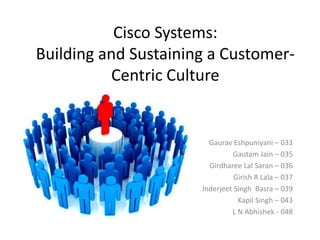
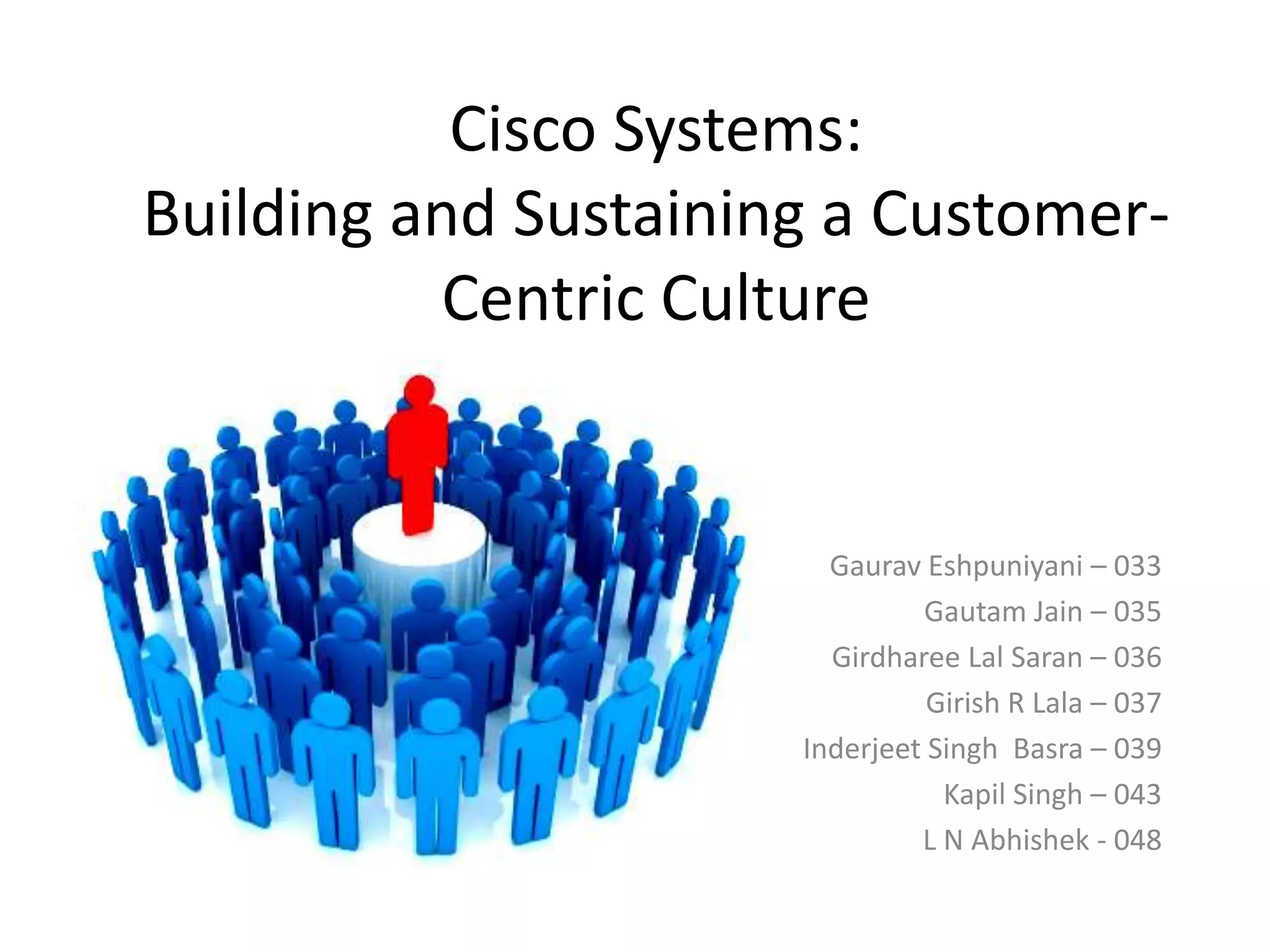

Cisco Systems:
Building and Sustaining a Customer-
          Centric Culture


                        Gaurav Eshpuniyani – 033
                               Gautam Jain – 035
                        Girdharee Lal Saran – 036
                                Girish R Lala – 037
                      Inderjeet Singh Basra – 039
                                 Kapil Singh – 043
                               L N Abhishek - 048
Contents
• Background and culture of Cisco
• Problem
• Customer centric model
• Initiatives of Cisco to build and sustain a
  customer centric culture
• Customer satisfaction vs. Customer loyalty
• Examples from our Companies. --- Pending
Background
• Sandy Lerner and Leonard Bosack founded CISCO
• In 1986, they assembled 1st CISCO router
• Venture capitalist Donald Valentine of Sequoia
  Capital invested $2.5 million
• Unhappy with the new corporate atmosphere, In
  1990, Lerner and Bosack left the company
• Between 1993 and 2001, acquired 73 companies
• One third of Cisco’s technology from acquisitions
• Separate business units to meet the needs of
  each without compromise
Culture
• Core Values: Empowerment, teamwork, open
  communication and trust
• Inculcation of Cisco values in staff in all
  meetings
• Egalitarian practices
• Accessible management
• Ranked 15th on Fortune’s “Best companies to
  work for” list in 2001
Problem
•   Cisco was adding customers ten times the rate it was hiring engineers
•   Growth rendered one to one contact between customers and engineers
    impractical
•   Sustainability of customer advocacy when Cisco gets bigger
•   Due to economic downturn Cisco axed 8500 employees lowering sales by 1/3rd in
    2001
•   Cisco’s three decentralised business lines had product overlap and redundancy
•   Cisco’s structure became inefficient as the co. grew and customer expectations
    and needs changed.
•   Cisco was a high touch vendor and worried whether the cos reorganisation would
    hurt its ability to maintain and develop customer loyalty.
•   Sliding market share
•   whether Cisco will be able to convince the customers that they are buying the
    relationship rather than a router
•   How Cisco should justify it premium charge
Customer centricity
• Refers to the orientation of a company to the
  needs and behaviors of its customers, rather
  than internal drivers (such as the quest for
  short term profit).
FIVE KEY STEPS FOR IMPLEMENTING A
    CUSTOMER-CENTRIC MODEL

1) Identify who your customers are
2) Find out what your customers want
3) Design your customer and sales process
   around the needs of the customer
4) Train your employees
5) Put in Place Performance Metrics and
   Measure Customer Feedback
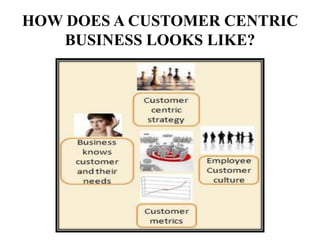
HOW DOES A CUSTOMER CENTRIC
    BUSINESS LOOKS LIKE?
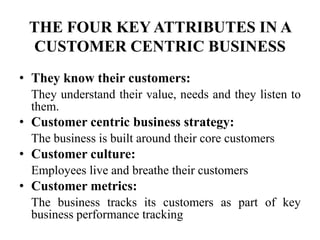
THE FOUR KEY ATTRIBUTES IN A
 CUSTOMER CENTRIC BUSINESS
• They know their customers:
  They understand their value, needs and they listen to
  them.
• Customer centric business strategy:
  The business is built around their core customers
• Customer culture:
  Employees live and breathe their customers
• Customer metrics:
  The business tracks its customers as part of key
  business performance tracking
BENEFITS TO THE ORGANIZATION

• A profitable customer base
• Clear understanding of how to grow your business
  and profits, based on a deep knowledge of your
  customers
• An ability to respond quickly to your customer
  needs and changes in your business environment
• A faster, more efficient organization, as everyone
  beats to the same drum
• Better protection in downturns, due to more loyal
  customers
Customer Advocacy
• Lerners belief – Success was not a matter of
  developing cutting edge technology, but of
  developing cutting-edge technology that was
  relevant to the customer.
• Consolidation of all functions that directly
  touched the customer but sales into a single
  “Customer Advocacy” organization
• “Customer Satisfaction” – Everyone’s Objective
• Customer Advocacy ingrained in people.
• Cisco viewed technology as a means to an end.
• Employees direct contact with the customer
• Staff bonuses tied to customer satisfaction
• IT function used technology to drive customer
  satisfaction and loyalty
• 5 point scale measured customer satisfaction
• Payment on the basis of customer intimacy
• Pre and post sales customer sales online surveys
• Detection of dissatisfied customers, trends and
  potential challenges
• Understand customer concerns/preferences and
  develop action plans
Consolidation of Technical Support
• Centralized Technical Assistance Centre (TAC) across
  all product lines – 1996
• Resulted into in-depth support, online or by phone,
  at any hour of the day, anywhere on earth.
• Cisco engineers worked directly with the people
• To overcome customer perception developed four
  priority system
• Cisco’s Critical Account Program (CAP) to take over
  serious cases
• Even low score surveys were followed to know
  reasons
Internet Business Solutions
• Cisco automated processes that didnot require human touch
  like
   – employee training
   – financial and project management
   – ranking and reward system
   • 90% to Cisco’s customer business and virtually all administration was
     done online
   • IBSG developed ”iQ Net Readiness Scorecard” with four drivers –
     Leadership, governance, competencies and technology – No charge to
     cos.
   • IBSG goal was to become a thought partner and trusted advisor for the
     customers in their eBusiness journey and acceperate their progress
   • Cisco measured IBSG only on customer success in implementing
     solutions that IBSG helped and the overall customer satisfaction
Acquisition Strategy
• Focus on skills/technologies that Cisco lacked
• weighed the culture of its potential acquisition targets
• Only focussed on companies that solved the customer
  problems
• Cisco treated the employees of the acquired companies as
  great assets
• Did not lay off employees of the acquired companies
• Provided extensive cultural orientation to the new companies.
• Cisco’s customer centric orientation and acquisition aplomb
  helped propel its growth
Cisco Restructuring
• Shift from decentralized operation focused on specific
  customer to a centralized one focused on
  technologies, marketing and engineering
   – Engineering was organised around eleven technology groups
   – Three sales groups were retained
• New structure to promote rapid technical innovation by
  eliminating overlap in R&D
• Products designed with more common parts
• Bought larger quantities of fewer parts
• Used interchangable circuit boards resulting into saving of $23
  million
• Cisco gained market share due to restructuring
Customer Focus Initiative (CFI)
• CFI was created to serve customers better
• CFI included
    – indepth analysis of customer info by managers at all levels
    – developent of new business models
    – designing strategy to overcome tactical challenges
• Customer Response Program (CRP) was developed in 2002 to solve
  customer problem
• Customers were touched in different ways through:
    –   Customer satisfaction surveys
    –   interactions with customers in the fied on continual basis
    –   interactions with channel partners
    –   targetted surveys
    –   portal to capture all end user data
• All this data used to determine the top 10 issues with CISCO as the co. felt
  that the customer information is the pulse to know what makes them tick
• Customer value summaries
  – CVS shares the work that Cisco did on an account with the
    customer
• Customer Champion Program
  – CCP matched Sr. Cisco executives with key customers
    based on customer need and personality
  – Customer had full access to their sponsor executive
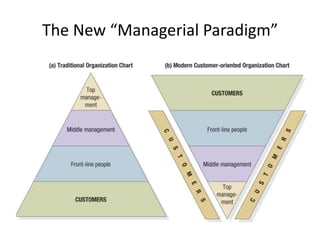
The New “Managerial Paradigm”
Satisfaction
– If the performance falls short of expectations, the
  customer is dissatisfied.
– If the performance matches the expectations, the
  customer is satisfied.
– If the performance exceeds expectations, the customer
  is delighted.

Conclusion: Do not create high expectations.

– Satisfaction is not ultimate goal of the company.
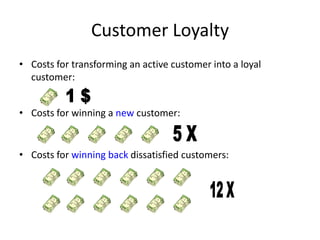
Customer Loyalty
• Costs for transforming an active customer into a loyal
  customer:


• Costs for winning a new customer:


• Costs for winning back dissatisfied customers:
Customer Satisfaction vs.
             Customer Loyalty

 Customer satisfaction measures how well a
  customer’s expectations are met.
 Customer loyalty measures how likely customers are
  to return and their willingness to perform partnership
  activities for the organization.
 Customer satisfaction is a prerequisite for customer
  loyalty.
 However, customer satisfaction does not mean your
  customers will certainly return.
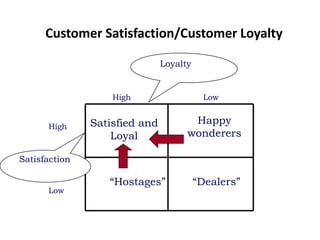
Customer Satisfaction/Customer Loyalty

                               Loyalty


                   High                    Low


               Satisfied and          Happy
      High
                   Loyal             wonderers

Satisfaction

                  “Hostages”             “Dealers”
      Low
Customer Groups

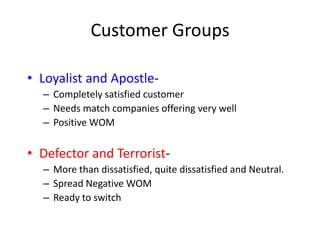
• Loyalist and Apostle-
  – Completely satisfied customer
  – Needs match companies offering very well
  – Positive WOM

• Defector and Terrorist-
  – More than dissatisfied, quite dissatisfied and Neutral.
  – Spread Negative WOM
  – Ready to switch
Customer Groups
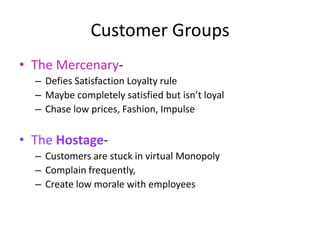
• The Mercenary-
  – Defies Satisfaction Loyalty rule
  – Maybe completely satisfied but isn’t loyal
  – Chase low prices, Fashion, Impulse

• The Hostage-
  – Customers are stuck in virtual Monopoly
  – Complain frequently,
  – Create low morale with employees
Customer Groups

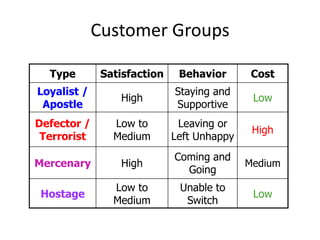
  Type        Satisfaction    Behavior       Cost
Loyalist /                   Staying and
                 High                        Low
 Apostle                     Supportive
Defector /      Low to        Leaving or
                                             High
 Terrorist      Medium       Left Unhappy
                             Coming and
Mercenary        High                       Medium
                               Going
                Low to        Unable to
 Hostage                                     Low
                Medium         Switch
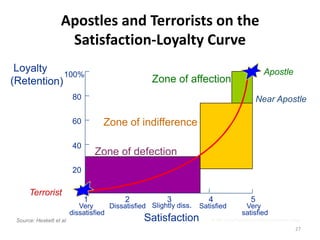
Apostles and Terrorists on the
                    Satisfaction-Loyalty Curve

                    100%                                                                                 Apostle
                                                     Zone of affection
                          80                                                                         Near Apostle

                          60        Zone of indifference

                          40
                                   Zone of defection
                          20

     Terrorist
                               1             2            3              4                       5
                            Very        Dissatisfied Slightly diss.   Satisfied              Very
                         dissatisfied                                                       satisfied
Source: Heskett et al.                             Satisfaction           © 1994 by the President and Fellows of Harvard College

                                                                                                                            27
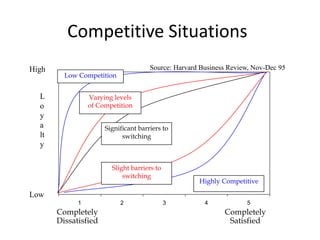
Competitive Situations
High                                  Source: Harvard Business Review, Nov-Dec 95
         Low Competition


  L              Varying levels
  o              of Competition
  y
  a                   Significant barriers to
  lt                        switching
  y

                        Slight barriers to
                            switching
                                                     Highly Competitive

Low
             1             2                 3         4            5
       Completely                                            Completely
       Dissatisfied                                           Satisfied
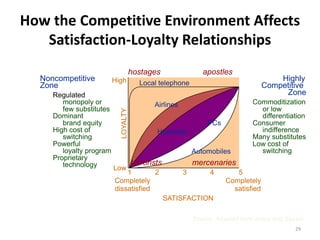
How the Competitive Environment Affects
   Satisfaction-Loyalty Relationships
                                    hostages               apostles
  Noncompetitive       High                                                       Highly
  Zone                                Local telephone                         Competitive
     Regulated                                                                     Zone
        monopoly or                  Airlines                      Commoditization
        few substitutes                                               or low

                          LOYALTY
     Dominant                                                         differentiation
        brand equity                                PCs            Consumer
     High cost of                     Hospitals                       indifference
        switching                                                  Many substitutes
     Powerful                                                      Low cost of
        loyalty program                         Automobiles           switching
     Proprietary
        technology           terrorists         mercenaries
                        Low
                            1        2        3      4       5
                        Completely                        Completely
                        dissatisfied                        satisfied
                                        SATISFACTION

                                                        Source: Adapted from Jones and Sasser
                                                                                          29
KPMG
• Customer Satisfaction and creating value to the customer is focus of our
  organization in every project

• Always aims to build long term relationships – most of the business in our practice
  is recurring business

• Concept of Account Manager is there in our organization as well, where the head of
  division is usually the relationship manager as well

• Tries to understand the customer needs and sets customer expectations in advance
  while drafting the project scope only

• Though, try to always provide value add in the deliverables to exceed customer
  expectations

• Loyalty is quite high in KPMG clients on the basis of its satisfaction

• In case of any fault, KPMG always responds immediately and solves the issue asap

• Building relationship is the key to any business
Thank you

Cisco systems - Managing customer relation in a growing organization

  • 1.
    Cisco Systems: Building andSustaining a Customer- Centric Culture Gaurav Eshpuniyani – 033 Gautam Jain – 035 Girdharee Lal Saran – 036 Girish R Lala – 037 Inderjeet Singh Basra – 039 Kapil Singh – 043 L N Abhishek - 048
  • 2.
    Contents • Background andculture of Cisco • Problem • Customer centric model • Initiatives of Cisco to build and sustain a customer centric culture • Customer satisfaction vs. Customer loyalty • Examples from our Companies. --- Pending
  • 3.
    Background • Sandy Lernerand Leonard Bosack founded CISCO • In 1986, they assembled 1st CISCO router • Venture capitalist Donald Valentine of Sequoia Capital invested $2.5 million • Unhappy with the new corporate atmosphere, In 1990, Lerner and Bosack left the company • Between 1993 and 2001, acquired 73 companies • One third of Cisco’s technology from acquisitions • Separate business units to meet the needs of each without compromise
  • 4.
    Culture • Core Values:Empowerment, teamwork, open communication and trust • Inculcation of Cisco values in staff in all meetings • Egalitarian practices • Accessible management • Ranked 15th on Fortune’s “Best companies to work for” list in 2001
  • 5.
    Problem • Cisco was adding customers ten times the rate it was hiring engineers • Growth rendered one to one contact between customers and engineers impractical • Sustainability of customer advocacy when Cisco gets bigger • Due to economic downturn Cisco axed 8500 employees lowering sales by 1/3rd in 2001 • Cisco’s three decentralised business lines had product overlap and redundancy • Cisco’s structure became inefficient as the co. grew and customer expectations and needs changed. • Cisco was a high touch vendor and worried whether the cos reorganisation would hurt its ability to maintain and develop customer loyalty. • Sliding market share • whether Cisco will be able to convince the customers that they are buying the relationship rather than a router • How Cisco should justify it premium charge
  • 6.
    Customer centricity • Refersto the orientation of a company to the needs and behaviors of its customers, rather than internal drivers (such as the quest for short term profit).
  • 7.
    FIVE KEY STEPSFOR IMPLEMENTING A CUSTOMER-CENTRIC MODEL 1) Identify who your customers are 2) Find out what your customers want 3) Design your customer and sales process around the needs of the customer 4) Train your employees 5) Put in Place Performance Metrics and Measure Customer Feedback
  • 8.
    HOW DOES ACUSTOMER CENTRIC BUSINESS LOOKS LIKE?
  • 9.
    THE FOUR KEYATTRIBUTES IN A CUSTOMER CENTRIC BUSINESS • They know their customers: They understand their value, needs and they listen to them. • Customer centric business strategy: The business is built around their core customers • Customer culture: Employees live and breathe their customers • Customer metrics: The business tracks its customers as part of key business performance tracking
  • 10.
    BENEFITS TO THEORGANIZATION • A profitable customer base • Clear understanding of how to grow your business and profits, based on a deep knowledge of your customers • An ability to respond quickly to your customer needs and changes in your business environment • A faster, more efficient organization, as everyone beats to the same drum • Better protection in downturns, due to more loyal customers
  • 11.
    Customer Advocacy • Lernersbelief – Success was not a matter of developing cutting edge technology, but of developing cutting-edge technology that was relevant to the customer. • Consolidation of all functions that directly touched the customer but sales into a single “Customer Advocacy” organization • “Customer Satisfaction” – Everyone’s Objective • Customer Advocacy ingrained in people. • Cisco viewed technology as a means to an end. • Employees direct contact with the customer • Staff bonuses tied to customer satisfaction
  • 12.
    • IT functionused technology to drive customer satisfaction and loyalty • 5 point scale measured customer satisfaction • Payment on the basis of customer intimacy • Pre and post sales customer sales online surveys • Detection of dissatisfied customers, trends and potential challenges • Understand customer concerns/preferences and develop action plans
  • 13.
    Consolidation of TechnicalSupport • Centralized Technical Assistance Centre (TAC) across all product lines – 1996 • Resulted into in-depth support, online or by phone, at any hour of the day, anywhere on earth. • Cisco engineers worked directly with the people • To overcome customer perception developed four priority system • Cisco’s Critical Account Program (CAP) to take over serious cases • Even low score surveys were followed to know reasons
  • 14.
    Internet Business Solutions •Cisco automated processes that didnot require human touch like – employee training – financial and project management – ranking and reward system • 90% to Cisco’s customer business and virtually all administration was done online • IBSG developed ”iQ Net Readiness Scorecard” with four drivers – Leadership, governance, competencies and technology – No charge to cos. • IBSG goal was to become a thought partner and trusted advisor for the customers in their eBusiness journey and acceperate their progress • Cisco measured IBSG only on customer success in implementing solutions that IBSG helped and the overall customer satisfaction
  • 15.
    Acquisition Strategy • Focuson skills/technologies that Cisco lacked • weighed the culture of its potential acquisition targets • Only focussed on companies that solved the customer problems • Cisco treated the employees of the acquired companies as great assets • Did not lay off employees of the acquired companies • Provided extensive cultural orientation to the new companies. • Cisco’s customer centric orientation and acquisition aplomb helped propel its growth
  • 16.
    Cisco Restructuring • Shiftfrom decentralized operation focused on specific customer to a centralized one focused on technologies, marketing and engineering – Engineering was organised around eleven technology groups – Three sales groups were retained • New structure to promote rapid technical innovation by eliminating overlap in R&D • Products designed with more common parts • Bought larger quantities of fewer parts • Used interchangable circuit boards resulting into saving of $23 million • Cisco gained market share due to restructuring
  • 17.
    Customer Focus Initiative(CFI) • CFI was created to serve customers better • CFI included – indepth analysis of customer info by managers at all levels – developent of new business models – designing strategy to overcome tactical challenges • Customer Response Program (CRP) was developed in 2002 to solve customer problem • Customers were touched in different ways through: – Customer satisfaction surveys – interactions with customers in the fied on continual basis – interactions with channel partners – targetted surveys – portal to capture all end user data • All this data used to determine the top 10 issues with CISCO as the co. felt that the customer information is the pulse to know what makes them tick
  • 18.
    • Customer valuesummaries – CVS shares the work that Cisco did on an account with the customer • Customer Champion Program – CCP matched Sr. Cisco executives with key customers based on customer need and personality – Customer had full access to their sponsor executive
  • 19.
  • 20.
    Satisfaction – If theperformance falls short of expectations, the customer is dissatisfied. – If the performance matches the expectations, the customer is satisfied. – If the performance exceeds expectations, the customer is delighted. Conclusion: Do not create high expectations. – Satisfaction is not ultimate goal of the company.
  • 21.
    Customer Loyalty • Costsfor transforming an active customer into a loyal customer: • Costs for winning a new customer: • Costs for winning back dissatisfied customers:
  • 22.
    Customer Satisfaction vs. Customer Loyalty  Customer satisfaction measures how well a customer’s expectations are met.  Customer loyalty measures how likely customers are to return and their willingness to perform partnership activities for the organization.  Customer satisfaction is a prerequisite for customer loyalty.  However, customer satisfaction does not mean your customers will certainly return.
  • 23.
    Customer Satisfaction/Customer Loyalty Loyalty High Low Satisfied and Happy High Loyal wonderers Satisfaction “Hostages” “Dealers” Low
  • 24.
    Customer Groups • Loyalistand Apostle- – Completely satisfied customer – Needs match companies offering very well – Positive WOM • Defector and Terrorist- – More than dissatisfied, quite dissatisfied and Neutral. – Spread Negative WOM – Ready to switch
  • 25.
    Customer Groups • TheMercenary- – Defies Satisfaction Loyalty rule – Maybe completely satisfied but isn’t loyal – Chase low prices, Fashion, Impulse • The Hostage- – Customers are stuck in virtual Monopoly – Complain frequently, – Create low morale with employees
  • 26.
    Customer Groups Type Satisfaction Behavior Cost Loyalist / Staying and High Low Apostle Supportive Defector / Low to Leaving or High Terrorist Medium Left Unhappy Coming and Mercenary High Medium Going Low to Unable to Hostage Low Medium Switch
  • 27.
    Apostles and Terroristson the Satisfaction-Loyalty Curve 100% Apostle Zone of affection 80 Near Apostle 60 Zone of indifference 40 Zone of defection 20 Terrorist 1 2 3 4 5 Very Dissatisfied Slightly diss. Satisfied Very dissatisfied satisfied Source: Heskett et al. Satisfaction © 1994 by the President and Fellows of Harvard College 27
  • 28.
    Competitive Situations High Source: Harvard Business Review, Nov-Dec 95 Low Competition L Varying levels o of Competition y a Significant barriers to lt switching y Slight barriers to switching Highly Competitive Low 1 2 3 4 5 Completely Completely Dissatisfied Satisfied
  • 29.
    How the CompetitiveEnvironment Affects Satisfaction-Loyalty Relationships hostages apostles Noncompetitive High Highly Zone Local telephone Competitive Regulated Zone monopoly or Airlines Commoditization few substitutes or low LOYALTY Dominant differentiation brand equity PCs Consumer High cost of Hospitals indifference switching Many substitutes Powerful Low cost of loyalty program Automobiles switching Proprietary technology terrorists mercenaries Low 1 2 3 4 5 Completely Completely dissatisfied satisfied SATISFACTION Source: Adapted from Jones and Sasser 29
  • 30.
    KPMG • Customer Satisfactionand creating value to the customer is focus of our organization in every project • Always aims to build long term relationships – most of the business in our practice is recurring business • Concept of Account Manager is there in our organization as well, where the head of division is usually the relationship manager as well • Tries to understand the customer needs and sets customer expectations in advance while drafting the project scope only • Though, try to always provide value add in the deliverables to exceed customer expectations • Loyalty is quite high in KPMG clients on the basis of its satisfaction • In case of any fault, KPMG always responds immediately and solves the issue asap • Building relationship is the key to any business
  • 31.