Customer Relationship Management
By:
Ved Prakash Verma
M.E. Electrical (I&C), B. Tech (EE)
Lecturer , Electrical Engineering Department
A.B.V. Govt. Institute of Engineering &
Technology, Pragatinagar , Shimla-171202(HP)
Department of Technical Education,
Govt. of Himachal Pradesh
Customer Relationship Management (CRM)
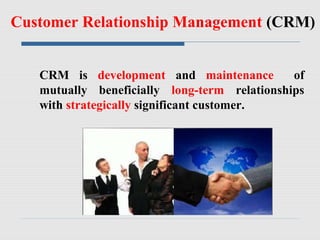
CRM is development and maintenance of
mutually beneficially long-term relationships
with strategically significant customer.
Cont…
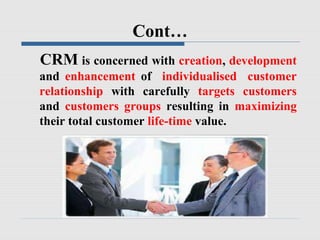
CRM is concerned with creation, development
and enhancement of individualised customer
relationship with carefully targets customers
and customers groups resulting in maximizing
their total customer life-time value.
Needs of CRM
 To enhance the company to identify, contact, attract
& acquire new customers.
 To obtain the better understanding of customers-
their wants & needs.
 To define the appropriate product & service offering
and match it to the unique needs of customers.
 To manage & optimize company’s sales cycle.
 To increase retention of existing customer by
improving sales, service & support.
 To identify cross selling and up selling opportunities.
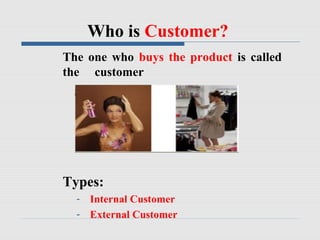
Who is Customer?
The one who buys the product is called
the customer
Types:
- Internal Customer
- External Customer
Types of Customer
 Loyal Customer
 Discount Customer
 Impulse Customer
 Need Based Customer
 Wandering Customer
Loyal Customer
They represents not more than 20 percent of
organizations customer base, but make up more
than 50 percent of sales
Discount Customer
They shop in our store frequently, but make
their decisions based on size of discount/
markdowns
Impulse Customer
They do not come for buying a particular item
at the store, but come into the store on a whim
and will purchase what seems good at that the
time.
Need- Based Customer
They have a specific intension to buy a
particular type of items
Wandering Customer
They have no specific need or desire in a mind
when they come into store. Rather, they want a
sense of experience or community
Customer Satisfaction
Customer Satisfaction is a mental state,
which results from the customer’s comparison
of experience prior to the purchase with
performance perceptions after purchase.
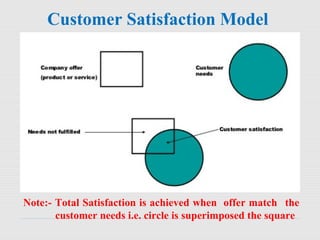
Customer Satisfaction Model
Note:- Total Satisfaction is achieved when offer match the
customer needs i.e. circle is superimposed the square
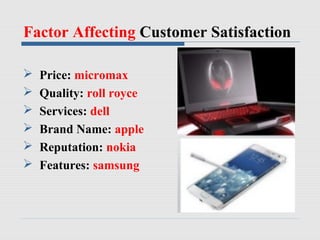
Factor Affecting Customer Satisfaction
 Price: micromax
 Quality: roll royce
 Services: dell
 Brand Name: apple
 Reputation: nokia
 Features: samsung
Techniques of Achieving Customer
Satisfaction
 Understanding the Customer Needs
 Exceeding Customer Expectations
 Help Customer Help Themselves
 Hire the Best Customer Services Support
 Use of Tours and Demos
 Fixing Recurring Problems
 Clearly Defined Customer Services Policy
 Believing in Customer Complaints
Customer Satisfaction Index (CSI)
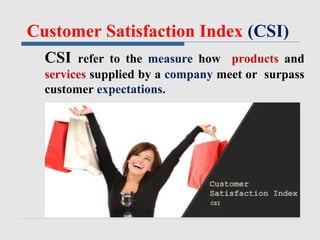
CSI refer to the measure how products and
services supplied by a company meet or surpass
customer expectations.
Importance of CSI
 CSI is leading indicators of customer
repurchase intentions and loyalty.
 CSI is point of differentiation.
 CSI reduce customer chum.
 CSI increases the customer lifetime value.
 CSI reduces negative word of mouth.
 It’s cheaper to retain customer than acquire
new one.
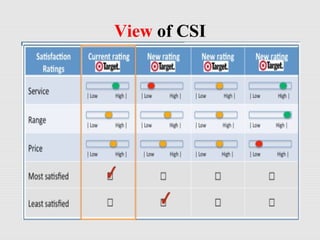
View of CSI
Benefits of CSI
 CSI benefits to investors how to make wealthy
relationship between a firm’s current condition and
its future capacity.
 CSI benefits to managers how to strength the
customer relationship.
 CSI benefits the Government to enhancing
economic growth, consumer utility and living
standards for citizens.
 CSI also benefits consumers in term of voice
measure that reflects their material living
standards.
Any Questions?
Thank

Customer relationship management ppt

  • 1.
    Customer Relationship Management By: VedPrakash Verma M.E. Electrical (I&C), B. Tech (EE) Lecturer , Electrical Engineering Department A.B.V. Govt. Institute of Engineering & Technology, Pragatinagar , Shimla-171202(HP) Department of Technical Education, Govt. of Himachal Pradesh
  • 2.
    Customer Relationship Management(CRM) CRM is development and maintenance of mutually beneficially long-term relationships with strategically significant customer.
  • 3.
    Cont… CRM is concernedwith creation, development and enhancement of individualised customer relationship with carefully targets customers and customers groups resulting in maximizing their total customer life-time value.
  • 4.
    Needs of CRM To enhance the company to identify, contact, attract & acquire new customers.  To obtain the better understanding of customers- their wants & needs.  To define the appropriate product & service offering and match it to the unique needs of customers.  To manage & optimize company’s sales cycle.  To increase retention of existing customer by improving sales, service & support.  To identify cross selling and up selling opportunities.
  • 5.
    Who is Customer? Theone who buys the product is called the customer Types: - Internal Customer - External Customer
  • 6.
    Types of Customer Loyal Customer  Discount Customer  Impulse Customer  Need Based Customer  Wandering Customer
  • 7.
    Loyal Customer They representsnot more than 20 percent of organizations customer base, but make up more than 50 percent of sales
  • 8.
    Discount Customer They shopin our store frequently, but make their decisions based on size of discount/ markdowns
  • 9.
    Impulse Customer They donot come for buying a particular item at the store, but come into the store on a whim and will purchase what seems good at that the time.
  • 10.
    Need- Based Customer Theyhave a specific intension to buy a particular type of items
  • 11.
    Wandering Customer They haveno specific need or desire in a mind when they come into store. Rather, they want a sense of experience or community
  • 12.
    Customer Satisfaction Customer Satisfactionis a mental state, which results from the customer’s comparison of experience prior to the purchase with performance perceptions after purchase.
  • 13.
    Customer Satisfaction Model Note:-Total Satisfaction is achieved when offer match the customer needs i.e. circle is superimposed the square
  • 14.
    Factor Affecting CustomerSatisfaction  Price: micromax  Quality: roll royce  Services: dell  Brand Name: apple  Reputation: nokia  Features: samsung
  • 15.
    Techniques of AchievingCustomer Satisfaction  Understanding the Customer Needs  Exceeding Customer Expectations  Help Customer Help Themselves  Hire the Best Customer Services Support  Use of Tours and Demos  Fixing Recurring Problems  Clearly Defined Customer Services Policy  Believing in Customer Complaints
  • 16.
    Customer Satisfaction Index(CSI) CSI refer to the measure how products and services supplied by a company meet or surpass customer expectations.
  • 17.
    Importance of CSI CSI is leading indicators of customer repurchase intentions and loyalty.  CSI is point of differentiation.  CSI reduce customer chum.  CSI increases the customer lifetime value.  CSI reduces negative word of mouth.  It’s cheaper to retain customer than acquire new one.
  • 18.
  • 19.
    Benefits of CSI CSI benefits to investors how to make wealthy relationship between a firm’s current condition and its future capacity.  CSI benefits to managers how to strength the customer relationship.  CSI benefits the Government to enhancing economic growth, consumer utility and living standards for citizens.  CSI also benefits consumers in term of voice measure that reflects their material living standards.
  • 20.