Evaluation of a Clinical Information System  Baylee A. (1-3, 13, 19-23, 28-35)Bill K.  (8-12)Katina D. (13-18)Megan S. (4-7)Susan H. (24-27)
IntroductionThis power point was made with the intention to explain, show the components of, and  evaluate a Clinical Information System, or CIS). The CIS is a broad system that contain the Electronic Health Record, EHR and/or the Electronic Medical Record, EMR. This power  point goes through the components of CIS system, key players, benefits of a CIS, the EHR component, the clinical decision making process, cost , education, and safety. This was made for educational purposes and for the intention of gaining new knowledge.
CIS and Key Players
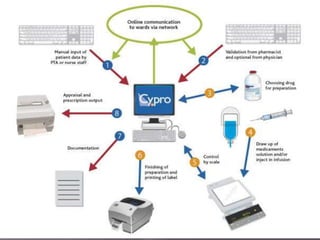
What is Clinical Information Systems (CIS)?CIS is a computer based system that is designed for collecting, storing, manipulating and making available clinical information important to the healthcare delivery process. Information is kept in real time so that patient data is can be accessed quickly (McGonigle& Mastrian 2009). Clinical Information Systems must be able to integrate with all departments within the hospital. Example: Pharmacy must be able to view lab results on patients to get correct  doses of Lovenox.
Benefits to CISPatient Safety: Alerts to fall risks or suicide risks. Patient drug allergies can easily be seen to decrease drug reactions. Medication: Pharmacy has access to patients labs for correct dosing. Medication Administration Record (MAR) within the CIS helps to decrease medication errors. Patients home medications can easily be added to record which allows for better patient care through medication reconciliation, and less chance of drug-to-drug interactions. Communication:  Staff members have quick access to notes that have been placed in patient chart for better continuation of care. Messages can also be sent within the CIS to certain other departments regarding the patient. Medications can be requested from pharmacy within the CIS
Benefits to CISQuality Control:  Certain diseases can easily be tracked within the CIS to look at patient outcomes and to make sure patients are getting the best standard of care related to each specific disease.  This is also easier for government to evaluate patient care that is delivered at each facility.  “Embedding Evidence Based Practice into nursing documentation can also increase the compliance with Joint Commission core measures (McGonigle&Mastrian, 2009).”Ease of Use: Having  that patients chart at the finger tips of staff members helps to deliver better patient care in a quick and effective manner. Many hospital  staff members can access a patients chart at one time. Information can be put into the chart very quickly also, lab results, doctor orders, progress notes.
Key Players to Development of CISAny department that interfaces with the CIS should be apart of the development of the CISMedical Staff (i.e. Physician and Nursing)Ancillary Staff (i.e. Nursing Assistants, Transport Techs, Pharmacy, Laboratory)Patient AccountsInformation Technology Departments- Assists in actual construction of the CIS and can make changes to the CIS once construction is completeNurses who specialize in Nursing Informatics will be very beneficial in development of CIS.
Components of EHR
Solid reasons for each EHRHealth Information and Data: This component is needed to properly put in the right patient with existing history, past and present, doctor visits, surgeries, family histories, and all other pertinent information related to specific patient. Members that would need access to this info are: attending and referral doctors and direct care nursing staff and patient therapies. Other departments who only need brief amounts should be restricted, ie. Billing, radiology, lab and other departments.Results management: this is a good key component as it allows for fast and organized lab, X-ray, MRI, CT, or surgery results helping save time for doctors, nurses, or other direct patient departments. The need for persons to view this is not as great unless you are directly caring for this patient. Should be accessible for the patient as well
  Order Entry Management: This component is necessary for each department to put in quick orders on patients, ie. Respiratory, lab, nurses, doctors, radiology and so forth. This is a must because of time saved versus one or two areas who are able to put in orders. Decision Support: Should be accessible for everyone as this will be used as a reminder for the patient benefit. It comprises of medication reminders reducing errors, labs needed, radiology that is needed, new physician appointments, and brings all patient care reminders into one place making it easier to help educate patient home care.Electronic Communication and Connectivity: This component would go hand in hand with all other communication. IT gives patients and staff the ability to communicate needs online, staff the ability to report with each other no matter if they are in the same system, or for patients to access their health history no matter where they are. Should only be used by direct patient members. Patients only need access for own history not family, and staff should only see if needed at time of care.
Patient Support: This component is great for educating patients. It can allow the provider to educate on home care, Give education material downloaded directly to patient, Educate families on family member diagnosis and care needed, and can help with secondary education such as need for dieting, exercise, follow up checks, and what to watch for at home. Very good tool that can be used by any health care providerAdministrative Processes: This component gathers in all the other departments not in direct care roles, but essential. These include billing, scheduling, risk, social services, case management, and facility administration. All components of patient data aren’t necessary for these departments unless it becomes necessary to review patient history. These departments are essential for any facility and need fast access like any other.
Reporting and population management: This is used for data collection. This is a great way to use data for any specific group of patients based on age, sex, diagnosis, or history and see what may be in common. Great data to use to find new treatments, diagnose patient problems before they become to bad, or help educate patients on what to expect. This basically is research. That is essentially the benefit of having all data on a CIS, it keeps it all in one place, organized, and accessible.
Clinical Decision Making
Clinical decision support: this provides users with the tools to acquire, manipulate, apply and display appropriate information to aid in the making of correct, timely, and evidence based clinical decisions.
CLINICAL DECISION MAKING IN CIS-HOW SHOULD IT BE STRUCTURED?The clinical decision making in CIS should be structured in a simple and easy way to use it.Should be easy to access from the system itself.The software should be updated each and every time you log on to the system. The system that is being used will send  out automatic updates to access and download when there is new information available.

CLINICAL DECISION MAKING-HOW OFTEN SHOULD IT BE UPDATED WITH NEW EBP GUIDELINES?Define EPB (evidence based practice)- this is Nursing practice that is informed by research generated evidence of best practices.(Nursing Informatics and the Foundation of Knowledge,2009)EBP should be embedded in the EHR as prompts, pop-ups, links, reminders and text messages.
The information needs to be easy to retrieve.
iphone has apps that can be downloaded with the updated EBP information.
CLINICAL DECISION MAKING IN CIS-HERE ARE SOME COMPANIES THAT SUPPORT AND DESIGN CIS.TheraDoc, Inc. VisualDxDxplainQMR (Quick Medical Reference)DiagnosisProIliad
Safety and Security of CIS
Safety of CISSafety is a huge concern with EHRSecurity encompasses more than just the safety of the patient information, it covers backup of information, storage of information, protection of viruses, etc.
Safety of CISKeep patient information is confidential is the most important aspect of an EHRThe EHR has “Implementation of a firewall to prevent external access to data” (site).EHR systems have anti-virus software. This software keeps people from outside the system stealing patient informationAnother unique aspect, is where each worker has their own special identification number and password that they have to use to access patient informationAn example of this software is called Alberta software
Safety of CISEHR systems also have a back up storage area. This is an area where all information is “dumped”This protects the patient and the hospital who purchased the EHRIf the main system was to crash, all of the health record is recorded and stored at a different locationThis location is only for storage and is not used for anything else
CIS system Costs
CIS system CostsSystems are expensive.Costs:$10 million-$70 million for a 500 bed hospital.Implementation takes between 3-5 years costing $3500- $10,000 for application service provider systems. And $20,000- $40,000 for server-based provider systems.
Considered costsEHR Usability:Set UpHardwarePatient ImportSpecialty OptionsEHR Features:SchedulingFlexible TemplatesBillingLab IntegrationAccess for PatientsE-PrescribingSupportwww.emrandhipaa.com
CIS System CostsCosts per physician:$33,000 to purchase$1500 per month for maintenanceApproximately $60,000 per year for IT SupportLong term Cost-Savings$77.8 billion a yearSavings of Reduction in:Medical ErrorDiagnostic Test DuplicationAdministrative Expenseswww.emrandhipaa.com
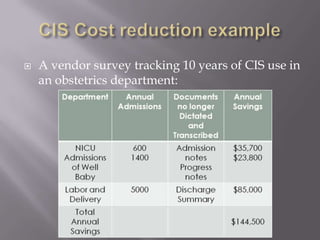
CIS Cost reduction exampleA vendor survey tracking 10 years of CIS use in an obstetrics department:
CIS Education
Education of CISEducation of EHR/EMR is very importantTo have a good educational system, there needs to be a set of goals that they want the trainees to be able to do at the end of the training programOnce these goals are defined, the target audience needs to be broken down into small sized groupsMost of the target audiences are large hospitalsThese groups can be further broken down by their specialty area, physicians, nurses, techs, aids, etc.
Education of CISTechnology helps get this new information to the co-workers“The power of technology to influence productivity really comes from several core factors: convenience to access, ease of tracking participation and scalability of distribution”(site).Education for current employee should be done firstEducation for new hires should start during their orientation before being aloud to work with patients and actual medical records (safety for patients)
Education of CISWith every major update of the EHR/EMR there should be added education to the employees The EHR/EMR will always change and update, so formal training and paper handouts should be made available for all co-workers
Conclusion As you can see, the CIS system is a very complex and vast system. It has many components and varying degrees of needs. These systems take up lots of space and time to initiate, but one could see the benefits of this type of system to the medical environment. They may be costly and require a bit of training on education and safety, but they are there for the connivance and ease of staff and patients. Medical technology is ever changing, so the medical environment needs to anticipate and make these changes with the world. The CIS helps the health care environment do this with ease.
References CIS theriak- important patient safety is a paramount. (copyright CIS 	healthcare 2009-2011) Retrieved April 07, 2011, from 	http://www.cis-theriak.com/cypro (Katina)Jimenez, A. (2010). E-learning supports EHR implementations: in 	addition to meaningful use, we need to define meaningful 	training. Health Management Technology, 31(11), 22-23. 	Retrieved from EBSCOhost. (Baylee)McGongile, D. & Mastrain, K. (2009). Nursing Informatics and the 	Foundation of Knowledge. Jones and Bartlett; Sudberry, MA (Bill)McGonigle, D., & Mastrian, K. G. (2009). Nursing informatics and the 	foundation of knowledge. Sudbury, MA: Jones and Bartlett. 	(Megan)McGonigle, D., Mastrian,K. Nursing Informatics and the Foundation 	of Knowledge (2009). (Katina)
References NIH National Center for Resaerch Resources. Electronic Health Care 	Overview,http://ncrr.nih.gov/publication/informatics/EHRpdf	accessed 10 april2011 (Bill)Parker, A. (2002).  Tracking a decade of CIS: a vendor 	survey 10 years of 	CIS use in the obstetrics department of a nationally renowned 	medical center with some stunning results.  Health Management 	Technology, 23(4), 28. (Susan)The Informatics Review. (2003, November 15). Clinical Decisions Support 	System. Retrieved April 07, 2011, from http://www.informatics-	review.com/decision-support/index.html (Katina)Win, K. (2005). A review of security of electronic health records. Health 	Information Management Journal, 34(1), 13-18. Retrieved 	from EBSCOhost. (Baylee)www.emrandhipaa.com (Susan)www.healthcaretechnologyonline.com  (Susan)

Cis powerpoint/Health Care Informatics (NUR/HSC SOL1-2) Spring 2011

  • 1.
    Evaluation of aClinical Information System Baylee A. (1-3, 13, 19-23, 28-35)Bill K. (8-12)Katina D. (13-18)Megan S. (4-7)Susan H. (24-27)
  • 2.
    IntroductionThis power pointwas made with the intention to explain, show the components of, and evaluate a Clinical Information System, or CIS). The CIS is a broad system that contain the Electronic Health Record, EHR and/or the Electronic Medical Record, EMR. This power point goes through the components of CIS system, key players, benefits of a CIS, the EHR component, the clinical decision making process, cost , education, and safety. This was made for educational purposes and for the intention of gaining new knowledge.
  • 3.
  • 4.
    What is ClinicalInformation Systems (CIS)?CIS is a computer based system that is designed for collecting, storing, manipulating and making available clinical information important to the healthcare delivery process. Information is kept in real time so that patient data is can be accessed quickly (McGonigle& Mastrian 2009). Clinical Information Systems must be able to integrate with all departments within the hospital. Example: Pharmacy must be able to view lab results on patients to get correct doses of Lovenox.
  • 5.
    Benefits to CISPatientSafety: Alerts to fall risks or suicide risks. Patient drug allergies can easily be seen to decrease drug reactions. Medication: Pharmacy has access to patients labs for correct dosing. Medication Administration Record (MAR) within the CIS helps to decrease medication errors. Patients home medications can easily be added to record which allows for better patient care through medication reconciliation, and less chance of drug-to-drug interactions. Communication: Staff members have quick access to notes that have been placed in patient chart for better continuation of care. Messages can also be sent within the CIS to certain other departments regarding the patient. Medications can be requested from pharmacy within the CIS
  • 6.
    Benefits to CISQualityControl: Certain diseases can easily be tracked within the CIS to look at patient outcomes and to make sure patients are getting the best standard of care related to each specific disease. This is also easier for government to evaluate patient care that is delivered at each facility. “Embedding Evidence Based Practice into nursing documentation can also increase the compliance with Joint Commission core measures (McGonigle&Mastrian, 2009).”Ease of Use: Having that patients chart at the finger tips of staff members helps to deliver better patient care in a quick and effective manner. Many hospital staff members can access a patients chart at one time. Information can be put into the chart very quickly also, lab results, doctor orders, progress notes.
  • 7.
    Key Players toDevelopment of CISAny department that interfaces with the CIS should be apart of the development of the CISMedical Staff (i.e. Physician and Nursing)Ancillary Staff (i.e. Nursing Assistants, Transport Techs, Pharmacy, Laboratory)Patient AccountsInformation Technology Departments- Assists in actual construction of the CIS and can make changes to the CIS once construction is completeNurses who specialize in Nursing Informatics will be very beneficial in development of CIS.
  • 8.
  • 9.
    Solid reasons foreach EHRHealth Information and Data: This component is needed to properly put in the right patient with existing history, past and present, doctor visits, surgeries, family histories, and all other pertinent information related to specific patient. Members that would need access to this info are: attending and referral doctors and direct care nursing staff and patient therapies. Other departments who only need brief amounts should be restricted, ie. Billing, radiology, lab and other departments.Results management: this is a good key component as it allows for fast and organized lab, X-ray, MRI, CT, or surgery results helping save time for doctors, nurses, or other direct patient departments. The need for persons to view this is not as great unless you are directly caring for this patient. Should be accessible for the patient as well
  • 10.
    OrderEntry Management: This component is necessary for each department to put in quick orders on patients, ie. Respiratory, lab, nurses, doctors, radiology and so forth. This is a must because of time saved versus one or two areas who are able to put in orders. Decision Support: Should be accessible for everyone as this will be used as a reminder for the patient benefit. It comprises of medication reminders reducing errors, labs needed, radiology that is needed, new physician appointments, and brings all patient care reminders into one place making it easier to help educate patient home care.Electronic Communication and Connectivity: This component would go hand in hand with all other communication. IT gives patients and staff the ability to communicate needs online, staff the ability to report with each other no matter if they are in the same system, or for patients to access their health history no matter where they are. Should only be used by direct patient members. Patients only need access for own history not family, and staff should only see if needed at time of care.
  • 11.
    Patient Support: Thiscomponent is great for educating patients. It can allow the provider to educate on home care, Give education material downloaded directly to patient, Educate families on family member diagnosis and care needed, and can help with secondary education such as need for dieting, exercise, follow up checks, and what to watch for at home. Very good tool that can be used by any health care providerAdministrative Processes: This component gathers in all the other departments not in direct care roles, but essential. These include billing, scheduling, risk, social services, case management, and facility administration. All components of patient data aren’t necessary for these departments unless it becomes necessary to review patient history. These departments are essential for any facility and need fast access like any other.
  • 12.
    Reporting and populationmanagement: This is used for data collection. This is a great way to use data for any specific group of patients based on age, sex, diagnosis, or history and see what may be in common. Great data to use to find new treatments, diagnose patient problems before they become to bad, or help educate patients on what to expect. This basically is research. That is essentially the benefit of having all data on a CIS, it keeps it all in one place, organized, and accessible.
  • 13.
  • 14.
    Clinical decision support:this provides users with the tools to acquire, manipulate, apply and display appropriate information to aid in the making of correct, timely, and evidence based clinical decisions.
  • 15.
    CLINICAL DECISION MAKINGIN CIS-HOW SHOULD IT BE STRUCTURED?The clinical decision making in CIS should be structured in a simple and easy way to use it.Should be easy to access from the system itself.The software should be updated each and every time you log on to the system. The system that is being used will send out automatic updates to access and download when there is new information available.
  • 16.
    CLINICAL DECISION MAKING-HOWOFTEN SHOULD IT BE UPDATED WITH NEW EBP GUIDELINES?Define EPB (evidence based practice)- this is Nursing practice that is informed by research generated evidence of best practices.(Nursing Informatics and the Foundation of Knowledge,2009)EBP should be embedded in the EHR as prompts, pop-ups, links, reminders and text messages.
  • 17.
    The information needsto be easy to retrieve.
  • 18.
    iphone has appsthat can be downloaded with the updated EBP information.
  • 19.
    CLINICAL DECISION MAKINGIN CIS-HERE ARE SOME COMPANIES THAT SUPPORT AND DESIGN CIS.TheraDoc, Inc. VisualDxDxplainQMR (Quick Medical Reference)DiagnosisProIliad
  • 20.
  • 21.
    Safety of CISSafetyis a huge concern with EHRSecurity encompasses more than just the safety of the patient information, it covers backup of information, storage of information, protection of viruses, etc.
  • 22.
    Safety of CISKeeppatient information is confidential is the most important aspect of an EHRThe EHR has “Implementation of a firewall to prevent external access to data” (site).EHR systems have anti-virus software. This software keeps people from outside the system stealing patient informationAnother unique aspect, is where each worker has their own special identification number and password that they have to use to access patient informationAn example of this software is called Alberta software
  • 23.
    Safety of CISEHRsystems also have a back up storage area. This is an area where all information is “dumped”This protects the patient and the hospital who purchased the EHRIf the main system was to crash, all of the health record is recorded and stored at a different locationThis location is only for storage and is not used for anything else
  • 24.
  • 25.
    CIS system CostsSystemsare expensive.Costs:$10 million-$70 million for a 500 bed hospital.Implementation takes between 3-5 years costing $3500- $10,000 for application service provider systems. And $20,000- $40,000 for server-based provider systems.
  • 26.
    Considered costsEHR Usability:SetUpHardwarePatient ImportSpecialty OptionsEHR Features:SchedulingFlexible TemplatesBillingLab IntegrationAccess for PatientsE-PrescribingSupportwww.emrandhipaa.com
  • 27.
    CIS System CostsCostsper physician:$33,000 to purchase$1500 per month for maintenanceApproximately $60,000 per year for IT SupportLong term Cost-Savings$77.8 billion a yearSavings of Reduction in:Medical ErrorDiagnostic Test DuplicationAdministrative Expenseswww.emrandhipaa.com
  • 28.
    CIS Cost reductionexampleA vendor survey tracking 10 years of CIS use in an obstetrics department:
  • 29.
  • 30.
    Education of CISEducationof EHR/EMR is very importantTo have a good educational system, there needs to be a set of goals that they want the trainees to be able to do at the end of the training programOnce these goals are defined, the target audience needs to be broken down into small sized groupsMost of the target audiences are large hospitalsThese groups can be further broken down by their specialty area, physicians, nurses, techs, aids, etc.
  • 31.
    Education of CISTechnologyhelps get this new information to the co-workers“The power of technology to influence productivity really comes from several core factors: convenience to access, ease of tracking participation and scalability of distribution”(site).Education for current employee should be done firstEducation for new hires should start during their orientation before being aloud to work with patients and actual medical records (safety for patients)
  • 32.
    Education of CISWithevery major update of the EHR/EMR there should be added education to the employees The EHR/EMR will always change and update, so formal training and paper handouts should be made available for all co-workers
  • 33.
    Conclusion As youcan see, the CIS system is a very complex and vast system. It has many components and varying degrees of needs. These systems take up lots of space and time to initiate, but one could see the benefits of this type of system to the medical environment. They may be costly and require a bit of training on education and safety, but they are there for the connivance and ease of staff and patients. Medical technology is ever changing, so the medical environment needs to anticipate and make these changes with the world. The CIS helps the health care environment do this with ease.
  • 34.
    References CIS theriak-important patient safety is a paramount. (copyright CIS healthcare 2009-2011) Retrieved April 07, 2011, from http://www.cis-theriak.com/cypro (Katina)Jimenez, A. (2010). E-learning supports EHR implementations: in addition to meaningful use, we need to define meaningful training. Health Management Technology, 31(11), 22-23. Retrieved from EBSCOhost. (Baylee)McGongile, D. & Mastrain, K. (2009). Nursing Informatics and the Foundation of Knowledge. Jones and Bartlett; Sudberry, MA (Bill)McGonigle, D., & Mastrian, K. G. (2009). Nursing informatics and the foundation of knowledge. Sudbury, MA: Jones and Bartlett. (Megan)McGonigle, D., Mastrian,K. Nursing Informatics and the Foundation of Knowledge (2009). (Katina)
  • 35.
    References NIH NationalCenter for Resaerch Resources. Electronic Health Care Overview,http://ncrr.nih.gov/publication/informatics/EHRpdf accessed 10 april2011 (Bill)Parker, A. (2002). Tracking a decade of CIS: a vendor survey 10 years of CIS use in the obstetrics department of a nationally renowned medical center with some stunning results. Health Management Technology, 23(4), 28. (Susan)The Informatics Review. (2003, November 15). Clinical Decisions Support System. Retrieved April 07, 2011, from http://www.informatics- review.com/decision-support/index.html (Katina)Win, K. (2005). A review of security of electronic health records. Health Information Management Journal, 34(1), 13-18. Retrieved from EBSCOhost. (Baylee)www.emrandhipaa.com (Susan)www.healthcaretechnologyonline.com (Susan)